Markets
News
Analysis
User
24/7
Economic Calendar
Education
Data
- Names
- Latest
- Prev



Signal Accounts for Members
All Signal Accounts
All Contests


U.S. EIA Weekly Natural Gas Stocks ChangeA:--
F: --
P: --
Richmond Federal Reserve President Barkin delivered a speech.
U.S. Weekly Treasuries Held by Foreign Central BanksA:--
F: --
P: --
Germany CPI Final MoM (Dec)A:--
F: --
P: --
Germany CPI Final YoY (Dec)A:--
F: --
P: --
Germany HICP Final MoM (Dec)A:--
F: --
P: --
Germany HICP Final YoY (Dec)A:--
F: --
P: --
Brazil PPI MoM (Nov)A:--
F: --
P: --
Canada New Housing Starts (Dec)A:--
F: --
U.S. Capacity Utilization MoM (SA) (Dec)A:--
F: --
U.S. Industrial Output YoY (Dec)A:--
F: --
P: --
U.S. Manufacturing Capacity Utilization (Dec)A:--
F: --
P: --
U.S. Manufacturing Output MoM (SA) (Dec)A:--
F: --
U.S. Industrial Output MoM (SA) (Dec)A:--
F: --
U.S. NAHB Housing Market Index (Jan)A:--
F: --
P: --
Russia CPI YoY (Dec)A:--
F: --
P: --
U.S. Weekly Total Rig CountA:--
F: --
P: --
U.S. Weekly Total Oil Rig CountA:--
F: --
P: --
Japan Core Machinery Orders YoY (Nov)A:--
F: --
P: --
Japan Core Machinery Orders MoM (Nov)A:--
F: --
P: --
U.K. Rightmove House Price Index YoY (Jan)A:--
F: --
P: --
China, Mainland Urban Area Unemployment Rate (Dec)A:--
F: --
P: --
China, Mainland GDP YoY (YTD) (Q4)A:--
F: --
P: --
China, Mainland GDP (Q4)A:--
F: --
P: --
China, Mainland GDP QoQ (SA) (Q4)A:--
F: --
P: --
China, Mainland Annual GDPA:--
F: --
P: --
China, Mainland Annual GDP GrowthA:--
F: --
P: --
China, Mainland GDP YoY (Q4)A:--
F: --
P: --
China, Mainland Industrial Output YoY (YTD) (Dec)A:--
F: --
P: --
Japan Industrial Output Final MoM (Nov)--
F: --
P: --
Japan Industrial Output Final YoY (Nov)--
F: --
P: --
Euro Zone Core HICP Final MoM (Dec)--
F: --
P: --
Euro Zone HICP Final MoM (Dec)--
F: --
P: --
Euro Zone HICP Final YoY (Dec)--
F: --
P: --
Euro Zone HICP MoM (Excl. Food & Energy) (Dec)--
F: --
P: --
Euro Zone Core CPI Final YoY (Dec)--
F: --
P: --
Euro Zone Core HICP Final YoY (Dec)--
F: --
P: --
Euro Zone CPI YoY (Excl. Tobacco) (Dec)--
F: --
P: --
Euro Zone Core CPI Final MoM (Dec)--
F: --
P: --
Canada National Economic Confidence Index--
F: --
P: --
Canada CPI MoM (SA) (Dec)--
F: --
P: --
Canada Core CPI MoM (SA) (Dec)--
F: --
P: --
Canada CPI YoY (SA) (Dec)--
F: --
P: --
Canada Trimmed CPI YoY (SA) (Dec)--
F: --
P: --
Canada CPI YoY (Dec)--
F: --
P: --
Canada CPI MoM (Dec)--
F: --
P: --
Canada Core CPI YoY (Dec)--
F: --
P: --
Canada Core CPI MoM (Dec)--
F: --
P: --
South Korea PPI MoM (Dec)--
F: --
P: --
China, Mainland 1-Year Loan Prime Rate (LPR)--
F: --
P: --
China, Mainland 5-Year Loan Prime Rate--
F: --
P: --
U.K. Average Weekly Earnings (3-Month Average, Including Bonuses) YoY (Nov)--
F: --
P: --
U.K. Average Weekly Earnings (3-Month Average, Excluding Bonuses) YoY (Nov)--
F: --
P: --
Germany PPI YoY (Dec)--
F: --
P: --
Germany PPI MoM (Dec)--
F: --
P: --
U.K. Unemployment Rate (Dec)--
F: --
P: --
U.K. 3-Month ILO Unemployment Rate (Nov)--
F: --
P: --
U.K. 3-Month ILO Employment Change (Nov)--
F: --
P: --
U.K. Unemployment Claimant Count (Dec)--
F: --
P: --
Euro Zone Current Account (Not SA) (Nov)--
F: --
P: --


No matching data
Latest Views
Latest Views
Trending Topics
Top Columnists
Latest Update
White Label
Data API
Web Plug-ins
Affiliate Program
View All

No data
Japan's fiscal health fears surged as election-driven tax cut proposals sent bond yields to multi-decade highs.
Japanese government bonds sold off sharply as reports of a potential cut to the food tax stoked concerns about the nation's fiscal health ahead of a snap election expected next month.
The prospect of increased government spending led investors to demand higher returns, pushing bond yields to multi-decade highs.
The sell-off was most pronounced in long-term debt. The yield on Japan's 30-year government bond climbed 10 basis points to 3.58%, its highest level since the bond was first issued.
Meanwhile, yields on 10-year and 20-year notes also surged, reaching their highest points since 1999. Investors are now closely watching a 20-year bond auction scheduled for Tuesday for further signals on market sentiment.
The market's reaction was triggered by a Kyodo report stating that Japan's ruling bloc is considering a tax plan that includes suspending the sales tax, with a possible implementation date as early as January.
Fiscal discipline concerns are not limited to one party. The Centrist Reform Alliance, a new coalition of opposition parties, is also proposing a sales tax cut, although it has stated it aims to do so without issuing additional deficit-financing bonds.
Eiichiro Miura, senior general investment manager at Nissay Asset Management, summarized the market's core concern. "Both ruling and opposition parties are advocating for consumption tax cuts, increasing the risk of fiscal expansion regardless of the outcome of the election," he said.
Prime Minister Sanae Takaichi is expected to detail her plans at a press conference on Monday for an election that could happen as soon as February 8.
While bond markets reacted negatively, the news had a different effect on equities. Some food-related stocks in Tokyo saw a lift on Monday morning, driven by expectations that a tax cut would boost consumption.
Separately, the Japanese yen edged higher as traders sought safe-haven assets following threats from U.S. President Donald Trump to impose new tariffs on certain European nations.
Hedge funds closed their bullish euro positions just days before US President Donald Trump threatened to impose new tariffs on European nations as he ramped up efforts to take over Greenland.
Leveraged funds flipped to a small net short on the common currency during the week ended Jan. 13, data from the Commodity Futures Trading Commission show. It was the first bearish shift since late November, and the move may add to the downward pressure on the euro after Trump proposed the levies unless there's a deal for the US to acquire Greenland.
"Hedge funds will be happy to be sitting net short and maybe looking to add to it if the 'spat' looks like it could turn into a full-on trade war," said Nick Twidale, chief analyst at AT Global Markets.
The euro swung between gains and losses on Monday morning in Asia, underscoring the uncertainties that lie ahead as investors contemplated the specter of a renewed trade war that could undermine European growth. Morgan Stanley had warned that traders are underpricing the risk of extreme scenarios potentially causing ruptures in major currencies, especially in the euro.
The common currency dipped as much as 0.2% before climbing 0.3% to $1.1628. The Bloomberg Dollar Spot Index declined 0.2%.
"Euro-dollar can test support at 1.1499 this week" on the tensions, Commonwealth Bank of Australia strategists including Joseph Capurso and Carol Kong wrote in a note. "The trade spat, centered on who controls Greenland, is likely to escalate before it de-escalates."
Jane Street Group LLC's unit in India reported an almost six-fold jump in trading gains for the financial year ended March before its operations were brought to an abrupt halt by the regulator on allegations of market manipulation last year.
Net trading gains after accounting for transaction charges stood at 47 billion rupees ($517 million) for the year at JSI Investment Pvt. — a unit of Jane Street Group — compared with 7.9 billion rupees the previous year, filings with the Indian government showed. After-tax profit was 28.4 billion rupees, up 494% from a year ago.
The financial results cast new light on the scale of Jane Street's trading operations in India, where the company is currently facing investigations by the stock market regulator. The confrontation between the Securities and Exchange Board of India and one of Wall Street's most successful trading firms has drawn global attention, prompting heightened scrutiny of such outfits in other markets, including China.
Other trading firms including Hudson River Trading LLC and Optiver Holding BV also posted strong profit growth in India despite regulatory curbs, showcasing their agility in tapping opportunities across the country's equity market. Following the probes, many companies shifted away from high-frequency options strategies.
New York-based Jane Street was accused by SEBI of manipulating the local stock market in a July 3 interim order. The regulator added that the company made more than $4 billion in profits by trading stocks, futures and options in little over two years through March.
Jane Street previously said it disagrees with the findings of SEBI's interim order. It has filed an appeal with a Mumbai court seeking information it said is crucial to its defense. The trial is set for Monday.
Representatives of Jane Street last year met with the Treasury Department, Commerce Department and the Executive Office of the President to discuss Jane Street's operations in India, according to lobbying disclosures and people familiar with the matter, who asked not to be named discussing non-public information.
In the meantime, the Indian regulator is examining additional trading strategies used by Jane Street, including allegations that the firm manipulated the country's main equity index to profit from an options strategy commonly known as a "short straddle," people familiar with the investigation have said.
A unit of JSI Investment, which was also named in the SEBI order, reported a net trading loss of 1.5 billion rupees for the year ending March, a separate filing with the government showed. JSI2 Investment saw a capital injection of 8.6 billion rupees from its parent during the year, and had outstanding borrowing of 32 billion rupees in March.
The Indian units said that they are not engaged in any trading of securities and derivatives at the time of submitting their financials in December and will continue to evaluate the resumption of activities, the filings showed.
Singapore's real estate stocks are set for their best start in 14 years, buoyed by investor bets that upcoming earnings reports will unveil generous capital return plans.
The FTSE ST All-Share Real Estate Investment and Services Index — which tracks nine listed property development firms — has surged nearly 14% this year, marking the strongest January performance since 2012, according to Bloomberg-compiled data. The rally has outpaced a broader Bloomberg index of Asian real estate stocks by around 10 percentage points over the same period.
Singapore's real estate sector has gained momentum, driven by a surge in private home sales and growing investor confidence amid easing borrowing costs. Optimism is also fueled by expectations that funds tied to Singapore's market reform initiative will flow into mid- and small-cap names, further boosting the sector.
"Real estate stocks in Singapore have garnered increasing interest over the past year, buoyed by a more favorable interest rate environment and resilient industry outlook," Oversea-Chinese Banking Corp. analysts, including Andy Wong, wrote in a report. Several companies in the sector "have been very active in capital recycling and reconstituting their portfolios, while also carrying out share buybacks."
A surprisingly strong finish to 2025 for Malaysia's economy has prompted economists to recalibrate their expectations for Bank Negara Malaysia (BNM), with most now forecasting the central bank will keep its key interest rate stable.
The shift in sentiment comes after the Department of Statistics Malaysia released an advance estimate showing the economy expanded by 5.7% year-on-year in the fourth quarter of 2025. This robust performance pushed full-year gross domestic product (GDP) growth for 2025 to 4.9%, beating many earlier projections.
Following the impressive data, CIMB Investment Bank Bhd stated it anticipates BNM will maintain the overnight policy rate (OPR) at its current level throughout 2026. The bank argues that with economic growth on a moderate and stable track, coupled with tame inflation, there is little pressure for a policy change.
CIMB has revised its GDP growth forecast for Malaysia in 2026 upward to 4.4%, from a previous estimate of 4.1%. The bank expects a "stable OPR outlook," supported by benign demand-driven inflation, a strong Malaysian Ringgit, and expanded productive capacity.
Public Investment Bank Bhd echoed this view, noting the strong fourth-quarter performance creates an upside bias to its own full-year 2025 GDP forecast of 4.7%. The firm acknowledged that growth could reach 4.9% if the momentum continued through the end of the year.
Analysts project that Malaysia's economic growth in 2026 will be primarily anchored by domestic activity. Several key factors are expected to support this trend:
• Services Sector: This sector is forecast to be the main engine of growth, particularly in wholesale and retail trade, transportation, and storage.
• Government Support: A second round of salary adjustments for civil servants and cash assistance programs like SARA and STR will bolster consumer spending.
• Tourism: The Visit Malaysia 2026 campaign is expected to provide a significant boost to tourism-related activities, including food, beverages, and accommodation.
However, this domestic strength is likely to be tempered by challenges in the manufacturing sector. Weaker external demand, especially for non-electrical and electronics exports, is expected to cause a moderation in this area.
A crucial factor supporting a stable OPR is the outlook for inflation, which is expected to remain low. CIMB projects that inflation will average just 1.5% year-on-year in 2026, citing several reasons:
• Low Input Costs: Energy prices and other input costs remain contained.
• Limited Price Hikes: After an excise duty increase on alcohol and tobacco in November, economists do not foresee further adjustments to government-administered prices.
Analysts from both CIMB and Public Investment Bank highlighted that the late-2025 economic outperformance was broad-based. Growth was not confined to a single area, with the services, manufacturing, and construction sectors all contributing significantly. The construction sector’s strength was driven by non-residential buildings and specialized construction activities.


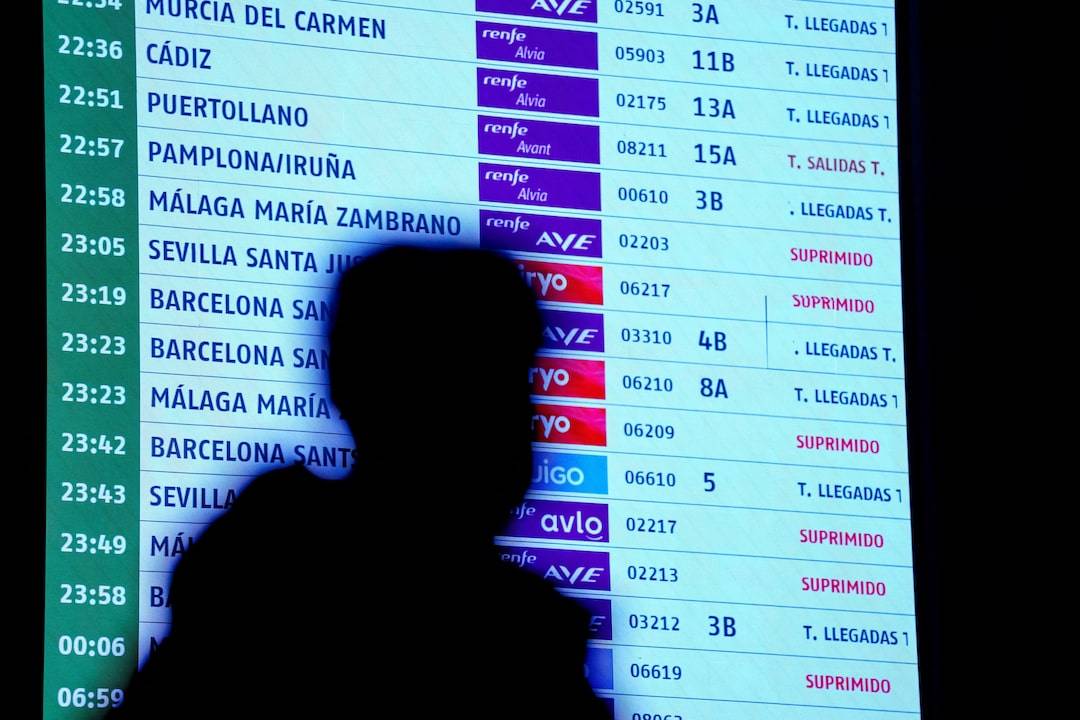
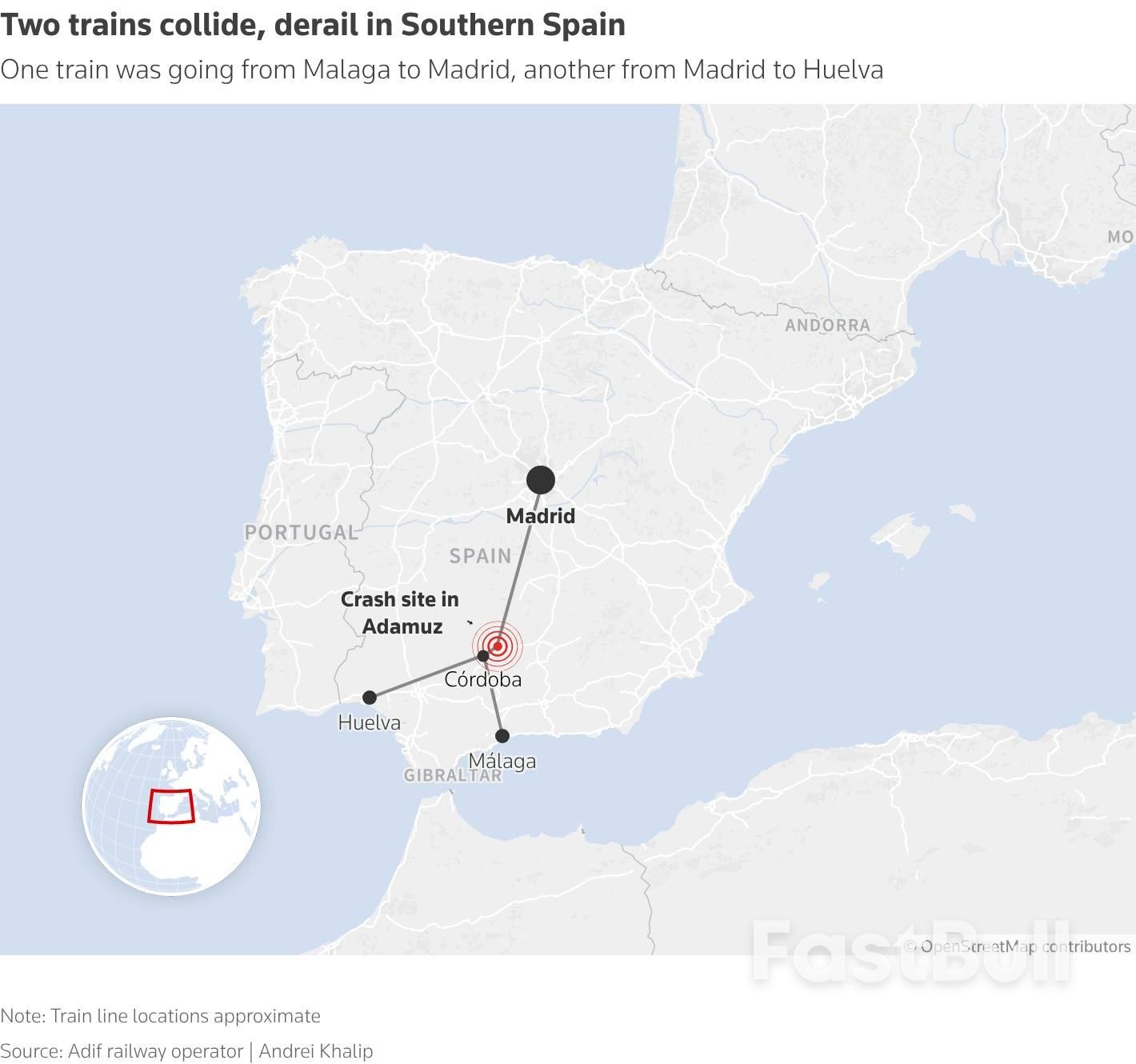
A high-speed train derailed and smashed into another oncoming train in southern Spain on Sunday, pushing the second train off the tracks in a collision that police sources confirmed to Reuters had killed at least 21 people.
The accident happened near Adamuz, in Cordoba province. So far, 21 people have been confirmed dead by police, with state broadcaster Television Espanola adding that 100 people had been injured, 25 seriously. The driver of one of the trains, which was travelling from Madrid to Huelva, was among those who died, the TV station added.
Map of railroad collision in southern Spain"The Iryo 6189 Malaga - (to Madrid) train has derailed from the track at Adamuz, crashing onto the adjacent track. The (Madrid) to Huelva train which was travelling on the adjacent track has also derailed," said Adif, which runs the rail network, in a social media post.
Adif said the accident happened at 6:40 p.m. (1740 GMT), about 10 minutes after the Iryo train left Cordoba heading towards Madrid.
Iryo is a private rail operator, majority-owned by Italian state-controlled railway group Ferrovie dello Stato. The train involved was a Freccia 1000 train which was travelling between Malaga and Madrid, a spokesperson for Ferrovie dello Stato said.
The company said in a statement that it deeply regretted what had happened and had activated all emergency protocols to work closely with the relevant authorities to manage the situation.
The second train was operated by Renfe, which also did not respond to a request for comment.
Adif has suspended all rail services between Madrid and Andalusia.
The Iryo train had more than 300 passengers on board, while the Renfe train had around 100.
Paco Carmona, Cordoba fire chief, told TVE the first train heading to Madrid from Malaga had been evacuated.
The other train's carriages were badly damaged, he said, with twisted metal and seats. "There are still people trapped. We don't know how many people have died and the operation is concentrating on getting people out of areas which are very narrow," he said. "We have to remove the bodies to reach anyone who is still alive. It is proving to be a complicated task."
Transport Minister Oscar Puente said he was following events from rail operator Adif's headquarters in Madrid.
"The latest information is very serious," he posted on X. "The impact was terrible, causing the first two carriages of the Renfe train to be thrown off the track. The number of victims cannot be confirmed at this time. The most important thing now is to help the victims."
The mayor of Adamuz, Rafael Moreno, told El Pais newspaper that he had been among the first to arrive at the scene of the accident alongside the local police and saw what he believed to be a badly lacerated body several metres from the accident site.
"The scene is horrific," he said. "I don't think they were on the same track, but it's not clear. Now the mayors and residents of the area are focused on helping the passengers."
Images on local television showed a reception centre set up for passengers in the town of Adamuz, population 5,000, with locals coming and going with food and blankets amid nighttime temperatures of around 42 degrees Fahrenheit (6 degrees Celsius).
A woman named Carmen posted on X that she had been on board the Iryo train to Madrid. "Ten minutes after departing (from Cordoba) the train started to shake a lot, and it derailed from coach 6 behind us. The lights went out."
Footage posted by another Iryo train passenger, also on X, showed an Iryo staffer in a fluorescent jacket instructing passengers to remain in their seats in the darkened carriages, and those with first aid training to keep watch over fellow passengers. He also urged people to maintain mobile phone batteries to be able to use their torches when they disembarked.
Salvador Jimenez, a journalist for RTVE who was on board the Iryo train, shared images showing the nose of the rear carriage of the train lying on its side, with evacuated passengers sitting on the side of the carriage facing upwards.
Jimenez told TVE by phone from beside the stricken trains that passengers had used emergency hammers to smash the windows and climb out, and they had seen two people taken out of the overturned carriages on stretchers.
"There's a certain uncertainty about when we'll get to Madrid, where we'll spend the night, we've had no message from the train company yet," he said. "It's very cold but here we are."

Data Interpretation

Political

Commodity

Remarks of Officials

Traders' Opinions

Middle East Situation

Energy
Oil prices showed little movement on Monday, holding steady after a recent rally as concerns over a potential supply disruption from Iran began to fade. The market is weighing easing geopolitical tensions against fresh data on U.S. crude inventories.
By 0158 GMT, Brent crude was trading up 5 cents at $64.18 a barrel. U.S. West Texas Intermediate (WTI) for February delivery edged up 8 cents to $59.52, with the more active March contract rising 2 cents to $59.36.
A primary factor capping price gains is the situation in Iran. A government crackdown on protests over economic hardship has subdued civil unrest, lowering the perceived risk of a U.S. intervention that could threaten oil flows from OPEC's fourth-largest producer.
This de-escalation was seemingly supported by comments from U.S. President Donald Trump, who appeared to step back from earlier threats of intervention.
The market has responded by unwinding the "Iran premium" that had pushed prices to twelve-week highs, according to IG market analyst Tony Sycamore. Despite the recent pullback, prices still settled higher on Friday, and the continued movement of U.S. military assets to the Gulf highlights lingering concerns.
Adding to the bearish sentiment was recent U.S. inventory data that surprised the market. According to the EIA, domestic crude stocks rose by 3.4 million barrels in the week ending January 9.
This build-up contradicted analyst expectations for a 1.7 million-barrel draw, reinforcing what Sycamore described as "bearish supply pressures" on the market.
Traders are also monitoring developments in Venezuela. President Trump has stated the U.S. would run the country's oil industry following the capture of Nicolas Maduro, and the U.S. energy secretary confirmed that efforts are underway to grant Chevron an expanded production license.
However, the market remains skeptical about a quick turnaround for Venezuela's struggling oil sector. "It is becoming clear that Venezuela's production ramp-up will take many years to play out," noted Sycamore, suggesting that a significant supply increase from the nation is not imminent.
White Label
Data API
Web Plug-ins
Poster Maker
Affiliate Program
The risk of loss in trading financial instruments such as stocks, FX, commodities, futures, bonds, ETFs and crypto can be substantial. You may sustain a total loss of the funds that you deposit with your broker. Therefore, you should carefully consider whether such trading is suitable for you in light of your circumstances and financial resources.
No decision to invest should be made without thoroughly conducting due diligence by yourself or consulting with your financial advisors. Our web content might not suit you since we don't know your financial conditions and investment needs. Our financial information might have latency or contain inaccuracy, so you should be fully responsible for any of your trading and investment decisions. The company will not be responsible for your capital loss.
Without getting permission from the website, you are not allowed to copy the website's graphics, texts, or trademarks. Intellectual property rights in the content or data incorporated into this website belong to its providers and exchange merchants.
Not Logged In
Log in to access more features

FastBull Membership
Not yet
Purchase
Log In
Sign Up