• Trade
  • Markets
  • Copy
  • Contests
  • News
  • 24/7
  • Calendar
  • Q&A
  • Chats
Trending
Screeners
SYMBOL
LAST
BID
ASK
HIGH
LOW
NET CHG.
%CHG.
SPREAD
SPX
S&P 500 Index
6827.42
6827.42
6827.42
6899.86
6801.80
-73.58
-1.07%
--
DJI
Dow Jones Industrial Average
48458.04
48458.04
48458.04
48886.86
48334.10
-245.98
-0.51%
--
IXIC
NASDAQ Composite Index
23195.16
23195.16
23195.16
23554.89
23094.51
-398.69
-1.69%
--
USDX
US Dollar Index
97.920
98.000
97.920
98.070
97.890
-0.030
-0.03%
--
EURUSD
Euro / US Dollar
1.17391
1.17398
1.17391
1.17447
1.17262
-0.00003
0.00%
--
GBPUSD
Pound Sterling / US Dollar
1.33799
1.33807
1.33799
1.33856
1.33546
+0.00092
+ 0.07%
--
XAUUSD
Gold / US Dollar
4345.73
4346.14
4345.73
4350.16
4294.68
+46.34
+ 1.08%
--
WTI
Light Sweet Crude Oil
57.381
57.411
57.381
57.601
57.194
+0.148
+ 0.26%
--

Community Accounts

Signal Accounts
--
Profit Accounts
--
Loss Accounts
--
View More

Become a signal provider

Sell trading signals to earn additional income

View More

Guide to Copy Trading

Get started with ease and confidence

View More

Signal Accounts for Members

All Signal Accounts

Best Return
  • Best Return
  • Best P/L
  • Best MDD
Past 1W
  • Past 1W
  • Past 1M
  • Past 1Y

All Contests

  • All
  • Trump Updates
  • Recommend
  • Stocks
  • Cryptocurrencies
  • Central Banks
  • Featured News
Top News Only
Share

London Metal Exchange: Intends To Publish A Consultation On The Proposed Changes To Our Rules In Response To The Regime Early In2026

Share

London Metal Exchange: Announces Publication Of Update Describing How The London Metal Exchange Plans To Implement The Fca Policy Statement 25/1 On Commodity Reform

Share

USA - Listed Shares Of Gold Miners Rise Premarket After Gold Rises About 1%

Share

The Council Of The European Union: In Light Of The Situation In Venezuela, The Council Decided Today To Extend The Existing Restrictions For Another Year, Until 10 January 2027

Share

Ivory Coast 2025/26 Cocoa Arrivals Reached 894000 T By December 14 Versus 895000 T Year Ago - Exporters' Estimate

Share

Ishares MSCI Chile ETF Up 3.9% Premarket After Jose Antonio Kast Wins Chile's Presidential Election On Sunday

Share

Spain's Debt-To-GDP Ratio Falls To 103.2% In Third Quarter 2025

Share

China's Central Bank: Authorises DBS Bank As Yuan Clearing Bank In Singapore

Share

Bank Of Korea - South Korea Central Bank, Nps Agree To Extend Currency Swap Agreement For Another Year

Share

Poland's CPI At 0.1% Month-On-Month In November Versus 0.1% Released Earlier

Share

London Metal Exchange (LME): Copper Inventories Decreased By 25 Tons, Aluminum Inventories Decreased By 50 Tons, Nickel Inventories Increased By 360 Tons, Zinc Inventories Increased By 2,550 Tons, Lead Inventories Increased By 17,725 Tons, And Tin Inventories Increased By 125 Tons

Share

Polish Inflation At 2.5% Year-On-Year In November

Share

Poland's January-October Import Up 5.4% To 309.3 Billion Euros

Share

Poland's January-October Trade Balance At -5.1 Billion Euros

Share

Poland's January-October Export Up 2.8% To 304.3 Billion Euros

Share

Ceasefire Negotiations Between Ukraine And US Representatives In Berlin To Continue Monday Morning - German Source Familiar With The Schedule

Share

Spain's IBEX Hits Fresh Record High, Up Over 1%

Share

Spot Silver Rises Nearly 3% To $63.82/Oz

Share

France's Foreign Minister Says He Suggesd To EU's Kallas That US Representatives Brief EU Foreign Ministers On Gaza Peace Plan During Their Meeting

Share

India Trade Secretary: Prime Facie Don't See A Case Of Rice Dumping To USA And There Is No Active Investigation On That

TIME
ACT
FCST
PREV
France HICP Final MoM (Nov)

A:--

F: --

P: --

China, Mainland Outstanding Loans Growth YoY (Nov)

A:--

F: --

P: --

China, Mainland M2 Money Supply YoY (Nov)

A:--

F: --

P: --

China, Mainland M0 Money Supply YoY (Nov)

A:--

F: --

P: --

China, Mainland M1 Money Supply YoY (Nov)

A:--

F: --

P: --

India CPI YoY (Nov)

A:--

F: --

P: --

India Deposit Gowth YoY

A:--

F: --

P: --

Brazil Services Growth YoY (Oct)

A:--

F: --

P: --

Mexico Industrial Output YoY (Oct)

A:--

F: --

P: --

Russia Trade Balance (Oct)

A:--

F: --

P: --

Philadelphia Fed President Henry Paulson delivers a speech
Canada Building Permits MoM (SA) (Oct)

A:--

F: --

P: --

Canada Wholesale Sales YoY (Oct)

A:--

F: --

P: --

Canada Wholesale Inventory MoM (Oct)

A:--

F: --

P: --

Canada Wholesale Inventory YoY (Oct)

A:--

F: --

P: --

Canada Wholesale Sales MoM (SA) (Oct)

A:--

F: --

P: --

Germany Current Account (Not SA) (Oct)

A:--

F: --

P: --

U.S. Weekly Total Rig Count

A:--

F: --

P: --

U.S. Weekly Total Oil Rig Count

A:--

F: --

P: --

Japan Tankan Small Manufacturing Outlook Index (Q4)

A:--

F: --

P: --

Japan Tankan Large Non-Manufacturing Diffusion Index (Q4)

A:--

F: --

P: --

Japan Tankan Large Non-Manufacturing Outlook Index (Q4)

A:--

F: --

P: --

Japan Tankan Large Manufacturing Outlook Index (Q4)

A:--

F: --

P: --

Japan Tankan Small Manufacturing Diffusion Index (Q4)

A:--

F: --

P: --

Japan Tankan Large Manufacturing Diffusion Index (Q4)

A:--

F: --

P: --

Japan Tankan Large-Enterprise Capital Expenditure YoY (Q4)

A:--

F: --

P: --

U.K. Rightmove House Price Index YoY (Dec)

A:--

F: --

P: --

China, Mainland Industrial Output YoY (YTD) (Nov)

A:--

F: --

P: --

China, Mainland Urban Area Unemployment Rate (Nov)

A:--

F: --

P: --

Saudi Arabia CPI YoY (Nov)

A:--

F: --

P: --

Euro Zone Industrial Output YoY (Oct)

--

F: --

P: --

Euro Zone Industrial Output MoM (Oct)

--

F: --

P: --

Canada Existing Home Sales MoM (Nov)

--

F: --

P: --

Euro Zone Total Reserve Assets (Nov)

--

F: --

P: --

U.K. Inflation Rate Expectations

--

F: --

P: --

Canada National Economic Confidence Index

--

F: --

P: --

Canada New Housing Starts (Nov)

--

F: --

P: --

U.S. NY Fed Manufacturing Employment Index (Dec)

--

F: --

P: --

U.S. NY Fed Manufacturing Index (Dec)

--

F: --

P: --

Canada Core CPI YoY (Nov)

--

F: --

P: --

Canada Manufacturing Unfilled Orders MoM (Oct)

--

F: --

P: --

U.S. NY Fed Manufacturing Prices Received Index (Dec)

--

F: --

P: --

U.S. NY Fed Manufacturing New Orders Index (Dec)

--

F: --

P: --

Canada Manufacturing New Orders MoM (Oct)

--

F: --

P: --

Canada Core CPI MoM (Nov)

--

F: --

P: --

Canada Trimmed CPI YoY (SA) (Nov)

--

F: --

P: --

Canada Manufacturing Inventory MoM (Oct)

--

F: --

P: --

Canada CPI YoY (Nov)

--

F: --

P: --

Canada CPI MoM (Nov)

--

F: --

P: --

Canada CPI YoY (SA) (Nov)

--

F: --

P: --

Canada Core CPI MoM (SA) (Nov)

--

F: --

P: --

Canada CPI MoM (SA) (Nov)

--

F: --

P: --

Federal Reserve Board Governor Milan delivered a speech
U.S. NAHB Housing Market Index (Dec)

--

F: --

P: --

Australia Composite PMI Prelim (Dec)

--

F: --

P: --

Australia Services PMI Prelim (Dec)

--

F: --

P: --

Australia Manufacturing PMI Prelim (Dec)

--

F: --

P: --

Japan Manufacturing PMI Prelim (SA) (Dec)

--

F: --

P: --

U.K. Unemployment Claimant Count (Nov)

--

F: --

P: --

U.K. Unemployment Rate (Nov)

--

F: --

P: --

U.K. 3-Month ILO Unemployment Rate (Oct)

--

F: --

P: --

Q&A with Experts
    • All
    • Chatrooms
    • Groups
    • Friends
    Connecting
    .
    .
    .
    Type here...
    Add Symbol or Code

      No matching data

      All
      Trump Updates
      Recommend
      Stocks
      Cryptocurrencies
      Central Banks
      Featured News
      • All
      • Russia-Ukraine Conflict
      • Middle East Flashpoint
      • All
      • Russia-Ukraine Conflict
      • Middle East Flashpoint
      Search
      Products

      Charts Free Forever

      Chats Q&A with Experts
      Screeners Economic Calendar Data Tools
      Membership Features
      Data Warehouse Market Trends Institutional Data Policy Rates Macro

      Market Trends

      Market Sentiment Order Book Forex Correlations

      Top Indicators

      Charts Free Forever
      Markets

      News

      News Analysis 24/7 Columns Education
      From Institutions From Analysts
      Topics Columnists

      Latest Views

      Latest Views

      Trending Topics

      Top Columnists

      Latest Update

      Signals

      Copy Rankings Latest Signals Become a signal provider AI Rating
      Contests
      Brokers

      Overview Brokers Assessment Rankings Regulators News Claims
      Broker listing Forex Brokers Comparison Tool Live Spread Comparison Scam
      Q&A Complaint Scam Alert Videos Tips to Detect Scam
      More

      Business
      Events
      Careers About Us Advertising Help Center

      White Label

      Data API

      Web Plug-ins

      Affiliate Program

      Awards Institution Evaluation IB Seminar Salon Event Exhibition
      Vietnam Thailand Singapore Dubai
      Fans Party Investment Sharing Session
      FastBull Summit BrokersView Expo
      Recent Searches
        Top Searches
          Markets
          News
          Analysis
          User
          24/7
          Economic Calendar
          Education
          Data
          • Names
          • Latest
          • Prev

          View All

          No data

          Scan to Download

          Faster Charts, Chat Faster!

          Download App
          English
          • English
          • Español
          • العربية
          • Bahasa Indonesia
          • Bahasa Melayu
          • Tiếng Việt
          • ภาษาไทย
          • Français
          • Italiano
          • Türkçe
          • Русский язык
          • 简中
          • 繁中
          Open Account
          Search
          Products
          Charts Free Forever
          Markets
          News
          Signals

          Copy Rankings Latest Signals Become a signal provider AI Rating
          Contests
          Brokers

          Overview Brokers Assessment Rankings Regulators News Claims
          Broker listing Forex Brokers Comparison Tool Live Spread Comparison Scam
          Q&A Complaint Scam Alert Videos Tips to Detect Scam
          More

          Business
          Events
          Careers About Us Advertising Help Center

          White Label

          Data API

          Web Plug-ins

          Affiliate Program

          Awards Institution Evaluation IB Seminar Salon Event Exhibition
          Vietnam Thailand Singapore Dubai
          Fans Party Investment Sharing Session
          FastBull Summit BrokersView Expo

          Natural Gas Forecast 2023 – Will Struggle Without Deep Supply Deficit, Strong European LNG Demand

          Devin

          Russia-Ukraine Conflict

          Energy

          Summary:

          The European Union has enough gas for the winter but could face a shortage in 2023 if Russia cuts supplies further.

          Natural Gas Forecast 2023 – Will Struggle Without Deep Supply Deficit, Strong European LNG Demand_1

          In the wake of a tumultuous year that saw nearby U.S. natural gas futures breach the elusive $10.00 level in early June and move through the even harder to attain $11.00 level in late August, prices are trading lower than where they were a year ago.

          And the bearish tone into the end of the year came on a day where the U.S. Energy information Administration (EIA) reported a stunning 213 Bcf withdrawal from storage for the week-ending December 23.

          Natural Gas Forecast 2023 – Will Struggle Without Deep Supply Deficit, Strong European LNG Demand_2

          Weekly Nearby Natural Gas

          Huge Demand from Europe Sets Early Bullish Tone

          The reason for the early run-up in prices was strong demand from Europe. As the Russia-Ukraine war progressed from February, European nations began to take precautions to avoid a natural gas shortage in the winter of 2022-2023. And U.S. producers were more than willing to sell them LNG at inflated prices. The U.S. producers weren’t gouging the Europeans, but rather stronger demand and record high prices in Europe and Asia set the bar extremely high.

          Demand for U.S. LNG was so strong that traders began to price in a supply deficit in the United States for the winter of 2022-2023.

          That was until a timely explosion at an LNG plant in Texas stopped the rally.

          Freeport LNG Fire Cuts Key Source of US Gas Supply to Europe, Asia

          The Freeport LNG plant shut on June 8 after a pipe failure caused an explosion due to inadequate operating and testing procedures, human error and fatigue, according to a report by consultants hired to review the incident and suggest action.

          Initially, the outage was supposed to last three-weeks, or just enough for the operator of one of the largest U.S. export plants producing LNG to delay cargoes to Europe, and further stressing the continent’s drive to phase out Russian gas.

          The outage at the plant, which provides around 20% of U.S. LNG processing capacity, triggered alarm bells among players in a market already struggling with reduced Russian supplies and resurgent demand in Asia.

          Initially, natural gas futures fell on the news, but high summer demand drove prices over $11.00 in late August. After that it was downhill all the way as traders anticipated the outage would free up supplies and help rebuild U.S. storage for winter demand.

          US Natural Gas Output to Rise, Demand to Fall in 2023

          U.S. natural gas production and demand will rise to record highs in 2022, the U.S. Energy Information Administration (EIA) said in its Short-Term Energy Outlook (STEO) on Tuesday.

          EIA projected dry gas production will rise to 98.07 Billion cubic feet per day (bcfd) in 2022 and 99.69 bcfd in 2023 from a record 94.57 bcfd in 2021.

          The agency also projected gas consumption would rise from 84.01 bcfd in 2021 to 88.39 bcfd in 2022 before sliding to 85.08 bcfd in 2023. That compares with a record 85.29 bcfd in 2019.

          The agency forecast average U.S. liquefied natural gas (LNG) exports would reach 10.85 bcfd in 2022 and 12.33 bcfd in 2023, up from a record 9.76 bcfd in 2021.

          EU Could Face Gas Shortage Next Year, IEA Warns

          The European Union has enough gas for the winter but could face a shortage next year if Russia cuts supplies further.

          Despite slashing gas deliveries in 2022, Europe averted a severe shortage and started the winter with brimming gas storage tanks – thanks in part to emergency EU measures to fill storage, plus a lucky spell of mild weather and high gas prices that dampened demand for the fuel.

          But 2023 may pose an even tougher test than the energy crunch that in 2022 hiked fuel bills for European households and forced industries to temporarily close to avoid crippling gas costs.

          If Russia was to cut the small share of gas it still delivers to Europe, and Chinese gas demand rebounded from COVID-19 lockdown-induced lows, the EU could face a gas shortfall of 27 billion cubic meters (bcm) in 2023, according to the International Energy Agency (IEA). Total EU gas consumption was 412 bcm in 2021.

          “This is a serious challenge,” IEA Executive Director Fatih Birol told a press conference with the European Commission in Brussels in December.

          However, the IEA said the shortage could be averted by expanding subsidies and policies to renovate gas-guzzling buildings, replace fossil fuel-based heating with heat pumps and massively expand renewable energy.

          2023 Natural Gas Outlook

          The new year is expected to start with working gas in storage at 3,112 Bcf. This is 133 Bcf below year-earlier levels and 85 Bcf below the five-year average, according to the EIA. Although the EIA numbers are bullish, forecasts for record warmth the first half of January will keep a lid on prices. However, if the cold weather returns in late January and throughout February then the supply deficit could grow.

          Long-term bulls want to see a repeat of last year’s rally, but without the LNG outage. Prices will begin to rise if cold weather widens the deficit, production drops and Russian threatens to cut supply to Europe. This would raise concerns about a shortage during the U.S. summer cooling season.

          The Europeans will once again be forced to buy U.S. LNG to refill their storage facilities. Additionally, we expect the Freeport LNG plant to be back online by March. Whenever Freeport returns, U.S. demand for gas will jump. The plant can turn about 2.1 billion cubic feet per day (bcfd) of gas into LNG, which is about 2% of U.S. daily production.

          Bearish traders want to see a small winter deficit, record production and Russian gas flowing into Europe. So essentially, they would like the war to end and Russian supply flows return to pre-war levels.

          The key to a bullish market in 2023 will be whether the U.S. summer cooling season ends with a big enough deficit to carry over to the start of winter. And the odds of that taking place will increase if Russia cuts supply, the war continues and the U.S. sees record heat this number.

          Article Source: FXEMPIRE

          Risk Warnings and Disclaimers
          You understand and acknowledge that there is a high degree of risk involved in trading. Following any strategies or investment methods may lead to potential losses. The content on the site is provided by our contributors and analysts for information purposes only. You are solely responsible for determining whether any trading assets, securities, strategy, or any other product is suitable for investing based on your own investment objectives and financial situation.
          Comments
          Add to Favorites
          Share

          December 30th Financial News

          FastBull Featured

          Daily News

          【Quick Facts】

          1, Electric and hybrid car sales have exceeded 10% of U.S. light vehicle sales.
          2, Russia-Ukraine conflict is not the main driver of energy price increases.
          3, The U.S. labor market still shows tenacious.
          4, Citi: 2023 the Fed is still anti-inflation.
          5, Tesla recorded the largest one-day gain in 5 months.
          6, There is no alternative to the Iran nuclear deal.

          【News Details】

          1, Electric and hybrid car sales have exceeded 10% of U.S. light vehicle sales.
          According to Wards Intelligence, U.S. sales of hybrid, plug-in hybrid and electric vehicles combined grew to 11 percent of U.S. light-duty vehicle sales in the fourth quarter of 2021 as sales of non-hybrid internal combustion engine (ICE) vehicles declined.
          In 2021, sales of several existing hybrid, plug-in hybrid and electric models increased, but a large portion of the sales growth came from new models in different segments. Manufacturers added 49 non-hybrid internal combustion engine models in 2021, while hybrid and electric models increased by 126.
          Most of these new-hybrid or electric models are crossover vehicles, which combine attributes of cars and SUVs, or models such as vans and pickup trucks, which previously had few hybrid or electric options.
          As consumers have become more comfortable with larger vehicles, manufacturers of hybrids and plug-in hybrids have expanded into segments such as crossovers, vans and pickups. Of the various electric or hybrid powertrain types, crossovers now account for the majority of sales.
          2, Russia-Ukraine conflict is not the main driver of energy price increases.
          By studying global trade volumes and commodity prices, trade balances, and bilateral trade flows between major economic powers and Russia, Zsolt Darvas, a senior fellow at the Bruegel Institute, and Catarina Martins, a research analyst, found that energy prices rise more in 2021 than in 2022, suggesting that war and sanctions are not the most significant drivers. Nonetheless, in the IMF's revised projections for October 2021 to October 2022, the volume of global trade in goods and services falls by 3.4 percent, while energy prices rise by 100 percent and non-energy commodity prices rise by only 8 percent. The Russia-Ukraine conflict may be a significant driver of these forecast revisions, though other factors are also at play. While the IMF did not revise forecasts for important industrial production input costs, soaring energy prices have worsened the trade balance of energy-importing countries.
          More than half of Russia's trade surplus comes from soaring energy prices. And the other half stems from the collapse of Russian imports, which could gradually erode the capacity of the Russian economy over time. But in reality, the decline in exports of commodities other than energy suggests that Russia's capacity has weakened. Although Russia's trading partners have shifted to China, India and Turkey, this only compensates for a portion of its shrinking trade with developed countries.
          Sanctions do have an impact on trade. There is no evidence that European and American companies have bypassed the sanctions by rerouting sanctioned goods through China and Turkey to Russia. The U.K. and the U.S. have long since stopped importing fossil fuels from Russia, and the EU has reduced its imports from Russia. With the EU embargo on Russian crude oil and refined products coming into effect, Russian fossil fuel export revenues to the EU will shrink further and the shift to exports to other countries will not fully compensate for this shrinkage.
          3, The U.S. labor market still shows tenacious.
          The latest data showed that U.S. initial jobless claims increased by 9,000 to a seasonally adjusted 225,000, in line with market expectations. Continuing jobless claims rose by 41,000 to 1.71 million, reaching the highest level since February. These two figures show that the U.S. job market remains tight.
          Given the recent increase in layoffs announced by large companies, the market would have expected to see a larger increase in claims than is usually seen at this time of year, but so far this has not happened.
          4, Citi: 2023 the Fed is still anti-inflation.
          The market is currently pricing in a lower Fed rate hike than the dot plot and expects inflation to return to 2% quickly. However, we expect the Fed to raise rates by 50 basis points in February and 25 basis points each in March and May, bringing the terminal rate to 5.25-5.5%. Market confidence at the end of the volatile period of the rate hike cycle appears to be premature. In addition, if financial conditions continue to ease, the Fed may find it necessary to continue to raise rates by a greater margin, or at least continue to raise rates by 25 basis points for a longer period than the market expects. With labor costs rising rapidly, non-housing service prices will accelerate, and core inflation remains above 4%, which should make the Fed more worried about the "premature" lifting of restrictions.
          For tapering, the Fed will not announce any major changes in balance sheet policy until the end of 2023. It is expected that the Fed will gradually reduce its balance sheet, halving the reduction cap in September 2023 and ending the taper in December.
          In addition, there will be changes to the Fed's voting committee in 2023. Based on interpretations of Fed officials' speeches in recent months, the 2023 voting committee is more dovish in general compared to the 2022 voting committee.
          5, Tesla recorded the largest one-day gain in 5 months.
          EST Thursday, December 29, Tesla has fallen for seven consecutive trading days of the second trading day rebound, today's intraday once up 10%, closing up 8.08%, at $ 121.82 per share, the largest intraday and closing gains in five months, with market value overnight blood about 30 billion U.S. dollars (more than 200 billion yuan). But Tesla may still fall by more than 65% for the year, the worst annual performance since the listing. In news, just before Tesla's rally on the 29th, Morgan Stanley released its latest report, in which the bank's star analyst Adam Jonas said he lowered his target price for Tesla shares from $330 to $250, but maintained his overweight rating and expects Tesla to continue to lead the electric car market competition in 2023.
          6, There is no alternative to the Iran nuclear deal.
          Russian Foreign Minister Sergei Lavrov said on Dec. 29 local time that there is no alternative to the comprehensive Iran nuclear deal and any speculation that there may be alternative plans or other options to this deal is irresponsible and could lead to a worsening of the situation. Lavrov said the West claims that the negotiations on resuming compliance with the Iran nuclear deal have reached a dead end, but every detail has now been negotiated and the parties can reach an agreement if the West has the political will to do so. It is time for the West to make responsible decisions and the Russian side is ready for that.

          【Focus of the Day】

          UTC+8 22:45 US Chicago PMI (Dec)
          Risk Warnings and Disclaimers
          You understand and acknowledge that there is a high degree of risk involved in trading. Following any strategies or investment methods may lead to potential losses. The content on the site is provided by our contributors and analysts for information purposes only. You are solely responsible for determining whether any trading assets, securities, strategy, or any other product is suitable for investing based on your own investment objectives and financial situation.
          Comments
          Add to Favorites
          Share

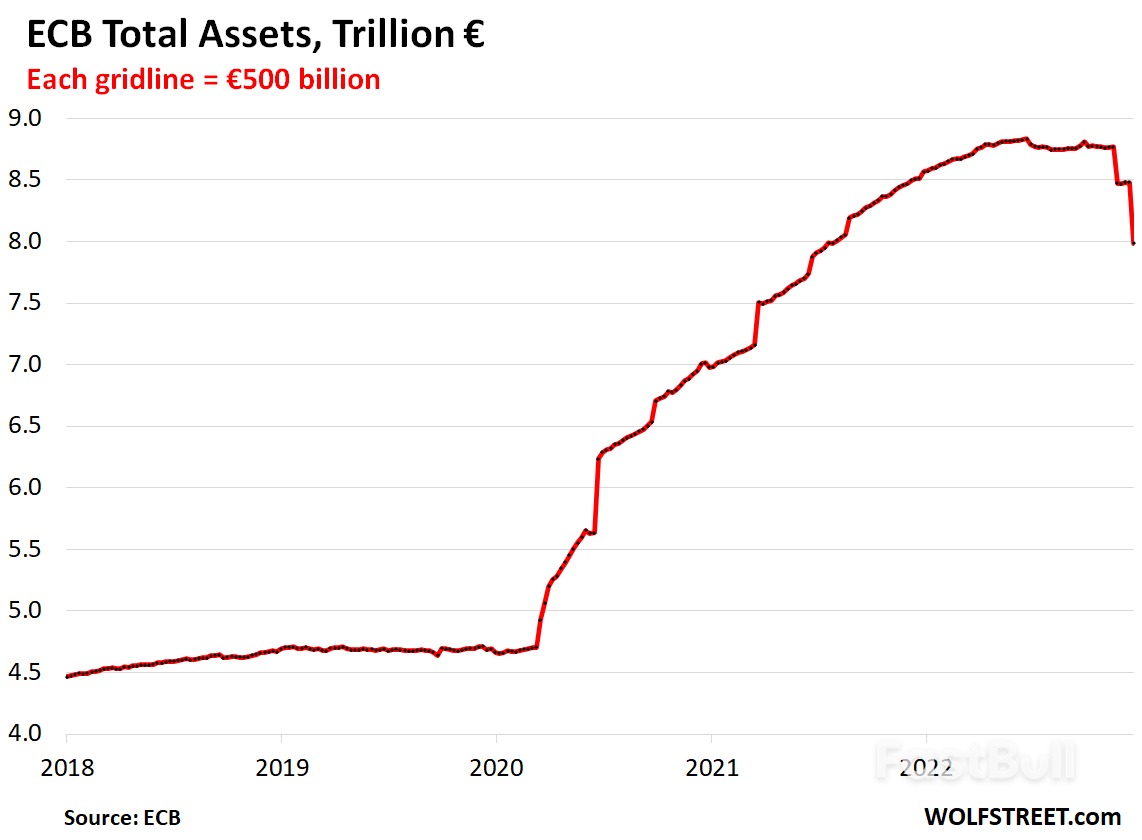
          ECB’s Balance Sheet Plunges by €492 billion in One Week and by €850 Billion from Peak

          Justin

          Central Bank

          Monetary Rug-Pull? December dump in the markets anything to do with global QT?

          The ECB had two major types of QE: It handed cash to banks via free-money loans, and it handed cash to the bond market by purchasing bonds. Those were the good times, RIP. All this has stopped. And now the ECB is unwinding this stuff.
          At its October meeting, the ECB announced Step 1 of QT: Unwinding the loans. At its December meeting, it announced Step 2 of QT: shedding bonds it had purchased. What we’re primarily seeing here on its balance sheet today is the effect of Step 1 of QT – the first big batches of loans got paid back. This looks like a monetary rug-pull:
          ECB’s Balance Sheet Plunges by €492 billion in One Week and by €850 Billion from Peak_1

          The loan QT: massive

          During the pandemic, as part of flooding everything with liquidity, the ECB lent cash to the banks – the Targeted Longer-Term Refinancing Operations (TLTRO III) – which the banks would then spread around. From the beginning of the pandemic through July 2021, the ECB handed out €1.6 trillion of those loans.
          These loans came with complex incentives to encourage banks to lend them out to businesses and households, which banks would do, and thereby replace other funding, that they then could use elsewhere, such as to buy other stuff with, such as securities. That’s how these loans enabled banks to buy stuff in the markets globally – which helped inflate asset prices. And when they pay back those loans, they have to shed some of this stuff…. we’ll get to that now.
          At its October meeting, the ECB announced Step 1 of QT to “help address unexpected and extraordinary inflation increases,” as it said. To do so, it made the terms of these loans unattractive for the banks, which would induce the banks to pay them back.
          The loans have dates at which they can be paid back. The first payback date was in July, when €74 billion in loans were paid back; the second was in November, when €296 billion were paid back.
          The third payback date was in mid-December. At the time, the ECB announced that €447 billion in loans would be paid back. Today, it booked €498 billion in loan paybacks on its balance sheet. The total balance of Long-Term Refinancing Loans has now plunged by €896 billion from the peak in June 2021 (€2.22 trillion) to €1.32 trillion today.
          This is a huge amount of liquidity that vanished since mid-November, €743 billion in two moves, which could have well helped incite the dump in the markets globally since then:
          ECB’s Balance Sheet Plunges by €492 billion in One Week and by €850 Billion from Peak_2

          The bond QT: not yet, but coming

          At its December meeting, the ECB announced Step 2 of QT: It would start shedding its bond holdings in March 2023, initially at a rate of €15 billion a month. Details will be announced after the February meeting, it said. The pace of subsequent declines “will be determined over time,” it said. Since then, there have already been comments by ECB heads about accelerating the bond QT.
          The ECB ended QE in June 2022, and “securities held for monetary policy purposes” have remained roughly stable since then. On today’s balance sheet, the securities amounted to €4.94 trillion, down by €20 billion from the peak in June:
          ECB’s Balance Sheet Plunges by €492 billion in One Week and by €850 Billion from Peak_3
          When the ECB received the €895 billion from the loan payoffs, it destroyed the money, just like it created the money when it originally made the loans. This is a massive amount of liquidity that came out of the financial system over about the past six weeks. Everything in the financial markets is global. And QT is global. And it’s not just the Fed. And it’s just the beginning.

          Source:Wolf Richter

          Risk Warnings and Disclaimers
          You understand and acknowledge that there is a high degree of risk involved in trading. Following any strategies or investment methods may lead to potential losses. The content on the site is provided by our contributors and analysts for information purposes only. You are solely responsible for determining whether any trading assets, securities, strategy, or any other product is suitable for investing based on your own investment objectives and financial situation.
          Comments
          Add to Favorites
          Share

          Financial institutions assessing how best to improve data infrastructure

          Justin

          Bond

          A central theme in OMFIF’s 2022 research has been the race between technological growth and adoption. This is particularly true with respect to the data management and processing systems that allow for increased efficiencies in financial institutions. This year, OMFIF studied the efforts of a diverse array of financial organisations to bolster their data processing. Our findings present a picture of the financial system in which several high-capital private institutions are leaders in improving their data systems, while others fall behind. Meanwhile, public institutions are caught in a conundrum of how best to reconcile the considerable costs and security concerns around the diffusion of such data.
          Early in 2022, a key theme in OMFIF’s Global Public Investor 2022 was the significance of improved data access. In the GPI, over 70 central bank reserves manager survey respondents told OMFIF that a key barrier to accessing new asset classes was knowledge of that particular asset. The presence of such a barrier was especially pronounced when central bank reserves managers were asked about environmental, social and governance adoption. A majority mentioned that insufficient data was a barrier to implementing ESG initiatives. This suggests that both improved access to ESG data — and in many cases improved tools to process that data — would help many central banks efforts to embrace sustainability goals.
          We continued to look at the hurdles financial institutions face with respect to their data management in the case of public funds. In the ‘Global Public Pensions’ report, over 80% of public funds that responded to our survey sought to build or improve their data management systems. Yet, 70% cited issues around integrating new technologies into their existing infrastructure and a growing majority mentioned cybersecurity and costs as barriers. Such challenges were present, for instance, with respect to cloud-based storage systems, which can be much more efficient but are more exposed to threats.

          Data integration, cybersecurity and costs key barriers to using new technologies

          What are your top technology challenges? Share of respondents, %
          Financial institutions assessing how best to improve data infrastructure_1
          Another key theme has been the role that developing countries in the global south have played in spearheading the implementation of many modern data systems and digital tools, such as cryptocurrencies. Our research shows that many of them are also working to improve the digitalisation of their financial system more generally. This was a theme in the ‘Africa Financial Markets’ report, which underscored the considerable efforts many African countries were going to in order to bolster their processing of digital financial data. Egypt was notable for making a particularly large step in developing its data capacity and working to create a fintech hub. Meanwhile, Uganda formulated a five-year plan, which included additional support for big data, artificial intelligence and machine learning.
          In the ‘Digital assets’ report, OMFIF studied the diffusion of digital assets and the possible emergence of central bank digital currencies in a growing number of countries. As that report covered, if such efforts are successful, it would significantly bolster government access to data on transactions occurring in the economy. This brings with it the prospect of expanded oversight into market operations, posing both benefits to warding against illicit activity as well as risks of overreach. Similar considerations around improving data access and processing emerged in the ‘Future of payments’ report. Here central bank survey respondents expressed a need to reconcile the cybersecurity and exchange rate volatility risks of digital payments systems alongside the clear benefits for cross-border payments.
          So how is the financial system grappling with digitalisation and the increased need for improved data management practices? Our findings from this year’s reports suggest that many public institutions are doing so with caution. They simultaneously are striving to bolster their management systems while warding against the cybersecurity challenges that can erode value. In 2023, financial institutions will continue to embrace digital payments systems and data management tools.

          Source:OMFIF

          Risk Warnings and Disclaimers
          You understand and acknowledge that there is a high degree of risk involved in trading. Following any strategies or investment methods may lead to potential losses. The content on the site is provided by our contributors and analysts for information purposes only. You are solely responsible for determining whether any trading assets, securities, strategy, or any other product is suitable for investing based on your own investment objectives and financial situation.
          Comments
          Add to Favorites
          Share

          Has the U.S. Really Withdrawn from the Middle East?

          Alex

          Political

          One of the more enduring narratives over the past few years has been America's supposed withdrawal from the Middle East and North Africa. It's a recurring theme in media reports and analyses, and often seeps into debates and discussions. But there appears to be plenty of daylight between perception and reality. And the fact of the matter is, the US's business, academic, cultural, military and diplomatic partners in the region understand all too well that America has stayed. They also know how important it is for America to remain.
          Let's first examine the evidence.
          There are more than 1,200 American companies in Egypt alone, in energy, IT, agriculture, health care, transportation, consumer products, tourism and transport. Corporations are also thriving, most notably, in Saudi Arabia and the UAE, where the likes of Amoco, Halliburton and Exxon and AES are well known. There are literally hundreds of companies spread across the region. Much like Americans helped develop companies such as Saudi Aramco, for example, they continue working with their Arab partners to develop jobs, businesses and the region's economies.
          U.S. institutions of higher learning educate and train the present and future leaders of the region, as they have in the past, including Johns Hopkins, Yale, Georgetown, Harvard, Stanford, Yale and several more. Many of the region's top business and political leaders are graduates of U.S. educational institutions. All of those I have met have got many a positive out of their time in the country and from its institutions.
          Many of my former students at the American University in Cairo, another significant U.S.-Arab joint venture, are top businesspeople, diplomats, senior government officials, including one minister, and in other leadership posts. Georgetown, where I taught for years, has a thriving campus in Qatar. Other U.S. colleges and universities in the area include Texas A&M, Carnegie Mellon, Cornell-Weill Medical College, and NYU Abu Dhabi.
          Several U.S. medical research institutes collaborate with their counterparts in the region, such as Cedar-Sinai Medical Institutes and the Dubai Harvard Centre for Medical Research. Branches of some of the top American hospitals can be found in the Arab world, such as the Cleveland Clinic. MIT collaborates with Masdar in energy and environment. This is important to point out because scientific and intellectual collaborations between U.S. universities and scholars with those in the Middle East are essential bridges, many of which have been around for a long time. And they will remain. More will be developed.
          The U.S. also has training programmes that the region's militaries take advantage of. And they are always welcome.
          The "American withdrawal" narrative is most potent around two issues: security and energy.
          The US's commitment to a secure Mena has been a source of concern ever since Washington began promoting a "Pivot to East Asia" policy more than a decade ago, in the face of a rising China. Yet, it is sometimes forgotten that the U.S. conducts joint military exercises with several Arab militaries, such as "Eagle Resolve", "Nautical Defender", "Native Fury", "Hercules 2". The International Maritime Exercise, it's worth pointing out, included 60 countries. There will be many more such exercises in the future.
          The U.S. is engaged and will remain committed to engaging in protecting, with its Arab partners and others, the vital sea lanes of the region, including – but not limited to – the Suez Canal, the Red Sea, Bab Al Mandab, the Strait of Hormuz, and the Arabian Gulf, as well as the connecting trade and communications routes in the Indian Ocean. Americans and Arabs have strategic interests in the Mediterranean Sea, too.
          When it comes to energy, the argument has firmer legs to stand on. After all, the U.S. is importing less oil and gas from the region primarily due to its success in shale oil and shale gas, which is about 70 per cent of its production. However, many of America's allies and trading partners rely increasingly on regional energy. Washington's efforts, along with its Arab partners, to keep the trade routes safe and open are geared towards global trade and investment, not just U.S. trade and investment.
          It is important for U.S. administrations, irrespective of which party is in power, to remind themselves, and the rest of the world, of America's deep integration with the Mena region, for two reasons: one, to dispel a notion that is riddled with inaccuracies; and two, to foster healthy competition with a Beijing that is increasingly interested in the region.
          Relationships need renewal from time to time, and increasing competition from China and others should prompt the U.S. and U.S. companies, hospitals, educational institutions, and more to think about future strategies. The Covid-19 pandemic got in the way of some joint ventures and collaborations. The 2011 Arab uprisings also disrupted parts of some U.S.-Arab partnerships and joint ventures.
          Moreover, it is true that far fewer U.S. students are going to the Middle East than before 2011. They were never near the number of Arab students who came to the U.S.. And Arab students are, and should always be, welcome to the U.S. to study. But more effort must be made to develop a greater two-way flow of students. This could develop further relations, investment, understandings, and actions between the U.S. and the Arab world in the future. To create better future relations, younger people – and not just the senior leaders – need to be involved.
          A number of changes have occurred in the region over the past decades. American companies and other institutions, including the government, must understand and be sensitive to these events if they hope to prosper.
          Many Arab views of America have changed drastically since the early days of then U.S. president Franklin Roosevelt's meeting with the King Abdul Aziz Ibn Saud of Saudi Arabia on February 14, 1945. The 2003 invasion and occupation of Iraq, the sloppy exit from Afghanistan last year, and the perception of a supposed withdrawal from the region have undermined its otherwise positive relations with the region and its peoples.
          Americans and the Arabs can undoubtedly benefit from continuing relations at many levels and in many fields. Washington is still in the region and will remain in the region. And whether they realise it or not, America and the Arab world are natural allies and partners, and long may their alliances and partnerships continue.

          Source: The National News

          Risk Warnings and Disclaimers
          You understand and acknowledge that there is a high degree of risk involved in trading. Following any strategies or investment methods may lead to potential losses. The content on the site is provided by our contributors and analysts for information purposes only. You are solely responsible for determining whether any trading assets, securities, strategy, or any other product is suitable for investing based on your own investment objectives and financial situation.
          Comments
          Add to Favorites
          Share

          China's Services Sector Eyes Recovery After Reopening, But Challenges Loom

          Owen Li

          Economic

          Jordan Li, a restaurant owner in the southwestern Chinese city of Chengdu, hopes desperately that next month's Lunar New Year holidays will help him make up for business lost this year because of COVID-related travel and other restrictions.
          Although infections have risen sharply since the central government lifted most of its pandemic-control curbs this month, Li thinks people will still travel to Chengdu. He envisions a different problem: a lack of workers to handle the demand.
          Li says he is preparing for a worst-case scenario in which he single-handedly keeps his restaurant open as he "can be the boss, the chef, the waiter and handle the finances all at the same time."
          Stung by the repeated pandemic-related disruptions to his business in the past three years, he does not want to hire staff until operations return to normal.
          Li's predicament underscores challenges for China's economically crucial services sector as it bets on a post-COVID revival.
          With the virus spreading unchecked across the country now, representatives from the services sector say frequent lockdowns have left them without money to expand.
          They also must deal with a growing number of sick workers, especially ahead of and during the Lunar New Year next month, a peak travel period in China, when millions head home to celebrate with families.
          The contact-intensive services sector, which accounted for 53.3% of China's gross domestic product (GDP) in 2021, suffered the most amid the country's anti-virus curbs, which shut down many restaurants and restricted travel.
          Beijing this month dismantled almost all such curbs, which have battered the $17-trillion economy.
          "There is still a shortage of labour in the services sector in the big cities, and the loss of productivity is quite obvious," said Dan Wang, chief economist at Hang Seng Bank China. "That situation won't improve significantly before Chinese New Year, and the rebound isn't happening simultaneously, but city by city."
          Ordinary Chinese and travel agencies say a return to anything like normal will take months, given worries about COVID and more careful spending because of the impact of the pandemic.
          "It's hard to say how much demand there will be for travel during the Spring Festival because it depends on whether people can recover in time," adds Zhou Weihong, deputy general manager at Spring Tour, the travel arm of Shanghai-based Spring Group.
          Consumption Revival
          Retail sales, a key gauge of consumption, dropped 5.9% in November from a year earlier, and catering fell by 8.4% amid broad-based weakness in the services sector.
          Policymakers have set out plans to revive consumption and investment, but the impact of a slowing economy on unemployment and wages is expected to keep a lid on services spending in the near term.
          In Lijiang city, a tourist hotspot in the southwestern Chinese province of Yunnan, about half of shops and restaurants have shuttered since pandemic control measures were put in place three years ago.
          Standing in a small, empty restaurant this month after curbs on domestic travel were lifted, its owner, surnamed Wen, said business had been bad during the pandemic. There were little prospects for a revival, he said.
          "It's not the COVID restrictions that stopped people coming, it's because people don't have money," he said.
          Many shops in Shanghai, Beijing and elsewhere have also closed in recent days with staff unable to come to work, while some factories have already sent many of their workers on leave for the Lunar New Year holidays.
          The lack of healthy workers has also led to long waits for deliveries in major Chinese cities.
          "We've recently recruited two new people, but recruiting is hard," said Seven, manager of a Blue Frog restaurant franchise in Beijing's Chaoyang district, the capital's worst hit in the recent COVID wave.
          "The cost of living in Beijing is going up, and even though the pay at our restaurant is quite good, people are then still worried about getting infected on the job."
          Some in the service sector say there remains some hope.
          A senior executive at a hotel chain with more than 600 properties in China said the firm was "confident that Lunar New Year is going to be great," as its website traffic surged 300%-400% after the announcements of eased COVID rules.
          The chain is now scrambling to "adjust to the new policies" to get ready for the holidays, the executive said.

          Source: Yahoo

          To stay updated on all economic events of today, please check out our Economic calendar
          Risk Warnings and Disclaimers
          You understand and acknowledge that there is a high degree of risk involved in trading. Following any strategies or investment methods may lead to potential losses. The content on the site is provided by our contributors and analysts for information purposes only. You are solely responsible for determining whether any trading assets, securities, strategy, or any other product is suitable for investing based on your own investment objectives and financial situation.
          Comments
          Add to Favorites
          Share

          How Will Japan Resolve Shipping Insurance for Russian LNG Imports?

          Cohen

          Commodity

          Japan, the world's top liquefied natural gas (LNG) importer, is facing its latest challenge in securing vital gas supplies from Russia after Western reinsurers said they would halt marine war insurance for ships travelling in Russian waters from Jan. 1.
          Having joined other G7 countries in imposing sweeping sanctions on Moscow for the invasion of Ukraine, Japan has been reducing its reliance on Russian oil and coal, but it continues to buy Russian LNG amid elevated prices in a tight global market as Europe ramps up imports.
          Which companies are affected?
          Japan's Tokio Marine & Nichido Fire Insurance, Sompo Japan Insurance and Mitsui Sumitomo Insurance told shipowners last week that from Jan. 1 they would stop offering insurance coverage for ship damage caused by war in Russian waters, because reinsurers were withdrawing coverage.
          Without the war insurance, shippers such as Mitsui OSK Lines and Nippon Yusen might have to halt operations in Russian waters, including loading LNG from the Sakhalin-2 complex in Russia's Far East, industry sources said. Japan receives 9% of its imported LNG from Sakhalin-2, which is owned by Gazprom and Japanese trading houses.
          Loss of supply from Sakhalin-2 could send Japanese power and gas utilities such as JERA and Tokyo Gas Co Ltd scrambling for alternatives.
          The country has already faced repeated challenges in securing gas supplies since Russia sent its armed forces into Ukraine in February. It has had to persuade G7 partners to give it leeway so it could keep importing Russian LNG, and after the Russian government decided in June to seize control of Sakhalin-2, Japanese trading houses had to agree to remain as shareholders of the new Russian operator.
          What actions have been taken?
          To avoid supply disruption, the three Japanese insurers are negotiating with various reinsurers to retain the war coverage.
          In a rare joint letter, Japan's Financial Services Agency and Agency for Natural Resources and Energy have also asked insurers to take on additional risks to continue providing marine war insurance for shippers transporting LNG from the Sakhalin-2.
          "The top priority now is to secure marine war insurance," a senior official at the industry ministry said.
          It is still unclear whether the insurers can secure sufficient reinsurance, especially at a time when many Western counterparts are away on holidays.
          What are the other options?
          Shipowners may continue operations without the war coverage by shouldering the risks, since voyages between Sakhalin island and Japan are short, taking just a few days, and since the LNG export facility is located far from the battlefields of Russia and Ukraine.
          However, they risk losing their tankers to seizure in Russia for some unforeseeable reason. Each LNG tanker costs 20 billion to 30 billion yen ($150 million to $220 million).
          Other parties, such as the government and Japanese utilities, the buyers of the Sakhalin fuel, might have to share the risk, industry sources said, although sources in the government and among buyers said they were not yet considering such a move.
          "Insurers and shipping companies are trying to resolve the issues and we are closely watching the situation," a source at a utility said.
          Another option would be to use a sovereign liability guarantee, like the one that covered shipments of Iranian oil to Japan in 2012, after Western insurers cut cover due to sanctions on Iran.
          Legislation that authorised that guarantee was for Iranian oil imports only, so new law would be needed for guarantees covering shipments from Russia, the ministry official said.
          What is the risk for Japan's gas and power supplies?
          The clock is ticking, but any immediate risk of fuel and power shortages looks small, even if some LNG cargoes are delayed early next month, another source at a power utility said. The reason was that stocks built up ahead of the peak winter demand season were larger than usual, that source said.
          LNG inventories at Japan's major power utilities were 2.41 million tonnes on Dec. 25, above the five-year average of 1.84 million tonnes for the same time of year, according to industry ministry data.
          Also, Japan has created a new mechanism to allow the industry ministry to help redirect supplies of LNG in the event of an emergency so gas and power companies do not run short.
          If supply from Sakhalin-2 is disrupted, buyers can exercise the upward quantity tolerance clause typically found in long-term contracts, allowing them to request 5% to 10% additional volumes from suppliers elsewhere.
          A source at an urban gas provider said his company could also get alternative supply from the spot market if it could accept the higher price there.
          Japanese buyers paid $15.78 per million British thermal units (mmBtu) for Russian LNG in November, below the average price of imported LNG of $17.86 and an average spot-cargo price for delivery to Japan of $18.40, according to the Japan Organization for Metals and Energy Security.
          The average LNG price for February delivery to northeast Asia is around $31 per mmBtu.
          Japan uses LNG for 39% of its electricity generation.

          Source: Reuters

          Risk Warnings and Disclaimers
          You understand and acknowledge that there is a high degree of risk involved in trading. Following any strategies or investment methods may lead to potential losses. The content on the site is provided by our contributors and analysts for information purposes only. You are solely responsible for determining whether any trading assets, securities, strategy, or any other product is suitable for investing based on your own investment objectives and financial situation.
          Comments
          Add to Favorites
          Share
          FastBull
          Copyright © 2025 FastBull Ltd

          728 RM B 7/F GEE LOK IND BLDG NO 34 HUNG TO RD KWUN TONG KLN HONG KONG

          TelegramInstagramTwitterfacebooklinkedin
          App Store Google Play Google Play
          Products
          Charts

          Chats

          Q&A with Experts
          Screeners
          Economic Calendar
          Data
          Tools
          Membership
          Features
          Function
          Markets
          Copy Trading
          Latest Signals
          Contests
          News
          Analysis
          24/7
          Columns
          Education
          Company
          Careers
          About Us
          Contact Us
          Advertising
          Help Center
          Feedback
          User Agreement
          Privacy Policy
          Business

          White Label

          Data API

          Web Plug-ins

          Poster Maker

          Affiliate Program

          Risk Disclosure

          The risk of loss in trading financial instruments such as stocks, FX, commodities, futures, bonds, ETFs and crypto can be substantial. You may sustain a total loss of the funds that you deposit with your broker. Therefore, you should carefully consider whether such trading is suitable for you in light of your circumstances and financial resources.

          No decision to invest should be made without thoroughly conducting due diligence by yourself or consulting with your financial advisors. Our web content might not suit you since we don't know your financial conditions and investment needs. Our financial information might have latency or contain inaccuracy, so you should be fully responsible for any of your trading and investment decisions. The company will not be responsible for your capital loss.

          Without getting permission from the website, you are not allowed to copy the website's graphics, texts, or trademarks. Intellectual property rights in the content or data incorporated into this website belong to its providers and exchange merchants.

          Not Logged In

          Log in to access more features

          FastBull Membership

          Not yet

          Purchase

          Become a signal provider
          Help Center
          Customer Service
          Dark Mode
          Price Up/Down Colors

          Log In

          Sign Up

          Position
          Layout
          Fullscreen
          Default to Chart
          The chart page opens by default when you visit fastbull.com