Markets
News
Analysis
User
24/7
Economic Calendar
Education
Data
- Names
- Latest
- Prev



Signal Accounts for Members
All Signal Accounts
All Contests


U.K. Retail Sales MoM (SA) (Dec)A:--
F: --
P: --
France Manufacturing PMI Prelim (Jan)A:--
F: --
P: --
France Services PMI Prelim (Jan)A:--
F: --
P: --
France Composite PMI Prelim (SA) (Jan)A:--
F: --
P: --
Germany Manufacturing PMI Prelim (SA) (Jan)A:--
F: --
P: --
Germany Services PMI Prelim (SA) (Jan)A:--
F: --
P: --
Germany Composite PMI Prelim (SA) (Jan)A:--
F: --
P: --
Euro Zone Composite PMI Prelim (SA) (Jan)A:--
F: --
P: --
Euro Zone Manufacturing PMI Prelim (SA) (Jan)A:--
F: --
P: --
Euro Zone Services PMI Prelim (SA) (Jan)A:--
F: --
P: --
U.K. Composite PMI Prelim (Jan)A:--
F: --
P: --
U.K. Manufacturing PMI Prelim (Jan)A:--
F: --
P: --
U.K. Services PMI Prelim (Jan)A:--
F: --
P: --
Mexico Economic Activity Index YoY (Nov)A:--
F: --
P: --
Russia Trade Balance (Nov)A:--
F: --
P: --
Canada Core Retail Sales MoM (SA) (Nov)A:--
F: --
P: --
Canada Retail Sales MoM (SA) (Nov)A:--
F: --
U.S. IHS Markit Manufacturing PMI Prelim (SA) (Jan)A:--
F: --
P: --
U.S. IHS Markit Services PMI Prelim (SA) (Jan)A:--
F: --
P: --
U.S. IHS Markit Composite PMI Prelim (SA) (Jan)A:--
F: --
P: --
U.S. UMich Consumer Sentiment Index Final (Jan)A:--
F: --
P: --
U.S. UMich Current Economic Conditions Index Final (Jan)A:--
F: --
P: --
U.S. UMich Consumer Expectations Index Final (Jan)A:--
F: --
P: --
U.S. Conference Board Leading Economic Index MoM (Nov)A:--
F: --
P: --
U.S. Conference Board Coincident Economic Index MoM (Nov)A:--
F: --
P: --
U.S. Conference Board Lagging Economic Index MoM (Nov)A:--
F: --
P: --
U.S. UMich 1-Year-Ahead Inflation Expectations Final (Jan)A:--
F: --
P: --
U.S. Conference Board Leading Economic Index (Nov)A:--
F: --
P: --
U.S. Weekly Total Rig CountA:--
F: --
P: --
U.S. Weekly Total Oil Rig CountA:--
F: --
P: --
Germany Ifo Business Expectations Index (SA) (Jan)--
F: --
P: --
Germany IFO Business Climate Index (SA) (Jan)--
F: --
P: --
Germany Ifo Current Business Situation Index (SA) (Jan)--
F: --
P: --
U.S. Dallas Fed PCE Price Index YoY (Nov)--
F: --
P: --
Brazil Current Account (Dec)--
F: --
P: --
Mexico Unemployment Rate (Not SA) (Dec)A:--
F: --
P: --
Canada National Economic Confidence Index--
F: --
P: --
U.S. Non-Defense Capital Durable Goods Orders MoM (Excl. Aircraft) (Nov)--
F: --
P: --
U.S. Durable Goods Orders MoM (Excl. Defense) (SA) (Nov)--
F: --
P: --
U.S. Durable Goods Orders MoM (Excl.Transport) (Nov)--
F: --
P: --
U.S. Durable Goods Orders MoM (Nov)--
F: --
P: --
U.S. Chicago Fed National Activity Index (Nov)--
F: --
P: --
U.S. Dallas Fed New Orders Index (Jan)--
F: --
P: --
U.S. Dallas Fed General Business Activity Index (Jan)--
F: --
P: --
U.K. BRC Shop Price Index YoY (Jan)--
F: --
P: --
China, Mainland Industrial Profit YoY (YTD) (Dec)--
F: --
P: --
Mexico Trade Balance (Dec)--
F: --
P: --
U.S. S&P/CS 20-City Home Price Index YoY (Not SA) (Nov)--
F: --
P: --
U.S. S&P/CS 20-City Home Price Index MoM (SA) (Nov)--
F: --
P: --
U.S. FHFA House Price Index MoM (Nov)--
F: --
P: --
U.S. FHFA House Price Index (Nov)--
F: --
P: --
U.S. Richmond Fed Manufacturing Composite Index (Jan)--
F: --
P: --
U.S. Conference Board Present Situation Index (Jan)--
F: --
P: --
U.S. Conference Board Consumer Expectations Index (Jan)--
F: --
P: --
U.S. Richmond Fed Manufacturing Shipments Index (Jan)--
F: --
P: --
U.S. Richmond Fed Services Revenue Index (Jan)--
F: --
P: --
U.S. Conference Board Consumer Confidence Index (Jan)--
F: --
P: --
Australia RBA Trimmed Mean CPI YoY (Q4)--
F: --
P: --
Australia CPI YoY (Q4)--
F: --
P: --
Australia CPI QoQ (Q4)--
F: --
P: --


No matching data
Latest Views
Latest Views
Trending Topics
Top Columnists
Latest Update
White Label
Data API
Web Plug-ins
Affiliate Program
View All

No data
USD/CAD plunges amidst Trump's tariff threat on Canadian goods and critical central bank rate decisions.
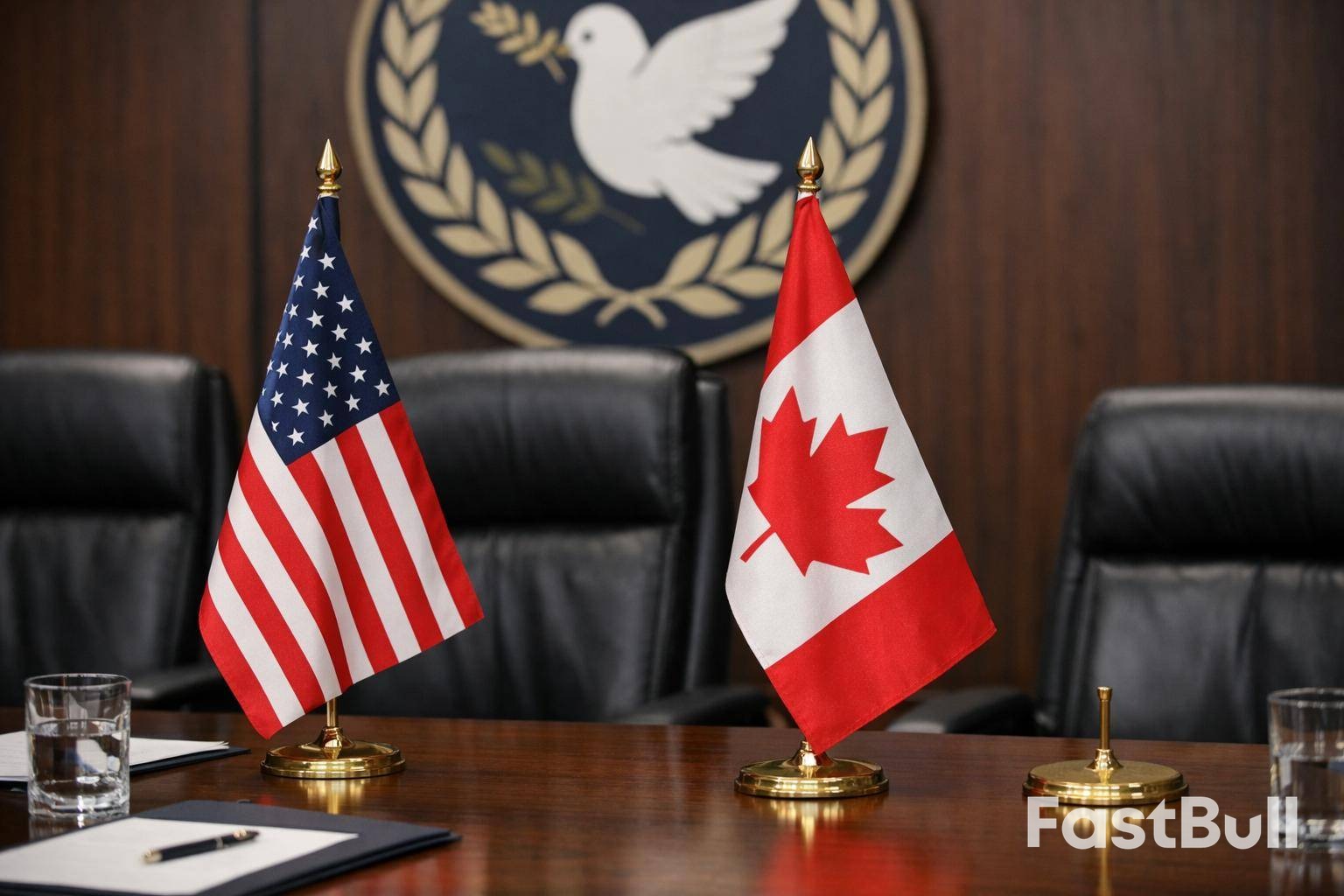
The USD/CAD exchange rate has dropped to its lowest point since January 5, driven by a retreat in the U.S. dollar index. The pair has fallen for five straight days, marking its longest losing streak since May 2025.
However, new political risks are emerging, with central bank decisions from both Canada and the United States set to define the pair's next move this week.
A significant new factor for the Canadian dollar is a threat from Donald Trump to impose a 100% tariff on all Canadian exports to the United States. This includes goods covered under the USMCA trade agreement he previously negotiated.
The threat stems from two main issues:
• Canada-China Trade Deal: Trump expressed anger over a new trade agreement between Canada and China that lowers tariffs on Chinese electric vehicles to 6%. In return, China lifted its tariffs on Canadian canola.
• Mark Carney's WEF Speech: He was also disappointed by a speech from Mark Carney at the World Economic Forum. Carney criticized the power games of the world's largest economies and called for middle-power countries to unite in response.
This statement was widely interpreted as being aimed at Trump, who had recently made threats concerning Greenland, a semi-autonomous island linked to Denmark. A 100% tariff would have a major impact, as Canada is the largest trading partner of the U.S., with billions of dollars in goods flowing between the two countries annually.
Still, some market observers remain skeptical, pointing to Trump's reputation for backing down from major threats, sometimes referred to as TACO ("Trump Always Chickens Out"). This was seen last week in the Greenland issue, where an initial aggressive stance ended with a deal that introduced no significant changes.
The monetary policy outlook will be the other critical driver for USD/CAD this week, with both the Bank of Canada (BoC) and the U.S. Federal Reserve scheduled to announce rate decisions.
Bank of Canada Decision on Thursday
Economists broadly expect the Bank of Canada to hold its key interest rate steady at 2.25%. This would give policymakers more time to assess incoming macroeconomic data, which has recently sent conflicting signals.
While Canada's labor market slowed in December after three consecutive months of growth, an inflation report last week showed that consumer prices rose more than anticipated.
Most analysts forecast that the BoC will maintain its current rate for the rest of the year. One analyst told Reuters, "At this point, the BoC is ready to take a fairly long wait-and-see stance. If there's a risk of a move, it's more likely to be a cut than a hike this year."
Federal Reserve Decision on Wednesday
Similarly, the Federal Reserve is expected to leave its benchmark interest rate unchanged in the current range of 3.50% to 3.75%.
Recent economic data from the U.S. has been encouraging. A report last week showed that the U.S. GDP grew by 4.4% in the third quarter, surpassing the median forecast of 4.3%. Furthermore, the labor market has shown signs of improvement in recent months, although inflation remains somewhat constrained.
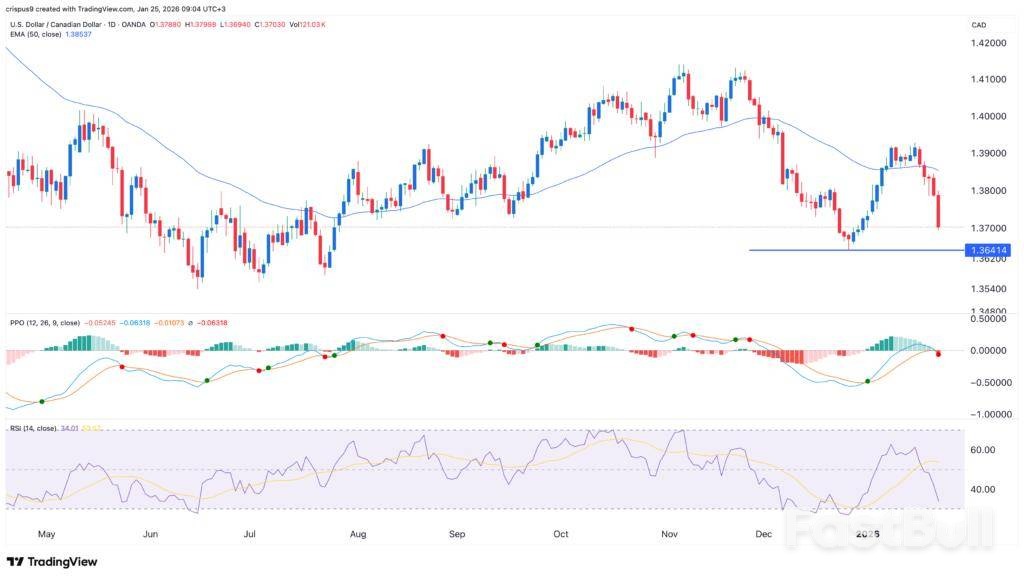
The daily chart shows that the USD/CAD has been in a strong downtrend, falling from a high of 1.3925 on January 16 to its current level around 1.3700.
Several technical indicators point to continued weakness:
• The pair is trading below both the 50-day and 100-day Exponential Moving Averages (EMA), a classic signal that sellers are in control.
• The Relative Strength Index (RSI) and the Percentage Price Oscillator (PPO) are both pointing downwards, indicating bearish momentum.
Based on this technical picture, the forecast for USD/CAD remains bearish. The next key support level to watch is 1.3640.
The European Union and Vietnam are set to elevate their relationship during a visit to Hanoi on Thursday by European Council President Antonio Costa. An EU official confirmed the move, which comes as both sides look to strengthen international partnerships in an era of trade disruption driven by U.S. tariffs.
The visit is timed shortly after To Lam was re-appointed as Vietnam's top official. The meeting could make Costa the first leader of a major global power to meet Lam since the ruling Communist Party confirmed him for a new term as general secretary on Friday.
According to the official, who spoke on the condition of anonymity, the diplomatic upgrade has been planned for months but was delayed due to scheduling issues.
This move will place the European Union in Vietnam's highest tier of diplomatic partners, alongside nations like China, the U.S., and Russia. It aligns with Vietnam's long-standing strategy of balancing its relationships with major world powers.
While largely symbolic, these upgrades typically signal more frequent high-level meetings between officials, though they do not usually involve new binding agreements. The European Council declined to comment on the matter, and Vietnam's government did not respond to a request for comment.
The push for stronger ties comes as Vietnam navigates complex international relations. Despite upgrading bilateral ties with the U.S. during a late 2023 visit by former president Joe Biden, Vietnam's relationship with Washington worsened last year following tariffs imposed by the Trump administration.
The enhanced partnership with the EU is expected to pave the way for greater cooperation across several key sectors. A draft joint statement indicates a focus on research, technology, energy, and critical minerals. Vietnam holds significant, though often underdeveloped, deposits of rare earths, gallium, and tungsten.
As a trade-reliant nation, Vietnam is a critical node in global supply chains, particularly for electronics, clothing, and footwear. The country has proactively signed numerous free trade agreements, including a major deal with the European Union.
However, the EU-Vietnam free trade agreement (FTA) has been a source of tension. Since it took effect in 2020, the deal has amplified Vietnam's trade surplus with the 27-nation bloc. In 2024, the EU's trade deficit with Hanoi reached €42.5 billion ($50.26 billion).
EU officials have repeatedly criticized Vietnam's implementation of the agreement, accusing Hanoi of using various non-tariff barriers to obstruct imports from the EU. To date, Brussels has taken limited action to resolve these issues.
For its part, the EU is also facing pressure from U.S. tariffs and has prioritized shoring up ties with economic partners worldwide. This includes recent efforts to advance trade agreements with South American nations in the Mercosur bloc.
Before his trip to Vietnam, Costa is scheduled to visit India. According to the EU Council, he and European Commission President Ursula von der Leyen plan to hold trade negotiations with Indian Prime Minister Narendra Modi.
The United States captured former Venezuelan President Nicolás Maduro in January 2026, a geopolitical development immediately followed by an oil transfer agreement announced by President Donald Trump. This event is set to create significant ripples in global energy markets, influencing both short-term volatility and long-term price trends.
Following Maduro's capture, the Trump administration quickly secured an agreement with Venezuela's interim leadership. Acting Vice President Deli Rodriguez confirmed that the nation would hand over between 30 and 50 million barrels of oil to the United States at no cost.
President Donald Trump stated, "Venezuela's interim authorities agreed to provide the U.S. with 30-50 million barrels of oil immediately."
The move highlights a direct link between U.S. foreign policy and its energy strategy, targeting Venezuela's vast oil reserves, which have been notoriously mismanaged.
The initial market response was swift. Major traditional oil stocks, including Chevron and Exxon, climbed 2% on the news. Investors appear to be pricing in the potential for short-term oil price hikes driven by leadership uncertainty in the oil-rich nation.
However, the cryptocurrency sector remained unaffected. There were no discernible changes in crypto markets, likely because long-standing sanctions have already isolated Venezuela from global financial systems and limited its links to the digital asset industry.
While immediate uncertainty may push prices up, the long-term outlook could be the opposite. The capture of Maduro echoes past U.S. actions against oil-producing regimes, which often aim to reshape global supply dynamics. Decades of sanctions and mismanagement under previous administrations led to a severe decline in Venezuela's oil infrastructure.
According to one petroleum analyst, the new arrangement could ultimately lower global oil prices if Venezuelan production is restored. The success of this scenario hinges entirely on whether the U.S. can effectively help revamp the country's crumbling infrastructure to boost output.
"Maduro's arrest could possibly raise oil prices slightly due to uncertainty around Venezuela's leadership structure," the analyst noted. But, they added, "potential increased output from Venezuela could drop global crude oil prices long-term, especially if the US is successful in raising investment in Venezuela's crumbling infrastructure."
The Bank of Japan is holding its key interest rate steady at 0.75%, a closely watched decision driven by signs that inflation is beginning to moderate. The move, which signals a pause after a rate hike last year, has immediate implications for the yen and could influence global financial markets through the popular carry trade.
The BOJ's Policy Board voted 8-1 to maintain the current interest rate. The decision was not unanimous, highlighting a division among policymakers on the best path forward for Japan's economy.
Board member Hajime Takata was the sole dissenter, casting a vote in favor of a 25 basis point hike. The central bank's decision was made independently, without direct influence from Prime Minister Sanae Takaichi.
Immediately following the announcement, the yen weakened as bond markets reacted. The yield on the ten-year Japanese Government Bond (JGB) now stands at 2.25%, reflecting the market's response to the continued low-rate environment.
This decision has significant implications for the yen carry trade, a strategy where investors borrow in a low-interest-rate currency (like the yen) to invest in assets denominated in a higher-interest-rate currency. The persistence of low rates in Japan could keep this trade attractive, affecting asset prices globally. Historically, shifts in the carry trade have been known to exert pressure on international financial assets.
Alongside the rate decision, the Bank of Japan updated its economic projections. The central bank now forecasts GDP growth to be between 0.8% and 1.0% by fiscal year 2026. This outlook assumes that inflation will continue to moderate, supported by government fiscal measures aimed at boosting private consumption.
The BOJ's overarching policy is to strike a balance between stable economic activity and price stability, with a long-term inflation target of 2% for the Consumer Price Index (CPI).
While the policy aims for stability, it operates against a backdrop of significant risk. Japan's national debt remains a major concern, standing at 240% of its GDP. Furthermore, any financial maneuvers related to the yen could have ripple effects on external markets. The BOJ's current stance suggests it expects inflation to stabilize, allowing the economy to navigate these challenges.

Remarks of Officials

Middle East Situation

Latest news on the Israeli-Palestinian conflict

Palestinian-Israeli conflict

Political
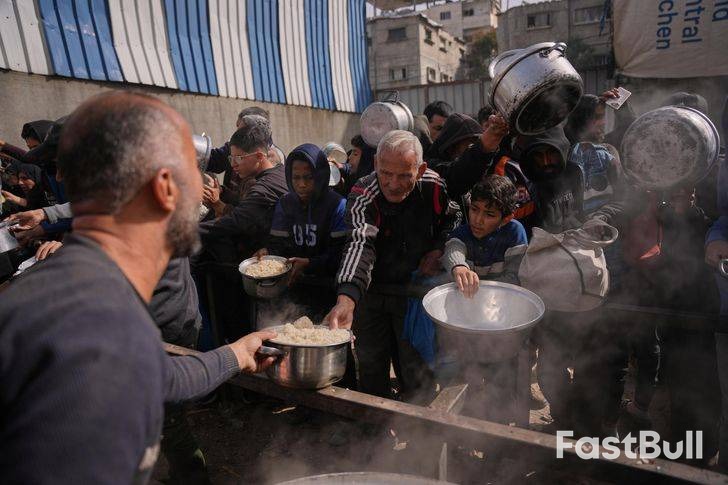
Top U.S. envoys met with Israeli Prime Minister Benjamin Netanyahu on Saturday, urging his government to move forward with the second phase of the Gaza ceasefire agreement. The diplomatic push comes as the deal faces significant hurdles, including the return of a hostage's remains and the reopening of a critical border crossing.
Netanyahu met with U.S. President Donald Trump's envoy Steve Witkoff and son-in-law Jared Kushner. According to a U.S. official, the talks focused on recovering the last hostage's remains from Gaza and outlining the next steps for the territory's demilitarization. While the U.S. is keen to maintain momentum on the Trump-brokered deal, Netanyahu is under domestic pressure to delay progress until Hamas returns the hostage.

The most critical signal of the ceasefire's second phase would be the reopening of the Rafah border crossing between Gaza and Egypt. Ali Shaath, head of a planned technocratic government intended to manage Gaza's daily affairs, stated on Thursday that the crossing would open in both directions this week. However, Israel, which currently controls the Gaza side of the crossing, has not confirmed this and said it would review the issue.
The situation is complicated by the case of Ran Gvili, whose body remains in Gaza. His family is urging for increased pressure on Hamas. "President Trump himself stated this week in Davos that Hamas knows exactly where our son is being held," the family said Saturday, accusing the group of violating the agreement.
Hamas countered on Wednesday, claiming it had provided mediators with "all information" it possesses about Gvili's remains and accused Israel of obstructing search operations in areas it controls. The ceasefire originally took effect on October 10.
Egypt's top diplomat is also pushing for an immediate reopening of the Rafah crossing. Foreign Minister Bader Abdelatty spoke by phone with Nickolay Mladenov, the Bulgarian diplomat serving as the high representative for Trump's new Board of Peace in Gaza.
According to a statement from the Egyptian Foreign Ministry, their discussion covered several key elements of the ceasefire's second phase:
• Deployment of an international monitoring force.
• Opening the Rafah crossing for entry and exit.
• Withdrawal of Israeli forces from the strip.
The ministry described the implementation of this phase as a "key entry point" for Gaza's reconstruction. Meanwhile, a Hamas delegation met with the head of Turkey's National Intelligence Organization in Istanbul to discuss the ceasefire.

Despite the diplomatic efforts, tensions remain high. On Saturday, an Israeli strike killed two Palestinian teenagers, cousins aged 13 and 15, in Gaza. According to Shifa Hospital in Gaza City, which received the bodies, the boys were searching for firewood at the time.
A relative, Arafat al-Zawara, said the teens were killed about 500 meters from the Yellow Line, which separates Israeli-controlled areas from the rest of the strip, in a zone the Israeli military had previously declared safe for Palestinians.
The Israeli military stated it had targeted militants who crossed the Yellow Line to plant explosives, denying that children were killed in the strike.
According to Gaza's Health Ministry, more than 480 Palestinians have been killed by Israeli fire since the ceasefire began. These casualty records are generally considered reliable by U.N. agencies and independent experts. Israel disputes the figures but has not provided its own data.
OPEC member Libya has signed a landmark 25-year oil development agreement with France's TotalEnergies and U.S.-based ConocoPhillips, launching a multi-billion dollar effort to revitalize its energy sector and boost crude production.
The deal was formalized at the Libya Energy and Economic Summit in Tripoli through the Waha Oil Company, a subsidiary of the state-owned National Oil Corporation. Under the terms, ConocoPhillips and TotalEnergies each hold a 20.4% stake in the Waha venture.
This long-term partnership involves investments exceeding $20 billion, which will be financed externally. The primary goal is to add 850,000 barrels per day (bpd) of additional oil capacity.
According to Libyan Prime Minister Abdul Hamid Dbeibah, the project is projected to generate approximately $376 billion in net revenues for the country. He emphasized that the deal will strengthen ties with key international energy partners, expand investment, and provide new economic resources, including job creation and wage increases.
The involvement of major U.S. corporations highlights a renewed international focus on Libya's energy potential. Massad Boulos, a senior adviser to the U.S. President for Arab World and Middle East Affairs, stated that deals signed by ConocoPhillips and Chevron prove that "the United States and its world-class companies are betting on Libya's future."
Boulos added, "By opening new opportunities for competitive international investment, Libya is signalling it's ready to play in the big league again."
In a separate move, the Libyan government also signed an initial cooperation agreement with Chevron and Egypt's Ministry of Petroleum.
Beyond the Waha deal, Libya is actively preparing to award new exploration and development licenses to international firms. Masoud Suleman, acting chairman of the National Oil Corporation, announced that the results of the country's first oil exploration bidding round in over 17 years will be released on February 11.
The licensing round covers 22 areas—11 offshore and 11 onshore. Several global energy giants have qualified to participate, including:
• BP
• Chevron
• ExxonMobil
• TotalEnergies
• Eni
• Shell
• OMV
Libya produces some of North Africa's most cost-effective, low-sulfur crude oil. Much of this potential has been sidelined since the 2011 civil war. As Europe seeks to diversify its energy sources away from Russia, Libyan crude has become increasingly important due to its quality, proximity, and an existing pipeline connecting western Libya to Italy.
Ryan Lance, chief executive of ConocoPhillips, noted that Libya recently hit a production milestone of 1.4 million bpd. "The country is well-positioned to deliver oil and gas to Europe and around the world, helping ensure European energy security, as well as global energy security," he said.
The ultimate goal is ambitious. Patrick Pouyanne, CEO of TotalEnergies, described Libya's target of reaching 2 million bpd by the end of the decade as a "strong and pragmatic and realistic ambition."
However, significant challenges remain. The country operates under two rival governments: a UN-backed administration in Tripoli and an eastern-based government supported by military commander Field Marshal Khalifa Haftar. This political division creates persistent security risks, and rival factions have previously forced the shutdown of oilfields and terminals. In 2023, for instance, unrest led to a temporary declaration of force majeure at Sharara, Libya's largest oilfield.

A recent survey of economic experts suggests South Korea's economy is set for another year of sluggish performance, with more than half predicting growth will remain in the 1% range.
The poll, conducted by Southernpost Inc. for the Korea Enterprises Federation (KEF), surveyed 100 economics professors to gauge their outlook on Asia's fourth-largest economy.
The consensus among the surveyed economists points to a challenging year ahead. The average growth forecast for the Korean economy stands at 1.8%, a figure slightly more pessimistic than the government's 2% outlook and the International Monetary Fund's (IMF) 1.9% projection.
Key findings from the survey include:
• 54% of experts believe Korea's economy will post growth in the 1% range this year.
• 36% anticipate a return to 2% growth, but not until 2027, driven by a slow recovery in demand and consumption.
• 6% forecast that economic growth could fall below 1%.
This follows a year in which the economy expanded by just 1%, a notable slowdown from the 2% growth recorded in the previous year.
Beyond headline growth figures, the experts identified specific risks clouding the economic horizon. They projected the won-dollar exchange rate to fluctuate between 1,403 won and 1,516 won this year, indicating potential for currency volatility.
Furthermore, trade relations with the United States are a significant source of concern. Nearly 60% of the respondents said the outcome of U.S.-Korea tariff negotiations would negatively impact both Korean exports to the U.S. and domestic corporate investment.
On the domestic front, technology presents both opportunities and challenges. An overwhelming 92% of the economists surveyed believe the expanding use of artificial intelligence (AI) will help address labor shortages and boost productivity, particularly within the manufacturing sector.
However, this optimism is tempered by security concerns. Nearly 90% of the experts urged the government to implement effective measures to prevent the overseas leakage of critical technologies like semiconductors, calling for strict penalties for any violations.
White Label
Data API
Web Plug-ins
Poster Maker
Affiliate Program
The risk of loss in trading financial instruments such as stocks, FX, commodities, futures, bonds, ETFs and crypto can be substantial. You may sustain a total loss of the funds that you deposit with your broker. Therefore, you should carefully consider whether such trading is suitable for you in light of your circumstances and financial resources.
No decision to invest should be made without thoroughly conducting due diligence by yourself or consulting with your financial advisors. Our web content might not suit you since we don't know your financial conditions and investment needs. Our financial information might have latency or contain inaccuracy, so you should be fully responsible for any of your trading and investment decisions. The company will not be responsible for your capital loss.
Without getting permission from the website, you are not allowed to copy the website's graphics, texts, or trademarks. Intellectual property rights in the content or data incorporated into this website belong to its providers and exchange merchants.
Not Logged In
Log in to access more features
Log In
Sign Up