• Trade
  • Markets
  • Copy
  • Contests
  • News
  • 24/7
  • Calendar
  • Q&A
  • Chats
Trending
Screeners
SYMBOL
LAST
BID
ASK
HIGH
LOW
NET CHG.
%CHG.
SPREAD
SPX
S&P 500 Index
6827.42
6827.42
6827.42
6899.86
6801.80
-73.58
-1.07%
--
DJI
Dow Jones Industrial Average
48458.04
48458.04
48458.04
48886.86
48334.10
-245.98
-0.51%
--
IXIC
NASDAQ Composite Index
23195.16
23195.16
23195.16
23554.89
23094.51
-398.69
-1.69%
--
USDX
US Dollar Index
97.950
98.030
97.950
98.500
97.950
-0.370
-0.38%
--
EURUSD
Euro / US Dollar
1.17394
1.17409
1.17394
1.17496
1.17192
+0.00011
+ 0.01%
--
GBPUSD
Pound Sterling / US Dollar
1.33707
1.33732
1.33707
1.33997
1.33419
-0.00148
-0.11%
--
XAUUSD
Gold / US Dollar
4299.39
4299.39
4299.39
4353.41
4257.10
+20.10
+ 0.47%
--
WTI
Light Sweet Crude Oil
57.233
57.485
57.233
58.011
56.969
-0.408
-0.71%
--

Community Accounts

Signal Accounts
--
Profit Accounts
--
Loss Accounts
--
View More

Become a signal provider

Sell trading signals to earn additional income

View More

Guide to Copy Trading

Get started with ease and confidence

View More

Signal Accounts for Members

All Signal Accounts

Best Return
  • Best Return
  • Best P/L
  • Best MDD
Past 1W
  • Past 1W
  • Past 1M
  • Past 1Y

All Contests

  • All
  • Trump Updates
  • Recommend
  • Stocks
  • Cryptocurrencies
  • Central Banks
  • Featured News
Top News Only
Share

Incoming Czech Prime Minister Babis: Czech Republic Will Not Take On Guarantees For Ukraine Financing, European Commission Must Find Alternatives

Share

Turkey President Erdogan: Hopes To Discuss Ukraine-Russia Peace Plan With Trump After Meeting With Putin

Share

Turkey President Erdogan: Peace Is Not Far Away, Black Sea Should Not Be Used As A Battleground, Safe Navigation Needed

Share

IAEA: Ukraine's Znpp Temporarily Lost All Offsite Power Overnight Due To Widespread Military Activities Affecting The Electrical Grid

Share

Iranian Media Says 18 Crew Members Of Foreign Tanker Seized In Gulf Of Oman Over Carrying 'Smuggled Fuel' Detained

Share

Regional Governor: Two Killed In Ukrainian Drone Strike On Russia's Saratov

Share

Chinese Foreign Ministry - China Foreign Minister Met With United Arab Emirates Counterpart On Dec 12

Share

China's Central Financial And Economic Affairs Commission Deputy Director: Will Expand Export And Increase Import In 2026

Share

Thai Leader Anutin: Landmine Blast That Killed Thai Soldiers 'Not A Roadside Accident'

Share

Thai Leader Anutin: Thailand To Continue Military Action Until 'We Feel No More Harm'

Share

Cambodian Prime Minister Hun Manet Says He Had Phone Calls With Trump And Malaysian Leader Anwar About Ceasefire

Share

Cambodia's Hun Manet Says USA, Malaysia Should Verify 'Which Side Fired First' In Latest Conflict

Share

Cambodia's Hun Manet: Cambodia Maintains Its Stance In Seeking Peaceful Resolution Of Disputes

Share

Nasdaq Companies: Allergan, Ferrovia, Insmed, Monolithic Power Systems, Seagate Technology, And Western Digital Will Be Added To The NASDAQ 100 Index. Biogen, CdW, GlobalFoundries, Lululemon, ON Semiconductor, And Tradedesk Will Be Removed From The NASDAQ 100 Index

Share

Witkoff Headed To Berlin This Weekend To Meet With Zelenskiy, European Leaders -Wsj Reporter On X

Share

Russia Attacks Two Ukrainian Ports, Damaging Three Turkish-Owned Vessels

Share

[Historic Flooding Occurs In At Least Four Rivers In Washington State Due To Days Of Torrential Rains] Multiple Areas In Washington State Have Been Hit By Severe Flooding Due To Days Of Torrential Rains, With At Least Four Rivers Experiencing Historic Flooding. Reporters Learned On The 12th That The Floods Caused By The Torrential Rains In Washington State Have Destroyed Homes And Closed Several Highways. Experts Warn That Even More Severe Flooding May Occur In The Future. A State Of Emergency Has Been Declared In Washington State

Share

Trump Says Proposed Free Economic Zone In Donbas Would Work

Share

Trump: I Think My Voice Should Be Heard

Share

Trump Says Will Be Choosing New Fed Chair In Near Future

TIME
ACT
FCST
PREV
U.K. Trade Balance Non-EU (SA) (Oct)

A:--

F: --

P: --

U.K. Trade Balance (Oct)

A:--

F: --

P: --

U.K. Services Index MoM

A:--

F: --

P: --

U.K. Construction Output MoM (SA) (Oct)

A:--

F: --

P: --

U.K. Industrial Output YoY (Oct)

A:--

F: --

P: --

U.K. Trade Balance (SA) (Oct)

A:--

F: --

P: --

U.K. Trade Balance EU (SA) (Oct)

A:--

F: --

P: --

U.K. Manufacturing Output YoY (Oct)

A:--

F: --

P: --

U.K. GDP MoM (Oct)

A:--

F: --

P: --

U.K. GDP YoY (SA) (Oct)

A:--

F: --

P: --

U.K. Industrial Output MoM (Oct)

A:--

F: --

P: --

U.K. Construction Output YoY (Oct)

A:--

F: --

P: --

France HICP Final MoM (Nov)

A:--

F: --

P: --

China, Mainland Outstanding Loans Growth YoY (Nov)

A:--

F: --

P: --

China, Mainland M2 Money Supply YoY (Nov)

A:--

F: --

P: --

China, Mainland M0 Money Supply YoY (Nov)

A:--

F: --

P: --

China, Mainland M1 Money Supply YoY (Nov)

A:--

F: --

P: --

India CPI YoY (Nov)

A:--

F: --

P: --

India Deposit Gowth YoY

A:--

F: --

P: --

Brazil Services Growth YoY (Oct)

A:--

F: --

P: --

Mexico Industrial Output YoY (Oct)

A:--

F: --

P: --

Russia Trade Balance (Oct)

A:--

F: --

P: --

Philadelphia Fed President Henry Paulson delivers a speech
Canada Building Permits MoM (SA) (Oct)

A:--

F: --

P: --

Canada Wholesale Sales YoY (Oct)

A:--

F: --

P: --

Canada Wholesale Inventory MoM (Oct)

A:--

F: --

P: --

Canada Wholesale Inventory YoY (Oct)

A:--

F: --

P: --

Canada Wholesale Sales MoM (SA) (Oct)

A:--

F: --

P: --

Germany Current Account (Not SA) (Oct)

A:--

F: --

P: --

U.S. Weekly Total Rig Count

A:--

F: --

P: --

U.S. Weekly Total Oil Rig Count

A:--

F: --

P: --

Japan Tankan Large Non-Manufacturing Diffusion Index (Q4)

--

F: --

P: --

Japan Tankan Small Manufacturing Outlook Index (Q4)

--

F: --

P: --

Japan Tankan Large Non-Manufacturing Outlook Index (Q4)

--

F: --

P: --

Japan Tankan Large Manufacturing Outlook Index (Q4)

--

F: --

P: --

Japan Tankan Small Manufacturing Diffusion Index (Q4)

--

F: --

P: --

Japan Tankan Large Manufacturing Diffusion Index (Q4)

--

F: --

P: --

Japan Tankan Large-Enterprise Capital Expenditure YoY (Q4)

--

F: --

P: --

U.K. Rightmove House Price Index YoY (Dec)

--

F: --

P: --

China, Mainland Industrial Output YoY (YTD) (Nov)

--

F: --

P: --

China, Mainland Urban Area Unemployment Rate (Nov)

--

F: --

P: --

Saudi Arabia CPI YoY (Nov)

--

F: --

P: --

Euro Zone Industrial Output YoY (Oct)

--

F: --

P: --

Euro Zone Industrial Output MoM (Oct)

--

F: --

P: --

Canada Existing Home Sales MoM (Nov)

--

F: --

P: --

Euro Zone Total Reserve Assets (Nov)

--

F: --

P: --

U.K. Inflation Rate Expectations

--

F: --

P: --

Canada National Economic Confidence Index

--

F: --

P: --

Canada New Housing Starts (Nov)

--

F: --

P: --

U.S. NY Fed Manufacturing Employment Index (Dec)

--

F: --

P: --

U.S. NY Fed Manufacturing Index (Dec)

--

F: --

P: --

Canada Core CPI YoY (Nov)

--

F: --

P: --

Canada Manufacturing Unfilled Orders MoM (Oct)

--

F: --

P: --

Canada Manufacturing New Orders MoM (Oct)

--

F: --

P: --

Canada Core CPI MoM (Nov)

--

F: --

P: --

Canada Manufacturing Inventory MoM (Oct)

--

F: --

P: --

Canada CPI YoY (Nov)

--

F: --

P: --

Canada CPI MoM (Nov)

--

F: --

P: --

Canada CPI YoY (SA) (Nov)

--

F: --

P: --

Canada Core CPI MoM (SA) (Nov)

--

F: --

P: --

Q&A with Experts
    • All
    • Chatrooms
    • Groups
    • Friends
    Connecting
    .
    .
    .
    Type here...
    Add Symbol or Code

      No matching data

      All
      Trump Updates
      Recommend
      Stocks
      Cryptocurrencies
      Central Banks
      Featured News
      • All
      • Russia-Ukraine Conflict
      • Middle East Flashpoint
      • All
      • Russia-Ukraine Conflict
      • Middle East Flashpoint
      Search
      Products

      Charts Free Forever

      Chats Q&A with Experts
      Screeners Economic Calendar Data Tools
      Membership Features
      Data Warehouse Market Trends Institutional Data Policy Rates Macro

      Market Trends

      Market Sentiment Order Book Forex Correlations

      Top Indicators

      Charts Free Forever
      Markets

      News

      News Analysis 24/7 Columns Education
      From Institutions From Analysts
      Topics Columnists

      Latest Views

      Latest Views

      Trending Topics

      Top Columnists

      Latest Update

      Signals

      Copy Rankings Latest Signals Become a signal provider AI Rating
      Contests
      Brokers

      Overview Brokers Assessment Rankings Regulators News Claims
      Broker listing Forex Brokers Comparison Tool Live Spread Comparison Scam
      Q&A Complaint Scam Alert Videos Tips to Detect Scam
      More

      Business
      Events
      Careers About Us Advertising Help Center

      White Label

      Data API

      Web Plug-ins

      Affiliate Program

      Awards Institution Evaluation IB Seminar Salon Event Exhibition
      Vietnam Thailand Singapore Dubai
      Fans Party Investment Sharing Session
      FastBull Summit BrokersView Expo
      Recent Searches
        Top Searches
          Markets
          News
          Analysis
          User
          24/7
          Economic Calendar
          Education
          Data
          • Names
          • Latest
          • Prev

          View All

          No data

          Scan to Download

          Faster Charts, Chat Faster!

          Download App
          English
          • English
          • Español
          • العربية
          • Bahasa Indonesia
          • Bahasa Melayu
          • Tiếng Việt
          • ภาษาไทย
          • Français
          • Italiano
          • Türkçe
          • Русский язык
          • 简中
          • 繁中
          Open Account
          Search
          Products
          Charts Free Forever
          Markets
          News
          Signals

          Copy Rankings Latest Signals Become a signal provider AI Rating
          Contests
          Brokers

          Overview Brokers Assessment Rankings Regulators News Claims
          Broker listing Forex Brokers Comparison Tool Live Spread Comparison Scam
          Q&A Complaint Scam Alert Videos Tips to Detect Scam
          More

          Business
          Events
          Careers About Us Advertising Help Center

          White Label

          Data API

          Web Plug-ins

          Affiliate Program

          Awards Institution Evaluation IB Seminar Salon Event Exhibition
          Vietnam Thailand Singapore Dubai
          Fans Party Investment Sharing Session
          FastBull Summit BrokersView Expo

          US Atlantic Coast Now a Breeding Ground for Supercharged Hurricanes

          Thomas

          Energy

          Summary:

          Rate at which hurricanes gather speed has risen significantly – and researchers say fossil-fuel dependency will only intensify storms.

          The US Atlantic coast has become a breeding ground for super-charged hurricanes which are likely to batter coastal communities even harder if the world remains hooked on fossil fuels, a new study found.
          Global heating caused by greenhouse gas emissions from burning oil, gas and coal is the main factor contributing to increasingly severe storms and flooding affecting the American east coast over the past four decades. Rapid intensification has led to storms gathering strength so quickly it has become increasingly difficult to provide timely warnings and evacuation orders to residents.
          The warming planet is poised to bring hurricanes that intensify quicker and, with them, a heightened risk of flooding to east coast communities which modeling suggests will get even worse without radical action to curb greenhouse gases, according to the study published in the journal Geophysical Research Letters.
          "The nearshore environment has absolutely become more favorable for hurricanes near the Atlantic coast and that's very consistent with the rising hurricane intensification we've observed in the region," said Karthik Balaguru, a climate scientist and lead author. "Our findings have profound implications for coastal residents, decision- and policy-makers."
          Analysing storm activity and the conditions that shaped them, the researchers found that the rates at which hurricanes gathered speed near the US Atlantic coast increased significantly between 1979 and 2018.
          The Atlantic coast has a unique mix of environmental conditions not found in the Gulf of Mexico, another hurricane hotspot, that makes eastern US states particularly vulnerable to rapidly intensifying and wetter storms, according to researchers from the department of energy's Pacific Northwest National Laboratory.
          Last month, Hurricane Ian killed at least 126 people and caused widespread flooding and infrastructure damage in Florida after transforming from a tropical storm to a category 4 hurricane within 24 hours. Storms that intensify close to the shoreline pose a more serious threat to life, land and property, as rising sea levels means storm surge is higher and reaches further inland.
          For a storm to explode in strength or undergo rapid intensification it requires near-perfect environmental conditions that do not happen often. But the ingredients needed for this perfect storm recipe – warm ocean surface, high humidity, low wind shear and the spinning motion of air (vorticity) – have become increasingly common as greenhouse gas emissions have built up, researchers found.
          One major factor is that as the planet has warmed, the temperature difference between land and water has widened.
          As higher air pressure over the cooler sea blows inland toward warmer, lower-pressure areas, the Earth's rotation guides these winds in a cyclonic, swirling direction, sucking up warm, moist air and converting its energy into damaging winds. As moist air rises inside the hurricane's core and cools toward the top, water vapor condenses and emits heat, further energizing the storm.
          Warmer land temperatures strengthen this twisting motion that pulls humid air up, while a warmer sea surface – also a product of greenhouse gas warming – adds even more humidity, a crucial ingredient for intensification.
          Another important factor is wind shear, which measures the strength and direction of wind higher up in the atmosphere.
          The findings build on previous studies which found that the growing contrast in land-sea temperature is also associated with changing rainfall patterns and drought. "This study adds a new and important consequence – changes to hurricane behavior in coastal regions that could affect large populations around the world," said Ruby Leung, atmospheric scientist and co-author.
          Ian was one of the strongest storms to hit the US coast, but not the deadliest.
          In 2017 in Puerto Rico, Hurricane Maria, which caused the longest blackout in US history and led to 3,000 deaths, intensified from a category 1 to a category 5 hurricane within just 15 hours. The same mix of pro-hurricane conditions could form in many other regions, including those near the east Asian coastline and the northwest Arabian Sea, according to the study.
          Projections using several climate models suggest that the destructive trend looks set to continue unless fossil fuels are phased out. Balaguru said: "What we have seen is likely related to climate change. Natural variability does play a role, but to a lesser degree."

          Source: The Guardian

          Risk Warnings and Disclaimers
          You understand and acknowledge that there is a high degree of risk involved in trading. Following any strategies or investment methods may lead to potential losses. The content on the site is provided by our contributors and analysts for information purposes only. You are solely responsible for determining whether any trading assets, securities, strategy, or any other product is suitable for investing based on your own investment objectives and financial situation.
          Comments
          Add to Favorites
          Share

          Asia Stocks Rise as Relief Rally Builds After UK U-turn

          Alex

          Stocks

          Asia stocks nudged higher on Tuesday as the dramatic U-turn in British fiscal policy brightened investor sentiment, while the U.S. dollar took a breather at its lowest levels in more than a week as a revival in risk-taking lowered its appeal.
          Britain's new finance minister Jeremy Hunt abandoned most of Prime Minister Liz Truss' economic plan that had led to a political maelstrom fuelled by market turmoil, with the pound hitting record lows in recent weeks and the Bank of England being forced to intervene.
          Morgan Stanley analysts said the fiscal U-turn was likely to have significant implications for the BoE as its economists now revise their call for the November meeting to a 75-basis-point rate hike, from 100 basis points.
          Hunt's move led to Britain's government bonds, currency and shares soaring, also lifting Wall Street.
          Given such a wholesale scrapping of PM Truss' Tory leadership promises, it remains an open question how long Truss will remain in power, said Tapas Strickland, head of market economics at National Australia Bank.
          MSCI's broadest index of Asia-Pacific shares outside Japan rose 0.43%, while Japan's Nikkei was up 0.6%. S&P 500 futures and Nasdaq futures were both up 0.8%.
          China's stock market opened nearly flat and edged up 0.12% to 3,088.54 as the Chinese ruling Communist Party's twice-a-decade congress remains in session this week.
          Chinese state banks are stepping up intervention to defend the weakening yuan, banking sources told Reuters on Monday, while many companies have announced share buyback programmes.
          In currency markets, the U.S. dollar retreated against most currencies overnight, with sterling subdued early on Tuesday after gaining 1.6% in the previous session.
          The Australian dollar rose on Tuesday after the Reserve Bank of Australia said it expects to raise interest rates further over the coming months.
          The yen touched a fresh 32-year low of 149.10 per dollar on Monday, not far off the psychological metric of 150. Investors have been watching out for any signs of further intervention by the Bank of Japan, with authorities repeatedly warning of a firm response to overly rapid yen declines.
          NAB's Strickland said many are noting 150 as a key threshold that the government will be keen to avoid a sustained break of, for political reasons.
          Meanwhile, China has delayed the release of economic indicators, including the country's third-quarter gross domestic product due on Tuesday and trade data that had been scheduled last Friday.
          Brent was up 0.08% to $91.69 a barrel, while U.S. crude rose 0.04% to $85.49 per barrel.

          Source: Reuters

          Risk Warnings and Disclaimers
          You understand and acknowledge that there is a high degree of risk involved in trading. Following any strategies or investment methods may lead to potential losses. The content on the site is provided by our contributors and analysts for information purposes only. You are solely responsible for determining whether any trading assets, securities, strategy, or any other product is suitable for investing based on your own investment objectives and financial situation.
          Comments
          Add to Favorites
          Share

          Aluminium Stocks Grow

          Owen Li

          Commodity

          Energy- European natural gas prices fall further

          Although oil prices traded in a fairly large range yesterday, ICE Brent managed to settle little changed from Friday's close. The strength in equities and the weakness in the dollar failed to push oil prices higher. Instead, the market still seems wary of the demand outlook for the market. President Xi has made it clear that China will continue to follow a zero-Covid policy, which raises uncertainty over Chinese oil demand through 2023. Recession concerns elsewhere only add to the market's uncertainty.
          The EIA yesterday released its latest drilling productivity report, in which US shale oil production is forecast to average 9.105MMbbls/d in November, up from an estimated 9.001MMbbls/d in October. Unsurprisingly, the Permian region is expected to drive the bulk of this growth with output expected to increase by 50Mbbls/d, whilst Bakken and Eagle Ford are forecast to see output increase by 22Mbbls/d and 18Mbbls/d respectively. The report also showed that drilled but uncompleted wells (DUCs) continue to decline. DUC inventory fell by 10 to total just 4,333 at the end of September. This is the lowest number since at least 2014. US producers have been relying on DUCs to sustain production growth at a time when we are not seeing significant growth in drilling activity. However, as the number of DUCs continues to decline so does the rate at which they decline. In 2021 the average monthly decline in DUCs was 219 vs. 76 so far this year.
          European natural gas prices came under further pressure yesterday. The Nov-22 TTF contract fell close to 10%, leaving the market at just under EUR128/MWh, which is the lowest level since June. There is now a fairly strong contango in the front end of the curve, as the market seems less concerned about supply in the near term, but is much more concerned about 2023 supply and the region's ability to build adequate storage ahead of the 2023/24 winter in the absence of Russian supply. For now, though, EU storage continues to increase with the latest numbers from Gas Infrastructure Europe showing storage is more than 92% full. Although, with the 2022/23 heating season still ahead of us, it is important that the market doesn't get too complacent about the supply/demand picture in the near term.
          The European Commission also continues to work on proposals for the EU energy markets, which according to reports, could include a proposal for a temporary dynamic price limit on TTF. In addition, there are suggestions that the voluntary gas demand cut of 15% could become a mandatory cut. Proposed measures will be discussed by EU leaders when they meet on 20-21 October.

          Metals – LME aluminium stockpiles jump most since February

          LME aluminium prices fell by more than 3% after large inflows into exchange warehouses. The latest LME data showed arrivals of 65.8kt, the biggest daily addition since February, taking total stocks to 433kt, the highest since 8 June. The majority of the inflows were reported in Gwangyang in South Korea and Port Klang in Malaysia, raising speculation that large volumes of unwanted Russian metal could be starting to arrive at the exchange's warehouses.
          Union members at Antofagasta's Los Pelambres copper mine in Chile have reached an agreement with the management, avoiding a strike, according to media reports. The union members failed to reach an agreement during a formal discussion two weeks ago. The mine produced around 336kt of copper last year.
          According to the latest forecast from the Ministry of Economy, Trade and Industry (METI), crude steel production in Japan is expected to drop by 6.8% YoY (fourth consecutive quarter decline) to 22.5mt in 4Q22. The group expects Japan's total crude steel output to decline by 5.6% YoY to 90.99mt during the 2022 calendar year.

          Agriculture – rising Indian sugar output

          The Indian Sugar Mills Association (ISMA) projects that India's sugar production will increase by 2% YoY to 36.5mt in the 2022/23 marketing year that started this month. Sugar output without the diversion of cane juice and B-heavy molasses is expected to be around 41mt in 2022/23, compared to 39.2mt a year ago. On the consumption side, the group expects Indian sugar demand to total around 27.5mt in 2022/23, while opening stocks were 5.5mt as of 1 October. This leaves a large exportable surplus from India. However, mills are still waiting for an announcement with regard to the export policy for sugar. The Food Secretary in India has said that the government is set to announce the sugar export quota for the season (that began in October) within a week.
          Data from the National Oilseed Processors Association (NOPA) showed that soybean crushing in the US dropped to the lowest level in a year and also came in below market estimates of 161mn bushels. Soybean crushing fell 4.5% MoM to 158mn bushels in September, as the crushing pace slowed due to seasonal maintenance and repair downtime ahead of the fall harvest. However, it was still up 2.8% YoY. Meanwhile, soy oil supplies among NOPA members dropped to 1.5 billion lbs (lowest since September 2020) as of 30 September, down from 1.6b lbs a month earlier and lower than the 1.7b lbs seen at the same stage last year.

          Source: ING

          Risk Warnings and Disclaimers
          You understand and acknowledge that there is a high degree of risk involved in trading. Following any strategies or investment methods may lead to potential losses. The content on the site is provided by our contributors and analysts for information purposes only. You are solely responsible for determining whether any trading assets, securities, strategy, or any other product is suitable for investing based on your own investment objectives and financial situation.
          Comments
          Add to Favorites
          Share

          Wall Street Rally Throws Spotlight on Reports from Tesla, Netflix

          Cohen

          Stocks

          Investors are speculating about whether Monday's big stock surge is the start of a recovery or another pause in the market's decline, and the answer may depend in part on upcoming quarterly results from heavyweights including Tesla Inc, Johnson & Johnson and Netflix Inc.
          The world's most widely tracked stock benchmark jumped 2.65% on Monday, lifted in part by strong quarterly results from Bank of America, even as investors worry that the U.S. Federal Reserve's war against inflation may hobble the economy.
          Expectations are low for the September-quarter earnings season that's now underway, suggesting potential upside for shares of companies that do come in ahead of analysts' estimates, while raising risks for companies that fail to meet even modest expectations.
          "This week and next week are just crucial and full of earnings," said Peter Tuz, President of Chase Investment Counsel in Charlottesville, Virginia.
          Monday's major rally on Wall Street was just the latest in an unusually volatile year. The S&P 500 has recorded daily gains or losses of more than 2% 39 times so far in 2022, compared to seven times last year and 44 times in all of 2020.
          Shares of Tesla jumped 7%, with the electric vehicle maker's report late on Wednesday set to be one of this week's main attractions.
          Wall Street's most heavily traded stock, Tesla has tumbled over 17% since Oct. 2, when it disclosed third-quarter vehicle deliveries that missed estimates as logistical challenges overshadowed its record deliveries. However, analysts still expect Chief Executive Elon Musk to deliver a 60% jump in quarterly revenue and a 48% surge in "adjusted" earnings before interest, taxes, depreciation and amortization.
          Analysts worried about a deteriorating global economy have slashed their quarterly earnings outlooks. They now on average expect S&P 500 September quarter earnings per share to have increased 3.0% year/year, down from a consensus estimate of over 11% in July, according to I/B/E/S data from Refinitiv.
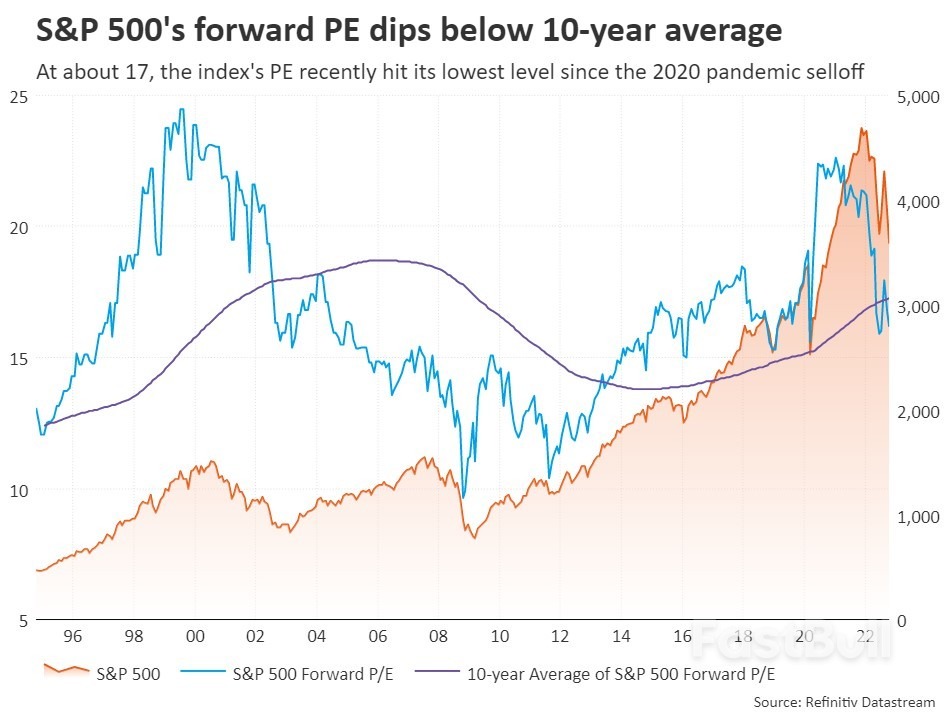
          Wall Street Rally Throws Spotlight on Reports from Tesla, Netflix_1With the S&P 500 down 23% so far in 2022, the index's forward earnings valuation has dropped to 17, marginally below its 10-year average, according to Refinitiv data.
          Netflix reports on Tuesday, with analysts expecting revenue to grow just 5% year/year, its lowest quarterly increase ever, according to Refinitiv. Netflix's stock on Monday jumped over 6%, leaving it with a loss of about 59% in 2022.
          Other major companies reporting their results this week include Lockheed Martin on Tuesday, Procter & Gamble on Wednesday and AT&T on Thursday.
          Many investors warn that expectations the Fed will continue its aggressive interest rate hikes will limit the amount of optimism generated by a potentially strong quarterly earnings season.
          "Right now, the Fed owns the market," said Emily Roland, Co-Chief Investment Strategist at John Hancock Investment Management in Boston. "Sentiment is extremely bearish. You want to be careful here."

          Source: Reuters

          Risk Warnings and Disclaimers
          You understand and acknowledge that there is a high degree of risk involved in trading. Following any strategies or investment methods may lead to potential losses. The content on the site is provided by our contributors and analysts for information purposes only. You are solely responsible for determining whether any trading assets, securities, strategy, or any other product is suitable for investing based on your own investment objectives and financial situation.
          Comments
          Add to Favorites
          Share

          Asia Morning Bites

          Samantha Luan

          Stocks

          Bond

          Political

          Global markets

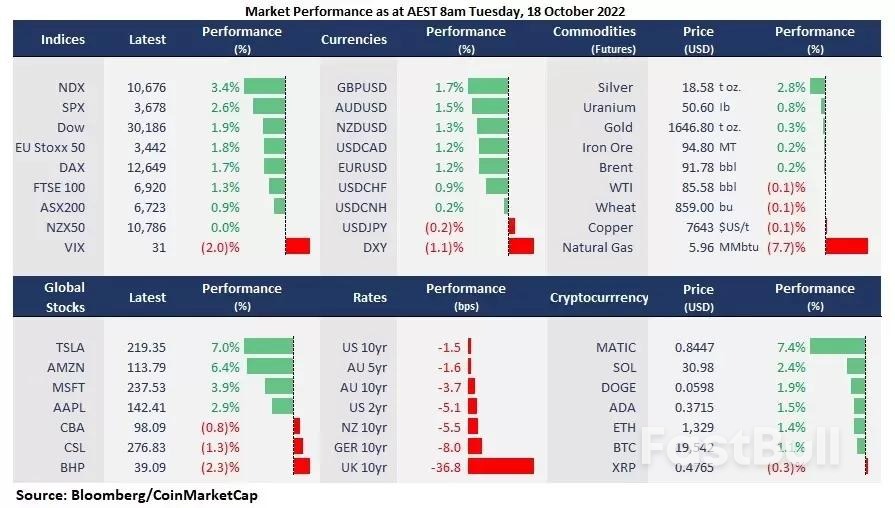
          U.S. stocks erased their losses from Friday's session, opening higher and then trading quite flat until the close. The S&P500 rose 2.65% and the NASDAQ was up 3.43%.
          Falling bond yields may have helped restore some confidence, and this may have been helped by tailwinds from the UK Gilts market, where new Chancellor, Jeremy Hunt, took an axe to the previous mini-budget and put the UK's finances on a sounder footing.
          30Y UK Gilt yields fell 40.2bp, the 10Y dropped 35.7bp and 2Y Gilt yields declined by 33.3bp. 10Y European government bond yields declined by about 8bp on average, while the 10Y U.S. Treasury yield was down just 0.8bp.
          Equity futures suggest that the positive tone will persist into today's trading, and this could help lift the EUR further. EUR/USD rose to 0.9843 yesterday from about 0.972 and could be buoyed further if risk sentiment holds up. The AUD is trading just below 63 cents, after touching 0.6189 briefly yesterday.
          Cable has recovered all the way to 1.1356, though it looked as if it might hit 1.145 at one point yesterday. But the JPY seems to be looking at further weakness, missing out on the G-10 rallies, and edging ever closer to 150. The BoJ will be getting anxious after their recent jawboning seems to have fallen on deaf ears.
          Asian FX has lagged behind the G-10 rally, and will likely pick up the slack today. Yesterday, the VND was the weakest of the Asia pack, dropping as the central bank widened the trading band to 5% (from 3%) on either side of the fixing rate.

          G-7 Macro

          It is very quiet on the G-7 calendar today. Germany's ZEW business survey is probably the main pick of the day.
          The expectations component of the survey is not far above the Global Financial Crisis low of -63.9, and could well push below that today. The consensus expects it to fall to -66.5.

          China

          There are some delays to the economic data scheduled for release during the Party Congress. These include the customs export and import numbers, which were scheduled for release yesterday, as well as GDP, retail sales, industrial production, and fixed asset investment, which were previously scheduled for release today. We aren't concerned that the release in the data is because it is particularly weak.
          Although we don't expect it to paint a particularly positive picture of the Chinese economy when it is eventually released. Rather, the delay suggests that the government believes that the 20th Party Congress is the most important thing happening in China right now and would like to avoid other information flows that could create mixed messages.

          Source: ING

          Risk Warnings and Disclaimers
          You understand and acknowledge that there is a high degree of risk involved in trading. Following any strategies or investment methods may lead to potential losses. The content on the site is provided by our contributors and analysts for information purposes only. You are solely responsible for determining whether any trading assets, securities, strategy, or any other product is suitable for investing based on your own investment objectives and financial situation.
          Comments
          Add to Favorites
          Share

          Wall Street Rallies to Kick Off The Week Ahead of Major Tech Earnings

          Damon

          Stocks

          Bond

          Forex

          US stocks rebounded strongly amid a tech-fuelled rally after a drop last Friday. There is a combination of reasons why stock markets continued the rebounding momentum since hotter-than-expected US CPI data was released last week. Firstly, rates eased surging after the UK's new finance minister Jeremy Hunt made a U-turn of the previously proposed tax-cutting plan. The UK 10-year gilt yield fell to 3.96% from 4.32% a day ago, boosting the British Pound to jump 1% against the US dollar. Secondly, a bunch of US big banks' earnings came in stronger than expected, leading earnings optimism into the second half of October. Netflix and Tesla's shares jumped 6.6% and 7%, respectively, ahead of their third-quarter earnings reports on Wednesday and Thursday. Third, major US indices are at key technical support levels, algorithmic trading may have caused short covering in positions.Wall Street Rallies to Kick Off The Week Ahead of Major Tech Earnings_1
          S&P 200 rebounds at the 200 weekly moving average, with the pivotal support around 3,500. All 11 sectors in the S&P 500 finished higher, with consumer discretionary leading gains, up 4.23%. The other two growth sectors, including technology and communication services, were also up more than 3%. And Real Estate jumped 3.9% amid banks' earnings optimism.
          Goldman Sachs is reportedly planning to merge trading and investment banking, making its four main divisions into three, one day ahead of the third quarter earnings reports, which is the third reorganization since 2018. The bank will also split the money-losing consumer banking between two new divisions. Apparently, the bank is under pressure due to a downgrade in valuation by analysts.
          Credit Suisse considers selling its US asset management business, CSAM, amid its billions of dollars in losses. The unit may draw interest from private equity firms, while the bank is also in process of selling its securitized products, according to Bloomberg.
          USD/JPY tops 149, the highest since September 1990 after the BOJ confirmed to keep its ultra-loss monetary policy last week, while the US dollar index fell due to a slide in global bond yields, with most major currencies jumping about 1% against the greenback.
          Asian markets are set to open higher following a strong close on Wall Street. ASX futures were up 0.92%. Nikkei 225 futures jumped 1.42% and Hang Seng Index futures rose 1.81%.
          Crude oil was flat on mixed signals that the Chinese Party Congress offered over the weekend. President Xi's speech shows that the country's zero Covid policy will remain while continue supporting property and technology with stimulus measures. A softened US dollar also helped ease falls in the prices on Monday.
          Gold futures finished higher after paring early gains. The precious metal may continue to be under pressure of rising rates and a strong dollar, with a key resistance level around the 20-day MA at 1,677.

          Source: CMC

          Risk Warnings and Disclaimers
          You understand and acknowledge that there is a high degree of risk involved in trading. Following any strategies or investment methods may lead to potential losses. The content on the site is provided by our contributors and analysts for information purposes only. You are solely responsible for determining whether any trading assets, securities, strategy, or any other product is suitable for investing based on your own investment objectives and financial situation.
          Comments
          Add to Favorites
          Share

          Trade outlook 2023: Slow Steaming in Rough Waters

          Kevin Du

          Global trade growth held up well in 2022, before entering the slow lane

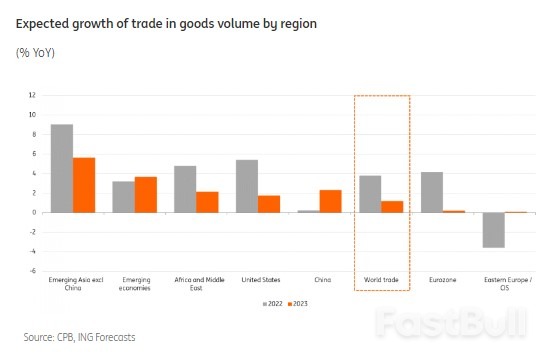
          So far this year, global merchandise trade has held up extremely well given the volatile and uncertain environment, with world goods trade standing at 4.7% year-to-date (January to July) according to CPB world trade data. Despite households worrying about the rising cost of living and the end of lockdowns, which resulted in a shift back to services and travelling, consumers' appetite to spend on physical things was still running high in the first half of the year compared to the previous year.
          Looking at the details, the eurozone and the US registered YTD growth of around 6%, while the UK figure was in double digits, thanks to an extremely low comparative base of 2021. Emerging economies registered a solid growth rate of 4.1%. Only Eastern Europe/CIS and China's YTD growth figures were in negative territory with the former being especially hampered by the war in Ukraine and the latter suffering from Covid lockdowns. Although we expect the rest of the year to result in subdued goods trade, global trade will still likely see a growth rate of 3.8% this year, far better than we had expected back in April and much closer to our initial call of 4.1% in January.

          Resolved congestion at US bottleneck port illustrative of supply chain relief

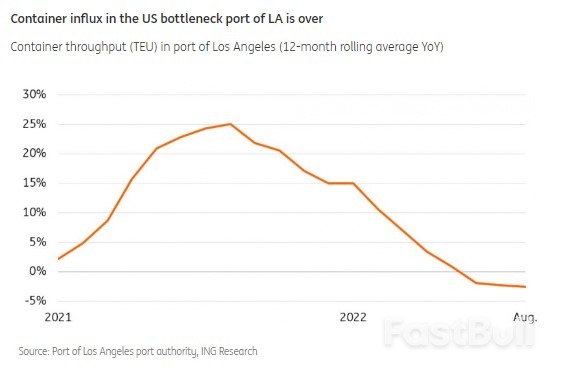
          Slowing consumer demand is bringing relief to global supply chains. After an unprecedented wave of incoming containers, leading to record throughput and peaking congestion in dominant US container gateway LA-Longbeach in early 2022, volumes trended down. With operations fully resumed after Covid, the impressive backlog of waiting vessels was quickly reduced and almost cleared in September. To avoid new supply chain disruptions and build resilience, shippers in the US increased their inventories to relatively high levels in the first quarter of 2022, according to the logistics managers index. They also started ordering early for the holiday season, which flattened the traditional peak season (the third quarter). At the same time, consumers shifted back to services and started to cut spending on goods. This created a 'Bullwhip effect' of self-reinforcing inventory moderation across the supply chain which drove volumes down. Consequently, the 12-month rolling TEU-throughput has slipped into negative territory. And this could continue for a while. The slack in spending on goods (or normalisation) is also reflected in the parcel delivering figures of FedEx and other delivery companies. Moreover, global air cargo volume – known as an early indicator for consumer products demand – has also slumped since early 2022, showing a 5% decline YTD after an initial strong recovery in 2020 and 2021.

          Trade outlook 2023: Slow Steaming in Rough Waters_1But congestion and delays won't completely end before 2023

          Although major ports, including US-bottleneck LA-Long Beach and Shanghai, have managed to get through unprecedented backlogs, there is still a long way to go before global congestion eases. In the US, more ships are directed to the East Coast and elsewhere, diverted to smaller ports which still see more delays. This is also the reason why transatlantic container rates are at more elevated levels. Ocean timelines of cargo ex-works until the port of destination have improved since their peak at the start of 2022, but they still hover around double the pre-pandemic lead times of around 80-90 days. This also means that arrival performance has a long way to go to return to normal levels. Since May, global schedule reliability, tracked by Sea Intelligence, has embarked on a cautious recovery path, standing at 46.2% in August. However, this is still a far cry from the 2018-19 average of 74%. Some 7% of the fleet is stuck queuing up in ports around the world, with 11% of goods still being blocked on waiting container ships.

          Falling container rates mark a turning point in transport and trade costs

          Softening demand has sent spot rates on the major trade lanes down, ending an extraordinary two-year period in container shipping. Spot rates have been coming down for longer on the main trades from Asia, but higher contract rates and an initiated shift to longer-term contracts by container liners pushed average transport costs for larger shippers up in the first half of 2022. Mid-year, Maersk had 71% of shipments fixed in long contracts. Nevertheless renegotiated contracts have likely reached a turning point as well. And with falling average global earnings for vessels, the mixed bucket of tariffs for shippers is now beyond its peak, and with the economic headwinds, the balance could quickly shift. Smaller shippers now benefit the most from lower tariffs as they are usually dependent on the spot market. Dry bulk rates have also weakened, although they still hover above pre-pandemic levels. Yet, contrary to the container market, tanker rates have rallied after a difficult pandemic phase with lower oil demand – with the Ukraine war having severe implications for the oil and tanker market.
          Trade outlook 2023: Slow Steaming in Rough Waters_2Overall, global supply chain pressures have come down from the peak registered in December 2021, but are still some way off their average level, meaning that supply chain uncertainty is still an everyday reality for the rest of 2022. Shippers have anticipated that.

          Our outlook for 2023: receding demand meets over-supply

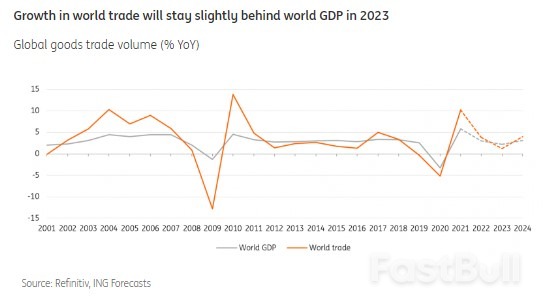
          The current market moderation is expected to spill over into 2023. With recessionary scenarios running high, we don't expect world trade to exceed 2% next year and are pencilling in a subdued growth rate of 1.2% for global goods trade. This falls behind expected GDP growth. With 1) consumer demand faltering, 2) the energy and subsequent inflation crisis persisting, and 3) ongoing labour and material shortages, there are simply not enough silver linings to keep global goods trade robustly flowing. Energy prices are very likely to remain high, burdening companies' cost competitiveness and households' purchasing power, despite government compensation packages.

          Trade outlook 2023: Slow Steaming in Rough Waters_3US and European demand-side weakness tempers expectations, while Asia holds up better

          Although governments around the world are trying to support the demand-side with large fiscal stimulus packages, the uncertainty around the final energy bill in Europe, tightening credit conditions in the US, and a subdued growth environment in China do not speak in favour of robust demand. Consumers face economic uncertainty and the strong dollar has led to more expensive cross-border shopping in China. The European picture shows similarities, as European consumer confidence has tested new lows amid the energy crisis. While consumer spending in the US held up relatively well in 2022, we expect it to fall in 2023 due to rising interest rates resulting in ever-tighter credit conditions and rising unemployment, further weighing on demand.
          Consequently, trade in consumer products is expected to stick below growth averages next year. On the industrial side, sliding new export orders (PMI) also indicate a slowdown, with Europe in the eye of the energy storm. Order books, while still reasonably filled, are declining. Meanwhile, trade in Asia might fare better than elsewhere next year with the region better able to weather disruptions. Intra-Asian trade has proved robust with many companies reorienting and diversifying their business activities towards Asia excluding China. Once again, we expect intra-Asian trade to show higher growth rates than overall trade.
          Global energy supply remains tense
          The winter season of 2023/24 could prove more challenging for gas supplies with minimal Russian gas flows. Therefore, building inventories will become more challenging next year, leading to gas prices rising to 200€/MWh. The EU ban on Russian oil comes into force on 5 December, followed by a refined products ban on 5 February, which might lead to a decline in the Russian oil supply. If insurance and shipping firms are stopped from providing transportation of Russian energy products above the agreed-upon cap by the G7, the international energy supply will automatically be curtailed and global trade patterns will shift. Although other large tanker 'flag states' like Liberia and Panama could step in by taking the leading role in transporting Russian oil around the world from Greece, Cyprus, and Malta, this shift won't come without obstacles. In addition, China and India are wary of the risk of secondary sanctions, which might limit their appetite for Russian commodity products next year.

          Ongoing labour and material shortages persist

          There is a significant risk of strikes and labour negotiations in the transportation sector due to spiking inflation and eroding purchasing power. Strikes in all parts of the world this year, such as in the US, UK, Germany, South Africa and South Korea have made the transport sector hold its breath. And the war in Ukraine remains a downside risk. As we've written previously, 10.5% of all seafarers come from Russia and 4% from Ukraine, according to the International Chamber of Shipping. With Russia possibly announcing a full mobilisation, already persisting shortages of sailors could, in theory, intensify. Then, new Covid-19 lockdowns in China might return in 2023. Although restrictions have tended to become shorter and more focused, activity will be impacted nonetheless. As a result of the persistent zero-Covid policy, congestion in Chinese ports increased significantly this year, with container dwell times on the import-side soaring due to difficulties with inland connections and closed factories in the region. This creates production backlogs, leading to a wave of export traffic through the port later and affecting global ports and sailing schemes as well.

          Trade outlook 2023: Slow Steaming in Rough Waters_4Continued recovery of oil product flows support trade in 2023

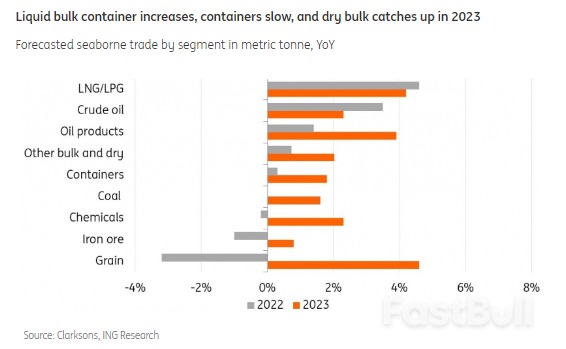
          More than 80% of world trade is seaborne. The breakdown in typical flows shows a mixed picture but is expected to sum up to just above 2% year-on-year in 2023 in terms of tonnage. This exceeds our forecast for world goods trade (in value), which can be explained by the fact that the energy crisis leads to more seaborne transport of energy carriers (like liquefied natural gas [LNG]). Next to that, airfreight carries mainly consumer goods, which has a more moderate outlook.
          Demand for oil and oil products is continuing to catch up after the pandemic setback and this is expected to continue in 2023, although the economic slowdown will weigh on demand. The European urgency to replace piped natural gas is also leading to a rush for seaborne LNG flows, but in terms of trade this is mainly a replacement of piped gas.
          On the container side, the inflationary environment with eroded purchasing power continues to temper demand for consumer goods in 2023, with growth sticking under 2% which is well below its long-term average. For dry bulk flows, 2023 is set to be a better year as industrial demand from China (particularly important for iron ore) is expected to catch up. On the other side, demand for coal from Europe continues to be strong and hampered grain trade due to the Black Sea blockage in 2022 is assumed to be less disturbed. Trade outlook 2023: Slow Steaming in Rough Waters_5

          2023 balance and rates: clearing backlogs and new capacity put extra pressure on container tariffs

          Next year we won't see another shortage in container shipping, as subsiding backlogs will boost productivity and a flood of new vessels will come online from 2023 amid a weakened market. Twenty-eight percent of the current installed fleet capacity is on order and just under half of that is expected to be delivered over the course of next year. This obviously threatens to accelerate the downward trend in spot prices. But container rates will not go down the drain, for these three reasons (in addition to the strong dollar):
          Better capacity management
          During the pandemic, container liners and alliances learned how to better manage capacity cancelling and cooperate in alliances, by cancelling scheduled sailings (blank sailings), (super) slow steaming, and scrapping less efficient older-generation vessels. During the previous two periods, scrapping numbers were extremely low and new IMO energy efficiency and intensity standards from 2023 (also turning into a vessel rating) will have an influence on this perspective.
          Increasing operational costs and larger capital investments
          Second, costs are higher in general due to increases in compliant fuel, port and infrastructure fees (for example, the Suez Canal rate hike of 15%) and wages. Next, ordered dual fuel and new-generation vessels require larger capital investments. And alternative fuels like LNG, biofuels and methanol are more costly. Lastly, more regulation is coming: in Europe, shipping is proposed to be included in the emissions trading scheme (ETS) as part of the new climate strategy, and the FuelEU Maritime proposal prescribes an annual reduction of the carbon-intensity of existing ships by 2% in 2025 which leads to the increased use of more expensive low carbon fuels. On a global scale, collectives including the getting to zero coalition and cargo owners for zero-emission vessels are also pushing for low-carbon solutions from 2030. The bottom line is, the cost base will be higher.
          Global supply chains are still fragile and exposed to volatility, leading to fragile supply chains
          Third, the war in Ukraine has disrupted the market, leading to trade inefficiencies such as longer routes. The workforce is also still stretched and spiking inflation could lead to more strikes and interruptions at ports. Lockdowns are still a local disruptive threat in China, while extreme weather events are a bigger operational risk in shipping. This means costly frictions remain a threat.

          Extreme weather is considered a bigger threat for supply chains than it used to be

          For the second time in only four years, low water levels in Germany's main rivers have seriously threatened economic activity, with most of the goods transported being intermediate goods and raw materials that are required for further processing in other industries and are preferably transported by ship, including bulk goods such as coal and steel, dangerous goods and heavy goods. In the US, falling water levels in the Mississippi River are currently log-jamming more than 100 vessels. In China, heatwaves and little rainfall have caused drought in the southwestern Chinese province of Sichuan, a hydroelectric power producer. Some factories in western China have been affected by limited-to-no-power supply, shopping malls have little air-con and lighting, and some apartments have been left without a working lift. Extreme weather events are becoming an ever-larger threat to the transportation sector, seriously affecting supply chains and hampering world trade. With extreme weather events on the rise, weather forecasts represent a disruptive threat urging resilience in global supply chains.

          Source: ING

          Risk Warnings and Disclaimers
          You understand and acknowledge that there is a high degree of risk involved in trading. Following any strategies or investment methods may lead to potential losses. The content on the site is provided by our contributors and analysts for information purposes only. You are solely responsible for determining whether any trading assets, securities, strategy, or any other product is suitable for investing based on your own investment objectives and financial situation.
          Comments
          Add to Favorites
          Share
          FastBull
          Copyright © 2025 FastBull Ltd

          728 RM B 7/F GEE LOK IND BLDG NO 34 HUNG TO RD KWUN TONG KLN HONG KONG

          TelegramInstagramTwitterfacebooklinkedin
          App Store Google Play Google Play
          Products
          Charts

          Chats

          Q&A with Experts
          Screeners
          Economic Calendar
          Data
          Tools
          Membership
          Features
          Function
          Markets
          Copy Trading
          Latest Signals
          Contests
          News
          Analysis
          24/7
          Columns
          Education
          Company
          Careers
          About Us
          Contact Us
          Advertising
          Help Center
          Feedback
          User Agreement
          Privacy Policy
          Business

          White Label

          Data API

          Web Plug-ins

          Poster Maker

          Affiliate Program

          Risk Disclosure

          The risk of loss in trading financial instruments such as stocks, FX, commodities, futures, bonds, ETFs and crypto can be substantial. You may sustain a total loss of the funds that you deposit with your broker. Therefore, you should carefully consider whether such trading is suitable for you in light of your circumstances and financial resources.

          No decision to invest should be made without thoroughly conducting due diligence by yourself or consulting with your financial advisors. Our web content might not suit you since we don't know your financial conditions and investment needs. Our financial information might have latency or contain inaccuracy, so you should be fully responsible for any of your trading and investment decisions. The company will not be responsible for your capital loss.

          Without getting permission from the website, you are not allowed to copy the website's graphics, texts, or trademarks. Intellectual property rights in the content or data incorporated into this website belong to its providers and exchange merchants.

          Not Logged In

          Log in to access more features

          FastBull Membership

          Not yet

          Purchase

          Become a signal provider
          Help Center
          Customer Service
          Dark Mode
          Price Up/Down Colors

          Log In

          Sign Up

          Position
          Layout
          Fullscreen
          Default to Chart
          The chart page opens by default when you visit fastbull.com