• Trade
  • Markets
  • Copy
  • Contests
  • News
  • 24/7
  • Calendar
  • Q&A
  • Chats
Trending
Screeners
SYMBOL
LAST
BID
ASK
HIGH
LOW
NET CHG.
%CHG.
SPREAD
SPX
S&P 500 Index
6827.42
6827.42
6827.42
6899.86
6801.80
-73.58
-1.07%
--
DJI
Dow Jones Industrial Average
48458.04
48458.04
48458.04
48886.86
48334.10
-245.98
-0.51%
--
IXIC
NASDAQ Composite Index
23195.16
23195.16
23195.16
23554.89
23094.51
-398.69
-1.69%
--
USDX
US Dollar Index
97.950
98.030
97.950
98.500
97.950
-0.370
-0.38%
--
EURUSD
Euro / US Dollar
1.17394
1.17409
1.17394
1.17496
1.17192
+0.00011
+ 0.01%
--
GBPUSD
Pound Sterling / US Dollar
1.33707
1.33732
1.33707
1.33997
1.33419
-0.00148
-0.11%
--
XAUUSD
Gold / US Dollar
4299.39
4299.39
4299.39
4353.41
4257.10
+20.10
+ 0.47%
--
WTI
Light Sweet Crude Oil
57.233
57.485
57.233
58.011
56.969
-0.408
-0.71%
--

Community Accounts

Signal Accounts
--
Profit Accounts
--
Loss Accounts
--
View More

Become a signal provider

Sell trading signals to earn additional income

View More

Guide to Copy Trading

Get started with ease and confidence

View More

Signal Accounts for Members

All Signal Accounts

Best Return
  • Best Return
  • Best P/L
  • Best MDD
Past 1W
  • Past 1W
  • Past 1M
  • Past 1Y

All Contests

  • All
  • Trump Updates
  • Recommend
  • Stocks
  • Cryptocurrencies
  • Central Banks
  • Featured News
Top News Only
Share

China's Central Financial And Economic Affairs Commission Deputy Director: Will Expand Export And Increase Import In 2026

Share

Thai Leader Anutin: Landmine Blast That Killed Thai Soldiers 'Not A Roadside Accident'

Share

Thai Leader Anutin: Thailand To Continue Military Action Until 'We Feel No More Harm'

Share

Cambodian Prime Minister Hun Manet Says He Had Phone Calls With Trump And Malaysian Leader Anwar About Ceasefire

Share

Cambodia's Hun Manet Says USA, Malaysia Should Verify 'Which Side Fired First' In Latest Conflict

Share

Cambodia's Hun Manet: Cambodia Maintains Its Stance In Seeking Peaceful Resolution Of Disputes

Share

Nasdaq Companies: Allergan, Ferrovia, Insmed, Monolithic Power Systems, Seagate Technology, And Western Digital Will Be Added To The NASDAQ 100 Index. Biogen, CdW, GlobalFoundries, Lululemon, ON Semiconductor, And Tradedesk Will Be Removed From The NASDAQ 100 Index

Share

Witkoff Headed To Berlin This Weekend To Meet With Zelenskiy, European Leaders -Wsj Reporter On X

Share

Russia Attacks Two Ukrainian Ports, Damaging Three Turkish-Owned Vessels

Share

[Historic Flooding Occurs In At Least Four Rivers In Washington State Due To Days Of Torrential Rains] Multiple Areas In Washington State Have Been Hit By Severe Flooding Due To Days Of Torrential Rains, With At Least Four Rivers Experiencing Historic Flooding. Reporters Learned On The 12th That The Floods Caused By The Torrential Rains In Washington State Have Destroyed Homes And Closed Several Highways. Experts Warn That Even More Severe Flooding May Occur In The Future. A State Of Emergency Has Been Declared In Washington State

Share

Trump Says Proposed Free Economic Zone In Donbas Would Work

Share

Trump: I Think My Voice Should Be Heard

Share

Trump Says Will Be Choosing New Fed Chair In Near Future

Share

Trump Says Proposed Free Economic Zone In Donbas Complex But Would Work

Share

Trump Says Land Strikes In Venezuela Will Start Happening

Share

US President Trump: Thailand And Cambodia Are In A Good Situation

Share

State Media: North Korean Leader Kim Hails Troops Returning From Russia Mission

Share

The 10-year Treasury Yield Rose About 5 Basis Points During The "Fed Rate Cut Week," And The 2/10-year Yield Spread Widened By About 9 Basis Points. On Friday (December 12), In Late New York Trading, The Yield On The Benchmark 10-year US Treasury Note Rose 2.75 Basis Points To 4.1841%, A Cumulative Increase Of 4.90 Basis Points For The Week, Trading Within A Range Of 4.1002%-4.2074%. It Rose Steadily From Monday To Wednesday (before The Fed Announced Its Rate Cut And Treasury Bill Purchase Program), Subsequently Exhibiting A V-shaped Recovery. The 2-year Treasury Yield Fell 1.82 Basis Points To 3.5222%, A Cumulative Decrease Of 3.81 Basis Points For The Week, Trading Within A Range Of 3.6253%-3.4989%

Share

Trump: Lots Of Progress Being Made On Russia-Ukraine

Share

NOPA November US Soybean Crush Estimated At 220.285 Million Bushels

TIME
ACT
FCST
PREV
U.K. Trade Balance Non-EU (SA) (Oct)

A:--

F: --

P: --

U.K. Trade Balance (Oct)

A:--

F: --

P: --

U.K. Services Index MoM

A:--

F: --

P: --

U.K. Construction Output MoM (SA) (Oct)

A:--

F: --

P: --

U.K. Industrial Output YoY (Oct)

A:--

F: --

P: --

U.K. Trade Balance (SA) (Oct)

A:--

F: --

P: --

U.K. Trade Balance EU (SA) (Oct)

A:--

F: --

P: --

U.K. Manufacturing Output YoY (Oct)

A:--

F: --

P: --

U.K. GDP MoM (Oct)

A:--

F: --

P: --

U.K. GDP YoY (SA) (Oct)

A:--

F: --

P: --

U.K. Industrial Output MoM (Oct)

A:--

F: --

P: --

U.K. Construction Output YoY (Oct)

A:--

F: --

P: --

France HICP Final MoM (Nov)

A:--

F: --

P: --

China, Mainland Outstanding Loans Growth YoY (Nov)

A:--

F: --

P: --

China, Mainland M2 Money Supply YoY (Nov)

A:--

F: --

P: --

China, Mainland M0 Money Supply YoY (Nov)

A:--

F: --

P: --

China, Mainland M1 Money Supply YoY (Nov)

A:--

F: --

P: --

India CPI YoY (Nov)

A:--

F: --

P: --

India Deposit Gowth YoY

A:--

F: --

P: --

Brazil Services Growth YoY (Oct)

A:--

F: --

P: --

Mexico Industrial Output YoY (Oct)

A:--

F: --

P: --

Russia Trade Balance (Oct)

A:--

F: --

P: --

Philadelphia Fed President Henry Paulson delivers a speech
Canada Building Permits MoM (SA) (Oct)

A:--

F: --

P: --

Canada Wholesale Sales YoY (Oct)

A:--

F: --

P: --

Canada Wholesale Inventory MoM (Oct)

A:--

F: --

P: --

Canada Wholesale Inventory YoY (Oct)

A:--

F: --

P: --

Canada Wholesale Sales MoM (SA) (Oct)

A:--

F: --

P: --

Germany Current Account (Not SA) (Oct)

A:--

F: --

P: --

U.S. Weekly Total Rig Count

A:--

F: --

P: --

U.S. Weekly Total Oil Rig Count

A:--

F: --

P: --

Japan Tankan Large Non-Manufacturing Diffusion Index (Q4)

--

F: --

P: --

Japan Tankan Small Manufacturing Outlook Index (Q4)

--

F: --

P: --

Japan Tankan Large Non-Manufacturing Outlook Index (Q4)

--

F: --

P: --

Japan Tankan Large Manufacturing Outlook Index (Q4)

--

F: --

P: --

Japan Tankan Small Manufacturing Diffusion Index (Q4)

--

F: --

P: --

Japan Tankan Large Manufacturing Diffusion Index (Q4)

--

F: --

P: --

Japan Tankan Large-Enterprise Capital Expenditure YoY (Q4)

--

F: --

P: --

U.K. Rightmove House Price Index YoY (Dec)

--

F: --

P: --

China, Mainland Industrial Output YoY (YTD) (Nov)

--

F: --

P: --

China, Mainland Urban Area Unemployment Rate (Nov)

--

F: --

P: --

Saudi Arabia CPI YoY (Nov)

--

F: --

P: --

Euro Zone Industrial Output YoY (Oct)

--

F: --

P: --

Euro Zone Industrial Output MoM (Oct)

--

F: --

P: --

Canada Existing Home Sales MoM (Nov)

--

F: --

P: --

Euro Zone Total Reserve Assets (Nov)

--

F: --

P: --

U.K. Inflation Rate Expectations

--

F: --

P: --

Canada National Economic Confidence Index

--

F: --

P: --

Canada New Housing Starts (Nov)

--

F: --

P: --

U.S. NY Fed Manufacturing Employment Index (Dec)

--

F: --

P: --

U.S. NY Fed Manufacturing Index (Dec)

--

F: --

P: --

Canada Core CPI YoY (Nov)

--

F: --

P: --

Canada Manufacturing Unfilled Orders MoM (Oct)

--

F: --

P: --

Canada Manufacturing New Orders MoM (Oct)

--

F: --

P: --

Canada Core CPI MoM (Nov)

--

F: --

P: --

Canada Manufacturing Inventory MoM (Oct)

--

F: --

P: --

Canada CPI YoY (Nov)

--

F: --

P: --

Canada CPI MoM (Nov)

--

F: --

P: --

Canada CPI YoY (SA) (Nov)

--

F: --

P: --

Canada Core CPI MoM (SA) (Nov)

--

F: --

P: --

Q&A with Experts
    • All
    • Chatrooms
    • Groups
    • Friends
    Connecting
    .
    .
    .
    Type here...
    Add Symbol or Code

      No matching data

      All
      Trump Updates
      Recommend
      Stocks
      Cryptocurrencies
      Central Banks
      Featured News
      • All
      • Russia-Ukraine Conflict
      • Middle East Flashpoint
      • All
      • Russia-Ukraine Conflict
      • Middle East Flashpoint
      Search
      Products

      Charts Free Forever

      Chats Q&A with Experts
      Screeners Economic Calendar Data Tools
      Membership Features
      Data Warehouse Market Trends Institutional Data Policy Rates Macro

      Market Trends

      Market Sentiment Order Book Forex Correlations

      Top Indicators

      Charts Free Forever
      Markets

      News

      News Analysis 24/7 Columns Education
      From Institutions From Analysts
      Topics Columnists

      Latest Views

      Latest Views

      Trending Topics

      Top Columnists

      Latest Update

      Signals

      Copy Rankings Latest Signals Become a signal provider AI Rating
      Contests
      Brokers

      Overview Brokers Assessment Rankings Regulators News Claims
      Broker listing Forex Brokers Comparison Tool Live Spread Comparison Scam
      Q&A Complaint Scam Alert Videos Tips to Detect Scam
      More

      Business
      Events
      Careers About Us Advertising Help Center

      White Label

      Data API

      Web Plug-ins

      Affiliate Program

      Awards Institution Evaluation IB Seminar Salon Event Exhibition
      Vietnam Thailand Singapore Dubai
      Fans Party Investment Sharing Session
      FastBull Summit BrokersView Expo
      Recent Searches
        Top Searches
          Markets
          News
          Analysis
          User
          24/7
          Economic Calendar
          Education
          Data
          • Names
          • Latest
          • Prev

          View All

          No data

          Scan to Download

          Faster Charts, Chat Faster!

          Download App
          English
          • English
          • Español
          • العربية
          • Bahasa Indonesia
          • Bahasa Melayu
          • Tiếng Việt
          • ภาษาไทย
          • Français
          • Italiano
          • Türkçe
          • Русский язык
          • 简中
          • 繁中
          Open Account
          Search
          Products
          Charts Free Forever
          Markets
          News
          Signals

          Copy Rankings Latest Signals Become a signal provider AI Rating
          Contests
          Brokers

          Overview Brokers Assessment Rankings Regulators News Claims
          Broker listing Forex Brokers Comparison Tool Live Spread Comparison Scam
          Q&A Complaint Scam Alert Videos Tips to Detect Scam
          More

          Business
          Events
          Careers About Us Advertising Help Center

          White Label

          Data API

          Web Plug-ins

          Affiliate Program

          Awards Institution Evaluation IB Seminar Salon Event Exhibition
          Vietnam Thailand Singapore Dubai
          Fans Party Investment Sharing Session
          FastBull Summit BrokersView Expo

          The World Is Scarred from China Shock 1.0. They're Not About to Let 2.0 Happen So Easily

          Samantha Luan

          Economic

          Political

          Summary:

          China is pivoting to new growth drivers in solar cells, electric vehicles.This could create "China shock 2.0" that impacts other economies around the world.The US and other nations are strategizing to counter China's emerging dominance in these industries.

          China's economy is undergoing a painful transition as Beijing tries to steer it out of a post-COVID slump and a real-estate debt crisis.
          Chinese leader Xi Jinping's administration is championing what it calls the "new three" industries of solar cells, electric vehicles, and lithium-ion batteries to drive its economy.
          It's already manufacturing and exporting these goods aggressively.
          In particular, China's manufacturers are pumping out so many solar panels that the resulting global glut and price crash are prompting people to line their garden fences with the once-prized product.
          This is just one of the industries the world is bracing for in the next phase of the "China shock."

          What happened in China shock 1.0?

          "China shock" was a term coined by David H. Autor, David Dorn, and Gordon H. Hanson in a 2016 paper about the country's economic rise and its impact on the world's trade and labor markets.
          Once mired in poverty, Communist China started its economic reforms in 1978 when it opened up its economy and allowed for more private enterprise.
          The country's growth was breakneck, with GDP growing over 80 times since then.
          That growth was driven by rapid industrialization, which propelled China into the position of the world's factory. Its massive manufacturing sector churned out millions of products that it exported at low cost.
          The world welcomed China into its fold, heralding an age of globalization that companies from the US and elsewhere profited from. At the time, policymakers were of the view that the East Asian giant would become more open economically and politically as a result of this integration.
          Consumers, too, benefited from low inflation.
          However, this trend came at a huge cost for communities in the US and elsewhere that were dependent on manufacturing. Swathes of workers lost their jobs to China.
          This is the "China shock."

          How Beijing could be creating China shock 2.0

          Now, China is targeting three new strategic industries that the rest of the world is also eying.
          This time, though, Western countries are not letting Beijing get its way so easily — especially since China is aiming to develop its own supply chain ecosystem in these areas.
          "The advanced economies are facing the combined impact of China's moderating medium-term GDP growth on global demand as well as competition from China's new wave of industrialization," Rajiv Biswas, an international economist and the author of "Asian Megatrends," told Business Insider.
          This development doesn't stem only from China's push into manufacturing the end products in the fields of EVs, lithium-ion batteries, and solar cells. The country is also developing global supply chains for critical raw materials, such as rare earths, that will supply these industries.
          "Consequently, the industrial economies of the OECD nations are facing new economic challenges from China's strategic competition in these key growth industries," Biswas said.
          Such competition is even keener now due to deflation in China— which has become the only major economy in the world dealing with negative consumer prices.
          Meanwhile, China's slowing economic growth also means it's not buying as much from other countries, ratcheting up trade tensions.
          Last year, China's imports of goods from the rest of the world fell by 5.5% from a year ago, official data shows.

          What is the US and the rest of the world doing about China shock 2.0?

          The world isn't going to be caught flat-footed by China's emerging dominance in hot new industries this time.
          "It is likely that strategic competition between the US, EU, and China will continue in the long-term in areas of advanced manufacturing technologies," said Biswas.
          Many companies are already diversifying supply chains away from China for a range of products.
          The US is taking steps to boost chip manufacturing at home. The CHIPS Act provides $52 billion in subsidies for production, research, and workforce development. The US Inflation Reduction Act is also boosting investment in clean energy.
          On April 2, the Department of Energy announced a $75 million investment to develop a research facility to strengthen the domestic supply chains of critical minerals.
          Meanwhile, US Treasury Secretary Janet Yellen is in China for meetings with top Chinese officials. The Treasury said in a press release announcing her visit that she will be "pressing Chinese counterparts on unfair trade practices and underscoring the global economic consequences of Chinese industrial overcapacity."
          At a Suniva solar cell plant in Georgia on March 27, Yellen said she was "concerned about global spillovers from the excess capacity that we are seeing in China" that have now hit new energy industries like solar, electric vehicles, and lithium-ion batteries.
          The European Union, too, is taking steps to protect its domestic manufacturing in emerging key industries.
          In October, the European Commission launched a probe into whether EV imports from China benefited from illegal subsidization that in turn, threatens to damage the EU's EV manufacturers. If this is found to be true, the EU could impose tariffs on these imports. The EU investigation is ongoing.
          The EU has also established the European Chips Act to boost domestic chip production.
          After all, it's once bitten, twice shy.
          "People like me grew up with the view: If people send you cheap goods, you should send a thank-you note. That's what standard economics basically says," Yellen told the Journal in an interview published on Wednesday. "I would never ever again say, 'Send a thank-you note.'"

          What is China's response to the West's moves?

          China is framing the US response as a move to contain its growth.
          "The US side has adopted a string of measures to suppress China's trade and technology development," Wang Wenbin, a spokesperson for the Chinese foreign ministry, said at a regular press conference on Wednesday.
          "This is not 'de-risking,' but creating risks. These are typical non-market practices," Wang added.
          He also said China's exports of EVs, lithium-ion batteries, and solar cells have risen due to the "international division of labor and market demand" thanks to the global energy transition to more sustainable energy sources.
          China is also de-risking by increasingly trading with Southeast Asia, where there is a burgeoning middle class, said Biswas, the economist. Other large developing markets China is targeting include Africa and Latin America, he added.
          Last year, China exported more goods to Southeast Asia than to the US for the first time ever, according to a Bloomberg analysis of Chinese customs data published in January — signaling a change in global trade flows amid the changing geopolitical landscape.
          The US presidential election campaign season this year is likely to heat up some trade issues, Nomura economists wrote in a note on March 15.
          "We reckon China's export price deflation and overcapacity in a number of strategically important sectors might cause trade tensions to escalate later this year, and possibly beyond," the Nomura economists added.

          Source: Business insider

          To stay updated on all economic events of today, please check out our Economic calendar
          Risk Warnings and Disclaimers
          You understand and acknowledge that there is a high degree of risk involved in trading. Following any strategies or investment methods may lead to potential losses. The content on the site is provided by our contributors and analysts for information purposes only. You are solely responsible for determining whether any trading assets, securities, strategy, or any other product is suitable for investing based on your own investment objectives and financial situation.
          Add to Favorites
          Share

          Eurozone Economic Pulse Quickens Thanks to Services: Can Stocks Surge Further?

          Thomas

          Economic

          Stocks

          The Eurozone economy is witnessing an upswing, with the latest business surveys indicating the fastest expansion in private sector activity in the last ten months, primarily driven by the services sector's robust growth.
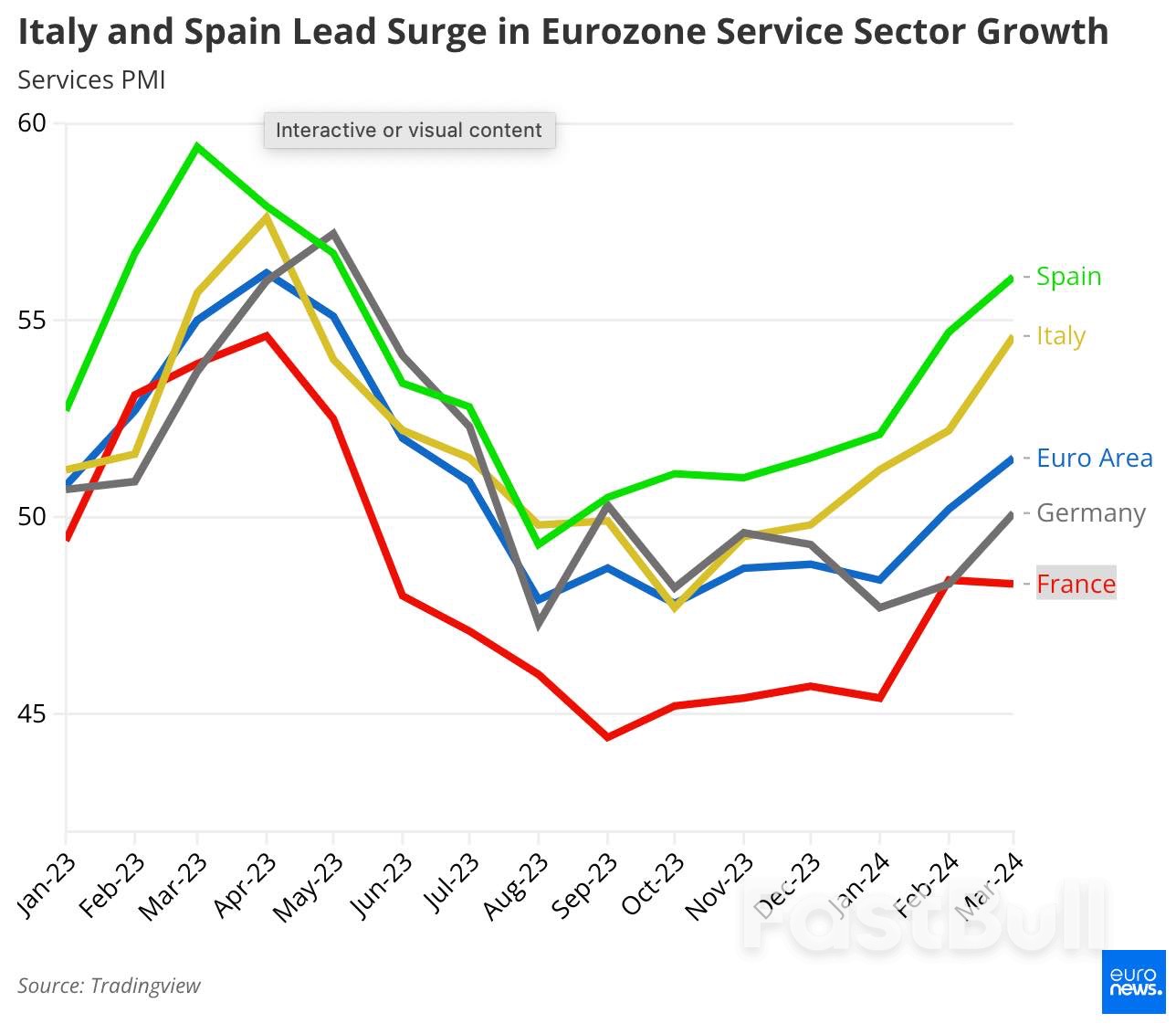
          According to the latest Eurozone Composite PMI data, activity expanded to 50.3 in March, the most robust level observed since May 2023. This revision from an initial estimate of 49.9 signifies a notable leap from February's 49.2, hinting at expansionary economic conditions.

          Sectoral divergence: Services vs. manufacturing

          However, a stark contrast between the health of the services and manufacturing sectors remains evident. The Eurozone Services PMI climbed to 51.5 from February's 50.2. On the other hand, manufacturing PMI lingered in contraction territory at 46.1 in March 2024, underscoring ongoing challenges in the sector.
          arch witnessed a sustained robust performance in the service sector job market, with employment levels increasing for the thirty-eighth consecutive month. Additionally, a notable deceleration in service sector input cost inflation to an eight-month low suggests easing price pressures, a welcome sign for the eurozone economy.
          Optimism among businesses surged, reaching its most elevated level since the eve of Russia’s invasion of Ukraine in February 2022.
          Dr. Cyrus de la Rubia, Chief Economist at Hamburg Commercial Bank, offered an insightful analysis, stating, "the service sector in the eurozone is gradually finding its footing, fuelled by wage growth outpacing inflation, thus bolstering the purchasing power of households." He further elaborated, "individuals are more inclined to dine out, travel, and spend their money on other services. However, a full-fledged boom is not on the horizon."

          Regional highlights: Italy and Spain lead service expansion

          Eurozone Economic Pulse Quickens Thanks to Services: Can Stocks Surge Further?_1
          This optimistic outlook is mirrored across several eurozone countries, with Spain (55.3) and Italy (53.5) achieving 11-month highs in their Composite PMI Output Index, followed by Ireland (53.2). Despite France (48.3) and Germany (47.7) recording improvements, their figures still indicate contraction, though at a reduced pace.
          Germany's service sector notably edged above the stagnation mark, with the Services PMI climbing to 50.1 in March from February's 48.3, a sign of modest recovery. Spain and Italy's service sectors exhibited strong expansion, with PMIs reaching 10 and 11-month highs, respectively.
          Despite these positive developments, France's service sector continued to contract, marking a ten-month streak of decline, albeit at the weakest pace yet.
          Dr. Tariq Kamal Chaudhry, an economist at Hamburg Commercial Bank, highlighted the upbeat sentiment among service providers in Italy, noting an increase in orders both domestically and internationally. "This buoyancy", he remarked, "positions the service sector as a key growth driver in the Italian economy, which has faced stagnant growth rates". The HCOB Nowcast predicts this momentum could nudge economic growth slightly above zero for the first quarter of 2024.

          Can the European stock market rally continue

          Eurozone Economic Pulse Quickens Thanks to Services: Can Stocks Surge Further?_2
          The eurozone's economic recovery continues, with services sector performance suggesting a potential upward revision of growth forecasts for the first half of 2024.
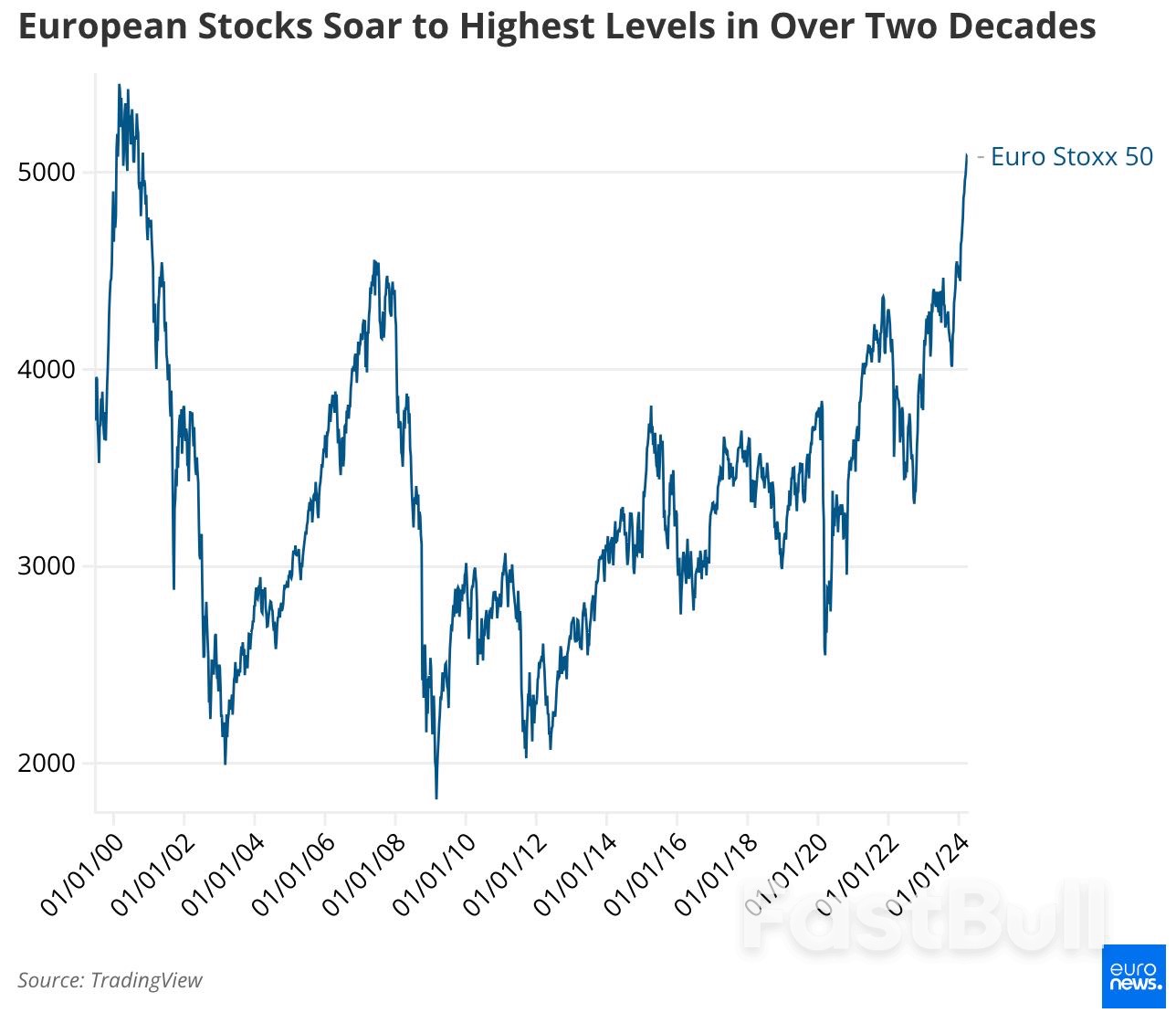
          The European stock market, as reflected by the Euro Stoxx 50 index, is at its highest since November 2000. It has enjoyed nine consecutive weeks of gains, boasting a 12% increase since the beginning of the year. These figures are reflective of the confidence investors have in the economic recovery and the health of the corporate sector within the euro area.
          Current market valuations do not raise particular concerns, with the price-to-earnings ratio hovering around 14 times, which aligns with the ten-year historical average. This suggests that the market is not overvalued by historical standards, allowing room for cautious optimism among investors.
          The sustainability of this stock rally may well depend on the continuation of current trends, namely declining inflation rates, expectations of ECB rate cuts, and upward revisions in the profit estimates of European companies. These factors have provided the foundation for the ongoing optimism in the markets.
          However, a principal risk to European equities currently stems from the generalised rise in commodity prices. Brent crude oil's ascent to $90 a barrel, marking a 16% increase since the year's start, could foreshadow a resurgence of inflation in Europe. Such a development may squeeze corporate profit margins and place the ECB under pressure regarding its interest rate decisions.

          Source: euronews.com

          To stay updated on all economic events of today, please check out our Economic calendar
          Risk Warnings and Disclaimers
          You understand and acknowledge that there is a high degree of risk involved in trading. Following any strategies or investment methods may lead to potential losses. The content on the site is provided by our contributors and analysts for information purposes only. You are solely responsible for determining whether any trading assets, securities, strategy, or any other product is suitable for investing based on your own investment objectives and financial situation.
          Add to Favorites
          Share

          How Biden’s Inflation Problem Risks Derailing Western Rate Cuts

          Alex

          Central Bank

          Economic

          When a tough decision looms, it helps if someone else can make it first and take the blame if it all goes wrong.
          It’s a position much of the world’s central banking fraternity have found themselves in.
          Almost all raised interest rates to battle inflation, and are now looking for the chance to cut borrowing costs back down again.
          The difficulty is working out when.
          Luckily, June appears to provide the perfect opportunity. The European Central Bank meets first on June 6, followed by the US Federal Reserve a week later, then the Bank of England shortly after.
          It means Andrew Bailey and his colleagues in Threadneedle Street can wait for the Fed – and preferably the ECB too – to act, then follow suit.
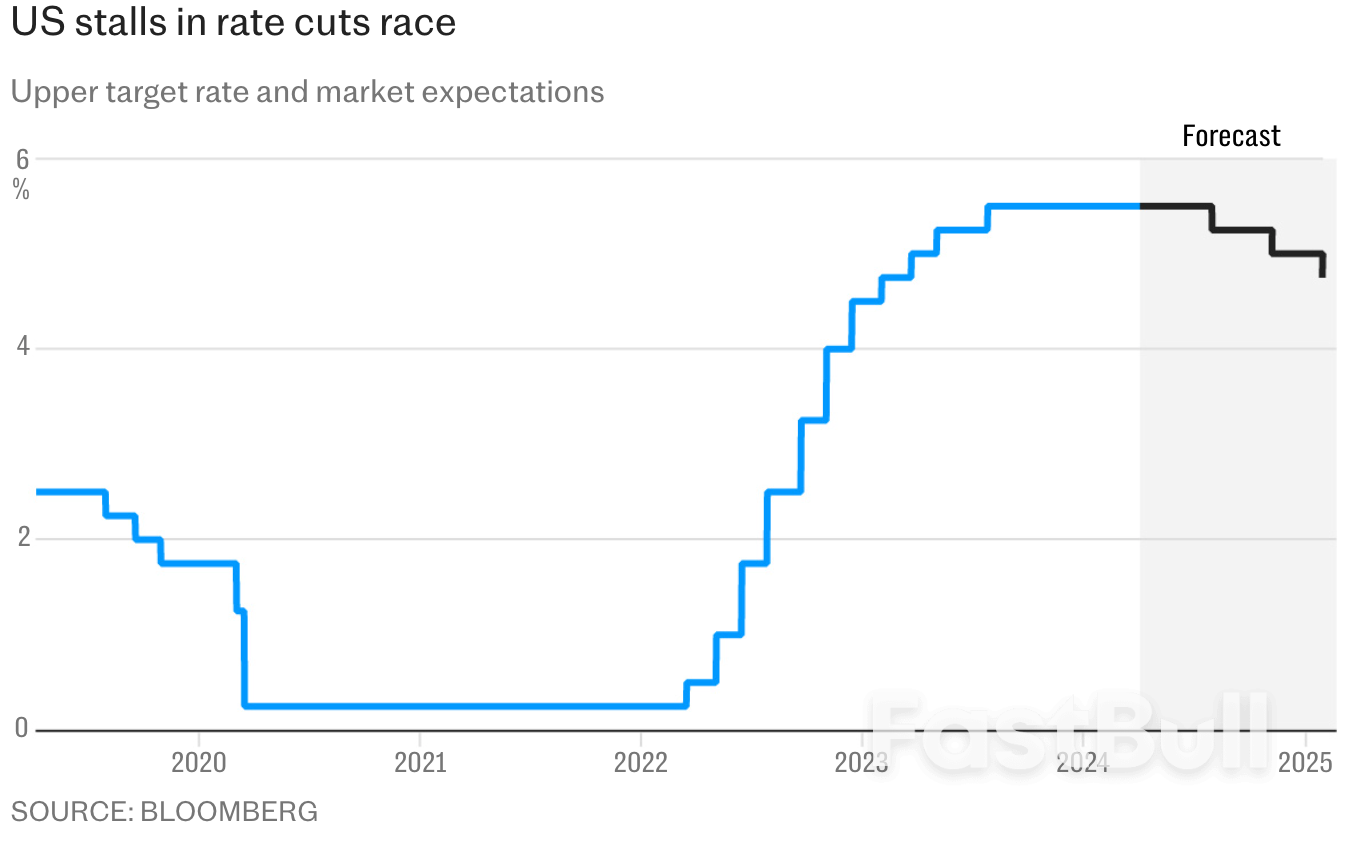
          But even as the weak eurozone economy appears to be crying out for lower rates, the American juggernaut, pumped up on Joe Biden’s heavy borrowing and spending, thunders on, and thus may require rates to stay higher for longer. Traders in financial markets are now pushing back their predictions for the first US rate cut to July.
          How Biden’s Inflation Problem Risks Derailing Western Rate Cuts_1
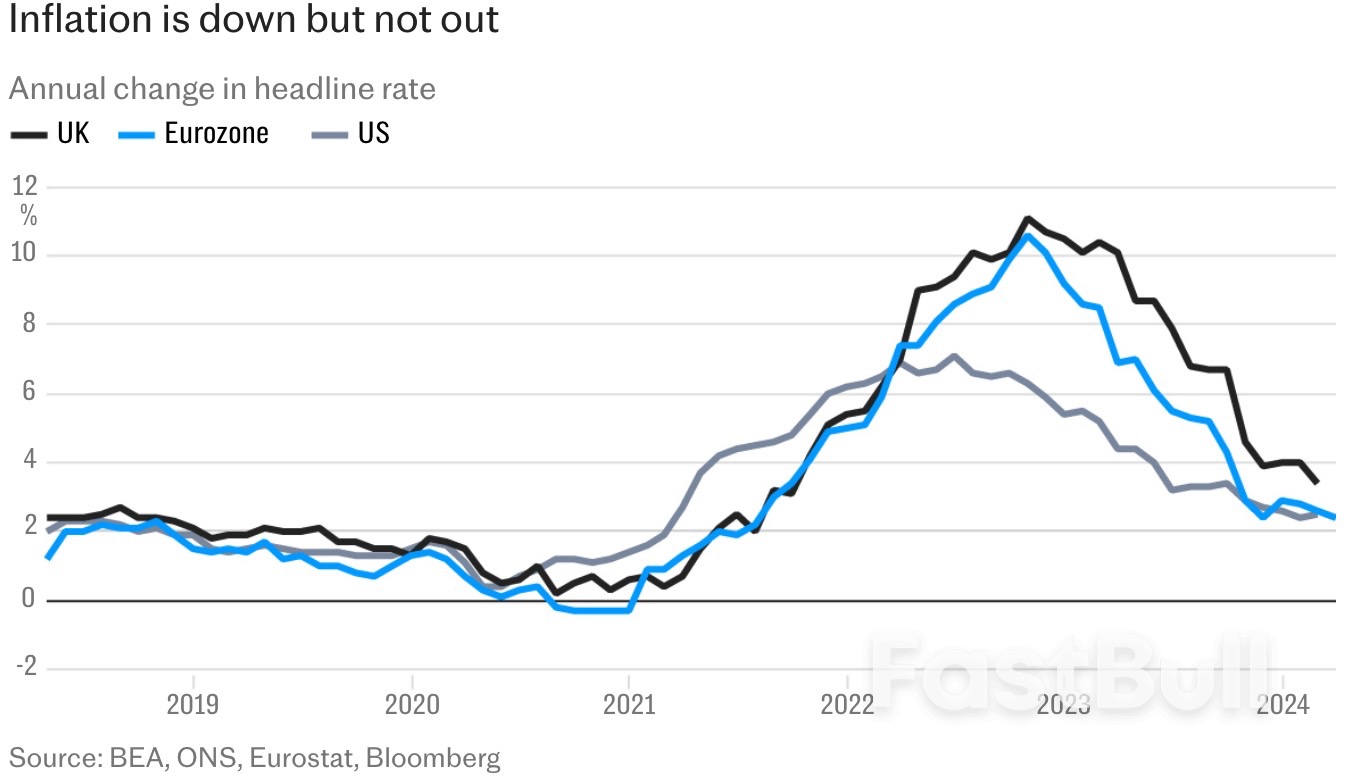
          Recent US inflation data suggest price rises remain stubbornly high. Headline inflation, as measured by the consumer prices index (CPI), stood at 3.2pc in February, while core inflation, which strips out volatile movements in food and energy, showed prices were 3.8pc higher than a year ago.
          The Fed’s preferred measure of inflation, based on the personal consumption expenditures (PCE) index, currently stands at 2.5pc – or 2.8pc excluding food and energy. All measures remain above the central bank’s 2pc target.
          Analysis by Goldman Sachs showed housing costs remain a key driver. With costs up 6pc compared with a year ago, this is double the average of the past two decades and well above the rate consistent with the Fed’s 2pc target.
          Restaurants and other leisure spending also remain key drivers of inflation, while spending on hotels and furnishings is much softer.
          Goldman also highlighted that while energy prices are currently at 138pc of pre-pandemic levels and wage growth remains robust, there are signs that the jobs market is cooling. Goldman believes inflation will be back at the Fed’s 2pc target by next year.
          How Biden’s Inflation Problem Risks Derailing Western Rate Cuts_2
          But Pimco, one of the world’s biggest bond investors, said growth in the world’s biggest economy remained “surprisingly strong” and was likely to continue relative to other G7 economies.
          “We still expect the Fed to start normalising policy midyear, similar to other developed market central banks. However, the Fed’s subsequent rate-cutting path could be more gradual,” said Pimco’s Tiffany Wilding and Andrew Balls.
          “The factors that have contributed to US resilience could continue to support the (still-slowing) economy for a while longer,” they added, outlining five reasons why the US economy was likely to stay strong.
          Biden’s spending spree during the pandemic was one major factor, they said. “Still-elevated Federal deficits have bolstered US demand relative to other regions.”
          The US deficit in 2023 was $1.7 trillion (£1.35 trillion), or 6.3pc of GDP.
          Pimco also described the looming US election as an “inflection point” that nevertheless suggested both candidates would “lean towards policies” that would boost economic growth and borrowing.

          Source: The Telegraph

          To stay updated on all economic events of today, please check out our Economic calendar
          Risk Warnings and Disclaimers
          You understand and acknowledge that there is a high degree of risk involved in trading. Following any strategies or investment methods may lead to potential losses. The content on the site is provided by our contributors and analysts for information purposes only. You are solely responsible for determining whether any trading assets, securities, strategy, or any other product is suitable for investing based on your own investment objectives and financial situation.
          Add to Favorites
          Share

          ASIndia Stares At High Youth Unemployment As Hiring In Its Behemoth IT sector slows

          Samantha Luan

          Economic

          India is facing a youth unemployment problem as a decline in white-collar jobs in its information technology sector has left many fresh graduates and young people unemployed.
          In the October to December period last year, unemployment in India’s youth aged 20 to 24 years rose to 44.49%, from 43.65% in the previous quarter. Unemployment among 25- to 29-year-olds rose to 14.33% during the same period from 13.35% in the prior quarter, according to the Centre for Monitoring Indian Economy.
          The world’s most populous country, which also has the world’s largest youth population, had 43.3 million university enrollments in fiscal year ending March 2022, according to the latest government data.
          “We’ve seen consistently high growth of the economy, but I don’t think employment has kept up pace,” Chandra Garisa, CEO of recruitment firm Foundit said, explaining that white-collar job availability, especially in the IT sector, has been on a decline.
          “One of the largest segments that employ white-collar employees is IT and services, and hiring in the sector has slowed down quite a bit,” he told CNBC.
          As automation and artificial intelligence adoption picks up pace, many roles in IT are becoming redundant — a phenomenon that’s not restricted to India.
          “Earlier, the vast majority of college graduates used to be hired for basic skills, but now those basic skills are being taken care of by technology,” Garisa noted.
          Data from Foundit showed that online hiring for both IT hardware and software sections plummeted by 18% last year from 2022. IT saw the biggest decline in hiring activity across the 14 sectors in the study. There was also an overall 5% drop in job postings in 2023 from the prior year.
          “There is a mismatch between demand and supply of jobs and it is becoming a larger social issue in India,” Suyash Rai, deputy director and fellow at Carnegie India told CNBC.
          The IT sector is estimated to have employed 5.4 million people in fiscal year ending March 2023, according to the Ministry of Electronics and IT.

          Skills mismatch

          Youth unemployment in India is also driven by a “transitory mismatch of skills” as many students are equipped with skills for the IT sector, but job creation is happening in the manufacturing industry,” Garisa said.
          “Two big things are creating a skills mismatch — shift in demand across sectors which are opening up more opportunities, and advancements in technology which is making basic skills irrelevant,” he added.
          In February, there was a 6% rise in job postings in the manufacturing sector compared to the previous month while IT postings fell by 9%, according to Foundit.
          “The sectors which were hiring traditionally in the past are not the same ones which are growing and hiring now,” Garisa said. “What is being demanded from a fresh graduate now is very different from five years back, or even two years back.”
          For instance, jobs in the manufacturing sector that required AI skills rose by 21% last year from just 8% in 2022, with positions for data analysts and junior technical software engineers seeing the highest jumps, according to Foundit.
          Garisa highlighted that there is still a perception among the youth that careers in the manufacturing sector are not as good as those in IT — which means some candidates might not be able to capitalize on the emerging new jobs.
          “That’s changing, but it needs to change a lot more for outgoing graduates from college to really look at these as quality career opportunities.”

          Source:CNBC

          To stay updated on all economic events of today, please check out our Economic calendar
          Risk Warnings and Disclaimers
          You understand and acknowledge that there is a high degree of risk involved in trading. Following any strategies or investment methods may lead to potential losses. The content on the site is provided by our contributors and analysts for information purposes only. You are solely responsible for determining whether any trading assets, securities, strategy, or any other product is suitable for investing based on your own investment objectives and financial situation.
          Add to Favorites
          Share

          Singapore’s Region-Lagging Bonds Face Little Near-Term Relief

          Devin

          Economic

          Bond

          Overseas investors in Singapore government bonds may need to steel themselves for more disappointment.
          The debt is already the worst performing in Southeast Asia in dollar terms this year with a loss of over 4%, data compiled by Bloomberg showed. The upcoming policy review by the Monetary Authority of Singapore is unlikely to provide much relief, given sticky inflation and still solid economic data. In any case, MAS uses the local dollar as its main policy tool, meaning bonds are often driven by moves in overseas markets.
          Bond investors around the world are keenly awaiting a wave of easing by central banks, notably the Federal Reserve, after the most aggressive tightening campaign in living memory dealt a blow to the market. But the expected start of rate cuts has been steadily pushed back as the US economy proves resilient and Treasury yields have climbed back to new highs for the year.
          In this environment, Singapore bonds find themselves caught somewhat between a rock and a hard place, given their strong link to the US market. Local yields tend to follow any move in their Treasury counterparts higher but are unlikely to drop as much as many regional peers when the cutting cycle begins.
          “Given that USD rates have run up a lot more than SGD rates, we would expect SGD rates to fall less than USD rates in an easing cycle,” said Eugene Leow, senior rates strategist at DBS Group Holdings. “A reasonable base case is between 2-3 Fed cuts this year. So SGD rates should already be reflecting this pricing.”
          Two Federal Reserve officials who vote on US monetary policy decisions this year said this week that they still expect three rate cuts in 2024.
          Singapore’s rate of core inflation, which excludes housing and private transportation costs, accelerated to a seven-month high in February, the most recently available data showed. The MAS watches the core measure closely to determine policy settings.
          MAS policy isn’t likely to change until October “unless Singapore inflation posts larger than expected declines in the coming months,” said Winson Phoon, head of fixed-income research at Maybank Securities Pte in Singapore.
          For DBS’s Leow, what happens in the US is more of an issue for Singapore bonds than affairs at home. For example, a stronger greenback could put a bit of upward pressure on yields, he said.
          “We think the MAS will stay on hold this April,” he said. “There should not be any material impact on Singapore yields, which still takes the cue from USD rates.”

          Source: Bloomberg

          To stay updated on all economic events of today, please check out our Economic calendar
          Risk Warnings and Disclaimers
          You understand and acknowledge that there is a high degree of risk involved in trading. Following any strategies or investment methods may lead to potential losses. The content on the site is provided by our contributors and analysts for information purposes only. You are solely responsible for determining whether any trading assets, securities, strategy, or any other product is suitable for investing based on your own investment objectives and financial situation.
          Add to Favorites
          Share

          The Commodities Feed: No Change to OPEC+ Policy

          ING

          Commodity

          Economic

          Energy – JMMC recommends no change to OPEC+ cuts

          Oil prices continue to edge higher, although Brent is facing some resistance at the US$90/bbl level, with it unable to break above it so far. Meanwhile, the market is also moving into overbought territory.
          OPEC+ held its Joint Ministerial Monitoring Committee (JMMC) meeting yesterday and as widely expected the committee recommended no change to the group’s output policy for the remainder of the quarter, which will keep the market in deficit through the second quarter and support prices. The meeting appears to have focused on compliance with supply cuts, with members who have overproduced in the first quarter of the year set to submit compensation plans by the end of April. The next JMMC meeting will be held on 1 June.
          The latest inventory report from the EIA shows that US commercial crude oil inventories increased by an unexpected 3.21m barrels over the last week. API numbers earlier in the week showed that crude oil inventories fell by 2.29m barrels. The increase reported by the EIA seems to be driven by lower crude exports, which fell by 159k b/d week-on-week, while refinery run rates were also marginally lower over the week. While crude stock changes were bearish, the report was more constructive when looking at refined products, where we saw stock draws and stronger implied demand.
          Gasoline inventories fell by 4.26m barrels over the week, which leave total US gasoline inventories at 227.8m barrels – below the 5-year average of around 235m barrels. The fall in gasoline stocks was driven by the East Coast, where they fell by 3.43m barrels, leaving stocks in the region almost 9% below the 5-year average. Tightening gasoline stocks going into the summer driving season suggests that gasoline cracks are likely to remain firm.
          The US Department of Energy (DoE) decided not to go ahead with its latest tender to buy up to 3m barrels of crude oil for the Strategic Petroleum Reserve. The planned purchase was announced in mid-March for August and September deliveries. Current market conditions would have made the DoE reconsider the purchase, given the rally we have seen in the market.

          Metals – Zinc smelting charges fall on tighter supply

          Tight concentrate supply and rising competition for mined ores have pushed zinc smelting charges lower. According to media reports, Korea Zinc, in an annual deal with Canada’s Teck Resources Ltd, has agreed to a 40% decline in zinc smelting fees. Teck has signed to supply smelters with zinc concentrates from its Red Dog mine in Alaska, with processing fees set at $165/t, down from $274/t seen last year. This is the lowest level since 2021. Teck’s deals serve as a benchmark for the rest of the industry and a sharp decline in processing charges could put a strain on the profit margins of zinc smelters globally.
          SHFE weekly inventories for all base metals rose over the last week, according to the latest data from the exchange. Copper stocks increased by 1,621 tonnes to 291,849 tonnes, the highest since April 2020. Meanwhile, aluminium inventories rose by 2,634 tonnes (+1.2% WoW) to 219,474 tonnes (the highest since May 2023), while nickel and lead stocks increased by 8.2% WoW and 5.2% WoW respectively.
          The latest LME COTR report shows that investors increased their net bullish position for copper by 7,891 lots to 88,426 lots for the week ending 29 March – this is the seventh consecutive week of increases amid expectations of potential output cuts in China. A similar move has been seen in aluminium, with speculators increasing their net bullish bets by 1,587 lots to 124,487 lots over the last reporting week.
          Gold prices hit yet another record high yesterday with spot gold breaking above $2,300/oz for the first time. The strength in the market came after the US ISM services index came in lower than expected, whilst comments from Fed Chair Jerome Powell stating that recent strong macro data does not materially change the overall picture when it comes to monetary policy, would have also helped. The market is still largely of the expectation that the Fed will start cutting interest rates in June. However, these expectations may change after tomorrow’s US jobs report.

          Agriculture – Thailand's sugar output beats forecasts

          Recent data from Thailand’s Office of the Cane and Sugar Board shows that sugar production in Thailand rose to 8.75mt so far in the 2023/24 season, higher than the previous forecast of 7.5mt – although output is still down significantly from the 11mt produced in 2022/23 due to dry weather conditions. The agency reported that all millers (except two) in the country had completed sugarcane crushing for the season.
          To stay updated on all economic events of today, please check out our Economic calendar
          Risk Warnings and Disclaimers
          You understand and acknowledge that there is a high degree of risk involved in trading. Following any strategies or investment methods may lead to potential losses. The content on the site is provided by our contributors and analysts for information purposes only. You are solely responsible for determining whether any trading assets, securities, strategy, or any other product is suitable for investing based on your own investment objectives and financial situation.
          Add to Favorites
          Share

          The Market News Today: U.S. Stock Futures Rise Ahead of Weekly Initial Claims

          Kevin Du

          Economic

          Commodity

          Stocks

          U.S. Stock Futures Edge Up Amid Rate Hike Concerns and Strong Job Data
          U.S. stock futures are showing modest gains during Thursday’s pre-market session despite the Dow’s three-day loss, as investors weigh Fed Chair Powell’s remarks on needing more evidence of inflation control before rate cuts. The Fed’s cautious stance, echoed by Atlanta Fed President Bostic, dampens expectations for rate reductions, with CME FedWatch showing a decreased likelihood of a cut in June. Strong ADP employment data fuels concerns of prolonged high rates, while experts anticipate a broader market rally beyond tech stocks. Upcoming economic reports on jobless claims and trade deficit are in focus, with the nonfarm payrolls report due Friday.

          10-Year Treasury Yield Rises Amid Fed Speeches and Upcoming Economic Data

          The 10-year Treasury yield climbed slightly on Thursday, reaching 4.361%, as investors anticipate Federal Reserve officials’ speeches and key economic data. The yield had briefly hit a yearly high of 4.429% the previous day. Fed Chair Powell’s recent comments suggest a cautious approach to rate cuts, impacting market expectations. Investors await the U.S. jobs report and initial jobless claims, with Fed speeches also scheduled. Current expectations lean towards rates holding steady in May, with a reduced probability of a June cut.

          Gold Hits Record Highs on Rate Cut Expectations and Weak Currency

          Gold prices soared to a record $2,304.09 per ounce early Thursday, driven by expectations of Federal Reserve interest rate cuts in 2024 and global currency depreciation. U.S. gold futures also rose by 0.2% to $2,318.70. Despite Fed Chair Powell emphasizing the need for more data before rate cuts, anticipated in June, the slowing U.S. services industry growth supports a softer inflation outlook. The upcoming U.S. jobs report and inflation data remain critical factors influencing gold’s trajectory and the likelihood of rate reductions.

          Oil Prices Stable Amid Supply Concerns and U.S. Economic Growth

          Oil prices remained steady as supply cuts by major producers and signs of robust U.S. economic growth influenced the market. Brent futures slightly dropped to $89.30 a barrel, while U.S. WTI futures edged down to $85.42 a barrel. The OPEC+ meeting’s decision to maintain output policy and address oversupply issues has reassured markets, despite geopolitical tensions in the Middle East and ongoing conflict in Eastern Europe. Federal Reserve Chair Powell’s cautious stance on rate cuts also signals continued strong U.S. economic performance, impacting oil demand.

          US Natural Gas Futures Dip Ahead of EIA Storage Report

          US Natural Gas futures are seeing a slight decline as the market anticipates the US Energy Information Administration’s storage report, expected to show a withdrawal between -38 and -43 Bcf. Recent cooler weather across most of the US, excluding some regions, has driven stronger demand, while a forthcoming spring storm in the Great Lakes and East is expected to maintain this trend. However, a shift to milder conditions next week across the US predicts a decrease in demand.

          Source: FX Empire

          To stay updated on all economic events of today, please check out our Economic calendar
          Risk Warnings and Disclaimers
          You understand and acknowledge that there is a high degree of risk involved in trading. Following any strategies or investment methods may lead to potential losses. The content on the site is provided by our contributors and analysts for information purposes only. You are solely responsible for determining whether any trading assets, securities, strategy, or any other product is suitable for investing based on your own investment objectives and financial situation.
          Add to Favorites
          Share
          FastBull
          Copyright © 2025 FastBull Ltd

          728 RM B 7/F GEE LOK IND BLDG NO 34 HUNG TO RD KWUN TONG KLN HONG KONG

          TelegramInstagramTwitterfacebooklinkedin
          App Store Google Play Google Play
          Products
          Charts

          Chats

          Q&A with Experts
          Screeners
          Economic Calendar
          Data
          Tools
          Membership
          Features
          Function
          Markets
          Copy Trading
          Latest Signals
          Contests
          News
          Analysis
          24/7
          Columns
          Education
          Company
          Careers
          About Us
          Contact Us
          Advertising
          Help Center
          Feedback
          User Agreement
          Privacy Policy
          Business

          White Label

          Data API

          Web Plug-ins

          Poster Maker

          Affiliate Program

          Risk Disclosure

          The risk of loss in trading financial instruments such as stocks, FX, commodities, futures, bonds, ETFs and crypto can be substantial. You may sustain a total loss of the funds that you deposit with your broker. Therefore, you should carefully consider whether such trading is suitable for you in light of your circumstances and financial resources.

          No decision to invest should be made without thoroughly conducting due diligence by yourself or consulting with your financial advisors. Our web content might not suit you since we don't know your financial conditions and investment needs. Our financial information might have latency or contain inaccuracy, so you should be fully responsible for any of your trading and investment decisions. The company will not be responsible for your capital loss.

          Without getting permission from the website, you are not allowed to copy the website's graphics, texts, or trademarks. Intellectual property rights in the content or data incorporated into this website belong to its providers and exchange merchants.

          Not Logged In

          Log in to access more features

          FastBull Membership

          Not yet

          Purchase

          Become a signal provider
          Help Center
          Customer Service
          Dark Mode
          Price Up/Down Colors

          Log In

          Sign Up

          Position
          Layout
          Fullscreen
          Default to Chart
          The chart page opens by default when you visit fastbull.com