• Trade
  • Markets
  • Copy
  • Contests
  • News
  • 24/7
  • Calendar
  • Q&A
  • Chats
Trending
Screeners
SYMBOL
LAST
BID
ASK
HIGH
LOW
NET CHG.
%CHG.
SPREAD
SPX
S&P 500 Index
6827.42
6827.42
6827.42
6899.86
6801.80
-73.58
-1.07%
--
DJI
Dow Jones Industrial Average
48458.04
48458.04
48458.04
48886.86
48334.10
-245.98
-0.51%
--
IXIC
NASDAQ Composite Index
23195.16
23195.16
23195.16
23554.89
23094.51
-398.69
-1.69%
--
USDX
US Dollar Index
97.950
98.030
97.950
98.500
97.950
-0.370
-0.38%
--
EURUSD
Euro / US Dollar
1.17394
1.17409
1.17394
1.17496
1.17192
+0.00011
+ 0.01%
--
GBPUSD
Pound Sterling / US Dollar
1.33707
1.33732
1.33707
1.33997
1.33419
-0.00148
-0.11%
--
XAUUSD
Gold / US Dollar
4299.39
4299.39
4299.39
4353.41
4257.10
+20.10
+ 0.47%
--
WTI
Light Sweet Crude Oil
57.233
57.485
57.233
58.011
56.969
-0.408
-0.71%
--

Community Accounts

Signal Accounts
--
Profit Accounts
--
Loss Accounts
--
View More

Become a signal provider

Sell trading signals to earn additional income

View More

Guide to Copy Trading

Get started with ease and confidence

View More

Signal Accounts for Members

All Signal Accounts

Best Return
  • Best Return
  • Best P/L
  • Best MDD
Past 1W
  • Past 1W
  • Past 1M
  • Past 1Y

All Contests

  • All
  • Trump Updates
  • Recommend
  • Stocks
  • Cryptocurrencies
  • Central Banks
  • Featured News
Top News Only
Share

US Envoy John Coale Says Around 1000 Remaining Political Prisoners In Belarus Could Be Released In Coming Months

Share

US Defense Secretary Hegseth: Attacker Was Killed By Partner Forces

Share

Pentagon Says Two USA Army Soldiers And One Civilian USA Interpreter Were Killed, And Three Were Wounded In Syria

Share

Israel Says It Kills Senior Hamas Commander Raed Saed In Gaza

Share

Ukraine's Navy Says Russian Drone Attack Hit Civilian Turkish Vessel Carrying Sunflower Oil To Egypt On Saturday

Share

Israeli Military Says It Put Planned Strike On South Lebanon Site On Hold After Lebanese Army Requested Access

Share

Norwegian Nobel Committee: Calls On The Belarusian Authorities To Release All Political Prisoners

Share

Norwegian Nobel Committee: His Freedom Is A Deeply Welcome And Long-Awaited Moment

Share

Ukraine Says It Received 114 Prisoners From Belarus

Share

USA Embassy In Lithuania: Maria Kalesnikava Is Not Going To Vilnius

Share

USA Embassy In Lithuania: Other Prisoners Are Being Sent From Belarus To Ukraine

Share

Ukraine President Zelenskiy: Five Ukrainians Released By Belarus In US-Brokered Deal

Share

USA Vilnius Embassy: USA Stands Ready For "Additional Engagement With Belarus That Advances USA Interests"

Share

USA Vilnius Embassy: Belarus, USA, Other Citizens Among The Prisoners Released Into Lithuania

Share

USA Vilnius Embassy: USA Will Continue Diplomatic Efforts To Free The Remaining Political Prisoners In Belarus

Share

USA Vilnius Embassy: Belarus Releases 123 Prisoners Following Meeting Of President Trump's Envoy Coale And Belarus President Lukashenko

Share

USA Vilnius Embassy: Masatoshi Nakanishi, Aliaksandr Syrytsa Are Among The Prisoners Released By Belarus

Share

USA Vilnius Embassy: Maria Kalesnikava And Viktor Babaryka Are Among The Prisoners Released By Belarus

Share

USA Vilnius Embassy: Nobel Peace Prize Laureate Ales Bialiatski Is Among The Prisoners Released By Belarus

Share

Belarusian Presidential Administration Telegram Channel: Lukashenko Has Pardoned 123 Prisoners As Part Of Deal With US

TIME
ACT
FCST
PREV
U.K. Trade Balance Non-EU (SA) (Oct)

A:--

F: --

P: --

U.K. Trade Balance (Oct)

A:--

F: --

P: --

U.K. Services Index MoM

A:--

F: --

P: --

U.K. Construction Output MoM (SA) (Oct)

A:--

F: --

P: --

U.K. Industrial Output YoY (Oct)

A:--

F: --

P: --

U.K. Trade Balance (SA) (Oct)

A:--

F: --

P: --

U.K. Trade Balance EU (SA) (Oct)

A:--

F: --

P: --

U.K. Manufacturing Output YoY (Oct)

A:--

F: --

P: --

U.K. GDP MoM (Oct)

A:--

F: --

P: --

U.K. GDP YoY (SA) (Oct)

A:--

F: --

P: --

U.K. Industrial Output MoM (Oct)

A:--

F: --

P: --

U.K. Construction Output YoY (Oct)

A:--

F: --

P: --

France HICP Final MoM (Nov)

A:--

F: --

P: --

China, Mainland Outstanding Loans Growth YoY (Nov)

A:--

F: --

P: --

China, Mainland M2 Money Supply YoY (Nov)

A:--

F: --

P: --

China, Mainland M0 Money Supply YoY (Nov)

A:--

F: --

P: --

China, Mainland M1 Money Supply YoY (Nov)

A:--

F: --

P: --

India CPI YoY (Nov)

A:--

F: --

P: --

India Deposit Gowth YoY

A:--

F: --

P: --

Brazil Services Growth YoY (Oct)

A:--

F: --

P: --

Mexico Industrial Output YoY (Oct)

A:--

F: --

P: --

Russia Trade Balance (Oct)

A:--

F: --

P: --

Philadelphia Fed President Henry Paulson delivers a speech
Canada Building Permits MoM (SA) (Oct)

A:--

F: --

P: --

Canada Wholesale Sales YoY (Oct)

A:--

F: --

P: --

Canada Wholesale Inventory MoM (Oct)

A:--

F: --

P: --

Canada Wholesale Inventory YoY (Oct)

A:--

F: --

P: --

Canada Wholesale Sales MoM (SA) (Oct)

A:--

F: --

P: --

Germany Current Account (Not SA) (Oct)

A:--

F: --

P: --

U.S. Weekly Total Rig Count

A:--

F: --

P: --

U.S. Weekly Total Oil Rig Count

A:--

F: --

P: --

Japan Tankan Large Non-Manufacturing Diffusion Index (Q4)

--

F: --

P: --

Japan Tankan Small Manufacturing Outlook Index (Q4)

--

F: --

P: --

Japan Tankan Large Non-Manufacturing Outlook Index (Q4)

--

F: --

P: --

Japan Tankan Large Manufacturing Outlook Index (Q4)

--

F: --

P: --

Japan Tankan Small Manufacturing Diffusion Index (Q4)

--

F: --

P: --

Japan Tankan Large Manufacturing Diffusion Index (Q4)

--

F: --

P: --

Japan Tankan Large-Enterprise Capital Expenditure YoY (Q4)

--

F: --

P: --

U.K. Rightmove House Price Index YoY (Dec)

--

F: --

P: --

China, Mainland Industrial Output YoY (YTD) (Nov)

--

F: --

P: --

China, Mainland Urban Area Unemployment Rate (Nov)

--

F: --

P: --

Saudi Arabia CPI YoY (Nov)

--

F: --

P: --

Euro Zone Industrial Output YoY (Oct)

--

F: --

P: --

Euro Zone Industrial Output MoM (Oct)

--

F: --

P: --

Canada Existing Home Sales MoM (Nov)

--

F: --

P: --

Euro Zone Total Reserve Assets (Nov)

--

F: --

P: --

U.K. Inflation Rate Expectations

--

F: --

P: --

Canada National Economic Confidence Index

--

F: --

P: --

Canada New Housing Starts (Nov)

--

F: --

P: --

U.S. NY Fed Manufacturing Employment Index (Dec)

--

F: --

P: --

U.S. NY Fed Manufacturing Index (Dec)

--

F: --

P: --

Canada Core CPI YoY (Nov)

--

F: --

P: --

Canada Manufacturing Unfilled Orders MoM (Oct)

--

F: --

P: --

Canada Manufacturing New Orders MoM (Oct)

--

F: --

P: --

Canada Core CPI MoM (Nov)

--

F: --

P: --

Canada Manufacturing Inventory MoM (Oct)

--

F: --

P: --

Canada CPI YoY (Nov)

--

F: --

P: --

Canada CPI MoM (Nov)

--

F: --

P: --

Canada CPI YoY (SA) (Nov)

--

F: --

P: --

Canada Core CPI MoM (SA) (Nov)

--

F: --

P: --

Q&A with Experts
    • All
    • Chatrooms
    • Groups
    • Friends
    Connecting
    .
    .
    .
    Type here...
    Add Symbol or Code

      No matching data

      All
      Trump Updates
      Recommend
      Stocks
      Cryptocurrencies
      Central Banks
      Featured News
      • All
      • Russia-Ukraine Conflict
      • Middle East Flashpoint
      • All
      • Russia-Ukraine Conflict
      • Middle East Flashpoint
      Search
      Products

      Charts Free Forever

      Chats Q&A with Experts
      Screeners Economic Calendar Data Tools
      Membership Features
      Data Warehouse Market Trends Institutional Data Policy Rates Macro

      Market Trends

      Market Sentiment Order Book Forex Correlations

      Top Indicators

      Charts Free Forever
      Markets

      News

      News Analysis 24/7 Columns Education
      From Institutions From Analysts
      Topics Columnists

      Latest Views

      Latest Views

      Trending Topics

      Top Columnists

      Latest Update

      Signals

      Copy Rankings Latest Signals Become a signal provider AI Rating
      Contests
      Brokers

      Overview Brokers Assessment Rankings Regulators News Claims
      Broker listing Forex Brokers Comparison Tool Live Spread Comparison Scam
      Q&A Complaint Scam Alert Videos Tips to Detect Scam
      More

      Business
      Events
      Careers About Us Advertising Help Center

      White Label

      Data API

      Web Plug-ins

      Affiliate Program

      Awards Institution Evaluation IB Seminar Salon Event Exhibition
      Vietnam Thailand Singapore Dubai
      Fans Party Investment Sharing Session
      FastBull Summit BrokersView Expo
      Recent Searches
        Top Searches
          Markets
          News
          Analysis
          User
          24/7
          Economic Calendar
          Education
          Data
          • Names
          • Latest
          • Prev

          View All

          No data

          Scan to Download

          Faster Charts, Chat Faster!

          Download App
          English
          • English
          • Español
          • العربية
          • Bahasa Indonesia
          • Bahasa Melayu
          • Tiếng Việt
          • ภาษาไทย
          • Français
          • Italiano
          • Türkçe
          • Русский язык
          • 简中
          • 繁中
          Open Account
          Search
          Products
          Charts Free Forever
          Markets
          News
          Signals

          Copy Rankings Latest Signals Become a signal provider AI Rating
          Contests
          Brokers

          Overview Brokers Assessment Rankings Regulators News Claims
          Broker listing Forex Brokers Comparison Tool Live Spread Comparison Scam
          Q&A Complaint Scam Alert Videos Tips to Detect Scam
          More

          Business
          Events
          Careers About Us Advertising Help Center

          White Label

          Data API

          Web Plug-ins

          Affiliate Program

          Awards Institution Evaluation IB Seminar Salon Event Exhibition
          Vietnam Thailand Singapore Dubai
          Fans Party Investment Sharing Session
          FastBull Summit BrokersView Expo

          Indian Stock Market: 8 Key Things That Changed For Market Overnight

          Samantha Luan

          Economic

          Stocks

          Summary:

          Gift Nifty was trading around 21,956 level, up more than 30 points from Nifty futures Wednesday close, indicating a mildly positive start for the Indian stock market indices.

          Indian stock market: The domestic equity indices are expected to open on a cautious note on Thursday amid weakness in global peers as investors watch out for key economic data releases.
          Asian markets traded lower while the US stock indices closed in the red overnight ahead of the key US inflation data. The US fourth quarter GDP growth was revised slightly lower, while India’s GDP data for the third quarter of FY24 will be released today.
          Investors will keenly watch out for the US personal consumption expenditures (PCE) price index, the US Federal Reserve’s preferred inflation gauge, for clues on the timing of an interest rate cut from the Fed.
          Evidence of stubborn inflation in recent data on consumer and producer prices, a resilient US economy, and commentary from some Fed officials have caused the market to dial back expectations for the Fed's first rate cut to June from March, Reuters reported.
          On Wednesday, the Indian stock market indices ended more than a percent lower, dragged by selling across the sectors, with midcaps and smallcaps getting the hardest beating.
          The Sensex plunged 790.34 points, or 1.08%, to close at 72,304.88, while the Nifty 50 slipped 247.20 points, or 1.11%, and ended at 21,951.15.
          “Markets turned cautious ahead of the release of India’s Q3 GDP data on Thursday and the F&O monthly expiry. Further, US Q4 GDP preliminary reading and core PCE data would keep investors busy. We expect the market to remain volatile amid key events," said Siddhartha Khemka, Head - Retail Research, Motilal Oswal Financial Services Ltd.
          Here are key domestic and global market cues for Sensex today:
          Asian Markets
          Asian markets traded lower on Thursday tracking overnight losses on Wall Street as investors await key economic data from the US and China.
          Japan’s Nikkei 225 declined 0.7% and the Topix dropped 0.3%. South Korea’s Kospi dipped 0.8%, while the Kosdaq fell 0.6%. Hong Kong’s Hang Seng index futures indicated a marginally higher open.
          Gift Nifty Today
          Gift Nifty was trading around 21,956 level, up more than 30 points from Nifty futures Wednesday close, indicating a mildly positive start for the Indian stock market indices.

          Wall Street

          The US stock market indices ended marginally lower on Wednesday, a day ahead of a key inflation data that is expected to influence expectations for the timing of an interest rate cut from the Federal Reserve.
          The Dow Jones Industrial Average eased 23.39 points, or 0.06%, to 38,949.02, while the S&P 500 fell 8.42 points, or 0.17%, to close at 5,069.76. The Nasdaq Composite ended 87.56 points, or 0.55%, lower at 15,947.74.
          Among stocks, UnitedHealth shares declined 2.95%, Applied Materials shares dropped 2.62%, and Beyond Meat stock price spiked 30.72%.
          US GDP
          The US economy expanded at a slightly slower rate at the end of last year as the gross domestic product (GDP) grew at a revised 3.2% annualized pace in the fourth quarter, compared with a prior estimate of 3.3%.
          In the full year 2023, US GDP growth was 2.5%, marking an acceleration from 2022.
          Consumer spending advanced at a 3% rate, faster than initially estimated, Bureau of Economic Analysis figures showed.

          Japan’s Factory Output

          Japan's factory output fell 7.5% in January from the previous month, as against the median market forecast for a 7.3% drop, Reuters reported. Separate data showed Japanese retail sales rose 2.3% in January from a year earlier, marking a 23rd straight month of increase.
          Bitcoin Price Today
          Bitcoin prices surpassed $63,000 overnight led by a surge in demand from the new US bitcoin exchange-traded funds. The price of the world’s largest cryptocurrency is up more than 45% this month, its highest gain since December 2020. Bitcoin price jumped as much as 13% to $63,968 — its first trip above $60,000 since November 2021 — before it pared gains.

          Nifty indices rejig

          The National Stock Exchange (NSE) announced that Shriram Finance will replace UPL in the Nifty 50 Index, while Jio Financial Services will be included in the Nifty Next 50 index effective from March 28, 2024

          US Dollar

          The US dollar was firm ahead of the key inflation data that could ruffle the interest rate outlook. The dollar index, which tracks the greenback against six other major currencies, is up 0.3% to 103.92.
          On the dollar, the yen touched 150.68 in early Asia trade, closer to October’s weakest level at 151.74, Reuters reported.

          Source:Reuters

          To stay updated on all economic events of today, please check out our Economic calendar
          Risk Warnings and Disclaimers
          You understand and acknowledge that there is a high degree of risk involved in trading. Following any strategies or investment methods may lead to potential losses. The content on the site is provided by our contributors and analysts for information purposes only. You are solely responsible for determining whether any trading assets, securities, strategy, or any other product is suitable for investing based on your own investment objectives and financial situation.
          Add to Favorites
          Share

          Supply Still Matters: Why U.S. Housing Inflation Relief May Be Short-Lived

          Alex

          Economic

          U.S. Federal Reserve officials say they are confident housing inflation will finally cool in coming months, a key and long-awaited component of their effort to control overall price increases and secure their turn to interest rate cuts.
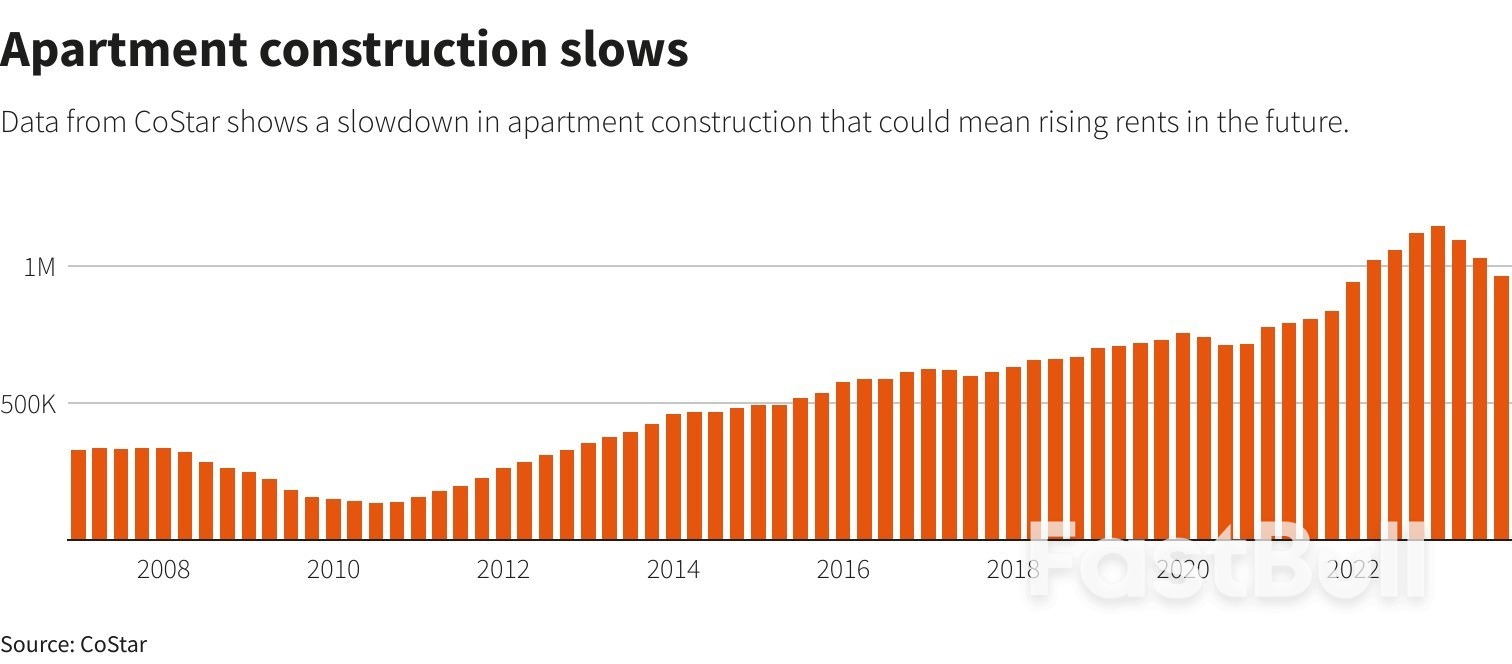
          The real challenge on that front, however, may be just over the horizon when a pipeline of new apartments starts to run dry while the stock of single-family homes remains short, a recipe for future price pressure in a category accounting for about a third of the Consumer Price Index.
          Though their 2% inflation target uses an index that is less sensitive to shelter costs, Fed officials still see housing and rent dynamics as an important, unresolved part of their inflation battle, one that could highlight one of the inherent tensions in today's tight-credit policy stance.
          Fed officials acknowledge the difficulty of finding a rate setting that keeps overall demand in check without choking off the supply of new homes and apartments, but some argue that policymakers already have leaned against the economy too hard.
          "You think you can snap your fingers and housing can be created...The reality is that is not the case," said Jay Lybik, national director of multifamily analytics for real estate data firm CoStar. After a surge of building boosted apartment supply, CoStar's data signals new unit volumes in sharp decline by early next year, falling to perhaps 50,000 or 60,000 per month versus the estimated 100,000 needed to keep pace with demand.
          "We risk a real acceleration in terms of rents that will make things worse come 2025 and 2026," Lybik said.Supply Still Matters: Why U.S. Housing Inflation Relief May Be Short-Lived_1

          'Longer-run problems'

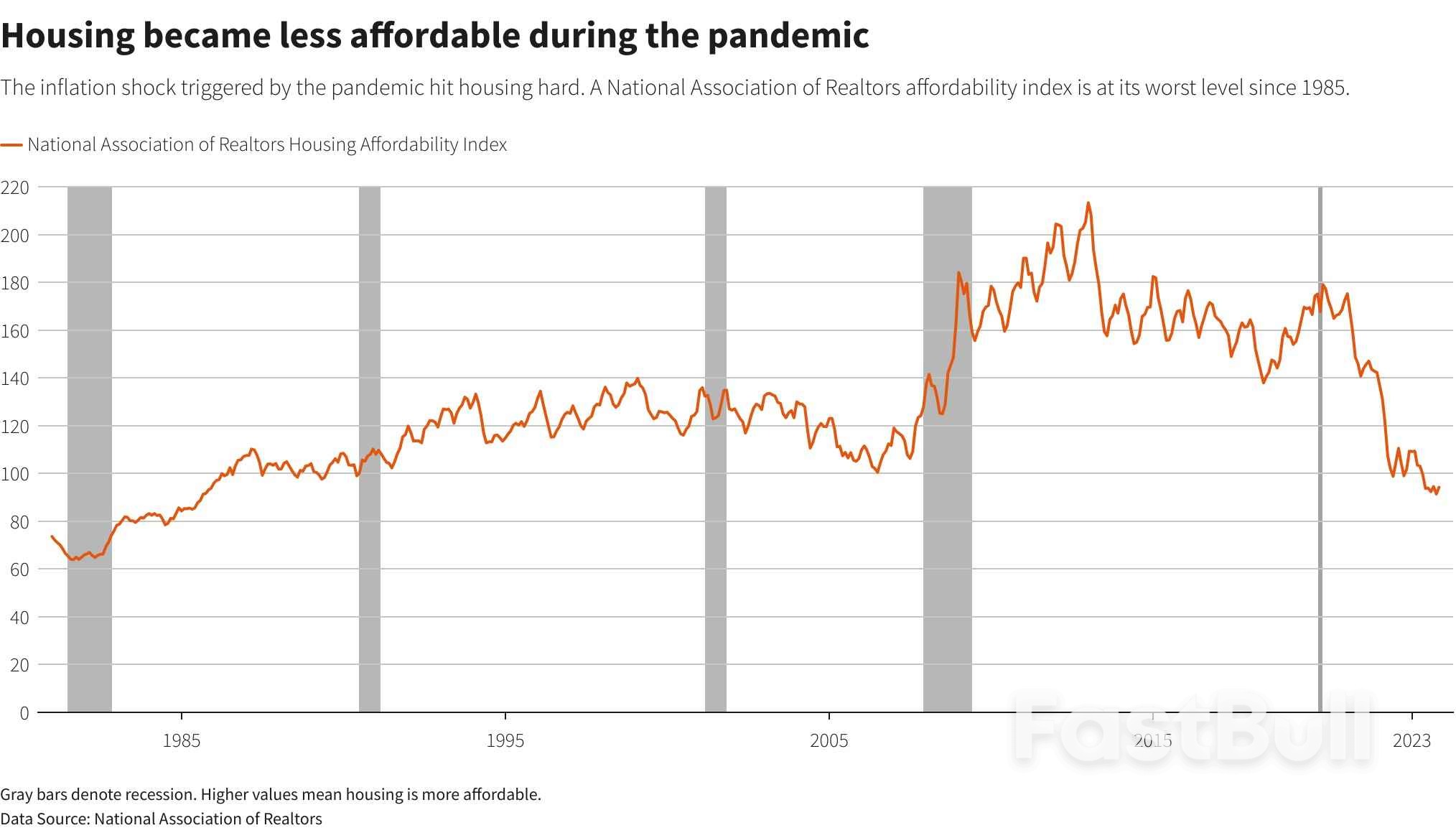
          Housing affordability concerns intensified during the pandemic, with median home prices jumping 50% from its onset through the end of 2022 - though they have since eased - and apartment construction tilted towards higher-end units. Members of Congress have called on the Fed to cut rates both to bring down mortgage costs for consumers and encourage construction; states are toying with rent-control measures and programs to boost supply.
          The issues are far bigger than the Fed.
          "We have longer-run problems with the availability of housing," Fed Chair Jerome Powell said at a press conference following the central bank's January meeting. "There hasn't been enough housing built," Powell said, but "these are not things that we have any tools to address."
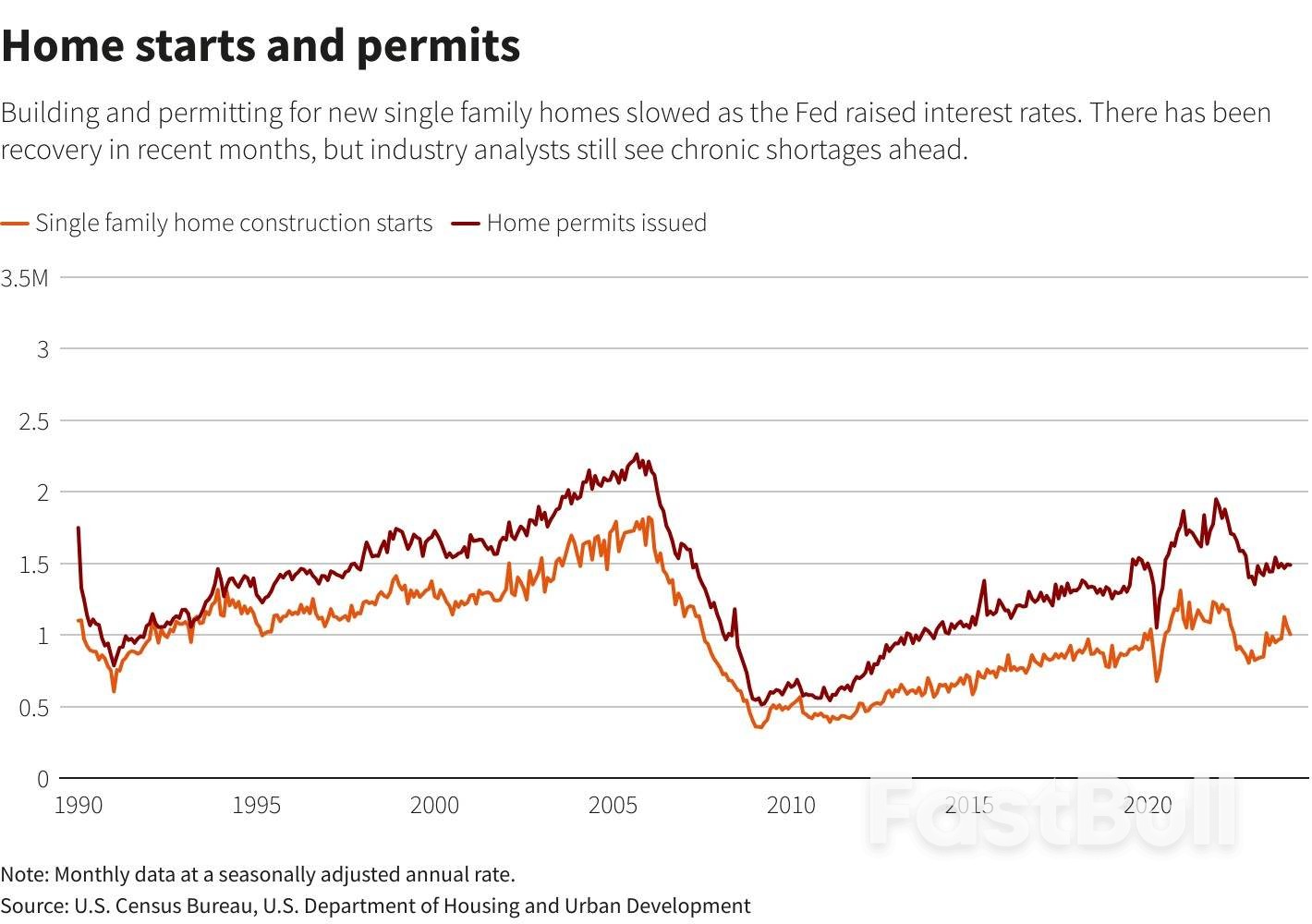
          Housing markets vary widely across the country, shaped by local zoning rules, politics and land prices. Still, financing costs heavily influenced by the Fed are key to the investment decisions being made today that will determine future housing supply.
          For the Fed's immediate purposes, a coming "disinflation" in overall shelter costs seems almost certain as the record pandemic-era jump in rents and home prices fades into the past, but nonetheless essential to gaining the necessary confidence in declining inflation to begin rate cuts. After rapid rate hikes beginning in March 2022, the policy rate has been held at 5.25%-to-5.50% since July.Supply Still Matters: Why U.S. Housing Inflation Relief May Be Short-Lived_2

          'Built-In' Inflationary Pressure

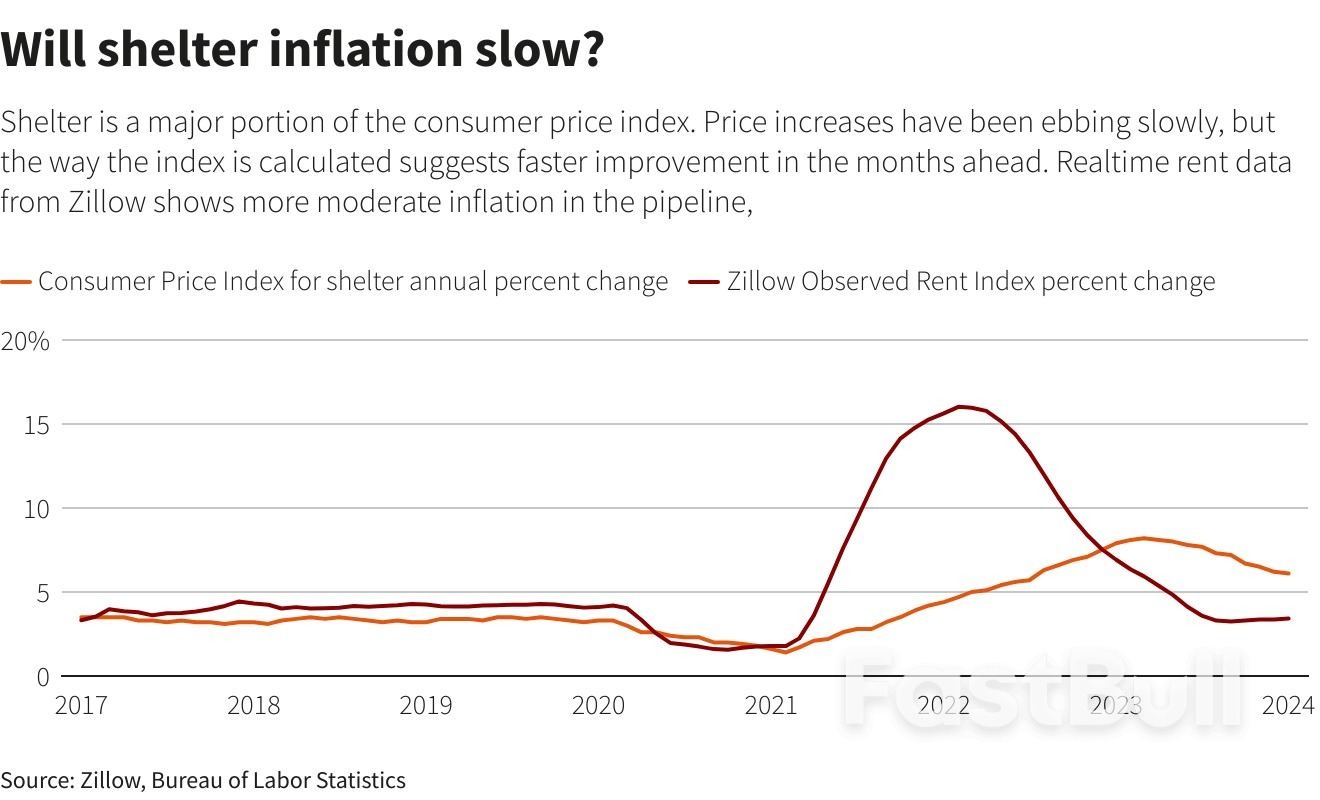
          While inflation has fallen from 40-year highs, recent progress has been "bumpy" Fed officials acknowledge, with shelter inflation in particular remaining higher for longer than anticipated.
          A surprise jump in CPI last month was largely driven by shelter costs still rising by 6% year-over-year versus 4% typically seen before the pandemic when overall inflation was near or below the Fed's target.
          Rent measures assembled in closer to real time aiming to capture current market prices instead of the slow-moving averages in official data indicate price increases have been slowing. For example, an index from online real estate firm Zillow closely watched by Fed officials was rising at a 3.4% annual rate as of January.
          "We know it's coming," Arben Skivjani, deputy chief economist for property management and analytics firm RealPage, said of housing inflation's decline in a recent National Association for Business Economics presentation. After rising nearly 16% annually in early 2022, asking rents have shown virtually no increase since last summer, RealPage data shows.
          Supply constraints, though, may risk secularly faster inflation.
          "We have not built enough homes, we've not built enough shelter for at least a decade...You're short supply of a good that everybody still wants," Mark Fleming, chief economist at title and settlement company First American, said at an NABE discussion of housing inflation. "What's going to happen to the price?...Long run, there's definitely built-in inflationary pressure."Supply Still Matters: Why U.S. Housing Inflation Relief May Be Short-Lived_3

          Missing 'puzzle piece'

          Shelter inflation peaked at an 8.32% annual rate in March 2023, the fastest since the early 1980s. The median home price surged nearly 50% from $322,000 in 2020's second quarter as the pandemic began to a peak of $479,000 at the end of 2022, Census data shows, the fastest run-up since the early 1960s.
          The median price has since edged back to $417,000, a side effect of Fed rate hikes that at one point pushed the average interest rate on a 30-year home mortgage to nearly 8%, the highest in a quarter century.
          But some indexes of more recent home sales show prices rising again, leaving Fed officials hunting for data on home sales and construction to show evidence that demand and supply might move toward better balance.
          New Cleveland Fed research on the stark supply-demand imbalance that has powered pandemic-era home price appreciation is one example of the focus on it.Supply Still Matters: Why U.S. Housing Inflation Relief May Be Short-Lived_4
          Chicago Fed President Austan Goolsbee called housing a missing "puzzle piece" in the Fed's hope for broadly lower inflation, while Richmond Fed President Thomas Barkin has made analysis of building patterns in his district, comparing communities able to keep pace in new home construction with those that are constrained, a staple of his recent speeches.
          EY Chief Economist Gregory Daco said shelter inflation's near-term path was clear. It is headed down, and could over the next couple of months make a substantial contribution to lower headline inflation, a fact he argues is so clear he feels "increasingly frustrated" by the Fed's reluctance to act on it.
          Next year, he said, is another story.
          "Rent inflation has slowed quite tremendously. That has yet to appear fully" in the data the Fed watches most closely, he said. "Fast forward another six to 12 months...and it may actually move the other direction...That's where the lack of supply comes in."

          Source: Reuters

          To stay updated on all economic events of today, please check out our Economic calendar
          Risk Warnings and Disclaimers
          You understand and acknowledge that there is a high degree of risk involved in trading. Following any strategies or investment methods may lead to potential losses. The content on the site is provided by our contributors and analysts for information purposes only. You are solely responsible for determining whether any trading assets, securities, strategy, or any other product is suitable for investing based on your own investment objectives and financial situation.
          Add to Favorites
          Share

          ECB to Keep Floor Under Market Rates but With Eye on Demand

          Devin

          Central Bank

          Economic

          The European Central Bank will continue putting a "floor" under market interest rates in the years to come, but banks will play a greater role in deciding how much liquidity they want, four sources told Reuters.
          The ECB is reviewing how it steers short-term interest rates in a new era in which inflation is higher and the massive amount of cash pumped into the banking system via stimulus programmes over the last decade is no longer needed and even creates some unwanted side-effects.
          For much of the past 10 years the mechanism was simple: The ECB kept rates at zero or lower and flooded banks with more cash than they needed via bond purchases and loans, to encourage them to lend and revive inflation that was then too low.
          This removed the need for banks to borrow from the ECB and pinned the overnight rate that banks charge each other to the one the ECB pays on deposits.
          This framework needs changing now that interest rates are far above zero and massive amounts of excess reserves are unnecessary -- and are even causing huge losses to the ECB and some of the 20 central banks around the euro zone.
          Policymakers meeting in Frankfurt last week agreed that the ECB would stick to a "floor" system, where the central bank effectively sets the lowest rate at which banks would lend to each other, the sources said on condition of anonymity because the deliberations are confidential.
          But there is an important twist: The ECB will not single-handedly decide how much liquidity it provides to the banking system once it has finished draining excess reserves some years from now, the sources added.
          Instead, policymakers agreed commercial banks would help determine that by borrowing the reserves they need from the ECB, in a similar vein to what the Bank of England is doing.
          To facilitate this, the ECB will make it cheaper for banks to borrow by lowering the rate on its weekly cash auctions, currently at 4.5%, and bringing it closer to its 4.0% deposit rate, the sources said.
          This so-called "narrow corridor" would reduce the financial penalty and the stigma for banks that are short of cash, particularly in the transition phase.
          Policymakers also agreed they would tolerate some fluctuations in the Euro Short-Term Rate (ESTR), the benchmark in the inter-bank market, around the ECB's own deposit rate.
          They expect to announce this new framework -- known in market parlance as a "demand-driven floor" -- next month, potentially as early as the ECB's non-policy meeting on March 13, the sources added.
          For now, no change is planned for banks' minimum reserve requirements, which will remain at 1% of customer deposits. But the sources said that some individual policymakers are keen for such a move and may propose it.
          The sources added that there was still debate on how big the ECB's bond portfolio should be and whether it should mostly be comprised of short-term securities or also of longer-dated ones.
          An ECB spokesperson declined to comment.
          For now, this discussion is little more than theoretical.
          The ECB still owns some 4.7 trillion euros ($5.1 trillion) worth of bonds, meaning the banking sector as a whole will have more reserves than it needs until 2029, according to the ECB's own estimates.
          This is the result of successive bond-buying programmes through which the ECB massively increased the number of reserves in the banking system to fight low inflation and the financial impact of the COVID-19 pandemic.
          ECB President Christine Lagarde said earlier this month the central bank will continue to have "a combination of a portfolio of bonds, but also lending operation of different maturities" on its balance sheet.
          A staff paper found the ECB could halve its stock of bonds by mid-2026 but would then have to resume purchases to underpin banks' lending to the economy.
          The ECB's rate on bank deposits is currently at a record-high but ECB policymakers have hinted they expect to start cutting it later this year.
          ECB board member Isabel Schnabel was the first to suggest the central bank for the euro zone could take a leaf out of the Bank of England's book in a speech last year.
          ($1 = 0.9229 euros)

          Source: Reuters

          To stay updated on all economic events of today, please check out our Economic calendar
          Risk Warnings and Disclaimers
          You understand and acknowledge that there is a high degree of risk involved in trading. Following any strategies or investment methods may lead to potential losses. The content on the site is provided by our contributors and analysts for information purposes only. You are solely responsible for determining whether any trading assets, securities, strategy, or any other product is suitable for investing based on your own investment objectives and financial situation.
          Add to Favorites
          Share

          Hawkish BoJ Fuels Yen Surge, Dollar Awaits Crucial PCE Inflation Insights

          Samantha Luan

          Central Bank

          Economic

          Forex

          Japanese Yen rallied broadly in Asian session, energized by hawkish remarks of a BoJ official. These remarks served as a potent reminder to the markets of two critical points: Firstly, BoJ is poised to hike interest rates, buoyed by positive developments in wage negotiations; secondly, while April is viewed as the more likely timing for this move, a March hike cannot not been entirely ruled out. This news initially led to a slight dip in Nikkei, though it managed to recover almost all of its losses by the afternoon, signaling a positive reception among investors to the anticipated policy tightening.
          Elsewhere in the currency markets, Australian Dollar trading as the second-strongest performer of the day, partly supported by rebound in Chinese stock markets. However, this could be a temporary adjustment, as Aussie recovers from its post-CPI losses. Similarly, New Zealand Dollar is regaining some ground lost following RBNZ rate decision yesterday.
          Conversely, Dollar is facing some downward pressure, with the market's attention now turning to today's PCE inflation data from US. This data could mirror the latest CPI figures, indicating a stall in the disinflation process. Fed fund futures are predicting a 65% chance of a June rate cut, but this forecast could shift based on today's PCE inflation outcomes. Meanwhile, Euro is also on high alert, with Germany set to release its CPI data today and the broader Eurozone CPI data expected tomorrow.
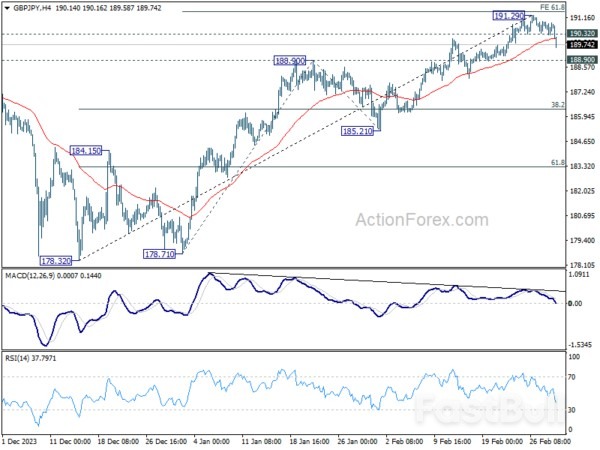
          Technically, GBP/JPY should have made a short term top at 191.29 with today's fall, after just missing 61.8% projection of 178.71 to 188.90 from 185.21 at 191.50. Considering bearish divergence condition in 4H MACD, it's probably now corrective the whole five-wave rally from 178.32. Deeper decline should be seen to 188.90 resistance turned support first. Break will target 38.2% retracement of 178.32 to 191.29 at 186.33.
          Hawkish BoJ Fuels Yen Surge, Dollar Awaits Crucial PCE Inflation Insights_1In Asia, at the time of writing, Nikkei is down -0.05%. Hong Kong HSI is down -0.02%. China Shanghai SSE is up 0.66%. Singapore Strait Times is up 0.19%. Japan 10-year JGB yield is up 0.029 at 0.726. Overnight, DOW fell -0.06%. S&P 500 fell -0.17%. NASDAQ fell -0.55%. 10-year yield fell -0.041 to 4.274.

          BoJ's Takata urges policy shift, time to exit ultra-accommodative stance

          In a significant speech today, BoJ board member Hajime Takata emphasized the need for a "nimble and flexible response" to the nation's monetary policy strategy, and called for the moves away from the current "extremely accommodative monetary policy".
          He outlined several measures for consideration, including exiting yield curve control, moving away from negative interest rates, and revising the BoJ's commitment to expanding its monetary base until inflation consistently exceeds the 2% target.
          Takata's remarks come at a time when Japan appears to be on the cusp of meeting its long-sought-after inflation target of 2%. He noted, "While there are some economic uncertainties, I feel that we're finally seeing prospects for achieving our 2% inflation target."
          Furthermore, Takata highlighted the positive momentum in spring wage negotiations, with many companies proposing wage hikes surpassing those of 2023. This trend towards higher wages, coupled with the corporate sector's growing resilience to yield increases upon the exit of current monetary policies, underscores a strengthening economic foundation.

          Japan faces steepest industrial decline in nearly four years, -7.5% mom drop in Jan

          Japan's industrial production faced a significant downturn in January, recording a -7.5% mom decline in production, marking the sharpest drop since May 2020. This downturn was slightly more severe than the anticipated -7.3% mom, with a widespread decrease across 14 of the 15 surveyed industries. Motor vehicles sector experienced the most substantial fall, plummeting by -17.8% mom, driven by declines in regular passenger cars and electrical drive systems.
          Manufacturers remain somewhat optimistic, anticipating a rebound with of 4.8% in output for February and a further 2.0% rise in March, as surveyed by the Ministry of Economy, Trade and Industry. However, these forecasted gains are deemed insufficient by METI officials to fully counterbalance the steep January decline.
          In contrast to the industrial sector's struggles, Japan's retail sales presented a brighter picture, rising 2.3% yoy in January, surpassing the expected 2.0% increase.

          RBNZ's Orr confident on bringing down inflation, highlights global risks

          RBNZ to said in a conversation with Radio New Zealand that the central bank RBNZ's very confident on returning inflation to target band of 1%-3% by the second half of 2024, with a goal to hit near 2% midpoint in 2025.
          Highlighting the broader context, Orr pointed out that key risks to this positive outlook are mostly global. Domestic economy aligns with RBNZ's expectations. Orr noted the current "subdued spending" and "declined" inflation levels as outcomes of the existing monetary policy settings and trade conditions.
          Later in the day, Orr told a parliamentary committee the importance of "retaining a restrictive stance with the official cash rate," as a pivotal factor for ensuring the forecasted return to target inflation levels.

          NZ ANZ business confidence falls to 34.7, patchy economy

          New Zealand ANZ Business Confidence fell from 36.6 to 34.7 in February. Own activity outlook rose from 25.6 to 29.5. Inflation expectations fell from 4.28% to 4.03%. Pricing intentions eased from 50% to 48%, continuing their sideways trend of recent months. Cost expectations fell from 75.6 to 73.5. Wages expectation fell from 81.4 to 78.9.
          ANZ's describes the economy as "patchy," with visible "green shoots" in some sectors, yet acknowledges the "ongoing challenges" facing other segments. The survey does not imply the "economy is rolling over" or that "inflation has been beaten".

          Australia's retail sales rises 1.1% mom in Jan, stagnates in trend terms

          Australia's retail sales rose 1.1% mom in January, below expectation of 1.7% mom. This increase marks a recovery from December's significant -2.1% mom decline, where consumer spending retracted following the Black Friday sales rush in November.
          According to Ben Dorber, ABS head of retail statistics, retail turnover has effectively returned to the levels observed in September 2023. Additionally, "retail turnover was unchanged in trend terms in January," indicating that, despite the month's positive performance, the broader trend reflects a period of stagnation in retail sales when considering the volatility of the past few months.

          Fed's Williams labels three rate cuts this year a reasonable starting point

          In an event overnight, New York Fed President John Williams provided said the economy remains robust, with expectations for continued positive growth and a gradual decrease in inflation. His asserted that three rate cuts within the year could serve as a "reasonable starting point".
          Williams highlighted the significant decline in inflation over the past year and a half, emphasizing the "broad-based" reductions across various components of inflation measurements. Despite the positive trend, Williams candidly acknowledged "we still have a ways to go on the journey to sustained 2% inflation."

          Fed's Collins methodical, forward-looking approach to rate cuts

          Boston Fed President Susan Collins suggested that it may become "appropriate to begin easing policy later this year," highlighting the importance of a "methodical, forward-looking approach" to gradually reduce rates.
          Collins anticipated further inflation deceleration would might necessitate further slowdown in economic activity. However, she noted the "considerable uncertainty" surrounding the magnitude and timing of this slowdown. The path ahead, as Collins notes, is expected to be "bumpy," as suggested by hotter-than-expected employment and price increase readings.
          In this context, it will be important to focus on seeking "sustained, broadening signs" of progress towards its dual mandate goals, acknowledging that such progress may unfold unevenly. Collins cautions against setting overly stringent expectations for the data, indicating that "expecting all data to speak uniformly is too high a bar."

          ECB's Nagel eyes next week's economic projections as important policy milestone

          Bundesbank President Joachim Nagel highlighted the critical need for "reliable data on wage developments" before commencing rate cuts. With ECB's updated economic projections on the horizon next week, Nagel described the forthcoming report as an "important milestone".
          Nagel took a moment to reflect on the successes achieved through current policy in reducing inflation. However, he was quick to caution against complacency, emphasizing "we can't make any mistakes in the final stretch of the journey."
          His warning against premature rate cuts was stark, labeling such a move as "fatal." Nagel's concern is that an ill-timed easing of monetary policy could lead to a resurgence of inflation, thereby damaging the ECB's credibility and triggering financial market instability.

          Looking ahead

          European session will feature retail sales, CPI flash and unemployment from Germany, consumer spending and GDP revision from France, GDP and KOF economic barometer from Swiss, M4 money supply and mortgage approvals from UK.
          Later in the day, Canada will release GDP. US will release personal income and spending, PCE inflation, jobless claims, Chicago PMI and pending home sales.

          USD/JPY Daily Outlook

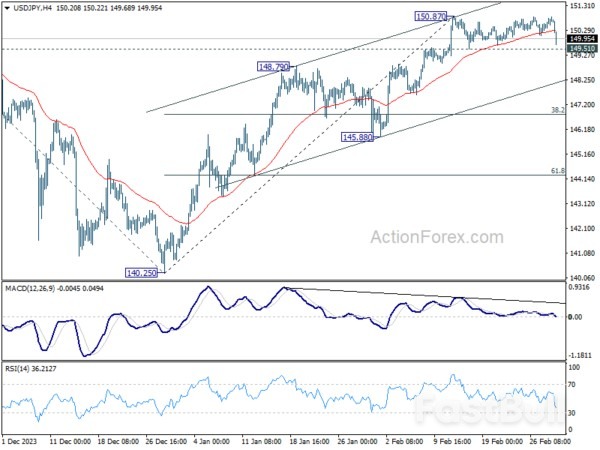
          USD/JPY falls notably today but stays above 149.51 minor support. Intraday bias remains neutral first. Considering bearish divergence condition in 4H MACD, firm break of 149.51 should confirm short term topping at 150.87. Intraday bias will then be back on the downside for channel support (now at 148.04), even as a corrective move. On the upside, though, break of 150.87 will resume the rally from 140.25 to retest 151.89/93 key resistance zone.Hawkish BoJ Fuels Yen Surge, Dollar Awaits Crucial PCE Inflation Insights_2
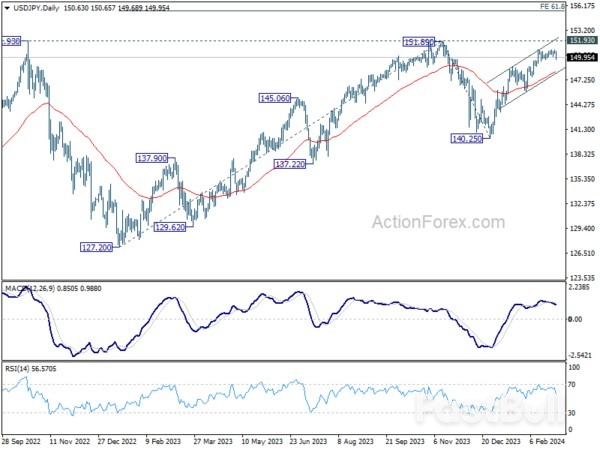
          In the bigger picture, rise from 140.25 is seen as resuming the trend from 127.20 (2023 low). Decisive break of 151.89/.93 resistance zone will confirm this bullish case and target 61.8% projection of 127.20 to 151.89 from 140.25 at 155.50. However, break of 148.79 resistance turned support will delay this bullish case, and extend the corrective pattern from 151.89 with another falling leg.Hawkish BoJ Fuels Yen Surge, Dollar Awaits Crucial PCE Inflation Insights_3

          Source: ActionForex

          To stay updated on all economic events of today, please check out our Economic calendar
          Risk Warnings and Disclaimers
          You understand and acknowledge that there is a high degree of risk involved in trading. Following any strategies or investment methods may lead to potential losses. The content on the site is provided by our contributors and analysts for information purposes only. You are solely responsible for determining whether any trading assets, securities, strategy, or any other product is suitable for investing based on your own investment objectives and financial situation.
          Add to Favorites
          Share

          February 29th Financial News

          FastBull Featured

          Daily News

          [Quick Facts]

          1.Collins: Rate cuts could start later this year.
          2.U.S. reaches bipartisan deal, with no risk of a government shutdown until March 22nd.
          3.U.S. slightly revises Q4 economic growth downward.
          4.Williams: There is still a long way to go before inflation returns to 2%, but interest rates will be cut later this year.
          5.Simkus: There's nothing wrong with starting to discuss conditions for rate cuts in March.
          6.Kazaks: ECB should be patient.

          [News Details]

          Collins: Rate cuts could start later this year
          Recent higher-than-expected jobs and inflation data mean that the Fed's path to getting inflation back to its 2% target may remain rocky, Boston Fed President Susan Collins said in a speech on the 28th. She is looking for signs of a sustained decline in housing inflation and non-housing services inflation, as well as more evidence that wages are rising at a pace that does not add to inflationary pressures.
          I believe that it may be appropriate to begin easing policy later this year. When that happens, a gradual reduction in interest rates through a methodical, forward-looking approach could provide the flexibility needed to manage risks while promoting price stability and maximizing employment.
          The Fed should take time to evaluate the data before making any changes to policy to ensure that the dual mission is realized.
          U.S. reaches bipartisan deal, with no risk of a government shutdown until March 22nd
          U.S. congressional leaders reached an agreement to avoid a partial government shutdown on March 2nd and to fund parts of the government through September 30th. The rest of the U.S. government, including the Departments of Defense and Homeland Security, could still shut down on March 23rd.
          The stopgap appropriations bill also covers funding needed for government departments through March 22nd, although negotiators have yet to agree on spending for the rest of the government. The House will vote on the bill on Thursday. House Speaker Johnson's office has said he is prepared to allow a government shutdown if a deal on a full-year spending bill is not reached in the future.
          U.S. slightly revises Q4 economic growth downward
          The U.S. Department of Commerce on Wednesday slightly revised downward its annual GDP rate for the fourth quarter of last year, reflecting a downward revision to inventory investment. Consumer spending, state and local government investment, and residential and business spending were revised upward.
          Consumer spending, which accounts for more than two-thirds of U.S. economic activity, rose 3.0%, adding two percentage points to GDP growth. The previous estimate was for a 2.8% growth rate. Stronger consumer spending, combined with upward revisions to investment in residential construction and business spending on mainly non-residential buildings such as factories, meant that demand was stronger than initially thought.
          That said, while the data was downgraded, its composition was much stronger than initially expected, which bodes well for the short-term outlook.
          Williams: There is still a long way to go before inflation returns to 2%, but interest rates will be cut later this year.
          New York Fed President Williams said in a speech on the 28th, that in pushing inflation to continue to move closer to the 2% target, we still have a long way to go. I am committed to fully restoring price stability in the context of a strong economy and labor market.
          The Fed has time to assess the data before deciding to cut rates. As we go through the remainder of this journey, I will be looking at the data, the economic outlook, and the risks to assess the appropriate path for monetary policy to best achieve our objectives.
          However, rate cuts are still possible this year, depending on data coming out in the future. My view is that a forecast of three rate cuts this year, similar to the one presented in December, is a reasonable starting point.
          PCE inflation is expected to fall to 2%-2.25% this year and 2% next year. Economic growth is expected to slow to around 1.5% this year and the unemployment rate to rise to around 4%. While the outlook remains at risk, the economy has become more balanced.
          Simkus: There's nothing wrong with starting to discuss conditions for rate cuts in March
          ECB Governing Council member Simkus said in a speech on the 28th that while a rate cut in March would be premature, it would not be inappropriate to start discussing monetary policy easing at next week's meeting. The eurozone economy stagnated last quarter and growth faces downside risks. Both headline and core inflation have declined, and there are signs that wage growth is now slowing as well. Thus, the overall economic environment is not inconsistent with a discussion of interest rate cuts.
          Not only is the probability of discussing a rate cut increasing, but the probability of an actual rate cut is also increasing. June is indeed the month to consider a rate cut, and whether or not to do so will depend on how the economy develops, with a 25 basis point cut for the first time certainly preferred. We don't need to cut rates at every meeting and could move more slowly, but these are strategies to be discussed later.
          Kazaks: ECB should be patient
          ECB Governing Council member Kazaks said in a speech on the 28th that it is too early to assume that the current level of monetary restrictions will be maintained for long enough, taking into account the uncertainty of developments and avoiding a rise in inflation. The lesson learned from the experience of the 1970s and 1980s is that it would be very terrible to act too soon and then be forced to raise interest rates again.
          There is not much difference in the economy between the start of easing in April and June, but that does not mean that the risks are evenly distributed. The labor market remains strong and the economy is just going through a period of a bit of weakness, not a sharp and severe recession. The current situation calls for patience; some important data, especially in the labor market, won't be released until later in the spring, and there is nothing in sight that tells us we should act.

          [Focus of the Day]

          UTC+8 21:00 Germany February CPI
          UTC+8 21:30 U.S. January PCE
          UTC+8 21:30 Canada Q4 GDP Annualized Rate
          UTC+8 23:50 Atlanta Fed President Bostic's Speech
          UTC+8 00:00 Chicago Fed President Goolsbee's Speech on Monetary Policy
          04:30 Cleveland Fed President Mester Interview with Yahoo Finance
          Risk Warnings and Disclaimers
          You understand and acknowledge that there is a high degree of risk involved in trading. Following any strategies or investment methods may lead to potential losses. The content on the site is provided by our contributors and analysts for information purposes only. You are solely responsible for determining whether any trading assets, securities, strategy, or any other product is suitable for investing based on your own investment objectives and financial situation.
          Add to Favorites
          Share

          India Amasses Record Seasonal Coal Stocks as Mine Output Surges

          Thomas

          Commodity

          India's coal-fired generators have managed to amass record stocks of fuel for the end of February, even as they produce record amounts of electricity to cover burgeoning demand and a drought that has hit hydropower.
          The fuel supply picture has been transformed in less than two years from scarcity to abundance as a result of a huge increase in domestic production and prioritisation of coal movements to power stations across the rail network.
          Coal-fired generators produced a record 112 billion kilowatt-hours in January 2024 up from 91 billion kWh in January 2022, Ministry of Power data show.
          Even so, power plant inventories have continued to increase as the amount of fuel arriving has outstripped combustion.
          Generators had 44 million tonnes of fuel on hand on February 26 up from 26 million tonnes at the end of February 2022.
          Stocks were enough to meet more than 15 days of the minimum requirement from under 10 days at the same time in 2022.
          Generators have been able to accumulate fuel despite running unusually hard in the autumn to compensate for the lack of hydropower after a weak monsoon in 2023.
          Fuel security has been boosted by an enormous increase in the volume of coal produced from the country's own mines.
          Domestic production hit a seasonal record 100 million tonnes in January 2024 up from 80 million tonnes in January 2022, according to the Ministry of Coal.
          Mines despatched an additional 12 million tonnes in January 2024 compared with January 2022 and most of the extra was sent to generators (+9 million) rather than other users (+3 million).
          Mines loaded an average of 315 unit trains or rakes per day in January 2024 up from 285 per day in January 2022, Ministry of Coal data show.
          Nearly all the extra unit trains were despatched to generators rather than other users under government orders to prioritise electricity supplies.
          The surge in domestic production has trimmed reliance on imports of thermal coal.
          Total imports of non-coking coal were 124 million tonnes between April and December 2023 down from 127 million tonnes in the same period a year earlier.
          Imports accounted for 7.4% of all coal received by generators in the first eight months of fiscal 2024 down from 7.7% in the same period of fiscal 2023.
          In the short term, the massive increase in inventories should avert widespread power cuts during the pre-monsoon (March-May) and post-monsoon (September-October) months this year.
          In the long term, India's miners, traders and importers are all very bullish about the outlook as soaring electricity demand encourages the government to adopt an "all-of-the-above" approach to fossil and renewable generation.

          Source: Reuters

          Risk Warnings and Disclaimers
          You understand and acknowledge that there is a high degree of risk involved in trading. Following any strategies or investment methods may lead to potential losses. The content on the site is provided by our contributors and analysts for information purposes only. You are solely responsible for determining whether any trading assets, securities, strategy, or any other product is suitable for investing based on your own investment objectives and financial situation.
          Add to Favorites
          Share

          Bitcoin Touches $60,000 Mark Once Again

          Zi Cheng

          Traders' Opinions

          Cryptocurrency

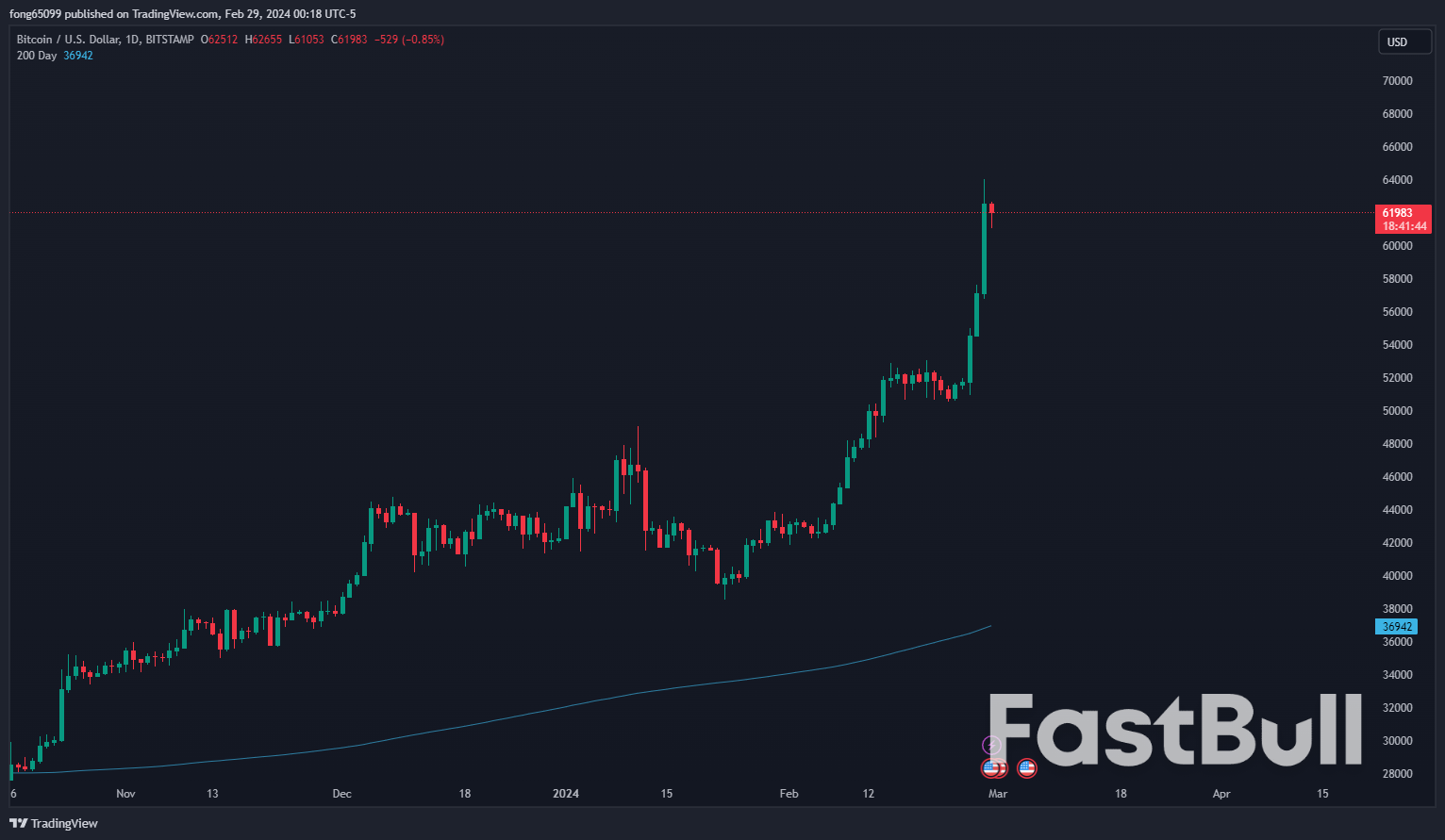
          Bitcoin's price has surged above $60,000 for the first time in over two years, propelled by a rapid rally that brings the world's largest cryptocurrency tantalizingly close to its all-time high. On Wednesday, Bitcoin surged by as much as 12.6 percent, reaching $63,968, before retracing to approximately $60,000. This rally has resulted in a 42 percent increase in the cryptocurrency's value within the first two months of the year.
          This swift ascent evokes memories of the crypto bull market that propelled Bitcoin to its record peak of nearly $69,000 in November 2021. Investors are flocking to Bitcoin amid a "fear of missing out" on potential further price increases.
          Bitcoin Touches $60,000 Mark Once Again_1
          In January, mainstream asset managers such as BlackRock and Invesco received approval from US regulators to launch spot bitcoin exchange-traded funds (ETFs). This decision cleared the path for a surge of new investment from individuals seeking to engage in cryptocurrency speculation through regulated means. Currently, these 11 approved funds collectively hold 303,000 bitcoins, valued at $18 billion, representing approximately 1.5 percent of the total bitcoin supply, as reported by K33 Research.
          The spike in bitcoin's price coincides with a broader upswing in traditional financial markets. Nvidia's impressive financial performance has fueled investor excitement regarding the potential of artificial intelligence technology, contributing to record highs in US and European stocks over the past week.
          Meanwhile, the surge in activity on the crypto trading platform Coinbase, which experienced traffic ten times above its normal levels, led to disruptions for some users. These disruptions included instances where users saw a zero balance displayed in their accounts.
          Despite regulatory crackdowns on major crypto companies by US authorities and persistent skepticism surrounding the token, the price of bitcoin has surged. Just last week, officials from the European Central Bank criticized the cryptocurrency, asserting that "the fair value of bitcoin is still zero."
          The cryptocurrency sector has received a boost from the perception that it is evolving beyond the scandals of recent years. However, this positive momentum was interrupted when the Securities and Exchange Commission imposed a record $4.3 billion fine on Binance, the largest crypto exchange globally, in November. The charges included failure to implement adequate measures against money laundering and violations of international sanctions.
          Risk Warnings and Disclaimers
          You understand and acknowledge that there is a high degree of risk involved in trading. Following any strategies or investment methods may lead to potential losses. The content on the site is provided by our contributors and analysts for information purposes only. You are solely responsible for determining whether any trading assets, securities, strategy, or any other product is suitable for investing based on your own investment objectives and financial situation.
          Add to Favorites
          Share
          FastBull
          Copyright © 2025 FastBull Ltd

          728 RM B 7/F GEE LOK IND BLDG NO 34 HUNG TO RD KWUN TONG KLN HONG KONG

          TelegramInstagramTwitterfacebooklinkedin
          App Store Google Play Google Play
          Products
          Charts

          Chats

          Q&A with Experts
          Screeners
          Economic Calendar
          Data
          Tools
          Membership
          Features
          Function
          Markets
          Copy Trading
          Latest Signals
          Contests
          News
          Analysis
          24/7
          Columns
          Education
          Company
          Careers
          About Us
          Contact Us
          Advertising
          Help Center
          Feedback
          User Agreement
          Privacy Policy
          Business

          White Label

          Data API

          Web Plug-ins

          Poster Maker

          Affiliate Program

          Risk Disclosure

          The risk of loss in trading financial instruments such as stocks, FX, commodities, futures, bonds, ETFs and crypto can be substantial. You may sustain a total loss of the funds that you deposit with your broker. Therefore, you should carefully consider whether such trading is suitable for you in light of your circumstances and financial resources.

          No decision to invest should be made without thoroughly conducting due diligence by yourself or consulting with your financial advisors. Our web content might not suit you since we don't know your financial conditions and investment needs. Our financial information might have latency or contain inaccuracy, so you should be fully responsible for any of your trading and investment decisions. The company will not be responsible for your capital loss.

          Without getting permission from the website, you are not allowed to copy the website's graphics, texts, or trademarks. Intellectual property rights in the content or data incorporated into this website belong to its providers and exchange merchants.

          Not Logged In

          Log in to access more features

          FastBull Membership

          Not yet

          Purchase

          Become a signal provider
          Help Center
          Customer Service
          Dark Mode
          Price Up/Down Colors

          Log In

          Sign Up

          Position
          Layout
          Fullscreen
          Default to Chart
          The chart page opens by default when you visit fastbull.com