• Trade
  • Markets
  • Copy
  • Contests
  • News
  • 24/7
  • Calendar
  • Q&A
  • Chats
Trending
Screeners
SYMBOL
LAST
BID
ASK
HIGH
LOW
NET CHG.
%CHG.
SPREAD
SPX
S&P 500 Index
6970.94
6970.94
6970.94
6974.33
6934.06
+4.66
+ 0.07%
--
DJI
Dow Jones Industrial Average
49423.40
49423.40
49423.40
49499.67
49011.31
-80.66
-0.16%
--
IXIC
NASDAQ Composite Index
23748.40
23748.40
23748.40
23761.43
23562.97
+77.06
+ 0.33%
--
USDX
US Dollar Index
98.600
98.680
98.600
98.960
98.380
-0.260
-0.26%
--
EURUSD
Euro / US Dollar
1.16692
1.16699
1.16692
1.16982
1.16214
+0.00383
+ 0.33%
--
GBPUSD
Pound Sterling / US Dollar
1.34612
1.34623
1.34612
1.34855
1.33903
+0.00682
+ 0.51%
--
XAUUSD
Gold / US Dollar
4615.54
4615.97
4615.54
4630.02
4512.81
+106.39
+ 2.36%
--
WTI
Light Sweet Crude Oil
58.843
58.873
58.843
59.584
58.317
+0.202
+ 0.34%
--

Community Accounts

Signal Accounts
--
Profit Accounts
--
Loss Accounts
--
View More

Become a signal provider

Sell trading signals to earn additional income

View More

Guide to Copy Trading

Get started with ease and confidence

View More

Signal Accounts for Members

All Signal Accounts

Best Return
  • Best Return
  • Best P/L
  • Best MDD
Past 1W
  • Past 1W
  • Past 1M
  • Past 1Y

All Contests

  • All
  • Trump Updates
  • Recommend
  • Stocks
  • Cryptocurrencies
  • Central Banks
  • Featured News
Top News Only
Share

Spain's LNG Imports From US Soar To Nearly A Third Of Gas Supply In 2025

Share

Kpler: Iran's Oil Stored On Water Hits A Record High

Share

European Central Bank Governing Council Member Villeroy: France Could Find Itself In The Danger Zone With Markets If Budget Deficit Remains Over 5% Of GDP

Share

European Central Bank Governing Council Member Villeroy: I Want To Reiterate Loudly And Clearly My Full Solidarity And My Admiration For Jay Powell, A Model Of Integrity And Commitment To The Public Interest

Share

European Central Bank Governing Council Member Villeroy: One Doesn't Change A Winning Monetary Policy

Share

House Financial Services Committee Chairman Says Pursuing Criminal Charges Against Fed's Chairman Powell 'Creates An Unnecessary Distraction'

Share

Iran's Supreme Leader Ayatollah Khamenei: The Iranian Government's Approval Rating Is Rising, Which Is A Warning To The United States

Share

USDA Maintained Its 2025/2026 Corn Production Forecast For Argentina At 53 Million Tons, Compared To Market Expectations Of 53.63 Million Tons; It Also Maintained Its 2025/2026 Corn Production Forecast For Brazil At 131 Million Tons, Compared To Market Expectations Of 132.46 Million Tons

Share

USDA Maintained Its 2025/2026 Soybean Production Forecast For Argentina At 48.5 Million Tons, Compared To Market Expectations Of 48.53 Million Tons. It Also Raised Its 2025/2026 Soybean Production Forecast For Brazil From 175 Million Tons To 178 Million Tons, Compared To Market Expectations Of 176.35 Million Tons

Share

On December 12, The Iranian Foreign Ministry Summoned The Ambassadors Of Britain, France, Germany, And Italy To Iran, Stating That Iran Opposes Any Form Of Political Or Media Support For "rioters" Involved In The Unrest, And That Such Actions Would Be Considered Interference In Iran's Internal Affairs

Share

Venezuelan Opposition Leader Machado Will Meet With US President Trump On Thursday

Share

The U.S. Department Of Agriculture (USDA) Projects U.S. Cotton Ending Stocks At 4.2 Million Bales, Compared With Analysts' Expectations Of 4.56 Million Bales And USDA's Previous Estimate Of 4.5 Million Bales

Share

The U.S. Department Of Agriculture (USDA) Projects Total U.S. Wheat Ending Stocks At 926 Million Bushels, Compared With Analysts' Expectations Of 896.41 Million Bushels And USDA's Previous Estimate Of 901 Million Bushels

Share

The U.S. Department Of Agriculture (USDA) Projects U.S. Corn Ending Stocks At 2.227 Billion Bushels, Compared With Analysts' Expectations Of 1.98551 Billion Bushels And USDA's Previous Estimate Of 2.029 Billion Bushels

Share

The U.S. Department Of Agriculture (USDA) Projects U.S. Soybean Ending Stocks At 350 Million Bushels, Compared With Analysts' Expectations Of 294.47 Million Bushels And USDA's Previous Estimate Of 290 Million Bushels

Share

ICE Cotton Futures Hold Gains After USDA's Wasde Report, Last Up 1.1%

Share

2025/26 World End Stocks-Wheat 278.25 Million Tonnes (Trade Estimate 275.95 Million)

Share

2025/26 World End Stocks- Corn 290.91 Million (Trade Estimate 279.62 Million)

Share

2025/26 World End Stocks-Soybeans 124.41 Million (Trade Estimate 123.07 Million)

Share

USA Natural Gas Futures Extend Gains, Prices Up By 5% On Record LNG Export Flows, Colder Forecasts

TIME
ACT
FCST
PREV
U.S. Average Hourly Wage MoM (SA) (Dec)

A:--

F: --

P: --
U.S. Average Weekly Working Hours (SA) (Dec)

A:--

F: --

P: --

U.S. New Housing Starts Annualized MoM (SA) (Oct)

A:--

F: --

P: --
U.S. Total Building Permits (SA) (Oct)

A:--

F: --

P: --

U.S. Building Permits MoM (SA) (Oct)

A:--

F: --

P: --

U.S. Annual New Housing Starts (SA) (Oct)

A:--

F: --

P: --
U.S. U6 Unemployment Rate (SA) (Dec)

A:--

F: --

P: --

U.S. Manufacturing Employment (SA) (Dec)

A:--

F: --

P: --
U.S. Labor Force Participation Rate (SA) (Dec)

A:--

F: --

P: --

U.S. Private Nonfarm Payrolls (SA) (Dec)

A:--

F: --

P: --
U.S. Nonfarm Payrolls (SA) (Dec)

A:--

F: --

P: --
U.S. Average Hourly Wage YoY (Dec)

A:--

F: --

P: --
U.S. Government Employment (Dec)

A:--

F: --

P: --

U.S. UMich Consumer Expectations Index Prelim (Jan)

A:--

F: --

P: --

U.S. UMich Consumer Sentiment Index Prelim (Jan)

A:--

F: --

P: --

U.S. UMich Current Economic Conditions Index Prelim (Jan)

A:--

F: --

P: --

U.S. UMich 1-Year-Ahead Inflation Expectations Prelim (Jan)

A:--

F: --

P: --

U.S. UMich 5-Year-Ahead Inflation Expectations Prelim YoY (Jan)

A:--

F: --

P: --

U.S. 5-10 Year-Ahead Inflation Expectations (Jan)

A:--

F: --

P: --

U.S. Weekly Total Oil Rig Count

A:--

F: --

P: --

U.S. Weekly Total Rig Count

A:--

F: --

P: --

Indonesia Retail Sales YoY (Nov)

A:--

F: --

P: --

Euro Zone Sentix Investor Confidence Index (Jan)

A:--

F: --

P: --

India CPI YoY (Dec)

A:--

F: --

P: --

Canada National Economic Confidence Index

A:--

F: --

P: --

Germany Current Account (Not SA) (Nov)

A:--

F: --

P: --

U.S. Conference Board Employment Trends Index (SA) (Dec)

A:--

F: --

P: --
China, Mainland M0 Money Supply YoY (Dec)

--

F: --

P: --

China, Mainland M2 Money Supply YoY (Dec)

--

F: --

P: --

China, Mainland M1 Money Supply YoY (Dec)

--

F: --

P: --

Richmond Federal Reserve President Barkin delivered a speech.
U.S. 3-Year Note Auction Yield

--

F: --

P: --

U.S. 10-Year Note Auction Avg. Yield

--

F: --

P: --

New York Federal Reserve President Williams delivered a speech.
Japan Trade Balance (Customs Data) (SA) (Nov)

--

F: --

P: --

Japan Trade Balance (Nov)

--

F: --

P: --

U.K. BRC Overall Retail Sales YoY (Dec)

--

F: --

P: --

U.K. BRC Like-For-Like Retail Sales YoY (Dec)

--

F: --

P: --

Turkey Retail Sales YoY (Nov)

--

F: --

P: --

U.S. NFIB Small Business Optimism Index (SA) (Dec)

--

F: --

P: --

Brazil Services Growth YoY (Nov)

--

F: --

P: --

Canada Building Permits MoM (SA) (Nov)

--

F: --

P: --

U.S. CPI MoM (SA) (Dec)

--

F: --

P: --

U.S. CPI YoY (Not SA) (Dec)

--

F: --

P: --

U.S. Real Income MoM (SA) (Dec)

--

F: --

P: --

U.S. CPI MoM (Not SA) (Dec)

--

F: --

P: --

U.S. Core CPI (SA) (Dec)

--

F: --

P: --

U.S. Core CPI YoY (Not SA) (Dec)

--

F: --

P: --

U.S. Core CPI MoM (SA) (Dec)

--

F: --

P: --

U.S. Weekly Redbook Index YoY

--

F: --

P: --

U.S. New Home Sales Annualized MoM (Oct)

--

F: --

P: --

U.S. Annual Total New Home Sales (Oct)

--

F: --

P: --

U.S. Cleveland Fed CPI MoM (SA) (Dec)

--

F: --

P: --

U.S. Cleveland Fed CPI MoM (Dec)

--

F: --

P: --

China, Mainland Exports (Dec)

--

F: --

P: --

China, Mainland Imports YoY (CNH) (Dec)

--

F: --

P: --

China, Mainland Imports (CNH) (Dec)

--

F: --

P: --

China, Mainland Trade Balance (CNH) (Dec)

--

F: --

P: --

China, Mainland Imports YoY (USD) (Dec)

--

F: --

P: --

China, Mainland Exports YoY (USD) (Dec)

--

F: --

P: --

U.S. EIA Short-Term Crude Production Forecast For The Next Year (Jan)

--

F: --

P: --

Q&A with Experts
    • All
    • Chatrooms
    • Groups
    • Friends
    drvutiupti flag
    SlowBear ⛅ flag
    Lord Yellow Mountain
    @Lord Yellow MountainI completely get your point boss, cos, when the drop happens it is gonna be like 500pips in less than 1hrs
    john flag
    Lord Yellow Mountain
    @Lord Yellow Mountain don't FOMO whatsoever
    "SlowBear ⛅" recalled a message
    Jamolla flag
    I’m holding longs but tightening risk
    SlowBear ⛅ flag
    drvutiupti
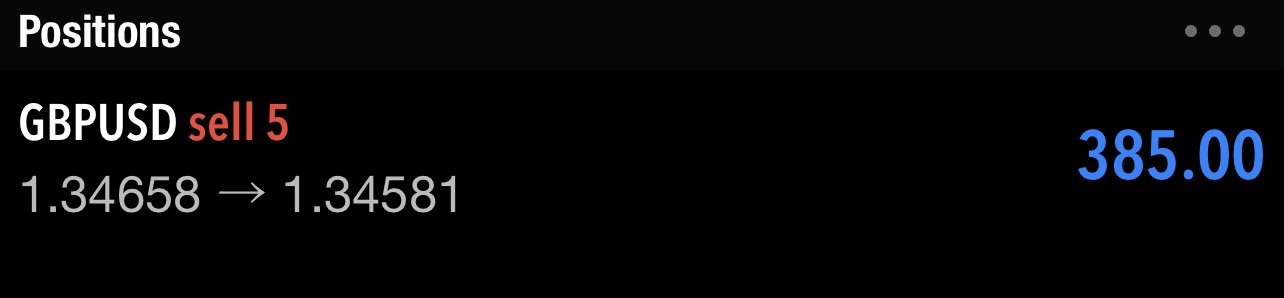
    @drvutiuptiWow, that is interesting, a 5lot sell on GU, that shoulf be like the last 2hr short sell that occured not bad
    Rjbull flag
    But its not breathing so deep
    Dushan flag
    4600 buying limit position huge
    drvutiupti flag
    SlowBear ⛅
    @SlowBear ⛅ my usual lot size is $100-$150 pip value
    SlowBear ⛅ flag
    Lord Yellow Mountain
    @Lord Yellow Mountain My advise will be, wait for it, set alrert to key region that can leads to market shifts and say awake - if Gold is gonna sell off the Asian session is where the kickoff will commence
    SlowBear ⛅ flag
    drvutiupti
    @drvutiupti Wow that is interesting, i am happy for you mate, milk the market away
    drvutiupti flag
    SlowBear ⛅
    @SlowBear ⛅ this is my trade from today, so just chilling with low lot size
    "drvutiupti" recalled a message
    "drvutiupti" recalled a message
    ElanMT5 flag
    ElanMT5 flag
    ElanMT5 flag
    john flag
    Jamolla
    I’m holding longs but tightening risk
    @JamollaCPI could decide short-term direction
    Galileo flag
    Jamolla
    I’m holding longs but tightening risk
    @Jamollat right now am flat waiting for confirmation or sweep
    Roel Diaz flag
    Type here...
    Add Symbol or Code

      No matching data

      All
      Trump Updates
      Recommend
      Stocks
      Cryptocurrencies
      Central Banks
      Featured News
      • All
      • Russia-Ukraine Conflict
      • Middle East Flashpoint
      • All
      • Russia-Ukraine Conflict
      • Middle East Flashpoint
      Search
      Products

      Charts Free Forever

      Chats Q&A with Experts
      Screeners Economic Calendar Data Tools
      Membership Features
      Data Warehouse Market Trends Institutional Data Policy Rates Macro

      Market Trends

      Market Sentiment Order Book Forex Correlations

      Top Indicators

      Charts Free Forever
      Markets

      News

      News Analysis 24/7 Columns Education
      From Institutions From Analysts
      Topics Columnists

      Latest Views

      Latest Views

      Trending Topics

      Top Columnists

      Latest Update

      Signals

      Copy Rankings Latest Signals Become a signal provider AI Rating
      Contests
      Brokers

      Overview Brokers Assessment Rankings Regulators News Claims
      Broker listing Forex Brokers Comparison Tool Live Spread Comparison Scam
      Q&A Complaint Scam Alert Videos Tips to Detect Scam
      More

      Business
      Events
      Careers About Us Advertising Help Center

      White Label

      Data API

      Web Plug-ins

      Affiliate Program

      Awards Institution Evaluation IB Seminar Salon Event Exhibition
      Vietnam Thailand Singapore Dubai
      Fans Party Investment Sharing Session
      FastBull Summit BrokersView Expo
      Recent Searches
        Top Searches
          Markets
          News
          Analysis
          User
          24/7
          Economic Calendar
          Education
          Data
          • Names
          • Latest
          • Prev

          View All

          No data

          Scan to Download

          Faster Charts, Chat Faster!

          Download App
          English
          • English
          • Español
          • العربية
          • Bahasa Indonesia
          • Bahasa Melayu
          • Tiếng Việt
          • ภาษาไทย
          • Français
          • Italiano
          • Türkçe
          • Русский язык
          • 简中
          • 繁中
          Open Account
          Search
          Products
          Charts Free Forever
          Markets
          News
          Signals

          Copy Rankings Latest Signals Become a signal provider AI Rating
          Contests
          Brokers

          Overview Brokers Assessment Rankings Regulators News Claims
          Broker listing Forex Brokers Comparison Tool Live Spread Comparison Scam
          Q&A Complaint Scam Alert Videos Tips to Detect Scam
          More

          Business
          Events
          Careers About Us Advertising Help Center

          White Label

          Data API

          Web Plug-ins

          Affiliate Program

          Awards Institution Evaluation IB Seminar Salon Event Exhibition
          Vietnam Thailand Singapore Dubai
          Fans Party Investment Sharing Session
          FastBull Summit BrokersView Expo

          Europe's Job Market Reverses: What's Next for Workers?

          Oliver Scott

          Remarks of Officials

          Central Bank

          Data Interpretation

          Energy

          Economic

          Summary:

          Europe's employee leverage recedes as slowing growth, industrial pressures, and AI fears empower employers.

          The era of employee leverage in Europe, defined by the "Great Resignation" and "Quiet Quitting" that followed the pandemic, is decisively over. A combination of industrial pressure, slowing wage growth, and the looming impact of artificial intelligence is rapidly shifting the balance of power back to employers, ushering in a new period of caution and uncertainty for the continent's workforce.

          During and immediately after the COVID-19 pandemic, European workers held a rare advantage. Government support programs helped companies retain staff, while a global labor shortage increased demand for talent. In 2022, research from McKinsey revealed that a third of European workers were considering leaving their jobs within months. Angelika Reich, a leadership advisor at Spencer Stuart, described this as a "striking figure for a region with a traditionally low [staff] turnover."

          That moment has passed. The European labor market has "cooled down," Reich noted, and a tougher economic climate is making employees more hesitant to switch jobs.

          Eurozone Job Growth Is Slowing Down

          While Europe's labor market has shown resilience, its momentum is fading. The European Central Bank (ECB) projects that employment growth in the 21-member eurozone will slow to 0.6% this year and 0.7% in 2025.

          Though the annual change seems minor, each 0.1 percentage point represents approximately 163,000 fewer new jobs. This stands in stark contrast to just three years ago, when the eurozone was creating 2.76 million new jobs annually with a robust growth rate of 1.7%.

          Migration, which previously helped ease worker shortages and fuel job growth, is now stabilizing or declining, adding another layer of complexity to the labor supply. The new mood has given rise to fresh terminology, such as the "Great Hesitation," where firms delay hiring and workers avoid quitting, and "Career Cushioning," where employees quietly prepare for potential layoffs.

          A person stands before a directory at a German job center, illustrating the growing pressure on the country's labor market.

          Germany's Industrial Woes Signal Broader Trend

          Germany's economic struggles are setting the tone for much of the continent. According to the IW economic think tank in Cologne, more than one in three German companies plans to cut jobs this year.

          This trend is reflected across other major European economies:

          • France: The Bank of France expects unemployment to rise to 7.8%.

          • United Kingdom: Two-thirds of economists surveyed by The Times believe unemployment could climb as high as 5.5% from its current 5.1%.

          • Poland: Unemployment reached 5.6% in November, up from 5% a year earlier.

          • Romania and the Czech Republic: Both nations are experiencing similar increases in joblessness.

          Workers assemble a vehicle at a Volkswagen facility, a sector central to Germany's industrial base that has announced significant layoffs.

          Manufacturing Sector Under Pressure

          Germany's industrial base has been hit particularly hard, losing over 120,000 positions in sectors like automotive, machinery, metals, and textiles. The key drivers are high energy costs, weak export demand, and intense competition from China.

          These pressures are not unique to Germany; manufacturers in France, Italy, and Poland face similar challenges. The eurozone's Manufacturing Purchasing Managers' Index (PMI) fell to 48.8 in December, its lowest point in nine months. A reading below 50.0 indicates a contraction in industrial activity. Julian Stahl, a labor market expert at XING, observed that "most firms are aiming to hold the line or shrink slightly rather than grow," though he added that hiring has not "stopped completely."

          The negative headlines are also creating a reputational problem. Bettina Schaller Bossert, president of the World Employment Confederation, noted that many young graduates now believe there is "no future in the automotive sector," despite new opportunities emerging within it.

          Some Economies Continue to Outperform

          The picture is not uniformly bleak. Several European countries are bucking the trend, with Spain leading the way thanks to a post-COVID tourism boom. According to the European Centre for the Development of Vocational Training, an EU agency, strong job growth is also expected in:

          • Luxembourg

          • Ireland

          • Croatia

          • Portugal

          • Greece

          Even in weaker economies, demand remains high in specific fields. "What felt like a widespread scarcity of workers during the Great Resignation has become more sector-specific," Stahl explained. "There are still serious shortages in retail, health care, logistics, engineering and other highly specialized roles."

          The Shadow of AI: Reshaping the Workforce

          While Europe has adopted AI more slowly than the United States and China, anxiety about automation replacing human jobs is widespread. A July study by consulting firm EY found that a quarter of European workers fear AI could put their jobs at risk, and 74% believe companies will need a smaller headcount as a result of the technology.

          Projections for an AI-Driven Future

          In November, Germany’s Institute for Employment Research (IAB) projected that 1.6 million jobs in the country could be reshaped or eliminated by AI by 2040. While high-skilled positions are expected to be disproportionately affected, the tech sector could generate around 110,000 new roles.

          Enzo Webe, head of the IAB's forecasting department, anticipates a "transformation" of the labor market but "not less work." Other forecasts vary widely, from the rise of an "AI precariat"—a class of people left jobless and without purpose—to more optimistic scenarios where AI redistributes tedious tasks rather than eliminating professions.

          "A lot of drudge tasks can be pushed to AI to free up human labor," said John Springford of the Centre for European Reform. "But there's a good reason to believe that professional, knowledge work won't shrink."

          For many workers, the rapid advance of AI may become the kind of "jolt" described by University College London professor Anthony Klotz, who coined the term "Great Resignation." He argues that such jolts—sudden moments of clarity—are what prompt people to quit. AI could be the catalyst that encourages European workers to make their next career move before automation makes it for them.

          To stay updated on all economic events of today, please check out our Economic calendar
          Risk Warnings and Disclaimers
          You understand and acknowledge that there is a high degree of risk involved in trading. Following any strategies or investment methods may lead to potential losses. The content on the site is provided by our contributors and analysts for information purposes only. You are solely responsible for determining whether any trading assets, securities, strategy, or any other product is suitable for investing based on your own investment objectives and financial situation.
          Add to Favorites
          Share

          Europe And China’s Feud Over Chips Is Reaching A Breaking Point

          Justin

          Political

          Stocks

          An effort by Europe to stand up to China and retain local technology is approaching a breaking point.

          In a fight over a critical link in the global supply chain, chipmaker Nexperia BV was wrested away from its Chinese owner by a Dutch court and now one of the leaders in so-called legacy chips is racing to defend its independence. If the Nijmegen-based company is successful, Europe would hold on to valuable semiconductor manufacturing expertise and hand the region a rare victory over China.

          By pushing back over Nexperia, Europe aims to "set a precedent for what 'de-risking' means," said Benedetta Girardi, program coordinator at the Hague Centre for Strategic Studies, referring to Europe's objective of reducing dependencies on China. The intention is to show that Europe "wants sovereignty and autonomy as part of the conversation" over tech, even as it seeks to maintain trade relations with a key partner.

          Since a Dutch court intervened in Nexperia's ownership in October, the standoff has threatened to disrupt auto production in Europe and around the world. On one side, there's the core of the company, which is in the hands of court-appointed trustees in the Netherlands; the other side is a key production site that's aligned with dispossessed owner Wingtech Technology Co. — an electronics firm that's 30%-owned by entities close to the Chinese state.

          As Nexperia seeks to expand non-Chinese production capacity, Wingtech has stepped up efforts to regain control over the chipmaker it's owned since 2019. It has initiated talks with the court-appointed trustees to try to settle the dispute, while also appealing to the Dutch supreme court over the suspension of its ownership rights.

          A court hearing on Wednesday will determine whether there's a quick resolution or a drawn-out legal tussle. The Amsterdam court could order an investigation into the chipmaker if it sees reasons to doubt how Nexperia was managed. On the flipside, the measures taken against Wingtech's ownership of Nexperia and its founder could be dropped if the court opts against a probe.

          The hearing is expected to have wide-ranging implications not just for Nexperia's future, but the sustainability of the automotive supply chain and geopolitical ties.

          Behind the scenes, meanwhile, the two Nexperias are preparing for a potential future without the other. For Nexperia China, that means finding alternative sources of wafers — the thin, flat slices of semiconductor material that's usually made of silicon. For the Dutch parent, it means expanding other production sites to have enough capacity to meet customer demand. Both efforts are complex.

          "Facing the predicament arising from the improper interference by the Dutch government, Nexperia China has actively carried out 'production self-rescue'," including procuring wafers elsewhere, Wingtech Chairwoman Ruby Yang told Bloomberg in an interview.

          "Our wafer procurement cooperation in the Chinese market is a natural extension of this strategy," she said, adding that the initiative is aimed at improving operations "rather than serving as a wholesale replacement for the existing supply chain."

          According to Yang, the Dutch side is investing about $300 million to expand other facilities with the goal of having 90% of its production capacity outside China by mid-2026. The projects demonstrate "a clear intent to de-couple from China," she said.

          The expansion plans at Nexperia's sites in Malaysia and the Philippines aim to add tens of billions of units to annual capacity, according to people close to the situation. The company confirmed efforts to "accelerate existing capacity-expansion plan​s" but declined to comment on specific figures or targets.

          With some Nexperia rivals such as US-based OnSemi signaling that they could scale up to take over Nexperia's orders, there's pressure to act fast and there's little margin for error.

          The messy dispute has prompted banks to withdraw hundred of millions of dollars of financing to Nexperia, including an untapped $800 million revolving credit line, said the people, who asked not to be identified since the discussions are private. The chipmaker said it is "debt-free and has a strong liquidity position, which is unaffected by events in recent months," a spokesperson said in response to Bloomberg questions.

          The acrimony publicly emerged in October when a court in Amsterdam ordered Wingtech's ownership rights placed in a trust over allegations the firm was improperly transferring technology from Europe to China. It also suspended Wingtech founder Zhang Xuezheng as Nexperia's chief executive officer on claims he was diverting resources to affiliated companies and hobbling the Dutch chipmaker. Wingtech has denied wrongdoing.

          The court decision prompted Nexperia's site in Guangdong — which has capacity for over 50 billion units a year, or about half of the group's pre-crisis production — to stop cooperating with its parent in the Netherlands, which in turn halted wafer deliveries to China.

          Alongside the internal corporate feud, the Dutch and Chinese governments stepped in. The Netherlands imposed oversight powers on national security grounds and Beijing restricted Nexperia's exports from China. The political spat eased after deliveries were allowed to resume, but China continues to press for the Dutch to back down.

          "There is clearly an intention to turn Wingtech into kind of a future champion," said Mathieu Duchâtel, director of international studies at think tank Institut Montaigne. "For the Europeans, what it showed is the key importance of having safe access to assembly capacity, which is clearly a weak point."

          While Nexperia is a bit player in the global semiconductor industry, its importance is in its ability to produce chips that perform simple functions like controlling power supply at high volumes — about 3,000 components every second. While they're low-tech, the components are used in almost every electronic device.

          Nexperia's operations are set up for an era of seamless global commerce. Wafers from facilities in Germany and the UK are shipped for testing and assembly to sites in China, Malaysia and the Philippines. From there, finished components are delivered to customers around the world, including back to Europe.

          Concerns about supplies has spurred some big customers — such as auto-parts supplier Robert Bosch GmbH — to shuttle wafers from Nexperia facilities in Europe to China, according to people familiar with the matter. The process is costly and complex and consequently not seen as a long-term solution, the people said.

          As part of its expansion plans, the Dutch parent has held talks with customers on investing in Nexperia's sites in southeast Asia, the people said.

          A Bosch spokesman declined to comment on supplier relationships for competitive reasons, but said the company remains in close contact with Nexperia and is working to minimize any production constraints.

          Shortages of Nexperia chips have caught automakers by surprise. Honda Motor Co. halted production at several plants, while Volkswagen AG and others scrambled teams to secure alternatives. Top parts supplier ZF Friedrichshafen AG reduced output.

          To avoid a similar choke point in the future, European nations are discussing how to subsidize backend production outside of China, a person familiar with the matter said. At the same time, China also faces pressure from the country's carmakers, including BYD, to ensure stable supply, according to people briefed on the matter.

          Even if one or both Nexperias survive or find a way to reconcile, the brand's reputation has been damaged and that could be hard to repair and creates longer term uncertainties.

          "As countries jockey for control over different stages of the semiconductor value chain, it's going to lay out these potential breaking points," said Jacob Feldgoise, senior data research analyst at Georgetown University's Center for Security and Emerging Technology. "The risk associated with this situation was really not on anyone's radar."

          Source: Bloomberg Europe

          Risk Warnings and Disclaimers
          You understand and acknowledge that there is a high degree of risk involved in trading. Following any strategies or investment methods may lead to potential losses. The content on the site is provided by our contributors and analysts for information purposes only. You are solely responsible for determining whether any trading assets, securities, strategy, or any other product is suitable for investing based on your own investment objectives and financial situation.
          Add to Favorites
          Share

          Fed Chair Powell Cites Trump Pressure in Legal Threats

          Kevin Morgan

          Remarks of Officials

          Cryptocurrency

          Political

          Central Bank

          Daily News

          Economic

          Federal Reserve Chair Jerome Powell has accused the Trump administration of using the threat of criminal charges as a form of political pressure, framing it as a direct challenge to the central bank's independence for refusing to align monetary policy with the former president's wishes.

          In a rare public statement on Sunday, Powell revealed that the Department of Justice had issued grand jury subpoenas to the Federal Reserve. The subpoenas are officially linked to his testimony before the Senate Banking Committee last year concerning a multiyear renovation project of historic Fed buildings.

          However, Powell asserted that the legal action is not truly about the renovation. "Those are pretexts," he stated, arguing that the threat of indictment is a direct result of the Fed setting interest rates based on economic data rather than political demands from the executive branch.

          Powell positioned the conflict as a fundamental test of whether U.S. monetary policy will remain independent or be shaped by political intimidation.

          A Legal Probe or Political Retaliation?

          The conflict between the White House and the Federal Reserve has escalated into a direct legal confrontation, raising questions about the motivations behind the investigation. Powell, while emphasizing his respect for the rule of law, was clear that he views the legal action as a politically motivated campaign.

          The subpoenas focus on his prior testimony about the Fed's building renovations, but Powell insists this is a smokescreen. He contends the real issue is the central bank's refusal to bow to political pressure on interest rate decisions, a stance that has put him at odds with Donald Trump for years.

          The Long-Simmering Feud Over Interest Rates

          This latest development revives a years-long conflict between Powell and Trump. During his presidency, Trump repeatedly and publicly criticized the Fed for maintaining interest rates at levels he considered too high, arguing they were undermining economic growth.

          Trump openly considered removing Powell from his position and consistently pressured the central bank to implement more aggressive rate cuts. Despite being appointed by Trump in 2018, Powell consistently resisted these demands, emphasizing the Federal Reserve's statutory independence and its dual mandate to ensure price stability and maximum employment. These sustained attacks from a sitting president were widely seen as an unprecedented effort to influence U.S. monetary policy.

          Powell noted that he has served under four different administrations from both political parties and has always performed his duties "without political fear or favor."

          Market Ripples and Questions of Credibility

          The legal escalation introduces a new layer of uncertainty for financial markets, which are already navigating a complex landscape of fiscal policy, rising government debt, and central bank actions.

          Jimmy Xue, co-founder and COO of Axis, told Yellow.com that these proceedings could challenge the Fed's autonomy at a time of growing fiscal dominance. According to Xue, attacks on central bank independence enhance the appeal of assets like Bitcoin, which operate outside of direct political and legal influence. He noted that as concerns grow over policy being driven by executive pressure, institutional investors are increasingly looking to Bitcoin's fixed supply as a hedge against potential currency debasement.

          A Broader Test for Institutional Independence

          Powell framed the situation as a critical test that extends beyond his own position or the Federal Reserve itself. He described it as a defining moment for whether independent American institutions can operate without facing political coercion.

          He asserted that public service sometimes requires standing firm against threats and vowed to continue carrying out the duties for which he was confirmed by the Senate. This confrontation marks one of the most direct clashes between the White House and the Federal Reserve in recent history, carrying significant implications for U.S. monetary policy and the global financial system's confidence in America's institutional guardrails.

          To stay updated on all economic events of today, please check out our Economic calendar
          Risk Warnings and Disclaimers
          You understand and acknowledge that there is a high degree of risk involved in trading. Following any strategies or investment methods may lead to potential losses. The content on the site is provided by our contributors and analysts for information purposes only. You are solely responsible for determining whether any trading assets, securities, strategy, or any other product is suitable for investing based on your own investment objectives and financial situation.
          Add to Favorites
          Share

          Chile's Bond Market: Fed & Global Risks Outweigh Politics

          Michael Ross

          Remarks of Officials

          Political

          Central Bank

          China–U.S. Trade War

          Traders' Opinions

          Economic

          Bond

          Chilean fixed-income investors are turning their attention outward in 2026, with decisions made in Washington and global geopolitical tensions now seen as more influential than the country's new political leadership.

          A Bloomberg survey of analysts and traders reveals a clear shift in focus. When asked about the most important driver for Chilean interest rates this year, respondents were split evenly: 30% pointed to the US Federal Reserve, and another 30% cited global geopolitics. For January alone, the Fed's influence is even more pronounced, with 40% identifying US monetary policy as the top factor. Geopolitics ranked third, its highest share in the survey since May.

          This outlook underscores just how tightly Chile's bond market is linked to international trends. Movements in US Treasury yields and shifts in global risk appetite often have a more direct impact on peso-denominated assets than domestic economic or political events.

          Geopolitical Tensions Add a New Layer of Risk

          Global political risks have surged to the forefront, driven by upheaval in Venezuela and renewed friction between the United States and China. Following the removal of Nicolás Maduro in Venezuela, Vice President Delcy Rodríguez was sworn in as acting president. The Trump administration has since encouraged US energy firms to help revive the country's oil sector while pressing Caracas to limit its relationships with China, Russia, Iran, and Cuba.

          China has responded firmly. Foreign Ministry spokeswoman Mao Ning recently condemned reports of US pressure on Venezuela as a "typical bullying act." While US Energy Secretary Chris Wright later clarified that Washington would not block China's access to Venezuelan oil, uncertainty persists. It remains unclear how aggressively the Trump administration will move to counter China's deep investment footprint across Latin America.

          "In the event of an escalation or increased tensions between major powers, a risk-off stance in portfolios would not be unreasonable," noted Rodrigo Skarmeta, a strategist at SURA Investments. He explained that such a scenario could lead to capital flowing out of Chilean fixed-income assets and into safer havens, which would hurt valuations and push local yields higher.

          Investor Strategy for a Changing Market

          Even without a major geopolitical shock, investors are bracing for a less lucrative year after a strong 2025. "Fixed income will offer lower returns compared to last year," Skarmeta said, adding that opportunities can still be found in the middle of the yield curve, especially in bonds with maturities of three to five years that offer good risk-adjusted returns.

          Survey data reveals a clear consensus among investors:

          • Maturity: Three-quarters of respondents favor securities with maturities between one and five years.

          • Debt Type: Among those, 45% prefer debt linked to the Consumer Price Index (CPI).

          • Yields: A majority expect yields to fall, with 60% anticipating a decline for nominal bonds and 45% for inflation-linked notes.

          • Yield Curve: Nearly 45% expect the nominal yield curve to steepen.

          Fed Uncertainty Remains the Dominant Concern

          For investors, the issue isn't whether the Federal Reserve will cut rates, but the ambiguity around the timing and speed of its actions.

          "Although the Fed is likely to cut rates moderately this year, there is considerable uncertainty regarding the pace and timing of these cuts, as well as how changes in the Fed's composition might influence the rate path," said Pedro Quintanilla-Dieck, a strategist at UBS. He stressed that any volatility in US Treasuries would be "transmitted directly to the Chilean bond market."

          Domestic Politics Take a Backseat

          Meanwhile, local political developments are becoming less of a concern for the market. Despite the upcoming March 11 inauguration of President-elect José Antonio Kast, Chilean politics ranked last as a potential driver for interest rates for the first time since September.

          Kast has outlined an agenda that includes cutting $6 billion in spending over 18 months, reducing corporate taxes, streamlining regulations, and boosting infrastructure investment. He also plans to tighten immigration enforcement and address crime.

          "The arrival of a center-right government with a fiscal consolidation agenda is positive for Chilean assets," Quintanilla-Dieck concluded. He suggested this should "limit sharp movements in the yield curve, especially at the long end."

          To stay updated on all economic events of today, please check out our Economic calendar
          Risk Warnings and Disclaimers
          You understand and acknowledge that there is a high degree of risk involved in trading. Following any strategies or investment methods may lead to potential losses. The content on the site is provided by our contributors and analysts for information purposes only. You are solely responsible for determining whether any trading assets, securities, strategy, or any other product is suitable for investing based on your own investment objectives and financial situation.
          Add to Favorites
          Share

          Iran Protests Rage as US Weighs Military Options

          Ukadike Micheal

          Remarks of Officials

          Political

          Middle East Situation

          Iran is grappling with one of the most significant challenges to its clerical leadership since the 1979 Islamic Revolution, as nationwide protests are met with a violent state crackdown. In response, U.S. President Donald Trump is weighing a range of options, including potential military action, while Tehran signals it remains open to dialogue.

          The unrest, which began over severe economic distress, has escalated into widespread calls for the fall of the clerical establishment. As the government attempts to suppress the demonstrations, Iran's leaders find themselves confronting a defiant populace and mounting international pressure, all while their regional influence has diminished.

          Protests and Crackdown Grip the Nation

          The demonstrations, which started on December 28, have spread across the country. Initially sparked by soaring prices, they quickly evolved into a broader anti-government movement. The government's response has been severe.

          According to the U.S.-based rights group HRANA, the crackdown has resulted in a significant death toll. The group has verified the deaths of 490 protesters and 48 security personnel. Additionally, more than 10,600 people have been arrested. Iranian authorities have not released an official count, and a state-imposed internet blackout since Thursday has severely restricted the flow of information.

          Figure 1: This map illustrates the widespread nature of protests across Iran, which started on Dec. 28 and peaked at 177 locations by Jan. 8 before a nationwide internet blackout was imposed.

          Washington Considers Military Strikes and Sanctions

          The White House is actively considering its response to the escalating violence. President Trump confirmed on Sunday that he is in contact with the opposition and that a meeting with Iranian officials is being arranged to discuss the country's nuclear program.

          However, he also warned that action might be necessary before any meeting takes place. "Iran wants to negotiate," Trump told reporters. "We might meet with them... but we may have to act because of what is happening before the meeting."

          Trump is scheduled to meet with senior advisers on Tuesday to discuss a list of options for Iran. According to The Wall Street Journal, these include:

          • Military strikes

          • Deployment of secret cyber weapons

          • Expanded sanctions

          • Providing online support to anti-government groups

          Executing military strikes on installations could be highly risky, as some elite military bases are located in densely populated areas, potentially causing large civilian casualties.

          Tehran's Dual Strategy: Dialogue and Deterrence

          Despite the tense situation, Iran claims it is maintaining lines of communication with the United States. Foreign ministry spokesperson Esmaeil Baghaei confirmed on Monday that a channel between Foreign Minister Abbas Araqchi and U.S. special envoy Steve Witkoff remains open for necessary exchanges. Traditional diplomatic contacts through Switzerland are also active.

          "The Islamic Republic is a country that never left the negotiating table," Baghaei stated, but noted that "contradictory messages" from the U.S. undermined their seriousness. Araqchi echoed this sentiment, stating that Iran is prepared for war but also open to dialogue.

          At the same time, Iranian officials have issued stark warnings. Parliament Speaker Mohammad Baqer Qalibaf, a former Revolutionary Guards commander, cautioned Washington against a "miscalculation." He declared that in the event of an attack, "the occupied territories (Israel) as well as all U.S. bases and ships will be our legitimate target."

          This aggressive posturing comes as Tehran recovers from a war last June, during which the U.S. and Israel bombed its nuclear sites. Iran's regional power has also been weakened by setbacks for allies like Lebanon's Hezbollah following the October 7, 2023, attacks on Israel.

          Iran's Official Narrative: Blaming Foreign Powers

          Iranian authorities have accused the United States and Israel of orchestrating the unrest. State media has called for nationwide rallies to condemn what it calls "terrorist actions led by the United States and Israel." State television broadcasted footage of pro-government demonstrations and funeral processions for security forces killed in the clashes.

          Araqchi asserted the situation was "under total control" and claimed Trump's warnings had encouraged "terrorists" to target both protesters and security forces to provoke foreign intervention.

          To control the narrative, authorities have blacked out the internet. In response, President Trump said he would speak with Elon Musk about potentially restoring access through the Starlink satellite service. Araqchi said internet service would be restored in coordination with security agencies.

          Alan Eyre, a former U.S. diplomat and expert on Iran, told Reuters he believes it is unlikely the protests will topple the government. "I think it more likely that it puts these protests down eventually, but emerges from the process far weaker," he said, pointing to the cohesion of Iran's elite and the lack of an organized opposition.

          Risk Warnings and Disclaimers
          You understand and acknowledge that there is a high degree of risk involved in trading. Following any strategies or investment methods may lead to potential losses. The content on the site is provided by our contributors and analysts for information purposes only. You are solely responsible for determining whether any trading assets, securities, strategy, or any other product is suitable for investing based on your own investment objectives and financial situation.
          Add to Favorites
          Share

          Indonesia Plans To Sell First Asia Sovereign Dollar Bond Of 2026

          Winkelmann

          Bond

          Indonesia plans to sell US-dollar bonds, the first such offering by an Asian sovereign this year, giving further impetus to a record start to global debt issuance by borrowers in 2026.

          Southeast Asia's largest economy started marketing fixed-rate bonds with maturity of a little over five years, 10- and 30 years, according to people familiar with the matter that asked not to be identified talking about confidential information.

          The sale comes as the administration of President Prabowo Subianto looks to fund a budget deficit that risks exceeding the legal cap of 3% of gross domestic product (GDP) in 2026.

          Indonesia has set its budget deficit target at 2.68% of GDP this year, with total net bond issuance — including local- and foreign-currency debt — pegged at 799.5 trillion rupiah (RM192 billion) in 2026. The gap hit the highest level in at least two decades in 2025.

          Citigroup Inc raised its 2026 budget deficit forecast to 3.5% of GDP from 2.7%, citing expectations of faster spending on the free-meals programme and larger transfers to regional governments.

          Source: Theedgemarkets

          Risk Warnings and Disclaimers
          You understand and acknowledge that there is a high degree of risk involved in trading. Following any strategies or investment methods may lead to potential losses. The content on the site is provided by our contributors and analysts for information purposes only. You are solely responsible for determining whether any trading assets, securities, strategy, or any other product is suitable for investing based on your own investment objectives and financial situation.
          Add to Favorites
          Share

          Financial Giants Under Pressure As Trump Pushes Credit Card Interest Rate Cap

          Gerik

          Economic

          Stock Market Reacts Swiftly To Trump’s Interest Rate Proposal

          On Monday, financial markets responded decisively to former President Donald Trump’s public call for capping credit card interest rates at 10% for one year. In a post made on Truth Social, Trump stated that this measure would take effect on January 20, 2026, coinciding with a potential return to office. However, the absence of implementation details left investors uncertain about how such a policy would materialize, leading to notable declines in financial services stocks.
          The proposal had a direct and measurable impact on stock valuations across the financial sector. Citi Group's share price fell by 4.06%, losing $4.92 in after-hours trading. JPMorgan Chase dropped 2.52%, while Bank of America saw a 2.60% decline. Payment processors were not immune: Visa’s stock slid 1.71% and Mastercard declined by 1.70%, indicating investor concern extended beyond traditional lenders to companies facilitating credit transactions.
          Other financial institutions also experienced significant movement. Wells Fargo lost 2.07%, and PayPal saw a milder 0.17% drop. These declines suggest that markets are pricing in the possibility of profit margin compression if interest revenues from credit card lending are suddenly capped.

          Causal Versus Correlational Impacts On Stock Performance

          The timing and consistency of the market reaction point toward a causal relationship between Trump’s announcement and the decline in financial stock prices. The coordinated drop across different types of institutions banks, credit card networks, and fintech firms reinforces the interpretation that this was not coincidental or due to unrelated macroeconomic developments. Rather, it reflects a direct concern that future earnings could be undermined by regulatory action, even if only proposed informally and lacking legislative backing.
          Trump’s post echoed themes from his 2024 campaign, where he emphasized consumer protection and corporate accountability. By reiterating his pledge to shield Americans from what he characterized as excessive credit card fees, Trump tapped into populist sentiment but also raised alarm bells for markets that thrive on regulatory predictability.
          Yet, the lack of policy clarity undermines confidence. No official legislative or executive mechanism was outlined, making it difficult for investors to assess the actual likelihood or structure of the cap. Despite this ambiguity, the sharp stock reactions highlight how even loosely defined regulatory threats can destabilize investor sentiment in sectors heavily reliant on interest-driven revenues.

          Investor Sentiment And Forward-Looking Risk

          Although the announcement lacks legislative traction at this stage, the markets' swift pricing in of potential downside risk reflects how sensitive the financial sector remains to shifts in political rhetoric. With the 2026 presidential term in focus, investors are likely to continue monitoring Trump’s statements closely, especially if his campaign momentum translates into higher chances of policy enforcement.
          Until clearer guidance emerges, financial stocks may remain vulnerable to further volatility stemming from regulatory proposals whether symbolic or serious in the run-up to January 2026.

          Source: CNBC

          To stay updated on all economic events of today, please check out our Economic calendar
          Risk Warnings and Disclaimers
          You understand and acknowledge that there is a high degree of risk involved in trading. Following any strategies or investment methods may lead to potential losses. The content on the site is provided by our contributors and analysts for information purposes only. You are solely responsible for determining whether any trading assets, securities, strategy, or any other product is suitable for investing based on your own investment objectives and financial situation.
          Add to Favorites
          Share
          FastBull
          Copyright © 2026 FastBull Ltd

          728 RM B 7/F GEE LOK IND BLDG NO 34 HUNG TO RD KWUN TONG KLN HONG KONG

          TelegramInstagramTwitterfacebooklinkedin
          App Store Google Play Google Play
          Products
          Charts

          Chats

          Q&A with Experts
          Screeners
          Economic Calendar
          Data
          Tools
          Membership
          Features
          Function
          Markets
          Copy Trading
          Latest Signals
          Contests
          News
          Analysis
          24/7
          Columns
          Education
          Company
          Careers
          About Us
          Contact Us
          Advertising
          Help Center
          Feedback
          User Agreement
          Privacy Policy
          Personal Information Protection Statement
          Business

          White Label

          Data API

          Web Plug-ins

          Poster Maker

          Affiliate Program

          Risk Disclosure

          The risk of loss in trading financial instruments such as stocks, FX, commodities, futures, bonds, ETFs and crypto can be substantial. You may sustain a total loss of the funds that you deposit with your broker. Therefore, you should carefully consider whether such trading is suitable for you in light of your circumstances and financial resources.

          No decision to invest should be made without thoroughly conducting due diligence by yourself or consulting with your financial advisors. Our web content might not suit you since we don't know your financial conditions and investment needs. Our financial information might have latency or contain inaccuracy, so you should be fully responsible for any of your trading and investment decisions. The company will not be responsible for your capital loss.

          Without getting permission from the website, you are not allowed to copy the website's graphics, texts, or trademarks. Intellectual property rights in the content or data incorporated into this website belong to its providers and exchange merchants.

          Not Logged In

          Log in to access more features

          FastBull Membership

          Not yet

          Purchase

          Become a signal provider
          Help Center
          Customer Service
          Dark Mode
          Price Up/Down Colors

          Log In

          Sign Up

          Position
          Layout
          Fullscreen
          Default to Chart
          The chart page opens by default when you visit fastbull.com