• Trade
  • Markets
  • Copy
  • Contests
  • News
  • 24/7
  • Calendar
  • Q&A
  • Chats
Trending
Screeners
SYMBOL
LAST
BID
ASK
HIGH
LOW
NET CHG.
%CHG.
SPREAD
SPX
S&P 500 Index
6834.46
6834.46
6834.46
6861.30
6831.41
+7.05
+ 0.10%
--
DJI
Dow Jones Industrial Average
48496.46
48496.46
48496.46
48679.14
48476.03
+38.42
+ 0.08%
--
IXIC
NASDAQ Composite Index
23174.02
23174.02
23174.02
23345.56
23163.68
-21.14
-0.09%
--
USDX
US Dollar Index
97.780
97.860
97.780
98.070
97.770
-0.170
-0.17%
--
EURUSD
Euro / US Dollar
1.17626
1.17634
1.17626
1.17634
1.17262
+0.00232
+ 0.20%
--
GBPUSD
Pound Sterling / US Dollar
1.33975
1.33983
1.33975
1.34014
1.33546
+0.00268
+ 0.20%
--
XAUUSD
Gold / US Dollar
4324.07
4324.50
4324.07
4350.16
4294.68
+24.68
+ 0.57%
--
WTI
Light Sweet Crude Oil
56.738
56.768
56.738
57.601
56.666
-0.495
-0.86%
--

Community Accounts

Signal Accounts
--
Profit Accounts
--
Loss Accounts
--
View More

Become a signal provider

Sell trading signals to earn additional income

View More

Guide to Copy Trading

Get started with ease and confidence

View More

Signal Accounts for Members

All Signal Accounts

Best Return
  • Best Return
  • Best P/L
  • Best MDD
Past 1W
  • Past 1W
  • Past 1M
  • Past 1Y

All Contests

  • All
  • Trump Updates
  • Recommend
  • Stocks
  • Cryptocurrencies
  • Central Banks
  • Featured News
Top News Only
Share

Miran: Don't See Evidence Of Concern In Inflation Expectations Data

Share

Ukraine's Military Says It Hit Russsian Plant In Rostov Region Producing Missile Fuel

Share

Fed's Miran: If Shelter Inflation Does Not Decline It Might Change The Outlook For Inflation Overall

Share

S&P 500 Financial Sector Trading At All-Time Highs, Last Up 0.4%

Share

Poland Had Equivalent Of EUR 4.87 Billion On Its Forex Accounts At End Of November

Share

Ukraine's Military Says It Hit Russian Gas Processing Plant In Astrakhan

Share

Ukraine's Top Negotiator: Talks With USA Have Been Constructive And Productive

Share

The Nasdaq Golden Dragon China Index Fell 0.9% In Early Trading

Share

The S&P 500 Opened 32.78 Points Higher, Or 0.48%, At 6860.19; The Dow Jones Industrial Average Opened 136.31 Points Higher, Or 0.28%, At 48594.36; And The Nasdaq Composite Opened 134.87 Points Higher, Or 0.58%, At 23330.04

Share

Miran: Goods Inflation Could Be Settling In At A Higher Level Than Was Normal Before The Pandemic, But That Will Be More Than Offset By Housing Disinflation

Share

Miran, Who Dissented In Favor Of A Larger Cut At Last Fed Meeting, Repeats Keeping Policy Too Tight Will Lead To Job Losses

Share

Miran: Does Not Think Higher Goods Inflation Is Mostly From Tariffs, But Acknowledges Does Not Have A Full Explanation For It

Share

Toronto Stock Index .GSPTSE Rises 67.16 Points, Or 0.21 Percent, To 31594.55 At Open

Share

Miran: Excluding Housing And Non-Market Based Items, Core Pce Inflation May Be Below 2.3%, “Within Noise” Of The Fed's 2% Target

Share

Polish State Assets Minister Balczun Says Jsw Needs Over USD 830 Million Financing To Keep Liquidity For A Year

Share

Miran: Prices Are “Once Again Stable” And Monetary Policy Should Reflect That

Share

Fed's Miran: Current Excess Inflation Is Not Reflective Of Underlying Supply And Demand In The Economy

Share

Portugal Treasury Puts 2026 Net Financing Needs At 13 Billion Euros, Up From 10.8 Billion In 2025

Share

Portugal Treasury Expects 2026 Net Financing Needs At 29.4 Billion Euros, Up From 25.8 Billion In 2025

Share

Bank Of America Says With Indonesia's Smelter Now Ramping Up, It Expects Aluminium Supply Growth To Accelerate To 2.6% Year On Year In 2026

TIME
ACT
FCST
PREV
Japan Tankan Large Non-Manufacturing Outlook Index (Q4)

A:--

F: --

P: --

Japan Tankan Large Manufacturing Outlook Index (Q4)

A:--

F: --

P: --

Japan Tankan Small Manufacturing Diffusion Index (Q4)

A:--

F: --

P: --

Japan Tankan Large Manufacturing Diffusion Index (Q4)

A:--

F: --

P: --

Japan Tankan Large-Enterprise Capital Expenditure YoY (Q4)

A:--

F: --

P: --

U.K. Rightmove House Price Index YoY (Dec)

A:--

F: --

P: --

China, Mainland Industrial Output YoY (YTD) (Nov)

A:--

F: --

P: --

China, Mainland Urban Area Unemployment Rate (Nov)

A:--

F: --

P: --

Saudi Arabia CPI YoY (Nov)

A:--

F: --

P: --

Euro Zone Industrial Output YoY (Oct)

A:--

F: --

P: --

Euro Zone Industrial Output MoM (Oct)

A:--

F: --

P: --

Canada Existing Home Sales MoM (Nov)

A:--

F: --

P: --

Canada National Economic Confidence Index

A:--

F: --

P: --

Canada New Housing Starts (Nov)

A:--

F: --

P: --
U.S. NY Fed Manufacturing Employment Index (Dec)

A:--

F: --

P: --

U.S. NY Fed Manufacturing Index (Dec)

A:--

F: --

P: --

Canada Core CPI YoY (Nov)

A:--

F: --

P: --

Canada Manufacturing Unfilled Orders MoM (Oct)

A:--

F: --

P: --

U.S. NY Fed Manufacturing Prices Received Index (Dec)

A:--

F: --

P: --

U.S. NY Fed Manufacturing New Orders Index (Dec)

A:--

F: --

P: --

Canada Manufacturing New Orders MoM (Oct)

A:--

F: --

P: --

Canada Core CPI MoM (Nov)

A:--

F: --

P: --

Canada Trimmed CPI YoY (SA) (Nov)

A:--

F: --

P: --

Canada Manufacturing Inventory MoM (Oct)

A:--

F: --

P: --

Canada CPI YoY (Nov)

A:--

F: --

P: --

Canada CPI MoM (Nov)

A:--

F: --

P: --

Canada CPI YoY (SA) (Nov)

A:--

F: --

P: --

Canada Core CPI MoM (SA) (Nov)

A:--

F: --

P: --

Canada CPI MoM (SA) (Nov)

A:--

F: --

P: --

Federal Reserve Board Governor Milan delivered a speech
U.S. NAHB Housing Market Index (Dec)

--

F: --

P: --

Australia Composite PMI Prelim (Dec)

--

F: --

P: --

Australia Services PMI Prelim (Dec)

--

F: --

P: --

Australia Manufacturing PMI Prelim (Dec)

--

F: --

P: --

Japan Manufacturing PMI Prelim (SA) (Dec)

--

F: --

P: --

U.K. 3-Month ILO Employment Change (Oct)

--

F: --

P: --

U.K. Unemployment Claimant Count (Nov)

--

F: --

P: --

U.K. Unemployment Rate (Nov)

--

F: --

P: --

U.K. 3-Month ILO Unemployment Rate (Oct)

--

F: --

P: --

U.K. Average Weekly Earnings (3-Month Average, Including Bonuses) YoY (Oct)

--

F: --

P: --

U.K. Average Weekly Earnings (3-Month Average, Excluding Bonuses) YoY (Oct)

--

F: --

P: --

France Services PMI Prelim (Dec)

--

F: --

P: --

France Composite PMI Prelim (SA) (Dec)

--

F: --

P: --

France Manufacturing PMI Prelim (Dec)

--

F: --

P: --

Germany Services PMI Prelim (SA) (Dec)

--

F: --

P: --

Germany Manufacturing PMI Prelim (SA) (Dec)

--

F: --

P: --

Germany Composite PMI Prelim (SA) (Dec)

--

F: --

P: --

Euro Zone Composite PMI Prelim (SA) (Dec)

--

F: --

P: --

Euro Zone Services PMI Prelim (SA) (Dec)

--

F: --

P: --

Euro Zone Manufacturing PMI Prelim (SA) (Dec)

--

F: --

P: --

U.K. Services PMI Prelim (Dec)

--

F: --

P: --

U.K. Manufacturing PMI Prelim (Dec)

--

F: --

P: --

U.K. Composite PMI Prelim (Dec)

--

F: --

P: --

Euro Zone ZEW Economic Sentiment Index (Dec)

--

F: --

P: --

Germany ZEW Current Conditions Index (Dec)

--

F: --

P: --

Germany ZEW Economic Sentiment Index (Dec)

--

F: --

P: --

Euro Zone Trade Balance (Not SA) (Oct)

--

F: --

P: --

Euro Zone ZEW Current Conditions Index (Dec)

--

F: --

P: --

Euro Zone Trade Balance (SA) (Oct)

--

F: --

P: --

U.S. Retail Sales MoM (Excl. Automobile) (SA) (Oct)

--

F: --

P: --

Q&A with Experts
    • All
    • Chatrooms
    • Groups
    • Friends
    Connecting
    .
    .
    .
    Type here...
    Add Symbol or Code

      No matching data

      All
      Trump Updates
      Recommend
      Stocks
      Cryptocurrencies
      Central Banks
      Featured News
      • All
      • Russia-Ukraine Conflict
      • Middle East Flashpoint
      • All
      • Russia-Ukraine Conflict
      • Middle East Flashpoint
      Search
      Products

      Charts Free Forever

      Chats Q&A with Experts
      Screeners Economic Calendar Data Tools
      Membership Features
      Data Warehouse Market Trends Institutional Data Policy Rates Macro

      Market Trends

      Market Sentiment Order Book Forex Correlations

      Top Indicators

      Charts Free Forever
      Markets

      News

      News Analysis 24/7 Columns Education
      From Institutions From Analysts
      Topics Columnists

      Latest Views

      Latest Views

      Trending Topics

      Top Columnists

      Latest Update

      Signals

      Copy Rankings Latest Signals Become a signal provider AI Rating
      Contests
      Brokers

      Overview Brokers Assessment Rankings Regulators News Claims
      Broker listing Forex Brokers Comparison Tool Live Spread Comparison Scam
      Q&A Complaint Scam Alert Videos Tips to Detect Scam
      More

      Business
      Events
      Careers About Us Advertising Help Center

      White Label

      Data API

      Web Plug-ins

      Affiliate Program

      Awards Institution Evaluation IB Seminar Salon Event Exhibition
      Vietnam Thailand Singapore Dubai
      Fans Party Investment Sharing Session
      FastBull Summit BrokersView Expo
      Recent Searches
        Top Searches
          Markets
          News
          Analysis
          User
          24/7
          Economic Calendar
          Education
          Data
          • Names
          • Latest
          • Prev

          View All

          No data

          Scan to Download

          Faster Charts, Chat Faster!

          Download App
          English
          • English
          • Español
          • العربية
          • Bahasa Indonesia
          • Bahasa Melayu
          • Tiếng Việt
          • ภาษาไทย
          • Français
          • Italiano
          • Türkçe
          • Русский язык
          • 简中
          • 繁中
          Open Account
          Search
          Products
          Charts Free Forever
          Markets
          News
          Signals

          Copy Rankings Latest Signals Become a signal provider AI Rating
          Contests
          Brokers

          Overview Brokers Assessment Rankings Regulators News Claims
          Broker listing Forex Brokers Comparison Tool Live Spread Comparison Scam
          Q&A Complaint Scam Alert Videos Tips to Detect Scam
          More

          Business
          Events
          Careers About Us Advertising Help Center

          White Label

          Data API

          Web Plug-ins

          Affiliate Program

          Awards Institution Evaluation IB Seminar Salon Event Exhibition
          Vietnam Thailand Singapore Dubai
          Fans Party Investment Sharing Session
          FastBull Summit BrokersView Expo

          Distillate Futures See Big Outflow of Speculative Money

          Owen Li

          Commodity

          Energy

          Summary:

          Portfolio investors have continued to realise profits on formerly bullish diesel positions and begun to turn bearish as supplies adjust...

          Portfolio investors have continued to realise profits on formerly bullish diesel positions and begun to turn bearish as supplies adjust to the disruption of trade through the Red Sea and a mixed industrial outlook.
          Hedge funds and other money managers sold the equivalent of 26 million barrels in the six most important petroleum-related futures and options contracts over the seven days ending on March 26.
          Sales came after fund managers purchased 140 million barrels the week before, one of the largest increases in the last decade, according to position reports filed with exchanges and regulators.
          But nearly all the latest week’s sales were in middle distillates (-24 million barrels), both U.S. diesel (-8 million) and European gas oil (-17 million).
          There were only minor adjustments elsewhere in NYMEX and ICE WTI (-5 million barrels), Brent (+1 million) and U.S. gasoline (+3 million).
          As a result, the combined distillates position was reduced to 49 million barrels (43rd percentile for all weeks since 2013), down from a recent peak of 87 million (72nd percentile) on Feb. 13.
          The reduction in distillate positions has coincided with a significant softening of gas oil and diesel prices compared with crude oil.
          The premium for European gas oil over Brent crude had shrunk to roughly $168 per tonne on March 26, down from a recent peak of $274 on Feb. 9.
          The premium for U.S. ultra-low sulphur diesel over U.S. crude had fallen to $28 per barrel from $48 over the same period.
          Despite attacks on tankers in the Red Sea and Gulf of Aden that forced the re-routing of diesel trade there has been no discernible tightening of supplies.
          U.S. diesel inventories were about 14 million barrels (-10% or -0.86 standard deviations) below the prior ten-year seasonal average on March 22.
          But the deficit has not worsened significantly from 11 million barrels (-8% or -0.76 standard deviations) at the start of 2024.
          The market has adjusted to the longer routes for diesel deliveries and the impact of Ukraine’s drone attacks on Russia’s refineries.
          In the meantime, the outlook for a cyclical industrial recovery in the major economies to boost diesel consumption and prices has remained mixed.
          Global freight flows appear to be strengthening after a long but shallow downturn between the middle of 2022 and the middle of 2023.
          Manufacturing in the United States and China also shows signs of increasing, but Europe’s industrial businesses have struggled to emerge decisively from recession.
          Persistent inflation in the services sector has forced central banks to postpone anticipated interest rate cuts until the middle of the year or later.
          In consequence, the expected tightening of distillate inventories has been pushed back and caused many fund managers to be more cautious in the short term.

          U.S. Natural Gas

          Investors made few changes to gas positions for the third week running, after an earlier buying surge in late February and the start of March occasioned by the announcement of production and drilling cuts fizzled out.
          Hedge funds and other money managers had reduced their net short position to 431 billion cubic feet (bcf) (20th percentile for all weeks since 2010) on March 26 from 1,675 bcf (3rd percentile) on Feb. 20.
          In real terms, prices remain only a little above the multi-decade lows hit in mid-February. Announced drilling and output cuts should put a floor beneath them and the balance of risks is tilted to the upside in the medium term.
          But working gas stocks were still 656 bcf (+40% or +1.44 standard deviations) above the prior ten-year seasonal average on March 22 and it will take time erode the bloated inventories.

          Source: Devdiscourse

          Risk Warnings and Disclaimers
          You understand and acknowledge that there is a high degree of risk involved in trading. Following any strategies or investment methods may lead to potential losses. The content on the site is provided by our contributors and analysts for information purposes only. You are solely responsible for determining whether any trading assets, securities, strategy, or any other product is suitable for investing based on your own investment objectives and financial situation.
          Add to Favorites
          Share

          [Fed] Mester: A Rate Cut Won't Be Considered at the Next Meeting

          FastBull Featured

          Remarks of Officials

          Cleveland Fed President Loretta J. Mester said on April 2 as follows.
          The Fed has made substantial progress on inflation, but inflation is still above the 2% target. The monthly inflation readings in January and February came in firmer than the readings over the second half of last year and are a good reminder that the disinflation process will be "bumpy".
          The inflation picture hasn't changed much so far this year, and I continue to believe that inflation will keep declining over time to 2%, but more data are needed to boost our confidence and give us a better sense of whether the disinflation process is stalling out. The Fed is not expected to gain enough confidence at the next FOMC meeting to decide on a rate cut.
          If the economy develops in line with expectations, it would be appropriate for the Fed to start cutting rates later in the year. The actual path of policy will depend on how the economy develops.
          Economic growth is expected to slow somewhat this year compared with last year, but it will remain above the trend growth of 2%; the labor market is expected to come into better balance this year, with the unemployment rate rising modestly from its current very low level; and further progress on disinflation is expected to be made but at a slower pace than last year.
          The bigger risk would be to begin reducing the funds rate too early. And with labor markets and economic growth both being very solid, we do not need to take that risk. Our current monetary policy stance puts us in a good position to manage risks that could manifest themselves on either side. If the labor market deteriorates, the Fed can move rates down quickly. If inflation appears to be stalling, the Fed can hold its restrictive stance for longer.

          Mester's Speech

          Risk Warnings and Disclaimers
          You understand and acknowledge that there is a high degree of risk involved in trading. Following any strategies or investment methods may lead to potential losses. The content on the site is provided by our contributors and analysts for information purposes only. You are solely responsible for determining whether any trading assets, securities, strategy, or any other product is suitable for investing based on your own investment objectives and financial situation.
          Add to Favorites
          Share

          Charting the Fed's Economic Data Flow

          Cohen

          Economic

          Central Bank

          The U.S. Federal Reserve held its benchmark overnight interest rate steady in the 5.25%-5.50% range at its March 19-20 policy meeting, and officials continued to anticipate approving three quarter-percentage-point rate cuts by the end of 2024.
          Before policymakers begin to ease borrowing costs, they say they want to see more data confirming that inflation is returning to the U.S. central bank's 2% target.
          Here's a recap of recent key data watched by the central bank:

          Job Openings (Released April 2, next release May 1)

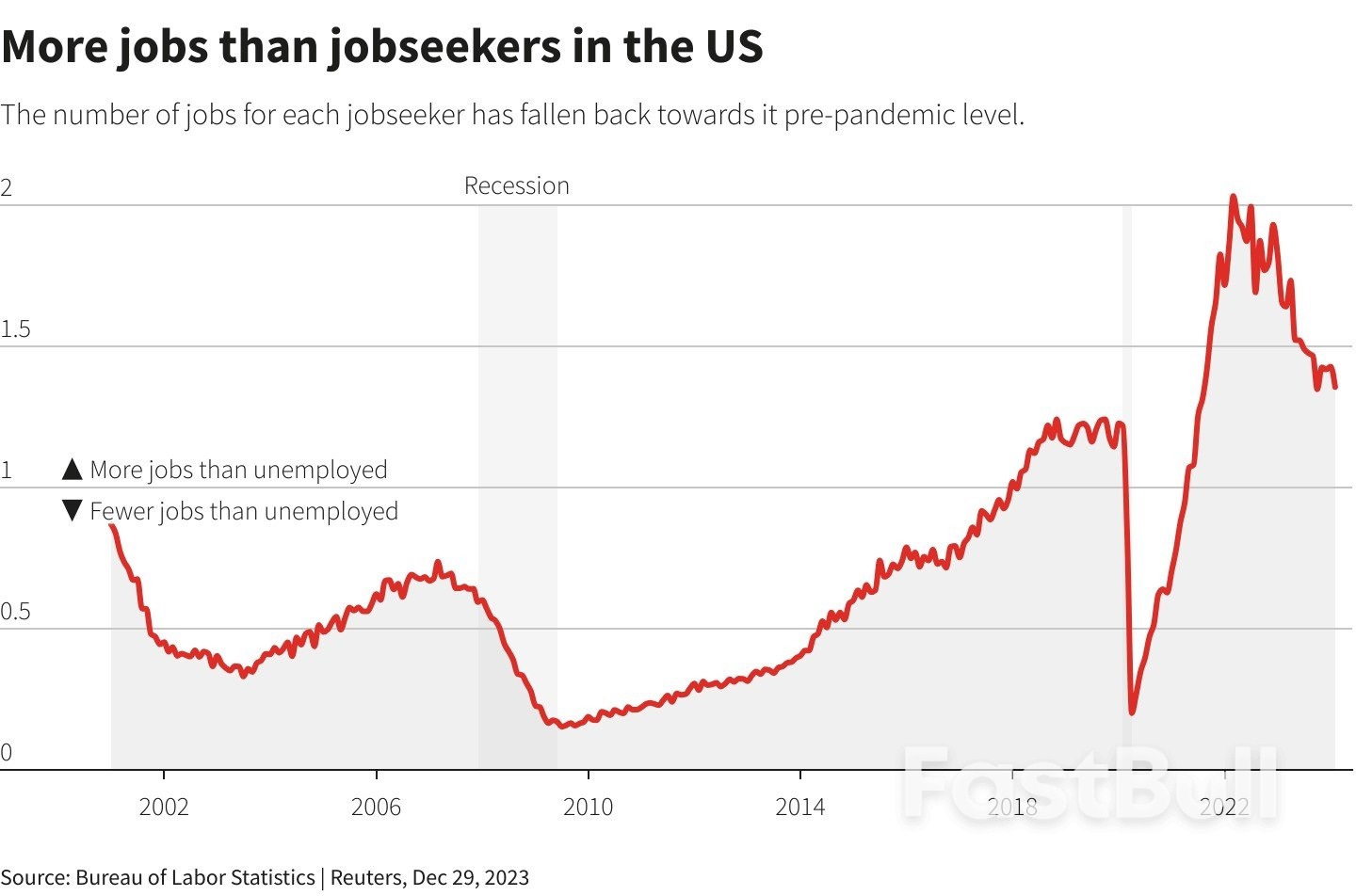
          Fed Chair Jerome Powell keeps a close eye on the U.S. Labor Department's Job Openings and Labor Turnover Survey (JOLTS) for information on the imbalance between labor supply and demand, and particularly on the number of job openings available to each person who is without a job but looking for one. The ratio had been falling steadily towards its pre-pandemic level, but since October has remained in the 1.35-1.43 range, higher than the 1.2-to-1 level seen before the health crisis.
          The number fell in the most recent release, for February, as the number of people seeking work rose, pushing up the unemployment rate.
          Other aspects of the survey, like the quits rate, have edged back to pre-pandemic levels.Charting the Fed's Economic Data Flow_1

          Inflation (PCE released March 29; next release CPI on April 10)

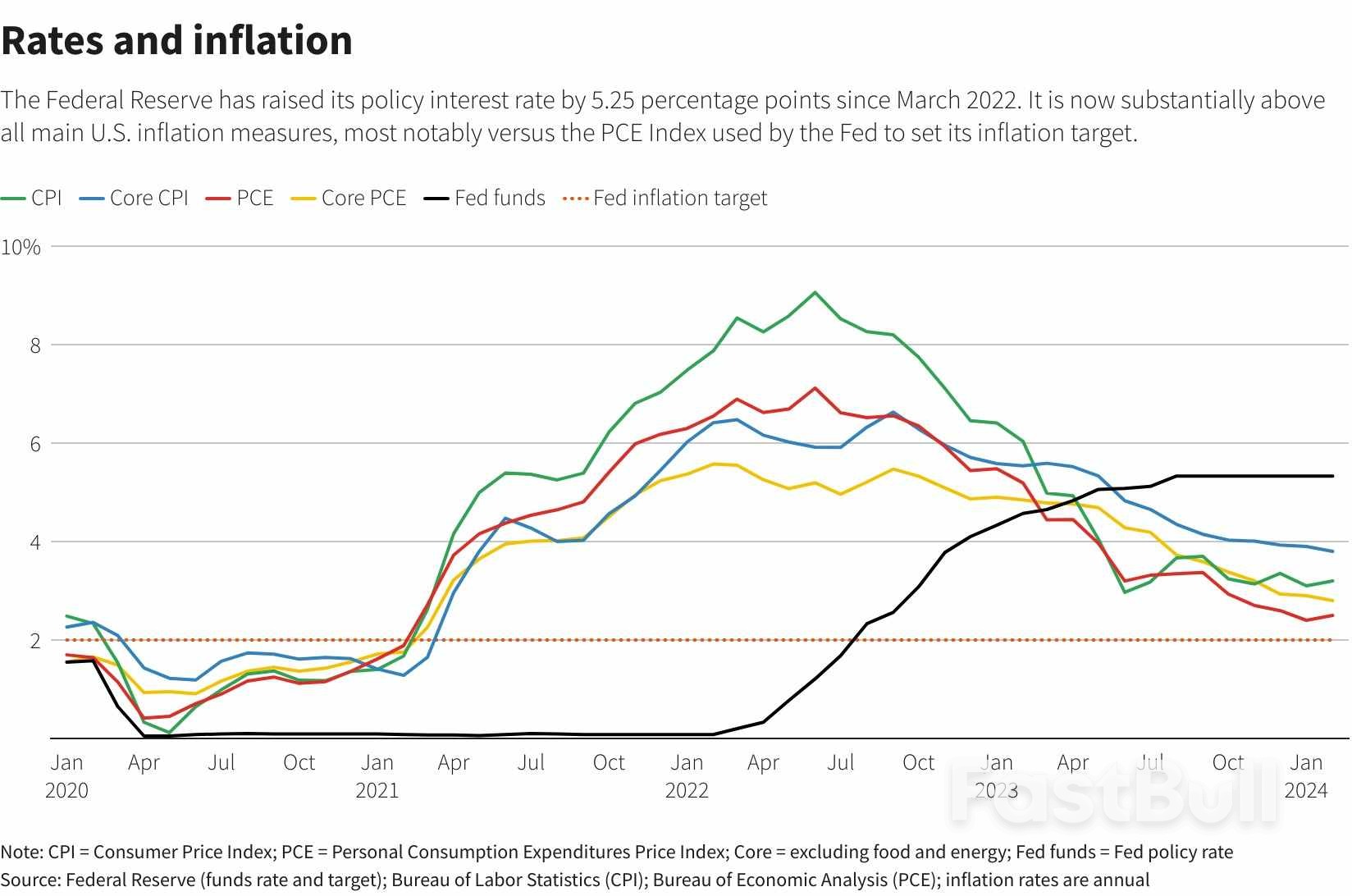
          The personal consumption expenditures (PCE) price index, which the Fed uses to set its 2% inflation target, increased at a 2.5% annual rate in February, up from the 2.4% rate seen in January. Core inflation stripped of volatile food and energy prices rose 2.8%, a slight decline from the upwardly revised 2.9% in January. Neither number is likely to boost confidence among Fed policymakers that inflation will steadily return to their target.
          The CPI had risen 3.2% on a year-on-year basis in February, up from 3.1% in the prior month, and higher than analysts expected. The core rate excluding food and energy costs, meanwhile, only edged down to 3.8% from 3.9%, another reminder that the Fed's inflation battle may last longer than anticipated. Rising gasoline and shelter costs contributed the bulk of the CPI increase. Whether the Fed's hoped-for consistent easing in housing costs is imminent remains uncertain.Charting the Fed's Economic Data Flow_2

          Employment (Released March 8; next release April 5)

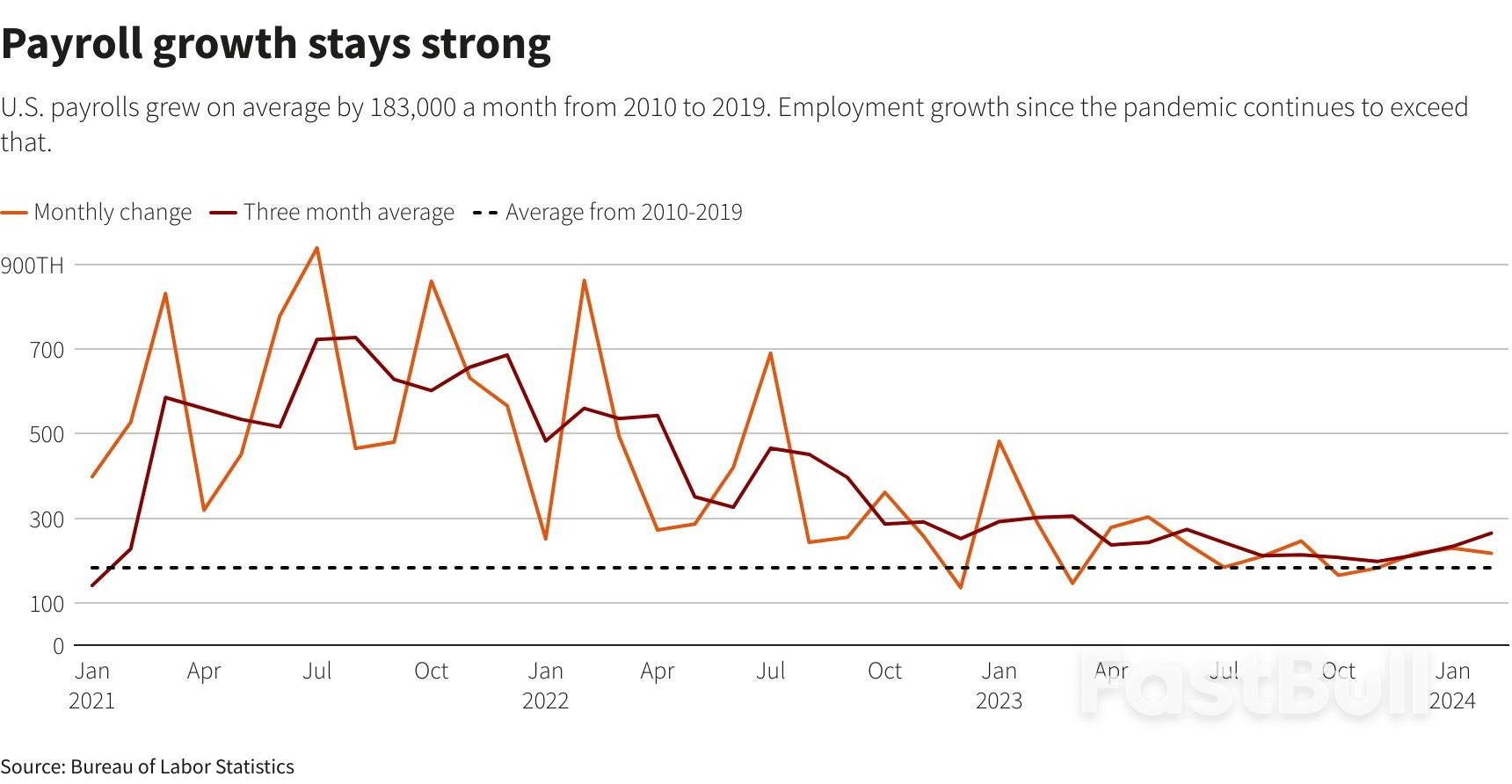
          U.S. firms added a larger-than-expected 275,000 jobs in February, though employment gains in the previous two months were revised lower by 167,000. The unemployment rate rose to a two-year high of 3.9% as a rise in the size of the workforce was outweighed by a larger increase in the number of people reporting they were out of work.
          Fed officials have become more comfortable with the idea that continued strong job growth could still allow inflation to fall, especially if the supply of labor continues to grow and wage growth eases.
          Charting the Fed's Economic Data Flow_3On the wage front, growth eased on a month-to-month basis to just 0.1%, the smallest increase in two years and essentially neutralizing the unexpectedly strong jump in hourly pay in the prior month.
          The annual increase, meanwhile, slowed to 4.3% from 4.4%. While marking further progress, that level is still well above the 3.0%-3.5% range that most policymakers view as consistent with the Fed's 2% inflation target.

          Source: Reuters

          To stay updated on all economic events of today, please check out our Economic calendar
          Risk Warnings and Disclaimers
          You understand and acknowledge that there is a high degree of risk involved in trading. Following any strategies or investment methods may lead to potential losses. The content on the site is provided by our contributors and analysts for information purposes only. You are solely responsible for determining whether any trading assets, securities, strategy, or any other product is suitable for investing based on your own investment objectives and financial situation.
          Add to Favorites
          Share

          Japanese Yen Remains Confined In A Familiar Range Near Multi-decade Low Against USD

          Alex

          Economic

          Forex

          The Japanese Yen (JPY) edges higher against its American counterpart during the Asian session on Wednesday, albeit it lacks follow-through and remains confined in a familiar range held over the past two weeks or so. Investors remain on alert amid the possibility of intervention by Japanese authorities to prevent a destabilizing fall in the domestic currency. This, along with a generally weaker sentiment around the equity markets, turns out to be a key factor lending some support to the safe-haven JPY.
          The US Dollar (USD), on the other hand, is seen consolidating the previous day's retracement slide from a five-month top and contributes to the mildly offered tone surrounding the USD/JPY pair. Any meaningful appreciating move for the JPY, however, seems elusive in the wake of the Bank of Japan's (BoJ) dovish language, signaling that the next rate hike will be some time away. In contrast, the markets continue trimming their bets that the Federal Reserve (Fed) will cut interest rates in June.
          Expectations that the gap between US and Japanese interest rates will stay wide might further hold back the JPY bulls from placing aggressive bets, which, in turn, should help limit the downside for the USD/JPY pair. Investors now look to the US economic docket – featuring the release of the ADP report on private-sector employment and ISM Services PMI. This, along with speeches by influential FOMC members, including the Fed Chair Jerome Powell, should provide a fresh impetus later today.

          Daily Digest Market Movers: Japanese Yen lacks firm near-term direction amid mixed fundamental cues

          Japanese Finance Minister Shunichi Suzuki repeated his warning that authorities were ready to take appropriate action against excessive exchange-rate volatility and offered some support to the Japanese Yen.
          The uncertainty over the Federal Reserve’s plans to cut interest rates, along with persistent geopolitical risks, tempers investors' appetite for riskier assets and further benefits the JPY's relative safe-haven status.
          The Bank of Japan struck a dovish tone at the end of the March meeting and stopped short of offering any guidance about future policy steps, or the pace of policy normalization, which caps gains for the JPY.
          Odds of a June Fed rate cut dip below 50% after data released this week showed that the US manufacturing sector expanded in March for the first time since September 2022 and that demand for labor remains elevated.
          The US Bureau of Labor Statistics (BLS) reported in the Job Openings and Labor Turnover Survey (JOLTS) on Tuesday that the number of job openings on the last business day of February stood at 8.75 million.
          A separate report by the Commerce Department's Census Bureau showed that new orders for US-manufactured goods rebounded more than expected, by 1.4% in February following a 3.8% drop in the previous month.
          San Francisco Fed President Mary Daly said on Tuesday that inflation is gradually decreasing, though the process is erratic and gradual, and that maintaining the status quo is the appropriate policy at present.
          Adding to this, Cleveland Fed President Loretta Mester expects the central bank to cut rates later this year, though noted that moving rates down too soon would risk undoing the progress made on inflation.
          This comes on the back of Fed Chair Jerome Powell's remarks on Friday, saying that there was no need to be in a hurry to cut interest rates and raised doubts if the central bank will cut rates three times this year.
          The yield on the benchmark 10-year US government bond advanced to a four-month high, helping the US Dollar to stall the overnight pullback from a multi-month top and acting as a tailwind for the USD/JPY pair.

          Technical Analysis: USD/JPY extends its consolidative price move in a familiar range, bullish bias remains

          From a technical perspective, the range-bound price action witnessed over the past two weeks or so might still be categorized as a bullish consolidation phase against the backdrop of a strong rally from the March swing low. Moreover, oscillators on the daily chart are holding in the positive territory and are still far from being in the overbought zone. This, in turn, suggests that the path of least resistance for the USD/JPY pair is to the upside. That said, bulls might need a sustained breakout through the trading range resistance, around the 152.00 mark, or a multi-decade high before positioning for any further appreciating move.
          On the flip side, the lower end of the aforementioned trading range, around the 151.10-151.00 area, is likely to protect the immediate downside. Some follow-through selling below the 150.85-150.80 horizontal resistance breakpoint, now turned support, could expose the next relevant support near the 150.25 area. This is closely followed by the 150.00 psychological mark, which if broken decisively might turn the USD/JPY pair vulnerable to accelerate the corrective decline further towards the 149.35-149.30 region before eventually dropping to the 149.00 mark.

          Source:FXStreet

          To stay updated on all economic events of today, please check out our Economic calendar
          Risk Warnings and Disclaimers
          You understand and acknowledge that there is a high degree of risk involved in trading. Following any strategies or investment methods may lead to potential losses. The content on the site is provided by our contributors and analysts for information purposes only. You are solely responsible for determining whether any trading assets, securities, strategy, or any other product is suitable for investing based on your own investment objectives and financial situation.
          Add to Favorites
          Share

          April 3rd Financial News

          FastBull Featured

          Daily News

          [Quick Facts]

          1. Daly says three rate cuts is a reasonable expectation for 2024.
          2. U.S. Job openings rise modestly.
          3. OPEC oil output stays steady as the group's latest cutbacks stall.
          4. Mester says the Fed is likely to start cutting rates in June.
          5. U.S. and global economy continues to improve, U.S. bond bulls losing.

          [News Details]

          Daly says three rate cuts is a reasonable expectation for 2024
          Fed officials repeated last month that three rate cuts are expected for 2024. "I think that is a very reasonable baseline," said San Francisco Fed President Mary Daly in a speech on Monday. Given the strong economic growth momentum in the U.S., however, there is no urgency to adjust the bank rates, and staying put is right currently.
          Inflation is falling but at a bumpy and slow pace. The timing and size of rate cuts will depend on how fast inflation slows and whether the economy weakens. Three rate cuts for 2024 is a forecast, not a commitment, and it is too early to take this as a pre-determined path.
          U.S. Job openings rise modestly
          The U.S. Bureau of Labor Statistics released the results of the Job Openings and Labor Turnover Survey (JOLTS) showing that the number of job openings at the end of February was 8,756,000, largely in line with market expectations of 8,760,000, while the January figure was revised down from 8,863,000 to 8,748,000.
          The data suggests that U.S. labor demand is stabilizing at a high level. Layoffs rose to a nearly one-year high during the month, driven by increased layoffs in the leisure and hospitality sector. However, the quits rate, which measures voluntary job leavers as a share of total employment, held at 2.2%, the lowest level since 2020, suggesting that people lack confidence in their ability to find other jobs in the current market or reflecting a narrowing of the wage premium for those seeking to change jobs.
          While the number of job openings has fallen back from its peak, the pace of decline has slowed markedly since it dropped below 9 million last October. The ratio of job openings to the number of unemployed has fallen to 1:1.36, a four-month low, suggesting that the U.S. labor market remains tight.
          As the unemployment rate rises and the ratio of job openings to the unemployed falls, wage pressures are expected to weaken further. With the labor market coming into better balance, the Fed should feel more confident about cutting rates this summer.
          OPEC oil output stays steady as the group's latest cutbacks stall
          OPEC's crude oil production held steady last month, but some members stalled on the production cutbacks. OPEC produced 26.86 million barrels of crude per day in March, virtually unchanged from the previous month, according to a survey. It has been three months since a new deal was struck to prop up oil prices by cutting production, and several OPEC countries, such as Saudi Arabia and Kuwait, are adhering to the deal, but some others are not. Iraq, the United Arab Emirates, and Gabon together have produced hundreds of thousands of barrels a day, exceeding their agreed quota.
          Mester says the Fed is likely to start cutting rates in June
          Cleveland Fed President Loretta Mester said in a speech Monday that the Fed has made substantial progress on disinflation, but the inflation rate is still above the 2% target. Inflation for January and February was more stubborn than in the second half of last year, proving once again that the disinflation process will be "bumpy".
          Economic growth is expected to slow somewhat this year compared to last year, but it will be slightly above the trend growth of 2%; the labor market is expected to remain balanced this year, with the unemployment rate rising slightly from its current very low level; and further progress in disinflation is expected to be made but at a slower rate than last year.
          The greater risk at this point is to start cutting interest rates too soon, and the Fed does not have to take risks to do so in the context of a strong labor market and economic growth. Monetary policy is in a good place right now. If the labor market deteriorates, the Fed can cut rates quickly. If inflation stagnates, the Fed will maintain a restrictive monetary stance for longer. The Fed is not expected to gain enough confidence to decide on rate cuts at the next FOMC meeting, but things could change at the June meeting.
          U.S. and global economy continues to improve, U.S. bond bulls losing
          With the cyclical strength of the U.S. and global economies, the risk of a sustained rise in U.S. Treasury yields has increased, and long positions are reduced. Leading indicators point to a cyclical upturn in the U.S. and global economies, and the current indicators have confirmed this. 10-year U.S. bond yields have been rising steadily throughout the year, recently driven by real yields. Judging from this, the market is perhaps largely assuming that U.S. bond yields will move higher. The non-farm payrolls data due Friday could challenge this as the job market shows signs of slowing. However, the data is unlikely to change the current market expectation or reduce the risk of higher inflation.

          [Focus of the Day]

          UTC+8 17:00 Eurozone HICP (Mar)
          20:15 U.S. ADP (Mar)
          21:45 Fed Governor Bowman Speaks
          22:00 U.S. ISM Non-manufacturing PMI (Mar)
          Risk Warnings and Disclaimers
          You understand and acknowledge that there is a high degree of risk involved in trading. Following any strategies or investment methods may lead to potential losses. The content on the site is provided by our contributors and analysts for information purposes only. You are solely responsible for determining whether any trading assets, securities, strategy, or any other product is suitable for investing based on your own investment objectives and financial situation.
          Add to Favorites
          Share

          Yuan Pressure Mounting as Green Shoots Fail to Lift Mood

          Thomas

          Economic

          Forex

          The yuan is a whisker away from the weak end of its onshore trading band, the latest sign that a recent slew of upbeat economic data hasn’t been enough to bolster the Chinese currency.
          China’s currency slid to a four-month low against the dollar in onshore trading Tuesday and came within a few pips of the lower end of the trading range permitted by the central bank. In the more freely traded offshore market, the yuan has been hovering at a weaker level than the onshore daily limit for some eight consecutive sessions. Signs of stress are also growing in the options market.
          The persistent pressure on the currency indicates that traders expect Beijing to lean on a weaker yuan to help revive growth in the absence of massive stimulus. Its task is complicated by the need to prevent disorderly capital outflows. To stabilize the market, policymakers stuck with its support for the foreign-exchange market with a stronger-than-expected daily fixing on Wednesday.
          The phenomenon also mirrors the broader Asian trend, where regional currencies have buckled under the weight of a stronger dollar as the Federal Reserve signals it’s in no rush to ease policy.
          The central bank is sticking to the currency stability playbook, said Christopher Wong, strategist at Oversea-Chinese Banking Corp. But “with most Asian currencies depreciating, I won’t rule out the scenario that policymakers are taking the opportunity to let the yuan depreciate slightly” to be in line with others, he added.
          Here are three charts that show the yuan’s stress in currency markets:

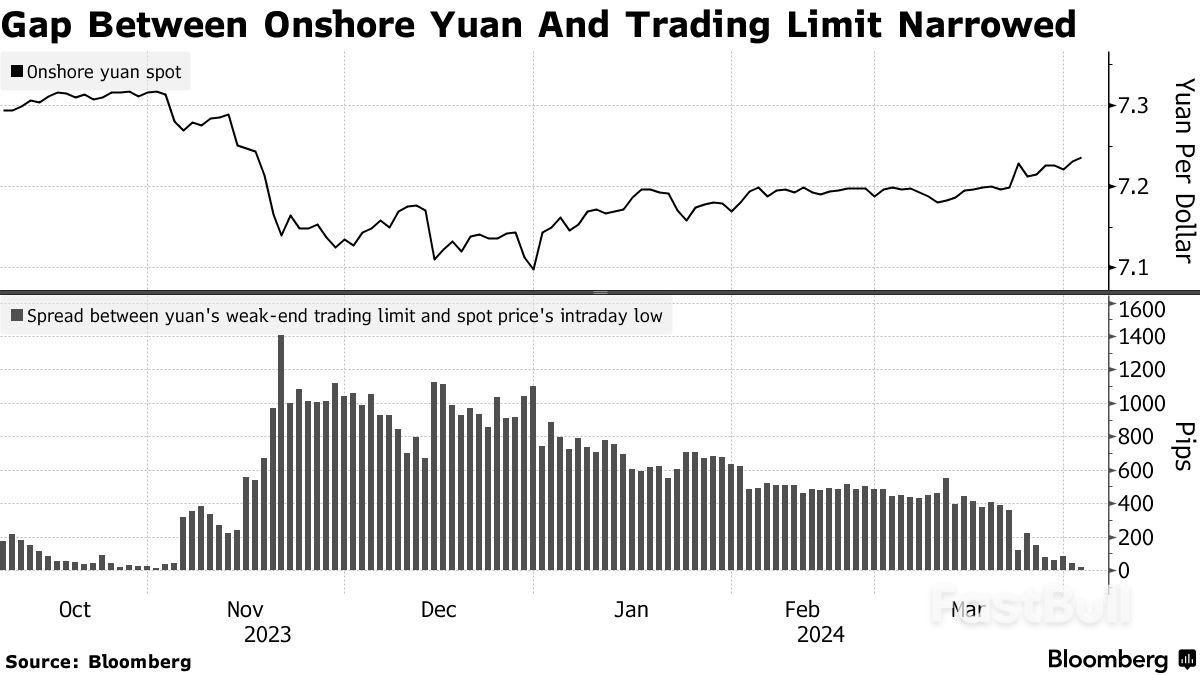
          Testing Boundaries

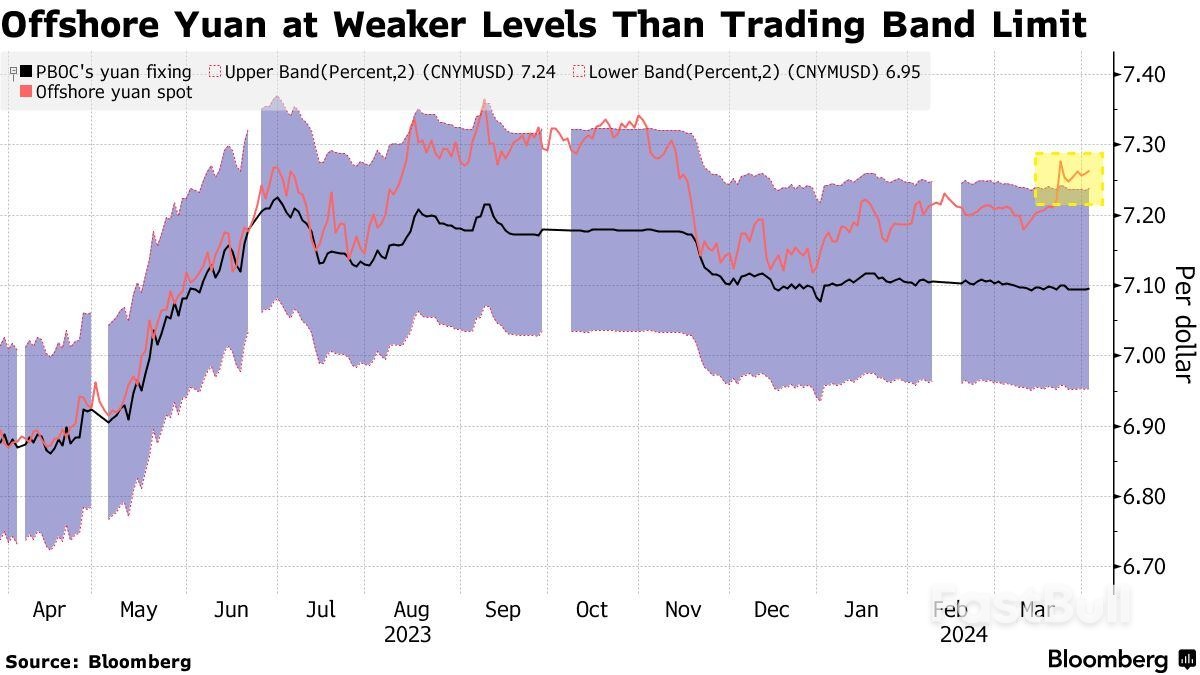
          The yuan traded less than 20 pips away from the lower daily trading limit against the dollar on Tuesday, the nearest it’s been to the band since November. The managed currency’s move is confined to 2% on either side of the daily reference rate, known as the fixing, set by the People’s Bank of China.
          Investors were briefly blocked from some yuan swap transactions that implied the currency was outside the weak end of its fixed trading band against the dollar on Tuesday, according to traders.
          Yuan Pressure Mounting as Green Shoots Fail to Lift Mood_1

          Beyond Limit

          The offshore yuan, which faces far fewer restrictions, has been trading at a weaker level than the lower end of the onshore trading band for eight sessions as of Tuesday. That’s the longest stretch since the People’s Bank of China made its yuan fixing regime more market oriented in August 2015.
          Yuan Pressure Mounting as Green Shoots Fail to Lift Mood_2

          Buying Protection

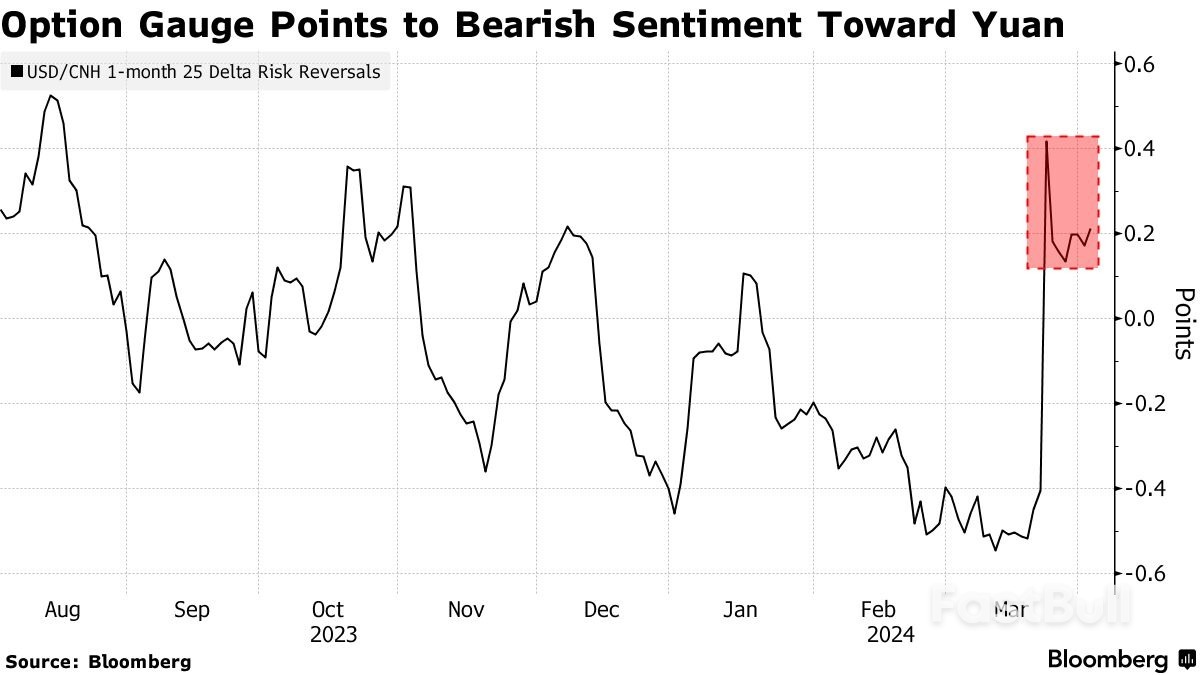
          Bearish yuan sentiment is also picking up in the options market. A gauge of demand for one-month dollar-yuan call options over put options, a measure known as risk reversal, remains elevated after touching a seven-month high late last month.
          Yuan Pressure Mounting as Green Shoots Fail to Lift Mood_3

          Source: Bloomberg

          To stay updated on all economic events of today, please check out our Economic calendar
          Risk Warnings and Disclaimers
          You understand and acknowledge that there is a high degree of risk involved in trading. Following any strategies or investment methods may lead to potential losses. The content on the site is provided by our contributors and analysts for information purposes only. You are solely responsible for determining whether any trading assets, securities, strategy, or any other product is suitable for investing based on your own investment objectives and financial situation.
          Add to Favorites
          Share

          Hang Seng Index, Nikkei Index, ASX 200: Futures Flash Red Pre China Services PMI

          Zi Cheng

          Stocks

          US Equity Markets: US Factory Orders and Job Openings

          On Wednesday, overnight US economic indicators warrant investor attention amidst increasing uncertainty about a June Fed rate cut.
          JOLTs job openings remained steady at 8.75 million in February after a downward revision to the January reading of 8.86 million. Economists forecast JOLTs job openings of 8.75 million. Importantly, the quit rate rose, signaling workforce confidence in labor market conditions. JOLTs job quits rose from 3.446 million to 3.484 million.
          Factory orders beat expectations, rising by 1.4% in February after sliding by 3.8% in January.
          10-year US Treasury yields ended the Tuesday session up 0.93% to 4.353%, down from a session high of 4.405%.
          On Tuesday, the Nasdaq Composite Index and the S&P 500 declined by 0.95% and 0.72%, respectively. The Dow slid by 1.00%.

          Asia Economic Calendar: Service Sector PMIs in the Spotlight

          On Wednesday, the Asian economic calendar will also warrant investor attention. Numbers from China could drive demand for riskier assets after better-than-expected manufacturing data.Economists forecast the Caixin Services PMI to increase from 52.5 to 52.7 in March. The figures will likely influence buyer demand for ASX 200 and Hang Seng Index-listed stocks.Service PMI numbers from Japan may influence the Bank of Japan rate path. The BoJ is eyeing the services sector to fuel demand-driven inflation. Economists expect the Jibun Bank Services PMI to rise from 52.9 to 54.9 in March.

          Commodities: Crude Oil, Gold, and Iron Ore Price Trends

          Commodity price trends can impact market risk sentiment and the ASX 200. Crude oil and gold prices were higher on Tuesday. SGX TSI Iron ore prices also trended higher.

          The USD/JPY, the Intervention Zone, and the Nikkei

          The Nikkei remains in the hands of the USD/JPY and the Japanese government. Falling bets on a June Fed rate cut could drive buyer demand for the US dollar. An accommodative Bank of Japan would leave the Japanese government to counter a USD/JPY break above the 152 barrier.

          The Futures Markets

          On Wednesday, the ASX 200 and the Nikkei were down 30 and 230 points, respectively.

          ASX 200

          Hang Seng Index, Nikkei Index, ASX 200: Futures Flash Red Pre China Services PMI_1
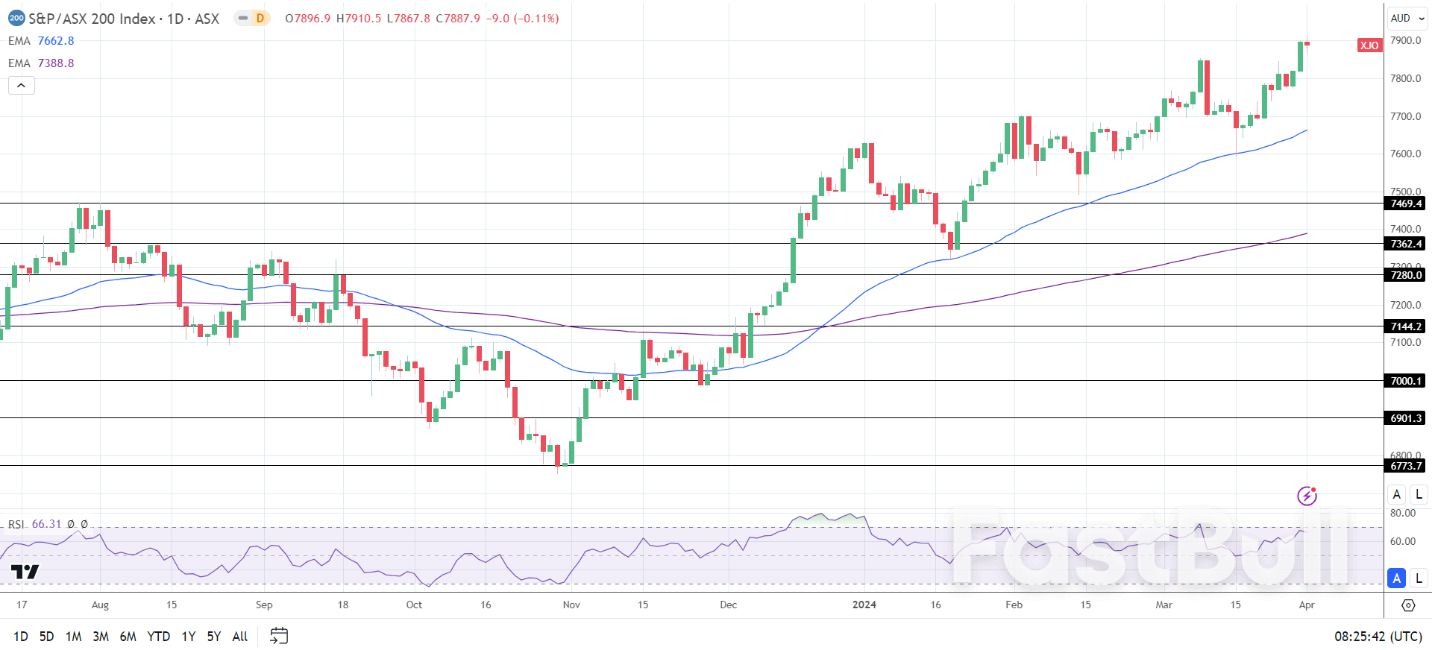
          The ASX 200 declined by 0.11% on Tuesday. Tech stocks pressured the ASX 200 on fading expectations of a June Fed rate cut. The S&P ASX All Technology Index (XTX) ended the session down 0.52%. Bank and mining stocks had mixed sessions. However, gold (XAU/USD) and oil limited the losses.
          Gold (XAU/USD) stocks Northern Star Resources Ltd. (NST) and Evolution Mining Ltd (EVN) surged by 2.56% and 5.87%, respectively.
          Woodside Energy Group Ltd (WDS) ended the session flat, while Santos Ltd (STO) advanced by 1.16%.
          BHP Group Ltd (BHP) and Rio Tinto Ltd. (RIO) ended the day up 1.94% and 0.68%, respectively. Iron ore prices advanced on the Singapore futures exchange, supporting the Tuesday session gains. However, Fortescue Metals Group Ltd. (FMG) bucked the trend, falling 1.09%.
          National Australia Bank Ltd. (NAB)and Westpac Banking Corp. (WBC) rose by 0.52% and 0.04%, respectively. ANZ Group Holdings Ltd. (ANZ) and Commonwealth Bank of Australia (CBA) saw losses of 0.03% and 0.22%, respectively.

          Hang Seng Index

          Hang Seng Index, Nikkei Index, ASX 200: Futures Flash Red Pre China Services PMI_2
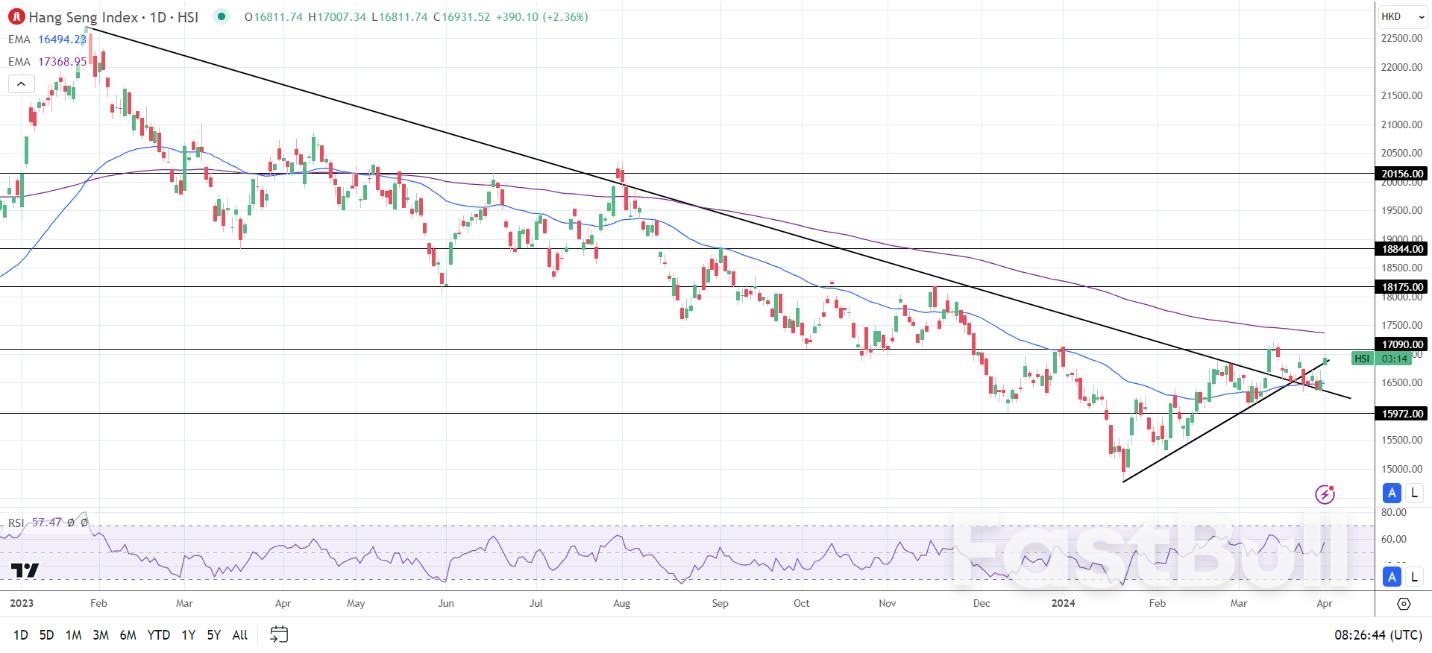
          On Tuesday, the Hang Seng Index rallied 2.36%. Real estate and tech ended the session in positive territory. The Hang Seng Tech Index (HSTECH) and Hang Seng Mainland Properties Index (HSMPI) saw gains of 1.89% and 1.90%, respectively. Investors responded to the better-than-expected private sector PMIs from China.
          Tencent (0700) and Alibaba (9988) advanced by 1.78% and 1.07%, respectively.
          Bank stocks had a positive start to the second quarter. HSBC (0005) rose by 1.23%. China Construction Bank (0939) and Industrial Commercial Bank (1398) rallied 2.75% and 2.28%, respectively.

          The Nikkei 225

          Hang Seng Index, Nikkei Index, ASX 200: Futures Flash Red Pre China Services PMI_3

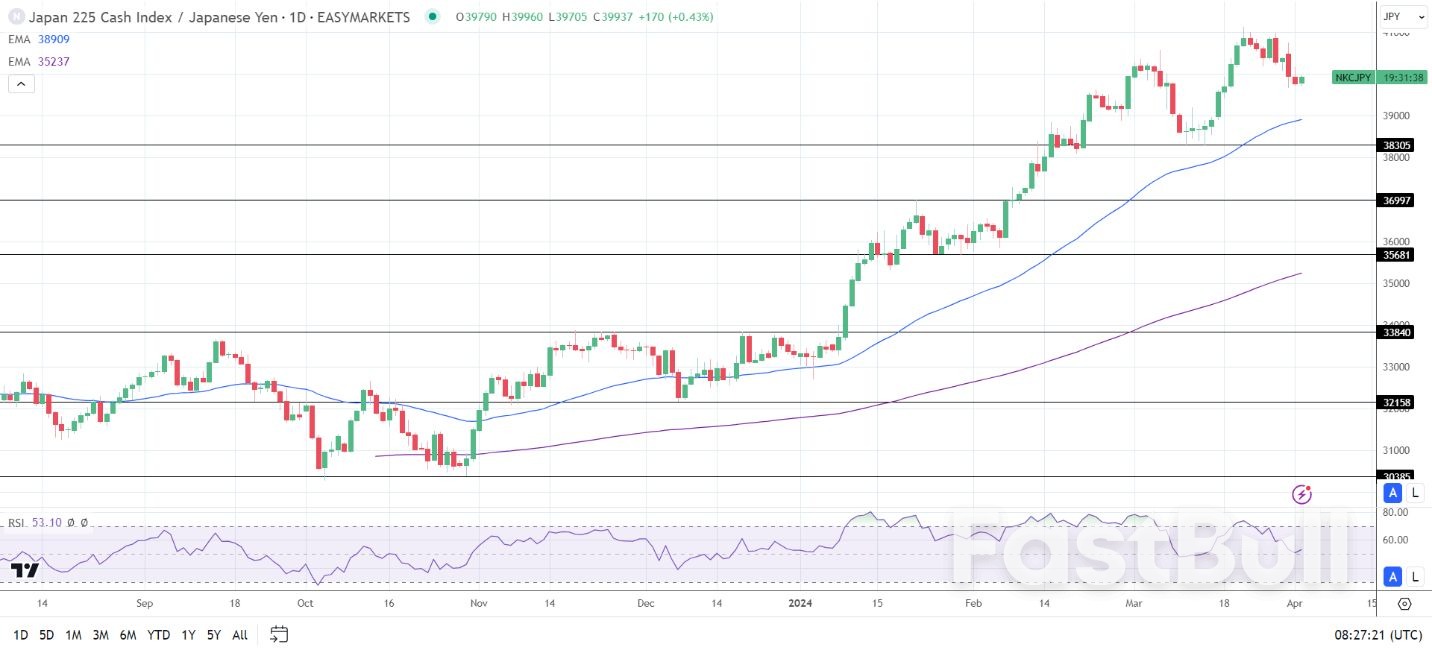
          The Nikkei gained 0.09% on Tuesday. A steadier USD/JPY offered market comfort despite hovering within the intervention zone. Semiconductors tracked their Nasdaq-listed counterparts into positive territory, delivering the gains for the Nikkei.
          Bank stocks saw more losses after the Monday sell-off. Sumitomo Mitsui Financial Group Inc. (8316) and Mitsubishi UFJ Financial Group Inc. (8306) declined by 0.12% and 0.03%, respectively.
          It was another mixed session for the main components of the Nikkei.
          Tokyo Electron Ltd. (8035) rallied 3.42%, with Fast Retailing Co. Ltd. (9983) advancing by 0.13%.
          However, Softbank Group Corp. (9948) and Sony Group Corporation (6758) fell by 0.39% and 0.27%, respectively. KDDI Corp. (9433) ended the session down 0.04%.

          Source: FX Empire

          Risk Warnings and Disclaimers
          You understand and acknowledge that there is a high degree of risk involved in trading. Following any strategies or investment methods may lead to potential losses. The content on the site is provided by our contributors and analysts for information purposes only. You are solely responsible for determining whether any trading assets, securities, strategy, or any other product is suitable for investing based on your own investment objectives and financial situation.
          Add to Favorites
          Share
          FastBull
          Copyright © 2025 FastBull Ltd

          728 RM B 7/F GEE LOK IND BLDG NO 34 HUNG TO RD KWUN TONG KLN HONG KONG

          TelegramInstagramTwitterfacebooklinkedin
          App Store Google Play Google Play
          Products
          Charts

          Chats

          Q&A with Experts
          Screeners
          Economic Calendar
          Data
          Tools
          Membership
          Features
          Function
          Markets
          Copy Trading
          Latest Signals
          Contests
          News
          Analysis
          24/7
          Columns
          Education
          Company
          Careers
          About Us
          Contact Us
          Advertising
          Help Center
          Feedback
          User Agreement
          Privacy Policy
          Business

          White Label

          Data API

          Web Plug-ins

          Poster Maker

          Affiliate Program

          Risk Disclosure

          The risk of loss in trading financial instruments such as stocks, FX, commodities, futures, bonds, ETFs and crypto can be substantial. You may sustain a total loss of the funds that you deposit with your broker. Therefore, you should carefully consider whether such trading is suitable for you in light of your circumstances and financial resources.

          No decision to invest should be made without thoroughly conducting due diligence by yourself or consulting with your financial advisors. Our web content might not suit you since we don't know your financial conditions and investment needs. Our financial information might have latency or contain inaccuracy, so you should be fully responsible for any of your trading and investment decisions. The company will not be responsible for your capital loss.

          Without getting permission from the website, you are not allowed to copy the website's graphics, texts, or trademarks. Intellectual property rights in the content or data incorporated into this website belong to its providers and exchange merchants.

          Not Logged In

          Log in to access more features

          FastBull Membership

          Not yet

          Purchase

          Become a signal provider
          Help Center
          Customer Service
          Dark Mode
          Price Up/Down Colors

          Log In

          Sign Up

          Position
          Layout
          Fullscreen
          Default to Chart
          The chart page opens by default when you visit fastbull.com