• Trade
  • Markets
  • Copy
  • Contests
  • News
  • 24/7
  • Calendar
  • Q&A
  • Chats
Trending
Screeners
SYMBOL
LAST
BID
ASK
HIGH
LOW
NET CHG.
%CHG.
SPREAD
SPX
S&P 500 Index
6846.50
6846.50
6846.50
6878.28
6827.18
-23.90
-0.35%
--
DJI
Dow Jones Industrial Average
47739.31
47739.31
47739.31
47971.51
47611.93
-215.67
-0.45%
--
IXIC
NASDAQ Composite Index
23545.89
23545.89
23545.89
23698.93
23455.05
-32.22
-0.14%
--
USDX
US Dollar Index
99.000
99.080
99.000
99.000
99.000
+0.050
+ 0.05%
--
EURUSD
Euro / US Dollar
1.16349
1.16380
1.16349
1.16365
1.16322
-0.00015
-0.01%
--
GBPUSD
Pound Sterling / US Dollar
1.33194
1.33240
1.33194
1.33217
1.33140
-0.00011
-0.01%
--
XAUUSD
Gold / US Dollar
4189.70
4190.14
4189.70
4218.85
4175.92
-8.21
-0.20%
--
WTI
Light Sweet Crude Oil
58.555
58.807
58.555
60.084
58.495
-1.254
-2.10%
--

Community Accounts

Signal Accounts
--
Profit Accounts
--
Loss Accounts
--
View More

Become a signal provider

Sell trading signals to earn additional income

View More

Guide to Copy Trading

Get started with ease and confidence

View More

Signal Accounts for Members

All Signal Accounts

Best Return
  • Best Return
  • Best P/L
  • Best MDD
Past 1W
  • Past 1W
  • Past 1M
  • Past 1Y

All Contests

  • All
  • Trump Updates
  • Recommend
  • Stocks
  • Cryptocurrencies
  • Central Banks
  • Featured News
Top News Only
Share

Ukraine's Security Must Be Guaranteed, In The Long Term, As A First Line Of Defence For Our Union, Says European Commission President

Share

Ukraine's Sovereignty Must Be Respected, Says European Commission President

Share

The Goal Is A Strong Ukraine, On The Battlefield And At The Negotiating Table, Says European Commission President

Share

As Peace Talks Are Ongoing, The EU Remains Ironclad In Its Support For Ukraine, Says European Commission President

Share

Pepsico: Asking USA-Based Pepna Employees As Well As Pbus Division Offices And Pfus Region Offices To Work Remotely This Week

Share

A U.S. Judge Ruled That President Trump’s Ban On Several Wind Power Projects Was Illegal

Share

Senior USA Administration Official: We Continue To Monitor Drc-Rwanda Situation Closely, Continue To Work With All Sides To Ensure Commitments Are Honored

Share

Israeli Military Says It Has Struck Infrastructure Belonging To Hezbollah In Several Areas In Southern Lebanon

Share

SPDR Gold Holdings Down 0.11%, Or 1.14 Tonnes

Share

On Monday (December 8), In Late New York Trading, S&P 500 Futures Fell 0.21%, Dow Jones Futures Fell 0.43%, NASDAQ 100 Futures Fell 0.08%, And Russell 2000 Futures Fell 0.04%

Share

Morgan Stanley: Data Center ABS Spreads Are Expected To Widen In 2026

Share

(US Stocks) The Philadelphia Gold And Silver Index Closed Down 2.34% At 311.01 Points. (Global Session) The NYSE Arca Gold Miners Index Closed Down 2.17%, Hitting A Daily Low Of 2235.45 Points; US Stocks Remained Slightly Down Before The Opening Bell—holding Steady Around 2280 Points—before Briefly Rising Slightly

Share

IMF: IMF Executive Board Approves Extension Of The Extended Credit Facility Arrangement With Nepal

Share

Trump: Same Approach Will Apply To Amd, Intel, And Other Great American Companies

Share

Trump: Department Of Commerce Is Finalizing Details

Share

Trump: $25% Will Be Paid To United States Of America

Share

Trump: President Xi Responded Positively

Share

[Consumer Discretionary ETFs Fell Over 1.4%, Leading The Decline Among US Sector ETFs; Semiconductor ETFs Rose Over 1.1%] On Monday (December 8), The Consumer Discretionary ETF Fell 1.45%, The Energy ETF Fell 1.09%, The Internet ETF Fell 0.18%, The Regional Banks ETF Rose 0.34%, The Technology ETF Rose 0.70%, The Global Technology ETF Rose 0.93%, And The Semiconductor ETF Rose 1.13%

Share

Trump: I Have Informed President Xi, Of China, That United States Will Allow Nvidia To Ship Its H200 Products To Approved Customers In China

Share

Argentina's Merval Index Closed Up 0.02% At 3.047 Million Points. It Rose To A New Daily High Of 3.165 Million Points In Early Trading In Buenos Aires Before Gradually Giving Back Its Gains

TIME
ACT
FCST
PREV
France Trade Balance (SA) (Oct)

A:--

F: --

P: --
Euro Zone Employment YoY (SA) (Q3)

A:--

F: --

P: --
Canada Part-Time Employment (SA) (Nov)

A:--

F: --

P: --

Canada Unemployment Rate (SA) (Nov)

A:--

F: --

P: --

Canada Full-time Employment (SA) (Nov)

A:--

F: --

P: --

Canada Labor Force Participation Rate (SA) (Nov)

A:--

F: --

P: --

Canada Employment (SA) (Nov)

A:--

F: --

P: --

U.S. PCE Price Index MoM (Sept)

A:--

F: --

P: --

U.S. Personal Income MoM (Sept)

A:--

F: --

P: --

U.S. Core PCE Price Index MoM (Sept)

A:--

F: --

P: --

U.S. PCE Price Index YoY (SA) (Sept)

A:--

F: --

P: --

U.S. Core PCE Price Index YoY (Sept)

A:--

F: --

P: --

U.S. Personal Outlays MoM (SA) (Sept)

A:--

F: --

P: --
U.S. 5-10 Year-Ahead Inflation Expectations (Dec)

A:--

F: --

P: --

U.S. Real Personal Consumption Expenditures MoM (Sept)

A:--

F: --

P: --
U.S. Weekly Total Rig Count

A:--

F: --

P: --

U.S. Weekly Total Oil Rig Count

A:--

F: --

P: --

U.S. Consumer Credit (SA) (Oct)

A:--

F: --

P: --
China, Mainland Foreign Exchange Reserves (Nov)

A:--

F: --

P: --

Japan Trade Balance (Oct)

A:--

F: --

P: --

Japan Nominal GDP Revised QoQ (Q3)

A:--

F: --

P: --

China, Mainland Imports YoY (CNH) (Nov)

A:--

F: --

P: --

China, Mainland Exports (Nov)

A:--

F: --

P: --

China, Mainland Imports (CNH) (Nov)

A:--

F: --

P: --

China, Mainland Trade Balance (CNH) (Nov)

A:--

F: --

P: --

China, Mainland Exports YoY (USD) (Nov)

A:--

F: --

P: --

China, Mainland Imports YoY (USD) (Nov)

A:--

F: --

P: --

Germany Industrial Output MoM (SA) (Oct)

A:--

F: --

P: --
Euro Zone Sentix Investor Confidence Index (Dec)

A:--

F: --

P: --

Canada National Economic Confidence Index

A:--

F: --

P: --

U.K. BRC Like-For-Like Retail Sales YoY (Nov)

--

F: --

P: --

U.K. BRC Overall Retail Sales YoY (Nov)

--

F: --

P: --

Australia Overnight (Borrowing) Key Rate

--

F: --

P: --

RBA Rate Statement
RBA Press Conference
Germany Exports MoM (SA) (Oct)

--

F: --

P: --

U.S. NFIB Small Business Optimism Index (SA) (Nov)

--

F: --

P: --

Mexico 12-Month Inflation (CPI) (Nov)

--

F: --

P: --

Mexico Core CPI YoY (Nov)

--

F: --

P: --

Mexico PPI YoY (Nov)

--

F: --

P: --

U.S. Weekly Redbook Index YoY

--

F: --

P: --

U.S. JOLTS Job Openings (SA) (Oct)

--

F: --

P: --

China, Mainland M1 Money Supply YoY (Nov)

--

F: --

P: --

China, Mainland M0 Money Supply YoY (Nov)

--

F: --

P: --

China, Mainland M2 Money Supply YoY (Nov)

--

F: --

P: --

U.S. EIA Short-Term Crude Production Forecast For The Year (Dec)

--

F: --

P: --

U.S. EIA Natural Gas Production Forecast For The Next Year (Dec)

--

F: --

P: --

U.S. EIA Short-Term Crude Production Forecast For The Next Year (Dec)

--

F: --

P: --

EIA Monthly Short-Term Energy Outlook
U.S. API Weekly Gasoline Stocks

--

F: --

P: --

U.S. API Weekly Cushing Crude Oil Stocks

--

F: --

P: --

U.S. API Weekly Crude Oil Stocks

--

F: --

P: --

U.S. API Weekly Refined Oil Stocks

--

F: --

P: --

South Korea Unemployment Rate (SA) (Nov)

--

F: --

P: --

Japan Reuters Tankan Non-Manufacturers Index (Dec)

--

F: --

P: --

Japan Reuters Tankan Manufacturers Index (Dec)

--

F: --

P: --

Japan Domestic Enterprise Commodity Price Index MoM (Nov)

--

F: --

P: --

Japan Domestic Enterprise Commodity Price Index YoY (Nov)

--

F: --

P: --

China, Mainland PPI YoY (Nov)

--

F: --

P: --

China, Mainland CPI MoM (Nov)

--

F: --

P: --

Italy Industrial Output YoY (SA) (Oct)

--

F: --

P: --

Q&A with Experts
    • All
    • Chatrooms
    • Groups
    • Friends
    Connecting
    .
    .
    .
    Type here...
    Add Symbol or Code

      No matching data

      All
      Trump Updates
      Recommend
      Stocks
      Cryptocurrencies
      Central Banks
      Featured News
      • All
      • Russia-Ukraine Conflict
      • Middle East Flashpoint
      • All
      • Russia-Ukraine Conflict
      • Middle East Flashpoint
      Search
      Products

      Charts Free Forever

      Chats Q&A with Experts
      Screeners Economic Calendar Data Tools
      Membership Features
      Data Warehouse Market Trends Institutional Data Policy Rates Macro

      Market Trends

      Market Sentiment Order Book Forex Correlations

      Top Indicators

      Charts Free Forever
      Markets

      News

      News Analysis 24/7 Columns Education
      From Institutions From Analysts
      Topics Columnists

      Latest Views

      Latest Views

      Trending Topics

      Top Columnists

      Latest Update

      Signals

      Copy Rankings Latest Signals Become a signal provider AI Rating
      Contests
      Brokers

      Overview Brokers Assessment Rankings Regulators News Claims
      Broker listing Forex Brokers Comparison Tool Live Spread Comparison Scam
      Q&A Complaint Scam Alert Videos Tips to Detect Scam
      More

      Business
      Events
      Careers About Us Advertising Help Center

      White Label

      Data API

      Web Plug-ins

      Affiliate Program

      Awards Institution Evaluation IB Seminar Salon Event Exhibition
      Vietnam Thailand Singapore Dubai
      Fans Party Investment Sharing Session
      FastBull Summit BrokersView Expo
      Recent Searches
        Top Searches
          Markets
          News
          Analysis
          User
          24/7
          Economic Calendar
          Education
          Data
          • Names
          • Latest
          • Prev

          View All

          No data

          Scan to Download

          Faster Charts, Chat Faster!

          Download App
          English
          • English
          • Español
          • العربية
          • Bahasa Indonesia
          • Bahasa Melayu
          • Tiếng Việt
          • ภาษาไทย
          • Français
          • Italiano
          • Türkçe
          • Русский язык
          • 简中
          • 繁中
          Open Account
          Search
          Products
          Charts Free Forever
          Markets
          News
          Signals

          Copy Rankings Latest Signals Become a signal provider AI Rating
          Contests
          Brokers

          Overview Brokers Assessment Rankings Regulators News Claims
          Broker listing Forex Brokers Comparison Tool Live Spread Comparison Scam
          Q&A Complaint Scam Alert Videos Tips to Detect Scam
          More

          Business
          Events
          Careers About Us Advertising Help Center

          White Label

          Data API

          Web Plug-ins

          Affiliate Program

          Awards Institution Evaluation IB Seminar Salon Event Exhibition
          Vietnam Thailand Singapore Dubai
          Fans Party Investment Sharing Session
          FastBull Summit BrokersView Expo

          Credit Suisse Shares Tank after Saudi Backer Rules out Further Assistance

          Justin

          Central Bank

          Summary:

          Shares of embattled bank Credit Suisse hit another all-time low for a second consecutive day.Credit Suisse’s biggest backer, Saudi National Bank, has said it won’t provide further financial help for the bank.Speaking to CNBC’s Hadley Gamble during a panel session in Riyadh on Wednesday morning, Credit Suisse Chairman Axel Lehmann declined to comment on whether his firm would need any sort of government assistance in the future.

          Shares of Credit Suisse on Wednesday plunged to a fresh all-time low for the second consecutive day after a top investor of the embattled Swiss bank said it would not be able to provide any more cash due to regulatory restrictions.
          Trading in the bank’s plummeting shares was halted several times throughout the morning as it fell below 2 Swiss francs ($2.17) for the first time.
          The stock recovered slightly by around midday London time, before extending losses in early afternoon deals. Credit Suisse was last seen trading over 30% lower for the session.
          The share price rout renewed a broader sell-off among European lenders, which were already facing significant market turmoil as a result of the Silicon Valley Bank fallout. Several Italian banks on Wednesday were also subject to automatic trading stoppages, including UniCredit, Finecobank and Monte Dei Paschi.
          Credit Suisse's largest investor, Saudi National Bank, said it could not provide the Swiss bank with any further financial assistance, according to a Reuters report, sparking the latest leg lower.
          "We cannot because we would go above 10%. It's a regulatory issue," Saudi National Bank Chairman Ammar Al Khudairy told Reuters Wednesday. However, he added that the SNB is happy with Credit Suisse's transformation plan and suggested the bank was unlikely to need extra money.
          The Saudi National Bank took a 9.9% stake in Credit Suisse last year as part of the Swiss bank's $4.2 billion capital raise to fund a massive strategic overhaul aimed at improving investment banking performance and addressing a litany of risk and compliance failures.
          Meanwhile, speaking to CNBC's Hadley Gamble during a panel session in Riyadh on Wednesday morning, Credit Suisse Chairman Axel Lehmann declined to comment on whether his firm would need any sort of government assistance in the future.
          When asked if he would rule out some kind of assistance, Lehmann answered, "That's not the topic."
          "We are regulated, we have strong capital ratios, very strong balance sheet. We are all hands on deck. So that's not the topic whatsoever."

          'Material weaknesses'

          Investors are also continuing to assess the impact of the bank's Tuesday announcement that it had found "material weaknesses" in its financial reporting processes for 2022 and 2021.
          The Swiss lender disclosed the observation in its annual report, which was initially scheduled for last Thursday but was delayed by a late call from the U.S. Securities and Exchange Commission.
          The SEC conversation related to a "technical assessment of previously disclosed revisions to the consolidated cash flow statements in the years ended December 31, 2020, and 2019, as well as related controls."
          In late 2022 the bank disclosed that it was seeing "significantly higher withdrawals of cash deposits, non-renewal of maturing time deposits and net asset outflows at levels that substantially exceeded the rates incurred in the third quarter of 2022."
          Credit Suisse saw customer withdrawals of more than 110 billion Swiss francs in the fourth quarter, as a string of scandals, legacy risk and compliance failures continued to plague it.

          Source:CNBC

          Risk Warnings and Disclaimers
          You understand and acknowledge that there is a high degree of risk involved in trading. Following any strategies or investment methods may lead to potential losses. The content on the site is provided by our contributors and analysts for information purposes only. You are solely responsible for determining whether any trading assets, securities, strategy, or any other product is suitable for investing based on your own investment objectives and financial situation.
          Comments
          Add to Favorites
          Share

          Why Japan's 'Shunto' Spring Wage Talks Are a Big Deal This Year

          Cohen

          Economic

          Every March, management of major Japanese firms meet with unions for wage talks across industries that set the tone for employees' pay in the new fiscal year.
          The precedent set at the "shunto" spring wage talks also influences wages at smaller firms that employ seven out of 10 Japanese workers.
          The outcome will have a huge influence on how soon the Bank of Japan (BOJ) can end ultra-low interest rates. Steady wage hikes are crucial to kick-starting domestic demand and keeping inflation sustainably around its 2% target.
          In Japan, with the economy entrenched in deflation for 15 years since the recession of the 1990s, people are unable to shake the perception that neither prices nor wages will rise.
          Here is an overview of the wage negotiations: and why they are important.
          How is pay decided in Japan?
          In around March of each year, companies and unions negotiate pay for the fiscal year beginning in April of that year.
          The practice, known as "shunto," began in 1956 when Japan's postwar economy was booming. Unions demanded improvement in wages and job conditions by resorting to strikes in big cities, which peaked in the 1960s to 1970s.
          The shunto wages eventually peaked in 1974 with a record 33% rise in pay. The increases fell below 3% after Japan slipped into deflation and prolonged economic stagnation in the late 1990s as it suffered its own banking crisis.
          Since then, unionists have turned cooperative, rather than combative, working with management on the shared objective of job security.
          The focus on job security, rather than higher pay, is blamed for keeping Japan's wage growth stagnant. The share of low-paid part-timers in the workforce has also doubled since the early 1990s, and these so-called non-regular workers now account for nearly 40% of the workforce, putting a drag on pay increases.
          Why are companies under pressure?
          The stimulus policies introduced by former Prime Minister Shinzo Abe dubbed "Abenomics" in the late 2010s helped boost exporters' profits by weakening the yen. But it failed to trickle down to households in terms of wage increases.
          Incumbent premier Fumio Kishida wants to change this under his flagship "new capitalism" policies that seek to distribute wealth more broadly among the population through higher pay.
          He has called on companies to deliver wage hikes that exceed the pace of inflation and help households navigate higher costs from rising fuel and raw material prices.
          Companies themselves need to offer higher pay to retain talent and hire young workers as Japan's rapidly ageing population intensifies a labour shortage.
          What will be the outcome of the wage talks?
          Some of Japan's biggest firms have already promised large pay hikes including auto giant Toyota Motor Corp and fashion brand Uniqlo parent Fast Retailing.
          Analysts expect big firms to offer wage hikes of around 3% in wage talks, which would be the fastest pace of increase since 1997 when Japan was on the cusp of deflation. That would follow last year's 2.2% increase, the first hike in four years.
          Such increases would meet Kishida's call for 3% rises but fall short of the ambitious 5% demanded by the Rengo labour umbrella group.
          Will wages keep rising?
          The key for the economy will be how much companies will raise base pay, which are across-the-board and permanent payments that provide the basis of future allowances like retirement and pensions.
          Wary of increasing fixed costs, many Japanese firms have long opted to pay one-off bonuses in good times rather than raise base pay.
          As Japan slid into deflation in the late 1990s, management and unions agreed for more than a decade to no increases in base pay.
          Economists projected a 2.85% wage increase in a January poll, with base pay increases accounting for 1.08% and 1.78% from an increase in additional salary, based on seniority.
          A survey by the Institute of Labour Administration, a labour think tank, which is known for its correlation with shunto results, showed a rise of 8,590 yen ($64.04), or 2.75%, for an average 439 workers surveyed. Asked whether they would carry out base pay increase, 41.6% said they intended to.
          Mizuho Research & Technologies economists foresee declines persisting until 2024 which will weigh on consumption.
          ($1 = 134.1300 yen)

          Source: CNA

          To stay updated on all economic events of today, please check out our Economic calendar
          Risk Warnings and Disclaimers
          You understand and acknowledge that there is a high degree of risk involved in trading. Following any strategies or investment methods may lead to potential losses. The content on the site is provided by our contributors and analysts for information purposes only. You are solely responsible for determining whether any trading assets, securities, strategy, or any other product is suitable for investing based on your own investment objectives and financial situation.
          Comments
          Add to Favorites
          Share

          DeSantis Sharpens Divide Between Republican Isolationists and Hawks Over Ukraine

          Thomas

          Political

          The 2024 Republican presidential race could become a contest between isolationists and foreign policy hawks after Florida Governor Ron DeSantis sent his strongest signal yet he does not believe support for Ukraine is in the U.S. national interest, analysts, strategists and campaign aides said on Tuesday.
          The war in Ukraine provides a new battleground for declared and as yet undeclared Republican 2024 hopefuls that could shape how the party engages with the world for years to come, those people said.
          On the one side are former President Donald Trump and DeSantis, who is testing the waters for a White House run.
          Although the governor has not yet officially declared himself a candidate, he and Trump are the clear front runners in the Republican race. Both have dismissed U.S. support for Ukraine and other allies as a waste of resources and said that leaders should pay more attention to issues at home.
          On the other side, a slew of declared and likely Republican challengers - including former UN Ambassador Nikki Haley and Trump's former Vice President Mike Pence - have portrayed themselves as steadfast defenders of Ukraine, willing to stand up to U.S. foes including Russia and China.
          Caught in the middle is the Republican electorate, which is split on whether the U.S. should support Ukraine and how the nation should engage with the world more generally, according to Reuters/Ipsos polling.
          Once the party of foreign policy "hawks," Republicans have increasingly cooled on foreign entanglements and military support for allies, particularly after Trump took office in 2016.
          The ideological shift of the party - which led the U.S. to war in Iraq and Afghanistan two decades ago - was laid bare on Monday when conservative television host Tucker Carlson posted on Twitter responses from Republican candidates and possible hopefuls to questions on the war in Ukraine.
          "While the U.S. has many vital national interests ... becoming further entangled in a territorial dispute between Ukraine and Russia is not one of them," DeSantis said in his reply.
          Some Republicans were quick to hit back.
          In a statement on Tuesday, Haley reiterated her support for Ukraine. "America is far better off with a Ukrainian victory," she wrote.
          Republican senators Marco Rubio, who is from DeSantis' home state, and Lindsey Graham, both former presidential candidates, criticized isolationists within their party.
          "When it comes to Putin, you either pay now or pay later," Graham wrote on Twitter, referring to Russian President Vladimir Putin.
          "DeSantis's comments very much recall the Republican pre-World War Two tradition of so-called isolationism, which was really an indifference to European security," said Dan Fried, a former top State Department official under President George W. Bush who is now with the Atlantic Council think tank in Washington.
          Party Split
          Republican voters are divided on the issue.
          In a Reuters/Ipsos poll in February, 55% of Republicans said the United States should support democratic countries when they are attacked by non-democratic nations. Asked whether the U.S. should continue sending weapons to Ukraine, self-identified Republicans were split 50-50.
          "People care about foreign policy, but I think it's kind of mixed on Ukraine funding," said Trudy Caviness, a member of the Iowa Republican State Central Committee.
          "What I've heard (from party members) is that we have to give them what we've promised so far and then move on."
          Pollsters, analysts and campaign aides interviewed by Reuters said that DeSantis' embrace of a more isolationist approach could open the way for more hawkish candidates to appeal to the significant chunk of the Republican electorate that still prefers a more hands-on U.S. foreign policy.
          Several prospective candidates, including Haley, Pence and former Secretary of State Mike Pompeo have made their foreign policy experience a key part of their pitch to voters.
          By embracing Trump's hands-off brand of foreign policy, DeSantis risks turning off some of the white-collar Republicans that are most eager to move on from the former president.
          While 46% of non-college educated Republicans said the United States should provide weapons to Ukraine, some 59% of those with a college degree said the U.S. should provide arms to Ukraine, according to a Reuters/Ipsos poll in February.
          However, many will be voting for personalities rather than policies, pollsters said. That will give the eventual winner of the Republican nomination significant power to shape the party's foreign policy preferences going forward.
          "I think leadership matters a great deal on issues where voters can be a little unsure what they think about them," said Sarah Longwell, a Republican strategist.

          Source: Devdiscourse

          Risk Warnings and Disclaimers
          You understand and acknowledge that there is a high degree of risk involved in trading. Following any strategies or investment methods may lead to potential losses. The content on the site is provided by our contributors and analysts for information purposes only. You are solely responsible for determining whether any trading assets, securities, strategy, or any other product is suitable for investing based on your own investment objectives and financial situation.
          Comments
          Add to Favorites
          Share

          Lower Spot LNG Prices Tempt China Buyers, But Japan Buys Less

          Owen Li

          Commodity

          The decline in the spot price of liquefied natural gas (LNG) in Asia to a 21-month low is tempting China to boost its imports of the super-chilled fuel.
          China is on track to import 5.39 million tonnes of LNG in March, according to data compiled by commodity analysts Kpler.
          This would be up from February's 4.96 million tonnes and also above the 4.77 million from March last year.
          China lost its crown as the world's biggest LNG importer last year to former champion Japan, as high prices led Chinese utilities to sharply reduce spot purchases and only take cargoes bought under long-term, mainly crude-oil linked contracts.
          But the spot price in Asia has been trending lower since mid-December and ended at $13.50 per million British thermal units (mmBtu) in the week to March 10.
          This is down 64% from the northern winter peak of $38 per mmBtu reached in the week to Dec. 16, and also 81% below the record high of $70.50, hit in late August.
          Spot LNG prices soared last year in the wake of Russia's invasion of Ukraine as European buyers sought large volumes in an effort to replace Russian pipeline natural gas.
          Europe's imports surged to a record high of 13.44 million tonnes in December, but they have trended lower since then as the continent enjoyed a warmer than usual winter, which ensured adequate natural gas inventories amid lower consumption.
          Europe's LNG imports are forecast by Kpler at 11.24 million tonnes in March, which would be the lowest monthly total since October's 10.11 million.
          Despite China's renewed interest in LNG, total imports for Asia are also trending lower, with Kpler forecasting March arrivals of 20.99 million tonnes.
          This is down from 22.21 million in February and also below the 22.78 million from March last year.
          Lower Spot LNG Prices Tempt China Buyers, But Japan Buys Less_1Japan Weakness
          Much of the decline in Asia's imports can be put down to Japan, which is due to receive 4.99 million tonnes of LNG in March, the lowest monthly total since May 2020.
          South Korea, Asia's third-biggest LNG buyer, is on track to import 4.08 million tonnes in March - which would be the weakest month since November - down from February's 5.14 million.
          Slightly offsetting the decline from Japan and South Korea is more cargoes going to India, Asia's fourth-biggest LNG buyer, with arrivals of 1.59 million tonnes expected in March, the most since November.
          Effectively, Asia's LNG market has two current drivers, with cheaper spot prices encouraging buying in China, India and other price-sensitive importers such as Bangladesh.
          The other driver is milder than usual temperatures, which has curbed LNG imports in Japan, South Korea and Taiwan.
          Another factor to consider is Asia's rising imports of thermal coal, which is used to generate electricity and thus competes with LNG.
          Japan's imports of thermal coal are expected to reach 12.05 million tonnes in March, up from 11.07 million in February, which would be the strongest monthly outcome since August.
          South Korea's thermal coal imports are forecast by Kpler at 8.24 million tonnes in March, up from 7.55 million in February, while Taiwan is on track to import 5.27 million, the most since July last year.
          China is also buying more thermal coal from the seaborne market, with March imports estimated at 20.32 million tonnes, up from 18.63 million in February and 15.81 million in March last year.
          Seaborne thermal coal prices have also been trending lower since hitting record highs in March 2022 in the wake of Russia's invasion of Ukraine on Feb. 24 last year.
          However, renewed buying interest is starting to lead prices higher, with Indonesian 4,200 kilocalorie per kg (kcal/kg) coal, as assessed by commodity price reporting agency Argus, ending last week at $73.84 a tonne, up from $72.43 the prior week.
          Australian 5,500 kcal/kg coal at Newcastle port, a grade popular in India, also rose last week, ending at $121.18 a tonne, up from $117.95 the previous week.
          Coal remains cheaper than spot LNG when used in a Japanese power plant, according to Refinitiv data, but if coal prices continue to recover and LNG keeps dropping, this situation may reverse in coming weeks.

          Source: ETEnergyWorld

          Risk Warnings and Disclaimers
          You understand and acknowledge that there is a high degree of risk involved in trading. Following any strategies or investment methods may lead to potential losses. The content on the site is provided by our contributors and analysts for information purposes only. You are solely responsible for determining whether any trading assets, securities, strategy, or any other product is suitable for investing based on your own investment objectives and financial situation.
          Comments
          Add to Favorites
          Share

          Deep Breaths as Banks Calm, But Only a Bit

          Samantha Luan

          Stocks

          Hyperventilating world markets have finally caught their breath as the U.S. bank shock of the past week appeared to calm somewhat and gyrating interest rates found a level.
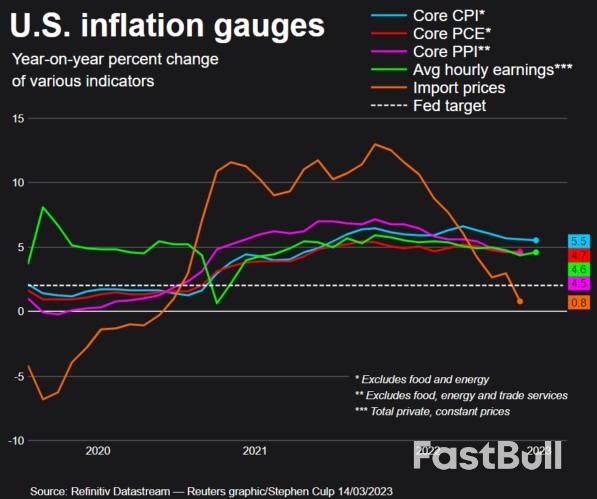
          But volatility is likely to persist, <>MOVE> - not least in pre-meeting blackout periods for major central banks - as easing financial system tensions merely re-introduce rate hike risks that sticky US inflation readings seem to warrant.
          And with longer-running global banking sagas exposed by the events of the past week, nerves were jangled again on Wednesday as Credit Suisse shares dropped by as much as 10.5% to a new record low, as its largest investor said it couldn't give the Swiss bank more financial assistance.
          After bank stocks rebounded somewhat on Tuesday, despite Moody's downgrading the credit outlook for the entire U.S. banking system, attention turned to tighter regulation and workouts for the worst affected firms.
          The Federal Reserve is considering tougher rules and oversight for midsize banks similar in size to Silicon Valley Bank, which collapsed suddenly last week. Strengthened rules on banks in the $100 billion to $250 billion range could ape those for larger more systemic banks and involve stringent capital and liquidity requirements or beefed up annual "stress tests".
          Even though reports abounded of depositor flight from the smaller weaker banks to the larger financial firms, stock prices in the sector at large caught a breath.
          That continued in Asia on Wednesday, although Europe's bank stocks and wider bourses stayed in the red and U.S. futures were a touch lower. The VIX equity volatility gauge hugged Tuesday's close at 23.
          Apart from fresh Credit Suisse angst, another reason for the persistent trepidation in Europe was signals from central bank sources that the European Central Bank would push ahead with a hefty half-point interest rate rise at its policymaking meeting on Thursday.
          If the ECB stays the course and the Fed follows suit next week, anxiety about further banking ructions may return - or at least see further wild volatility in rates markets that could end up having similar effects.
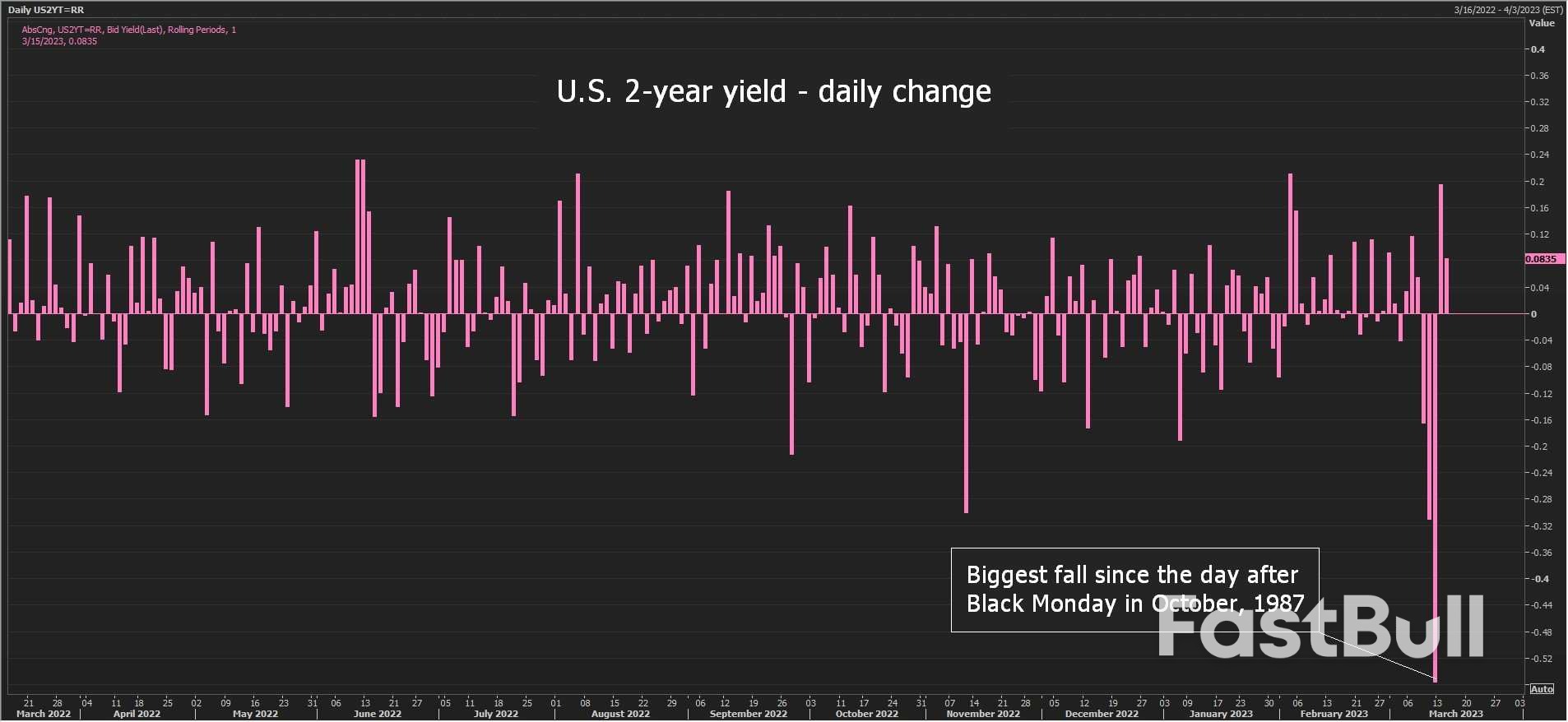
          U.S. Treasury market volatility is already at its highest since the aftermath of the last big banking crash in 2009, with the biggest drop since 1987 in 2-year Treasury yields on Monday followed by the biggest one-day jump in 14 years on Tuesday.
          On Wednesday, 2-year yields settled about 4.3% - still 80 basis points lower than they were a week ago, but up half a point from Tuesday's trough. Futures markets now see an 80% chance of a quarter-point Fed hike next week to a 4.75-5.0% range, with a 'terminal rate' at 5% in May.
          The dollar was slightly higher as rates recalibrated.
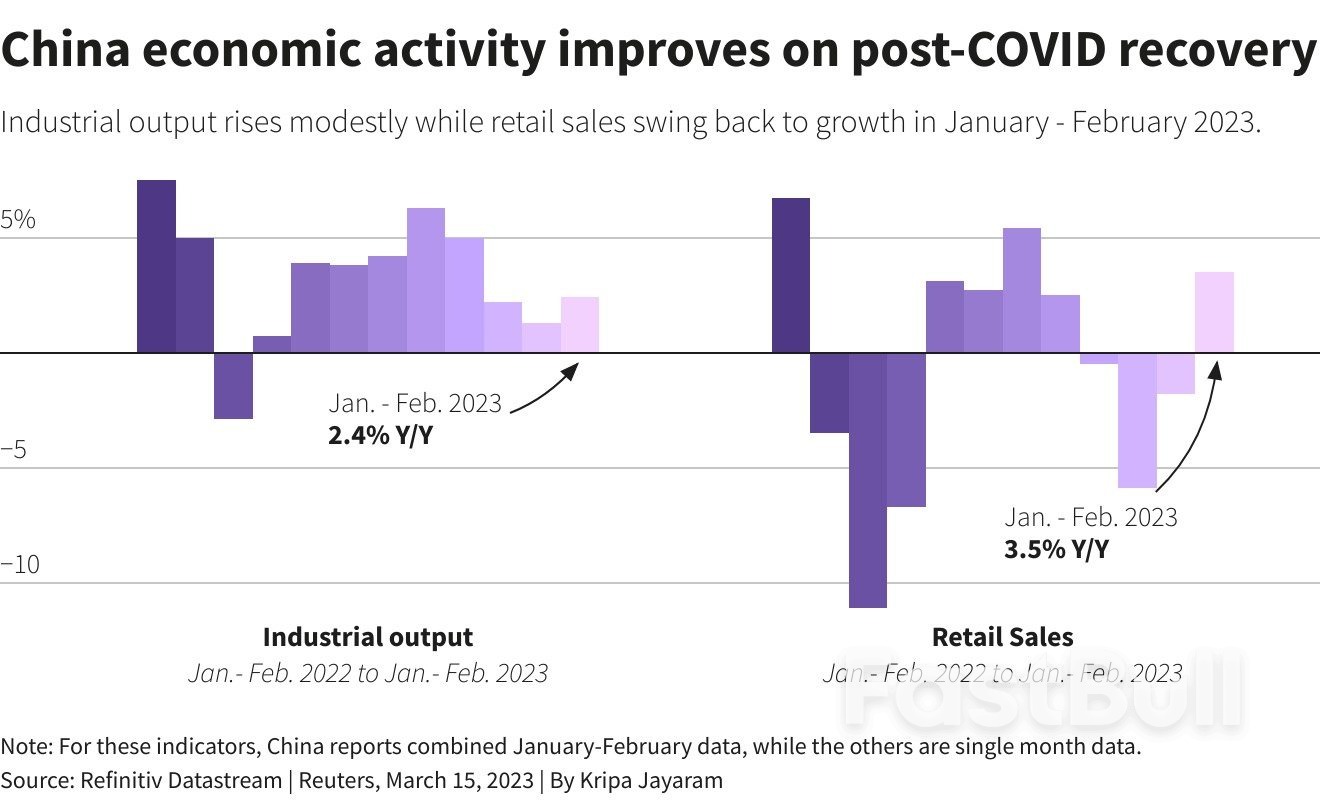
          Chinese industrial and retail updates for February showed the post-COVID lockdown recovery underway but at an underwhelming pace.
          Sterling was steady at investors awaited the Spring UK budget, with bumper tax receipts allowing finance minister Jeremy Hunt to offer some relief to pensions and childcare while extending critical energy price supports.
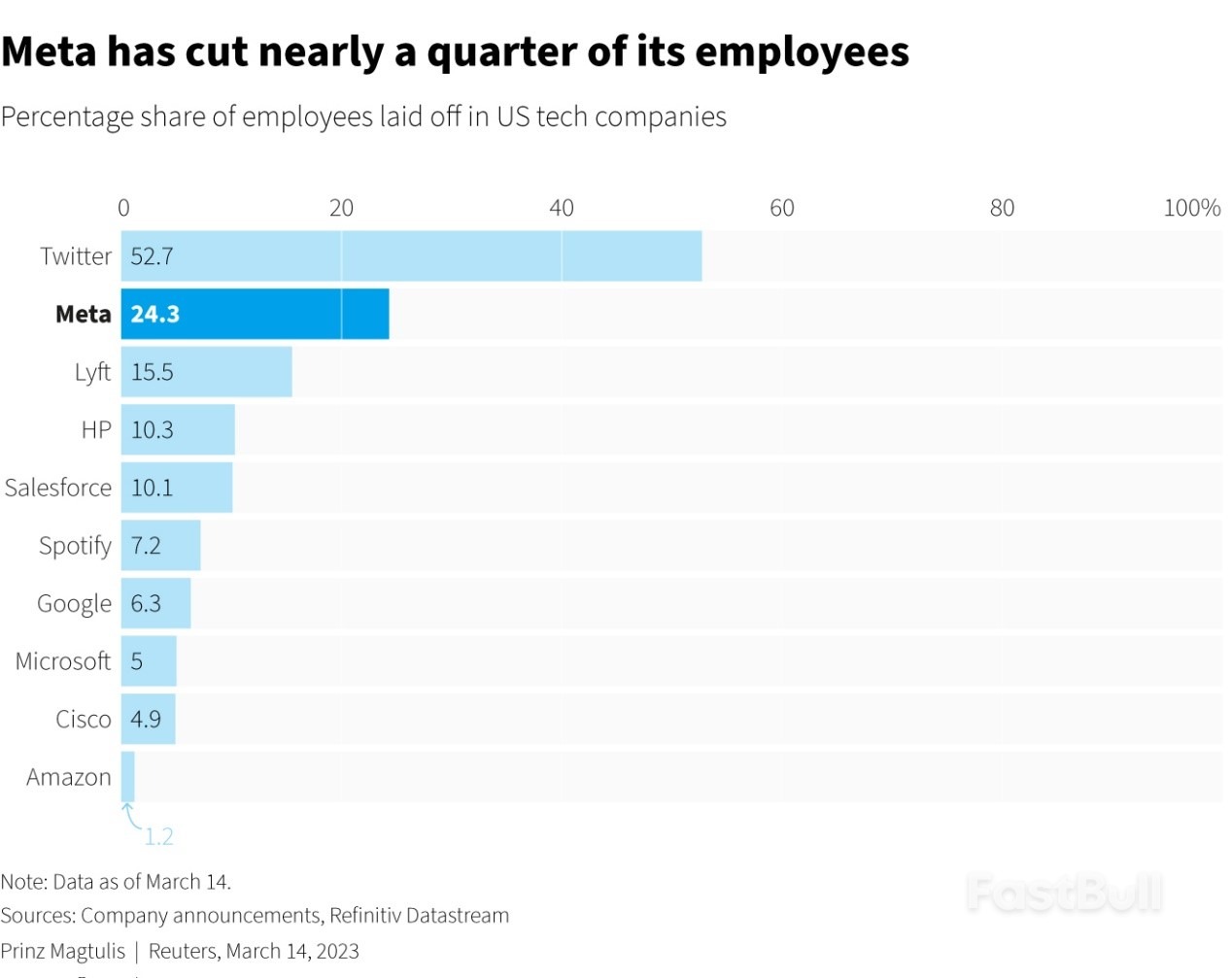
          With widespread trepidation about the impact of the SVB collapse on the U.S. tech sector at large, Facebook-parent Meta said on Tuesday it would cut 10,000 jobs this year, making it the first Big Tech company to announce a second round of mass layoffs as the industry braces for a deep economic downturn.
          Apple supplier Foxconn said on Wednesday it expected smart consumer electronics demand would decline slightly this year, as it reported a 10% fall in fourth-quarter net profit from a year earlier.
          In more upbeat tech news, startup OpenAI said it is beginning to release a powerful artificial intelligence model known as GPT-4, with image as well as text prompts in searches.
          Key developments that may provide direction to U.S. markets later on Wednesday:
          * US Feb retail sales and producer prices, US March NAHB housing market index, Empire State manufacturing survey, Jan business inventories.
          * UK government's Spring budget
          * US corp earnings: Adobe

          Deep Breaths as Banks Calm, But Only a Bit_1Deep Breaths as Banks Calm, But Only a Bit_2Deep Breaths as Banks Calm, But Only a Bit_3Source: Yahoo

          Risk Warnings and Disclaimers
          You understand and acknowledge that there is a high degree of risk involved in trading. Following any strategies or investment methods may lead to potential losses. The content on the site is provided by our contributors and analysts for information purposes only. You are solely responsible for determining whether any trading assets, securities, strategy, or any other product is suitable for investing based on your own investment objectives and financial situation.
          Comments
          Add to Favorites
          Share

          FX Daily: A Nervous Calm Returns to FX Markets

          Samantha Luan

          Forex

          USD: Dollar takes a trip across its 'smile curve'
          Financial market conditions have settled a little. Without any further public policy pronouncements yesterday, US regional banks reclaimed some of Monday's heavy losses, US bond yields reversed some of their enormous drop, and measures of money market stress such as the 3m FRA-OIS spread or the 3m EUR cross-currency basis swap partially eased back from stressed levels.
          However, it seems far too early to sound the 'all-clear' on this topic. The genuine fear is that depositors in these less scrutinised and less regulated banks (the 2018 roll-back of regulation in the Dodd-Frank reforms is being blamed here) will choose to migrate deposits to more highly scrutinised, highly regulated, and better-capitalised banks. Overnight Bloomberg reports that $15bn of deposits have flowed to Bank of America, one of the Financial Stability Board's 30 Global Systemically Important Banks (G-SIBs).
          Investors will probably continue to monitor the stock prices of these US regional banks for signs of stress and might also gain some insights on deposit flight by Thursday's release of Federal Reserve borrowing data. Borrowing through the primary credit facility at the Fed's discount window will be scrutinised - last week's reading saw $4.4bn being borrowed versus a March 2020 pandemic peak of $50bn. Presumably, we might also get a read on Thursday evening of banks' use this week of the Fed's new Bank Term Funding Program. This offers funds for 90 days- one year at 10bp over one year USD OIS - currently at 4.68%. This is marginally cheaper than the 4.75% rate through the primary credit facility at the discount window. The size of any borrowing could have a say on market sentiment.
          This brings us to the Fed and the dollar. As our US economist, James Knightley, wrote after the release of the February CPI yesterday, inflationary pressures are still evident but are expected to fall. The Fed must be praying that market pricing of the 22 March FOMC meeting moves back to a +25bp hike (+20bp now priced) such that it can deliver a no-fuss hike and, like an Olympic high-diver, adjust rates without barely making a ripple in the pool of financial markets.
          For the dollar - more settled financial conditions should allow it to reconnect with softer rate differentials and leave the dollar slightly offered. Our concern is, however, that the dollar could easily cross its 'smile curve' should US banking sector stress re-appear and banks want to hoard dollars - that is why we should focus on the EUR cross-currency basis swap now. The idea of the smile curve is that the dollar does well when things are very good or very bad (e.g. start of the financial crisis in 2008 or the start of the pandemic in March 2020) and tends to gently sink at any conditions in between.
          Expect a further day of consolidation in the dollar, although softer US retail sales figures at 1330CET could give it a gentle downside bias. DXY could nudge down to 102.75 should conditions allow.
          EUR: Settling in for the ECB
          After the wild swings in short-dated bond yields this week, the two-year EUR:USD swap differential seems to be settling around the -100bp area - some 40bp narrower than last week. Should equities settle down a little, EUR/USD could start to reconnect a little with yield differentials and head up to the 1.08 area. As above, any severe signs of US money market stress could easily see these EUR/USD gains reverse. The mood in EUR/USD may also be subdued ahead of the European Central Bank's expected 50bp hike tomorrow.
          Elsewhere, we have just seen an above-expected February CPI release for Sweden. This should cement 50bp hike expectations for the 26 April Riksbank meeting. This would take the policy rate to 3.50%. EUR/SEK has sold off 0.4% on the news, but we would be wary of holding the Swedish krona at the current time. The Swedish banking system is one of the more dependent on wholesale funding markets and also has sizable exposure to the Swedish residential and in particular commercial property sector. Ever higher rates in Sweden only stand to heap more pressure on the property sector, on the banks, and on the SEK.
          GBP: A 'Budget for growth'
          At 1330CET today, UK Chancellor Jeremy Hunt will present what has been billed as a 'budget for growth'. At the heart of the budget seems measures to ameliorate the cost-of-living crisis (caps on energy bills), measures to address the decline in the UK labour force (childcare support and pension reform) plus perhaps some incentives on investment (new forms of tax breaks). While the UK's near-term growth forecasts may be revised higher, ING's UK economist James Smith argues that medium-term growth prospects will be revised lower. And we suspect that Chancellor Hunt may be saving more overt fiscal stimulus for the Autumn Statement or the Budget this time next year ahead of elections later in 2024.
          We doubt anything in the Budget will be sterling negative - after all taxation levels are near the limit - but equally we do not see it as especially sterling positive either. With the Bank of England nearer to a pause than most, we think EUR/GBP can reclaim recent losses and head back to 0.89, while cable may struggle to break 1.22.
          CEE: First inflation reminder after SVB
          Today, we will see an inflation test in the Central and Eastern Europe (CEE) region after the recovery of global markets. In the Czech Republic, PPI numbers will be released, which surprised massively to the upside in January. Although PPI has been falling since last July in year-on-year terms, surveys suggest that a significant drop is not in place, as already indicated by the CPI numbers.
          In Poland, we will later see CPI numbers for February, the latest in the CEE region. We expect the February number to show a rise from 17.2% to 18.7% YoY, slightly above market expectations. The February CPI reading is highly uncertain due to the annual update of basket weights, however in any case it should be this year's peak. At the same time, core inflation is projected to remain sticky and elevated as the earlier energy shock should continue feeding into the prices of other goods and services. In our view, the path of core inflation will not allow the National Bank of Poland to start cutting rates this year and the easing cycle may start late next year.
          In the FX space, yesterday we saw the CEE currencies find a floor and stabilise a bit. The Hungarian forint, the biggest underperformer in recent days, even posted a 0.7% gain yesterday. We believe that it is the Hungarian forint and the Czech koruna that should benefit the most in the region from the calming global markets. If the euro maintains its dominance over the US dollar we should see further gains for these two currencies, supported by a return of gas prices to previous lows and higher market rates. Thus, we expect a move to 385 EUR/HUF and 23.70 EUR/CZK for now.

          Source: ING

          Risk Warnings and Disclaimers
          You understand and acknowledge that there is a high degree of risk involved in trading. Following any strategies or investment methods may lead to potential losses. The content on the site is provided by our contributors and analysts for information purposes only. You are solely responsible for determining whether any trading assets, securities, strategy, or any other product is suitable for investing based on your own investment objectives and financial situation.
          Comments
          Add to Favorites
          Share

          Funds end Feb with Huge Short Position in U.S. Rates, Bonds

          Devin

          Bond

          Hedge funds closed February holding huge short positions in short-term U.S. interest rate and Treasuries futures, positions that may have been crushed by the collapse in implied rates and bond yields following the Silicon Valley Bank crisis.
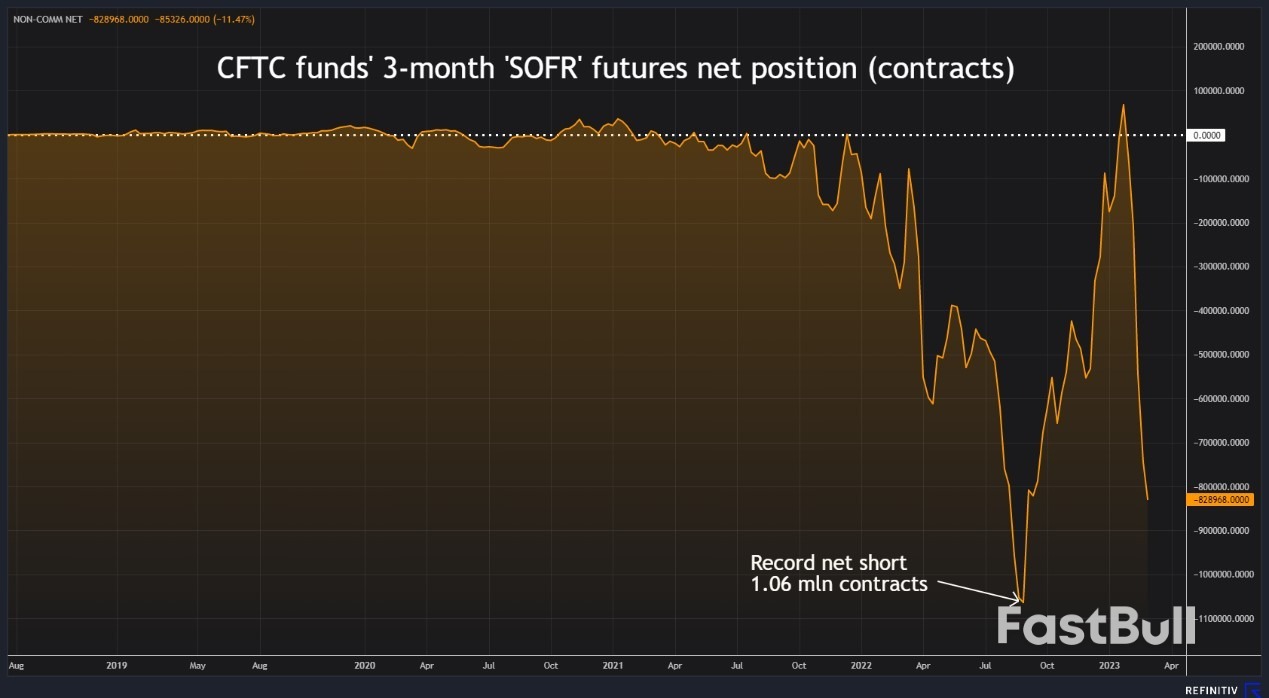
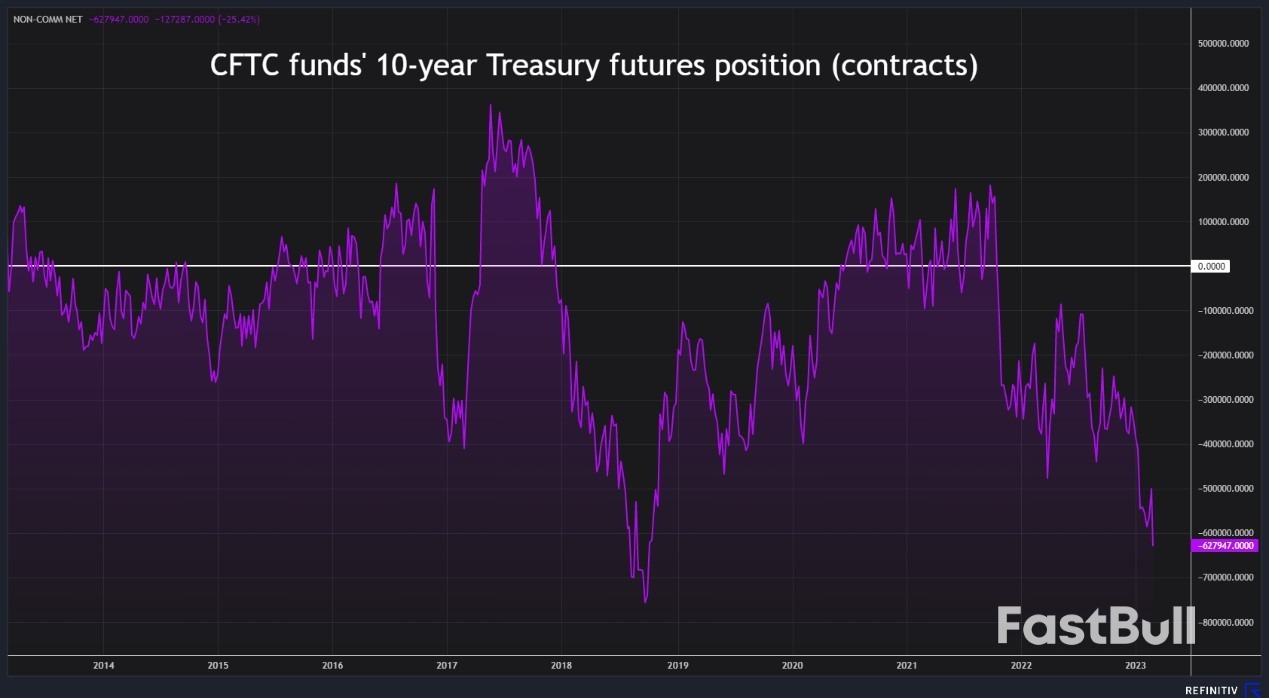
          Commodity Futures Trading Commission (CFTC) data published on Tuesday shows that speculators held the largest net short position in three-month 'SOFR' rate futures since September, and the biggest net short 10-year Treasuries futures position since 2018.
          While they trimmed their net short 2-year Treasuries futures position, it was only a reduction of around 5% from the record short a couple of weeks earlier. It remained substantial.
          The CFTC positioning data is for the week ending Feb. 28, and is now only lagging by one week following a cyber attack on the derivatives platform of ION Group, which delayed trading firms' reporting earlier this year.
          The significance of these figures is the context of the last few days - the collapse of SVB prompting swift intervention from U.S. financial authorities on Sunday night, and an extraordinary decline in bond yields and market-based interest rates.
          If these positions were roughly maintained or even increased in the last couple of weeks, they could be deeply under water.
          In the week through Feb. 28 funds expanded their net short position in three-month 'Secured Overnight Financing Rate' futures to 829,000 contracts, the largest since the record short of 1.06 million contacts last September.
          Funds end Feb with Huge Short Position in U.S. Rates, Bonds_16% Hopes Evaporate
          The stampede until last week to position for rising U.S. interest rates was remarkable in its speed and scale - funds held a small net long position at the end of January.
          The frenzy to bet on higher U.S. rates and yields saw the implied terminal rate reach 5.70% last week. BlackRock's Rick Rieder said there was a "reasonable chance" the Fed could go as high as 6% and stay there for some time.
          Many of those calls have now been reversed.
          Funds increased their net short 10-year Treasuries position to 628,000 contracts, the largest since October 2018. They trimmed their two-year futures net short to 656,575 contracts - two weeks prior they were net short 696,686 contracts, a record.
          Funds end Feb with Huge Short Position in U.S. Rates, Bonds_2A short position is essentially a wager that an asset's price will fall, and a long position is a bet it will rise. In bonds and interest rates, yields and implied rates fall when prices rise, and move up when prices fall.
          Hedge funds take positions in short-dated U.S. rates and bonds futures for hedging purposes and relative value trades, so the CFTC data is not reflective of purely directional bets. But it is a pretty good guide.
          CFTC speculators might have significantly reduced these positions since Feb. 28. But if not, they are likely to have been blindsided by the recent market turmoil.
          Consider, in the last few days we have seen: the biggest fall in the 2-year yield since Black Monday in 1987, the '2s/10s' yield curve steepen 70 basis points but remain deeply inverted, and the highest Treasury market volatility since the Great Financial Crisis.

          Funds end Feb with Huge Short Position in U.S. Rates, Bonds_3Source: Reuters

          Risk Warnings and Disclaimers
          You understand and acknowledge that there is a high degree of risk involved in trading. Following any strategies or investment methods may lead to potential losses. The content on the site is provided by our contributors and analysts for information purposes only. You are solely responsible for determining whether any trading assets, securities, strategy, or any other product is suitable for investing based on your own investment objectives and financial situation.
          Comments
          Add to Favorites
          Share
          FastBull
          Copyright © 2025 FastBull Ltd

          728 RM B 7/F GEE LOK IND BLDG NO 34 HUNG TO RD KWUN TONG KLN HONG KONG

          TelegramInstagramTwitterfacebooklinkedin
          App Store Google Play Google Play
          Products
          Charts

          Chats

          Q&A with Experts
          Screeners
          Economic Calendar
          Data
          Tools
          Membership
          Features
          Function
          Markets
          Copy Trading
          Latest Signals
          Contests
          News
          Analysis
          24/7
          Columns
          Education
          Company
          Careers
          About Us
          Contact Us
          Advertising
          Help Center
          Feedback
          User Agreement
          Privacy Policy
          Business

          White Label

          Data API

          Web Plug-ins

          Poster Maker

          Affiliate Program

          Risk Disclosure

          The risk of loss in trading financial instruments such as stocks, FX, commodities, futures, bonds, ETFs and crypto can be substantial. You may sustain a total loss of the funds that you deposit with your broker. Therefore, you should carefully consider whether such trading is suitable for you in light of your circumstances and financial resources.

          No decision to invest should be made without thoroughly conducting due diligence by yourself or consulting with your financial advisors. Our web content might not suit you since we don't know your financial conditions and investment needs. Our financial information might have latency or contain inaccuracy, so you should be fully responsible for any of your trading and investment decisions. The company will not be responsible for your capital loss.

          Without getting permission from the website, you are not allowed to copy the website's graphics, texts, or trademarks. Intellectual property rights in the content or data incorporated into this website belong to its providers and exchange merchants.

          Not Logged In

          Log in to access more features

          FastBull Membership

          Not yet

          Purchase

          Become a signal provider
          Help Center
          Customer Service
          Dark Mode
          Price Up/Down Colors

          Log In

          Sign Up

          Position
          Layout
          Fullscreen
          Default to Chart
          The chart page opens by default when you visit fastbull.com