• Trade
  • Markets
  • Copy
  • Contests
  • News
  • 24/7
  • Calendar
  • Q&A
  • Chats
Trending
Screeners
SYMBOL
LAST
BID
ASK
HIGH
LOW
NET CHG.
%CHG.
SPREAD
SPX
S&P 500 Index
6827.42
6827.42
6827.42
6899.86
6801.80
-73.58
-1.07%
--
DJI
Dow Jones Industrial Average
48458.04
48458.04
48458.04
48886.86
48334.10
-245.98
-0.51%
--
IXIC
NASDAQ Composite Index
23195.16
23195.16
23195.16
23554.89
23094.51
-398.69
-1.69%
--
USDX
US Dollar Index
97.950
98.030
97.950
98.500
97.950
-0.370
-0.38%
--
EURUSD
Euro / US Dollar
1.17394
1.17409
1.17394
1.17496
1.17192
+0.00011
+ 0.01%
--
GBPUSD
Pound Sterling / US Dollar
1.33707
1.33732
1.33707
1.33997
1.33419
-0.00148
-0.11%
--
XAUUSD
Gold / US Dollar
4299.39
4299.39
4299.39
4353.41
4257.10
+20.10
+ 0.47%
--
WTI
Light Sweet Crude Oil
57.233
57.485
57.233
58.011
56.969
-0.408
-0.71%
--

Community Accounts

Signal Accounts
--
Profit Accounts
--
Loss Accounts
--
View More

Become a signal provider

Sell trading signals to earn additional income

View More

Guide to Copy Trading

Get started with ease and confidence

View More

Signal Accounts for Members

All Signal Accounts

Best Return
  • Best Return
  • Best P/L
  • Best MDD
Past 1W
  • Past 1W
  • Past 1M
  • Past 1Y

All Contests

  • All
  • Trump Updates
  • Recommend
  • Stocks
  • Cryptocurrencies
  • Central Banks
  • Featured News
Top News Only
Share

Ukraine Says It Received 114 Prisoners From Belarus

Share

USA Embassy In Lithuania: Maria Kalesnikava Is Not Going To Vilnius

Share

USA Embassy In Lithuania: Other Prisoners Are Being Sent From Belarus To Ukraine

Share

Ukraine President Zelenskiy: Five Ukrainians Released By Belarus In US-Brokered Deal

Share

USA Vilnius Embassy: USA Stands Ready For "Additional Engagement With Belarus That Advances USA Interests"

Share

USA Vilnius Embassy: Belarus, USA, Other Citizens Among The Prisoners Released Into Lithuania

Share

USA Vilnius Embassy: USA Will Continue Diplomatic Efforts To Free The Remaining Political Prisoners In Belarus

Share

USA Vilnius Embassy: Belarus Releases 123 Prisoners Following Meeting Of President Trump's Envoy Coale And Belarus President Lukashenko

Share

USA Vilnius Embassy: Masatoshi Nakanishi, Aliaksandr Syrytsa Are Among The Prisoners Released By Belarus

Share

USA Vilnius Embassy: Maria Kalesnikava And Viktor Babaryka Are Among The Prisoners Released By Belarus

Share

USA Vilnius Embassy: Nobel Peace Prize Laureate Ales Bialiatski Is Among The Prisoners Released By Belarus

Share

Belarusian Presidential Administration Telegram Channel: Lukashenko Has Pardoned 123 Prisoners As Part Of Deal With US

Share

Two Local Syrian Officials: Joint US-Syrian Military Patrol In Central Syria Came Under Fire From Unknown Assailants

Share

Israeli Military Says It Targeted 'Key Hamas Terrorist' In Gaza City

Share

Rwanda's Actions In Eastern Drc Are A Clear Violation Of Washington Accords Signed By President Trump - Secretary Of State Rubio

Share

Israeli Military Issues Evacuation Warning In Southern Lebanon Village Ahead Of Strike - Spokesperson On X

Share

Belarusian State Media Cites US Envoy Coale As Saying He Discussed Ukraine And Venezuela With Lukashenko

Share

Belarusian State Media Cites US Envoy Coale As Saying That US Removes Sanctions On Belarusian Potassium

Share

Thai Prime Minister: No Ceasefire Agreement With Cambodia

Share

US, Ukraine To Discuss Ceasefire In Berlin Ahead Of European Summit

TIME
ACT
FCST
PREV
U.K. Trade Balance Non-EU (SA) (Oct)

A:--

F: --

P: --

U.K. Trade Balance (Oct)

A:--

F: --

P: --

U.K. Services Index MoM

A:--

F: --

P: --

U.K. Construction Output MoM (SA) (Oct)

A:--

F: --

P: --

U.K. Industrial Output YoY (Oct)

A:--

F: --

P: --

U.K. Trade Balance (SA) (Oct)

A:--

F: --

P: --

U.K. Trade Balance EU (SA) (Oct)

A:--

F: --

P: --

U.K. Manufacturing Output YoY (Oct)

A:--

F: --

P: --

U.K. GDP MoM (Oct)

A:--

F: --

P: --

U.K. GDP YoY (SA) (Oct)

A:--

F: --

P: --

U.K. Industrial Output MoM (Oct)

A:--

F: --

P: --

U.K. Construction Output YoY (Oct)

A:--

F: --

P: --

France HICP Final MoM (Nov)

A:--

F: --

P: --

China, Mainland Outstanding Loans Growth YoY (Nov)

A:--

F: --

P: --

China, Mainland M2 Money Supply YoY (Nov)

A:--

F: --

P: --

China, Mainland M0 Money Supply YoY (Nov)

A:--

F: --

P: --

China, Mainland M1 Money Supply YoY (Nov)

A:--

F: --

P: --

India CPI YoY (Nov)

A:--

F: --

P: --

India Deposit Gowth YoY

A:--

F: --

P: --

Brazil Services Growth YoY (Oct)

A:--

F: --

P: --

Mexico Industrial Output YoY (Oct)

A:--

F: --

P: --

Russia Trade Balance (Oct)

A:--

F: --

P: --

Philadelphia Fed President Henry Paulson delivers a speech
Canada Building Permits MoM (SA) (Oct)

A:--

F: --

P: --

Canada Wholesale Sales YoY (Oct)

A:--

F: --

P: --

Canada Wholesale Inventory MoM (Oct)

A:--

F: --

P: --

Canada Wholesale Inventory YoY (Oct)

A:--

F: --

P: --

Canada Wholesale Sales MoM (SA) (Oct)

A:--

F: --

P: --

Germany Current Account (Not SA) (Oct)

A:--

F: --

P: --

U.S. Weekly Total Rig Count

A:--

F: --

P: --

U.S. Weekly Total Oil Rig Count

A:--

F: --

P: --

Japan Tankan Large Non-Manufacturing Diffusion Index (Q4)

--

F: --

P: --

Japan Tankan Small Manufacturing Outlook Index (Q4)

--

F: --

P: --

Japan Tankan Large Non-Manufacturing Outlook Index (Q4)

--

F: --

P: --

Japan Tankan Large Manufacturing Outlook Index (Q4)

--

F: --

P: --

Japan Tankan Small Manufacturing Diffusion Index (Q4)

--

F: --

P: --

Japan Tankan Large Manufacturing Diffusion Index (Q4)

--

F: --

P: --

Japan Tankan Large-Enterprise Capital Expenditure YoY (Q4)

--

F: --

P: --

U.K. Rightmove House Price Index YoY (Dec)

--

F: --

P: --

China, Mainland Industrial Output YoY (YTD) (Nov)

--

F: --

P: --

China, Mainland Urban Area Unemployment Rate (Nov)

--

F: --

P: --

Saudi Arabia CPI YoY (Nov)

--

F: --

P: --

Euro Zone Industrial Output YoY (Oct)

--

F: --

P: --

Euro Zone Industrial Output MoM (Oct)

--

F: --

P: --

Canada Existing Home Sales MoM (Nov)

--

F: --

P: --

Euro Zone Total Reserve Assets (Nov)

--

F: --

P: --

U.K. Inflation Rate Expectations

--

F: --

P: --

Canada National Economic Confidence Index

--

F: --

P: --

Canada New Housing Starts (Nov)

--

F: --

P: --

U.S. NY Fed Manufacturing Employment Index (Dec)

--

F: --

P: --

U.S. NY Fed Manufacturing Index (Dec)

--

F: --

P: --

Canada Core CPI YoY (Nov)

--

F: --

P: --

Canada Manufacturing Unfilled Orders MoM (Oct)

--

F: --

P: --

Canada Manufacturing New Orders MoM (Oct)

--

F: --

P: --

Canada Core CPI MoM (Nov)

--

F: --

P: --

Canada Manufacturing Inventory MoM (Oct)

--

F: --

P: --

Canada CPI YoY (Nov)

--

F: --

P: --

Canada CPI MoM (Nov)

--

F: --

P: --

Canada CPI YoY (SA) (Nov)

--

F: --

P: --

Canada Core CPI MoM (SA) (Nov)

--

F: --

P: --

Q&A with Experts
    • All
    • Chatrooms
    • Groups
    • Friends
    Connecting
    .
    .
    .
    Type here...
    Add Symbol or Code

      No matching data

      All
      Trump Updates
      Recommend
      Stocks
      Cryptocurrencies
      Central Banks
      Featured News
      • All
      • Russia-Ukraine Conflict
      • Middle East Flashpoint
      • All
      • Russia-Ukraine Conflict
      • Middle East Flashpoint
      Search
      Products

      Charts Free Forever

      Chats Q&A with Experts
      Screeners Economic Calendar Data Tools
      Membership Features
      Data Warehouse Market Trends Institutional Data Policy Rates Macro

      Market Trends

      Market Sentiment Order Book Forex Correlations

      Top Indicators

      Charts Free Forever
      Markets

      News

      News Analysis 24/7 Columns Education
      From Institutions From Analysts
      Topics Columnists

      Latest Views

      Latest Views

      Trending Topics

      Top Columnists

      Latest Update

      Signals

      Copy Rankings Latest Signals Become a signal provider AI Rating
      Contests
      Brokers

      Overview Brokers Assessment Rankings Regulators News Claims
      Broker listing Forex Brokers Comparison Tool Live Spread Comparison Scam
      Q&A Complaint Scam Alert Videos Tips to Detect Scam
      More

      Business
      Events
      Careers About Us Advertising Help Center

      White Label

      Data API

      Web Plug-ins

      Affiliate Program

      Awards Institution Evaluation IB Seminar Salon Event Exhibition
      Vietnam Thailand Singapore Dubai
      Fans Party Investment Sharing Session
      FastBull Summit BrokersView Expo
      Recent Searches
        Top Searches
          Markets
          News
          Analysis
          User
          24/7
          Economic Calendar
          Education
          Data
          • Names
          • Latest
          • Prev

          View All

          No data

          Scan to Download

          Faster Charts, Chat Faster!

          Download App
          English
          • English
          • Español
          • العربية
          • Bahasa Indonesia
          • Bahasa Melayu
          • Tiếng Việt
          • ภาษาไทย
          • Français
          • Italiano
          • Türkçe
          • Русский язык
          • 简中
          • 繁中
          Open Account
          Search
          Products
          Charts Free Forever
          Markets
          News
          Signals

          Copy Rankings Latest Signals Become a signal provider AI Rating
          Contests
          Brokers

          Overview Brokers Assessment Rankings Regulators News Claims
          Broker listing Forex Brokers Comparison Tool Live Spread Comparison Scam
          Q&A Complaint Scam Alert Videos Tips to Detect Scam
          More

          Business
          Events
          Careers About Us Advertising Help Center

          White Label

          Data API

          Web Plug-ins

          Affiliate Program

          Awards Institution Evaluation IB Seminar Salon Event Exhibition
          Vietnam Thailand Singapore Dubai
          Fans Party Investment Sharing Session
          FastBull Summit BrokersView Expo

          Blood and Billions: The Cost of Russia's War in Ukraine

          Kevin Du

          Political

          Economic

          Russia-Ukraine Conflict

          Summary:

          Russia's invasion of Ukraine has left tens of thousands of dead, displaced millions and sown economic turmoil across the world in the 18 months since its launch on Feb. 24, 2022.

          Russia's invasion of Ukraine has left tens of thousands of dead, displaced millions and sown economic turmoil across the world in the 18 months since its launch on Feb. 24, 2022.
          Here are some details of the impact:
          Death
          The war has caused death on a level not seen in Europe since World War Two.
          More than 9,000 civilians had been recorded as killed and more than 16,000 injured by the end of July, according to the United Nations High Commissioner for Human Rights (OHCHR), which said it believed the actual figures were considerably higher.
          The war has left nearly 500,000 troops either dead or injured, according to the New York Times.
          The paper cited officials from the United States, which supports Ukraine, as saying as many as 120,000 Russian troops have been killed and 170,000 to 180,000 injured, with Ukraine's military toll at 70,000 killed and 100,000 to 120,000 wounded.
          Russian officials say U.S. estimates of Russian losses are far too high - and propaganda. Russian Defence Minister Sergei Shoigu said on Sept. 21 that 5,937 Russian soldiers had been killed since the start of the war. No further updates have been given and losses are a state secret.
          Ukraine has not said how many of its soldiers have been killed and says its military losses are a state secret as they affect battlefield tactics.
          Reuters is unable to verify the toll on either side.
          The conflict in eastern Ukraine began in 2014 after a pro-Russian president was toppled in Ukraine's Maidan Revolution and Russia annexed Crimea, with Russian-backed forces fighting Ukraine's armed forces.
          About 14,000 people were killed there between 2014 and the end of 2021, according to the OHCHR, including 3,106 civilians.
          Displacement
          Since the 2022 invasion, millions of Ukrainians have been forced from their homes, the United Nations refugee agency has said. Ukraine has a population of more than 41 million.
          An estimated 17.6 million people in Ukraine require urgent humanitarian support, including more than 5  million people internally displaced by the war, the UNHCR said.
          There are over 5.9 million refugees from Ukraine recorded across Europe, according to the agency's data.
          Ukraine
          Russia has taken 11% of Ukraine's territory since the start of the war, an area equivalent to Massachusetts, New Hampshire and Connecticut combined, according to the Belfer Center at the Harvard Kennedy School.
          When added to Crimea, which Russia annexed from Ukraine in 2014, Russia now controls about 17.5% of Ukraine, an area of about 41,000 square miles (106,000 square km).
          After pushing back Russian forces in 2022, it has failed to make major inroads against well-dug in Russian troops since launching a new counteroffensive in early June.
          Ukraine has lost a swathe of its coastline; its economy has been crippled and some cities have been turned into wastelands by the fighting.
          Ukraine's economy contracted by 30% in 2022 and is forecast to grow by of 1% to 3% this year, according to the International Monetary Fund.
          It is unclear how much Ukraine has spent on the fighting.
          Russia
          Russia's expenditure on the war is a state secret, but it coincides with a major shock to the Russian economy from the toughest ever Western sanctions imposed after the invasion.
          The economy defied early expectations for a double-digit contraction in 2022, but a return to prosperity remains a long way off as the government directs more spending towards the military.
          Russia's economy will grow 1.5% this year, according to the International Monetary Fund, after a contraction of 2.1% in 2022.
          "In the medium term, the Russian economy will be hampered by the departure of multinationals, the loss of human capital, its disconnection from global financial markets, a reduction in its policy buffers," IMF spokeswoman Julie Kozack said last month.
          "And therefore, we do expect over the medium term that output in Russia will be 7 percent lower than the pre-war forecast."
          Russia has doubled its 2023 defence spending target to more than $100 billion - a third of all public expenditure - a government document reviewed by Reuters showed, as the costs of the war in Ukraine spiral and place growing strain on Moscow's finances.
          As Russia's military spending soars and sanctions squeeze its energy revenues, Moscow faces a battle to keep its budget deficit in check.
          Russia has lost a major chunk of the European gas market but has been able to keep selling its oil to global markets, although the United States, Europe and other powers have limited or ended their purchases.
          It has been excluded from Western financial markets, most of its oligarchs are sanctioned, and it is experiencing problems sourcing some items such as microchips.
          CIA Director William Burns said earlier this year that Putin risked turning Russia into "an economic colony of China over time".
          Russia has defaulted on its foreign bonds for the first time since the calamitous months following the 1917 Bolshevik revolution.
          Prices
          The invasion and Western sanctions on Russia led to steep rises in the prices of fertiliser, wheat, metals and energy, fuelling an inflationary wave and a global food crisis.
          Russia is the world's second largest oil exporter after Saudi Arabia and the world's biggest exporter of natural gas, wheat, nitrogen fertiliser and palladium.
          Shortly after Russia's invasion of Ukraine, international oil prices spiked to their highest levels since the records of 2008.
          Western Weapons
          Since the invasion, the United States has committed more than $43 billion in security assistance to Ukraine, including stinger anti-aircraft systems, Javelin anti-armour systems, 155mm Howitzers and equipment to protect against chemical, biological, radiological and nuclear attack.
          The biggest overall supporters of Ukraine in nominal terms are the United States, the European Union, Britain, Germany and Japan, according to The Kiel Institute for the World Economy.
          Russia says the West's weapons supplies are escalating the war.

          Source: Reuters

          To stay updated on all economic events of today, please check out our Economic calendar
          Risk Warnings and Disclaimers
          You understand and acknowledge that there is a high degree of risk involved in trading. Following any strategies or investment methods may lead to potential losses. The content on the site is provided by our contributors and analysts for information purposes only. You are solely responsible for determining whether any trading assets, securities, strategy, or any other product is suitable for investing based on your own investment objectives and financial situation.
          Comments
          Add to Favorites
          Share

          Politics, Fed Seen Swaying Japan's Yen Intervention Thinking

          Thomas

          Forex

          Economic

          Central Bank

          The Federal Reserve's Jackson Hole symposium this week looms as a key risk for Japanese authorities worried that new hawkish signals from U.S. central bankers could trigger another sharp yen selloff that would force Tokyo to prop up the currency.
          The annual gathering of Fed officials and other global policymakers has historically been an opportunity for central bankers to regroup and flag their next big steps to markets.
          Until recently, investors had expected Fed Chair Jerome Powell might be looking to end to interest rate hikes amid signs inflation was moderating.
          The worry now for Japanese officials is that he signals the opposite as price pressures linger, which could trigger a repeat of last year's yen selloff against the dollar, forcing authorities to intervene again.
          While the yen's fortunes are largely a product of dollar movements, the currency's weakness has become politically problematic not only for Prime Minister Fumio Kishida but also the Bank of Japan, whose ultra-loose monetary settings have been blamed for inflating import costs.
          "Authorities aren't worried about the weak yen as much as they were around September and October last year," said Masafumi Yamamoto, chief currency strategist at Mizuho Securities.
          "But the chance of intervention will heighten if a worsening economy hurts the administration's approval ratings."
          Money markets expect the Fed to maintain rates in the current 5.25%-5.5% range until the second quarter next year before starting to ease. But investors will be looking for clues about possible additional rate hikes from Powell's speech on Friday.
          BOJ Governor Kazuo Ueda is scheduled to attend the Jackson Hole meeting, which has thrown Japan curve balls in the past.
          In 2010, former Fed Chair Ben Bernanke's suggestion of deploying quantitative easing triggered a yen spike that forced then BOJ head Masaaki Shirakawa to cut short his stay at the retreat, and call an emergency meeting in Tokyo to ease monetary policy.
          This time around, concerns centre on yen weakness.
          To be sure, Japan has not been as worried by recent bouts of yen selling, issuing fewer verbal warnings even as the dollar breached the 145 mark that triggered intervention last year.
          With the pace of yen declines moderate and a revival of inbound tourism turning the public's attention to the benefits of a weak currency, authorities see the threshold for yen-buying currency intervention fairly high compared with last year.
          But the more passive approach could change if hawkish comments by Powell drive up the dollar/yen at a faster speed, say three government officials with direct knowledge on Japan's currency policy.
          "Japan likely won't intervene as long as the moves are gradual," one of the officials said. "It's really about cracking down on speed limit violations."
          The yen lost about 1.5% against the dollar this month, much slower than a 4.8% dive seen in the three weeks to Oct. 21 last year when the dollar hit a 32-year high above 150 yen.
          Politics of 150
          While authorities say that speed - rather than levels - is key in deciding when to step in, a breach of the 150-yen threshold could heighten political pressure on Prime Minister Kishida to act, the officials say.
          With his approval ratings sliding, Kishida on Tuesday unveiled a plan to cushion the blow from rising fuel costs driven in part by the weak yen.
          "When to intervene has always been an extremely political decision in Japan. Nowadays, it's the prime minister that ultimately makes the call," said Atsushi Takeuchi, a former BOJ official who was involved in Tokyo's market foray a decade ago.
          "Authorities usually don't have a specific line-in-the-sand in mind. But key thresholds like 150 are important for political reasons, as they are easy to understand."
          Japan's dilemma runs deep. Core inflation exceeded the central bank's 2% target for 16 straight months in July as firms continue to pass on higher import costs driven in part by the weak yen.
          Worried about hurting a fragile economy, the BOJ has stressed its resolve to keep interest rates ultra-low even as it decided last month to raise a cap on long-term bond yields.
          The BOJ's dovish tone, coupled with prospects that U.S. interest rates could stay higher for longer, has kept the dollar hovering around a nine-month high of 146.565 yen hit last week.
          But while the Fed and worries about China's economic woes could bring yen moves back into focus, there are doubts intervention would actually achieve much.
          "Authorities could smooth the pace of currency moves," said Daisaku Ueno, chief currency strategist at Mitsubishi UFJ Morgan Stanley Securities. "But they can't affect levels or trend, which depends largely on U.S. monetary policy."

          Source: Reuters

          To stay updated on all economic events of today, please check out our Economic calendar
          Risk Warnings and Disclaimers
          You understand and acknowledge that there is a high degree of risk involved in trading. Following any strategies or investment methods may lead to potential losses. The content on the site is provided by our contributors and analysts for information purposes only. You are solely responsible for determining whether any trading assets, securities, strategy, or any other product is suitable for investing based on your own investment objectives and financial situation.
          Comments
          Add to Favorites
          Share

          U.S. Bond Yields Surge Despite Muted Inflation as Investors Look Beyond Fed

          Damon

          Economic

          Central Bank

          Bond

          A recent spike in U.S. bond yields has come alongside muted expectations for inflation, a sign to some bond fund managers that economic resilience and high bond supply are now playing a larger role than second-guessing the Federal Reserve.
          Benchmark 10-year nominal yields on Tuesday hit near 16-year peaks on concerns about U.S. Federal Reserve Chair Jerome Powell sending a hawkish message about keeping rates high at the annual Jackson Hole symposium on Friday.
          Bond yields, which move inversely to prices, tend to rise in an inflationary environment because inflation erodes the value of a future bond payout.
          But while higher moves in bond yields in the last several months were often driven by investors pricing in higher interest rates as the Fed sought to tame rising inflation, expectations on the pace of price rises have moved lower in recent weeks.
          "The narrative has very much changed over the last few months," said Calvin Norris, Portfolio Manager & US Rates Strategist at Aegon Asset Management.
          Investors see evidence that a fresh set of drivers has taken hold, including the Bank of Japan letting yields go higher, which may reduce foreign investors' appetite for Treasuries, and an increase in supply of U.S. government bonds, with investors demanding more for holding more debt.
          While the timing and size of the central bank's monetary tightening actions have preoccupied bond investors for well over a year, the market may have reached "an inflection point in terms of the primary driver of sentiment," BMO Capital Markets analysts said in a note last week.
          "The source of uncertainty is moving away from the (Fed) and toward the derivative of monetary policy in the economic fallout from policy rates at their highest level since 2001," they said. "The issues of longer-term growth, term premium, and issuance are accounting for an increasing share of the price action."
          Soft Landing
          Annual consumer price growth has slowed down from a peak above 9% in June 2022 to around 3%, considerably closer to the Fed's 2% target after policymakers delivered 525 basis points of rate hikes starting in March 2022.
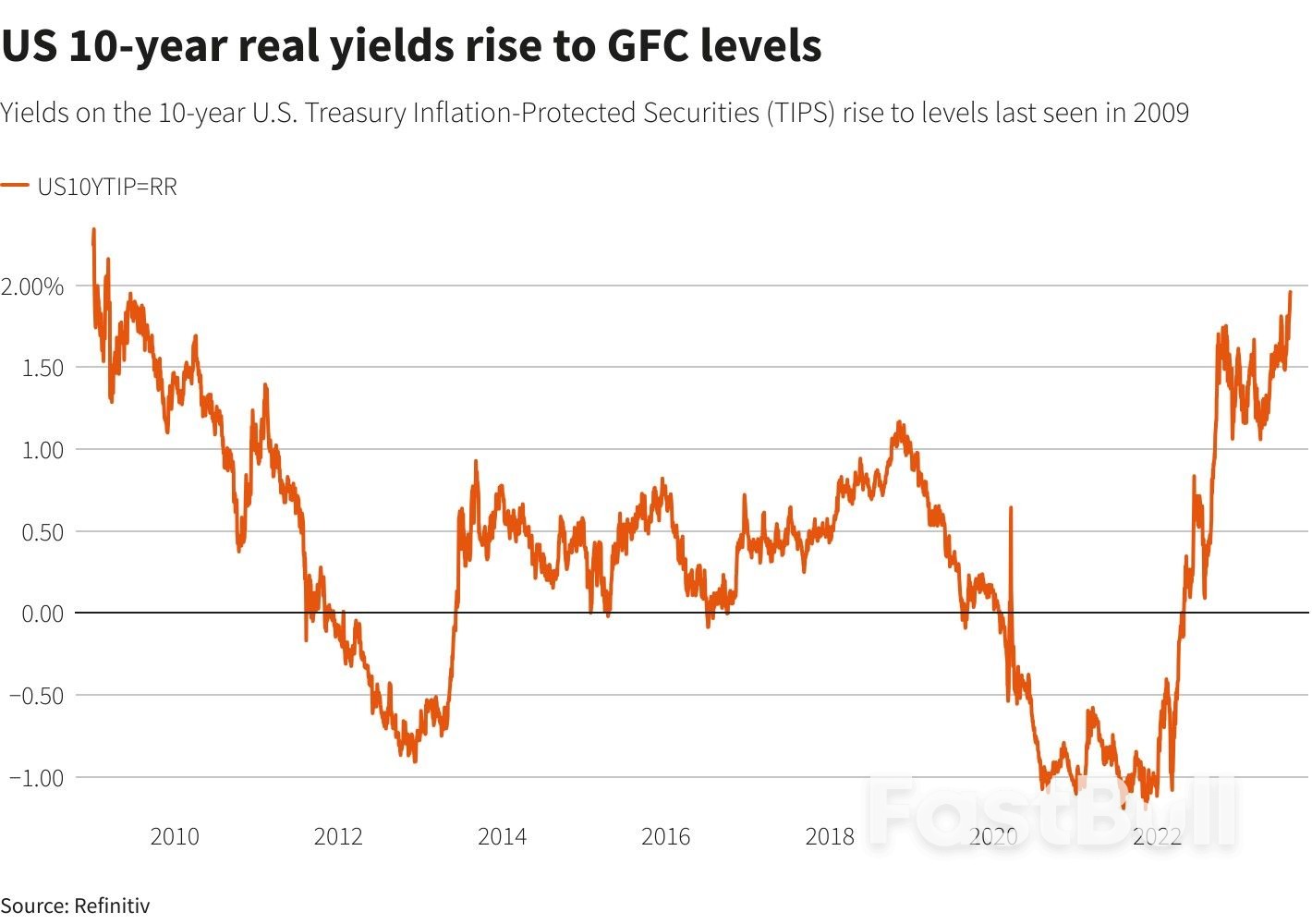
          Meanwhile, expectations for inflation over the next decade as measured by the Treasury Inflation-Protected Securities market have remained relatively stable in recent months. The 10-year breakeven inflation, at 2.35%, is about 5 basis points higher since the beginning of the year, while 10-year nominal yields have increased by about 50 basis points.U.S. Bond Yields Surge Despite Muted Inflation as Investors Look Beyond Fed_1
          "We're pricing in a soft landing, which means we're seeing things working out in the Fed's favor, as inflation is coming down and the probability of a recession has been reduced," said John Madziyire, senior portfolio manager and head of U.S. Treasuries and TIPS at Vanguard Fixed Income Group.
          Long-term Treasury yields account for factors such as inflation expectations and term premiums, or what investors demand to be compensated for the risk of holding long-term paper.
          "A lot of the move that we're seeing now has to do with more long-term structural questions, be it around growth or around term premiums," said Anthony Woodside, head of U.S. fixed income strategy at LGIM America.
          Yields are also a reflection of expectations around the so-called neutral rate - the level at which interest rates are neither stimulative or restrictive for the economy. A recent string of strong economic data despite higher interest rates has strengthened investor beliefs that interest rates will remain higher for longer, even if inflation is tamed.
          "The fact that growth has been so strong and is still very resilient, even at these restrictive rates, means that potentially the neutral rate is now higher," said Madziyire.
          While such longer-term factors have become more prominent recently, the Fed's more immediate monetary policy actions could land right back in the driver's seat in case of a reacceleration of inflation or a sharp deterioration in the economy.
          Money markets expect the Fed to maintain rates in the current 5.25%-5.5% range until the second quarter next year before starting to ease, but many will be looking for clues about possible additional rate hikes from Powell's Jackson Hole speech on Friday.
          "I still think there's some risk that the Fed goes further, but the market is not giving that a whole lot of credence right now," said Aegon's Norris.

          Source: Reuters

          To stay updated on all economic events of today, please check out our Economic calendar
          Risk Warnings and Disclaimers
          You understand and acknowledge that there is a high degree of risk involved in trading. Following any strategies or investment methods may lead to potential losses. The content on the site is provided by our contributors and analysts for information purposes only. You are solely responsible for determining whether any trading assets, securities, strategy, or any other product is suitable for investing based on your own investment objectives and financial situation.
          Comments
          Add to Favorites
          Share

          Investors Sticking with Gold as Fed's Rate Hike Cycle Nears End

          Owen Li

          Commodity

          Central Bank

          Gold isn't losing its allure, according to a dozen money managers who all told Bloomberg News they expect to maintain or raise their exposure to the precious metal in the coming 12 months.
          Bullion has stumbled in recent weeks in the face of multiple headwinds from surging real yields to a stronger U.S. dollar, and the prospect of U.S. rates staying higher for longer. The survey of investors — from sovereign wealth managers to hedge funds — offered some modest optimism for price prospects into 2024.
          None of the respondents said they would cut their exposure to gold in the immediate 12 months, and five of them said they expect to boost their allocations. More than two-thirds of them see prices rising, and five expect a clear all-time high. The poll was conducted between Aug 10 and 22.
          There's still obvious uncertainty around when the U.S. Federal Reserve (Fed) will end its tightening cycle, which would be an important positive for non-interest bearing gold. Global central banks continue to grapple with stubborn inflation, and the U.S. labour market has remained surprisingly resilient in the face of aggressive monetary tightening.
          While there's some signs that investors are bracing for rates to stay higher for longer, the swaps market is still pricing in no more rate hikes, and a shift to policy easing next year.
          "We do anticipate there's pent-up gold demand from investors waiting for the Fed to finish," said Darwei Kung, the head of commodities and portfolio manager at DWS Group. "That's a positive set-up from our perspective." He sees gold reaching a record US$2,250 (RM10,474) an ounce in the time period.
          Bullion is currently trading near US$1,900 an ounce, down about 8% from this year's peak. It reached a record in August 2020 at about US$2,075, in the midst of global economic turmoil triggered by the Covid-19 pandemic.
          To be sure, economists are getting more confident that the U.S. economy can glide to a soft landing, in a marked shift from widely-held views earlier this year that the economy would experience a sharp downturn.
          Safe haven
          A separate survey also showed expectations for higher gold prices. Gold will trade at US$2,021 per ounce 12 months from now, according to the median of 602 responses to Bloomberg's Markets Live Pulse online survey of global readers conducted from Aug 14 to 18.
          The continued appetite for gold points to lingering worries about geopolitical tensions and macroeconomic uncertainties — for example, simmering tensions between the U.S. and China, war in Ukraine, or what's next for China's property crisis. Other positive factors for gold include continued purchases by global central banks and relatively strong retail demand in emerging markets.
          Meanwhile, a breakdown in the correlation between equities and bonds — a cornerstone of the popular 60/40 investment strategy — is also helping to make the case for the metal due to its ability to diversify portfolios, according to the World Gold Council.
          "People are looking for things that really do move differently, and gold does that," the council's head of institutional investor relationships for Asia-Pacific ex‑China, Jaspar Crawley, said at a panel in Sydney on Tuesday (Aug 22). "Diversification has now become a real thing."
          Still, in the near term, gold-watchers have plenty of reasons to be gloomy about the precious metal's prospects. For the next clues on interest rates, investors will be paying attention to commentary from this week's Jackson Hole gathering of central bankers. Fed chair Jerome Powell is due to speak on Friday.
          In Singapore, spot gold had gained 0.3% to US$1,903.23 an ounce as of 2.10pm on Wednesday.

          Source: Bloomberg

          Risk Warnings and Disclaimers
          You understand and acknowledge that there is a high degree of risk involved in trading. Following any strategies or investment methods may lead to potential losses. The content on the site is provided by our contributors and analysts for information purposes only. You are solely responsible for determining whether any trading assets, securities, strategy, or any other product is suitable for investing based on your own investment objectives and financial situation.
          Comments
          Add to Favorites
          Share

          A Busy Day Ahead of Jackson Hole

          Samantha Luan

          Forex

          USD: Nvidia results in focus
          The Jackson Hole Economic Symposium starts tomorrow and should become the overwhelmingly predominant driver for currency markets. For now, investors are keeping a close eye on China and how effectively Beijing is defending its own currency. The 7.30 level in USD/CNY has emerged as the discomfort level for Chinese authorities, and a full session below that mark yesterday and overnight has prompted some optimistic calls that the worst is past us for the yuan's mini currency "crisis". It seems a bit premature, but the intent from the People's Bank of China (PBoC) to put a line in the sand at 7.30 is now clear, and would admittedly require another substantial deterioration in sentiment to accept a higher barrier for the pair.
          USD/CNH drops normally bring the dollar lower across the board. For now, the renminbi is stable rather than truly rebounding, which allowed a small EUR/USD drop yesterday. Markets will be looking at PMIs across developed economies today. The surveys have a larger market impact in European markets but have recently also been looked at with interest in the US, where consensus is expecting few changes from the July read. New home sales are also on the calendar.
          Another event to keep an eye on today will be the release of quarterly results from Nvidia. The firm is a key player in the AI space and some see today's results as a key turning point for the recent AI-led equity rally. The impact will likely extend to the currency market. Still, with Jackson Hole kicking off tomorrow and the material risk of Fed Chair Jerome Powell reiterating a hawkish message, any dollar bearish trend may struggle to find solid momentum.
          EUR: ECB cannot ignore PMIs
          Any forward-looking economic indicator is, at this stage, quite important for the euro and the European Central Bank. The bank is officially fully focused on inflation, but evidence of a slowdown in key parts of the euro area has mounted and is now too blatant to be overlooked. Core inflation dynamics will still remain the main input for the ECB – but should we see more indications from today's PMIs that the eurozone outlook is deteriorating, then policymakers might see the window for one last hike closing rapidly and opt for a September hike rather than delaying it until the fourth quarter.
          The focus will also be on Germany's PMIs. Manufacturing is expected to have flattened in August at 38.8, and services to have declined modestly to 51.5. Overall, the eurozone numbers are not expected to show any further material deterioration. Later today, the euro area consumer confidence will also be published.
          EUR/USD came under pressure yesterday and unless we receive some encouraging news from PMIs, or a drop in the dollar (e.g., caused by an equity rally after Nvidia results), we suspect markets may marginally prefer to stay bearish on the pair as for some pre-Jackson Hole positioning.
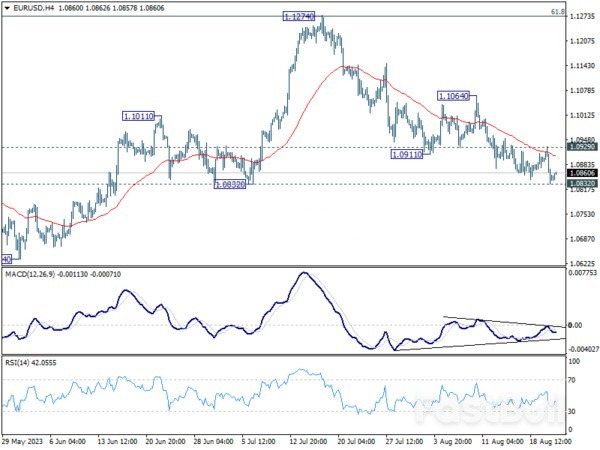
          EUR/USD is testing the early-July 1.0834 low this morning, a break lower puts the next support at 1.0800 (200-day MA).
          GBP: Volatile pricing ahead of PMIs
          Bank of England rate expectations have been quite volatile since the upside surprise in wages and CPI last week. The miss in retail sales on Friday saw peak Bank rate expectations as measured in the Sonia rate drop more than 10bp. Markets are currently looking at 5.95-6.0%, but today's PMI release in the UK may well move pricing again.
          Consensus is expecting some slowdown in both manufacturing (already in contraction territory) and services (to 51.0). The Bank of England will also look at the details of the survey searching for evidence that price pressures are abating.
          EUR/GBP can make another attempt at breaking 0.8500 today, although the sustainability of sub-0.8500 levels is questionable unless markets price in more rate hikes in the UK or price out tightening in the eurozone.
          SEK: Enjoying a breather
          The Swedish krona is emerging as an outperformer this week without any clear domestic driver justifying its strength against peers. EUR/SEK had risen above 11.90 and eyed 12.00, reaching new highs last week, and we suspect this week's correction is primarily technically driven.
          News on the troubled landlord SBB continues to worry investors, although at these levels, SEK is pricing in quite a good deal of domestic risks. Incidentally, the housing market has shown signs of stabilisation, which might leave slightly wider manoeuvring room for the Riksbank to deal with high inflation.
          Keep a close eye on today's Nvidia quarterly results. SEK is generally the most correlated G10 currency with US tech stocks. A disappointment on that side could trigger another EUR/SEK rally, even though some EUR softness is now helping put a cap on the pair. For the moment, a break above 12.00 is not our baseline scenario, and we see instead greater chances of a gradual – although bumpy – decline in the pair into year-end.

          Source: ING

          Risk Warnings and Disclaimers
          You understand and acknowledge that there is a high degree of risk involved in trading. Following any strategies or investment methods may lead to potential losses. The content on the site is provided by our contributors and analysts for information purposes only. You are solely responsible for determining whether any trading assets, securities, strategy, or any other product is suitable for investing based on your own investment objectives and financial situation.
          Comments
          Add to Favorites
          Share

          Investors Look to AI-Darling Nvidia's Earnings as U.S. Stocks Rally Wobbles

          Alex

          Economic

          Stocks

          Bullish investors are hoping Wednesday's earnings report from chip heavyweight Nvidia can rejuvenate a U.S. stocks rally that has stumbled in recent weeks.
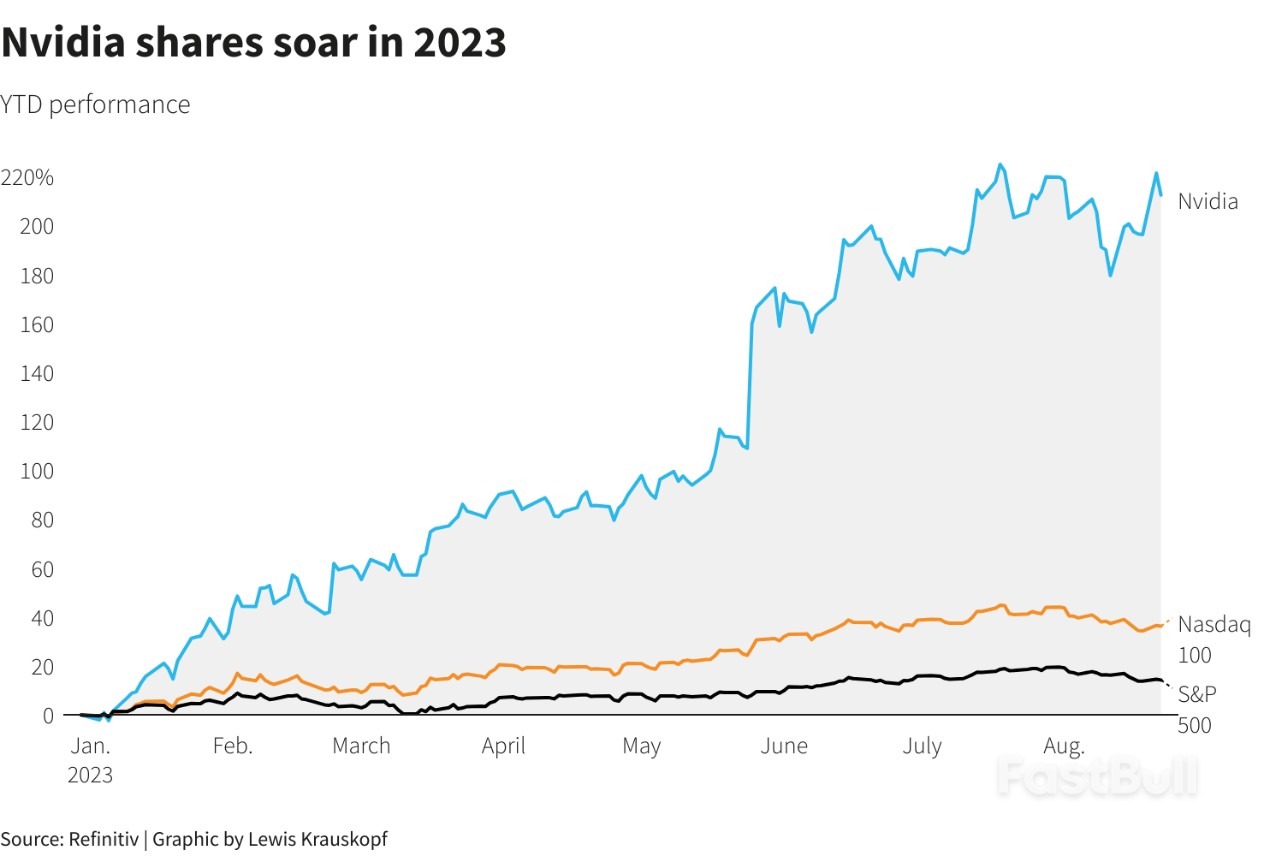
          Nvidia shares have tripled in 2023, underscoring how a rebound in megacap stocks and excitement over the business potential of artificial intelligence have helped propel the S&P 500 to a 14% gain this year.
          The chipmaker's year-to-date increase has led gains among the so-called Magnificent Seven group of megacap stocks, which also include Apple and Microsoft. The group's collective rise was responsible for roughly two-thirds of the S&P 500's increase through July.
          Yet the broader equity rally has recently faltered, with the benchmark index off more than 4% in August as soaring Treasury yields threaten to dull the allure of stocks. The market's turbulence is intensifying focus on Nvidia's fiscal second quarter report, due after market close on Wednesday.
          Nvidia is at the center of "two big themes the market is concerned about right now: Can Big Tech continue to lead the market, and is this AI story for real?" said Anthony Saglimbene, chief market strategist at Ameriprise Financial, which is slightly overweight the tech sector.
          "A little piece of good news in a stock that has been an important driver to the market could change the sentiment," he said.
          Investors Look to AI-Darling Nvidia's Earnings as U.S. Stocks Rally Wobbles_1Nvidia stunned the market with its prior report in May, when a stellar forecast sent its stock soaring 24% in one day. Following that report, the S&P 500 technology sector rallied 8% over the next five days.
          Driving the company's gains has been its position as a beneficiary of the rise of ChatGPT and other generative AI apps, virtually all of which are powered by its graphics processors.
          In one sign of AI's overall market boost, a Societe Generale analysis zeroing in on 20 stocks widely owned by AI-related exchange-traded funds found that removing those stocks from the S&P 500 would cut index performance by roughly 13 percentage points, leaving it with only a marginal gain for the year.
          Some investors may already be placing bets on a repeat strong performance: Nvidia shares have jumped nearly 12% since the start of last week, setting an all-time high on Tuesday before retreating. Such buildup in the shares, however, could make it more difficult for the company to surpass investor expectations with its Wednesday report.
          "My guess is the numbers are going to be just fine, but is it going to be enough?" said Chuck Carlson, chief executive officer at Horizon Investment Services. "If it's not, you could see a continuation of the sell-off that we have had here in the last month or so."
          Options in Nvidia imply a nearly 11% swing for the shares, in either direction, by Friday, according to Trade Alert data. That compares with the 8.6% average move logged by the stock on the day after the chipmaker has reported results over the last eight quarters.
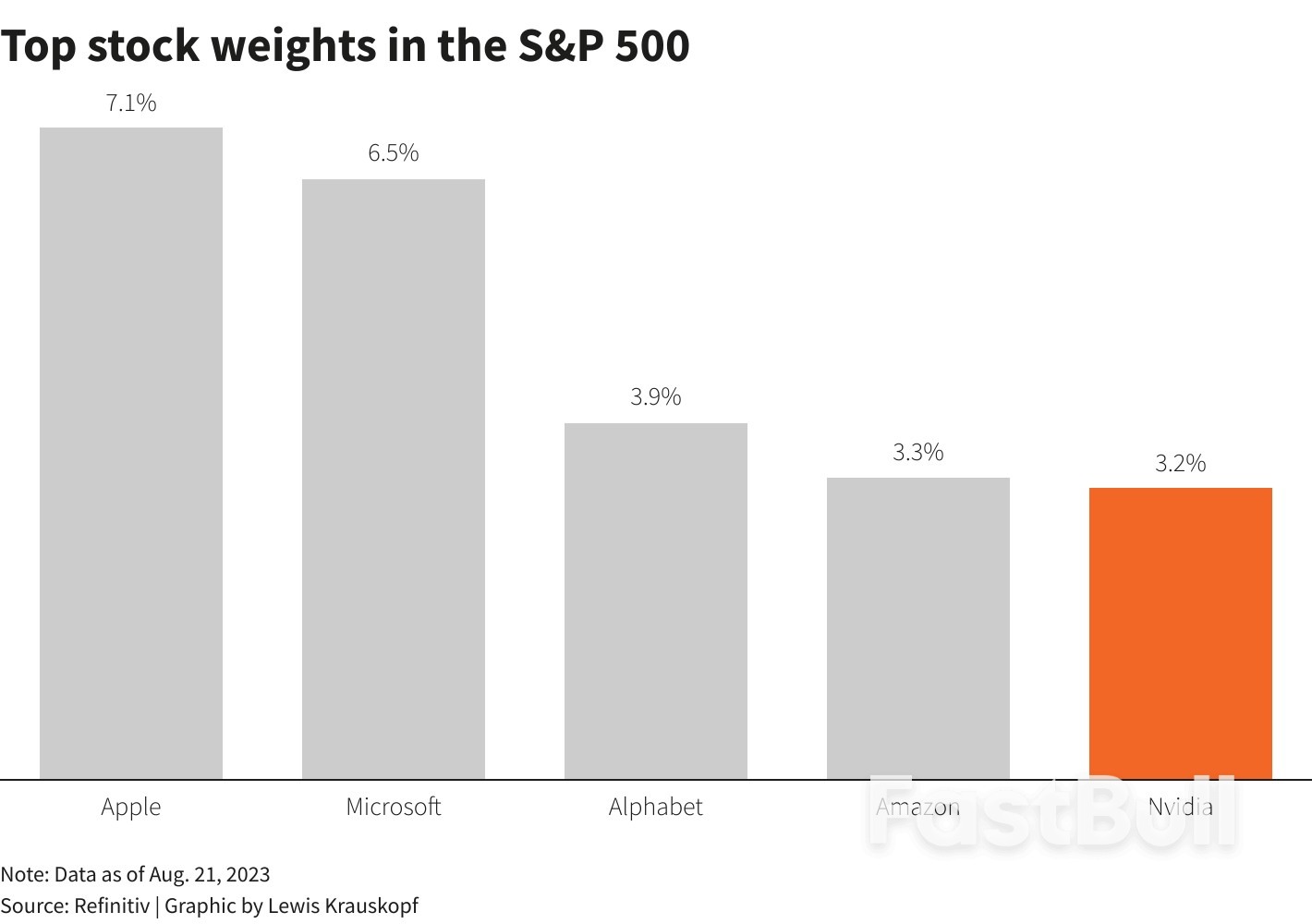
          Nvidia shares amount to the fifth-biggest weight in the S&P 500 and Nasdaq 100, at weights of 3.2% and 4.3%, respectively - meaning that moves in its stock price have an outsized sway on major indexes.
          Investors Look to AI-Darling Nvidia's Earnings as U.S. Stocks Rally Wobbles_2Nvidia's earnings report is not the only closely watched market event in the coming days. Investors will also be focused on a speech from Federal Reserve Chairman Jerome Powell at the central bank's annual conference in Jackson Hole, Wyoming, later this week.
          Signs that the central bank intends to hold rates around current levels for longer than investors had anticipated could further weigh on stocks.
          Still, few can deny the sway that Nvidia and megacap stocks have held over broader markets this year.
          Nvidia was one of 11 stocks named by Goldman Sachs as near-term beneficiaries of the "AI revolution." In a Monday note, Goldman analysts said an equal-weighted basket of those 11 stocks had returned 69% so far in 2023, outpacing a 7% gain for the overall equal-weight S&P 500.
          "Some of these stocks have already seen 2024 EPS estimates rise on the back of AI adoption, with NVDA representing a notable example," the Goldman analysts wrote.

          Source: Reuters

          To stay updated on all economic events of today, please check out our Economic calendar
          Risk Warnings and Disclaimers
          You understand and acknowledge that there is a high degree of risk involved in trading. Following any strategies or investment methods may lead to potential losses. The content on the site is provided by our contributors and analysts for information purposes only. You are solely responsible for determining whether any trading assets, securities, strategy, or any other product is suitable for investing based on your own investment objectives and financial situation.
          Comments
          Add to Favorites
          Share

          Euro Under Pressure Ahead of PMIs from EZ, UK and U.S.

          Damon

          Forex

          Economic

          Euro faces headwinds this week, emerging as one of the more subdued performers, with all eyes set on today's Eurozone PMI data. Its trajectory, when compared to Yen and Aussie, remains uncertain, as both showed minimal response to their respective PMI releases. Conversely, Dollar's movement, in anticipation of the PMI release, is expected to be constrained, with the market's primary focus shifting to Fed Chair Jerome Powell's upcoming speech at the Jackson Hole Symposium. Meanwhile, Canadian Dollar might witness some stirring due to release of its retail sales data.
          For the ongoing week, Yen sits at the bottom of the performance chart, trailed by Euro and then Dollar. Conversely, Australian Dollar is leading the pack, with the New Zealand Dollar and Swiss Franc closely following. Both Sterling and Canadian Dollar hold neutral positions. Remarkably, except for EUR/GBP, majority of major pairs and crosses are treading within the previous week's range.
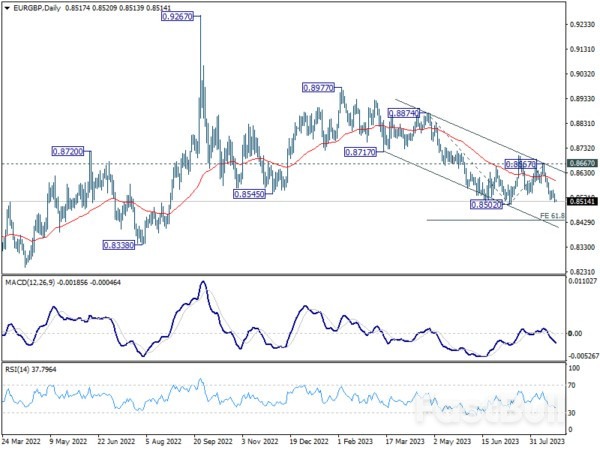
          Zooming in on EUR/GBP, release of UK PMIs is anticipated to induce some movement. Immediate focus is now on 0.8502 support in the cross. Decisive break there will resume larger decline from 0.8977. Next target is 61.8% projection of 0.8874 to 0.8502 from 0.8667 at 0.8437. Downside breakout in EUR/GBP, especially with a simultaneous break of 0.9520 support in EUR/CHF, might intensify Euro's descent across the board.Euro Under Pressure Ahead of PMIs from EZ, UK and U.S._1
          In Asia, at the time of writing, Nikkei is up 0.34%. Hong Kong HSI is up 0.91%. China Shanghai SSE is down -0.62%. Singapore Strait Times is up 0.36%. Japan 10-year JGB yield is up 0.007 at 0.679. Overnight, DOW dropped -0.51%. S&P 500 dropped -0.28%. NASDAQ rose 0.06%. 10-year yield dropped -0.014 to 4.328.

          Japan PMI manufacturing ticked up to 49.7, services rose to 54.3

          In August, Japan's Service PMI climbed from 53.8 to 54.3, while the Manufacturing PMI saw a slight increase from 49.6 to 49.7, just above anticipated figures. The Composite PMI also edged up from 52.2 to 52.6.
          Andrew Harker, from S&P Global Market Intelligence, pointed out the robust performance of the service sector, driven by consistent new order growth. In contrast, manufacturing only marginally rebounded but remained below the growth threshold.
          Despite the overall rise in new orders, manufacturing employment remained flat, ending its 28-month growth streak. Additionally, heightened oil prices impacted both sectors, causing the steepest rise in input costs in four months. Notably, business confidence dwindled in both domains due to longer-term economic uncertainties.

          Australian PMI hits 19-month low, but concerns on inflation and strong employment rise

          Australia's August PMI data showed a concerning decline across sectors. The Manufacturing PMI slightly decreased from 49.6 to 49.4, while Services PMI dropped to a 19-month low of 46.7. Composite PMI, reflecting both sectors, also declined to a 19-month low of 47.1.
          Warren Hogan, Chief Economic Advisor at Judo Bank, drew attention to the employment sector's resilience. He noted, "Despite weakening PMI figures, the employment index remains positive, indicating robust labour demand across both manufacturing and services."
          With businesses maintaining optimism, they might resist workforce reductions even amidst economic slowdowns. "As aggregate demand is supported by ongoing employment growth… it might mean a further substantial lift in interest rates could be required at some stage in the next 6-12 months," he added.
          Inflation remains a key concern. After 2022 disinflation trend, 2023 has shown a halt in the falling price indexes. The current data suggests an inflation rate of about 4%, overshooting the RBA's 2-3% target range.
          Hogan also noted wage growth concerns. Even with modest official growth figures, he cautioned that wage pressures might exceed RBA's forecasted 4% annual growth for 2023. "This may mean firm tightening bias to the RBA's policy deliberations for the rest of the year."

          NZ retail sales volume down -1.0% qoq in Q2, value down -0.2% qoq

          New Zealand's retail sales volume for Q2 plummeted by -1.0% qoq, settling at NZD 25B. This decline starkly contrasts with market forecasts which had anticipated a milder contraction of just -0.2% qoq. A broad-based slump was evident, as 11 out of 15 industries reported reduced seasonally adjusted sales volumes.
          Highlighting the sectors that bore the brunt of this downturn, food and beverage services saw a sharp decline of -4.4%. Hardware, building, and garden supplies trailed closely, recording a -4.8% drop. These sectors emerged as the primary drags on the overall sales volume for the quarter.
          While sales volume took a hit, retail sales value also showed signs of weakness, contracting -0.2% qoq to land at NZD 30B. Once again showcasing the breadth of the downturn, seven out of 15 industries registered a fall.

          Looking ahead

          Eurozone and UK PMIs will be the main focus in European session. Later in the day, Canada will release retail sales. U.S. will release PMIs and new home sales.

          EUR/USD Daily Outlook

          Immediate focus is now on 1.0832 support in EUR/USD. Firm break there will resume whole fall from 1.1274, and target target 1.0609/34 cluster support next. On the upside, however, break of 1.0929 resistance will turn intraday bias to the upside for stronger recovery.Euro Under Pressure Ahead of PMIs from EZ, UK and U.S._2
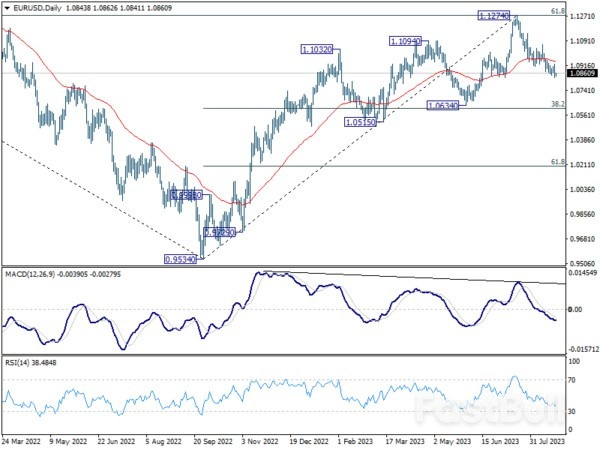
          In the bigger picture, a medium-term top should be formed at 1.1274, after failing to break through 61.8% retracement of 1.2348 (2021 high) to 0.9534 at 1.1273 decisively, on bearish divergence condition in D MACD. Fall from there is seen as a correction to the uptrend from 0.9534 (2022 low). Deeper decline would be seen to 1.0634 cluster support (38.2% retracement of 0.9534 to 1.1274 at 1.0609). Strong support could be seen there, at least on first attempt, to set the range for consolidation. Yet, medium term outlook will be neutral for now, as long as 1.1274 resistance holds.Euro Under Pressure Ahead of PMIs from EZ, UK and U.S._3

          Source: ActionForex

          To stay updated on all economic events of today, please check out our Economic calendar
          Risk Warnings and Disclaimers
          You understand and acknowledge that there is a high degree of risk involved in trading. Following any strategies or investment methods may lead to potential losses. The content on the site is provided by our contributors and analysts for information purposes only. You are solely responsible for determining whether any trading assets, securities, strategy, or any other product is suitable for investing based on your own investment objectives and financial situation.
          Comments
          Add to Favorites
          Share
          FastBull
          Copyright © 2025 FastBull Ltd

          728 RM B 7/F GEE LOK IND BLDG NO 34 HUNG TO RD KWUN TONG KLN HONG KONG

          TelegramInstagramTwitterfacebooklinkedin
          App Store Google Play Google Play
          Products
          Charts

          Chats

          Q&A with Experts
          Screeners
          Economic Calendar
          Data
          Tools
          Membership
          Features
          Function
          Markets
          Copy Trading
          Latest Signals
          Contests
          News
          Analysis
          24/7
          Columns
          Education
          Company
          Careers
          About Us
          Contact Us
          Advertising
          Help Center
          Feedback
          User Agreement
          Privacy Policy
          Business

          White Label

          Data API

          Web Plug-ins

          Poster Maker

          Affiliate Program

          Risk Disclosure

          The risk of loss in trading financial instruments such as stocks, FX, commodities, futures, bonds, ETFs and crypto can be substantial. You may sustain a total loss of the funds that you deposit with your broker. Therefore, you should carefully consider whether such trading is suitable for you in light of your circumstances and financial resources.

          No decision to invest should be made without thoroughly conducting due diligence by yourself or consulting with your financial advisors. Our web content might not suit you since we don't know your financial conditions and investment needs. Our financial information might have latency or contain inaccuracy, so you should be fully responsible for any of your trading and investment decisions. The company will not be responsible for your capital loss.

          Without getting permission from the website, you are not allowed to copy the website's graphics, texts, or trademarks. Intellectual property rights in the content or data incorporated into this website belong to its providers and exchange merchants.

          Not Logged In

          Log in to access more features

          FastBull Membership

          Not yet

          Purchase

          Become a signal provider
          Help Center
          Customer Service
          Dark Mode
          Price Up/Down Colors

          Log In

          Sign Up

          Position
          Layout
          Fullscreen
          Default to Chart
          The chart page opens by default when you visit fastbull.com