• Trade
  • Markets
  • Copy
  • Contests
  • News
  • 24/7
  • Calendar
  • Q&A
  • Chats
Trending
Screeners
SYMBOL
LAST
BID
ASK
HIGH
LOW
NET CHG.
%CHG.
SPREAD
SPX
S&P 500 Index
6827.42
6827.42
6827.42
6899.86
6801.80
-73.58
-1.07%
--
DJI
Dow Jones Industrial Average
48458.04
48458.04
48458.04
48886.86
48334.10
-245.98
-0.51%
--
IXIC
NASDAQ Composite Index
23195.16
23195.16
23195.16
23554.89
23094.51
-398.69
-1.69%
--
USDX
US Dollar Index
97.950
98.030
97.950
98.500
97.950
-0.370
-0.38%
--
EURUSD
Euro / US Dollar
1.17394
1.17409
1.17394
1.17496
1.17192
+0.00011
+ 0.01%
--
GBPUSD
Pound Sterling / US Dollar
1.33707
1.33732
1.33707
1.33997
1.33419
-0.00148
-0.11%
--
XAUUSD
Gold / US Dollar
4299.39
4299.39
4299.39
4353.41
4257.10
+20.10
+ 0.47%
--
WTI
Light Sweet Crude Oil
57.233
57.485
57.233
58.011
56.969
-0.408
-0.71%
--

Community Accounts

Signal Accounts
--
Profit Accounts
--
Loss Accounts
--
View More

Become a signal provider

Sell trading signals to earn additional income

View More

Guide to Copy Trading

Get started with ease and confidence

View More

Signal Accounts for Members

All Signal Accounts

Best Return
  • Best Return
  • Best P/L
  • Best MDD
Past 1W
  • Past 1W
  • Past 1M
  • Past 1Y

All Contests

  • All
  • Trump Updates
  • Recommend
  • Stocks
  • Cryptocurrencies
  • Central Banks
  • Featured News
Top News Only
Share

Ukraine's Navy Says Russian Drone Attack Hit Civilian Turkish Vessel Carrying Sunflower Oil To Egypt On Saturday

Share

Israeli Military Says It Put Planned Strike On South Lebanon Site On Hold After Lebanese Army Requested Access

Share

Norwegian Nobel Committee: Calls On The Belarusian Authorities To Release All Political Prisoners

Share

Norwegian Nobel Committee: His Freedom Is A Deeply Welcome And Long-Awaited Moment

Share

Ukraine Says It Received 114 Prisoners From Belarus

Share

USA Embassy In Lithuania: Maria Kalesnikava Is Not Going To Vilnius

Share

USA Embassy In Lithuania: Other Prisoners Are Being Sent From Belarus To Ukraine

Share

Ukraine President Zelenskiy: Five Ukrainians Released By Belarus In US-Brokered Deal

Share

USA Vilnius Embassy: USA Stands Ready For "Additional Engagement With Belarus That Advances USA Interests"

Share

USA Vilnius Embassy: Belarus, USA, Other Citizens Among The Prisoners Released Into Lithuania

Share

USA Vilnius Embassy: USA Will Continue Diplomatic Efforts To Free The Remaining Political Prisoners In Belarus

Share

USA Vilnius Embassy: Belarus Releases 123 Prisoners Following Meeting Of President Trump's Envoy Coale And Belarus President Lukashenko

Share

USA Vilnius Embassy: Masatoshi Nakanishi, Aliaksandr Syrytsa Are Among The Prisoners Released By Belarus

Share

USA Vilnius Embassy: Maria Kalesnikava And Viktor Babaryka Are Among The Prisoners Released By Belarus

Share

USA Vilnius Embassy: Nobel Peace Prize Laureate Ales Bialiatski Is Among The Prisoners Released By Belarus

Share

Belarusian Presidential Administration Telegram Channel: Lukashenko Has Pardoned 123 Prisoners As Part Of Deal With US

Share

Two Local Syrian Officials: Joint US-Syrian Military Patrol In Central Syria Came Under Fire From Unknown Assailants

Share

Israeli Military Says It Targeted 'Key Hamas Terrorist' In Gaza City

Share

Rwanda's Actions In Eastern Drc Are A Clear Violation Of Washington Accords Signed By President Trump - Secretary Of State Rubio

Share

Israeli Military Issues Evacuation Warning In Southern Lebanon Village Ahead Of Strike - Spokesperson On X

TIME
ACT
FCST
PREV
U.K. Trade Balance Non-EU (SA) (Oct)

A:--

F: --

P: --

U.K. Trade Balance (Oct)

A:--

F: --

P: --

U.K. Services Index MoM

A:--

F: --

P: --

U.K. Construction Output MoM (SA) (Oct)

A:--

F: --

P: --

U.K. Industrial Output YoY (Oct)

A:--

F: --

P: --

U.K. Trade Balance (SA) (Oct)

A:--

F: --

P: --

U.K. Trade Balance EU (SA) (Oct)

A:--

F: --

P: --

U.K. Manufacturing Output YoY (Oct)

A:--

F: --

P: --

U.K. GDP MoM (Oct)

A:--

F: --

P: --

U.K. GDP YoY (SA) (Oct)

A:--

F: --

P: --

U.K. Industrial Output MoM (Oct)

A:--

F: --

P: --

U.K. Construction Output YoY (Oct)

A:--

F: --

P: --

France HICP Final MoM (Nov)

A:--

F: --

P: --

China, Mainland Outstanding Loans Growth YoY (Nov)

A:--

F: --

P: --

China, Mainland M2 Money Supply YoY (Nov)

A:--

F: --

P: --

China, Mainland M0 Money Supply YoY (Nov)

A:--

F: --

P: --

China, Mainland M1 Money Supply YoY (Nov)

A:--

F: --

P: --

India CPI YoY (Nov)

A:--

F: --

P: --

India Deposit Gowth YoY

A:--

F: --

P: --

Brazil Services Growth YoY (Oct)

A:--

F: --

P: --

Mexico Industrial Output YoY (Oct)

A:--

F: --

P: --

Russia Trade Balance (Oct)

A:--

F: --

P: --

Philadelphia Fed President Henry Paulson delivers a speech
Canada Building Permits MoM (SA) (Oct)

A:--

F: --

P: --

Canada Wholesale Sales YoY (Oct)

A:--

F: --

P: --

Canada Wholesale Inventory MoM (Oct)

A:--

F: --

P: --

Canada Wholesale Inventory YoY (Oct)

A:--

F: --

P: --

Canada Wholesale Sales MoM (SA) (Oct)

A:--

F: --

P: --

Germany Current Account (Not SA) (Oct)

A:--

F: --

P: --

U.S. Weekly Total Rig Count

A:--

F: --

P: --

U.S. Weekly Total Oil Rig Count

A:--

F: --

P: --

Japan Tankan Large Non-Manufacturing Diffusion Index (Q4)

--

F: --

P: --

Japan Tankan Small Manufacturing Outlook Index (Q4)

--

F: --

P: --

Japan Tankan Large Non-Manufacturing Outlook Index (Q4)

--

F: --

P: --

Japan Tankan Large Manufacturing Outlook Index (Q4)

--

F: --

P: --

Japan Tankan Small Manufacturing Diffusion Index (Q4)

--

F: --

P: --

Japan Tankan Large Manufacturing Diffusion Index (Q4)

--

F: --

P: --

Japan Tankan Large-Enterprise Capital Expenditure YoY (Q4)

--

F: --

P: --

U.K. Rightmove House Price Index YoY (Dec)

--

F: --

P: --

China, Mainland Industrial Output YoY (YTD) (Nov)

--

F: --

P: --

China, Mainland Urban Area Unemployment Rate (Nov)

--

F: --

P: --

Saudi Arabia CPI YoY (Nov)

--

F: --

P: --

Euro Zone Industrial Output YoY (Oct)

--

F: --

P: --

Euro Zone Industrial Output MoM (Oct)

--

F: --

P: --

Canada Existing Home Sales MoM (Nov)

--

F: --

P: --

Euro Zone Total Reserve Assets (Nov)

--

F: --

P: --

U.K. Inflation Rate Expectations

--

F: --

P: --

Canada National Economic Confidence Index

--

F: --

P: --

Canada New Housing Starts (Nov)

--

F: --

P: --

U.S. NY Fed Manufacturing Employment Index (Dec)

--

F: --

P: --

U.S. NY Fed Manufacturing Index (Dec)

--

F: --

P: --

Canada Core CPI YoY (Nov)

--

F: --

P: --

Canada Manufacturing Unfilled Orders MoM (Oct)

--

F: --

P: --

Canada Manufacturing New Orders MoM (Oct)

--

F: --

P: --

Canada Core CPI MoM (Nov)

--

F: --

P: --

Canada Manufacturing Inventory MoM (Oct)

--

F: --

P: --

Canada CPI YoY (Nov)

--

F: --

P: --

Canada CPI MoM (Nov)

--

F: --

P: --

Canada CPI YoY (SA) (Nov)

--

F: --

P: --

Canada Core CPI MoM (SA) (Nov)

--

F: --

P: --

Q&A with Experts
    • All
    • Chatrooms
    • Groups
    • Friends
    Connecting
    .
    .
    .
    Type here...
    Add Symbol or Code

      No matching data

      All
      Trump Updates
      Recommend
      Stocks
      Cryptocurrencies
      Central Banks
      Featured News
      • All
      • Russia-Ukraine Conflict
      • Middle East Flashpoint
      • All
      • Russia-Ukraine Conflict
      • Middle East Flashpoint

      Search
      Products

      Charts Free Forever

      Chats Q&A with Experts
      Screeners Economic Calendar Data Tools
      Membership Features
      Data Warehouse Market Trends Institutional Data Policy Rates Macro

      Market Trends

      Market Sentiment Order Book Forex Correlations

      Top Indicators

      Charts Free Forever
      Markets

      News

      News Analysis 24/7 Columns Education
      From Institutions From Analysts
      Topics Columnists

      Latest Views

      Latest Views

      Trending Topics

      Top Columnists

      Latest Update

      Signals

      Copy Rankings Latest Signals Become a signal provider AI Rating
      Contests
      Brokers

      Overview Brokers Assessment Rankings Regulators News Claims
      Broker listing Forex Brokers Comparison Tool Live Spread Comparison Scam
      Q&A Complaint Scam Alert Videos Tips to Detect Scam
      More

      Business
      Events
      Careers About Us Advertising Help Center

      White Label

      Data API

      Web Plug-ins

      Affiliate Program

      Awards Institution Evaluation IB Seminar Salon Event Exhibition
      Vietnam Thailand Singapore Dubai
      Fans Party Investment Sharing Session
      FastBull Summit BrokersView Expo
      Recent Searches
        Top Searches
          Markets
          News
          Analysis
          User
          24/7
          Economic Calendar
          Education
          Data
          • Names
          • Latest
          • Prev

          View All

          No data

          Scan to Download

          Faster Charts, Chat Faster!

          Download App
          English
          • English
          • Español
          • العربية
          • Bahasa Indonesia
          • Bahasa Melayu
          • Tiếng Việt
          • ภาษาไทย
          • Français
          • Italiano
          • Türkçe
          • Русский язык
          • 简中
          • 繁中
          Open Account
          Search
          Products
          Charts Free Forever
          Markets
          News
          Signals

          Copy Rankings Latest Signals Become a signal provider AI Rating
          Contests
          Brokers

          Overview Brokers Assessment Rankings Regulators News Claims
          Broker listing Forex Brokers Comparison Tool Live Spread Comparison Scam
          Q&A Complaint Scam Alert Videos Tips to Detect Scam
          More

          Business
          Events
          Careers About Us Advertising Help Center

          White Label

          Data API

          Web Plug-ins

          Affiliate Program

          Awards Institution Evaluation IB Seminar Salon Event Exhibition
          Vietnam Thailand Singapore Dubai
          Fans Party Investment Sharing Session
          FastBull Summit BrokersView Expo

          Crude Oil Jumps, Dollar Rallies, Bonds Fall

          Swissquote

          Stocks

          Bond

          Energy

          Summary:

          Volatility in U.S. bond markets is rising, though we are far from alarming levels, while the U.S. dollar continues to amass major safe haven demands.

          The selloff in bonds continues on U.S. government drama. The sell-off in U.S. 10-year papers accelerated yesterday and the 10-year yield spiked to 2.64%. The 2-year yield however, which captures the expectations on Federal Reserve (Fed) actions remain steady a touch above the 5% mark, as even though the Fed's once-dove-now-hawk Neel Kashkari said that the U.S. may need more than one more rate hike to tame inflation, the looming government shutdown talks, the Detroit strikes and a few weak economic data released lately regarding the U.S. melting savings and fading confidence hint that it may be ambitious to bet on more rate hikes before the dust settles. But you never know, the U.S. will reveal its latest GDP update and it is expected to be revised higher. If that's the case, we will likely see more choppiness in bond markets.
          Volatility in U.S. bond markets is rising, though we are far from alarming levels, while the U.S. dollar continues to amass major safe haven demands. Nothing stands before the U.S. dollar's safe haven dominance. Gold slipped below the $1900 per ounce; rising yields increase the opportunity cost of holding the non-interest bearing gold, and thus, should keep a sustainable pressure on the precious metal even after the U.S. government shutdown show ends, as the Fed remains sufficiently decided to keep rates higher for longer, and the U.S. Treasury will be issuing more bonds, paying better yields in the next few months.
          Energy and technology stocks helped the S&P500 limit losses yesterday. The energy sector was up on a fresh jump in oil prices after U.S. inventories at Cushing and Oklahoma fell to critical levels, hinting at growing supply deficit in global energy space. AI stocks were up as U.S. President Joe Biden said that he will sign an executive action on AI this fall, and Meta announced to introduce AI features in Instagram, Messenger, and WhatsApp. Earlier this week, Amazon announced to buy a $4 billion stake in Anthropic, similar to Microsoft's creator of ChatGPT (which by the way is now valued at around $90bn, whereas it was worth $30bn at the beginning of this year). Amazon is also making a move into the AI's magical world, aiming to give its AWS customers access to AI. Microsoft told investors in the latest earnings call that the AI would increase Azure's revenue by around 2%, Anthropic should help drive similar revenue for AWS. Now, unfortunately for Amazon, investors didn't react with the same excitement than they did with Microsoft's investment in ChatGPT. Maybe a new DoJ probe was responsible for it, or it was just the rising yields. But somehow, Amazon follows its MAMAA peers with a certain lag, the e-commerce wing of the business is certainly responsible for that, in an environment full of worries regarding an imminent slowdown in spending.
          Zooming out, the S&P500 remains under pressure. Despite insatiable appetite for AI, the rising yields threaten valuations. There is an important support zone near 4180/4200 region, which shelters the 200-DMA and the major 38.2% Fibonacci retracement on last year's rally. If that support is pulled out, the index will step into a mid-term bearish consolidation zone, and selloff could deepen into yearend. In the short run, the risks remain tilted to the downside, as JP Morgan's Hedged Equity Fund apparently holds tens of thousands of protective puts aimed to protect the long-stock product from selloff and volatility. Those put options will expire on Friday, and their strike price are said to be not far from the actual levels. If exercised, we could see an additional negative pressure on Wall Street stocks.
          Risk Warnings and Disclaimers
          You understand and acknowledge that there is a high degree of risk involved in trading. Following any strategies or investment methods may lead to potential losses. The content on the site is provided by our contributors and analysts for information purposes only. You are solely responsible for determining whether any trading assets, securities, strategy, or any other product is suitable for investing based on your own investment objectives and financial situation.
          Comments
          Add to Favorites
          Share

          Germany Flash Inflation Set to Slow Sharply in September

          CMC

          Economic

          Forex

          European markets lost ground for the third day in a row yesterday, with the DAX languishing close to 6-month lows, while the FTSE100 struggled slipping back to its lowest level in almost 2-weeks.
          U.S. markets fared little better with the S&P500 and Nasdaq 100 slipping to 3-month lows before rebounding to close slightly higher on the day, while Asia markets have also continued to struggle on concerns over China's property sector.
          The wider concern however is how quickly inflationary pressures can recede at a time when oil prices continue to push higher, with Brent prices moving ever closer to $100 a barrel and what effect this 30% move off the summer lows will have on the global economy, consumer consumption patterns and more importantly company profit margins.
          Today's European open looks set to see a modest rebound largely due to position adjustment as we head towards the end of the week, month, and quarter tomorrow.
          The main focus today is on the latest German and Spain inflation numbers for September which could see a sharp slowdown in the annual rate.
          Earlier this month the ECB took the surprise decision to go ahead with another 25bps rate rise in the face of overwhelming evidence that the economy across Europe is slowing sharply, even as inflation has been shown to slowing sharply in recent months.
          Despite concerns that the ECB has once again set itself up for another policy mistake the hawks on the governing council carried the day, even as the ECB President Christine Lagarde made the case that it would probably be the last in the current cycle.
          Only time will tell how much of a policy mistake this turns out to be, but today's German flash CPI for September could well reinforce this feeling that perhaps the ECB could have exercised a little more patience.
          Expectations are for headline CPI in Germany to slow from 6.4% to 4.5%, which in turn is likely to translate into a similarly sharp slowdown in tomorrow's EU flash CPI numbers, at a time when both manufacturing and services PMIs are both deep in contraction territory.
          We also have the final numbers for U.S. Q2 GDP, as well as the latest weekly jobless claims numbers, which are expected to increase to 215k from 201k.
          After seeing a slowdown to 2% at the start of the year, the U.S. economy looked set to see a strong improvement in Q2 after the initial iteration of Q2 GDP came in at 2.4%, despite a slowdown in personal consumption to 1.6%. The second revision to Q2 GDP threw a bit of a curveball to that after a surprise downgrade to 2.1% when expectations had been for an upgrade to 2.5%.
          Today's final adjustment is expected to see this upgraded to 2.2%, with the downward revision coming about due to a fall in inventory levels, which declined by $1.8bn, instead of seeing an increase, while business spending was also reduced on equipment and IP products.
          Core prices also slowed for the quarter, coming down to 3.7% in a welcome move that helped make the argument for a pause in the rate hiking cycle when the Federal Reserve met earlier this month.
          EUR/USD – found support just above the lows of this year at the 1.0480 area. A move below 1.0480 retargets parity. The main resistance remains back at the 1.0740 area, which we need to get above to stabilise and minimise the risk of further weakness.
          GBP/USD – bias remains for a retest of the 1.2000 area, with resistance at the 1.2300 area in the short term. Only a move back above the 1.2430 area and 200-day SMA stabilises and argues for a return to the 1.2600 area.
          EUR/GBP – failed to overcome the 0.8700 area yesterday and resistance at the 200-day SMA at 0.8720, which is capping the upside. A break of 0.8720 targets the 0.8800 area, however while below the bias remains for a pullback. Support now at the 0.8620 area.
          USD/JPY – still on course for the 150.00 area with support currently at the lows last week at 147.20/30. A break above 150.00 retargets last year's higher at 152.00. Major support currently at the 146.00 area.

          Source: CMC

          To stay updated on all economic events of today, please check out our Economic calendar
          Risk Warnings and Disclaimers
          You understand and acknowledge that there is a high degree of risk involved in trading. Following any strategies or investment methods may lead to potential losses. The content on the site is provided by our contributors and analysts for information purposes only. You are solely responsible for determining whether any trading assets, securities, strategy, or any other product is suitable for investing based on your own investment objectives and financial situation.
          Comments
          Add to Favorites
          Share

          Oil Prices Extend Gains After 3% Surge Amid Tight Supply Concerns

          Owen Li

          Commodity

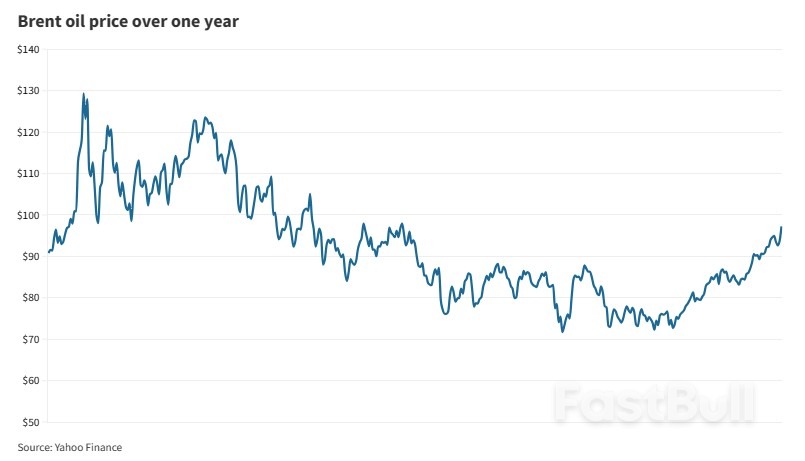
          Oil prices extended their gains on Thursday after surging more than 3 per cent the previous day as a large drop in U.S. crude stocks stoked supply concerns in a tightening crude market.
          Brent, the benchmark for two thirds of the world’s oil, was trading 0.71 per cent higher at $97.24 a barrel at 8.09am UAE time.
          West Texas Intermediate, the gauge that tracks U.S. crude, was up 0.96 per cent at $94.58 a barrel, the highest since August last year.
          On Wednesday, Brent settled 2.76 per cent higher at $96.55 a barrel, while WTI closed up 3.64 per cent at $93.68.Oil Prices Extend Gains After 3% Surge Amid Tight Supply Concerns_1
          "Crude prices are rising again after another inventory report reminded energy traders how tight the oil market has become," said Edward Moya, senior market analyst at Oanda.
          "Brent crude is now just over a few dollars away from the $100 price level, which could see further momentum buying if global leaders don’t do anything to try to jawbone prices down," Mr. Moya said.
          U.S. crude inventories, an indicator of fuel demand, fell by 2.2 million barrels last week to 416.3 million barrels, according to the U.S. Energy Information Administration.
          Analysts polled by Reuters were expecting a drop of 320,000 barrels in the week that ended on September 22.
          Petroleum stocks rose by 1 million barrels last week, while distillate fuel inventories increased by 400,000 barrels during the same period.
          Last week, Russia announced a temporary ban on gasoline and diesel exports in response to domestic shortages. On Monday, Moscow said it would lift the export ban on bunkering fuel for some vessels and diesel with high sulphur content.
          Oil prices have gained about 35 per cent since falling to a low of $71.84 in June, with the International Energy Agency predicting a tighter-than-anticipated crude market on OPEC+ cuts as China, the world’s second-largest economy, introduces stimulus measures to revive growth.
          OPEC+ members Saudi Arabia and Russia announced this month that they would extend supply cuts of a combined 1.3 million barrels per day to the end of the year.
          Brent is forecast to trade in the range of $90 to $100 a barrel over the coming months, before ending the year at $95, Swiss lender UBS said in a research note last week.
          It does not expect Brent crude to move above $100 a barrel on a "sustained basis" as it would lead to higher U.S. crude supply.
          Meanwhile, Goldman Sachs has raised its 12-month Brent forecast to $100 a barrel from $93 and said that the benchmark was "unlikely" to sustainably exceed $105 next year.
          The rise in energy prices is not expected to derail a soft economic landing for the U.S. economy, the investment bank said last week.
          "Most of the oil rally has probably taken place, measures of inflation expectations appear well anchored, and the Federal Reserve is focused on core inflation," Goldman Sachs said.

          Source: The National News

          Risk Warnings and Disclaimers
          You understand and acknowledge that there is a high degree of risk involved in trading. Following any strategies or investment methods may lead to potential losses. The content on the site is provided by our contributors and analysts for information purposes only. You are solely responsible for determining whether any trading assets, securities, strategy, or any other product is suitable for investing based on your own investment objectives and financial situation.
          Comments
          Add to Favorites
          Share

          Why the U.S. Fed's Interest Rate Pause Is a Win for Dollar Bulls

          Alex

          Economic

          Forex

          Central Bank

          The U.S. Federal Reserve's September meeting went largely as expected, with rates unchanged at 5.25 per cent to 5.50 per cent.
          However, it was the Fed's hawkish commentary at its subsequent press conference that kept dollar bulls interested.
          While markets have priced in one more rate hike in 2023, the central bank said it was "proceeding carefully" and hinted that rate cuts probably wouldn't be introduced until June next year – later than it had previously suggested.
          The U.S. Dollar Index, a measure of the value of the dollar against a weighted basket of major currencies, caught a bid to close the week more than 0.25 per cent higher, while U.S. equity markets closed much weaker last week.
          The US500 index shed 2.94 per cent, while the UT100 tech index was down more than 3.2 per cent.
          It seems the momentum of dollar strength has carried into this week. At the time of writing, the U.S. Dollar Index was testing its 2023 highs at 105.90 levels.
          U.S. Treasury yields are also catching a bid, which supports the dollar's strength against equities, various foreign exchange and commodity asset classes.
          Last week, yields on two-year government bonds hit 5.2 per cent, their highest level since July 2006.
          While 10-year yields also tested October 2007 highs at 4.5 per cent last week, it's important to note that the inversion is still very strong.
          Recall that when shorter-term yields remain higher than longer-term yields, similar to what we are experiencing now, this unnatural inversion historically points towards upcoming recessionary conditions.
          As long as U.S. yields remain elevated, expect the dollar's strength to remain robust, with all other asset classes remaining under pressure.
          Keep an eye out for a triple data release at 4.30pm Dubai time on Wednesday, which includes U.S. gross domestic product, personal consumption expenditure (PCE) prices for the second quarter, and the weekly jobless claims.
          U.S. GDP is expected to have edged up to 2.2 per cent during the second quarter, versus a previous reading of 2 per cent.
          But it's the core PCE print – the Fed's preferred gauge of inflation – that could see short-term volatility.
          PCE prices in the second quarter are expected to have slowed to 2.5 per cent from a previous monthly reading of 4.2 per cent.
          While we may see a reading above 2.5 per cent due to higher energy prices in this period, the core PCE will be scrutinised more closely.
          Core PCE, excluding food and energy, is expected to come in at 3.7 per cent versus a previous print of 4.9 per cent.
          Any growth in the core PCE print will keep U.S. dollar prospects stronger, with equities negatively affected.
          Finally, the weekly jobless claims number will continue to offer insights into the strength of the labour market.
          Recall that a hotter-than-expected jobs market will directly and indirectly keep inflation higher – and the Fed is conscious of this.
          Jobless claims have continued to drop, suggesting that fewer people are filing for unemployment benefits in the short term, which has also supported the dollar.
          Expectations are for jobless claims to come in at 217,000 on Wednesday.
          I am keeping a support level in the U.S. Dollar Index at 104.50, with 107.20 being the next resistance level, which will be tested in the lead-up to the penultimate Fed meeting taking place on October 31 and November 1.
          Looking at equities, I expect to see the S&P 500 test 4,300 levels in the next two weeks, followed by 4,240 levels.
          Spot gold has been trading in a rather tight range. I expect short-term support to hold at $1,856 levels, with upsides capped at $1,955 levels.
          This creates intraday opportunities for day traders. However, remember to deploy stop-loss orders to protect against extended moves amid these uncertain market conditions.

          Source: The National News

          To stay updated on all economic events of today, please check out our Economic calendar
          Risk Warnings and Disclaimers
          You understand and acknowledge that there is a high degree of risk involved in trading. Following any strategies or investment methods may lead to potential losses. The content on the site is provided by our contributors and analysts for information purposes only. You are solely responsible for determining whether any trading assets, securities, strategy, or any other product is suitable for investing based on your own investment objectives and financial situation.
          Comments
          Add to Favorites
          Share

          Dollar Surge Is Bringing 'Pseudo Tightening' to Southeast Asia

          Thomas

          Economic

          Forex

          Southeast Asian central banks are using tools other than rate hikes to defend their currencies against the surging dollar as bets on higher-for-longer Federal Reserve rates take hold.
          Indonesia is keeping a tight leash on liquidity by selling bills while Malaysia's interbank rate has risen to the highest since July. The shift comes despite earlier calls for peak rates in Southeast Asia as the threat of food and energy-related inflation pressures as well as elevated Fed rates spur caution.
          “We expect central banks across the region to continue using a combination of liquidity tightening and intervention to lean against further depreciation in their currencies against the dollar,” said Abhay Gupta, strategist at Bank of America in Singapore. Southeast Asian central banks are becoming more tolerant of “pseudo tightening,” he added.
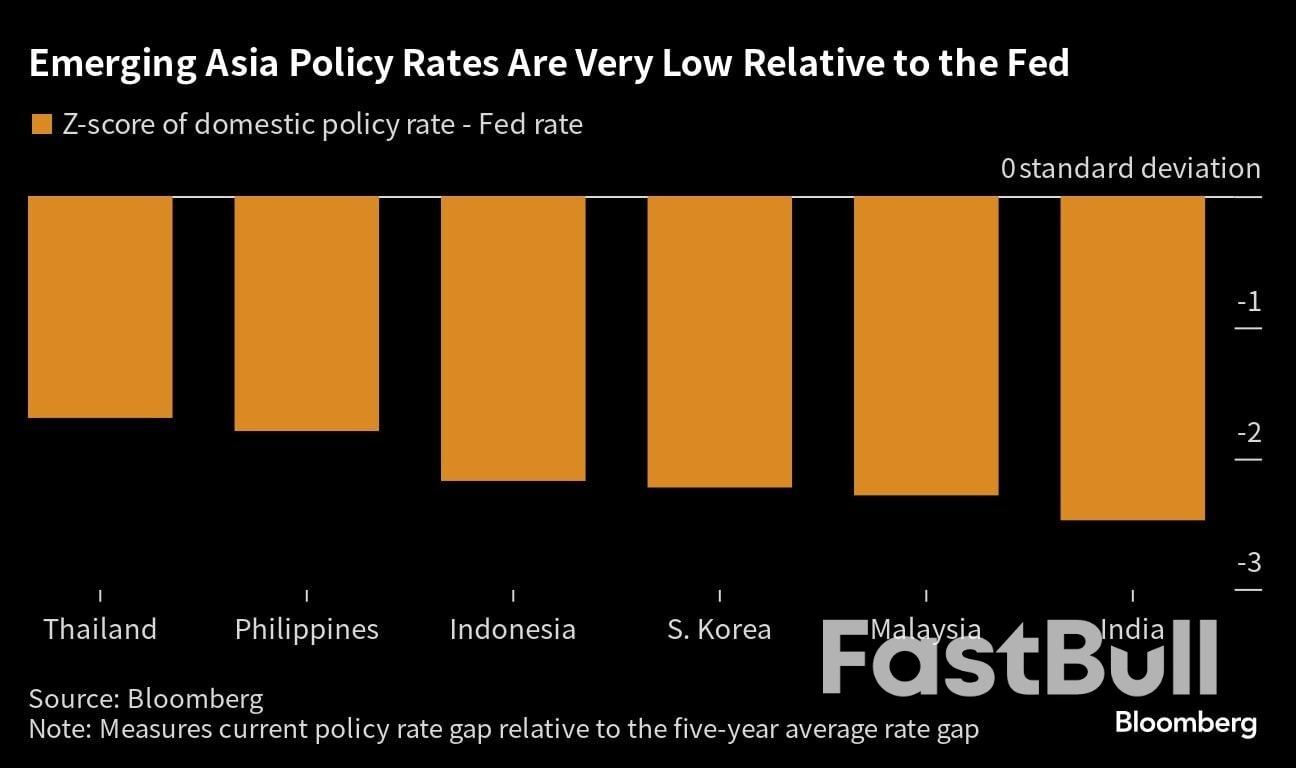
          The rate differential between benchmarks from Southeast Asia and the U.S. has continued to widen as central banks in Indonesia, the Philippines and Malaysia paused rate increases in the first half of the year. Malaysia's benchmark rate is now at a 250-basis point discount to the upper bound of the Fed fund rate, which is a record gap. It is also 2.3 standard deviations below the five-year rate differential. The same gauge for Indonesia stands at -2.2, the Philippines (-1.8) and Thailand (-1.7).Dollar Surge Is Bringing 'Pseudo Tightening' to Southeast Asia_1
          Despite the wide rate gap, Bank Indonesia has so far refrained from signaling rate hikes. It has instead started selling so-called SRBI securities or notes with tenors of six-, nine- and 12-months to attract foreign inflows and reduce the reliance on the benchmark rate, which if tightened too much may hurt the economy.
          It's not just Indonesia, central banks in Malaysia and the Philippines are also using bill sales to tighten liquidity and drive rates higher, said Gupta. The three-month Kuala Lumpur Interbank Rate has risen to 3.57%, the highest since July 13. Bangko Sentral ng Pilipinas' 56-day bill received an average yield of 6.7191% on Sept 22, the highest since the Aug 25 sale.
          The BSP governor said on Tuesday if risks from energy and transport prices materialise, the central bank may increase borrowing costs by 25 basis points at the Nov 16 meeting or earlier. The Thai central bank hiked its key rate by 25-basis points to a 10-year high of 2.5% on Wednesday while signaling upside risk to inflation.

          Source: Bloomberg

          To stay updated on all economic events of today, please check out our Economic calendar
          Risk Warnings and Disclaimers
          You understand and acknowledge that there is a high degree of risk involved in trading. Following any strategies or investment methods may lead to potential losses. The content on the site is provided by our contributors and analysts for information purposes only. You are solely responsible for determining whether any trading assets, securities, strategy, or any other product is suitable for investing based on your own investment objectives and financial situation.
          Comments
          Add to Favorites
          Share

          Not Stretched Enough Yet

          Devin

          Economic

          Central Bank

          Bond

          Level of 3% for the Bund yield and then 5% for 10yr Treasuries still on the cards
          It's proving to be a rough month for bonds, with core product doing worst. A clear bear market in government bonds. And it has had little to do with imminent central bank rate hike fears, as the Fed is practically done, and likely the European Central Bank too. The issue is not about rising official rates. It's more about capacity to cut, and here the market has continued to downsize the extent of rate cuts in 2024/25. That raises the implied floor for both U.S. and eurozone market rates, and continues to pressure longer tenor rates higher. There has been little out there to negate this theme. If anything, activity data has tended to shave firmer than expected and inflation data has been a tad firmer than expected.
          There are factors pushing in the opposite direction too. In the past week Germany cut its issuance estimate for the fourth quarter, which is a supply positive (lower issuance). U.S. auctions have been taken down quite well so far, in the 2yr and 5yr, this week. So there is demand out there. Demand for corporate bonds also remains firm as investors eye decent all-in yields. And in the U.S. the imminent prospect of a (partial) government shutdown means a dampening in spending and activity. Not by much. But enough to be felt. The fact that new macro data won't all be published due to the shutdown means the Fed likely won't hike, as they can't fly blind.
          But overall the dominant impulse for market rates is for a push higher to continue. Most of this is coming from the back end, and in particular the benchmark 10yr area. Hence curves are steepening (dis-inversion), as front ends look steady. We think this continues; ongoing dis-inversion, and curves lifting from the back end. The 10yr Bund yield has a (future) 3% handle written all over it, and 5% for the 10yr Treasury yield is looking more probable by the day. This bear market continues to be directionally led by Treasuries, and the risk-off tone in equity markets has not materially hampered it, partially as investment grade credit remains so well bid, and acts as a compressor.
          And so far any downward pull from the U.S. government shutdown have been overshadowed by other factors. There should not be a huge Treasury impact from the shutdown in any case. Although it can become significant should it last for more than a month.
          Here's how a government shutdown might impact financial markets
          The first thing to note is this is different from the debt ceiling debacle that struck some months back. A key element then centred on the risk that the U.S. Treasury could run out of cash and not be in a position make coupon and redemption payments on government debt, which in turn risked a technical default and potential significant instability on financial markets. In the extreme it could have taken the system down. It was also possible back then that parts of the government could have been shut down to help prioritise the servicing of the debt. In the event, these extremes did not occur, as the debt ceiling was eventually suspended (albeit a tad too close to potential default for comfort).
          The government shutdown that we are talking about here is different, at least in terms of its impact on Treasuries. The Treasury can continue to issue debt to raise cash, so there is no risk to the payment of interest or redemption payments on government debt. Hence there is no risk of default on the debt. The important nuance here is the Treasury has the cash. It's just that they don't have a legal right to spend it beyond the end of September. For spending to continue unfettered into October, the appropriate spending bill(s) need to be passed by Congress. Only the parts of government impacted by the specific spending bills are impacted, but that is wide enough to cause considerable pain to many government employees or social security recipients.
          The impact of a shutdown of some parts of government on financial markets is mostly centred on the dampening effect it has on economic activity. As a stand-alone issue, this should place downward pressure on Treasury yields. And the degree of severity would depend on how long the (partial) government shutdown lasts. There is also the possibility that risk assets could fret as an element of macro uncertainty is thrown into the equation. That too would likely push cash into bonds and money market funds (and out of risk assets). Importantly though, there is no material incremental default risk for Treasuries, and so the financial system should not come under pressure.
          There is a technical dimension to this too. To the extent that the Treasury continues to issue on bond markets, and then spends less of the cash raised, there is a tightening of underlying liquidity conditions. This can act as a force of upside to ultra-short term rates. It should not be significant, but at the margin acts as something of a counter-weight to the downward pressure on (longer tenor) market rates. But it should not be a dominating influence. Either way there should not be a huge impact either way, provided it does not get out of hand in terms of longevity of any (partial) government shutdown.
          The day ahead
          In the U.S. the 7yr auction will complete the re-funding run for this week. Not a massive duration test, and so should be fine. The big hitter on the data front is the core PCE price index. It's currently running at 3.7%, and the market is expecting it to be unchanged at that rate for the second quarter. We fear that it might just nudge higher, based off other inflation data that has surprised a tad to the upside through the second quarter. We'll also keep an eye on jobless claims, still running at close to 200k, and so tame. And pending home sales should be weak. In the eurozone there is a inflation focus, with CPI releases coming from right across Europe, likely featuring more evidence of sticky inflation conditions.

          Source: ING

          To stay updated on all economic events of today, please check out our Economic calendar
          Risk Warnings and Disclaimers
          You understand and acknowledge that there is a high degree of risk involved in trading. Following any strategies or investment methods may lead to potential losses. The content on the site is provided by our contributors and analysts for information purposes only. You are solely responsible for determining whether any trading assets, securities, strategy, or any other product is suitable for investing based on your own investment objectives and financial situation.
          Comments
          Add to Favorites
          Share

          When Is Success Not Success? When Fed Gets Inflation Down to 2.5%

          Damon

          Central Bank

          Economic

          If signals from the U.S. bond market prove accurate, the Fed will be successful in getting inflation down to a '2 handle'. Just not its 2% target.
          Moves in bond yields, implied inflation breakeven rates, and inflation-adjusted 'real' yields suggest investors anticipate the Fed's 'higher for longer' interest rate policy will help lower inflation to around 2.5%.
          The moves currently underfoot in the bond market are dramatic. But this is not a re-pricing of the Fed's near-term trajectory, rather a repricing of the longer term economic and inflation outlook.
          Annual consumer price inflation around 2.5% could legitimately be considered a success - it was 9% in June last year - especially if the hallowed economic soft landing is achieved and a painful recession is avoided.When Is Success Not Success? When Fed Gets Inflation Down to 2.5%_1
          Policymakers would probably bite your hand off for that scenario but never admit it. They will insist policy be set to get inflation down to 2% which, crucially for markets, implies there will be no easing, as investors had long expected.
          "The risk of inflation staying higher than where we want it is the bigger risk. We ought to have 100% commitment that we're going to get inflation back to target," Chicago Fed President Austan Goolsbee told CNBC on Monday.
          This suggests the Fed is entering a phase of structurally higher rates than perhaps policymakers themselves, and certainly investors, had anticipated.
          What is curious about this is the bond market appears to accept that the economy will remain relatively hot and policy will stay restrictive for longer, yet is unconvinced inflation will get down to 2%.
          Many analysts are skeptical that moves in bond yields can be broken down, quantified and compartmentalized with any great degree of accuracy. There are too many moving parts, especially further out the curve.
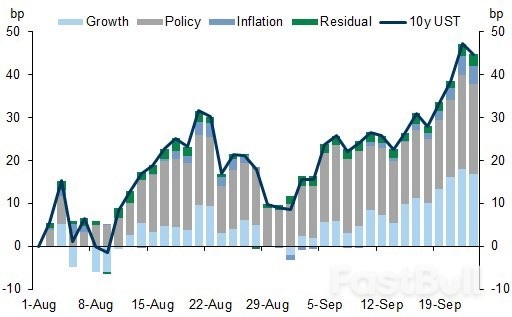
          But interest rate strategists at Goldman Sachs have tried to break down what is behind the selloff in 10-year bonds over the last couple of months that has driven yields up more than 50 basis points to a 16-year high above 4.50%.
          They attribute just under half of the rise to 'policy' - investors are finally realizing that the Fed is in for the long haul on higher rates - and about a third to stronger 'growth'. 'Inflation' and 'residual' - essentially increased supply - account for a fraction of the increase, they estimate.When Is Success Not Success? When Fed Gets Inflation Down to 2.5%_2
          Give An Inch, Take A Mile
          This fits with what inflation breakeven rates and real yields have shown in recent weeks - shorter-dated rates drifting lower and longer-dated rates rising.
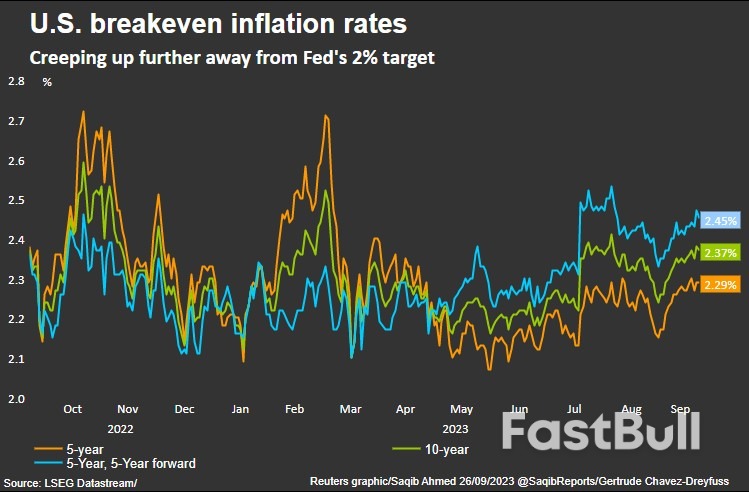
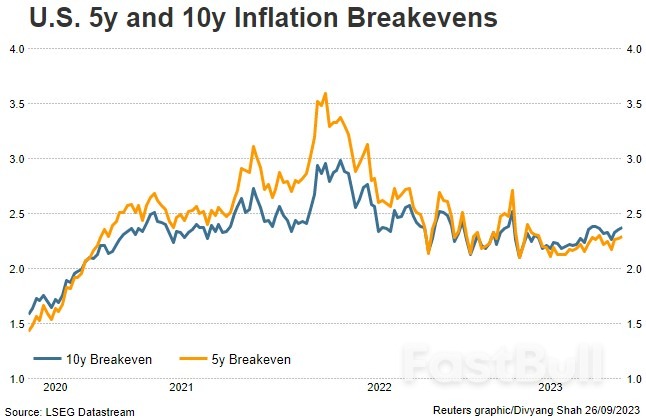
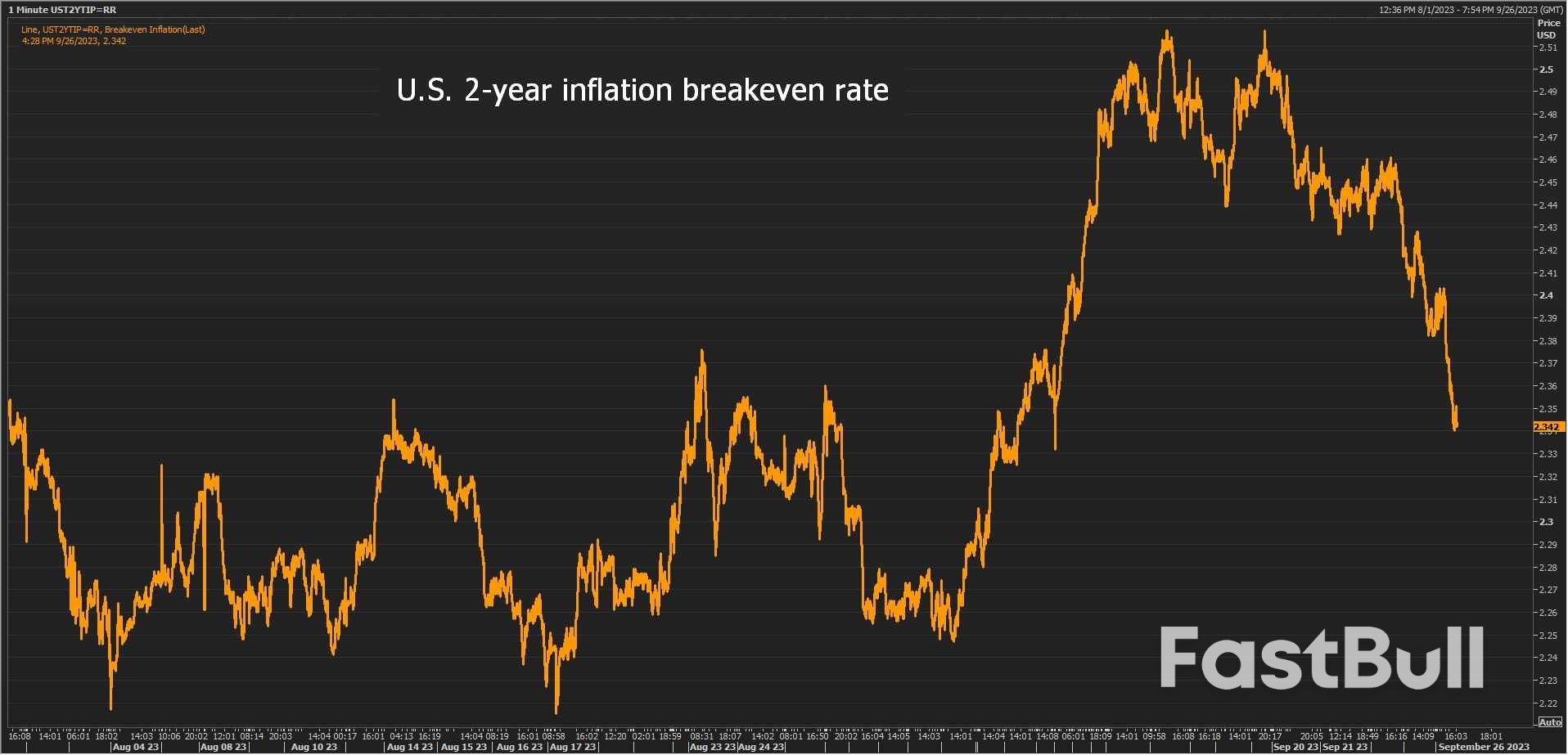
          Two-year breakevens are around 2.35%, up from a sub-2.00% low in July but down from a peak earlier this month above 2.50%, and the 10-year breakeven rate is around 2.40%, up from lows around 2.30% in May, June and July.
          Breakeven inflation is the difference between the yield on a nominal bond and the yield of an inflation-linked bond of the same maturity. The result is traders' implicit forecast of average inflation over the relevant time horizon.
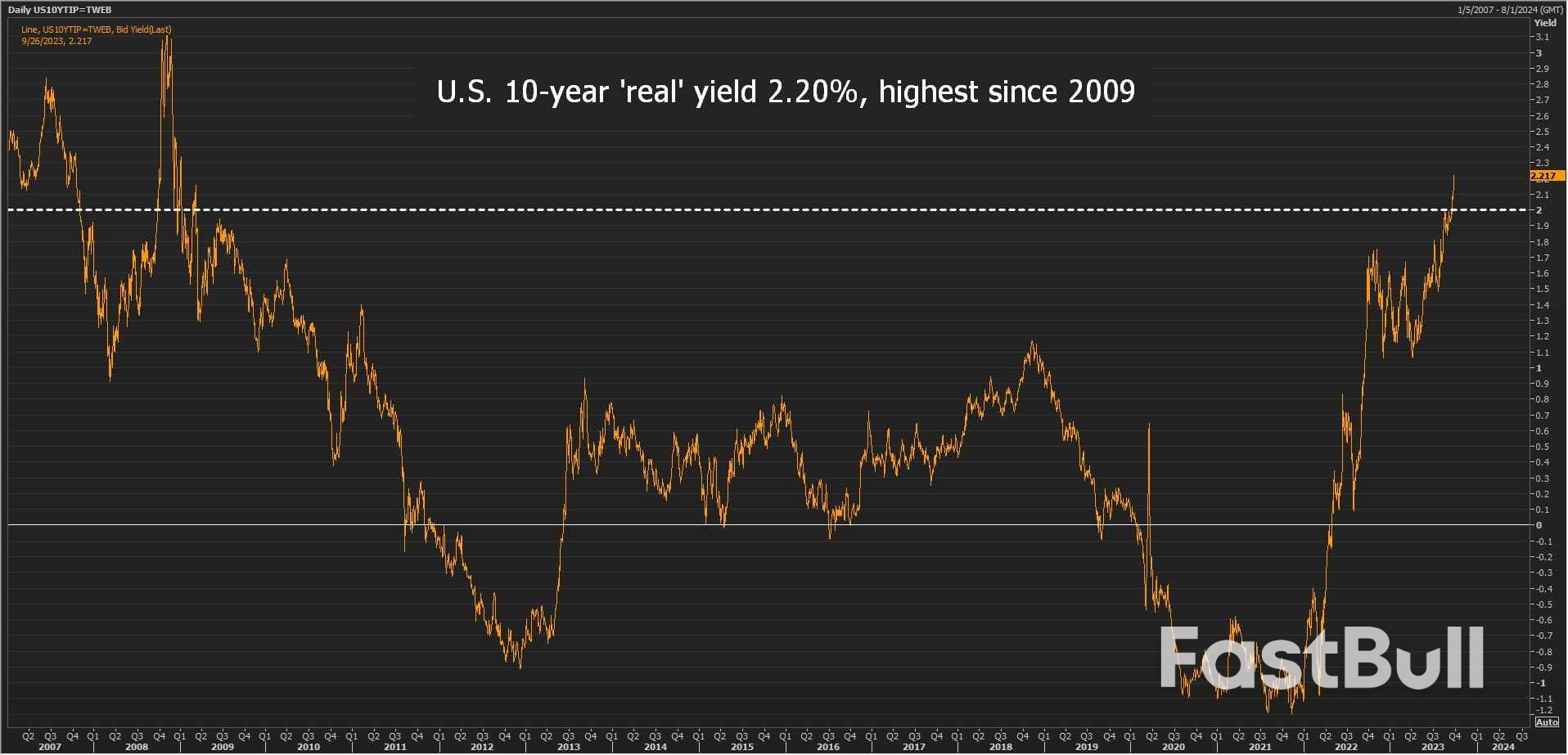
          The yield on two-year Treasury Inflation-Protected Securities (TIPS) has fallen from a peak of around 3.15% in July to 2.80% now, not far from where it was at the start of August.
          The yield on 10-year TIPS, meanwhile, has risen to a 15-year high of 2.20% from around 1.60% in early August, and is showing little sign of reversing.
          TIPS are a key market-based barometer of investors' inflation expectations, but they have their flaws. TIPS can be highly volatile, illiquid, and driven by portfolio hedging flows more than outright directional bets on inflation.
          Taken together, breakevens and TIPS suggest the inflation outlook is gradually coalescing above the Fed's 2% target.When Is Success Not Success? When Fed Gets Inflation Down to 2.5%_3When Is Success Not Success? When Fed Gets Inflation Down to 2.5%_4When Is Success Not Success? When Fed Gets Inflation Down to 2.5%_5
          Marvin Barth, founder of independent research firm Thematic Markets, reckons long-dated yields could rise another 150 basis points or so. "This is about inflation expectations, and they have risen."
          Barth and others say the surge in long-dated yields is due to 'term premium'. That is the compensation investors demand for taking on interest rate risk over a bond's lifetime, which is in theory higher the longer the maturity.
          This is contributing to a steepening - or disinverting - of the yield curve. Long-dated yields have been well below short-dated yields for over a year but the gap is shrinking fast, another sign that pessimism around the economy is evaporating.
          "It's all about the term premium," says Torsten Slok, chief economist and partner at Apollo Global Management. "The worry is that despite the big move in the term premium since late July, it is still significantly below its historical average."

          Source: Reuters

          To stay updated on all economic events of today, please check out our Economic calendar
          Risk Warnings and Disclaimers
          You understand and acknowledge that there is a high degree of risk involved in trading. Following any strategies or investment methods may lead to potential losses. The content on the site is provided by our contributors and analysts for information purposes only. You are solely responsible for determining whether any trading assets, securities, strategy, or any other product is suitable for investing based on your own investment objectives and financial situation.
          Comments
          Add to Favorites
          Share
          FastBull
          Copyright © 2025 FastBull Ltd

          728 RM B 7/F GEE LOK IND BLDG NO 34 HUNG TO RD KWUN TONG KLN HONG KONG

          TelegramInstagramTwitterfacebooklinkedin
          App Store Google Play Google Play
          Products
          Charts

          Chats

          Q&A with Experts
          Screeners
          Economic Calendar
          Data
          Tools
          Membership
          Features
          Function
          Markets
          Copy Trading
          Latest Signals
          Contests
          News
          Analysis
          24/7
          Columns
          Education
          Company
          Careers
          About Us
          Contact Us
          Advertising
          Help Center
          Feedback
          User Agreement
          Privacy Policy
          Business

          White Label

          Data API

          Web Plug-ins

          Poster Maker

          Affiliate Program

          Risk Disclosure

          The risk of loss in trading financial instruments such as stocks, FX, commodities, futures, bonds, ETFs and crypto can be substantial. You may sustain a total loss of the funds that you deposit with your broker. Therefore, you should carefully consider whether such trading is suitable for you in light of your circumstances and financial resources.

          No decision to invest should be made without thoroughly conducting due diligence by yourself or consulting with your financial advisors. Our web content might not suit you since we don't know your financial conditions and investment needs. Our financial information might have latency or contain inaccuracy, so you should be fully responsible for any of your trading and investment decisions. The company will not be responsible for your capital loss.

          Without getting permission from the website, you are not allowed to copy the website's graphics, texts, or trademarks. Intellectual property rights in the content or data incorporated into this website belong to its providers and exchange merchants.

          Not Logged In

          Log in to access more features

          FastBull Membership

          Not yet

          Purchase

          Become a signal provider
          Help Center
          Customer Service
          Dark Mode
          Price Up/Down Colors

          Log In

          Sign Up

          Position
          Layout
          Fullscreen
          Default to Chart
          The chart page opens by default when you visit fastbull.com