• Trade
  • Markets
  • Copy
  • Contests
  • News
  • 24/7
  • Calendar
  • Q&A
  • Chats
Trending
Screeners
SYMBOL
LAST
BID
ASK
HIGH
LOW
NET CHG.
%CHG.
SPREAD
SPX
S&P 500 Index
6870.39
6870.39
6870.39
6895.79
6858.28
+13.27
+ 0.19%
--
DJI
Dow Jones Industrial Average
47954.98
47954.98
47954.98
48133.54
47871.51
+104.05
+ 0.22%
--
IXIC
NASDAQ Composite Index
23578.12
23578.12
23578.12
23680.03
23506.00
+72.99
+ 0.31%
--
USDX
US Dollar Index
98.890
98.970
98.890
98.960
98.730
-0.060
-0.06%
--
EURUSD
Euro / US Dollar
1.16504
1.16511
1.16504
1.16717
1.16341
+0.00078
+ 0.07%
--
GBPUSD
Pound Sterling / US Dollar
1.33239
1.33248
1.33239
1.33462
1.33136
-0.00073
-0.05%
--
XAUUSD
Gold / US Dollar
4206.54
4206.97
4206.54
4218.85
4190.61
+8.63
+ 0.21%
--
WTI
Light Sweet Crude Oil
59.273
59.303
59.273
60.084
59.247
-0.536
-0.90%
--

Community Accounts

Signal Accounts
--
Profit Accounts
--
Loss Accounts
--
View More

Become a signal provider

Sell trading signals to earn additional income

View More

Guide to Copy Trading

Get started with ease and confidence

View More

Signal Accounts for Members

All Signal Accounts

Best Return
  • Best Return
  • Best P/L
  • Best MDD
Past 1W
  • Past 1W
  • Past 1M
  • Past 1Y

All Contests

  • All
  • Trump Updates
  • Recommend
  • Stocks
  • Cryptocurrencies
  • Central Banks
  • Featured News
Top News Only
Share

German Government Spokesperson: We See Russia As A Threat To Our Security

Share

Thai Army Chief Of Staff: Thailand Seeking To Cripple Cambodia's Military Capability

Share

German Government Spokesperson: We Reject Criticism Of Europe In New US National Security Strategy

Share

Ivory Coast 2025/26 Cocoa Arrivals Reached 803000 T By December 7 Versus 820000 T A Year Ago - Exporters' Estimate

Share

EU To Delay Proposals For Automotive Sector, Including Co2 Emissions, To Dec 16, Draft EU Commission Document Shows

Share

Kremlin: India Buys Energy Where It Is Profitable To And As Far As We Understand They Will Continue To Do That

Share

Turkey's Main Banking Index Up 2.5%

Share

Turkey's Main BIST-100 Index Up 1.9%

Share

Hungary's Preliminary November Budget Balance Huf -403 Billion

Share

Indian Rupee Down 0.1% At 90.07 Per USA Dollar As Of 3:30 P.M. Ist, Previous Close 89.98

Share

India's Nifty 50 Index Provisionally Ends 0.96% Lower

Share

[JPMorgan: US Stock Rally May Stagnate Following Fed Rate Cut] JPMorgan Strategists Say The Recent Rally In US Stocks May Stall As Investors Take Profits Following The Anticipated Fed Rate Cut. The Market Currently Predicts A 92% Probability Of The Fed Lowering Borrowing Costs On Wednesday. Expectations Of A Rate Cut Have Continued To Rise, Fueled By Positive Signals From Policymakers In Recent Weeks. "Investors May Be More Inclined To Lock In Gains At The End Of The Year Rather Than Increase Directional Exposure," Mislav Matejka's Team Wrote In A Report

Share

Russian Defence Ministry: Russian Forces Take Control Of Novodanylivka In Ukraine's Zaporizhzhia Region

Share

Russian Defence Ministry: Russian Forces Take Control Of Chervone In Ukraine's Donetsk Region

Share

French Finance Ministry: Government Started Process To Block Temporarily Shein Platform

Share

Finance Minister: Indonesia To Impose Coal Export Tax Of Up To 5% Next Year

Share

[Trump Considering Fired Homeland Security Secretary Noem? White House Denies] According To Reports From US Media Outlets Such As The Daily Beast And The UK's Independent, The White House Has Denied Reports That US President Trump Is Considering Firing Homeland Security Secretary Noem. White House Spokesperson Abigail Jackson Posted On Social Media On The 7th Local Time, Calling The Claims "fake News" And Stating That "Secretary Noem Has Done An Excellent Job Implementing The President's Agenda And 'making America Safe Again'."

Share

HKEX: Standard Chartered Bought Back 571604 Total Shares On Other Exchanges For Gbp9.5 Million On Dec 5

Share

Morgan Stanley Reiterates Bullish Outlook On US Stocks Due To Fed Rate Cut Expectations. Morgan Stanley Strategists Believe That The US Stock Market Faces A "bullish Outlook" Given Improved Earnings Expectations And Anticipated Fed Rate Cuts. They Expect Strong Corporate Earnings By 2026, And Anticipate The Fed Will Cut Rates Based On Lagging Or Mildly Weak Labor Markets. They Expect The US Consumer Discretionary Sector And Small-cap Stocks To Continue To Outperform

Share

China's National Development And Reform Commission Announced That Starting From 24:00 On December 8, The Retail Price Limit For Gasoline And Diesel In China Will Be Reduced By 55 Yuan Per Ton, Which Translates To A Reduction Of 0.04 Yuan Per Liter For 92-octane Gasoline, 0.05 Yuan Per Liter For 95-octane Gasoline, And 0.05 Yuan Per Liter For 0# Diesel

TIME
ACT
FCST
PREV
France Industrial Output MoM (SA) (Oct)

A:--

F: --

P: --
France Trade Balance (SA) (Oct)

A:--

F: --

P: --
Euro Zone Employment YoY (SA) (Q3)

A:--

F: --

P: --
Canada Part-Time Employment (SA) (Nov)

A:--

F: --

P: --

Canada Unemployment Rate (SA) (Nov)

A:--

F: --

P: --

Canada Full-time Employment (SA) (Nov)

A:--

F: --

P: --

Canada Labor Force Participation Rate (SA) (Nov)

A:--

F: --

P: --

Canada Employment (SA) (Nov)

A:--

F: --

P: --

U.S. PCE Price Index MoM (Sept)

A:--

F: --

P: --

U.S. Personal Income MoM (Sept)

A:--

F: --

P: --

U.S. Core PCE Price Index MoM (Sept)

A:--

F: --

P: --

U.S. PCE Price Index YoY (SA) (Sept)

A:--

F: --

P: --

U.S. Core PCE Price Index YoY (Sept)

A:--

F: --

P: --

U.S. Personal Outlays MoM (SA) (Sept)

A:--

F: --

P: --
U.S. 5-10 Year-Ahead Inflation Expectations (Dec)

A:--

F: --

P: --

U.S. Real Personal Consumption Expenditures MoM (Sept)

A:--

F: --

P: --
U.S. Weekly Total Rig Count

A:--

F: --

P: --

U.S. Weekly Total Oil Rig Count

A:--

F: --

P: --

U.S. Consumer Credit (SA) (Oct)

A:--

F: --

P: --
China, Mainland Foreign Exchange Reserves (Nov)

A:--

F: --

P: --

Japan Trade Balance (Oct)

A:--

F: --

P: --

Japan Nominal GDP Revised QoQ (Q3)

A:--

F: --

P: --

China, Mainland Imports YoY (CNH) (Nov)

A:--

F: --

P: --

China, Mainland Exports (Nov)

A:--

F: --

P: --

China, Mainland Imports (CNH) (Nov)

A:--

F: --

P: --

China, Mainland Trade Balance (CNH) (Nov)

A:--

F: --

P: --

China, Mainland Exports YoY (USD) (Nov)

A:--

F: --

P: --

China, Mainland Imports YoY (USD) (Nov)

A:--

F: --

P: --

Germany Industrial Output MoM (SA) (Oct)

A:--

F: --

P: --
Euro Zone Sentix Investor Confidence Index (Dec)

A:--

F: --

P: --

Canada National Economic Confidence Index

--

F: --

P: --

U.K. BRC Like-For-Like Retail Sales YoY (Nov)

--

F: --

P: --

U.K. BRC Overall Retail Sales YoY (Nov)

--

F: --

P: --

Australia Overnight (Borrowing) Key Rate

--

F: --

P: --

RBA Rate Statement
RBA Press Conference
Germany Exports MoM (SA) (Oct)

--

F: --

P: --

U.S. NFIB Small Business Optimism Index (SA) (Nov)

--

F: --

P: --

Mexico 12-Month Inflation (CPI) (Nov)

--

F: --

P: --

Mexico Core CPI YoY (Nov)

--

F: --

P: --

Mexico PPI YoY (Nov)

--

F: --

P: --

U.S. Weekly Redbook Index YoY

--

F: --

P: --

U.S. JOLTS Job Openings (SA) (Oct)

--

F: --

P: --

China, Mainland M1 Money Supply YoY (Nov)

--

F: --

P: --

China, Mainland M0 Money Supply YoY (Nov)

--

F: --

P: --

China, Mainland M2 Money Supply YoY (Nov)

--

F: --

P: --

U.S. EIA Short-Term Crude Production Forecast For The Year (Dec)

--

F: --

P: --

U.S. EIA Natural Gas Production Forecast For The Next Year (Dec)

--

F: --

P: --

U.S. EIA Short-Term Crude Production Forecast For The Next Year (Dec)

--

F: --

P: --

EIA Monthly Short-Term Energy Outlook
U.S. API Weekly Gasoline Stocks

--

F: --

P: --

U.S. API Weekly Cushing Crude Oil Stocks

--

F: --

P: --

U.S. API Weekly Crude Oil Stocks

--

F: --

P: --

U.S. API Weekly Refined Oil Stocks

--

F: --

P: --

South Korea Unemployment Rate (SA) (Nov)

--

F: --

P: --

Japan Reuters Tankan Non-Manufacturers Index (Dec)

--

F: --

P: --

Japan Reuters Tankan Manufacturers Index (Dec)

--

F: --

P: --

Japan Domestic Enterprise Commodity Price Index MoM (Nov)

--

F: --

P: --

Japan Domestic Enterprise Commodity Price Index YoY (Nov)

--

F: --

P: --

China, Mainland PPI YoY (Nov)

--

F: --

P: --

Q&A with Experts
    • All
    • Chatrooms
    • Groups
    • Friends
    Connecting
    .
    .
    .
    Type here...
    Add Symbol or Code

      No matching data

      All
      Trump Updates
      Recommend
      Stocks
      Cryptocurrencies
      Central Banks
      Featured News
      • All
      • Russia-Ukraine Conflict
      • Middle East Flashpoint
      • All
      • Russia-Ukraine Conflict
      • Middle East Flashpoint

      Search
      Products

      Charts Free Forever

      Chats Q&A with Experts
      Screeners Economic Calendar Data Tools
      Membership Features
      Data Warehouse Market Trends Institutional Data Policy Rates Macro

      Market Trends

      Market Sentiment Order Book Forex Correlations

      Top Indicators

      Charts Free Forever
      Markets

      News

      News Analysis 24/7 Columns Education
      From Institutions From Analysts
      Topics Columnists

      Latest Views

      Latest Views

      Trending Topics

      Top Columnists

      Latest Update

      Signals

      Copy Rankings Latest Signals Become a signal provider AI Rating
      Contests
      Brokers

      Overview Brokers Assessment Rankings Regulators News Claims
      Broker listing Forex Brokers Comparison Tool Live Spread Comparison Scam
      Q&A Complaint Scam Alert Videos Tips to Detect Scam
      More

      Business
      Events
      Careers About Us Advertising Help Center

      White Label

      Data API

      Web Plug-ins

      Affiliate Program

      Awards Institution Evaluation IB Seminar Salon Event Exhibition
      Vietnam Thailand Singapore Dubai
      Fans Party Investment Sharing Session
      FastBull Summit BrokersView Expo
      Recent Searches
        Top Searches
          Markets
          News
          Analysis
          User
          24/7
          Economic Calendar
          Education
          Data
          • Names
          • Latest
          • Prev

          View All

          No data

          Scan to Download

          Faster Charts, Chat Faster!

          Download App
          English
          • English
          • Español
          • العربية
          • Bahasa Indonesia
          • Bahasa Melayu
          • Tiếng Việt
          • ภาษาไทย
          • Français
          • Italiano
          • Türkçe
          • Русский язык
          • 简中
          • 繁中
          Open Account
          Search
          Products
          Charts Free Forever
          Markets
          News
          Signals

          Copy Rankings Latest Signals Become a signal provider AI Rating
          Contests
          Brokers

          Overview Brokers Assessment Rankings Regulators News Claims
          Broker listing Forex Brokers Comparison Tool Live Spread Comparison Scam
          Q&A Complaint Scam Alert Videos Tips to Detect Scam
          More

          Business
          Events
          Careers About Us Advertising Help Center

          White Label

          Data API

          Web Plug-ins

          Affiliate Program

          Awards Institution Evaluation IB Seminar Salon Event Exhibition
          Vietnam Thailand Singapore Dubai
          Fans Party Investment Sharing Session
          FastBull Summit BrokersView Expo

          Copper’s Bull Run Is Only Just Beginning

          ING

          Commodity

          Central Bank

          Summary:

          Copper rallied to its highest level in one year last week as major smelters in China pledged to control capacity after a collapse in treatment and refining charges. We believe copper’s outlook is starting to look brighter despite lingering short-term demand concerns.
          Copper surges to 1-year high

          Copper’s Bull Run Is Only Just Beginning_1

          Source: LME, ING Research

          China curbs copper capacity

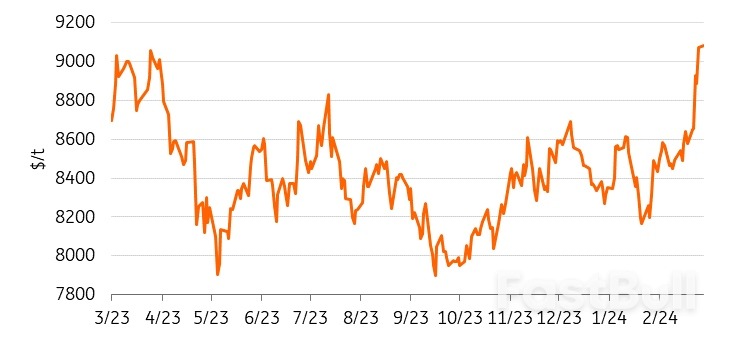
          Copper climbed above $9,000/t last week, surging to its highest level in one year after months of range-bound trading. The rally was triggered by news that major copper smelters in China have pledged to curb output in response to a tightening copper ore market.
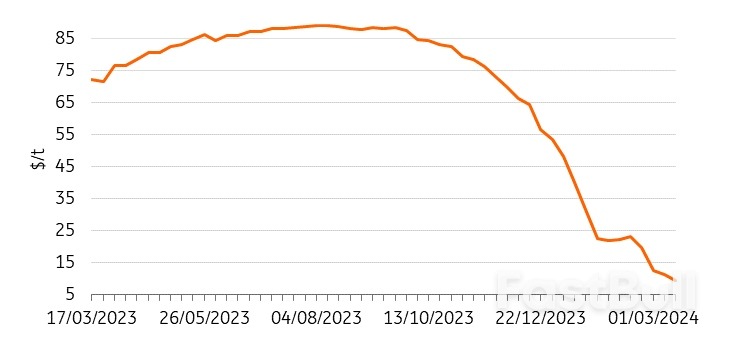
          This has come after a collapse in spot treatment and refining charges to record lows. Spot charges in China plunged to $9.40/t last week, according to weekly data from Fastmarkets. They are now down more than 80% since the beginning of the year.

          Copper TCs plunge to record lows

          Copper’s Bull Run Is Only Just Beginning_2

          Source: Fastmarkets, ING Research

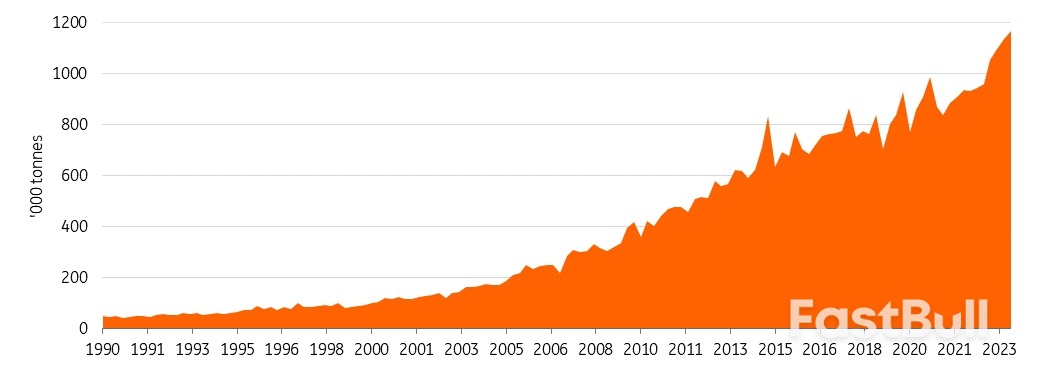
          Treatment and refining charges are the fees that smelters are paid to convert concentrate into metal. They are also a key sign for copper’s future direction. Typically, a tighter supply of concentrates leads to a drop in these charges. The drop in treatment charges is not only a reflection of the tightening concentrates market, but also of a rapid expansion in copper smelter capacities in China. This expansion has been driven by China’s strategic need for copper as demand from the green energy sector continues to grow. Last year, China’s production of refined copper surged 13.5% year-on-year to 12.99 million tonnes, according to data from the National Bureau of Statistics (NBS).

          China’s refined copper output hits record highs

          Copper’s Bull Run Is Only Just Beginning_3

          Source: NBS, ING Research

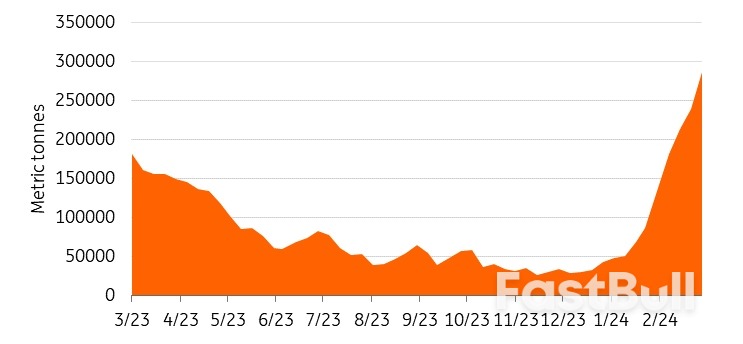
          As a sign of still-muted demand in China while output continues to ramp up, Shanghai Futures Exchange (SHFE) copper inventories have recently hit their highest level since 2020. The pace of this inventory build-up will now be in focus to gauge the extent and effectiveness of the pledged smelter curbs by major Chinese smelters.

          Shanghai copper inventories surge to highest since 2020

          Copper’s Bull Run Is Only Just Beginning_4

          Source: SHFE, ING Research

          However, the impact of China’s capacity controls on refined copper output will depend on the details of the production cuts. The group of 19 smelters stopped short of coordinated production cuts but vowed to re-arrange maintenance work, reduce runs and delay the startup of new projects.

          Global market is tightening

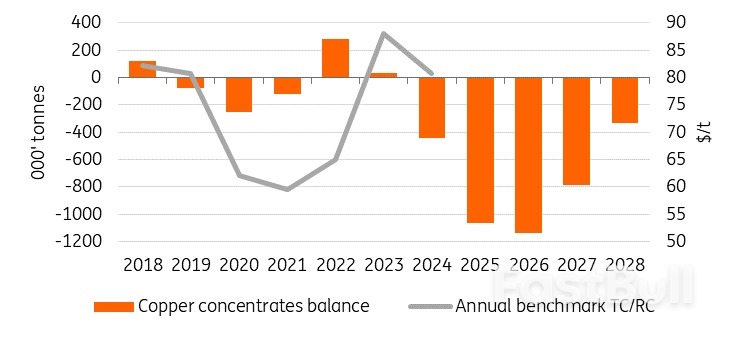
          A copper concentrates market deficit is expected this year after supply setbacks at global mines. Most recently in Panama, Canada’s First Quantum mine has ignited massive protests in the country and has been forced to shut down activity. Cobre Panama copper mine is one of the world’s largest sources of copper, accounting for around 1.5% of global copper output. The mine accounted for 2.5% of China’s copper concentrate imports last year.
          Meanwhile, copper mines currently in operation are nearing their peak due to declining ore grades and reserves exhaustion. For example, the world’s largest copper mine, Escondida in Chile, has already reached its peak. Its production in 2025 is expected to be at least 5% lower than it is today.
          In Chile, Codelco – the world’s biggest supplier of copper – is struggling to return production to pre-pandemic levels of about 1.7 million tonnes a year by the end of the decade from around 1.3 million tonnes this year. This marks the lowest level in a quarter century amid ageing assets and declining ore grade. At the same time, there is a lack of high-quality large-scale projects in the pipeline that could push the copper market into deficit as demand from the green energy sector grows.
          As a sign that the copper ore market is tightening as smelters expand, copper-concentrate supply contracts for 2024 that set processing charges have been set 9% lower for 2024. This marked the first fall in fees since 2021 after a six-year high in 2023.

          Copper concentrates deficit continues to grow

          Copper’s Bull Run Is Only Just Beginning_5

          Source: CRU, Fastmarkets, ING Research

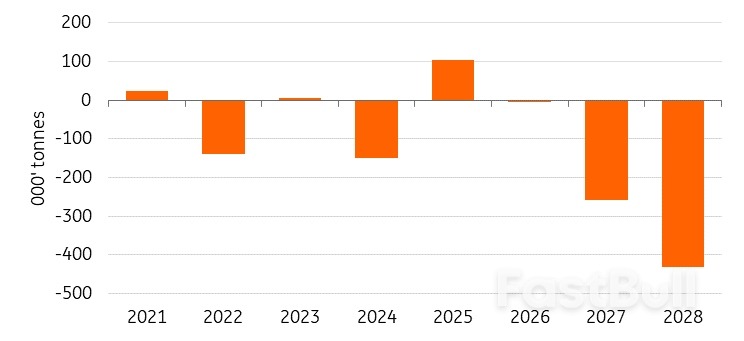
          Meanwhile, the global refined copper market was expected to be fairly balanced this year, but the shortfall in mine supply now means that the market is likely to be in a deficit – the extent of which will also be dependent on the scope of Chinese smelters production curbs, as well as how quickly Chinese copper demand will pick up in the second quarter (which is seasonally the strongest quarter for copper demand).

          Refined copper market heading towards deficit

          Copper’s Bull Run Is Only Just Beginning_6

          Source: CRU, ING Research

          Fed loosening will support copper

          Copper prices have also been lifted by the nearing end of the Federal Reserve’s interest rate tightening cycle.
          Elevated rates and a stronger dollar have been a drag on industrial metals over the past two years. Looking ahead, copper prices will be supported by a weaker US dollar on the back of Fed easing. We believe the Fed’s interest rate path will continue to drive copper’s short-term price outlook.
          Our US economist expects the starting point for Fed rate cuts in the second quarter of 2024. Copper will benefit from looser monetary policy, which will alleviate the financial strain on manufacturers and construction companies by reducing borrowing costs. But if US rates stay higher for longer, this would lead to a stronger US dollar and weaker investor sentiment, which in turn would translate to lower copper prices.

          Demand uncertainties remain

          At the same time, demand uncertainties remain. China is also the world’s biggest consumer of copper and a slump in China’s property market has been a major headwind to copper demand for the past year. A continued slowdown in the sector remains the main downside risk for the metal. However, while housing starts were down more than 20% last year, completions (which are the key source of copper consumption) have been rising. This could give additional support to copper prices looking forward.
          At the recent National People’s Congress in Beijing, China unveiled its economic targets for 2024, including a growth target of around 5%. However, on the property sector – the pillar of commodities demand – very few new measures were announced. The property sector will likely remain a prolonged drag on growth, notes our China economist. We believe an improvement in the ailing property sector in China will be key in supporting copper’s next move higher.

          Copper’s future looks bright

          In the short term, the upside to copper prices might be capped by macro drivers, including ongoing demand concerns in China and lingering uncertainty over US monetary policy.
          However, micro dynamics are starting to look more constructive for copper amid a tightening supply outlook. The demand side is expected to slowly improve this year, especially from the green energy sector. Copper is used in everything from electric vehicles (EVs) to wind turbines and power grids. In EVs, copper is a key component used in electric motors, batteries and wiring, as well as charging stations. Copper has no substitute for its use in EVs, wind and solar energy, and its appeal to investors as a key green metal will support higher prices over the next few years. Last year, rising demand for renewables and EVs in China has already offset the slump from the more traditional sectors like the property market, and we expect this shift in demand drivers to continue this year.
          We see copper prices rising in the second quarter, which is seasonally the strongest quarter for copper demand, to $8,700/t from $8,400/t in the first quarter. We see prices peaking in the fourth quarter at $9,000/t. They will, however, remain volatile as the market continues to respond to macro drivers, including the path of US interest rates and Chinese policies.
          Risk Warnings and Disclaimers
          You understand and acknowledge that there is a high degree of risk involved in trading. Following any strategies or investment methods may lead to potential losses. The content on the site is provided by our contributors and analysts for information purposes only. You are solely responsible for determining whether any trading assets, securities, strategy, or any other product is suitable for investing based on your own investment objectives and financial situation.
          Add to Favorites
          Share

          Global Market Quick Take: Europe – 19 March 2024

          SAXO

          Economic

          Equities

          Japanese equities are up 0.2% despite the JPY weakening 0.9% today against the USD (above the 150 level again) as the Japanese central bank is ending its negative policy rate that has been in place since 2016. US and European equity futures are slightly lower in early trading hours with the next big central bank event being FOMC tomorrow night. Later today the German Mar ZEW survey is among the first indications we get on the European economy in March and is well-watched economic figure. Nvidia unveiled yesterday its new AI chip called Blackwell which taking over from the successful Hopper AI chip, but investors were not overly excited with Nvidia shares down 2% in extended trading. Nvidia’s GTC conference will last until Thursday and will likely continue to impact AI stocks. On earnings, Xiaomi, China’s largest mobile phone maker, is expected to revenue growth of 10% YoY in Q4.

          FX

          The historic decision from the Bank of Japan to end negative rates and yield curve control came with caveats around accommodative policy being maintained and saw yen coming under pressure. USDJPY rose above the 150 handle to highs of 150.43 and focus now turns to risks of a hawkish outcome from the Fed meeting. EURJPY rose above 163 and could target the 2022 high at 164.30. The RBA was on hold but weakened its hawkish bias. AUDUSD plunged 50 pips as a result and was last seen at lows of 0.6515. USDCHF getting close to a re-test of the 0.89 handle as EURCHF printed fresh YTD highs at 0.9661 with SNB meeting on Thursday still likely to throw a dovish surprise as we discussed in the podcast yesterday. The EURUSD was attempting a rally to 1.09+ yesterday but the dollar's strength got in the way and the pair slipped back towards 1.0860. GBPUSD remained range-bound around 1.2720 yesterday but also lost momentum to test the 1.27 handle in Asia today ahead of UK CPI and BOE decision this week. GBP strength could be tested if equity sentiment weakens, as noted in our weekly FX chartbook.

          Commodities

          Strong factory output and investment growth data in China underpinned copper and a rebound in iron ore back above USD 100/t while crude oil traded near a near five-month high, supported by OPEC+ production curbs and not least diesel and gasoline strength after Ukrainian drone strikes over the weekend hit three Russian refineries potentially knocking out 600k b/d of Russian oil-refining capacity. Iraq is said to cut its oil exports to compensate for its recent above-quota production. EU gas reached a six-week high on supply concerns from an unplanned Norwegian outage, US Freeport LNG export problems and focus on Russia’s LNG export capability following drone attacks. Gold trades nervous ahead of Wednesday’s FOMC with focus on the 284 tons long recently bought by hedge funds. Short-covering in key crops gaining momentum led by wheat following Monday’s jump on Black Sea supply concerns

          Fixed income

          The Bank of Japan ended its negative interest rate policy and abandoned yield curve control while maintaining quantitative easing. Markets have been anticipating the move for days, and Japanese government bond yields slid across tenors after the announcement. Although bond markets remain muted after the announcement, such a decision will have profound long-term repercussions for global bond markets, including the repatriation of Japanese investors. In Europe, Bunds tumbled yesterday, with 10-year yields rising by 20 basis points in only six days as European sovereign debt continues to flood the primary market, and inflation met market expectations with core CPI at 3.1%. US Treasuries also ended the day lower, with yields rising by 2bps across tenors. This week's focus is on the Federal Reserve and the update on the Summary of Economic Projections, which will show higher growth and inflation for 2024. The question is whether such forecasts will be accompanied by 75bps of rate cuts this year. We see a higher probability of US Treasury yields ending the week higher, with ten-year yields resuming their rise to 4.5%.

          Macro

          The Bank of Japan has entered a new era as it scrapped negative interest rates and yield curve control, while also ending its ETF purchases. The central bank has set the short-term interest rate at between 0-0.1% in its first rate hike since 2007, although comments suggested that they expect accommodative conditions to persist for some time which is a signal that concurrent rate rises are unlikely. The Reserve Bank of Australia kept its policy settings unchanged but toned down its hawkish bias even though there was no mention of rate cuts in the statement. Markets have increased the odds of rate cuts this year, now standing at over 40bps from 35bps pre-RBA.

          Technical analysis highlights

          S&P 500 & Nasdaq 100 Bearish Engulfing top and reversal pattern. Key support for S&P 500 at 5,057. Nasdaq 100 key support at 17,478. DAX looks toppish, key support at 17,620. Below expect sell-off to 17,326-17,118.EURUSD correction support at 1.0870 and 1.0830. USDJPY likely to test resistance at 150.90 and 151.95. EURJPY likely to break resistance at 163.70, potential to 165. GBPUSD correction, support at 1.27, but could drop to 1.2660. GBPJPY likely bullish move to 192.60. AUDJPY range bound 96.80- 98.20. Gold correction unfolding likely to test support at 2,134, possibly 2,115. WTI crude oil testing resist at 82.56, upside potential to 84.60. US 10-year T-yields testing resistance at 4.35.

          Volatility

          Yesterday, the VIX slightly decreased to $14.33 (-0.08 | -0.56%). The S&P 500 and Nasdaq 100 indices saw increases of 0.63% and 0.99%, respectively. These movements indicate a positive market sentiment ahead of the anticipated FOMC announcements. The VVIX dropped to 86.78 (-5.39 | -5.85%), suggesting a decrease in volatility expectations, while the SKEW index experienced a slight increase to 139.94 (+1.03 | +0.76%). With no major economic news affecting US markets on Monday, all eyes are on the FOMC's upcoming interest rate decisions. VIX futures showed a slight uptick to 15.35 (+0.020 | +0.13%), while S&P 500 and Nasdaq 100 futures are down slightly to 5209.50 (-5.25 | -0.10%) and 18190.00 (-41.50 | -0.23%), respectively. Monday's trading session was most active in options for TSLA, NVDA, AAPL, GOOGL, AMD, GOOG, AMZN, PLTR, WBD, and SOFI.

          In the news

          BOJ ends negative rate policy implemented in 2016 and raises policy rate for the first time since 2007 (FT), Nvidia unveils new AI chip named Blackwell at GTC conference to succeed its successful Hopper chip (Bloomberg), UBS market value reaches $100bn for the first time in 16 years as Credit Suisse integration is working out (Bloomberg), Gunvor says Ukraine drone attacks shut 600,000 barrels of Russian refining (Bloomberg)

          Macro events (all times are GMT)

          Germany Mar ZEW survey est. 20.5 vs prior 19.9 (10:00), US Fed Housing Starts est. 1440k vs prior 1331k, Canada Fed CPI est. 3.1% YoY vs prior 2.9% (12:30), APIs weekly crude and fuel stock report (1930).
          To stay updated on all economic events of today, please check out our Economic calendar
          Risk Warnings and Disclaimers
          You understand and acknowledge that there is a high degree of risk involved in trading. Following any strategies or investment methods may lead to potential losses. The content on the site is provided by our contributors and analysts for information purposes only. You are solely responsible for determining whether any trading assets, securities, strategy, or any other product is suitable for investing based on your own investment objectives and financial situation.
          Add to Favorites
          Share

          2024 US Election: Shaking Up Chinese Equities And The Renminbi?

          SAXO

          Economic

          Political

          Biden and Trump as Presumptive Nominees for the November Election

          Biden's recent victory in Georgia solidified his position as the presumptive Democratic nominee, set to be formally declared at the party's convention in August. Meanwhile, Trump's accumulation of delegates from victories in Georgia, Mississippi, Hawaii, and Washington cements his status as the presumptive Republican nominee. Despite the dominance of the two major parties, independent candidates such as Robert F. Kennedy Jr. and the emerging no-label movement present a potential wildcard in the election. However, with the electoral landscape still predominantly shaped by Biden and Trump, the likelihood remains that one of them will clinch the presidency in the upcoming US presidential election in November 2024.

          Trump's Tariff Threats Cast Shadow Over Chinese Markets

          Trump's recent pronouncement of a potential 60% tariff on Chinese exports, along with a threatened 10% tariff on goods from the rest of the world entering the US, has stirred apprehension among investors. While campaign promises often differ from actual policy implementation, the potential impact of such a plan warrants careful consideration.
          Although the power to regulate commerce with foreign countries primarily lies with Congress, a portion of this authority is delegated to the White House. Trump's previous utilization of retaliatory authority under the Trade Act of 1974 during his presidency from 2017 to 2021, which allowed him to impose tariffs of up to 25% on many Chinese products, underscores the potential for further tariff increases under his leadership. President Biden's decision to retain Trump’s China tariffs after assuming office in 2021 further suggests the possibility of such measures not facing challenges. Thus, it appears plausible that Trump, if re-elected, may resort to retaliatory measures to increase tariffs across a broader range of products, despite potentially the tariff rate and scope being somewhat reduced.
          Regarding the proposed 10% tariffs on goods from other countries, the situation is more complex. It may be challenging to justify retaliation against the entire world, requiring resorting to the more generalized power of regulating international commerce delegated by Congress to the administration. In his previous term, Trump withdrew from the Trans-Pacific Partnership as he had pledged to do during the campaign but did not follow through on his election rhetoric to withdraw from the WTO.
          As ludicrous as the hypothetical scenario depicted in French economist Frédéric Bastiat's renowned satirical masterpiece, where candlemakers petition the government to block sunlight to shield their business from cheaper competition, protectionism frequently prevails in political arenas. Protectionism, as outlined by Mancur Olson in his influential work, "The Rise and Decline of Nations," favours organized interest groups to the detriment of a broader population of consumers. It often leads politicians to advocate for protectionist measures, such as tariffs, despite their adverse effects on overall economic welfare.
          An increasing probability of a return of Trump to the White House is likely to weigh on the Chinese equity market and potentially favour the supply-chain reshoring beneficiary markets, such as Southeast Asian countries, India, Mexico and so on, elevating the trends of China exporting more intermediate goods and capital goods to these countries while the latter are exporting more consumer goods to the U.S.

          Trump or Biden, More Fragmentation Beyond Tariff

          Regardless of whether Biden or Trump occupies the White House, a complex fragmentation dynamic has been underway between China and the U.S., showing no signs of abating. It's imperative to recognize the trend of dual convergence in US-China policies since 2016, as noted by Medeiros (2023). This convergence refers to the alignment of both the executive and congressional branches, as well as the Democratic and Republican Parties, in their approach towards China.
          Moreover, three significant developments have unfolded over the past decade, irrespective of the presidential occupant. Initially, China wasn't a focal point in election campaigns until 2016, when it emerged as a prominent issue in both presidential and congressional elections. Candidates competed to demonstrate toughness on China to bolster their credentials as guardians of US economic and security interests, often accusing opponents of being weak on China.
          Congress has also become a pivotal actor in shaping US-China policies, with legislative activity, hearings, and investigations related to China surging, reflecting bipartisan concern. Despite shifts in party control, Congressional activism on China remains consistent. For instance, data compiled by Medeiros shows a tripling of US Congress’s legislative activity, hearings, and investigations related to China, from around 100 in prior decades to over 450 in the 117th Congress from Jan 2021 to Jan 2023.
          The securitization of economic policies has become prevalent in both China and the US, with economic issues increasingly viewed through a national security lens. This reflects a broader geopolitical strategy aimed at safeguarding US interests, particularly concerning China.
          Most notably, on October 7, 2022, under the Biden administration, the Bureau of Industry and Security (BIS) rolled out additional export controls on advanced computing and semiconductor manufacturing items to restrict China’s access to advanced semiconductors. Subsequently, the BIS implemented additional rules on October 17, 2023, broadening the control’s technical parameters, extending the licensing requirement to more countries, imposing end-use control, and extending restrictions on activities of U.S. persons.
          Prohibiting foreign countries from obtaining state-of-the-art critical technology has been a recurring theme throughout economic history. For instance, in the 18th century, while the textile industry held a position similar to today's semiconductor industry, Britain prohibited the export of any "machine, engine, tool, press, paper, utensil or implement" and any "model or plan…part of parts thereof" used in the cotton, linen, woolen, or silk manufactures of the kingdom”. Additionally, woolen workers faced severe penalties, including confiscation of property and loss of citizenship, for leaving the country (David J. Jeremy, 1973).

          Increasing Data Security Concerns Have Significant Economic and Market Impact

          The tightening of control based on national security extends beyond semiconductors. Woes in the contract research organization (CRO) sector have persisted for months. More recently, the Chairman and a Ranking Member of the US House of Representatives Select Committee on the Strategic Competition between the United States and the Chinese Communist Party introduced the BIOSECURE Act in January 2024. This act aims to restrict federally funded medical providers from using biotech companies from foreign adversary countries of concern, including BGI Group and its subsidiaries, MGI, and Complete Genomics and “WuXi Apptec. In February 2024, these lawmakers, accompanied by a couple of senators, called for the Biden administration to investigate WuXi AppTec and its subsidiaries for their alleged ties to the Chinese military. In March, the Senate’s Homeland Security Committee approved The Prohibiting Foreign Access to American Genetic Information Act of 2024 which would ban BGI, MGI, Complete Genomics, WuXi AppTec, as well as their subsidiaries given their alleged ties to the Chinese Communist Party.
          The national security concerns go beyond semiconductors and human genetic data. Last month, Biden issued an executive order titled "Preventing Access to Americans' Bulk Sensitive Personal Data and United States Government-Related Data by Countries of Concern," which covers not only personal data such as genomic, biometric, and health data but also financial and geolocation data. Furthermore, the Biden administration established the Office of Information and Communications Technology and Services (OICTS), to implement the Information and Communications Technology Supply Chain Rule. This rule, which began during the Trump administration and expanded during the Biden administration, aims to address the risk of supply chains controlled by a ‘foreign adversary’. The OICTS conducted a probe into connected vehicles and their related supply chains for data security. The term ‘connected vehicles’ encompasses vehicles equipped with sensors, cameras, battery systems, onboard computers, or even as simple as GPS systems that can collect, process, and transmit data.
          On the Congressional side, last week, the House of Representatives passed a bill to force ByteDance to divest TikTok with an overwhelming vote of 352-65, with 90% of Republicans and 75% of Democrats assenting, reflecting widespread support across the political aisles.
          Therefore, while a status quo Biden administration may offer some positivity in the arena of trade and tariffs, broader geopolitical trends and bipartisan consensus on China policy suggest continued challenges in many aspects of the economic relationship between the U.S. and China. The rising emphasis on data security in the U.S. is likely to persist under both a Biden and Trump administration, posing significant risks to the Chinese equity market.

          Investing in China Ahead of the US Presidential Election

          The securitization of economic policies has expanded beyond trade and semiconductors. The emerging focus on data security brings the front line of conflicts to electric vehicles and their entire supply chains, encompassing batteries, sensors, and numerous other industries and products where China currently holds significant global market shares, anticipating robust growth in the coming years. These sectors now face challenges that extend beyond the US market to global markets. US laws potentially possess extraterritorial capabilities, denying access to the US market for European and other automakers using Chinese-supplied parts or Chinese automakers’ subsidiaries elsewhere. Additionally, data security concerns regarding TikTok could readily extend to Chinese company-controlled e-commerce platforms operating in the US, such as PDD’s Temu and Nanjing Lingtian Information Technology’s Shein.
          Businesses worldwide, including those from China, the US, Europe, and Japan, are reevaluating their risk exposure by rerouting production and supply chains to countries with better trade relations with the US, such as Southeast Asian countries, India, Mexico, and Eastern European nations. This trend is evidenced by the increase in Chinese exports to countries like Vietnam and India for intermediate products, while these countries export more consumer goods to the US. Investors may find diversification opportunities in some of these markets.
          In the Chinese market, investors may discover opportunities in companies benefiting from import substitution, particularly those involved in producing parts and equipment for tech products. Moreover, China's industrial policies aimed at promoting innovation and self-reliance are likely to benefit companies in technology hardware and advanced manufacturing. Investors should explore this space. These shifts will unfold gradually, both leading up to and following the election. Investors should conduct thorough research and remain vigilant as developments unfold.
          Furthermore, as the likelihood of a Trump presidency increases, the renminbi may weaken, particularly if tariffs on China are raised. Experienced foreign exchange traders may consider positioning themselves for this scenario by betting on a weaker renminbi against the US dollar or Japanese yen through spot or options trades.
          To stay updated on all economic events of today, please check out our Economic calendar
          Risk Warnings and Disclaimers
          You understand and acknowledge that there is a high degree of risk involved in trading. Following any strategies or investment methods may lead to potential losses. The content on the site is provided by our contributors and analysts for information purposes only. You are solely responsible for determining whether any trading assets, securities, strategy, or any other product is suitable for investing based on your own investment objectives and financial situation.
          Add to Favorites
          Share

          [BOJ] Monetary Policy: End Negative Interest Rates!

          FastBull Featured

          Remarks of Officials

          On March 19, local time, the Bank of Japan (BOJ) passed the monetary policy of ending negative interest rates with a vote of 7:2 at its March policy meeting and raised interest rates to around 0 to 0.1%. In addition, the Bank of Japan will continue to buy government bonds, at about the same volume as before. The Monetary Policy Statement showed:

          Exit Yield Curve Control (YCC)

          The Bank considers that the policy framework of Quantitative and Qualitative Monetary Easing (QQE) with Yield Curve Control and the negative interest rate policy to date have fulfilled their roles. With the price stability target of 2%, it will conduct monetary policy as appropriate depending on the developments in economic activity and prices as well as financial conditions, guiding the short-term interest rate as a primary policy tool.
          The Bank will continue its Japanese government bonds (JGBs) purchases with broadly the same amount as before. In case of a rapid rise in long-term interest rates, it will increase the amount of JGB purchases and conduct fixed-rate purchase operations of JGBs. In the event of a rapid rise in yields, it will make nimble responses by increasing the amount of JGB purchases.

          Discontinue purchases of ETFs

          The Bank will discontinue purchases of exchange-traded funds (ETFs) and Japan real estate investment trusts (J-REITs). In addition, the Bank will gradually reduce the amount of purchases of CP and corporate bonds and will discontinue the purchases in about one year.
          Japan's economy has recovered moderately, although some weakness has been seen in part. The employment and income situation has improved moderately. Private consumption has been resilient, although the impact of price rises has been observed. On the price front, the negative contribution of energy prices to the YoY rate of increase in the consumer price index (CPI, all items less fresh food) has been relatively large, partly due to the government's economic measures. That said, the rate of increase in the CPI has been at around 2% recently, mainly on the back of the fact that, despite waning, the effects of a pass-through to consumer prices of cost increases led by the past rise in costs, and services prices have increased moderately. Inflation expectations have risen moderately. The YoY rate of increase in the CPI is likely to be above 2% through fiscal 2024.
          Japan's economy is likely to continue recovering moderately for the time being, supported by factors such as the materialization of pent-up demand, although it is expected to be under downward pressure stemming from a slowdown in the pace of recovery in overseas economies. Thereafter, as a virtuous cycle from income to spending gradually intensifies, Japan's economy is projected to continue growing at a pace above its potential growth rate.
          There are extremely high uncertainties surrounding Japan's economic activity and price outlook, including developments in overseas economic activity and prices, developments in commodity prices, and domestic firms' wage- and price-setting behavior. BOJ will pay due attention to developments in financial and foreign exchange markets and their impact on Japan's economic activity and prices.

          Japan's monetary policy

          Risk Warnings and Disclaimers
          You understand and acknowledge that there is a high degree of risk involved in trading. Following any strategies or investment methods may lead to potential losses. The content on the site is provided by our contributors and analysts for information purposes only. You are solely responsible for determining whether any trading assets, securities, strategy, or any other product is suitable for investing based on your own investment objectives and financial situation.
          Add to Favorites
          Share

          BTC/USD Anticipates Pullback As Market Readies for Correction Phase

          Chandan Gupta

          Traders' Opinions

          Cryptocurrency

          Bitcoin's journey through Friday's trading session was anything but smooth, reflecting the cautious sentiment prevailing among investors. Amidst the market's unpredictability, one cannot ignore the significant impact of ETF inflows driving Bitcoin's trajectory, particularly orchestrated by Wall Street.
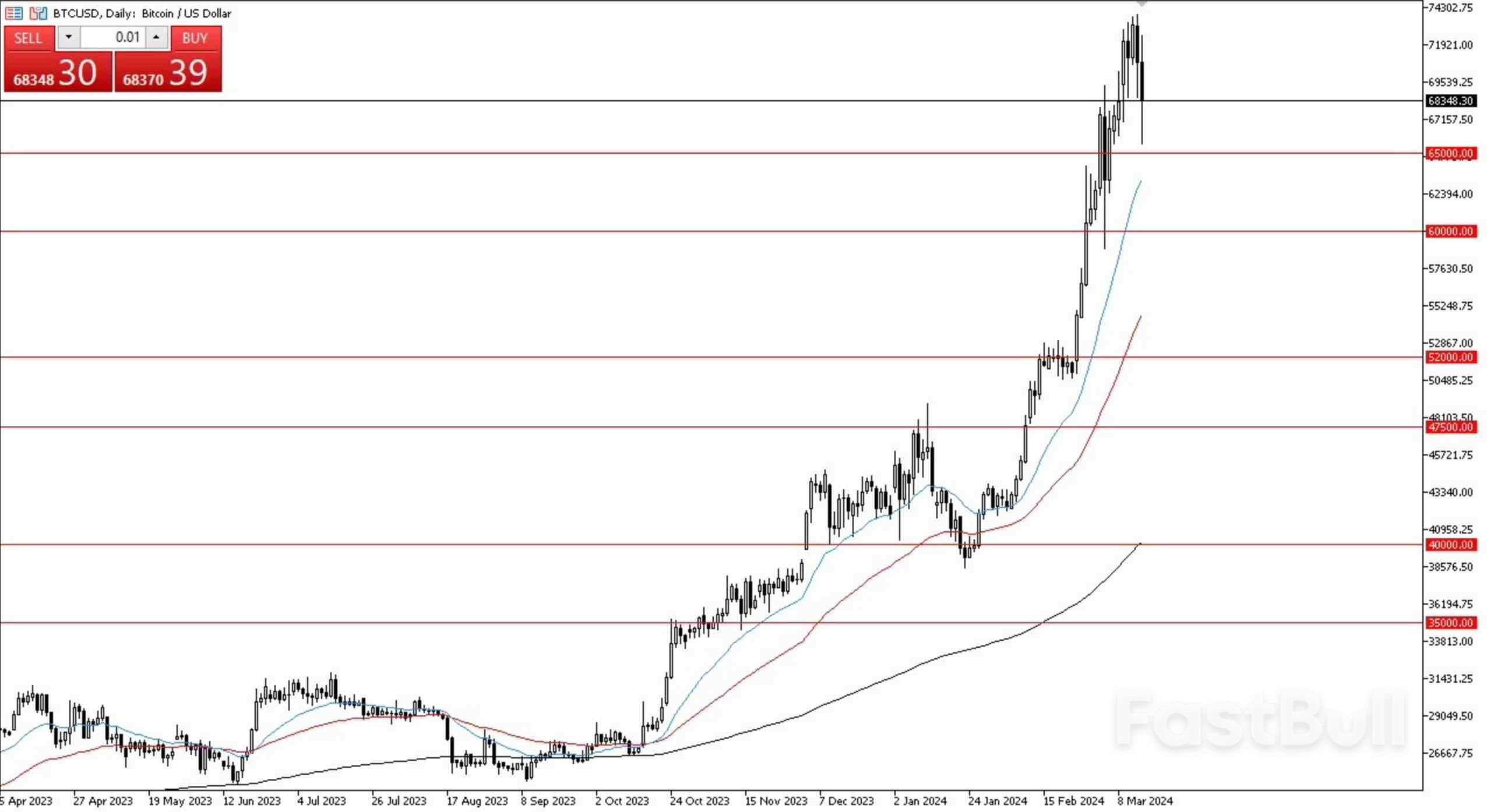
          As the forefront catalyst, ETF inflows have steered Bitcoin's market dynamics, ushering in a wave of forced inflows from institutional investors. Despite the recent surge, it's evident that Bitcoin is teetering on the brink of being overextended. However, finding support just above the $65,000 mark suggests a potential short-term floor.
          The convergence of the 20-day EMA towards this support level further underscores the bullish sentiment prevalent in the market. Yet, amidst this optimism, there's a looming recognition of the need for a pullback—a sentiment echoed by many investors, myself included.
          A pullback presents a compelling buying opportunity, with targets set at $60,000 or even as low as $52,000. While achieving these levels may not come easily, they remain distinct possibilities that investors must be prepared for. The inevitable exhaustion of ETF inflows on Wall Street raises questions about Bitcoin's future trajectory once this catalyst diminishes.
          Anticipating a significant amount of profit-taking in the near future, it's crucial for investors to remain vigilant. Friday's early hours may have provided a glimpse into this scenario, signaling the potential for a breakdown. However, amidst any market turbulence, the key is to identify opportunities for value and capitalize on them.
          Attempting to counter the prevailing trend in Bitcoin is akin to fighting a losing battle. Instead, embracing this trend and leveraging it to one's advantage is the prudent approach. As investors, we're part of a feedback loop—a symbiotic relationship with the market that requires adaptability and foresight.
          In conclusion, navigating Bitcoin's market swings requires a delicate balance between optimism and caution. While ETF inflows continue to drive momentum, awareness of potential overextension and the need for a pullback is imperative. As we traverse through these fluctuations, seizing opportunities for value amidst market turbulence is paramount.
          Billions of dollars have flowed into spot Bitcoin exchange-traded funds (ETFs) since they were approved by U.S. regulators in January, buoying prices amid a fresh wave of investor interest in crypto. The so-called halving also looms in April, marking an upcoming cut to issuance of new Bitcoin that will restrict token supply at a time when demand has been rising, providing further support to prices.BTC/USD Anticipates Pullback As Market Readies for Correction Phase_1
          Risk Warnings and Disclaimers
          You understand and acknowledge that there is a high degree of risk involved in trading. Following any strategies or investment methods may lead to potential losses. The content on the site is provided by our contributors and analysts for information purposes only. You are solely responsible for determining whether any trading assets, securities, strategy, or any other product is suitable for investing based on your own investment objectives and financial situation.
          Add to Favorites
          Share

          Canada CPI Preview: Inflation Expected To Rebound Slightly To 3.1% In February

          Alex

          Economic

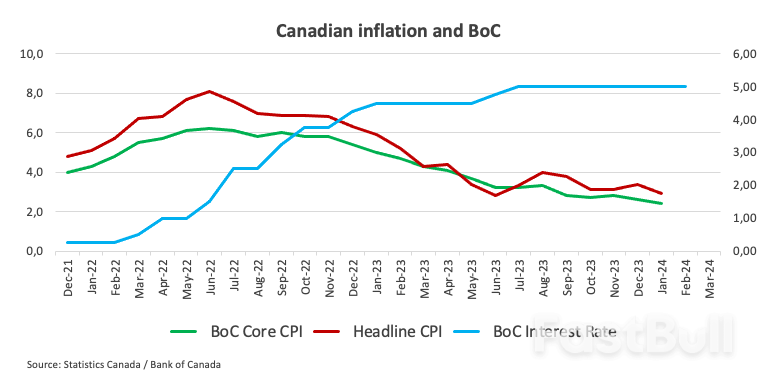
          Canada is slated to unveil the always-relevant inflation-related figures on Tuesday. Statistics Canada will release the Consumer Price Index (CPI) for the month of February, with expectations pointing towards a year-on-year rise of 3.1% in the headline print, slightly surpassing January’s 2.9% increase. Monthly projections anticipate a 0.6% increase in the index compared to the previous month's flat reading.
          Alongside the CPI data, the Bank of Canada (BoC) will release its Core Consumer Price Index gauge, which excludes volatile elements like food and energy costs. In January, the BoC Core CPI indicated a monthly uptick of 0.1% and a year-on-year rise of 2.4%.
          These statistics will be closely monitored as they could influence the trajectory of the Canadian Dollar (CAD) and shape outlooks regarding the Bank of Canada's monetary policy. Speaking about the Canadian Dollar (CAD), it has shown weakness against the US Dollar (USD) in past sessions and presently hovers around multi-session lows well past the 1.3500 yardstick.

          What to expect from Canada’s inflation rate?

          Analysts expect a pick-up of price pressures throughout Canada during last month. In fact, inflation measured by annual changes in the Consumer Price Index, is forecast to resume its upward trajectory in February, mirroring trends observed in many of Canada's G10 counterparts, notably its neighbour, the US. After reaching 4% in August, the CPI has shown a downward trend, with the exception of the bounce recorded in the last month of the year. All in all, inflation indicators still remain well above the Bank of Canada's 2% target.Canada CPI Preview: Inflation Expected To Rebound Slightly To 3.1% In February_1
          Should the forthcoming data confirm the anticipated increase in inflationary pressures, investors might consider the possibility of the central bank keeping the current restrictive stance in place for a longer duration than originally predicted. Still, any additional tightening of monetary conditions seems unlikely, as per comments from the bank’s officials.
          The latter situation would necessitate a sudden and sustained resurgence of price pressures and a rapid increase in consumer demand, both of which seem improbable in the foreseeable future.
          During his remarks at the latest BoC meeting, Governor Tiff Macklem expressed optimism about the ongoing battle against inflation, noting current progress and anticipating further advancements. He highlighted the significance of core inflation measures, suggesting that if they remain unchanged, the forecasts for overall inflation reduction may not come to fruition. He assessed the risks to the inflation outlook as reasonably balanced and noted that well-anchored inflation expectations are aiding efforts to bring inflation back under control.

          When is the Canada CPI data due and how could it affect USD/CAD?

          On Tuesday at 12:30 GMT, Canada is set to release the Consumer Price Index for February. The Canadian Dollar's potential response is tied to changes in monetary policy expectations by the Bank of Canada. However, barring any real surprise in either direction, the BoC is unlikely to change its current cautious monetary policy stance, in line with other central banks such as the Federal Reserve (Fed).
          The USD/CAD has started the new trading year in quite a bullish fashion, although the uptrend appears to have met a decent barrier around the 1.3600 zone.
          Pablo Piovano, Senior Analyst at FXStreet, says: “There is a strong likelihood of USD/CAD maintaining the constructive bias as long as it remains above the significant 200-day Simple Moving Average (SMA) at 1.3479. The bullish sentiment is expected to strengthen even more if there is a sustained break above the so-far yearly tops around 1.3600. On the flip side, the breach of the 200-day SMA could open the door to extra losses and a potential move to the January low of 1.3358 (January 31). South from here, there are no support levels of note prior to the December 2023 bottom of 1.3177, which occurred on December 27”.
          Pablo adds: "Significant increases in volatility around CAD would require unexpected inflation figures. If the numbers fall below expectations, it could strengthen the argument for potential interest rate cuts by the BoC in the next few months, further appreciating USD/CAD. However, a rebound in the CPI, similar to trends observed in the US, might provide some support to the Canadian Dollar, although to a limited extent. A higher-than-anticipated inflation reading would intensify pressure on the Bank of Canada to maintain elevated rates for an extended period, potentially resulting in prolonged challenges for many Canadians dealing with higher interest rates, as highlighted by Bank of Canada Governor Macklem."

          Source:FXStreet

          To stay updated on all economic events of today, please check out our Economic calendar
          Risk Warnings and Disclaimers
          You understand and acknowledge that there is a high degree of risk involved in trading. Following any strategies or investment methods may lead to potential losses. The content on the site is provided by our contributors and analysts for information purposes only. You are solely responsible for determining whether any trading assets, securities, strategy, or any other product is suitable for investing based on your own investment objectives and financial situation.
          Add to Favorites
          Share

          Stable Eurozone Bond Yields Amidst BOJ Policy Shift; Investor Confidence Boosts Equities

          Ukadike Micheal

          Economic

          Stocks

          Bond

          Eurozone bond yields remained largely unchanged on Tuesday, with global attention focused on the Bank of Japan's decision to terminate eight years of negative interest rates. Germany's 10-year bond yield, serving as the eurozone's benchmark, saw a marginal increase of less than 1 basis point, reaching 2.462%. Similarly, the 2-year bond yield for Germany experienced a minor uptick of less than 1 basis point, climbing to 2.923%. The BOJ announced its new policy rate, setting the overnight call rate within a range of 0-0.1%, marking a departure from its previous key rate of -0.1%.
          Analysts indicated that further rate hikes might be necessary before Japanese investors consider withdrawing from foreign bond markets to repatriate cash. Meanwhile, upbeat investors rushed into emerging market equities in March at the fastest pace since April 2017 and into eurozone stocks at the quickest clip since June 2020, according to Bank of America's fund manager survey. Global growth expectations among fund managers surveyed by BofA were at a two-year high, with "risk appetite" reaching its highest level since November 2021.
          The surge in investor optimism was fueled by a series of stronger-than-expected U.S. data releases, boosting sentiment in global stock markets and reducing the likelihood of Federal Reserve rate cuts, which could potentially impact bond prices. Despite this, the benchmark U.S. S&P 500 continued to trade at all-time highs. BofA's survey revealed a shift in sentiment regarding bond yields, with only 40% of respondents expecting lower yields in the next 12 months, down from 62% in December 2023. Inflation emerged as the primary concern for markets, replacing the previous fear of a global recession.
          March witnessed outflows from U.S. equities, particularly from discretionary and tech stocks. However, the "long Magnificent Seven" stocks, comprising Alphabet, Amazon, Apple, Meta, Microsoft, Nvidia, and Tesla, remained the most crowded trade among investors. Notably, survey respondents expressed positive sentiments about corporate profit growth for the first time since January 2022, underscoring the prevailing investor optimism in the market.
          The stability in eurozone bond yields amid the BOJ's policy shift reflects the intricate interplay between global monetary policies and investor sentiments. Despite uncertainties surrounding inflation and market risks, the surge in investor optimism, particularly in emerging market equities and eurozone stocks, underscores the resilience of global markets. Investors should remain vigilant and adapt their strategies to navigate evolving market conditions effectively.

          Source: Yahoo Finance

          To stay updated on all economic events of today, please check out our Economic calendar
          Risk Warnings and Disclaimers
          You understand and acknowledge that there is a high degree of risk involved in trading. Following any strategies or investment methods may lead to potential losses. The content on the site is provided by our contributors and analysts for information purposes only. You are solely responsible for determining whether any trading assets, securities, strategy, or any other product is suitable for investing based on your own investment objectives and financial situation.
          Add to Favorites
          Share
          FastBull
          Copyright © 2025 FastBull Ltd

          728 RM B 7/F GEE LOK IND BLDG NO 34 HUNG TO RD KWUN TONG KLN HONG KONG

          TelegramInstagramTwitterfacebooklinkedin
          App Store Google Play Google Play
          Products
          Charts

          Chats

          Q&A with Experts
          Screeners
          Economic Calendar
          Data
          Tools
          Membership
          Features
          Function
          Markets
          Copy Trading
          Latest Signals
          Contests
          News
          Analysis
          24/7
          Columns
          Education
          Company
          Careers
          About Us
          Contact Us
          Advertising
          Help Center
          Feedback
          User Agreement
          Privacy Policy
          Business

          White Label

          Data API

          Web Plug-ins

          Poster Maker

          Affiliate Program

          Risk Disclosure

          The risk of loss in trading financial instruments such as stocks, FX, commodities, futures, bonds, ETFs and crypto can be substantial. You may sustain a total loss of the funds that you deposit with your broker. Therefore, you should carefully consider whether such trading is suitable for you in light of your circumstances and financial resources.

          No decision to invest should be made without thoroughly conducting due diligence by yourself or consulting with your financial advisors. Our web content might not suit you since we don't know your financial conditions and investment needs. Our financial information might have latency or contain inaccuracy, so you should be fully responsible for any of your trading and investment decisions. The company will not be responsible for your capital loss.

          Without getting permission from the website, you are not allowed to copy the website's graphics, texts, or trademarks. Intellectual property rights in the content or data incorporated into this website belong to its providers and exchange merchants.

          Not Logged In

          Log in to access more features

          FastBull Membership

          Not yet

          Purchase

          Become a signal provider
          Help Center
          Customer Service
          Dark Mode
          Price Up/Down Colors

          Log In

          Sign Up

          Position
          Layout
          Fullscreen
          Default to Chart
          The chart page opens by default when you visit fastbull.com