• Trade
  • Markets
  • Copy
  • Contests
  • News
  • 24/7
  • Calendar
  • Q&A
  • Chats
Trending
Screeners
SYMBOL
LAST
BID
ASK
HIGH
LOW
NET CHG.
%CHG.
SPREAD
SPX
S&P 500 Index
6827.42
6827.42
6827.42
6899.86
6801.80
-73.58
-1.07%
--
DJI
Dow Jones Industrial Average
48458.04
48458.04
48458.04
48886.86
48334.10
-245.98
-0.51%
--
IXIC
NASDAQ Composite Index
23195.16
23195.16
23195.16
23554.89
23094.51
-398.69
-1.69%
--
USDX
US Dollar Index
97.950
98.030
97.950
98.500
97.950
-0.370
-0.38%
--
EURUSD
Euro / US Dollar
1.17394
1.17409
1.17394
1.17496
1.17192
+0.00011
+ 0.01%
--
GBPUSD
Pound Sterling / US Dollar
1.33707
1.33732
1.33707
1.33997
1.33419
-0.00148
-0.11%
--
XAUUSD
Gold / US Dollar
4299.39
4299.39
4299.39
4353.41
4257.10
+20.10
+ 0.47%
--
WTI
Light Sweet Crude Oil
57.233
57.485
57.233
58.011
56.969
-0.408
-0.71%
--

Community Accounts

Signal Accounts
--
Profit Accounts
--
Loss Accounts
--
View More

Become a signal provider

Sell trading signals to earn additional income

View More

Guide to Copy Trading

Get started with ease and confidence

View More

Signal Accounts for Members

All Signal Accounts

Best Return
  • Best Return
  • Best P/L
  • Best MDD
Past 1W
  • Past 1W
  • Past 1M
  • Past 1Y

All Contests

  • All
  • Trump Updates
  • Recommend
  • Stocks
  • Cryptocurrencies
  • Central Banks
  • Featured News
Top News Only
Share

Iranian Media Says 18 Crew Members Of Foreign Tanker Seized In Gulf Of Oman Over Carrying 'Smuggled Fuel' Detained

Share

Regional Governor: Two Killed In Ukrainian Drone Strike On Russia's Saratov

Share

Chinese Foreign Ministry - China Foreign Minister Met With United Arab Emirates Counterpart On Dec 12

Share

China's Central Financial And Economic Affairs Commission Deputy Director: Will Expand Export And Increase Import In 2026

Share

Thai Leader Anutin: Landmine Blast That Killed Thai Soldiers 'Not A Roadside Accident'

Share

Thai Leader Anutin: Thailand To Continue Military Action Until 'We Feel No More Harm'

Share

Cambodian Prime Minister Hun Manet Says He Had Phone Calls With Trump And Malaysian Leader Anwar About Ceasefire

Share

Cambodia's Hun Manet Says USA, Malaysia Should Verify 'Which Side Fired First' In Latest Conflict

Share

Cambodia's Hun Manet: Cambodia Maintains Its Stance In Seeking Peaceful Resolution Of Disputes

Share

Nasdaq Companies: Allergan, Ferrovia, Insmed, Monolithic Power Systems, Seagate Technology, And Western Digital Will Be Added To The NASDAQ 100 Index. Biogen, CdW, GlobalFoundries, Lululemon, ON Semiconductor, And Tradedesk Will Be Removed From The NASDAQ 100 Index

Share

Witkoff Headed To Berlin This Weekend To Meet With Zelenskiy, European Leaders -Wsj Reporter On X

Share

Russia Attacks Two Ukrainian Ports, Damaging Three Turkish-Owned Vessels

Share

[Historic Flooding Occurs In At Least Four Rivers In Washington State Due To Days Of Torrential Rains] Multiple Areas In Washington State Have Been Hit By Severe Flooding Due To Days Of Torrential Rains, With At Least Four Rivers Experiencing Historic Flooding. Reporters Learned On The 12th That The Floods Caused By The Torrential Rains In Washington State Have Destroyed Homes And Closed Several Highways. Experts Warn That Even More Severe Flooding May Occur In The Future. A State Of Emergency Has Been Declared In Washington State

Share

Trump Says Proposed Free Economic Zone In Donbas Would Work

Share

Trump: I Think My Voice Should Be Heard

Share

Trump Says Will Be Choosing New Fed Chair In Near Future

Share

Trump Says Proposed Free Economic Zone In Donbas Complex But Would Work

Share

Trump Says Land Strikes In Venezuela Will Start Happening

Share

US President Trump: Thailand And Cambodia Are In A Good Situation

Share

State Media: North Korean Leader Kim Hails Troops Returning From Russia Mission

TIME
ACT
FCST
PREV
U.K. Trade Balance Non-EU (SA) (Oct)

A:--

F: --

P: --

U.K. Trade Balance (Oct)

A:--

F: --

P: --

U.K. Services Index MoM

A:--

F: --

P: --

U.K. Construction Output MoM (SA) (Oct)

A:--

F: --

P: --

U.K. Industrial Output YoY (Oct)

A:--

F: --

P: --

U.K. Trade Balance (SA) (Oct)

A:--

F: --

P: --

U.K. Trade Balance EU (SA) (Oct)

A:--

F: --

P: --

U.K. Manufacturing Output YoY (Oct)

A:--

F: --

P: --

U.K. GDP MoM (Oct)

A:--

F: --

P: --

U.K. GDP YoY (SA) (Oct)

A:--

F: --

P: --

U.K. Industrial Output MoM (Oct)

A:--

F: --

P: --

U.K. Construction Output YoY (Oct)

A:--

F: --

P: --

France HICP Final MoM (Nov)

A:--

F: --

P: --

China, Mainland Outstanding Loans Growth YoY (Nov)

A:--

F: --

P: --

China, Mainland M2 Money Supply YoY (Nov)

A:--

F: --

P: --

China, Mainland M0 Money Supply YoY (Nov)

A:--

F: --

P: --

China, Mainland M1 Money Supply YoY (Nov)

A:--

F: --

P: --

India CPI YoY (Nov)

A:--

F: --

P: --

India Deposit Gowth YoY

A:--

F: --

P: --

Brazil Services Growth YoY (Oct)

A:--

F: --

P: --

Mexico Industrial Output YoY (Oct)

A:--

F: --

P: --

Russia Trade Balance (Oct)

A:--

F: --

P: --

Philadelphia Fed President Henry Paulson delivers a speech
Canada Building Permits MoM (SA) (Oct)

A:--

F: --

P: --

Canada Wholesale Sales YoY (Oct)

A:--

F: --

P: --

Canada Wholesale Inventory MoM (Oct)

A:--

F: --

P: --

Canada Wholesale Inventory YoY (Oct)

A:--

F: --

P: --

Canada Wholesale Sales MoM (SA) (Oct)

A:--

F: --

P: --

Germany Current Account (Not SA) (Oct)

A:--

F: --

P: --

U.S. Weekly Total Rig Count

A:--

F: --

P: --

U.S. Weekly Total Oil Rig Count

A:--

F: --

P: --

Japan Tankan Large Non-Manufacturing Diffusion Index (Q4)

--

F: --

P: --

Japan Tankan Small Manufacturing Outlook Index (Q4)

--

F: --

P: --

Japan Tankan Large Non-Manufacturing Outlook Index (Q4)

--

F: --

P: --

Japan Tankan Large Manufacturing Outlook Index (Q4)

--

F: --

P: --

Japan Tankan Small Manufacturing Diffusion Index (Q4)

--

F: --

P: --

Japan Tankan Large Manufacturing Diffusion Index (Q4)

--

F: --

P: --

Japan Tankan Large-Enterprise Capital Expenditure YoY (Q4)

--

F: --

P: --

U.K. Rightmove House Price Index YoY (Dec)

--

F: --

P: --

China, Mainland Industrial Output YoY (YTD) (Nov)

--

F: --

P: --

China, Mainland Urban Area Unemployment Rate (Nov)

--

F: --

P: --

Saudi Arabia CPI YoY (Nov)

--

F: --

P: --

Euro Zone Industrial Output YoY (Oct)

--

F: --

P: --

Euro Zone Industrial Output MoM (Oct)

--

F: --

P: --

Canada Existing Home Sales MoM (Nov)

--

F: --

P: --

Euro Zone Total Reserve Assets (Nov)

--

F: --

P: --

U.K. Inflation Rate Expectations

--

F: --

P: --

Canada National Economic Confidence Index

--

F: --

P: --

Canada New Housing Starts (Nov)

--

F: --

P: --

U.S. NY Fed Manufacturing Employment Index (Dec)

--

F: --

P: --

U.S. NY Fed Manufacturing Index (Dec)

--

F: --

P: --

Canada Core CPI YoY (Nov)

--

F: --

P: --

Canada Manufacturing Unfilled Orders MoM (Oct)

--

F: --

P: --

Canada Manufacturing New Orders MoM (Oct)

--

F: --

P: --

Canada Core CPI MoM (Nov)

--

F: --

P: --

Canada Manufacturing Inventory MoM (Oct)

--

F: --

P: --

Canada CPI YoY (Nov)

--

F: --

P: --

Canada CPI MoM (Nov)

--

F: --

P: --

Canada CPI YoY (SA) (Nov)

--

F: --

P: --

Canada Core CPI MoM (SA) (Nov)

--

F: --

P: --

Q&A with Experts
    • All
    • Chatrooms
    • Groups
    • Friends
    Connecting
    .
    .
    .
    Type here...
    Add Symbol or Code

      No matching data

      All
      Trump Updates
      Recommend
      Stocks
      Cryptocurrencies
      Central Banks
      Featured News
      • All
      • Russia-Ukraine Conflict
      • Middle East Flashpoint
      • All
      • Russia-Ukraine Conflict
      • Middle East Flashpoint
      Search
      Products

      Charts Free Forever

      Chats Q&A with Experts
      Screeners Economic Calendar Data Tools
      Membership Features
      Data Warehouse Market Trends Institutional Data Policy Rates Macro

      Market Trends

      Market Sentiment Order Book Forex Correlations

      Top Indicators

      Charts Free Forever
      Markets

      News

      News Analysis 24/7 Columns Education
      From Institutions From Analysts
      Topics Columnists

      Latest Views

      Latest Views

      Trending Topics

      Top Columnists

      Latest Update

      Signals

      Copy Rankings Latest Signals Become a signal provider AI Rating
      Contests
      Brokers

      Overview Brokers Assessment Rankings Regulators News Claims
      Broker listing Forex Brokers Comparison Tool Live Spread Comparison Scam
      Q&A Complaint Scam Alert Videos Tips to Detect Scam
      More

      Business
      Events
      Careers About Us Advertising Help Center

      White Label

      Data API

      Web Plug-ins

      Affiliate Program

      Awards Institution Evaluation IB Seminar Salon Event Exhibition
      Vietnam Thailand Singapore Dubai
      Fans Party Investment Sharing Session
      FastBull Summit BrokersView Expo
      Recent Searches
        Top Searches
          Markets
          News
          Analysis
          User
          24/7
          Economic Calendar
          Education
          Data
          • Names
          • Latest
          • Prev

          View All

          No data

          Scan to Download

          Faster Charts, Chat Faster!

          Download App
          English
          • English
          • Español
          • العربية
          • Bahasa Indonesia
          • Bahasa Melayu
          • Tiếng Việt
          • ภาษาไทย
          • Français
          • Italiano
          • Türkçe
          • Русский язык
          • 简中
          • 繁中
          Open Account
          Search
          Products
          Charts Free Forever
          Markets
          News
          Signals

          Copy Rankings Latest Signals Become a signal provider AI Rating
          Contests
          Brokers

          Overview Brokers Assessment Rankings Regulators News Claims
          Broker listing Forex Brokers Comparison Tool Live Spread Comparison Scam
          Q&A Complaint Scam Alert Videos Tips to Detect Scam
          More

          Business
          Events
          Careers About Us Advertising Help Center

          White Label

          Data API

          Web Plug-ins

          Affiliate Program

          Awards Institution Evaluation IB Seminar Salon Event Exhibition
          Vietnam Thailand Singapore Dubai
          Fans Party Investment Sharing Session
          FastBull Summit BrokersView Expo

          June 6th Financial News

          FastBull Featured

          Daily News

          Summary:

          U.S. ADP shows that the labor market is slowing; the Bank of Canada cuts interest rates by 25 basis points, the first major central bank to do so...

          [Quick Facts]

          1. U.S. ADP shows labor market slowing.
          2. The U.S. services sector expanded in May.
          3. The Bank of Canada cuts interest rates by 25bp.
          4. The ECB may start cutting rates, but what about after that?

          [News Details]

          U.S. ADP shows labor market slowing
          The U.S. ADP employment increased by 152,000 in May, lower than the increase in April. It was below market expectations and hit a three-month low. In addition, the April data was revised downward.
          Employment in the goods manufacturing sector increased by only 3,000, a significant reduction from the previous month's 47,000. The services sector saw an increase of 149,000 jobs, of which 55,000 came from trade, logistics and utilities industries, but the number of jobs in the information industry continued to decline by 7,000.
          The May data indicates that the U.S. labor market, although still solid, has softened in some districts and industries. Both U.S. job growth and wage gains have slowed since entering May.
          After the data was released, swap contract pricing showed that investors still expect the Federal Reserve to cut interest rates at least once this year, in November rather than the previously forecast December. The probability of a 25 basis point rate cut in September is close to 70%, according to the CME FedWatch Tool.
          The U.S. services sector expanded in May
          The U.S. ISM non-manufacturing PMI rose from 49.4 in April to 53.8 in May, the highest level since last August. The business activity index surged by 10.3 points to 61.2, the biggest gain since March 2021 and the highest level since November 2022. New orders growth accelerated again after slowing in the previous two months, rising to 54.1, while a measure of services input costs eased. The employment index came in at 47.1, still in contractionary territory.
          This data contrasts with the ISM manufacturing report, which showed factory activity contracted for a second straight month in May. The strong performance of the ISM non-manufacturing PMI could make policymakers more cautious about cutting interest rates.
          The Bank of Canada cuts interest rates by 25bp
          The Bank of Canada (BOC) cut its key policy rate by 25 basis points to 4.75% on June 5, marking the central bank's first rate cut in four years. It is also the first central bank among G7 countries to do so. BOC officials agreed that monetary policy no longer needs to be that restrictive as evidence continues to show that underlying inflation is slowing, and recent data have increased the central bank's confidence that inflation will continue to move towards its 2% target, according to the monetary policy statement.
          The easing path depends on sustained progress on inflation, which is "likely to be uneven". Global tensions, faster-than-expected house price rises, and high wage growth relative to productivity are all potential risks to the economic outlook.
          BOC Governor Tiff Macklem said that further rate cuts are possible as long as inflation continues to ease and officials gain more confidence that inflation is moving closer to 2%. Nonetheless, we will make rate decisions on a meeting-by-meeting basis.
          Various data suggest that the Bank of Canada will not only cut interest rates faster than the Federal Reserve but may even make several rate cuts before the U.S. starts cutting rates. Currently, the market generally expects the Bank of Canada to have several more rate cuts during the year. Other major central banks cutting rates before the Fed highlights the divergence between the U.S. and other countries in terms of inflation progress and economic growth.
          The ECB may start cutting rates, but what about after that?
          After the Bank of Canada became the first central bank in the G7 countries to cut rates, the European Central Bank (ECB) will probably follow suit. The ECB believes inflation has been curbed, which is enough to ease the burden on the economy. ECB officials recently have shown more confidence that they can lower rates in June. This has led the market to bet that the ECB will cut rates at the June meeting.
          However, what will happen after the June rate cut remains uncertain, which is what the market is focusing on. ECB officials are divided on this issue. Many officials have become more cautious after data showed stronger-than-expected economic growth and wage gains as well as high inflation.

          [Focus of the Day]

          UTC+8 13:45 Switzerland Unemployment Rate (May)
          UTC+8 20:15 ECB June Interest Rate Decision
          UTC+8 20:45 ECB President Christine Lagarde Holds Monetary Policy Press Conference
          Risk Warnings and Disclaimers
          You understand and acknowledge that there is a high degree of risk involved in trading. Following any strategies or investment methods may lead to potential losses. The content on the site is provided by our contributors and analysts for information purposes only. You are solely responsible for determining whether any trading assets, securities, strategy, or any other product is suitable for investing based on your own investment objectives and financial situation.
          Add to Favorites
          Share

          ECB to Begin Cuts But Path Beyond Gets Murkier

          Owen Li

          Economic

          Central Bank

          After being held at a peak of 4% for nine months, analysts polled by Bloomberg almost unanimously predict that the deposit rate will be reduced by a quarter-point to 3.75% on Thursday — a step ECB officials have widely telegraphed in recent weeks.
          Despite a bumpier retreat in price growth toward the 2% goal, President Christine Lagarde declared in May that inflation in the 20-nation euro zone is “under control” following its historic spike. That's put the ECB on course to loosen monetary policy before either the Federal Reserve or the Bank of England, where the problem is proving more stubborn.
          Where the ECB goes from here is unclear, with views becoming more cautious in the wake of data showing stronger-than-anticipated economic growth, inflation and wage increases. While most economists reckon there'll be three rate cuts this year, investors have pared back their expectations and are only fully pricing two.
          Lagarde will discuss the situation at a 2:45 p.m. briefing in Frankfurt — 30 minutes after the ECB's policy announcement.

          Interest Rates

          Officials have fueled long-standing expectations of this week's 25 basis-point cut. Even hawkish Governing Council members like Bundesbank President Joachim Nagel and Executive Board member Isabel Schnabel have maintained that there are sufficient grounds for such a move.
          That level of commitment has raised some eyebrows following the recent batch of economic reports.
          “If they were consistent with their reaction function, they should actually be holding this week,” said Soeren Radde, an economist at Point72. “Which tells you that it's a political compromise they came up with.”
          Anatoli Annenkov, an economist at Societe Generale, called the latest data “not unambiguously supportive of policy easing, leaving a question mark as to why policymakers have been so focused on June, already since early this year.”
          What Bloomberg Economics Says...
          “The ECB will almost certainly lower rates by 25 basis points on June 6. The focus at the press conference is likely to be on what will happen in the months ahead. President Lagarde is unlikely to explicitly signal another move in July, but she may give a gentle nod to more action in September.”
          Some have spoken out against a second straight cut in July, though Bank of France Governor Francois Villeroy de Galhau wants that option to remain available and Italy's Fabio Panetta argues that policy will remain tight even after several cuts.
          The focus is increasingly on the quarterly meetings for which fresh economic projections are produced — June, September and December — because that's also when more of the relevant data on wages, corporate profits and productivity is available, as Dutch central-bank chief Klaas Knot has stated.

          New Forecasts

          Economists don't expect material shifts in this round of ECB forecasts, which they reckon will again show inflation returning to target in 2025. There may be an upward revision for growth this year, however, after first-quarter gross domestic product topped estimates.
          One figure to watch is core inflation for 2026, which is currently seen at 2%. An increase may be taken as a signal that the bar for further monetary easing is high.
          Another wrinkle is that these projections are put together by national central banks, alongside ECB staff. In the past, “there has been a sense” that this setup can lead to more hawkish outcomes, according to JPMorgan economist Greg Fuzesi.

          Global Backdrop

          While the ECB looked set to diverge from the Fed until recently, the stickiness of some inflation categories in Europe is prompting comparisons to the challenge faced by officials on the other side of the Atlantic.
          US policymakers have to had to rethink monetary loosening after price gains surpassed expectations, even if traders are still hopeful of a rate cut this year. The Bank of England is also unlikely to cut this month, while the Bank of Canada did so on Wednesday.
          Within Europe but outside of the euro zone, Sweden's Riksbank and the Swiss National Bank are among those to have already begun to ease policy.

          Source: Bloomberg

          To stay updated on all economic events of today, please check out our Economic calendar
          Risk Warnings and Disclaimers
          You understand and acknowledge that there is a high degree of risk involved in trading. Following any strategies or investment methods may lead to potential losses. The content on the site is provided by our contributors and analysts for information purposes only. You are solely responsible for determining whether any trading assets, securities, strategy, or any other product is suitable for investing based on your own investment objectives and financial situation.
          Add to Favorites
          Share

          Why OPEC+ Failed To Put $80 Floor Under Oil Prices

          Alex

          Economic

          Commodity

          For years, market participants have been lamenting the lack of detailed communication from OPEC+ on the group's intended production beyond the following three months. This weekend, the alliance gave them a full timetable of planned production levels until September 2025. The oil bulls were disappointed.
          The key disappointment was the plan to start unwinding some of the extra voluntary production cuts as early as October this year.
          While OPEC+ extended most output reductions into 2025, it said it could begin unwinding some voluntary cuts after the end of the third quarter of 2024—subject to market conditions.
          Most analysts see the OPEC+ alliance's announcement this weekend as bearish for oil prices toward the end of the year because of the plan to begin unwinding the cuts. But most analysts don't think there would be market conditions for the group to begin gradually adding supply in the fourth quarter of 2024.
          OPEC+'s announcement of a detailed plan for its production well into 2025 coincided with a bearish sentiment that had already taken hold of the market, stemming from fears of weaker-than-expected oil demand in the near term.
          The prospect of sluggish demand growth below OPEC's estimates of 2.25 million bpd growth in 2024, coupled with the plan to potentially start tapering the cuts as early as this year and a 300,000-bpd boost to the UAE's quota next year, sent oil prices tumbling this week.
          Oil hit a four-month low, and Brent Crude prices slipped below $80 per barrel for the first time since early February.
          Goldman Sachs said that the OPEC+ plan to start bringing back some production is negative for oil prices as it shows producers' desire to pump more crude as soon as the market conditions allow.
          "The communication of a surprisingly detailed default plan to unwind extra cuts makes it harder to maintain low production if the market turns out softer than bullish OPEC expectations," analysts at Goldman Sachs wrote in a note carried by Reuters.
          "As a result of the bearish meeting, and given recent upside surprises to inventories relative to our expectations, we now see the risks to our $75-90 range for Brent as skewed to the downside," Daan Struyven, head of oil research at Goldman Sachs, said.
          TD Securities commodity strategist Ryan McKay wrote in note cited by Bloomberg, "The easing of supply risk premia has already been weighing on prices and spreads, and the OPEC agreement has done little to turn that tide."
          Mukesh Sahdev, Senior Vice President and Head of Oil Trading/Downstream Solution at Rystad Energy, commented that, "The bottom line is that the OPEC+ math does appear to be an OPAQUE math."
          "It is fair to acknowledge that OPEC+ effort is commendable in keeping oil prices in a stable range despite geopolitical rifts in a super election year," Sahdev added.
          However, OPEC+ is likely to consider fundamentals beyond the third quarter, and it is "unlikely to find support to unwind cuts in near term."
          Third-quarter demand and market balances could be tempting for a reversal of the cuts from October, but OPEC+ is likely to consider balances for Q4 and beyond, Sahdev says. These balances, according to Rystad Energy, are expected to be flat demand growth in the last quarter of the year, a decline in crude demand at refineries, and nearly 1 million bpd growth in non-OPEC+ supply.
          "2025 fundamentals do not provide a strong signal for an OPEC+ strategy reversal," Sahdev noted.
          Helima Croft, head of global commodity strategy at RBC Capital Markets, said the market shouldn't get too bearish on the OPEC+ announcement as the cut reversal is subject to market conditions and may not begin this year at all.
          "While any signal to add back barrels will be seized on by market bears, we think it is important that the taper timeline execution will be data dependent and subject to review at summer's end," Croft wrote in a note carried by MarketWatch.
          RBC Capital Markets sees the OPEC timeline "as something of an aspirational taper schedule, not a binding course of action," the strategist added.
          The sell-off in oil this week is overdone, ING's commodities strategists Warren Patterson and Ewa Manthey wrote in a Wednesday note.
          "The decision from OPEC+ warrants relatively more weakness further along the forward curve (we currently see a small surplus in 2025 with the gradual return of OPEC+ supply), but speculative money will be largely positioned in the nearby prompts," they said.
          Technical signals also suggest that the oil market is now entering oversold territory, but weakness in refinery margins remains a concern for the market, ING reckons.

          Source:Oilprice

          To stay updated on all economic events of today, please check out our Economic calendar
          Risk Warnings and Disclaimers
          You understand and acknowledge that there is a high degree of risk involved in trading. Following any strategies or investment methods may lead to potential losses. The content on the site is provided by our contributors and analysts for information purposes only. You are solely responsible for determining whether any trading assets, securities, strategy, or any other product is suitable for investing based on your own investment objectives and financial situation.
          Add to Favorites
          Share

          Euro Steadies ahead of ECB Decision, Dollar Dips

          Kevin Du

          Economic

          Forex

          The euro gained 0.07% to $1.0876, as traders looked ahead to the ECB meeting later in the global day for guidance on the bank's rate outlook.
          While policymakers have telegraphed an intention to lower borrowing costs this month, they have remained reticent on how soon subsequent cuts could come.
          "The Governing Council's rationale will likely be driven by a stronger-than-expected recovery in (business) activity and increased confidence that inflation will return to the targeted level," said market strategist Henk Potts at Barclays Private Bank.
          "Beyond the June meeting, we forecast that we could see quarter-point cuts in September and December."
          In the broader market, the U.S. dollar was on the back foot, weighed in part by easing labour market conditions in the United States which added to the case for Fed rate cuts this year.
          Markets have priced in nearly 50 basis points of Fed rate cuts this year, with the first expected to come in September.
          Data on Wednesday showed the U.S. services sector switched back into growth mode in May after a short-lived contraction the month before, though details of the survey pointed to employment remaining in contraction territory.
          "While new orders suggest continued demand, the selected industry comments and continued employment contraction reveal a touch of caution among service-providers," said economists at Wells Fargo.
          Against the U.S. dollar, the kiwi touched a three-month top of $0.6201, while sterling rose 0.09% to $1.2800 and the Aussie edged 0.25% higher to $0.6664.
          The dollar index eased 0.14% to 104.10.

          YEN RISES

          The yen nursed some of its losses from the previous session and rose 0.4% to 155.50 per dollar.
          The Japanese currency had a brief rally earlier in the week following turbulence in emerging markets owing to political worries, which sent investors unwinding positions in yen-funded carry trades.
          In a carry trade, an investor borrows in a currency of a country with low interest rates and invests the proceeds in a higher-yielding currency.
          A strong election victory for Mexico's ruling party sparked concern about disputed constitutional reform, resulting in a squeeze on long peso/short yen positions, which has been a favourite among carry trades.
          The peso was last little changed against the yen, following a 2.6% gain in the previous session. It had fallen roughly 6% against the Japanese currency at the start of the week, in the wake of Mexico's election results.
          Adding to yen gains were expectations of the Bank of Japan (BOJ) scaling back its massive bond purchases as early as this month, as it works to normalise monetary policy.
          The BOJ will hold its two-day monetary policy meeting next week.
          "A greater influence was headlines that the BOJ might look to cut back on bond purchases in the June BOJ meeting," said Chris Weston, head of research at Pepperstone.
          BOJ Governor Kazuo Ueda kept a near-term tapering of the bank's huge bond buying on the table as he said this week the BOJ's basic stance is to allow market forces to set long-term interest rates.
          "This was almost a momentum play from the Japanese central bank - that is, add in JPY positive news flow when funding currencies - JPY and CHF - were already being covered and bought back, and the result was the JPY rally gaining additional legs," said Weston.

          Source: Reuters

          To stay updated on all economic events of today, please check out our Economic calendar
          Risk Warnings and Disclaimers
          You understand and acknowledge that there is a high degree of risk involved in trading. Following any strategies or investment methods may lead to potential losses. The content on the site is provided by our contributors and analysts for information purposes only. You are solely responsible for determining whether any trading assets, securities, strategy, or any other product is suitable for investing based on your own investment objectives and financial situation.
          Add to Favorites
          Share

          Silver Price Rallies to $29.36 per Ounce, Up 9.34% Over the Last Month

          Glendon

          Economic

          Silver, the precious metal with a rich history and diverse applications, has long been a sought-after investment asset. As investors navigate the ever-changing financial landscape, keeping a close eye on the silver price today is crucial for making informed decisions. In this article, we'll explore the current trends, factors influencing silver prices, and potential investment opportunities.

          Current Silver Price and Market Trends

          According to real-time data from Tako Search, as of May 1, 2024, the silver spot price per troy ounce stands at $29.36. This figure represents the current market value of unrefined silver, excluding any premiums or manufacturing costs.
          Over the past month, the silver price has exhibited a notable upward trend, rising by 9.34%. However, it's essential to note that silver prices can be volatile, and short-term fluctuations are common. Investors should consider both historical trends and current market conditions when evaluating silver as an investment opportunity.

          Factors Influencing Silver Prices

          Several factors contribute to the fluctuations in silver prices, including:
          Industrial Demand: Silver has numerous industrial applications, ranging from electronics and solar panels to medical devices and water purification systems. Increased demand from these sectors can drive up silver prices, while a slowdown in industrial activity can have the opposite effect.
          Investment Demand: Silver is often viewed as a safe-haven asset and a hedge against inflation and economic uncertainty. During times of market volatility or geopolitical tensions, investors may flock to precious metals like silver, driving up demand and prices.
          Supply and Mining: The supply of silver is influenced by mining activities and recycling efforts. Disruptions in mining operations, changes in production levels, or discoveries of new silver deposits can impact the overall supply and, consequently, the price.
          Currency Fluctuations: As a globally traded commodity, silver prices are influenced by currency exchange rates. A stronger U.S. dollar can make silver more expensive for international buyers, potentially dampening demand and lowering prices.
          Government Policies and Regulations: Government policies, trade agreements, and regulations related to mining, taxation, and environmental concerns can affect the silver market and influence prices.

          Investing in Silver

          Investors can gain exposure to silver through various investment vehicles, each with its own advantages and considerations:
          Physical Silver: Purchasing physical silver in the form of coins, bars, or rounds is a popular investment option. It offers direct ownership and the ability to hold a tangible asset. However, storage and insurance costs should be factored in.
          Silver ETFs and Funds: Exchange-traded funds (ETFs) and mutual funds that track the price of silver provide a convenient way to invest in the metal without the need for physical storage. These products offer liquidity and diversification but may involve management fees.
          Silver Mining Stocks: Investing in shares of silver mining companies can provide exposure to the silver market, but the performance of these stocks may not always correlate directly with silver prices.
          Silver Futures and Options: Futures contracts and options on silver allow investors to speculate on price movements or hedge their positions. However, these instruments involve higher risk and require a thorough understanding of derivatives trading.

          Silver as an Inflation Hedge

          One of the key reasons investors consider silver is its potential to act as an inflation hedge. Historically, silver prices have tended to rise during periods of high inflation, as the metal's value retains its purchasing power better than fiat currencies.
          However, it's important to note that silver's performance as an inflation hedge can vary depending on the time frame. Over longer periods, measured in decades or centuries, silver has proven to be an effective hedge against inflation. In shorter time frames, however, its effectiveness may be less consistent.

          Conclusion

          The silver price today reflects a complex interplay of various factors, including industrial demand, investment sentiment, supply dynamics, and global economic conditions. While silver can be a valuable addition to a diversified investment portfolio, it's crucial for investors to conduct thorough research, understand the risks involved, and align their investment strategies with their financial goals and risk tolerance.
          By staying informed about current silver prices, market trends, and the factors influencing the precious metal's value, investors can make more informed decisions and potentially capitalize on opportunities in the silver market.
          To stay updated on all economic events of today, please check out our Economic calendar
          Risk Warnings and Disclaimers
          You understand and acknowledge that there is a high degree of risk involved in trading. Following any strategies or investment methods may lead to potential losses. The content on the site is provided by our contributors and analysts for information purposes only. You are solely responsible for determining whether any trading assets, securities, strategy, or any other product is suitable for investing based on your own investment objectives and financial situation.
          Add to Favorites
          Share

          USD/JPY Forecast: Household Spending and Jobs Report Drive Near-Term Trends

          Thomas

          Economic

          Forex

          Bank of Japan in the Spotlight
          On Thursday (June 6), Bank of Japan Board member Toyoaki Nakamura could influence buyer appetite for the USD/JPY.
          Recent economic indicators support more meaningful Bank of Japan discussions about interest rate hikes. In April, average cash earnings increased 2.1% year-on-year after an increase of 1.0% in March. The April numbers reflected the outcome of the spring wage negotiations, also known as Shunto.
          Higher wages may increase disposable income, fueling consumer spending and demand-driven inflation. The BoJ could hike interest rates to deliver price stability.
          Additionally, the Jibun Bank Services PMI fell modestly from 54.3 to 53.8 in May, up from a preliminary PMI of 53.6. The rate of job creation was among the most marked since 2007, while input price inflation softened from an eight-month high in April.
          Reactions to the latest economic data will need consideration, with support for a nearer-term rate hike likely to drive buyer demand for the Yen,
          Beyond the stats, views on the effects of a weak Yen on the Japanese economy will also attract investor attention. On Tuesday (June 4), BoJ Deputy Governor Ryozo Himino reportedly highlighted the effects of Yen trends on the Japanese economy, saying,
          “Exchange-rate fluctuations affect economic activity in various ways. It also affects inflation in a broad-based and sustained way, beyond the direct impact on import prices.”
          His comments suggested that sustained weakness in the Yen could influence the BoJ interest rate trajectory.
          There are no stats from Japan to consider on Thursday, as investors await household spending numbers for April (Fri).

          US Economic Calendar: US Labor Market in the Spotlight

          Later in the session on Thursday, US labor market data will warrant investor attention.
          Economists forecast initial jobless claims to increase from 219k to 220k in the week ending June 1. According to preliminary numbers, unit labor costs and nonfarm productivity rose by 4.9% and 0.1% in Q1 2024.
          An unexpected spike in jobless claims could raise investor bets on a September Fed rate cut. Weaker labor market conditions could affect wage growth and reduce disposable income. Downward trends in disposable income could impact consumer spending, dampening demand-driven inflation. The net effect could be a less hawkish Fed interest rate trajectory.
          Unless there are marked revisions to the preliminary unit labor cost and nonfarm productivity figures, the jobless claims will likely impact the USD/JPY more.
          On Wednesday (June 5), the US ISM Services PMI beat forecasts, surging from 49.4 to 53.8 in May. However, the ISM Services Employment Index rose from 45.9 to 47.1, signaling a continued contraction, albeit at a less marked rate. Additionally, the ADP reported a softer-than-expected increase in private payrolls. The reports suggested a weakening US labor market environment.

          Short-term Forecast

          Near-term trends for the USD/JPY will hinge on household spending numbers from Japan and the US Jobs Report. A jump in household spending and weaker-than-expected US wage growth figures would likely impact buyer demand for the USD/JPY. Nevertheless, interest rate differentials firmly favor the US dollar.

          USD/JPY Price Action

          Daily Chart
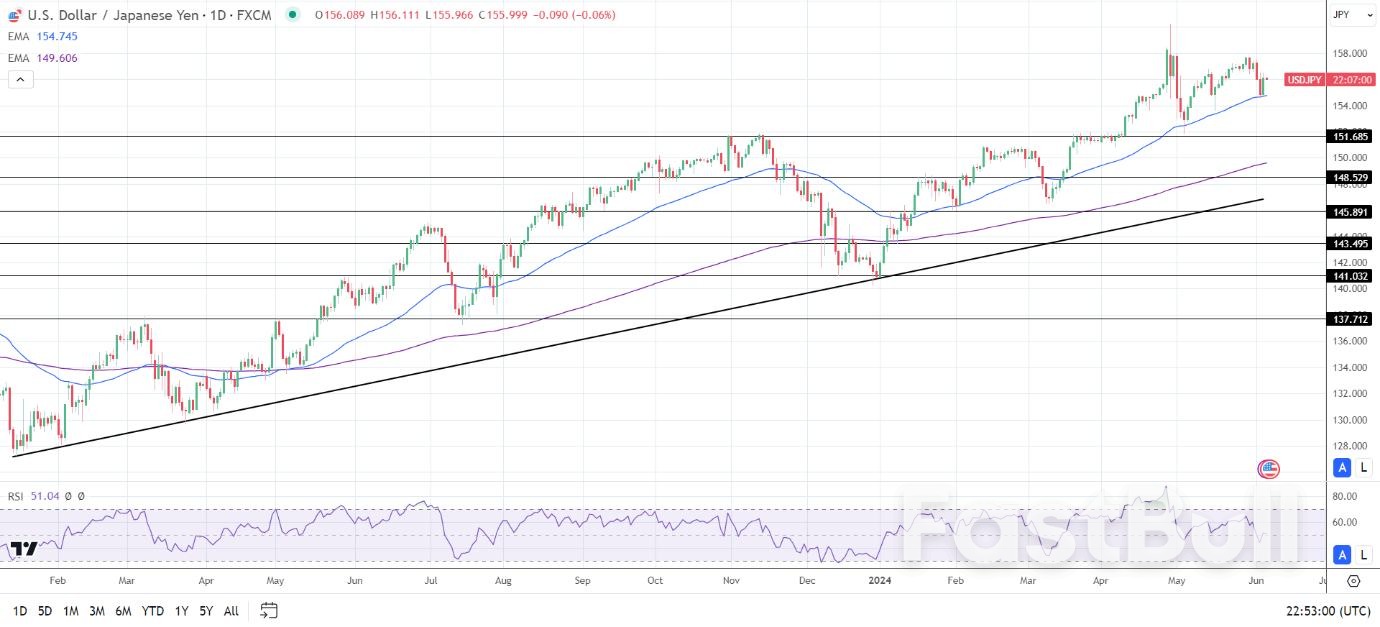
          The USD/JPY sat comfortably above the 50-day and 200-day EMAs, affirming the bullish price signals.
          A USD/JPY break above the 156.500 level could give the bulls a run at the 158 level. Furthermore, a USD/JPY return to the 158 level would support a move toward the April 29 high of 160.209.
          Investors should consider Bank of Japan commentary and US labor market data.
          Conversely, a USD/JPY fall through the 155 handle would bring the 50-day EMA into play. A drop below the 50-day EMA could signal a fall toward the 151.685 support level.
          The 14-day RSI at 50.67 suggests a USD/JPY return to 160 before entering overbought territory.
          USD/JPY Forecast: Household Spending and Jobs Report Drive Near-Term Trends_1

          Source: FX Empire

          To stay updated on all economic events of today, please check out our Economic calendar
          Risk Warnings and Disclaimers
          You understand and acknowledge that there is a high degree of risk involved in trading. Following any strategies or investment methods may lead to potential losses. The content on the site is provided by our contributors and analysts for information purposes only. You are solely responsible for determining whether any trading assets, securities, strategy, or any other product is suitable for investing based on your own investment objectives and financial situation.
          Add to Favorites
          Share

          BlackRock Stays Bullish on Indian Bonds After Narrow Modi Win

          Samantha Luan

          Economic

          Bond

          Political

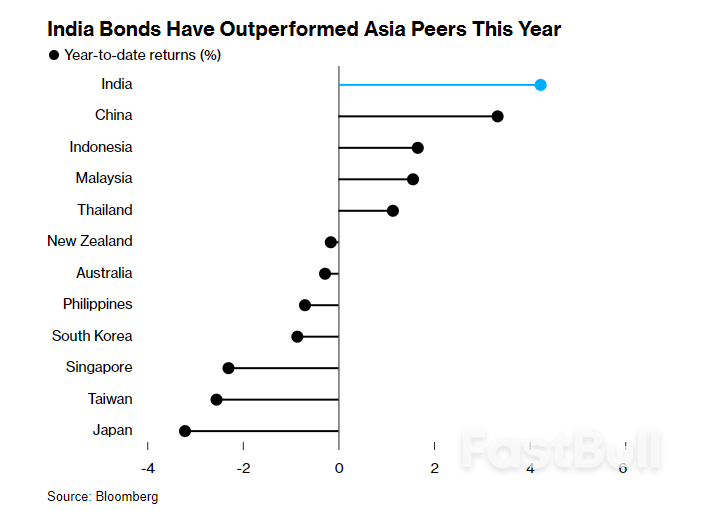
          BlackRock Inc. is sticking to its bullish view on Indian bonds, brushing aside market concerns that Prime Minister Narendra Modi’s narrow election win may spur populist spending.
          The coalition of parties led by Modi is unlikely to deviate from the path of fiscal consolidation, and cooling inflation will allow the Reserve Bank of India to embark on easing later this year, according to Neeraj Seth, chief investment officer and head of APAC fundamental fixed income at BlackRock.
          “It’s actually a good time to be long duration in India,” Seth said in a Wednesday interview. “I wouldn’t change my view on the back of the election outcome,” he said, adding that he prefers the more liquid seven- and 10-year bonds.
          India’s financial markets were jolted Tuesday as results showed Modi’s party losing its majority in parliament, an outcome that Moody’s Ratings said may delay more far-reaching economic reforms and impede progress on fiscal consolidation. The country’s ten-year benchmark yield jumped by as much as 12 basis points on Tuesday — the most since October — before stabilizing on Wednesday.BlackRock Stays Bullish on Indian Bonds After Narrow Modi Win_1
          While expansionary spending is a risk, a “significant deviation” from efforts toward fiscal discipline is unlikely as the coalition of parties led by Modi retains a majority, he added. Modi’s government had taken decisive steps to rein in the deficit, bringing it down to 5.6% of gross domestic product in the fiscal year ended in March and aiming to lower it even further to 4.5% by 2025-26.
          India’s cooling inflation — with the latest consumer price gain at 4.83% versus last year’s high at above 7% — supports Seth’s view that the RBI can ease regardless of the Federal Reserve’s action. The monetary authority is expected to hold rates steady on Friday.
          “To some extent, India is one of the very few economies — and RBI one of the few central banks — where I see that the path dependency of monetary policy is not very high on the Fed,” Seth said.
          His optimism on the asset class is shared by abrdn and Standard Chartered Plc, which are focused on the favorable supply-demand dynamic due to inflows expected from an upcoming index inclusion. India’s bond market has attracted $6.6 billion of foreign funds this year ahead of the addition to JPMorgan Chase & Co.’s emerging indexes later this month.
          “The structural inflows on the back of index inclusion, which will happen over the next 10 months, will provide a technically positive backdrop,” he said.

          Source:Bloomberg

          To stay updated on all economic events of today, please check out our Economic calendar
          Risk Warnings and Disclaimers
          You understand and acknowledge that there is a high degree of risk involved in trading. Following any strategies or investment methods may lead to potential losses. The content on the site is provided by our contributors and analysts for information purposes only. You are solely responsible for determining whether any trading assets, securities, strategy, or any other product is suitable for investing based on your own investment objectives and financial situation.
          Add to Favorites
          Share
          FastBull
          Copyright © 2025 FastBull Ltd

          728 RM B 7/F GEE LOK IND BLDG NO 34 HUNG TO RD KWUN TONG KLN HONG KONG

          TelegramInstagramTwitterfacebooklinkedin
          App Store Google Play Google Play
          Products
          Charts

          Chats

          Q&A with Experts
          Screeners
          Economic Calendar
          Data
          Tools
          Membership
          Features
          Function
          Markets
          Copy Trading
          Latest Signals
          Contests
          News
          Analysis
          24/7
          Columns
          Education
          Company
          Careers
          About Us
          Contact Us
          Advertising
          Help Center
          Feedback
          User Agreement
          Privacy Policy
          Business

          White Label

          Data API

          Web Plug-ins

          Poster Maker

          Affiliate Program

          Risk Disclosure

          The risk of loss in trading financial instruments such as stocks, FX, commodities, futures, bonds, ETFs and crypto can be substantial. You may sustain a total loss of the funds that you deposit with your broker. Therefore, you should carefully consider whether such trading is suitable for you in light of your circumstances and financial resources.

          No decision to invest should be made without thoroughly conducting due diligence by yourself or consulting with your financial advisors. Our web content might not suit you since we don't know your financial conditions and investment needs. Our financial information might have latency or contain inaccuracy, so you should be fully responsible for any of your trading and investment decisions. The company will not be responsible for your capital loss.

          Without getting permission from the website, you are not allowed to copy the website's graphics, texts, or trademarks. Intellectual property rights in the content or data incorporated into this website belong to its providers and exchange merchants.

          Not Logged In

          Log in to access more features

          FastBull Membership

          Not yet

          Purchase

          Become a signal provider
          Help Center
          Customer Service
          Dark Mode
          Price Up/Down Colors

          Log In

          Sign Up

          Position
          Layout
          Fullscreen
          Default to Chart
          The chart page opens by default when you visit fastbull.com