• Trade
  • Markets
  • Copy
  • Contests
  • News
  • 24/7
  • Calendar
  • Q&A
  • Chats
Trending
Screeners
SYMBOL
LAST
BID
ASK
HIGH
LOW
NET CHG.
%CHG.
SPREAD
SPX
S&P 500 Index
6835.94
6835.94
6835.94
6878.28
6827.18
-34.46
-0.50%
--
DJI
Dow Jones Industrial Average
47681.77
47681.77
47681.77
47971.51
47611.93
-273.21
-0.57%
--
IXIC
NASDAQ Composite Index
23490.11
23490.11
23490.11
23698.93
23455.05
-88.01
-0.37%
--
USDX
US Dollar Index
99.000
99.080
99.000
99.160
98.730
+0.050
+ 0.05%
--
EURUSD
Euro / US Dollar
1.16410
1.16417
1.16410
1.16717
1.16162
-0.00016
-0.01%
--
GBPUSD
Pound Sterling / US Dollar
1.33286
1.33294
1.33286
1.33462
1.33053
-0.00026
-0.02%
--
XAUUSD
Gold / US Dollar
4186.99
4187.40
4186.99
4218.85
4175.92
-10.92
-0.26%
--
WTI
Light Sweet Crude Oil
58.621
58.651
58.621
60.084
58.495
-1.188
-1.99%
--

Community Accounts

Signal Accounts
--
Profit Accounts
--
Loss Accounts
--
View More

Become a signal provider

Sell trading signals to earn additional income

View More

Guide to Copy Trading

Get started with ease and confidence

View More

Signal Accounts for Members

All Signal Accounts

Best Return
  • Best Return
  • Best P/L
  • Best MDD
Past 1W
  • Past 1W
  • Past 1M
  • Past 1Y

All Contests

  • All
  • Trump Updates
  • Recommend
  • Stocks
  • Cryptocurrencies
  • Central Banks
  • Featured News
Top News Only
Share

Brent Crude Futures Settle At $62.49/Bbl, Down $1.26, 1.98 Percent

Share

Trump: Farming Equipment Has Gotten Too Expensive

Share

Trump: We Will Take Off A Lot Of Environment Rules That Affect Tractor Companies

Share

Kremlin Says Still No Word On US-Ukraine Talks In Florida

Share

Trump: USA Will Take Small Portion Of Tariff Revenues To Give It To Farmers

Share

Trump: Taking Action To Protect Farmers

Share

Nymex January Gasoline Futures Closed At $1.7981 Per Gallon, And Nymex January Heating Oil Futures Closed At $2.2982 Per Gallon

Share

USA Crude Oil Futures Settle At $58.88/Bbl, Down $1.20, 2.00 Percent

Share

Netflix Co-CEO On Warner Bros Deal: We Are Very Confident That Regulators Should And Will Approve It

Share

Alina Habba, The Interim Federal Prosecutor For New Jersey, Has Resigned. This Follows An Appeals Court Ruling That President Trump's Nomination Of Her Was Illegitimate

Share

Netflix Co-CEO On Paramount Skydance Bid For Warner Bros Says The Move Was Entirely Expected- UBS Conf

Share

U.S. Senate Democratic Member And Antitrust Activist Warren Stated That Paramount Skydance's Hostile Takeover Offer Triggered A "Level 5 Antitrust Alert."

Share

Benin Government: Coup Plotters Kidnapped Two Senior Military Officials Who Were Later Freed

Share

Canada: G7 Finance Ministers Discussed Export Controls And Critical Minerals In Call

Share

Benin Government: Nigeria Carried Out Air Strikes To Help Thwart Coup Bid

Share

Fitch: Expects General Government (Gg) Deficit To Fall Modestly In Canada And But Rise Modestly In USA In 2026

Share

An Important Point Of Consensus Was Concern Regarding Application Of Non-Market Policies, Including Export Controls, To Critical Minerals Supply Chains

Share

Fitch: Despite Full-Year Impact Of Tariffs, We Expect USA Fiscal Deficit To Widen In 2026 Due To Additional Tax Cuts Under One Big Beautiful Bill Act

Share

Private Equity Firm Cinven Has Signed A £190 Million Deal To Acquire A Majority Stake In UK Advisory Firm Flint Global

Share

Bank Of England's Taylor Expects Inflation To Fall To Target 'In The Near Term'

TIME
ACT
FCST
PREV
France Trade Balance (SA) (Oct)

A:--

F: --

P: --
Euro Zone Employment YoY (SA) (Q3)

A:--

F: --

P: --
Canada Part-Time Employment (SA) (Nov)

A:--

F: --

P: --

Canada Unemployment Rate (SA) (Nov)

A:--

F: --

P: --

Canada Full-time Employment (SA) (Nov)

A:--

F: --

P: --

Canada Labor Force Participation Rate (SA) (Nov)

A:--

F: --

P: --

Canada Employment (SA) (Nov)

A:--

F: --

P: --

U.S. PCE Price Index MoM (Sept)

A:--

F: --

P: --

U.S. Personal Income MoM (Sept)

A:--

F: --

P: --

U.S. Core PCE Price Index MoM (Sept)

A:--

F: --

P: --

U.S. PCE Price Index YoY (SA) (Sept)

A:--

F: --

P: --

U.S. Core PCE Price Index YoY (Sept)

A:--

F: --

P: --

U.S. Personal Outlays MoM (SA) (Sept)

A:--

F: --

P: --
U.S. 5-10 Year-Ahead Inflation Expectations (Dec)

A:--

F: --

P: --

U.S. Real Personal Consumption Expenditures MoM (Sept)

A:--

F: --

P: --
U.S. Weekly Total Rig Count

A:--

F: --

P: --

U.S. Weekly Total Oil Rig Count

A:--

F: --

P: --

U.S. Consumer Credit (SA) (Oct)

A:--

F: --

P: --
China, Mainland Foreign Exchange Reserves (Nov)

A:--

F: --

P: --

Japan Trade Balance (Oct)

A:--

F: --

P: --

Japan Nominal GDP Revised QoQ (Q3)

A:--

F: --

P: --

China, Mainland Imports YoY (CNH) (Nov)

A:--

F: --

P: --

China, Mainland Exports (Nov)

A:--

F: --

P: --

China, Mainland Imports (CNH) (Nov)

A:--

F: --

P: --

China, Mainland Trade Balance (CNH) (Nov)

A:--

F: --

P: --

China, Mainland Exports YoY (USD) (Nov)

A:--

F: --

P: --

China, Mainland Imports YoY (USD) (Nov)

A:--

F: --

P: --

Germany Industrial Output MoM (SA) (Oct)

A:--

F: --

P: --
Euro Zone Sentix Investor Confidence Index (Dec)

A:--

F: --

P: --

Canada National Economic Confidence Index

A:--

F: --

P: --

U.K. BRC Like-For-Like Retail Sales YoY (Nov)

--

F: --

P: --

U.K. BRC Overall Retail Sales YoY (Nov)

--

F: --

P: --

Australia Overnight (Borrowing) Key Rate

--

F: --

P: --

RBA Rate Statement
RBA Press Conference
Germany Exports MoM (SA) (Oct)

--

F: --

P: --

U.S. NFIB Small Business Optimism Index (SA) (Nov)

--

F: --

P: --

Mexico 12-Month Inflation (CPI) (Nov)

--

F: --

P: --

Mexico Core CPI YoY (Nov)

--

F: --

P: --

Mexico PPI YoY (Nov)

--

F: --

P: --

U.S. Weekly Redbook Index YoY

--

F: --

P: --

U.S. JOLTS Job Openings (SA) (Oct)

--

F: --

P: --

China, Mainland M1 Money Supply YoY (Nov)

--

F: --

P: --

China, Mainland M0 Money Supply YoY (Nov)

--

F: --

P: --

China, Mainland M2 Money Supply YoY (Nov)

--

F: --

P: --

U.S. EIA Short-Term Crude Production Forecast For The Year (Dec)

--

F: --

P: --

U.S. EIA Natural Gas Production Forecast For The Next Year (Dec)

--

F: --

P: --

U.S. EIA Short-Term Crude Production Forecast For The Next Year (Dec)

--

F: --

P: --

EIA Monthly Short-Term Energy Outlook
U.S. API Weekly Gasoline Stocks

--

F: --

P: --

U.S. API Weekly Cushing Crude Oil Stocks

--

F: --

P: --

U.S. API Weekly Crude Oil Stocks

--

F: --

P: --

U.S. API Weekly Refined Oil Stocks

--

F: --

P: --

South Korea Unemployment Rate (SA) (Nov)

--

F: --

P: --

Japan Reuters Tankan Non-Manufacturers Index (Dec)

--

F: --

P: --

Japan Reuters Tankan Manufacturers Index (Dec)

--

F: --

P: --

Japan Domestic Enterprise Commodity Price Index MoM (Nov)

--

F: --

P: --

Japan Domestic Enterprise Commodity Price Index YoY (Nov)

--

F: --

P: --

China, Mainland PPI YoY (Nov)

--

F: --

P: --

China, Mainland CPI MoM (Nov)

--

F: --

P: --

Italy Industrial Output YoY (SA) (Oct)

--

F: --

P: --

Q&A with Experts
    • All
    • Chatrooms
    • Groups
    • Friends
    Connecting
    .
    .
    .
    Type here...
    Add Symbol or Code

      No matching data

      All
      Trump Updates
      Recommend
      Stocks
      Cryptocurrencies
      Central Banks
      Featured News
      • All
      • Russia-Ukraine Conflict
      • Middle East Flashpoint
      • All
      • Russia-Ukraine Conflict
      • Middle East Flashpoint
      Search
      Products

      Charts Free Forever

      Chats Q&A with Experts
      Screeners Economic Calendar Data Tools
      Membership Features
      Data Warehouse Market Trends Institutional Data Policy Rates Macro

      Market Trends

      Market Sentiment Order Book Forex Correlations

      Top Indicators

      Charts Free Forever
      Markets

      News

      News Analysis 24/7 Columns Education
      From Institutions From Analysts
      Topics Columnists

      Latest Views

      Latest Views

      Trending Topics

      Top Columnists

      Latest Update

      Signals

      Copy Rankings Latest Signals Become a signal provider AI Rating
      Contests
      Brokers

      Overview Brokers Assessment Rankings Regulators News Claims
      Broker listing Forex Brokers Comparison Tool Live Spread Comparison Scam
      Q&A Complaint Scam Alert Videos Tips to Detect Scam
      More

      Business
      Events
      Careers About Us Advertising Help Center

      White Label

      Data API

      Web Plug-ins

      Affiliate Program

      Awards Institution Evaluation IB Seminar Salon Event Exhibition
      Vietnam Thailand Singapore Dubai
      Fans Party Investment Sharing Session
      FastBull Summit BrokersView Expo
      Recent Searches
        Top Searches
          Markets
          News
          Analysis
          User
          24/7
          Economic Calendar
          Education
          Data
          • Names
          • Latest
          • Prev

          View All

          No data

          Scan to Download

          Faster Charts, Chat Faster!

          Download App
          English
          • English
          • Español
          • العربية
          • Bahasa Indonesia
          • Bahasa Melayu
          • Tiếng Việt
          • ภาษาไทย
          • Français
          • Italiano
          • Türkçe
          • Русский язык
          • 简中
          • 繁中
          Open Account
          Search
          Products
          Charts Free Forever
          Markets
          News
          Signals

          Copy Rankings Latest Signals Become a signal provider AI Rating
          Contests
          Brokers

          Overview Brokers Assessment Rankings Regulators News Claims
          Broker listing Forex Brokers Comparison Tool Live Spread Comparison Scam
          Q&A Complaint Scam Alert Videos Tips to Detect Scam
          More

          Business
          Events
          Careers About Us Advertising Help Center

          White Label

          Data API

          Web Plug-ins

          Affiliate Program

          Awards Institution Evaluation IB Seminar Salon Event Exhibition
          Vietnam Thailand Singapore Dubai
          Fans Party Investment Sharing Session
          FastBull Summit BrokersView Expo

          Japan Stocks Extend Its Gains To 34-Year High

          Zi Cheng

          Traders' Opinions

          Economic

          Summary:

          On Wednesday, Japan's stocks surged to a 34-year high, while global equities, the dollar, and bonds remained stable ahead of Thursday's U.S. inflation data.
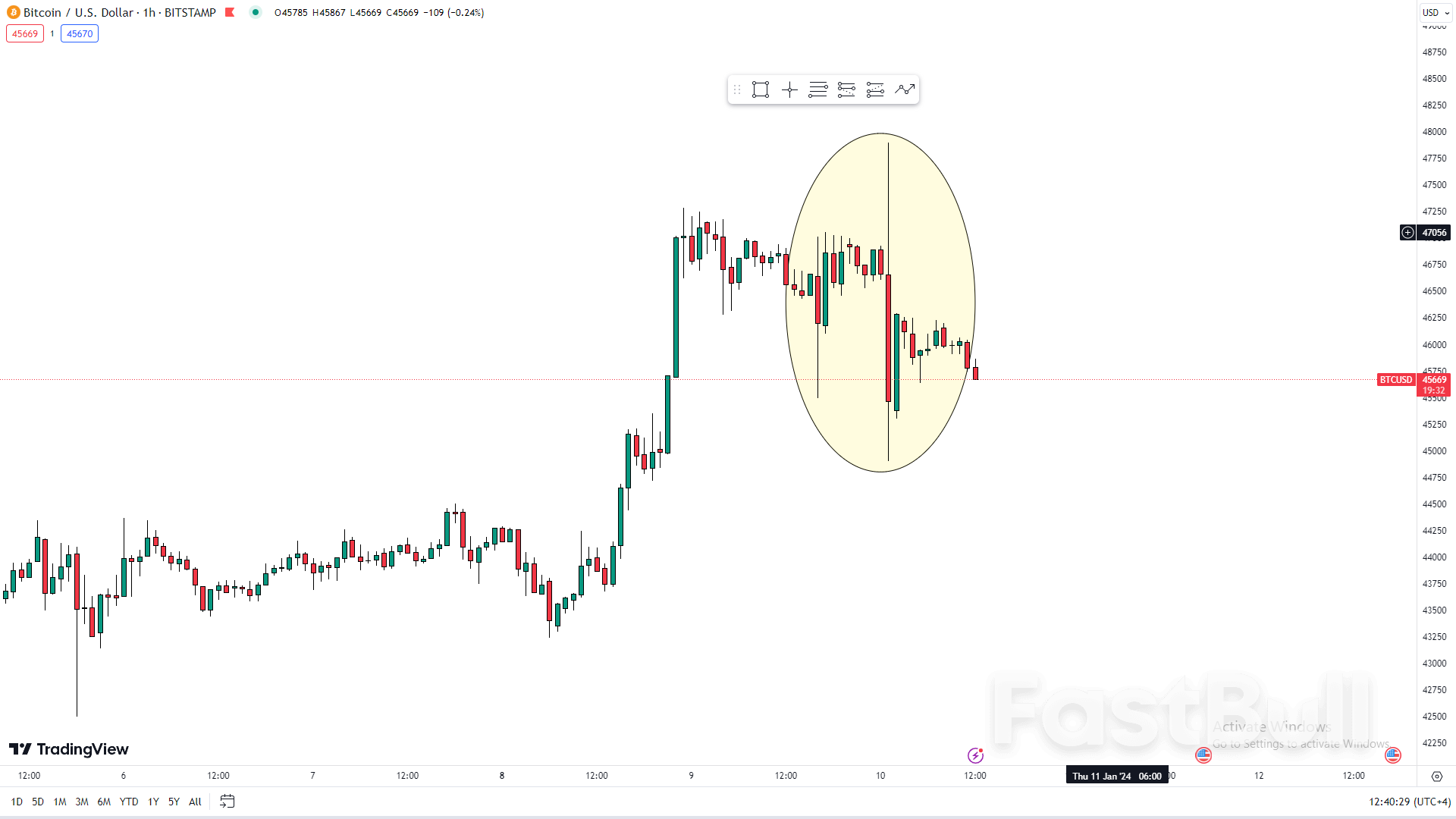
          Following a surge triggered by an unauthorized announcement from the U.S. Securities and Exchange Commission's X account claiming approval of Bitcoin exchange-traded funds, Bitcoin subsequently stabilized.
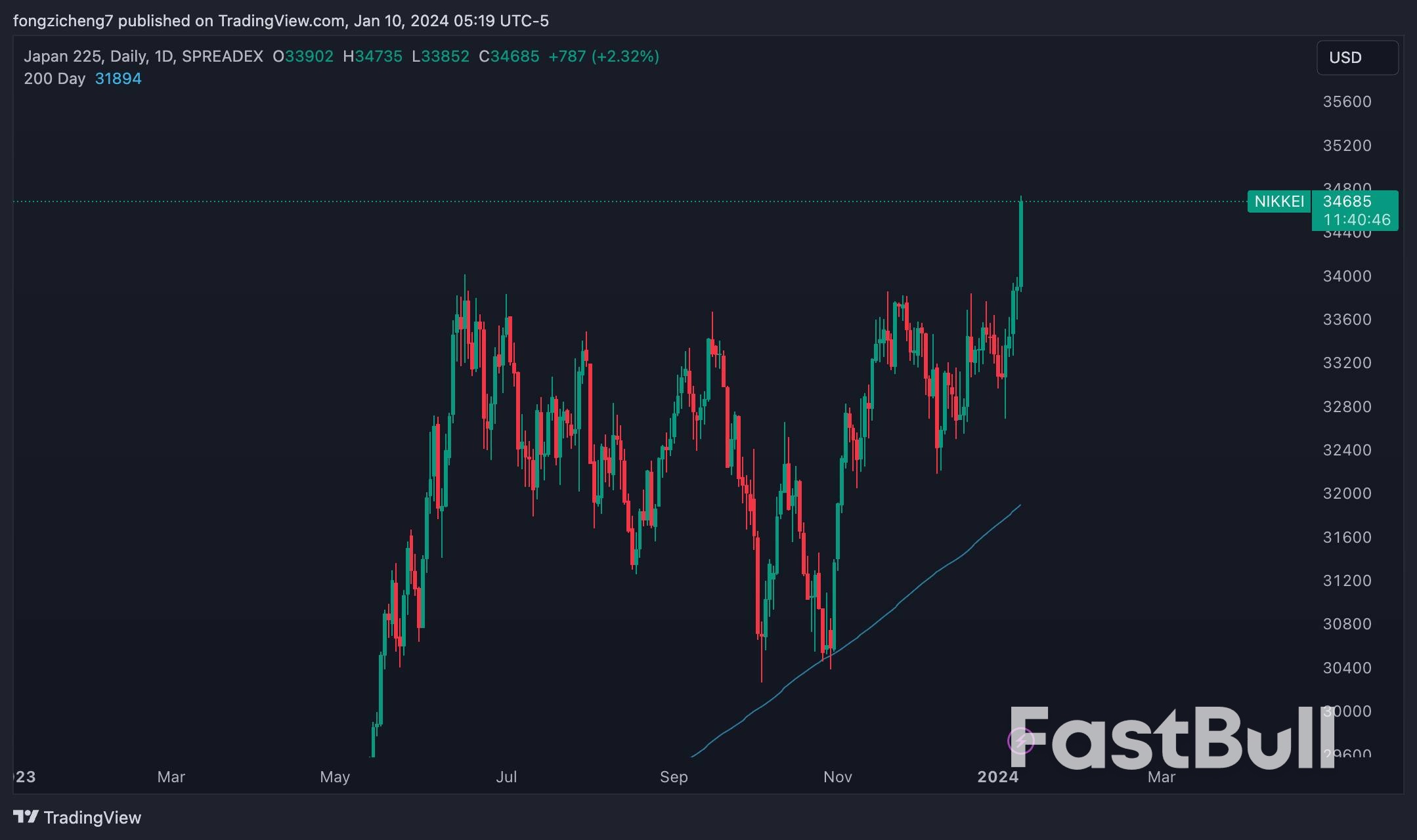
          Concurrently, Japan's Nikkei index, which experienced its most successful year in a decade in 2023, saw a 2% rise, surpassing the 34,000 mark for the first time since 1990. The upswing was spearheaded by exporters, benefiting from a weakened yen attributed to data revealing a 20th consecutive month of decline in Japanese real wages, reported for November.
          Japan Stocks Extend Its Gains To 34-Year High_1
          Duncan MacInnes, an investment director at the British firm Ruffer, expressed his perspective on Japan, noting its compelling dynamics. According to him, corporate governance, a historical challenge for the country, is undergoing significant improvements.
          Additionally, Japan's market is characterized as highly cyclical, making it particularly susceptible to downturns.
          Meanwhile, in early trading, the pan-European Stoxx 600 index exhibited stability. However, the FTSE 100 in Britain registered a 0.19% decline, contrasting with the 0.2% uptick in Germany's DAX index.
          Following a 0.15% dip in the U.S. S&P 500 index on Tuesday, futures for the same index exhibited a 0.19% increase. Investors eagerly anticipated the release of inflation figures and the commencement of the corporate earnings season. Additionally, Nasdaq 100 futures saw a notable 0.37% uptick.
          Towards the end of 2023, both U.S. and European markets experienced a surge, attributed to the more rapid-than-anticipated cooling of inflation and a shift in central banks' tone toward a more accommodative stance. This change in sentiment encouraged investors to speculate on significant rate cuts anticipated to occur throughout the current year.
          In January, the enthusiasm surrounding the anticipation of declining borrowing costs has diminished, resulting in a roughly 0.3% decline in the S&P 500, which had previously surged by 24% last year.
          Meanwhile, the U.S. dollar index demonstrated a lack of significant movement, maintaining a flat trajectory. Notably, the U.S. currency has experienced a 2% increase since reaching a five-month low in late December.
          Bitcoin, currently trading at $45,540, observed a 1.3% decrease after briefly surging to $47,897 due to false reports of ETF approvals. The U.S. Securities and Exchange Commission (SEC) clarified that it had not yet granted approval for a spot bitcoin ETF and acknowledged unauthorized access to its X social media account.
          To stay updated on all economic events of today, please check out our Economic calendar
          Risk Warnings and Disclaimers
          You understand and acknowledge that there is a high degree of risk involved in trading. Following any strategies or investment methods may lead to potential losses. The content on the site is provided by our contributors and analysts for information purposes only. You are solely responsible for determining whether any trading assets, securities, strategy, or any other product is suitable for investing based on your own investment objectives and financial situation.
          Comments
          Add to Favorites
          Share

          Major Bullish Breakout from 7-month Range with Further Potential Upside in Store

          Devin

          Forex

          Stocks

          The Nikkei 225 has indeed staged the bullish breakout from its 7-month range resistance at 33,770 in today's Asian session (10 January) and rallied to a 34-year high at 34,440.
          Overall, its current 2024 year-to-date return stands at +2.9% which has outperformed the major US benchmark stock indices; S&P 500 (-0.3%), Nasdaq 100 (-0.9%), Dow Jones Industrial Average (-0.4%), and Russell 2000 (-2.9%) over the first two trading weeks of 2024.
          Weak direct correlation between USD/JPY & Nikkei 225

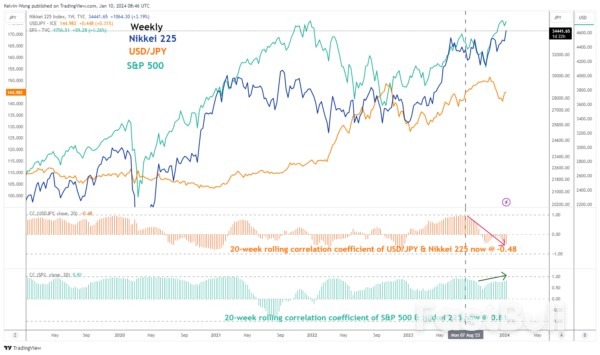
          Major Bullish Breakout from 7-month Range with Further Potential Upside in Store_1Fig 1: Long-term direct correlation analysis of USD/JPY & Nikkei 225 as of 10 Jan 2024 (Source: TradingView, click to enlarge chart)

          So far since Q4 2023, the direct linkage of USD/JPY with Nikkei 225 has diminished and broken down which suggests that going forward, it is unlikely that a weaker JPY can boost investors' sentiment in the Japanese stock market which it did in the past.
          The 20-week rolling correlation coefficient of USD/JPY and Nikkei 225 has dropped to -0.48 as of 10 January 2024 at this time of the writing (see Fig 1).
          An exit from a deflationary environment supports a further upmove in the Nikkei 225

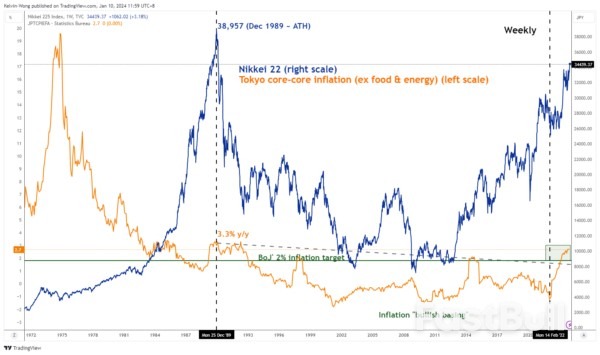
          Major Bullish Breakout from 7-month Range with Further Potential Upside in Store_2Fig 2: Trend movements of Tokyo core-core inflation with Nikkei 225 as of 10 Jan 2024 (Source: TradingView, click to enlarge chart)

          Secondly, on closer inspection, the sustainability of the current bullish tone seen in the Nikkei 225 is largely more dependent on the inflation situation in Japan rather than a weaker JPY (more export-oriented). A clear path of an exit from a 20-year-plus deflationary environment is likely to lend support to another potential major uptrend phase in the Japanese stock market as consumers and business confidences resurface which in turn can see a significant increase in domestic demand.
          Overlaying the leading Tokyo's core-core inflation (excluding food and energy) trend with the Nikkei 225 (see Fig 2), the prior major uptrend of Nikkei 225 from February 2022 to June 2023 has moved in sync with an increase in the core-core inflation rate. The recent December 2023 reading of Tokyo's core-core inflation has remained elevated at 2.7% year-on-year, unchanged from November; close to a 31-year high.
          Outperformance of domestic demand-oriented sectors

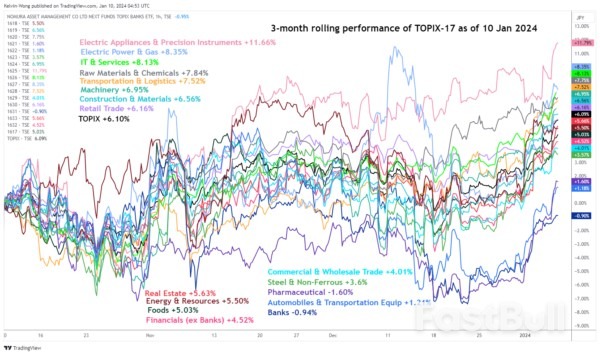
          Major Bullish Breakout from 7-month Range with Further Potential Upside in Store_3Fig 3: 3-month rolling performances of 17 TOPIX Sectors as of 10 Jan 2024 (Source: TradingView, click to enlarge chart)

          From a medium-term sector rotation perspective (3-month rolling performance) among the 17 core TOPIX sectors, several domestic demand-oriented sectors such as IT & Services (+8.13%), Transportation & Logistics (+7.52%), Construction & Materials (+6.65%) outperformed the general market (TOPIX +6.10%). In contrast, sectors that tend to depend on a weaker JPY underperformed; Commercial & Wholesale Trade (+4%), and Automobiles & Transportation Equipment (+1.21%) (see Fig 3).
          36,600 next major resistance to watch on Nikkei 225

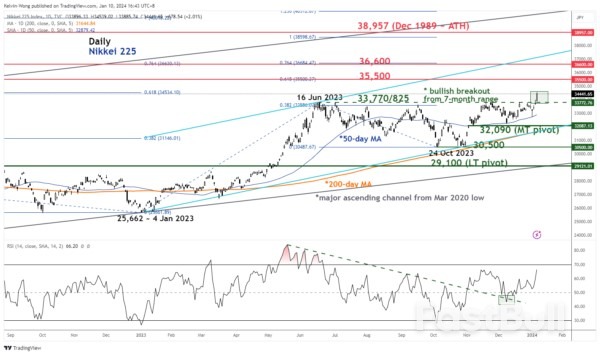
          Major Bullish Breakout from 7-month Range with Further Potential Upside in Store_4Fig 4: Nikkei 225 major & medium-term trends as of 10 Jan 2024 (Source: TradingView, click to enlarge chart)

          In the lens of technical analysis, the Nikkei 225 is likely to have kickstarted a potential fresh major uptrend phase with its key medium-term pivotal support at 32,090 (the lower boundary of the ascending channel from 4 January 2023 low & upward sloping 200-day moving average).
          The next major resistance stands at 36,600 which is defined by the upper boundary of the ascending channel and a cluster of Fibonacci extension levels.
          In addition, the daily RSI momentum indicator has continued to exhibit bullish momentum conditions and has not reached an extreme overbought region (above 70 level).
          On the other hand, failure to hold at 32,090 negates the bullish tone to expose the next medium-term support at 30,500 in the first step.
          Risk Warnings and Disclaimers
          You understand and acknowledge that there is a high degree of risk involved in trading. Following any strategies or investment methods may lead to potential losses. The content on the site is provided by our contributors and analysts for information purposes only. You are solely responsible for determining whether any trading assets, securities, strategy, or any other product is suitable for investing based on your own investment objectives and financial situation.
          Comments
          Add to Favorites
          Share

          US Oil and Gas Production Growth Starts to Decelerate

          Owen Li

          Energy

          U.S. oil and gas production continued to climb in October, but there were indications of both starting to flatten and turn down in response to lower prices since the middle of 2022.
          Oil production from the Lower 48 states excluding Alaska and federal waters in the Gulf of Mexico rose to a record 10.9 million barrels per day (b/d), according to the U.S. Energy Information Administration (EIA).
          Production had increased by 0.7 million b/d compared with the same month a year earlier, but growth had slowed from 0.9-1.1 million b/d earlier in 2023 (“Petroleum supply monthly”, EIA, December 29).
          The slowdown was a delayed response to the sharp retreat in prices, after the spike in the middle of 2022, amid fears about the impact of Russia's invasion of Ukraine and the U.S. and European Union sanctions imposed on Moscow in response.
          Front-month U.S. crude futures prices were down $36 per barrel (-29%) in October 2023 from the post-invasion peak in June 2022, after adjusting for inflation.
          In response, the number of rigs drilling for oil was down by 122 (-20%) in October 2023 from the peak in December 2022.
          The rig count followed prices lower with an average lag of four to five months, consistent with the historic pattern since 1990.
          By contrast, production held up more strongly than usual, setting a string of new records in the third quarter and the start of the fourth, rather than following prices down with a typical lag of 10 to 12 months.
          Some of the resilience may have been due to the temporary spike in prices in the third quarter, which encouraged producers to squeeze out as many extra barrels as possible in the short term.
          Owners of stripper wells and other mature wells had a strong incentive to maximise production to benefit from the price spike.
          Drilling has continued to become more efficient with longer horizontal sections making contact with more reservoir rock and capturing more oil from each well.
          Some privately-owned producers may also have accelerated drilling and well completions to boost production and secure higher company valuations.
          Research has shown much of the increase in production during the third quarter came from a small number of privately-owned firms.
          But all these are likely to be transitory production increases. If prices remain subdued, production growth will eventually decelerate further.
          Front-month U.S. crude futures averaged $72 per barrel in December 2023 and so far in January 2024, which is in only the 43rd percentile for all months since the start of the century in real terms.
          U.S. production growth seized market share from Saudi Arabia and its OPEC⁺ allies and made it harder for them to lift prices in 2023.
          But if prices remain at current levels, or perhaps fall another $10 per barrel, putting them in only the 33rd percentile, U.S. production growth is likely to halt and restore some of the OPEC⁺ market power.
          Natural Gas
          U.S. gas production hit a record high in October, but signs of output starting to turn lower were much more evident than for oil.
          Dry gas production reached 3,240 billion cubic feet (bcf) which was 71 bcf (+2%) higher than in the same month in the prior year (“Natural gas monthly”, EIA, December 29).
          But production growth had decelerated progressively from 176 bcf (+6%) in the 12 months to January 2023 and 200 bcf (+7%) in the year to September 2022.
          Like oil, gas production had responded to the fall in prices since the middle of 2022 as Europe reoriented itself away from Russian pipeline gas.
          Unlike oil, however, the gas market has no equivalent of OPEC⁺ to smooth the adjustment of production and prices.
          Front-month U.S. gas futures prices had fallen by $6 per million British thermal units (-66%) by October 2023 from the peak in August 2022 after adjusting for inflation.
          Real prices averaged a little over $3 (12th percentile for all months since 2000) in October 2023, down from $9 (79th percentile) in August 2022.
          The number of rigs drilling primarily for gas had fallen by 44 (-27%) since September 2022 in response to the collapse in prices.
          Prices have since fallen further to an average of just $2.54 (5th percentile) in December 2023 as an unusually mild start to winter ensured inventories remained much higher than average for the time of year.
          But the price-driven adjustment process is well underway, with production likely to flatten (temporarily) in the first half of 2024 and excess inventories to be eliminated by the middle of the year.

          Source: Reuters

          Risk Warnings and Disclaimers
          You understand and acknowledge that there is a high degree of risk involved in trading. Following any strategies or investment methods may lead to potential losses. The content on the site is provided by our contributors and analysts for information purposes only. You are solely responsible for determining whether any trading assets, securities, strategy, or any other product is suitable for investing based on your own investment objectives and financial situation.
          Comments
          Add to Favorites
          Share

          Inflation in Australia Continues to Decline, AUD/USD Tests Important Support

          FXOpen

          Forex

          Data today from the Australian Bureau of Statistics on Wednesday showed the monthly consumer price index (CPI) rose 4.3% year-on-year in November, the slowest pace since January 2022. Value a month earlier = 4.9%. Market forecasts = 4.4%.
          This strengthened market expectations that interest rates would not have to rise further. Although the head of the Reserve Bank of Australia, Michele Bullock, warned of the risks of rising price pressures caused by domestic demand, for example, due to rising prices for rental housing.
          Against the backdrop of the publication of news about inflation in Australia, no strong surges were noticed in the AUD/USD market. Perhaps this was due to the fact that there were no surprises.
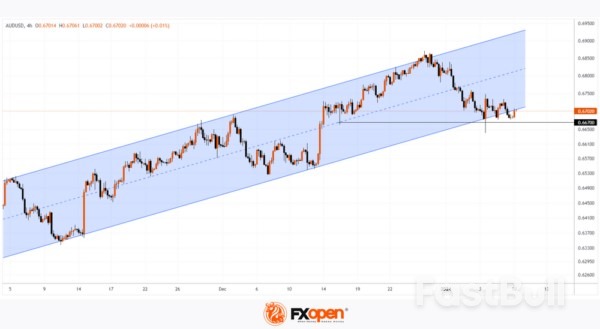
          Inflation in Australia Continues to Decline, AUD/USD Tests Important Support_1Meanwhile, the 4-hour chart shows that the AUD/USD rate is nearing important support, which is formed by the lower line of the trend channel (shown in blue), within which the price has been moving since last fall.
          Wherein:
          → in 2024, the price managed to push off from this line several times, but continued growth did not follow;
          → the highs of the days of January 4, 5 and 9 form a sequence of falling tops;
          → on January 5, prices broke through the low of December 15, but then rose sharply — a sign of demand below the level of 0.667.
          Thus, the chart provides evidence to suggest that the forces of demand have enough capacity to prevent the price from falling, but are so exhausted that they cannot resume the upward trend in the blue channel.
          It is possible that the AUD/USD market will trade in a restrained manner until the release of tomorrow’s inflation news in the US (16:30 GMT+3), which could lead to the formation of a new balance of supply and demand.
          This article represents the opinion of the Companies operating under the FXOpen brand only. It is not to be construed as an offer, solicitation, or recommendation with respect to products and services provided by the Companies operating under the FXOpen brand, nor is it to be considered financial advice.
          Risk Warnings and Disclaimers
          You understand and acknowledge that there is a high degree of risk involved in trading. Following any strategies or investment methods may lead to potential losses. The content on the site is provided by our contributors and analysts for information purposes only. You are solely responsible for determining whether any trading assets, securities, strategy, or any other product is suitable for investing based on your own investment objectives and financial situation.
          Comments
          Add to Favorites
          Share

          SEC's Twitter Turmoil Sparks Fears: Will Bitcoin ETF Decision Face Delays?

          Warren Takunda

          Cryptocurrency

          In a surprising and unprecedented turn of events, the United States Securities and Exchange Commission (SEC) found itself at the center of a social media hack on January 9, 2024, raising significant concerns and causing ripples in the anticipation of the decision to approve spot Bitcoin exchange-traded funds (ETFs). The SEC's compromised Twitter account, @SECGov X, posted an unauthorized tweet claiming the approval of Bitcoin ETFs, triggering a brief but intense response in both social media and the cryptocurrency markets.
          SEC's Twitter Turmoil Sparks Fears: Will Bitcoin ETF Decision Face Delays?_1
          Despite the unauthorized post causing a momentary surge in Bitcoin prices, soaring briefly above $46,000, the SEC moved swiftly to clarify that the tweet was false, and they had not yet approved the Bitcoin ETF. The clarification promptly led to a correction in Bitcoin's price, settling at nearly $45,958 at around 12:20 a.m. ET.
          The SEC initiated an investigation into the incident, revealing that the compromise was not a result of any breach in the SEC's systems. Instead, it occurred due to an unidentified individual gaining control over a phone number associated with the @SECGov account through a third party. Notably, the SEC acknowledged that the compromised account did not have two-factor authentication enabled at the time.
          Market experts and commentators are divided on the potential implications of this social media mishap on the SEC's decision-making timeline for Bitcoin ETFs. While some worry that the SEC might exploit the situation as a reason to delay the decision beyond the anticipated January 10 deadline, others see this as a remote possibility.
          Dennis Porter, CEO of Satoshi Action Fund, remains optimistic, stating, "It depends on the intention of the SEC. If the SEC is looking for ways to continue delaying the ETF process, it’s possible they could use this as a reason to slow down the rollout." However, Porter notes that his contacts still indicate a green light for spot Bitcoin ETFs on January 10.
          U.S. attorney and commercial litigator Joe Carlasare leans toward the SEC making a decision by the deadline, saying, "Anything is possible, but I find [it] to be extremely unlikely [that] they aren’t going to approve or reject based on this incident." Bloomberg ETF analyst Eric Balchunas anticipates an official approval announcement between 4:00 pm and 5:00 pm Eastern Time on January 10.
          Mati Greenspan of Quantum Economics, however, suggests a more cautious approach, stating, "I can certainly see a situation where the SEC would try to use this fiasco as a way to delay the ETF approval. It wouldn’t be the first time they’ve used underhanded methods to force their agenda on the markets."
          Digital asset lawyer Anthony Tu-Sekine of Seward and Kissel remains skeptical that the incident would alter the likelihood of approvals at this late stage. He finds the situation puzzling, stating, "This is really puzzling."
          The incident adds a layer of complexity to the already closely watched regulatory landscape surrounding Bitcoin and cryptocurrency. Gary Gensler, SEC Chair, known for taking a stringent stance on crypto, denied the approval of Bitcoin ETFs following the false social media post. The SEC is expected to make a decision on the ETFs this week, after years of opposing the idea.
          As Bitcoin's volatility underscores the impact of regulatory decisions on the cryptocurrency market, traders and investors remain on edge. Gensler's previous actions against major crypto players, including Coinbase and Ripple, further intensify the anticipation for a favorable Bitcoin ETF decision. The SEC's ability to navigate this complex terrain will undoubtedly shape the future trajectory of crypto regulations and market dynamics.
          Risk Warnings and Disclaimers
          You understand and acknowledge that there is a high degree of risk involved in trading. Following any strategies or investment methods may lead to potential losses. The content on the site is provided by our contributors and analysts for information purposes only. You are solely responsible for determining whether any trading assets, securities, strategy, or any other product is suitable for investing based on your own investment objectives and financial situation.
          Comments
          Add to Favorites
          Share

          Monitoring Central Bank Speakers Ahead of US CPI

          ING

          Forex

          USD: Holding pattern
          It has been a quiet start to the week in FX. Markets are in wait-and-see mode ahead of tomorrow's US CPI data, and currently lacking a clear sense of direction. The dollar has been modestly supported, in particular against commodity currencies as equities had an uninspiring day yesterday. Our view remains that a gradual repricing of Federal Reserve rate expectations to a later start of the easing cycle will keep risk assets on unstable ground in the near term, helping the dollar recover some ground before a clearer downtrend emerges.
          Today, the US calendar is quiet, with only MBA application numbers in focus. It will be more interesting to hear from New York Fed President John Williams in his speech about the 2024 economic outlook. The inconsistency between payrolls and the ISM services index makes the Fed's interpretation of the data particularly important. Our perception is that there still isn't enough weakness in the jobs market to justify a cut in March and the Fed may want to favour some hawkish repricing in the USD curve.
          DXY should keep hovering around the 102.50 level until tomorrow's inflation data unless Williams moves the market.
          ECB: Schnabel may protest dovish expectations
          European Central Bank doves have given a nudge to the market's dovish rate bets since the start of the week. Yesterday, French Governing Council member Francois Villeroy reaffirmed that rates will be cut in 2024, after Mario Centeno said the first cut could come in the first half of the year. The more hawkish-oriented Boris Vujcic had previously said that easing before the summer was unlikely.
          Today, there are two more doves speaking - Luis de Guindos and Pablo Hernandez de Cos - but we'll keep a closer eye on an online Q&A held by Isabel Schnabel at 1400 GMT. She often voiced the consensus of ECB hawks, and surprised markets by ruling out more hikes and shifting the discussion to easing in early December. Evidence of sticky inflation in the December report suggests she may favour a pushback against rate cut bets should she comment on monetary policy.
          We could see some short-term benefits to the euro as hawks voice their inflation concerns, but those have proven to be neither sizeable nor long-lasting in the past months. The lack of market-moving data releases suggests EUR/USD should trade largely in line with global risk sentiment and US data this week. We expect the pair to consolidate in a 1.0880/1.1020 range in the coming days barring surprises on the US inflation side.
          GBP: Bailey's testimony in focus
          Bank of England Governor Andrew Bailey will testify before Parliament on the financial stability report published in December. Any reference to the future path of monetary policy may follow the tone of the latest BoE meeting, where Bailey focused on pouring cold water on rate cut bets.
          Still, markets are pricing in 125bp of easing by the end of the year in the UK, only 15bp less than the eurozone and the US. We remain of the view that a deterioration in economic conditions in the UK will ultimately warrant substantial BoE rate cuts (we estimate 100bp), while markets are considerably overestimating the size of the ECB easing cycle. However, data releases and BoE commentary in the near term may encourage some hawkish repricing at the front-end of the GBP curve, which could keep pressure on EUR/GBP. We still target a rebound in the pair from 2Q onwards.
          Scandies: Norwegian underlying inflation declines further
          Norway released CPI figures for December this morning, showing headline inflation remained unchanged at 4.8% while underlying inflation declined from 5.8% to 5.5%. The print was marginally softer than consensus and the krone is a touch weaker to start the European FX session. We expect further progress on disinflation and a deterioration in global conditions to lead to rate cuts by Norges Bank as early as 2Q, broadly in line with market expectations.
          In Sweden, some November activity data was released this morning. Retail sales declined, while the month-on-month growth indicator was in positive territory (0.2%) despite expectations of a contraction. The implications aren't too deep for the Riksbank view though, given the backward-looking nature of the data and the bank's focus on inflation. December CPI numbers are released next week: expect some action in the krona.
          We currently see some room for a rebound in SEK/NOK before the pair enters a structural downtrend that we see lasting until late this year.
          Risk Warnings and Disclaimers
          You understand and acknowledge that there is a high degree of risk involved in trading. Following any strategies or investment methods may lead to potential losses. The content on the site is provided by our contributors and analysts for information purposes only. You are solely responsible for determining whether any trading assets, securities, strategy, or any other product is suitable for investing based on your own investment objectives and financial situation.
          Comments
          Add to Favorites
          Share

          Searching for Rift in Transatlantic Easing

          Damon

          Central Bank

          Economic

          After six months of churning interest rate speculation, few now doubt 2024 will see the three major Transatlantic central banks easing policy - the only quiz is whether they move in lockstep.
          Even though all three faced similar global inflation impulses from post-pandemic supply-side shocks and a Ukraine-related energy spike, seven months separated the Bank of England starting the rate hike rush at the end of 2021, the Fed following in March 2022 and the European Central Bank completing the three-pronged attack that July.
          The Fed and BoE have both lumped just over 5 percentage points onto policy rates since, the ECB some 450 bps.
          This year - to the puzzlement of some - little or none of that time divergence is expected. Precious little difference in rate cut amounts is priced, despite differing disinflation dynamics and very different economic and fiscal trajectories.
          The ebb and flow of fixed income markets has tended to sweep all three along in tandem.
          Right now, money markets and futures expect both the Fed and ECB to deliver an identical 135bps each over the course of this year - with only a marginal bias for the Fed to start first in March.
          Both are more than fully priced for a first quarter-point cut by May 1.
          First to hike, the BOE is partly painted as a foot-dragger on the way down - although it too is 80% priced for its first ease by early May and has only 20bps fewer cuts than the other two pencilled in for the year.
          Further out the curve, the lockstep pricing is as stark - with two-year government yield spreads between the U.S. and euro zone almost flatlining in a 30bp range for five months and UK-US spreads hugged a 50bp range.
          Unsurprisingly, currency markets have been likewise corralled - with the pivotal euro/dollar exchange ratestuck in 6 cent range since August and sterling/dollar hugging an 8-cent band and implied volatility levels near their lowest since the hiking campaigns kicked off.
          Policy in synch or just synchronicity?Searching for Rift in Transatlantic Easing_1
          Searching for Rift in Transatlantic Easing_2Searching for Rift in Transatlantic Easing_3Out Of Step
          The reluctance of the investment world to discriminate when trading a truly global inflation episode is clearly one factor - compounded by the fact that sovereign reserve currency debt is often held and traded in similar global investment buckets.
          High levels of uncertainty add to that, with policymaker reluctance to deviate too far from the dominant Fed view due to fears of exchange rate volatility and investors fearful of getting steamrolled by the sort of indiscriminate trading evident in recent months.
          But Gilles Moëc, Group Chief Economist at AXA Investment Managers, thinks there's good fundamental justification for driving a wedge between some of the relative central bank timelines now embedded in markets - especially Fed and ECB.
          For a start, he reckons the aggressive rates market pricing for both central banks this year is overdone as there are no 'red lights' flashing yet for either central bank to make them rush to ease as soon as March, a seeming anchor for market pricing seems 'brave'.
          But the balance of economic and budgetary risks from here surely should point to earlier rate cuts in Europe.
          "We feel there is too little thought given by the market on the possibility of some significant Transatlantic divergence this year," Moec wrote.
          If the sort of perfect soft landings being assumed are not quite so smooth and monetary policy more skewed than now thought, he added, there are two scenarios. Either the central banks have overtightened and face recession, or they haven't done enough and will struggle to keep a lid on inflation.
          "The Euro area is more at risk of falling in the first scenario, and the U.S. in the second," Moec said, adding the debt market rally of recent months made it difficult to argue the Fed's current stance was fully transmitted to the real economy there via the financial system as activity motors on.
          To be sure, Fed officials have been repeating that point again this year and even the more dovish policymakers are still not indicating a rate cut before midyear.
          Moec said Axa's central scenario is for just over half the rate cuts currently priced into markets for both central banks and outlined several 'alternative' outcomes that question the synchronous nature of the moves when they come.
          Pointing to the strong jobs market and lack of any significant jump in loan delinquency rates stateside, Moec reckoned the Fed may still not have done enough to slow the economy sufficiently and fiscal spending there was unlikely to be curtailed significantly in an election year.
          A more depressed starting point for the euro economy and the fact that lagged ECB tightening was likely to coincide with much tighter budget policy in Germany and elsewhere flipped the risks to an earlier easing by ECB.
          The euro might be a major casualty if that emerges as likely, even if the attendant risk of that spurring imported inflation forces the ECB to rein the extent of full-year easing after an early jump of the gun.
          And another area of emerging difference between the central banks, one that partly offsets any early ECB move, is in balance sheet reduction policies. The Fed is already talking of when it may start slowing 'quantitative tightening' and the ECB only gets going on that score in earnest from July.
          So even if Transatlantic divergence does become a favoured market play in the weeks and months ahead, it may be difficult to prise the two apart.Searching for Rift in Transatlantic Easing_4

          Searching for Rift in Transatlantic Easing_5Source: Reuters

          To stay updated on all economic events of today, please check out our Economic calendar
          Risk Warnings and Disclaimers
          You understand and acknowledge that there is a high degree of risk involved in trading. Following any strategies or investment methods may lead to potential losses. The content on the site is provided by our contributors and analysts for information purposes only. You are solely responsible for determining whether any trading assets, securities, strategy, or any other product is suitable for investing based on your own investment objectives and financial situation.
          Comments
          Add to Favorites
          Share
          FastBull
          Copyright © 2025 FastBull Ltd

          728 RM B 7/F GEE LOK IND BLDG NO 34 HUNG TO RD KWUN TONG KLN HONG KONG

          TelegramInstagramTwitterfacebooklinkedin
          App Store Google Play Google Play
          Products
          Charts

          Chats

          Q&A with Experts
          Screeners
          Economic Calendar
          Data
          Tools
          Membership
          Features
          Function
          Markets
          Copy Trading
          Latest Signals
          Contests
          News
          Analysis
          24/7
          Columns
          Education
          Company
          Careers
          About Us
          Contact Us
          Advertising
          Help Center
          Feedback
          User Agreement
          Privacy Policy
          Business

          White Label

          Data API

          Web Plug-ins

          Poster Maker

          Affiliate Program

          Risk Disclosure

          The risk of loss in trading financial instruments such as stocks, FX, commodities, futures, bonds, ETFs and crypto can be substantial. You may sustain a total loss of the funds that you deposit with your broker. Therefore, you should carefully consider whether such trading is suitable for you in light of your circumstances and financial resources.

          No decision to invest should be made without thoroughly conducting due diligence by yourself or consulting with your financial advisors. Our web content might not suit you since we don't know your financial conditions and investment needs. Our financial information might have latency or contain inaccuracy, so you should be fully responsible for any of your trading and investment decisions. The company will not be responsible for your capital loss.

          Without getting permission from the website, you are not allowed to copy the website's graphics, texts, or trademarks. Intellectual property rights in the content or data incorporated into this website belong to its providers and exchange merchants.

          Not Logged In

          Log in to access more features

          FastBull Membership

          Not yet

          Purchase

          Become a signal provider
          Help Center
          Customer Service
          Dark Mode
          Price Up/Down Colors

          Log In

          Sign Up

          Position
          Layout
          Fullscreen
          Default to Chart
          The chart page opens by default when you visit fastbull.com