Markets
News
Analysis
User
24/7
Economic Calendar
Education
Data
- Names
- Latest
- Prev



Signal Accounts for Members
All Signal Accounts
All Contests


U.S. 2-Year Note Auction Avg. YieldA:--
F: --
P: --
U.K. BRC Shop Price Index YoY (Jan)A:--
F: --
P: --
China, Mainland Industrial Profit YoY (YTD) (Dec)A:--
F: --
P: --
Germany 2-Year Schatz Auction Avg. YieldA:--
F: --
P: --
Mexico Trade Balance (Dec)A:--
F: --
P: --
U.S. Weekly Redbook Index YoYA:--
F: --
P: --
U.S. S&P/CS 20-City Home Price Index YoY (Not SA) (Nov)A:--
F: --
P: --
U.S. S&P/CS 20-City Home Price Index MoM (SA) (Nov)A:--
F: --
U.S. FHFA House Price Index MoM (Nov)A:--
F: --
P: --
U.S. FHFA House Price Index (Nov)A:--
F: --
P: --
U.S. FHFA House Price Index YoY (Nov)A:--
F: --
U.S. S&P/CS 10-City Home Price Index YoY (Nov)A:--
F: --
P: --
U.S. S&P/CS 10-City Home Price Index MoM (Not SA) (Nov)A:--
F: --
P: --
U.S. S&P/CS 20-City Home Price Index (Not SA) (Nov)A:--
F: --
P: --
U.S. S&P/CS 20-City Home Price Index MoM (Not SA) (Nov)A:--
F: --
P: --
U.S. Richmond Fed Manufacturing Composite Index (Jan)A:--
F: --
P: --
U.S. Conference Board Present Situation Index (Jan)A:--
F: --
P: --
U.S. Conference Board Consumer Expectations Index (Jan)A:--
F: --
P: --
U.S. Richmond Fed Manufacturing Shipments Index (Jan)A:--
F: --
P: --
U.S. Richmond Fed Services Revenue Index (Jan)A:--
F: --
P: --
U.S. Conference Board Consumer Confidence Index (Jan)A:--
F: --
U.S. 5-Year Note Auction Avg. YieldA:--
F: --
P: --
U.S. API Weekly Refined Oil StocksA:--
F: --
P: --
U.S. API Weekly Crude Oil StocksA:--
F: --
P: --
U.S. API Weekly Gasoline StocksA:--
F: --
P: --
U.S. API Weekly Cushing Crude Oil StocksA:--
F: --
P: --
Australia RBA Trimmed Mean CPI YoY (Q4)A:--
F: --
P: --
Australia CPI YoY (Q4)A:--
F: --
P: --
Australia CPI QoQ (Q4)A:--
F: --
P: --
Germany GfK Consumer Confidence Index (SA) (Feb)A:--
F: --
P: --
Germany 10-Year Bund Auction Avg. Yield--
F: --
P: --
India Industrial Production Index YoY (Dec)--
F: --
P: --
India Manufacturing Output MoM (Dec)--
F: --
P: --
U.S. MBA Mortgage Application Activity Index WoW--
F: --
P: --
Canada Overnight Target Rate--
F: --
P: --
BOC Monetary Policy Report
U.S. EIA Weekly Crude Stocks Change--
F: --
P: --
U.S. EIA Weekly Cushing, Oklahoma Crude Oil Stocks Change--
F: --
P: --
U.S. EIA Weekly Crude Demand Projected by Production--
F: --
P: --
U.S. EIA Weekly Crude Oil Imports Changes--
F: --
P: --
U.S. EIA Weekly Heating Oil Stock Changes--
F: --
P: --
U.S. EIA Weekly Gasoline Stocks Change--
F: --
P: --
BOC Press Conference
Russia PPI MoM (Dec)--
F: --
P: --
Russia PPI YoY (Dec)--
F: --
P: --
U.S. Target Federal Funds Rate Lower Limit (Overnight Reverse Repo Rate)--
F: --
P: --
U.S. Interest Rate On Reserve Balances--
F: --
P: --
U.S. Federal Funds Rate Target--
F: --
P: --
U.S. Target Federal Funds Rate Upper Limit (Excess Reserves Ratio)--
F: --
P: --
FOMC Statement
FOMC Press Conference
Brazil Selic Interest Rate--
F: --
P: --
Australia Import Price Index YoY (Q4)--
F: --
P: --
Japan Household Consumer Confidence Index (Jan)--
F: --
P: --
Turkey Economic Sentiment Indicator (Jan)--
F: --
P: --
Euro Zone M3 Money Supply (SA) (Dec)--
F: --
P: --
Euro Zone Private Sector Credit YoY (Dec)--
F: --
P: --
Euro Zone M3 Money Supply YoY (Dec)--
F: --
P: --
Euro Zone 3-Month M3 Money Supply YoY (Dec)--
F: --
P: --
South Africa PPI YoY (Dec)--
F: --
P: --


No matching data
Latest Views
Latest Views
Trending Topics
Top Columnists
Latest Update
White Label
Data API
Web Plug-ins
Affiliate Program
View All

No data
Trump refuses to say if he would use force to seize Greenland; Sanae Takaichi: Dissolve the House of Representatives on Friday, advance the election to February 8th......
The number of Chinese visitors to Japan almost halved in December, in the clearest sign yet of the economic impact from the rift between Japan and China following Japanese Prime Minister Sanae Takaichi's comments on Taiwan.
Compared to December 2024, the number of Chinese who entered Japan last month fell 45% to about 330,000 people, according to Tourism Minister Yasushi Kaneko.
The slide comes as tensions simmer between Japan and China following Takaichi's November assertion that a Chinese invasion of Taiwan could form a legal justification for Japan to deploy troops. China subsequently warned its citizens against traveling to Japan, triggering flight cancellations.


The yield on Japan's 40-year government bond surged to a record high on Tuesday, part of a broad market selloff fueled by investor anxiety over the country's fiscal stability. Concerns are growing that proposed cuts to the food sales tax could significantly weaken Japan's financial position.
In a sharp move, the yield on the 40-year Japanese government bond (JGB) climbed more than five basis points to 4%, the highest level since the bond was first introduced.
Shorter-term bonds also saw significant selling pressure:
• 10-year JGB yield: Rose over six basis points to 2.3%, a level not seen since 1999.
• 20-year JGB yield: Jumped by approximately nine basis points to 3.35%.
The bond market turmoil followed an announcement by Prime Minister Sanae Takaichi that she intends to dissolve parliament on Friday and call a snap election for February 8. This decision has placed economic policy at the forefront of the upcoming political campaign, sparking the market's reaction.
Masahiko Loo, senior fixed income strategist at State Street Investment Management, noted that the pressure on long-dated JGBs stems from multiple factors. "Ultra‑long JGB yields are being pushed higher not only by the structural supply–demand imbalance but also by a fresh re-pricing of term and risk premium as markets absorb a more expansionary fiscal stance and persistent inflation," Loo explained.
This market dynamic has revived a pattern known as the "Takaichi trade," characterized by a stronger Nikkei stock index alongside weaker JGBs and a weaker yen. Loo told CNBC that the current volatility mirrors a similar episode in October of the previous year when markets reacted to signals of looser fiscal policy from Takaichi.
However, he emphasized that the current move is driven more by technical factors and market sentiment rather than indicating any fundamental structural distress in the market.
Looking ahead, Loo projects that the yield curve will likely remain steep through the first half of the year. He anticipates it will stabilize later as bond issuance patterns adjust and domestic banks re-enter the market as buyers.
Analysts at Crédit Agricole Corporate and Investment Bank share the view that markets are increasingly pricing in a sustained shift toward more aggressive fiscal policy under Takaichi's leadership.
They pointed out that Takaichi aims to break from what she has termed the "shackles of excessive austerity." This policy stance suggests a tolerance for larger government deficits, a prospect that continues to weigh on the Japanese bond market.
The Indonesian rupiah has plunged to its weakest point in history, hit by a combination of renewed fears over central bank independence and ongoing anxiety about the country's fiscal health.
On Tuesday, the rupiah fell 0.3% to 16,986 against the US dollar. This new low surpasses the previous record set in April and marks a level weaker than those seen during the 1997-1998 Asian Financial Crisis.
Investor confidence was shaken by a political move on Monday. President Prabowo Subianto nominated his nephew to become a deputy governor at Bank Indonesia, the nation's central bank. This has sparked immediate concern among market participants about the potential erosion of the institution's autonomy.
These fears are not new. Last year, Bank Indonesia agreed to absorb some of the debt costs associated with Prabowo's key programs. At the same time, lawmakers were discussing potential revisions to the central bank's governing law, adding to worries about political influence over monetary policy.
Beyond the central bank, investors are also focused on Indonesia's budget deficit. A strict cap on the deficit was established following the Asian Financial Crisis, but last year's shortfall pushed close to that ceiling.
The pressure is mounting as Indonesia's domestic economy shows signs of cooling. A slowdown could force Bank Indonesia to cut interest rates to stimulate growth, a move that would likely place even more downward pressure on the already fragile rupiah.
As the currency struggles, all eyes are on Bank Indonesia's next move. The central bank is scheduled to announce its first policy rate of the year on Wednesday, with analysts surveyed by Bloomberg unanimously expecting it to hold rates steady.
Indonesia's rupiah has plummeted to a historic low, battered by a combination of fiscal uncertainty and fresh concerns over the independence of its central bank.
The currency weakened by 0.3% to 16,986 against the US dollar on Tuesday. This decline pushes the rupiah past its previous record low set in April and exceeds the depths seen during the 1997-1998 Asian Financial Crisis.
Investor anxiety intensified after President Prabowo Subianto nominated his nephew for a deputy governor position at Bank Indonesia on Monday. This move has ignited fears about a potential erosion of the central bank's autonomy, a cornerstone of stable monetary policy.
These concerns are not isolated. Last year, Bank Indonesia agreed to shoulder a portion of the debt costs for Prabowo's priority programs. Furthermore, lawmakers have previously considered revisions to the central bank's governing law, adding to market nervousness.
The political developments are compounding existing worries about Indonesia's fiscal discipline. Investors are closely watching whether the government will adhere to its strict budget deficit cap, a rule established in the wake of the Asian Financial Crisis.
Last year's fiscal shortfall approached this legal ceiling. With the domestic economy showing signs of cooling, the central bank could face pressure to cut interest rates to stimulate growth—a move that would likely place even more strain on the struggling rupiah.
Market participants are now focused on Bank Indonesia's upcoming policy announcement on Wednesday. According to a Bloomberg survey of analysts, the consensus expectation is for the central bank to keep its key interest rate on hold.

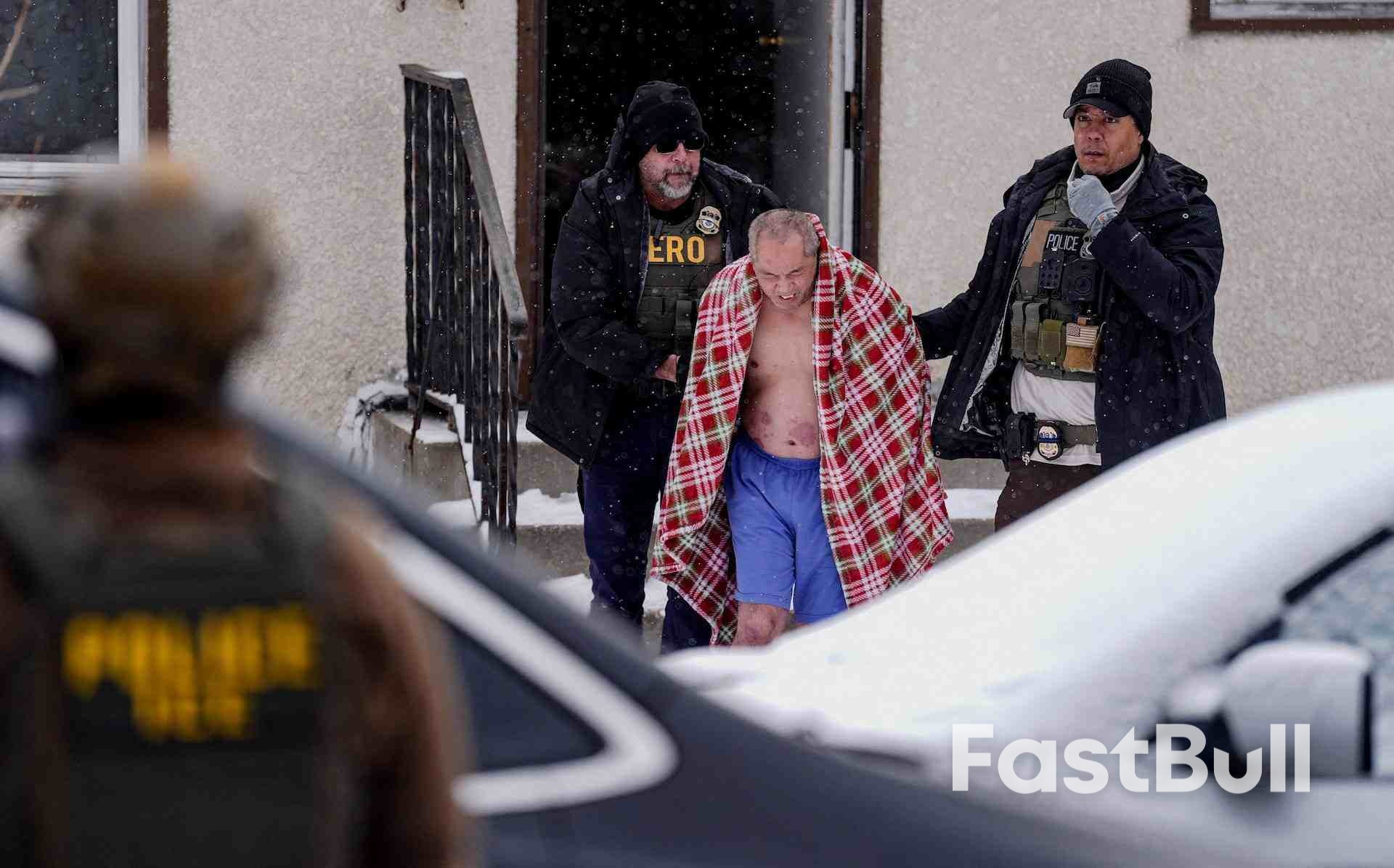
A Minnesota man told Reuters on Monday he felt fear, shame and desperation a day after ICE officers broke down his door with guns drawn, handcuffed him and dragged him into the snow wearing shorts and Crocs.
ChongLy Thao, 56, a naturalized U.S. citizen who goes by the name Scott, was returned home later on Sunday without explanation or apology, he said.
"I was praying. I was like, God, please help me, I didn't do anything wrong. Why do they do this to me? Without my clothes on," Thao, a Hmong man born in Laos, told Reuters from his home on Monday, while neighbors were at work fixing the broken door.
Pictures of the incident, opens new tab showing Thao barely clothed and covered in a blanket taken by a Reuters photographer and bystanders spread on social media, further fueling concern that federal law enforcement officers were exceeding their authority as part of U.S. President Donald Trump's immigration crackdown, which has seen some 3,000 officers deployed in the Minneapolis area.
A statement published by the family called the incident "unnecessary, degrading, and deeply traumatizing." The highest temperature in Saint Paul on Sunday was 14 degrees Fahrenheit (minus 10 degrees Celsius).
The Department of Homeland Security said officers were investigating two convicted sex offenders at the address and that a U.S. citizen living there refused to be fingerprinted or facially identified, so he was detained.
"He matched the description of the targets. As with any law enforcement agency, it is standard protocol to hold all individuals in a house of an operation for safety of the public and law enforcement," DHS spokeswoman Tricia McLaughlin said in a statement.
DHS published wanted posters for two men targeted in the investigation who were still at large, describing each as a "criminal illegal alien" from Laos who is subject to deportation orders. One of the men in the wanted posters previously lived at the house but moved out, according to relatives close to the situation, who described him as the ex-husband of a member of the Thao family.
A U.S. District Judge in Minnesota on Friday issued an injunction blocking the Trump administration from some aggressive tactics that she said would "chill" an ordinary citizen from engaging in constitutionally protected protest.
"That conduct includes the drawing and pointing of weapons; the use of pepper spray and other non-lethal munitions; actual and threatened arrest and detainment of protesters and observers; and other intimidation tactics," Judge Katherine Menendez wrote.
The Trump administration is appealing her injunction.
Thao said his parents brought him from Laos to the United States in 1974 when he was four-years-old and that he became a U.S. citizen in 1991. During the ordeal, he feared being sent back to Laos, where he has no relatives.
He said he was singing karaoke when there was a loud noise at the door. He and his family hid in a bedroom, where the federal officers found him. Thao said that he was trying to find his ID as officers escorted him out of the house.
Thao was wearing only boxer shorts and Crocs on his feet when officers denied him the chance to put on more clothes, he said. He used a blanket that his four-year-old grandson had been sleeping with on the couch to cover his torso.
After taking his fingerprints and a head shot in the car, officers returned him to his home, Thao said.
"We came here for a purpose, right? ... To have a bright future. To have a safe place to live," he said. "If this is going to turn out to be America, what are we doing here? Why are we here?"
White Label
Data API
Web Plug-ins
Poster Maker
Affiliate Program
The risk of loss in trading financial instruments such as stocks, FX, commodities, futures, bonds, ETFs and crypto can be substantial. You may sustain a total loss of the funds that you deposit with your broker. Therefore, you should carefully consider whether such trading is suitable for you in light of your circumstances and financial resources.
No decision to invest should be made without thoroughly conducting due diligence by yourself or consulting with your financial advisors. Our web content might not suit you since we don't know your financial conditions and investment needs. Our financial information might have latency or contain inaccuracy, so you should be fully responsible for any of your trading and investment decisions. The company will not be responsible for your capital loss.
Without getting permission from the website, you are not allowed to copy the website's graphics, texts, or trademarks. Intellectual property rights in the content or data incorporated into this website belong to its providers and exchange merchants.
Not Logged In
Log in to access more features
Log In
Sign Up