

Markets
News
Analysis
User
24/7
Economic Calendar
Education
Data
- Names
- Latest
- Prev



Signal Accounts for Members
All Signal Accounts
All Contests
 Japan Trade Balance (Customs Data) (SA) (Nov)
A:--
F: --
P: --
 U.K. BRC Overall Retail Sales YoY (Dec)
A:--
F: --
P: --
U.K. BRC Like-For-Like Retail Sales YoY (Dec)A:--
F: --
P: --
 Turkey Retail Sales YoY (Nov)
A:--
F: --
P: --
 U.S. NFIB Small Business Optimism Index (SA) (Dec)
A:--
F: --
P: --
 Brazil Services Growth YoY (Nov)
A:--
F: --
P: --
 Canada Building Permits MoM (SA) (Nov)
A:--
F: --
U.S. CPI MoM (SA) (Dec)A:--
F: --
P: --
U.S. CPI YoY (Not SA) (Dec)A:--
F: --
P: --
U.S. Real Income MoM (SA) (Dec)A:--
F: --
P: --
U.S. CPI MoM (Not SA) (Dec)A:--
F: --
P: --
U.S. Core CPI (SA) (Dec)A:--
F: --
P: --
U.S. Core CPI YoY (Not SA) (Dec)A:--
F: --
P: --
U.S. Core CPI MoM (SA) (Dec)A:--
F: --
P: --
U.S. Weekly Redbook Index YoYA:--
F: --
P: --
U.S. Building Permits Revised YoY (SA) (Oct)A:--
F: --
P: --
U.S. Building Permits Revised MoM (SA) (Oct)A:--
F: --
P: --
U.S. New Home Sales Annualized MoM (Oct)A:--
F: --
U.S. Annual Total New Home Sales (Oct)A:--
F: --
U.S. Cleveland Fed CPI MoM (SA) (Dec)A:--
F: --
P: --
U.S. Cleveland Fed CPI MoM (Dec)A:--
F: --
P: --
 China, Mainland Exports (Dec)
--
F: --
P: --
China, Mainland Imports YoY (CNH) (Dec)--
F: --
P: --
China, Mainland Imports (CNH) (Dec)--
F: --
P: --
China, Mainland Trade Balance (CNH) (Dec)--
F: --
P: --
China, Mainland Imports YoY (USD) (Dec)--
F: --
P: --
China, Mainland Exports YoY (USD) (Dec)--
F: --
P: --
China, Mainland M0 Money Supply YoY (Dec)--
F: --
P: --
China, Mainland M1 Money Supply YoY (Dec)--
F: --
P: --
China, Mainland M2 Money Supply YoY (Dec)--
F: --
P: --
U.S. EIA Natural Gas Production Forecast For The Next Year (Jan)--
F: --
P: --
U.S. EIA Short-Term Crude Production Forecast For The Next Year (Jan)--
F: --
P: --
U.S. EIA Short-Term Crude Production Forecast For The Year (Jan)--
F: --
P: --
EIA Monthly Short-Term Energy Outlook U.S. 30-Year Bond Auction Avg. Yield--
F: --
P: --
U.S. Budget Balance (Dec)--
F: --
P: --
 Argentina 12-Month CPI (Dec)
--
F: --
P: --
Argentina National CPI YoY (Dec)--
F: --
P: --
Argentina CPI MoM (Dec)--
F: --
P: --
Richmond Federal Reserve President Barkin delivered a speech. U.S. API Weekly Cushing Crude Oil Stocks--
F: --
P: --
U.S. API Weekly Crude Oil Stocks--
F: --
P: --
U.S. API Weekly Refined Oil Stocks--
F: --
P: --
U.S. API Weekly Gasoline Stocks--
F: --
P: --
 South Korea Unemployment Rate (SA) (Dec)
--
F: --
P: --
Japan Reuters Tankan Non-Manufacturers Index (Jan)--
F: --
P: --
Japan Reuters Tankan Manufacturers Index (Jan)--
F: --
P: --
China, Mainland Trade Balance (USD) (Dec)--
F: --
P: --
China, Mainland Exports YoY (CNH) (Dec)--
F: --
P: --
China, Mainland Outstanding Loans Growth YoY (Dec)--
F: --
P: --











No matching data

Latest Views
Latest Views
Trending Topics
Top Columnists
Latest Update
White Label
Data API
Web Plug-ins
Affiliate Program
View All
No data
Trump's 25% tariff on Iran-linked trade, effective immediately, imperils key partners like China and UAE.
President Donald Trump has announced a 25% tariff on goods from any country doing business with Iran, a move that places China and the United Arab Emirates at the forefront of economic risk.
The new policy, which Trump stated would be effective "immediately," aims to intensify pressure on the regime of Supreme Leader Ayatollah Ali Khamenei. The threat comes as Iranian authorities crack down on over two weeks of nationwide protests, which have received vocal support from the U.S. president.
According to data from the International Monetary Fund, China is Tehran's largest trading partner, with their commerce totaling $17.8 billion in 2024. The relationship is critical for Iran, which sends nearly 90% of its oil exports to China. This trade activity now exposes Beijing to significant U.S. tariffs, despite a trade truce agreed upon with Washington in October.
The United Arab Emirates follows closely, with $16.1 billion in trade with Iran. The exposure drops off significantly after the top two, with Turkey in third place at $8.8 billion.
The tariff threat extends beyond the Middle East and Asia, implicating several of Washington's European allies. Germany and Switzerland, for instance, have combined trade with Iran amounting to nearly $3.5 billion.
Other major economies also face potential consequences. India, which has previously navigated trade disputes with the U.S., is Iran's fourth-largest partner. Uzbekistan, a nation that signed a new trade and economic deal with the Trump administration in November, recorded $1.3 billion in trade with Iran in 2024.
The political backdrop for these measures is the widespread unrest within Iran. The protests originally erupted late last year following a sharp devaluation of the Iranian currency, a direct result of severe sanctions tied to the country's nuclear program.
These demonstrations have since evolved into the most significant and violent challenge to Khamenei's authority, drawing global attention and contributing to a rise in oil prices. The sentiment was echoed by German Chancellor Friedrich Merz, who on Tuesday became the first G7 leader to predict the Iranian regime was in its "final days."
Despite the announcement, crucial details about the tariffs remain unspecified. The Trump administration has not clarified which specific transactions, goods, or entities would be targeted, nor how the policy would be enforced.
Tracking compliance is further complicated by the opacity of Iran's official trade data, as the country often limits statistical releases and uses third-country channels to circumvent sanctions. So far, China, the UAE, Turkey, and India have not issued public comments on the proposed tariffs.
Capital flows into gold amid rising geopolitical and broader market risks, together with Jerome Powell's remarks about potential criminal prosecution, have not only driven XAU/USD to record highs (as discussed earlier today) but have also put pressure on the US Dollar Index (DXY).
Markets are also digesting the latest Non-Farm Payrolls data released on Friday. The figures pointed to a slowdown in the US economy, with actual job growth at 50K versus expectations of 66K. This reinforces the case for interest-rate cuts and acts as a bearish factor for the US dollar.
As a result, the dollar index is moving lower today.
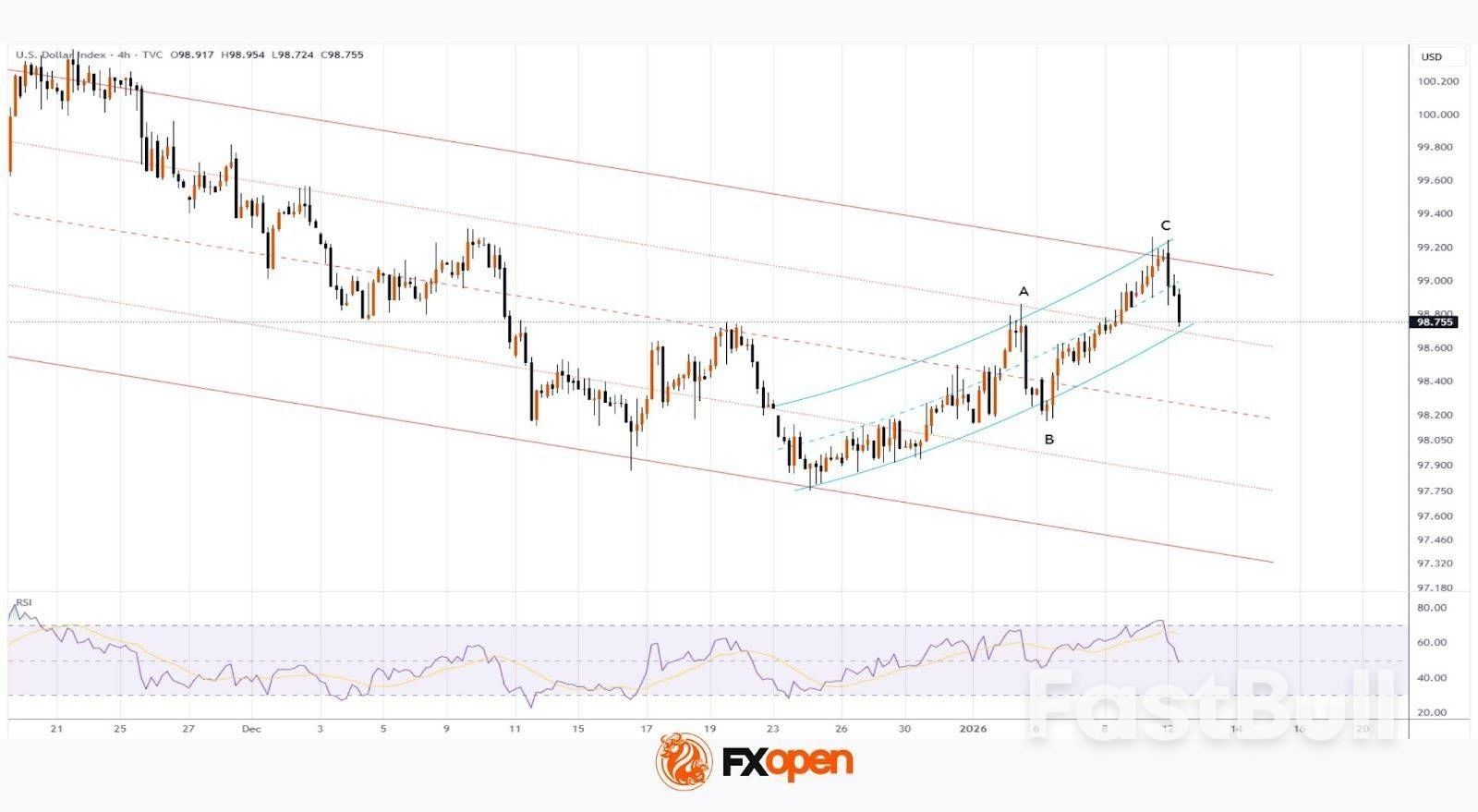
In the final days of 2025, when reviewing the DXY chart, we:
→ reaffirmed the descending channel (highlighted in red);
→ suggested that it would remain a key technical guide into early 2026.
This view has been confirmed, as the upper boundary of the channel is acting as strong resistance. Today's decline appears to be a reversal from this level. In this context, it is reasonable to assume that:
→ the recent move represents an intermediate A–B–C corrective rise within a broader downtrend, with point C coinciding with RSI overbought conditions;
→ the short-term upward trajectory (marked by blue lines) may soon be broken by sellers. If the broader downtrend resumes, DXY could slide towards the median of the descending channel.
President Donald Trump is launching a new populist economic message, using social media and high-profile interviews to address voter frustration ahead of the midterm elections. His next stop is a key battleground state where he will make his case directly to workers and business leaders.
On Tuesday, Trump will visit a Ford Motor Co. factory that builds F-150 trucks and speak at a Detroit Economic Club event, promoting his tariff and manufacturing policies as solutions to rising costs.
This visit is his third to a bellwether state since early December, signaling a new push from the administration to combat inflation and high gas prices. "With a little bit of patience, the American people are going to continue to see that the best is yet to come," White House Press Secretary Karoline Leavitt told Fox News.
With the November midterms approaching, the Trump administration is accelerating efforts to convince voters it is focused on their financial well-being. Since the start of the year, the administration has proposed a series of populist measures, including:
• Capping credit card charges.
• Banning institutional investors from purchasing rental homes.
• Buying mortgage-backed securities to lower interest rates.
• Intensifying pressure on the Federal Reserve.
In a recent social media post, Trump also stated he wants to prevent "big Technology Companies" from passing higher utility bills to consumers, a consequence of the energy demand from new AI-linked data centers.
Democratic strategist Jim Manley sees this as a sign of desperation. "It reinforces the idea that he understands that he's in a bad place right now and he's throwing everything but the kitchen sink at it," he said.
In a surprising move demonstrating the political weight of "affordability," Trump called longtime critic Senator Elizabeth Warren on Monday. The call came just after the Democratic senator gave a speech criticizing her own party for not fully embracing a populist economic agenda.
"I'm not going to talk about details of a conversation, but I just want to say it was all about costs, about how we reduce costs for American families," Warren said on Bloomberg Television.
While critical of the president's broader economic policies, Warren said she would "absolutely" work with him on issues she supports, such as passing legislation to cap credit card rates, "if he will actually fight for it."
A White House official confirmed the two had a productive conversation about credit card interest rates and housing affordability.
Despite the focus on pocketbook issues, many Republican lawmakers worry that headlines about foreign policy—from Venezuela to Iran and Greenland—are overshadowing the administration's economic message.
Recent polling reflects this challenge. A Quinnipiac University poll last month showed Trump's approval at 40%, with 54% disapproving. Only a third of voters rated the economy as "excellent" or "good," while 65% described it as "not so good" or "poor."
Trump's visit to Michigan is his second this term, underscoring the state's importance. Michigan was a key part of the "blue wall" that narrowly fell to him in 2024, and this year its governor's race, a Senate seat, and several close House races could be pivotal.
The state's economy under Trump presents a mixed picture. While Michigan's unemployment rate fell from 5.5% in April to 5% in November, the improvement was partly due to a shrinking labor force, with over 55,000 fewer people working or looking for work.
Michigan's economy is also uniquely exposed to Trump's tariff policies. Automakers have seen profits squeezed and costs rise, though they have so far managed by focusing on more expensive trucks and SUVs and getting some tariff relief on parts from Canada and Mexico. Forecasters at the University of Michigan project the state will lose 2,000 jobs this year, with unemployment expected to rise to 5.6% by the second quarter.
It remains unclear if Trump will increase his travel to battleground states. With ten months until the midterms, a Republican source close to the White House expressed confidence in holding the Senate but was more skeptical about the House. The source noted that the administration should have been more attuned to cost-of-living issues, which drove many voters to Trump in 2024.
After limited domestic travel in 2025, Trump held two campaign-style events in December in Pennsylvania and North Carolina. Advisers reportedly want him on the campaign trail more often to sell his policies.
Republican pollster Greg Strimple noted that Trump has a significant financial advantage. "I think that they are going to have money to define the race economically earlier in the cycle than normal," he said. Strimple also suggested that Trump's own anxieties could be a powerful motivator, pointing to the president's warning to lawmakers that he could face impeachment if Democrats retake the House. "I think that's animating," Strimple said.
The second week of the new year started with a lot of jitters and soul-searching as Donald Trump stepped up pressure on the Federal Reserve (Fed), sending the DoJ after Fed Chair Jerome Powell over the Fed's HQ renovations. But remember: Powell stood up for himself and made it very clear that the allegations had more to do with Trump's frustration that the Fed is not cutting interest rates at the speed he desires — a pace that would better serve his political ambitions.
And it's striking how powerful politicians are not told by those around them that the Fed cannot simply cut rates without consequences. Doing so would — leaving reputational issues aside — revive inflation and make matters worse. It wouldn't help solve the cost-of-living crisis, it wouldn't bring inflation down, and it wouldn't make housing more affordable. It would have the opposite effect.
This is why we are seeing the US yield curve steepen in response to serious attacks on the Fed's independence. The long end of the curve is rising faster than the short end on expectations that aggressive rate cuts today would push down short-dated yields, but ultimately fuel inflation and require tighter policy further down the road.
The US dollar is also feeling the pinch from the turmoil around the Fed. The debasement trade continues as investors lose confidence in a weakened Fed, which would be forced into looser monetary policy — resulting in weaker growth and higher inflation. I found the latest reactions from former Fed heads — iconic names such as Janet Yellen, Ben Bernanke and Alan Greenspan — exceptionally sincere. They warned that "this is how monetary policy is made in emerging markets with weak institutions, with highly negative consequences for inflation and the functioning of their economies."
If you have any doubt, Turkey is a striking example of what happens when a country undermines its central bank and hands control to a president who insisted that "higher rates cause inflation," pointing to Japan as historical evidence. Of course, Japan's liquidity trap had nothing to do with Turkey's economic fundamentals. Outcome? Inflation exploded, the lira collapsed — and not into golden dust — and the country has been steadily getting poorer since then.
Could the same happen to the US? The Titanic was made of iron, Sirs — and yes, it sank.
The debasement trade — the trade of a weakening US — is also boosting appetite for hard commodities. Gold and silver traded at fresh record highs yesterday, with silver consolidating near $85 per ounce this morning. I think it's only a matter of time before the white metal tests the $100 mark. There is little to stop the debasement trade as headlines worsen by the day.
Another example of a fallen star is Great Britain. Even though institutions remain strong, trust in — and appetite for — sterling deteriorated so badly after Brexit that reversing the trend looks extremely difficult. So again, yes: the Titanic can sink. And this time, the consequences would be global. The US dollar is involved in roughly 90% of global FX transactions, so the ripple effects could be enormous.
Turning to US equities, markets gap-opened lower yesterday, as rising rate-cut expectations are only half-good news. But buyers stepped back in, particularly into tech names helped by a weaker dollar, and the S&P 500 closed the session at a fresh record.
Make no mistake: the cheap dollar is powering part of this rally. While S&P 500 gains look impressive in nominal terms, the picture changes once returns are converted into other major currencies. The SMI, for example, may look unappetizing at first glance, but the Swiss index returned more than 15% last year, while the S&P 500 lost value in Swiss-franc terms. This is why hedging USD exposure matters. The US dollar is no longer the automatic safe haven it once was. In a selloff today, there is little reason to expect capital to flow into the dollar. Gold and silver look far more likely to absorb safety flows.
Today, the US releases its latest CPI data, while big banks kick off earnings season, with JPMorgan reporting Q4 results — just a day after Trump suggested credit-card interest rates should be capped at 10%, a comment that sent related stocks sharply lower. While last year was strong for trading and deal-making revenues, investors will focus on banks' economic outlook, loan-loss provisions, and views on AI productivity, credit quality, margins and capital deployment. Their guidance could set the tone for earnings season, as investors look for proof that Big Tech deserves its elevated valuations.
The S&P 500 is expected to deliver 8.3% earnings growth this quarter — the tenth consecutive quarter of positive EPS growth. Excluding the Magnificent Seven, earnings growth would fall to 4.6%. But expectations for coming quarters remain optimistic, helping avert a broader selloff despite unhelpful headlines — alongside continued liquidity support from the Fed. So I wouldn't necessarily sell America, but I would hedge US dollar risk.
In Japan, markets are shining as reports that PM Takaichi may dissolve the lower house and call a snap election boost sentiment. A strong victory could unlock greater fiscal stimulus, giving rise to what some are calling the "Takaichi rally." Tech stocks are leading gains, with the Topix up more than 2.5% at the time of writing, as she prioritises technology and defence investment. But the yields are to keep in mind: the 10-year JGB yield jumped to 2.16% this morning and the USDJPY is approaching the 159 level — a move that could soon trigger official pushback. Caution is warranted for those shorting the yen at current levels.
And a quick word on the risks posed by rising Japanese yields for global markets:Normally, rising JGB yields increase the risk of a global selloff, as higher domestic yields raise the incentive for large Japanese investors to repatriate capital and lock in more attractive returns at home. Today, however, global liquidity remains so ample that this channel matters less than it normally would.
Markets yesterday morning were pondering the chances and/or the potential reach of a revival of the 'Sell America' trade as the US Department of Justice served Fed Chair Jerome Powell and the Fed with subpoenas related the renovation of the Fed building. Powell reacted forcefully to what he sees an new attack on Fed independence.
In a first reaction in Aisa and Europe, US equities, the dollar and especially the ultra-long end of the curve suffered from rising US risk premia. However, tensions soon eased. If anything it turned out to be only a very light version of Sell America. US equities reversed early declines and even closed with marginal gains (S&P 500 +0.16%). The dollar indeed returned a limited part of its recent rebound. However, at a DXY close of 98.86 and EUR/USD at 1.167 the move was technically insignificant. US Treasuries underperformed Bunds, but bigger early session yield rises ended with a negligible steepening (2-y + 0.2 bps; 30-y +1.5 bps).
The 3-y ($58 bln) and especially 10-y ($39 bln) US Treasury auction also met more than decent investor buying interest. Maybe the pushback also from Republican Senators on the attack against Fed independence mitigated the market reaction. In Europe, interest markets extended the recent (corrective?) easing with German yields declining between 1.2 bps (2-y) and 2.6 bps (30-y). Expected softer inflation at the start of the year made markets conclude that the debate on an ECB rate hike is premature.
Especially Japanese markets show rather forceful moves this morning as press reports indicate a growing chance of PM Takaichi calling snap elections that might already take place mid-February. Japanese equities this morning are rising sharply on an the prospect of a potential ongoing fiscal stimulus . At the same time, risk premia at the long and of the yield curve are rising sharply (30-y +8.1 bp to 3.5%). The yen at the same time weakens (USD/JPY 158.9, weakest level of the yen since July 2024). Japanese Fin Min Katayama expressing concerns on this one-way decline of the yen in a meeting with US Fin Min Scott Bessent, for now didn't provide much support.
In the US, President Trump added another layer of uncertainty on already complicated US trade relations as he announced a tariffs of 25% on goods from countries that are doing business with Iran. For now, it is unclear which countries will be affected and how this will be implemented. US (equity) markets take a wait-and-see approach. Futures show negligible losses. Regarding the eco data, the US December CPI takes center stage. Markets expect 0.3% M/M and 2.7% Y/Y both for core and headline inflation. Figures still might feel some noise from the shutdown. We don't have a strong view on the risk to the outcome. Even so, a big downwards surprise is probably needed to reopen the debate on frontloading additional Fed easing. NY Fed president John Williams in comments overnight at least suggested that after the three consecutive rate cuts in H2 last year, the Fed is now well poisoned to stabilize the labour market and bring inflation back to target.
There are few data in EMU, but we look out on any potential spill-overs from the sell-off at the long end of the Japanese yield curve to other markets. In this respect, the US Treasury also sells 30-y bonds. The dollar (except for USD/JPY) shows little of a clear directional trend.
The European Commission in a plan outlined yesterday is considering a minimum price system for Chinese electric vehicles that would replace current import tariffs. The latter range up to 35% and were introduced after the EC concluded Chinese-made EVs enjoyed an unfair advantage from subsidies at home. Beijing retaliated but negotiations have since taken place to avoid the matter spiraling into an all-out trade war. The plan, under which Chinese exporters submit a minimum price proposal, annual volume limits as well as future investments in the region, all for the EC to then assess, should be seen in this context of defusing tensions.
The British Retail Consortium's retail sales gauge rose by 1.2% in December, well below the 12-month average of 2.3%. Food sales rose 3.1%. The non-food category posted a 0.3% annual decline with both in-store and online sales falling in yearly terms. Same store sales rose 1% with a similar divergence seen in food (+2.7% y/y) and non-food (-0.5% y/y). BRC's Chief Executive Dickinson noted "It was a drab Christmas for retailers, as sales growth slowed for the fourth consecutive month." She explained food sales rose mainly due to ongoing food inflation and added that non-food sales fell flat as gifting items did worse than expected and consumers were holding out for discounts. Dickinson concluded that "These figures show that consumer spending remains cautious, with households squeezed by the rising cost of living. Now is the time to support struggling families […]".
Exxon Mobil CEO Darren Woods delivered a blunt message to President Donald Trump last Friday, declaring Venezuela "uninvestable." The comment, made during a White House meeting with roughly 20 oil industry executives, echoed a stark warning already circulating among industry leaders and analysts.
The meeting was convened as President Trump pushed for a $100 billion investment from U.S. companies to rebuild Venezuela's collapsed oil sector following the capture of President Nicolás Maduro. However, many executives are skeptical that a quick turnaround is possible. According to sources familiar with the discussions, some even tried to persuade the White House not to hold the meeting, fearing their companies would be seen as opportunistically carving up Venezuela's vast crude reserves, which are believed to be the world's largest.
While Woods attended and spoke his mind, his directness appeared to backfire. By Sunday, Trump told reporters he "didn't like" the CEO's remarks and was inclined to exclude Exxon from Venezuela, stating, "They're playing too cute."
Andrew Logan, an oil and gas director at the climate advocacy nonprofit CERES, noted the miscalculation. "Woods thought he was speaking the truth—and he probably was—but he didn't read the room," Logan said. "He wasn't in a position to say that without blowback, and blowback is what he got."
The entire oil industry has good reason to be cautious about Venezuela. Reversing the decline of the country's oil production, which recently stood at nearly 1 million barrels per day, would be a monumental task. Restoring it to its 1970s peak of almost 4 million barrels daily would require tens of billions of dollars.
Before making any significant commitments, companies see several non-negotiable prerequisites:
• Infrastructure Overhaul: Abandoned rigs, leaky pipelines, and fire-damaged equipment would need to be rebuilt or replaced.
• Legal & Political Reforms: Clear rules are needed to allow companies to move money in and out of the country freely.
• On-the-Ground Security: Guarantees of physical safety for personnel and assets are essential.
Mike Sommers, CEO of the American Petroleum Institute, confirmed this unified stance on Monday. "The industry was unified on Friday... that there are going to be certain prerequisites that have to happen before there's continued investment in Venezuela," he told reporters.
For now, Chevron Corp. is the only major international oil company still operating in the country.
According to a source familiar with Exxon's thinking, the company was surprised by the media's reaction to Woods' comments. The CEO had also told Trump that Exxon was prepared to send an assessment team if invited by the Venezuelan government and expressed confidence the administration could deliver the necessary reforms.
Despite the President's public rebuke, administration officials reportedly took note of the changes Woods recommended. Exxon declined to comment further.
The incident reflects Woods' increasingly outspoken leadership, a departure from the more conservative public approach of his predecessor, Rex Tillerson, who later became Trump's Secretary of State. "They're gone from seeing silence as a source of strength to seeing silence as weakness," commented Logan. "It's been a dramatic shift."
This assertive style has been visible on other fronts:
• Challenging European Policy: Woods was one of the first high-profile CEOs to directly attack new European climate and human rights laws last year.
• Opposing Paris Agreement Exit: He pushed back against Trump's plan to withdraw the U.S. from the Paris climate agreement, arguing it would sacrifice America's influence on global carbon policy.
• Confronting Chevron: In a striking move, Woods took Chevron to international arbitration over its deal to buy Hess Corp., which included a 30% stake in Exxon's prized oil project off the coast of Guyana. Though Exxon lost the case, it left Chevron in strategic limbo for over a year.
There are currently no signs that the Trump administration will actively block Exxon's involvement in a potential Venezuelan reconstruction. As a major Western oil company with previous experience in the country—having left after billions in assets were seized—Exxon is well-positioned to contribute.
Venezuela's oil is mostly heavy and sour, presenting technical production challenges that could limit the capabilities of smaller, independent companies who appeared more optimistic at the White House meeting.
After the meeting, President Trump told reporters, "we sort of formed a deal." However, when asked for specifics, Energy Secretary Chris Wright could only point to Chevron's plan to increase its Venezuelan production by about 50% over the next 18 to 24 months as the "one specific pledge" made by an oil company.
What is the most expensive stock in 2026? Some companies trade at prices that seem unreachable for most investors, often costing tens or even hundreds of thousands of dollars per share. In this article, we explain what makes a stock so expensive, identify the highest-priced stocks in the world, and help you understand whether owning them actually makes sense for different types of investors.
When people ask what is the most expensive stock, many assume it refers to the company with the highest overall value. In reality, that is a common misunderstanding. A stock’s share price only reflects the cost of one individual share, not the total size of the company. Market capitalization, which multiplies share price by the number of shares outstanding, is a better measure of company value. Some firms simply have far fewer shares available, which pushes the price of each share much higher.
Another key reason certain stocks become extremely expensive is their approach to stock splits. Companies that avoid splitting their shares allow prices to rise steadily over many years. As the business grows and profits increase, the share price continues climbing instead of being reset through a split. Limited share supply and a long-term ownership strategy also reduce short-term trading, which helps maintain a high per-share price. This is why many companies with massive market value never appear on lists of the most expensive stocks in the world.
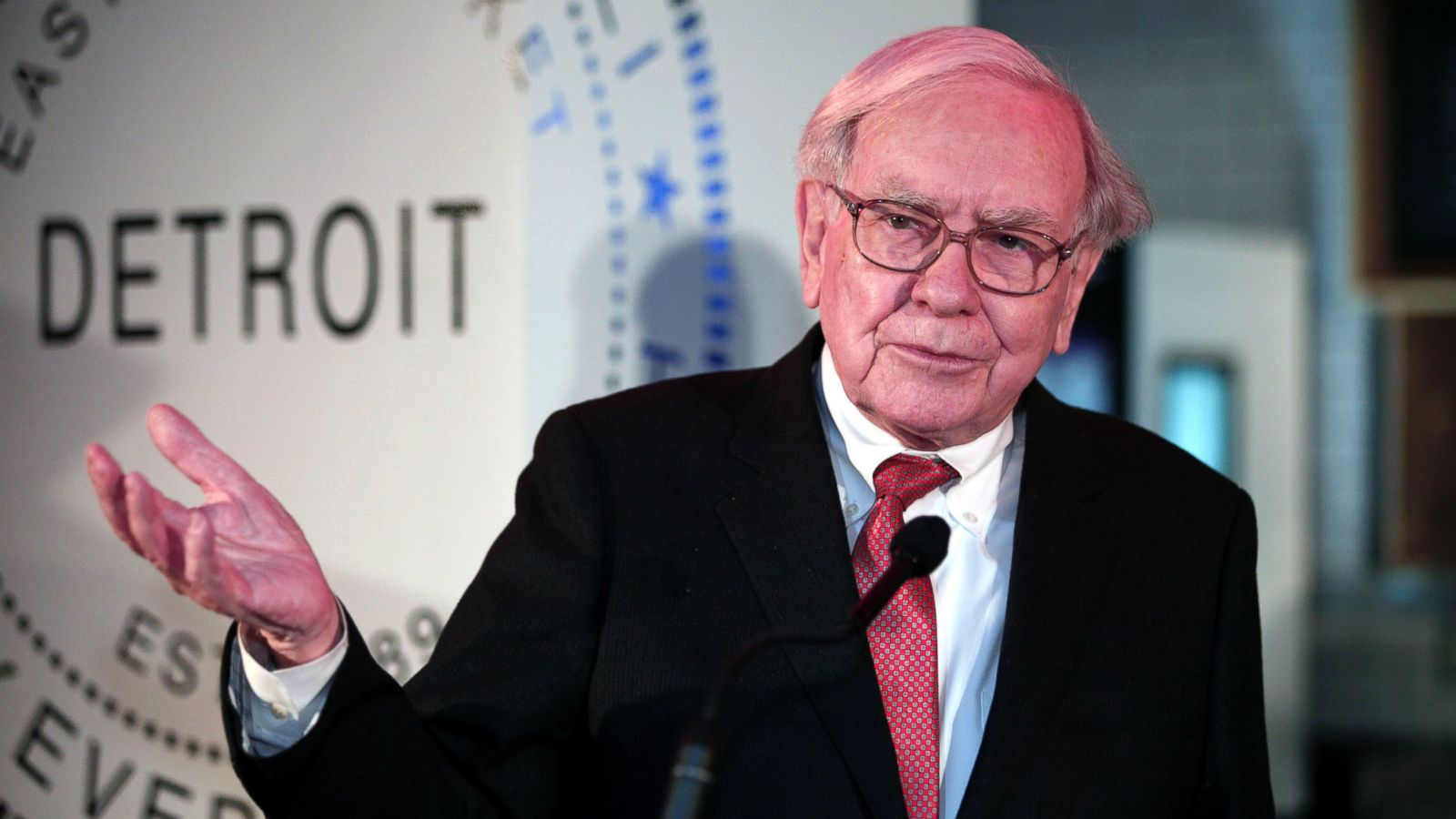
As of early 2026, Berkshire Hathaway Class A (BRK.A) is still the most expensive stock in the world by share price. It trades around $748,000 per share, which is why it’s often the first answer to questions like what is the most expensive stock right now and what stock is the most expensive.
BRK.A’s price isn’t “high” because it is trendy. The biggest driver is policy: Berkshire has never split its Class A shares. Over decades, a strong business plus no splits naturally pushed the per-share price into the hundreds of thousands.
Below are the top 8 highest-priced stocks in 2026 by share price. Prices move daily, so treat these as up-to-date reference points rather than fixed numbers.
| Rank (2026) | Company / Ticker | Approx. Share Price (Early Jan 2026) | Industry | Main Reason for High Price |
|---|---|---|---|---|
| 1 | Berkshire Hathaway (BRK.A) | ~$748,000 | Conglomerate / Insurance | No stock splits for Class A; long-term compounding |
| 2 | Lindt & Sprüngli (LISN) | ~CHF 116,400 | Consumer Defensive (Chocolate) | Very limited share availability; premium brand positioning |
| 3 | NVR (NVR) | ~$7,582 | Homebuilding | High price per share supported by strong profitability and share structure |
| 4 | Booking Holdings (BKNG) | ~$5,392 | Online Travel | Large cash flows and long-term growth; fewer shares than many mega-caps |
| 5 | Seaboard (SEB) | ~$4,407 | Agriculture & Shipping | Thin float and diversified operations |
| 6 | AutoZone (AZO) | ~$3,523 | Auto Parts Retail | Consistent earnings and aggressive buybacks over time |
| 7 | First Citizens BancShares (FCNCA) | ~$2,159 | Banking | High nominal price partly shaped by share count and long-term performance |
| 8 | White Mountains Insurance Group (WTM) | ~$2,042 | Insurance | Relatively low share count and steady capital management |
If you came here asking what is the most expensive stock, the answer is BRK.A. But the top 8 list shows something important: “expensive” is usually about share structure and company policy (like avoiding stock splits), not automatically about being a better investment.
A common assumption is that the most expensive stock in the world must also be the best investment. In reality, share price alone offers very limited insight. A stock trading at $700,000 per share is not automatically better than one trading at $70. The price only reflects how much one share costs, not how strong the business is or how much upside remains.
When investors ask what's the most expensive stock, they often focus on the number itself rather than what sits behind it. Two companies with identical market value can have drastically different share prices simply because one has more shares outstanding than the other. This is why price comparisons without context can be misleading.
Instead of focusing on price, long-term investors look at the fundamentals that actually drive value. These factors apply whether a company is the most expensive stock right now or a low-priced growth stock.
High-priced stocks often perform well because they score highly in several of these areas, not simply because their shares are expensive. Understanding this distinction helps investors avoid assuming that price equals quality.
Owning a stock with a very high share price can come with both advantages and drawbacks. Whether it makes sense depends on your goals and financial situation.
These trade-offs matter more than the headline price when evaluating whether a high-priced stock fits your portfolio.
For investors with significant capital, buying full shares of very expensive stocks may be possible, but still requires careful thought. Even if you can afford a single share, concentration risk becomes an issue. Putting a large portion of your portfolio into one position, even if it answers the question of what stock is the most expensive, can reduce diversification.
High-net-worth investors often approach these stocks as long-term holdings rather than short-term trades. The decision is usually based on business quality and long-term outlook, not the prestige of owning a high-priced share.
For most investors, buying a full share of the most expensive stock right now is simply unrealistic. Fortunately, there are alternatives that still provide exposure without requiring massive capital.
These options allow everyday investors to participate without focusing solely on what is the most expensive stock right now. In most cases, building a balanced portfolio matters far more than owning a single high-priced name.
The United States is home to the most expensive stocks in the world. Major exchanges like the NYSE and Nasdaq list companies with extremely high share prices, including Berkshire Hathaway. This is largely due to mature capital markets and long-established public companies.
No, Bitcoin is not a stock. It is a cryptocurrency and does not represent ownership in a company. While Bitcoin can trade at a high price per coin, it is fundamentally different from stocks and should not be compared directly.
There is no official limit to how expensive a stock can become. As long as a company avoids stock splits and continues to grow over time, its share price can keep rising indefinitely.
Understanding what is the most expensive stock goes beyond looking at a high share price. Expensive stocks often reflect unique share structures and long-term business strategies rather than superior investment returns. For most investors, the key is not owning the priciest stock, but choosing investments that match their financial goals, risk tolerance, and budget.
728 RM B 7/F GEE LOK IND BLDG NO 34 HUNG TO RD KWUN TONG KLN HONG KONG


White Label
Data API
Web Plug-ins
Poster Maker
Affiliate Program
The risk of loss in trading financial instruments such as stocks, FX, commodities, futures, bonds, ETFs and crypto can be substantial. You may sustain a total loss of the funds that you deposit with your broker. Therefore, you should carefully consider whether such trading is suitable for you in light of your circumstances and financial resources.
No decision to invest should be made without thoroughly conducting due diligence by yourself or consulting with your financial advisors. Our web content might not suit you since we don't know your financial conditions and investment needs. Our financial information might have latency or contain inaccuracy, so you should be fully responsible for any of your trading and investment decisions. The company will not be responsible for your capital loss.
Without getting permission from the website, you are not allowed to copy the website's graphics, texts, or trademarks. Intellectual property rights in the content or data incorporated into this website belong to its providers and exchange merchants.
Not Logged In
Log in to access more features

FastBull Membership
Not yet
Purchase


Log In
Sign Up


