
• Trade
  • Markets
  • Copy
  • Contests
  • News
  • 24/7
  • Calendar
  • Q&A
  • Chats
Trending
Screeners
SYMBOL
LAST
BID
ASK
HIGH
LOW
NET CHG.
%CHG.
SPREAD
SPX
S&P 500 Index
6863.71
6863.71
6863.71
6878.28
6861.22
-6.69
-0.10%
--
DJI
Dow Jones Industrial Average
47844.58
47844.58
47844.58
47971.51
47771.72
-110.40
-0.23%
--
IXIC
NASDAQ Composite Index
23602.97
23602.97
23602.97
23698.93
23579.88
+24.85
+ 0.11%
--
USDX
US Dollar Index
99.060
99.140
99.060
99.060
98.730
+0.110
+ 0.11%
--
EURUSD
Euro / US Dollar
1.16317
1.16324
1.16317
1.16717
1.16312
-0.00109
-0.09%
--
GBPUSD
Pound Sterling / US Dollar
1.33150
1.33161
1.33150
1.33462
1.33136
-0.00162
-0.12%
--
XAUUSD
Gold / US Dollar
4180.97
4181.38
4180.97
4218.85
4177.03
-16.94
-0.40%
--
WTI
Light Sweet Crude Oil
59.024
59.054
59.024
60.084
58.892
-0.785
-1.31%
--

Community Accounts

Signal Accounts
--
Profit Accounts
--
Loss Accounts
--
View More

Become a signal provider

Sell trading signals to earn additional income

View More

Guide to Copy Trading

Get started with ease and confidence

View More

Signal Accounts for Members

All Signal Accounts

Best Return
  • Best Return
  • Best P/L
  • Best MDD
Past 1W
  • Past 1W
  • Past 1M
  • Past 1Y

All Contests

  • All
  • Trump Updates
  • Recommend
  • Stocks
  • Cryptocurrencies
  • Central Banks
  • Featured News
Top News Only
Share

The S&P 500 Opened 4.80 Points Higher, Or 0.07%, At 6875.20; The Dow Jones Industrial Average Opened 16.52 Points Higher, Or 0.03%, At 47971.51; And The Nasdaq Composite Opened 60.09 Points Higher, Or 0.25%, At 23638.22

Share

Reuters Poll - Swiss National Bank Policy Rate To Be 0.00% At End-2026, Said 21 Of 25 Economists, Four Said It Would Be Cut To -0.25%

Share

USGS - Magnitude 7.6 Earthquake Strikes Misawa, Japan

Share

Reuters Poll - Swiss National Bank To Hold Policy Rate At 0.00% On December 11, Said 38 Of 40 Economists, Two Said Cut To -0.25%

Share

Traders Believe There Is A 20% Chance That The European Central Bank Will Raise Interest Rates Before The End Of 2026

Share

Toronto Stock Index .GSPTSE Rises 11.99 Points, Or 0.04 Percent, To 31323.40 At Open

Share

Japan Meteorological Agency: A Tsunami With A Maximum Height Of Three Meters Is Expected Following The Earthquake In Japan

Share

Japan Meteorological Agency: A 7.2-magnitude Earthquake Struck Off The Coast Of Northern Japan, And A Tsunami Warning Has Been Issued

Share

Japan Finance Minister Katayama: G7 Expected To Hold Another Meeting By The End Of This Year

Share

The Japan Meteorological Agency Reported That An Earthquake Occurred In The Sea Near Aomori

Share

Japan Finance Minister Katayama: The G7 Finance Ministers' Meeting Discussed The Critical Mineral Supply Chain And Support For Ukraine

Share

Japan Finance Minister Katayama: Held Onlinemeeting With G7 Finance Ministers

Share

Fed Data - USA Effective Federal Funds Rate At 3.89 Percent On 05 December On $88 Billion In Trades Versus 3.89 Percent On $87 Billion On 04 December

Share

Chinese Foreign Minister Wang Yi: One-China Principle Is An Important Political Foundation For China-Germany Relations, And There Is No Room For Ambiguity

Share

Chinese Foreign Minister Wang Yi: Hopes Germany To Understand, Support China's Position Regarding Japan Prime Minister's Remark On Taiwan

Share

Chinese Foreign Minister Wang Yi: Hopes Germany Will View China More Objectively And Rationally, Adhere To The Positioning Of China-Germany Partnership

Share

China Foreign Ministry: China's Foreign Minister Wang Yi Meets German Counterpart

Share

Israeli Government Spokesperson: Netanyahu Will Meet Trump On December 29

Share

Stc Did Not Ask Internationally-Government To Leave Aden - Senior Stc Official To Reuters

Share

Members Of Internationally-Recognised Government, Opposed To Northern Houthis, Have Left Aden - Senior Stc Official To Reuters

TIME
ACT
FCST
PREV
France Trade Balance (SA) (Oct)

A:--

F: --

P: --
Euro Zone Employment YoY (SA) (Q3)

A:--

F: --

P: --
Canada Part-Time Employment (SA) (Nov)

A:--

F: --

P: --

Canada Unemployment Rate (SA) (Nov)

A:--

F: --

P: --

Canada Full-time Employment (SA) (Nov)

A:--

F: --

P: --

Canada Labor Force Participation Rate (SA) (Nov)

A:--

F: --

P: --

Canada Employment (SA) (Nov)

A:--

F: --

P: --

U.S. PCE Price Index MoM (Sept)

A:--

F: --

P: --

U.S. Personal Income MoM (Sept)

A:--

F: --

P: --

U.S. Core PCE Price Index MoM (Sept)

A:--

F: --

P: --

U.S. PCE Price Index YoY (SA) (Sept)

A:--

F: --

P: --

U.S. Core PCE Price Index YoY (Sept)

A:--

F: --

P: --

U.S. Personal Outlays MoM (SA) (Sept)

A:--

F: --

P: --
U.S. 5-10 Year-Ahead Inflation Expectations (Dec)

A:--

F: --

P: --

U.S. Real Personal Consumption Expenditures MoM (Sept)

A:--

F: --

P: --
U.S. Weekly Total Rig Count

A:--

F: --

P: --

U.S. Weekly Total Oil Rig Count

A:--

F: --

P: --

U.S. Consumer Credit (SA) (Oct)

A:--

F: --

P: --
China, Mainland Foreign Exchange Reserves (Nov)

A:--

F: --

P: --

Japan Trade Balance (Oct)

A:--

F: --

P: --

Japan Nominal GDP Revised QoQ (Q3)

A:--

F: --

P: --

China, Mainland Imports YoY (CNH) (Nov)

A:--

F: --

P: --

China, Mainland Exports (Nov)

A:--

F: --

P: --

China, Mainland Imports (CNH) (Nov)

A:--

F: --

P: --

China, Mainland Trade Balance (CNH) (Nov)

A:--

F: --

P: --

China, Mainland Exports YoY (USD) (Nov)

A:--

F: --

P: --

China, Mainland Imports YoY (USD) (Nov)

A:--

F: --

P: --

Germany Industrial Output MoM (SA) (Oct)

A:--

F: --

P: --
Euro Zone Sentix Investor Confidence Index (Dec)

A:--

F: --

P: --

Canada National Economic Confidence Index

A:--

F: --

P: --

U.K. BRC Like-For-Like Retail Sales YoY (Nov)

--

F: --

P: --

U.K. BRC Overall Retail Sales YoY (Nov)

--

F: --

P: --

Australia Overnight (Borrowing) Key Rate

--

F: --

P: --

RBA Rate Statement
RBA Press Conference
Germany Exports MoM (SA) (Oct)

--

F: --

P: --

U.S. NFIB Small Business Optimism Index (SA) (Nov)

--

F: --

P: --

Mexico 12-Month Inflation (CPI) (Nov)

--

F: --

P: --

Mexico Core CPI YoY (Nov)

--

F: --

P: --

Mexico PPI YoY (Nov)

--

F: --

P: --

U.S. Weekly Redbook Index YoY

--

F: --

P: --

U.S. JOLTS Job Openings (SA) (Oct)

--

F: --

P: --

China, Mainland M1 Money Supply YoY (Nov)

--

F: --

P: --

China, Mainland M0 Money Supply YoY (Nov)

--

F: --

P: --

China, Mainland M2 Money Supply YoY (Nov)

--

F: --

P: --

U.S. EIA Short-Term Crude Production Forecast For The Year (Dec)

--

F: --

P: --

U.S. EIA Natural Gas Production Forecast For The Next Year (Dec)

--

F: --

P: --

U.S. EIA Short-Term Crude Production Forecast For The Next Year (Dec)

--

F: --

P: --

EIA Monthly Short-Term Energy Outlook
U.S. API Weekly Gasoline Stocks

--

F: --

P: --

U.S. API Weekly Cushing Crude Oil Stocks

--

F: --

P: --

U.S. API Weekly Crude Oil Stocks

--

F: --

P: --

U.S. API Weekly Refined Oil Stocks

--

F: --

P: --

South Korea Unemployment Rate (SA) (Nov)

--

F: --

P: --

Japan Reuters Tankan Non-Manufacturers Index (Dec)

--

F: --

P: --

Japan Reuters Tankan Manufacturers Index (Dec)

--

F: --

P: --

Japan Domestic Enterprise Commodity Price Index MoM (Nov)

--

F: --

P: --

Japan Domestic Enterprise Commodity Price Index YoY (Nov)

--

F: --

P: --

China, Mainland PPI YoY (Nov)

--

F: --

P: --

China, Mainland CPI MoM (Nov)

--

F: --

P: --

Q&A with Experts
    • All
    • Chatrooms
    • Groups
    • Friends
    Connecting
    .
    .
    .
    Type here...
    Add Symbol or Code

      No matching data

      All
      Trump Updates
      Recommend
      Stocks
      Cryptocurrencies
      Central Banks
      Featured News
      • All
      • Russia-Ukraine Conflict
      • Middle East Flashpoint
      • All
      • Russia-Ukraine Conflict
      • Middle East Flashpoint
      Search
      Products

      Charts Free Forever

      Chats Q&A with Experts
      Screeners Economic Calendar Data Tools
      Membership Features
      Data Warehouse Market Trends Institutional Data Policy Rates Macro

      Market Trends

      Market Sentiment Order Book Forex Correlations

      Top Indicators

      Charts Free Forever
      Markets

      News

      News Analysis 24/7 Columns Education
      From Institutions From Analysts
      Topics Columnists

      Latest Views

      Latest Views

      Trending Topics

      Top Columnists

      Latest Update

      Signals

      Copy Rankings Latest Signals Become a signal provider AI Rating
      Contests
      Brokers

      Overview Brokers Assessment Rankings Regulators News Claims
      Broker listing Forex Brokers Comparison Tool Live Spread Comparison Scam
      Q&A Complaint Scam Alert Videos Tips to Detect Scam
      More

      Business
      Events
      Careers About Us Advertising Help Center

      White Label

      Data API

      Web Plug-ins

      Affiliate Program

      Awards Institution Evaluation IB Seminar Salon Event Exhibition
      Vietnam Thailand Singapore Dubai
      Fans Party Investment Sharing Session
      FastBull Summit BrokersView Expo
      Recent Searches
        Top Searches
          Markets
          News
          Analysis
          User
          24/7
          Economic Calendar
          Education
          Data
          • Names
          • Latest
          • Prev

          View All

          No data

          Scan to Download

          Faster Charts, Chat Faster!

          Download App
          English
          • English
          • Español
          • العربية
          • Bahasa Indonesia
          • Bahasa Melayu
          • Tiếng Việt
          • ภาษาไทย
          • Français
          • Italiano
          • Türkçe
          • Русский язык
          • 简中
          • 繁中
          Open Account
          Search
          Products
          Charts Free Forever
          Markets
          News
          Signals

          Copy Rankings Latest Signals Become a signal provider AI Rating
          Contests
          Brokers

          Overview Brokers Assessment Rankings Regulators News Claims
          Broker listing Forex Brokers Comparison Tool Live Spread Comparison Scam
          Q&A Complaint Scam Alert Videos Tips to Detect Scam
          More

          Business
          Events
          Careers About Us Advertising Help Center

          White Label

          Data API

          Web Plug-ins

          Affiliate Program

          Awards Institution Evaluation IB Seminar Salon Event Exhibition
          Vietnam Thailand Singapore Dubai
          Fans Party Investment Sharing Session
          FastBull Summit BrokersView Expo

          Tracking BTC Amid Fluctuating ETF Inflows and SEC Actions

          Samantha Luan

          Cryptocurrency

          Summary:

          Bitcoin (BTC) declined by 1.26% on Monday (May 6), closing the session at $63,191.News of the SEC issuing Robinhood (HOOD) a Wells Notice impacted buyer demand for BTC and the broader crypto market.
          BTC Impacted by SEC Wells Notice to Robinhood
          Bitcoin (BTC) declined by 1.26% on Monday (May 6). Reversing a 0.11% gain from Sunday (May 5), BTC ended the session at $63,191.
          News of the SEC issuing Robinhood (HOOD) a Wells Notice impacted buyer demand for BTC and the broader crypto market.
          CEO and co-founder Vlad Tenev had this to say about the Wells Notice,
          “Over the last three years, we’ve reached a state of regulatory onslaught that is harmful to American companies and consumers. The SEC’s continued attack on crypto, coupled with recent rule proposals like the one related to predictive data analytics, mark yet another improper attempt by the administrative state to stifle innovation.”
          The news coincided with the SEC filing its remedies reply brief in the ongoing SEC vs. Ripple case.
          However, the US BTC-spot ETF market brushed aside the news with a second successive session of net inflows.
          According to Farside Investors,
          Grayscale Bitcoin Trust (GBTC) saw net inflows of $3.9 million. Significantly, GBTC saw net inflows for the second successive session and the second time since January 11.Fidelity Wise Origin Bitcoin Fund (FBTC) recorded net inflows of $99.2 million, down from $102.6 million on Friday (May 3).ARK 21Shares Bitcoin ETF saw net inflows of $75.6 million, up from $28.1 million on Friday (May 3).Excluding flow data for iShares Bitcoin Trust (IBIT), the US BTC-spot ETF market recorded total net inflows of $195.5 million. On Friday (May 3), the US BTC-spot ETF market saw total net inflows of $378.3 million.
          Rising bets on a September Fed interest rate cut drove buyer demand for BTC-spot ETFs. According to the CME FedWatch Tool, the chances of the Fed leaving interest rates unchanged fell from 42.5% to 35.2% between April 29 and May 6.
          BTC was up 1.07% to $63,865 on Tuesday (May 7) morning.

          Technical Analysis

          Bitcoin Analysis
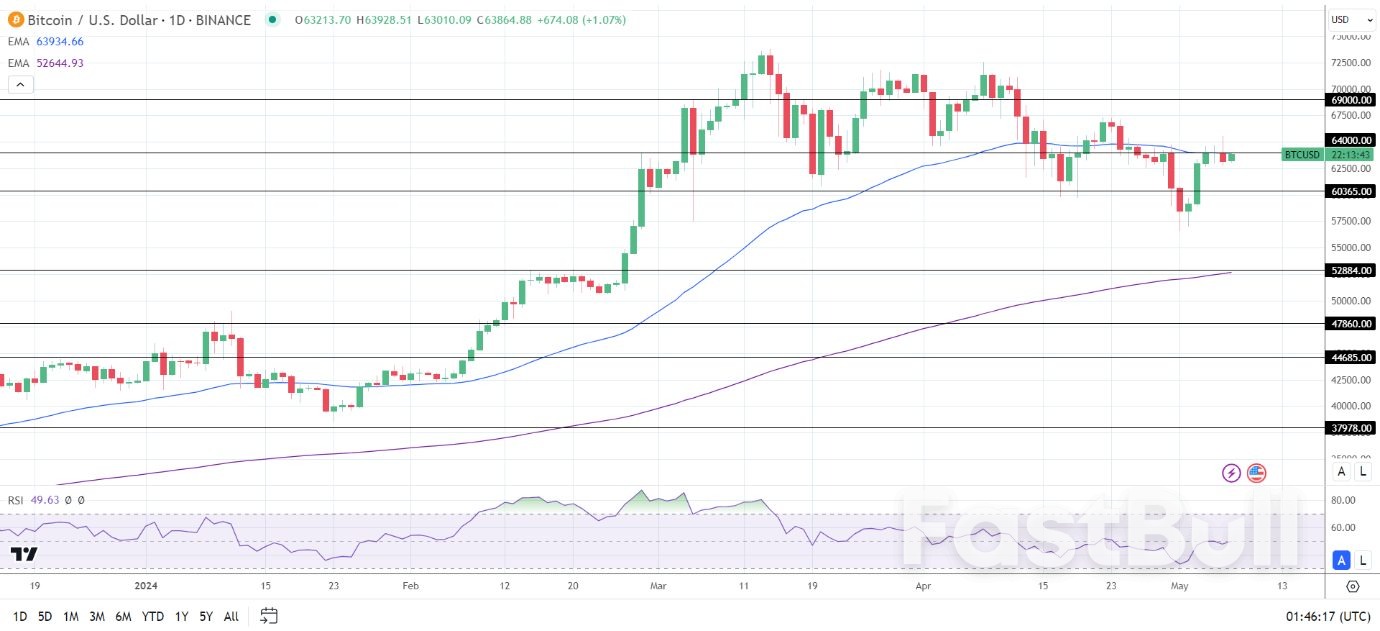
          Tracking BTC Amid Fluctuating ETF Inflows and SEC Actions_1BTC sat below the 50-day EMA while holding above the 200-day EMA, sending bearish near-term but bullish longer-term price signals.
          A BTC break above the 50-day EMA and the $64,000 resistance level would support a move toward the $69,000 resistance level. A breakout from the $69,000 resistance level could give the bulls a run at the $73,808 all-time high.
          On Tuesday (May 6), SEC activity, Fed speakers, and BTC-spot ETF market flow trends need consideration.
          Conversely, a BTC drop below the $62,500 level could signal a fall to the $60,365 support level.
          With a 49.63 14-Daily RSI reading, BTC could drop below the $60,000 handle before entering oversold territory.
          Ethereum Analysis
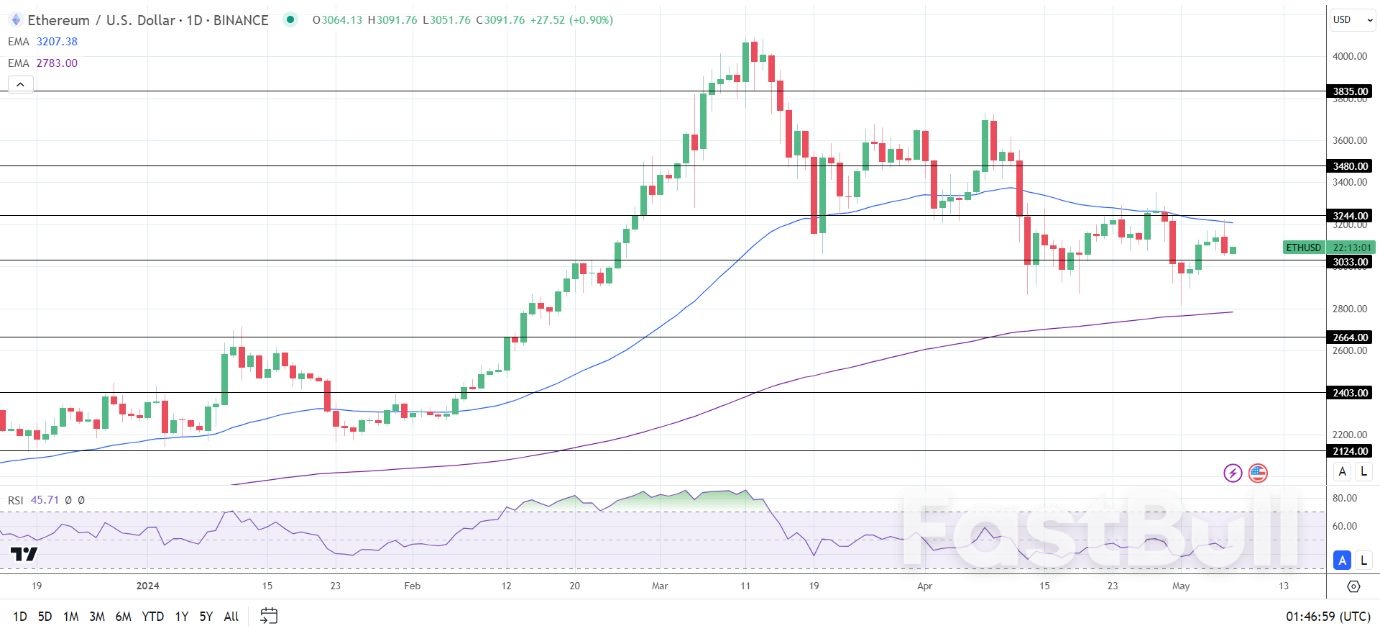
          Tracking BTC Amid Fluctuating ETF Inflows and SEC Actions_2ETH hovered below the 50-day EMA while remaining above the 200-day EMA. The EMAs affirmed the bearish near-term but bullish longer-term price signals.
          An ETH move through the 50-day EMA could give the bulls a run at the $3,244 resistance level. A break above the $3,244 resistance level would support a move toward the $3,480 resistance level.
          Conversely, an ETH break below the $3,033 support level could signal a drop toward the 200-day EMA.
          The 14-period Daily RSI reading of 45.71 suggests an ETH fall to the 200-day EMA before entering oversold territory.

          Source: FX Empire

          Risk Warnings and Disclaimers
          You understand and acknowledge that there is a high degree of risk involved in trading. Following any strategies or investment methods may lead to potential losses. The content on the site is provided by our contributors and analysts for information purposes only. You are solely responsible for determining whether any trading assets, securities, strategy, or any other product is suitable for investing based on your own investment objectives and financial situation.
          Add to Favorites
          Share

          China Is Buying Gold Like There’s No Tomorrow

          Samantha Luan

          Commodity

          As gold surged this year to its highest price ever, Xena Lin joined the frenzy by making monthly purchases of gold “beans”, pebble-like morsels of the precious metal.
          For Lin, a 25-year-old administrative worker in southern China, the US$80 beans – small enough to rest on a fingertip and weighing about one-thirtieth of an ounce – were an affordable way to buy into the gold excitement without splurging for jewellery, gold bars or coins. She had dabbled with investing in stocks in the past, but she said buying gold, especially in this fun way, inspired her to continue investing.
          “I’m still working hard to save more,” Lin said.
          Often considered a safe investment during times of geopolitical and economic turmoil, gold has soared in price in response to Russia’s invasion of Ukraine and the war in the Gaza Strip. But gold’s climb to highs above US$2,400 per ounce has proved more resilient, and lasted longer, because of China.
          Chinese consumers have flocked to gold as their confidence in traditional investments like real estate or stocks has faltered. At the same time, the country’s central bank has steadily added to its gold reserves, while whittling away at its holdings of US debt. And throwing fuel on the fire are Chinese speculators betting that there is still room for appreciation.
          China already held considerable sway in gold markets. But the country’s influence has become more pronounced during this latest bull run – a nearly 50 per cent increase in the global price since late 2022. It continued to scale new heights despite factors that traditionally make gold a comparatively less appealing investment: higher interest rates and a strong US dollar.
          Last month, gold prices vaulted higher even after the Federal Reserve signalled that it would keep higher interest rates for longer. And it has continued to appreciate even as the US dollar has risen against almost every major currency in the world this year.
          Prices have pulled back , but there is a growing sentiment that the gold market is governed no longer by economic factors but by the whims of Chinese buyers and investors.
          “China is unquestionably driving the price of gold,” said Ross Norman, CEO of MetalsDaily.com, a precious-metals information platform based in London. “The flow of gold to China has gone from solid to an absolute torrent.”
          Gold consumption in the country rose 6 per cent in the first quarter from a year earlier, according to the China Gold Association. It came on the heels of a 9 per cent increase last year.
          Gold investing became more alluring as traditional investments turned lacklustre. China’s real estate sector, the destination for most families’ savings, remains in crisis. Investor confidence in the country’s stock markets has not fully returned. A string of big investment funds aimed at the wealthy toppled after failed bets on real estate.
          With few better alternatives, money flowed into Chinese funds that traded in gold, and many young people took to collecting beans in tiny quantities.
          Online merchants are aggressively hawking gold beans. On Alibaba’s Taobao, one of China’s biggest e-commerce platforms, a merchant sold gold beans on a livestream – a blend of the Home Shopping Network and Amazon. She said buying beans was “like shopping, but an investment”.
          The tiny beans came in five shapes, including one that resembled a peanut and another like a persimmon. Paying US$87 per bean, a person could buy into the gold boom for the price of a hot pot meal, she said.
          Kelly Zhong, a teacher in Beijing, started buying gold in 2020 at the outset of the pandemic. She has amassed more than 2 pounds (0.9 kg) of gold bars, but she has also invested in the metal through exchange-traded funds. She said she was inspired by an old saying: “Jade in prosperous times, gold in troubled times.”
          As she felt the world become more chaotic, Zhong added to her stockpile, betting that gold prices would only climb. She has stopped buying, but she is not ready to sell. She sees no reason to. The Chinese economy is still struggling, and neither real estate nor stocks seem like a sound investment.
          “The money has to go somewhere,” she said.
          Another major buyer of gold in China is the country’s central bank. In March, the People’s Bank of China added to its gold reserves for a 17th straight month. Last year, the bank bought more gold than any other central bank in the world, adding more to its reserves than it had in nearly 50 years.
          Beijing is buying up gold to diversify its reserve funds and reduce its dependence on the US dollar, long considered the most important currency to hold in reserve. China has been reducing its US Treasury holdings for more than a decade. As at March, China had about US$775 billion worth of US debt, down from about US$1.1 trillion in 2021.
          When China increased its gold holdings in the past, it bought domestically using yuan, said Guan Tao, global chief economist at BOC International in Beijing. But this time, he said, the bank is using foreign currencies to buy gold – effectively reducing its exposure to the US dollar and other currencies.
          Many central banks, including China, started acquiring gold after the US Treasury Department took the rare step of freezing Russia’s US dollar holdings under sanctions imposed on Moscow. Other American allies imposed similar restrictions for their currencies.
          Guan said the sanctions had shaken the “foundation of trust for the current international monetary system” and forced central banks to protect their reserves with more diverse holdings. “We can see this wave of gold’s rise may be different from the past,” he said.
          Although Beijing has been buying up gold, the metal accounts for only about 4.6 per cent of China’s foreign exchange reserves. In percentage terms, India holds nearly twice as much of its reserves in gold.
          The combination of aggressive retail buying from Chinese consumers and central bank purchases has drawn the interest of speculators on markets in Shanghai who are betting that this trend will continue. Average trading volume for gold on the Shanghai Futures Exchange more than doubled in April from a year earlier.
          “They are swimming with the tide,” said Norman from MetalsDaily. “China is now dominating the gold market.”
          For Lin, buying gold beans is satisfying, she said, because it feels like frivolous shopping but she’s actually investing her money in something she can touch. She said she would continue to buy more beans.
          “The price of gold always goes up and down,” she said. “But the increase is within the range that I can bear, so I think it’s OK.”

          Source:NYTims

          Risk Warnings and Disclaimers
          You understand and acknowledge that there is a high degree of risk involved in trading. Following any strategies or investment methods may lead to potential losses. The content on the site is provided by our contributors and analysts for information purposes only. You are solely responsible for determining whether any trading assets, securities, strategy, or any other product is suitable for investing based on your own investment objectives and financial situation.
          Add to Favorites
          Share

          Japan Warns Of Action Over Rapid Currency Moves

          Cohen

          Economic

          Japan may have to take action against any disorderly, speculative-driven foreign exchange moves, the government’s top currency diplomat Masato Kanda said on Tuesday, reinforcing Tokyo’s readiness to intervene again to support a fragile yen.
          “It is preferable for exchange rates to remain in a stable manner following fundamentals, and if the market is functioning soundly in this way, there is of course no need for the government to intervene,” Kanda, Japan’s vice-minister of finance for international affairs, told reporters.
          “However, when there are excessive fluctuations or disorderly movements due to speculation, the market is not functioning and the government may have to take appropriate action. We will continue to take the same firm approach as we have in the past.”
          Tokyo is suspected to have intervened on at least two separate days last week to support the yen after it tumbled to lows last seen more than three decades ago.
          Bank of Japan data suggested authorities spent more than 9 trillion yen (S$79 billion) in defence of its currency, helping lift the yen from a 34-year low of 160.245 per dollar to a roughly one-month high of 151.86 over the span of a week.
          The yen was last trading around 154.27 in early Asia.
          Kanda said it is normal practice for a currency authority to not comment on whether it has carried out market intervention, when asked about recent speculations that Japan has conducted yen-buying interventions.
          A weaker yen is a boon for Japanese exporters, but a headache for policymakers as it increases import costs, adds to inflationary pressures and squeezes households.
          Kanda also noted that a number of countries in addition to Japan had expressed serious concerns about foreign exchange market volatility in a meeting leading up to a Asean+3 finance ministers and central bank governors conference in the Georgian capital Tbilisi last week.
          Asean+3 groups the 10-member Association of Southeast Asian Nations (Asean) as well as Japan, China and South Korea.
          “The current concerns are not confined to Japan,” Kanda said.

          Source:Reuters

          To stay updated on all economic events of today, please check out our Economic calendar
          Risk Warnings and Disclaimers
          You understand and acknowledge that there is a high degree of risk involved in trading. Following any strategies or investment methods may lead to potential losses. The content on the site is provided by our contributors and analysts for information purposes only. You are solely responsible for determining whether any trading assets, securities, strategy, or any other product is suitable for investing based on your own investment objectives and financial situation.
          Add to Favorites
          Share

          The US Will See a Recession by Year-End That Could Spark a 30% Drop in the Stock Market, Legendary Forecaster Gary Shilling Says

          Cohen

          Economic

          Stocks

          In an interview with Business Insider, the Wall Street vet — who was among the investors in the mid-2000s to call the subprime mortgage bubble — said he saw a recession coming by the end of the year as the job market continues to weaken. That could be the final blow to the stock market rally fueled by investor overconfidence, causing stocks to drop by as much as 30%, Shilling said.
          Shilling pointed to the recent run-up in risky assets, such as stocks and cryptocurrency. That itself is a sign the market is poised to drop, especially once a downturn gets underway, he said.
          "You look at all the kind of speculation that we've had out there, it's indicative of a lot of overconfidence, and that usually gets corrected and corrected violently," he said.
          The economy has already been flashing key signs of weakness as high interest rates take their toll. The labor market is weakening, with the unemployment rate sticking close to a two-year high in March.
          Meanwhile, quit rates slumped to around 2% in March, a sign that workers are waking up to difficult hiring conditions and are less willing to leave their jobs than they were in the past.
          The job market, for one, is "obviously slipping" as firms pull back on hiring, Shilling said.
          Shilling believes companies have held onto more workers than they needed due to the shortage of labor that slammed employers during the pandemic. Layoffs will escalate later this year, with unemployment peaking at 5%-7% as the economy continues to weaken, he predicted.
          "Employers wanted to hang onto their workforce and even add to it, because they figured things were going to be tight forever. Well, they haven't been tight forever. The economy's growth has been slipping … Employers are simply cutting back," Shilling warned.
          Job losses could end up hitting Americans hard, especially since there are signs that many may be in worse shape financially than they were several years ago. Consumers probably blew through the last of their excess savings from the pandemic in March, San Francisco Fed economists estimated.
          Meanwhile, a handful of recession indicators have been sounding the alarm on the economy for months. The 2-10 Treasury yield curve, the bond market's most famous recession gauge, has been signaling a downturn since July 2022. The Conference Board's Leading Economic Index, another gauge of economic strength, ticked lower in April, though the measure is not yet in recessionary territory.
          "When you start to see the softness in these indicators and the actual turn down in business can be long and variable, but they are reliable enough, and I think that the safe bet is for a recession starting later this year if we're not already in it," Shilling said.
          Shilling is known for his contrarian and often bearish takes on the market. Previously, he told Business Insider he looks to actively disagree with other Wall Street strategists, as the consensus view is typically already discounted in markets.
          "I think people are being overly optimistic and hopeful in the face of a lot of evidence to the contrary," he warned.

          Source: Business Insider

          To stay updated on all economic events of today, please check out our Economic calendar
          Risk Warnings and Disclaimers
          You understand and acknowledge that there is a high degree of risk involved in trading. Following any strategies or investment methods may lead to potential losses. The content on the site is provided by our contributors and analysts for information purposes only. You are solely responsible for determining whether any trading assets, securities, strategy, or any other product is suitable for investing based on your own investment objectives and financial situation.
          Add to Favorites
          Share

          World Prefers U.S. Over China For Leadership When A Democrat Is President,Gallup Analysis Shows

          Alex

          Political

          Most countries prefer alignment with the U.S. over China when the White House is occupied by a Democrat, according to Gallup poll data going back to 2007.
          "Significantly more countries seem to prefer U.S. leadership over Chinese leadership, at least under Democratic administrations," Gallup said in a report released Monday, adding that a Republican executive comes with a "net approval disadvantage."
          Gallup's report showed that in 2023, nearly half (48%) of the world's countries leaned towards the U.S. as opposed to China — which was favored by 21% of the more than 130 countries polled. Over a fifth of the nations were found to be "strongly aligned" with the U.S., the highest rate since 2009.
          Throughout most of the Trump administration, a larger share of countries had favored China, which changed as Democrat Joe Biden took office at the start of 2021.
          "The magnitude of these swings comes into stark focus when one compares country alignments across years," the global analytics and advisory firm said, citing similar party-related trends under the George Bush and Barack Obama administrations.
          The trend outlined by Gallup suggests that America's influence over the world could be dependent on the tightly contested upcoming presidential rematch between Biden and Trump.
          Leading up to the election, both candidates have signaled a tough stance on China, with a growing number of Americans seeing Beijing as an enemy rather than a competitor or partner, according to a Pew Research poll released last week.
          According to Gallup, the "bounce-back" under the Biden administration suggests that the U.S.'s net approval advantage over China is resilient, especially when accounting for more strongly aligned groups.
          Though China made short-term country gains in relative alignment under Trump, most fell under the "weakly aligned" category." China's favorability peaked in 2007 as it emerged on the global stage, but increased familiarity with Beijing has not boosted its appeal, Gallup said.
          Meanwhile, U.S. leadership has enjoyed a general net approval rate under the Biden and Obama administrations, compared with net disapproval rates under the Trump and last two years of the Bush leadership, the report showed.
          In the back-and-forth battle for global influence, however, both the world's economic superpowers have suffered a trend of disillusionment in one form or the other in recent years.
          Gallup analysis showed that since 2017, more countries disapproved of both China and U.S. leadership than approved of them, with 2021 being an exception. The disapproval rate was the highest under the Trump administration, peaking in 2020 at 48%.
          Even though this proportion has declined during the Biden administration, it remains roughly double what it was for most of the Obama administration, Gallup said.
          "This trend toward an increasing number of countries expressing negative net approval of U.S. and Chinese leadership suggests a growing lack of enthusiasm for these two global powers," it added.
          The U.S. has lost much of its relative favorability versus China in countries such as Russia and some nations in Africa. On the other hand, it made gains in some countries impacted by the invasion of Ukraine, such as Poland, and several Asian countries.
          While it gained approval of countries in Southeast Asia, such as the Philippines, a majority of countries in the region are likely to align with China and not the U.S. if forced to pick sides, according to a regional survey earlier this year.
          Of the countries identified as world leaders in Gallup's latest "Rating World Leaders" report, Germany led both the U.S. and China with an approval rate of 46%. The third largest economy in the world had the highest approval ratings in both Europe and Asia.

          Source:CNBC

          Risk Warnings and Disclaimers
          You understand and acknowledge that there is a high degree of risk involved in trading. Following any strategies or investment methods may lead to potential losses. The content on the site is provided by our contributors and analysts for information purposes only. You are solely responsible for determining whether any trading assets, securities, strategy, or any other product is suitable for investing based on your own investment objectives and financial situation.
          Add to Favorites
          Share

          Strong Dollar Forces a Rethink of Exports-Currency Rule in Korea

          Thomas

          Economic

          Forex

          The fourth-largest economy in Asia punches above its weight as a global exporter and key player in tech supply chains. But its exports depend heavily on raw-material imports that are becoming increasingly expensive as the won weakens, while a growing offshoring trend means dollar proceeds aren't necessarily all sent back home.
          The pain is particularly acute for small and mid-sized firms that are reluctant to hedge on exchange rates but remain reliant on materials from overseas.
          “A sense of dread is creeping up on me,” said Lee Eui-hyun, chief executive officer of Seoul-based Daeil Special Steel Co., a small company that trades and assembles metal parts used in industrial equipment. Daeil pays for pricier imports as the current exchange rate weakens while it faces pressure from competitors to cut prices of its shipments, Lee said.
          As the dollar continues to strengthen on the back of receding expectations of US interest-rate cuts, concerns over feeble local currencies are deepening across Asia. Exporters have traditionally welcomed a soft currency, but there's more to worry when a rapid, unexpected depreciation incurs costs and makes business planning difficult for all. Japanese companies have also expressed unusual discomfort with the weak yen.
          The won has weakened more than 5% against the dollar this year, among the worst performers in Asia next to Japan and Thailand. Its tumble past the 1,400 mark in mid-April, a level unseen since late 2022, alarmed policymakers and drew a stern warning against one-sided bets.
          While bigger firms like Samsung Electronics Co. are typically seen as gaining from a weak currency thanks to their market dominance, the won's recent drop to 1,400 was also unexpected for them, said Lee Sang-ho, vice president at the Federation of Korean Industries, a lobby group representing the country's biggest companies.
          Conglomerates that are borrowing money overseas to expand facilities are among the firms suffering in particular along with steel, chemical and energy importers and airlines, according to Cho Gyeong Lyeob, senior research fellow at the Korea Economic Research Institute. “A weaker won is more negative than positive,” he said at a seminar.

          Worst Performers

          To be sure, South Korea's exports have held up in recent months, rising nearly 14% in April from a year earlier thanks to record demand in the US. Inflation remains above the central bank's 2% target, with expectations that a weaker won will accelerate price gains in the coming months.
          Finance Minister Choi Sang-mok aired his concerns over the won's weakness with Treasury Secretary Janet Yellen and Japanese counterpart Shunichi Suzuki in Washington last month, ahead of an unprecedented joint statement on sharp declines in the won and the yen.
          One notable difference between South Korea and Japan on exchange rates is how investors respond to currency moves. Whereas a weaker currency typically boosts Japanese stocks on the expectations their overseas profits will rise in yen terms, a softer won has often coincided with a fall in share prices.
          A complex combination of factors feed into the stock price movements, but the bottom line is that higher import costs can squeeze margins while a cheaper won does little to boost exports. Investors also worry that a rapid slump in the won can destabilize financial markets.
          “It should be remembered exporters are importers, too.” said Lim Kyung-min, a manager at the Korea Federation of SMEs. “The prices of energy and raw materials have risen in particular since the pandemic.”
          Any competitive edge South Korea may enjoy from a weaker won can easily get eroded in markets where it's competing against other Asian countries that are continuing to climb up the supply chain ladder.
          “Data don't show any growth in South Korea's exports due to a weak won,” said Lee Jung-hoon, an economist at Eugene Investment Co.
          The situation is particularly troubling for companies that lack financial hedges against currency volatility. In a survey conducted by the Korea Federation of SMEs in August last year — when the dollar-won exchange rate jumped 3% to 1,322 — about 49% of small- and medium-sized exporters said they had no particular contingency plans.
          Many SMEs have refrained from signing up to currency-linked derivatives since 2008 when the nation's exporters suffered losses of about $2.7 billion on contracts sold as a hedge against the won's appreciation in the so-called KIKO crisis.
          The survey also said fewer than half found the won's devaluation positive for their profitability, while more than one fourth said the depreciation was negative for them. While they hoped for the rate to come down to 1,262 won per dollar, it currently stands at 1,363.00 as of Friday's close.
          For Daeil's Lee, time is running out. A further-extended weakening of the won will probably fuel the prices of domestic goods as well as imported ones, aggravating burdens for manufacturers like him.
          The situation is putting increasing strain on companies already struggling to keep up payments on loans amid the highest borrowing costs in years.
          “We may have six months to a year at best to last,” Lee said. “Beyond that, it's going to get so difficult.”

          Source: Bloomberg

          To stay updated on all economic events of today, please check out our Economic calendar
          Risk Warnings and Disclaimers
          You understand and acknowledge that there is a high degree of risk involved in trading. Following any strategies or investment methods may lead to potential losses. The content on the site is provided by our contributors and analysts for information purposes only. You are solely responsible for determining whether any trading assets, securities, strategy, or any other product is suitable for investing based on your own investment objectives and financial situation.
          Add to Favorites
          Share

          [Fed] Barkin: Current Interest Rate Levels Are Sufficient to Bring Inflation Down 

          FastBull Featured

          Remarks of Officials

          Tom Barkin, President of the Federal Reserve Bank of Richmond, said on May 6 as follows.
          Inflation data since the beginning of this year reminds the Fed that the disinflation process is not yet done. Although economic growth has been lower than expected, demand remains strong, with final sales to private domestic purchasers performing strongly. The labor market has also been remarkably resilient, as the U.S. created an average of 246,000 new jobs per month this year and the unemployment rate has remained at historically low levels.
          The current strong labor market suggests that the economy is not in recession, but tighter monetary policy does have the potential to cause the economy to slow further, and the full impact of past interest rate hikes has not yet come.
          Even if the economy slows, the labor market is likely to be less affected, and employers experiencing labor shortages may be reluctant to lay off workers during a slowdown. In general, the current economy is more resilient than it used to be.
          Most of the past decline in inflation has been based on falling goods prices, but shelter and services inflation remains above historical levels. With the goods sector's contribution to headline inflation diminishing and housing and services inflation continuing to be stubborn, there will be a risk that headline inflation will be higher than the Fed's 2% target.
          Despite concerns about demand and inflation, the Fed is confident that the current restrictive monetary policy can dampen demand and bring inflation down. Given the strong labor market, the Fed has plenty of time to see if inflation can move sustainably toward the 2% target.

          Barkin's Speech

          Risk Warnings and Disclaimers
          You understand and acknowledge that there is a high degree of risk involved in trading. Following any strategies or investment methods may lead to potential losses. The content on the site is provided by our contributors and analysts for information purposes only. You are solely responsible for determining whether any trading assets, securities, strategy, or any other product is suitable for investing based on your own investment objectives and financial situation.
          Add to Favorites
          Share
          FastBull
          Copyright © 2025 FastBull Ltd

          728 RM B 7/F GEE LOK IND BLDG NO 34 HUNG TO RD KWUN TONG KLN HONG KONG

          TelegramInstagramTwitterfacebooklinkedin
          App Store Google Play Google Play
          Products
          Charts

          Chats

          Q&A with Experts
          Screeners
          Economic Calendar
          Data
          Tools
          Membership
          Features
          Function
          Markets
          Copy Trading
          Latest Signals
          Contests
          News
          Analysis
          24/7
          Columns
          Education
          Company
          Careers
          About Us
          Contact Us
          Advertising
          Help Center
          Feedback
          User Agreement
          Privacy Policy
          Business

          White Label

          Data API

          Web Plug-ins

          Poster Maker

          Affiliate Program

          Risk Disclosure

          The risk of loss in trading financial instruments such as stocks, FX, commodities, futures, bonds, ETFs and crypto can be substantial. You may sustain a total loss of the funds that you deposit with your broker. Therefore, you should carefully consider whether such trading is suitable for you in light of your circumstances and financial resources.

          No decision to invest should be made without thoroughly conducting due diligence by yourself or consulting with your financial advisors. Our web content might not suit you since we don't know your financial conditions and investment needs. Our financial information might have latency or contain inaccuracy, so you should be fully responsible for any of your trading and investment decisions. The company will not be responsible for your capital loss.

          Without getting permission from the website, you are not allowed to copy the website's graphics, texts, or trademarks. Intellectual property rights in the content or data incorporated into this website belong to its providers and exchange merchants.

          Not Logged In

          Log in to access more features

          FastBull Membership

          Not yet

          Purchase

          Become a signal provider
          Help Center
          Customer Service
          Dark Mode
          Price Up/Down Colors

          Log In

          Sign Up

          Position
          Layout
          Fullscreen
          Default to Chart
          The chart page opens by default when you visit fastbull.com