• Trade
  • Markets
  • Copy
  • Contests
  • News
  • 24/7
  • Calendar
  • Q&A
  • Chats
Trending
Screeners
SYMBOL
LAST
BID
ASK
HIGH
LOW
NET CHG.
%CHG.
SPREAD
SPX
S&P 500 Index
6827.42
6827.42
6827.42
6899.86
6801.80
-73.58
-1.07%
--
DJI
Dow Jones Industrial Average
48458.04
48458.04
48458.04
48886.86
48334.10
-245.98
-0.51%
--
IXIC
NASDAQ Composite Index
23195.16
23195.16
23195.16
23554.89
23094.51
-398.69
-1.69%
--
USDX
US Dollar Index
97.910
97.990
97.910
98.070
97.810
-0.040
-0.04%
--
EURUSD
Euro / US Dollar
1.17464
1.17472
1.17464
1.17596
1.17262
+0.00070
+ 0.06%
--
GBPUSD
Pound Sterling / US Dollar
1.33865
1.33872
1.33865
1.33961
1.33546
+0.00158
+ 0.12%
--
XAUUSD
Gold / US Dollar
4335.61
4336.04
4335.61
4350.16
4294.68
+36.22
+ 0.84%
--
WTI
Light Sweet Crude Oil
56.884
56.914
56.884
57.601
56.789
-0.349
-0.61%
--

Community Accounts

Signal Accounts
--
Profit Accounts
--
Loss Accounts
--
View More

Become a signal provider

Sell trading signals to earn additional income

View More

Guide to Copy Trading

Get started with ease and confidence

View More

Signal Accounts for Members

All Signal Accounts

Best Return
  • Best Return
  • Best P/L
  • Best MDD
Past 1W
  • Past 1W
  • Past 1M
  • Past 1Y

All Contests

  • All
  • Trump Updates
  • Recommend
  • Stocks
  • Cryptocurrencies
  • Central Banks
  • Featured News
Top News Only
Share

Fed Data - USA Effective Federal Funds Rate At 3.64 Percent On 12 December On $102 Billion In Trades Versus 3.64 Percent On $99 Billion On 11 December

Share

Brazil's Petrobras Says No Impact Seen On Oil, Petroleum Products Output As Workers Start Planned Strike

Share

Statement: US Travel Group Warns New Proposed Trump Administration Requirements For Foreign Tourists To Provide Social Media Histories Could Mean Millions Of People Opting Not To Visit

Share

Blackrock: Kerry White Will Become Head Of Citi Investment Management At Citi Wealth

Share

Blackrock: Rob Jasminski, Head Of Citi Investment Management, Has Joined With Team

Share

Blackrock: Effective Dec 15, Citi Investment Management Employees Will Join Blackrock

Share

Blackrock: Formally Launch Citi Portfolio Solutions Powered By Blackrock

Share

According To Data From The Federal Reserve Bank Of New York, The Secured Overnight Funding Rate (Sofr) Was 3.67% On The Previous Trading Day (December 15), Compared To 3.66% The Day Before

Share

Peru Energy And Mines Ministry: Copper Production Up 4.8% Year-On-Year In October To 248192 Metric Tons

Share

Security Source: Ukrainian Drones Hits Russian Oil Infrastructure In Caspian Sea For Third Time

Share

Spot Palladium Extends Gains, Last Up 5% To $1562.7/Oz

Share

Mexico's Economy Ministry Announces Start Of Anti-Dumping Investigation And Anti-Subsidy Investigations Into USA Pork Imports

Share

Canada Nov CPI Common +2.8%, CPI Median +2.8%, CPI Trim +2.8% On Year

Share

NY Fed's Empire State Prices Paid Index +37.6 In December Versus+49.0 In November

Share

Canada Nov Consumer Prices +0.1% On Month, +2.2% On Year

Share

Canada Nov CPI Core -0.1% On Month, +2.9% On Year

Share

Canada Nov Core CPI, Seasonally Adjusted +0.2% On Month, Oct +0.3% (Unrevised)

Share

UK Health Minister Streeting On Doctors' Strike: Vote To Go Ahead Reveals The Bma's Shocking Disregard For Patient Safety

Share

Venezuelan State Oil Company Pdvsa Says Was Subject To Cyber Attack But Operations Unaffected

Share

Russia Central Bank Says January-October Current Account Surplus At $37.1 Billion

TIME
ACT
FCST
PREV
Japan Tankan Small Manufacturing Outlook Index (Q4)

A:--

F: --

P: --

Japan Tankan Large Non-Manufacturing Outlook Index (Q4)

A:--

F: --

P: --

Japan Tankan Large Manufacturing Outlook Index (Q4)

A:--

F: --

P: --

Japan Tankan Small Manufacturing Diffusion Index (Q4)

A:--

F: --

P: --

Japan Tankan Large Manufacturing Diffusion Index (Q4)

A:--

F: --

P: --

Japan Tankan Large-Enterprise Capital Expenditure YoY (Q4)

A:--

F: --

P: --

U.K. Rightmove House Price Index YoY (Dec)

A:--

F: --

P: --

China, Mainland Industrial Output YoY (YTD) (Nov)

A:--

F: --

P: --

China, Mainland Urban Area Unemployment Rate (Nov)

A:--

F: --

P: --

Saudi Arabia CPI YoY (Nov)

A:--

F: --

P: --

Euro Zone Industrial Output YoY (Oct)

A:--

F: --

P: --

Euro Zone Industrial Output MoM (Oct)

A:--

F: --

P: --

Canada Existing Home Sales MoM (Nov)

A:--

F: --

P: --

Canada National Economic Confidence Index

A:--

F: --

P: --

Canada New Housing Starts (Nov)

A:--

F: --

P: --
U.S. NY Fed Manufacturing Employment Index (Dec)

A:--

F: --

P: --

U.S. NY Fed Manufacturing Index (Dec)

A:--

F: --

P: --

Canada Core CPI YoY (Nov)

A:--

F: --

P: --

Canada Manufacturing Unfilled Orders MoM (Oct)

A:--

F: --

P: --

U.S. NY Fed Manufacturing Prices Received Index (Dec)

A:--

F: --

P: --

U.S. NY Fed Manufacturing New Orders Index (Dec)

A:--

F: --

P: --

Canada Manufacturing New Orders MoM (Oct)

A:--

F: --

P: --

Canada Core CPI MoM (Nov)

A:--

F: --

P: --

Canada Trimmed CPI YoY (SA) (Nov)

A:--

F: --

P: --

Canada Manufacturing Inventory MoM (Oct)

A:--

F: --

P: --

Canada CPI YoY (Nov)

A:--

F: --

P: --

Canada CPI MoM (Nov)

A:--

F: --

P: --

Canada CPI YoY (SA) (Nov)

A:--

F: --

P: --

Canada Core CPI MoM (SA) (Nov)

A:--

F: --

P: --

Canada CPI MoM (SA) (Nov)

A:--

F: --

P: --

Federal Reserve Board Governor Milan delivered a speech
U.S. NAHB Housing Market Index (Dec)

--

F: --

P: --

Australia Composite PMI Prelim (Dec)

--

F: --

P: --

Australia Services PMI Prelim (Dec)

--

F: --

P: --

Australia Manufacturing PMI Prelim (Dec)

--

F: --

P: --

Japan Manufacturing PMI Prelim (SA) (Dec)

--

F: --

P: --

U.K. 3-Month ILO Employment Change (Oct)

--

F: --

P: --

U.K. Unemployment Claimant Count (Nov)

--

F: --

P: --

U.K. Unemployment Rate (Nov)

--

F: --

P: --

U.K. 3-Month ILO Unemployment Rate (Oct)

--

F: --

P: --

U.K. Average Weekly Earnings (3-Month Average, Including Bonuses) YoY (Oct)

--

F: --

P: --

U.K. Average Weekly Earnings (3-Month Average, Excluding Bonuses) YoY (Oct)

--

F: --

P: --

France Services PMI Prelim (Dec)

--

F: --

P: --

France Composite PMI Prelim (SA) (Dec)

--

F: --

P: --

France Manufacturing PMI Prelim (Dec)

--

F: --

P: --

Germany Services PMI Prelim (SA) (Dec)

--

F: --

P: --

Germany Manufacturing PMI Prelim (SA) (Dec)

--

F: --

P: --

Germany Composite PMI Prelim (SA) (Dec)

--

F: --

P: --

Euro Zone Composite PMI Prelim (SA) (Dec)

--

F: --

P: --

Euro Zone Services PMI Prelim (SA) (Dec)

--

F: --

P: --

Euro Zone Manufacturing PMI Prelim (SA) (Dec)

--

F: --

P: --

U.K. Services PMI Prelim (Dec)

--

F: --

P: --

U.K. Manufacturing PMI Prelim (Dec)

--

F: --

P: --

U.K. Composite PMI Prelim (Dec)

--

F: --

P: --

Euro Zone ZEW Economic Sentiment Index (Dec)

--

F: --

P: --

Germany ZEW Current Conditions Index (Dec)

--

F: --

P: --

Germany ZEW Economic Sentiment Index (Dec)

--

F: --

P: --

Euro Zone Trade Balance (Not SA) (Oct)

--

F: --

P: --

Euro Zone ZEW Current Conditions Index (Dec)

--

F: --

P: --

Euro Zone Trade Balance (SA) (Oct)

--

F: --

P: --

U.S. Retail Sales MoM (Excl. Automobile) (SA) (Oct)

--

F: --

P: --

Q&A with Experts
    • All
    • Chatrooms
    • Groups
    • Friends
    Connecting
    .
    .
    .
    Type here...
    Add Symbol or Code

      No matching data

      All
      Trump Updates
      Recommend
      Stocks
      Cryptocurrencies
      Central Banks
      Featured News
      • All
      • Russia-Ukraine Conflict
      • Middle East Flashpoint
      • All
      • Russia-Ukraine Conflict
      • Middle East Flashpoint
      Search
      Products

      Charts Free Forever

      Chats Q&A with Experts
      Screeners Economic Calendar Data Tools
      Membership Features
      Data Warehouse Market Trends Institutional Data Policy Rates Macro

      Market Trends

      Market Sentiment Order Book Forex Correlations

      Top Indicators

      Charts Free Forever
      Markets

      News

      News Analysis 24/7 Columns Education
      From Institutions From Analysts
      Topics Columnists

      Latest Views

      Latest Views

      Trending Topics

      Top Columnists

      Latest Update

      Signals

      Copy Rankings Latest Signals Become a signal provider AI Rating
      Contests
      Brokers

      Overview Brokers Assessment Rankings Regulators News Claims
      Broker listing Forex Brokers Comparison Tool Live Spread Comparison Scam
      Q&A Complaint Scam Alert Videos Tips to Detect Scam
      More

      Business
      Events
      Careers About Us Advertising Help Center

      White Label

      Data API

      Web Plug-ins

      Affiliate Program

      Awards Institution Evaluation IB Seminar Salon Event Exhibition
      Vietnam Thailand Singapore Dubai
      Fans Party Investment Sharing Session
      FastBull Summit BrokersView Expo
      Recent Searches
        Top Searches
          Markets
          News
          Analysis
          User
          24/7
          Economic Calendar
          Education
          Data
          • Names
          • Latest
          • Prev

          View All

          No data

          Scan to Download

          Faster Charts, Chat Faster!

          Download App
          English
          • English
          • Español
          • العربية
          • Bahasa Indonesia
          • Bahasa Melayu
          • Tiếng Việt
          • ภาษาไทย
          • Français
          • Italiano
          • Türkçe
          • Русский язык
          • 简中
          • 繁中
          Open Account
          Search
          Products
          Charts Free Forever
          Markets
          News
          Signals

          Copy Rankings Latest Signals Become a signal provider AI Rating
          Contests
          Brokers

          Overview Brokers Assessment Rankings Regulators News Claims
          Broker listing Forex Brokers Comparison Tool Live Spread Comparison Scam
          Q&A Complaint Scam Alert Videos Tips to Detect Scam
          More

          Business
          Events
          Careers About Us Advertising Help Center

          White Label

          Data API

          Web Plug-ins

          Affiliate Program

          Awards Institution Evaluation IB Seminar Salon Event Exhibition
          Vietnam Thailand Singapore Dubai
          Fans Party Investment Sharing Session
          FastBull Summit BrokersView Expo

          The US Will See a Recession by Year-End That Could Spark a 30% Drop in the Stock Market, Legendary Forecaster Gary Shilling Says

          Cohen

          Economic

          Stocks

          Summary:

          Investors should be prepared for a recession with the potential to send the stock market plummeting this year, according to top forecaster Gary Shilling.

          In an interview with Business Insider, the Wall Street vet — who was among the investors in the mid-2000s to call the subprime mortgage bubble — said he saw a recession coming by the end of the year as the job market continues to weaken. That could be the final blow to the stock market rally fueled by investor overconfidence, causing stocks to drop by as much as 30%, Shilling said.
          Shilling pointed to the recent run-up in risky assets, such as stocks and cryptocurrency. That itself is a sign the market is poised to drop, especially once a downturn gets underway, he said.
          "You look at all the kind of speculation that we've had out there, it's indicative of a lot of overconfidence, and that usually gets corrected and corrected violently," he said.
          The economy has already been flashing key signs of weakness as high interest rates take their toll. The labor market is weakening, with the unemployment rate sticking close to a two-year high in March.
          Meanwhile, quit rates slumped to around 2% in March, a sign that workers are waking up to difficult hiring conditions and are less willing to leave their jobs than they were in the past.
          The job market, for one, is "obviously slipping" as firms pull back on hiring, Shilling said.
          Shilling believes companies have held onto more workers than they needed due to the shortage of labor that slammed employers during the pandemic. Layoffs will escalate later this year, with unemployment peaking at 5%-7% as the economy continues to weaken, he predicted.
          "Employers wanted to hang onto their workforce and even add to it, because they figured things were going to be tight forever. Well, they haven't been tight forever. The economy's growth has been slipping … Employers are simply cutting back," Shilling warned.
          Job losses could end up hitting Americans hard, especially since there are signs that many may be in worse shape financially than they were several years ago. Consumers probably blew through the last of their excess savings from the pandemic in March, San Francisco Fed economists estimated.
          Meanwhile, a handful of recession indicators have been sounding the alarm on the economy for months. The 2-10 Treasury yield curve, the bond market's most famous recession gauge, has been signaling a downturn since July 2022. The Conference Board's Leading Economic Index, another gauge of economic strength, ticked lower in April, though the measure is not yet in recessionary territory.
          "When you start to see the softness in these indicators and the actual turn down in business can be long and variable, but they are reliable enough, and I think that the safe bet is for a recession starting later this year if we're not already in it," Shilling said.
          Shilling is known for his contrarian and often bearish takes on the market. Previously, he told Business Insider he looks to actively disagree with other Wall Street strategists, as the consensus view is typically already discounted in markets.
          "I think people are being overly optimistic and hopeful in the face of a lot of evidence to the contrary," he warned.

          Source: Business Insider

          To stay updated on all economic events of today, please check out our Economic calendar
          Risk Warnings and Disclaimers
          You understand and acknowledge that there is a high degree of risk involved in trading. Following any strategies or investment methods may lead to potential losses. The content on the site is provided by our contributors and analysts for information purposes only. You are solely responsible for determining whether any trading assets, securities, strategy, or any other product is suitable for investing based on your own investment objectives and financial situation.
          Add to Favorites
          Share

          World Prefers U.S. Over China For Leadership When A Democrat Is President,Gallup Analysis Shows

          Alex

          Political

          Most countries prefer alignment with the U.S. over China when the White House is occupied by a Democrat, according to Gallup poll data going back to 2007.
          "Significantly more countries seem to prefer U.S. leadership over Chinese leadership, at least under Democratic administrations," Gallup said in a report released Monday, adding that a Republican executive comes with a "net approval disadvantage."
          Gallup's report showed that in 2023, nearly half (48%) of the world's countries leaned towards the U.S. as opposed to China — which was favored by 21% of the more than 130 countries polled. Over a fifth of the nations were found to be "strongly aligned" with the U.S., the highest rate since 2009.
          Throughout most of the Trump administration, a larger share of countries had favored China, which changed as Democrat Joe Biden took office at the start of 2021.
          "The magnitude of these swings comes into stark focus when one compares country alignments across years," the global analytics and advisory firm said, citing similar party-related trends under the George Bush and Barack Obama administrations.
          The trend outlined by Gallup suggests that America's influence over the world could be dependent on the tightly contested upcoming presidential rematch between Biden and Trump.
          Leading up to the election, both candidates have signaled a tough stance on China, with a growing number of Americans seeing Beijing as an enemy rather than a competitor or partner, according to a Pew Research poll released last week.
          According to Gallup, the "bounce-back" under the Biden administration suggests that the U.S.'s net approval advantage over China is resilient, especially when accounting for more strongly aligned groups.
          Though China made short-term country gains in relative alignment under Trump, most fell under the "weakly aligned" category." China's favorability peaked in 2007 as it emerged on the global stage, but increased familiarity with Beijing has not boosted its appeal, Gallup said.
          Meanwhile, U.S. leadership has enjoyed a general net approval rate under the Biden and Obama administrations, compared with net disapproval rates under the Trump and last two years of the Bush leadership, the report showed.
          In the back-and-forth battle for global influence, however, both the world's economic superpowers have suffered a trend of disillusionment in one form or the other in recent years.
          Gallup analysis showed that since 2017, more countries disapproved of both China and U.S. leadership than approved of them, with 2021 being an exception. The disapproval rate was the highest under the Trump administration, peaking in 2020 at 48%.
          Even though this proportion has declined during the Biden administration, it remains roughly double what it was for most of the Obama administration, Gallup said.
          "This trend toward an increasing number of countries expressing negative net approval of U.S. and Chinese leadership suggests a growing lack of enthusiasm for these two global powers," it added.
          The U.S. has lost much of its relative favorability versus China in countries such as Russia and some nations in Africa. On the other hand, it made gains in some countries impacted by the invasion of Ukraine, such as Poland, and several Asian countries.
          While it gained approval of countries in Southeast Asia, such as the Philippines, a majority of countries in the region are likely to align with China and not the U.S. if forced to pick sides, according to a regional survey earlier this year.
          Of the countries identified as world leaders in Gallup's latest "Rating World Leaders" report, Germany led both the U.S. and China with an approval rate of 46%. The third largest economy in the world had the highest approval ratings in both Europe and Asia.

          Source:CNBC

          Risk Warnings and Disclaimers
          You understand and acknowledge that there is a high degree of risk involved in trading. Following any strategies or investment methods may lead to potential losses. The content on the site is provided by our contributors and analysts for information purposes only. You are solely responsible for determining whether any trading assets, securities, strategy, or any other product is suitable for investing based on your own investment objectives and financial situation.
          Add to Favorites
          Share

          Strong Dollar Forces a Rethink of Exports-Currency Rule in Korea

          Thomas

          Economic

          Forex

          The fourth-largest economy in Asia punches above its weight as a global exporter and key player in tech supply chains. But its exports depend heavily on raw-material imports that are becoming increasingly expensive as the won weakens, while a growing offshoring trend means dollar proceeds aren't necessarily all sent back home.
          The pain is particularly acute for small and mid-sized firms that are reluctant to hedge on exchange rates but remain reliant on materials from overseas.
          “A sense of dread is creeping up on me,” said Lee Eui-hyun, chief executive officer of Seoul-based Daeil Special Steel Co., a small company that trades and assembles metal parts used in industrial equipment. Daeil pays for pricier imports as the current exchange rate weakens while it faces pressure from competitors to cut prices of its shipments, Lee said.
          As the dollar continues to strengthen on the back of receding expectations of US interest-rate cuts, concerns over feeble local currencies are deepening across Asia. Exporters have traditionally welcomed a soft currency, but there's more to worry when a rapid, unexpected depreciation incurs costs and makes business planning difficult for all. Japanese companies have also expressed unusual discomfort with the weak yen.
          The won has weakened more than 5% against the dollar this year, among the worst performers in Asia next to Japan and Thailand. Its tumble past the 1,400 mark in mid-April, a level unseen since late 2022, alarmed policymakers and drew a stern warning against one-sided bets.
          While bigger firms like Samsung Electronics Co. are typically seen as gaining from a weak currency thanks to their market dominance, the won's recent drop to 1,400 was also unexpected for them, said Lee Sang-ho, vice president at the Federation of Korean Industries, a lobby group representing the country's biggest companies.
          Conglomerates that are borrowing money overseas to expand facilities are among the firms suffering in particular along with steel, chemical and energy importers and airlines, according to Cho Gyeong Lyeob, senior research fellow at the Korea Economic Research Institute. “A weaker won is more negative than positive,” he said at a seminar.

          Worst Performers

          To be sure, South Korea's exports have held up in recent months, rising nearly 14% in April from a year earlier thanks to record demand in the US. Inflation remains above the central bank's 2% target, with expectations that a weaker won will accelerate price gains in the coming months.
          Finance Minister Choi Sang-mok aired his concerns over the won's weakness with Treasury Secretary Janet Yellen and Japanese counterpart Shunichi Suzuki in Washington last month, ahead of an unprecedented joint statement on sharp declines in the won and the yen.
          One notable difference between South Korea and Japan on exchange rates is how investors respond to currency moves. Whereas a weaker currency typically boosts Japanese stocks on the expectations their overseas profits will rise in yen terms, a softer won has often coincided with a fall in share prices.
          A complex combination of factors feed into the stock price movements, but the bottom line is that higher import costs can squeeze margins while a cheaper won does little to boost exports. Investors also worry that a rapid slump in the won can destabilize financial markets.
          “It should be remembered exporters are importers, too.” said Lim Kyung-min, a manager at the Korea Federation of SMEs. “The prices of energy and raw materials have risen in particular since the pandemic.”
          Any competitive edge South Korea may enjoy from a weaker won can easily get eroded in markets where it's competing against other Asian countries that are continuing to climb up the supply chain ladder.
          “Data don't show any growth in South Korea's exports due to a weak won,” said Lee Jung-hoon, an economist at Eugene Investment Co.
          The situation is particularly troubling for companies that lack financial hedges against currency volatility. In a survey conducted by the Korea Federation of SMEs in August last year — when the dollar-won exchange rate jumped 3% to 1,322 — about 49% of small- and medium-sized exporters said they had no particular contingency plans.
          Many SMEs have refrained from signing up to currency-linked derivatives since 2008 when the nation's exporters suffered losses of about $2.7 billion on contracts sold as a hedge against the won's appreciation in the so-called KIKO crisis.
          The survey also said fewer than half found the won's devaluation positive for their profitability, while more than one fourth said the depreciation was negative for them. While they hoped for the rate to come down to 1,262 won per dollar, it currently stands at 1,363.00 as of Friday's close.
          For Daeil's Lee, time is running out. A further-extended weakening of the won will probably fuel the prices of domestic goods as well as imported ones, aggravating burdens for manufacturers like him.
          The situation is putting increasing strain on companies already struggling to keep up payments on loans amid the highest borrowing costs in years.
          “We may have six months to a year at best to last,” Lee said. “Beyond that, it's going to get so difficult.”

          Source: Bloomberg

          To stay updated on all economic events of today, please check out our Economic calendar
          Risk Warnings and Disclaimers
          You understand and acknowledge that there is a high degree of risk involved in trading. Following any strategies or investment methods may lead to potential losses. The content on the site is provided by our contributors and analysts for information purposes only. You are solely responsible for determining whether any trading assets, securities, strategy, or any other product is suitable for investing based on your own investment objectives and financial situation.
          Add to Favorites
          Share

          [Fed] Barkin: Current Interest Rate Levels Are Sufficient to Bring Inflation Down 

          FastBull Featured

          Remarks of Officials

          Tom Barkin, President of the Federal Reserve Bank of Richmond, said on May 6 as follows.
          Inflation data since the beginning of this year reminds the Fed that the disinflation process is not yet done. Although economic growth has been lower than expected, demand remains strong, with final sales to private domestic purchasers performing strongly. The labor market has also been remarkably resilient, as the U.S. created an average of 246,000 new jobs per month this year and the unemployment rate has remained at historically low levels.
          The current strong labor market suggests that the economy is not in recession, but tighter monetary policy does have the potential to cause the economy to slow further, and the full impact of past interest rate hikes has not yet come.
          Even if the economy slows, the labor market is likely to be less affected, and employers experiencing labor shortages may be reluctant to lay off workers during a slowdown. In general, the current economy is more resilient than it used to be.
          Most of the past decline in inflation has been based on falling goods prices, but shelter and services inflation remains above historical levels. With the goods sector's contribution to headline inflation diminishing and housing and services inflation continuing to be stubborn, there will be a risk that headline inflation will be higher than the Fed's 2% target.
          Despite concerns about demand and inflation, the Fed is confident that the current restrictive monetary policy can dampen demand and bring inflation down. Given the strong labor market, the Fed has plenty of time to see if inflation can move sustainably toward the 2% target.

          Barkin's Speech

          Risk Warnings and Disclaimers
          You understand and acknowledge that there is a high degree of risk involved in trading. Following any strategies or investment methods may lead to potential losses. The content on the site is provided by our contributors and analysts for information purposes only. You are solely responsible for determining whether any trading assets, securities, strategy, or any other product is suitable for investing based on your own investment objectives and financial situation.
          Add to Favorites
          Share

          Why The IEA Is Wrong About Peak Oil Demand

          Samantha Luan

          Economic

          Commodity

          It is fairly common nowadays to see relatively near-term estimates for a point at which demand for petroleum-based fuels begins to decline. The term often used to describe this “tipping point” is Peak Oil Demand. When I say “near term,” I mean right around the corner if you look at an estimate published last year by the International Energy Agency-IEA, an intergovernmental agency headquartered in Paris, France, and originally established after the Oil Embargo of 1973 to help cushion against future oil shocks. This agency has expanded its mission to a fairly broad remit over the years since, and it is not the purpose of this article to detail all its endeavors. One role we will highlight is that of the one it plays in gauging and advising member governments on energy security and energy sources for the coming years.
          In that capacity, the IEA in a report entitled, Oil 2023, and published last year settled on 2028 as the year past which the use of petroleum fuels will begin to decline.
          “Growth in the world’s demand for oil is set to slow almost to a halt in the coming years, with the high prices and security of supply concerns highlighted by the global energy crisis hastening the shift towards cleaner energy technologies, according to a new IEA report released today.”
          This view is largely shared, particularly with respect to liquid motor fuels, by other agencies and organizations that produce long range estimates. The U.S. Energy Information Agency-EIA, Rystad, and Det Norske Veritas- DNV, all show this category tailing off rapidly in the 2030s as electric vehicles assume larger shares of passenger vehicles. We will call this the “Bear Case” for liquid fuels.
          As you might expect the Organization of Petroleum Exporting Countries-OPEC, disagrees with this view. In fact in their recent report on oil demand outlook, published in Nov 2023, they see oil demand of all kinds, except for electricity generation, rising from ~105 mm BOPD in 2025, to 116 mm BOPD in 2045. This forecast show use of oil as a road fuel continuing to be the largest source of demand increase for this period.
          Why The IEA Is Wrong About Peak Oil Demand_1
          The report notes that “the divergence between the IEA and OPEC outlooks is largely due to assumptions regarding the speed at which internal combustion engine vehicles will be replaced by electric vehicles.”
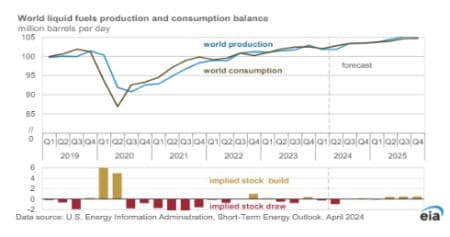
          What is interesting is that it is very difficult, if not impossible, to see a production trend being established that would support the bear case. In the U.S., we are pumping at a rate of over 13.2 mm BOPD and still importing ~6.7 mm BOPD to feed our nearly 22 mm BOPD daily habit. The U.S. Energy Information Agency-EIA forecasts in their monthly Short-Term Energy Outlook-STEO that by the end of 2025, global production and demand fall into a fairly tight balance at 105 mm BOPD. That certainly isn’t a long-term trend, but as is often said, the long-term trend is made up of a bunch of short-term ones. For my part, I would say that the trend line in the STEO graph below matches the OPEC estimate more closely than the other three.
          Why The IEA Is Wrong About Peak Oil Demand_2
          Both of these notions cannot be true. Which is the correct assumption about future oil demand? Or are they both wrong? What are two factors these two disparate views of oil demand are not taking into account?
          The first answer lies in how you interpret the growth of the middle class in China, India, and Africa in terms of energy demand and the final form it will take. The second is the advent of energy demand for Artificial Intelligence (AI), an entirely new source of demand that is just now starting to appear in energy demand forecasts. I discussed one possible outcome of this demand for U.S. natural gas in an article in March 2024.
          To be clear, I am not arguing that AI demand will directly impact crude oil demand as a primary source. Most analysts are factoring renewables and natural gas to meet AI demand. What will impact demand for WTI and other baskets of crude is the relationship to light oil production in the U.S. and the associated gas that’s produced along with it. We will leave that discussion for a future article and refocus on our basic topic. What could oil demand actually be when accounting for growth in currently underserved but upwardly aspiring lower classes?
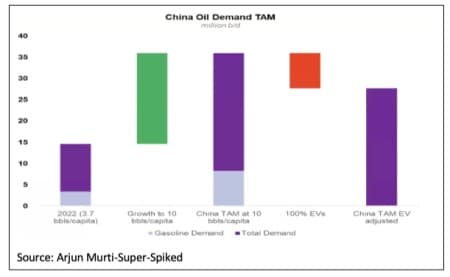
          Then there is the Bull Case for oil. Arjun Murti, a well-known energy commentator and partner at energy analyst firm Veriten, as well as a former Goldman Sachs energy analyst, discussed future energy demand in a recent podcast on his Super-Spiked blog. In the episode titled, “Everyone is Rich,” Arjun posits what the impact on world energy demand would be if everyone was as energy-rich as the “Lucky,” 1.2 billion people that live in the Western World. More specifically, Arjun asks what it would mean for the other 7 billion people in China, India, Asia, and Africa to have the lifestyle that Americans, Canadians, Europeans, and a few other countries enjoy. The answer he comes up with on an absolute basis, 250 mm BOPD, using a reference point of 10 bbls a year!
          Where are we now? The U.S consumes ~22 bbls of oil annually per capita while China consumes 3.7 bbls per capita. Indians use just 1.3 bbls per annum. That’s a pretty wide gap, and as Arjun notes, “economic growth and energy growth are one and the same. You do not get economic growth without adequate energy.”
          One of the arguments put forward by the Peak Oil crowd is that efficiency growth Gross Domestic Product (GDP), and energy substitution will bend the curve on oil demand, as noted in the 2030’s, and spell the twilight of fossil fuels. Arjun points out that there is simply no evidence this is happening using data compiled by Goldman Sachs through 2019. Efficiency gains never lower the amount of energy needed to produce an additional dollar of GDP, above 2.7% GDP growth. A point rarely hit in modern times. To close that gap and attain growth you need more energy inputs. Oil.
          Looking at Arjun’s graph below, which uses China as an example, we can see with their present demand of 3.7 bbls per capita which equates to about 15 mm BOPD. With 10 bbl per annum added on for growth in the middle class, you get to 35 mm BOPD to meet Chinese energy demand. Even if China attains 100% Electric Vehicle-EV penetration, not something Arjun (or I) believe is possible, you still have 27 mm BOPD of oil demand. According to SP Global China produces about 4.1 mm BOPD, leaving a gap of about 11 mm BOPD they must import to meet present-day demand.
          Why The IEA Is Wrong About Peak Oil Demand_3
          A point that leads me to what Arjun noted as the ultimate demand limiter and why, although countries that will surely desire to increase their oil usage may not be able to do so. Geopolitical limits to imports. Quoting Arjun, “There is no precedent for countries importing 20-30 mm BOPD” to meet their energy needs. The U.S., before the advent of shale production was importing over 10 mm BOPD as recently as 2005. That’s what we know is possible.
          It should be noted that India is in a similar fix and for it to meet Arjun’s 10 bbl per capita standard for being rich, they must import 35-45 mm BOPD. We just don’t know if this can be done from both a logistical and sheer capacity of supply basis. As the EIA graph above highlights global oil production has increased only about 3 mm BOPD since 2019. In order for the world’s poor to become richer, a great deal more oil will have to come to market.
          The message of the growth of the middle class globally often gets lost in the constant blare of climate change and energy transition noise. The fact remains that the world we live in today and the one likely to exist at mid-century, runs on oil.
          The notion that the world can quickly and painlessly transition to other forms of energy has developed some, not holes, but gaping craters in recent times. Offshore wind farms are being canceled as costs mount. Car manufacturers are delaying implementation of EV rollouts due to lack of interest from consumers. Communities impacted by siting of solar farms are pushing back on land use as they propose to gobble up large tracts for this purpose.
          Roger Pielke, another well-known energy commentator and author, in a post in his Substack, The Honest Broker, cites a White Paper by Vaclav Smil that discusses our energy transition progress to this point-
          “All we have managed to do halfway through the intended grand global energy transition is a small relative decline in the share of fossil fuel in the world’s primary energy consumption—from nearly 86 percent in 1997 to about 82 percent in 2022. But this marginal relative retreat has been accompanied by a massive absolute increase in fossil fuel combustion: in 2022 the world consumed nearly 55 percent more energy locked in fossil carbon than it did in 1997.”
          Balanced against this lack of progress in substituting oil for other forms of energy is the fact that the world’s energy supply is in a tight balance with demand at present. If the poor of the world make even modest progress toward Arjun’s 10 bbl per annum prognostication in the coming years, the Bull Case for oil will certainly asset itself.

          Source:Oilprice

          To stay updated on all economic events of today, please check out our Economic calendar
          Risk Warnings and Disclaimers
          You understand and acknowledge that there is a high degree of risk involved in trading. Following any strategies or investment methods may lead to potential losses. The content on the site is provided by our contributors and analysts for information purposes only. You are solely responsible for determining whether any trading assets, securities, strategy, or any other product is suitable for investing based on your own investment objectives and financial situation.
          Add to Favorites
          Share

          Japan's Service Activity Extends Gains on Solid Demand, PMI Shows

          Kevin Du

          Economic

          Japanese service sector activity grew at the fastest pace in eight months in April thanks to solid business and consumer spending, a private survey showed on Tuesday, results that should keep the central bank on track to hike rates again this year.
          The final au Jibun Bank Service purchasing managers' index (PMI) rose to 54.3 last month, the highest level since August 2023, and up slightly from 54.1 in March.
          The index has remained above the 50-mark that separates contraction from expansion since September 2022, but it edged down from the flash reading of 54.6.
          The survey showed prices charged by firms to their clients increased sharply, with the rate of inflation hitting its highest since April 2014 when the nation raised the sales tax.
          The firms cited rising expenses from higher wages as the main reason for passing on costs to customers, a fact that won't be lost on the Bank of Japan which has for years urged firms to raise pay at a steady pace to spur consumption.
          The BOJ, which ended negative interest rates in a landmark decision in March, is expected to hike rates again this year. The central bank has signalled a cautious approach to further tightening due to a fragile economic recovery.
          The service sector has been a bright spot in an economy that has struggled to mount a broad-based post-COVID revival, helping to offset some of the persistent weakness seen in manufacturing. For policymakers, the strength in business and consumer spending in the latest survey should be welcome news.
          "April data revealed another strong month for the Japanese service sector as rising business and consumer spending fuelled the fastest upturn in business activity since August 2023," said Tim Moore, economics director at S&P Global Market Intelligence.
          New business growth accelerated for the sixth straight month to hit the fastest pace since June 2023, with firms saying that sales were also boosted by robust inbound tourism, the survey showed.
          Input prices increased at the quickest pace since August due to rising labour costs, as well as higher prices of transport and raw materials, which drove the substantial uptick in prices charged to clients.
          "Service providers are increasingly seeking to negotiate higher prices charged with clients in response to elevated cost pressures," Moore said.
          The composite PMI, which combines the manufacturing and service activity figures, expanded to 52.3 in April, the highest level since August 2023, from 51.7 in March.

          Source: Reuters

          To stay updated on all economic events of today, please check out our Economic calendar
          Risk Warnings and Disclaimers
          You understand and acknowledge that there is a high degree of risk involved in trading. Following any strategies or investment methods may lead to potential losses. The content on the site is provided by our contributors and analysts for information purposes only. You are solely responsible for determining whether any trading assets, securities, strategy, or any other product is suitable for investing based on your own investment objectives and financial situation.
          Add to Favorites
          Share

          May 7th Financial News

          FastBull Featured

          Daily News

          [Quick Facts]

          1. Hamas agrees to a Gaza ceasefire while Israel will continue operations in Rafah.
          2. Fed's Barkin says full impact of high interest rates yet to come.
          3. Fed's Williams says next Fed move likely to be lower rates.
          4. NY Fed survey shows Americans are preparing for higher housing costs.

          [News Details]

          Hamas agrees to a Gaza ceasefire while Israel will continue operation in Rafah
          The Palestinian militant group Hamas on Monday agreed to a Gaza ceasefire proposal set by mediators. In a brief statement, Hamas leader Ismail Haniyeh said he had informed Qatari and Egyptian mediators that Hamas accepted their cease-fire proposal. But Israeli Prime Minister Benjamin Netanyahu's office later said that Hamas' latest ceasefire proposal did not meet Israel's demands but Israel would send a delegation to meet with negotiators to try to reach an agreement. Meanwhile, he added that Israel's War Cabinet had approved the continuation of the operation in Rafah. "The War Cabinet has unanimously decided that Israel will continue to conduct operations in Rafah to exert military pressure on Hamas in order to facilitate the release of hostages and to achieve other war objectives," according to the statement.
          An anonymous Israeli official said Hamas accepted a scaled-down version of the Egyptian proposal, which contained elements unacceptable to Israel. "It seems to be a ruse to make Israel look like the one rejecting the agreement," the Israeli official said.
          However, another official with knowledge of the peace talks said the proposal Hamas accepted was the same as the one Israel agreed to in late April. A U.S. official familiar with the cease-fire talks said Netanyahu and the War Cabinet have not appeared to approach the latest phase of negotiations in good faith.
          Fed's Barkin says full impact of high interest rates yet to come
          Richmond Fed President Tom Barkin said in a speech on Monday that he is optimistic that the current restrictive interest rates can restrain demand and bring inflation back to the target level. The full impact of high interest rates has not yet come.
          For recent inflation data in particular, Barkin said, the challenge is whether policymakers should take more signal from the past three months, or the prior seven months when the economy seemed to be making steady progress back to the Fed's inflation target.
          Given the strong performance of the labor market, we have time to gain that confidence.
          Sustained housing and services inflation is likely to drive prices higher. The risk is that sustained housing and services inflation will keep the headline index above our target as we get less help from the goods sector. That is what we have seen so far this year.
          I still prefer to prioritize keeping inflation in check, and I think that's affordable with a continued strong job market, Barkin said.
          Fed's Williams says next Fed move likely to be lower rates
          Eventually, we will cut interest rates, but the current monetary policy is in a "very good place, New York Fed President John Williams said on Monday. We have time to collect more information, so be steady.
          The economy is generally coming into a better balance in the face of slower growth. The economy is expected to grow by 2%-2.5% this year.
          When asked how many more months of weak data are needed to cut interest rates, Williams said "it depends on the overall data, rather than based on just the jobs report or CPI or other information. We have to make sure we look at the big picture.
          NY Fed survey shows Americans are preparing for higher housing costs
          Americans are once again bracing for another round of higher housing costs, according to a New York Fed survey. The survey found that respondents saw higher near-term increases for both rent and home prices, although they do see some relief over the longer haul for home prices. Households also see no relief on home borrowing costs.
          The New York Fed said that in February respondents predicted home prices would rise 5.1% a year from now, up from the 2.6% they predicted a year ago. But five years from now, respondents saw home prices up by 2.7%, from 2.8% in last year's poll. On the rental front, respondents reckon costs a year from now will be up 9.7%, the second-highest reading in the survey's history. Five years from now, survey respondents see rent growth rate "essentially flat" at 5.1%, the New York Fed said. The report found that respondents still have a "strongly positive" outlook on housing as an investment. They also expect mortgage rates, already high, to go higher.

          [Focus of the Day]

          UTC+8 12:30 RBA Interest Rate Decision for May
          UTC+8 13:30 RBA Governor Bullock Holds a Monetary Policy News Conference
          UTC+8 20:30 Bank of England MPC Member Haldane Speaks
          UTC+8 23:30 Minneapolis Fed President Kashkari Participates in a Fireside Chat
          Risk Warnings and Disclaimers
          You understand and acknowledge that there is a high degree of risk involved in trading. Following any strategies or investment methods may lead to potential losses. The content on the site is provided by our contributors and analysts for information purposes only. You are solely responsible for determining whether any trading assets, securities, strategy, or any other product is suitable for investing based on your own investment objectives and financial situation.
          Add to Favorites
          Share
          FastBull
          Copyright © 2025 FastBull Ltd

          728 RM B 7/F GEE LOK IND BLDG NO 34 HUNG TO RD KWUN TONG KLN HONG KONG

          TelegramInstagramTwitterfacebooklinkedin
          App Store Google Play Google Play
          Products
          Charts

          Chats

          Q&A with Experts
          Screeners
          Economic Calendar
          Data
          Tools
          Membership
          Features
          Function
          Markets
          Copy Trading
          Latest Signals
          Contests
          News
          Analysis
          24/7
          Columns
          Education
          Company
          Careers
          About Us
          Contact Us
          Advertising
          Help Center
          Feedback
          User Agreement
          Privacy Policy
          Business

          White Label

          Data API

          Web Plug-ins

          Poster Maker

          Affiliate Program

          Risk Disclosure

          The risk of loss in trading financial instruments such as stocks, FX, commodities, futures, bonds, ETFs and crypto can be substantial. You may sustain a total loss of the funds that you deposit with your broker. Therefore, you should carefully consider whether such trading is suitable for you in light of your circumstances and financial resources.

          No decision to invest should be made without thoroughly conducting due diligence by yourself or consulting with your financial advisors. Our web content might not suit you since we don't know your financial conditions and investment needs. Our financial information might have latency or contain inaccuracy, so you should be fully responsible for any of your trading and investment decisions. The company will not be responsible for your capital loss.

          Without getting permission from the website, you are not allowed to copy the website's graphics, texts, or trademarks. Intellectual property rights in the content or data incorporated into this website belong to its providers and exchange merchants.

          Not Logged In

          Log in to access more features

          FastBull Membership

          Not yet

          Purchase

          Become a signal provider
          Help Center
          Customer Service
          Dark Mode
          Price Up/Down Colors

          Log In

          Sign Up
          Position
          Layout
          Fullscreen
          Default to Chart
          The chart page opens by default when you visit fastbull.com