• Trade
  • Markets
  • Copy
  • Contests
  • News
  • 24/7
  • Calendar
  • Q&A
  • Chats
Trending
Screeners
SYMBOL
LAST
BID
ASK
HIGH
LOW
NET CHG.
%CHG.
SPREAD
SPX
S&P 500 Index
6827.42
6827.42
6827.42
6899.86
6801.80
-73.58
-1.07%
--
DJI
Dow Jones Industrial Average
48458.04
48458.04
48458.04
48886.86
48334.10
-245.98
-0.51%
--
IXIC
NASDAQ Composite Index
23195.16
23195.16
23195.16
23554.89
23094.51
-398.69
-1.69%
--
USDX
US Dollar Index
97.950
98.030
97.950
98.500
97.950
-0.370
-0.38%
--
EURUSD
Euro / US Dollar
1.17394
1.17409
1.17394
1.17496
1.17192
+0.00011
+ 0.01%
--
GBPUSD
Pound Sterling / US Dollar
1.33707
1.33732
1.33707
1.33997
1.33419
-0.00148
-0.11%
--
XAUUSD
Gold / US Dollar
4299.39
4299.39
4299.39
4353.41
4257.10
+20.10
+ 0.47%
--
WTI
Light Sweet Crude Oil
57.233
57.485
57.233
58.011
56.969
-0.408
-0.71%
--

Community Accounts

Signal Accounts
--
Profit Accounts
--
Loss Accounts
--
View More

Become a signal provider

Sell trading signals to earn additional income

View More

Guide to Copy Trading

Get started with ease and confidence

View More

Signal Accounts for Members

All Signal Accounts

Best Return
  • Best Return
  • Best P/L
  • Best MDD
Past 1W
  • Past 1W
  • Past 1M
  • Past 1Y

All Contests

  • All
  • Trump Updates
  • Recommend
  • Stocks
  • Cryptocurrencies
  • Central Banks
  • Featured News
Top News Only
Share

Iranian Media Says 18 Crew Members Of Foreign Tanker Seized In Gulf Of Oman Over Carrying 'Smuggled Fuel' Detained

Share

Regional Governor: Two Killed In Ukrainian Drone Strike On Russia's Saratov

Share

Chinese Foreign Ministry - China Foreign Minister Met With United Arab Emirates Counterpart On Dec 12

Share

China's Central Financial And Economic Affairs Commission Deputy Director: Will Expand Export And Increase Import In 2026

Share

Thai Leader Anutin: Landmine Blast That Killed Thai Soldiers 'Not A Roadside Accident'

Share

Thai Leader Anutin: Thailand To Continue Military Action Until 'We Feel No More Harm'

Share

Cambodian Prime Minister Hun Manet Says He Had Phone Calls With Trump And Malaysian Leader Anwar About Ceasefire

Share

Cambodia's Hun Manet Says USA, Malaysia Should Verify 'Which Side Fired First' In Latest Conflict

Share

Cambodia's Hun Manet: Cambodia Maintains Its Stance In Seeking Peaceful Resolution Of Disputes

Share

Nasdaq Companies: Allergan, Ferrovia, Insmed, Monolithic Power Systems, Seagate Technology, And Western Digital Will Be Added To The NASDAQ 100 Index. Biogen, CdW, GlobalFoundries, Lululemon, ON Semiconductor, And Tradedesk Will Be Removed From The NASDAQ 100 Index

Share

Witkoff Headed To Berlin This Weekend To Meet With Zelenskiy, European Leaders -Wsj Reporter On X

Share

Russia Attacks Two Ukrainian Ports, Damaging Three Turkish-Owned Vessels

Share

[Historic Flooding Occurs In At Least Four Rivers In Washington State Due To Days Of Torrential Rains] Multiple Areas In Washington State Have Been Hit By Severe Flooding Due To Days Of Torrential Rains, With At Least Four Rivers Experiencing Historic Flooding. Reporters Learned On The 12th That The Floods Caused By The Torrential Rains In Washington State Have Destroyed Homes And Closed Several Highways. Experts Warn That Even More Severe Flooding May Occur In The Future. A State Of Emergency Has Been Declared In Washington State

Share

Trump Says Proposed Free Economic Zone In Donbas Would Work

Share

Trump: I Think My Voice Should Be Heard

Share

Trump Says Will Be Choosing New Fed Chair In Near Future

Share

Trump Says Proposed Free Economic Zone In Donbas Complex But Would Work

Share

Trump Says Land Strikes In Venezuela Will Start Happening

Share

US President Trump: Thailand And Cambodia Are In A Good Situation

Share

State Media: North Korean Leader Kim Hails Troops Returning From Russia Mission

TIME
ACT
FCST
PREV
U.K. Trade Balance Non-EU (SA) (Oct)

A:--

F: --

P: --

U.K. Trade Balance (Oct)

A:--

F: --

P: --

U.K. Services Index MoM

A:--

F: --

P: --

U.K. Construction Output MoM (SA) (Oct)

A:--

F: --

P: --

U.K. Industrial Output YoY (Oct)

A:--

F: --

P: --

U.K. Trade Balance (SA) (Oct)

A:--

F: --

P: --

U.K. Trade Balance EU (SA) (Oct)

A:--

F: --

P: --

U.K. Manufacturing Output YoY (Oct)

A:--

F: --

P: --

U.K. GDP MoM (Oct)

A:--

F: --

P: --

U.K. GDP YoY (SA) (Oct)

A:--

F: --

P: --

U.K. Industrial Output MoM (Oct)

A:--

F: --

P: --

U.K. Construction Output YoY (Oct)

A:--

F: --

P: --

France HICP Final MoM (Nov)

A:--

F: --

P: --

China, Mainland Outstanding Loans Growth YoY (Nov)

A:--

F: --

P: --

China, Mainland M2 Money Supply YoY (Nov)

A:--

F: --

P: --

China, Mainland M0 Money Supply YoY (Nov)

A:--

F: --

P: --

China, Mainland M1 Money Supply YoY (Nov)

A:--

F: --

P: --

India CPI YoY (Nov)

A:--

F: --

P: --

India Deposit Gowth YoY

A:--

F: --

P: --

Brazil Services Growth YoY (Oct)

A:--

F: --

P: --

Mexico Industrial Output YoY (Oct)

A:--

F: --

P: --

Russia Trade Balance (Oct)

A:--

F: --

P: --

Philadelphia Fed President Henry Paulson delivers a speech
Canada Building Permits MoM (SA) (Oct)

A:--

F: --

P: --

Canada Wholesale Sales YoY (Oct)

A:--

F: --

P: --

Canada Wholesale Inventory MoM (Oct)

A:--

F: --

P: --

Canada Wholesale Inventory YoY (Oct)

A:--

F: --

P: --

Canada Wholesale Sales MoM (SA) (Oct)

A:--

F: --

P: --

Germany Current Account (Not SA) (Oct)

A:--

F: --

P: --

U.S. Weekly Total Rig Count

A:--

F: --

P: --

U.S. Weekly Total Oil Rig Count

A:--

F: --

P: --

Japan Tankan Large Non-Manufacturing Diffusion Index (Q4)

--

F: --

P: --

Japan Tankan Small Manufacturing Outlook Index (Q4)

--

F: --

P: --

Japan Tankan Large Non-Manufacturing Outlook Index (Q4)

--

F: --

P: --

Japan Tankan Large Manufacturing Outlook Index (Q4)

--

F: --

P: --

Japan Tankan Small Manufacturing Diffusion Index (Q4)

--

F: --

P: --

Japan Tankan Large Manufacturing Diffusion Index (Q4)

--

F: --

P: --

Japan Tankan Large-Enterprise Capital Expenditure YoY (Q4)

--

F: --

P: --

U.K. Rightmove House Price Index YoY (Dec)

--

F: --

P: --

China, Mainland Industrial Output YoY (YTD) (Nov)

--

F: --

P: --

China, Mainland Urban Area Unemployment Rate (Nov)

--

F: --

P: --

Saudi Arabia CPI YoY (Nov)

--

F: --

P: --

Euro Zone Industrial Output YoY (Oct)

--

F: --

P: --

Euro Zone Industrial Output MoM (Oct)

--

F: --

P: --

Canada Existing Home Sales MoM (Nov)

--

F: --

P: --

Euro Zone Total Reserve Assets (Nov)

--

F: --

P: --

U.K. Inflation Rate Expectations

--

F: --

P: --

Canada National Economic Confidence Index

--

F: --

P: --

Canada New Housing Starts (Nov)

--

F: --

P: --

U.S. NY Fed Manufacturing Employment Index (Dec)

--

F: --

P: --

U.S. NY Fed Manufacturing Index (Dec)

--

F: --

P: --

Canada Core CPI YoY (Nov)

--

F: --

P: --

Canada Manufacturing Unfilled Orders MoM (Oct)

--

F: --

P: --

Canada Manufacturing New Orders MoM (Oct)

--

F: --

P: --

Canada Core CPI MoM (Nov)

--

F: --

P: --

Canada Manufacturing Inventory MoM (Oct)

--

F: --

P: --

Canada CPI YoY (Nov)

--

F: --

P: --

Canada CPI MoM (Nov)

--

F: --

P: --

Canada CPI YoY (SA) (Nov)

--

F: --

P: --

Canada Core CPI MoM (SA) (Nov)

--

F: --

P: --

Q&A with Experts
    • All
    • Chatrooms
    • Groups
    • Friends
    Connecting
    .
    .
    .
    Type here...
    Add Symbol or Code

      No matching data

      All
      Trump Updates
      Recommend
      Stocks
      Cryptocurrencies
      Central Banks
      Featured News
      • All
      • Russia-Ukraine Conflict
      • Middle East Flashpoint
      • All
      • Russia-Ukraine Conflict
      • Middle East Flashpoint
      Search
      Products

      Charts Free Forever

      Chats Q&A with Experts
      Screeners Economic Calendar Data Tools
      Membership Features
      Data Warehouse Market Trends Institutional Data Policy Rates Macro

      Market Trends

      Market Sentiment Order Book Forex Correlations

      Top Indicators

      Charts Free Forever
      Markets

      News

      News Analysis 24/7 Columns Education
      From Institutions From Analysts
      Topics Columnists

      Latest Views

      Latest Views

      Trending Topics

      Top Columnists

      Latest Update

      Signals

      Copy Rankings Latest Signals Become a signal provider AI Rating
      Contests
      Brokers

      Overview Brokers Assessment Rankings Regulators News Claims
      Broker listing Forex Brokers Comparison Tool Live Spread Comparison Scam
      Q&A Complaint Scam Alert Videos Tips to Detect Scam
      More

      Business
      Events
      Careers About Us Advertising Help Center

      White Label

      Data API

      Web Plug-ins

      Affiliate Program

      Awards Institution Evaluation IB Seminar Salon Event Exhibition
      Vietnam Thailand Singapore Dubai
      Fans Party Investment Sharing Session
      FastBull Summit BrokersView Expo
      Recent Searches
        Top Searches
          Markets
          News
          Analysis
          User
          24/7
          Economic Calendar
          Education
          Data
          • Names
          • Latest
          • Prev

          View All

          No data

          Scan to Download

          Faster Charts, Chat Faster!

          Download App
          English
          • English
          • Español
          • العربية
          • Bahasa Indonesia
          • Bahasa Melayu
          • Tiếng Việt
          • ภาษาไทย
          • Français
          • Italiano
          • Türkçe
          • Русский язык
          • 简中
          • 繁中
          Open Account
          Search
          Products
          Charts Free Forever
          Markets
          News
          Signals

          Copy Rankings Latest Signals Become a signal provider AI Rating
          Contests
          Brokers

          Overview Brokers Assessment Rankings Regulators News Claims
          Broker listing Forex Brokers Comparison Tool Live Spread Comparison Scam
          Q&A Complaint Scam Alert Videos Tips to Detect Scam
          More

          Business
          Events
          Careers About Us Advertising Help Center

          White Label

          Data API

          Web Plug-ins

          Affiliate Program

          Awards Institution Evaluation IB Seminar Salon Event Exhibition
          Vietnam Thailand Singapore Dubai
          Fans Party Investment Sharing Session
          FastBull Summit BrokersView Expo

          Russian Oil-Product Stranded At Sea As Korea Cracks Down

          Cohen

          Economic

          Political

          Summary:

          Holdings of naphtha at sea balloon after investigation starts.Russian shipments to Taiwan and China increase, Kpler reports.
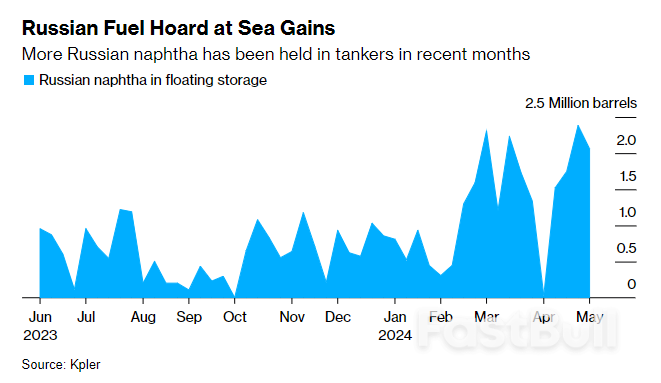
          Cargoes of an oil product from Russia are building up at sea as South Korean buyers turn cautious, highlighting how the invasion of Ukraine is still impacting flows more than two years later.
          More than 2 million barrels of Russian naphtha, a building block for plastics, have been held in 10 tankers for more than a week, with some in the waters near Oman and Malta, as of May 7, according to market intelligence firm Kpler. That’s up from a weekly average of about 790,000 barrels in January and February.
          Russian Oil-Product Stranded At Sea As Korea Cracks Down_1
          Petrochemical makers in South Korea — traditionally major buyers of the Russian product — are now shunning direct imports, and any cargoes with unclear origins, for fear of government scrutiny, according to traders with knowledge of the matter who asked not to be identified. That follows the launch in March of an investigation into naphtha imports by the country’s authorities.
          Global energy markets — for crude oil, natural gas, and petroleum products — were upended by the invasion in early 2022 as some buyers shunned exports, flows were rerouted, and a web of western sanctions and price caps brought an extra layer of complication. Like most import-dependent economies, South Korea, and its refiners and plastics makers, have been forced to adapt.
          Before the assault on Kyiv, Russia was South Korea’s top naphtha supplier. While direct flows dwindled after the war began, imports from nations such as United Arab Emirates, Malaysia, Singapore and Tunisia swelled, according to Kpler data. In March, however, South Korean authorities launched the probe to examine whether naphtha from Russia was being re-labeled.
          Since then, imports from Mideast suppliers — such as Kuwait and Oman — have risen, according to Viktor Katona, an analyst at Kpler. At the same time, Russian naphtha flows to China and Taiwan have expanded, Katona said, noting shipments from Moscow accounted for more than half of Taiwan’s imports in April.
          While South Korean refiners and petrochemical companies are allowed to import naphtha from Moscow, they need to comply with a Group of Seven price cap that bars access to western services if cargoes cost more than certain levels. Seoul isn’t a part of the G-7 but it has supported measures that the group imposed in an effort to punish Russia for the war.

          Source:Bloomberg

          To stay updated on all economic events of today, please check out our Economic calendar
          Risk Warnings and Disclaimers
          You understand and acknowledge that there is a high degree of risk involved in trading. Following any strategies or investment methods may lead to potential losses. The content on the site is provided by our contributors and analysts for information purposes only. You are solely responsible for determining whether any trading assets, securities, strategy, or any other product is suitable for investing based on your own investment objectives and financial situation.
          Add to Favorites
          Share

          As Bank Lending Slows,Bond Market Takes Centre Stage

          Alex

          Economic

          Bond

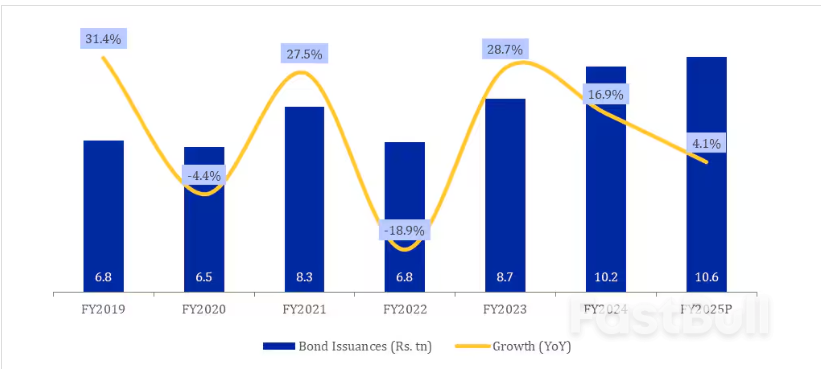
          ICRA, a credit rating agency, forecasts that the growth of new loans (incremental credit flow) in the Indian economy will slow down in the financial year 2025 (FY2025), while bond issuances are expected to rise to Rs 10.6 trillion in FY2025 from Rs 10.2 trillion in FY2024.

          Why bonds are suddenly attractive?

          While the overall growth of new credit in the Indian economy might slow down in FY2025, the bond market is expected to pick up the slack. Companies are likely to take advantage of attractive domestic interest rates and favorable conditions to raise money by issuing bonds.
          As interest rates remain high in developed countries, borrowing money domestically through bond issuance becomes a more attractive option for Indian companies.
          If the yield on Indian Government Bonds (IGBs) remains stable due to foreign investment, the competitiveness of bond issuance compared to bank loans is expected to improve. This could incentivize companies to issue more bonds.

          Here's a breakdown:

          Source of credit: The slowdown in bank credit is expected to be primarily from domestic sources, which are likely to provide Rs 24.5 trillion in new loans in FY2025. This is lower than the record high achieved in FY2024
          Non-Food Bank Credit (NFBC): This refers to loans provided by banks for purposes other than agriculture. ICRA expects NFBC growth to also moderate slightly in FY2025 compared to the record high of FY2024.
          Bond market to pick up slack
          Corporate Bond issuances: ICRA predicts that even though overall credit growth might slow down, companies will increasingly turn to issuing bonds to raise money. This is likely due to:
          Attractive Interest Rates: Interest rates are expected to remain high in developed countries. This makes borrowing money domestically in India (through bond issuance) a more attractive option for large companies.
          Favorable conditions: ICRA expects conditions for issuing corporate bonds to remain positive for both companies issuing bonds (borrowers) and investors buying them.
          The total value of all corporate bonds currently issued (outstanding) is expected to reach RS 50.3 trillion by the end of March 2025. This represents a YoY (Year-over-Year) growth of 9.5%.
          "Competitive funding conditions in domestic markets compared to developed markets meant that large corporates tapped more domestic funding sources over the last two years. Strong demand for loans from retail borrowers and non-bank finance companies (NBFCs) drove a significant portion of the incremental flow of credit from banks. This resulted in the highest ever NFBC expansion of Rs 22.3 trillion in FY2024 far outpacing the incremental NFBC expansion of Rs. 18.2 trillion recorded in FY2023," noted ICRA in a note.
          The incremental credit flow was also supported by the all-time high corporate bond issuances of Rs 10.2 trillion in FY2024 (YoY +16.9%), resulting in the stock of corporate bonds outstanding rising to an estimated Rs 46.0 trillion (+6.6% YoY) as on March 31, 2024, from Rs. 43.1 trillion as on March 31, 2023.
          Domestic bond issurances
          As Bank Lending Slows,Bond Market Takes Centre Stage_1
          Besides, the stock of commercial papers (CPs) outstanding also rose by Rs 0.4 trillion in FY2024 to Rs. 3.9 trillion as on March 31, 2024. Cumulatively, these three sources accounted for Rs. 25.4 trillion of incremental credit flow in the domestic market, an all-time high.
          Headwinds for bank lending:
          Regulatory actions: Recent regulations on unsecured loans (personal loans without collateral) and limitations on bank funding for NBFCs (Non-Banking Financial Companies) might restrict the growth of new loans offered by banks. Reduced availability of cash in the banking system could further limit banks' ability to provide new loans.
          However, the yield on Indian Government Bonds (IGBs) is likely to remain range-bound, driven by demand from foreign portfolio flows upon inclusion of IGBs in global indices. This shall improve the competitiveness of funding from debt capital markets vis a vis bank borrowing and would drive up corporate bond issuances, said ICRA.
          “Growth is expected to eventually taper off from these levels on the back of tight liquidity, even as the foreign flows in IGBs will remain supportive for growth in corporate bond issuances. Accordingly, ICRA estimates incremental total credit (bonds, non-food bank credit and CPs) expansion to dip to Rs. 24.5 trillion in FY2025,” said Sachin Sachdeva, Vice President & Sector Head, ICRA.

          Source:Business Standard

          To stay updated on all economic events of today, please check out our Economic calendar
          Risk Warnings and Disclaimers
          You understand and acknowledge that there is a high degree of risk involved in trading. Following any strategies or investment methods may lead to potential losses. The content on the site is provided by our contributors and analysts for information purposes only. You are solely responsible for determining whether any trading assets, securities, strategy, or any other product is suitable for investing based on your own investment objectives and financial situation.
          Add to Favorites
          Share

          German Exports Expected to Stagnate This Year- DIHK

          Owen Li

          Economic

          Although there are signs of a slight upturn in the global economy, companies are not benefiting from it enough because of political uncertainty and geopolitical risks, the Chamber's regular AHK World Business Outlook suggested.
          "The weak development of German foreign trade at the turn of the year and the slight improvement in business expectations and investment intentions point to a challenging year, despite small rays of hope," Volker Treier, DIHK head of foreign trade, said.
          The German economy is highly trade-oriented and therefore sensitive to international events that weaken foreign demand.
          German companies with activities abroad were increasingly optimistic about global economic developments, the DIHK survey showed.
          Of the 4,300 companies surveyed, 31% expected an economic upturn at their overseas locations in the current year, boosted by slowing inflation rates and the hope of interest rate cuts.
          In the last survey in November, the figure was 22%.
          One in five companies still anticipated an economic slowdown, compared with 28% in the previous survey.
          "There are signs of an upturn on many global markets. This gives many companies hope that the mood will improve again," Treier added.
          "However, the improved economic expectations are not yet materialising in an equally strong revival in international trade - and therefore also in the business of German companies locally," he added.

          EXPECTATIONS DETERIORATE IN CHINA

          While companies were more upbeat about their foreign-based operations, their expectations for China deteriorated once again.
          The continuing weak demand in the Chinese economy was seen as a business risk by 80% of the companies.
          "The increasing competitive disadvantages compared to Chinese firms, particularly in terms of market access, contacts with authorities or in obtaining information for public tenders represent a burden for German companies," Maximilian Butek, chief representative at the DIHK delegation in Shanghai, said.
          Companies were more optimistic about business opportunities in other parts of the Asia-Pacific region, which remains an important destination for the diversification of supply chains.
          Firms had not seen any improvement in their situation in the eurozone from November and business expectations for the coming twelve months remained below the global average, according to the survey.
          In the U.S., companies are much more concerned about uncertain economic policy conditions and, above all, trade barriers that could start in November.

          Source: Reuters

          To stay updated on all economic events of today, please check out our Economic calendar
          Risk Warnings and Disclaimers
          You understand and acknowledge that there is a high degree of risk involved in trading. Following any strategies or investment methods may lead to potential losses. The content on the site is provided by our contributors and analysts for information purposes only. You are solely responsible for determining whether any trading assets, securities, strategy, or any other product is suitable for investing based on your own investment objectives and financial situation.
          Add to Favorites
          Share

          Fear Gauge For India Jumps As Stock Traders Mull Modi Win Margin

          Samantha Luan

          Economic

          A period of relative calm in India’s $4.6 trillion stock market has been shaken by speculation that Prime Minister Narendra Modi’s party may win fewer seats than initially expected in the ongoing national elections, which could affect its ability to carry out policy reforms.
          The India VIX Index — a measure that uses equity option prices to gauge expected market swings over the next 30 days — rose for a ninth straight day on Tuesday, heading for its longest streak since March 2020. The so-called fear gauge, which hit a record low just two weeks ago, is now approaching its highest close since early 2023.
          Modi is still widely expected to win a third five-year term in the marathon election that began April 19 and will run through June 1, with the leader having predicted that his Bharatiya Janata Party and its allies will win more than 400 of the 543 seats up for grabs in the lower house of parliament.
          However, attention has recently shifted to a dip in voter turnout during the first two phases of voting and media reports have fanned some speculation among equity traders of a less emphatic performance for the ruling coalition. In the last election in 2019, the BJP expanded its majority to 303 seats, and the alliance it leads currently commands 353 seats.
          “There is a chatter that BJP may win 290-300 seats and if that happens, markets will surely see a blip,” said Mukesh Jain, managing director of Jaipur-based Maverick Share Brokers Pvt, which has been tracking the markets for over two decades.
          Fear Gauge For India Jumps As Stock Traders Mull Modi Win Margin_1
          India’s benchmark NSE Nifty 50 Index slid as much as 0.9% in a third day of declines on Tuesday, heading for its lowest close since April 19. That’s even as a broader gauge of Asian stocks advanced for a fourth day. Turnover in equity derivatives has also slumped to its lowest since December.
          Last week, the Election Commission of India said it was disappointed with the turnout so far and is taking measures to boost participation in the remaining phases of polling. On Tuesday, voting kicked off in Modi’s home state of Gujarat in what is the third phase of the election. The winner will be declared on June 4. A party needs 272 seats in parliament to have a majority.
          “There is a creeping likelihood that the deviation between reality and expectations in terms of seats that the BJP-led alliance can win could be high,” said Dhananjay Sinha, co-head of equities at Systematix Group. “This is leading to quite a bit of uncertainty in the market. It’s very likely that the recent jump in VIX is reflecting this concern in the market.”Fear Gauge For India Jumps As Stock Traders Mull Modi Win Margin_2
          To be sure, a victory for Modi’s party still remains the most-anticipated outcome for traders. And based on India’s past political history, there’s no link between lower voter turnout and support for the incumbent party.
          “Frankly, I don’t see any possibility of this,” Jain of Maverick Share Brokers said when asked about the changes of the BJP-led alliance failing to win the election. “I haven’t really thought of this scenario.”
          Further, the recent weakness in Indian stocks is coming after a period of extended outperformance versus regional peers. Strategists at global banks from Goldman Sachs Group Inc. and JPMorgan Chase & Co. have said that Indian equities are set to attract more foreign inflows post the general elections on bets that Modi, who has promised continued spending on infrastructure, will return to power.

          Source:Bloomberg

          To stay updated on all economic events of today, please check out our Economic calendar
          Risk Warnings and Disclaimers
          You understand and acknowledge that there is a high degree of risk involved in trading. Following any strategies or investment methods may lead to potential losses. The content on the site is provided by our contributors and analysts for information purposes only. You are solely responsible for determining whether any trading assets, securities, strategy, or any other product is suitable for investing based on your own investment objectives and financial situation.
          Add to Favorites
          Share

          Russia's War Economy Starves Crucial Oil Industry of Manpower

          Thomas

          Commodity

          Russia-Ukraine Conflict

          Economic

          Russia's oil and gas industry has been crucial for bankrolling the invasion of Ukraine, giving the Kremlin the funds to keep fighting even as the conflict drags on through its third year. But the industry is facing a shortage of manpower as the full mobilization of Russia's economy for war exacerbates a longstanding demographic crunch.
          In a nation where Gazprom PJSC's “Dreams Come True” slogan has long summed up the career aspirations of many citizens, high-paying energy companies now find themselves having to compete for workers against the Russian army and weapons manufacturers, according to analysts and recruiters working with the industry. The sign-up bonus alone for a soldier fighting in Ukraine may be equivalent to nearly a year's salary for an average oil and gas field worker.
          This problem isn't entirely new — Russia has faced a shrinking working-age population for almost two decades. The collapse in birth rates in the 1990s was a root cause and the Covid pandemic added to the challenge, but the invasion of Ukraine has made it much more acute.
          Lack of personnel is now hitting businesses across all parts of the economy, according to recent reports from Russia's central bank. While the oil and gas industry appears to be ticking along smoothly, there may be a longer-term impact.
          “Staff shortages have affected even the wealthy industries,” said Alexei Zakharov, president of online recruiter Superjob.ru. “The oil and gas sector can afford to attract employees with higher salaries, but the state competes by offering military contracts.”
          Russia's oil and gas sector lacks some 40,000 employees this year, according to estimates from Moscow-based Kasatkin Consulting, which employs some former Deloitte researchers in the region. The industry raised the number of online job listings in the first quarter by 24% compared to a year before, looking not just for qualified personnel but also low-skilled workers, show data from major Russian recruitment platform hh.ru.
          “This industry has open vacancies for electricians, drivers, mechanics, welders, machinists, general workers, sales managers, design engineers, salesmen,” said Anna Osipova, head of regional external communications at hh.ru.
          Russia's Energy Ministry didn't respond to Bloomberg request for comment.
          The oil and gas industry has long been one of Russia's highest-paying employers, offering a wage that exceeded the national average by at least two thirds since 2017, according to Bloomberg calculations based on data from the Federal Statistics Service. In January and February, the monthly nominal salary in the industry — including workers in oil and gas production, services, refining, pipeline shipments and storage — averaged some 125,200 rubles ($1,340).
          That sum no longer competes with what the Russian army is offering to contract soldiers. In addition to the flat nationwide sign-on bonus of 195,000 rubles, each Russian region offers its own one-time payment to a new recruit, rising to as much as 1 million rubles.
          “Competition with salaries in the armed forces and military industrial complex has certainly had an impact,” on workforce availability for the Russian oil and gas industry, said Dmitry Kasatkin, a partner at Moscow-based Kasatkin Consulting.
          If a worker doesn't want to fight in Ukraine - where the UK Ministry of Defense estimates more than 450,000 Russian soldiers have been killed or wounded since President Vladimir Putin decided to invade in February 2022 — there are also lucrative contracts available with military manufacturers. Demand for tanks, armored vehicles and weapons has soared and arms factories have been searching for workers in the tight labor market.
          Last year, Russia's state defense corporation, Rostec, raised salaries by an average 17.2%. “We still need people,” Chief Executive Officer Sergey Chemezov told Vladimir Putin in August. “Many of our facilities have been working on the weekends, on bank holidays, and at night.”

          Demographic Crunch

          Putin's decision to mobilize Russia's economy for war has worsened a longstanding demographic problem.
          In the 1990s, the economic turmoil after the breakup of the Soviet Union sent fertility rates plunging. Between 2007 and the end of 2021, the nation's working-age population shrank by 5.8 million people, according to statistical data. The pandemic exacerbated the issue. From 2020 to 2022, almost 750,000 people died in Russia with Covid-19 listed as the main cause, according to Federal Statistics Service data.
          The share of employees under 30 years in the Russian labor market dropped to 14.9% in 2022, the lowest since early 1990, according to estimates of audit and consulting firm FinExpertiza.
          Another consequence of Russia's military aggression against Ukraine has been to limit the flow of laborers from abroad. International sanctions have weakened the ruble, boosted inflation and complicated international money transfers, making Russia less attractive for migrants from ex-Soviet countries. Last year, the official net inflow of foreign migrants into the country was almost 110,000 people, just a quarter of the level in 2021, the last year of statistics before the war started.
          That level of immigration is just a drop in the ocean compared with Russia's demand for labor. At the end of March, the nation needed 1.86 million extra workers, according to data from Federal Statistics Service based on companies' requests to job centers.

          Employee Perks

          “The northern regions are starving for more workforce, there are just not enough people,“ said Denis, a 41 year-old who left the Russian energy industry last August to pursue another career in Moscow.
          As salaries alone are not enough to attract a new workforce, Russian oil and gas companies, which often run their core operations in remote areas with harsh climates, have been offering further perks.
          A field worker doing monthly shifts somewhere in Siberia or the Arctic can expect “hot meals three times a day” and regular medical check-ups covered by the employer, according to job listings at hh.ru. Some employers also throw in Soviet-style incentives such as “New-Year presents for kids” and trips to corporate resorts, according to recent listings on the site.
          To widen the circle of potential employees, some companies have introduced a policy of “bring your friend and get paid,” offering around $50 to $100 per new hire. That's not much by western standards, but in Russia it's enough to buy the minimum level of food necessary for one person for a month.
          All those perks are still not enough to lure the most desirable young skilled workers to the energy industry. In 2022, 816,000 students graduated universities in the field of energy, down by almost 13% compared with 2018, according to Sofia Mangileva, an analyst at Moscow-based consultant Yakov & Partners.
          That's forcing companies to turn to older workers. “The oil industry used to encourage people to retire on time — You are close to the retirement age? Here's a big bonus for you and we'll see you off with honor, to make room for the younger generation,” said Superjob.ru's Zakharov. Now the companies are phasing these programs out and encouraging the personnel “to work as long as possible,” he said.

          Key Industry

          Since the invasion of Ukraine, Russia's oil and gas sector has been targeted by an ever-tightening net of international sanctions designed to curb the flow of petrodollars. Yet the industry has continued to operate smoothly, giving Moscow the funds needed to keep sending soldiers to the front line and purchase weapons to attack Ukrainian cities and infrastructure.
          Last year's oil-production drilling rates set a post-Soviet record, while Russia's crude exports remain robust even as the country makes output cuts in partnership with the Organization of Petroleum Exporting Countries. The country's natural gas production is rebounding after a sharp drop in 2022 and 2023 when pipeline flows to Europe were mostly halted. The government expects pipeline exports of the fuel to recover by almost a fifth this year due to higher flows to China.
          The labor shortages raise questions about whether Russia's oil and gas industry can sustain this performance in the longer-term.
          “Restricted access to Western high-tech oil services creates a risk for maintaining and increasing profitable production and refining of oil and gas,” said Mangileva. “The lack of qualified personnel aggravates this challenge, since the task now is not only to operate the equipment, but also to develop our own technologies.”

          Source: Bloomberg

          To stay updated on all economic events of today, please check out our Economic calendar
          Risk Warnings and Disclaimers
          You understand and acknowledge that there is a high degree of risk involved in trading. Following any strategies or investment methods may lead to potential losses. The content on the site is provided by our contributors and analysts for information purposes only. You are solely responsible for determining whether any trading assets, securities, strategy, or any other product is suitable for investing based on your own investment objectives and financial situation.
          Add to Favorites
          Share

          Morning Bid: Cooler US Takes Edginess Off Markets, UBS Jumps

          Warren Takunda

          Economic

          Stocks

          World markets have returned to levels of almost month ago as fears of an overheated U.S. economy abate even as corporate profit growth remains brisk.
          The April miss on new payrolls and the sight of annual wage growth ebbing below 4% have been enough to switch the narrative back to a Federal Reserve which is on hold for now, rather than one that may even consider further interest rate hikes.
          That may seem like scant consolation to investors who at the start of the year had expected more than 100 basis points of cuts in 2024 - but it's taken the edge off restive bond markets that see another $125 billion of new Treasury coupons hit the Street again this week, starting with $58 billion of 3-year notes on Tuesday.
          A standback look at incoming U.S. economic reports shows data surprises now running at their most negative since February last year.
          What's more, the Fed's latest loan officers survey shows renewed weakening in demand for industrial loans and a decline in household demand for credit in the first quarter of the year.
          And another New York Fed survey released on Monday showed Americans are bracing for another round of higher housing costs.
          New York Fed boss John Williams said that at some undefined point the U.S. central bank will lower its interest rate target.
          "Eventually we'll have rate cuts" but for now monetary policy is in a "very good place," he said on Monday.
          That's seen interest rate futures move back out to price almost 50bps of Fed easing for the year, albeit only from September on. Two-year Treasury yields hovered at 4.80% on Tuesday, well off highs above 5% seen before the payrolls report last week.
          Another strong gain in Wall Street stocks (.SPX), (.IXIC) on Monday show sentiment buoyed again as first quarter corporate earnings have on aggregate come in well above expectations at the start of last month. Walt Disney tops the earnings diary later on Tuesday.
          The dollar (.DXY) held firm on Tuesday, pushing higher again against Japan's yen to as high as 154.65 despite the two suspected bouts of Japanese intervention last week to support the yen.
          Japan's top currency diplomat Masato Kanda once again on Tuesday said Japan may have to take action against any disorderly, speculative-driven foreign exchange moves.
          In overseas stocks, most Asian and European bourses were higher - with only Hong Kong's Hang Seng (.HSI) breaking its stellar recent run to end in the red. Still, the Hong Kong benchmark is still up 8.35% for the year to date in dollar terms - just shy of the S&P500's 8.6% gain.

          UBS TROUNCES EXPECTATIONS

          In Europe, Switzerland's UBS (UBSG.S) stole the show on Tuesday as its stock surged 8% on first-quarter profits that trounced forecasts and as the bank said it was sticking with plans for share buybacks over three years despite Swiss government proposals that would hike its capital requirements.
          The bank's shares have soared nearly 50% since its merger with Credit Suisse last year, with investors upbeat about UBS prospects given the low acquisition costs, its huge increase in assets and - so far - its relatively smooth progress in integrating its stricken rival.
          Elsewhere, UniCredit (CRDI.MI), Italy's second-largest bank, gained nearly 3% as it raised investor reward guidance for the year after posting a much higher-than-expected net income and further boosting capital levels.
          But BP (BP.L) slipped after the oil giant reported first-quarter earnings down 40% from a year earlier and missed forecasts due to lower energy prices and a U.S. refinery outage, even as oil and gas production increased.
          Key diary items that may provide direction to U.S. markets later on Tuesday:
          * US March consumer credit
          * Minneapolis Federal Reserve President Neel Kashkari speaks
          * US corporate earnings: Walt Disney, Duke Energy, Mckesson, Occidental Petroleum, Sempra, Assurant, Wynn Resorts, Rockwell Automation, Reddit, Arista Networks, Lyft, Match, Henry Schein, Electronic Arts, Jack Henry, Bio Rad, TransDigm, NRG, Kenvue etc
          * Chinese President Xi Jinping in France and Serbia as part of week-long visit to Europe
          * UK finance minister Jeremy Hunt answers questions in parliament
          * US Treasury auctions $58 billion of 3-year notes
          Morning Bid: Cooler US Takes Edginess Off Markets, UBS Jumps_1

          Morning Bid: Cooler US Takes Edginess Off Markets, UBS Jumps_2Morning Bid: Cooler US Takes Edginess Off Markets, UBS Jumps_3Source: Reuters

          To stay updated on all economic events of today, please check out our Economic calendar
          Risk Warnings and Disclaimers
          You understand and acknowledge that there is a high degree of risk involved in trading. Following any strategies or investment methods may lead to potential losses. The content on the site is provided by our contributors and analysts for information purposes only. You are solely responsible for determining whether any trading assets, securities, strategy, or any other product is suitable for investing based on your own investment objectives and financial situation.
          Add to Favorites
          Share

          Bitcoin Trader Flags Key Levels as BTC Price Attacks $64K Liquidity

          Warren Takunda

          Cryptocurrency

          Economic

          Bitcoin returned above $64,000 on May 7 as the market took liquidity on both sides of the order book.
          Bitcoin Trader Flags Key Levels as BTC Price Attacks $64K Liquidity_1

          BTC/USD 1-hour chart. Source: TradingView

          BTC price aims to grind down nearby sellers

          Data from Cointelegraph Markets Pro and TradingView showed BTC price action heading higher from the day’s lows of $62,864 on Bitstamp.
          Still within a trading range in place since May 3, BTC/USD nonetheless gave speculators little chance to rest, with sharp moves in either direction liquidating positions.
          After the daily close, it was bid liquidity being taken around $63,500, with Bitcoin then reversing to attack a larger cloud of liquidity around $1,000 higher, data from monitoring resource CoinGlass confirms.Bitcoin Trader Flags Key Levels as BTC Price Attacks $64K Liquidity_2

          BTC liquidation heatmap (screenshot). Source: CoinGlass

          Commenting on recent price action, popular trader Daan Crypto Trades noted that the weekend’s CME futures gap had already closed.
          “Took some hours after the futures re-open but got there on Monday which is something we tend to see quite often,” he acknowledged in part of commentary on X (formerly Twitter).Bitcoin Trader Flags Key Levels as BTC Price Attacks $64K Liquidity_3

          BTC/USD chart with CME futures data. Source: Daan Crypto Trades/X

          Fellow trader Skew meanwhile highlighted several key levels to pay attention to going forward.
          “Price currently still chopping around $64K,” part of his latest market update stated on the day.

          “Going forward structurally important to trade Monthly open & $61K as market demand. HTF pivot $67K.”Bitcoin Trader Flags Key Levels as BTC Price Attacks $64K Liquidity_4BTC/USD chart. Source: Skew/X

          Skew added that the recovery from two-month lows near $58,000 differentiated this bull market from that of 2021 when Bitcoin first attacked that level — all thanks to spot buyer demand.

          U.S., Hong Kong Bitcoin ETF narrative flips bullish

          On the subject of demand, the United States spot Bitcoin exchange-traded funds (ETFs) managed a strong day of inflows on May 6.
          Data from sources including United Kingdom-based investment firm Farside confirms that all ten spot ETFs — including the Grayscale Bitcoin Trust (GBTC) — saw either neutral positive flows. These totaled $217 million.
          On May 3, GBTC saw its first day of inflows since its conversion to an ETF.Bitcoin Trader Flags Key Levels as BTC Price Attacks $64K Liquidity_5

          Bitcoin spot ETF flows (screenshot). Source: Farside

          “As long as inflows stays positive here the supply is getting scooped up so overall quite bullish,” popular commentator WhalePanda wrote in part of an X reaction.
          WhalePanda additionally described the inflows to the newly-launched Hong Kong spot ETFs as “very stable volume-wise with consistant $8-9 million.”

          Source: Cointelegraph

          To stay updated on all economic events of today, please check out our Economic calendar
          Risk Warnings and Disclaimers
          You understand and acknowledge that there is a high degree of risk involved in trading. Following any strategies or investment methods may lead to potential losses. The content on the site is provided by our contributors and analysts for information purposes only. You are solely responsible for determining whether any trading assets, securities, strategy, or any other product is suitable for investing based on your own investment objectives and financial situation.
          Add to Favorites
          Share
          FastBull
          Copyright © 2025 FastBull Ltd

          728 RM B 7/F GEE LOK IND BLDG NO 34 HUNG TO RD KWUN TONG KLN HONG KONG

          TelegramInstagramTwitterfacebooklinkedin
          App Store Google Play Google Play
          Products
          Charts

          Chats

          Q&A with Experts
          Screeners
          Economic Calendar
          Data
          Tools
          Membership
          Features
          Function
          Markets
          Copy Trading
          Latest Signals
          Contests
          News
          Analysis
          24/7
          Columns
          Education
          Company
          Careers
          About Us
          Contact Us
          Advertising
          Help Center
          Feedback
          User Agreement
          Privacy Policy
          Business

          White Label

          Data API

          Web Plug-ins

          Poster Maker

          Affiliate Program

          Risk Disclosure

          The risk of loss in trading financial instruments such as stocks, FX, commodities, futures, bonds, ETFs and crypto can be substantial. You may sustain a total loss of the funds that you deposit with your broker. Therefore, you should carefully consider whether such trading is suitable for you in light of your circumstances and financial resources.

          No decision to invest should be made without thoroughly conducting due diligence by yourself or consulting with your financial advisors. Our web content might not suit you since we don't know your financial conditions and investment needs. Our financial information might have latency or contain inaccuracy, so you should be fully responsible for any of your trading and investment decisions. The company will not be responsible for your capital loss.

          Without getting permission from the website, you are not allowed to copy the website's graphics, texts, or trademarks. Intellectual property rights in the content or data incorporated into this website belong to its providers and exchange merchants.

          Not Logged In

          Log in to access more features

          FastBull Membership

          Not yet

          Purchase

          Become a signal provider
          Help Center
          Customer Service
          Dark Mode
          Price Up/Down Colors

          Log In

          Sign Up

          Position
          Layout
          Fullscreen
          Default to Chart
          The chart page opens by default when you visit fastbull.com
