Markets
News
Analysis
User
24/7
Economic Calendar
Education
Data
- Names
- Latest
- Prev


Signal Accounts for Members
All Signal Accounts
All Contests


Venezuela Top Economic Advisor Ortega: Want Venezuela To Be Known As A Country With One Of The Highest Oil Production Levels
Swedish Central Bank Governor Thedeen:-, My Assessment Is That The Likelihoodof Very Restrictive Trade Barriers Is Nevertheless Limited
Swedish Central Bank Governor Thedeen:-The Greenland Crisis Hascreated Renewed Uncertainty Regarding The Rules That Will Apply To Our Economicexchanges With The United States
Swedish Central Bank's Seim: I Assess That The Increased Uncertainty Reduces The Risk Of Demand Driven Inflation In Sweden Somewhat
Swedish Central Bank's Deputy Governor Bunge: Will Probably Have To Monitor Both Whether The Strengthening Of The Krona Continues And Its Impact On Prices
Iceland's Central Bank: Further Decisions To Lower Interest Rates Will Depend On Clear Evidence That Inflation Is Falling Back To Bank's 2½% Inflation Target
Swedish Central Bank Governor Thedeen:-At Present I Assess That Monetarypolicy Is Following A Stable And Reasonable Course
Regional Official: Regional Invitees To Istanbul Talks Were Discussed With Iran During Planning Process
Regional Official: Iran Has Said From The Start That It Will Only Discuss With US Its Nuclear Programme, Americans Wanted Other Issues On Agenda

Australia Overnight (Borrowing) Key RateA:--
F: --
P: --
RBA Rate Statement
Japan 10-Year Note Auction YieldA:--
F: --
P: --
The U.S. House of Representatives voted on a short-term spending bill to end the partial government shutdown.
Saudi Arabia IHS Markit Composite PMI (Jan)A:--
F: --
P: --
RBA Press Conference
Turkey PPI YoY (Jan)A:--
F: --
P: --
Turkey CPI YoY (Jan)A:--
F: --
P: --
Turkey CPI YoY (Excl. Energy, Food, Beverage, Tobacco & Gold) (Jan)A:--
F: --
P: --
U.K. 10-Year Note Auction YieldA:--
F: --
P: --
Richmond Federal Reserve President Barkin delivered a speech.
U.S. Weekly Redbook Index YoYA:--
F: --
P: --
Mexico Manufacturing PMI (Jan)A:--
F: --
P: --
U.S. API Weekly Refined Oil StocksA:--
F: --
P: --
U.S. API Weekly Gasoline StocksA:--
F: --
P: --
U.S. API Weekly Cushing Crude Oil StocksA:--
F: --
P: --
U.S. API Weekly Crude Oil StocksA:--
F: --
P: --
Japan IHS Markit Services PMI (Jan)A:--
F: --
P: --
Japan IHS Markit Composite PMI (Jan)A:--
F: --
P: --
China, Mainland Caixin Services PMI (Jan)A:--
F: --
P: --
China, Mainland Caixin Composite PMI (Jan)A:--
F: --
P: --
India HSBC Services PMI Final (Jan)A:--
F: --
P: --
India IHS Markit Composite PMI (Jan)A:--
F: --
P: --
Russia IHS Markit Services PMI (Jan)A:--
F: --
P: --
South Africa IHS Markit Composite PMI (SA) (Jan)A:--
F: --
P: --
Italy Services PMI (SA) (Jan)A:--
F: --
P: --
Italy Composite PMI (Jan)A:--
F: --
P: --
Germany Composite PMI Final (SA) (Jan)A:--
F: --
P: --
Euro Zone Composite PMI Final (Jan)A:--
F: --
P: --
Euro Zone Services PMI Final (Jan)A:--
F: --
P: --
U.K. Composite PMI Final (Jan)--
F: --
P: --
U.K. Total Reserve Assets (Jan)--
F: --
P: --
U.K. Services PMI Final (Jan)--
F: --
P: --
U.K. Official Reserves Changes (Jan)--
F: --
P: --
Euro Zone Core CPI Prelim YoY (Jan)--
F: --
P: --
Euro Zone Core HICP Prelim YoY (Jan)--
F: --
P: --
Euro Zone PPI MoM (Dec)--
F: --
P: --
Euro Zone HICP Prelim YoY (Jan)--
F: --
P: --
Euro Zone Core HICP Prelim MoM (Jan)--
F: --
P: --
Italy HICP Prelim YoY (Jan)--
F: --
P: --
Euro Zone Core CPI Prelim MoM (Jan)--
F: --
P: --
Euro Zone PPI YoY (Dec)--
F: --
P: --
U.S. MBA Mortgage Application Activity Index WoW--
F: --
P: --
Brazil IHS Markit Composite PMI (Jan)--
F: --
P: --
Brazil IHS Markit Services PMI (Jan)--
F: --
P: --
U.S. ADP Employment (Jan)--
F: --
P: --
The U.S. Treasury Department released its quarterly refinancing statement.
U.S. IHS Markit Composite PMI Final (Jan)--
F: --
P: --
U.S. IHS Markit Services PMI Final (Jan)--
F: --
P: --
U.S. ISM Non-Manufacturing Price Index (Jan)--
F: --
P: --
U.S. ISM Non-Manufacturing Employment Index (Jan)--
F: --
P: --
U.S. ISM Non-Manufacturing New Orders Index (Jan)--
F: --
P: --
U.S. ISM Non-Manufacturing PMI (Jan)--
F: --
P: --
U.S. ISM Non-Manufacturing Inventories Index (Jan)--
F: --
P: --
U.S. EIA Weekly Crude Oil Imports Changes--
F: --
P: --
U.S. EIA Weekly Crude Demand Projected by Production--
F: --
P: --
U.S. EIA Weekly Heating Oil Stock Changes--
F: --
P: --
U.S. EIA Weekly Gasoline Stocks Change--
F: --
P: --
U.S. EIA Weekly Crude Stocks Change--
F: --
P: --
U.S. EIA Weekly Cushing, Oklahoma Crude Oil Stocks Change--
F: --
P: --
Australia Trade Balance (SA) (Dec)--
F: --
P: --


No matching data
View All

No data
India's rupee posted a 7-year high gain on US tariff cuts, with BofA forecasting further strengthening.
The Indian rupee just posted its strongest single-day gain in over seven years, and Bank of America believes the rally has further to run. Following a new trade agreement with the U.S., the bank has upgraded its forecast and expects the rupee to strengthen significantly by the end of March.
Vikas Jain, Bank of America's head of India fixed income, currencies, and commodities trading, stated in an interview that the bank now projects the rupee will reach 88.60-89.00 against the U.S. dollar. This represents a 2% upward revision from its previous forecast of 90.50-91.00.
The currency's sharp move was triggered by an announcement from U.S. President Donald Trump, who confirmed that tariffs on Indian goods would be reduced from 50% to 18%.
The market reacted immediately. The rupee surged 1.4% on Tuesday to 90.2650 from near-record lows, marking its biggest one-day jump since December 2018. By Wednesday, the currency was trading at 90.46.
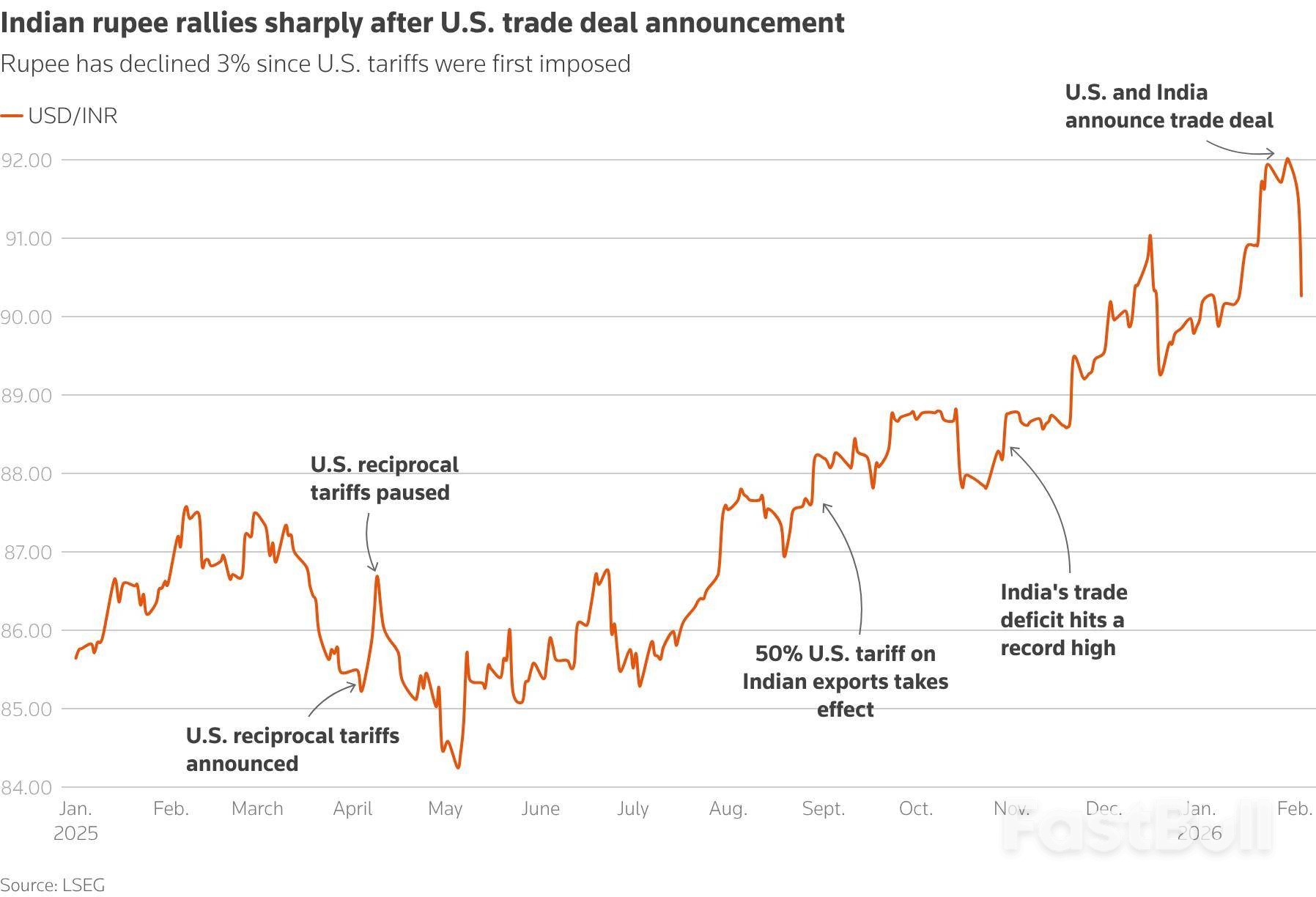
Lingering uncertainty over the trade deal had been a major headwind for the rupee. In January alone, the currency weakened by 2% and hit a record low of 91.9875 as foreign investors pulled approximately $4 billion net from stock markets.
"Rupee was under pressure due to the outflows which we saw for the last month, and I think that should stop," Jain explained.
He added that a shift in exporter behavior could provide another layer of support. As the rupee fell, many exporters had reduced their currency hedging and held onto U.S. dollars overseas, expecting further weakness. With the outlook now improving, they are likely to increase hedging activity, which involves selling dollars and buying rupees.
As foreign capital potentially returns to India, Jain does not anticipate the Reserve Bank of India (RBI) will step in to aggressively buy U.S. dollars and build its foreign exchange reserves.
According to the latest data, the RBI sold nearly $30 billion between September and November. Despite this, India’s foreign exchange reserves reached a record high of $709 billion in the week ending January 23, boosted by rising gold prices and multiple FX swaps.
"I do not think RBI will be buying aggressively at the current level," Jain noted. "If the rupee stays around this level, the RBI might roll over their forward book and not intervene heavily."
Discounts on Russian oil for Indian refiners have widened significantly in the last ten days, posing a direct challenge to a recent trade understanding with the United States aimed at curbing these purchases.
Traders familiar with the transactions report that Russia's flagship Urals grade is now being offered at a discount of more than $10 per barrel below Brent crude. This price includes shipping and other associated costs.
According to market intelligence firm Argus, the current discount is around $11 a barrel. This marks a notable increase from the $9.15 figure recorded as recently as January 22. The current markdown is also at least three times higher than the levels quoted before the U.S. sanctioned Russian energy giants Rosneft PJSC and Lukoil PJSC in October. The final discount can vary based on payment conditions.
The growing price incentive from Russia coincides with new geopolitical pressure from Washington. President Donald Trump announced on Monday that the U.S. would lower import tariffs on Indian products. In exchange, India is expected to stop purchasing Russian oil.
While Prime Minister Narendra Modi acknowledged the agreement, he did not provide specific details, leaving the status of crude oil imports ambiguous. This lack of clarity has caused Indian refiners to pause their Russian oil purchases as they seek guidance from New Delhi.
India emerged as a major customer for Russian crude following the invasion of Ukraine in early 2022, drawn by the substantial discounts. While not traditionally a top buyer, India's imports surged, peaking at 2 million barrels per day.
Purchases have moderated in recent months but remained strong. According to data from Kpler, India imported an average of 1.2 million barrels per day in January.
Despite the political pressure, market analysts believe India's demand for Russian crude will persist. In a note on Tuesday, Kpler stated that India is "unlikely to fully disengage" from Russian oil in the near future.
The data intelligence firm projects that India's imports will hold steady in the range of 1.1 million to 1.3 million barrels per day through the first quarter and into the beginning of the second. Kpler estimates the current Urals discount to India at approximately $9 per barrel against ICE Brent, making it about $4 to $5 per barrel cheaper than comparable Venezuelan crude.
German Chancellor Friedrich Merz is leading a delegation to the Middle East this week in a strategic push to diversify energy supplies and lessen Germany's dependence on liquefied natural gas (LNG) from the United States.
The three-day trip begins Wednesday in Riyadh with a scheduled meeting with Crown Prince Mohammed bin Salman. The chancellor and accompanying corporate leaders will then travel to Qatar and the United Arab Emirates before returning to Berlin.
According to government officials, the visit is a core part of Germany's broader strategy to secure new global energy sources and find new markets for its industrial exports.
Germany's move is driven by growing concerns over its reliance on American energy. Following Russia's invasion of Ukraine, Germany banned Russian pipeline gas, which had previously accounted for over half of its natural gas imports. This forced a rapid pivot to other suppliers.
Today, LNG makes up about 13% of Germany's total gas imports, with a staggering 94% of that LNG coming from the U.S.
This heavy concentration is now viewed as a potential security risk, particularly after the Trump administration used energy as a bargaining chip in tariff negotiations. Last year, Europe pledged to purchase $750 billion in US energy through 2028. However, recent rhetoric from Trump has renewed fears in Berlin that this economic leverage could be used strategically.
"High dependency is a problem in view of the authoritarian development of the US government and the risk of geopolitical blackmail," explained Susanne Nies, an energy expert at the Helmholtz-Zentrum Berlin think tank. Nies suggested Germany should also explore alternatives like increased pipeline gas from Norway and LNG from Canada or Australia.
This effort follows a similar trip made by Merz's predecessor, Olaf Scholz, who visited the Gulf states in September 2022 to secure LNG deals immediately after the break with Russia. Merz's current visit aims to build on that foundation and further reduce exposure to any single supplier.
Beyond energy, the chancellor's agenda includes discussions on closer defense cooperation and the tense security situation in the region. The visit, however, is shadowed by concerns over potential renewed US attacks on Iran following a harsh crackdown on protestors in Tehran.
A significant challenge in pivoting to Gulf suppliers is a mismatch in timelines. Gulf LNG producers typically require buyers to sign long-term contracts of at least 20 years.
This conflicts with Germany's climate policy, which mandates a complete ban on all LNG imports from the end of 2043. This deadline gives German companies a strong incentive to continue using US export terminals, which offer greater contractual flexibility.
Claudia Kemfert, head of the energy department at the German Institute for Economic Research, highlighted the underlying issue. "The very high dependence on the US is problematic because it creates new geopolitical and price risks," she said. "The lesson to be learned from this is that Germany should reduce its overall dependence on fossil fuels and not just switch supplier countries."
South Korean officials are engaged in a high-stakes effort to prevent the United States from imposing a threatened 25% tariff hike, a move that could disrupt a trade agreement reached last year. The diplomatic scramble comes as lawmakers in Seoul work to pass a special bill needed to authorize investment funds pledged to the U.S.
To de-escalate the situation, South Korea's top diplomat, Cho Hyun, met with Secretary of State Marco Rubio in Washington on Tuesday. According to South Korea's Foreign Ministry, Minister Cho used the meeting to detail the country's domestic efforts to implement the tariff agreement and reaffirmed its investment commitments.
This visit follows a similar trip last week by Industry Minister Kim Jung-kwan, who held talks with Secretary of Commerce Howard Lutnick. During that meeting, Kim clarified that Seoul has no intention of delaying or failing to implement the trade deal. Cho stated before his departure that he would seek American understanding of South Korea's legislative process.
The diplomatic push was triggered after President Donald Trump announced last week that he would raise the levy on South Korean goods from 15% to 25%. Trump cited the failure of the country's legislature to formally codify the trade deal the two nations agreed upon last year.
That agreement, which took months to negotiate, was designed to lower threatened U.S. tariff rates in exchange for significant investment promises from South Korea. However, the latest threat highlights the persistent risks facing U.S. trading partners. While it remains unclear if or when Washington will formalize the tariff hike, officials in Seoul have indicated that the U.S. is holding internal discussions on the matter.
Back in South Korea, Finance Minister Koo Yun-cheol has been lobbying parliament for the swift passage of the "Special Law on Strategic Investment with the US." This legislation is crucial as it underpins South Korea's pledge to invest $350 billion in the United States.
Following a meeting with Minister Koo, the chair of the National Assembly's finance committee confirmed that they will push to hold a hearing on the law before this month's Lunar New Year holiday, signaling a potential path forward to resolving the impasse.

BNB (BNB), a Binance-tied cryptocurrency, may plunge by another 15% in February, continuing its slide from the October top above $1,300 and now struggling to hold above the $750 support level.
BNB/USD daily price chart. Source: TradingViewLet's examine the reasons behind my bearish outlook.
Markets have started pricing a sharper pullback in AI-linked equities after a crowded rally, and crypto has tracked that risk-off move.
A Goldman Sachs basket of US software stocks fell 6% on Tuesday, marking its biggest one-day drop since April's tariff-driven selloff. The tech-heavy Nasdaq-100 slipped 1.6%.
BNB/USD vs. Nasdaq Composite daily performance chart. Source: TradingViewBNB fell alongside, showing how closely cryptocurrencies have been tracking the tech sector's gains and losses.
AI trades have dominated US equities for the past three years. Still, more investors now see that rally, driven by the "Magnificent Seven" megacaps, starting to fade as leadership broadens across the market.
In 2026, that shift has become clearer, with value stocks sharply outperforming growth. I therefore expect further downside in these riskier assets, as gold (XAU) and silver (XAG) show signs of recovery.
XAU/USD vs. XAG/USD daily price chart. Source: TradingViewThat's a bid for protection from equities' overvaluations, which will likely hurt BNB.
At the same time, the nomination of Kevin Warsh as the next Fed chairman has pushed traders to reassess the "higher-for-longer" path for rates. Higher expected rates usually pressure liquidity-sensitive assets like BNB first.
BNB has also faced coin-specific pressure from negative coverage tied to Binance and co-founder Changpeng Zhao.
The latest wave centers on allegations of market manipulation linked to '10/10,' with claims circulating that Binance-linked activity amplified a price crash on Oct. 10 that triggered roughly $19 billion in liquidations across the crypto market.
Binance and CZ have pushed back on manipulation claims previously, and no new confirmed legal determination has emerged yet. Still, the headlines have weighed on sentiment during an already fragile BNB market.
On the 4-hour chart, BNB is carving a bear pennant: a sharp drop followed by tight, contracting consolidation. That structure often resolves in the direction of the prior downside move.
BNB/USD four-hour price chart. Source: TradingViewA breakdown from the pennant's lower trendline would keep the downtrend intact and open the door to a move toward the mid-$650s, roughly another 15% lower from current levels.
The nearby moving averages sit above the BNB price, which adds overhead resistance if bulls try to reclaim momentum.
Moreover, BNB cost-basis bands keep the downside pressure intact.
Most buyers from the last 12 months are sitting on losses, according to Glassnode data. That makes quick selloffs more likely if BNB tries to bounce, because many holders will use rallies to reduce damage.
BNB realized price by age vs. price. Source: GlassnodeBuyers from around 12 months ago sit close to break-even. That creates another layer of selling if the price climbs back toward their average entry level.
Overall, my bias is strongly bearish toward BNB.
The British Pound rallied above 1.3650 and 1.3750 against the US Dollar. GBP/USD even climbed above 1.3850 before the bears appeared.
Looking at the 4-hour chart, the pair traded as high as 1.3869 and recently saw a downside correction. There was a drop below the 1.3800 and 1.3750 levels. The pair declined below the 38.2% Fib retracement level of the upward move from the 1.3342 swing low to the 1.3869 high.

It found bids near the 1.3640 zone. Immediate support could be 1.3645. The first major area for the bulls might be near 1.3600 or the 50% Fib retracement level of the upward move from the 1.3342 swing low to the 1.3869 high.
There is also a declining channel or a possible bullish flag forming with support at 1.3600. The main support sits at 1.3550 and the 100 simple moving average (red, 4-hour), below which the pair might test the 200 simple moving average (green, 4-hour).
If there is a fresh increase, the pair could face resistance near 1.3750. The first key hurdle could be 1.3800. The next stop for the bulls might be 1.3860, where they could face hurdles. A close above 1.3860 could open the doors for more gains. In the stated case, the bulls could aim for a move toward 1.4000.
Looking at EUR/USD, the pair corrected some gains and tested the 1.1780 support. It is now stuck in a range and facing hurdles near 1.1850.
The risk of loss in trading financial instruments such as stocks, FX, commodities, futures, bonds, ETFs and crypto can be substantial. You may sustain a total loss of the funds that you deposit with your broker. Therefore, you should carefully consider whether such trading is suitable for you in light of your circumstances and financial resources.
No decision to invest should be made without thoroughly conducting due diligence by yourself or consulting with your financial advisors. Our web content might not suit you since we don't know your financial conditions and investment needs. Our financial information might have latency or contain inaccuracy, so you should be fully responsible for any of your trading and investment decisions. The company will not be responsible for your capital loss.
Without getting permission from the website, you are not allowed to copy the website's graphics, texts, or trademarks. Intellectual property rights in the content or data incorporated into this website belong to its providers and exchange merchants.
Not Logged In
Log in to access more features
Log In
Sign Up