Markets
News
Analysis
User
24/7
Economic Calendar
Education
Data
- Names
- Latest
- Prev


Signal Accounts for Members
All Signal Accounts
All Contests


[Survey Shows Calls For Rate Hikes This Year Weaken; ECB May Keep Rates Unchanged Until End Of Next Year] With Calls For A 2026 Rate Hike Waning, The European Central Bank (ECB) Is Expected To Keep Interest Rates Unchanged Until At Least The End Of Next Year. Economists Surveyed Unanimously Predict That The ECB Governing Council Will Maintain The Deposit Rate At 2% When It Meets In Frankfurt On February 4-5. While The Percentage Of Those Expecting One Or More Rate Hikes Before 2028 Has Risen From About A Quarter In The Previous Survey To A Third, Fewer Believe Such Action Will Be Taken This Year
IMF: Bangladesh's Inflation Projected To Remain Elevated At 8.9% In Fy26 Before Subsiding To Around 6% In Fy27
ICE - Brent Crude Speculators Raise Net Long Positions By 29947 Contracts To 246917 In Week To January 27
ICE - Gasoil Speculators Raise Net Long Positions By 7479 Contracts To 74062 In Week To January 27
ICE Futures Europe - Robusta Coffee Speculators Raise Net Long Position By 7124 Lots To 14057 Lots As Of Jan 27 - Exchange Cot Data
ICE Futures Europe - Cocoa Speculators Trim Net Short Position By 1653 Lots To 23192 Lots As Of Jan 27 - Exchange Cot Data
ICE Futures Europe - White Sugar Speculators Cut Net Long Position By 6986 Lots To 42036 Lots As Of Jan 27 - Exchange Cot Data
ICE Futures Europe - Feed Wheat Speculators Trim Net Short Position By 57 Lots To 1013 Lots As Of Jan 27 - Exchange Cot Data
St. Louis Federal Reserve President Musalem: The FOMC Meeting Is About Persuading Each Other, And The Best Ideas Will Prevail
The MSCI Emerging Market Currency Index Is On Track For Its Biggest One-day Drop Since 2024, With Investors Watching The Metals Market Crash
Reuters Poll - Mexico's Central Bank Likely To Maintain Its Benchmark Interest Rate At 7% Next Week, According To All 28 Economists Polled
[Trump: US Is Planning To Rebuild "traditional Battleships"] On January 30, US President Trump Stated That The Current Situation In Iran Is "quite Serious." He Had Clearly Warned Iran, And The Latter Subsequently Chose To Back Down, Indicating That The Parties Involved "really Want To Reach An Agreement." When Asked If He Had Set A Deadline For Reaching An Agreement With Iran, Trump Said That No Specific Timetable Had Been Set Yet, And It "will Depend On How Things Develop."
Federal Reserve's Musalem: If I See New Evidence Of Weakness In The Labor Market, I Might Support A Fed Rate Cut
Musalem Says He Expects Inflation To Decline Towards 2%, But Sees A Risk It Could Remain Above 2% For Longer
Musalem Says He Expects Economy To Continue Growing Above Trend, Boosted By Credit Conditions And Fiscal Policy

U.K. M4 Money Supply (SA) (Dec)A:--
F: --
U.K. M4 Money Supply YoY (Dec)A:--
F: --
P: --
U.K. M4 Money Supply MoM (Dec)A:--
F: --
P: --
U.K. Mortgage Lending (Dec)A:--
F: --
U.K. Mortgage Approvals (Dec)A:--
F: --
Italy Unemployment Rate (SA) (Dec)A:--
F: --
P: --
Euro Zone Unemployment Rate (Dec)A:--
F: --
P: --
Euro Zone GDP Prelim QoQ (SA) (Q4)A:--
F: --
P: --
Euro Zone GDP Prelim YoY (SA) (Q4)A:--
F: --
P: --
Italy PPI YoY (Dec)A:--
F: --
P: --
Mexico GDP Prelim YoY (Q4)A:--
F: --
P: --
Brazil Unemployment Rate (Dec)A:--
F: --
P: --
South Africa Trade Balance (Dec)A:--
F: --
P: --
India Deposit Gowth YoYA:--
F: --
P: --
Germany CPI Prelim YoY (Jan)A:--
F: --
P: --
Germany CPI Prelim MoM (Jan)A:--
F: --
P: --
Germany HICP Prelim YoY (Jan)A:--
F: --
P: --
Germany HICP Prelim MoM (Jan)A:--
F: --
P: --
U.S. Core PPI YoY (Dec)A:--
F: --
U.S. Core PPI MoM (SA) (Dec)A:--
F: --
P: --
U.S. PPI YoY (Dec)A:--
F: --
P: --
U.S. PPI MoM (SA) (Dec)A:--
F: --
P: --
Canada GDP MoM (SA) (Nov)A:--
F: --
P: --
Canada GDP YoY (Nov)A:--
F: --
P: --
U.S. PPI MoM Final (Excl. Food, Energy and Trade) (SA) (Dec)A:--
F: --
P: --
U.S. PPI YoY (Excl. Food, Energy & Trade) (Dec)A:--
F: --
P: --
U.S. Chicago PMI (Jan)A:--
F: --
Canada Federal Government Budget Balance (Nov)A:--
F: --
P: --
U.S. Weekly Total Oil Rig CountA:--
F: --
P: --
U.S. Weekly Total Rig CountA:--
F: --
P: --
China, Mainland NBS Manufacturing PMI (Jan)--
F: --
P: --
China, Mainland NBS Non-manufacturing PMI (Jan)--
F: --
P: --
China, Mainland Composite PMI (Jan)--
F: --
P: --
South Korea Trade Balance Prelim (Jan)--
F: --
Japan Manufacturing PMI Final (Jan)--
F: --
P: --
South Korea IHS Markit Manufacturing PMI (SA) (Jan)--
F: --
P: --
Indonesia IHS Markit Manufacturing PMI (Jan)--
F: --
P: --
China, Mainland Caixin Manufacturing PMI (SA) (Jan)--
F: --
P: --
Indonesia Trade Balance (Dec)--
F: --
P: --
Indonesia Inflation Rate YoY (Jan)--
F: --
P: --
Indonesia Core Inflation YoY (Jan)--
F: --
P: --
India HSBC Manufacturing PMI Final (Jan)--
F: --
P: --
Australia Commodity Price YoY (Jan)--
F: --
P: --
Russia IHS Markit Manufacturing PMI (Jan)--
F: --
P: --
Turkey Manufacturing PMI (Jan)--
F: --
P: --
U.K. Nationwide House Price Index MoM (Jan)--
F: --
P: --
U.K. Nationwide House Price Index YoY (Jan)--
F: --
P: --
Germany Actual Retail Sales MoM (Dec)--
F: --
Italy Manufacturing PMI (SA) (Jan)--
F: --
P: --
South Africa Manufacturing PMI (Jan)--
F: --
P: --
Euro Zone Manufacturing PMI Final (Jan)--
F: --
P: --
U.K. Manufacturing PMI Final (Jan)--
F: --
P: --
Brazil IHS Markit Manufacturing PMI (Jan)--
F: --
P: --
Canada National Economic Confidence Index--
F: --
P: --
Canada Manufacturing PMI (SA) (Jan)--
F: --
P: --
U.S. IHS Markit Manufacturing PMI Final (Jan)--
F: --
P: --
U.S. ISM Output Index (Jan)--
F: --
P: --
U.S. ISM Manufacturing Employment Index (Jan)--
F: --
P: --
U.S. ISM Manufacturing New Orders Index (Jan)--
F: --
P: --


No matching data
Latest Views
Latest Views
Trending Topics
Top Columnists
Latest Update
White Label
Data API
Web Plug-ins
Affiliate Program
View All

No data
Global equity funds had a third straight week of inflows in the week to January 28 on upbeat earnings expectations, while safe-haven assets like gold and bond funds also saw solid demand amid uncertainty over potential U.S. tariff moves under President Donald Trump.
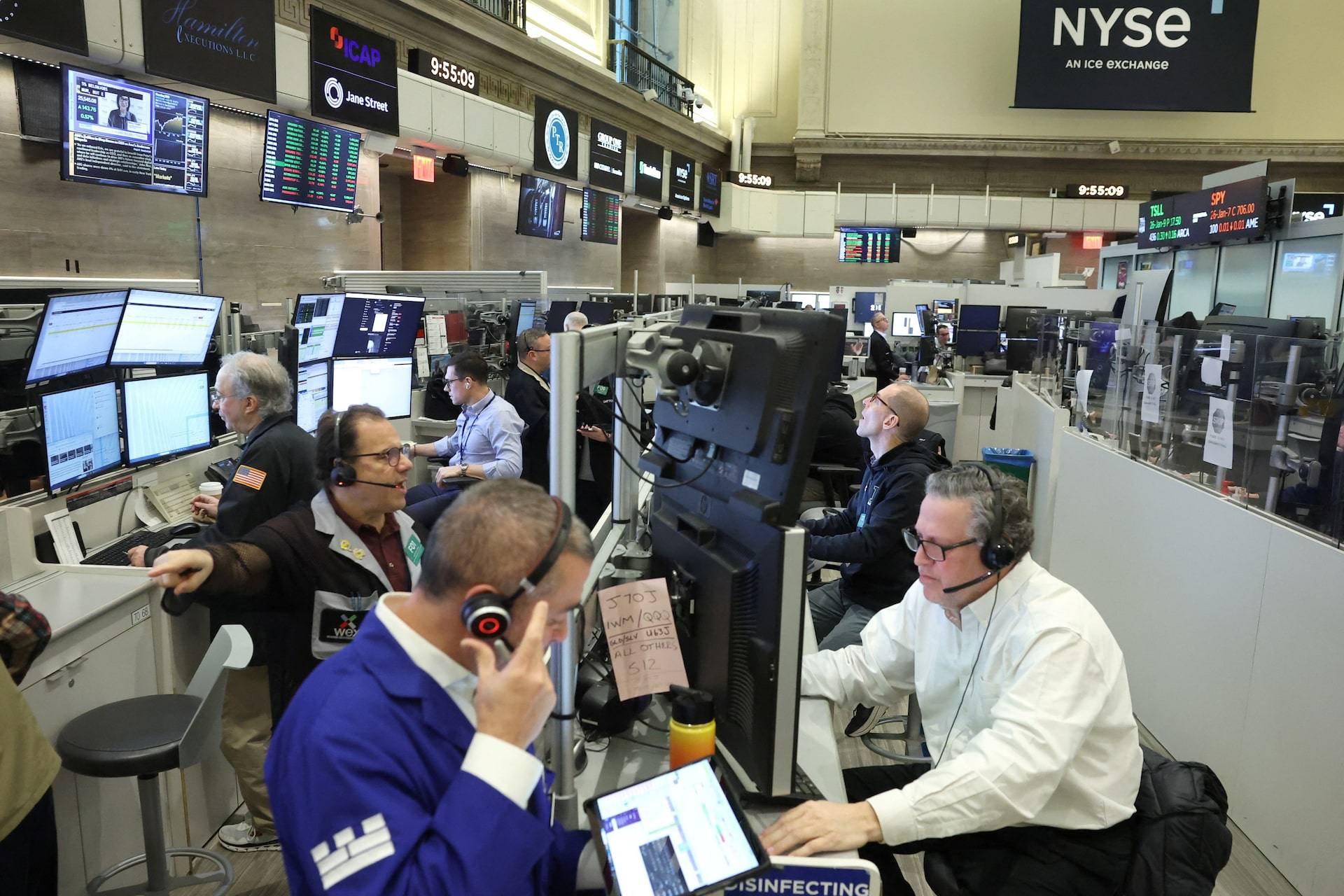
Jan 30 (Reuters) - Global equity funds had a third straight week of inflows in the week to January 28 on upbeat earnings expectations, while safe-haven assets like gold and bond funds also saw solid demand amid uncertainty over potential U.S. tariff moves under President Donald Trump.
Global equity funds attracted $33.39 billion worth of inflows in the week, compared with about $9.5 billion worth of inflows in the previous week, LSEG Lipper data showed.
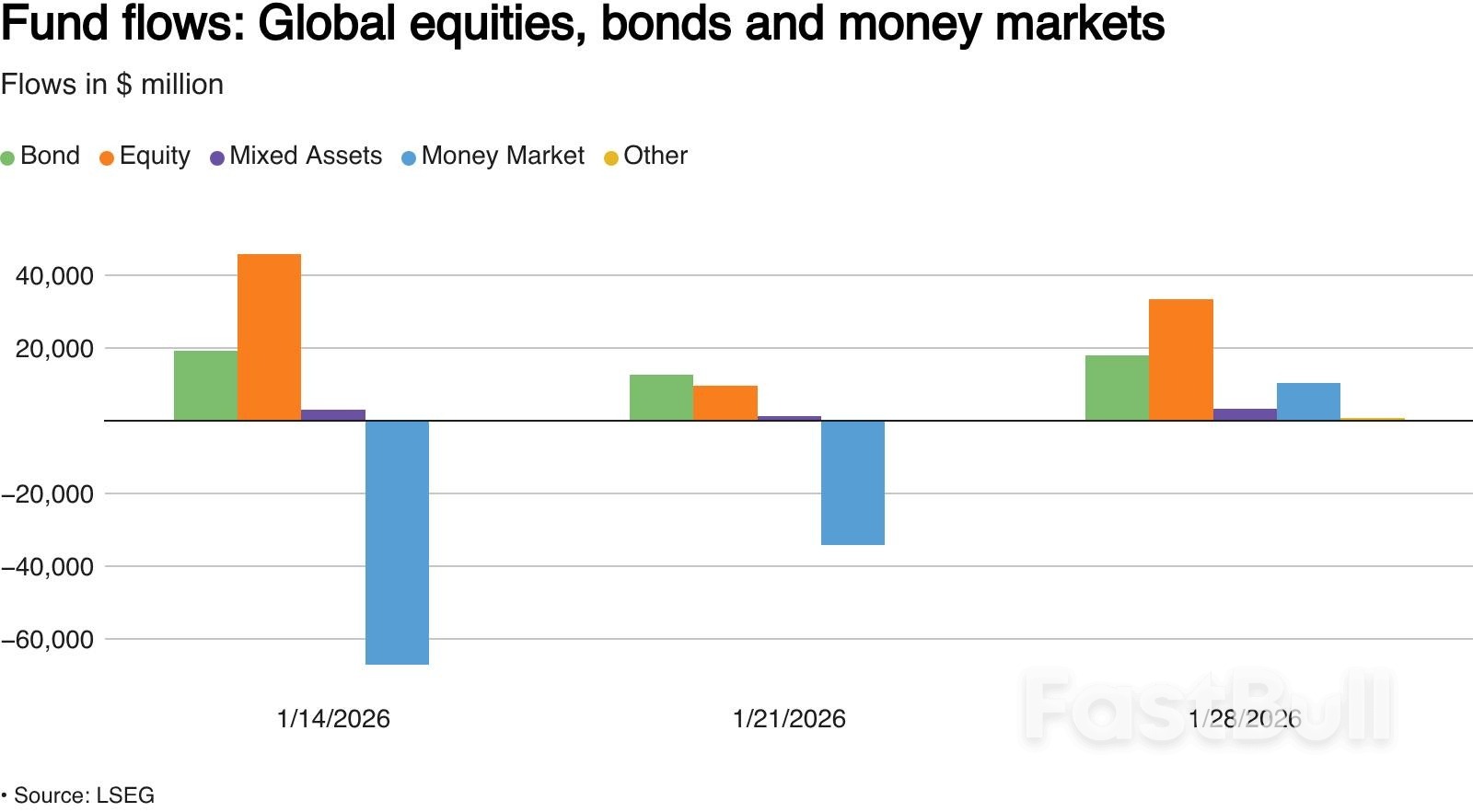
Weekly flows into global equity, bond and money market funds in $ millionBy region, European equity funds led with $11.03 billion worth of inflows, the largest amount in three weeks. Investors also added $10.73 billion and $6.95 billion to U.S. and Asian funds respectively.
Among sectoral funds, industrial, tech, and metals and mining funds were the top gainers with weekly inflows of $3.04 billion, $2.7 billion and $2.24 billion, respectively.
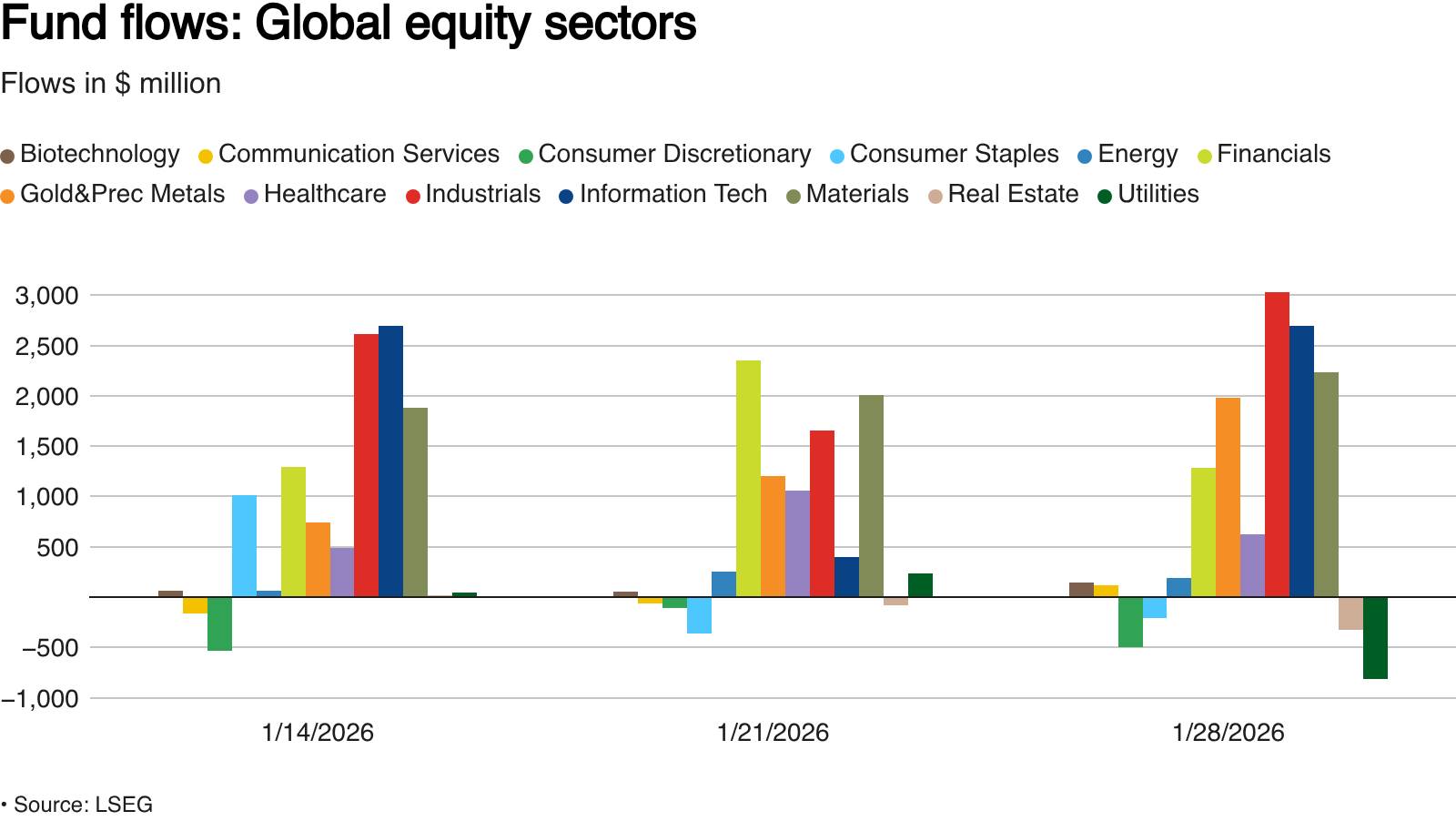
Weekly flows into global equity sector funds in $ millionGlobal bond funds had roughly $18.02 billion worth of net investments as investors extended their recent run of net purchases into a fourth successive week.
Short-term bond funds were popular, securing approximately $3.8 billion, the largest amount in three weeks. Investors also added corporate bond funds of a significant $3.45 billion.
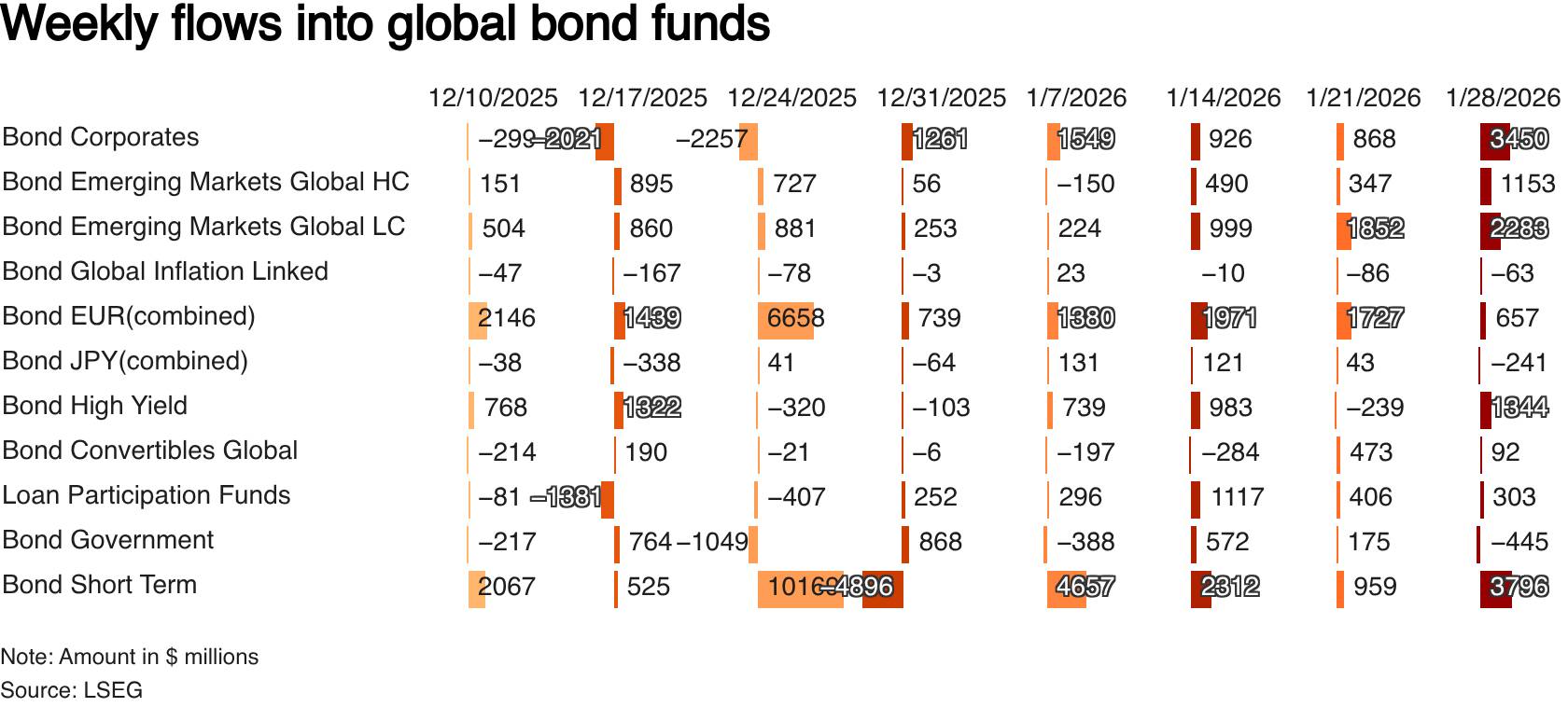
Weekly flows into global bond funds in $ millionMoney market funds witnessed $10.31 billion in net inflows, with investors turning net buyers after two successive weeks of net sales.
The gold and precious metals commodity funds attracted a net $2.25 billion weekly net investment, the largest amount for a week since December 24.
Emerging market (EM) equity funds attracted $12.63 billion in net inflows last week, the largest since at least 2022, lifted by their cheaper valuations and growth prospects. EM bond funds also had a net $3.51 billion worth of weekly inflows.
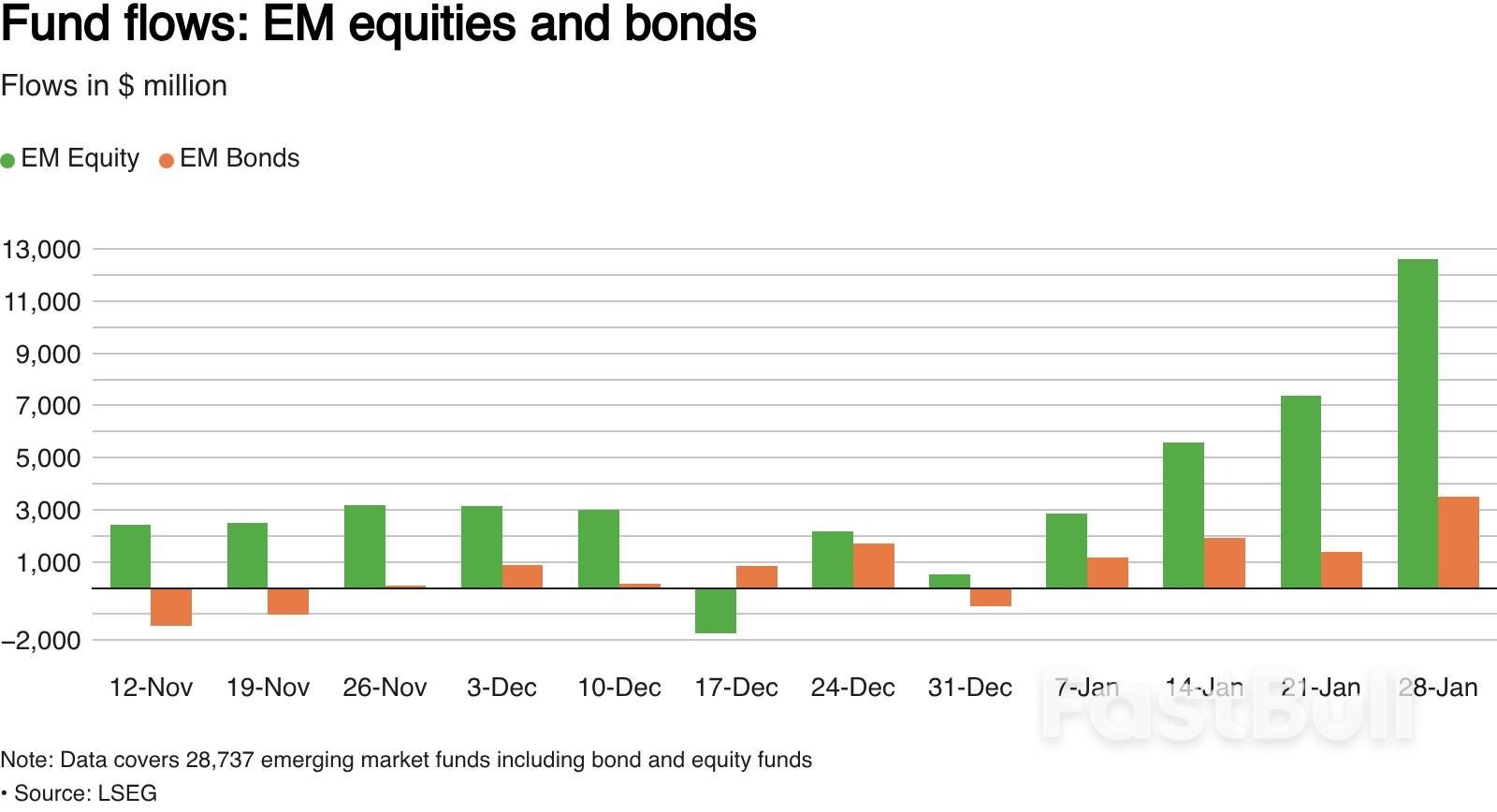
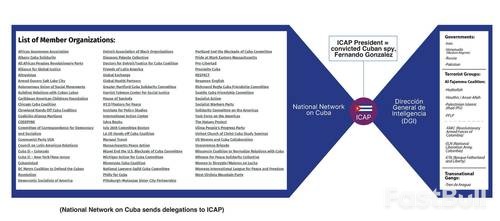
Weekly flows into EM equity and bond funds in $ millionPresident Trump declared this week that Cuba "will be failing pretty soon," attributing the nation's struggles to its dwindling oil supply from Venezuela. Following his remarks, the president signed an Executive Order on Thursday declaring a national emergency related to Cuba.
The order establishes a new mechanism authorizing the U.S. to impose tariffs on imports from any country that provides crude oil to the Cuban government, either directly or indirectly. The Secretaries of State and Commerce will lead the implementation of these measures.
The Trump administration claims the action is necessary because the Cuban regime supports hostile nations, including Russia, China, and Iran. The official justification also states that Havana provides "defense, intelligence and security assistance to adversaries in the Western Hemisphere" and violates the human rights of its own citizens.
This policy targets what the administration views as a network of malign influence.

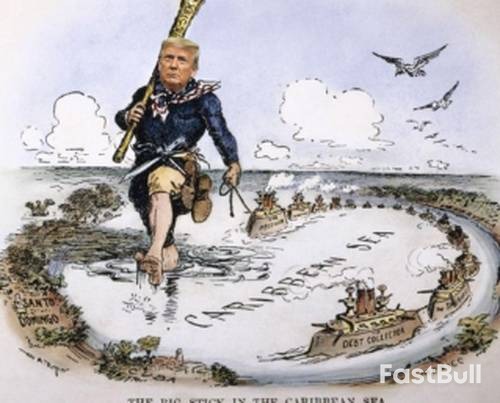
This latest move against Cuba was not unexpected. It aligns with a broader U.S. strategy in the region, often described as a form of "gunboat diplomacy."
Juan S. Gonzalez, who serves as President Joe Biden's top White House aide for Western Hemisphere affairs, previously indicated that U.S. strategy involved dismantling the Nicolas Maduro regime in Venezuela first, followed by cutting off all support to Cuba. The logic suggests that without Venezuelan backing, the Cuban government would become significantly more vulnerable.

The pressure on Cuba's energy supply is already showing tangible effects. Earlier this week, Mexican President Claudia Sheinbaum confirmed that the state-owned oil company, Pemex, had halted planned oil shipments to the island nation.
Meanwhile, Cuba's power grid appears to be on the verge of collapse. According to political commentator Eduardo Menoni, power outages are now lasting for more than 20 hours a day. He stated that "Cuba's electrical system has completely collapsed in Havana."
The administration's actions are framed as part of a larger objective to counter Marxism and its allies within the Western Hemisphere.
German two-year government bond yields are on track for their largest monthly decline since last April, as investors increasingly bet that the European Central Bank will respond to the deflationary pressure of a stronger euro.
The euro surged to a 4.5-year high against the dollar this week after U.S. President Donald Trump commented that the dollar's value was "great." This currency strength is amplifying concerns about its impact on the Eurozone economy.
In response, German 2-year yields, which are highly sensitive to monetary policy expectations, were trading at 2.06%. While up 0.5 basis points on the day, they are set for a 6.5-basis-point weekly drop—the biggest since October—and a 6-basis-point fall for January.
Money markets now price in a roughly 30% chance of an ECB rate cut by September, a significant jump from less than 10% just a week ago. Meanwhile, the probability of a rate hike by April 2027 has fallen from 50% to just 20%.
With the ECB's next monetary policy meeting approaching, investors are focused on how the central bank will navigate growing economic headwinds.
"Policy rates might be unchanged again in February, but the ECB has no shortage of issues to ponder," noted Mark Wall, chief European economist at Deutsche Bank Research. He highlighted key questions facing the bank, asking, "Is a 'Second China Shock' a more significant concern to Europe than U.S. tariffs? And is currency stability becoming a challenge to the smooth transmission of monetary policy?"
The primary worry is that the powerful combination of a strong euro and China's export activity could create a deflationary shock, forcing the ECB to abandon its current stance and pursue further interest rate cuts. Economists also point to persistent geopolitical risks, emphasizing the need for the ECB to remain agile.
Despite market anxiety, recent economic data shows the Eurozone economy is growing at a modest but steady pace. Borrowing costs remained relatively stable after reports confirmed this trend and showed inflation in North Rhine-Westphalia, Germany's most populous state, holding at 2%.
Germany's 10-year government bond yield, the benchmark for the Eurozone, rose 1.5 basis points to 2.85%.
However, some analysts remain cautious. "We have seen some temporary good performances in Germany quickly reverse in the past few years, so the big question now is whether this will be repeated in the coming quarters," said Franziska Palmas, senior Europe economist at Capital Economics.
Longer-dated bond yields also saw movement. Germany’s 30-year yield was up 1.6 basis points at 3.5%, having reached 3.556% in late December, its highest level since the summer of 2011.
The risk premium on French government bonds widened. The yield gap between French 10-year bonds and their German counterparts expanded to 58 basis points after hitting a 19-month low of 55.50 basis points on Monday.
Similarly, Italy's 10-year government bond yields increased by 2 basis points to 3.47%. The spread over German Bunds stood at around 61 basis points, after tightening to 53.50 basis points in mid-January—its narrowest level since August 2008.
A World Trade Organization (WTO) panel has ruled in favor of China, finding that key U.S. tax credits for clean energy discriminate against imported goods. The ruling targets specific measures within the Inflation Reduction Act (IRA), a landmark U.S. climate and energy law.
In its report, the WTO panel recommended that the United States must bring its policies into compliance. Specifically, it advised Washington to withdraw the domestic content bonus credits for clean energy investment and production.
The panel set a deadline of October 1, 2026, for the withdrawal, calling it a "reasonable" timeframe for the United States to adjust its measures.
China’s Ministry of Commerce praised the decision, describing the panel's ruling as "objective and fair."
Beijing initiated the complaint at the WTO in March 2024. The government stated the action was necessary to protect the interests of China's electric vehicle industry and to ensure a level playing field in the global market.
The Inflation Reduction Act, signed into law by President Joe Biden, directs billions of dollars in tax credits toward consumers and companies. The goal is to encourage the purchase of electric vehicles and the domestic production of renewable energy as part of a broader strategy to decarbonize the U.S. power sector.
While Washington has the right to appeal the WTO's decision, the process is complicated. The WTO's highest appeals court is currently paralyzed, which means a final, binding ruling on the matter may not be possible even if an appeal is filed.


The United Kingdom is recalibrating its foreign policy, pivoting toward stronger economic ties with China in a move that signals a broader realignment in global trade. A recent visit to China by UK Prime Minister Keir Starmer—the first by a British leader in eight years—has unlocked several major business deals, even without a formal trade agreement.
Facing domestic economic pressures, the Starmer government has framed its engagement with China as a strategic necessity, prioritizing commercial interests to fuel growth. This approach has already yielded significant results.
Key developments from the visit include:
• AstraZeneca's Landmark Investment: The pharmaceutical giant announced a $15 billion investment in China, its largest ever in the country.
• Octopus Energy's Market Entry: The British energy firm confirmed its expansion into the Chinese market.
• Scotch Whisky Tariff Cut: China agreed to halve tariffs on Scotch whisky, providing a major boost to Scottish distillers.
• Visa-Free Travel: British travelers can now enter China without a visa for up to 30 days.
This "business-first" policy allows the UK to pursue economic stability while managing geopolitical complexities. The government maintains that it does not need to choose between its relationships with the United States and China, viewing both as critical for its future prosperity.
The UK's pivot comes as other major economies are also reassessing their trade relationships, often in response to actions from the United States.
EU-US Trade Deal Hits a Wall
The European Union has suspended the approval process for its trade deal with the U.S. following escalating tariff threats from President Donald Trump. The U.S. had threatened to impose tariffs on several European nations if it did not gain control over Greenland.
Bernd Lange, chairman of the European Parliament's international trade committee, stated the EU had "no alternative but to suspend work" on the agreement. The deal, intended to cap U.S. tariffs on most EU goods at 15%, is now in jeopardy.
New Partnerships Take Shape
While transatlantic ties face friction, other alliances are strengthening. After nearly two decades of talks, India and the European Union have finalized a major trade agreement, which Prime Minister Narendra Modi described as a "turning point" for bilateral relations.
Meanwhile, Canada is also adjusting its trade policy, signaling a different approach by easing tariffs on Chinese electric vehicles.
These global trade shifts are occurring against the backdrop of an intense economic rivalry between the world's two largest economies. According to the World Bank, the U.S. and China dominate the global landscape in both nominal GDP and purchasing power parity (PPP).
• Nominal GDP: The U.S. leads with a projected economy of $30,507 billion, compared to China's $19,232 billion.
• Purchasing Power Parity (PPP): China has overtaken the U.S., with its GDP valued at a forecasted $40,716 billion versus the U.S. at $30,507 billion.
While the U.S. maintains a higher per capita income, China's consistently higher growth rates in recent decades have intensified the competition for global economic leadership, encouraging nations like the UK to forge diverse and pragmatic economic partnerships.
White Label
Data API
Web Plug-ins
Poster Maker
Affiliate Program
The risk of loss in trading financial instruments such as stocks, FX, commodities, futures, bonds, ETFs and crypto can be substantial. You may sustain a total loss of the funds that you deposit with your broker. Therefore, you should carefully consider whether such trading is suitable for you in light of your circumstances and financial resources.
No decision to invest should be made without thoroughly conducting due diligence by yourself or consulting with your financial advisors. Our web content might not suit you since we don't know your financial conditions and investment needs. Our financial information might have latency or contain inaccuracy, so you should be fully responsible for any of your trading and investment decisions. The company will not be responsible for your capital loss.
Without getting permission from the website, you are not allowed to copy the website's graphics, texts, or trademarks. Intellectual property rights in the content or data incorporated into this website belong to its providers and exchange merchants.
Not Logged In
Log in to access more features
Log In
Sign Up