• Trade
  • Markets
  • Copy
  • Contests
  • News
  • 24/7
  • Calendar
  • Q&A
  • Chats
Screeners
SYMBOL
LAST
ASK
BID
HIGH
LOW
NET CHG.
%CHG.
SPREAD
SPX
S&P 500 Index
6950.22
6950.22
6950.22
6964.65
6921.61
+34.61
+ 0.50%
--
DJI
Dow Jones Industrial Average
49412.39
49412.39
49412.39
49488.81
49137.65
+313.69
+ 0.64%
--
IXIC
NASDAQ Composite Index
23601.35
23601.35
23601.35
23688.94
23486.08
+100.11
+ 0.43%
--
USDX
US Dollar Index
96.790
96.870
96.790
97.060
96.680
-0.040
-0.04%
--
EURUSD
Euro / US Dollar
1.18803
1.18811
1.18803
1.18991
1.18502
+0.00010
+ 0.01%
--
GBPUSD
Pound Sterling / US Dollar
1.36940
1.36949
1.36940
1.37003
1.36636
+0.00160
+ 0.12%
--
XAUUSD
Gold / US Dollar
5088.49
5088.83
5088.49
5100.65
5013.05
+78.22
+ 1.56%
--
WTI
Light Sweet Crude Oil
60.807
60.837
60.807
60.885
60.054
+0.059
+ 0.10%
--

Community Accounts

Signal Accounts
--
Profit Accounts
--
Loss Accounts
--
View More

Become a signal provider

Sell trading signals to earn additional income

View More

Guide to Copy Trading

Get started with ease and confidence

View More

Signal Accounts for Members

All Signal Accounts

Best Return
  • Best Return
  • Best P/L
  • Best MDD
Past 1W
  • Past 1W
  • Past 1M
  • Past 1Y

All Contests

  • All
  • Trump Updates
  • Recommend
  • Stocks
  • Cryptocurrencies
  • Central Banks
  • Featured News
Top News Only
Share

Slovakia To File Lawsuit Against EU's Ban Of Russian Gas Imports, Dennik N Cites Prime Minister Fico

Share

Asked About Bank Indonesia's Independence, Governor Warjiyo Says Bi Decides Its Monetary Policy Based On Inflation, Forex Rate And Growth Data

Share

South Korea National Security Office: Urges North Korea To Immediately Halt Ballistic Missile Launches

Share

German Defense Minister Pistorius: Well On The Way To Joining Forces With The US In The Arctic Sentry Mission

Share

Angola Also Expects To Raise $500 Million In 2026 From World Bank Development Policy Operations, Debt Plan Shows

Share

Indonesia Central Bank Governor: Rupiah Is Currently Undervalued

Share

Indonesia Central Bank Governor: Rupiah Movement Recently Due To Short Term Factors, Fundamentals Will Help Rupiah Strengthen

Share

Polish Minister Of State Assets Says That Poland To Sign Memorandum Of Understanding With Finland On Hydrogen Supply

Share

China Renews Cooperation MOU On Green Maritime Technology, Shipbuilding Industry With Denmark - Industry Ministry

Share

Indian Rupee Up 0.24% At 91.72 Per USA Dollar As Of 3:30 P.M. Ist, Previous Close 91.94

Share

India's Nifty 50 Index Provisionally Ends 0.75% Higher

Share

The US Dollar Fell More Than 100 Points Against The Japanese Yen In The Short Term, Reaching A Low Of 153.2

Share

Softbank: About 8600 Cases Of Personal Information May Have Been Leaked Due To Server Malfunction

Share

India's Nifty 50 Index Extends Gains, Last Up 0.5%

Share

Spot Palladium Rises Over 3% To $2054.44/Oz

Share

Indonesia Central Bank Governor: Bank Indonesia Is Also Expanding Monetary Operation Instruments To Include Currencies Such As Yen, Yuan

Share

Indonesia Central Bank Governor: Looking Forward, Bi Will Continue To Monitor For Room To Further Lower Interest Rate

Share

Indonesia Central Bank Governor: Looking Forward Bi Is Committed To Maintain Rupiah Stability, Including Through Measured Interventions

Share

European Bank Stocks Index Rises 1%, Highest Level Since May 2008

Share

Hong Kong December Net Gold Exports To China 12.205 Metric Tons Versus 16.16 Metric Tons In November

TIME
ACT
FCST
PREV
U.S. IHS Markit Manufacturing PMI Prelim (SA) (Jan)

A:--

F: --

P: --

U.S. IHS Markit Services PMI Prelim (SA) (Jan)

A:--

F: --

P: --

U.S. IHS Markit Composite PMI Prelim (SA) (Jan)

A:--

F: --

P: --

U.S. UMich Consumer Sentiment Index Final (Jan)

A:--

F: --

P: --

U.S. UMich Current Economic Conditions Index Final (Jan)

A:--

F: --

P: --

U.S. UMich Consumer Expectations Index Final (Jan)

A:--

F: --

P: --

U.S. Conference Board Leading Economic Index MoM (Nov)

A:--

F: --

P: --

U.S. Conference Board Coincident Economic Index MoM (Nov)

A:--

F: --

P: --

U.S. Conference Board Lagging Economic Index MoM (Nov)

A:--

F: --

P: --

U.S. UMich 1-Year-Ahead Inflation Expectations Final (Jan)

A:--

F: --

P: --

U.S. Conference Board Leading Economic Index (Nov)

A:--

F: --

P: --

U.S. Weekly Total Rig Count

A:--

F: --

P: --

U.S. Weekly Total Oil Rig Count

A:--

F: --

P: --

Japanese Prime Minister Sanae Takaichi delivers a speech
Germany Ifo Business Expectations Index (SA) (Jan)

A:--

F: --

P: --

Germany IFO Business Climate Index (SA) (Jan)

A:--

F: --

P: --

Germany Ifo Current Business Situation Index (SA) (Jan)

A:--

F: --

P: --

Brazil Current Account (Dec)

A:--

F: --

P: --

Mexico Unemployment Rate (Not SA) (Dec)

A:--

F: --

P: --

Canada National Economic Confidence Index

A:--

F: --

P: --

U.S. Non-Defense Capital Durable Goods Orders MoM (Excl. Aircraft) (Nov)

A:--

F: --

P: --
U.S. Durable Goods Orders MoM (Excl. Defense) (SA) (Nov)

A:--

F: --

P: --
U.S. Durable Goods Orders MoM (Excl.Transport) (Nov)

A:--

F: --

P: --

U.S. Durable Goods Orders MoM (Nov)

A:--

F: --

P: --
U.S. Chicago Fed National Activity Index (Nov)

A:--

F: --

P: --
U.S. Dallas Fed New Orders Index (Jan)

A:--

F: --

P: --

U.S. Dallas Fed General Business Activity Index (Jan)

A:--

F: --

P: --
U.S. 2-Year Note Auction Avg. Yield

A:--

F: --

P: --

U.K. BRC Shop Price Index YoY (Jan)

A:--

F: --

P: --

China, Mainland Industrial Profit YoY (YTD) (Dec)

A:--

F: --

P: --

Germany 2-Year Schatz Auction Avg. Yield

--

F: --

P: --

Mexico Trade Balance (Dec)

--

F: --

P: --

U.S. Weekly Redbook Index YoY

--

F: --

P: --

U.S. S&P/CS 20-City Home Price Index YoY (Not SA) (Nov)

--

F: --

P: --

U.S. S&P/CS 20-City Home Price Index MoM (SA) (Nov)

--

F: --

P: --

U.S. FHFA House Price Index MoM (Nov)

--

F: --

P: --

U.S. FHFA House Price Index (Nov)

--

F: --

P: --

U.S. FHFA House Price Index YoY (Nov)

--

F: --

P: --

U.S. S&P/CS 10-City Home Price Index YoY (Nov)

--

F: --

P: --

U.S. S&P/CS 10-City Home Price Index MoM (Not SA) (Nov)

--

F: --

P: --

U.S. S&P/CS 20-City Home Price Index (Not SA) (Nov)

--

F: --

P: --

U.S. S&P/CS 20-City Home Price Index MoM (Not SA) (Nov)

--

F: --

P: --

U.S. Richmond Fed Manufacturing Composite Index (Jan)

--

F: --

P: --

U.S. Conference Board Present Situation Index (Jan)

--

F: --

P: --

U.S. Conference Board Consumer Expectations Index (Jan)

--

F: --

P: --

U.S. Richmond Fed Manufacturing Shipments Index (Jan)

--

F: --

P: --

U.S. Richmond Fed Services Revenue Index (Jan)

--

F: --

P: --

U.S. Conference Board Consumer Confidence Index (Jan)

--

F: --

P: --

U.S. 5-Year Note Auction Avg. Yield

--

F: --

P: --

U.S. API Weekly Refined Oil Stocks

--

F: --

P: --

U.S. API Weekly Crude Oil Stocks

--

F: --

P: --

U.S. API Weekly Gasoline Stocks

--

F: --

P: --

U.S. API Weekly Cushing Crude Oil Stocks

--

F: --

P: --

Australia RBA Trimmed Mean CPI YoY (Q4)

--

F: --

P: --

Australia CPI YoY (Q4)

--

F: --

P: --

Australia CPI QoQ (Q4)

--

F: --

P: --

Germany GfK Consumer Confidence Index (SA) (Feb)

--

F: --

P: --

Germany 10-Year Bund Auction Avg. Yield

--

F: --

P: --

India Industrial Production Index YoY (Dec)

--

F: --

P: --

India Manufacturing Output MoM (Dec)

--

F: --

P: --

Q&A with Experts
    • All
    • Chatrooms
    • Groups
    • Friends
    SlowBear ⛅ flag
    ANDY
    @ANDY wow this is one origial buy from supply bro!
    Khawatir_ flag
    SlowBear ⛅ flag
    ANDY
    should the position be closed, afraid it will go down?
    @ANDYQell EURUSD sell is not bad for a sounter trend, but why do you have to open this many?
    McOkanz flag
    If you’re not confident enough dont take sell on gold, but it’s currently selling now, I don’t have a specific tp yet
    3008000 flag
    hi guys any on what's happening on jpy pairs
    3008000 flag
    clue
    3008000 flag
    It has suddenly dump 100pips and their is no high impact news today
    SURYAVANSHI flag
    Trading Contest

    SURYAVANSHI

    ID: 5249090

    2026 FastBull GOLD Global S1 Ongoing
    148
    Rankings
    +205,430.50
    Profit and loss(USD)
    205.43%
    Return rate
    Show your trading skills, PK top traders globally
    Contest details
    McOkanz flag
    3008000
    hi guys any on what's happening on jpy pairs
    @Visitor3008000 USDJPy fuvk me up with wick 😂🤣
    Nues Scalp flag
    Why can't I enter the live contest even though I've registered?
    Nues Scalp flag
    I can't trade my contest. Where is the login info?
    SlowBear ⛅ flag
    3008000
    hi guys any on what's happening on jpy pairs
    @3008000the yen pairs are still in their correctve stage lets just watch out
    SlowBear ⛅ flag
    3008000
    It has suddenly dump 100pips and their is no high impact news today
    @3008000 the yen pairs are still going through the ubcertainties that surronds the BoJ Intervention so lets stay clear of them
    ndu flag
    trump is target south korea again with tarrif due to a delay to make an agreement with US and that not good for USD.
    Tấn Tài Ng flag
    The Japanese yen is about to explode, soon to be a safe haven for gold and silver stars.
    ndu flag
    Tấn Tài Ng
    The Japanese yen is about to explode, soon to be a safe haven for gold and silver stars.
    @Tấn Tài Ng
    Judy flag
    what are your buy limits for gold my people?
    Tấn Tài Ng flag
    Silver was initially ignored, but when people started paying attention, its price rose sharply, as did the Japanese yen.
    SlowBear ⛅ flag
    ndu
    @ndu I agree, the Yen and USD relationship is divergening and like you said investors are shifting to Gold and silver instead of the usual carry trader relationshop between both currencies
    VT Lian flag
    Tấn Tài Ng
    Silver was initially ignored, but when people started paying attention, its price rose sharply, as did the Japanese yen.
    @Tấn Tài Ngyour english is good
    Type here...
    Add Symbol or Code

      No matching data

      All
      Trump Updates
      Recommend
      Stocks
      Cryptocurrencies
      Central Banks
      Featured News
      • All
      • Russia-Ukraine Conflict
      • Middle East Flashpoint
      • All
      • Russia-Ukraine Conflict
      • Middle East Flashpoint
      Search
      Products

      Charts Free Forever

      Chats Q&A with Experts
      Screeners Economic Calendar Data Tools
      Membership Features
      Data Warehouse Market Trends Institutional Data Policy Rates Macro

      Market Trends

      Market Sentiment Order Book Forex Correlations

      Top Indicators

      Charts Free Forever
      Markets

      News

      News Analysis 24/7 Columns Education
      From Institutions From Analysts
      Topics Columnists

      Latest Views

      Latest Views

      Trending Topics

      Top Columnists

      Latest Update

      Signals

      Copy Rankings Latest Signals Become a signal provider AI Rating
      Contests
      Brokers

      Overview Brokers Assessment Rankings Regulators News Claims
      Broker listing Forex Brokers Comparison Tool Live Spread Comparison Scam
      Q&A Complaint Scam Alert Videos Tips to Detect Scam
      More

      Business
      Events
      Careers About Us Advertising Help Center

      White Label

      Data API

      Web Plug-ins

      Affiliate Program

      Awards Institution Evaluation IB Seminar Salon Event Exhibition
      Vietnam Thailand Singapore Dubai
      Fans Party Investment Sharing Session
      FastBull Summit BrokersView Expo
      Recent Searches
        Top Searches
          Markets
          News
          Analysis
          User
          24/7
          Economic Calendar
          Education
          Data
          • Names
          • Latest
          • Prev

          View All

          No data

          Scan to Download

          Faster Charts, Chat Faster!

          Download App
          English
          • English
          • Español
          • العربية
          • Bahasa Indonesia
          • Bahasa Melayu
          • Tiếng Việt
          • ภาษาไทย
          • Français
          • Italiano
          • Türkçe
          • Русский язык
          • 简中
          • 繁中
          Open Account
          Search
          Products
          Charts Free Forever
          Markets
          News
          Signals

          Copy Rankings Latest Signals Become a signal provider AI Rating
          Contests
          Brokers

          Overview Brokers Assessment Rankings Regulators News Claims
          Broker listing Forex Brokers Comparison Tool Live Spread Comparison Scam
          Q&A Complaint Scam Alert Videos Tips to Detect Scam
          More

          Business
          Events
          Careers About Us Advertising Help Center

          White Label

          Data API

          Web Plug-ins

          Affiliate Program

          Awards Institution Evaluation IB Seminar Salon Event Exhibition
          Vietnam Thailand Singapore Dubai
          Fans Party Investment Sharing Session
          FastBull Summit BrokersView Expo

          From Fib Levels To Fireworks: Natural Gas Explodes 146% In 12 Days

          Justin

          Forex

          Commodity

          Summary:

          Natural Gas has once again reminded traders of its explosive potential. After finding buyers at a key Fibonacci extension area, prices catapulted 146% in just 12 trading days—an extraordinary rally that left skeptics behind and rewarded those who trusted the technical confluence.

          Natural Gas has once again reminded traders of its explosive potential. After finding buyers at a key Fibonacci extension area, prices catapulted 146% in just 12 trading days—an extraordinary rally that left skeptics behind and rewarded those who trusted the technical confluence. This surge wasn't just about numbers on a chart; it was a vivid demonstration of how market psychology, technical precision, and momentum can align to produce breathtaking moves. For traders and analysts alike, the rally offers a textbook case study in how Fibonacci levels can act as springboards for powerful trends. Charts often speak louder than words, so let's turn to the charts to see how this remarkable move unfolded…

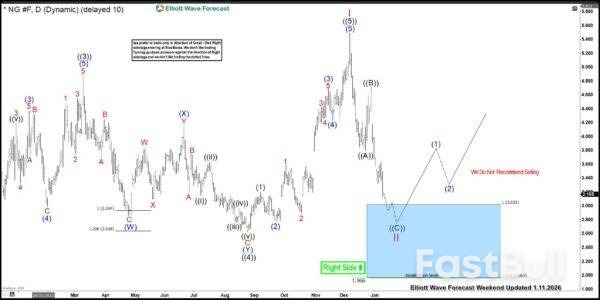
          Natural Gas Daily Chart (Jan 14): Price approaches the 3.022 – 1.965 Fibonacci extension zone

          Natural Gas 11 Jan Daily Elliott Wave ChartOn the daily chart from January 11, Natural Gas was approaching the 3.022 – 1.965 blue box zone—a critical Fibonacci extension area we had been watching closely. This region carried the potential to attract buyers and set the stage for the next leg of the rally. Going to a smaller time frame, within wave (( C )), we saw wave (3) unfolded shorter than wave (1). This gave us a precise invalidation level for wave (5) of ((C)) at 3.008. A break below that level would have opened the door for a deeper pullback toward the 2.620 – 1.965 area. However, buyers stepped in just before this threshold was tested, defending the structure and reigniting the rally.
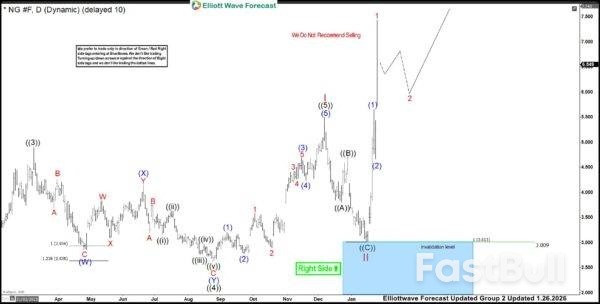
          Natural Gas Daily Chart (Jan 26): Fibonacci extension zone drives a powerful 146% rally in 12 days

          "Daily chart from January 26 above captures the explosive rally that followed. After price respected the Blue box zone, buyers stepped in with conviction, driving Natural Gas sharply higher reaching a high of $7.439. The move unfolded with textbook momentum, surging 146% in less than two weeks and confirming the strength of the technical setup. The Natural Gas rally underscores a simple truth: Blue box zones mark decisive turning points. Recognizing these areas early can sharpen your edge, helping you anticipate momentum shifts and position yourselves in the market with confidence.
          Source: Elliott Wave Forecast

          Risk Warnings and Disclaimers
          You understand and acknowledge that there is a high degree of risk involved in trading. Following any strategies or investment methods may lead to potential losses. The content on the site is provided by our contributors and analysts for information purposes only. You are solely responsible for determining whether any trading assets, securities, strategy, or any other product is suitable for investing based on your own investment objectives and financial situation.
          Add to Favorites
          Share

          Tariff Talk Fades as Investors Buy the Dip and Chase Earnings Momentum

          Gerik

          Economic

          Tariff Shock Fails to Derail Risk Appetite

          Markets once again demonstrated resilience in the face of renewed tariff rhetoric from Donald Trump, who unexpectedly announced that U.S. tariffs on South Korean goods would rise to 25% from 15% due to delays in implementing a previously agreed trade deal. The measures would affect key sectors such as automobiles, pharmaceuticals, and lumber, traditionally sensitive areas for South Korea’s export driven economy.
          Initial market reaction was negative, with South Korea’s benchmark index briefly falling more than 1%. However, the dip proved short lived. Buyers quickly stepped in, pushing equities sharply higher and sending the market to fresh record levels. This rapid reversal suggests that investors increasingly view tariff announcements as tactical pressure rather than firm policy, weakening the causal impact of such statements on asset prices.

          Dip Buying Reflects Confidence in De-escalation

          The speed of the rebound highlights growing confidence that trade tensions will ultimately cool. Market participants pointed to the likelihood of diplomatic engagement, with South Korea’s industry minister expected to travel to Washington in the coming days. This expectation has reinforced the belief that negotiations, rather than prolonged confrontation, will shape the outcome.
          Traders have increasingly priced in the idea that tariff threats often serve as leverage rather than endpoints. As a result, volatility generated by political headlines is now more likely to attract opportunistic buying than sustained selling, particularly in markets that have delivered strong performance year to date.

          Earnings Optimism Anchors Global Markets

          Beyond Asia, broader global sentiment remained constructive. Investors are positioning ahead of earnings from major U.S. technology companies, including Meta Platforms, Microsoft, and Tesla, which are seen as critical to extending the current equity rally into 2026.
          This earnings driven optimism has lifted markets across regions. MSCI’s Asia-Pacific index excluding Japan rose to a new record high, Japan’s Nikkei advanced despite a stronger yen, and European equity futures pointed to a firmer open. U.S. futures also edged higher, reinforcing the view that corporate fundamentals remain the dominant driver of risk appetite.

          Precious Metals Capture Residual Unease

          While equities surged, underlying caution was evident in commodities. Gold rose around 1% to above $5,060 an ounce, and silver jumped roughly 5% to near $109, pushing both metals back toward record highs. The rally reflects continued hedging against policy unpredictability and currency weakness, particularly as investors remain alert to geopolitical risk.
          This divergence between strong equity inflows and rising demand for safe havens suggests a layered market response. Rather than signaling panic, it points to portfolio diversification, where investors maintain exposure to growth while simultaneously insuring against political and macroeconomic shocks.

          Markets Adapt to Political Volatility

          The latest episode reinforces a clear pattern in early 2026. Tariff headlines and political disruptions continue to generate short term volatility, but their influence on market direction has diminished. Investors appear increasingly confident that earnings growth, liquidity, and negotiation channels will ultimately override confrontational rhetoric.
          For now, markets are treating trade policy risk as episodic rather than structural. As long as earnings expectations remain intact and diplomatic off ramps stay open, tariff threats are more likely to be absorbed than feared, turning market dips into buying opportunities rather than triggers for broader selloffs.

          Source: Reuters

          To stay updated on all economic events of today, please check out our Economic calendar
          Risk Warnings and Disclaimers
          You understand and acknowledge that there is a high degree of risk involved in trading. Following any strategies or investment methods may lead to potential losses. The content on the site is provided by our contributors and analysts for information purposes only. You are solely responsible for determining whether any trading assets, securities, strategy, or any other product is suitable for investing based on your own investment objectives and financial situation.
          Add to Favorites
          Share

          India and EU Forge Landmark Trade Pact Amid US Friction

          Ukadike Micheal

          Remarks of Officials

          Economic

          Political

          Russia-Ukraine Conflict

          India and the European Union announced on Tuesday they have concluded negotiations on an ambitious trade pact, a move celebrated by both sides as the "mother of all deals" in a global economy shaken by U.S. President Donald Trump's tariff policies.

          The agreement solidifies a powerful economic bloc. According to the European Commission, trade in goods and services between the EU and India already exceeds €180 billion ($213 billion) annually and supports nearly 800,000 jobs in the EU.

          This new deal is projected to double the EU's goods exports to the nation of 1.4 billion people by 2032. The core mechanism is the elimination or reduction of tariffs on 96.6% of the value of EU shipments to India.

          A New Era for Trade and Investment

          Prime Minister Narendra Modi, in a video message, emphasized that the agreement unlocks "big opportunities" for both economies. He noted that the partnership represents a combined 25% of global GDP and one-third of all international trade. "Along with trade, this agreement strengthens our shared commitment toward democracy and rule of law," Modi stated.

          The Prime Minister highlighted the strategic value of the pact, framing it as a complement to India's existing agreements with Britain and the European Free Trade Association. "This will strengthen both trade and the global supply chain," he said.

          Modi also pointed to specific domestic benefits, congratulating key Indian industries. "I congratulate all those attached with sectors such as textiles, gems and jewelry and leather and shoes as this pact will be very helpful to all of you," he remarked. "This trade deal will not only empower manufacturing in India but will also further expand sectors linked to services."

          What the Tariff Cuts Mean in Practice

          The agreement outlines significant reductions in Indian tariffs on key European products. Specific changes include:

          • European Wines: Tariffs will be slashed from 150% to 75% initially, with a further reduction to as low as 20% over time.

          • Olive Oil: The current 45% tariff will be phased out completely, dropping to 0% over a five-year period.

          A Deeper Strategic and Security Partnership

          The summit in New Delhi, attended by European Commission President Ursula von der Leyen and European Council President Antonio Costa, also produced a Security and Defense Partnership. This complementary agreement aims to enhance cooperation beyond economics.

          According to an EU handout, the partnership will focus on critical areas including:

          • Maritime security

          • The defense industry

          • Cyber and hybrid threats

          • Space

          • Counter-terrorism

          Geopolitical Tensions with the United States

          The historic India-EU deal was finalized against a backdrop of friction with the Trump administration. In August, President Trump imposed steep 50% tariffs on Indian goods, which included a 25% penalty targeting New Delhi’s purchases of Russian oil.

          The U.S. administration has openly criticized the EU for pursuing the trade pact. In an interview with ABC News on Sunday, U.S. Treasury Secretary Scott Bessent directly challenged the European position.

          "We have put 25% tariffs on India for buying Russian oil. Guess what happened last week? The Europeans signed a trade deal with India," Bessent said.

          He argued that the EU's actions indirectly undermine sanctions against Russia. "And just to be clear again, the Russian oil goes into India. The refined products come out, and the Europeans buy the refined products. They are financing the war against themselves," Bessent explained. "So, [under] President Trump's leadership, we will eventually end this Ukraine-Russia war."

          To stay updated on all economic events of today, please check out our Economic calendar
          Risk Warnings and Disclaimers
          You understand and acknowledge that there is a high degree of risk involved in trading. Following any strategies or investment methods may lead to potential losses. The content on the site is provided by our contributors and analysts for information purposes only. You are solely responsible for determining whether any trading assets, securities, strategy, or any other product is suitable for investing based on your own investment objectives and financial situation.
          Add to Favorites
          Share

          Asian Stocks Reach Fresh Record as Earnings Optimism Drowns Out Trump’s Korea Tariff Threat

          Gerik

          Economic

          Stocks

          Earnings Optimism Overpowers Trade Rhetoric

          Asian stock markets advanced to unprecedented levels on Tuesday, with investors focusing squarely on an intense week of U.S. corporate earnings rather than President Donald Trump’s decision to raise tariffs on South Korean imports. The MSCI Asia-Pacific index excluding Japan rose 0.9% to a record high, signaling sustained confidence in global equity momentum despite escalating geopolitical noise.
          The rally was underpinned by rising expectations ahead of earnings from major U.S. technology firms, including Microsoft, Apple, and Tesla, scheduled to report later in the week. Nasdaq futures gained 0.5%, reinforcing the view that earnings strength remains the dominant driver of market sentiment.
          This response suggests that while tariff announcements create short-term volatility, they are increasingly treated as background risk unless they directly threaten corporate profitability or global growth.

          South Korea Rebounds Despite Tariff Shock

          South Korean equities provided a clear example of this dynamic. After initially slipping on news that Trump would raise tariffs on Korean imports to 25%, the KOSPI reversed course and surged more than 2% to a new all-time high. The rebound indicates investor confidence that diplomatic engagement, rather than prolonged confrontation, will ultimately shape trade outcomes.
          Market participants noted expectations that South Korea’s industry minister could travel to Washington as soon as Friday, potentially easing tensions. This highlights how markets differentiate between political signaling and policy execution, treating the former as noise unless reinforced by concrete action.

          Tech Led Strength Across The Region

          Gains were broad-based across Asia. Japan’s Nikkei 225 rose 0.7%, even as a stronger yen clouded the outlook for exporters. Chinese blue-chip stocks edged up, while Hong Kong’s Hang Seng Index gained around 1%. European markets were also set for a firmer open, with Euro Stoxx 50 futures pointing higher.
          The regional rally underscores a correlation between global technology sector optimism and equity performance, with Asian markets benefiting indirectly from U.S. earnings expectations due to deep supply chain and capital market linkages.

          Safe Havens Signal Persistent Unease

          While equities pushed higher, safe-haven assets told a more cautious story. Gold climbed another 1% to around $5,065 an ounce, approaching its recent record, while silver gained 4% to $108 an ounce. Analysts pointed to ongoing geopolitical uncertainty and a weaker dollar as key drivers behind the renewed surge in precious metals.
          This divergence illustrates a layered market response. Equity investors are embracing risk through earnings exposure, while other participants continue to hedge against policy instability and currency volatility. The relationship between rising equities and surging gold is therefore not contradictory but reflective of different risk management strategies operating simultaneously.

          Dollar Weakness Adds Another Tailwind

          Currency markets added to the broader narrative of uncertainty. The U.S. dollar hovered near four-and-a-half-month lows, pressured by speculation over potential U.S.-Japan coordination to support the yen and concerns about Washington’s tolerance for a weaker currency. Although the dollar edged slightly higher against the yen on Tuesday, it remains well below levels seen earlier in January.
          This currency backdrop has indirectly supported Asian equities by improving financial conditions and boosting capital flows into non-U.S. markets, reinforcing the rally’s momentum.
          Overall, Asian markets’ record-breaking performance reflects a clear prioritization of earnings growth over geopolitical disruption. Trump’s tariff threats against South Korea added to global uncertainty, but investors appear confident that strong corporate results, particularly from U.S. technology leaders, will continue to anchor risk appetite. Unless trade tensions escalate into concrete economic damage, markets seem prepared to treat political shocks as temporary detours rather than structural threats to the rally.

          Source: Reuters

          To stay updated on all economic events of today, please check out our Economic calendar
          Risk Warnings and Disclaimers
          You understand and acknowledge that there is a high degree of risk involved in trading. Following any strategies or investment methods may lead to potential losses. The content on the site is provided by our contributors and analysts for information purposes only. You are solely responsible for determining whether any trading assets, securities, strategy, or any other product is suitable for investing based on your own investment objectives and financial situation.
          Add to Favorites
          Share

          Canada and India to Boost Oil & Gas Trade, Ending Chill

          Owen Li

          Energy

          Commodity

          Economic

          Political

          Canada and India are set to reboot their relationship with a renewed focus on energy, pledging to expand two-way trade in oil and gas after a period of diplomatic tension. The move signals a major strategic reset for both nations.

          A New Framework for Energy Cooperation

          Under the revived partnership, Ottawa will commit to increasing shipments of crude oil, liquefied natural gas (LNG), and liquefied petroleum gas (LPG) to India. In return, New Delhi will boost its exports of refined petroleum products to Canada.

          The agreement is expected to be formalized following a meeting between Canadian Energy Minister Tim Hodgson and Indian Petroleum and Natural Gas Minister Hardeep Singh Puri at India Energy Week in Goa on Tuesday.

          This meeting serves to relaunch the "ministerial energy dialogue," a key channel for cooperation that had become inactive during a dispute over the killing of a Canadian Sikh activist.

          Broader Goals for a Strategic Partnership

          The renewed dialogue extends beyond traditional fossil fuels. According to a joint statement, Hodgson and Puri will also commit to:

          • Facilitating greater reciprocal investment in their respective energy sectors.

          • Exploring collaboration on hydrogen, biofuels, and battery storage.

          • Cooperating on critical minerals and modernizing electricity systems.

          • Investigating the use of artificial intelligence in the energy industry.

          This initiative is a key part of Prime Minister Mark Carney's effort to diversify Canada's export markets, particularly as trade tensions with the United States escalate. It reflects a shift toward a more pragmatic, economy-focused diplomacy with major Asian partners.

          The Economic Stakes and Geopolitical Context

          The relaunch signals that both governments recognize significant untapped potential in their energy relationship. Prime Minister Carney is expected to visit India in the coming weeks to solidify this reset, building on talks he and Prime Minister Narendra Modi restarted in November for a comprehensive economic partnership agreement.

          In 2024, two-way goods trade between the two countries reached C$13.3 billion ($9.7 billion), and Ottawa sees substantial room for growth. Energy is a primary focus, with India currently accounting for just 1% of Canada's critical minerals exports.

          New infrastructure, including the expansion of the Trans Mountain pipeline, creates a more direct path for Canadian crude to reach India, though most shipments still transit through the U.S. Gulf Coast. Canada's west coast LPG terminals also offer relatively short shipping routes to the Indian market, and the country began exporting LNG to Asia in June 2025.

          Carney's push to strengthen ties with India follows a recent trip to Beijing, where an agreement to reduce tariff barriers prompted U.S. President Donald Trump to threaten 100% tariffs on Canadian goods. Carney has maintained that Canada is not pursuing a free trade agreement with China.

          To stay updated on all economic events of today, please check out our Economic calendar
          Risk Warnings and Disclaimers
          You understand and acknowledge that there is a high degree of risk involved in trading. Following any strategies or investment methods may lead to potential losses. The content on the site is provided by our contributors and analysts for information purposes only. You are solely responsible for determining whether any trading assets, securities, strategy, or any other product is suitable for investing based on your own investment objectives and financial situation.
          Add to Favorites
          Share

          Market Quick Take - 27 January 2026

          SAXO

          Forex

          Stocks

          Commodity

          Cryptocurrency

          Economic

          Market drivers and catalysts

          · Equities: U.S. stocks rose ahead of the Federal Reserve, Europe edged up, Asia mixed as Japan fell and Hong Kong held.
          · Volatility: Vix stable, short-dated stress fades, skew elevated, Fed decision in focus
          · Digital assets: Bitcoin rangebound; altcoins steady; IBIT resilient; ETHA softer; macro-driven sentiment
          · Currencies: JPY comeback has stalled after steep rally. US sideways after sharp weakening Monday.
          · Commodities: Gold holds above USD 5,000; silver's wide range highlights growing unease and potential rally fatigue; nat gas retreats after doubling
          · Fixed Income: Japan's yields rise again, US benchmark 10-year treasury yield quiet after retreating to important level
          · Macro: US Jan Conference Board Consumer Confidence

          Macro headlines

          · Trump announced tariffs on South Korean goods would rise from 15% to 25%, affecting products like cars and pharmaceuticals if its legislature failed to sign the trade deal agreed back in July. The timing of the new tariffs is unclear.
          · US durable goods orders jumped 5.3% in November 2025, rebounding from a 2.1% October drop, driven by a 97.6% surge in civilian aircraft orders. Other increases included electrical equipment, metals, machinery, and electronics. Excluding transportation, orders rose 0.5%; excluding defense, they surged 6.6%. Non-defense capital goods orders, excluding aircraft, increased 0.7%.
          · The Chicago Fed National Activity Index rose to -0.04 in November 2025 from -0.42 in October, showing improving economic growth (the number is relative to trend growth). Production contributed +0.08, up from -0.26; employment improved to -0.07 from -0.11; sales and inventories held at -0.03; and consumption and housing ticked up to -0.02. The CFNAI Diffusion Index rose to -0.24 from -0.43.
          · Focus is on Wednesday's Fed decision amid speculation of the announcement of Trump's choice for Fed Chair and a possible partial government shutdown from Democratic opposition to Homeland Security spending. Trade uncertainty remains with Trump's tariff threat on Canadian imports linked to a China deal, though Ottawa downplays it.

          Macro calendar highlights (times in GMT)

          1315 – US Weekly ADP Employment Change (4 weeks ending Jan 3)1400 – US Nov. Home Price Index1500 – US Jan Conference Board Consumer Confidence1800 – US Treasury to auction 5-year notes0030 – Australia Dec. and Q4 CPI data

          Earnings events

          · Today: LVMH, UnitedHealth, Boeing, RTX, NextEra Energy, Texas Instruments, Union Pacific, HCA Healthcare, General Motors, UPS, Seagate, Northrop Grumman, Atlas Copco
          · Wednesday: Microsoft, Meta, Tesla, ASML, Lam Research, IBM, Amphenol, GE Vernova, AT&T, Danaher, ServiceNow, Starbucks, General Dynamics
          · Thursday: Apple, Samsung, Visa, Mastercard, Roche, SK Hynix, Caterpillar, SAP, ThermoFisher Scientific, KLA Corp, Blackstone, Southern Copper, ABB, Lockheed Martin
          · Friday: ExxonMobil, Cheveron, American Express, Verizon, Regeneron

          Equities

          · USA: The Dow rose 0.6% to 49,412.40, the S&P 500 gained 0.5% to 6,950.23, and the Nasdaq added 0.4% to 23,601.36 as investors positioned for the Federal Reserve (Fed) decision and a heavy earnings week. Apple climbed 3.0%, Meta rose 2.1% and Microsoft gained 0.9% as traders leaned into big-tech results, while Tesla fell 3.1% as investors de-risked ahead of its own report. Safe-haven flows stayed loud too, with gold briefly topping $5,110 an ounce as fiscal and geopolitical noise kept risk appetite in check.
          · Europe: Europe finished slightly higher, with the STOXX 600 up 0.2% to 609.57 and the Euro STOXX 50 up 0.2% to 5,957.80 as investors looked through recent tariff jitters and toward the Fed and earnings. Puma rebounded 17.0% after heavy recent losses, while Adidas gained 2.2% as sentiment across the sector stabilised. Rheinmetall slipped 2.1% as defence names cooled, and the next test is a busy run of bank results and central-bank signals.
          · Asia: Asia was mixed: Japan's Nikkei 225 slid 1.8% to 52,885 and the Topix dropped 2.1% to 3,552.49 as a stronger yen pressured exporters, while Hong Kong's Hang Seng edged up 0.1% to 26,765.52 and China's CSI 300 added 0.1% to 4,706.96. In Tokyo, tech-linked names led the fall, with Fujitsu down 7.8%, Renesas off 6.3% and Sumco lower by 6.1%. In Hong Kong, property shares outperformed as lower rates and the removal of stamp duty supported the housing theme, and markets now waited for the Fed and fresh China data.

          Volatility

          · Market volatility remains contained after last week's tariff-driven wobble, with the VIX holding near the mid-teens ($16.15). Very short-dated volatility dropped sharply, suggesting investors feel more comfortable about immediate headline risk, even if confidence is not fully restored. Attention now shifts to the Federal Reserve meeting (27–28 January), where rates are expected to remain unchanged, but markets will be highly sensitive to Chair Powell's tone on inflation, rate cuts, and the broader policy outlook.
          · Despite calmer headline volatility, option pricing still reflects caution beneath the surface. Skew remains elevated, meaning downside risks are priced more expensively than upside, a typical pattern when investors stay invested but keep protection in place.
          · Expected move (SPX, this week): options imply a move of roughly ±80 points (about ±1.2%) into Friday's close.
          Skew check (today's expiry): skew appears broadly balanced to slightly upside-leaning near the money, indicating no urgent demand for same-day crash protection, but still a preference to manage risk selectively.

          Digital Assets

          · Crypto markets traded in a narrow range, with bitcoin holding near $88,000 and most major altcoins showing only modest moves. Ethereum hovered just below $3,000, while solana and xrp remained stable, reflecting a broader "wait-and-see" mood ahead of the Fed decision.
          · ETF price action was softer on the day, with both IBIT and ETHA lower, broadly in line with cautious risk sentiment. The more interesting signal came from recent flows. Bitcoin ETF flows were slightly positive, led by IBIT, while ethereum ETF flows were positive overall but split beneath the surface, with ETHA seeing outflows and strong inflows going into competing products.
          · For investors, the message is one of selectivity rather than broad enthusiasm. Crypto remains closely tied to macro conditions and liquidity expectations, meaning upcoming Fed communication is likely to be a key driver for the next directional move rather than crypto-specific news alone.

          Fixed Income

          · Japan's government bond yields rose at the front end of the curve again, with the benchmark 2-year JGB yield up almost a basis point to above 1.28%, a new high for the cycle as the market raised expectations of a March BoJ hike to above 25% and to nearly 50% for an April rate hike. At the longer end of the curve, a 40-year JGB auction receive sufficient demand to avoid notice, while the benchmark 10-year JGB yield rose nearly five basis points Tuesday to 2.29%, still some eight basis points shy of the multi-decade high in yields posted last week.
          · US treasuries saw little volatility Monday, with the benchmark 2-year treasury yield remaining pinned just under the key zone of 3.60%+, while the benchmark 10-year treasury yield has settled right above the key 4.20% level that had capped the action from September until last week's break above and testing of 4.30%+. In early hours in Europe Tuesday, the benchmark traded at 4.22%.

          Commodities

          · Gold and silver rebounded strongly after a late bout of selling on Monday saw silver tumble by more than USD 15 after hitting a fresh record high near USD 118 earlier in the session. Gold, meanwhile, found solid support at USD 5,000 before bouncing back toward USD 5,100.
          · With silver now trading at its strongest level relative to gold since 2011, volatility has surged to levels that are increasingly untradeable for both bulls and bears, highlighting rally fatigue while raising the risk of a correction. Attention is turning toward Chinese speculative positioning and the risk of positions being scaled back ahead of the Lunar New Year, starting on 16 February, when local markets will remain shut for more than a week.
          · U.S. natural gas futures spiked above USD 7 on Monday before selling emerged after a week in which the soon-to-expire February contract more than doubled amid surging demand and supply disruptions caused by the U.S. winter storm. While disruptions may persist for a bit longer, the March contract is already trading 44% lower at USD 3.71, reflecting the transition from peak winter demand toward spring and lower heating needs.
          · Oil trades lower after Brent, for the fourth time since October, found resistance above USD 66.50. The latest rejection is being attributed to the resumption of output from Kazakhstan's giant Tengiz field, while Chevron looks set to increase supply from Venezuela. With no fresh developments on Iran, traders' focus has shifted back to ample supply, once again weighing on prices. OPEC+ meets today with no additional production increase expected next month.

          Currencies

          · The JPY rally was tamed Monday and in Tokyo hours Tuesday. After USDJPY traded as low as 153.31 Monday, it rebounded to 154.50+ despite a relatively weak US dollar, while EURJPY rebounded as high as 183.61 Tuesday after posting a low south of 182 in Monday's rush higher in the JPY, a move that was a follow on to an avalanche of JPY buying Friday after the US New York Fed reportedly "checked" the USDJPY.
          · The US dollar sell-off extended sharply Monday and went sideways in Tuesday's Asian session, with EURUSD trading near 1.1880 after a high of 1.1899. AUDUSD tested the highs since early 2023 of 0.6942 on Monday, missing that mark by a single pip before retreating toward 0.6920.
          · AUD reports its December and Q4 CPI data early Wednesday, ahead of next Tuesday's RBA meeting, in which a rate hike is seen somewhat more likely than not.

          Source: SAXO

          To stay updated on all economic events of today, please check out our Economic calendar
          Risk Warnings and Disclaimers
          You understand and acknowledge that there is a high degree of risk involved in trading. Following any strategies or investment methods may lead to potential losses. The content on the site is provided by our contributors and analysts for information purposes only. You are solely responsible for determining whether any trading assets, securities, strategy, or any other product is suitable for investing based on your own investment objectives and financial situation.
          Add to Favorites
          Share

          Europe Bets Big on Offshore Wind for Energy Security

          King Ten

          Energy

          Remarks of Officials

          Economic

          Political

          Ten European nations have agreed to jointly develop a massive offshore wind network, a landmark move designed to secure the region's energy supply, reduce dependence on U.S. natural gas, and manage the rising cost of renewables.

          At the North Sea Summit, ministers from Britain, Belgium, Denmark, France, Germany, Iceland, Ireland, Luxembourg, the Netherlands, and Norway signed a pact to build 100 gigawatts (GW) of offshore wind capacity. This ambitious project aims to power over 50 million households and builds on a 2023 commitment to install 300 GW of offshore wind by 2050—a strategy initially driven by the energy crisis following Russia's 2022 invasion of Ukraine.

          A Strategic Pivot from US Gas Imports

          The agreement comes at a critical juncture in Europe's relationship with the United States. Following the disruption of Russian gas flows, Europe has become heavily reliant on U.S. liquefied natural gas (LNG). In 2025, U.S. gas made up 57% of all LNG imports into the EU and Britain, accounting for roughly a quarter of the region's total gas supply.

          Concerns over this dependency have been amplified by President Donald Trump's "energy dominance" agenda and transactional approach to diplomacy, highlighted by a recent dispute over Greenland. This new wind power initiative is a clear effort to build a more independent and homegrown energy system.

          Navigating a Challenging Climate for Renewables

          While wind power is central to Northern Europe's energy strategy—generating 19% of EU electricity in 2025—the industry faces significant headwinds. The region currently operates just 37 GW of offshore wind capacity, making the planned 100 GW expansion a profound transformation of its power market.
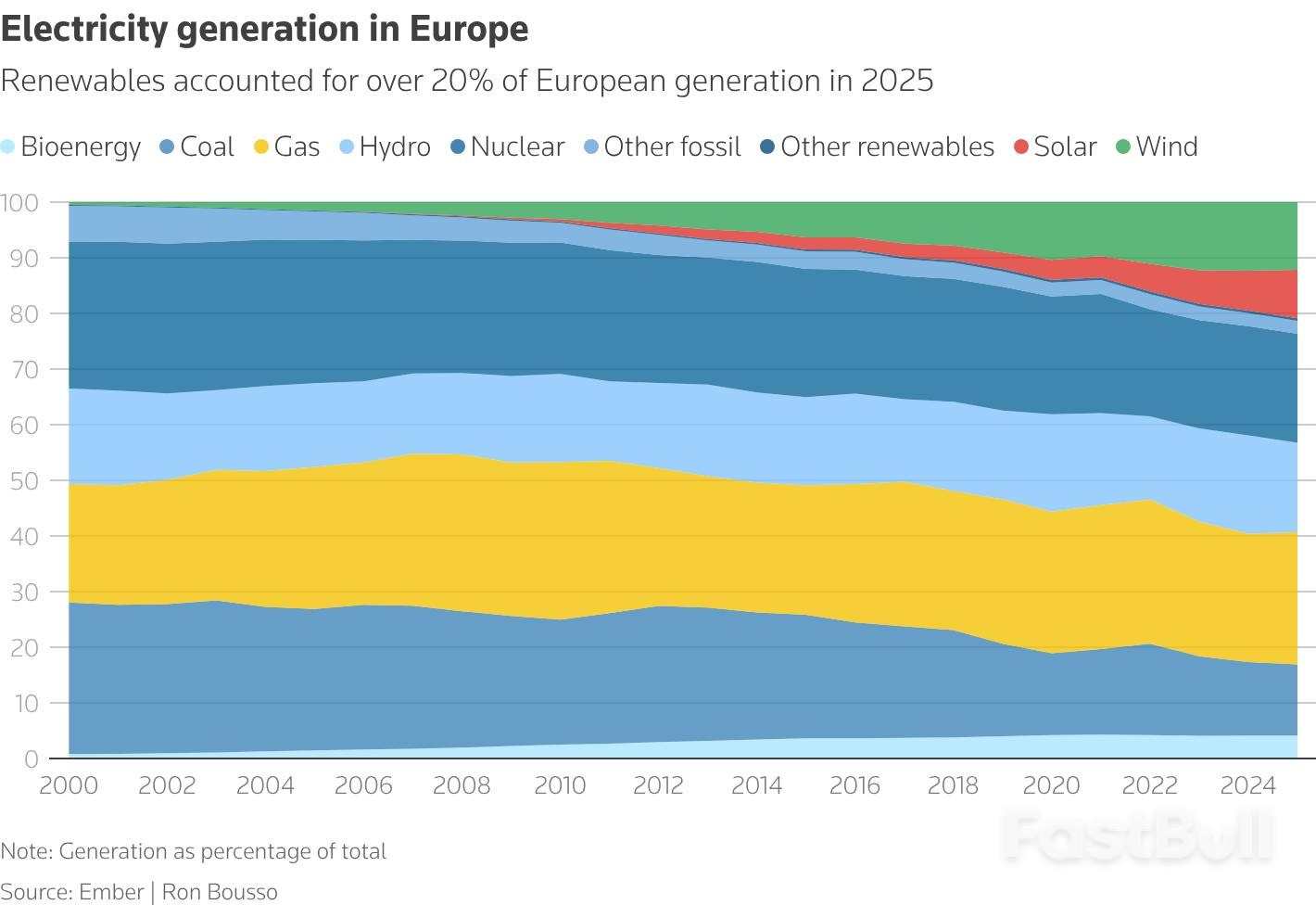
          Figure 1: Europe's electricity generation mix has transformed since 2000, with renewable sources like wind and solar steadily displacing fossil fuels.

          Globally, investor confidence in clean energy has cooled due to rising capital costs, supply chain bottlenecks, and concerns over China's dominance in renewables manufacturing. In the U.S., the Trump administration's open hostility toward green energy, especially wind power, has led to the cancellation of multiple projects and further weakened market sentiment.

          At the same time, Europe's cost-of-living crisis, exacerbated by high energy prices, has made climate policies a political battleground, creating public resistance to net-zero initiatives.
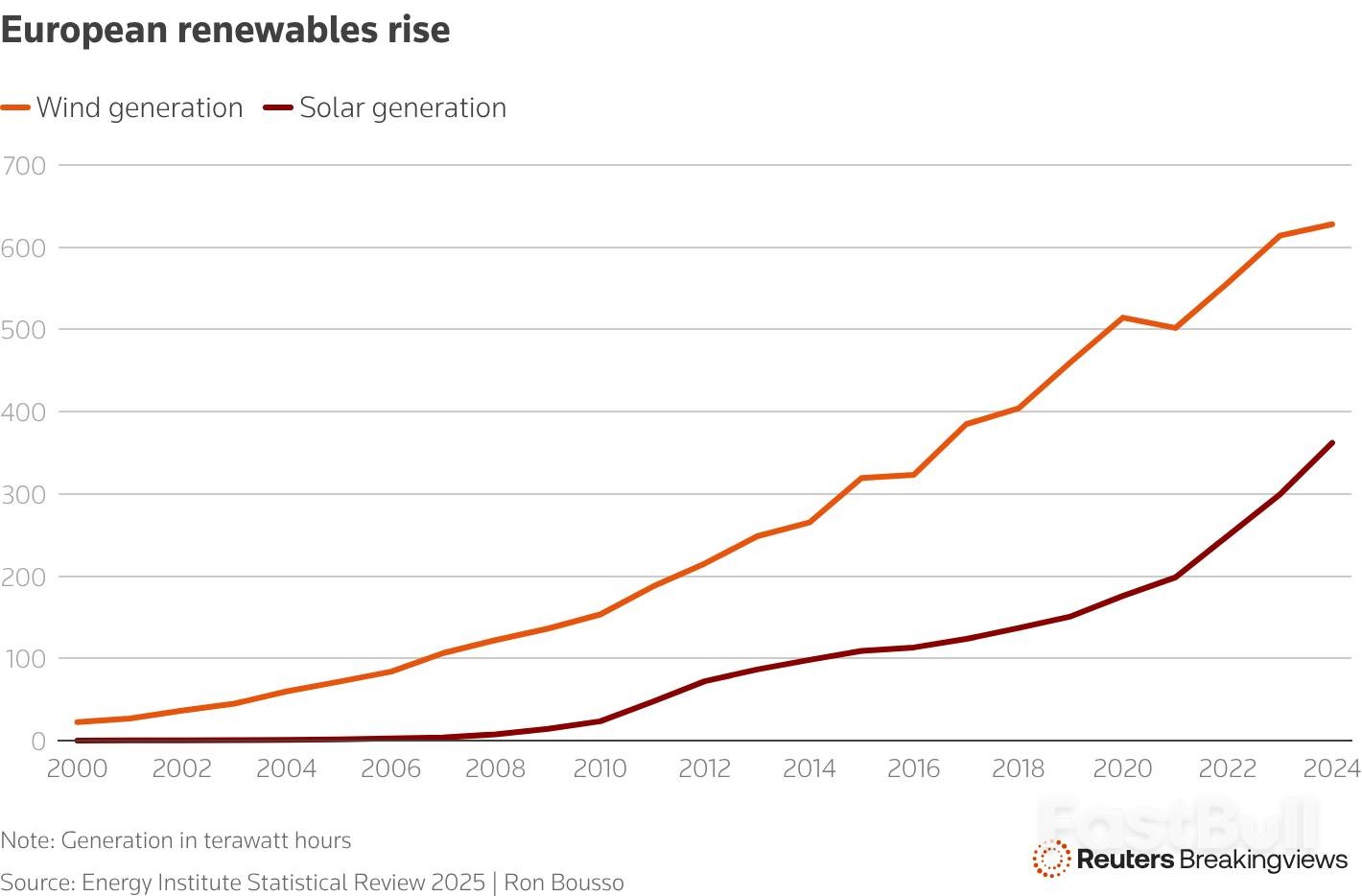
          Figure 2: Wind and solar generation in Europe have grown significantly since 2000, with wind power consistently leading the expansion of renewable energy capacity.

          A Blueprint for Cost Reduction and Efficiency

          The multi-nation offshore wind pact is designed to address cost concerns as much as energy security. It includes several features aimed at lowering development expenses and, eventually, consumer electricity bills.

          Leveraging Economies of Scale

          The sheer scale of the 100 GW commitment is its most powerful feature. By providing the offshore wind supply chain with greater demand certainty, the plan is expected to spur investment in European manufacturing. Industry group WindEurope projects the initiative will:

          • Cut costs by 30% between 2025 and 2040.

          • Create 91,000 jobs.

          • Generate 1 trillion euros ($1.19 trillion) in economic activity.

          Building an Integrated Power Network

          A core element of the agreement is a plan to connect wind farms to multiple countries through a network of bidirectional cables and interconnectors. This integrated grid will allow electricity to flow where it is most needed, improving efficiency and giving operators the flexibility to respond to shifting supply and demand across different markets.

          This cross-border "arbitrage" should also minimize "negative pricing" events, where excess wind generation forces operators to shut down turbines and receive compensation. "When it is windy in Germany, it may not be windy in the UK, so if Germany can't use all of the power, the UK can take some instead of wasting it," explained Jordan May, a senior analyst at consultancy TGS 4C.

          Furthermore, because the network will span multiple time zones, peak demand hours will vary by country. This diversity should make it easier to match supply with demand, reducing the need for gas-fired backup power.

          An Unexpected Boost from US Policy

          Europe may also benefit indirectly from President Trump's stance on wind energy. The U.S. offshore wind sector has seen a sharp downturn, with the International Energy Agency slashing its 2030 forecast for the country by over 50%. Reduced American demand for vessels, components, and services could lead to lower prices for European operators.

          The Real Cost of Europe's Energy Future

          Despite the plan's potential, the path forward is complex. European governments must develop intricate new regulations to align different national subsidy programs and power market rules—a process that could take years and face political opposition.

          The cost of transitioning to renewables remains a contentious issue in Europe. However, forecasting these costs is difficult, and the same uncertainty applies to fossil fuels, which are subject to volatile global prices. While offshore wind requires significant upfront investment, its long-term operating costs are generally lower. In contrast, gas-fired plants are cheaper to build but remain exposed to price shocks.

          Critically, debates over the cost of renewables often overlook the cost of inaction. Europe's power demand is projected to nearly double by 2050, requiring massive investment to upgrade and expand aging grids regardless of the energy source. Delaying this work will only make it more expensive.

          Ultimately, this joint offshore wind plan provides a clear path toward greater energy independence and industrial strength. Its success, however, will be measured by its ability to deliver lower, more stable electricity prices for European consumers.

          To stay updated on all economic events of today, please check out our Economic calendar
          Risk Warnings and Disclaimers
          You understand and acknowledge that there is a high degree of risk involved in trading. Following any strategies or investment methods may lead to potential losses. The content on the site is provided by our contributors and analysts for information purposes only. You are solely responsible for determining whether any trading assets, securities, strategy, or any other product is suitable for investing based on your own investment objectives and financial situation.
          Add to Favorites
          Share
          FastBull
          Copyright © 2026 FastBull Ltd

          728 RM B 7/F GEE LOK IND BLDG NO 34 HUNG TO RD KWUN TONG KLN HONG KONG

          TelegramInstagramTwitterfacebooklinkedin
          App Store Google Play Google Play
          Products
          Charts

          Chats

          Q&A with Experts
          Screeners
          Economic Calendar
          Data
          Tools
          Membership
          Features
          Function
          Markets
          Copy Trading
          Latest Signals
          Contests
          News
          Analysis
          24/7
          Columns
          Education
          Company
          Careers
          About Us
          Contact Us
          Advertising
          Help Center
          Feedback
          User Agreement
          Privacy Policy
          Personal Information Protection Statement
          Business

          White Label

          Data API

          Web Plug-ins

          Poster Maker

          Affiliate Program

          Risk Disclosure

          The risk of loss in trading financial instruments such as stocks, FX, commodities, futures, bonds, ETFs and crypto can be substantial. You may sustain a total loss of the funds that you deposit with your broker. Therefore, you should carefully consider whether such trading is suitable for you in light of your circumstances and financial resources.

          No decision to invest should be made without thoroughly conducting due diligence by yourself or consulting with your financial advisors. Our web content might not suit you since we don't know your financial conditions and investment needs. Our financial information might have latency or contain inaccuracy, so you should be fully responsible for any of your trading and investment decisions. The company will not be responsible for your capital loss.

          Without getting permission from the website, you are not allowed to copy the website's graphics, texts, or trademarks. Intellectual property rights in the content or data incorporated into this website belong to its providers and exchange merchants.

          Not Logged In

          Log in to access more features

          Connect Broker
          Become a signal provider
          Help Center
          Customer Service
          Dark Mode
          Price Up/Down Colors

          Log In

          Sign Up

          Position
          Layout
          Fullscreen
          Default to Chart
          The chart page opens by default when you visit fastbull.com