• Trade
  • Markets
  • Copy
  • Contests
  • News
  • 24/7
  • Calendar
  • Q&A
  • Chats
Screeners
SYMBOL
LAST
ASK
BID
HIGH
LOW
NET CHG.
%CHG.
SPREAD
SPX
S&P 500 Index
6984.05
6984.05
6984.05
6988.81
6958.82
+33.82
+ 0.49%
--
DJI
Dow Jones Industrial Average
49076.44
49076.44
49076.44
49157.80
48894.61
-335.95
-0.68%
--
IXIC
NASDAQ Composite Index
23834.70
23834.70
23834.70
23850.55
23694.38
+233.35
+ 0.99%
--
USDX
US Dollar Index
96.020
96.100
96.020
97.060
95.950
-0.810
-0.84%
--
EURUSD
Euro / US Dollar
1.19790
1.19798
1.19790
1.19898
1.18502
+0.00997
+ 0.84%
--
GBPUSD
Pound Sterling / US Dollar
1.37802
1.37814
1.37802
1.37907
1.36636
+0.01022
+ 0.75%
--
XAUUSD
Gold / US Dollar
5089.40
5089.81
5089.40
5102.90
5013.05
+79.13
+ 1.58%
--
WTI
Light Sweet Crude Oil
61.808
61.838
61.808
61.863
60.054
+1.060
+ 1.74%
--

Community Accounts

Signal Accounts
--
Profit Accounts
--
Loss Accounts
--
View More

Become a signal provider

Sell trading signals to earn additional income

View More

Guide to Copy Trading

Get started with ease and confidence

View More

Signal Accounts for Members

All Signal Accounts

Best Return
  • Best Return
  • Best P/L
  • Best MDD
Past 1W
  • Past 1W
  • Past 1M
  • Past 1Y

All Contests

  • All
  • Trump Updates
  • Recommend
  • Stocks
  • Cryptocurrencies
  • Central Banks
  • Featured News
Top News Only
Share

MSCI's Nordic Countries Index Rose 0.6%, Marking Its Sixth Consecutive Day Of Gains, Closing At 395.00 Points, A New Closing High In At Least A Year. Among The Ten Sectors, The Nordic Financial Sector Saw The Largest Gains. Epiroc Ab, A Supplier Of Construction And Mining Machinery, Led The Pack Among Nordic Stocks, Rising 4.1%

Share

Euro Up 0.88% At $1.1985

Share

USA Dollar Index At Near Four-Year Low, Last Down 0.95% At 96.17

Share

National Association Of Cereal Exporters - Brazil Corn Exports Seen Reaching 3.39 Million Tonnes In January Versus 3.45 Million Tonnes In The Previous Week

Share

National Association Of Cereal Exporters - Brazil Soymeal Exports Seen Reaching 1.78 Million Tonnes In January Versus 1.82 Million Tonnes In The Previous Week

Share

National Association Of Cereal Exporters - Brazil Soy Exports Seen Reaching 3.23 Million Tonnes In January Versus 3.79 Million Tonnes In The Previous Week

Share

Petrobras Executives: Entering Venezuela Could Be An Alternative

Share

Boeing CEO: Trump Administration Understands Importance Of Commercial Aerospace Industry To US Economy

Share

ICE Arabica Coffee Futures Rise More Than 3% To $3.6730 Per Lb

Share

Vortexa: US Gulf Coast Oil, LNG Exports Hit Zero On Sunday Due To Freeze

Share

Iranian President Speaks With Saudi Crown Prince By Phone

Share

[Investors Bet On Sinbaum's Ability To Protect Mexican Peso From Trump Impact] Investors Are Betting That Mexican President Claudia Sinbaum's Ability To Resolve The Dispute With US President Donald Trump Will Help Extend One Of The Best-performing Currencies In Emerging Markets This Year. The Mexican Peso Has Benefited From Carry Trades, A Weaker Dollar, And Soaring Commodity Prices, Accumulating A Gain Of Over 4% This Year. Jason Schenker, President Of Prestige Economics, Which Topped Bloomberg's Fourth-quarter Peso Exchange Rate Forecasts, Believes That If Trade Negotiations Yield Unexpectedly Positive Results, The Peso Could "very Easily" Surge To 16 To The Dollar, And Even Break The 15 Mark Within The Next 12-18 Months

Share

Armenia And Azerbaijan Agree On Rail Transit Of LNG And Bitumen Via Azerbaijani Territory, Tass Reports

Share

WTO: Members Consider Request For Panel To Examine Indian Measures On Batteries, E-Vehicles

Share

[EU Warns Against Over-Reliance On US Gas After Phase-out Of Russian Gazette] Teresa Ribera, The EU's Competition Chief, Warned Via Rte Radio That The EU Should Not Become Overly Reliant On US Liquefied Natural Gas (LNG) Imports As It Seeks To Diversify Its Energy Basket. Since The Russia-Ukraine Conflict, The EU Has Replaced Some Of Its Lost Russian Gas Supply With US LNG And Faces Pressure To Increase Purchases. According To The Institute For Energy Economics And Financial Analysis (IEEFA), If Europe Fulfills All Its US LNG Supply Agreements, 80% Of Its Total Imports Could Come From The US By 2030, Compared To 57% In 2025

Share

US Senate Democratic Leader Schumer: $17.2 Billion New York City Tunnel Project In Jeopardy After Trump Administration Suspended Funding In October

Share

Brazil's Real Strengthens 1% Versus USA Dollar In Spot Trading

Share

Dollar/Yen Down 0.8% At 152.92

Share

Sterling Up 0.8% At $1.3787, Its Strongest Since October 2021

Share

Sovecon Agriculture Consultancy Says It Has Raised Its 2025/26 Russian Wheat Export Forecast By 1.1 Million Metric Tons (Mmt) To 45.7 Mmt

TIME
ACT
FCST
PREV
Mexico Unemployment Rate (Not SA) (Dec)

A:--

F: --

P: --

Canada National Economic Confidence Index

A:--

F: --

P: --

U.S. Non-Defense Capital Durable Goods Orders MoM (Excl. Aircraft) (Nov)

A:--

F: --

P: --
U.S. Durable Goods Orders MoM (Excl. Defense) (SA) (Nov)

A:--

F: --

P: --
U.S. Durable Goods Orders MoM (Excl.Transport) (Nov)

A:--

F: --

P: --

U.S. Durable Goods Orders MoM (Nov)

A:--

F: --

P: --
U.S. Chicago Fed National Activity Index (Nov)

A:--

F: --

P: --
U.S. Dallas Fed New Orders Index (Jan)

A:--

F: --

P: --

U.S. Dallas Fed General Business Activity Index (Jan)

A:--

F: --

P: --
U.S. 2-Year Note Auction Avg. Yield

A:--

F: --

P: --

U.K. BRC Shop Price Index YoY (Jan)

A:--

F: --

P: --

China, Mainland Industrial Profit YoY (YTD) (Dec)

A:--

F: --

P: --

Germany 2-Year Schatz Auction Avg. Yield

A:--

F: --

P: --

Mexico Trade Balance (Dec)

A:--

F: --

P: --

U.S. Weekly Redbook Index YoY

A:--

F: --

P: --

U.S. S&P/CS 20-City Home Price Index YoY (Not SA) (Nov)

A:--

F: --

P: --

U.S. S&P/CS 20-City Home Price Index MoM (SA) (Nov)

A:--

F: --

P: --
U.S. FHFA House Price Index MoM (Nov)

A:--

F: --

P: --

U.S. FHFA House Price Index (Nov)

A:--

F: --

P: --

U.S. FHFA House Price Index YoY (Nov)

A:--

F: --

P: --
U.S. S&P/CS 10-City Home Price Index YoY (Nov)

A:--

F: --

P: --

U.S. S&P/CS 10-City Home Price Index MoM (Not SA) (Nov)

A:--

F: --

P: --

U.S. S&P/CS 20-City Home Price Index (Not SA) (Nov)

A:--

F: --

P: --

U.S. S&P/CS 20-City Home Price Index MoM (Not SA) (Nov)

A:--

F: --

P: --

U.S. Richmond Fed Manufacturing Composite Index (Jan)

A:--

F: --

P: --

U.S. Conference Board Present Situation Index (Jan)

A:--

F: --

P: --

U.S. Conference Board Consumer Expectations Index (Jan)

A:--

F: --

P: --

U.S. Richmond Fed Manufacturing Shipments Index (Jan)

A:--

F: --

P: --

U.S. Richmond Fed Services Revenue Index (Jan)

A:--

F: --

P: --

U.S. Conference Board Consumer Confidence Index (Jan)

A:--

F: --

P: --
U.S. 5-Year Note Auction Avg. Yield

--

F: --

P: --

U.S. API Weekly Refined Oil Stocks

--

F: --

P: --

U.S. API Weekly Crude Oil Stocks

--

F: --

P: --

U.S. API Weekly Gasoline Stocks

--

F: --

P: --

U.S. API Weekly Cushing Crude Oil Stocks

--

F: --

P: --

Australia RBA Trimmed Mean CPI YoY (Q4)

--

F: --

P: --

Australia CPI YoY (Q4)

--

F: --

P: --

Australia CPI QoQ (Q4)

--

F: --

P: --

Germany GfK Consumer Confidence Index (SA) (Feb)

--

F: --

P: --

Germany 10-Year Bund Auction Avg. Yield

--

F: --

P: --

India Industrial Production Index YoY (Dec)

--

F: --

P: --

India Manufacturing Output MoM (Dec)

--

F: --

P: --

U.S. MBA Mortgage Application Activity Index WoW

--

F: --

P: --

Canada Overnight Target Rate

--

F: --

P: --

BOC Monetary Policy Report
U.S. EIA Weekly Crude Stocks Change

--

F: --

P: --

U.S. EIA Weekly Cushing, Oklahoma Crude Oil Stocks Change

--

F: --

P: --

U.S. EIA Weekly Crude Demand Projected by Production

--

F: --

P: --

U.S. EIA Weekly Crude Oil Imports Changes

--

F: --

P: --

U.S. EIA Weekly Heating Oil Stock Changes

--

F: --

P: --

U.S. EIA Weekly Gasoline Stocks Change

--

F: --

P: --

BOC Press Conference
Russia PPI MoM (Dec)

--

F: --

P: --

Russia PPI YoY (Dec)

--

F: --

P: --

U.S. Target Federal Funds Rate Lower Limit (Overnight Reverse Repo Rate)

--

F: --

P: --

U.S. Interest Rate On Reserve Balances

--

F: --

P: --

U.S. Federal Funds Rate Target

--

F: --

P: --

U.S. Target Federal Funds Rate Upper Limit (Excess Reserves Ratio)

--

F: --

P: --

FOMC Statement
FOMC Press Conference
Brazil Selic Interest Rate

--

F: --

P: --

Q&A with Experts
    • All
    • Chatrooms
    • Groups
    • Friends
    EuroTrader flag
    Coolx
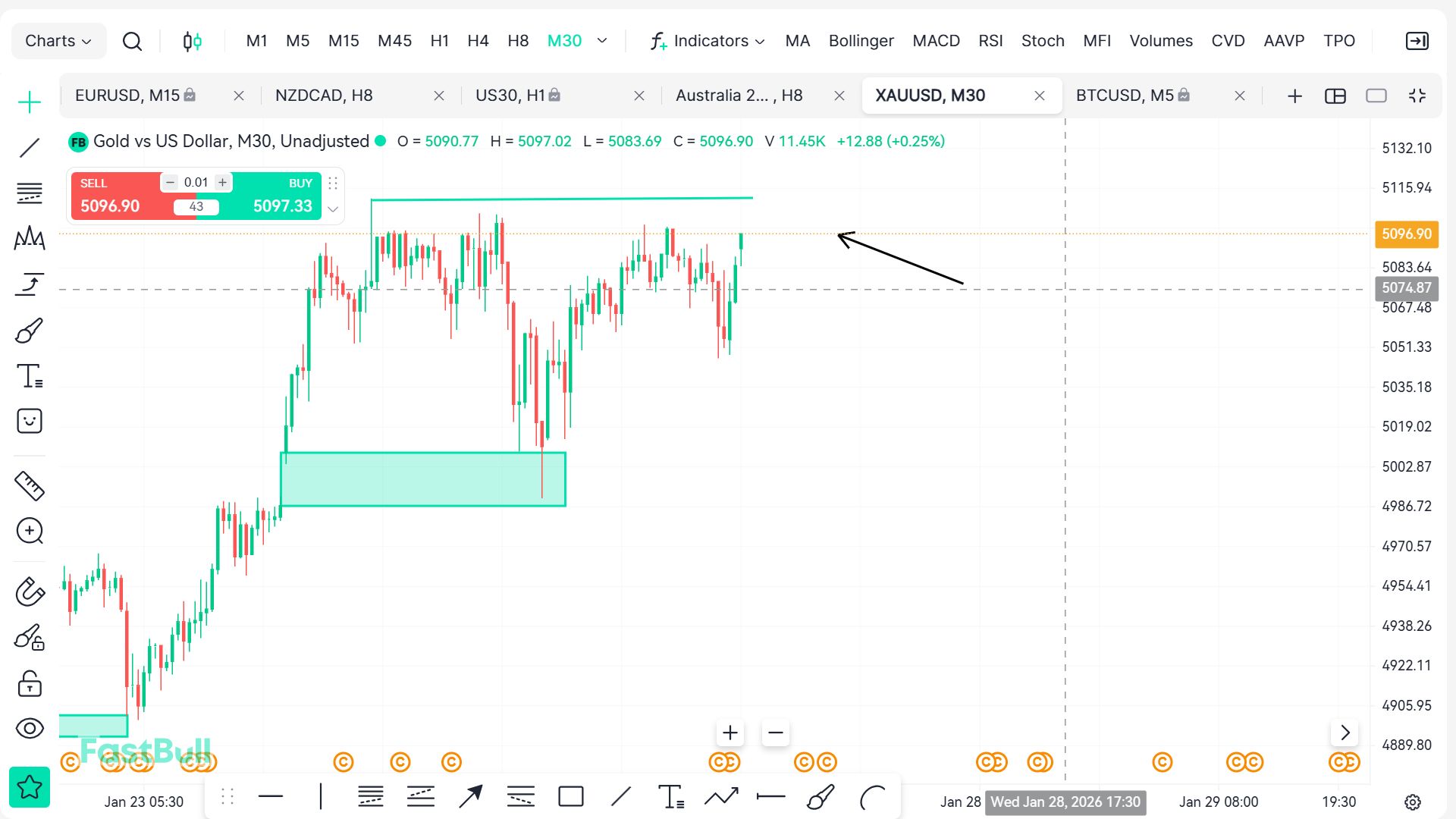
    @Coolx gold has been really choppy since the open today not mudh price runs
    EuroTrader flag
    @Coolxwhich opportunity did you see was it the longs or the sells
    EuroTrader flag
    @REETRADER price might want to leave this highs in play till the rate announcement
    EuroTrader flag
    Size flag
    Size flag
    Size
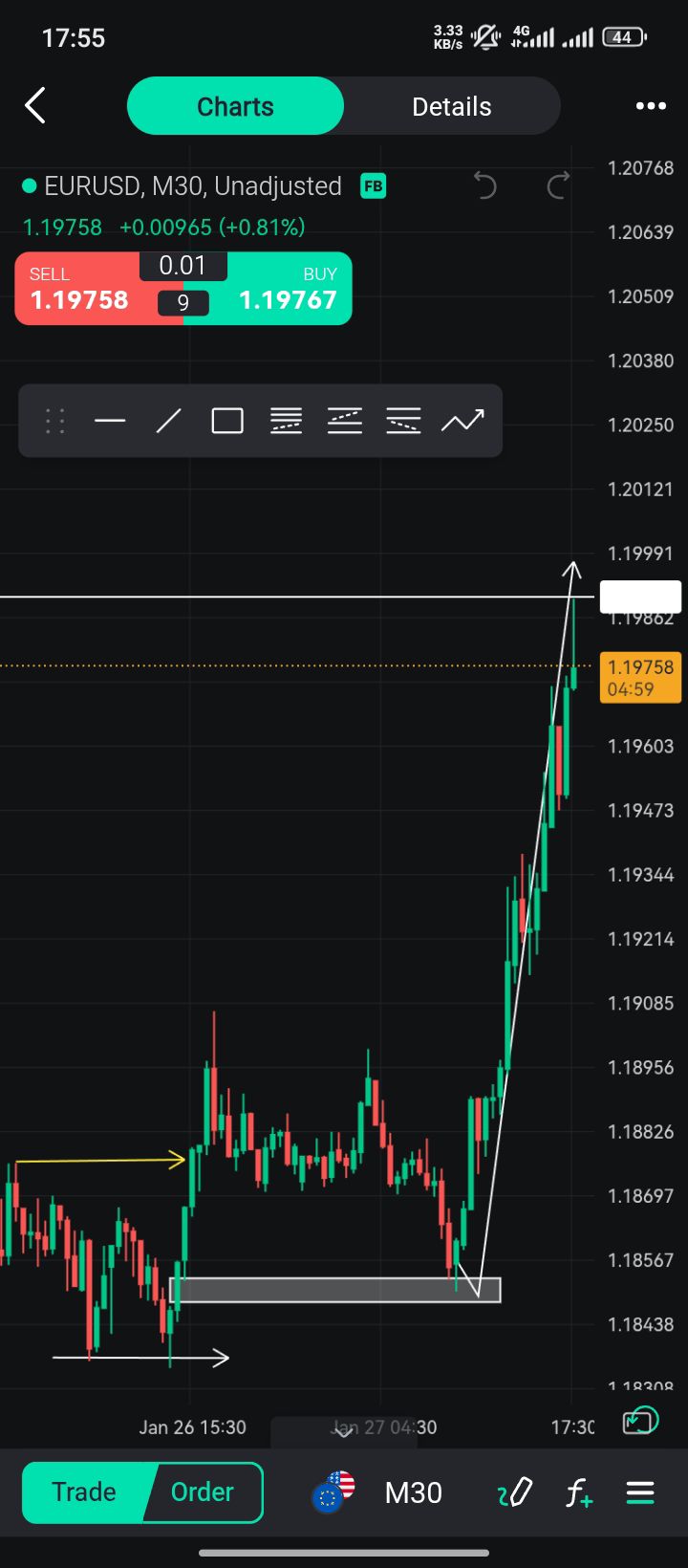
    EURUSD just got to my target level...
    Coolx flag
    Coolx flag
    EuroTrader
    @Coolxwhich opportunity did you see was it the longs or the sells
    @EuroTraderprice correction according to my view
    Coolx flag
    not an adviser just a learner view buddy
    Glad Master flag
    Glad Master
    XAUUSD SELL 5090/5093 TP¹   5087 TP²   5084 TP³   5081 TP⁴   5078 TP⁵   5075 TP⁶   5072 SL    5100
    #𝗫𝗔𝗨𝗨𝗦𝗗  TP2 HIT 60+PIPS PROFIT DONE
    Size flag
    Coolx
    not an adviser just a learner view buddy
    @CoolxNo worries sharing your view is always welcome, even as a learner.
    Coolx flag
    Size
    @Sizeahh nice
    Coolx flag
    Size
    @Sizethank you brother
    Size flag
    Every perspective helps us all see the market a bit differently@Coolx
    Coolx flag
    what you people are looking kindly share your views too buddies @euro @size
    Size flag
    Coolx
    @Coolxthanks mate, played out as expected...
    Size flag
    Coolx
    @CoolxYou are welcome mate...
    Size flag
    Coolx
    @CoolxThis is gold right ???
    Coolx flag
    dont't you people are trading in Crypto ?
    Coolx flag
    Size
    @Sizeyeah brother
    Type here...
    Add Symbol or Code

      No matching data

      All
      Trump Updates
      Recommend
      Stocks
      Cryptocurrencies
      Central Banks
      Featured News
      • All
      • Russia-Ukraine Conflict
      • Middle East Flashpoint
      • All
      • Russia-Ukraine Conflict
      • Middle East Flashpoint
      Search
      Products

      Charts Free Forever

      Chats Q&A with Experts
      Screeners Economic Calendar Data Tools
      Membership Features
      Data Warehouse Market Trends Institutional Data Policy Rates Macro

      Market Trends

      Market Sentiment Order Book Forex Correlations

      Top Indicators

      Charts Free Forever
      Markets

      News

      News Analysis 24/7 Columns Education
      From Institutions From Analysts
      Topics Columnists

      Latest Views

      Latest Views

      Trending Topics

      Top Columnists

      Latest Update

      Signals

      Copy Rankings Latest Signals Become a signal provider AI Rating
      Contests
      Brokers

      Overview Brokers Assessment Rankings Regulators News Claims
      Broker listing Forex Brokers Comparison Tool Live Spread Comparison Scam
      Q&A Complaint Scam Alert Videos Tips to Detect Scam
      More

      Business
      Events
      Careers About Us Advertising Help Center

      White Label

      Data API

      Web Plug-ins

      Affiliate Program

      Awards Institution Evaluation IB Seminar Salon Event Exhibition
      Vietnam Thailand Singapore Dubai
      Fans Party Investment Sharing Session
      FastBull Summit BrokersView Expo
      Recent Searches
        Top Searches
          Markets
          News
          Analysis
          User
          24/7
          Economic Calendar
          Education
          Data
          • Names
          • Latest
          • Prev

          View All

          No data

          Scan to Download

          Faster Charts, Chat Faster!

          Download App
          English
          • English
          • Español
          • العربية
          • Bahasa Indonesia
          • Bahasa Melayu
          • Tiếng Việt
          • ภาษาไทย
          • Français
          • Italiano
          • Türkçe
          • Русский язык
          • 简中
          • 繁中
          Open Account
          Search
          Products
          Charts Free Forever
          Markets
          News
          Signals

          Copy Rankings Latest Signals Become a signal provider AI Rating
          Contests
          Brokers

          Overview Brokers Assessment Rankings Regulators News Claims
          Broker listing Forex Brokers Comparison Tool Live Spread Comparison Scam
          Q&A Complaint Scam Alert Videos Tips to Detect Scam
          More

          Business
          Events
          Careers About Us Advertising Help Center

          White Label

          Data API

          Web Plug-ins

          Affiliate Program

          Awards Institution Evaluation IB Seminar Salon Event Exhibition
          Vietnam Thailand Singapore Dubai
          Fans Party Investment Sharing Session
          FastBull Summit BrokersView Expo

          European stocks rise after EU’s ‘mother of all deals’ with India; Dr Martens shares drop 12%

          Adam

          Stocks

          Summary:

          European stocks rose on the EU-India “mother of all deals,” with Puma jumping on Anta’s stake, while Dr Martens slumped 12% on weak results amid renewed global trade uncertainty.

          European stocks were broadly higher on Tuesday, as investors reacted to the European Union’s landmark trade deal with India and braced for a flurry of corporate earnings.
          The pan-European Stoxx 600 was last seen 0.3% higher, with most sectors and major bourses in positive territory.
          Indian Prime Minister Narendra Modi announced on Tuesday that India and the EU had closed a “landmark” free trade agreement, touted as the “mother of all deals.” The agreement represents about 25% of global gross domestic product and about a third of global trade.
          The EU’s biggest exports to India are machinery, transport equipment and chemicals, according to the European Council. The bloc’s biggest imports from India are machinery, chemicals and fuels.
          Europe’s Stoxx Chemicals index was last seen trading 0.8% lower, while the trade-sensitive autos sector shed 0.7%. Regional industrials stocks added 0.1%.
          Earnings season is getting underway again with regional investors keeping an eye on the latest financial reports from ASML, Volvo, LVMH and Deutsche Bank, among others, this week. On Tuesday, Atlas Copco, Sandvik and Logitech International are due to report.
          Stock moves
          Looking at individual stocks, Puma jumped 8.6% after China’s Anta Sports confirmed it would buy a 29% from France’s billionaire Pinault family for 1.5 billion euros ($1.78 billion).
          Swedish medical equipment maker Getinge slipped toward the bottom of the regional index, down 6.5% after the firm reported a slight drop in order intake for the fourth quarter of 2025. Full-year revenue came in at 34.97 billion Swedish kronor ($39.1 billion), slightly below expectations set out in a consensus compiled by LSEG.
          British bootmaker Dr Martens shed 12% after the company posted disappointing quarterly results and forecast roughly flat revenue growth for 2026. Revenue fell 3.1% to £251 million ($343 million) in its fiscal third quarter, led by a 7% drop in direct-to-consumer sales as the company scaled back its promotions. Wholesale revenue, however, increased 9.3%.
          “This is a year of pivot, as we make the necessary changes to our business to set us up for future sustainable growth,” Chief Executive Ije Nwokorie said in a statement alongside the results, adding that he is “laser focused” on executing Dr Martens’ strategy of reducing discounts, driving growth in other products, opening in new markets, and simplifying its operational model.
          South Korea tariffs
          There’s been more global trade uncertainty overnight after U.S. President Donald Trump took aim at South Korea Monday, saying he would increase tariffs on Asia’s fourth-largest economy.
          Trump said on Truth Social that the country’s legislature has not approved Seoul’s trade deal with Washington, and that tariffs on South Korean autos, pharmaceuticals and lumber would rise from 15% to 25%. Shares of South Korean autos fell sharply but pared losses overnight.
          S&P 500 futures were near the flatline overnight after the major averages started the busy earnings week on a positive note. Investors are also waiting for the Federal Reserve’s rate decision later this week.
          The central bank is widely expected to keep its key rate at a target range of 3.5% to 3.75%, but traders will search for clues on when future cuts may come.

          Source: cnbc

          Risk Warnings and Disclaimers
          You understand and acknowledge that there is a high degree of risk involved in trading. Following any strategies or investment methods may lead to potential losses. The content on the site is provided by our contributors and analysts for information purposes only. You are solely responsible for determining whether any trading assets, securities, strategy, or any other product is suitable for investing based on your own investment objectives and financial situation.
          Add to Favorites
          Share

          UK's Starmer: We Won't Choose Between the US and China

          Isaac Bennett

          Remarks of Officials

          Political

          Economic

          Daily News

          China–U.S. Trade War

          UK Prime Minister Keir Starmer has declared that his government will not be forced to pick a side between the United States and China, emphasizing a dual approach of maintaining close ties with Washington while actively engaging with Beijing. His comments signal a key foreign policy direction ahead of his planned visit to China.

          Starmer confirmed that the UK will preserve its strong security, business, and defense relationship with the U.S. However, he argued that "sticking your head in the sand and ignoring China" is not a viable strategy.

          A Push for Economic Ties with Beijing

          The Prime Minister's planned state visit to China—the first by a UK leader in eight years—is framed as a move to unlock major economic benefits. Starmer stated the trip could create "significant opportunities" for British companies and is expected to include a delegation of UK business leaders for stops in Shanghai and Beijing.

          Addressing potential security concerns, Starmer insisted that building a relationship with China "does not mean compromising on national security – quite the opposite."

          This diplomatic outreach follows the UK government's recent and controversial approval for China to establish a new embassy in London. The decision proceeded despite opposition concerns that the facility could be used for espionage activities against the United Kingdom.

          Navigating US Trade Friction

          Starmer’s balanced approach comes amid a backdrop of global trade tensions, particularly involving the United States under President Trump. The Prime Minister's visit to China could risk friction with Washington, which has previously threatened allies over their economic ties with Beijing.

          Trump's Tariff Threats on Allies

          President Trump has shown a willingness to use tariffs to enforce his foreign and economic policy goals. In one instance, he threatened to impose tariffs on allied nations that opposed the U.S. acquisition of Greenland, stating, "we need Greenland for national security." While tensions later subsided after Trump clarified he would seek negotiations rather than use force, the episode highlighted his transactional approach.

          More directly, Trump threatened Canada with a 100% tariff after the country reached a "strategic partnership" trade deal with the Chinese government. The threat emerged after Canadian Prime Minister Carney's speech in Davos was perceived as critical of the U.S. world order.

          The Canada-China agreement included several key tariff reductions:

          • China would lower levies on Canadian canola oil from 85% to 15%.

          • Canada would cut taxes on Chinese electric vehicles from 100% to 6.1%.

          Pressure on South Korea

          The U.S. has also applied economic pressure on other key partners. Trump threatened to raise tariffs on South Korean goods from 15% to 25%, targeting products like automobiles, lumber, and pharmaceuticals. He accused South Korea of failing to honor a trade deal struck the previous year.

          The announcement caused a sharp reaction in South Korea's stock market, particularly affecting carmakers. In response, Seoul urged Trump to reaffirm his commitment to their trade agreement, under which President Lee Jae Myung had agreed last July for South Korea to invest $350 billion in the United States.

          To stay updated on all economic events of today, please check out our Economic calendar
          Risk Warnings and Disclaimers
          You understand and acknowledge that there is a high degree of risk involved in trading. Following any strategies or investment methods may lead to potential losses. The content on the site is provided by our contributors and analysts for information purposes only. You are solely responsible for determining whether any trading assets, securities, strategy, or any other product is suitable for investing based on your own investment objectives and financial situation.
          Add to Favorites
          Share

          China soaks up the crude oil glut, but only if the price is right

          Adam

          Commodity

          Where exactly is the expected supply glut in the global crude market?
          The best answer is China, which saw storage flows surge in December, resulting in a surplus of more than 1 million barrels per day for 2025.
          China's surplus of crude oil jumped to 2.67 million bpd in December, up from 1.88 million bpd in November and the most since the 2.27 million bpd seen in June 2020, when the world's largest crude buyer was gorging on cheap oil at the height of the COVID-19 pandemic.
          For 2025 the volume of surplus crude was 1.13 million bpd, largely steady from the 1.15 million bpd seen in 2024, according to calculations based on official data.
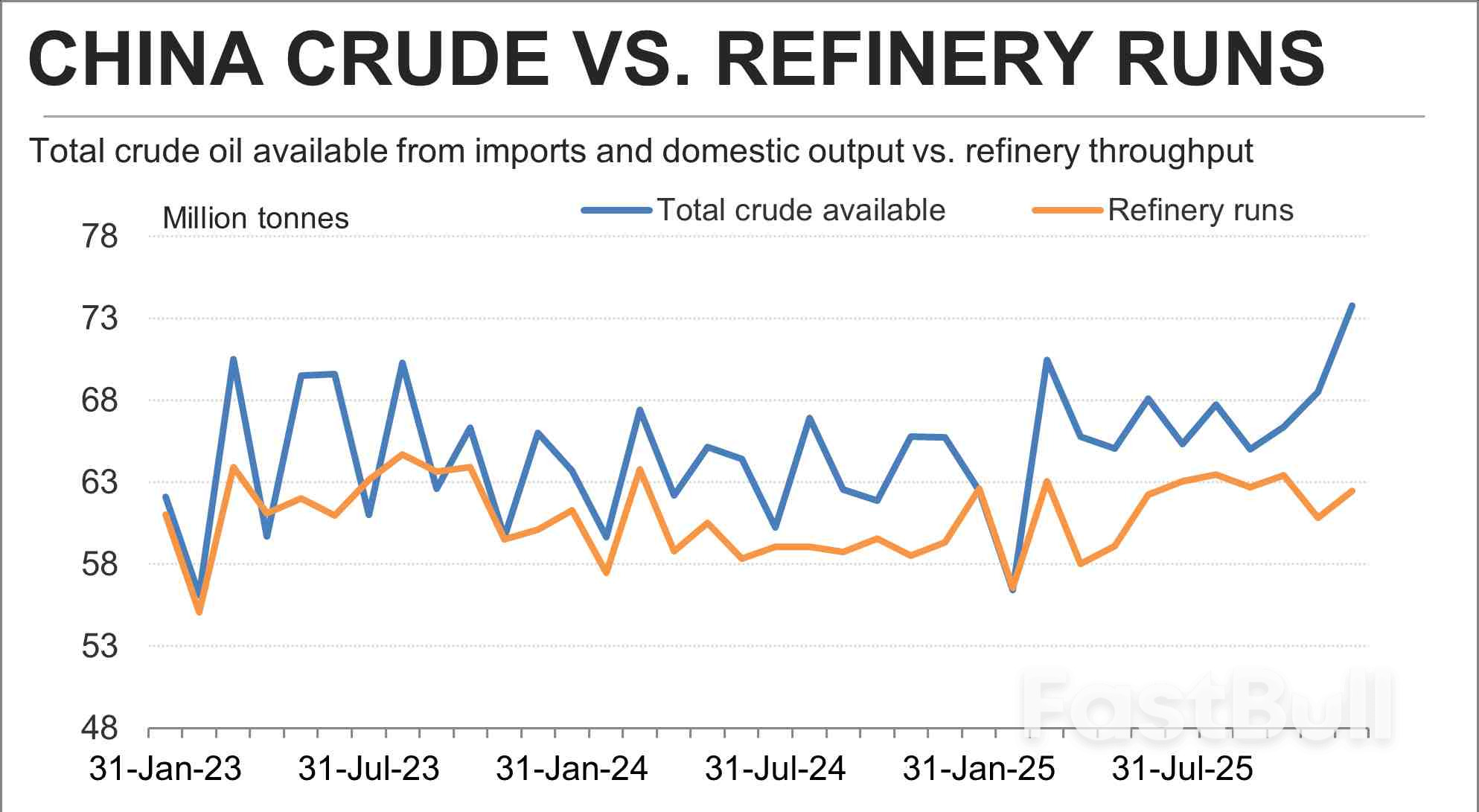
          China does not disclose the volumes of crude flowing into or out of its strategic and commercial stockpiles, but an estimate can be made by deducting the amount of oil processed from the total crude available from imports and domestic output.
          It is worth noting that not all the surplus crude was likely to have been added to storage, with some being processed in plants not captured by the official data.
          But even allowing for those gaps, it is clear that from March 2025 onwards, China was importing crude at a far higher rate than necessary to meet domestic fuel demand.
          December's crude imports surged to a record 13.18 million bpd, up 17% from the same month in 2024, with the strong arrivals taking imports for the full year to 11.55 million bpd, another all-time peak and up 4.4% from the prior year.
          Domestic crude production was 4.19 million bpd, while output for the full year was up 1.5% to 4.32 million bpd.
          Combining December's imports and domestic production yields 17.37 million bpd of crude available to refiners.
          December refinery throughput was 14.7 million bpd, meaning that the monthly surplus was 2.67 million bpd.
          For 2025 China's refiners processed 14.75 million bpd, a record high exceeding the 14.7 million bpd from 2023.
          Despite the increase in refinery throughput, the surplus for the year amounted to 1.13 million bpd as the total volume of available crude of 15.88 million bpd outweighed refinery processing of 14.75 million bpd.
          The volume of surplus crude flowing into China largely answers the question as to where the global surplus of crude oil is.
          China soaks up the crude oil glut, but only if the price is right_1

          China total crude available vs refinery throughput

          WILL CHINA BUYING LAST?
          Amin Nasser, the chief executive of the world's largest oil exporter Saudi Aramco (2222.SE) , told the Davos forum last week that "oil glut predictions are seriously exaggerated."
          That statement really only holds true for as long as China keeps buying way more oil than it needs to meet domestic demand and exports of refined products.
          What would happen to the crude price if China pared back its imports by around 1 million bpd in 2026 from 2025 levels?
          This would act as a drag on the crude price and make it challenging to outline a bullish case in the absence of a major supply interruption caused by geopolitical conflict.
          The question is whether China is likely to continue boosting its crude stockpiles in 2026.
          China has long aimed to build its strategic reserves by as much as 500 million barrels, meaning there is plenty of scope for it to continue to buy more than it needs to meet demand.
          But the key factor will be price.
          China has shown in the past that it tends to pull back on imports when oil prices rise too high or too quickly.
          China made a rare draw on stockpiles in the first two months of 2025, a period after a rise in global benchmark Brent futures to a six-month high above $80 a barrel.
          Similarly, China tends to boost imports when crude prices fall, with the recent strength in imports coming after Brent entered a sustained downtrend from July last year to an eight-month low of $58.72 a barrel by December 16.
          It's likely that China will continue to buy extra crude for as long as prices remain at levels deemed reasonable.

          Source: reuters

          Risk Warnings and Disclaimers
          You understand and acknowledge that there is a high degree of risk involved in trading. Following any strategies or investment methods may lead to potential losses. The content on the site is provided by our contributors and analysts for information purposes only. You are solely responsible for determining whether any trading assets, securities, strategy, or any other product is suitable for investing based on your own investment objectives and financial situation.
          Add to Favorites
          Share

          North American Morning Briefing: Nasdaq Futures Rise; Trade Relations, Earnings in Focus

          Adam

          Stocks

          OPENING CALL

          Stocks were gaining premarket Tuesday with trade relations and big-name earnings competing for the spotlight on the eve of the Federal Reserve's interest-rates decision .
          Trump said the U.S. would increase tariffs on South Korea , accusing Seoul of not implementing a trade pact quickly enough.
          Meanwhile, India and the EU finalized a free-trade agreement that the latter said would eliminate or reduce tariffs for more than 90% of its goods.
          Boeing and RTX Corp are among the companies reporting earnings today, with results from four members of the Magnificent Seven megacap tech group due out later this week.
          UnitedHealth reported earnings before the bell.
          "This week is pivotal in setting the market's near--term tone as 2026 progresses," SWBC said. "History shows that a strong January often frames the narrative for the rest of the year, with investor psychology playing an outsized role."
          Investors are looking out for any government moves to shift the dollar-yen exchange rate. The possibility of a government shutdown also looms large.

          Stocks to Watch

          Humana and CVS Health fell in offhours trading after The Wall Street Journal reported that the Trump administration had proposed roughly flat rates for Medicare insurers next year. Shares of UnitedHealth slid nearly 10% premarket ahead of earnings.
          Nike is laying off about 775 workers, or around 1% of its overall workforce, as it ramps up automation.
          The chairman of the Senate's antitrust subcommittee raised concerns over Netflix's proposed deal with Warner Bros. Discovery.
          Chip stocks rose ahead of the open, with Micron among the bigger gainers. The company said it plans to invest roughly $24 billion in Singapore to meet surging memory-chip demand.
          Anta agreed to acquire a stake in Puma for $1.8 billion, making it the biggest shareholder. Puma shares jumped.
          Tesla's new-car registrations in Europe dropped 20% on the year in December, according to an industry body.
          The U.S. Army signed a $5.6 billion, 10-year contract with Salesforce, part of a drive to adopt commercial software tools. Shares rose 2% premarket.

          Economic Insight

          Navellier expects a big debate about inflation
          surrounding Trump's upcoming Fed chair nomination, which requires Senate confirmation.
          "Due to falling rental and home prices, low crude oil prices, plus all the deflation imported from China and weak economies around the world, a serious deflation risk is brewing that would require the Fed to slash key interest rates by at least 1%."
          Markets expect the next chair to push a few more rate cuts over the summer, but an extended pause seems more likely if growth stays strong and labor demand recovers, Russell Investments said.
          Watch For:
          S&P Cotality Case-Shiller Home Price Index for November; New Home Sales for December; Conference Board - Consumer Confidence for January; Federal Open Market Committee meeting; earnings from Boeing, General Motors, RTX Corp, United Parcel Service, UnitedHealth Group
          Today's Top Headlines/Must Reads:
          - Fed Set to Pause Rate Cuts, With No Clear Path to Resuming
          - Stung by Trump, America's Top Trading Partners Shift Gaze to China
          - Wall Street Is Fixated on a Possible Yen Intervention

          MARKET WRAPS

          Forex:
          The yen turned higher against the dollar, briefly reaching an 11-week high against the dollar before trimming gains.
          ING said the dollar could find some stability after two days of heavy selling, noting that resilient U.S. economic data and the upcoming FOMC meeting are mildly positive for the greenback.
          Barclays said the sharp drop in USD/JPY following the intervention signals could translate into a bigger and broader dollar depreciation trend .
          MUFG said the yen had started to give back some of its recent gains and would likely resume weakening without more signs of intervention .
          Bonds:
          Treasury yields rose as markets priced in an interest-rate hold .
          Although standing pat won't appeal to the White House, it is consistent with market expectations and, more importantly, with the healthy U.S. economic cycle observed to date, Natixis IM Solutions said.
          ING said increased government expenditure comes with fiscal risks and Japan last week reminded markets that these shouldn't be ignored, especially not by Treasury investors.
          HSBC said a sudden pickup in U.S. rates volatility is the biggest risk facing bond markets .
          Energy:
          Oil prices fell as traders monitored global supplies and the impact of a massive storm on U.S. production.
          "Despite recent rallies, sentiment has been weighed by expectations that global oil output will continue to outpace demand ," MUFG said.
          Still, losses are capped by freezing conditions in the U.S. boosting demand for heating fuels and straining energy infrastructure.
          Gas
          U.S. natural-gas prices eased after hitting their highest in three years due to the impact of the storm on heating demand and refinery operations.
          Metals:
          Gold prices slipped in early trade but continued to hold above $5,000 .
          Investors now await U.S. consumer confidence data later on Tuesday and Federal Reserve Chair Jerome Powell's speech on Wednesday.
          Silver futures were down. The precious metal entered 2026 in a structural bull market , thanks to factors including resilient industrial demand, OCBC Group Research said.
          China's decision to allow foreigners to invest in domestic nickel and lithium futures contracts is a highly significant move, according to BANDS Financial.
          Copper
          Prices fell on a firmer dollar but remained above the $13,000 mark .
          "Stockpiles of copper in Shanghai Futures Exchange warehouses rose last week to their highest seasonal level on record, suggesting demand has been soft," ANZ Research said.
          TODAY'S TOP HEADLINES
          EU to Provide Google with Data-Sharing Compliance Guidance
          The European Union has launched a new legal process to help Alphabet's Google comply with the bloc's digital-competition rulebook.
          The European Commission said Tuesday that it had opened so-called specification proceedings into Google's compliance with the Digital Markets Act, a law designed to level the playing field for companies that rely on search engines and app stores to reach customers.
          Tesla Ends 2025 With Lower Sales in Europe, While China's BYD Powers On
          Tesla closed the year with lower sales in Europe as Chinese auto giant BYD continued to outpace Elon Musk's electric-vehicle maker.
          New-car registrations for Tesla models, a reflection of sales, slumped 20% on year to 35,280 units in December across the European Union, the U.K., Iceland, Liechtenstein, Norway and Switzerland, according to the European Automobile Manufacturers' Association, an industry body also known as ACEA. On an annual basis, Tesla sales contracted 27% to 238,656 units.
          Micron to Invest $24 Billion in Singapore to Boost Chip Production
          Micron Technology plans to invest about US$24 billion in Singapore over the next 10 years as it expands its manufacturing facility to meet surging demand for memory chips amid the artificial-intelligence boom.
          The Boise, Idaho-based chip giant on Tuesday said it broke ground on an advanced wafer fabrication facility located within the company's existing NAND manufacturing complex in Singapore. The plant represents a planned investment of 31 billion Singapore dollars, equivalent to US$24.41 billion, over the next decade, with wafer output scheduled to begin in the second half of 2028, it said in a statement.
          Global Markets Mixed as Japanese Yen Eases After Rally
          Investors remained on alert for any signs of possible yen intervention even as the currency eased back from Monday's sharp gains and the dollar recovered. Gold and silver remained close to the fresh highs reached at the start of the week, boosted by continued demand for safe-havens. President Trump said on Saturday he would put 100% tariffs on Canada if Prime Minister Mark Carney struck a trade deal with China and on Monday he said the U.S. will increase tariffs on South Korea from 15% to 25% as it hadn't moved quickly enough to implement last year's trade pact. In a sign of shifting alliances as a result of Trump's tariffs, India and the European Union said Tuesday they reached a free-trade agreement.
          Elsewhere, U.S. natural gas futures eased a touch after big gains due to the weekend's winter storm across much of the U.S. Investors also looked ahead to Wednesday's rate decision from the Federal Reserve and accompanying comments from chair Jerome Powell.
          A Year After the DeepSeek Crash, Markets Face a New Chinese AI Threat
          It's a year on from the "DeepSeek moment" that sparked a $1 trillion market panic.
          The artificial-intelligence trade has proved resilient since then because a stream of more capable models continues to justify vast spending by U.S. companies. But Chinese AI models are threatening to capture more of the market in 2026, making it harder for U.S. leaders such as Alphabet's Google, OpenAI, and Anthropic to cash in.
          Trump Administration Proposes Keeping Steady the Rates Medicare Pays Insurers
          The Trump administration is proposing roughly flat rates for Medicare insurers next year, an update that falls well short of Wall Street expectations.
          Payments to the plans would increase by an estimated .09% on average in 2027, the Centers for Medicare and Medicaid Services proposed Monday.
          Deep Freeze Sends U.S. Natural-Gas Prices Soaring
          U.S. natural-gas futures topped $7 for the first time since 2022 as a massive winter storm swept across the country, driving up heating demand and threatening supply.

          Source: morningstar

          Risk Warnings and Disclaimers
          You understand and acknowledge that there is a high degree of risk involved in trading. Following any strategies or investment methods may lead to potential losses. The content on the site is provided by our contributors and analysts for information purposes only. You are solely responsible for determining whether any trading assets, securities, strategy, or any other product is suitable for investing based on your own investment objectives and financial situation.
          Add to Favorites
          Share

          EU's Energy Warning: Don't Swap Russian Gas for US LNG

          King Ten

          Energy

          Remarks of Officials

          Commodity

          Political

          Russia-Ukraine Conflict

          Economic

          The European Union’s competition chief has issued a sharp warning against becoming overly dependent on liquefied natural gas (LNG) from the United States as the bloc works to secure its energy future.

          "We know that we cannot rely on Russian gas, and that we should pay attention not to rely too much on American gas," Teresa Ribera said in a radio interview on Tuesday.

          This cautionary stance comes as Europe rapidly pivots away from its former primary supplier, Russia, following the invasion of Ukraine.

          The Scale of the Shift to US Energy

          To replace lost volumes of Russian gas, European nations have increasingly turned to US LNG. This shift is solidified by a major trade agreement with Washington, which includes a commitment to purchase $750 billion in American energy by 2028.

          The momentum is significant. A recent report from the Institute for Energy Economics and Financial Analysis (IEEFA) projected that if current supply deals are fulfilled and gas demand reduction efforts lag, the US could account for as much as 80% of Europe's gas imports by 2030. This would be a substantial increase from a projected 57% in 2025.

          Even as the EU diversifies, Russia remains a key player, currently providing about 15% of the bloc's LNG supplies and standing as its second-largest provider after the United States.

          Concerns Over a New Dependency

          Top officials are openly cautioning that trading one dependency for another is not a sustainable long-term strategy.

          "One of the reasons why we need to produce much more of our own energy is that it is not good to be reliant on any country in the world fundamentally for our energy supply," EU energy chief Dan Jorgensen told reporters. He added, "we need to be very careful that now we're moving out of Russian energy, that we're not replacing that dependency with other dependencies."

          These concerns are amplified by geopolitical uncertainties. Past actions by former US President Donald Trump, including his interest in Greenland's mining rights and threats of tariffs against European nations, serve as a reminder of the political risks associated with over-reliance on a single partner.

          Europe's Broader Energy Strategy

          The EU's overarching goal remains a complete phaseout of Russian gas. To achieve true energy security, the bloc is focused on a two-pronged approach: seeking a diverse range of alternative suppliers while simultaneously accelerating its own transition to renewable energy.

          This strategy is designed not only to secure its energy supply chain but also to meet the continent's ambitious climate target of achieving zero emissions by 2050.

          To stay updated on all economic events of today, please check out our Economic calendar
          Risk Warnings and Disclaimers
          You understand and acknowledge that there is a high degree of risk involved in trading. Following any strategies or investment methods may lead to potential losses. The content on the site is provided by our contributors and analysts for information purposes only. You are solely responsible for determining whether any trading assets, securities, strategy, or any other product is suitable for investing based on your own investment objectives and financial situation.
          Add to Favorites
          Share

          Hungary Keeps Interest Rate at 6.5% Amid Stubborn Inflation

          Michael Ross

          Data Interpretation

          Central Bank

          Remarks of Officials

          Economic

          Traders' Opinions

          Forex

          The National Bank of Hungary has held its benchmark interest rate at 6.5%, opting for a wait-and-see approach as it looks for more conclusive evidence that slowing inflation is sustainable.

          This marks the 16th consecutive month the rate has remained unchanged, tying with Romania for the highest in the European Union. The decision, announced on Tuesday, was in line with the forecasts of 22 out of 23 economists surveyed by Bloomberg.

          A Cautious Shift in Monetary Policy

          Hungary's central bank recently adjusted its policy guidance. After previously ruling out rate cuts, policymakers now state that decisions will be made on a meeting-by-meeting basis, driven entirely by incoming economic data. The bank's projections indicate that inflation is expected to return to its 3% target, plus or minus a one percentage point tolerance band, over the monetary policy horizon.

          However, despite headline inflation slowing in December and moving closer to the target, officials remain cautious. Deputy Governor Zoltan Kurali highlighted a key concern on January 14, pointing to "stubborn" price increases in the services sector, a critical indicator of underlying inflation expectations.

          At an annual rate of 6.8%, services inflation was more than double the headline figure last month. Kurali noted that policymakers would need "a lot of conviction" before they could begin cutting rates.

          All Eyes on February Inflation Data

          With the central bank holding firm for now, market focus is shifting to the next policy meeting in February. A crucial factor in that decision will be the January inflation report, scheduled for release by the statistics office on February 12.

          This data will provide the first clear picture of how businesses, particularly in the services industry, have repriced their offerings at the start of the new year.

          Market Expectations and Currency Headwinds

          Money market traders are already positioning for a change in policy. According to forward rate agreements, investors are anticipating one or two quarter-point rate cuts within the next three months, with the first potentially coming as soon as February.

          Adding another layer to the bank's decision-making is the strength of the Hungarian forint. The currency is trading near a two-year high against the euro, buoyed by a broader emerging-market rally and a weaker U.S. dollar. A stronger forint helps to lower the cost of imported goods, including energy, which eases inflationary pressures and gives the central bank more room to consider rate cuts.

          This economic maneuvering occurs ahead of parliamentary elections scheduled for April 12, where Prime Minister Viktor Orban's party is reportedly trailing in most polls after 16 years in power.

          To stay updated on all economic events of today, please check out our Economic calendar
          Risk Warnings and Disclaimers
          You understand and acknowledge that there is a high degree of risk involved in trading. Following any strategies or investment methods may lead to potential losses. The content on the site is provided by our contributors and analysts for information purposes only. You are solely responsible for determining whether any trading assets, securities, strategy, or any other product is suitable for investing based on your own investment objectives and financial situation.
          Add to Favorites
          Share

          The New Middle East: Two Blocs Compete Beyond Iran

          Isaac Bennett

          Palestinian-Israeli conflict

          Energy

          Middle East Situation

          Political

          Economic

          Recent headlines about Iran’s internal turmoil and potential military confrontations obscure a more fundamental shift in the Middle East. Tehran is no longer the primary force shaping the region’s strategic direction. Instead, a new era is dawning, defined by competition between two emerging coalitions: an Abrahamic bloc and an Islamic bloc. The evolution of this rivalry—not Iran's next move—will determine the future of the region and America's role within it.

          The Rise of the Abrahamic Coalition

          Though not yet a formal alliance, the first bloc is becoming increasingly coherent. Centered on Israel and the United Arab Emirates, this group extends to include Morocco, Greece, and even India. This coalition aims to reconfigure the region through a combination of military power, technological partnership, and economic integration.

          Core members believe the existing Middle Eastern order has failed to stop militant Islam, whether the Shiite version backed by Iran or the Sunni variant supported by Turkey and Qatar. They argue that true stability can only be achieved by intervening in regional conflicts to support more secular forces. Capitalizing on President Donald Trump's push to broaden the Abraham Accords, these nations are prioritizing the expansion of Arab-Israeli normalization, regardless of progress on Palestinian self-determination or a two-state solution.

          This Abrahamic coalition is gaining momentum. Israel's military operations following the Oct. 7, 2023, Hamas attack have bolstered its deterrence and power projection capabilities. The UAE, known as "Little Sparta," continues to use its economic might and diplomatic agility to expand its influence far beyond the Gulf. United Nations experts and international NGOs suspect the UAE of supplying weapons to the Rapid Support Forces in Sudan, the Southern Transitional Council in Yemen, and Libyan strongman Khalifa Haftar.

          Greece has become a vital partner in the Eastern Mediterranean, collaborating with Israel on military drills and energy projects to counter their shared competitor, Turkey. Further east, India’s growing ties with both Israel and the UAE—through bilateral agreements and multilateral platforms like I2U2 and the India-Middle East-Europe Economic Corridor—give the bloc strategic depth far beyond the region itself.

          The Islamic Bloc Forms a Counterweight

          Opposing the Abrahamic axis is the Islamic coalition, a counterbalancing effort led by Saudi Arabia and including Turkey, Pakistan, Qatar, and a more cautious Egypt. These nations view the Israel-UAE axis as a source of instability, arguing that its support for separatist groups worsens fragmentation in conflict zones. They see the narrative of pushing back against Islamists as a self-serving excuse to project power.

          This group prefers to preserve and operate within existing structures, however flawed. In Yemen, Sudan, and elsewhere, they are backing weak states struggling to maintain sovereignty and territorial integrity.

          Over the past year, Saudi Arabia has bolstered its defense relationship with Pakistan, creating a mutual security pact after an Israeli airstrike on Qatar. Its military cooperation with Turkey has also grown, with a more formal defense agreement seemingly on the horizon. Egypt, concerned by Israeli and Emirati activities in the Horn of Africa, is also discussing closer coordination with Riyadh on Sudan and Somalia. Together, these states are forming a loose but expanding counterweight across the region.

          The Saudi-UAE Rivalry at the Center

          At the heart of this realignment is the most critical bilateral rift in the Middle East today: the escalating rivalry between Saudi Arabia and the UAE. Once close partners, the two Gulf powers are now strategic competitors. This divergence was highlighted in Yemen, where Saudi Arabia struck the Port of Mukalla to stop Emirati arms shipments, ultimately forcing a UAE withdrawal.

          If left unchecked, this competition could escalate from proxy conflicts to direct confrontation. Threats of airspace restrictions, border closures, and even a UAE withdrawal from Saudi-led institutions like OPEC+ have already been voiced by senior officials. Such moves, once unthinkable, would disrupt energy markets, regional travel, and cross-border business. While Gulf diplomacy has contained the friction so far, the underlying divide is structural, not merely personal.

          U.S. Strategy in a New Regional Order

          This new competition complicates a key U.S. foreign policy goal: Saudi-Israeli normalization. Riyadh still sees the value in a deal that would grant it a U.S. security treaty in exchange for integrating Israel into the region. However, without significant changes in Israeli policy, especially regarding Gaza and the West Bank, the kingdom is more likely to align with Turkey and Pakistan than with Israel.

          For the United States, the primary challenge is no longer countering an Iranian regime that appears critically weakened. The new task is managing the damaging rivalries among its own partners to prevent further fragmentation. This is made more difficult by divisions within Washington, where officials reportedly have diverging views and independent business interests in the region, leading to a hands-off approach.

          To achieve a breakthrough, the Trump administration must take two steps. First, it needs to actively manage the rivalries among its partners and its own aides, perhaps by appointing a special envoy to coordinate a unified regional strategy. Second, it must preserve a viable path to Saudi-Israeli normalization by influencing political outcomes in Jerusalem after upcoming elections. The next Israeli government cannot be beholden to radical elements opposed to Palestinian self-determination.

          Saudi Arabia is the Middle East's crucial swing state. A senior Saudi official described the kingdom's policy as pragmatic, guided by "maximum flexibility at a time of maximum uncertainty." If President Trump can secure Saudi-Israeli normalization, he could steer Riyadh and the wider region away from its current path of rivalry. This would fold both coalitions into a broader American-led framework, stabilizing the post-Iran Middle East for decades to come.

          To stay updated on all economic events of today, please check out our Economic calendar
          Risk Warnings and Disclaimers
          You understand and acknowledge that there is a high degree of risk involved in trading. Following any strategies or investment methods may lead to potential losses. The content on the site is provided by our contributors and analysts for information purposes only. You are solely responsible for determining whether any trading assets, securities, strategy, or any other product is suitable for investing based on your own investment objectives and financial situation.
          Add to Favorites
          Share
          FastBull
          Copyright © 2026 FastBull Ltd

          728 RM B 7/F GEE LOK IND BLDG NO 34 HUNG TO RD KWUN TONG KLN HONG KONG

          TelegramInstagramTwitterfacebooklinkedin
          App Store Google Play Google Play
          Products
          Charts

          Chats

          Q&A with Experts
          Screeners
          Economic Calendar
          Data
          Tools
          Membership
          Features
          Function
          Markets
          Copy Trading
          Latest Signals
          Contests
          News
          Analysis
          24/7
          Columns
          Education
          Company
          Careers
          About Us
          Contact Us
          Advertising
          Help Center
          Feedback
          User Agreement
          Privacy Policy
          Personal Information Protection Statement
          Business

          White Label

          Data API

          Web Plug-ins

          Poster Maker

          Affiliate Program

          Risk Disclosure

          The risk of loss in trading financial instruments such as stocks, FX, commodities, futures, bonds, ETFs and crypto can be substantial. You may sustain a total loss of the funds that you deposit with your broker. Therefore, you should carefully consider whether such trading is suitable for you in light of your circumstances and financial resources.

          No decision to invest should be made without thoroughly conducting due diligence by yourself or consulting with your financial advisors. Our web content might not suit you since we don't know your financial conditions and investment needs. Our financial information might have latency or contain inaccuracy, so you should be fully responsible for any of your trading and investment decisions. The company will not be responsible for your capital loss.

          Without getting permission from the website, you are not allowed to copy the website's graphics, texts, or trademarks. Intellectual property rights in the content or data incorporated into this website belong to its providers and exchange merchants.

          Not Logged In

          Log in to access more features

          Connect Broker
          Become a signal provider
          Help Center
          Customer Service
          Dark Mode
          Price Up/Down Colors

          Log In

          Sign Up

          Position
          Layout
          Fullscreen
          Default to Chart
          The chart page opens by default when you visit fastbull.com