• Trade
  • Markets
  • Copy
  • Contests
  • News
  • 24/7
  • Calendar
  • Q&A
  • Chats
Trending
Screeners
SYMBOL
LAST
BID
ASK
HIGH
LOW
NET CHG.
%CHG.
SPREAD
SPX
S&P 500 Index
6827.42
6827.42
6827.42
6899.86
6801.80
-73.58
-1.07%
--
DJI
Dow Jones Industrial Average
48458.04
48458.04
48458.04
48886.86
48334.10
-245.98
-0.51%
--
IXIC
NASDAQ Composite Index
23195.16
23195.16
23195.16
23554.89
23094.51
-398.69
-1.69%
--
USDX
US Dollar Index
97.950
98.030
97.950
98.500
97.950
-0.370
-0.38%
--
EURUSD
Euro / US Dollar
1.17394
1.17409
1.17394
1.17496
1.17192
+0.00011
+ 0.01%
--
GBPUSD
Pound Sterling / US Dollar
1.33707
1.33732
1.33707
1.33997
1.33419
-0.00148
-0.11%
--
XAUUSD
Gold / US Dollar
4299.39
4299.39
4299.39
4353.41
4257.10
+20.10
+ 0.47%
--
WTI
Light Sweet Crude Oil
57.233
57.485
57.233
58.011
56.969
-0.408
-0.71%
--

Community Accounts

Signal Accounts
--
Profit Accounts
--
Loss Accounts
--
View More

Become a signal provider

Sell trading signals to earn additional income

View More

Guide to Copy Trading

Get started with ease and confidence

View More

Signal Accounts for Members

All Signal Accounts

Best Return
  • Best Return
  • Best P/L
  • Best MDD
Past 1W
  • Past 1W
  • Past 1M
  • Past 1Y

All Contests

  • All
  • Trump Updates
  • Recommend
  • Stocks
  • Cryptocurrencies
  • Central Banks
  • Featured News
Top News Only
Share

Iranian Media Says 18 Crew Members Of Foreign Tanker Seized In Gulf Of Oman Over Carrying 'Smuggled Fuel' Detained

Share

Regional Governor: Two Killed In Ukrainian Drone Strike On Russia's Saratov

Share

Chinese Foreign Ministry - China Foreign Minister Met With United Arab Emirates Counterpart On Dec 12

Share

China's Central Financial And Economic Affairs Commission Deputy Director: Will Expand Export And Increase Import In 2026

Share

Thai Leader Anutin: Landmine Blast That Killed Thai Soldiers 'Not A Roadside Accident'

Share

Thai Leader Anutin: Thailand To Continue Military Action Until 'We Feel No More Harm'

Share

Cambodian Prime Minister Hun Manet Says He Had Phone Calls With Trump And Malaysian Leader Anwar About Ceasefire

Share

Cambodia's Hun Manet Says USA, Malaysia Should Verify 'Which Side Fired First' In Latest Conflict

Share

Cambodia's Hun Manet: Cambodia Maintains Its Stance In Seeking Peaceful Resolution Of Disputes

Share

Nasdaq Companies: Allergan, Ferrovia, Insmed, Monolithic Power Systems, Seagate Technology, And Western Digital Will Be Added To The NASDAQ 100 Index. Biogen, CdW, GlobalFoundries, Lululemon, ON Semiconductor, And Tradedesk Will Be Removed From The NASDAQ 100 Index

Share

Witkoff Headed To Berlin This Weekend To Meet With Zelenskiy, European Leaders -Wsj Reporter On X

Share

Russia Attacks Two Ukrainian Ports, Damaging Three Turkish-Owned Vessels

Share

[Historic Flooding Occurs In At Least Four Rivers In Washington State Due To Days Of Torrential Rains] Multiple Areas In Washington State Have Been Hit By Severe Flooding Due To Days Of Torrential Rains, With At Least Four Rivers Experiencing Historic Flooding. Reporters Learned On The 12th That The Floods Caused By The Torrential Rains In Washington State Have Destroyed Homes And Closed Several Highways. Experts Warn That Even More Severe Flooding May Occur In The Future. A State Of Emergency Has Been Declared In Washington State

Share

Trump Says Proposed Free Economic Zone In Donbas Would Work

Share

Trump: I Think My Voice Should Be Heard

Share

Trump Says Will Be Choosing New Fed Chair In Near Future

Share

Trump Says Proposed Free Economic Zone In Donbas Complex But Would Work

Share

Trump Says Land Strikes In Venezuela Will Start Happening

Share

US President Trump: Thailand And Cambodia Are In A Good Situation

Share

State Media: North Korean Leader Kim Hails Troops Returning From Russia Mission

TIME
ACT
FCST
PREV
U.K. Trade Balance Non-EU (SA) (Oct)

A:--

F: --

P: --

U.K. Trade Balance (Oct)

A:--

F: --

P: --

U.K. Services Index MoM

A:--

F: --

P: --

U.K. Construction Output MoM (SA) (Oct)

A:--

F: --

P: --

U.K. Industrial Output YoY (Oct)

A:--

F: --

P: --

U.K. Trade Balance (SA) (Oct)

A:--

F: --

P: --

U.K. Trade Balance EU (SA) (Oct)

A:--

F: --

P: --

U.K. Manufacturing Output YoY (Oct)

A:--

F: --

P: --

U.K. GDP MoM (Oct)

A:--

F: --

P: --

U.K. GDP YoY (SA) (Oct)

A:--

F: --

P: --

U.K. Industrial Output MoM (Oct)

A:--

F: --

P: --

U.K. Construction Output YoY (Oct)

A:--

F: --

P: --

France HICP Final MoM (Nov)

A:--

F: --

P: --

China, Mainland Outstanding Loans Growth YoY (Nov)

A:--

F: --

P: --

China, Mainland M2 Money Supply YoY (Nov)

A:--

F: --

P: --

China, Mainland M0 Money Supply YoY (Nov)

A:--

F: --

P: --

China, Mainland M1 Money Supply YoY (Nov)

A:--

F: --

P: --

India CPI YoY (Nov)

A:--

F: --

P: --

India Deposit Gowth YoY

A:--

F: --

P: --

Brazil Services Growth YoY (Oct)

A:--

F: --

P: --

Mexico Industrial Output YoY (Oct)

A:--

F: --

P: --

Russia Trade Balance (Oct)

A:--

F: --

P: --

Philadelphia Fed President Henry Paulson delivers a speech
Canada Building Permits MoM (SA) (Oct)

A:--

F: --

P: --

Canada Wholesale Sales YoY (Oct)

A:--

F: --

P: --

Canada Wholesale Inventory MoM (Oct)

A:--

F: --

P: --

Canada Wholesale Inventory YoY (Oct)

A:--

F: --

P: --

Canada Wholesale Sales MoM (SA) (Oct)

A:--

F: --

P: --

Germany Current Account (Not SA) (Oct)

A:--

F: --

P: --

U.S. Weekly Total Rig Count

A:--

F: --

P: --

U.S. Weekly Total Oil Rig Count

A:--

F: --

P: --

Japan Tankan Large Non-Manufacturing Diffusion Index (Q4)

--

F: --

P: --

Japan Tankan Small Manufacturing Outlook Index (Q4)

--

F: --

P: --

Japan Tankan Large Non-Manufacturing Outlook Index (Q4)

--

F: --

P: --

Japan Tankan Large Manufacturing Outlook Index (Q4)

--

F: --

P: --

Japan Tankan Small Manufacturing Diffusion Index (Q4)

--

F: --

P: --

Japan Tankan Large Manufacturing Diffusion Index (Q4)

--

F: --

P: --

Japan Tankan Large-Enterprise Capital Expenditure YoY (Q4)

--

F: --

P: --

U.K. Rightmove House Price Index YoY (Dec)

--

F: --

P: --

China, Mainland Industrial Output YoY (YTD) (Nov)

--

F: --

P: --

China, Mainland Urban Area Unemployment Rate (Nov)

--

F: --

P: --

Saudi Arabia CPI YoY (Nov)

--

F: --

P: --

Euro Zone Industrial Output YoY (Oct)

--

F: --

P: --

Euro Zone Industrial Output MoM (Oct)

--

F: --

P: --

Canada Existing Home Sales MoM (Nov)

--

F: --

P: --

Euro Zone Total Reserve Assets (Nov)

--

F: --

P: --

U.K. Inflation Rate Expectations

--

F: --

P: --

Canada National Economic Confidence Index

--

F: --

P: --

Canada New Housing Starts (Nov)

--

F: --

P: --

U.S. NY Fed Manufacturing Employment Index (Dec)

--

F: --

P: --

U.S. NY Fed Manufacturing Index (Dec)

--

F: --

P: --

Canada Core CPI YoY (Nov)

--

F: --

P: --

Canada Manufacturing Unfilled Orders MoM (Oct)

--

F: --

P: --

Canada Manufacturing New Orders MoM (Oct)

--

F: --

P: --

Canada Core CPI MoM (Nov)

--

F: --

P: --

Canada Manufacturing Inventory MoM (Oct)

--

F: --

P: --

Canada CPI YoY (Nov)

--

F: --

P: --

Canada CPI MoM (Nov)

--

F: --

P: --

Canada CPI YoY (SA) (Nov)

--

F: --

P: --

Canada Core CPI MoM (SA) (Nov)

--

F: --

P: --

Q&A with Experts
    • All
    • Chatrooms
    • Groups
    • Friends
    Connecting
    .
    .
    .
    Type here...
    Add Symbol or Code

      No matching data

      All
      Trump Updates
      Recommend
      Stocks
      Cryptocurrencies
      Central Banks
      Featured News
      • All
      • Russia-Ukraine Conflict
      • Middle East Flashpoint
      • All
      • Russia-Ukraine Conflict
      • Middle East Flashpoint
      Search
      Products

      Charts Free Forever

      Chats Q&A with Experts
      Screeners Economic Calendar Data Tools
      Membership Features
      Data Warehouse Market Trends Institutional Data Policy Rates Macro

      Market Trends

      Market Sentiment Order Book Forex Correlations

      Top Indicators

      Charts Free Forever
      Markets

      News

      News Analysis 24/7 Columns Education
      From Institutions From Analysts
      Topics Columnists

      Latest Views

      Latest Views

      Trending Topics

      Top Columnists

      Latest Update

      Signals

      Copy Rankings Latest Signals Become a signal provider AI Rating
      Contests
      Brokers

      Overview Brokers Assessment Rankings Regulators News Claims
      Broker listing Forex Brokers Comparison Tool Live Spread Comparison Scam
      Q&A Complaint Scam Alert Videos Tips to Detect Scam
      More

      Business
      Events
      Careers About Us Advertising Help Center

      White Label

      Data API

      Web Plug-ins

      Affiliate Program

      Awards Institution Evaluation IB Seminar Salon Event Exhibition
      Vietnam Thailand Singapore Dubai
      Fans Party Investment Sharing Session
      FastBull Summit BrokersView Expo
      Recent Searches
        Top Searches
          Markets
          News
          Analysis
          User
          24/7
          Economic Calendar
          Education
          Data
          • Names
          • Latest
          • Prev

          View All

          No data

          Scan to Download

          Faster Charts, Chat Faster!

          Download App
          English
          • English
          • Español
          • العربية
          • Bahasa Indonesia
          • Bahasa Melayu
          • Tiếng Việt
          • ภาษาไทย
          • Français
          • Italiano
          • Türkçe
          • Русский язык
          • 简中
          • 繁中
          Open Account
          Search
          Products
          Charts Free Forever
          Markets
          News
          Signals

          Copy Rankings Latest Signals Become a signal provider AI Rating
          Contests
          Brokers

          Overview Brokers Assessment Rankings Regulators News Claims
          Broker listing Forex Brokers Comparison Tool Live Spread Comparison Scam
          Q&A Complaint Scam Alert Videos Tips to Detect Scam
          More

          Business
          Events
          Careers About Us Advertising Help Center

          White Label

          Data API

          Web Plug-ins

          Affiliate Program

          Awards Institution Evaluation IB Seminar Salon Event Exhibition
          Vietnam Thailand Singapore Dubai
          Fans Party Investment Sharing Session
          FastBull Summit BrokersView Expo

          Distinguishing Securities from Non-Securities in the Cryptocurrency Market

          Kevin Du

          Cryptocurrency

          Summary:

          The cryptocurrency market raises many questions concerning its financial and regulatory status, including whether cryptocurrencies are securities.

          The cryptocurrency market raises many questions concerning its financial and regulatory status, including whether cryptocurrencies are securities​​. Securities are typically negotiable financial instruments with monetary value issued by companies or governments, which are also well-regulated, and investors must be informed about potential risks​​.
          On the other hand, cryptocurrencies are largely unregulated, and their status as securities remains debated and unclear. Exchanges and crypto developers exercise caution to operate within the law in various financial jurisdictions. However, these laws and requirements differ from one jurisdiction to another, contributing to the issue's complexity​.

          What Is the Howey Test for Crypto?

          Classifying cryptos as securities or commodities is a topic of ongoing debate in many jurisdictions. This is primarily due to the unique nature of cryptos and the fact that they do not fit into traditional asset classifications.
          The US Securities and Exchange Commission (SEC) proposed the Howey Test to determine which offerings qualify as securities. This test posits that for a transaction or an asset to be classified as a security, it must involve an "investment of money in a common enterprise with a reasonable expectation of profits to be derived from the efforts of others."
          Applying the Howey Test to cryptos generates mixed results:
          · Investment in Money : Cryptos pass this criterion as investing in them involves money​​.
          · In a Common Enterprise : This criterion is met to some extent. For instance, in crypto lending services, clients lend out their money expecting a fixed or variable profit based on how an exchange uses it​​.
          · Expectation of Profit : While many crypto investors aim to profit, there are exceptions, like stablecoins, which are used as a store of wealth, not for profit, classifying them more as a currency than a security​​.
          · Efforts of Others : Here, cryptos generally do not pass the test, as no third party is typically involved in ensuring investors' profits. It is more about collective market sentiment and investor activities. However, due to third-party involvement, stablecoins and certain cases like crypto staking and lending services may pass this test​.
          Despite these guidelines, confusion lingers over which cryptos the SEC's criteria should label as securities.
          Conversely, commodities are interchangeable basic goods that commerce utilizes, substitutable with other goods of a similar kind. Some cryptos, particularly Bitcoin, have been considered commodities because any particular entity did not issue it, and their value does not depend on the performance of an underlying company.

          Which Cryptocurrencies Are Not Securities?

          Often, cryptocurrencies do not meet all the criteria of the Howey Test, which is why they might not be classified as securities.
          For instance, the expectation of profits when investing in cryptocurrencies generally depends on market forces of supply and demand, not necessarily on the efforts of a common enterprise or third parties. This distinction separates them from securities, where the issuing entity's efforts typically generate profits.
          The SEC has declared that Bitcoin and Ether, the cryptocurrencies underpinning the Bitcoin and Ethereum networks, respectively, do not fall under the category of securities. This is largely due to their decentralized nature. The agency no longer views them as securities when a cryptocurrency becomes sufficiently decentralized, as Bitcoin and Ether have become.
          In contrast, the SEC almost always views smaller initial coin offerings, or ICOs, as securities.
          Also, in a landmark case in Connecticut, a federal jury concluded that Paycoin and several cryptocurrency mining-related assets are not securities, marking the first time a federal jury has considered whether a cryptocurrency is a security. The jury followed the Howey Test to determine whether the products constituted an investment contract or security. After deliberation, they concluded that the products at issue did not constitute a security​​.
          However, one should note that factors such as the specific details of the cryptocurrency, its underlying technology, and the jurisdiction evaluating it can influence the classification of a cryptocurrency as a security.
          Therefore, this information may not apply to all cryptocurrencies, and it is always advisable to consult with a legal professional or regulatory guidance when dealing with these issues.

          Which Cryptocurrencies Are Considered Securities?

          The regulatory and legal spaces are still grappling with the complex issue of deciding which cryptocurrencies qualify as securities. The SEC typically applies the Howey Test to determine whether a cryptocurrency qualifies as a security.
          Recently, the SEC has identified a number of cryptocurrencies as securities. The list of these crypto-assets classified as securities includes:
          · XRP (XRP)
          · Telegram Gram Token (TON)
          · LBRY Credits (LBC)
          · Decentraland (MANA)
          · DASH (DASH)
          · Power Ledger (POWR)
          · OmiseGo (OMG)
          · Algorand (ALGO)
          · Naga (NGC)
          · TokenCard (TKN)
          · IHT Real Estate (IHT)Kik (KIN)
          · Salt Lending (SALT)
          · Beaxy Token (BXY)
          · DragonChain (DRGN)
          · Tron (TRX)
          · BitTorrent (BTT)
          · Terra USD (UST)
          · Luna (LUNA)
          · Mirror Protocol mAssets (Multiple Symbols)
          · Mirror Protocol (MIR)
          · Mango (MNGO)
          · Ducat (DUCAT)
          · Locke (LOCKE)
          · EthereumMax (EMAX)
          · Hydro (HYDRO)
          · BitConnect (BCC)
          · Meta 1 Coin (META1)
          · Rally (RLY)
          · DerivaDAO (DDX)
          · XYO Network (XYO)
          · Rari (RGT)
          · Liechtenstein Cryptoasset Exchange (LCX)
          · DFX Finance (DFX)
          · Kromatica (KROM)
          · FlexaCoin (AMP)
          · Filecoin (FIL)

          What Happens If Cryptocurrencies Are Securities?

          Suppose a cryptocurrency is classified as a security. In that case, it becomes subject to the regulatory framework governing securities. This includes registration requirements, disclosure obligations, and other legal responsibilities designed to protect investors.
          · Registration : The issuer must register the offering with the SEC unless an exemption applies. Registration involves providing detailed information about the company, its management, and the security itself. This is a substantial process and can be expensive and time-consuming.
          · Disclosure : Issuers of securities must make regular disclosures to the public, including financial statements and information about their business operations, risk factors, and management.
          · Compliance and Enforcement : The issuer must comply with various laws and regulations designed to protect investors. If the issuer fails to comply, it could face enforcement actions from the SEC, which could result in fines, penalties, or other sanctions.
          · Broker-Dealer Rules : If the cryptocurrency qualifies as a security, then anyone participating in its sale might require registration as a broker-dealer. This requirement extends to exchanges that facilitate the trading of the cryptocurrency.
          · Investor Limitations : Only accredited investors, individuals or entities that fulfill certain financial criteria, can purchase some securities. This could limit the pool of potential buyers for the cryptocurrency.
          · Legal Ramifications : Should a cryptocurrency receive a security designation after its issuance, investors may file lawsuits against it, especially if the ICO did not adhere to securities laws.
          · Market Perception : Lastly, being classified as a security may affect the market's perception of the cryptocurrency. Some investors may see it as a more legitimate investment, while the increased regulation and potential for reduced liquidity may deter others.
          Cases such as BlockFi's interest rates account not being registered as a security highlight the ongoing complexity. This led to a $100 million fine for BlockFi, which neither accepted nor denied the allegation​.
          The SEC's lawsuit against Ripple for not registering XRP as a security presents another example of negatively impacting the industry.
          The agency's view of certain cryptocurrency assets as securities has even led to an investigation of Coinbase. Consequently, many tokens have been delisted from Coinbase, the US-based arm of Binance, and Kraken.
          Implications of Cryptocurrency's Regulatory Status
          The unclear regulatory status of cryptocurrencies has significant implications, making the idea of wide-ranging regulation seem unlikely. As long as they are unregulated in one jurisdiction, arguing for their legal status in others will always be challenging. This issue also influences the usage and trading of cryptocurrencies.
          Governments considering regulating crypto must also contend with general market risks, such as the irreversibility of blockchain transactions, the potential for scams, hacks, and manipulation, and the volatility of cryptocurrency values​​.
          Distinguishing Securities from Non-Securities in the Cryptocurrency Market_1Despite the regulatory challenges and uncertainties, the future of cryptocurrencies remains promising. They have the potential to revolutionize various aspects of finance, from payments and remittances to lending and fundraising.
          As regulators, industry players, and investors continue to navigate the complexities of this new digital frontier, it is essential to foster an environment that supports innovation while ensuring adequate protection for all participants.

          Source: Be in Crypto

          Risk Warnings and Disclaimers
          You understand and acknowledge that there is a high degree of risk involved in trading. Following any strategies or investment methods may lead to potential losses. The content on the site is provided by our contributors and analysts for information purposes only. You are solely responsible for determining whether any trading assets, securities, strategy, or any other product is suitable for investing based on your own investment objectives and financial situation.
          Comments
          Add to Favorites
          Share

          Anticipating Market Volatility: Major Economic Events for May 29 - June 2

          Warren Takunda

          Traders' Opinions

          In the dynamic world of financial markets, it is crucial for investors and traders to stay informed about upcoming economic events that can potentially impact various asset classes. This week, we have identified several major events that could shape market sentiment and contribute to heightened volatility. By understanding and analyzing these events, investors can make more informed decisions and navigate the markets with confidence. Let's delve into the key economic events to watch out for between May 29 and June 2.
          U.S. Non-Farm Payrolls (NFP) Report (June 2)
          One of the most eagerly awaited economic indicators, the U.S. Non-Farm Payrolls report, is scheduled for release on Friday. This report provides valuable insights into the labor market's health and serves as a key gauge for assessing the overall state of the U.S. economy. Investors closely monitor the NFP figures, including job creation, unemployment rates, and wage growth, as they can significantly influence market sentiment, particularly in the equity, currency, and bond markets. A robust NFP report often strengthens investor optimism, while a disappointing report can lead to increased market volatility.
          Eurozone Inflation Data (May 31)
          On Monday, the Eurozone will release its inflation data for the month of May. Inflation plays a critical role in shaping monetary policy decisions, and it is closely watched by central banks, investors, and market participants alike. Higher-than-expected inflation figures could potentially raise concerns about rising price levels and trigger speculation of central bank tightening measures, which could impact the value of the euro and European equity markets. Conversely, lower-than-expected inflation may alleviate inflationary concerns and support accommodative monetary policies.
          OPEC+ Meeting (June 1)
          The Organization of the Petroleum Exporting Countries (OPEC) and its allies, collectively known as OPEC+, are set to meet on Tuesday. This meeting holds significance for global oil markets as it determines production levels and quotas for participating countries. Any decisions made regarding production cuts or increases can have a substantial impact on oil prices, which, in turn, can reverberate throughout various sectors of the global economy. Investors and energy market participants will closely monitor the outcomes of this meeting for potential trading opportunities.
          Chinese Manufacturing PMI (May 31)
          The Purchasing Managers' Index (PMI) for the Chinese manufacturing sector will be released on Monday. China's manufacturing PMI is an essential economic indicator as it provides insights into the health of the world's second-largest economy. A PMI reading above 50 suggests expansion, while a reading below 50 indicates contraction. Investors and traders keenly observe this data to gauge the overall strength of the Chinese economy and its potential implications for global markets, particularly commodities, emerging markets, and global supply chains.
          As we approach the end of May and the start of a new month, several key economic events have the potential to influence financial markets. The U.S. NFP report, Eurozone inflation data, OPEC+ meeting, and Chinese manufacturing PMI are among the significant events that can spark market volatility and present both risks and opportunities for investors and traders. By staying abreast of these events and carefully analyzing their potential impact, market participants can make more informed decisions and adapt their strategies accordingly. As always, it is crucial to exercise caution, diversify portfolios, and maintain a long-term perspective when navigating the complex and ever-evolving world of financial markets.
          Risk Warnings and Disclaimers
          You understand and acknowledge that there is a high degree of risk involved in trading. Following any strategies or investment methods may lead to potential losses. The content on the site is provided by our contributors and analysts for information purposes only. You are solely responsible for determining whether any trading assets, securities, strategy, or any other product is suitable for investing based on your own investment objectives and financial situation.
          Comments
          Add to Favorites
          Share

          Uk Government Says It Is Meeting With Food Bosses Over High Prices — But Denies It Will Impose Caps

          Devin

          Economic

          • The U.K. government said it is engaging with the food sector amid attempts to reduce the inflation-driven strain on British households.
          • “The government is not considering imposing price caps. Any scheme to help bring down food prices for consumers would be voluntary,” a government spokesperson told CNBC by email.
          • It comes as Britons struggle with food and non-alcoholic beverage inflation at more than four decade highs of 19%.
          The U.K. government said it is engaging with the food sector amid attempts to reduce the inflation-driven strain on British households — but dismissed the possibility of mandating price caps on supermarket goods.
          “The government is not considering imposing price caps. Any scheme to help bring down food prices for consumers would be voluntary,” a government spokesperson told CNBC by email.
          “We know the pressure households are under with rising costs and while inflation is coming down, food prices remain stubbornly high. That’s why the prime minister and the chancellor have been meeting with the food sector to see what more can be done.”
          Citing sources, the Sunday Telegraph had on Saturday said that aides in Prime Minister Rishi Sunak’s office have begun work on a scheme that would see supermarkets voluntarily charge the lowest possible amount for certain items.
          Asked in an interview with the BBC on the possibility of a supermarket price cap on basic foods, British Health Secretary Steve Barclay said that the government wanted “constructive discussions with supermarkets about how we work together, not about any element of compulsion.”
          Such a proposal would mirror efforts already undertaken in France. A group of major French supermarkets in March agreed to cut prices on a range of basic items and to target a 10% ceiling on average price increases due to input costs. Retailers can choose on which items they cut prices.
          French Finance Minister Bruno Le Maire later said he would use “all the powers at my disposal to ensure that the big industrial companies pass on the decrease [in wholesale prices],” Reuters reported.
          Food prices have stayed stalwartly strong in Britain. Headline consumer price inflation in the U.K. eased to 8.7% in April from the 10.1% of March, largely due to declines in energy prices. But the inflation rate for food and non-alcoholic beverages proved more resilient, coming in at 19.1% in April, nearly flat on the 19.2% of March. The Office for National Statistics said that was the highest rate for more than 45 years.
          The U.K. economic outlook has brightened somewhat, with the Bank of England and International Monetary Fund saying they no longer forecast a recession this year.
          However, Britons are also grappling with the impact of firm interest rates, with pressure remaining high on the central bank to continue hiking. Many analysts and economists last week upped their expectations for the BoE’s peak rate to 5.25% or even 5.5%, from the current rate of 4.5%.
          BoE Governor Andrew Bailey earlier this month said that the U.K. was struggling with “second-round” inflation — whereby initial price shocks cause businesses to raise prices and workers achieve wage rises, potentially creating a spiral that can make inflation sticky.
          Corporate profits have come under scrutiny, as people struggle with the cost of living. Supermarket profits slipped in the first quarter, with several big firms saying they have offset the majority of input cost increases.
          In January, the chairman of Tesco, one of Britain’s largest supermarket chains, said it was “entirely possible” that some food firms were profiteering from inflation in order to protect their own margins, and that the business had “fallen out” with some of its suppliers over the issue.
          Andrew Opie, director of food and sustainability at industry group the British Retail Consortium, said any supermarket price cap would “not make a jot of difference to prices,” which he attributed to “the soaring cost of energy, transport, and labour, as well as higher prices paid to food manufacturers and farmers.”
          “Rather than recreating 1970s-style price controls, the government should focus on cutting red tape so that resources can be directed to keeping prices as low as possible,” Opie said.

          Source: CNBC

          To stay updated on all economic events of today, please check out our Economic calendar
          Risk Warnings and Disclaimers
          You understand and acknowledge that there is a high degree of risk involved in trading. Following any strategies or investment methods may lead to potential losses. The content on the site is provided by our contributors and analysts for information purposes only. You are solely responsible for determining whether any trading assets, securities, strategy, or any other product is suitable for investing based on your own investment objectives and financial situation.
          Comments
          Add to Favorites
          Share

          Debt Deal Adds Brake on US Economy Already at Risk of Recession

          Owen Li

          Economic

          The cap on government spending in Washington’s deal to raise the federal debt limit adds a fresh headwind to a US economy already burdened by the highest interest rates in decades and reduced access to credit.
          The tentative deal crafted by President Joe Biden and House Speaker Kevin McCarthy over the weekend — assuming it’s passed by Congress in coming days — avoids the worst-case scenario of a payments default triggering financial collapse. But it also could, even if at the margin, add to risks of a downturn in the world’s largest economy.
          Federal spending in recent quarters has helped support US growth in the face of headwinds including a slump in residential construction, and the debt-limit deal is likely to at least damp that impetus. Two weeks before the debt-limit deal, economists had calculated the chance of a recession in the coming year at 65%, a Bloomberg survey showed.
          For Federal Reserve policy makers, the spending cap is a fresh consideration to account for as they update their own projections for growth and the benchmark interest rate, which are due for release June 14. Futures traders as of late last week were pricing in no change in rates for the mid-June policy meeting, with one final 25 basis-point hike seen in July.
          “This will make fiscal policy slightly more restrictive at the same time that monetary policy is restrictive and likely to get more so,” said Diane Swonk, chief economist at KPMG LLP. “We have both policies moving in reverse and amplifying each other.”
          US stock futures advanced in Monday morning trading in Asia, with contracts on the S&P 500 index up 0.4% as of 9:02 a.m. in Tokyo. Treasuries trading was closed for the Memorial Day holiday, but 10-year Treasury futures ticked lower, sending the implied yield up slightly to 4.46%.
          The spending limits are expected to be applied starting with the fiscal year beginning Oct. 1, though it’s possible small effects will emerge before then — such as through clawbacks of Covid assistance or the impact of phasing out forbearance toward student debt. Those would be unlikely to show up in GDP accounts, however.
          Tobin Marcus, Evercore ISI’s senior US policy and politics strategist, also advised that it will be important to assess the degree to which spending limits are “pure gimmickry” as negotiators sought to bridge differences via accounting maneuvers.
          Even so, with spending for the coming fiscal year expected to be held around 2023 levels, what restraint the deal does impose would kick in at a moment when the economy might be in contraction. Economists surveyed by Bloomberg previously penciled in a 0.5% annualized drop in gross domestic product for both the third and fourth quarters.
          Bloomberg Economics: Cost of Debt Deal May See 570,000 Hit to US Employment
          “Fiscal multipliers tend to be higher in a recession, so if we were to enter a downturn, then the reduced fiscal spending could have a larger impact on GDP and employment,” Michael Feroli, chief US economist at JPMorgan Chase & Co., said in an emailed response to questions.
          Still, Feroli’s latest thinking sticks with JPMorgan’s base case of the US avoiding a recession.
          To the extent that the economy does slow, fiscal policy may work in tandem with monetary policy to quell inflation, which a report showed last week remains well above the Fed’s target.
          “It’s an important development — it’s been more than a decade since monetary and fiscal policymakers were rowing in the same direction,” said Jack Ablin, chief investment officer at Cresset Capital Management. “Perhaps fiscal restraint will be another ingredient to weigh on inflation.”
          Despite some 5 percentage points of Fed rate hikes since March of last year — the centerpiece of the most aggressive monetary-tightening campaign since the early 1980s — the US economy has so far proved resilient.
          Unemployment is at its lowest in more than a half century, at 3.4%, thanks to historically high demand for workers. Consumers still have excess savings to use from the pandemic, a San Francisco Fed study showed recently.
          Fed officials will have a range of considerations, because aside from the deal’s impact on the economic outlook, it will have some implications for money markets and liquidity.
          The Treasury has run down its cash balance to keep making payments since it hit the $31.4 trillion debt limit in January, and once the ceiling is suspended by the coming legislation, it will ramp up sales of Treasury bills in order to rebuild that stockpile to more normal levels.
          That wave of newly issued T-bills will effectively drain liquidity from the financial system, although its exact impact could be challenging to assess. Treasury officials may also arrange their issuance to minimize disruptions.
          With the Fed removing liquidity on its own, through running off its bond portfolio at a clip of up to $95 billion a month, it’s a dynamic that economists will be closely watching in coming weeks and months.
          Longer term, the scope of fiscal restraint that negotiators have crafted is almost certain to do little for the trajectory of federal debt.
          The International Monetary Fund last week said that the US would need to tighten its primary budget — that is, excluding debt-interest payments — by some 5 percentage points of GDP “to put public debt on a decisively downward path by the end of this decade.”
          Keeping spending at 2023 levels would fall well short of such major restraint.
          “The two-year spending caps at the core of the deal are somewhat in the eye of the beholder,” Evercore ISI’s Marcus wrote in a note to clients Sunday. His assessment: “Spending levels should stay roughly flat, posing minimal fiscal headwinds to the economy while also only marginally reducing deficits.”

          Source: Bloomberg

          To stay updated on all economic events of today, please check out our Economic calendar
          Risk Warnings and Disclaimers
          You understand and acknowledge that there is a high degree of risk involved in trading. Following any strategies or investment methods may lead to potential losses. The content on the site is provided by our contributors and analysts for information purposes only. You are solely responsible for determining whether any trading assets, securities, strategy, or any other product is suitable for investing based on your own investment objectives and financial situation.
          Comments
          Add to Favorites
          Share

          The 'Big 4' Drivers of Coal Imports and Power Emissions

          Cohen

          Energy

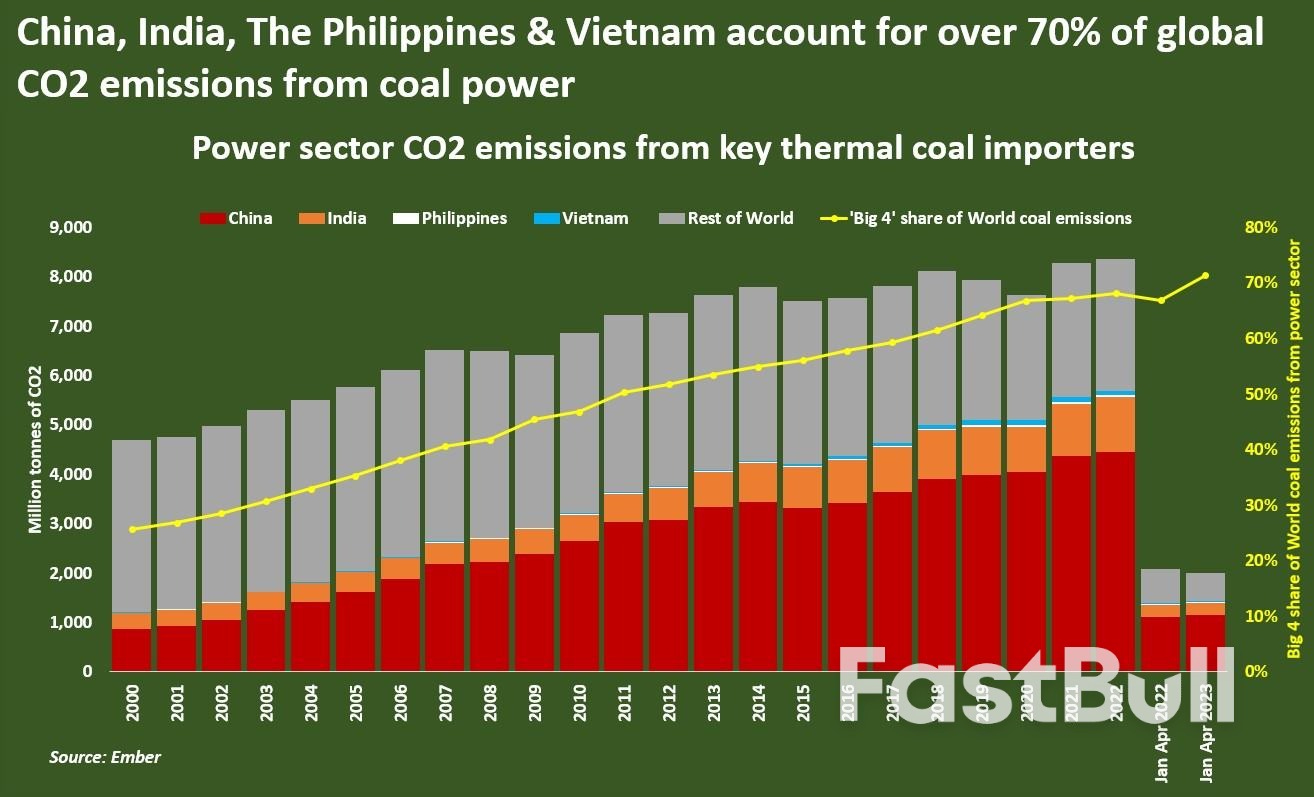
          Just four countries account for over half of all thermal coal imports and more than 70% of global power sector emissions from coal use, data shows, underscoring the extent of global dependence on these nations when it comes to cutting pollution.
          China, India, The Philippines and Vietnam accounted for 53% of world thermal coal imports during the first four months of 2023, compared to 40% for the same period in 2022, showed data from ship tracking firm Kpler.
          The same countries produced 71.4% of all carbon dioxide (CO2) emissions from power sector use of coal during January through April, showed data from think tank Ember, up from around 67% in the same period a year earlier.
          The 'Big 4' Drivers of Coal Imports and Power Emissions_1The concentration of coal imports and coal-fired emissions among only four nations makes it relatively easy for pollution trackers to identify major climate culprits, and monitor their collective polluting heft relative to the rest of the world.
          Yet this consolidated coal dependence also makes it possible to spot any impending trend reversals in coal use as these key economies integrate more renewable power into energy systems, with important implications for global emissions trajectories.
          China's Pull
          China is the overwhelming coal market giant, topping global rankings for coal output, use and imports by a large margin.
          In 2022, when China's economy was hamstrung by repeated and extended lockdowns to slow the spread of COVID-19, China's coal imports underwent a rare contraction from the year before as industrial demand for the fuel waned.
          That helped free up coal supplies for other buyers in 2022, most notably across Europe where power producers were hampered by cuts to natural gas supplies from Russia and were forced to find alternative sources of power from international markets.
          But China's appetite for coal has come roaring back in the opening months of 2023 thanks to Beijing's measures to revive economic growth, with thermal coal imports over the first four months jumping by 90% from the same period in 2022.
          The 'Big 4' Drivers of Coal Imports and Power Emissions_2That resumption in buying by China has helped push global coal export volumes to new highs so far in 2023, despite widespread efforts elsewhere to wean energy systems off coal in favour of greater use of non-emitting power sources.
          Trade Partner Ties
          China's greater industrial activity this year has also reinvigorated the economies of major trade partners, especially Vietnam and The Philippines which have strong supply chain ties into China.
          In turn, that has led to increased electricity generation in those countries, especially in The Philippines where coal-fired generation has climbed by more than 11% in the first quarter from the same period in 2022.
          In Vietnam, coal generation hit its highest monthly total in more than 20 months in March, and looks set to climb further in the months ahead following a jump in coal imports this month to the highest since mid-2020, data from Kpler and Ember shows.
          A key determinant of how much additional coal demand will emerge in The Philippines, Vietnam and elsewhere will be the strength or otherwise of China's economic revival over the rest of the year.
          While China's recovery from the stunted levels of 2022 was widespread in early 2023, there were signs of industrial slowdown in the latest economic releases that suggest growth rates may be more patchy going forward.
          In response, key suppliers to China's industries and factories are liable to slow their own output expansion rates, which may pare energy demand levels and limit overall coal use.
          However, industries and utilities are also liable to look to keep costs in check, which may result in increased use of low cost but high-emitting coal over cleaner-burning but more expensive fuels such as natural gas.
          India Rising
          India, the world's second-largest coal consumer and fifth-largest economy, is also at a key economic crossroads as its own momentum is checked by a slowdown in global goods demand due to rising interest rates and high energy and living costs.
          India's large, young and fast-growing middle class are expected to power the economy to a 5.9% growth pace in the 2023-24 fiscal year, according to the International Monetary Fund (IMF).
          However, sluggish demand in key importer economies such as the United States and Europe may slow consumption of items manufactured in India, such as electronics, textiles and pharmaceutical products, and may weigh on India's growth pace.
          India is also expected to face growing scrutiny over its practices of importing crude oil and other energy products from Russia despite international efforts to sanction Moscow following the invasion of Ukraine in 2022.
          India and Russia have recently suspended efforts to settle bilateral trade in rupees, after months of negotiations failed to convince Moscow to accept the Indian currency as a means of payment.
          This may push up India's import costs and potentially undermine economic momentum by eating into foreign currency reserves.
          As with the cost-sensitive power producers in South East Asia who are wary of a further slowdown in China's economy, power firms in India may also favour use of coal over more expensive gas given the conflicting signals over India's economic potential.
          That in turn may support further Indian coal imports, which are already up 15% through the first four months of 2023 from the same period in 2022.
          Slowing economic momentum may also dent India's efforts to boost renewable energy generation, which has been growing sharply in recent years but is highly dependant on major government investments and subsidies that may be imperilled by any economic hiccups.
          For climate and coal market followers alike, this means that India, alongside China and key South East Asia trade partners, will be the most important markets to track for guidance on coal imports and emissions over the remainder of 2023 and beyond.

          Source: ET EnergyWorld

          Risk Warnings and Disclaimers
          You understand and acknowledge that there is a high degree of risk involved in trading. Following any strategies or investment methods may lead to potential losses. The content on the site is provided by our contributors and analysts for information purposes only. You are solely responsible for determining whether any trading assets, securities, strategy, or any other product is suitable for investing based on your own investment objectives and financial situation.
          Comments
          Add to Favorites
          Share

          Bitcoin Touches $28,000 as U.S. Debt Ceiling Deal Heads to Congress

          Alex

          Cryptocurrency

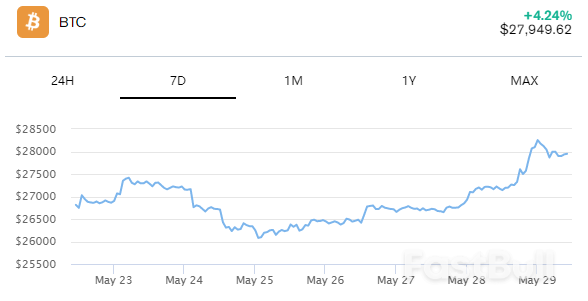
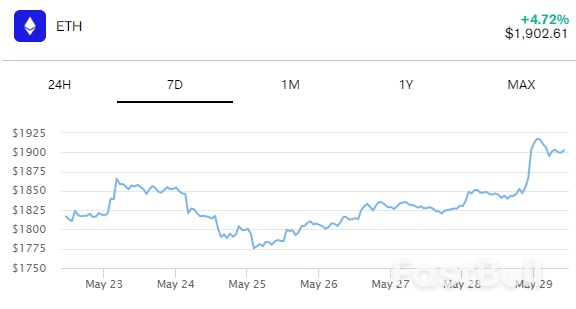
          Bitcoin and Ethereum continued to climb along with stocks as U.S. lawmakers ended their stalemate over the federal government's debt ceiling, boosting risk-on sentiments in the market.
          Bitcoin touched $28,000 Monday morning, with Ethereum breaking above $1,900. At time of publication, Bitcoin stands at just under $28,000, up 2.9% on the day, with Ethereum holding above $1,900, up 3.2% in the last 24 hours, per CoinGecko.
          A protracted stand-off between Democrats and Republicans over the federal government’s $31.4 trillion debt ceiling appeared to end this past weekend, as U.S. President Joe Biden and Republican House speaker Kevin McCarthy reached a tentative deal on Saturday evening.
          The deal will now move to Congress for a vote; if approved it will prevent the U.S. government from defaulting on its debt.
          Bitcoin Touches $28,000 as U.S. Debt Ceiling Deal Heads to Congress_1
          In exchange for implementing spending caps and making cuts to government programs, the agreement would extend the suspension of the debt ceiling until January 2025.
          The stock markets held on to last week’s impressive gains at the prospect of a formal deal, with the S&P 500 futures reaching a nine-month high above the 4,220 level and the tech-heavy Nasdaq-100 index futures opening with a positive gap above 14,400 points—a 14-month high—on Monday.
          On the other hand, gold’s price has dropped since last week as the lawmakers worked toward averting a default on the American economy, strengthening the dollar’s value. Gold was last trading at $1,941 per ounce, down 2.45% from the monthly opening value.
          The next major market moving event from the U.S. economy will arrive two weeks from now at the Federal Reserve policy rate meeting on June 14-15.
          Bitcoin Touches $28,000 as U.S. Debt Ceiling Deal Heads to Congress_2
          Currently, CME traders are placing a 65% chance, per the CME FedWatch tool, that the central bank will increase the benchmark rate yet again, dashing hopes that May’s 25-basis point rate hike was the last one for this year.
          Previously, rate hikes have put selling pressure on Bitcoin as higher dollar yields make risk-on assets like Bitcoin and stocks unattractive.

          Source: decrypt.co

          Risk Warnings and Disclaimers
          You understand and acknowledge that there is a high degree of risk involved in trading. Following any strategies or investment methods may lead to potential losses. The content on the site is provided by our contributors and analysts for information purposes only. You are solely responsible for determining whether any trading assets, securities, strategy, or any other product is suitable for investing based on your own investment objectives and financial situation.
          Comments
          Add to Favorites
          Share

          Erdogan Wins Turkish Election, Extending Rule To Third Decade

          Thomas

          Political

          President Recep Tayyip Erdogan has won Turkey’s presidential election, defeating opposition leader Kemal Kilicdaroglu in Sunday’s runoff vote and stretching his rule into a third decade.
          With 99.43% of the votes counted, preliminary official results announced by Turkey’s Supreme Election Council (YSK) on Sunday showed Erdogan winning with 52.14% of the votes. Kilicdaroglu received 47.86%.
          Speaking to thousands of his supporters outside the presidential complex in Ankara, Erdogan said that now was the time to “put aside all the debates and conflicts regarding the election period and unite around our national goals and dreams.”
          “We are not the only winners, the winner is Turkey. The winner is all parts of our society, our democracy is the winner,” Erdogan said.
          Erdogan said among the government’s main priorities would be fighting inflation and healing the wounds from a catastrophic earthquake on February 6 which claimed more than 50,000 lives in Turkey and neighboring Syria.
          Speaking at his party headquarters in the capital Ankara, Kilicdaroglu said he would continue to fight until there is “real democracy” in Turkey.
          “This was the most unfair election period in our history… We did not bow down to the climate of fear,” he said. “In this election, the will of the people to change an authoritarian government became clear despite all the pressures.”
          Kilicdaroglu said what “truly makes me sad is the hard days ahead for our country.”
          Foreign leaders including those of Russia, Qatar, Libya, Algeria, Hungary, Iran and the Palestinian Authority were among the first to congratulate Erdogan.
          In remarks published on the Kremlin’s website, Russian President Vladimir Putin said the election provided “clear evidence of the Turkish people’s support” for Erdogan’s efforts “to strengthen state sovereignty and pursue an independent foreign policy.”
          US President Joe Biden also congratulated Erdogan, tweeting that he looked forward to working together “as NATO allies” on “bilateral issues and shared global challenges.”
          Erdogan’s supporters gathered In Istanbul’s Taksim Square, chanting his name and “God is great.”
          Hundreds gathered outside the Istanbul headquarters of the ruling Justice and Development (AK) Party after preliminary results showed Erdogan in the lead. Some came with children while others waved flags, honked car horns and set off flares and fireworks.
          Speaking outside party headquarters amid the celebrations, Erdogan supporter Denel Anart said: “I hope he lives forever.”
          “He is my father, grandfather, uncle. He is my everything,” Anart said.
          Others struck a more religious note.
          “Muslims should rejoice. The whole world will know Muslims more,” said Sehat Pak, 33. “The Islamic world should rejoice.”
          But Mehmet Karli, adviser to Kilicdaroglu, called Erdogan’s election win a “pyrrhic victory” accusing the president of fueling tensions during the election.
          “It does appear that President Erdogan has won these elections. But it would be a mistake to call this a victory. Perhaps a pyrrhic victory is a better term to describe this situation,” Karli said.
          Erdogan’s victory over Kilicdaroglu, a 74-year-old bureaucrat and leader of the left-leaning CHP, leaves Turkey a deeply divided nation.
          “This is not a crushing defeat for those who wanted change,” Asli Aydintasbas, a visiting fellow at Brookings Institution, told CNN’s Becky Anderson. “We are once again looking at a divided country … both camps want entirely different things for Turkey.”
          In the first round of voting on May 14, Erdogan secured a nearly five-point lead over Kilicdaroglu but fell short of the 50% threshold needed to win.
          The president’s parliamentary bloc won a majority of seats in the parliamentary race on the same day.
          Erdogan Wins Turkish Election, Extending Rule To Third Decade_1

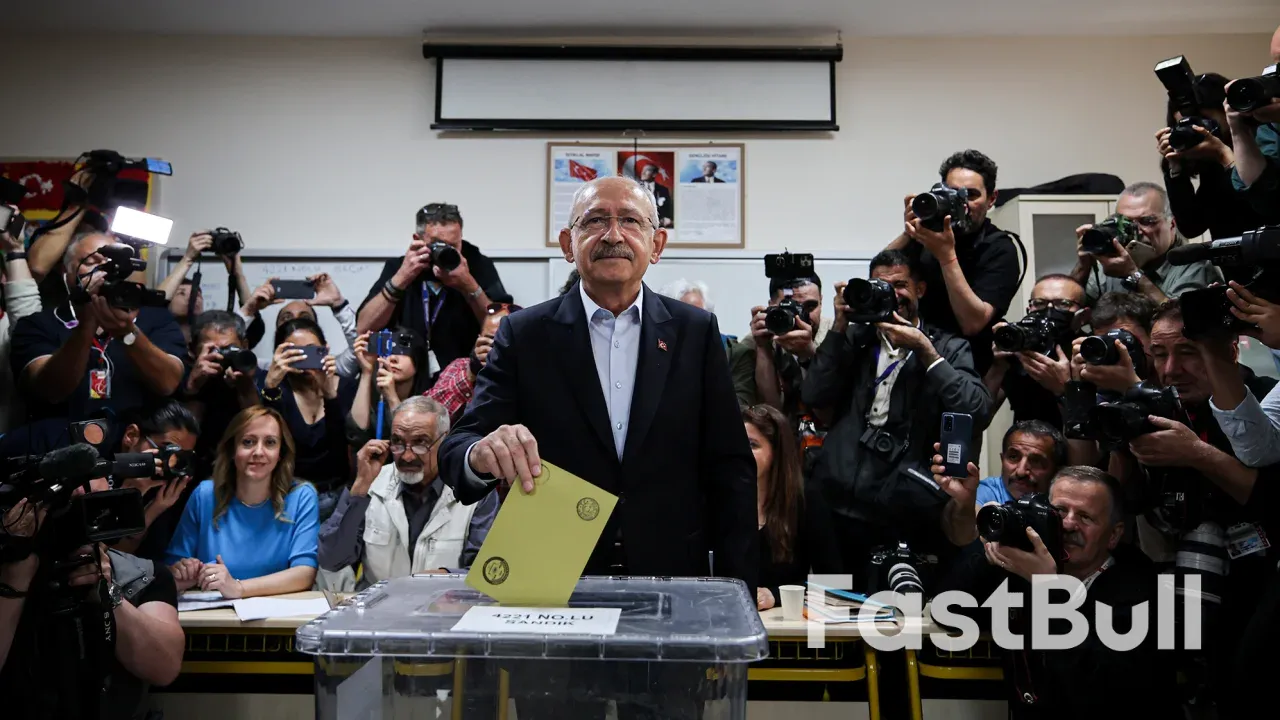
          Note: Opposition candidate Kemal Kilicdaroglu cast his vote at a polling station in Ankara.

          Electoral authorities said earlier that voting was passing “without any issues.”
          Last week, third-place candidate Sinan Ogan, who won 5% of the first-round vote, publicly endorsed Erdogan, further boosting the strongman leader’s chances of winning Sunday’s second and final presidential round.
          Many polls had incorrectly predicted that Kilicdaroglu would lead in the May 14 vote, which saw a high turnout of nearly 90% across the country.
          Six opposition groups had formed an unprecedented unified bloc behind Kilicdaroglu to try to wrest power from Erdogan.
          The opposition had described the election as a last stand for Turkish democracy, accusing Erdogan of hollowing out the country’s democratic institutions during his 20-year rule, eroding the power of the judiciary and repressing dissent.
          Erdogan also faces headwinds from a floundering economy and a shambolic initial response to the February earthquake.
          The government acknowledged its “mistakes” in its rescue operation and apologized to the public.
          Erdogan’s critics also spotlighted loose construction standards presided over by the ruling AK party, which turbocharged a construction boom since the early 2000s, and exacerbated the death toll. They also argued that the earthquake response underscored Erdogan’s alleged hollowing out of government entities in his bid to consolidate power.
          The country’s financial crisis – which saw the currency plummet and prices soar – is also partially blamed on Erdogan’s policies. The president suppressed interest rates leaving inflation unfettered, critics argued.
          Erdogan Wins Turkish Election, Extending Rule To Third Decade_2

          Note: Erdogan won the first round but fell short of the margin needed to avoid a runoff.

          In an interview with CNN’s Anderson last week, Erdogan vowed to double down on his unorthodox economic policies, arguing that interest rates and inflation were “positively correlated.”
          He also hailed his relationship with Russia’s President Putin as “special” and said he would continue to block Sweden’s access to NATO, despite Western criticism that he was obstructing a unified front against Moscow’s invasion of Ukraine.
          Erdogan, who controls the second-largest army in NATO, accused Sweden of harboring Kurdish terror groups and has preconditioned Stockholm’s accession on the extradition of wanted individuals. Sweden has refused Turkey’s repeated requests to extradite individuals Ankara describes as terrorists, arguing that the issue can only be decided by Swedish courts.
          Sweden’s Prime Minister Ulf Kristersson congratulated Erdogan for his victory. “Our common security is a future priority,” he tweeted.
          Since Russia launched its invasion of Ukraine in February 2022, the Turkish strongman has emerged as a key power broker, adopting a crucial balancing act between the two sides, widely known as “pro-Ukrainian neutrality.”
          He helped broker a key agreement known as the Black Sea Grain Corridor Initiative that unlocked millions of tons of wheat caught up in Russia’s invasion of Ukraine, averting a global hunger crisis. The agreement was extended for another two months last Wednesday, one day before it was set to expire.
          In a statement on Twitter, Ukrainian President Volodymyr Zelensky congratulated Erdogan for his victory.
          “We count on the further strengthening of the strategic partnership for the benefit of our countries, as well as the strengthening of cooperation for the security and stability of Europe,” Zelensky said.

          Source: CNN

          Risk Warnings and Disclaimers
          You understand and acknowledge that there is a high degree of risk involved in trading. Following any strategies or investment methods may lead to potential losses. The content on the site is provided by our contributors and analysts for information purposes only. You are solely responsible for determining whether any trading assets, securities, strategy, or any other product is suitable for investing based on your own investment objectives and financial situation.
          Comments
          Add to Favorites
          Share
          FastBull
          Copyright © 2025 FastBull Ltd

          728 RM B 7/F GEE LOK IND BLDG NO 34 HUNG TO RD KWUN TONG KLN HONG KONG

          TelegramInstagramTwitterfacebooklinkedin
          App Store Google Play Google Play
          Products
          Charts

          Chats

          Q&A with Experts
          Screeners
          Economic Calendar
          Data
          Tools
          Membership
          Features
          Function
          Markets
          Copy Trading
          Latest Signals
          Contests
          News
          Analysis
          24/7
          Columns
          Education
          Company
          Careers
          About Us
          Contact Us
          Advertising
          Help Center
          Feedback
          User Agreement
          Privacy Policy
          Business

          White Label

          Data API

          Web Plug-ins

          Poster Maker

          Affiliate Program

          Risk Disclosure

          The risk of loss in trading financial instruments such as stocks, FX, commodities, futures, bonds, ETFs and crypto can be substantial. You may sustain a total loss of the funds that you deposit with your broker. Therefore, you should carefully consider whether such trading is suitable for you in light of your circumstances and financial resources.

          No decision to invest should be made without thoroughly conducting due diligence by yourself or consulting with your financial advisors. Our web content might not suit you since we don't know your financial conditions and investment needs. Our financial information might have latency or contain inaccuracy, so you should be fully responsible for any of your trading and investment decisions. The company will not be responsible for your capital loss.

          Without getting permission from the website, you are not allowed to copy the website's graphics, texts, or trademarks. Intellectual property rights in the content or data incorporated into this website belong to its providers and exchange merchants.

          Not Logged In

          Log in to access more features

          FastBull Membership

          Not yet

          Purchase

          Become a signal provider
          Help Center
          Customer Service
          Dark Mode
          Price Up/Down Colors

          Log In

          Sign Up

          Position
          Layout
          Fullscreen
          Default to Chart
          The chart page opens by default when you visit fastbull.com