• Trade
  • Markets
  • Copy
  • Contests
  • News
  • 24/7
  • Calendar
  • Q&A
  • Chats
Screeners
SYMBOL
LAST
ASK
BID
HIGH
LOW
NET CHG.
%CHG.
SPREAD
SPX
S&P 500 Index
6976.45
6976.45
6976.45
6991.91
6916.63
+37.42
+ 0.54%
--
DJI
Dow Jones Industrial Average
49407.67
49407.67
49407.67
49484.95
48673.58
+515.21
+ 1.05%
--
IXIC
NASDAQ Composite Index
23592.10
23592.10
23592.10
23686.83
23356.40
+130.29
+ 0.56%
--
USDX
US Dollar Index
97.360
97.440
97.360
97.360
97.260
-0.050
-0.05%
--
EURUSD
Euro / US Dollar
1.18012
1.18021
1.18012
1.18146
1.17809
+0.00114
+ 0.10%
--
GBPUSD
Pound Sterling / US Dollar
1.36715
1.36725
1.36715
1.36859
1.36598
+0.00046
+ 0.03%
--
XAUUSD
Gold / US Dollar
4788.27
4788.72
4788.27
4855.89
4665.80
+129.67
+ 2.78%
--
WTI
Light Sweet Crude Oil
61.470
61.505
61.470
62.191
61.306
-0.612
-0.99%
--

Community Accounts

Signal Accounts
--
Profit Accounts
--
Loss Accounts
--
View More

Become a signal provider

Sell trading signals to earn additional income

View More

Guide to Copy Trading

Get started with ease and confidence

View More

Signal Accounts for Members

All Signal Accounts

Best Return
  • Best Return
  • Best P/L
  • Best MDD
Past 1W
  • Past 1W
  • Past 1M
  • Past 1Y

All Contests

  • All
  • Trump Updates
  • Recommend
  • Stocks
  • Cryptocurrencies
  • Central Banks
  • Featured News
Top News Only
Share

[Ethereum Drops Below $2300, Down 2.43% In The Past Hour] February 3, According To Htx Market Data, Ethereum Fell Below $2,300, Now Trading At $2,298.77, Down 2.43% In The Past Hour

Share

[Hamas: Ready To Transfer Gaza Strip Administration] On February 2nd Local Time, Hamas Spokesman Hazem Qasim Issued A Statement Saying That Hamas Has Completed The Necessary Procedures Concerning The Gaza Strip Administration And Is Ready To Transfer It To The Palestinian Technical Bureaucratic Committee. The Statement Said That A Committee Composed Of Representatives From Various Factions, Families, And Civil Society In The Gaza Strip Will Oversee The Transfer Process. The Statement Called On All Parties To Facilitate The Work Of The Technical Bureaucratic Committee In Order To Initiate The Gaza Reconstruction Process

Share

Indonesia's Benchmark Stock Index Rises 0.9% To 7992 Points

Share

Cctv - Chinese President Xi Meets With Uruguayan President Yamandu Orsi

Share

Vietnam Industry Ministry: Imposes Temporary Anti-Dumping Tariffs On Colourless Float Glass From Indonesia, Malaysia

Share

Indonesia's Benchmark Stock Index Falls 2% To 7,757

Share

Indonesia's Benchmark Stock Index Down 0.6% In Early Trade

Share

Singapore Stocks Rise As Much As 1% To A Record High Of 4942.47

Share

Trump Will Attend A Meeting With Colombian President Petro At 11 A.m. Eastern Time On Tuesday

Share

South Korea's KOSPI Index Rose 5% To 5,198.08 Points

Share

Spot Silver Extends Gains, Last Up 7% At $84.97/Oz

Share

[Trump Team Transfers Wallet To Bitgo Custodial Wallet Holding 5.267M Trump, Equivalent To $22.44M] February 3Rd, According To Onchain Lens Monitoring, Meme Coin Trump Team Allocation Wallet Transferred 5,267,000 Trump To Bitgo Custody Wallet, Worth Approximately 22.44 Million US Dollars

Share

Spot Gold/ Silver Rebound 3%/ 5% To Return Above US$4800/ US$80 Each

Share

China Central Bank Injects 105.5 Billion Yuan Via 7-Day Reverse Repos At 1.40% Versus Prior 1.40%

Share

Spot Gold Surged 4.00% Intraday, Currently Trading At $4,848.07 Per Ounce

Share

India's Gift Nifty At 25886, 3% Above The Nifty 50's Last Close Of 25,088

Share

LME Three-month Tin Rose More Than 3%

Share

Taiwan Overnight Interbank Rate Opens At 0.805 Percent (Versus 0.805 Percent At Previous Session Open)

Share

Taiwan Stocks Rise More Than 2%

Share

Japan Chief Cabinet Secretary Kihara: United Arab Emirates Notified Japan That United Arab Emirates President's State Visit To Japan Will Be Delayed From Originally Scheduled Feb 8

TIME
ACT
FCST
PREV
Indonesia Trade Balance (Dec)

A:--

F: --

P: --

Indonesia Inflation Rate YoY (Jan)

A:--

F: --

P: --

Indonesia Core Inflation YoY (Jan)

A:--

F: --

P: --

India HSBC Manufacturing PMI Final (Jan)

A:--

F: --

P: --

Australia Commodity Price YoY (Jan)

A:--

F: --

P: --

Russia IHS Markit Manufacturing PMI (Jan)

A:--

F: --

P: --

Turkey Manufacturing PMI (Jan)

A:--

F: --

P: --

U.K. Nationwide House Price Index MoM (Jan)

A:--

F: --

P: --

U.K. Nationwide House Price Index YoY (Jan)

A:--

F: --

P: --

Germany Actual Retail Sales MoM (Dec)

A:--

F: --

P: --
Italy Manufacturing PMI (SA) (Jan)

A:--

F: --

P: --

South Africa Manufacturing PMI (Jan)

A:--

F: --

P: --

Euro Zone Manufacturing PMI Final (Jan)

A:--

F: --

P: --

U.K. Manufacturing PMI Final (Jan)

A:--

F: --

P: --

Turkey Trade Balance (Jan)

A:--

F: --

P: --

Brazil IHS Markit Manufacturing PMI (Jan)

A:--

F: --

P: --

Canada National Economic Confidence Index

A:--

F: --

P: --

Canada Manufacturing PMI (SA) (Jan)

A:--

F: --

P: --

U.S. IHS Markit Manufacturing PMI Final (Jan)

A:--

F: --

P: --

U.S. ISM Output Index (Jan)

A:--

F: --

P: --

U.S. ISM Inventories Index (Jan)

A:--

F: --

P: --

U.S. ISM Manufacturing Employment Index (Jan)

A:--

F: --

P: --

U.S. ISM Manufacturing New Orders Index (Jan)

A:--

F: --

P: --

U.S. ISM Manufacturing PMI (Jan)

A:--

F: --

P: --

South Korea CPI YoY (Jan)

A:--

F: --

P: --

Japan Monetary Base YoY (SA) (Jan)

A:--

F: --

P: --

Australia Building Approval Total YoY (Dec)

A:--

F: --

P: --

Australia Building Permits MoM (SA) (Dec)

A:--

F: --

P: --

Australia Building Permits YoY (SA) (Dec)

A:--

F: --

P: --

Australia Private Building Permits MoM (SA) (Dec)

A:--

F: --

P: --

Australia Overnight (Borrowing) Key Rate

--

F: --

P: --

RBA Rate Statement
Japan 10-Year Note Auction Yield

--

F: --

P: --

Saudi Arabia IHS Markit Composite PMI (Jan)

--

F: --

P: --

RBA Press Conference
Turkey PPI YoY (Jan)

--

F: --

P: --

Turkey CPI YoY (Jan)

--

F: --

P: --

Turkey CPI YoY (Excl. Energy, Food, Beverage, Tobacco & Gold) (Jan)

--

F: --

P: --

U.S. Weekly Redbook Index YoY

--

F: --

P: --

U.S. JOLTS Job Openings (SA) (Dec)

--

F: --

P: --

Mexico Manufacturing PMI (Jan)

--

F: --

P: --

U.S. API Weekly Refined Oil Stocks

--

F: --

P: --

U.S. API Weekly Gasoline Stocks

--

F: --

P: --

U.S. API Weekly Cushing Crude Oil Stocks

--

F: --

P: --

U.S. API Weekly Crude Oil Stocks

--

F: --

P: --

Japan IHS Markit Services PMI (Jan)

--

F: --

P: --

Japan IHS Markit Composite PMI (Jan)

--

F: --

P: --

China, Mainland Caixin Services PMI (Jan)

--

F: --

P: --

China, Mainland Caixin Composite PMI (Jan)

--

F: --

P: --

India HSBC Services PMI Final (Jan)

--

F: --

P: --

India IHS Markit Composite PMI (Jan)

--

F: --

P: --

Russia IHS Markit Services PMI (Jan)

--

F: --

P: --

South Africa IHS Markit Composite PMI (SA) (Jan)

--

F: --

P: --

Italy Services PMI (SA) (Jan)

--

F: --

P: --

Italy Composite PMI (Jan)

--

F: --

P: --

Germany Composite PMI Final (SA) (Jan)

--

F: --

P: --

Euro Zone Composite PMI Final (Jan)

--

F: --

P: --

Euro Zone Services PMI Final (Jan)

--

F: --

P: --

U.K. Composite PMI Final (Jan)

--

F: --

P: --

U.K. Total Reserve Assets (Jan)

--

F: --

P: --

U.K. Services PMI Final (Jan)

--

F: --

P: --

Q&A with Experts
    • All
    • Chatrooms
    • Groups
    • Friends
    marsgents flag
    gold might test low today becareful long
    ANDY flag
    Good morning all
    IsuruDhana flag
    Good morning all
    3519695 flag
    hello
    margopal flag
    good morning 5151
    budiarno flag
    Wow, good morning to all fellow traders. May you be successful, amen.
    3203406 flag
    GOOD EVENING FROM LOS ANGELES
    JOSHUA flag
    Good evening & Good morning all God Bless us all
    Jakline flag
    gold market doing 4300
    3523817 flag
    them
    3523817 flag
    is this fr?
    Azanialery flag
    good morning
    ali flag
    Btc gold forex and stock making falling pattern something big coming
    3463881 flag
    are you all in short position?
    3524110 flag
    hello guys
    3524110 flag
    look at you
    3524110 flag
    fools
    3524110 flag
    monkey
    3463881 flag
    Visayan
    ali flag
    slowly slowly all stock getting red
    Type here...
    Add Symbol or Code

      No matching data

      All
      Trump Updates
      Recommend
      Stocks
      Cryptocurrencies
      Central Banks
      Featured News
      • All
      • Russia-Ukraine Conflict
      • Middle East Flashpoint
      • All
      • Russia-Ukraine Conflict
      • Middle East Flashpoint
      Search
      Products

      Charts Free Forever

      Chats Q&A with Experts
      Screeners Economic Calendar Data Tools
      Membership Features
      Data Warehouse Market Trends Institutional Data Policy Rates Macro

      Market Trends

      Market Sentiment Order Book Forex Correlations

      Top Indicators

      Charts Free Forever
      Markets

      News

      News Analysis 24/7 Columns Education
      From Institutions From Analysts
      Topics Columnists

      Latest Views

      Latest Views

      Trending Topics

      Top Columnists

      Latest Update

      Signals

      Copy Rankings Latest Signals Become a signal provider AI Rating
      Contests
      Brokers

      Overview Brokers Assessment Rankings Regulators News Claims
      Broker listing Forex Brokers Comparison Tool Live Spread Comparison Scam
      Q&A Complaint Scam Alert Videos Tips to Detect Scam
      More

      Business
      Events
      Careers About Us Advertising Help Center

      White Label

      Data API

      Web Plug-ins

      Affiliate Program

      Awards Institution Evaluation IB Seminar Salon Event Exhibition
      Vietnam Thailand Singapore Dubai
      Fans Party Investment Sharing Session
      FastBull Summit BrokersView Expo
      Recent Searches
        Top Searches
          Markets
          News
          Analysis
          User
          24/7
          Economic Calendar
          Education
          Data
          • Names
          • Latest
          • Prev

          View All

          No data

          Scan to Download

          Faster Charts, Chat Faster!

          Download App
          English
          • English
          • Español
          • العربية
          • Bahasa Indonesia
          • Bahasa Melayu
          • Tiếng Việt
          • ภาษาไทย
          • Français
          • Italiano
          • Türkçe
          • Русский язык
          • 简中
          • 繁中
          Open Account
          Search
          Products
          Charts Free Forever
          Markets
          News
          Signals

          Copy Rankings Latest Signals Become a signal provider AI Rating
          Contests
          Brokers

          Overview Brokers Assessment Rankings Regulators News Claims
          Broker listing Forex Brokers Comparison Tool Live Spread Comparison Scam
          Q&A Complaint Scam Alert Videos Tips to Detect Scam
          More

          Business
          Events
          Careers About Us Advertising Help Center

          White Label

          Data API

          Web Plug-ins

          Affiliate Program

          Awards Institution Evaluation IB Seminar Salon Event Exhibition
          Vietnam Thailand Singapore Dubai
          Fans Party Investment Sharing Session
          FastBull Summit BrokersView Expo

          Crypto Bill Hinges on White House Stablecoin Talks

          Natalie Gordon

          Remarks of Officials

          Political

          Cryptocurrency

          Summary:

          The White House is engaging industry leaders on stablecoin yields, aiming to unblock stalled crypto legislation in the Senate.

          White House Engages Industry on Key Crypto Issues

          The White House has entered direct talks with leaders from the cryptocurrency and banking industries to tackle a critical issue holding up a major digital asset bill: the regulation of stablecoin yields.

          Officials from the Trump administration convened the meeting to find a path forward for the Digital Asset Market Clarity (CLARITY) Act, a piece of market structure legislation currently under review in the Senate. According to The Digital Chamber, a crypto advocacy organization, its CEO Cody Carbone was among the representatives who met with administration officials to hash out the bill's provisions.
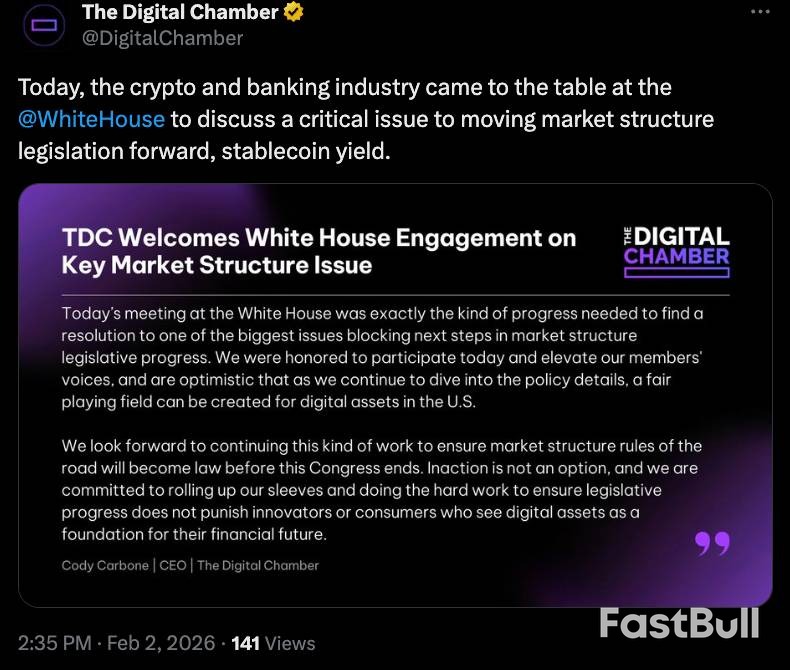
          The Digital Chamber confirmed the high-level meeting on X, highlighting stablecoin yield as a key issue for advancing comprehensive market structure legislation.

          The CLARITY Act’s progress stalled in January after the Senate Banking Committee postponed a scheduled markup session. Lawmakers are still grappling with several complex topics before they can advance the bill, including:

          • Tokenized equities

          • Decentralized finance (DeFi)

          • Ethics for elected officials investing in crypto

          • Stablecoin rewards

          Carbone described the White House meeting as "exactly the kind of progress needed" to resolve one of the bill's most significant obstacles. He added that he is "optimistic that as we continue to dive into the policy details, a fair playing field can be created for digital assets in the US."

          This positive sentiment was echoed by White House crypto adviser Patrick DeWitt, who called the discussion "constructive, fact-based" and "solutions-oriented." He expressed confidence that officials and industry leaders would reach a solution soon. Other organizations present included the Crypto Council for Innovation, the American Bankers Association, and the Blockchain Association.

          Navigating the Senate's Legislative Process

          The high-level meeting occurred amid a partial US government shutdown, which entered its third day after lawmakers failed to agree on a funding bill.

          The path for any crypto market structure bill is complex. The Senate is working through two separate but related legislative efforts that will eventually need to be reconciled.

          Last week, the Senate Agriculture Committee passed its version of the bill, which focuses on the Commodity Futures Trading Commission's role. However, it did so without any Democratic support, as some members raised objections to rules concerning elected officials holding digital assets.

          Meanwhile, the Senate Banking Committee is handling the sections of the bill that define how the US Securities and Exchange Commission will oversee the crypto space. For the legislation to reach a full floor vote, both committees will likely need to combine their respective bills into a single, cohesive package. The recent White House discussion signals a coordinated effort to clear the hurdles preventing that from happening.

          Risk Warnings and Disclaimers
          You understand and acknowledge that there is a high degree of risk involved in trading. Following any strategies or investment methods may lead to potential losses. The content on the site is provided by our contributors and analysts for information purposes only. You are solely responsible for determining whether any trading assets, securities, strategy, or any other product is suitable for investing based on your own investment objectives and financial situation.
          Add to Favorites
          Share

          Trump Unveils Plan for US Critical Minerals Stockpile

          Isaac Bennett

          Remarks of Officials

          Stocks

          Economic

          Commodity

          Daily News

          Political

          China–U.S. Trade War

          President Donald Trump announces the new initiative from the White House.

          President Donald Trump announced the creation of a U.S. critical mineral reserve late Monday, a move designed to reduce America’s reliance on China for materials vital to modern industry. The announcement immediately boosted the shares of domestic mining companies in after-hours trading.

          The initiative, dubbed "Project Vault," will establish a strategic stockpile of critical minerals specifically for the U.S. private sector. According to a White House official, the plan is backed by a combination of $1.67 billion in private capital and a $10 billion loan from the U.S. Export-Import Bank.

          The core objective is to secure a domestic supply chain for materials essential for electric vehicles, advanced defense systems, and other critical technologies, directly challenging China's dominance in the sector. The proposal was first reported by Bloomberg News earlier on Monday.

          Miners Rally on Stockpile News

          Investors reacted positively, betting the initiative will spur domestic demand and unlock government-backed financing for American mining operations. Key movers in extended trading included:

          • MP Materials: The operator of California's Mountain Pass mine saw its shares climb over 2%.

          • USA Rare Earth: The company's stock jumped by more than 2%.

          • Critical Metals Corp.: Shares rose by over 1%.

          Washington Deepens Its Role in the Minerals Sector

          Project Vault builds on a trend of increasing government intervention in the critical minerals industry. This strategic shift is highlighted by several recent developments.

          USA Rare Earth has already engaged in discussions with Commerce Secretary Howard Lutnick, presenting its domestic mining and magnet production assets. These talks have led to a proposed deal that could provide the company with approximately $1.6 billion in funding, subject to certain conditions, and would also include an equity stake for the U.S. government.

          This follows a landmark agreement made last summer between the Department of Defense and MP Materials. That deal involved the government taking an equity stake, setting a price floor for minerals, and committing to a long-term purchase agreement for a specific quantity of rare earth minerals and magnets.

          To stay updated on all economic events of today, please check out our Economic calendar
          Risk Warnings and Disclaimers
          You understand and acknowledge that there is a high degree of risk involved in trading. Following any strategies or investment methods may lead to potential losses. The content on the site is provided by our contributors and analysts for information purposes only. You are solely responsible for determining whether any trading assets, securities, strategy, or any other product is suitable for investing based on your own investment objectives and financial situation.
          Add to Favorites
          Share

          OpenAI is Unsatisfied With Some Nvidia Chips and Looking for Alternatives, Sources say

          Manuel

          Stocks

          OpenAI (OPAI.PVT) is unsatisfied with some of Nvidia’s (NVDA) latest artificial intelligence chips, and it has sought alternatives since last year, eight sources familiar with the matter said, potentially complicating the relationship between the two highest-profile players in the AI boom.
          The ChatGPT-maker’s shift in strategy, the details of which are first reported here, is over ​an increasing emphasis on chips used to perform specific elements of AI inference, the process when an AI model such as the one that powers the ChatGPT app responds to customer queries and requests. Nvidia ‌remains dominant in chips for training large AI models, while inference has become a new front in the competition.
          This decision by OpenAI and others to seek out alternatives in the inference chip market marks a significant test of Nvidia’s AI dominance and comes as the two companies are in ‌investment talks.
          In September, Nvidia said it intended to pour as much as $100 billion into OpenAI as part of a deal that gave the chipmaker a stake in the startup and gave OpenAI the cash it needed to buy the advanced chips.
          The deal had been expected to close within weeks, Reuters reported. Instead, negotiations have dragged on for months. During that time, OpenAI has struck deals with AMD (AMD) and others for GPUs built to rival Nvidia’s. But its shifting product road map also has changed the kind of computational resources it requires and bogged down talks with Nvidia, a person familiar with the matter said.
          On Saturday, Nvidia CEO Jensen Huang brushed off a report of tension with OpenAI, saying the idea was “nonsense” and that Nvidia planned a ⁠huge investment in OpenAI.
          "Customers continue to choose NVIDIA for inference because we deliver the ‌best performance and total cost of ownership at scale," Nvidia said in a statement.
          A spokesperson for OpenAI in a separate statement said the company relies on Nvidia to power the vast majority of its inference fleet and that Nvidia delivers the best performance per dollar for inference.
          Seven sources said that OpenAI is not satisfied with the speed at which Nvidia’s hardware can ‍spit out answers to ChatGPT users for specific types of problems such as software development and AI communicating with other software. It needs new hardware that would eventually provide about 10% of OpenAI’s inference computing needs in the future, one of the sources told Reuters.
          The ChatGPT maker has discussed working with startups including Cerebras and Groq (GROQ.PVT) to provide chips for faster inference, two sources said. But Nvidia struck a $20-billion licensing deal with Groq that shut down OpenAI’s talks, one of the sources told Reuters.
          Nvidia's decision to snap up key talent ​at Groq looked like an effort to shore up a portfolio of technology to better compete in a rapidly changing AI industry, chip industry executives said. Nvidia, in a statement, said that Groq's intellectual property was highly complementary ‌to Nvidia's product roadmap.

          NVIDIA ALTERNATIVES

          Nvidia’s graphics processing chips are well-suited for massive data crunching necessary to train large AI models like ChatGPT that have underpinned the explosive growth of AI globally to date. But AI advancements increasingly focus on using trained models for inference and reasoning, which could be a new, bigger stage of AI, inspiring OpenAI's efforts.
          The ChatGPT maker’s search for GPU alternatives since last year focused on companies building chips with large amounts of memory embedded in the same piece of silicon as the rest of the chip, called SRAM. Squishing as much costly SRAM as possible onto each chip can offer speed advantages for chatbots and other AI systems as they crunch requests from millions of users.
          Inference requires more memory than training because the chip needs to spend relatively more time fetching data from memory than performing mathematical operations. Nvidia and AMD GPU technology relies on external memory, which adds processing time and slows how quickly users can ⁠interact with a chatbot.
          Inside OpenAI, the issue became particularly visible in Codex, its product for creating computer code, which the company has ​been aggressively marketing, one of the sources added. OpenAI staff attributed some of Codex’s weakness to Nvidia’s GPU-based hardware, one source said.
          In a ​January 30 call with reporters, CEO Sam Altman said that customers using OpenAI’s coding models will “put a big premium on speed for coding work.”
          One way OpenAI will meet that demand is through its recent deal with Cerebras, Altman said, adding that speed is less of an imperative for casual ChatGPT users.
          Competing products such as Anthropic’s Claude and Google’s Gemini benefit from deployments that rely ‍more heavily on the chips Google made in-house, called tensor ⁠processing units, or TPUs, which are designed for the sort of calculations required for inference and can offer performance advantages over general-purpose AI chips like the Nvidia-designed GPUs.

          NVIDIA ON THE MOVE

          As OpenAI made clear its reservations about Nvidia technology, Nvidia approached companies working on SRAM-heavy chips, including Cerebras and Groq, about a potential acquisition, the people said. Cerebras declined and struck a commercial deal with OpenAI announced last month. Cerebras declined to comment.
          Groq ⁠held talks with OpenAI for a deal to provide computing power and received investor interest to fund the company at a valuation of roughly $14 billion, according to people familiar with the discussions. Groq declined to comment.
          But by December, Nvidia moved to license Groq’s tech in a non-exclusive ‌all-cash deal, the sources said. Although the deal would allow other companies to license Groq’s technology, the company is now focusing on selling cloud-based software, as Nvidia hired away Groq’s chip designers.

          Source: Reuters

          Risk Warnings and Disclaimers
          You understand and acknowledge that there is a high degree of risk involved in trading. Following any strategies or investment methods may lead to potential losses. The content on the site is provided by our contributors and analysts for information purposes only. You are solely responsible for determining whether any trading assets, securities, strategy, or any other product is suitable for investing based on your own investment objectives and financial situation.
          Add to Favorites
          Share

          Banks Bet on Business Loan Boom, Fed Survey Reveals

          Michael Ross

          Economic

          Central Bank

          Data Interpretation

          A new Federal Reserve survey indicates that banks are gearing up for a surge in business loan demand across all categories this year. Lenders largely attribute this optimism to expectations of lower interest rates and a rise in corporate spending and investment needs.

          A Mixed Picture in Late 2023

          The Fed's quarterly Senior Loan Officer Opinion Survey detailed a divided market in the fourth quarter. While demand for business loans from large and medium-sized companies increased, demand from small firms remained flat.

          On the consumer side, households showed weaker demand for most types of loans. The notable exception was credit card demand, which held steady.

          Lending Standards May Have Peaked

          Although banks continued to tighten their lending standards for businesses in the fourth quarter, the survey suggests this trend is unlikely to continue. Most institutions reported that they do not expect to tighten standards further in the coming year, potentially removing a significant barrier to credit growth that was present in 2023.

          One standout finding revealed a new lending preference: banks reported they are more likely to approve loans for firms with high exposure to artificial intelligence.

          Context for the Fed's Policy Stance

          This survey was available to Federal Reserve policymakers during their recent meeting, where they decided to hold the benchmark short-term borrowing rate in its 3.50%-3.75% range. The Fed signaled that a stabilizing labor market and persistent inflation would likely delay any rate cuts, a decision informed by data like this report on credit conditions.

          To stay updated on all economic events of today, please check out our Economic calendar
          Risk Warnings and Disclaimers
          You understand and acknowledge that there is a high degree of risk involved in trading. Following any strategies or investment methods may lead to potential losses. The content on the site is provided by our contributors and analysts for information purposes only. You are solely responsible for determining whether any trading assets, securities, strategy, or any other product is suitable for investing based on your own investment objectives and financial situation.
          Add to Favorites
          Share

          Ron Paul: The Dollar Is Dying and Gold Proves It

          Remarks of Officials

          Economic

          Central Bank

          Forex

          Commodity

          Political

          Former Texas congressman Ron Paul has issued one of his starkest warnings yet, arguing that the U.S. financial system is flashing red alerts that are louder, faster, and harder to ignore than ever before. In a recent interview with David Lin, Paul claimed that decades of unchecked government spending and monetary expansion are culminating in a crisis of confidence for the U.S. dollar.

          According to Paul, the current environment is fundamentally different from past debt scares. He contends that the nation has not only consumed a vast amount of its wealth but has also squandered its credibility through reckless fiscal and foreign policy.

          The Core Problem: A $38 Trillion Debt Spiral

          At the heart of Paul’s concern is the ballooning federal debt, which has surpassed $38 trillion. He views this not as a simple accounting issue but as a deep structural failure. In his analysis, the government no longer funds its obligations with real savings but instead relies on continuous money creation.

          "They don't have the money," Paul stated, explaining that the system functions by "stealing the purchasing power of the dollar by increasing the money supply." This process, he argues, amounts to a quiet transfer of wealth from ordinary citizens to the state.

          How Inflation Widens the Wealth Gap

          This constant creation of new money is the primary driver of widening income inequality, according to Paul. Those who receive the new money first—large financial institutions and politically connected entities—benefit before prices rise. Meanwhile, the wages and savings of the middle and lower classes are eroded by the subsequent inflation.

          Paul describes inflation as a hidden and damaging tax. "The poor are being hurt the most," he noted, suggesting that this "inflation tax" is more destructive than direct income taxes.

          Gold's Price Surge: A Verdict on Fiat Currency

          Paul directly connects these systemic pressures to the dramatic rise in the price of gold. With the precious metal trading near $5,000 per ounce at the time of his interview, he sees its sharp movements as a clear signal of collapsing confidence in government-issued fiat currency.

          "When you see gold going up over $100 in a day… it is different," he said, admitting that even he has been surprised by the recent speed of the market's reaction, despite having warned of this outcome for decades.

          When asked if the fiat system is nearing its end, Paul was unequivocal. "Yes, it is dying," he said, aligning with recent comments from investor Ray Dalio that the current monetary order is breaking down. Paul emphasized that the debt trajectory alone makes the system mathematically unsustainable.

          He also revisited his long-standing prediction that gold could reach $20,000 per ounce, framing it not as a bullish forecast but as a reflection of the dollar's potential collapse. "It went from $20 to $200 to $2,000," he said. "There's going to be another zero in our lifetime."

          However, Paul added a crucial caveat: the system may not even survive long enough to see such a price. In a complete monetary breakdown, he explained, quoting prices in dollars would become meaningless.

          Beyond the Market: Social and Political Fallout

          The consequences of this instability extend far beyond financial markets, Paul warned. He argued that as governments struggle to manage the ensuing chaos, civil liberties often become the first casualty. He pointed to growing constraints on free speech as evidence that economic stress makes authoritarian responses more probable.

          This financial fragility also has geopolitical implications. Paul suggested that alliances like NATO could become ineffective if the U.S. dollar loses its global dominance. "If you run out of money, you have to change your mind," he remarked, noting that financial exhaustion, not diplomacy, is often what brings wars to an end.

          A Glimmer of Hope?

          Despite the grim outlook, Paul expressed cautious optimism about a shift in public awareness. He observed that younger generations seem more open to the ideas of Austrian economics and are increasingly skeptical of centralized monetary control. He credits the internet with helping to spread these alternative viewpoints.

          Now hosting the Ron Paul Liberty Report, he continues to argue that debt liquidation and monetary reform are inevitable. However, he stressed that the path forward will not be easy. "This shift… is very, very dangerous," Paul concluded, warning that the risk of social disorder only grows the longer policymakers avoid confronting the underlying problems.

          To stay updated on all economic events of today, please check out our Economic calendar
          Risk Warnings and Disclaimers
          You understand and acknowledge that there is a high degree of risk involved in trading. Following any strategies or investment methods may lead to potential losses. The content on the site is provided by our contributors and analysts for information purposes only. You are solely responsible for determining whether any trading assets, securities, strategy, or any other product is suitable for investing based on your own investment objectives and financial situation.
          Add to Favorites
          Share

          US Treasury Signals Stable Borrowing, Eyes on Refunding

          Damon

          Traders' Opinions

          Remarks of Officials

          Data Interpretation

          Economic

          Bond

          The U.S. Treasury has slightly lowered its borrowing estimate for the first quarter, now expecting to raise $574 billion, a $3 billion decrease from its November forecast. The revision comes as a larger opening cash balance helped cushion a projected decline in net cash flows.

          Alongside its first-quarter plans, the Treasury announced it expects to borrow $109 billion in the second quarter. The department aims to maintain a cash balance of $850 billion by the end of March and increase it to $900 billion by the end of June.

          First-Quarter Financing Breakdown

          While the headline borrowing figure for the current quarter is down, the adjustment is primarily due to the higher-than-anticipated cash on hand at the start of the period. When this factor is excluded, the borrowing estimate is actually $19 billion higher than projected in November.

          Analysts noted that the updated forecasts signal continuity. "The estimates reflect little change from November and, thus, present little risk of any changes to coupon auction sizes in the near term," wrote Thomas Simons, chief U.S. economist at Jefferies, in a research note.

          Reviewing the Fourth Quarter of 2025

          In the final quarter of 2025, the Treasury borrowed $550 billion in privately-held net marketable debt, concluding the period with a cash balance of $873 billion.

          This was a departure from its November estimate, which had projected $569 billion in borrowing against an assumed end-of-December cash balance of $850 billion. The $20 billion reduction in borrowing was attributed mainly to stronger-than-expected net cash flows, moderated by the higher ending cash balance. Excluding the cash balance effect, actual borrowing was $42 billion lower than initially announced.

          Market Awaits Key Refunding Announcement

          With the latest borrowing estimates released, the bond market's attention is now fixed on the Treasury's quarterly refunding announcement scheduled for Wednesday. This release will provide concrete financing plans for the first and second quarters.

          The consensus expectation is that the Treasury will hold its note and bond auction sizes steady for the eighth consecutive quarter.

          Investors will be watching closely for any guidance on the department's next moves. Key questions include whether the Treasury will offer more details on future increases in coupon issuance or if it might signal cuts in long-end issuance. A reduction in long-term debt sales would align with the Trump administration's stated goal of lowering long-term borrowing costs.

          However, analysts believe a policy shift is unlikely for now. "There is no reason to expect that the Treasury will cut back on coupon issuance any time soon," Simons commented. He added that while Treasury Secretary Scott Bessent has previously expressed a desire to reduce long-end issuance, "there are still too many unknowns in the outlook to justify reducing coupon auction sizes."

          To stay updated on all economic events of today, please check out our Economic calendar
          Risk Warnings and Disclaimers
          You understand and acknowledge that there is a high degree of risk involved in trading. Following any strategies or investment methods may lead to potential losses. The content on the site is provided by our contributors and analysts for information purposes only. You are solely responsible for determining whether any trading assets, securities, strategy, or any other product is suitable for investing based on your own investment objectives and financial situation.
          Add to Favorites
          Share

          Trump's Big Oil Deal with India Hits Market Reality

          Edward Lawson

          Russia-Ukraine Conflict

          Energy

          Remarks of Officials

          Economic

          Commodity

          Political

          A sweeping trade deal announced by U.S. President Donald Trump and Indian Prime Minister Narendra Modi aims to redirect global crude oil flows, but the plan is poised to collide with the fundamental laws of market economics.

          Following tense negotiations, the agreement includes a commitment from India to purchase over $500 billion worth of U.S. energy, technology, and agricultural products. In exchange, the U.S. will lower its tariff on Indian goods from 25% to 18%.

          A key component of the deal involves India, the world's third-largest oil importer, ceasing its purchases of Russian crude. Instead, it will buy "much more" oil from the United States and potentially Venezuela. While the pact serves clear U.S. strategic interests, its real-world execution faces significant economic headwinds.

          The Geopolitical Goals of the Trade Pact

          This agreement advances two major White House objectives.

          First, the administration seeks to revitalize Venezuela's struggling oil industry. This follows Washington's move to take effective control of the country's oil sector after the seizure of President Nicolas Maduro last month.

          Second, the deal is designed to tighten the economic squeeze on Moscow. By pushing Russian crude out of Asia—one of its last major markets following Western sanctions over the war in Ukraine—the Trump administration hopes to further limit Russia's export revenues.

          The pact underscores a willingness to use U.S. geopolitical influence to shape global markets. However, political directives often struggle to override powerful market incentives.

          Venezuela's Oil Output Poses a Major Hurdle

          Efforts are underway to revive Venezuela's energy sector, including moves to sell up to 50 million barrels of crude, reform hydrocarbon laws to attract investment, and ease some sanctions. Asia, particularly China and India, might seem like a natural destination for this oil. China bought over half of Venezuela's crude exports last year, and India was a major buyer before Trump imposed a 25% tariff in March on countries purchasing Venezuelan oil.

          Despite this, several factors limit Venezuela's ability to become a dominant supplier to India.

          Production and Export Constraints

          Venezuelan oil production remains limited at around 900,000 barrels per day (bpd) and is expected to take months, if not years, to recover fully. Although exports jumped to approximately 800,000 bpd in January from 498,000 bpd in December, sustained growth is needed to clear stored inventory and reverse previous production cuts.

          Figure 1: Venezuelan crude oil exports by destination, showing China as the primary buyer and fluctuating total volumes from April 2024 to January 2026.

          The Economics of Sanctioned Crude

          The more significant issue is simple economics. Venezuelan oil was previously attractive to Asian buyers primarily because sanctions forced it to be sold at steep discounts.

          Recently, when cargoes of heavy Venezuelan crude were offered to Asian buyers at a $5 per barrel discount to the Brent benchmark, they were rejected. Traders noted the markdown was insufficient to make the heavy, sulfurous crude competitive with other available grades. Unless Venezuelan output rises so much that U.S. refiners cannot absorb it—forcing producers to offer larger discounts—Asia is likely to remain a marginal market.

          The Challenge of Shifting India to US Crude

          Pivoting India toward U.S. oil presents its own set of challenges. Last year, India's price-sensitive buyers purchased an average of only 320,000 bpd of U.S. oil, valued at around $7.5 billion. A significant increase appears unfeasible due to higher freight costs and the fact that the U.S. government has limited ability to control private market dynamics.

          Russia's Price Advantage Remains a Powerful Lure

          India, once the top buyer of discounted Russian crude after 2022, did reduce its purchases after the Trump administration doubled duties on Indian imports to 50% in August. This was followed by U.S. sanctions on Russia's top oil companies, Rosneft and Lukoil, in October and new EU restrictions on fuels made from Russian crude.

          As part of the new trade deal, the White House confirmed it will drop the additional 25% tariff.

          Figure 2: Indian monthly imports of Russian crude oil, illustrating a peak in mid-2025 followed by a decline into early 2026, though volumes remain significant.

          Even with past pressure, India imported 1.2 million bpd of Russian crude in January, accounting for over a fifth of its total imports. While this is down from the 2025 average of 1.7 million bpd, it is far from zero. The primary reason is the compelling price.

          Russian oil is currently being offered at a discount of more than $20 to Brent—the steepest markdown since April 2023. While Indian refiners heavily focused on exports to Europe, like Reliance Industries' Jamnagar complex, are unlikely to resume large-scale Russian purchases due to EU rules, refiners serving India's domestic market will find such discounts difficult to resist.

          Market Forces Will Have the Final Say

          Ultimately, economics will likely prevail over politics. While the U.S. wields significant influence, even President Trump cannot single-handedly steer crude flows in a highly liquid and transparent global oil market.

          New Delhi may also push back against U.S. pressure to prioritize lower domestic fuel prices, a critical issue for any government. In the end, price signals—not political directives—will determine the final destination of Russian and Venezuelan oil barrels.

          To stay updated on all economic events of today, please check out our Economic calendar
          Risk Warnings and Disclaimers
          You understand and acknowledge that there is a high degree of risk involved in trading. Following any strategies or investment methods may lead to potential losses. The content on the site is provided by our contributors and analysts for information purposes only. You are solely responsible for determining whether any trading assets, securities, strategy, or any other product is suitable for investing based on your own investment objectives and financial situation.
          Add to Favorites
          Share
          FastBull
          Copyright © 2026 FastBull Ltd

          728 RM B 7/F GEE LOK IND BLDG NO 34 HUNG TO RD KWUN TONG KLN HONG KONG

          TelegramInstagramTwitterfacebooklinkedin
          App Store Google Play Google Play
          Products
          Charts

          Chats

          Q&A with Experts
          Screeners
          Economic Calendar
          Data
          Tools
          Membership
          Features
          Function
          Markets
          Copy Trading
          Latest Signals
          Contests
          News
          Analysis
          24/7
          Columns
          Education
          Company
          Careers
          About Us
          Contact Us
          Advertising
          Help Center
          Feedback
          User Agreement
          Privacy Policy
          Personal Information Protection Statement
          Business

          White Label

          Data API

          Web Plug-ins

          Poster Maker

          Affiliate Program

          Risk Disclosure

          The risk of loss in trading financial instruments such as stocks, FX, commodities, futures, bonds, ETFs and crypto can be substantial. You may sustain a total loss of the funds that you deposit with your broker. Therefore, you should carefully consider whether such trading is suitable for you in light of your circumstances and financial resources.

          No decision to invest should be made without thoroughly conducting due diligence by yourself or consulting with your financial advisors. Our web content might not suit you since we don't know your financial conditions and investment needs. Our financial information might have latency or contain inaccuracy, so you should be fully responsible for any of your trading and investment decisions. The company will not be responsible for your capital loss.

          Without getting permission from the website, you are not allowed to copy the website's graphics, texts, or trademarks. Intellectual property rights in the content or data incorporated into this website belong to its providers and exchange merchants.

          Not Logged In

          Log in to access more features

          Connect Broker
          Become a signal provider
          Help Center
          Customer Service
          Dark Mode
          Price Up/Down Colors

          Log In

          Sign Up

          Position
          Layout
          Fullscreen
          Default to Chart
          The chart page opens by default when you visit fastbull.com