• Trade
  • Markets
  • Copy
  • Contests
  • News
  • 24/7
  • Calendar
  • Q&A
  • Chats
Trending
Screeners
SYMBOL
LAST
BID
ASK
HIGH
LOW
NET CHG.
%CHG.
SPREAD
SPX
S&P 500 Index
6827.42
6827.42
6827.42
6899.86
6801.80
-73.58
-1.07%
--
DJI
Dow Jones Industrial Average
48458.04
48458.04
48458.04
48886.86
48334.10
-245.98
-0.51%
--
IXIC
NASDAQ Composite Index
23195.16
23195.16
23195.16
23554.89
23094.51
-398.69
-1.69%
--
USDX
US Dollar Index
97.970
98.050
97.970
98.070
97.920
+0.020
+ 0.02%
--
EURUSD
Euro / US Dollar
1.17326
1.17333
1.17326
1.17447
1.17262
-0.00068
-0.06%
--
GBPUSD
Pound Sterling / US Dollar
1.33700
1.33709
1.33700
1.33740
1.33546
-0.00007
-0.01%
--
XAUUSD
Gold / US Dollar
4346.38
4346.79
4346.38
4348.78
4294.68
+46.99
+ 1.09%
--
WTI
Light Sweet Crude Oil
57.466
57.496
57.466
57.601
57.194
+0.233
+ 0.41%
--

Community Accounts

Signal Accounts
--
Profit Accounts
--
Loss Accounts
--
View More

Become a signal provider

Sell trading signals to earn additional income

View More

Guide to Copy Trading

Get started with ease and confidence

View More

Signal Accounts for Members

All Signal Accounts

Best Return
  • Best Return
  • Best P/L
  • Best MDD
Past 1W
  • Past 1W
  • Past 1M
  • Past 1Y

All Contests

  • All
  • Trump Updates
  • Recommend
  • Stocks
  • Cryptocurrencies
  • Central Banks
  • Featured News
Top News Only
Share

Poland's CPI At 0.1% Month-On-Month In November Versus 0.1% Released Earlier

Share

London Metal Exchange: Stocks Of Copper Down 25

Share

Polish Inflation At 2.5% Year-On-Year In November

Share

Poland's January-October Import Up 5.4% To 309.3 Billion Euros

Share

Poland's January-October Trade Balance At -5.1 Billion Euros

Share

Poland's January-October Export Up 2.8% To 304.3 Billion Euros

Share

Ceasefire Negotiations Between Ukraine And US Representatives In Berlin To Continue Monday Morning - German Source Familiar With The Schedule

Share

Spain's IBEX Hits Fresh Record High, Up Over 1%

Share

Spot Silver Rises Nearly 3% To $63.82/Oz

Share

Philippine Maritime Council: Expresses Alarm Over Recent Harassment Of Filipino Fishermen In South China Sea Shoal

Share

France's Foreign Minister Says He Suggesd To EU's Kallas That US Representatives Brief EU Foreign Ministers On Gaza Peace Plan During Their Meeting

Share

India Trade Secretary: Prime Facie Don't See A Case Of Rice Dumping To USA And There Is No Active Investigation On That

Share

India Trade Secretary: India's Rice Exported To USA Largely Limited To Basmati And At Price Higher Than General Price Of Rice

Share

India Trade Secretary: India Can Raise Shipments To Russia In Sectors Like Automobiles And Pharmaceuticals

Share

India Trade Secretary:India-Oman Trade Deal Completed And Will Be Signed Soon

Share

Burberry Shares Top FTSE Gainer, Up 3.5% In Positive European Luxury Sector

Share

India Trade Secretary: India-US Close To A “Framework” Deal But Won't Give A Timeline

Share

Yemen's Southern Transitional Council (Stc) Launches Military Operation In Abyan

Share

India Trade Official: As Mexico Has Raised Tariffs On Mfn Basis, We Don't See A Recourse In WTO

Share

India Trade Official: India Has Proposed A “Preferential Trade Agreement” With Mexico

TIME
ACT
FCST
PREV
France HICP Final MoM (Nov)

A:--

F: --

P: --

China, Mainland Outstanding Loans Growth YoY (Nov)

A:--

F: --

P: --

China, Mainland M2 Money Supply YoY (Nov)

A:--

F: --

P: --

China, Mainland M0 Money Supply YoY (Nov)

A:--

F: --

P: --

China, Mainland M1 Money Supply YoY (Nov)

A:--

F: --

P: --

India CPI YoY (Nov)

A:--

F: --

P: --

India Deposit Gowth YoY

A:--

F: --

P: --

Brazil Services Growth YoY (Oct)

A:--

F: --

P: --

Mexico Industrial Output YoY (Oct)

A:--

F: --

P: --

Russia Trade Balance (Oct)

A:--

F: --

P: --

Philadelphia Fed President Henry Paulson delivers a speech
Canada Building Permits MoM (SA) (Oct)

A:--

F: --

P: --

Canada Wholesale Sales YoY (Oct)

A:--

F: --

P: --

Canada Wholesale Inventory MoM (Oct)

A:--

F: --

P: --

Canada Wholesale Inventory YoY (Oct)

A:--

F: --

P: --

Canada Wholesale Sales MoM (SA) (Oct)

A:--

F: --

P: --

Germany Current Account (Not SA) (Oct)

A:--

F: --

P: --

U.S. Weekly Total Rig Count

A:--

F: --

P: --

U.S. Weekly Total Oil Rig Count

A:--

F: --

P: --

Japan Tankan Small Manufacturing Outlook Index (Q4)

A:--

F: --

P: --

Japan Tankan Large Non-Manufacturing Diffusion Index (Q4)

A:--

F: --

P: --

Japan Tankan Large Non-Manufacturing Outlook Index (Q4)

A:--

F: --

P: --

Japan Tankan Large Manufacturing Outlook Index (Q4)

A:--

F: --

P: --

Japan Tankan Small Manufacturing Diffusion Index (Q4)

A:--

F: --

P: --

Japan Tankan Large Manufacturing Diffusion Index (Q4)

A:--

F: --

P: --

Japan Tankan Large-Enterprise Capital Expenditure YoY (Q4)

A:--

F: --

P: --

U.K. Rightmove House Price Index YoY (Dec)

A:--

F: --

P: --

China, Mainland Industrial Output YoY (YTD) (Nov)

A:--

F: --

P: --

China, Mainland Urban Area Unemployment Rate (Nov)

A:--

F: --

P: --

Saudi Arabia CPI YoY (Nov)

A:--

F: --

P: --

Euro Zone Industrial Output YoY (Oct)

--

F: --

P: --

Euro Zone Industrial Output MoM (Oct)

--

F: --

P: --

Canada Existing Home Sales MoM (Nov)

--

F: --

P: --

Euro Zone Total Reserve Assets (Nov)

--

F: --

P: --

U.K. Inflation Rate Expectations

--

F: --

P: --

Canada National Economic Confidence Index

--

F: --

P: --

Canada New Housing Starts (Nov)

--

F: --

P: --

U.S. NY Fed Manufacturing Employment Index (Dec)

--

F: --

P: --

U.S. NY Fed Manufacturing Index (Dec)

--

F: --

P: --

Canada Core CPI YoY (Nov)

--

F: --

P: --

Canada Manufacturing Unfilled Orders MoM (Oct)

--

F: --

P: --

U.S. NY Fed Manufacturing Prices Received Index (Dec)

--

F: --

P: --

U.S. NY Fed Manufacturing New Orders Index (Dec)

--

F: --

P: --

Canada Manufacturing New Orders MoM (Oct)

--

F: --

P: --

Canada Core CPI MoM (Nov)

--

F: --

P: --

Canada Trimmed CPI YoY (SA) (Nov)

--

F: --

P: --

Canada Manufacturing Inventory MoM (Oct)

--

F: --

P: --

Canada CPI YoY (Nov)

--

F: --

P: --

Canada CPI MoM (Nov)

--

F: --

P: --

Canada CPI YoY (SA) (Nov)

--

F: --

P: --

Canada Core CPI MoM (SA) (Nov)

--

F: --

P: --

Canada CPI MoM (SA) (Nov)

--

F: --

P: --

Federal Reserve Board Governor Milan delivered a speech
U.S. NAHB Housing Market Index (Dec)

--

F: --

P: --

Australia Composite PMI Prelim (Dec)

--

F: --

P: --

Australia Services PMI Prelim (Dec)

--

F: --

P: --

Australia Manufacturing PMI Prelim (Dec)

--

F: --

P: --

Japan Manufacturing PMI Prelim (SA) (Dec)

--

F: --

P: --

U.K. Unemployment Claimant Count (Nov)

--

F: --

P: --

U.K. Unemployment Rate (Nov)

--

F: --

P: --

U.K. 3-Month ILO Unemployment Rate (Oct)

--

F: --

P: --

Q&A with Experts
    • All
    • Chatrooms
    • Groups
    • Friends
    Connecting
    .
    .
    .
    Type here...
    Add Symbol or Code

      No matching data

      All
      Trump Updates
      Recommend
      Stocks
      Cryptocurrencies
      Central Banks
      Featured News
      • All
      • Russia-Ukraine Conflict
      • Middle East Flashpoint
      • All
      • Russia-Ukraine Conflict
      • Middle East Flashpoint
      Search
      Products

      Charts Free Forever

      Chats Q&A with Experts
      Screeners Economic Calendar Data Tools
      Membership Features
      Data Warehouse Market Trends Institutional Data Policy Rates Macro

      Market Trends

      Market Sentiment Order Book Forex Correlations

      Top Indicators

      Charts Free Forever
      Markets

      News

      News Analysis 24/7 Columns Education
      From Institutions From Analysts
      Topics Columnists

      Latest Views

      Latest Views

      Trending Topics

      Top Columnists

      Latest Update

      Signals

      Copy Rankings Latest Signals Become a signal provider AI Rating
      Contests
      Brokers

      Overview Brokers Assessment Rankings Regulators News Claims
      Broker listing Forex Brokers Comparison Tool Live Spread Comparison Scam
      Q&A Complaint Scam Alert Videos Tips to Detect Scam
      More

      Business
      Events
      Careers About Us Advertising Help Center

      White Label

      Data API

      Web Plug-ins

      Affiliate Program

      Awards Institution Evaluation IB Seminar Salon Event Exhibition
      Vietnam Thailand Singapore Dubai
      Fans Party Investment Sharing Session
      FastBull Summit BrokersView Expo
      Recent Searches
        Top Searches
          Markets
          News
          Analysis
          User
          24/7
          Economic Calendar
          Education
          Data
          • Names
          • Latest
          • Prev

          View All

          No data

          Scan to Download

          Faster Charts, Chat Faster!

          Download App
          English
          • English
          • Español
          • العربية
          • Bahasa Indonesia
          • Bahasa Melayu
          • Tiếng Việt
          • ภาษาไทย
          • Français
          • Italiano
          • Türkçe
          • Русский язык
          • 简中
          • 繁中
          Open Account
          Search
          Products
          Charts Free Forever
          Markets
          News
          Signals

          Copy Rankings Latest Signals Become a signal provider AI Rating
          Contests
          Brokers

          Overview Brokers Assessment Rankings Regulators News Claims
          Broker listing Forex Brokers Comparison Tool Live Spread Comparison Scam
          Q&A Complaint Scam Alert Videos Tips to Detect Scam
          More

          Business
          Events
          Careers About Us Advertising Help Center

          White Label

          Data API

          Web Plug-ins

          Affiliate Program

          Awards Institution Evaluation IB Seminar Salon Event Exhibition
          Vietnam Thailand Singapore Dubai
          Fans Party Investment Sharing Session
          FastBull Summit BrokersView Expo

          China's Economic Woes Embolden Calls for Deeper Reforms

          Damon

          Economic

          Summary:

          China's economic malaise sparks stimulus or reform debate. Some advisers urge Beijing to ramp up infrastructure spending. Others call for reforms to unleash new growth drivers. Policy debate precedes key party meeting on economy.

          China's economic slowdown is polarising government advisers over the best way forward, with advocates of structural reforms now emerging from the shadows in a challenge to others calling for more state spending to shore up faltering growth.
          The rare debate among advisers, who influence policy-making but do not wield direct power, comes as global markets scramble for clues on how authorities will halt a downturn that has left millions without jobs, forced investors to flee and the yuan to tank.
          A dribble of piecemeal support measures from Beijing in recent months has raised questions about the tough choices China's new economic leadership now faces over whether to prioritise short-term relief or long overdue reforms.
          Advisers calling for immediate stimulus argue the central government's low debt means it can shoulder the burden with municipalities to finance infrastructure and other spending to rev up activity. But pro-reform advisers argue the stimulus playbook that helped drive growth for decades has run its course and that bolder structural changes to the economy are now needed.
          Both camps argue their proposals should be treated with urgency by policymakers, ahead of the annual Central Economic Work Conference, an agenda-setting gathering of top leaders expected in December.
          "We need stronger stimulus policies and an overall plan, a package of macroeconomic policy measures," said Yu Yongding, an influential government economist who previously advised the central bank.
          "China should issue more government bonds to finance infrastructure investment, including more investment in public facilities such as hospitals and old people’s homes. China should not be afraid of increasing its budget deficit-to-GDP ratio and government bonds-to-GDP ratio," Yu told Reuters.
          China's central bank is constrained in how much it can ease monetary policy amid fears a widening interest rate gap with the United States would trigger capital flight and yuan falls, Yu said.
          "We need to step up fiscal stimulus. There is room for the central government to step up spending given its sound fiscal position," said an adviser who spoke on condition of anonymity.
          The central government's debt as a share of gross domestic product is just 21%, far lower than 76% for local governments, including their hidden debt.
          China targets a budget deficit of 3.0% of GDP for 2023. Local governments are racing to issue the 2023 quota of 3.8 trillion yuan ($520.68 billion) in special bonds this month to fund infrastructure.
          The pro-reform camp is beating the drum for faster structural reforms, including relaxing the system of residence permits, or "hukou", to spur consumption, removing market entry barriers for private firms at the cost of state giants.
          Some are calling for reviving stalled market reforms amid signs of increased state controls in the economy.
          International Monetary Fund Managing Director Kristalina Georgieva told Reuters over the weekend that the Fund plans to tell China to boost domestic consumption, rein in local government debt and clean up its bloated property sector.
          "Policy stimulus is not effective and it's just a placebo," said one of the advisers.
          Liu Shijin, an adviser to the central bank, said China must push reforms to unleash spending power of migrant workers who had entered cities, a view shared by former central bank head Yi Gang.
          Reforms are urgently needed as growth engines such as property, exports and infrastructure are stalling, he said.
          "If we continue to focus on macroeconomic policies to stabilise growth, the side effects will increase, and more importantly, the opportunity for structural reform will be missed again," Liu told a forum last month.
          "It's not just macroeconomic policies that have short-term effects. Structural reforms with expansionary effects can also have immediate effects."
          Tightrope
          Despite the heated debate, analysts expect Chinese leaders can walk a tightrope between stimulus and reforms.
          "China's current economic woes are caused by both cyclical and structural factors and, hence, require measures on both fronts," Tao Wang, chief China economist at UBS, said in a note.
          The world's second-largest economy is showing some signs of stabilsing after a flurry of modest policy measures, but the outlook is clouded by a property downturn, aging demographics, high debt and geopolitical tensions.
          The Asian Development Bank on Wednesday trimmed its growth forecast of China to 4.9% from 5.0% in July due to the weakness in the property sector.
          While structural changes require political will, pro-reform advocates argue that without them, China will struggle to sustainably revive confidence in its economy, especially the private sector.
          "We must return to the basis set by Deng Xiaoping, otherwise the economy won’t be good as overseas investors don’t have confidence," said Yi Xianrong, an economist at Qingdao University and former government adviser. "The economy is unlikely to pick up as long as private firms lack the confidence to invest."
          ($1 = 7.2982 Chinese yuan)

          Source: Yahoo

          To stay updated on all economic events of today, please check out our Economic calendar
          Risk Warnings and Disclaimers
          You understand and acknowledge that there is a high degree of risk involved in trading. Following any strategies or investment methods may lead to potential losses. The content on the site is provided by our contributors and analysts for information purposes only. You are solely responsible for determining whether any trading assets, securities, strategy, or any other product is suitable for investing based on your own investment objectives and financial situation.
          Comments
          Add to Favorites
          Share

          Counting the Cost of Contagion Fears from Africa Coups

          Devin

          Political

          When Gabon's General Brice Oligui Nguema ousted his distant cousin last month, he became the eighth military leader who has taken power by force in Africa since 2020. But one aspect about the country was different: it had sold a sizeable amount of bonds on international capital markets, and had just weeks prior sealed continental Africa's first debt-for-nature swap.
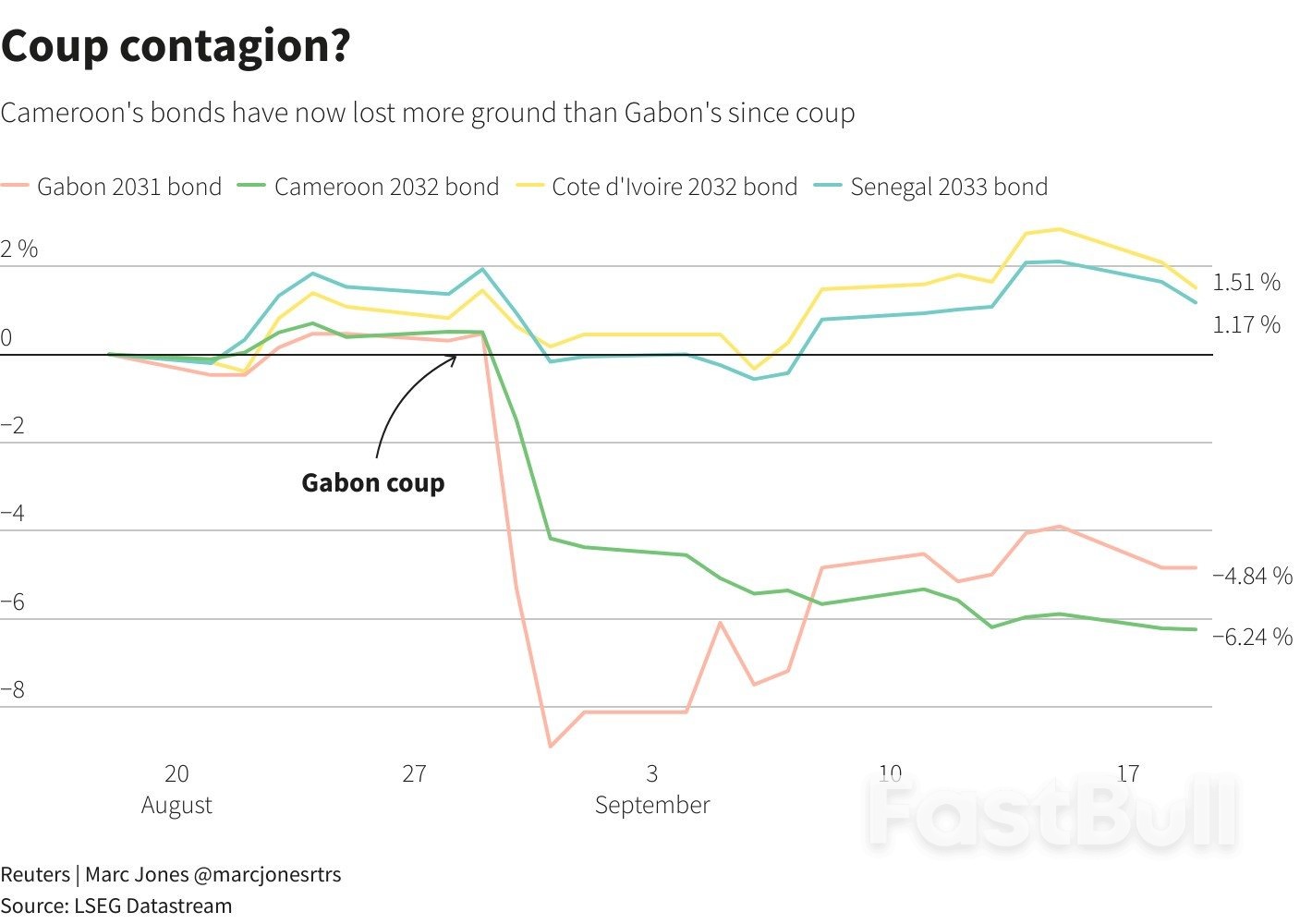
          The putsch not only sent Gabon's bonds tumbling 10%, but also hit those issued by a number of other countries including neighbouring Cameroon, as jittery investors scanned for who might be next.
          The apparent coup trend is adding to other major concerns deterring many investors from Africa - a wave of debt crises, tense geopolitics and an extreme vulnerability to climate change.
          "Nearly all markets in that region are paying some price in terms of rising cost of debt," said Sergey Dergachev, portfolio manager at Union Investment.Counting the Cost of Contagion Fears from Africa Coups_1
          A UNDP study dated July shows how the costs add up. It estimated Guinea's 2008 coup and one in Mali in 2012 wiped a combined $12-$13.5 billion off the two countries' economies over a 5-year period. This represented 76% of Guinea's 2008 gross domestic product and almost half of Mali's 2012 GDP, the study calculated.
          There have been scores of coups and attempted coups in recent decades including in Thailand, Ecuador, Egypt and Turkey.
          Investors in those markets reacted reflexively - sell first, think later.
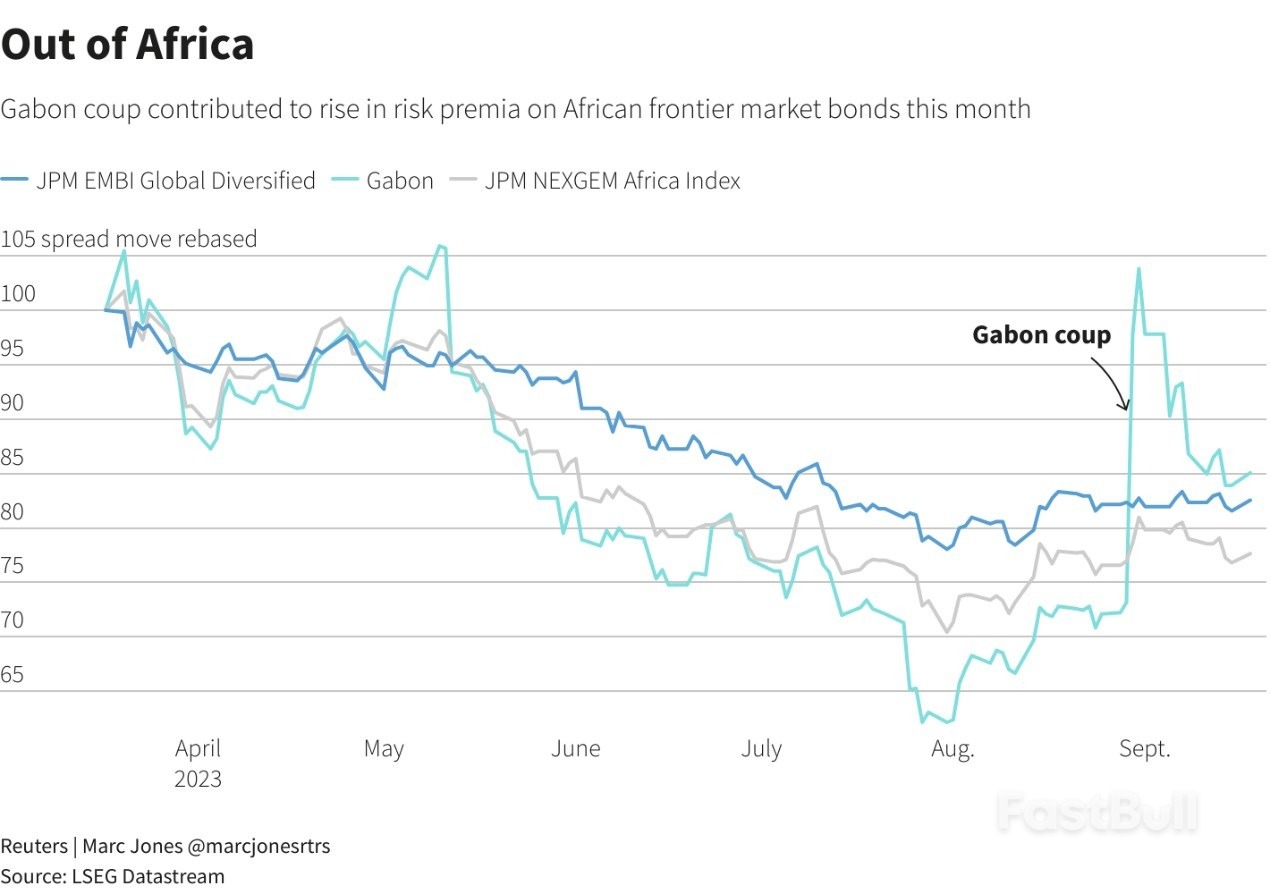
          Gabon's coup not only hurt its bonds, it also ratcheted up the interest rate premium, or 'spread', investors demand to hold bonds in JPMorgan's multi-country "Nexgem" Africa index, a move that has still not fully retraced.
          Cameroon has been particularly sensitive. Its bonds have lost more ground than Gabon's since the coup. The country's President Paul Biya has ruled for over 40 years through crackdowns and contested elections and wants his son to take over.Counting the Cost of Contagion Fears from Africa Coups_2
          In focus too is Senegal, whose President Macky Sall recently ruled out running for a third term after violent unrest, and Congo Republic which had to quash weekend rumours of an overthrow while President Denis Sassou Nguesso - in power for 38 years - was in New York for the U.N. General Assembly.
          Unequal Coups
          "Certainly, there's a lot of eyeballs on this (coup) theme right now," said Eamon Aghdasi, a sovereign analyst at investment firm GMO, who co-authored a recent paper on whether democracy matters to debt investors.
          "As a bondholder, the worst-case scenario is that a new government comes in and repudiates the previous government's debt".
          There is no sign of Gabon's new leaders repudiating debt, though payments on bonds have run into trouble elsewhere, such as Niger.
          Credit ratings usually suffer too. Fitch and Moody's have put Gabon on a downgrade warning since the Aug. 30 overthrow. Agencies slashed ratings for Burkina Faso, Mali and Niger, although further afield, Thailand's never budged despite two coups in the last two decades.
          "Coups, in general, in Africa or anywhere else, can cause problems for debt repayment partly because of the potential for sanctions," S&P Global analyst Ravi Bhatia said, adding that vital international support can also get shelved.Counting the Cost of Contagion Fears from Africa Coups_3
          Rising Costs
          Gabon, where the Bongo family had ruled for nearly 60 years amid stark inequality, has yet to face the kinds of sanctions imposed on Mali, Guinea, Burkina Faso and Niger - although its International Monetary Fund programme was already off track.
          Moody's cited the rise in oil prices in its decision to hold off on a full downgrade, as well as Gabon's membership of the Central African monetary union (CFA franc), which shields it from currency volatility.
          The country's bond spreads have eased somewhat since investors' initial panic and could recover entirely, some analysts say, if it makes its first post-coup bond payment on time next month.
          "You may get a situation where bondholders might say, if it's a change away from long-term single leaderships, then it may well be a turn for the better," said Simon Quijano-Evans, chief economist with Gemcorp. "As long as elections and democracy come back".
          Broadly though, concerns about sovereign stability across Africa loom large. This year's "Fragile States Index" published by non-profit The Fund for Peace rated 46 African countries as at least somewhat unstable.
          Even in Kenya, a solid democracy on the other side of the continent, investors warn that general risk aversion could push up the cost of issuing a new bond.

          Source: SaltWire

          Risk Warnings and Disclaimers
          You understand and acknowledge that there is a high degree of risk involved in trading. Following any strategies or investment methods may lead to potential losses. The content on the site is provided by our contributors and analysts for information purposes only. You are solely responsible for determining whether any trading assets, securities, strategy, or any other product is suitable for investing based on your own investment objectives and financial situation.
          Comments
          Add to Favorites
          Share

          Flurry of Data from Japan and Korea

          Samantha Luan

          Economic

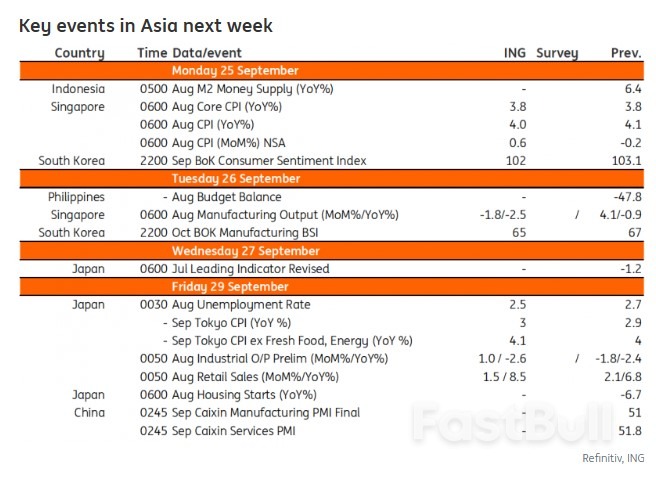
          Flurry of data out from Japan
          In Japan, we think solid consumption and service activity will likely support inflation staying above the 3% range. We believe that core inflation excluding fresh food and energy is expected to accelerate further in September with private service prices rising.
          Meanwhile, thanks to strong activity in services, the jobless rate is expected to edge down in August. Industrial production in Japan will also likely rebound from the previous month's decline mainly due to a pick-up in motor vehicle production.
          Sentiment in Korea likely on the downtrend
          We think both consumer and business sentiment indices in Korea could deteriorate. Business confidence should weaken on the back of sluggish exports and growing uncertainty in the near-term economic outlook. For consumers, weak domestic equity performance and the recent tightening of mortgage measures might have hurt sentiment.
          Singapore inflation to edge lower
          Singapore reports August inflation next week. We expect headline inflation to dip to 3.9% year-on-year, down from 4.1%YoY from the previous month. Favourable base effects and softer growth momentum will likely translate to a dip in CPI inflation. Core inflation will likely be flat at 3.8%YoY.
          Meanwhile, industrial production will likely still be in the red. We could see the tenth consecutive month of contraction for industrial production, tracking the sustained weakness of non-oil domestic exports (NODX). NODX recently posted another month of contraction as global trade grinds lower. Industrial production should stay challenged for as long as NODX is in contraction, with weaker industrial activity seen to weigh on GDP growth.Flurry of Data from Japan and Korea_1

          Source: ING

          To stay updated on all economic events of today, please check out our Economic calendar
          Risk Warnings and Disclaimers
          You understand and acknowledge that there is a high degree of risk involved in trading. Following any strategies or investment methods may lead to potential losses. The content on the site is provided by our contributors and analysts for information purposes only. You are solely responsible for determining whether any trading assets, securities, strategy, or any other product is suitable for investing based on your own investment objectives and financial situation.
          Comments
          Add to Favorites
          Share

          China's Huge Coal Plant Building Has Weird Climate Logic

          Kevin Du

          Economic

          China is building two-thirds of the coal-fired electricity generation capacity currently under construction globally, and this may not be as disastrous for the climate as it sounds.
          The world's largest producer and importer of coal has 136.24 gigawatts (GW) of coal-fired generation under construction, according to data released in July by the Global Energy Monitor.
          This represents 66.7% of the global total of 204.15 GW, and China is streets ahead of second-placed India, with 31.6 GW being built and third-placed Indonesia with 14.5 GW.
          These three countries represent 89% of the coal-fired plants currently under construction, and it's not a coincidence that all of them have large populations, growing energy demand and vast domestic coal reserves.
          China's under-construction coal generation is about 12% of its existing capacity, and adding more coal-fired power would seem incompatible with the stated goal of achieving net-zero carbon emissions by 2060.
          But it's worth looking at China's overall energy demand, including its status as the world's largest importer of crude oil.
          The large coal-fired construction programme can be seen in the wider context of China's rapid shift to electric vehicles and away from internal combustion engine (ICE) cars and trucks.
          Sales of what China terms new energy vehicles (NEVs), which includes fully electric vehicles and types of hybrids, are surging, and accounted for 36.9% of total sales in August, according to data from the China Passenger Car Association.
          A total of 1.94 million passenger vehicles were sold in China in August, the strongest month so far this year, with NEVs accounting for 716,000 of the sales.
          Sales of NEVs have accelerated from under 5% of the total in January 2021, as car makers scaled up production, resulting in lower costs and improved availability.
          It's likely that China will continue to push ahead with the rapid switch to NEVs, given its leadership in mass producing these vehicles and the batteries that power them.
          There is also an economic reason for China to encourage the switch to vehicles powered by electricity as it lessens the reliance on imported crude oil.
          China's imports of crude in the first eight months of 2023 were 11.4 million barrels per day (bpd), which if paid for at the current oil price would cost in the region of $250 billion.
          It makes sense for China to cut its crude imports over time, as this lowers its import bill and reduces its energy reliance on countries such as Saudi Arabia and Russia, which have acted against China's economic interest by tightening oil supply to drive prices higher.
          It makes sense from an economic and geopolitical perspective to power China's vehicle fleet using domestic electricity rather than imported crude oil.
          Coal-Fired Cars
          The question is then whether China can meet its climate goals by switching increasingly to NEVs, which will be powered by a coal-heavy electricity grid for decades to come.
          China used coal for about 63% of its electricity generation in 2022, with hydropower coming in second at 14%, and other renewable energies such as wind generating 9% and solar 5%.
          China is also the world's biggest installer of renewable power sources and is expanding its nuclear fleet as well, but coal is expected to remain the bedrock of electricity production, even as its share of generation gradually decreases.
          But even using a predominantly coal-fired grid to charge NEVs is better from a climate perspective, insofar as an electric vehicle powered by a 60% coal-fired grid will produce lower lifecycle emissions that a similar ICE vehicle.
          A model developed by the U.S. Department of Energy's Argonne National Laboratory shows that in a country with China's power generation profile, a battery electric vehicle will have to drive 78,700 miles (125,900 km) before being cleaner than an ICE equivalent.
          However, the average car will drive about 170,000 miles in its lifespan, meaning that the electric vehicle ends up being better for emissions than the ICE equivalent, even if powered by a predominantly coal-fired grid.
          While it would obviously be better for the environment for China to stop building coal-fired power plants and instead accelerate the deployment of renewables, there is some logic to the current policy.
          Using mainly domestic coal and some relatively low-cost imports will allow China to lower crude oil imports over time, increase the penetration of NEVs and have a lower emissions profile than if it carried on with a predominantly ICE vehicle fleet.

          Source: ET EnergyWorld

          To stay updated on all economic events of today, please check out our Economic calendar
          Risk Warnings and Disclaimers
          You understand and acknowledge that there is a high degree of risk involved in trading. Following any strategies or investment methods may lead to potential losses. The content on the site is provided by our contributors and analysts for information purposes only. You are solely responsible for determining whether any trading assets, securities, strategy, or any other product is suitable for investing based on your own investment objectives and financial situation.
          Comments
          Add to Favorites
          Share

          Indonesia's Rainforest Seen at Risk from 2024 Election Handouts

          Thomas

          Political

          Indonesia's elections next year are likely to spur deforestation as politicians seek campaign funds from businesses in return for easier access to rich natural resources, environmentalists say.
          The Southeast Asian nation, the world's third-largest democracy, will hold a general election on Feb. 14, with regional polls planned for later in 2024.
          "Next year's election is pivotal for Indonesia to determine the fate of the richest and most biodiverse forests in the world," said Annisa Rahmawati, a board member at Indonesian conservation group Satya Bumi.
          She and other experts fear the soaring costs of campaigns - and little oversight of spending - will undercut rainforest protection.
          Ward Berenschot, a professor in comparative political anthropology at the University of Amsterdam, said election campaigns in Indonesia are so expensive that politicians from local to national levels have developed "very close ties" with natural resource companies to help finance their ambitions.
          "Measures to protect forests have been under pressure because helping campaign donors, or sometimes even family companies, to sidestep or circumvent (them) has been a way to fund campaigns," said Berenschot, who has researched the issue.
          Nature-rich Indonesia has a third of the world's rainforests but large areas have been cleared in recent decades due to the expansion of crops like palm oil, as well as mining, pulp and paper expansion, and urbanisation.
          Trees suck up planet-warming carbon dioxide to grow, but release it when they rot or are burned. Land use change, mainly deforestation, accounts for about 10-20% of global greenhouse gas emissions.
          Indonesia's deforestation rates have slowed in recent years - helped by stricter policies and forest fire controls - but the Southeast Asian nation was still ranked fourth globally for primary tropical forest loss in 2022 by the nonprofit World Resources Institute.
          Vote-Buying Widespread Despite Crackdowns
          Vote-buying has become common in Indonesia's national elections over the last 25 years, despite crackdowns by the state corruption watchdog. A 2017 poll estimated that a third of voters are impacted by the practice.
          After the presidential election in 2019, runner-up Prabowo Subianto - now the defence minister - initially refused to accept the result, with his party citing fraud that included vote-buying. The Constitutional Court dismissed his objections.
          With current President Joko Widodo's second and final term due to end, candidates for next year's presidential elections include Prabowo, Central Java governor Ganjar Pranowo and former Jakarta governor Anies Baswedan.
          Key voter issues include jobs, the economy, health care access, the cost of living, corruption, pollution and climate change.
          Conservationists will be hopeful that Widodo's successor will build on the results his government has achieved in tackling deforestation and restoring mangroves, including making permanent a moratorium on primary forest clearing.
          With a growing population of 270 million, Indonesia's elections are becoming increasingly expensive - leading to forests being used as an "ATM" cash dispenser by many parties seeking campaign finance, said Rahmawati of Satya Bumi.
          This practice should stop "because it humiliates and ruins our progress in democracy ... destroying our environment and our economy", she said, adding that electoral candidates should be forced to publish the source of all their campaign funds.
          Marcus Colchester, a senior policy advisor at the UK-based Forest Peoples Programme, said Indonesian politicians are often unwilling to regulate corporations because they depend on them for funds.
          Those links often harm local and Indigenous peoples, whose land is sometimes granted to companies without their consent, he added.
          "(The) double whammy - impunity and graft - becomes the main obstacle to social justice and environmental prudence," Colchester said. "Accountability and democracy are undermined, and natural resource governance made impossible."
          Big Business Rules in Indonesian Politics
          Berenschot at the University of Amsterdam said changes to legislation have often favoured big business. A 2023 decree seeking to boost jobs and investment, for instance, was criticised by green groups as weakening environmental protections.
          "That close connection between business and politics also enabled certain policies and laws ... to be adopted, which risks accelerating deforestation," Berenschot said.
          In addition, Indonesia's major political parties are often led by wealthy individuals and business owners, who may prioritise the economy over issues like the environment.
          Politicians' campaign spending is hard to track and often lacks transparency.
          Ten years ago, an expert survey among 500 local political observers found that a successful candidate for district head spent on average $1.5 million on campaigning, while an elected governor spent about $10 million, he added.
          "For an economy where the minimum wage is about $300 per month, these are very big amounts of money," Berenschot noted.
          After An Election, Forests Face Pressure
          In election years, deforestation rates have slowed but then usually increased the following year, said Toerris Jaeger, director of the Oslo-based NGO Rainforest Foundation Norway.
          "In the past we have seen that before the end of a government period, licences and permits in the forest and peatland area were being given to companies that provided or backed up campaign funding or that were tied into political parties that are running in the election," said Jaeger.
          Failure to tackle the link between elections and deforestation will make it harder for Indonesia to reach its own climate goals related to reducing emissions from deforestation - and lead to more frequent natural disasters, he added.
          "Transparency and accountability are necessary to break the link between deforestation and funding for political campaigns," Jaeger said.

          Source: Devdiscourse

          Risk Warnings and Disclaimers
          You understand and acknowledge that there is a high degree of risk involved in trading. Following any strategies or investment methods may lead to potential losses. The content on the site is provided by our contributors and analysts for information purposes only. You are solely responsible for determining whether any trading assets, securities, strategy, or any other product is suitable for investing based on your own investment objectives and financial situation.
          Comments
          Add to Favorites
          Share

          What India's Inclusion in JPMorgan's Bond Index Means for Its Markets

          Cohen

          Economic

          Bond

          JPMorgan will include Indian government bonds in its Government Bond Index-Emerging Markets (GBI-EM) from June 2024, the Wall Street bank said on Friday.
          The inclusion, a first for the country, could lead to billions of dollars of inflows into local currency-denominated government debt and bring down bond yields, while also providing some support for the rupee.
          However, there is little direct impact expected on the equity markets.
          What prompted the inclusion?
          The Indian government began discussing the inclusion of its securities in global indexes as far back as 2013. However, its restrictions on foreign investments in domestic debt held that back.
          In April 2020, the Reserve Bank of India introduced a clutch of securities that were exempt from any foreign investment restrictions under a "fully accessible route" (FAR), making them eligible for inclusion in global indexes.
          Currently, 23 Indian Government Bonds (IGBs) with a combined notional value of $330 billion are index eligible, JPMorgan said.
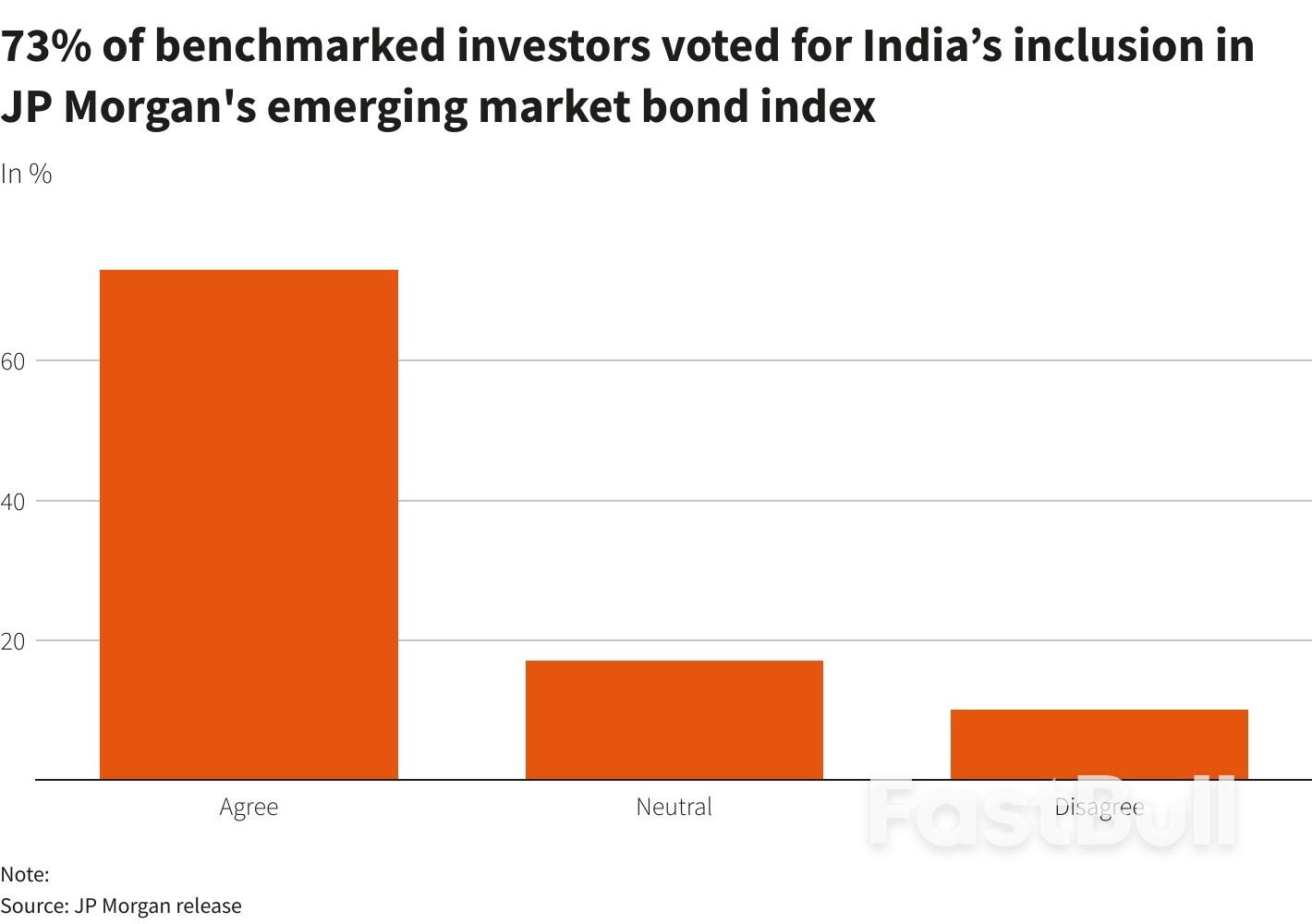
          About 73% of benchmarked investors voted in favour of India's inclusion, it said.What India's Inclusion in JPMorgan's Bond Index Means for Its Markets_1
          How large will the inflows be?
          JPMorgan said Indian bonds will eventually hold a weight of 10% in its index, following 1% additions to its weightage each month from next June.
          The inclusion could result in inflows of close to $24 billion over this 10-month period, analysts estimate.
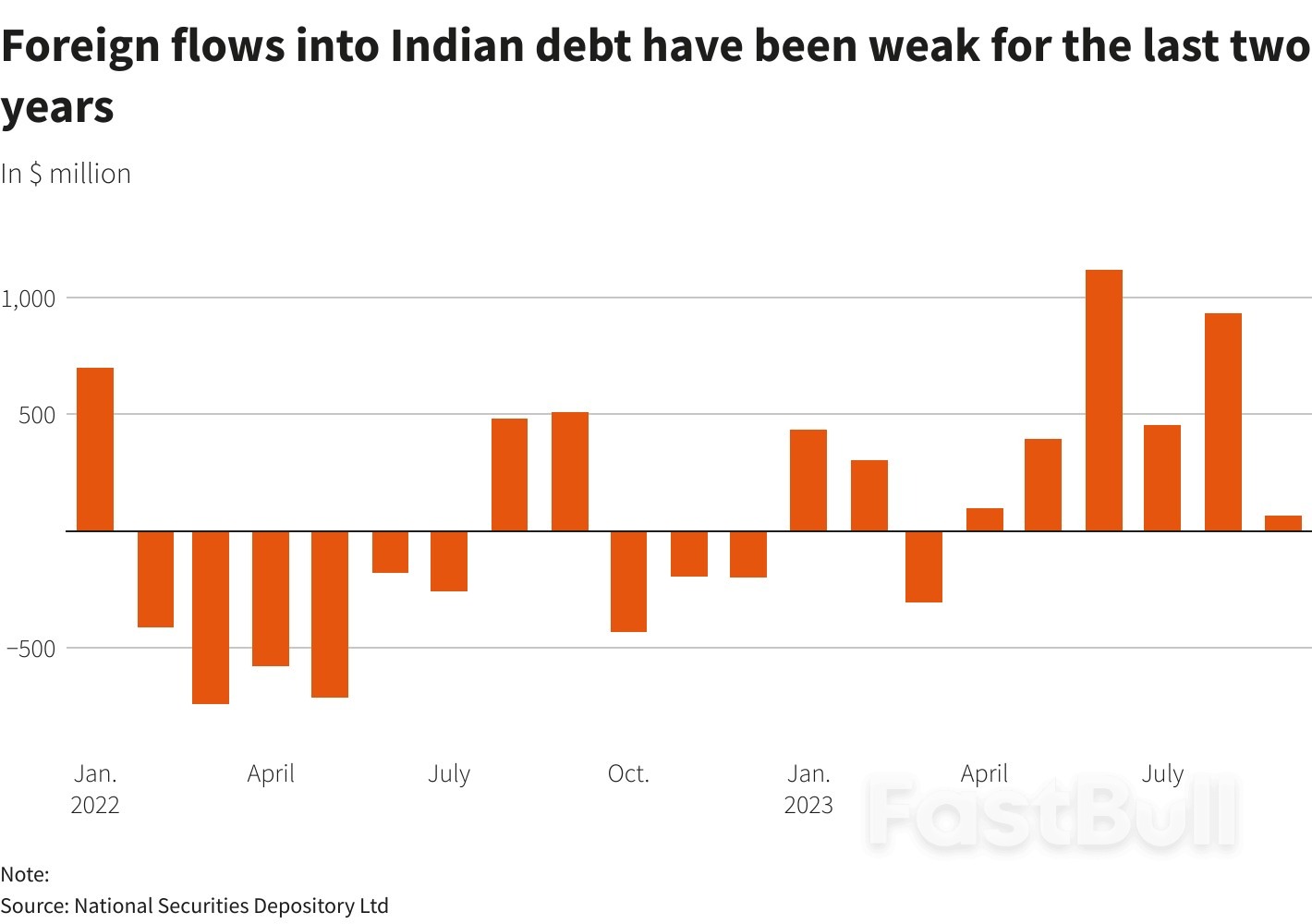
          This is significantly higher than the $3.5 billion invested by foreign investors in Indian debt so far this calendar year.
          Foreign holdings of outstanding bonds could rise to 3.4% by April-May 2025, from 1.7% currently, analysts estimate.
          What India's Inclusion in JPMorgan's Bond Index Means for Its Markets_2What is the impact on bond yields, borrowing costs?
          India's fiscal deficit remains high at a targeted 5.9% of GDP for the year ending March 31, 2024, which will result in the government borrowing a record 15 trillion rupees (about $181 billion).
          So far, banks, insurance companies and mutual funds have been the largest buyers of government debt. An additional source of funds will help cap bond yields and the government's borrowing costs.
          Traders estimate the benchmark bond yield will fall 10-15 basis points to 7% over the next few months.
          Corporate borrowers will also benefit as their borrowing costs are benchmarked to government bonds.
          However, increased foreign flows will also make the bond and currency markets more volatile and could push the government and central bank to intervene more actively.
          What does it mean for the rupee?
          Larger debt inflows from next financial year will make it easier for India to finance its current account deficit and reduce the pressure on the rupee.
          Index inclusion-related inflows of close to $24 billion will cover a material part of India's $81 billion current account deficit, estimated for next financial by IDFC First Bank.
          ($1 = 82.8510 Indian rupees)

          Source: Zee Business

          To stay updated on all economic events of today, please check out our Economic calendar
          Risk Warnings and Disclaimers
          You understand and acknowledge that there is a high degree of risk involved in trading. Following any strategies or investment methods may lead to potential losses. The content on the site is provided by our contributors and analysts for information purposes only. You are solely responsible for determining whether any trading assets, securities, strategy, or any other product is suitable for investing based on your own investment objectives and financial situation.
          Comments
          Add to Favorites
          Share

          Policy Takes Effect, But Global Risks Remain

          Alex

          Central Bank

          Economic

          Key insights from the week that was.]
          The September RBA meeting minutes presented a detailed account of the Board's deliberations and their assessment of risks. In recent months, the Board has stopped describing its considerations for policy – the choice between remaining on hold and a rate hike – as "finely balanced". Rather, it has become increasingly clear that the Board view the case for remaining on hold as the "stronger" argument, in step with their growing confidence in navigating a soft landing. While the Board still conclude that "some further tightening in policy may be required should inflation prove more persistent than expected", the hurdle for the Q3 CPI report or interim Monthly CPI Indicators to raise alarm is high. Westpac remains of the view that the RBA will remain on hold until August 2024 when we see the next rate cutting cycle begin, to restore balance to demand conditions and support growth's return towards trend.
          The Q3 Westpac-ACCI Survey of Industrial Trends demonstrated that the RBA's rapid tightening cycle is having a material impact on Australian industry. At 51.3, the Westpac-ACCI Actual Composite signals conditions are approaching stall speed. Indeed, that new orders growth held flat for a second consecutive quarter and is now the number one concern of manufacturers is consistent with the marked slowing of the Australian economy. Within this context, firms report there is little incentive to grow their workforce or lift their investment intentions despite an easing in labour and material shortages. Overall, the tone of the survey remains broadly downbeat, with expectations for future activity in the sector subdued – adding to the case for the RBA to remain on hold.
          Central bank meetings dominated the news offshore.
          The FOMC kept the fed funds rate at 5.375%; however, the dot plot suggests most members expect the data to justify one last hike before the end of the year. During Q&A, Chair Jerome Powell said 'we need to see more progress' when speaking to why they felt a further hike could be on the cards. On balance, the FOMC expects the upside surprise to growth currently being experienced in 2023 to persist into 2024, the GDP forecast for next year revised up from 1.1% to 1.5%. The unemployment rate is also only expected to lift at the margin from now to end-2024, from 3.8% to 4.1%, while PCE inflation is expected to only slowly trend down to 2.5% at end-2024. Consequently, the FOMC now expects only 50bps of cuts in 2024 from 5.625% at end-2023.
          While they do anticipate a further reduction in inflation and the fed funds rate in 2025 and 2026, it is again expected to be slow going and still leaves the fed funds rate above their longer run estimate of neutral, 2.5%. We see the U.S. economy disappointing the FOMC's expectations in coming months and so anticipate an earlier and larger start to the cutting cycle, pencilling in 100bps of rate cuts in 2024 versus the FOMC's 50bps. However, we also perceive greater inflation risks in the out years and so, at 3.375%, our end-2025 fed funds forecast is also materially above the FOMC's 2.5% 'longer run' figure. In our view, these inflation risks are likely to primarily be structural rather than cyclical, limiting the effectiveness of policy and, at the margin, creating greater risk for activity growth and the labour market. Highlighting this, through 2025, we see the unemployment rate holding around 5.0% and GDP growth remaining below trend.
          Overnight, the Bank of England paused for the first time since they started hiking in 2021 in a divided vote — five voted to remain on hold, while four voted to hike. The pause came as a surprise to economists, but market pricing had drawn much closer to the final result after the last CPI release. In August, annual inflation growth fell to 6.7%yr as the monthly gain only partially made up for July's fall, bringing the three-month average to flat. The contribution from services nudged down to 3.2% — just under half of total CPI. Goods also decelerated further, much to the surprise of the BoE. August was the second month that headline CPI undershot the BoE's forecast of 6.93% for Q3 (July's print was an undershoot at the second decimal place). Higher fuel costs have been observed in inflation prints in U.S. and Europe, but they did not add as much pressure to the headline print for the UK in monthly terms and were a dampening influence in the annual print. Reports suggest this may be a result of a more delayed response to the spike in oil prices. Overall, the percentage of the CPI basket running above the BoE's 2% target has trickled down to 81% over July and August.
          In addition to the weaker-than-expected CPI, the Committee was concerned about the growth outlook following a 0.5%mth decline in GDP in July. This followed other indicators which suggest weaker growth can be expected in the near term. Strong wages growth had seen economists anticipate further hikes. However, while the Average Weekly Earnings figures continue to overshoot the Bank's forecasts, they were characterised as "difficult to reconcile with other indicators of pay growth". The Decision Maker Panel data, frequently referenced by Governor Andrew Bailey, suggests wages growth has been stable at 5%. As such, the Committee will be looking at broader measures of wages ahead.
          The statement noted that the current stance was "restrictive" and that "Further tightening in monetary policy would be required if there were evidence of more persistent inflationary pressures". Before the November meeting, we will get two CPI prints and another wages read which may allay or fuel the hawks' fears. Hawk Sir Jon Cunliffe will also be leaving and BoE internal Sarah Breeden arriving. Breeden has said she will have a more 'balanced' approach to monetary policy.
          Across the Tasman, New Zealand's Q2 GDP rose 0.9%qtr, materially above the market's and RBNZ's expectation but in line with our New Zealand team's view. The technical recession through December and March quarters was also revised away and puts the economy 0.5% larger than the RBNZ expected in August. Given the revisions and Q2 GDP print, we continue to expect the RBNZ to hike once more by year end. The market is also coming to this view, although it is currently priced for this last hike to occur in early-2024.

          Source: Westpac Banking Corporation

          To stay updated on all economic events of today, please check out our Economic calendar
          Risk Warnings and Disclaimers
          You understand and acknowledge that there is a high degree of risk involved in trading. Following any strategies or investment methods may lead to potential losses. The content on the site is provided by our contributors and analysts for information purposes only. You are solely responsible for determining whether any trading assets, securities, strategy, or any other product is suitable for investing based on your own investment objectives and financial situation.
          Comments
          Add to Favorites
          Share
          FastBull
          Copyright © 2025 FastBull Ltd

          728 RM B 7/F GEE LOK IND BLDG NO 34 HUNG TO RD KWUN TONG KLN HONG KONG

          TelegramInstagramTwitterfacebooklinkedin
          App Store Google Play Google Play
          Products
          Charts

          Chats

          Q&A with Experts
          Screeners
          Economic Calendar
          Data
          Tools
          Membership
          Features
          Function
          Markets
          Copy Trading
          Latest Signals
          Contests
          News
          Analysis
          24/7
          Columns
          Education
          Company
          Careers
          About Us
          Contact Us
          Advertising
          Help Center
          Feedback
          User Agreement
          Privacy Policy
          Business

          White Label

          Data API

          Web Plug-ins

          Poster Maker

          Affiliate Program

          Risk Disclosure

          The risk of loss in trading financial instruments such as stocks, FX, commodities, futures, bonds, ETFs and crypto can be substantial. You may sustain a total loss of the funds that you deposit with your broker. Therefore, you should carefully consider whether such trading is suitable for you in light of your circumstances and financial resources.

          No decision to invest should be made without thoroughly conducting due diligence by yourself or consulting with your financial advisors. Our web content might not suit you since we don't know your financial conditions and investment needs. Our financial information might have latency or contain inaccuracy, so you should be fully responsible for any of your trading and investment decisions. The company will not be responsible for your capital loss.

          Without getting permission from the website, you are not allowed to copy the website's graphics, texts, or trademarks. Intellectual property rights in the content or data incorporated into this website belong to its providers and exchange merchants.

          Not Logged In

          Log in to access more features

          FastBull Membership

          Not yet

          Purchase

          Become a signal provider
          Help Center
          Customer Service
          Dark Mode
          Price Up/Down Colors

          Log In

          Sign Up
          Position
          Layout
          Fullscreen
          Default to Chart
          The chart page opens by default when you visit fastbull.com