• Trade
  • Markets
  • Copy
  • Contests
  • News
  • 24/7
  • Calendar
  • Q&A
  • Chats
Trending
Screeners
SYMBOL
LAST
BID
ASK
HIGH
LOW
NET CHG.
%CHG.
SPREAD
SPX
S&P 500 Index
6846.50
6846.50
6846.50
6878.28
6827.18
-23.90
-0.35%
--
DJI
Dow Jones Industrial Average
47739.31
47739.31
47739.31
47971.51
47611.93
-215.67
-0.45%
--
IXIC
NASDAQ Composite Index
23545.89
23545.89
23545.89
23698.93
23455.05
-32.22
-0.14%
--
USDX
US Dollar Index
99.000
99.080
99.000
99.000
99.000
+0.050
+ 0.05%
--
EURUSD
Euro / US Dollar
1.16369
1.16376
1.16369
1.16388
1.16322
+0.00005
0.00%
--
GBPUSD
Pound Sterling / US Dollar
1.33212
1.33223
1.33212
1.33220
1.33140
+0.00007
+ 0.01%
--
XAUUSD
Gold / US Dollar
4191.60
4192.04
4191.60
4193.27
4189.64
+1.90
+ 0.05%
--
WTI
Light Sweet Crude Oil
58.660
58.702
58.660
58.676
58.543
+0.105
+ 0.18%
--

Community Accounts

Signal Accounts
--
Profit Accounts
--
Loss Accounts
--
View More

Become a signal provider

Sell trading signals to earn additional income

View More

Guide to Copy Trading

Get started with ease and confidence

View More

Signal Accounts for Members

All Signal Accounts

Best Return
  • Best Return
  • Best P/L
  • Best MDD
Past 1W
  • Past 1W
  • Past 1M
  • Past 1Y

All Contests

  • All
  • Trump Updates
  • Recommend
  • Stocks
  • Cryptocurrencies
  • Central Banks
  • Featured News
Top News Only
Share

Japan Prime Minister Takaichi: 30 Injuries Reported So Far From Monday Earthquake

Share

USA Senate Committee Votes To Advance Nomination Of Jared Isaacman To Head Nasa

Share

Singapore Post - New Rate For Standard Regular Mail & Standard Large Mail Will Be S$0.62 And S$0.90 Respectively

Share

Australia's S&P/ASX 200 Index Down 0.27% At 8601.10 Points In Early Trade

Share

Trump: The USA Needs Mexico To Release 200000 Acre-Feet Of Water Before December 31St, And The Rest Must Come Soon After

Share

Trump: I Have Authorized Documentation To Impose A 5% Tariff On Mexico If This Water Isn't Released

Share

Brazil's Sao Paulo State Governor Tarcisio De Freitas Says Flavio Bolsonaro Will Have His Support - Cnn Brasil

Share

Ukraine's Security Must Be Guaranteed, In The Long Term, As A First Line Of Defence For Our Union, Says European Commission President

Share

Ukraine's Sovereignty Must Be Respected, Says European Commission President

Share

The Goal Is A Strong Ukraine, On The Battlefield And At The Negotiating Table, Says European Commission President

Share

As Peace Talks Are Ongoing, The EU Remains Ironclad In Its Support For Ukraine, Says European Commission President

Share

Pepsico: Asking USA-Based Pepna Employees As Well As Pbus Division Offices And Pfus Region Offices To Work Remotely This Week

Share

A U.S. Judge Ruled That President Trump’s Ban On Several Wind Power Projects Was Illegal

Share

Senior USA Administration Official: We Continue To Monitor Drc-Rwanda Situation Closely, Continue To Work With All Sides To Ensure Commitments Are Honored

Share

Israeli Military Says It Has Struck Infrastructure Belonging To Hezbollah In Several Areas In Southern Lebanon

Share

SPDR Gold Holdings Down 0.11%, Or 1.14 Tonnes

Share

On Monday (December 8), In Late New York Trading, S&P 500 Futures Fell 0.21%, Dow Jones Futures Fell 0.43%, NASDAQ 100 Futures Fell 0.08%, And Russell 2000 Futures Fell 0.04%

Share

Morgan Stanley: Data Center ABS Spreads Are Expected To Widen In 2026

Share

(US Stocks) The Philadelphia Gold And Silver Index Closed Down 2.34% At 311.01 Points. (Global Session) The NYSE Arca Gold Miners Index Closed Down 2.17%, Hitting A Daily Low Of 2235.45 Points; US Stocks Remained Slightly Down Before The Opening Bell—holding Steady Around 2280 Points—before Briefly Rising Slightly

Share

IMF: IMF Executive Board Approves Extension Of The Extended Credit Facility Arrangement With Nepal

TIME
ACT
FCST
PREV
France Trade Balance (SA) (Oct)

A:--

F: --

P: --
Euro Zone Employment YoY (SA) (Q3)

A:--

F: --

P: --
Canada Part-Time Employment (SA) (Nov)

A:--

F: --

P: --

Canada Unemployment Rate (SA) (Nov)

A:--

F: --

P: --

Canada Full-time Employment (SA) (Nov)

A:--

F: --

P: --

Canada Labor Force Participation Rate (SA) (Nov)

A:--

F: --

P: --

Canada Employment (SA) (Nov)

A:--

F: --

P: --

U.S. PCE Price Index MoM (Sept)

A:--

F: --

P: --

U.S. Personal Income MoM (Sept)

A:--

F: --

P: --

U.S. Core PCE Price Index MoM (Sept)

A:--

F: --

P: --

U.S. PCE Price Index YoY (SA) (Sept)

A:--

F: --

P: --

U.S. Core PCE Price Index YoY (Sept)

A:--

F: --

P: --

U.S. Personal Outlays MoM (SA) (Sept)

A:--

F: --

P: --
U.S. 5-10 Year-Ahead Inflation Expectations (Dec)

A:--

F: --

P: --

U.S. Real Personal Consumption Expenditures MoM (Sept)

A:--

F: --

P: --
U.S. Weekly Total Rig Count

A:--

F: --

P: --

U.S. Weekly Total Oil Rig Count

A:--

F: --

P: --

U.S. Consumer Credit (SA) (Oct)

A:--

F: --

P: --
China, Mainland Foreign Exchange Reserves (Nov)

A:--

F: --

P: --

Japan Trade Balance (Oct)

A:--

F: --

P: --

Japan Nominal GDP Revised QoQ (Q3)

A:--

F: --

P: --

China, Mainland Imports YoY (CNH) (Nov)

A:--

F: --

P: --

China, Mainland Exports (Nov)

A:--

F: --

P: --

China, Mainland Imports (CNH) (Nov)

A:--

F: --

P: --

China, Mainland Trade Balance (CNH) (Nov)

A:--

F: --

P: --

China, Mainland Exports YoY (USD) (Nov)

A:--

F: --

P: --

China, Mainland Imports YoY (USD) (Nov)

A:--

F: --

P: --

Germany Industrial Output MoM (SA) (Oct)

A:--

F: --

P: --
Euro Zone Sentix Investor Confidence Index (Dec)

A:--

F: --

P: --

Canada National Economic Confidence Index

A:--

F: --

P: --

U.K. BRC Like-For-Like Retail Sales YoY (Nov)

--

F: --

P: --

U.K. BRC Overall Retail Sales YoY (Nov)

--

F: --

P: --

Australia Overnight (Borrowing) Key Rate

--

F: --

P: --

RBA Rate Statement
RBA Press Conference
Germany Exports MoM (SA) (Oct)

--

F: --

P: --

U.S. NFIB Small Business Optimism Index (SA) (Nov)

--

F: --

P: --

Mexico 12-Month Inflation (CPI) (Nov)

--

F: --

P: --

Mexico Core CPI YoY (Nov)

--

F: --

P: --

Mexico PPI YoY (Nov)

--

F: --

P: --

U.S. Weekly Redbook Index YoY

--

F: --

P: --

U.S. JOLTS Job Openings (SA) (Oct)

--

F: --

P: --

China, Mainland M1 Money Supply YoY (Nov)

--

F: --

P: --

China, Mainland M0 Money Supply YoY (Nov)

--

F: --

P: --

China, Mainland M2 Money Supply YoY (Nov)

--

F: --

P: --

U.S. EIA Short-Term Crude Production Forecast For The Year (Dec)

--

F: --

P: --

U.S. EIA Natural Gas Production Forecast For The Next Year (Dec)

--

F: --

P: --

U.S. EIA Short-Term Crude Production Forecast For The Next Year (Dec)

--

F: --

P: --

EIA Monthly Short-Term Energy Outlook
U.S. API Weekly Gasoline Stocks

--

F: --

P: --

U.S. API Weekly Cushing Crude Oil Stocks

--

F: --

P: --

U.S. API Weekly Crude Oil Stocks

--

F: --

P: --

U.S. API Weekly Refined Oil Stocks

--

F: --

P: --

South Korea Unemployment Rate (SA) (Nov)

--

F: --

P: --

Japan Reuters Tankan Non-Manufacturers Index (Dec)

--

F: --

P: --

Japan Reuters Tankan Manufacturers Index (Dec)

--

F: --

P: --

Japan Domestic Enterprise Commodity Price Index MoM (Nov)

--

F: --

P: --

Japan Domestic Enterprise Commodity Price Index YoY (Nov)

--

F: --

P: --

China, Mainland PPI YoY (Nov)

--

F: --

P: --

China, Mainland CPI MoM (Nov)

--

F: --

P: --

Italy Industrial Output YoY (SA) (Oct)

--

F: --

P: --

Q&A with Experts
    • All
    • Chatrooms
    • Groups
    • Friends
    Connecting
    .
    .
    .
    Type here...
    Add Symbol or Code

      No matching data

      All
      Trump Updates
      Recommend
      Stocks
      Cryptocurrencies
      Central Banks
      Featured News
      • All
      • Russia-Ukraine Conflict
      • Middle East Flashpoint
      • All
      • Russia-Ukraine Conflict
      • Middle East Flashpoint
      Search
      Products

      Charts Free Forever

      Chats Q&A with Experts
      Screeners Economic Calendar Data Tools
      Membership Features
      Data Warehouse Market Trends Institutional Data Policy Rates Macro

      Market Trends

      Market Sentiment Order Book Forex Correlations

      Top Indicators

      Charts Free Forever
      Markets

      News

      News Analysis 24/7 Columns Education
      From Institutions From Analysts
      Topics Columnists

      Latest Views

      Latest Views

      Trending Topics

      Top Columnists

      Latest Update

      Signals

      Copy Rankings Latest Signals Become a signal provider AI Rating
      Contests
      Brokers

      Overview Brokers Assessment Rankings Regulators News Claims
      Broker listing Forex Brokers Comparison Tool Live Spread Comparison Scam
      Q&A Complaint Scam Alert Videos Tips to Detect Scam
      More

      Business
      Events
      Careers About Us Advertising Help Center

      White Label

      Data API

      Web Plug-ins

      Affiliate Program

      Awards Institution Evaluation IB Seminar Salon Event Exhibition
      Vietnam Thailand Singapore Dubai
      Fans Party Investment Sharing Session
      FastBull Summit BrokersView Expo
      Recent Searches
        Top Searches
          Markets
          News
          Analysis
          User
          24/7
          Economic Calendar
          Education
          Data
          • Names
          • Latest
          • Prev

          View All

          No data

          Scan to Download

          Faster Charts, Chat Faster!

          Download App
          English
          • English
          • Español
          • العربية
          • Bahasa Indonesia
          • Bahasa Melayu
          • Tiếng Việt
          • ภาษาไทย
          • Français
          • Italiano
          • Türkçe
          • Русский язык
          • 简中
          • 繁中
          Open Account
          Search
          Products
          Charts Free Forever
          Markets
          News
          Signals

          Copy Rankings Latest Signals Become a signal provider AI Rating
          Contests
          Brokers

          Overview Brokers Assessment Rankings Regulators News Claims
          Broker listing Forex Brokers Comparison Tool Live Spread Comparison Scam
          Q&A Complaint Scam Alert Videos Tips to Detect Scam
          More

          Business
          Events
          Careers About Us Advertising Help Center

          White Label

          Data API

          Web Plug-ins

          Affiliate Program

          Awards Institution Evaluation IB Seminar Salon Event Exhibition
          Vietnam Thailand Singapore Dubai
          Fans Party Investment Sharing Session
          FastBull Summit BrokersView Expo

          Bond Traders Step Up Short Bets on Fear the Fed Will Dash Rate-Cut Hopes

          Samantha Luan

          Economic

          Bond

          Central Bank

          Summary:

          Bond traders are stepping up short bets against Treasuries and buying derivatives to protect against a selloff, positioning for the risk that the Federal Reserve will dial back the market’s expectations for interest-rate cuts this year.

          While the US central bank is all but certain to hold rates steady Wednesday, trading data points to growing concern that its new forecasts will show increased reticence to ease monetary policy.
          The December forecasts showed policymakers were penciling in three quarter-point cuts in 2024, but since then the economy has continued to exhibit surprising strength and inflation has held above the Fed’s target.
          “The bond market is bracing for a hawkish Fed message Wednesday,” Bryce Doty, senior portfolio manager at Sit Investment Associates, said in a note to clients.
          Bond yields have risen this year, saddling investors with fresh losses, as expectations faded that the Fed would ease policy sharply. In late December, futures traders were pricing in virtual certainty the central bank would start cutting rates by Wednesday’s meeting and make a total of about six such moves by the year’s end.
          Traders have since reassessed the outlook and are expecting roughly three rate reductions in 2024, putting them in line with the Fed’s so-called dot-plot forecasts from December. But there’s a possibility the latest release will show policymakers expect even fewer cuts, potentially triggering another round of selling.
          Tom Simons, a senior economist with Jefferies, said he expects the median policymakers’ forecast will peg the benchmark rate at about 4.88% by the end of the year, implying just two quarter-point cuts. He said that would address some of the easing of financial conditions this year, evidenced by the rally in the stock market.
          “If the Fed were to keep rate forecasts unchanged, they would risk another renewed push to even easier financial conditions that would work against their effort to get inflation back down to 2%,” he said in a note to clients.
          Speculation that rates will come down later this year continues to be widespread, however, and there remain some signs of bullishness in the Treasury market. JPMorgan Chase & Co.’s latest client survey, for example, showed that while short bets have increased, outright long positions have risen as well and now stand at the biggest since Jan. 29.
          But on Monday, two-year Treasury yields hit the highest levels of the year, rising to as much as 4.75%, though they dropped slightly on Tuesday. Bank of America Corp.’s head of interest-rate strategy, Mark Cabana, Tuesday estimated that the two-year yield would rise another 10 basis points if the Fed’s new dot-plot shows just two cuts this year.
          The options market has shown investors positioning for such risks. On Monday, there was a big increase in open interest in two-year note futures, consistent with new short positions being set, as well as a large purchase of five-year note options anticipating the cash yield will rise to 4.45% by Friday. It was around 4.3% Tuesday.
          Traders have also been targeting protection against a hawkish shift with options linked to the Secured Overnight Financing Rate, which closely tracks the central bank’s policy path. Further out on the curve in Treasury options, there’s also been activity hedging for higher yields.
          New Shorts, Longs Unwound
          Open interest data over the past week has shown a heavy amount of new short positions added in 10-year note futures, particularly on March 13, when around $3 million per basis point in risk was added. The day before a large amount of long positions appeared to be liquidated into the selloff in the futures. Overall net change in open interest on 10-year note futures last week was roughly +43,000 contracts.
          Out of Cash Neutrals
          JPMorgan’s latest survey of Treasury clients released Tuesday is more mixed. It shows neutral positions dropping as both long and short positions rose in the week up to March 18. Moreover, the outright long positions are now the biggest since Jan. 29.
          Bearish Skew Extends
          Into last week’s back-up in Treasury yields, the cost of protection against a bigger selloff rose to the most expensive since the end of February in long-bond futures. In Treasury options, flows have reflected increased demand for protection on higher yields, with a recent stand-out trade including a weekly option targeting a rise in 5-year yields to 4.45% by Friday. Tuesday’s release of open interest data showed this position as new risk.
          Asset Manager De-Leveraging
          CFTC data in the week up to March 12 showed roughly 183,000 10-year note futures-equivalents of asset manager net-long liquidation, continuing the recent de-leveraging trend out of Treasury futures and potentially into credit. Asset manager net long positioning in Treasury futures is now at its lowest since July, shown by 10-year note futures equivalents.
          Basis Trade Is Seen Dwindling as Asset Managers Pivot to Credit.
          SOFR Options Most Active
          The largest three strikes which saw open interest gains benefitted from a large SOFR Jun24 94.9375/94.875/94.8125/94.75 put condor buyer over the past week, a position which stands to benefit from rate-cut pricing coming out of the June policy meeting. There was also demand over the past week for SOFR Jun24 94.875/94.9375/95.00/95.0625 call condor’s. Largest liquidation was seen in the 95.50 strike, supported by last week’s strike adjustment within a SOFR Dec24 structure.
          SOFR Options Heat-Map
          The most populated SOFR options strike out to the Dec24 tenor is the 95.50 strike, despite a heavy amount of liquidation seen over the past week. Within the 4.5% strike, a large amount of Jun24 puts remain. Other populated strikes include the 95.00, 95.25 and 94.875 where a decent amount of Jun24 puts open interest also remains.

          Source: Bloomberg

          To stay updated on all economic events of today, please check out our Economic calendar
          Risk Warnings and Disclaimers
          You understand and acknowledge that there is a high degree of risk involved in trading. Following any strategies or investment methods may lead to potential losses. The content on the site is provided by our contributors and analysts for information purposes only. You are solely responsible for determining whether any trading assets, securities, strategy, or any other product is suitable for investing based on your own investment objectives and financial situation.
          Add to Favorites
          Share

          Investors Are About to Find Out Whether Fed Still Expects 3 Rate Cuts in 2024

          Kevin Du

          Economic

          Central Bank

          That new projection on Wednesday will come in the form of a so-called "dot plot," a chart updated quarterly that shows the prediction of each Fed official about the direction of the federal funds rate.
          In December, the dot plot revealed a consensus among Fed officials for three cuts for 2024, the first sign that the central bank was prepared to start loosening monetary policy.
          Now that projection is in question following a string of hotter-than-expected inflation readings and cautious commentary from Fed officials.
          "This does leave a degree of uncertainty as to when they cut first and what they’ll do on the dot plot," said Wil Stith, bond portfolio manager for Wilmington Trust. "Will they leave it at three cuts or will they change that?"
          Fed Chair Jay Powell and his colleagues have been emphasizing for months that they want to be sure inflation is moving "sustainably" down to their 2% target before starting cuts. They are widely expected to hold the Fed’s benchmark rate steady at this week’s Federal Open Market Committee meeting, leaving it at a 23-year high.
          Investors have been adjusting their bets on when those cuts could start. After beginning the year predicting six cuts starting in March, they now expect three starting in June. Even the odds of a June cut have been falling in recent weeks. After June, the Fed only has four more meetings in 2024.
          Investors Are About to Find Out Whether Fed Still Expects 3 Rate Cuts in 2024_1
          "If anything, the [Fed's] message hasn't really changed," Charles Schwab's Kevin Gordon told Yahoo Finance Live last week. "It's really been the market that's been jumping around in terms of when it expects rate cuts to start and how many you're going to get this year."
          Two former Fed officials who used to take part in such deliberations — Esther George and Jim Bullard — told Yahoo Finance they are not expecting predictions to change significantly this week.
          "Maybe you'll see some more people say fewer cuts than they had before," said George, the former president of the Kansas City Fed. But it’s unclear whether that’s enough to change the median of three cuts for the year, she added.
          Bullard, the former St Louis Fed president, said that "unless you think you've seen really dramatically different data, you usually don't change your forecast all that much."
          In fact, Bullard said there is enough data to support cuts right now, and he doesn’t think the hotter inflation readings from the Consumer Price Index recently are enough to change the outlook for 2024.
          He instead pointed to the Fed’s favored inflation gauge, the core Personal Consumption Expenditures index, which was 2.8% as of January and could drop to 2% by the third quarter.
          The Fed could make its first cut, he said, once that reading gets to a range of 2.5%-2.7%.
          "I always felt like there was an implicit zone for the committee [for core PCE] of 1.5% to 2.5%," said Bullard, who is now dean of the Mitchell Daniels School of Business at Purdue University, while also admitting "it's tough to move if the inflation data is kind of zigging or zagging in the wrong direction."
          A few market observers say the recent readings suggest that zero cuts are now a possibility for 2024, while some are urging the Fed to wait past June before making any moves.
          Wilmington Trust's Stith predicted Fed officials will keep their consensus for three cuts in 2024, but he doesn’t expect those cuts to begin until late summer.
          "And if they do get rates down to 4.75%, given financial conditions, is that really going to result in a 2% sustainable inflation level or not?" he said. "I think that's sort of in the back of the market's mind given all the strength we’re seeing."
          Powell said two weeks ago in semi-annual testimony before the Senate that the Fed is "not far" from the confidence it needs to cut rates, while some of his colleagues have suggested over the last month that it could happen "later this year" or during the summer.
          For the Fed to cut rates, officials will need to see certain components of inflation — like housing and services — come down to gain confirmation that inflation is returning to 2%, according to George.
          "This committee has been pretty clear given what happened where inflation got out from under them and they thought it would be transitory that now they are quite determined to restore their credibility and get back to 2%," she said.

          Source: Yahoo Finance

          To stay updated on all economic events of today, please check out our Economic calendar
          Risk Warnings and Disclaimers
          You understand and acknowledge that there is a high degree of risk involved in trading. Following any strategies or investment methods may lead to potential losses. The content on the site is provided by our contributors and analysts for information purposes only. You are solely responsible for determining whether any trading assets, securities, strategy, or any other product is suitable for investing based on your own investment objectives and financial situation.
          Add to Favorites
          Share

          How the Bank of Japan's Plan for A Smooth Stimulus Exit Stumbled

          Thomas

          Economic

          Central Bank

          The Bank of Japan's strategy for an orderly exit from years of massive stimulus unraveled on an overcast day in December when Governor Kazuo Ueda and two deputies gathered at the bank's Tokyo headquarters.
          Inflation was slowing more than expected, complicating the central bank's plan to end negative interest rates by March or April and then follow quickly with further increases. The officials considered two alternatives.
          The first option was to wait for signs of economic improvement and then go ahead as planned. The second was to end negative rates but hold off on subsequent increases.
          Ultimately, the MIT-trained Ueda went with the second option, allowing Japan to shed its title as the last country with negative interest rates but leaving it short of its hoped-for normalisation and still facing years of near-zero rates that pressure the hard-hit yen.
          "With the economy lacking momentum, there was a growing feeling within the BOJ that inflation might not stay around 2% that long," said one person familiar with the deliberations, referring to the bank's key target.
          "The BOJ leadership probably realised that time was running short, if they wanted to end negative rates."
          The decision was also complicated by differences between Ueda's two deputies, as well as the governor's wavering on the exit timing. The existence of the two plans, and other details about the deliberations, are reported for the first time by Reuters.
          This account is based on interviews with 25 incumbent and former central bank officials with direct knowledge of the interactions, or familiar with the personalities and dynamics of the bank's leaders, as well as five government officials in regular contact with BOJ officials.
          They all spoke on the condition of anonymity as they were not authorised to discuss the matters publicly.
          A BOJ spokesperson said the bank would not comment on the deliberations outlined by Reuters.
          Reuters also spoke to five small-business owners to gauge how the policy shift could unfold across an economy battered by decline and deflation.
          On Tuesday, the BOJ drew the curtain on eight years of negative rates and other remnants of unorthodox policy, delivering its first increase in borrowing costs since 2007.
          "It's a watershed moment for Japan and for central banks across the world, as it finally puts an end to abnormal monetary stimulus," said former BOJ official Nobuyasu Atago.
          Still, he said, it could take several years for short-term rates to move up to even 1%.

          Local Tremors

          Even a slight rise in interest rates could send tremors through struggling local economies in Japan, reflecting how deflation and a diminishing population have squeezed demand.
          "The prospect of higher interest rates has become a significant concern for traditional inns," said Koji Ishida, who runs a hotel company and heads the local tourism association in Yugawara, a hot-spring resort southwest of Tokyo known for its ryokan, or traditional inns.
          In autumn, Ishida received a frantic call from the family that owns one of the town's most storied ryokan, saying it was nearing collapse and asking for help.
          "As neighbours, we needed to help them," Ishida said. He worried the failure of a prominent ryokan could tarnish the image of tourism-dependent Yugawara and trigger "a chain reaction of bankruptcies".
          Seiranso, a 94-year-old ryokan known for its mountainside outdoor bath at the foot of a waterfall, last month filed for bankruptcy protection with around 850 million yen ($5.7 million) in debt, including pandemic loans.
          Under those proceedings, it aims to turn itself around with backing from Ishida's company, according to its website. A lawyer for Seiranso declined to comment.
          Almost one-third of ryokan lost money in the last financial year, according to data from the Japan Ryokan and Hotel Association, an industry group.
          "The industry needs zero-interest rates," said Masanori Numao, whose family runs a ryokan in Kinugawa Onsen, a hot-spring resort in Nikko National Park, where their roots go back more than 300 years.
          Forty years ago, Kinugawa was thriving; after sunset there were "beautiful geisha", the clatter of wooden geta clogs and laughter from karaoke bars that lined the narrow streets, Numao said.
          Today, tourists sometimes photograph derelict hotels abandoned after the bubble economy burst in the early 1990s.
          Ryokan owners struggle to renovate ageing buildings because banks are unwilling to lend them more, making it difficult to attract tourists, Numao said.
          Higher interest rates would increase pressure on hot-spring towns like Kinugawa, he said. "The government is just watching resort towns drown."

          Policy Differences

          In taking over the BOJ last April, Ueda was mandated to dismantle the radical stimulus of his predecessor, Haruhiko Kuroda.
          Kuroda's "bazooka" approach initially helped boost stock prices. But it crushed bank margins and caused unwelcome yen declines that lawmakers feared could hurt voters through rising living costs.
          Ueda and his deputies were unanimous on the need for an exit, but not on the timing.
          Choosing the second option mended, at least momentarily, the quiet tension between the two deputy governors, career central banker Shinichi Uchida and former bank regulator Ryozo Himino.
          Ueda, Uchida and Himino did not respond to Reuters questions.
          Uchida was cautious about ending negative rates too hastily, believing that the BOJ should allow the economy to run hot by keeping ultra-low rates for a prolonged period.
          By contrast, Himino favoured an early exit from what he saw as excessive monetary support that could sow the seeds of a future bubble.
          As an outsider, Himino wasn't afraid to challenge some of the bank's traditions.
          At one informal meeting late last year, he complained about the BOJ's management style and suggested changes, ruffling feathers among some officials within the institution, according to two people with knowledge of the matter.
          Throughout the discussions, Ueda would listen silently and rarely spoke up. People who know him say the governor was neither a hawk nor a dove.
          Having studied under former Federal Reserve vice chairman Stanley Fischer, who also taught former central bankers Ben Bernanke and Mario Draghi, Ueda combined faith in economic models and a sense of pragmatism.
          However, he was not quick to make decisions, opting to analyse various options thoroughly until the last minute.
          "He's a pure academic who's great at comparing data and strategies," said a person who has known Ueda for decades. "But making quick, decisive decisions isn't his strength."
          While the two deputies rarely exhibited differences in public, it was usually Uchida who prevailed. Ueda relied heavily on Uchida's expertise on the technical aspects of the bank's monetary tools.
          How the Bank of Japan's Plan for A Smooth Stimulus Exit Stumbled_1Uchida was also the main interlocutor with officials from Prime Minister Fumio Kishida's government, sounding out their views on monetary policy and laying the groundwork for an exit.
          Kishida's administration had been nudging the BOJ to phase out stimulus in hope it would slow declines in the yen that were hurting households through higher food and fuel costs.
          "The government hopes the BOJ conducts monetary policy appropriately towards sustainably and stably achieving its price target accompanied by wage increases, with an eye on economic, price and financial developments," a spokesperson for the prime minister's office told Reuters.
          Once there was consensus the BOJ would go with the second option, Uchida proceeded with the next step of preparing markets.
          In a speech in Nara in February, Uchida hinted at what a post-negative rate monetary policy would look like.
          Tuesday's policy shift roughly aligned with those clues.
          Ueda's choice of the second option means the BOJ will keep rates at zero for a prolonged period, delaying Japan's return to normal borrowing costs, said five of the sources familiar with the bank's thinking. It will likely take years to reduce the bank's balance sheet, which had ballooned after heavy asset-buying, three analysts told Reuters.
          There is near-consensus among BOJ watchers that the bank will move very gradually, and allow short-term rates to rise to around 0.5% over several years.
          "Given Mr. Ueda's very cautious character and his focus on building consensus within the board, he will likely take plenty of time and proceed carefully in normalising policy," said former BOJ economist Hideo Hayakawa.

          ($1 = 148.3800 yen)

          Source: Reuters

          To stay updated on all economic events of today, please check out our Economic calendar
          Risk Warnings and Disclaimers
          You understand and acknowledge that there is a high degree of risk involved in trading. Following any strategies or investment methods may lead to potential losses. The content on the site is provided by our contributors and analysts for information purposes only. You are solely responsible for determining whether any trading assets, securities, strategy, or any other product is suitable for investing based on your own investment objectives and financial situation.
          Add to Favorites
          Share

          A Housing Market Rebound May Finally Be Underway

          Devin

          Economic

          Housing market activity has been muted over the last several years due to high mortgage rates and home prices, as well as limited inventory.
          Yet the latest batch of economic data suggests the landscape may be starting to shift and more housing options are becoming available for buyers.
          In February, housing starts climbed 10.7% month-over-month versus January's revised estimate, above the median forecast of 8.2%, according to a report released Tuesday by the US Census Bureau and the Department of Housing and Urban Development. It's the highest gain in nine months and marks a strong reversal of the 12.3% month-over-month decline seen in January.
          Housing starts came in 5.9% higher than a year ago. In total, privately owned housing starts grew to 1.521 million units, seasonally adjusted. Single-family housing starts last month rose 11.6% to hover near two-year highs.
          Building permits also climbed 1.9% month-over-month to hit 1.518 million. That was above the median forecast for a 0.5% gain, and marked the biggest leap since August.
          "The composition was strong, as four-fifths of the February increase came from the single-family starts component (+11.6%), while the more volatile multi-family starts component also increased (+8.3%)," Goldman Sachs strategists wrote in a note Tuesday.
          A Housing Market Rebound May Finally Be Underway_1

          Building starts and housing permits climbed in February(Source: Goldman Sachs Investment Research)

          Housing completions, too, came in at 1.729 million, 19.7% higher than the revised January estimate and 9.6% higher versus one year ago.
          Meanwhile, the NAHB homebuilder confidence index for March moved into positive territory for the first time since July, climbing above 50, the level associated with neutral sentiment.
          The "current sales conditions" gauge increased the most, from 52 to 56, as builders reported an uptick in home demand.
          A loosening housing market and improved inventory could bring relief to Americans who have endured the "lock-in" effect since the pandemic as current owners stay put to hold on to low mortgage rates they secured years ago.
          "Over the next two years we're forecasting very different paths for single and multi-family construction," Capital Economics strategists wrote in a Tuesday note. "We think single-family starts will benefit from the lack of second-hand homes on the market, which shifts demand to newbuilds. But we expect that strength will be offset by weakness in the multi-family starts, leaving total housing starts little higher than they currently are by end-2025."

          Source: Business Insider

          To stay updated on all economic events of today, please check out our Economic calendar
          Risk Warnings and Disclaimers
          You understand and acknowledge that there is a high degree of risk involved in trading. Following any strategies or investment methods may lead to potential losses. The content on the site is provided by our contributors and analysts for information purposes only. You are solely responsible for determining whether any trading assets, securities, strategy, or any other product is suitable for investing based on your own investment objectives and financial situation.
          Add to Favorites
          Share

          Oil Prices Are Soaring: The State of Play for ASX 200 Energy Stocks

          Thomas

          Commodity

          Bond

          Stocks

          Energy

          Oil prices have climbed to four-month highs on lower crude exports from the Middle East, signs of stronger demand in China and potential supply disruptions following Ukrainian attacks on Russian refineries.
          WTI crude is on a five-day winning streak, up 5.9% to US$87.20 per barrel since Tuesday, 12 March. This marks the highest close since 30 October 2023.
          But local energy stocks including Woodside (ASX: WDS), Beach Energy (ASX: BPT) and Karoon Energy (ASX: KAR) have struggled to keep pace with oil's gains. We'll explore some of the challenges facing local energy stocks below.
          Oil Prices Are Soaring: The State of Play for ASX 200 Energy Stocks_1

          WTI crude (Blue) vs. Beach Energy (Green), Woodside (Red) and Karoon Energy (Orange) year-to-date performance, adjusted for dividends (Source: TradingView)

          Oil Headlines At a Glance

          Before we dive in – Here's a headline dump for all things oil.
          · 20 Mar – Oil to trade at US$85-90 next quarter even without OPEC+ cuts (Bloomberg)
          · 19 Mar – China set for record Russian oil imports in March (Bloomberg)
          · 19 Mar – Oil prices inch higher amid attacks on Russian energy facilities (Reuters)
          · 14 Mar – Oil prices climb as revised IEA outlook signals tighter market (Reuters)
          · 13 Mar – Oil prices up 3% to 4-month high on US crude stock drop (Reuters)

          Woodside: Plenty of Uncertainties

          Woodside has experienced a ~25% drawdown from August 2023 highs amid softening LNG prices, oil production risks and uncertainties with the company's Climate Transition Action Plan (CTAP).
          Goldman Sachs retained a NEUTRAL rating on the stock with a $31.30 target price as of 28 February 2024, citing a number of risks including:
          · Relatively full valuation: "Trading at ~0.9x NAV, with 55% of growth projects comprising our NAV we see higher risk of schedule delays and capex increases eroding upside to our valuation."
          · Limited near term production growth to offset gas price weakness: "We expect production to remain relatively flat over 2024-2026 as Mad Dog 2 and Sangomar oil ramp up offsets existing decline at the North West Shelf and Bass Strait, leaving earnings largely exposed to softening LNG prices."
          · Oil production ramp-up uncertainty: "As Mad Dog 2 continues to ramp-up and Sangomar is brought online mid-year, ramp-up phasing, peak production rates, and initial decline rates will remain a focus over 2024 which could present downside risk to our estimates."
          Oil Prices Are Soaring: The State of Play for ASX 200 Energy Stocks_2

          Woodside 12-month price chart (Source: Market Index)

          Beach Energy: Mixed Catalysts

          Beach Energy's half-year FY24 result (announced 12 Feb) missed analyst expectations across most key metrics, attributed to higher costs, tariffs and depreciation/amortisation.
          · Production down 11% to 8.8MMboe (millions of barrels of oil equivalent), in-line with consensus
          · Underlying EBITDA down 1% to $488 million or 8% below $532 million consensus
          · Underlying NPAT down 10% to $173 million or 23% below $225 million consensus
          While the earnings underwhelmed, the company's new Managing Director Brett Woods told the market what it wanted to hear. In just two weeks on the job, he has:
          · Launched a strategic review into costs and capital discipline
          · Deep dive review into Waitsia Stage 2 and confirmed its develop as on time and on budget
          · Paused Western Flank exploration drilling to assess recent drilling results
          · In the earnings Q&A, he said he was keen to pursue value-accretive production growth in the Perth Basin but wanted to instil a higher degree of cost discipline across the business
          Oil Prices Are Soaring: The State of Play for ASX 200 Energy Stocks_3

          Beach Energy 12-month price chart (Source: Market Index)

          Karoon Energy: Working Through Who Dat

          Karoon Energy raised $480 million at $2.05 per new share (14.6% discount to pre-raise close) in November 2023 to acquire a 30% interest in the Who Dat and Dome Patrol oil and gas fields in the US.
          The raise increased outstanding shares on issue by approximately 41%, offset by factors such as:
          · Builds scale with 57-63% increase in 2024 production
          · Raises EBITDA by approximately 44%
          · A 75% lift in 2P reserves
          · Diversifies Karoon both geographically and by asset
          "Since the US acquisition, Karoon has suffered lower oil prices and temporary Brazil production issues. Who Dat performing strongly, and should boost in 1H24 with new wells online. The wild-card is the unpriced exploration & development upside around Who Dat (US) and Neon (Brazil)," Macquarie analysts said in a note earlier this year.
          Market Index's broker consensus data currently has a $2.57 target price. Citi stands out as the most bullish broker, with a $3.00 target price.
          "Operating cash flow was a good beat versus consensus and highlights the cash generation of the business which we think has been misunderstood. At a $60 oil price for CY25, we estimate that over the next 24 months KAR could earn ~40% of its market cap in FCF," the analysts said in a note dated 28 February.
          Oil Prices Are Soaring: The State of Play for ASX 200 Energy Stocks_4

          Karoon 12-month price chart (Source: Market Index)

          Putting It All Together

          The three oil majors above are carrying plenty of baggage from hefty CAPEX cycles to fulfilling climate transition commitments and integrating new assets, among other challenges. These factors collectively weigh on their current share price performance. However, should oil prices continue to push higher, energy stocks are likely to follow suit.

          Source: Market Index

          Risk Warnings and Disclaimers
          You understand and acknowledge that there is a high degree of risk involved in trading. Following any strategies or investment methods may lead to potential losses. The content on the site is provided by our contributors and analysts for information purposes only. You are solely responsible for determining whether any trading assets, securities, strategy, or any other product is suitable for investing based on your own investment objectives and financial situation.
          Add to Favorites
          Share

          Sentiment Remains Positive

          ING

          Commodity

          Energy

          Energy – US crude stocks edge lower

          Sentiment in the oil market remains positive, which saw Brent continue to edge higher yesterday. Supply risks surrounding Russian refined products continue to provide support at a time when the market is set to tighten following the rollover of additional voluntary cuts from OPEC+ into 2Q24. This expected tightening is reflected in the forward curve which is trading in deeper backwardation.
          Numbers released by the API overnight were fairly neutral. US crude oil inventories are estimated to have fallen by 1.52m barrels over the last week, which is similar to the roughly 1m barrel draw the market was expecting. In addition, the API reported that Cushing crude oil stocks increased by 325m barrels. On the products side, gasoline inventories fell by 1.57m barrels, while distillate stocks increased by 0.5m barrels over the week. The more widely followed Energy Information Administration (EIA) report will be released later today.
          The amount of Russian refining capacity estimated to be impacted by Ukrainian drone attacks varies, but estimates suggest at least 600k b/d has been affected. While this has provided support to the market, in theory, it suggests that Russian crude oil export availability is likely to increase as domestic refiners reduce run rates. If these disruptions are prolonged, it could eventually force Russian producers to reduce supply if they are unable to export all of this crude oil. These attacks are more bullish for refined products in the immediate term.
          European natural gas remains relatively well supported following its recent run higher. Front-month TTF remains above EUR28/MWh. The recent move higher comes despite very comfortable storage levels and the end of the heating season quickly approaching. EU gas storage is a little under 60% full- record highs for this time of year. However, the gas market appears to have been supported by the recent strength in the crude oil market, while supply cuts at the Freeport LNG facility in the US will also have provided support. Given the comfortable fundamentals, we believe the strength we have seen in prices will be relatively short-lived.

          Metals – Speculators boost their buying

          The latest LME COTR report released yesterday shows that investors increased their net bullish position in copper by 2,217 lots to 79,694 lots in the week ending 15 March, primarily driven by the growing bullish sentiment in light of tightening supply conditions. This is the largest net long for copper since October 2020. A similar move has been seen in aluminium, with speculators increasing their net long by 9,050 lots to 114,890 lots over the last reporting week.
          Risk Warnings and Disclaimers
          You understand and acknowledge that there is a high degree of risk involved in trading. Following any strategies or investment methods may lead to potential losses. The content on the site is provided by our contributors and analysts for information purposes only. You are solely responsible for determining whether any trading assets, securities, strategy, or any other product is suitable for investing based on your own investment objectives and financial situation.
          Add to Favorites
          Share

          Yen Hurtles Toward Historic Low, Fed in Focus

          Samantha Luan

          Forex

          Economic

          Stocks

          The central bank policy party rolls on into Wednesday with China and Indonesia under the spotlight in Asia ahead of the main event in Washington later in the day, as investors continue to digest the Bank of Japan's historic rate hike the day before.
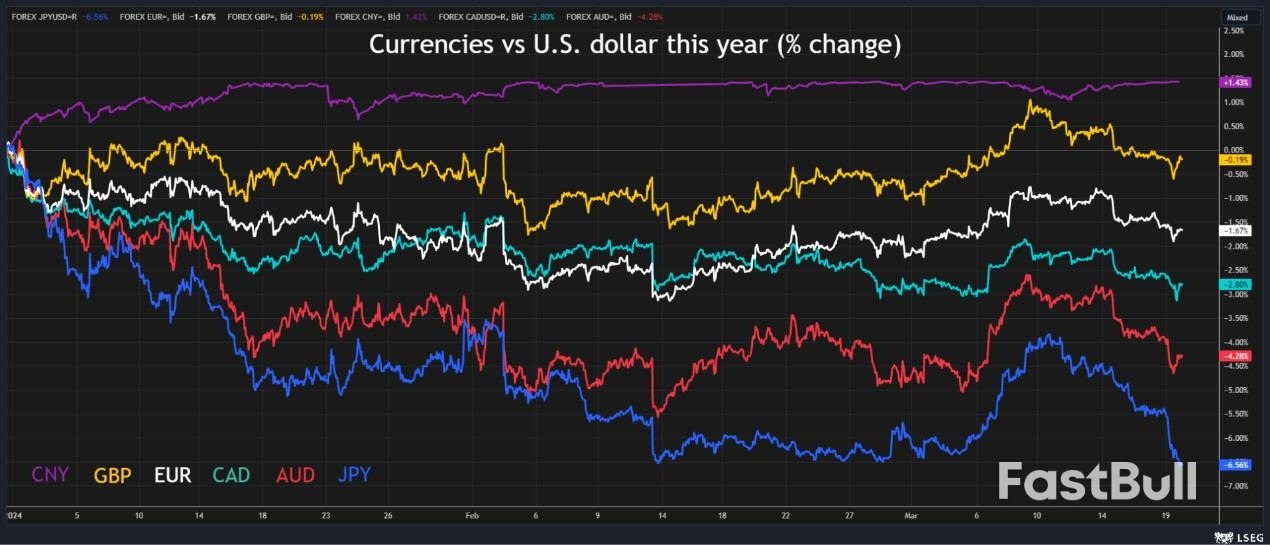
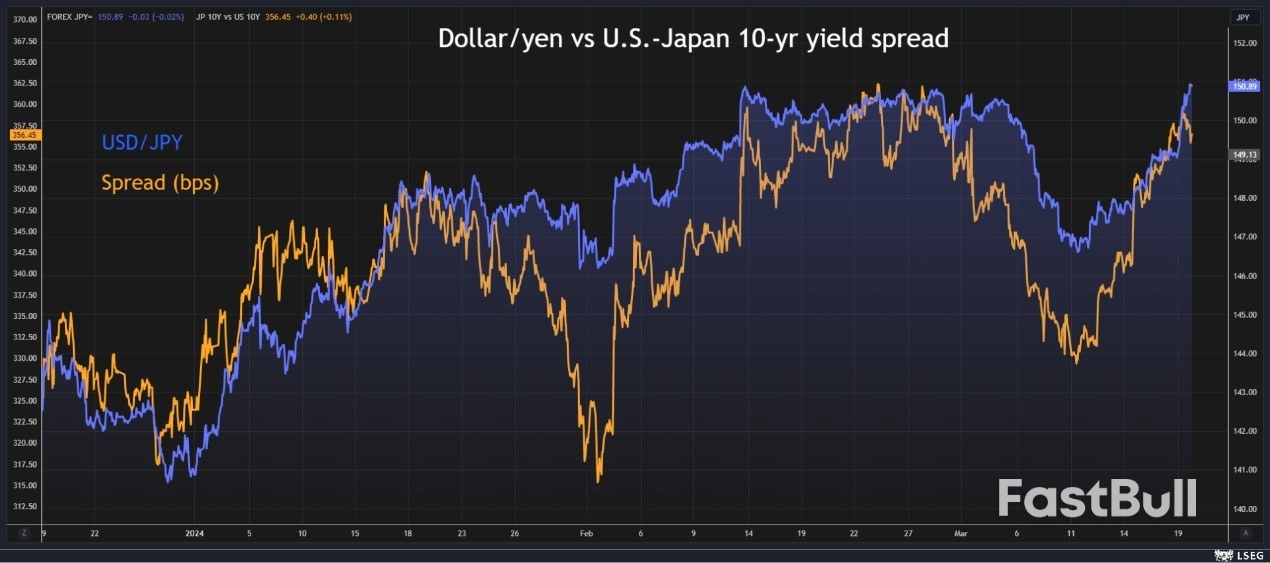
          The yen fell to a four-month low on Tuesday, hurtling towards 151.00 per dollar as investors took the BOJ's messaging to mean any further tightening will be gradual.
          If so, rate and yield spreads will continue to support major currencies like the dollar at the expense of the yen. The "carry trade" dynamic could be underscored even more on Wednesday by the Federal Reserve's policy statement, updated economic projections and Chair Jerome Powell's press conference.
          The yen's slide on Tuesday bucked the trend among major global currencies and pushed it back within sight of the recent multi-decade lows around 152.00 per dollar.Yen Hurtles Toward Historic Low, Fed in Focus_1
          Yen Hurtles Toward Historic Low, Fed in Focus_2The weak yen goes hand in glove with stronger Japanese stocks - the Nikkei 225 is back above 40,000 and within touching distance of its record high 40,472 points from earlier this month. A new high on Wednesday?
          Markets across the continent could open Wednesday in buoyant mood and shrug off the previous day's weakness, thanks to another rise on Wall Street and fall in U.S. bond yields.
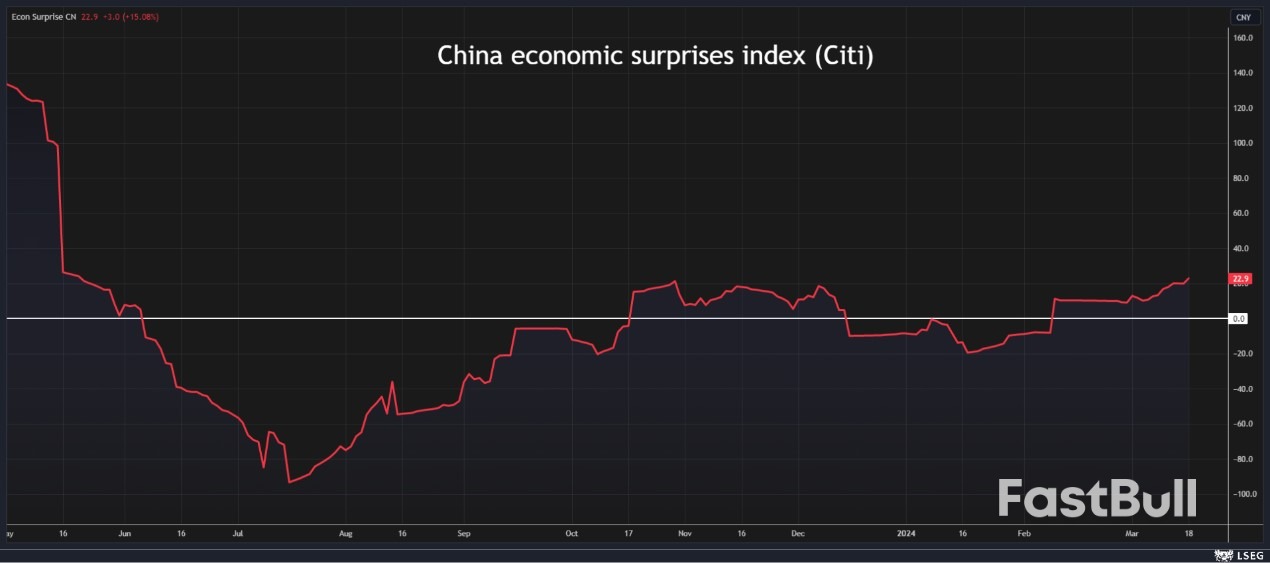
          Any upside could be limited, however, by investors' reluctance to take on too much exposure ahead of the Fed. And although China's economic surprises index is at a 10-month high, worries persist over the country's property crisis.
          Yen Hurtles Toward Historic Low, Fed in Focus_3This helps explain why 30-year Chinese government bond yields are down 40 basis points this year, recently hitting a record low of below 2.4% and coming within a whisker of dropping below 10-year yields, which also have hit 22-year troughs.
          Analysts reckon the People's Bank of China will leave its one- and five-year loan prime rates unchanged, after it left key bank lending rates on holds earlier this month.
          Despite the deflationary pressures still stalking the economy, monetary policy has "pretty much reached the limits of what it can do ... and so any further easing is likely to be modest," according to Win Thin at BBH.
          Bank Indonesia, meanwhile, is also expected to hold rates for a fifth month on Wednesday but cut in the second quarter of the year, according to a slim majority of economists in a Reuters poll.
          With inflation within the target range of 1.5% to 3.5% since July and the economy showing signs of a slowdown, all 31 economists in the March 8-15 poll agreed the central bank's next move would be a cut. The only issue is when.
          Here are key developments that could provide more direction to markets on Wednesday:
          - China LPR decision
          - Indonesia monetary policy decision
          - U.S. Fed policy decision

          Source: Reuters

          To stay updated on all economic events of today, please check out our Economic calendar
          Risk Warnings and Disclaimers
          You understand and acknowledge that there is a high degree of risk involved in trading. Following any strategies or investment methods may lead to potential losses. The content on the site is provided by our contributors and analysts for information purposes only. You are solely responsible for determining whether any trading assets, securities, strategy, or any other product is suitable for investing based on your own investment objectives and financial situation.
          Add to Favorites
          Share
          FastBull
          Copyright © 2025 FastBull Ltd

          728 RM B 7/F GEE LOK IND BLDG NO 34 HUNG TO RD KWUN TONG KLN HONG KONG

          TelegramInstagramTwitterfacebooklinkedin
          App Store Google Play Google Play
          Products
          Charts

          Chats

          Q&A with Experts
          Screeners
          Economic Calendar
          Data
          Tools
          Membership
          Features
          Function
          Markets
          Copy Trading
          Latest Signals
          Contests
          News
          Analysis
          24/7
          Columns
          Education
          Company
          Careers
          About Us
          Contact Us
          Advertising
          Help Center
          Feedback
          User Agreement
          Privacy Policy
          Business

          White Label

          Data API

          Web Plug-ins

          Poster Maker

          Affiliate Program

          Risk Disclosure

          The risk of loss in trading financial instruments such as stocks, FX, commodities, futures, bonds, ETFs and crypto can be substantial. You may sustain a total loss of the funds that you deposit with your broker. Therefore, you should carefully consider whether such trading is suitable for you in light of your circumstances and financial resources.

          No decision to invest should be made without thoroughly conducting due diligence by yourself or consulting with your financial advisors. Our web content might not suit you since we don't know your financial conditions and investment needs. Our financial information might have latency or contain inaccuracy, so you should be fully responsible for any of your trading and investment decisions. The company will not be responsible for your capital loss.

          Without getting permission from the website, you are not allowed to copy the website's graphics, texts, or trademarks. Intellectual property rights in the content or data incorporated into this website belong to its providers and exchange merchants.

          Not Logged In

          Log in to access more features

          FastBull Membership

          Not yet

          Purchase

          Become a signal provider
          Help Center
          Customer Service
          Dark Mode
          Price Up/Down Colors

          Log In

          Sign Up

          Position
          Layout
          Fullscreen
          Default to Chart
          The chart page opens by default when you visit fastbull.com