• Trade
  • Markets
  • Copy
  • Contests
  • News
  • 24/7
  • Calendar
  • Q&A
  • Chats
Trending
Screeners
SYMBOL
LAST
BID
ASK
HIGH
LOW
NET CHG.
%CHG.
SPREAD
SPX
S&P 500 Index
6827.42
6827.42
6827.42
6899.86
6801.80
-73.58
-1.07%
--
DJI
Dow Jones Industrial Average
48458.04
48458.04
48458.04
48886.86
48334.10
-245.98
-0.51%
--
IXIC
NASDAQ Composite Index
23195.16
23195.16
23195.16
23554.89
23094.51
-398.69
-1.69%
--
USDX
US Dollar Index
97.950
98.030
97.950
98.500
97.950
-0.370
-0.38%
--
EURUSD
Euro / US Dollar
1.17394
1.17409
1.17394
1.17496
1.17192
+0.00011
+ 0.01%
--
GBPUSD
Pound Sterling / US Dollar
1.33707
1.33732
1.33707
1.33997
1.33419
-0.00148
-0.11%
--
XAUUSD
Gold / US Dollar
4299.39
4299.39
4299.39
4353.41
4257.10
+20.10
+ 0.47%
--
WTI
Light Sweet Crude Oil
57.233
57.485
57.233
58.011
56.969
-0.408
-0.71%
--

Community Accounts

Signal Accounts
--
Profit Accounts
--
Loss Accounts
--
View More

Become a signal provider

Sell trading signals to earn additional income

View More

Guide to Copy Trading

Get started with ease and confidence

View More

Signal Accounts for Members

All Signal Accounts

Best Return
  • Best Return
  • Best P/L
  • Best MDD
Past 1W
  • Past 1W
  • Past 1M
  • Past 1Y

All Contests

  • All
  • Trump Updates
  • Recommend
  • Stocks
  • Cryptocurrencies
  • Central Banks
  • Featured News
Top News Only
Share

USA Embassy In Lithuania: Maria Kalesnikava Is Not Going To Vilnius

Share

USA Embassy In Lithuania: Other Prisoners Are Being Sent From Belarus To Ukraine

Share

Ukraine President Zelenskiy: Five Ukrainians Released By Belarus In US-Brokered Deal

Share

USA Vilnius Embassy: USA Stands Ready For "Additional Engagement With Belarus That Advances USA Interests"

Share

USA Vilnius Embassy: Belarus, USA, Other Citizens Among The Prisoners Released Into Lithuania

Share

USA Vilnius Embassy: USA Will Continue Diplomatic Efforts To Free The Remaining Political Prisoners In Belarus

Share

USA Vilnius Embassy: Belarus Releases 123 Prisoners Following Meeting Of President Trump's Envoy Coale And Belarus President Lukashenko

Share

USA Vilnius Embassy: Masatoshi Nakanishi, Aliaksandr Syrytsa Are Among The Prisoners Released By Belarus

Share

USA Vilnius Embassy: Maria Kalesnikava And Viktor Babaryka Are Among The Prisoners Released By Belarus

Share

USA Vilnius Embassy: Nobel Peace Prize Laureate Ales Bialiatski Is Among The Prisoners Released By Belarus

Share

Belarusian Presidential Administration Telegram Channel: Lukashenko Has Pardoned 123 Prisoners As Part Of Deal With US

Share

Two Local Syrian Officials: Joint US-Syrian Military Patrol In Central Syria Came Under Fire From Unknown Assailants

Share

Israeli Military Says It Targeted 'Key Hamas Terrorist' In Gaza City

Share

Rwanda's Actions In Eastern Drc Are A Clear Violation Of Washington Accords Signed By President Trump - Secretary Of State Rubio

Share

Israeli Military Issues Evacuation Warning In Southern Lebanon Village Ahead Of Strike - Spokesperson On X

Share

Belarusian State Media Cites US Envoy Coale As Saying He Discussed Ukraine And Venezuela With Lukashenko

Share

Belarusian State Media Cites US Envoy Coale As Saying That US Removes Sanctions On Belarusian Potassium

Share

Thai Prime Minister: No Ceasefire Agreement With Cambodia

Share

US, Ukraine To Discuss Ceasefire In Berlin Ahead Of European Summit

Share

Incoming Czech Prime Minister Babis: Czech Republic Will Not Take On Guarantees For Ukraine Financing, European Commission Must Find Alternatives

TIME
ACT
FCST
PREV
U.K. Trade Balance Non-EU (SA) (Oct)

A:--

F: --

P: --

U.K. Trade Balance (Oct)

A:--

F: --

P: --

U.K. Services Index MoM

A:--

F: --

P: --

U.K. Construction Output MoM (SA) (Oct)

A:--

F: --

P: --

U.K. Industrial Output YoY (Oct)

A:--

F: --

P: --

U.K. Trade Balance (SA) (Oct)

A:--

F: --

P: --

U.K. Trade Balance EU (SA) (Oct)

A:--

F: --

P: --

U.K. Manufacturing Output YoY (Oct)

A:--

F: --

P: --

U.K. GDP MoM (Oct)

A:--

F: --

P: --

U.K. GDP YoY (SA) (Oct)

A:--

F: --

P: --

U.K. Industrial Output MoM (Oct)

A:--

F: --

P: --

U.K. Construction Output YoY (Oct)

A:--

F: --

P: --

France HICP Final MoM (Nov)

A:--

F: --

P: --

China, Mainland Outstanding Loans Growth YoY (Nov)

A:--

F: --

P: --

China, Mainland M2 Money Supply YoY (Nov)

A:--

F: --

P: --

China, Mainland M0 Money Supply YoY (Nov)

A:--

F: --

P: --

China, Mainland M1 Money Supply YoY (Nov)

A:--

F: --

P: --

India CPI YoY (Nov)

A:--

F: --

P: --

India Deposit Gowth YoY

A:--

F: --

P: --

Brazil Services Growth YoY (Oct)

A:--

F: --

P: --

Mexico Industrial Output YoY (Oct)

A:--

F: --

P: --

Russia Trade Balance (Oct)

A:--

F: --

P: --

Philadelphia Fed President Henry Paulson delivers a speech
Canada Building Permits MoM (SA) (Oct)

A:--

F: --

P: --

Canada Wholesale Sales YoY (Oct)

A:--

F: --

P: --

Canada Wholesale Inventory MoM (Oct)

A:--

F: --

P: --

Canada Wholesale Inventory YoY (Oct)

A:--

F: --

P: --

Canada Wholesale Sales MoM (SA) (Oct)

A:--

F: --

P: --

Germany Current Account (Not SA) (Oct)

A:--

F: --

P: --

U.S. Weekly Total Rig Count

A:--

F: --

P: --

U.S. Weekly Total Oil Rig Count

A:--

F: --

P: --

Japan Tankan Large Non-Manufacturing Diffusion Index (Q4)

--

F: --

P: --

Japan Tankan Small Manufacturing Outlook Index (Q4)

--

F: --

P: --

Japan Tankan Large Non-Manufacturing Outlook Index (Q4)

--

F: --

P: --

Japan Tankan Large Manufacturing Outlook Index (Q4)

--

F: --

P: --

Japan Tankan Small Manufacturing Diffusion Index (Q4)

--

F: --

P: --

Japan Tankan Large Manufacturing Diffusion Index (Q4)

--

F: --

P: --

Japan Tankan Large-Enterprise Capital Expenditure YoY (Q4)

--

F: --

P: --

U.K. Rightmove House Price Index YoY (Dec)

--

F: --

P: --

China, Mainland Industrial Output YoY (YTD) (Nov)

--

F: --

P: --

China, Mainland Urban Area Unemployment Rate (Nov)

--

F: --

P: --

Saudi Arabia CPI YoY (Nov)

--

F: --

P: --

Euro Zone Industrial Output YoY (Oct)

--

F: --

P: --

Euro Zone Industrial Output MoM (Oct)

--

F: --

P: --

Canada Existing Home Sales MoM (Nov)

--

F: --

P: --

Euro Zone Total Reserve Assets (Nov)

--

F: --

P: --

U.K. Inflation Rate Expectations

--

F: --

P: --

Canada National Economic Confidence Index

--

F: --

P: --

Canada New Housing Starts (Nov)

--

F: --

P: --

U.S. NY Fed Manufacturing Employment Index (Dec)

--

F: --

P: --

U.S. NY Fed Manufacturing Index (Dec)

--

F: --

P: --

Canada Core CPI YoY (Nov)

--

F: --

P: --

Canada Manufacturing Unfilled Orders MoM (Oct)

--

F: --

P: --

Canada Manufacturing New Orders MoM (Oct)

--

F: --

P: --

Canada Core CPI MoM (Nov)

--

F: --

P: --

Canada Manufacturing Inventory MoM (Oct)

--

F: --

P: --

Canada CPI YoY (Nov)

--

F: --

P: --

Canada CPI MoM (Nov)

--

F: --

P: --

Canada CPI YoY (SA) (Nov)

--

F: --

P: --

Canada Core CPI MoM (SA) (Nov)

--

F: --

P: --

Q&A with Experts
    • All
    • Chatrooms
    • Groups
    • Friends
    Connecting
    .
    .
    .
    Type here...
    Add Symbol or Code

      No matching data

      All
      Trump Updates
      Recommend
      Stocks
      Cryptocurrencies
      Central Banks
      Featured News
      • All
      • Russia-Ukraine Conflict
      • Middle East Flashpoint
      • All
      • Russia-Ukraine Conflict
      • Middle East Flashpoint
      Search
      Products

      Charts Free Forever

      Chats Q&A with Experts
      Screeners Economic Calendar Data Tools
      Membership Features
      Data Warehouse Market Trends Institutional Data Policy Rates Macro

      Market Trends

      Market Sentiment Order Book Forex Correlations

      Top Indicators

      Charts Free Forever
      Markets

      News

      News Analysis 24/7 Columns Education
      From Institutions From Analysts
      Topics Columnists

      Latest Views

      Latest Views

      Trending Topics

      Top Columnists

      Latest Update

      Signals

      Copy Rankings Latest Signals Become a signal provider AI Rating
      Contests
      Brokers

      Overview Brokers Assessment Rankings Regulators News Claims
      Broker listing Forex Brokers Comparison Tool Live Spread Comparison Scam
      Q&A Complaint Scam Alert Videos Tips to Detect Scam
      More

      Business
      Events
      Careers About Us Advertising Help Center

      White Label

      Data API

      Web Plug-ins

      Affiliate Program

      Awards Institution Evaluation IB Seminar Salon Event Exhibition
      Vietnam Thailand Singapore Dubai
      Fans Party Investment Sharing Session
      FastBull Summit BrokersView Expo
      Recent Searches
        Top Searches
          Markets
          News
          Analysis
          User
          24/7
          Economic Calendar
          Education
          Data
          • Names
          • Latest
          • Prev

          View All

          No data

          Scan to Download

          Faster Charts, Chat Faster!

          Download App
          English
          • English
          • Español
          • العربية
          • Bahasa Indonesia
          • Bahasa Melayu
          • Tiếng Việt
          • ภาษาไทย
          • Français
          • Italiano
          • Türkçe
          • Русский язык
          • 简中
          • 繁中
          Open Account
          Search
          Products
          Charts Free Forever
          Markets
          News
          Signals

          Copy Rankings Latest Signals Become a signal provider AI Rating
          Contests
          Brokers

          Overview Brokers Assessment Rankings Regulators News Claims
          Broker listing Forex Brokers Comparison Tool Live Spread Comparison Scam
          Q&A Complaint Scam Alert Videos Tips to Detect Scam
          More

          Business
          Events
          Careers About Us Advertising Help Center

          White Label

          Data API

          Web Plug-ins

          Affiliate Program

          Awards Institution Evaluation IB Seminar Salon Event Exhibition
          Vietnam Thailand Singapore Dubai
          Fans Party Investment Sharing Session
          FastBull Summit BrokersView Expo

          Bond Markets Face Struggle to Surf 'Treasury Tsunami'

          Cohen

          Economic

          Bond

          Summary:

          Governments rarely correct deteriorating public finances until they meet some form of debt market disturbance...
          Governments rarely correct deteriorating public finances until they meet some form of debt market disturbance, but the retreat of central banks from sovereign bond markets may eventually set the scene for a showdown.
          Longstanding market angst about the dramatic buildup of Western government debt since the pandemic — some might say since the global financial crisis 16 years ago — has not yet been matched by anything approaching an investor strike or warning shot.
          Even though bond prices were predictably hammered by the global inflation spike and interest rate rises over the past three years, they have so far re-priced in a relatively orderly manner in keeping with the new official rate parameters.
          Aside from the brief British gilt shock after 2022's quickly-reversed UK budget blowout, there's been little sign of market stress in US or eurozone debt, and risk premiums for holding longer duration debt remains historically subdued.
          Perhaps assuming the inflation and rate storm is finally over, markets have not demanded much additional compensation for funding ever larger deficits and national debt burdens.
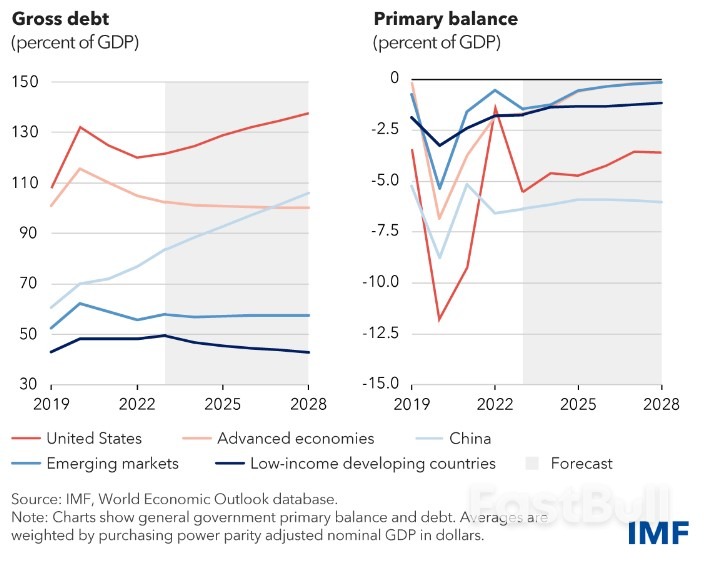
          Yet bemoaning a lack of remedial action on bloated spending and budgets in a year of multiple elections — particularly in the US with the biggest government bond market in the world — the International Monetary Fund (IMF) warned again last month: "Something will have to give."
          While the IMF wagged its finger at most developed and emerging economies, it reserved most concern for a US fiscal stance "out of line with long-term fiscal sustainability" — not least given the now US$27 trillion (RM128.86 trillion) Treasury market's pivotal position as a benchmark for global borrowing costs.
          The raw numbers are well documented. The Congressional Budget Office, in March forecast US government debt would rise to a record 107% of national output by the end of the decade and north of 150% in 20 years under current budget and interest cost trajectories.
          And yet, already facing hundreds of billions of new sovereign debt sales every quarter, the bond market's relative calm to date is remarkable.
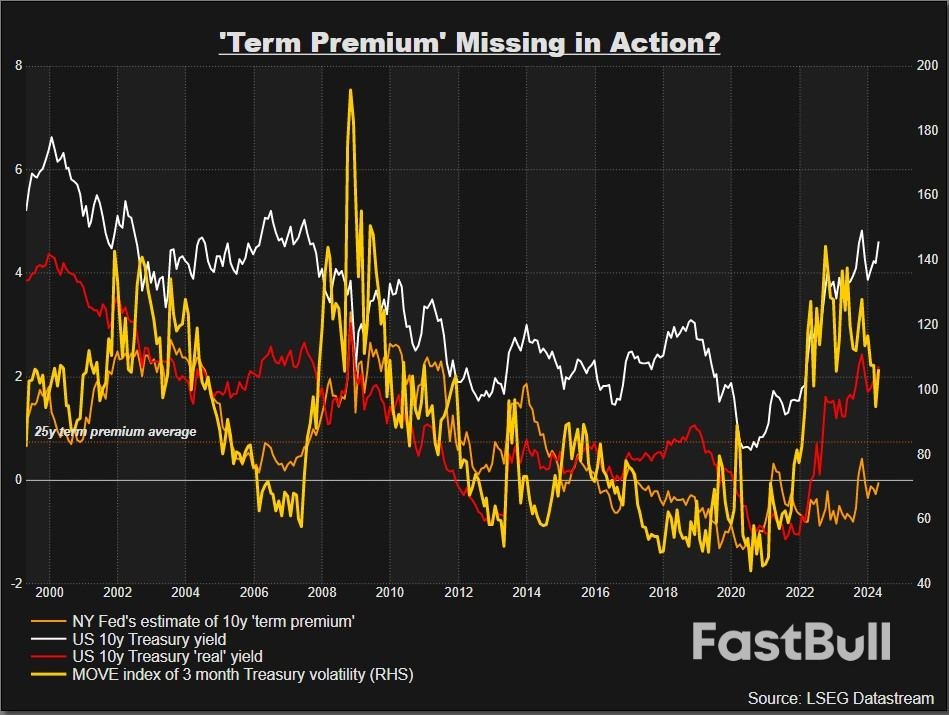
          After all, the New York Federal Reserve's (Fed) estimate of the 10-year "term premium" demanded by investors for holding longer-maturity Treasuries remains close to zero — some 150 basis points below the 60-year average and 35 bps below a 16-year mean that covers the Fed's bond-buying balance sheet expansion.
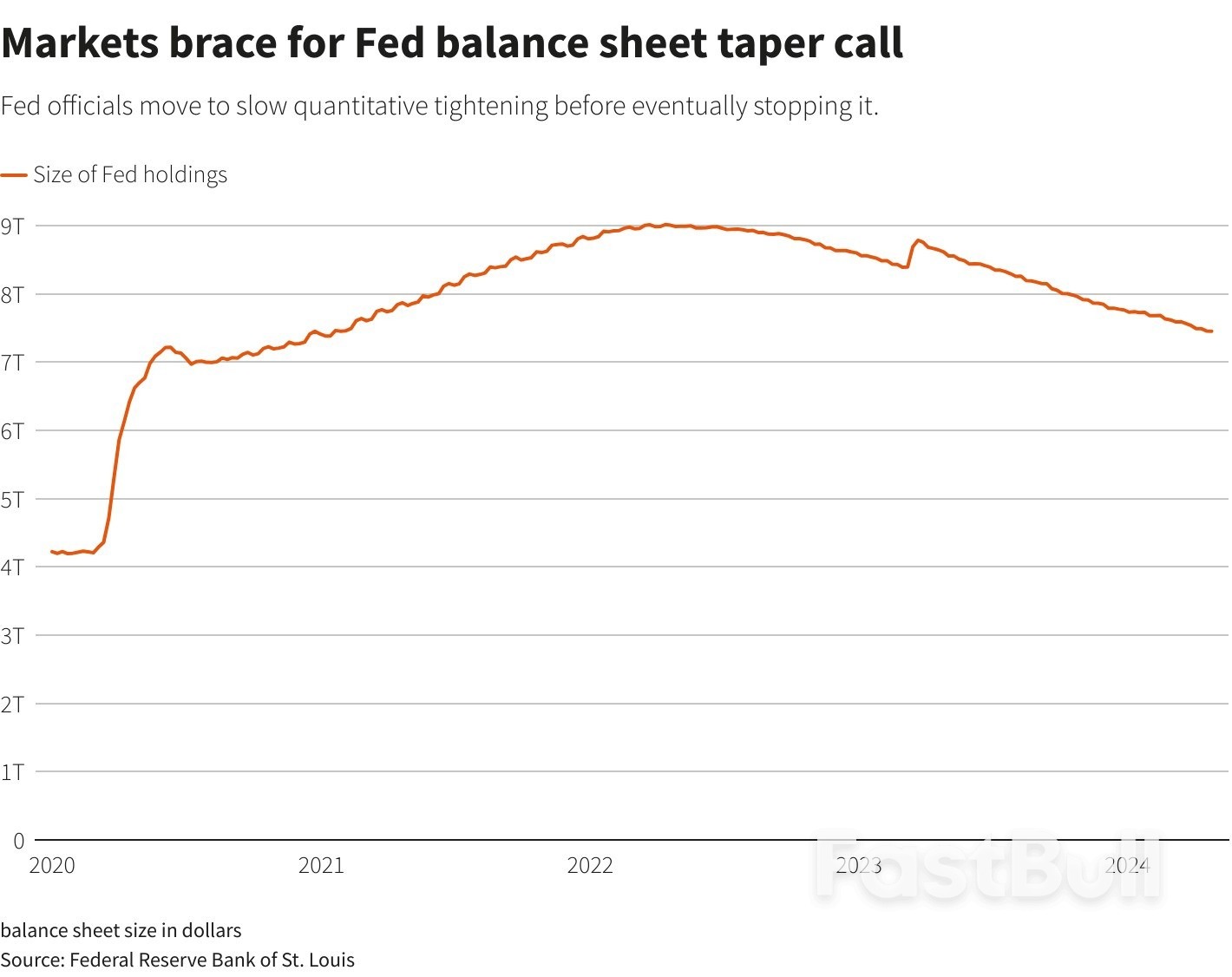
          Albeit faded, hopes for Fed interest rate cuts this year have been partly responsible for supporting bonds — even while the Fed continues to run down the vast stash of Treasuries loaded onto its balance sheet during the pandemic.
          While slowing the pace of "quantitative tightening" may well be discussed at this week's Fed policy meeting, there's little sign of it ending — let alone any resumption of buying.
          And it's not the only reliable buyer quietly stepping away.Bond Markets Face Struggle to Surf 'Treasury Tsunami'_1

          Bond Markets Face Struggle to Surf 'Treasury Tsunami'_2Surfing the 'tsunami'

          Barclays' annual Equity Gilt Study published this week dissected the market treatment of what it dubbed the "Treasury tsunami" of new debt supply.
          It concluded that as the Fed and other global central banks gradually back away from bond markets, investors will now start to price the debt flood more cautiously.
          The deep dive into the runes of US debt dynamics and Treasury market pricing doubted some of scarier stories of a "sudden stop" in demand for such a critical world asset or even a dramatic decline in the dollar's reserve status.
          But it said a combination of unchecked ballooning deficits buoying growth with high and volatile interest rates and inflation as well as a reduction in "price insensitive" bond holders such as the Fed and foreign central banks will likely seed a bigger market adjustment ahead.
          "The buyer base of US Treasuries has slowly been shifting away from price-insensitive investors, such as foreign central banks, which 'need' to buy government bonds, to price-sensitive ones, such as the domestic household sector, which 'chooses' to buy them," it said, adding hedge funds were also bucketed in that "household sector".
          "This transition should raise term premia to levels that are more consistent with fundamental drivers, which themselves would be under further pressure."
          An exceptional "higher for longer" US rate environment spurred by persistent US deficit-related stimulus now risks keeping the dollar buoyed around the world and may see many developing countries forced to run down dollar reserves and related Treasury holdings in support of local currencies.
          And it's not just emerging market central banks — there's something of that scenario too in Japan's unfolding battle this week to prop the yen from 34-year lows.
          What's more, years to come of higher spending or extended tax cuts — or both — will serve to lift the "neutral" Fed policy rate assumption over time from the Fed's own current 2.6% view.
          With market pricing now seeing inflation settling above target at about 2.5% longer term, Barclays reckons the long-term neutral policy rate could be as high as 4%.
          The study goes further say "worsening fiscal dynamics" are also lifting Treasury volatility, which feeds back into the market in a number of ways — not least undermining the portfolio diversification argument for holding bonds as an offset for any stock market stress.
          And keeping policy and cash rates high at current levels above 5% also challenges private demand for 10-year Treasuries still lower around 4.6%.
          The upshot?
          A higher term premium, neutral policy rate assumption and volatility risk pushing long-term borrowing rates higher and flipping the Treasury yield curve positive, whether the Fed cuts rates sharply or not.
          And if investors struggle to absorb the scale of new debt without a change of fiscal tack, Barclays fears there may be trouble ahead.
          "The Treasury universe has grown too large and investors need to factor the potential for increased bouts of illiquidity, poor functioning, and heightened volatility when thinking about valuations."
          Whether it's enough of a disturbance to force a change of thinking in Washington after the election remains to be seen.

          Bond Markets Face Struggle to Surf 'Treasury Tsunami'_3Bond Markets Face Struggle to Surf 'Treasury Tsunami'_4Source: Reuters

          To stay updated on all economic events of today, please check out our Economic calendar
          Risk Warnings and Disclaimers
          You understand and acknowledge that there is a high degree of risk involved in trading. Following any strategies or investment methods may lead to potential losses. The content on the site is provided by our contributors and analysts for information purposes only. You are solely responsible for determining whether any trading assets, securities, strategy, or any other product is suitable for investing based on your own investment objectives and financial situation.
          Add to Favorites
          Share

          [Fed] Powell's Press Conference Speech

          FastBull Featured

          Remarks of Officials

          On May 1, local time, after the Fed announced the interest rate decision, Chairman Powell held a press conference to answer reporters' questions, the highlights of which are as follows:
          Q1: In the inflation data of the first quarter, which areas of rebound are temporary? What do you expect inflation to look like in the coming months?
          A: Both goods inflation and non-housing services inflation exceeded expectations. The combination of the two resulted in headline inflation exceeding expectations. But my expectation remains that inflation will come down this year.
          Q2: Isn't it a contradiction that the Fed is reducing its balance sheet while keeping interest rates at restrictive levels in an attempt to reduce inflation and slow down the economy?
          A: Interest rates serve as an active tool of monetary policy, a long-standing strategy aimed at either easing or tightening restrictions on the economy to ensure a smooth process of balance sheet reduction without causing financial market turbulence as seen in the previous instance.
          Q3: Given the series of data since March, do you think the likelihood of no rate cuts this year has increased? Do you see a case for more patience with inflation and "synergizing" with the economic cycle to bring it down over time?
          A: The first question did not come as expected, I can only say that we will not lower interest rates until we have greater confidence in moving towards the long-term target of inflation persistently around 2%. In fact, we believe it will take longer to gain this confidence.
          Q4: You said earlier that you wouldn't consider raising interest rates if the economy was growing faster, does that mean you're more worried about causing the economy to slow down than you are about inflation picking up again?
          A: I think our policy stance is correct and appropriate for the current situation. We think it is restrictive, and the evidence for that can be found in the labor market. We think it is restrictive, and the fact that demand has fallen significantly over the last couple of years is due to policy. Therefore, I am not worried about inflation picking up again.
          Q5: With GDP currently around 2%, unemployment at 4%, and inflation hovering just above 3%, and judging by the recent data, it looks like a rate hike will be needed to get inflation back to 2%, was there any discussion of a rate hike at today's meeting? Are you comfortable with inflation at 3% for the rest of the year?
          A: We are not satisfied with 3% inflation, and over time we will bring inflation back to 2%. We believe our policy stance is appropriate. If we conclude that "policy is not restrictive enough to bring inflation below 2% in a sustainable manner", then we will raise interest rates, but we do not see evidence of this at the moment.
          Q6: You've mentioned several times that the labor market is normalizing, but wage growth is still much stronger than it was before the COVID-19 pandemic, so why is that happening?
          A: Compared to the peak three years ago, essentially all wage indicators have come down significantly, just not back to pre-pandemic levels, and we've seen fairly steady progress, but it's not consistent, and the road down has been full of bumps.
          Q7: The slowdown in housing inflation has not come (not reflected in the CPI), how confident are you that rents will fall in the coming months to the point of curbing inflation?
          A: Essentially, inflation in the economy exhibits a lag in many areas, with housing inflation being one of them. This aspect is quite intricate and requires some time to bring down. I believe that as long as market rents continue to decrease, it will be reflected in inflation.
          Risk Warnings and Disclaimers
          You understand and acknowledge that there is a high degree of risk involved in trading. Following any strategies or investment methods may lead to potential losses. The content on the site is provided by our contributors and analysts for information purposes only. You are solely responsible for determining whether any trading assets, securities, strategy, or any other product is suitable for investing based on your own investment objectives and financial situation.
          Add to Favorites
          Share

          Asia's Crude Oil Imports Slip in April, Trail OPEC Forecasts

          Warren Takunda

          Economic

          Commodity

          Asia's imports of crude oil slipped slightly in April from March, as increased arrivals in China failed to offset lower purchases elsewhere in the world's top-importing region.
          April imports were 26.89 million barrels per day (bpd), down from 27.33 million bpd in March and roughly in line with February's 26.68 million bpd, according to data compiled by LSEG Oil Research.
          For the first four months of the year Asia's crude imports were about 27.03 million bpd, only 300,000 bpd higher than for the same period in 2023, the LSEG data showed.
          This means that crude oil arrivals in Asia are growing at a pace that is so far well short of the forecast by groups such as the Organization of the Petroleum Exporting Countries (OPEC).
          OPEC's April oil market outlook forecast that global oil demand will rise by 2.25 million bpd in 2024 from the previous year, with 1.24 million bpd of that coming from non-OECD countries in Asia.
          China, the world's largest crude importer, is expected by OPEC to see demand increase by 680,000 bpd in 2024.
          However, using official customs data for the first quarter and LSEG's estimate for April imports, China's crude arrivals for the January-April period were about 11.17 million bpd, which is 290,000 bpd higher than the customs data for the same period last year.
          It should be noted that there is a difference between crude oil imports and demand growth, as the total demand figure can be met from more than just imports such as domestic production and changes in inventories.
          The Fed concluded its two-day monetary policy meeting with Chair Jerome Powell noting that while the annual inflation rate has dropped significantly, further progress is quote 'not assured'
          Nonetheless, the slower pace of imports in China and the rest of Asia suggest that demand growth is so far nowhere near as strong as the OPEC forecast indicates.
          It should also be noted that OPEC, and other analysts, expect demand growth to accelerate over the northern summer months and extend into the second half of 2024, largely on the view that China's economy is recovering growth momentum and the rest of the world is emerging from its inflation-linked slowdown.
          The International Energy Agency (IEA) has a more modest target for global oil demand growth, with its April report estimating 1.2 million bpd for 2024.
          The IEA's forecast for China's oil demand growth is 500,000 bpd for 2024, meaning it is also significantly above the current growth rate in China's imports.
          Asia's Crude Oil Imports Slip in April, Trail OPEC Forecasts  _1

          Asia crude oil imports vs Brent price

          PRICE IMPACT

          The question then becomes are China's crude imports likely to increase in coming months, and the answer likely depends on movements in crude prices as much as it may on China's improving economy.
          China's recent pattern of crude imports has been that they increase when oil prices soften and ease back when they increase, allowing for a lag of around two months to account for when cargoes are arranged and physically delivered.
          This means that much of the oil that was offloaded in the first four months of the year was bought when crude prices were still soft.
          Global benchmark Brent futures hit a six-month low of $72.29 on Dec. 13, and then recovered to trade in a range around $80 for much of the first quarter.
          Rising geopolitical tensions and extended output cuts by the OPEC+ group, which includes OPEC and allies such as Russia, led Brent higher from mid-March onwards, with the contract peaking at $92.18 on April 12.
          This means the impact of the price spike from mid-March onwards has yet to show up in China's import figures, and it will likely only be a factor from May onwards.
          What happens to China's imports in May, June and July will go some way towards answering the question as to whether China's economic recovery is strong enough to ameliorate the impact of higher oil prices.

          Source: Reuters

          To stay updated on all economic events of today, please check out our Economic calendar
          Risk Warnings and Disclaimers
          You understand and acknowledge that there is a high degree of risk involved in trading. Following any strategies or investment methods may lead to potential losses. The content on the site is provided by our contributors and analysts for information purposes only. You are solely responsible for determining whether any trading assets, securities, strategy, or any other product is suitable for investing based on your own investment objectives and financial situation.
          Add to Favorites
          Share

          US Not Suffering from ‘Stagflation’, Says Fed Chairman Jerome Powell

          Warren Takunda

          Economic

          Stocks

          Bond

          The US is not suffering from “stagflation” and is growing well despite stubborn inflation, Federal Reserve chairman Jerome Powell has said.
          Mr Powell on Wednesday night dismissed suggestions that the US was close to an economic trap of stagnant growth and rampant inflation, saying the economy was among the best in the world and the rate of price rises was on track to fall to the Fed’s 2pc target.
          The central bank chief added that it was “unlikely” the Fed would need to raise interest rates any higher to combat inflation, in comments that raised hopes borrowing costs have peaked and will soon be on the way down.
          Stock markets rallied after Mr Powell’s statements, which took investors by surprise. Most had expected him to signal that the Fed was still willing to put up borrowing costs if necessary after a recent run of strong economic data.
          The S&P 500, the Dow and the tech-heavy Nasdaq indexes all jumped by more than 1pc on Wall Street following Mr Powell’s press conference comments.
          Josh Jamner, a strategist at ClearBridge Investments in New York, said: “Many investors were positioned for, and fearful of, a more hawkish bent after a string of hot inflation prints so far this year.”
          Mr Powell’s rosier-than-expected assessment of the US economy will raise hopes that interest rates will soon begin falling around the world. The Bank of England’s Monetary Policy Committee meets next week, with division on the nine-person board over when to lower rates.
          The Bank’s panel of rate-setters is expected to hold borrowing costs at 5.25pc, even as many analysts believe inflation will have fallen below 2pc in April.
          The Fed on Wednesday held US interest rates at a 23-year-high range of 5.25pc to 5.5pc.
          Mr Powell said it was still too early to declare victory against inflation after “a lack of further progress”. US inflation rose for the second month in a row in March to reach 3.5pc and Mr Powell said it was “likely to take longer for us to gain confidence that we are on a sustainable path” towards 2pc inflation.
          He added that other central banks around the world were likely to cut interest rates before the US, given weaker growth rates elsewhere, but said this was unlikely to create economic problems as it has in the past.
          Asked about concerns that the US economy was at risk of “stagflation”, the Fed chief told reporters in Washington: “Right now we have 3pc growth, which is pretty solid I would say by any measure, and we have inflation running under 3pc. I do not see the ‘stag’ or the ‘flation’.”
          Market commentators last week raised fears of “stagflation” following weaker-than-expected growth in the first three months of the year coupled with surprisingly strong core inflation.
          However, new figures on Wednesday showed that job openings fell to a three-year low in March, a sign that inflationary pressures from a tight labour market are easing.
          Oil prices are also dropping rapidly, which should ease pressure on fuel prices around the world. Brent crude, the international benchmark, has fallen 6.6pc to $83.51 a barrel over the last three days, amid hopes of a ceasefire in the Israel-Gaza conflict.
          While the US economy is performing well, fresh data on Wednesday raised concerns about the strength of Britain’s economic recovery from the recession suffered at the end of last year.
          Manufacturing businesses reported a fall in activity in April, according to S&P Global’s influential purchasing managers’ index survey.
          Output had risen in March for the first time in more than a year but the latest figures suggest factories are struggling to create momentum.
          Companies are also facing the sharpest rise in costs since February of 2023, the survey found, and they are attempting to pass this on to customers, with prices charged to clients also accelerating.

          Source: Yahoofinance

          To stay updated on all economic events of today, please check out our Economic calendar
          Risk Warnings and Disclaimers
          You understand and acknowledge that there is a high degree of risk involved in trading. Following any strategies or investment methods may lead to potential losses. The content on the site is provided by our contributors and analysts for information purposes only. You are solely responsible for determining whether any trading assets, securities, strategy, or any other product is suitable for investing based on your own investment objectives and financial situation.
          Add to Favorites
          Share

          Bitcoin 4% Dip May 'Panic' Short-Term Holders as Price Falls Below Average Cost

          Warren Takunda

          Economic

          Cryptocurrency

          Bitcoin is now trading below the average purchase price paid by short-term holders, potentially causing “panic” due to unrealized losses, according to an on-chain analyst.
          “These recent buyers are statistically the most likely to panic,” analyst James Check, known as “Checkmatey,” said in a May 1 report.
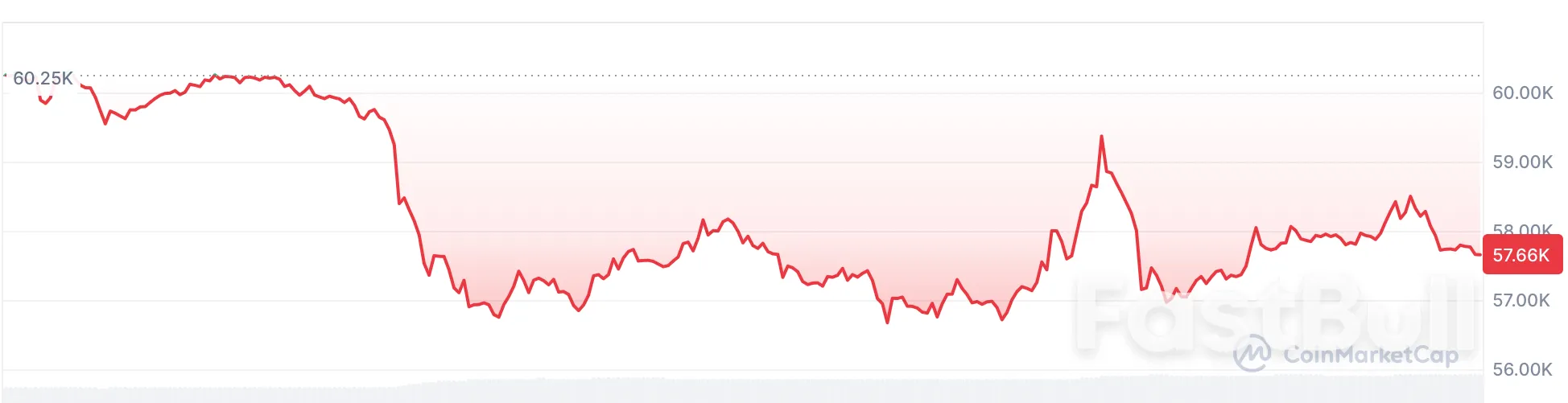
          “What a nuke we have on our hands to open the month of May,” Check added, referring to Bitcoin briefly plummeting 8% below a key support level to $56,814 on May 1, according to CoinMarketCap data.
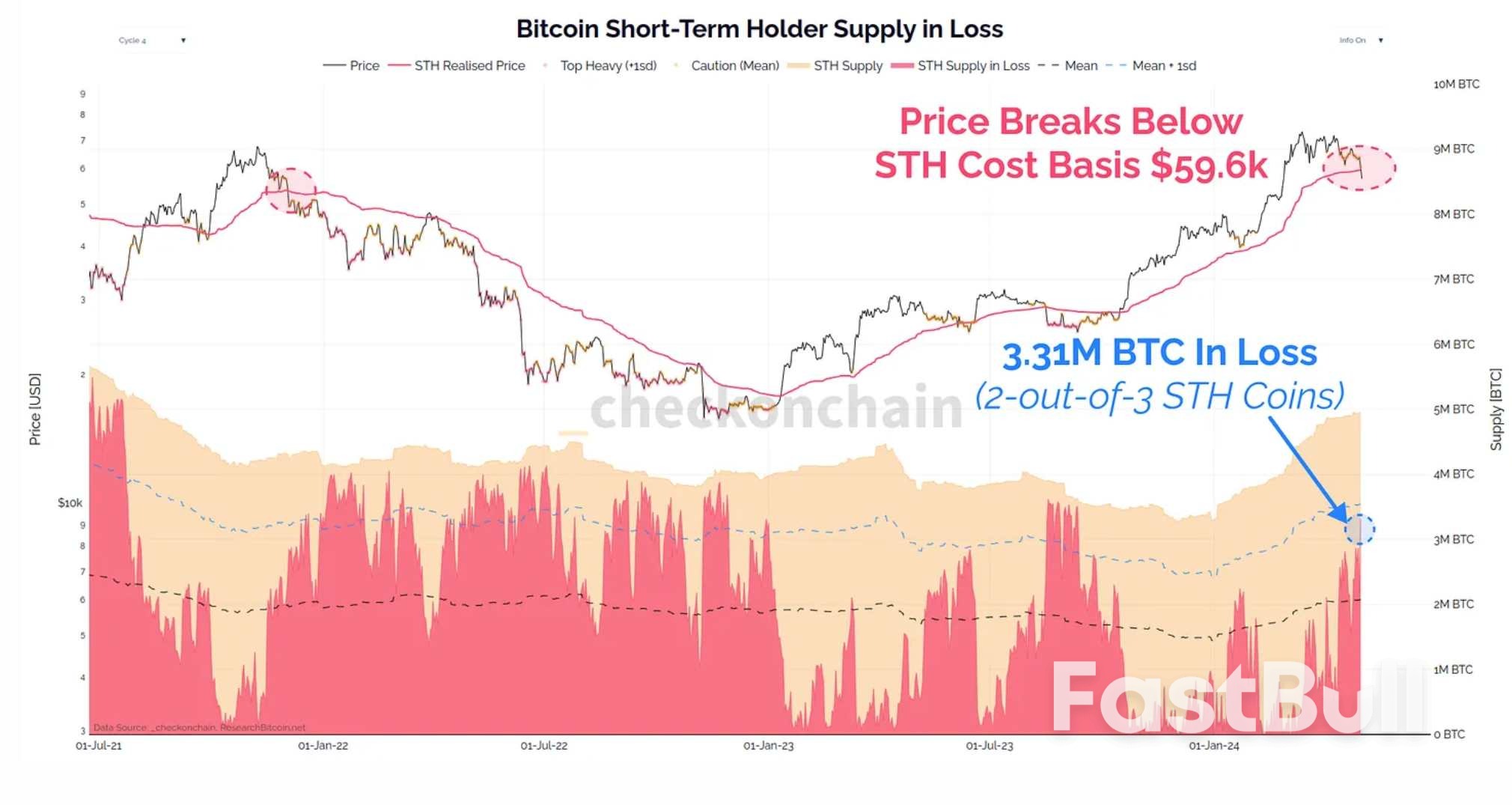
          The recent price drop saw Bitcoin hit its lowest level since February, which is significant for short-term Bitcoin holders — those who have held for under 155 days — as they paid an average price of $59,600 per Bitcoin.
          Even though the price has slightly recovered to $57,631 at the time of publication, short-term holders still hold an average 3% unrealized loss.
          Bitcoin’s price at the time of writing represents a decline of 4% in the past 24 hours. The sharp downturn led to the liquidation of $100.27 million in long positions over that time, according to CoinGlass data.
          Its price decline was driven by a crypto sell-off as market participants awaited the United States Federal Reserve’s interest rate decision, which kept the current high interest rates unchanged, as analysts expected.Bitcoin 4% Dip May 'Panic' Short-Term Holders as Price Falls Below Average Cost_1

          Bitcoin’s price briefly plummeted to its lowest price in three months on May 1. Source: CoinMarketCap

          Check suggested that while holding an unrealized loss is not ideal, short-term Bitcoin holders have experienced this before.
          “Most importantly, breaking the [short-term holder] cost basis isn’t the end of the world, nor the end of the bull market. It doesn’t help…but it is and has been recoverable,” he wrote.
          The short-term holder cost basis typically acts as support during bull periods and resistance during bear periods, explained crypto trading resource On-Chain College in a May 1 X post.
          However, it pointed to a few potential events that will not signal “the bull market is over.”
          A “quick move” to $59,600, roughly 2.2% above Bitcoin’s current price, would be “bullish,” the On-Chain College claimed.
          This is based on a similar pattern in June 2023, when the price dropped below cost basis and quickly rebounded before a significant upswing.Bitcoin 4% Dip May 'Panic' Short-Term Holders as Price Falls Below Average Cost_2

          Bitcoin’s price breaks below the short-term holder cost basis. Source: Checkonchain

          On-Chain College also noted that when Bitcoin’s price pulled back a few months later, in August 2023, it stayed volatile below the short-term cost basis for some time.
          This suggests that a “sustained period” below the cost basis could also signal a bullish trend, according to On-chain College.

          Source: Cointelegraph

          To stay updated on all economic events of today, please check out our Economic calendar
          Risk Warnings and Disclaimers
          You understand and acknowledge that there is a high degree of risk involved in trading. Following any strategies or investment methods may lead to potential losses. The content on the site is provided by our contributors and analysts for information purposes only. You are solely responsible for determining whether any trading assets, securities, strategy, or any other product is suitable for investing based on your own investment objectives and financial situation.
          Add to Favorites
          Share

          RBA Decision: Will A Rate Hike Be Back on The Table?

          XM

          Economic

          Central Bank

          Inflation setback

          The Reserve Bank of Australia is no stranger to policy flip-flops and the May decision may just add to the tally. Having dropped their tightening bias as recently as the last meeting in March, policymakers are staring at an unpleasant inflation picture.
          The monthly CPI reading ticked up to 3.5% y/y in March, while two closely watched underlying measures came in hotter than expected in the first quarter. Moreover, despite the labour market having somewhat cooled over the past year, wage growth has kept on accelerating, reaching 4.2% y/y in the fourth quarter of 2023.RBA Decision: Will A Rate Hike Be Back on The Table?_1
          The Q1 figure for wage costs isn't due until May 15 and the next CPI report will be released even later on May 29. Both pieces of data could be crucial to deciding whether the latest setback in the fight against inflation is just a blip or a warning that monetary policy is not restrictive enough.

          Focus on new CPI forecasts

          Without the additional data, however, the RBA will probably maintain a neutral stance in May, keeping the cash rate at 4.35%. But the Bank will also publish its quarterly Monetary Policy Statement containing updated economic projections. In the previous report, the Bank did not see inflation falling within its 2-3% target band before the end of 2025.
          It's unlikely that Governor Michelle Bullock would tolerate any further delay to meeting the inflation goal so the new forecasts may well provide a vital clue to future policy even if there's little modification to the statement.

          Economic growth has been patchy

          Looking at the economy more broadly, recent indicators support a wait-and-see approach by the RBA. Employment unexpectedly fell in March while the jobless rate crept up slightly. Retail sales also defied forecasts of an increase, suggesting consumers remain cautious about spending.
          But there's been a marked improvement in the services PMI since December and the housing market is booming again. More importantly perhaps for Australian exporters, China's economy seems to be on a steady path to recovery.
          Yet, none of the above pose an outsize danger to inflation, so the main debate for board members will more likely be about how comfortable they are to let CPI run above the target for a prolonged duration rather than how to contain a resurgence.

          Aussie stuck in a downward trajectory

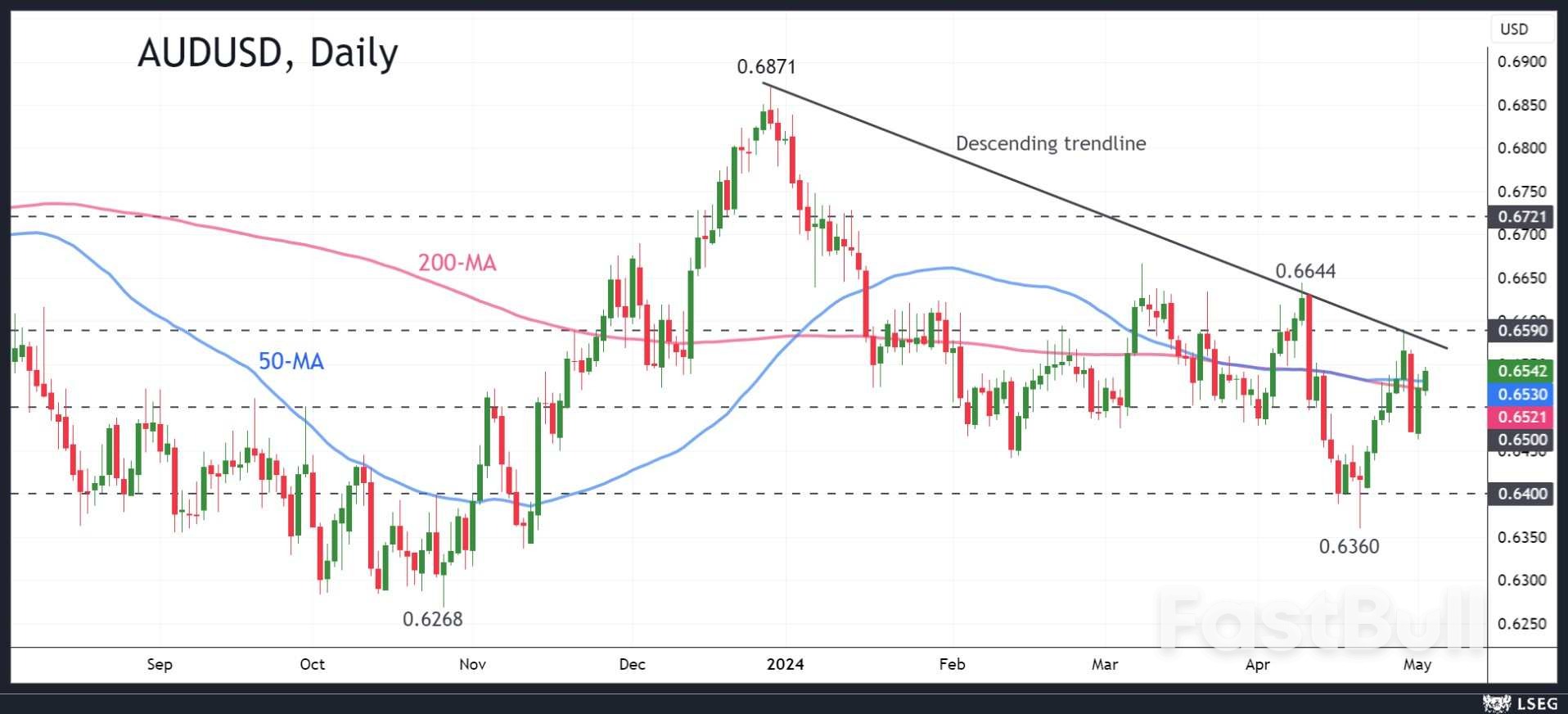
          If there is a hawkish tilt and the RBA reinstates its tightening bias, the aussie could recover above its moving averages and challenge the descending trendline around $0.6590. A step higher would bring the April peak of $0.6644 into range before attention shifts to the $0.6700 level.RBA Decision: Will A Rate Hike Be Back on The Table?_2
          In the scenario that the RBA overlooks the latest signs of price stickiness, the aussie could head back towards the April trough of $0.6360 before revisiting the October low of $0.6268.

          Is there a risk of a surprise rate hike?

          With sticky inflation in the US also proving problematic for the Fed, there's already been a sharp repricing of rate cut expectations for the major central banks. For the RBA, investors have gone a step further and priced in around a 40% probability of a 25-basis-point rate increase by year end. Hence, a hawkish tone alone might not necessarily spur a significant reaction in the markets on Tuesday.RBA Decision: Will A Rate Hike Be Back on The Table?_3
          However, it is worth considering Governor Bullock's greater urgency in beating inflation compared to her predecessor. So a surprise rate hike cannot be completely ruled out, particularly as policymakers have the option of a smaller increase of 15 bps at their disposal.
          To stay updated on all economic events of today, please check out our Economic calendar
          Risk Warnings and Disclaimers
          You understand and acknowledge that there is a high degree of risk involved in trading. Following any strategies or investment methods may lead to potential losses. The content on the site is provided by our contributors and analysts for information purposes only. You are solely responsible for determining whether any trading assets, securities, strategy, or any other product is suitable for investing based on your own investment objectives and financial situation.
          Add to Favorites
          Share

          US Oil and Gas Production Rebounds After Winter Storm

          Kevin Du

          Economic

          Energy

          U.S. oil and gas production rebounded sharply in February after extensive disruption the previous month caused by freezing wells and other outages stemming from Winter Storm Heather in the middle of January.
          Nationwide crude and condensates output jumped by 0.6 million barrels per day (b/d) in February reversing a decline of 0.7 million b/d in January, according to data from the U.S. Energy Information Administration (EIA).
          For 10 days between Jan. 13 and Jan. 23, centred around the winter storm, temperatures across the Lower 48 states were significantly colder than average for the time of year.
          The storm had a relatively large impact on the country's top producing area in the Permian Basin in Texas and New Mexico with frozen equipment and crews unable to reach well sites.
          But as the storm passed and normal operations were restored, output bounced back, causing a large jump in reported daily flows ("Petroleum supply monthly", EIA, April 30).
          Production from the Lower 48 states excluding federal waters in the Gulf of Mexico surged by 0.5 million b/d in February after declining 0.6 million b/d the month before.

          Oil Stabilisation?

          There are tentative signs that U.S. oil production is stabilising after the sharp fall in prices between the middle of 2022 and the middle of 2023.
          Lower 48 production was up by almost 0.7 million b/d in February compared with the same month a year earlier but there had been little or no growth in the last six months.
          Front-month U.S. crude futures prices have averaged around $73-84 per barrel for the last six months, close to the long-run average since the start of the century, after adjusting for inflation.
          Front-month futures prices have retreated from an average of more than $123 in June 2022, in the 82nd percentile for all months since 2000, four months after Russia's invasion of Ukraine.
          In a delayed response to lower prices, the number of rigs drilling for oil has averaged 500-510 per month since September 2023 down from an average of 623 in December 2022.
          Storm-related distortions will make identifying a change in trend difficult for another month or two, but there are signs the industry has found a new equilibrium after the shock caused by Russia's invasion.

          U.S. Gas Production

          Dry gas production rebounded by 2.3 billion cubic feet per day (bcf/d) in February after declining by 3.1 bcf/d in January owing to the storm ("Natural gas monthly", EIA, April 30).
          Production in February had increased by 3.7 bcf/d or 3.7% compared with the same month a year earlier, even after adjusting for the extra day of output owing to the leap year.
          But there had been essentially no growth in daily output since November, which could signal output is stabilising in gas too after an even more severe fall in prices.
          Front-month futures prices have averaged less than $2 per million British thermal units since the start of 2024, the lowest in real terms since the futures contract began trading in 1990.
          The number of rigs drilling primarily for gas averaged between 115 and 120 each month between September 2023 and February 2024, down from a post-invasion peak of 162 in September 2022.
          So far, gas inventories have remained far above normal because of the exceptionally warm winter in 2023/24, which more than offset the impact of ultra-low prices and record gas consumption by power generators.
          Inventories were almost 680 bcf (+39% or +1.46 standard deviations) above the prior 10-year seasonal average in late April 2024, according to weekly gas storage data from the EIA.
          The surplus had swelled almost continuously from just 64 bcf (+2% or +0.24 standard deviations) at the start of winter on Oct. 1, narrowing only briefly during the winter storm in January.
          In late February, however, several of the largest gas producers announced cuts to drilling programmes and/or output in an effort to reduce excess inventories and lift prices.
          The number of rigs drilling for gas declined even further to an average of just 108 in April, the lowest since the pandemic and its aftermath in 2020/21 and before that the last gas glut in 2016.
          Fewer rigs and increased consumption by power generators should eventually eliminated excess inventories, but the adjustment would be accelerated if there is a heatwave this summer boosting airconditioning.

          Source: Reuters

          To stay updated on all economic events of today, please check out our Economic calendar
          Risk Warnings and Disclaimers
          You understand and acknowledge that there is a high degree of risk involved in trading. Following any strategies or investment methods may lead to potential losses. The content on the site is provided by our contributors and analysts for information purposes only. You are solely responsible for determining whether any trading assets, securities, strategy, or any other product is suitable for investing based on your own investment objectives and financial situation.
          Add to Favorites
          Share
          FastBull
          Copyright © 2025 FastBull Ltd

          728 RM B 7/F GEE LOK IND BLDG NO 34 HUNG TO RD KWUN TONG KLN HONG KONG

          TelegramInstagramTwitterfacebooklinkedin
          App Store Google Play Google Play
          Products
          Charts

          Chats

          Q&A with Experts
          Screeners
          Economic Calendar
          Data
          Tools
          Membership
          Features
          Function
          Markets
          Copy Trading
          Latest Signals
          Contests
          News
          Analysis
          24/7
          Columns
          Education
          Company
          Careers
          About Us
          Contact Us
          Advertising
          Help Center
          Feedback
          User Agreement
          Privacy Policy
          Business

          White Label

          Data API

          Web Plug-ins

          Poster Maker

          Affiliate Program

          Risk Disclosure

          The risk of loss in trading financial instruments such as stocks, FX, commodities, futures, bonds, ETFs and crypto can be substantial. You may sustain a total loss of the funds that you deposit with your broker. Therefore, you should carefully consider whether such trading is suitable for you in light of your circumstances and financial resources.

          No decision to invest should be made without thoroughly conducting due diligence by yourself or consulting with your financial advisors. Our web content might not suit you since we don't know your financial conditions and investment needs. Our financial information might have latency or contain inaccuracy, so you should be fully responsible for any of your trading and investment decisions. The company will not be responsible for your capital loss.

          Without getting permission from the website, you are not allowed to copy the website's graphics, texts, or trademarks. Intellectual property rights in the content or data incorporated into this website belong to its providers and exchange merchants.

          Not Logged In

          Log in to access more features

          FastBull Membership

          Not yet

          Purchase

          Become a signal provider
          Help Center
          Customer Service
          Dark Mode
          Price Up/Down Colors

          Log In

          Sign Up

          Position
          Layout
          Fullscreen
          Default to Chart
          The chart page opens by default when you visit fastbull.com