• Trade
  • Markets
  • Copy
  • Contests
  • News
  • 24/7
  • Calendar
  • Q&A
  • Chats
Trending
Screeners
SYMBOL
LAST
BID
ASK
HIGH
LOW
NET CHG.
%CHG.
SPREAD
SPX
S&P 500 Index
6827.42
6827.42
6827.42
6899.86
6801.80
-73.58
-1.07%
--
DJI
Dow Jones Industrial Average
48458.04
48458.04
48458.04
48886.86
48334.10
-245.98
-0.51%
--
IXIC
NASDAQ Composite Index
23195.16
23195.16
23195.16
23554.89
23094.51
-398.69
-1.69%
--
USDX
US Dollar Index
97.950
98.030
97.950
98.500
97.950
-0.370
-0.38%
--
EURUSD
Euro / US Dollar
1.17394
1.17409
1.17394
1.17496
1.17192
+0.00011
+ 0.01%
--
GBPUSD
Pound Sterling / US Dollar
1.33707
1.33732
1.33707
1.33997
1.33419
-0.00148
-0.11%
--
XAUUSD
Gold / US Dollar
4299.39
4299.39
4299.39
4353.41
4257.10
+20.10
+ 0.47%
--
WTI
Light Sweet Crude Oil
57.233
57.485
57.233
58.011
56.969
-0.408
-0.71%
--

Community Accounts

Signal Accounts
--
Profit Accounts
--
Loss Accounts
--
View More

Become a signal provider

Sell trading signals to earn additional income

View More

Guide to Copy Trading

Get started with ease and confidence

View More

Signal Accounts for Members

All Signal Accounts

Best Return
  • Best Return
  • Best P/L
  • Best MDD
Past 1W
  • Past 1W
  • Past 1M
  • Past 1Y

All Contests

  • All
  • Trump Updates
  • Recommend
  • Stocks
  • Cryptocurrencies
  • Central Banks
  • Featured News
Top News Only
Share

Israel Says It Kills Senior Hamas Commander Raed Saed In Gaza

Share

Ukraine's Navy Says Russian Drone Attack Hit Civilian Turkish Vessel Carrying Sunflower Oil To Egypt On Saturday

Share

Israeli Military Says It Put Planned Strike On South Lebanon Site On Hold After Lebanese Army Requested Access

Share

Norwegian Nobel Committee: Calls On The Belarusian Authorities To Release All Political Prisoners

Share

Norwegian Nobel Committee: His Freedom Is A Deeply Welcome And Long-Awaited Moment

Share

Ukraine Says It Received 114 Prisoners From Belarus

Share

USA Embassy In Lithuania: Maria Kalesnikava Is Not Going To Vilnius

Share

USA Embassy In Lithuania: Other Prisoners Are Being Sent From Belarus To Ukraine

Share

Ukraine President Zelenskiy: Five Ukrainians Released By Belarus In US-Brokered Deal

Share

USA Vilnius Embassy: USA Stands Ready For "Additional Engagement With Belarus That Advances USA Interests"

Share

USA Vilnius Embassy: Belarus, USA, Other Citizens Among The Prisoners Released Into Lithuania

Share

USA Vilnius Embassy: USA Will Continue Diplomatic Efforts To Free The Remaining Political Prisoners In Belarus

Share

USA Vilnius Embassy: Belarus Releases 123 Prisoners Following Meeting Of President Trump's Envoy Coale And Belarus President Lukashenko

Share

USA Vilnius Embassy: Masatoshi Nakanishi, Aliaksandr Syrytsa Are Among The Prisoners Released By Belarus

Share

USA Vilnius Embassy: Maria Kalesnikava And Viktor Babaryka Are Among The Prisoners Released By Belarus

Share

USA Vilnius Embassy: Nobel Peace Prize Laureate Ales Bialiatski Is Among The Prisoners Released By Belarus

Share

Belarusian Presidential Administration Telegram Channel: Lukashenko Has Pardoned 123 Prisoners As Part Of Deal With US

Share

Two Local Syrian Officials: Joint US-Syrian Military Patrol In Central Syria Came Under Fire From Unknown Assailants

Share

Israeli Military Says It Targeted 'Key Hamas Terrorist' In Gaza City

Share

Rwanda's Actions In Eastern Drc Are A Clear Violation Of Washington Accords Signed By President Trump - Secretary Of State Rubio

TIME
ACT
FCST
PREV
U.K. Trade Balance Non-EU (SA) (Oct)

A:--

F: --

P: --

U.K. Trade Balance (Oct)

A:--

F: --

P: --

U.K. Services Index MoM

A:--

F: --

P: --

U.K. Construction Output MoM (SA) (Oct)

A:--

F: --

P: --

U.K. Industrial Output YoY (Oct)

A:--

F: --

P: --

U.K. Trade Balance (SA) (Oct)

A:--

F: --

P: --

U.K. Trade Balance EU (SA) (Oct)

A:--

F: --

P: --

U.K. Manufacturing Output YoY (Oct)

A:--

F: --

P: --

U.K. GDP MoM (Oct)

A:--

F: --

P: --

U.K. GDP YoY (SA) (Oct)

A:--

F: --

P: --

U.K. Industrial Output MoM (Oct)

A:--

F: --

P: --

U.K. Construction Output YoY (Oct)

A:--

F: --

P: --

France HICP Final MoM (Nov)

A:--

F: --

P: --

China, Mainland Outstanding Loans Growth YoY (Nov)

A:--

F: --

P: --

China, Mainland M2 Money Supply YoY (Nov)

A:--

F: --

P: --

China, Mainland M0 Money Supply YoY (Nov)

A:--

F: --

P: --

China, Mainland M1 Money Supply YoY (Nov)

A:--

F: --

P: --

India CPI YoY (Nov)

A:--

F: --

P: --

India Deposit Gowth YoY

A:--

F: --

P: --

Brazil Services Growth YoY (Oct)

A:--

F: --

P: --

Mexico Industrial Output YoY (Oct)

A:--

F: --

P: --

Russia Trade Balance (Oct)

A:--

F: --

P: --

Philadelphia Fed President Henry Paulson delivers a speech
Canada Building Permits MoM (SA) (Oct)

A:--

F: --

P: --

Canada Wholesale Sales YoY (Oct)

A:--

F: --

P: --

Canada Wholesale Inventory MoM (Oct)

A:--

F: --

P: --

Canada Wholesale Inventory YoY (Oct)

A:--

F: --

P: --

Canada Wholesale Sales MoM (SA) (Oct)

A:--

F: --

P: --

Germany Current Account (Not SA) (Oct)

A:--

F: --

P: --

U.S. Weekly Total Rig Count

A:--

F: --

P: --

U.S. Weekly Total Oil Rig Count

A:--

F: --

P: --

Japan Tankan Large Non-Manufacturing Diffusion Index (Q4)

--

F: --

P: --

Japan Tankan Small Manufacturing Outlook Index (Q4)

--

F: --

P: --

Japan Tankan Large Non-Manufacturing Outlook Index (Q4)

--

F: --

P: --

Japan Tankan Large Manufacturing Outlook Index (Q4)

--

F: --

P: --

Japan Tankan Small Manufacturing Diffusion Index (Q4)

--

F: --

P: --

Japan Tankan Large Manufacturing Diffusion Index (Q4)

--

F: --

P: --

Japan Tankan Large-Enterprise Capital Expenditure YoY (Q4)

--

F: --

P: --

U.K. Rightmove House Price Index YoY (Dec)

--

F: --

P: --

China, Mainland Industrial Output YoY (YTD) (Nov)

--

F: --

P: --

China, Mainland Urban Area Unemployment Rate (Nov)

--

F: --

P: --

Saudi Arabia CPI YoY (Nov)

--

F: --

P: --

Euro Zone Industrial Output YoY (Oct)

--

F: --

P: --

Euro Zone Industrial Output MoM (Oct)

--

F: --

P: --

Canada Existing Home Sales MoM (Nov)

--

F: --

P: --

Euro Zone Total Reserve Assets (Nov)

--

F: --

P: --

U.K. Inflation Rate Expectations

--

F: --

P: --

Canada National Economic Confidence Index

--

F: --

P: --

Canada New Housing Starts (Nov)

--

F: --

P: --

U.S. NY Fed Manufacturing Employment Index (Dec)

--

F: --

P: --

U.S. NY Fed Manufacturing Index (Dec)

--

F: --

P: --

Canada Core CPI YoY (Nov)

--

F: --

P: --

Canada Manufacturing Unfilled Orders MoM (Oct)

--

F: --

P: --

Canada Manufacturing New Orders MoM (Oct)

--

F: --

P: --

Canada Core CPI MoM (Nov)

--

F: --

P: --

Canada Manufacturing Inventory MoM (Oct)

--

F: --

P: --

Canada CPI YoY (Nov)

--

F: --

P: --

Canada CPI MoM (Nov)

--

F: --

P: --

Canada CPI YoY (SA) (Nov)

--

F: --

P: --

Canada Core CPI MoM (SA) (Nov)

--

F: --

P: --

Q&A with Experts
    • All
    • Chatrooms
    • Groups
    • Friends
    Connecting
    .
    .
    .
    Type here...
    Add Symbol or Code

      No matching data

      All
      Trump Updates
      Recommend
      Stocks
      Cryptocurrencies
      Central Banks
      Featured News
      • All
      • Russia-Ukraine Conflict
      • Middle East Flashpoint
      • All
      • Russia-Ukraine Conflict
      • Middle East Flashpoint
      Search
      Products

      Charts Free Forever

      Chats Q&A with Experts
      Screeners Economic Calendar Data Tools
      Membership Features
      Data Warehouse Market Trends Institutional Data Policy Rates Macro

      Market Trends

      Market Sentiment Order Book Forex Correlations

      Top Indicators

      Charts Free Forever
      Markets

      News

      News Analysis 24/7 Columns Education
      From Institutions From Analysts
      Topics Columnists

      Latest Views

      Latest Views

      Trending Topics

      Top Columnists

      Latest Update

      Signals

      Copy Rankings Latest Signals Become a signal provider AI Rating
      Contests
      Brokers

      Overview Brokers Assessment Rankings Regulators News Claims
      Broker listing Forex Brokers Comparison Tool Live Spread Comparison Scam
      Q&A Complaint Scam Alert Videos Tips to Detect Scam
      More

      Business
      Events
      Careers About Us Advertising Help Center

      White Label

      Data API

      Web Plug-ins

      Affiliate Program

      Awards Institution Evaluation IB Seminar Salon Event Exhibition
      Vietnam Thailand Singapore Dubai
      Fans Party Investment Sharing Session
      FastBull Summit BrokersView Expo
      Recent Searches
        Top Searches
          Markets
          News
          Analysis
          User
          24/7
          Economic Calendar
          Education
          Data
          • Names
          • Latest
          • Prev

          View All

          No data

          Scan to Download

          Faster Charts, Chat Faster!

          Download App
          English
          • English
          • Español
          • العربية
          • Bahasa Indonesia
          • Bahasa Melayu
          • Tiếng Việt
          • ภาษาไทย
          • Français
          • Italiano
          • Türkçe
          • Русский язык
          • 简中
          • 繁中
          Open Account
          Search
          Products
          Charts Free Forever
          Markets
          News
          Signals

          Copy Rankings Latest Signals Become a signal provider AI Rating
          Contests
          Brokers

          Overview Brokers Assessment Rankings Regulators News Claims
          Broker listing Forex Brokers Comparison Tool Live Spread Comparison Scam
          Q&A Complaint Scam Alert Videos Tips to Detect Scam
          More

          Business
          Events
          Careers About Us Advertising Help Center

          White Label

          Data API

          Web Plug-ins

          Affiliate Program

          Awards Institution Evaluation IB Seminar Salon Event Exhibition
          Vietnam Thailand Singapore Dubai
          Fans Party Investment Sharing Session
          FastBull Summit BrokersView Expo

          September 29th Financial News

          FastBull Featured

          Daily News

          Summary:

          Japan's inflation has slowed down for three consecutive months, supporting BoJ's view of bringing prices down; Barkin: It is too early to say if rate hikes are needed; the U.S. government shutdown looms, the House and Senate hold procedural votes...

          [Quick Facts]
          1. Japan's inflation has slowed down for three consecutive months, supporting BoJ's view of bringing prices down.
          2. Barkin: It is too early to say if rate hikes are needed.
          3. The U.S. initial claims data stabilized, and personal consumption expenditures have dropped significantly.
          4. The Eurozone's economic sentiment index fell for the fifth consecutive month in September.
          5. The U.S. inventories lower, triggering oil trading frenzy.
          6. The U.S. government shutdown looms, the House and Senate hold procedural votes.
          [News Details]
          Japan's inflation has slowed down for three consecutive months, supporting BoJ's view of bringing prices down
          Inflation in Tokyo, slowed for the third consecutive month in September, supporting the Bank of Japan's view that prices will further cool. Data on Friday showed that CPI excluding fresh food rose 2.5% YoY, lower than August's 2.8%. Commodity prices are falling which affects the economy, and the effects are lagging. The government's decision to expand utility subsidies also helped lower the headline inflation by 0.9 percentage points. Price trends remain a major concern for the Bank of Japan, which may need to raise its price forecasts at its October meeting as inflation remains stronger than initially expected. In its latest outlook released in July, the Bank of Japan saw its key price index averaging 2.5% in the year to March and expected it to rise by the end of the year.
          Barkin: It is too early to say if rate hikes are needed
          "I don't think this kind of growth we saw in the second and third quarters is likely to continue," said Richmond Fed President Barkin. Barkin on whether it was necessary to raise interest rates again this year, said it was too early to say if another rate hikes were needed. The negative factors caused by the government shutdown may cause more uncertainty to the economy. Expect to learn more about the trajectory of the economy and inflation in the coming weeks and months.
          While Fed officials agreed this month to keep their benchmark rate unchanged, 12 of 19 officials favored another rate hike in 2023, underscoring the central bank's desire to ensure inflation continues to decelerate. Forecasts also show that Fed officials generally see lower interest rate cuts in 2024 than previously expected, due to a stronger labor market. Barkin supports the decision to keep interest rates unchanged this month, saying it is difficult to know where demand and inflation are headed.
          The U.S. initial claims data stabilized, and personal consumption expenditures have dropped significantly
          The number of initial jobless claims in the U.S. continues to remain at a healthy level. The number of initial jobless claims last week was 204,000, slightly lower than expected and flatted with the previous week. The increase in continuing jobless claims was slightly lower than expected, but still close to the lows of the past 6-7 months.
          According to first-quarter data, personal consumption expenditures and the overall price index declined significantly. In terms of marginal effects, this is a modest development, which is why yields fell and stocks gained slightly. However, given the various cross-cutting factors in the market, the impact should be relatively transient.
          The Eurozone's economic sentiment index fell for the fifth consecutive month in September
          The Eurozone's economic sentiment index fell for the fifth consecutive month in September due to declines in services, retail, and consumer confidence, but the decline was slightly lower than expected. In addition, the industrial sentiment index improved after seven consecutive months of declining. Data released today showed that the Eurozone economic sentiment index fell to 93.3 in September, revised to 93.6 in August. Industrial confidence increased instead of falling, while the services industry, the largest sector of the Eurozone economy, declined. But it's not as serious as expected. In addition, consumer inflation expectations rose for the second consecutive month. Manufacturing sales price expectations also rose, although it was only slightly above the nearly three-year low recorded in August.
          The U.S. inventories lower, triggering oil trading frenzy
          The spread between Brent crude and the Middle East's Dubai benchmark, also known as the Brent-Dubai spread, surged on Thursday to a premium of more than $4 a barrel due to extremely low U.S. inventories. This is a strong contrast to last month when the spread was at a discount. Traders attributed the strengthening in spreads to the high Brent futures prices, as well as backwardation across the curve.
          Backwardation surged along with WTI crude oil prices. Betting on the direction of the spread has been one of the most popular one-way trades this year after the Russia-Ukraine conflict and prolonged Saudi-led production cuts pushed up the price of Dubai crude relative to Brent. This has resulted in spreads falling for about 10 consecutive months. However, this trend reversed this month as markets tightened along the Atlantic coast. The rise of U.S. crude prices will make it less attractive in Asian markets, while flows of Middle Eastern crude to Europe and the U.S. are expected to increase.
          The U.S. government shutdown looms, the House and Senate hold procedural votes
          There are just three days left before a partial shutdown of U.S. governments, the Senate is expected to hold a procedural vote on Thursday on a stopgap measure. House Speaker McCarthy has vetoed the bill. Meanwhile, the Republican-controlled House will continue to vote on amendments to four appropriations bills that have no chance of becoming law and, even if they did, would not be able to prevent a government shutdown. Congress has to pass legislation that President Joe Biden can sign before midnight Saturday to avoid the furloughs of hundreds of thousands of federal workers and the suspension of a wide range of services and the release of economic data.
          [Focus of the Day]
          UTC+8 15:40 ECB President Lagarde Delivers a Speech
          UTC+8 17:00 ECB Governing Council Member Kazaks Delivers a Speech
          UTC+8 17:00 Eurozone HICP (Sep)
          UTC+8 20:30 U.S. PCE (Aug)
          UTC+8 20:30 U.S. Personal Consumption Expenditures (Aug)
          UTC+8 20:30 Canada GDP YoY (Jul)
          UTC+8 00:45 New York Fed President Williams Delivers a Speech
          Risk Warnings and Disclaimers
          You understand and acknowledge that there is a high degree of risk involved in trading. Following any strategies or investment methods may lead to potential losses. The content on the site is provided by our contributors and analysts for information purposes only. You are solely responsible for determining whether any trading assets, securities, strategy, or any other product is suitable for investing based on your own investment objectives and financial situation.
          Comments
          Add to Favorites
          Share

          Gasoil Cracks Strengthen

          Owen Li

          Commodity

          Energy - No further China export quotas
          The rally in oil ran out of momentum yesterday and Brent struggled to hold onto gains made in the early part of the trading session. There is likely reluctance amongst participants to push too much higher right now with the market clearly in overbought territory. There is also possible nervousness that OPEC+ and specifically Saudi Arabia could start to ease cuts earlier than scheduled if prices move much higher- something we have highlighted for quite some time now.
          Gasoil cracks received a boost yesterday with the November ICE gasoil crack rallying from around US$30/bbl to close to US$34/bbl. This is after reports that the Chinese government told state refiners that it is unlikely that they will receive any further refined product export quotas this year. The government has issued three batches of export quotas so far this year, totalling 39.99mt, up from the 37.25mt issued over the whole of 2022. There had been some hope that China would release further export quotas, which would help ease the tightness in middle distillate markets.
          The latest inventory data from Global Insights shows that refined product inventories in the ARA region increased by 76kt over the last week to 5.29mt. Gasoil saw the largest increase in stocks, growing by 79kt to 1.99mt. However, it is still well below the 5-year average at the moment and will be a concern as we move closer towards the winter months. In Singapore, the latest data shows that total refined product inventories fell by 1.95MMbbls over the last week to 42.04MMbbls. The draw was largely driven by fuel oil stocks, which fell by 2.08MMbbls to 19.77MMbbls. while light distillates saw a marginal decline of 245Mbbls to 12.89MMbbls.
          In the gas market, Henry Hub managed a second day of gains with the market settling almost 1.6% higher yesterday. This is despite US gas storage increasing by 90Bcf over the last week, slightly above the 88Bcf the market was expecting. This leaves total US natural gas storage at 3.36Tcf, up 13.4% YoY and also 6% above the 5-year average. Forecasts for cooler weather appear to be what has driven the market higher.
          Metals – Zinc jumps higher
          The big mover in metals yesterday was zinc. LME zinc 3m prices settled 5.81% higher. This follows a sharp rise in cancelled warrants at LME warehouses. The latest data shows that cancelled warrants for zinc jumped 15,875 tonnes to 48,150 tonnes yesterday. The increase was driven by warehouses in Singapore. The sudden jump in cancelled warrants might result in declining inventories over the coming days.
          Shanghai Futures Exchange (ShFE) inventory data shows that weekly inventories for all base metals (with the exception of nickel) fell over the reporting week. Copper stocks fell by 15,169 tonnes to 38,996 tonnes, aluminium inventories declined 12.3% WoW to 79,194 tonnes- the lowest level since December 2016, while zinc and lead stocks fell over the week by 30.3% and 9%. In contrast, nickel inventories jumped 52.4% to 7,470 tonnes.
          In precious metals, gold prices in China fell after the government permitted more gold imports. Rallying gold prices in China in recent months have resulted in a record premium to international prices. The Shanghai gold premium had risen to a record of over US$120/oz recently but fell to a premium of just US$10/oz at yesterday’s close.
          Agriculture – Brazilian coffee harvest advances smoothly
          Cooxupe, Brazil's coffee export cooperative, reported that the domestic coffee harvest progressed to 99.2% as of 22 September compared to around 100% at this point in the season last year. Brazil reported that hot weather and irregular rains up to August, and improved weather conditions in September boosted the flowering progress for the coffee crop, especially in the producing regions of Matas de Minas (100% of harvest) and southern Minas Gerais (harvests 99.5%).

          Source: ING

          Risk Warnings and Disclaimers
          You understand and acknowledge that there is a high degree of risk involved in trading. Following any strategies or investment methods may lead to potential losses. The content on the site is provided by our contributors and analysts for information purposes only. You are solely responsible for determining whether any trading assets, securities, strategy, or any other product is suitable for investing based on your own investment objectives and financial situation.
          Comments
          Add to Favorites
          Share

          Policy on Hold as Risks Evolve

          Alex

          Central Bank

          Economic

          The Monthly CPI Indicator rose 0.6% (5.2%yr) in August, above the 0.3% (4.9%yr) print in July but still broadly in line with a trend deceleration since the peak of 8.4%yr in December 2022. While the print for headline inflation was in line with Westpac’s forecast, the component detail provided some surprises. Inflation in the housing segment was much weaker than anticipated – up 0.1% (6.6%yr) – driven by a fall in electricity prices (–1.3%mth) associated with the Energy Bill Relief Fund rebates in Melbourne. There were some key upside surprises too, including a 9.1% lift in fuel, a 1.3% increase in alcohol and tobacco prices, and a much more muted –0.1% fall in clothing and footwear than we initially anticipated. Underlying inflation momentum remained steady in August, with the Monthly Trimmed Mean holding flat at 5.6%yr. These developments, which in part reflects a stronger oil price (via fuel prices) and a weaker AUD (via imported components) – trends which seem to have persisted through to September – point to some upside risk to inflation over the near-term.
          Turning to the labour market, job vacancies were reported to have fallen by 8.9% between May and August, a pick-up from the more modest decline of 2.5% over the prior three months. The tone of the survey is consistent with other evidence on labour market conditions, which suggests that the labour market has moved past its tightest point – a consequence of the significant improvement in labour supply and a gradual moderation in labour demand from very strong levels. That said, the total stock of job vacancies remains is still 72% above pre-pandemic levels and the vacancy-to-unemployment ratio remains at a historically elevated 0.72, implying that that labour market conditions remain very tight for now and there is further scope to ease over the next year.
          However, as discussed by Chief Economist Bill Evans, the Monthly CPI Indicator is unlikely to have a major influence the RBA’s decision next week at the October Board meeting. As has been the case over the past year, the Board’s preference is to inspect the more comprehensive quarterly update on inflation – due next month – so it is therefore unlikely to change policy on the basis of the Monthly Indicator in the interim. Like the last two months, the RBA should continue to view the argument for remaining on hold as being the “stronger one”. This sentiment will be supported by the constructive flow of data developments over the last week, including another subdued print for nominal retail sales, with spending rising by only 0.2% in August, and emerging signs of a turning point in the labour market, suggesting that the impact of the RBA’s rapid tightening cycle is clearly working its way through the economy. Westpac remains of the view that the RBA will remain on hold until August 2024, wherein the next rate cut cycle is expected to begin in order to restore balance to demand conditions and support growth’s return towards trend.
          It was a quiet week offshore, with mostly second-tier data releases in the US.
          In the US, regional surveys pointed to a mixed picture. The Chicago Fed National Activity Index suggested the economy was growing below potential with a negative reading of –0.16 in August following a positive reading in July. All sub-indicators were in the red, though August’s weakness looks to be centred on a souring in personal consumption and housing. The employment indicator remained negative for a fourth consecutive month, reflective of emerging slack in the labour market.
          The Richmond Fed Manufacturing index broke a 16-month streak of negative readings, coming in at +5pts for September. On current conditions, strength came from shipments, capacity utilisation and new orders. For the region, employment in the sector was optimistic overall, with number of employees rising as wages continued its ascent. Expectations remained upbeat, but less so than August. Meanwhile, the Kansas City Fed Manufacturing index fell to –8pts in September from flat in August, although a semblance of optimism for expectations six months ahead persevered. Of note, the prices paid and received sub-indicators for current vs previous month were both positive. The rise in oil prices through September likely contributed to higher producer prices but further readings are necessary to confirm whether its impact will persist.
          Durable goods orders were firmer than expected in August, headline orders rising 0.2%mth and the measure excluding transport orders lifting 0.4%mth. Most of the strength was a consequence of defence spending however – excluding this, durable goods orders declined 0.7%mth. This supports the continued pessimistic outlook for manufacturing from the private sector, with firms’ investment intentions remaining under pressure. Weakness in non-defence goods orders, alongside autoworkers’ strikes, points to some downside risk for private investment in GDP for Q3.
          Regarding the consumer, there was a notable slip in confidence according to the Conference Board’s September survey, from 108.7 to 103.0, to be only slightly above the optimism/pessimism threshold. Underlying this is a clear divergence between households’ views around the present situation and expectations, the former still very optimistic at 147.1, whilst the latter soured nearly 10pts into deeply pessimistic territory, at 73.7.
          FOMC members were also active this week. Many, Bowman and Kashkari in particular, were advocating for an additional rate hike on the basis of inflation risks; however, comments from Barkin and Goolsbee emphasised the importance of assessing the materialising impact of policy tightening. Of note, Goolsbee spoke on the trade-off between inflation and unemployment, positing that it may be weaker in the post-COVID era and hence, there is a greater risk of over tightening.

          Source: Westpac Banking Corporation

          To stay updated on all economic events of today, please check out our Economic calendar
          Risk Warnings and Disclaimers
          You understand and acknowledge that there is a high degree of risk involved in trading. Following any strategies or investment methods may lead to potential losses. The content on the site is provided by our contributors and analysts for information purposes only. You are solely responsible for determining whether any trading assets, securities, strategy, or any other product is suitable for investing based on your own investment objectives and financial situation.
          Comments
          Add to Favorites
          Share

          Curtain Comes Down on Quarter to Forget

          Damon

          Economic

          Investors in Asia go into the final trading day of a bruising quarter - also a day packed with top-tier economic indicators from Japan - in a slightly better frame of mind after a much-needed rebound in global sentiment and risk assets on Thursday.
          Japanese retail sales, industrial output, consumer confidence and Tokyo inflation data top the regional calendar on Friday, which also includes Australian credit and lending figures and Thai manufacturing and current account data.
          Investors will not be able to switch off completely over the weekend, however, with the fast-evolving Evergrande saga making for gripping reading.
          On top of that, China's manufacturing and service sector purchasing managers index reports for September - official and unofficial - will be released on Sunday. Chinese markets will then close for the Golden week holidays.
          It has been a tough few week, and a tough quarter.
          The MSCI World stock index's rise on Thursday was its first in 10 days, snapping its longest losing streak since November 2011. Unless it rises 4% on Friday, it will post its first quarterly loss in a year.
          The MSCI Asia ex-Japan index fared even worse. It is on course for a 5% decline, which will be its second consecutive quarterly loss and seventh out of the last nine.Curtain Comes Down on Quarter to Forget _1Curtain Comes Down on Quarter to Forget _2
          Other Asia-related stats from the quarter tell a similar story.
          The yen is down three quarters in a row, and 10 out of the last 11; the Hong Kong property index is down three quarters, eyeing a 17% slide in Q3 and 30% loss so far this year, on track for its worst year since 2008; and Chinese shares are down two quarters in a row for the fist time since 2019.
          The drivers are by now well known - rising U.S. interest rates, surging Treasury yields and a powerful dollar rally, as well as a chronically underperforming China, tightening financial conditions and growing worries over the world economy.
          Some of these conditions may be stretched and the gloom over-cooked. Would a partial recovery in risk appetite and reversal of many of these trades at the start of the fourth quarter be a complete surprise?
          Thursday's market action show nothing ever moves in a straight line. Although the 10-year Treasury yield hit a new high intraday, U.S. yields fell across the curve, oil and the dollar posted notable losses, and stocks finally snapped higher.
          Sticking with the positivity, the International Monetary Fund said on Thursday it sees signs of economic stabilization in China and is confident it can grow faster if it takes steps to rebalance growth from investment toward consumer spending.
          In currency markets on Thursday, the yuan had its best day in two weeks, the yen eased a little bit further away from the 150/$ level, and the dollar index fell 0.5%, its biggest fall in nearly three weeks.
          Here are key developments that could provide more direction to markets on Friday:
          - Japan unemployment, retail sales, industrial output (August)
          - Japan Tokyo CPI inflation (August)
          - Australia lending, credit (August)

          Source:Yahoo

          To stay updated on all economic events of today, please check out our Economic calendar
          Risk Warnings and Disclaimers
          You understand and acknowledge that there is a high degree of risk involved in trading. Following any strategies or investment methods may lead to potential losses. The content on the site is provided by our contributors and analysts for information purposes only. You are solely responsible for determining whether any trading assets, securities, strategy, or any other product is suitable for investing based on your own investment objectives and financial situation.
          Comments
          Add to Favorites
          Share

          Surging Oil Prices: a New Concern for Central Banks

          Justin

          Central Bank

          Commodity

          Economic

          Surging oil prices have become the new concern for central banks, aggravating the current trilemma: how to balance slowing economies, still too-high inflation and the delayed impact of unprecedented rate hikes. Interestingly, the answer to this conundrum differs between major central banks.
          Looking ahead, the recent surge in oil prices will make things even more complicated as it will both worsen the economic slowdown but also push up inflation (or at least reduce the disinflationary trend). Balancing growth and inflation will become even harder and future interest rate decisions will not only be determined by these two variables but also by central banks’ credibility.
          In this regard, central banks most concerned about their credibility and the longer-term impact on inflation expectations could end up continuing to hike interest rates. In the following article, we will mainly focus on the eurozone and the ECB.

          Oil price rally likely to continue, but it's not sustainable in the longer run

          Oil prices are currently up by more than 25% this quarter and briefly reached $95/bbl last week. Our commodities analyst Warren Patterson expects oil prices to break above $100/bbl in the near term as supply cuts by OPEC+ countries more than offset weaker demand due to the global economy’s slowdown.
          However, he doesn’t see oil prices remaining above $100/bbl for long as weaker demand and political pressure to increase supply should help to bring oil prices back to levels slightly above $90/bbl.

          Is this the second wave of inflation that we thought would never come?

          A few weeks ago, we argued that the current inflation situation is not the same as the 1970s and that a second inflation wave looked highly unlikely. However, we also admitted that in the late 1970s, the second energy crisis was a main driver for the second inflation wave in many countries.
          In the eurozone, there were three peak periods for inflation in the 1970s. The first was in 1974, when headline inflation was close to 14%; the second in 1977 with headline inflation above 10%, and then again in late 1979 and early 1980 with headline inflation back at double-digit levels.
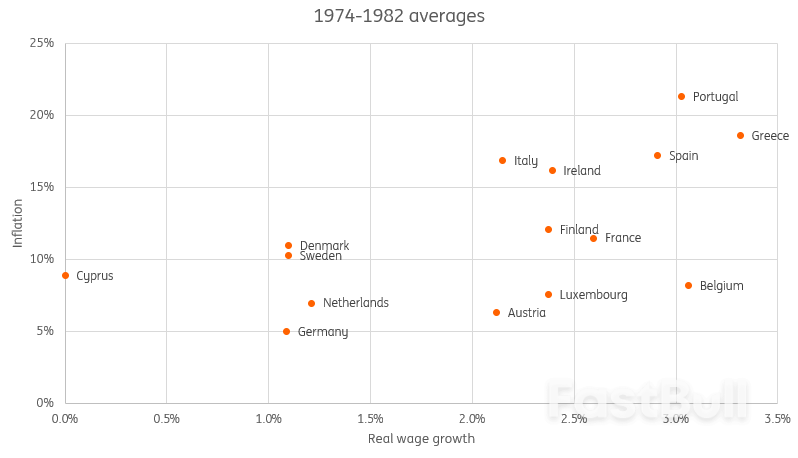
          Back then, real wage growth remained positive even during the spikes of the oil crises, which allowed inflation to remain above 7% for more than a decade (1972-84). Indeed, the countries that experienced higher real wage growth for the period also experienced the highest inflation over this period (see chart below).
          The current surge in inflation is different in that real wage growth turned negative quickly, which has slowed consumer demand drastically. This makes the chances of a prolonged second spike in inflation much smaller. With inflation currently trending down and wage growth stabilising above 4%, real wage growth is set to soon turn positive again, but we wouldn’t expect it to erase the losses from the past two years.
          At the same time, it is important to note that government support and employment growth have limited disposable income losses quite substantially.

          In the 70s, countries with higher real wage growth also experienced higher inflation

          Surging Oil Prices: a New Concern for Central Banks_1

          Source: European Commission AMECO - Inflation is measured as the average annual growth in the national CPI and real wage growth as average annual growth in real compensation per employee, with private consumption as deflator.

          European Commission AMECO

          Inflation is measured as the average annual growth in the national CPI and real wage growth as average annual growth in real compensation per employee, with private consumption as deflator.

          How do current oil prices change our inflation forecast?

          Despite this not being the 1970s, expectations of further disinflation will be impacted by higher oil prices. This could result in a slower decline of inflation to 2%. Given that our expectations for oil prices do include a drop in the first half of 2024 again, the effect on our own forecast is rather moderate. Plus, a smaller decline in energy prices has materialised this year compared to expectations (which impacts next year’s base effects).
          Assuming oil prices stay at $95/bbl for all of 2024, however, the headline figure would rise by 0.3ppt next year, with a peak of the energy price contribution of 1ppt in the second quarter. At the same time, higher oil prices would probably further dent consumer confidence and spending, thereby contributing to the current disinflationary trend due to weaker demand.
          Indeed, the big question is whether the higher oil price will once again result in broad-based second-round effects like we saw last year. A lot of drivers of core inflation are at this point still disinflationary, with manufacturing businesses still indicating that input costs are falling despite higher wages and energy prices. And as new orders are weakening, deflation for non-energy industrial goods is realistic towards the end of the year. For services, weaker demand is also contributing to slowing inflation despite higher wage costs, according to the September PMI. Our expectations are that core inflation will slow significantly from the 5.3% August reading towards the end of the year.
          Still, if the labour market remains as tight as it is now and the economy bounces back a bit in early 2024, there is a risk that higher energy input costs would also put core inflation further above 2%. A lot depends on the strength of the economy in the months ahead, adding uncertainty for the ECB.

          Pressure on the ECB to continue hiking

          Prior to the pandemic, most central banks would probably have looked past surging oil prices. Some even considered rising oil prices to eventually be deflationary, undermining purchasing power and industrial competitiveness. However, we are no longer in the pre-pandemic era, but the era of returned inflation. The ECB has emphasised in recent months that doing too little is more costly than doing too much in terms of rates.
          For the ECB, the recent staff projections were based on the technical assumption of an average oil price of $82/bbl in 2024. If oil prices were to average $95/bbl next year, this would probably push up the ECB’s inflation forecasts to 3.3% for 2024 (from 3.2%) and more importantly to 2.4% in 2025 (from 2.1%). As a result, the return to 2% would be delayed to 2026.
          The delayed return to 2% would not be the only reason for the ECB to consider further rate hikes. Even though the ECB would still acknowledge the deflationary nature of a new oil price shock, the risk that this new oil price shock could lead to a de-anchoring of inflation expectations will definitely add to the ECB’s concerns, making not only an additional rate hike more likely, but also that they stay higher for longer.

          Source:ING

          To stay updated on all economic events of today, please check out our Economic calendar
          Risk Warnings and Disclaimers
          You understand and acknowledge that there is a high degree of risk involved in trading. Following any strategies or investment methods may lead to potential losses. The content on the site is provided by our contributors and analysts for information purposes only. You are solely responsible for determining whether any trading assets, securities, strategy, or any other product is suitable for investing based on your own investment objectives and financial situation.
          Comments
          Add to Favorites
          Share

          What U.S. Congress Is Fighting Over as Shutdown Approaches

          Alex

          Political

          With the U.S. government due to run out of funding at midnight on Saturday, the Republican-controlled House of Representatives and the Democratic-controlled Senate are at odds over priorities they would like to include in legislation that would keep the government running in the new fiscal year that starts Oct. 1.
          Here are some of the issues they are fighting over:
          Spending
          House of Representatives Speaker Kevin McCarthy, a Republican, and Democratic President Joe Biden agreed in May to set overall agency spending at $1.59 trillion for the new fiscal year, as part of a deal that suspended the government's $31.4 trillion borrowing limit and removed the risk of a debt default.
          That agreement would keep spending roughly at the same level it is now, which amounts to an effective cut due to inflation.
          But House Republicans are pushing for deeper cuts, saying Congress needs to do more to shrink the federal government and rein in annual budget deficits that have grown sharply since the COVID-19 pandemic. They are advancing a set of spending bills that would reduce agency spending by $120 billion, or 7.6% from the current level, though those cuts would fall most heavily on domestic social programs.
          That is a relatively small slice of the total $6.4 trillion U.S. budget. Republicans are not proposing cuts to popular benefit programs like Social Security and Medicare, which are projected to grow dramatically as the U.S. population ages.
          Biden says McCarthy should stick with the original deal, and the White House has said the president would veto at least two of those spending bills.
          Immigration And Border Security
          House Republicans say any spending bill that would avoid a shutdown should include new restrictions on immigration to deal with a surge of migrants at the country's southern border. Their proposal includes:
          - Resumed construction of the U.S.-Mexico border wall, a signature policy of former Republican President Donald Trump
          - Tight limits on asylum seekers that would require them to apply for U.S. protection outside the country, or remain in detention while their case is considered
          - An increase in border agents and a boost in pay
          Biden is seeking additional money for border enforcement, but his Democrats oppose the Republicans' proposals as draconian.
          UKRAINE AID
          Biden is seeking $24 billion for Ukraine to help fight Russia, on top of the $113 billion the U.S. has already provided.
          A stopgap spending bill that has won bipartisan support in the Senate would include $6 billion for Ukraine. That leaves open the possibility for more aid later on.
          But some House Republicans oppose additional aid to the country and say they will vote against any bill that includes it.
          Disaster Aid
          The Federal Emergency Management Agency (FEMA) has warned Congress that it could soon run out of money to help people recover from hurricanes, wildfires and other natural disasters. The Senate has included $6 billion in disaster aid in its bipartisan stopgap bill, but that could face opposition in the House if it is paired with Ukraine aid.
          Abortion, Race and Other Social Issues
          House Republicans have sought to advance conservative social policies in several spending bills. Among them:
          - prohibiting pharmacies from dispensing mifepristone, an abortion drug
          - prohibiting the Defense Department from paying for employees to travel to states where it is legal to get an abortion
          - prohibiting Defense Department racial diversity programs
          - restrictions on teaching about racial topics
          Trump Criminal Cases
          Former President Donald Trump has called on Republicans in Congress to slash funding for the Justice Department and the FBI. He is facing two federal criminal prosecutions for seeking to overturn his 2020 election loss and mishandling classified documents.
          Some of Trump's allies in the House have backed that idea, but the chamber has not yet addressed Justice Department funding and it has not yet come up as a sticking point in the shutdown fight.

          Source: USNews

          Risk Warnings and Disclaimers
          You understand and acknowledge that there is a high degree of risk involved in trading. Following any strategies or investment methods may lead to potential losses. The content on the site is provided by our contributors and analysts for information purposes only. You are solely responsible for determining whether any trading assets, securities, strategy, or any other product is suitable for investing based on your own investment objectives and financial situation.
          Comments
          Add to Favorites
          Share

          China's Strong Metal Imports Not as Bullish as They Seem

          Devin

          Economic

          Refined copper volumes hit a year-to-date monthly high in August and primary aluminium imports were the highest since November 2021.
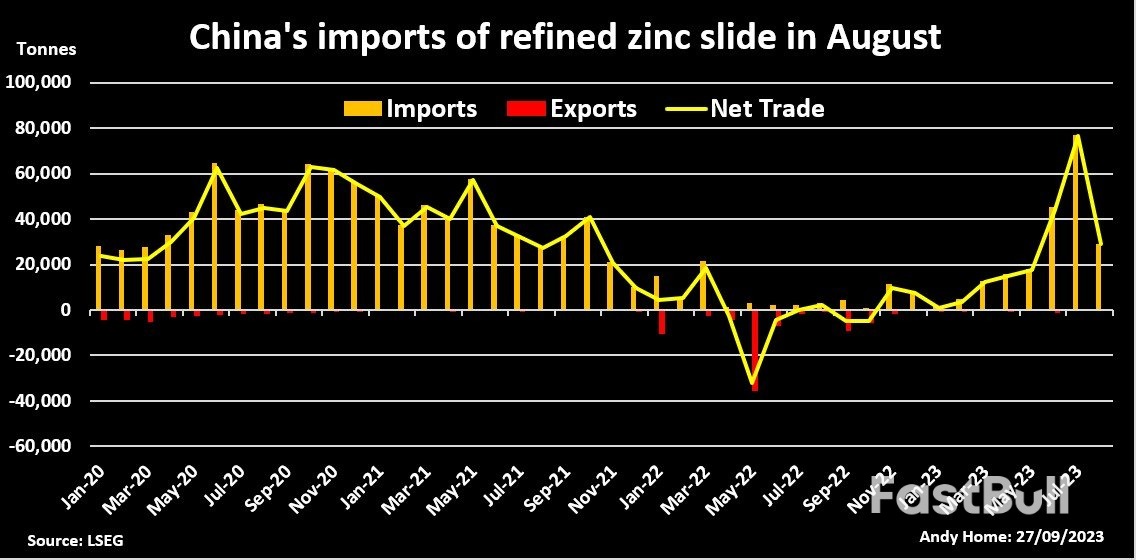
          The country has also fully reverted to being a net importer of unwrought zinc after flipping to net exporter in 2022.
          Rising imports are flowing through an open arbitrage window resulting from Shanghai Futures Exchange (ShFE) prices outperforming the London Metal Exchange (LME).
          While LME forward curves are in contango, cash is commanding a premium in Shanghai due to low visible exchange inventory.
          Higher imports would seem to fit the bullish narrative that the Chinese government's piecemeal stimulus programme is gaining traction and the world's largest buyer is recovering its metallic mojo.
          However, robust copper and aluminium imports come with important caveats and the broader metals trade picture is far more mixed.China's Strong Metal Imports Not as Bullish as They Seem_1
          From Russia With Love
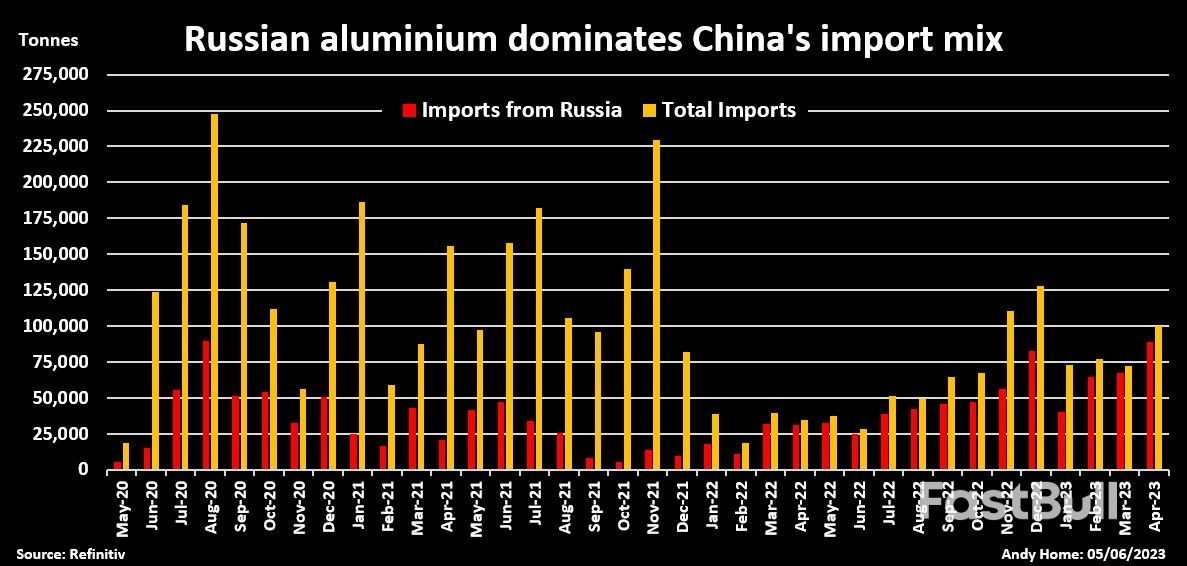
          China's imports of primary aluminium surged to a near two-year high of 153,000 metric tons in August, bringing the year-to-date count to 755,000 metric tons. Last year's equivalent tally was just 298,000 metric tons.
          However, just about all the metal being imported is Russian-brand. Imports of Russian aluminium accounted for 87% of the total in the first eight months of 2023.
          Is the headline acceleration in imports down to demand pull or supply push?
          Russian aluminium is not officially sanctioned but the U.S. market has been effectively closed by penal 200% import duties and many Western consumers are self-sanctioning by opting for different origin metal.
          China is clearly soaking up a large part of this displaced metal and it appears to be doing so at a discount.
          The average value of Russian imports was $2,162 per metric ton in August, compared with $2,279 for Malaysian-brand metal and $2,355 for both Australian and New Zealand imports.
          Without the Russian push, would China's aluminium imports look so impressively robust?China's Strong Metal Imports Not as Bullish as They Seem_2
          Slow Copper Boat To Shanghai
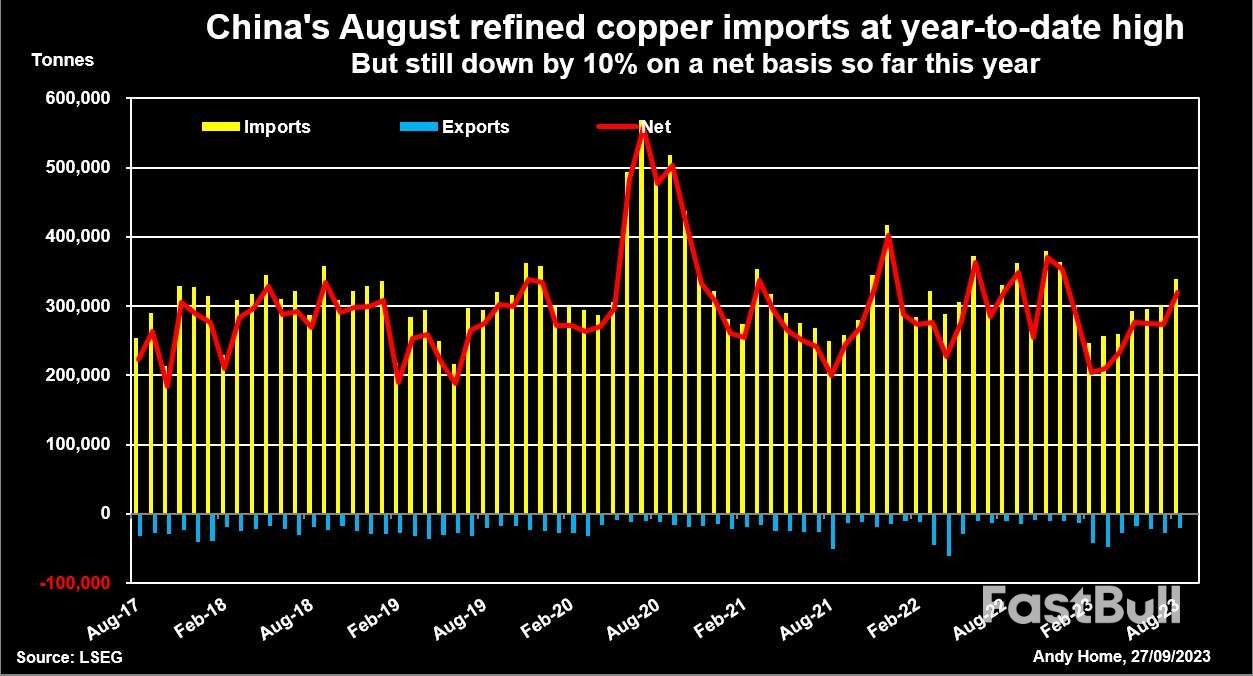
          Refined copper imports were 340,000 metric tons in August, the highest monthly tally this year.
          However, cumulative imports of 2.29 million metric tons are still down by 8% on last year and net imports are down by 10% due to slightly higher exports in 2023 relative to 2022.
          The mini-surge also has much to do with Democratic Republic of Congo (DRC). Imports of copper from DRC have accelerated sharply from 57,000 metric tons in June to 74,000 in July and an all-time record 97,000 in August.
          These are catch-up shipments from China's CMOC Group, which was blocked from exporting between June last year and April this year during a prolonged stand-off with the government over taxes.
          CMOC, which produced 254,000 metric tons of refined copper last year, began shipping from its stockpile in June with the metal evidently starting to arrive in China in July and August.
          Imports of copper from DRC have accounted for more than 25% of total inbound shipments in the last two reported months and have kicked the headline figure higher.China's Strong Metal Imports Not as Bullish as They Seem_3
          Zinc Business As Usual
          China was a net exporter of refined zinc last year for the first time since 2007. Western smelter outages sent physical premiums sky-high, sucking metal out of China as the supplier of last resort.
          The country's refined zinc trade has reverted to net imports this year but volumes remain modest by historical standards.
          Net imports of 199,000 metric tons over the first eight months of the year were, barring last year, the lowest since 2010.
          Moreover, imports of 29,000 metric tons in August itself were sharply off the pace of the 77,000 recorded in July. The next few months will tell whether zinc imports will return to the levels seen over the last decade.
          Shifting The Nickel Mix
          There has been no pick-up in China's imports of refined nickel. Indeed, they've been declining steadily since the start of last year.
          They've fallen another 50% to 48,000 metric tons over the first eight months of 2023.
          China's electric vehicle battery manufacturers don't need so much nickel in this form as they pivot to increased flows of intermediate products coming from Indonesia.
          Indonesian shipments of ferronickel grew by 51% in the first eight months of this year. Those of intermediate products and nickel matte were up by 92% and 138% respectively.
          Imports of Indonesian nickel sulphate only began in May but have already grown to 25,000 metric tons, accounting for 38% of total year-to-date arrivals.
          The share of refined metal in China's import mix is continually shrinking and with many Indonesian producers still ramping up new capacity that trend seems likely to run.
          All change in lead?
          China has been a significant exporter of refined lead since the middle of 2021, when, similar to sister metal zinc, smelter problems in the West caused physical premiums to soar.
          However, unlike their zinc peers, China's lead producers are still exporting to the tune of a net 101,000 metric tons in the first eight months of 2023.
          That was up by 10% on the same period last year and begs the question as to whether this is the new norm in terms of global flows of unwrought lead.

          Source: Metals Mine

          To stay updated on all economic events of today, please check out our Economic calendar
          Risk Warnings and Disclaimers
          You understand and acknowledge that there is a high degree of risk involved in trading. Following any strategies or investment methods may lead to potential losses. The content on the site is provided by our contributors and analysts for information purposes only. You are solely responsible for determining whether any trading assets, securities, strategy, or any other product is suitable for investing based on your own investment objectives and financial situation.
          Comments
          Add to Favorites
          Share
          FastBull
          Copyright © 2025 FastBull Ltd

          728 RM B 7/F GEE LOK IND BLDG NO 34 HUNG TO RD KWUN TONG KLN HONG KONG

          TelegramInstagramTwitterfacebooklinkedin
          App Store Google Play Google Play
          Products
          Charts

          Chats

          Q&A with Experts
          Screeners
          Economic Calendar
          Data
          Tools
          Membership
          Features
          Function
          Markets
          Copy Trading
          Latest Signals
          Contests
          News
          Analysis
          24/7
          Columns
          Education
          Company
          Careers
          About Us
          Contact Us
          Advertising
          Help Center
          Feedback
          User Agreement
          Privacy Policy
          Business

          White Label

          Data API

          Web Plug-ins

          Poster Maker

          Affiliate Program

          Risk Disclosure

          The risk of loss in trading financial instruments such as stocks, FX, commodities, futures, bonds, ETFs and crypto can be substantial. You may sustain a total loss of the funds that you deposit with your broker. Therefore, you should carefully consider whether such trading is suitable for you in light of your circumstances and financial resources.

          No decision to invest should be made without thoroughly conducting due diligence by yourself or consulting with your financial advisors. Our web content might not suit you since we don't know your financial conditions and investment needs. Our financial information might have latency or contain inaccuracy, so you should be fully responsible for any of your trading and investment decisions. The company will not be responsible for your capital loss.

          Without getting permission from the website, you are not allowed to copy the website's graphics, texts, or trademarks. Intellectual property rights in the content or data incorporated into this website belong to its providers and exchange merchants.

          Not Logged In

          Log in to access more features

          FastBull Membership

          Not yet

          Purchase

          Become a signal provider
          Help Center
          Customer Service
          Dark Mode
          Price Up/Down Colors

          Log In

          Sign Up
          Position
          Layout
          Fullscreen
          Default to Chart
          The chart page opens by default when you visit fastbull.com