• Trade
  • Markets
  • Copy
  • Contests
  • News
  • 24/7
  • Calendar
  • Q&A
  • Chats
Trending
Screeners
SYMBOL
LAST
BID
ASK
HIGH
LOW
NET CHG.
%CHG.
SPREAD
SPX
S&P 500 Index
6827.42
6827.42
6827.42
6899.86
6801.80
-73.58
-1.07%
--
DJI
Dow Jones Industrial Average
48458.04
48458.04
48458.04
48886.86
48334.10
-245.98
-0.51%
--
IXIC
NASDAQ Composite Index
23195.16
23195.16
23195.16
23554.89
23094.51
-398.69
-1.69%
--
USDX
US Dollar Index
97.950
98.030
97.950
98.500
97.950
-0.370
-0.38%
--
EURUSD
Euro / US Dollar
1.17394
1.17409
1.17394
1.17496
1.17192
+0.00011
+ 0.01%
--
GBPUSD
Pound Sterling / US Dollar
1.33707
1.33732
1.33707
1.33997
1.33419
-0.00148
-0.11%
--
XAUUSD
Gold / US Dollar
4299.39
4299.39
4299.39
4353.41
4257.10
+20.10
+ 0.47%
--
WTI
Light Sweet Crude Oil
57.233
57.485
57.233
58.011
56.969
-0.408
-0.71%
--

Community Accounts

Signal Accounts
--
Profit Accounts
--
Loss Accounts
--
View More

Become a signal provider

Sell trading signals to earn additional income

View More

Guide to Copy Trading

Get started with ease and confidence

View More

Signal Accounts for Members

All Signal Accounts

Best Return
  • Best Return
  • Best P/L
  • Best MDD
Past 1W
  • Past 1W
  • Past 1M
  • Past 1Y

All Contests

  • All
  • Trump Updates
  • Recommend
  • Stocks
  • Cryptocurrencies
  • Central Banks
  • Featured News
Top News Only
Share

USA Embassy In Lithuania: Maria Kalesnikava Is Not Going To Vilnius

Share

USA Embassy In Lithuania: Other Prisoners Are Being Sent From Belarus To Ukraine

Share

Ukraine President Zelenskiy: Five Ukrainians Released By Belarus In US-Brokered Deal

Share

USA Vilnius Embassy: USA Stands Ready For "Additional Engagement With Belarus That Advances USA Interests"

Share

USA Vilnius Embassy: Belarus, USA, Other Citizens Among The Prisoners Released Into Lithuania

Share

USA Vilnius Embassy: USA Will Continue Diplomatic Efforts To Free The Remaining Political Prisoners In Belarus

Share

USA Vilnius Embassy: Belarus Releases 123 Prisoners Following Meeting Of President Trump's Envoy Coale And Belarus President Lukashenko

Share

USA Vilnius Embassy: Masatoshi Nakanishi, Aliaksandr Syrytsa Are Among The Prisoners Released By Belarus

Share

USA Vilnius Embassy: Maria Kalesnikava And Viktor Babaryka Are Among The Prisoners Released By Belarus

Share

USA Vilnius Embassy: Nobel Peace Prize Laureate Ales Bialiatski Is Among The Prisoners Released By Belarus

Share

Belarusian Presidential Administration Telegram Channel: Lukashenko Has Pardoned 123 Prisoners As Part Of Deal With US

Share

Two Local Syrian Officials: Joint US-Syrian Military Patrol In Central Syria Came Under Fire From Unknown Assailants

Share

Israeli Military Says It Targeted 'Key Hamas Terrorist' In Gaza City

Share

Rwanda's Actions In Eastern Drc Are A Clear Violation Of Washington Accords Signed By President Trump - Secretary Of State Rubio

Share

Israeli Military Issues Evacuation Warning In Southern Lebanon Village Ahead Of Strike - Spokesperson On X

Share

Belarusian State Media Cites US Envoy Coale As Saying He Discussed Ukraine And Venezuela With Lukashenko

Share

Belarusian State Media Cites US Envoy Coale As Saying That US Removes Sanctions On Belarusian Potassium

Share

Thai Prime Minister: No Ceasefire Agreement With Cambodia

Share

US, Ukraine To Discuss Ceasefire In Berlin Ahead Of European Summit

Share

Incoming Czech Prime Minister Babis: Czech Republic Will Not Take On Guarantees For Ukraine Financing, European Commission Must Find Alternatives

TIME
ACT
FCST
PREV
U.K. Trade Balance Non-EU (SA) (Oct)

A:--

F: --

P: --

U.K. Trade Balance (Oct)

A:--

F: --

P: --

U.K. Services Index MoM

A:--

F: --

P: --

U.K. Construction Output MoM (SA) (Oct)

A:--

F: --

P: --

U.K. Industrial Output YoY (Oct)

A:--

F: --

P: --

U.K. Trade Balance (SA) (Oct)

A:--

F: --

P: --

U.K. Trade Balance EU (SA) (Oct)

A:--

F: --

P: --

U.K. Manufacturing Output YoY (Oct)

A:--

F: --

P: --

U.K. GDP MoM (Oct)

A:--

F: --

P: --

U.K. GDP YoY (SA) (Oct)

A:--

F: --

P: --

U.K. Industrial Output MoM (Oct)

A:--

F: --

P: --

U.K. Construction Output YoY (Oct)

A:--

F: --

P: --

France HICP Final MoM (Nov)

A:--

F: --

P: --

China, Mainland Outstanding Loans Growth YoY (Nov)

A:--

F: --

P: --

China, Mainland M2 Money Supply YoY (Nov)

A:--

F: --

P: --

China, Mainland M0 Money Supply YoY (Nov)

A:--

F: --

P: --

China, Mainland M1 Money Supply YoY (Nov)

A:--

F: --

P: --

India CPI YoY (Nov)

A:--

F: --

P: --

India Deposit Gowth YoY

A:--

F: --

P: --

Brazil Services Growth YoY (Oct)

A:--

F: --

P: --

Mexico Industrial Output YoY (Oct)

A:--

F: --

P: --

Russia Trade Balance (Oct)

A:--

F: --

P: --

Philadelphia Fed President Henry Paulson delivers a speech
Canada Building Permits MoM (SA) (Oct)

A:--

F: --

P: --

Canada Wholesale Sales YoY (Oct)

A:--

F: --

P: --

Canada Wholesale Inventory MoM (Oct)

A:--

F: --

P: --

Canada Wholesale Inventory YoY (Oct)

A:--

F: --

P: --

Canada Wholesale Sales MoM (SA) (Oct)

A:--

F: --

P: --

Germany Current Account (Not SA) (Oct)

A:--

F: --

P: --

U.S. Weekly Total Rig Count

A:--

F: --

P: --

U.S. Weekly Total Oil Rig Count

A:--

F: --

P: --

Japan Tankan Large Non-Manufacturing Diffusion Index (Q4)

--

F: --

P: --

Japan Tankan Small Manufacturing Outlook Index (Q4)

--

F: --

P: --

Japan Tankan Large Non-Manufacturing Outlook Index (Q4)

--

F: --

P: --

Japan Tankan Large Manufacturing Outlook Index (Q4)

--

F: --

P: --

Japan Tankan Small Manufacturing Diffusion Index (Q4)

--

F: --

P: --

Japan Tankan Large Manufacturing Diffusion Index (Q4)

--

F: --

P: --

Japan Tankan Large-Enterprise Capital Expenditure YoY (Q4)

--

F: --

P: --

U.K. Rightmove House Price Index YoY (Dec)

--

F: --

P: --

China, Mainland Industrial Output YoY (YTD) (Nov)

--

F: --

P: --

China, Mainland Urban Area Unemployment Rate (Nov)

--

F: --

P: --

Saudi Arabia CPI YoY (Nov)

--

F: --

P: --

Euro Zone Industrial Output YoY (Oct)

--

F: --

P: --

Euro Zone Industrial Output MoM (Oct)

--

F: --

P: --

Canada Existing Home Sales MoM (Nov)

--

F: --

P: --

Euro Zone Total Reserve Assets (Nov)

--

F: --

P: --

U.K. Inflation Rate Expectations

--

F: --

P: --

Canada National Economic Confidence Index

--

F: --

P: --

Canada New Housing Starts (Nov)

--

F: --

P: --

U.S. NY Fed Manufacturing Employment Index (Dec)

--

F: --

P: --

U.S. NY Fed Manufacturing Index (Dec)

--

F: --

P: --

Canada Core CPI YoY (Nov)

--

F: --

P: --

Canada Manufacturing Unfilled Orders MoM (Oct)

--

F: --

P: --

Canada Manufacturing New Orders MoM (Oct)

--

F: --

P: --

Canada Core CPI MoM (Nov)

--

F: --

P: --

Canada Manufacturing Inventory MoM (Oct)

--

F: --

P: --

Canada CPI YoY (Nov)

--

F: --

P: --

Canada CPI MoM (Nov)

--

F: --

P: --

Canada CPI YoY (SA) (Nov)

--

F: --

P: --

Canada Core CPI MoM (SA) (Nov)

--

F: --

P: --

Q&A with Experts
    • All
    • Chatrooms
    • Groups
    • Friends
    Connecting
    .
    .
    .
    Type here...
    Add Symbol or Code

      No matching data

      All
      Trump Updates
      Recommend
      Stocks
      Cryptocurrencies
      Central Banks
      Featured News
      • All
      • Russia-Ukraine Conflict
      • Middle East Flashpoint
      • All
      • Russia-Ukraine Conflict
      • Middle East Flashpoint
      Search
      Products

      Charts Free Forever

      Chats Q&A with Experts
      Screeners Economic Calendar Data Tools
      Membership Features
      Data Warehouse Market Trends Institutional Data Policy Rates Macro

      Market Trends

      Market Sentiment Order Book Forex Correlations

      Top Indicators

      Charts Free Forever
      Markets

      News

      News Analysis 24/7 Columns Education
      From Institutions From Analysts
      Topics Columnists

      Latest Views

      Latest Views

      Trending Topics

      Top Columnists

      Latest Update

      Signals

      Copy Rankings Latest Signals Become a signal provider AI Rating
      Contests
      Brokers

      Overview Brokers Assessment Rankings Regulators News Claims
      Broker listing Forex Brokers Comparison Tool Live Spread Comparison Scam
      Q&A Complaint Scam Alert Videos Tips to Detect Scam
      More

      Business
      Events
      Careers About Us Advertising Help Center

      White Label

      Data API

      Web Plug-ins

      Affiliate Program

      Awards Institution Evaluation IB Seminar Salon Event Exhibition
      Vietnam Thailand Singapore Dubai
      Fans Party Investment Sharing Session
      FastBull Summit BrokersView Expo
      Recent Searches
        Top Searches
          Markets
          News
          Analysis
          User
          24/7
          Economic Calendar
          Education
          Data
          • Names
          • Latest
          • Prev

          View All

          No data

          Scan to Download

          Faster Charts, Chat Faster!

          Download App
          English
          • English
          • Español
          • العربية
          • Bahasa Indonesia
          • Bahasa Melayu
          • Tiếng Việt
          • ภาษาไทย
          • Français
          • Italiano
          • Türkçe
          • Русский язык
          • 简中
          • 繁中
          Open Account
          Search
          Products
          Charts Free Forever
          Markets
          News
          Signals

          Copy Rankings Latest Signals Become a signal provider AI Rating
          Contests
          Brokers

          Overview Brokers Assessment Rankings Regulators News Claims
          Broker listing Forex Brokers Comparison Tool Live Spread Comparison Scam
          Q&A Complaint Scam Alert Videos Tips to Detect Scam
          More

          Business
          Events
          Careers About Us Advertising Help Center

          White Label

          Data API

          Web Plug-ins

          Affiliate Program

          Awards Institution Evaluation IB Seminar Salon Event Exhibition
          Vietnam Thailand Singapore Dubai
          Fans Party Investment Sharing Session
          FastBull Summit BrokersView Expo

          October 2th Financial News

          FastBull Featured

          Daily News

          Summary:

          The U.S. government's shutdown threat eases; McCarthy may be ousted after the stopgap measure is successfully passed; BoJ Governor: There is still a long way to go before exiting the easing policy...

          [Quick Facts]
          1. The U.S. government's shutdown threat eases, but no parties come up with a real solution.
          2. McCarthy may be ousted after the stopgap measure is successfully passed.
          3. Putin issued a decree declaring September 30 as "Unification Day".
          4. BoJ Governor: There is still a long way to go before exiting the easing policy.
          5. Oil prices are expected to hit their biggest quarterly rise since the Russia-Ukraine conflict amid tight supply.
          6. Bank of Canada may pause rate hikes as its economic growth is lower than expected.
          [News Details]
          The U.S. government's shutdown threat eases, but no parties come up with a real solution
          On the evening of September 30, U.S. President Joe Biden signed a temporary funding bill just less than an hour left before the federal government's funds for the 2023 fiscal year were exhausted, which temporarily eased the U.S. government's shutdown threat. The bill, which would allow the U.S. government to operate until November 17, includes $16 billion in disaster relief funding but does not include aid to Ukraine. Lawmakers from both parties who support funding to Ukraine say it will be handled separately. (The House passed the bill earlier Saturday)
          But this stopgap measure only postpones the problem without actually solving it. The ongoing shutdown threat of the government has aroused concern about the government's fiscal deficit, governance failure, and debt issues. Some American commentators said that in the face of the debt crisis and fiscal appropriation, bipartisan didn't come up with a real solution, but instead continues to aggravate the debt problem.
          McCarthy may be ousted after the stopgap measure successfully passed
          House Speaker McCarthy backed a bipartisan deal to avert a government shutdown, sparking dissatisfaction among far-right Republicans, who called for removing him from office. Gaetz, a Florida Republican, said on Sunday he would file a motion to oust the speaker this week, although the procedure has not resulted in a vote to remove the speaker since 1910.
          "I do intend to file a motion this week to try to remove House Speaker McCarthy from the leadership." Gaetz said. "I think we need to rip off the Band-Aid. I think we need new leadership that can be trustworthy," Gaetz said. His move stems from McCarthy's acceptance of a bipartisan agreement that does not implement the deep spending cuts demanded by conservatives. He said it was one of the promises McCarthy made when he was elected speaker but these failed to fulfill.
          Putin issued a decree declaring September 30 as "Unification Day"
          According to the "Kyiv Independent", Russian President Putin signed a decree declaring September 30 as "Unification Day" to commemorate the annexation of Luhansk, Donetsk, and Kherson regions into Russia. Putin said in a video, "One year ago, a decisive, historic, life-changing event occurred when the agreement for the integration of four new regions into the Russian Federation was signed on September 30." The Russian Defense Ministry announced that it would begin recruiting residents of these areas into the army as part of its biannual conscription campaign.
          BoJ Governor: There is still a long way to go before exiting the easing policy
          On September 30, Bank of Japan Governor Ueda Kazuo said at an academic conference that there is still a long way to go before changing its current monetary policy. Japan has not yet achieved a sustainable and stable price target of 2%. Temporary losses do not hamper the central bank's ability to conduct monetary policy. In the long term, central banks are usually structured to generate profits and provide their means of payment and settlement. However, this does not mean that the central bank can withstand unlimited losses and negative equity. If the financial risks become a problem and cause unnecessary confusion about policies, it could lead to credibility damage. Based on this view, BoJ believes that it is appropriate to continue to implement appropriate policies while focusing on financial soundness.
          Oil prices are expected to hit their biggest quarterly rise since the Russia-Ukraine conflict amid tight supply
          Earlier industry data on September 29th showed that Russia plans to export a little diesel next month. This move has caused European diesel futures prices to rebound above the key mark of $1000 per ton. Due to the Saudi-led OPEC+ supply cuts and extremely low inventories at Cushing in the United States, U.S. oil futures are set to hit their largest quarterly gain since the period ended in March 2022.
          However, WTI crude oil reversed its earlier gains on Friday, which may be mainly affected by fluctuations in U.S. stock markets. Although traders are cautious about the demand outlook, there are few obstacles to crude's move towards $100 as OPEC+ expects a crude supply exposure of 3 million barrels per day in the next quarter. Analysts at Deutsche Bank, including Barbara Lambrecht, said oil for short-term delivery trading at a high premium, indicating tight supply. Meanwhile, oil demand continues to grow. This has aroused tensions in the crude oil market, which is shown by the decline in inventories.
          Bank of Canada may pause rate hikes as its economic growth is lower than expected
          Canada's economy rebounded slightly last month, but growth remains weak, providing support for the central bank to remain on hold while inflation remains elevated. Preliminary data from Statistics Canada on Friday showed GDP edged up 0.1% in August, with declines in the retail and oil and gas sectors partially offset by gains in the wholesale and financial sectors, while July's GDP figure was flat.
          If output is flat in September, the economy is likely to grow at an annualized rate of 0.2% in the third quarter, which is lower than the expected 0.4%. Bank of Canada Governor Macklem and other officials hope that the weakness in consumer activity will translate into slower price increases in the coming months. They adopted a wait-and-see approach at the early September meeting, saying excess demand in the economy was easing. The data supports this view.
          [Focus of the Day]
          UTC+8 16:00 ECB Governing Council Members Centeno and Hernandez De Cos Deliver a Speech
          UTC+8 22:00 U.S. ISM Manufacturing PMI (Sep)
          UTC+8 23:00 BoE Monetary Policy Member Mann Delivers a Speech
          UTC+8 01:30 New York Fed President Williams Delivers a Speech
          Risk Warnings and Disclaimers
          You understand and acknowledge that there is a high degree of risk involved in trading. Following any strategies or investment methods may lead to potential losses. The content on the site is provided by our contributors and analysts for information purposes only. You are solely responsible for determining whether any trading assets, securities, strategy, or any other product is suitable for investing based on your own investment objectives and financial situation.
          Comments
          Add to Favorites
          Share

          Will the RBNZ Opt for A Hawkish Hold?

          XM

          Forex

          Economic

          Stellar economic performance revives hike bets

          Back in August, the Reserve Bank of New Zealand (RBNZ) decided to maintain the Official Cash Rate (OCR) at 5.5%, adding that the current level of interest rates is constraining spending and thereby inflation pressures, also expressing confidence that with rates staying at restrictive levels for some time, inflation will return to the 1-3% target range.
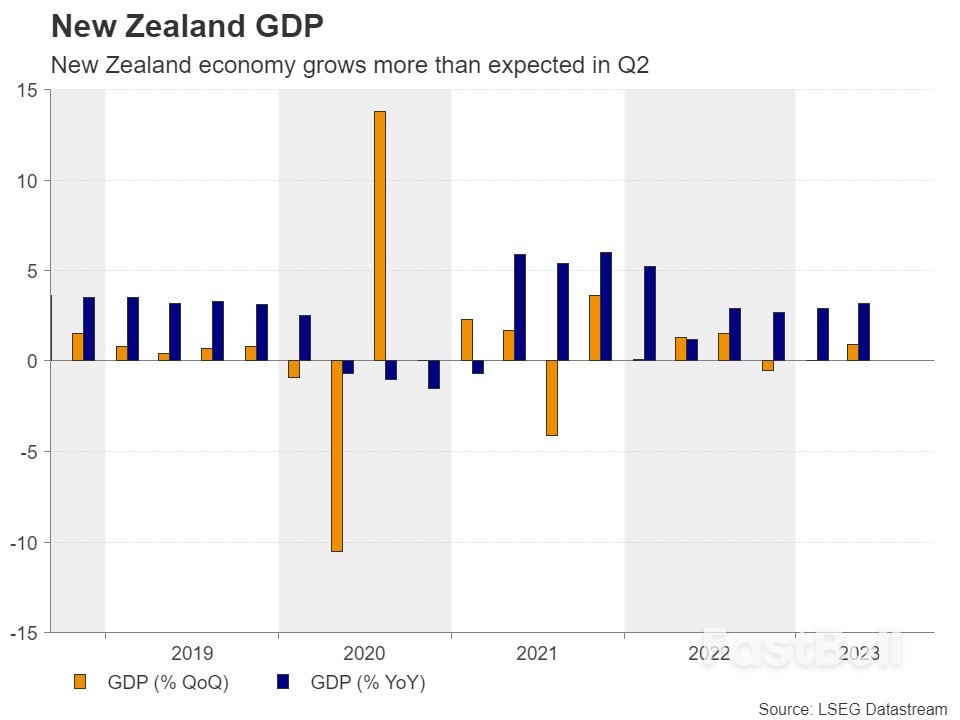
          Back then, they noted that the economy is evolving broadly as expected, with activity continuing to slow in parts of the economy that are more sensitive to interest rates. However, just last week, GDP data revealed that the economy grew by nearly double the anticipated pace in Q2, after stagnating in the first three months of the year. Although this appears to be a relief for the current government, which is under fire for how they've been handling the economy ahead of an election on October 14, it may worry the central bank which likely needs slower growth to achieve its inflation goal.
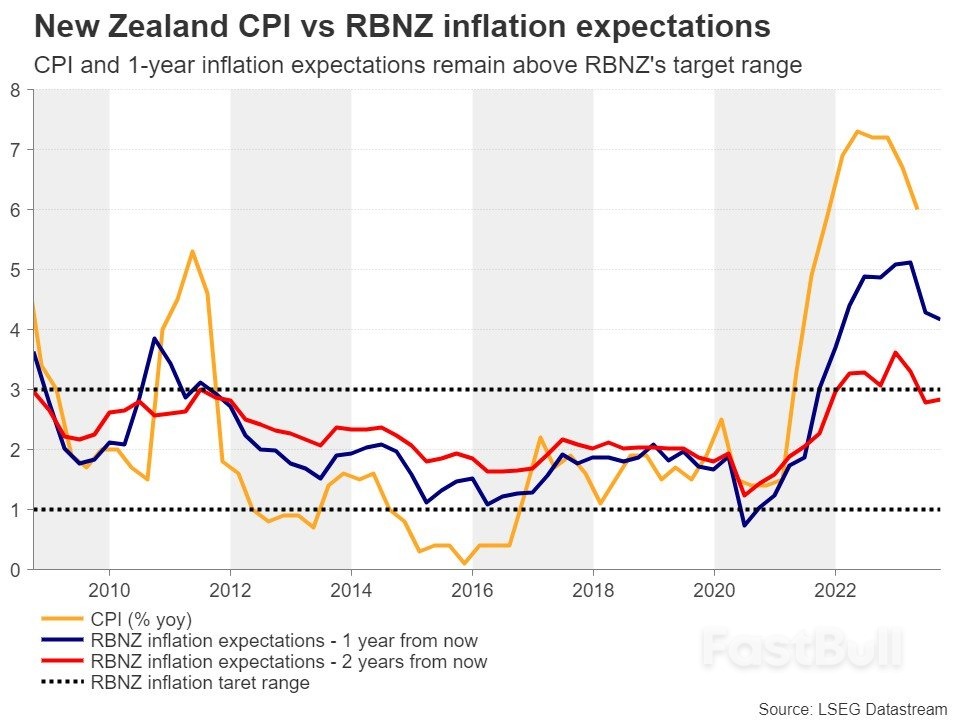
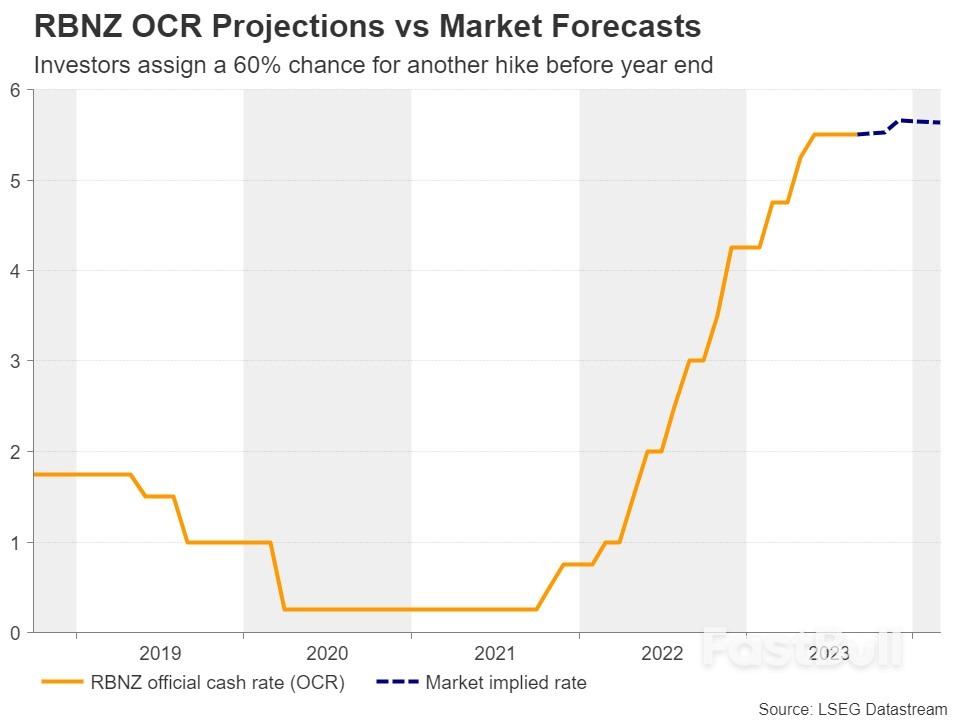
          Will the RBNZ Opt for A Hawkish Hold?_1With the Bank projecting that the economy would slip into recession in the second half of 2023 and the data offering no such sign, investors have begun pricing in around a 60% probability for another quarter-point hike by the end of the year as the stronger economic performance, combined with the latest rally in oil prices, adds upside risks to the nation's 6% inflation rate. Yes, 1-year inflation expectations are much lower, but still above the Bank's target, with only the 2-year projection lying slightly below the upper bound of the 1-3% target range.

          Will the RBNZ Opt for A Hawkish Hold?_2Will officials adopt a more hawkish language?

          For Wednesday's meeting, investors are 90% confident that policymakers will refrain from acting, and should this be the case, they may dig into the statement of hints on whether the Bank will open the door to another hike.
          Will the RBNZ Opt for A Hawkish Hold?_3All that suggests that, even if the Bank stands pat, the meeting could be a live one. The kiwi may slide in the case of policymakers abstaining from commenting on the possibility of additional hikes, as those expecting more may be disappointed. The opposite may be true should they bring to the table the likelihood of more action.
          Given that this will be one of the shorter meetings that are not accompanied by updated economic projections, and that policymakeres may prefer to have the CPI numbers for Q3 in hand before examining whether higher rates are needed, the former outcome may be more likely. The November gathering appears to be a wiser choice for proceeding with any policy or language changes.

          Kiwi traders may get disappointed

          The kiwi has been in a recovery mode the last couple of days against the US dollar, but this was mainly due to the dollar pulling back, perhaps as traders are rebalancing their portfolios and liquidating some long-dollar positions on the last trading of the quarter.
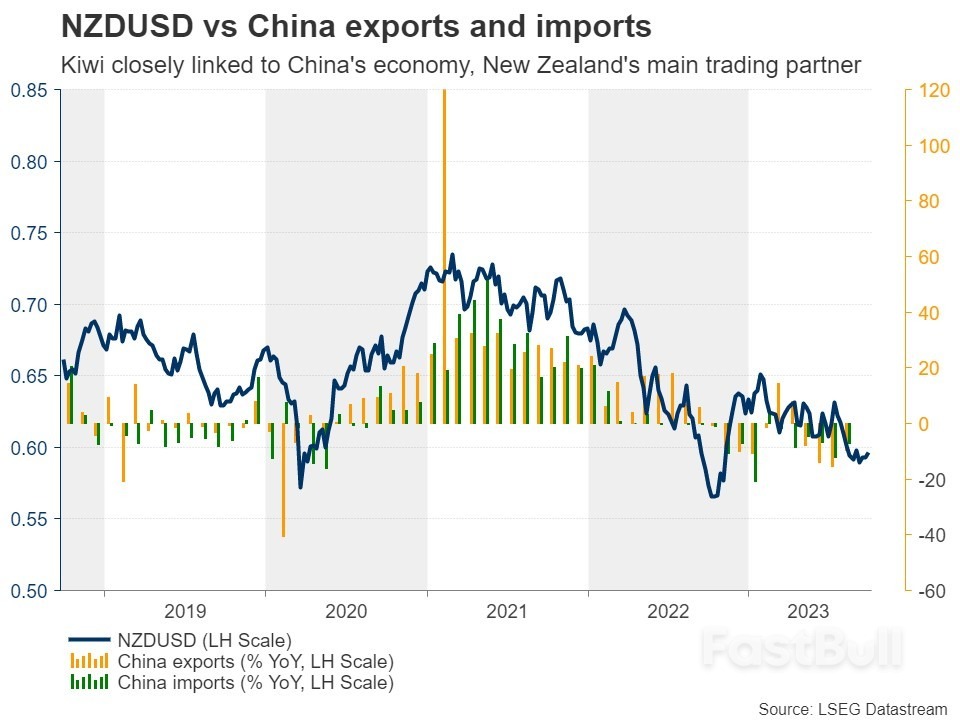
          A potentially dovish RBNZ could keep that recovery in check and bring the kiwi back under pressure. That said, given that monetary policy is not the only variable in the equation of the risk-linked currency, traders may have more than the RBNZ decision to examine. The challenges facing China, the world's second-largest economy and New Zealand's main trading partner, as well as concerns about the economic performance of Europe and the UK, could constitute another element of anxiety, and thereby add extra weight on the currency.

          Will the RBNZ Opt for A Hawkish Hold?_4Kiwi/dollar headed towards key resistance

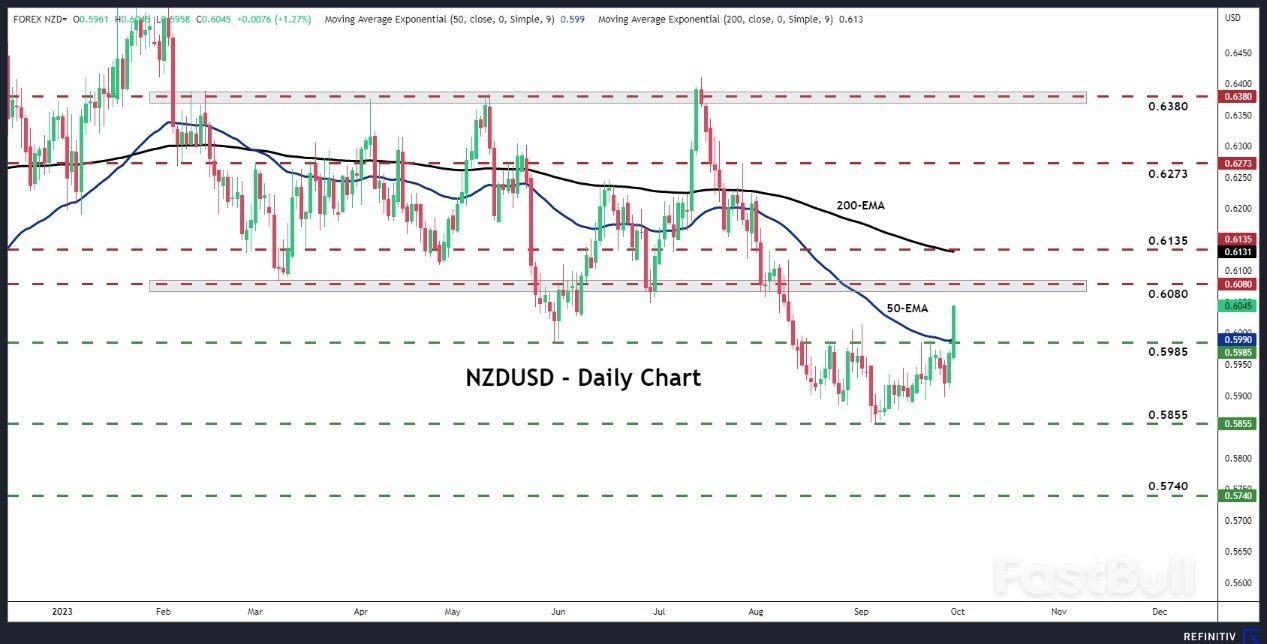
          Kiwi/dollar rallied above the 0.5985 zone today, confirming a temporary bottom at around 0.5855. However, the pair looks to be headed towards the very important zone of 0.6080, which acted as the lower end of the sideways range that contained most of the price action between February and August. The bulls may get rejected there if indeed the RBNZ appears dovish, with the potential subsequent decline aiming for another test at 0.5985. A break lower could encourage extensions towards the low of September 6, at 0.5855.Will the RBNZ Opt for A Hawkish Hold?_5
          To stay updated on all economic events of today, please check out our Economic calendar
          Risk Warnings and Disclaimers
          You understand and acknowledge that there is a high degree of risk involved in trading. Following any strategies or investment methods may lead to potential losses. The content on the site is provided by our contributors and analysts for information purposes only. You are solely responsible for determining whether any trading assets, securities, strategy, or any other product is suitable for investing based on your own investment objectives and financial situation.
          Comments
          Add to Favorites
          Share

          OPEC+ Meeting

          Owen Li

          Commodity

          Energy

          Energy - OPEC+ JMMC meeting
          The oil market remains well supported with the ICE Brent November contract expiring on Friday at US$95.31/bbl, which saw the oil market finishing the third quarter up a little more than 27% - its strongest performance since the first quarter of 2022. Fundamentally, there is still further upside with the market set to continue to tighten. Technically, following the expiry of the November contract on Friday, there is a gap left that the December contract will need to fill. This suggests that we should at some point see the December contract (which is currently trading around US$92.45/bbl) trading up above US$95/bbl.
          The latest positioning data shows that speculators reduced their net long in ICE Brent by 21,989 lots over the last reporting week to 243,542 lots. This was predominantly driven by fresh shorts. There were also some longs liquidated, suggesting that speculators believe the rally in the oil market has largely run out of steam. However, there was more speculative buying in NYMEX WTI with speculators increasing their net long by 20,123 lots to 314,519 lots. In addition, speculators also increased their spreading position by 49,525 to 478,407 lots. The tightening in US crude oil inventories, specifically at the WTI delivery hub, Cushing appears to have attracted speculators to the market, and in particular to the nearby timespreads.
          For the oil market this week, there will be plenty of attention paid to the OPEC+ Joint Ministerial Monitoring Committee (JMMC) meeting on Wednesday. The market will be eager to see if there are any signs of a change in the group's output policy, given the recent strength in the market. We do not believe that the group will change its output policy. However, what is possible (and a JMMC meeting is not needed for this), is Saudi Arabia starting to ease its additional voluntary supply cut of 1MMbbls/d. The Saudis have said that there is still concern over Chinese demand. However, PMI data out over the weekend will provide some confidence with China's manufacturing PMI returning to expansion territory in September for the first time since March, whilst the non-manufacturing PMI remained in expansion territory over the month.
          Metals – LME aluminium spreads strengthen
          The latest inventory data from the LME shows that aluminium on-warrant inventories fell sharply by 50,225 tonnes on Friday to 173,875 tonnes, while cancelled warrants increased by 46,000 tonnes to 312,175 tonnes. The tightening in available stocks saw 3m LME aluminium settle more than 3% higher on the day, while the cash/3M spread saw a significant narrowing in its contango - the spread has narrowed from US$29.21/t on Thursday to US$16.50/t on Friday.
          The latest positioning data from the CFTC shows that managed-money net longs in COMEX gold decreased by 30,995 lots over the last week to 35,644 lots as of last Tuesday - the lowest since early March. The higher-for-longer narrative we have seen with regard to Fed monetary policy has weighed on sentiment for gold. This is also evident when looking at gold ETF holdings, which have seen eighteen consecutive weeks of declines.
          Agriculture – USDA increases wheat stock estimates
          In its recent quarterly grains inventory report, the USDA revised down 2022/23 US corn stock estimates to 1.36b bushels as of 1 September, lower than 1.38b bushels a year ago and below market expectations of around 1.44b bushels. In contrast, the USDA revised up wheat stock estimates to 1.78b bushels for the 2022/23 season, higher than expectations of around 1.77b bushels. This was in line with last year's level of 1.78b bushels. Similarly, the agency increased its soybean stock estimates to 268m bushels, higher than expectations of 244m bushels, but down from 274m bushels a year ago.
          Recent numbers from Ukraine's Agriculture Ministry show that the domestic grain harvest so far this season rose 17% year-on-year to 30.5mt as of 29 September. The wheat harvest stood at 22.2mt (+16% YoY), while the corn harvest stood at 793.2kt.
          The latest CFTC data shows that money managers increased their net bearish bets in CBOT corn by 23,791 lots, leaving them with a net short position of 168,606 lots as of last Tuesday. The move was predominantly driven by fresh selling, with the gross short increasing by 21,733 lots. CBOT wheat saw a marginal reduction in the speculative net short. Speculators decreased their bearish bets by just 421 lots to leave them with a net short of 96,384 lots. Meanwhile, speculators reduced their net long in CBOT soybeans by 15,774 lots to 30,058 lots.

          Source: ING

          Risk Warnings and Disclaimers
          You understand and acknowledge that there is a high degree of risk involved in trading. Following any strategies or investment methods may lead to potential losses. The content on the site is provided by our contributors and analysts for information purposes only. You are solely responsible for determining whether any trading assets, securities, strategy, or any other product is suitable for investing based on your own investment objectives and financial situation.
          Comments
          Add to Favorites
          Share

          Forex and Cryptocurrencies Forecast

          Samantha Luan

          Cryptocurrency

          Forex

          EUR/USD: Correction is Not a Trend Reversal Yet

          The dynamics of the EUR/USD pair in the past week were atypical. In a standard scenario, combating inflation against the backdrop of a strong economy and a healthy labour market leads to an increase in the central bank's interest rate. This, in turn, attracts investors and strengthens the national currency. However, this time the situation unfolded quite differently.
          U.S. macroeconomic data released on Thursday, September 28, indicated strong GDP growth in Q2 at 2.1%. The number of initial unemployment claims was 204K, slightly higher than the previous figure of 202K, but less than the expected 215K. Meanwhile, the total number of citizens receiving such benefits amounted to 1.67 million, falling short of the 1.675 million forecast.
          This data suggests that the U.S. economy and labour market remain relatively stable, which should prompt the U.S. Federal Reserve to increase interest rates by 25 basis points (bps). It's worth noting that Neil Kashkari, President of the Federal Reserve Bank of Minneapolis, recently confirmed his full support for such a move, as combating high inflation remains the central bank's primary objective. Jamie Dimon, CEO of JPMorgan, went even further, stating that he does not rule out the possibility of rate hikes from the current 5.50% to as high as 7.00%.
          However, these figures and forecasts failed to make an impression on market participants. Especially since the rhetoric from Fed officials proved to be quite contradictory. For instance, Thomas Barkin, President of the Federal Reserve Bank of Richmond, does not believe that U.S. GDP will continue to grow in Q4. He also pointed out that there's a wide range of opinions regarding future rates and that it's unclear if additional changes in monetary policy are required. Austin Goolsbee, President of the Federal Reserve Bank of Chicago, noted that overconfidence in the trade-off between inflation and unemployment carries the risk of policy mistakes.
          Such statements have tempered bullish sentiment on the dollar. Amid this murky and contradictory backdrop, yields on U.S. Treasury bonds, which had been supporting the dollar, fell from multi-year highs. Uncertainty surrounding the U.S. federal budget and the threat of a government shutdown also weighed on the dollar. Furthermore, September 28 and 29 marked the last trading days of Q3, and after 11 weeks of gains, dollar bulls began closing long positions on the DXY index, locking in profits.
          As for the Eurozone, inflation has clearly started to wane. Preliminary data indicates that the annual Consumer Price Index (CPI) growth in Germany has slowed from 6.4% to 4.3%, reaching its lowest point since the onset of Russia's military invasion of Ukraine. The overall Eurozone CPI also fell—despite a previous rate of 5.3% and a forecast of 4.8%, it declined to 4.5%.
          This reduction in CPI led to a rescheduling of the European Central Bank's (ECB) anticipated dovish policy shift from Q3 2024 to Q2 2024. Moreover, the likelihood of a new interest rate hike has significantly diminished. In theory, this should have weakened the euro. However, concerns over the fate of the dollar proved to be more impactful, and after bouncing off 1.0487, EUR/USD moved upward, reaching a high of 1.0609.
          According to analysts at Germany's Commerzbank, some traders were simply very dissatisfied with levels below 1.0500, so neither macro data nor statements from Fed officials could exert any significant influence on this. However, the rebound does not indicate either a trend reversal or the complete end of the dollar rally. Commerzbank analysts believe that since the market has clearly bet on a soft landing for the U.S. economy, the dollar is likely to react particularly harshly to data that does not confirm this viewpoint.
          Analysts at MUFG Bank also believe that the 1.0500 zone has finally become a strong level that served as a catalyst for the reversal. However, in the opinion of the bank's economists, the correction is primarily technical in nature and could soon fizzle out.
          On Friday, September 29, traders awaited the release of the Personal Consumption Expenditures Index (PCE) in the U.S., which is a key indicator. Year-on-year, it registered at 3.9%, precisely matching forecasts (the previous figure was 4.3%). The market reacted with a minor increase in volatility, after which EUR/USD closed the trading week, month, and quarter at 1.0573. Strategists at Wells Fargo, part of the "big four" U.S. banks, believe that Europe's low metrics compared to the U.S. should exert further downward pressure on the euro. They also believe that the European Central Bank (ECB) has already concluded its current cycle of monetary tightening, as a result of which the pair may drop to the 1.0200 level by early 2024.
          Shifting from the medium-term outlook to the near-term, as of the evening of September 29, expert opinions are evenly split into three categories: one-third foresee further dollar strengthening and a decline in EUR/USD; another third expect an upward correction; and the last third take a neutral stance. As for technical analysis, both among trend indicators and oscillators on the D1 chart, the majority, 90%, still favor the U.S. dollar and are coloured red. Only 10% side with the euro. The pair's nearest support levels are around 1.0560, followed by 1.0490-1.0525, 1.0375, 1.0255, 1.0130, and 1.0000. Bulls will encounter resistance in the area of 1.0620-1.0630, then 1.0670-1.0700, followed by 1.0745-1.0770, 1.0800, 1.0865, 1.0895-1.0925, 1.0985, and 1.1045.
          Data releases pertaining to the U.S. labour market are anticipated throughout the week spanning from October 3 to October 6. The week will culminate on Friday, October 6, when key indicators, including the unemployment rate and the Non-Farm Payroll (NFP) figures, are set to be disclosed. Earlier in the week, specifically on Monday, October 2, insights into the U.S. manufacturing sector's business activity (PMI) will be unveiled. Federal Reserve Chair Jerome Powell is also scheduled to speak on this day. On Wednesday, October 4, information regarding the business activity in the U.S. services sector as well as Eurozone retail sales will be made public.

          GBP/USD: No Drivers for Pound Growth

          According to the latest data published by the UK's National Statistics Office, the country's Gross Domestic Product (GDP) increased by 0.6% year-over-year in Q2, exceeding expectations of 0.4% and up from 0.5% in the previous quarter. While this positive trend is certainly encouraging, the UK's 0.6% growth rate is 3.5 times lower than the comparable figure in the United States, which stands at 2.1%. Therefore, any commentary on which economy is stronger is unnecessary.
          Strategists from ING, the largest banking group in the Netherlands, believe that GBP/USD rose in the second half of the past week solely due to a correction in the U.S. dollar. According to them, there are no tangible catalysts related to the United Kingdom that would justify a sustained increase in the British currency at this stage.
          Analysts at UOB Group anticipate that GBP/USD could fluctuate within a fairly broad range of 1.2100-1.2380 over the next 1-3 weeks. However, Wells Fargo strategists expect the pair to continue its decline, reaching the 1.1600 zone in early 2024, where it last traded in November 2022. The likelihood of such a move is corroborated by signals from the Bank of England suggesting that the interest rate on the pound may have peaked.
          GBP/USD closed the past week at the 1.2202 mark. Analyst opinions on the pair's near-term future are split, offering no clear direction: 40% are bullish on the pair, another 40% are bearish, and the remaining 20% have adopted a neutral stance. Among trend indicators and oscillators on the daily chart (D1), 90% are painted in red, while 10% are in green. Should the pair move downward, it will encounter support levels and zones at 1.2120-1.2145, 1.2085, 1.1960, and 1.1800. Conversely, if the pair rises, it will face resistance at 1.2270, 1.2330, 1.2440-1.2450, 1.2510, 1.2550-1.2575, 1.2600-1.2615, 1.2690-1.2710, 1.2760, and 1.2800-1.2815.
          No significant events related to the United Kingdom's economy are anticipated for the upcoming week.

          USD/JPY: Awaiting the Breach of 150.00

          "Appropriate measures will be taken against excessive currency movements, not ruling out any options," "We are closely monitoring currency exchange rates." Do these phrases sound familiar? Indeed, they should: these are words from yet another verbal intervention conducted by Japan's Finance Minister Shunichi Suzuki on Friday, September 29. He added that "the government has no specific target level for the Japanese yen that could serve as a trigger for currency intervention."
          One can agree with the last statement, especially considering that USD/JPY reached the 149.70 level last week, a height it last achieved in October 2022. Moreover, amid large-scale global bond selloffs, the Bank of Japan (BoJ) took measures to curb the rising yields of 10-year JGBs and announced an unscheduled operation to purchase these bonds on September 29. In such a scenario, if not for the global dollar correction, it's highly likely that this operation could have propelled USD/JPY to break through the 150.00 mark.
          As we've already noted above, according to many experts, the dollar's sell-off is most likely related to profit-taking in the final days of the week, month, and quarter. Therefore, this trend may soon dissipate, making the breach of the 150.00 level inevitable.
          Could 150.00 be the "magic number" that triggers Japan's financial authorities to commence currency interventions? At the very least, market participants view this level as a potential catalyst for such intervention. This is all the more plausible given the current economic indicators. Industrial production remained unchanged in August compared to July, and core inflation in Japan's capital slowed for the third consecutive month in September. Under these conditions, economists at Mizuho Securities believe that although currency interventions may have limited impact, "the government would lose nothing politically by demonstrating to the Japanese public that it is taking the sharp rise in import prices seriously, caused by the weakening yen.".
          The week concluded with USD/JPY trading at the 149.32 mark. A majority of surveyed experts (60%) anticipate a southern correction for the USD/JPY pair, possibly even a sharp yen strengthening due to currency intervention. Meanwhile, 20% predict the pair will confidently continue its northward trajectory, and another 20% have a neutral outlook. On the D1 timeframe, all trend indicators and oscillators are painted in green; however, 10% of the latter are signalling overbought conditions. The nearest support levels are situated at 149.15, followed by 148.45, 147.95-148.05, 146.85-147.25, 145.90-146.10, 145.30, 144.45, 143.75-144.05, 142.20, 140.60-140.75, 138.95-139.05, and 137.25-137.50. The closest resistance stands at 149.70-150.00, followed by 150.40, 151.90 (October 2022 high), and 153.15.
          Apart from the release of the Tankan Large Manufacturers Index for Q3 on October 2, no other significant economic data concerning the state of the Japanese economy is scheduled for the upcoming week.

          CRYPTOCURRENCIES: Hopes on Halving and HalloweenForex and Cryptocurrencies Forecast_1

          In the first half of the week, BTC/USD trended downward, succumbing to the strengthening U.S. dollar. However, it managed to hold within the $26,000 zone, after which the dynamics shifted: The Dollar Index (DXY) began to weaken, giving the bulls an opportunity to push the pair back to the support/resistance area around $27,000.
          It's clear that the stringent monetary policy of the Federal Reserve will continue to exert pressure on bitcoin, as well as the broader cryptocurrency market. While the U.S. regulator opted not to raise the refinancing rate at the end of September, it did not rule out such a move in the future. Adding to the market's uncertainty is the SEC's pending decisions on spot bitcoin ETF applications.
          Mark Yusko, CEO of Morgan Creek Capital, believes that a favourable decision by the SEC on these applications could trigger an inflow of $300 billion in investments. In such a scenario, both the market capitalization and the coin's value would significantly increase.
          However, the key word here is "if." Anthony Scaramucci, the founder of SkyBridge Capital, acknowledged at the Messari Mainnet Conference in New York the existence of "headwinds" for bitcoin in the form of high interest rates set by the Federal Reserve and the hostility of SEC Chairman Gary Gensler. Nevertheless, this investor and former White House official is confident that bitcoin offers greater prospects than gold. If the bitcoin ETF applications are eventually approved, it would lead to widespread adoption of digital assets. Scaramucci believes that the worst is already behind us in the current bear market. "If you have bitcoin, I wouldn't sell it. You've weathered the winter. […] The next 10-20 years will be incredibly bullish," he stated. According to the financier, the younger generation will mainstream the first cryptocurrency, just as they did with the internet.
          Amid uncertainties surrounding the actions of the Federal Reserve and the SEC, the primary hope for the growth of the crypto market lies in the forthcoming halving event scheduled for April 2024. This event is almost certain to occur. However, even here, opinions vary. A number of experts predict a decline in bitcoin's price before the halving.
          An analyst known as Rekt Capital compared the current market situation to the BTC price dynamics in 2020 and speculated that the coin's price could fall within a descending triangle, potentially reaching as low as $19,082.
          Well-known trader Bluntz, who accurately predicted the extent of bitcoin's fall during the 2018 bear trend, also foresees a continuing downward trajectory. He doubts that the asset has hit its bottom because the descending triangle pattern forming on the chart appears incomplete. Consequently, Bluntz anticipates that bitcoin could depreciate to around $23,800, thereby completing the third corrective wave.
          Benjamin Cowen, another renowned analyst, is also bearish in his outlook. He believes that the BTC price could plummet to the $23,000 level. Cowen bases his prediction on historical patterns, which suggest that the price of the flagship cryptocurrency usually experiences a significant slump before a halving event. According to Cowen, past cycles indicate that BTC and other cryptocurrencies do not exhibit strong performance in the period leading up to this crucial event.
          In the event of a downturn in digital asset prices, the upcoming halving could spell financial ruin for many miners, some of whom have already succumbed to the competitive pressures of 2021-2022. Currently, miners are operating on thin margins. At present, block rewards constitute 96% of their income, while transaction fees make up just 4%. The halving will cut the block mining rewards in half, and if this occurs without a corresponding increase in the coin's price, it could lead to financial catastrophe for many operators.
          Some companies have started to connect their mining farms directly to nuclear power plants, bypassing distribution networks, while others are looking to renewable energy sources. However, not everyone has such options. According to Glassnode, the industry-average cost to mine one bitcoin currently stands at $24,000, although this varies significantly from country to country. CoinGecko data shows the lowest cost of mining in countries like Lebanon ($266), Iran ($532), and Syria ($1,330). In contrast, due to higher electricity costs, the U.S. sees costs soar to $46,280. If bitcoin's price or network fees do not significantly increase by the time of the halving, a wave of bankruptcies is likely.
          Is this a bad or good development? Such bankruptcies would lead to a reduction in the mining of new coins, creating a supply deficit, and ultimately driving up their price. As it is, the crypto exchange reserves have already decreased to 2 million BTC, nearing a six-year low. Market participants are opting to hold their reserves in cold storage, anticipating a future surge in prices.
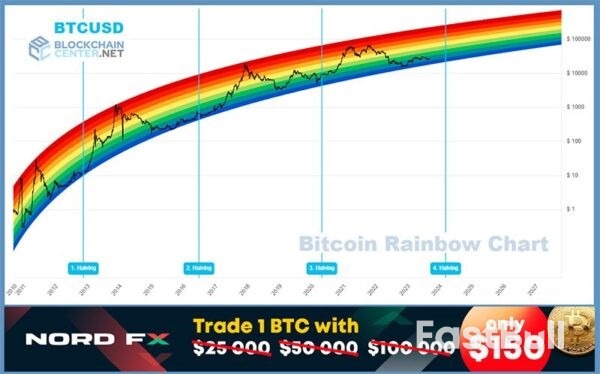
          Research firm Fundstrat has speculated that against the backdrop of the halving, BTC prices could surge by more than 500% from current levels, reaching the $180,000 mark. Financial corporation Standard Chartered projects that the price of the flagship cryptocurrency could rise to $50,000 this year and to $120,000 by the end of 2024. The Bitcoin Rainbow Chart by the Blockchain Center also recommends buying; BTC/USD quotes on their chart are currently in the lower zone, suggesting a rebound is due.
          According to Michael Saylor, the CEO of MicroStrategy, the inherent supply limitation of bitcoin capped at 21 million coins makes it the best asset for preserving and growing capital. The billionaire compared the depreciation rate of fiat currencies with the dynamics of inflation. He argued that individuals could see their savings erode if held in traditional currencies, citing that over the past 100 years, funds held in U.S. dollars would have lost about 99% of their value.
          As of the time of writing this review, on the evening of Friday, September 29, BTC/USD has neither fallen to $19,000 nor risen to $180,000. It is currently trading at $26,850. The overall market capitalization of the cryptocurrency market stands at $1.075 trillion, up from $1.053 trillion a week ago. The Crypto Fear & Greed Index has increased by 5 points, moving from 43 to 48, transitioning from the 'Fear' zone to the 'Neutral' zone.
          In conclusion, a forecast for the upcoming month. Experts have once again turned to artificial intelligence, this time to predict the price of the flagship cryptocurrency by Halloween (October 31). AI from CoinCodex posits that by the specified date, bitcoin will increase in price and reach a mark of $29,703.
          Interestingly, there is even a term in the crypto market known as "Uptober." The idea is that every October, bitcoin sees significant price gains. Looking at the 2021 figures, bitcoin was trading near $61,300 on October 31, marking an increase of over 344% compared to 2020. This phenomenon remained relevant even in the past year, 2022, following the high-profile crash of the FTX exchange. On October 1, 2022, the asset was trading at $19,300, but by October 31, the coin had reached a mark of $21,000. Let's see what awaits us this time.

          Source: NordFX

          Risk Warnings and Disclaimers
          You understand and acknowledge that there is a high degree of risk involved in trading. Following any strategies or investment methods may lead to potential losses. The content on the site is provided by our contributors and analysts for information purposes only. You are solely responsible for determining whether any trading assets, securities, strategy, or any other product is suitable for investing based on your own investment objectives and financial situation.
          Comments
          Add to Favorites
          Share

          What's Ahead in October?

          CMC

          Economic

          Central Bank

          Stocks

          Forex

          "Higher for longer rate" stance rattled Wall Street, can company earnings defeat bears?
          Wall Street fell for the second straight month on the bond jitters as the 10-year Treasury yields spiked to a fresh 15-year high following the Fed's hawkish reiteration, which spooked investors. And the IPO frenzy seemed to be short-lived, with ARM and Instacart, pulling back to just above their debut prices. Both the S&P 500 and Nasdaq posted the biggest monthly decline since December 2022. 10 out of 11 sectors in the S&P 500 finished lower in September, with the Real Estate and Utilities leading losses, down 7.2% and 8.2%, respectively. By contrast, the energy sector outperformed, up 3.2% for the month due to surging crude oil prices, which positively correlated with inflation. However, the stock markets may need a decent rebound as the S&P 500 declined nearly 5% in September, and the Fear & Greed gauge moved into "Extreme Fear" territory, suggesting the market may have been oversold.
          Notably, most mega-cap tech stocks declined throughout the month, with Nvidia slumping 10.3%, followed by Apple (-9.6%), and Amazon (-8.0%), while Tesla and Meta Platforms were slightly higher, up 2.1% and 1.3%, respectively, which bring an old debate back: Can AI stocks sustain their stellar performance? The upcoming third-quarter company earnings will be critical for the market trend on whether earnings growth can justify these stocks' valuations. The US earnings season usually kicks off with airlines and banks in the first half of the month, followed by Netflix and Tesla in the mid-month, and then mega-caps, such as Apple, Alphabet, Microsoft, and Meta Platforms, at the end of the month.
          With the absence of the Fed's meeting this month, economic data, including the US non-farm payroll, the September CPI, and the third-quarter GDP, will be in the spotlight for clues of the largest economic growth trajectory. But "good news" can be "bad news" as the resilient economic front usually strengthens expectations for higher interest rates.
          Both the ASX and the Aussie dollar were under pressure due to risk-off sentiment. RBA's rate decision and the CPI are key to shaping market trends
          In September, the Australian stock markets extended the decline amid prevailing risk-off sentiment on Wall Street. China's property woes added to its downside pressure, sending the ASX 200 down 2.2% for the month. All 11 sectors finished in the red, with Real Estate and Utilities leading losses, down 7.1% and 5.8%, respectively, while Financials and Energy stocks were resilient due to jumping premium payments and strong oil prices. QBE Insurance Group and Sancorp outperformed the broad markets, up 7.3% and 6.5% for the month, as the big insurers lifted their premium by 12%. Major energy stocks, such as Whitehaven and Santos, were up 7.4% and 3.8% on the positive energy demand outlooks ahead of the Northern Hemisphere's winter. At the same time, subdued metal prices continued to press on miner's socks, including BHP, Rio Tinto, Fortescue Metals, and Pilbara Minerals.
          On the economic front, Australia's monthly CPI re-accelerated to 5.2% year-over-year, up from 4.9% in the prior month, which increased the probability for the RBA to keep its rate hiking cycle. The data certainly offered support to the Australian dollar, with the AUD/USD consolidating above 0.63 for the past 7 months, showing signs of a potential bottom reversal in October.
          Apart from the global impact, RBA's rate decision and upcoming third-quarter CPI remain the focus of investors and traders. A hawkish stance and sticky inflation may send the stock markets lower but may lift the Aussie dollar higher, and vice versa.
          Chinese property woes sank its stocks, but there might be a stream of light at the end of the dark tunnel
          The selloff in the Chinese stock markets slowed but still finished the month in the red, with the Hang Seng Index down 3% and the CSI 300 slipping 2%. The Chinese property woes continued to weigh on sentiment. However, recent economic data showed that China's economy may have hit a bottom, as the September manufacturing PMI expanded for the first time since March. Alibaba's logistic arm, Cainiao, filed for IPO, which can be a sign to heat up the capital markets in the region, given the accommodative monetary policy by the PBOC compared with the US Fed. According to a report by Deloitte, "Shanghai Stock Exchange is expected to have retained first place in the global IPO ranking."
          In the new month, China's property sector's development, such as Country Garden and Evergrande, will continue to weigh on sentiment. The appealing sectors can still be on the lucrative EV stocks, like BYD, Nio, and XPeng, while China's big techs, particularly Alibaba and Baidu, may gain attention in the run-up to their third-quarter earnings season. China is due to release its third-quarter GDP in October, which will be crucial data for investors to gauge the country's economic health. The other influential economic data, such as CPI, PPI, and the trade balance, should also be on investors' radar.
          The New Zealand dollar showed signs of bottoming ahead of the RBNZ rate decision and the 2023 election
          The New Zealand dollar strengthened against most of its major trade partners' currencies in September, with NZD/USD up 0.51%, NZD/AUD up 1.24%, NZD/EUR up 3.08%, and NZD/GBP up 4.42%. New Zealand moved out of technical economic recession as its economic growth rebounded swiftly in the second quarter, rising by a surprising 0.9% from the prior quarter and was up 3.2% from a year ago. The Global Dairy Trade Index rose for two consecutive auctions, with Whole Milk Power's price, up 4.6% to US$2,799 at the auction on 19 September, the highest since 1 August. In the meantime, New Zealand's Business Outlook Index turned positive to 1.5 in September for the first time since May 2021, signalling a rebound in economic conditions as its housing markets also showed signs of hitting bottom earlier this year.
          New Zealand's election day falls on 14 October, and voting starts on 2 October. The latest poll shows that the potential right coalition has a better chance to win, with National leading ahead, which could add to the Kiwi dollar's strength, given the implied results. In addition, the RBNZ's OCR decision has a major impact on the dollar. The central bank is expected to hold onto the interest rate for the fourth consecutive time at 5.5% this month, given its stance from the last meeting as economic concerns became the priority. However, the bank also emphasized that the interest rate would need to stay at a restricted level to help cool down the inflation, which declined to 6% in the second quarter from 6.7% in the March quarter. The third-quarter CPI data will be released in the second half of the month after the rate decision and the election. A further decline in inflation may cap the Kiwi dollar's rebounding momentum; otherwise, higher-than-expected data may add to the NZD's rally.
          Globally, China's economic improvement and a potential overbought USD potentially provide further support to the local currency. Hence, the New Zealand dollar could head for a positive month in October.
          Crude oil extended gains after a volatile month
          The crude oil markets rose for the third consecutive month after briefly hitting the highest level since August 2022 on improved demand outlooks and expectations for OPEC + to keep supply tight by cutting production further. The WTI futures jumped 7.8%, and the Brent futures rose 6.9% in September. According to the crude inventory data, commercial crude oil stockpiles decreased by 2.2 million barrels by the week ending 22 September from the previous week. The crude imports increased by 8.2% on average over the past four weeks from the same period last year. China's improvement in its economic data fuelled the oil market's rally at the same time. On the supply side, OPEC+'s output reduction took the cartel's oil production to 40.40 million barrels per day in July, the lowest since August 2021, according to a Platts survey by S&P Global Commodity Insights. The leader of the organization, Sudi Arabic, voluntarily cut production by an extra 1 million barrels per day for July. The OPEC + meeting on 4 October can be a price mover in the short term, but the crude market may continue to rally till it hits the US$100 per barrel mark.
          Gold slumped to a 7-month low due to surging US bond yields and a strong USD
          Gold futures tumbled US$76 per ounce or 4.7% amid the US dollar's rally and surging US bond yields. Precious metal prices were particularly hit by the Fed's hawkish comments on the rate hike outlooks, as more than decade-high bond yields made it more expensive to hold onto physical gold, and a strong USD made it costly to purchase the precious metal in other currencies. The triple-top pattern in the gold chart suggests that the selling pressure may be mounting before it hits pivotal support of 1,700. However, a near-term rebound may be expected as gold was oversold last week, and a potential pullback in the king dollar could also lift the metal prices.

          To stay updated on all economic events of today, please check out our Economic calendar
          Risk Warnings and Disclaimers
          You understand and acknowledge that there is a high degree of risk involved in trading. Following any strategies or investment methods may lead to potential losses. The content on the site is provided by our contributors and analysts for information purposes only. You are solely responsible for determining whether any trading assets, securities, strategy, or any other product is suitable for investing based on your own investment objectives and financial situation.
          Comments
          Add to Favorites
          Share

          Global Economic Outlook: Navigating the Week Ahead

          Warren Takunda

          Economic

          United States

          Nonfarm Payrolls: The eagerly awaited September data is expected to show an increase of 150,000 jobs, reflecting a labor market that's slowly losing momentum.
          Unemployment Rate: Projections point to a dip in the unemployment rate to 3.7%.
          Wage Growth: Expectations are for wage growth to remain steady at 4.1%, a critical indicator of workers' purchasing power.
          Fed Speeches: Several Federal Reserve officials will take the stage, providing potential insights into monetary policy direction.
          JOLTS Data: Job openings data will offer a glimpse into the demand for labor in the U.S. economy.
          PMI Surveys: Both ISM and S&P Global PMI surveys will gauge the health of the U.S. manufacturing and service sectors, potentially hinting at ongoing economic challenges.
          Factory Orders and Trade Data: These figures provide insights into manufacturing trends and international trade dynamics.

          Americas (Excluding the U.S.)

          Canada: Employment figures and trade balance data will shed light on the Canadian economy.
          Mexico: Business and consumer morale will offer insights into economic sentiment.
          Brazil: Industrial output and foreign trade data are crucial indicators of Brazil's economic health.

          Europe

          Euro Area: Retail sales data will indicate consumer spending trends.
          Germany: A rebound in factory orders is expected, while industrial production may decline.
          France: Industrial production is anticipated to decline, and foreign trade figures will offer insights into trade dynamics.
          Italy: Unemployment rate and retail sales data will reflect Italy's economic conditions.
          Spain: The unemployment rate will be a key indicator of Spain's labor market health.
          Switzerland: Inflation rate, jobless data, and retail sales figures will provide insights into Switzerland's economic landscape.
          Turkey: Consumer prices and foreign trade statistics will be closely watched.
          United Kingdom: Housing price reports by Nationwide and Halifax will indicate the state of the UK housing market.

          Asia

          China: PMI surveys will offer insights into the impact of Beijing's support measures and risks from property developers.
          Japan: The Tankan Large Manufacturers Index and Bank of Japan's Summary of Opinions will provide insights into Japan's economic sentiment.
          India: September's PMI data and the RBI's policy rate decisions will shape India's monetary policy landscape.
          South Korea, Philippines, and Indonesia: September CPI prints will offer insights into inflation trends.
          Australia: RBA and RBNZ policy rate decisions, trade balance data, Ai Group index for September, and housing figures will shape Australia's economic outlook.
          To stay updated on all economic events of today, please check out our Economic calendar
          Risk Warnings and Disclaimers
          You understand and acknowledge that there is a high degree of risk involved in trading. Following any strategies or investment methods may lead to potential losses. The content on the site is provided by our contributors and analysts for information purposes only. You are solely responsible for determining whether any trading assets, securities, strategy, or any other product is suitable for investing based on your own investment objectives and financial situation.
          Comments
          Add to Favorites
          Share

          Wind Power Industry Drifts Off Course

          Kevin Du

          Economic

          A perfect storm of supply chain delays, design flaws and higher costs in the offshore wind industry has put dozens of projects at risk of not being delivered in time for countries to meet climate goals, industry executives, investors and analysts said.
          The race to reduce reliance on fossil fuels is putting pressure on manufacturers and supply chains to keep pace with demand for more clean energy, especially in the European Union which is finalising a legally binding goal to produce 42.5% of energy from renewables by 2030.
          Up from 32% now, the new target would require 420 gigawatts (GW) of wind energy including 103 GW offshore, more than double current capacity of 205 GW of which just 17 GW is offshore, according to industry group WindEurope.
          But so far this year, projects off Britain, the Netherlands and Norway have been delayed or shelved due to rising costs and supply chain constraints while Britain's renewable energy auction this month failed to attract any bids from offshore wind developers, also because of high industry costs.
          "If this turns into a prolonged pause of projects then without a doubt a lot of the 2030 renewables goals will be under pressure," said Jon Wallace, an investment manager at Jupiter Asset Management.
          Even before the EU agreed its new renewables target this year, companies including Orsted, Shell, Equinor, wind turbine manufacturer Siemens Gamesa and WindEurope had warned that the offshore wind industry was not big enough to deliver on climate targets.
          Supply chain disruptions which started during the global pandemic have been exacerbated by the Ukraine war while higher shipping rates, raw material costs, interest rates and inflation have dented profits for some wind developers.
          Markus Krebber, CEO of Germany's RWE, posted on LinkedIn that a combination of issues, all coming at time when the offshore industry was expected to expand quickly, called into question the achievement of climate protection goals.
          "We certainly see a big gap between the renewables and wind targets for 2030 and the path we are on right now. We are growing but nowhere near fast enough," said Ben Blackwell, CEO of the Global Wind Energy Council.
          Bigger and better?
          Over the last two decades, the industry has grown fast and cut technology costs to be on a par or even cheaper than fossil fuels in some parts of the world. But the race to develop ever bigger and more efficient turbines may have been too hasty, some executives and analysts said.
          Turbines have roughly doubled in size every decade with the largest ones operating in 2021 and 2022 coming with 110-metre blades and a capacity of 12 to 15 megawatts (MW). But the bigger they get the more susceptible they have become to faults, said Rob West, analyst at consultancy Thunder Said Energy.
          "Physics inherently punishes larger turbines. Larger blades will inherently deflect more, which means they need stiffer spar caps, shear webs and more expensive materials. They will also weigh more which pushes more stress and strain through the blade, root and nacelle during each rotation," he said.
          In June, Siemens Gamesa said quality problems at its two most recent onshore wind turbines would cost 1.6 billion euros ($1.7 billion) to fix.
          Fraser McLachlan, chief executive of GCube Insurance, said the number of insurance claims from wind developers has fallen in the past year but the amounts and severity of claims has gone up significantly.
          "It's like the iPhone. Everyone wants the next generation technology and equipment and the manufacturers have been trying to outdo each other and the result is you are not getting a sufficient amount of R&D invested in the technology," he said.
          "Participation in the offshore wind market has become a risky business, not only for insurers, but also manufacturers, developers, and supplier companies – with some now facing a material risk to their survival," McLachlan said.
          Siemens Gamesa Chief Executive Jochen Eickholt said its offshore business was facing separate issues to the onshore problems, including delays in construction of production sites, supply chain glitches and shortages of quality components.
          "We became a victim of our past successes over the last years. The interest in our products was very high, and this resulted in increased number of orders in 2021 and 2022 and it now requires a ramp-up in almost all of our production facilities," he said in August when the company reported third-quarter results.
          The world's leading turbine maker Vestas has also said it is struggling to deliver a backlog of orders and expects supply chain disruptions to continue this year.
          'Major market failure'
          At the same time, governments have stepped up auction rounds and tenders for seabed licences. Bloomberg New Energy Finance said it expected more than 60 GW of offshore wind contracts and leases to be for grabs worldwide through the end of 2024.
          But some wind developers said the electricity price on offer at auctions was too low for them to embark on new projects given the industry's problems with rising costs.
          "This is coming through to the developers who are discussing prices of turbines, labour, project deployment, hiring ships and finance and that's flowing into how they are budgeting projects," said Wallace at Jupiter.
          Britain aims to triple its offshore wind capacity to 50 GW by the end of this decade but the lack of bids from wind developers at its Sept. 8 auction could be a sign of things to come, some experts said.
          "The ratio between risk and reward is out of line in the offshore wind market in many jurisdictions. You can see this from investors not showing up," the Global Wind Energy Council's Blackwell told Reuters.
          "Governments can and should fix this issue quickly, otherwise we could see a major market failure and climate and economic goals will simply not be met," he said.
          In some auctions, prices have become too high for traditional renewables utilities to compete with major oil and gas companies on the hunt for greener assets.
          For example, BP and TotalEnergies won a German tender for 7 GWs of offshore wind after paying a record 12.6 billion euros for the leases. RWE and Denmark's Orsted dropped out of the auction due to concerns about the price.
          "We participated in that auction, and we would have loved to win. However, bid prices reached levels where our return expectations would not be met even in very optimistic scenarios," said RWE's Krebber.
          Such is the concern about the industry's problems, the European Commission said this month it will put forward a package of support measures.
          European companies are also struggling across the Atlantic.
          In recent months, developers including Orsted, Equinor, BP and Shell have sought to cancel or renegotiate power contracts for the first commercial-scale U.S. wind farms due to start operating between 2025 and 2028.
          And a fleet of U.S. projects central to President Joe Biden's aim for 30 GW of offshore wind by 2030 may not advance unless his administration eases requirements for subsidies in the Inflation Reduction Act, project developers have said.
          "The situation in U.S. offshore wind is severe," Orsted CEO Mads Nipper said last month.
          ($1 = 0.9435 euros)

          Source: ETEnergyworld

          To stay updated on all economic events of today, please check out our Economic calendar
          Risk Warnings and Disclaimers
          You understand and acknowledge that there is a high degree of risk involved in trading. Following any strategies or investment methods may lead to potential losses. The content on the site is provided by our contributors and analysts for information purposes only. You are solely responsible for determining whether any trading assets, securities, strategy, or any other product is suitable for investing based on your own investment objectives and financial situation.
          Comments
          Add to Favorites
          Share
          FastBull
          Copyright © 2025 FastBull Ltd

          728 RM B 7/F GEE LOK IND BLDG NO 34 HUNG TO RD KWUN TONG KLN HONG KONG

          TelegramInstagramTwitterfacebooklinkedin
          App Store Google Play Google Play
          Products
          Charts

          Chats

          Q&A with Experts
          Screeners
          Economic Calendar
          Data
          Tools
          Membership
          Features
          Function
          Markets
          Copy Trading
          Latest Signals
          Contests
          News
          Analysis
          24/7
          Columns
          Education
          Company
          Careers
          About Us
          Contact Us
          Advertising
          Help Center
          Feedback
          User Agreement
          Privacy Policy
          Business

          White Label

          Data API

          Web Plug-ins

          Poster Maker

          Affiliate Program

          Risk Disclosure

          The risk of loss in trading financial instruments such as stocks, FX, commodities, futures, bonds, ETFs and crypto can be substantial. You may sustain a total loss of the funds that you deposit with your broker. Therefore, you should carefully consider whether such trading is suitable for you in light of your circumstances and financial resources.

          No decision to invest should be made without thoroughly conducting due diligence by yourself or consulting with your financial advisors. Our web content might not suit you since we don't know your financial conditions and investment needs. Our financial information might have latency or contain inaccuracy, so you should be fully responsible for any of your trading and investment decisions. The company will not be responsible for your capital loss.

          Without getting permission from the website, you are not allowed to copy the website's graphics, texts, or trademarks. Intellectual property rights in the content or data incorporated into this website belong to its providers and exchange merchants.

          Not Logged In

          Log in to access more features

          FastBull Membership

          Not yet

          Purchase

          Become a signal provider
          Help Center
          Customer Service
          Dark Mode
          Price Up/Down Colors

          Log In

          Sign Up

          Position
          Layout
          Fullscreen
          Default to Chart
          The chart page opens by default when you visit fastbull.com