• Trade
  • Markets
  • Copy
  • Contests
  • News
  • 24/7
  • Calendar
  • Q&A
  • Chats
Trending
Screeners
SYMBOL
LAST
BID
ASK
HIGH
LOW
NET CHG.
%CHG.
SPREAD
SPX
S&P 500 Index
6827.42
6827.42
6827.42
6899.86
6801.80
-73.58
-1.07%
--
DJI
Dow Jones Industrial Average
48458.04
48458.04
48458.04
48886.86
48334.10
-245.98
-0.51%
--
IXIC
NASDAQ Composite Index
23195.16
23195.16
23195.16
23554.89
23094.51
-398.69
-1.69%
--
USDX
US Dollar Index
97.970
98.050
97.970
98.070
97.920
+0.020
+ 0.02%
--
EURUSD
Euro / US Dollar
1.17320
1.17327
1.17320
1.17447
1.17262
-0.00074
-0.06%
--
GBPUSD
Pound Sterling / US Dollar
1.33684
1.33693
1.33684
1.33740
1.33546
-0.00023
-0.02%
--
XAUUSD
Gold / US Dollar
4346.23
4346.57
4346.23
4348.78
4294.68
+46.84
+ 1.09%
--
WTI
Light Sweet Crude Oil
57.432
57.462
57.432
57.601
57.194
+0.199
+ 0.35%
--

Community Accounts

Signal Accounts
--
Profit Accounts
--
Loss Accounts
--
View More

Become a signal provider

Sell trading signals to earn additional income

View More

Guide to Copy Trading

Get started with ease and confidence

View More

Signal Accounts for Members

All Signal Accounts

Best Return
  • Best Return
  • Best P/L
  • Best MDD
Past 1W
  • Past 1W
  • Past 1M
  • Past 1Y

All Contests

  • All
  • Trump Updates
  • Recommend
  • Stocks
  • Cryptocurrencies
  • Central Banks
  • Featured News
Top News Only
Share

Polish Inflation At 2.5% Year-On-Year In November

Share

Poland's January-October Import Up 5.4% To 309.3 Billion Euros

Share

Poland's January-October Trade Balance At -5.1 Billion Euros

Share

Poland's January-October Export Up 2.8% To 304.3 Billion Euros

Share

Ceasefire Negotiations Between Ukraine And US Representatives In Berlin To Continue Monday Morning - German Source Familiar With The Schedule

Share

Spain's IBEX Hits Fresh Record High, Up Over 1%

Share

Spot Silver Rises Nearly 3% To $63.82/Oz

Share

Philippine Maritime Council: Expresses Alarm Over Recent Harassment Of Filipino Fishermen In South China Sea Shoal

Share

France's Foreign Minister Says He Suggesd To EU's Kallas That US Representatives Brief EU Foreign Ministers On Gaza Peace Plan During Their Meeting

Share

India Trade Secretary: Prime Facie Don't See A Case Of Rice Dumping To USA And There Is No Active Investigation On That

Share

India Trade Secretary: India's Rice Exported To USA Largely Limited To Basmati And At Price Higher Than General Price Of Rice

Share

India Trade Secretary: India Can Raise Shipments To Russia In Sectors Like Automobiles And Pharmaceuticals

Share

India Trade Secretary:India-Oman Trade Deal Completed And Will Be Signed Soon

Share

Burberry Shares Top FTSE Gainer, Up 3.5% In Positive European Luxury Sector

Share

India Trade Secretary: India-US Close To A “Framework” Deal But Won't Give A Timeline

Share

Yemen's Southern Transitional Council (Stc) Launches Military Operation In Abyan

Share

India Trade Official: As Mexico Has Raised Tariffs On Mfn Basis, We Don't See A Recourse In WTO

Share

India Trade Official: India Has Proposed A “Preferential Trade Agreement” With Mexico

Share

India Trade Official: Mexico's Primary Target Is Not To Hit Indian Exports

Share

India Trade Official: India, Mexico Have Agreed To Pursue A Trade Agreement To Mitigate The Impact Promptly

TIME
ACT
FCST
PREV
France HICP Final MoM (Nov)

A:--

F: --

P: --

China, Mainland Outstanding Loans Growth YoY (Nov)

A:--

F: --

P: --

China, Mainland M2 Money Supply YoY (Nov)

A:--

F: --

P: --

China, Mainland M0 Money Supply YoY (Nov)

A:--

F: --

P: --

China, Mainland M1 Money Supply YoY (Nov)

A:--

F: --

P: --

India CPI YoY (Nov)

A:--

F: --

P: --

India Deposit Gowth YoY

A:--

F: --

P: --

Brazil Services Growth YoY (Oct)

A:--

F: --

P: --

Mexico Industrial Output YoY (Oct)

A:--

F: --

P: --

Russia Trade Balance (Oct)

A:--

F: --

P: --

Philadelphia Fed President Henry Paulson delivers a speech
Canada Building Permits MoM (SA) (Oct)

A:--

F: --

P: --

Canada Wholesale Sales YoY (Oct)

A:--

F: --

P: --

Canada Wholesale Inventory MoM (Oct)

A:--

F: --

P: --

Canada Wholesale Inventory YoY (Oct)

A:--

F: --

P: --

Canada Wholesale Sales MoM (SA) (Oct)

A:--

F: --

P: --

Germany Current Account (Not SA) (Oct)

A:--

F: --

P: --

U.S. Weekly Total Rig Count

A:--

F: --

P: --

U.S. Weekly Total Oil Rig Count

A:--

F: --

P: --

Japan Tankan Small Manufacturing Outlook Index (Q4)

A:--

F: --

P: --

Japan Tankan Large Non-Manufacturing Diffusion Index (Q4)

A:--

F: --

P: --

Japan Tankan Large Non-Manufacturing Outlook Index (Q4)

A:--

F: --

P: --

Japan Tankan Large Manufacturing Outlook Index (Q4)

A:--

F: --

P: --

Japan Tankan Small Manufacturing Diffusion Index (Q4)

A:--

F: --

P: --

Japan Tankan Large Manufacturing Diffusion Index (Q4)

A:--

F: --

P: --

Japan Tankan Large-Enterprise Capital Expenditure YoY (Q4)

A:--

F: --

P: --

U.K. Rightmove House Price Index YoY (Dec)

A:--

F: --

P: --

China, Mainland Industrial Output YoY (YTD) (Nov)

A:--

F: --

P: --

China, Mainland Urban Area Unemployment Rate (Nov)

A:--

F: --

P: --

Saudi Arabia CPI YoY (Nov)

A:--

F: --

P: --

Euro Zone Industrial Output YoY (Oct)

--

F: --

P: --

Euro Zone Industrial Output MoM (Oct)

--

F: --

P: --

Canada Existing Home Sales MoM (Nov)

--

F: --

P: --

Euro Zone Total Reserve Assets (Nov)

--

F: --

P: --

U.K. Inflation Rate Expectations

--

F: --

P: --

Canada National Economic Confidence Index

--

F: --

P: --

Canada New Housing Starts (Nov)

--

F: --

P: --

U.S. NY Fed Manufacturing Employment Index (Dec)

--

F: --

P: --

U.S. NY Fed Manufacturing Index (Dec)

--

F: --

P: --

Canada Core CPI YoY (Nov)

--

F: --

P: --

Canada Manufacturing Unfilled Orders MoM (Oct)

--

F: --

P: --

U.S. NY Fed Manufacturing Prices Received Index (Dec)

--

F: --

P: --

U.S. NY Fed Manufacturing New Orders Index (Dec)

--

F: --

P: --

Canada Manufacturing New Orders MoM (Oct)

--

F: --

P: --

Canada Core CPI MoM (Nov)

--

F: --

P: --

Canada Trimmed CPI YoY (SA) (Nov)

--

F: --

P: --

Canada Manufacturing Inventory MoM (Oct)

--

F: --

P: --

Canada CPI YoY (Nov)

--

F: --

P: --

Canada CPI MoM (Nov)

--

F: --

P: --

Canada CPI YoY (SA) (Nov)

--

F: --

P: --

Canada Core CPI MoM (SA) (Nov)

--

F: --

P: --

Canada CPI MoM (SA) (Nov)

--

F: --

P: --

Federal Reserve Board Governor Milan delivered a speech
U.S. NAHB Housing Market Index (Dec)

--

F: --

P: --

Australia Composite PMI Prelim (Dec)

--

F: --

P: --

Australia Services PMI Prelim (Dec)

--

F: --

P: --

Australia Manufacturing PMI Prelim (Dec)

--

F: --

P: --

Japan Manufacturing PMI Prelim (SA) (Dec)

--

F: --

P: --

U.K. Unemployment Claimant Count (Nov)

--

F: --

P: --

U.K. Unemployment Rate (Nov)

--

F: --

P: --

U.K. 3-Month ILO Unemployment Rate (Oct)

--

F: --

P: --

Q&A with Experts
    • All
    • Chatrooms
    • Groups
    • Friends
    Connecting
    .
    .
    .
    Type here...
    Add Symbol or Code

      No matching data

      All
      Trump Updates
      Recommend
      Stocks
      Cryptocurrencies
      Central Banks
      Featured News
      • All
      • Russia-Ukraine Conflict
      • Middle East Flashpoint
      • All
      • Russia-Ukraine Conflict
      • Middle East Flashpoint
      Search
      Products

      Charts Free Forever

      Chats Q&A with Experts
      Screeners Economic Calendar Data Tools
      Membership Features
      Data Warehouse Market Trends Institutional Data Policy Rates Macro

      Market Trends

      Market Sentiment Order Book Forex Correlations

      Top Indicators

      Charts Free Forever
      Markets

      News

      News Analysis 24/7 Columns Education
      From Institutions From Analysts
      Topics Columnists

      Latest Views

      Latest Views

      Trending Topics

      Top Columnists

      Latest Update

      Signals

      Copy Rankings Latest Signals Become a signal provider AI Rating
      Contests
      Brokers

      Overview Brokers Assessment Rankings Regulators News Claims
      Broker listing Forex Brokers Comparison Tool Live Spread Comparison Scam
      Q&A Complaint Scam Alert Videos Tips to Detect Scam
      More

      Business
      Events
      Careers About Us Advertising Help Center

      White Label

      Data API

      Web Plug-ins

      Affiliate Program

      Awards Institution Evaluation IB Seminar Salon Event Exhibition
      Vietnam Thailand Singapore Dubai
      Fans Party Investment Sharing Session
      FastBull Summit BrokersView Expo
      Recent Searches
        Top Searches
          Markets
          News
          Analysis
          User
          24/7
          Economic Calendar
          Education
          Data
          • Names
          • Latest
          • Prev

          View All

          No data

          Scan to Download

          Faster Charts, Chat Faster!

          Download App
          English
          • English
          • Español
          • العربية
          • Bahasa Indonesia
          • Bahasa Melayu
          • Tiếng Việt
          • ภาษาไทย
          • Français
          • Italiano
          • Türkçe
          • Русский язык
          • 简中
          • 繁中
          Open Account
          Search
          Products
          Charts Free Forever
          Markets
          News
          Signals

          Copy Rankings Latest Signals Become a signal provider AI Rating
          Contests
          Brokers

          Overview Brokers Assessment Rankings Regulators News Claims
          Broker listing Forex Brokers Comparison Tool Live Spread Comparison Scam
          Q&A Complaint Scam Alert Videos Tips to Detect Scam
          More

          Business
          Events
          Careers About Us Advertising Help Center

          White Label

          Data API

          Web Plug-ins

          Affiliate Program

          Awards Institution Evaluation IB Seminar Salon Event Exhibition
          Vietnam Thailand Singapore Dubai
          Fans Party Investment Sharing Session
          FastBull Summit BrokersView Expo

          [Fed] Waller: No Need to Cut Rates Quickly

          FastBull Featured

          Remarks of Officials

          Summary:

          In the current cycle, with economic activity and labor markets in good shape and inflation coming down gradually to 2%, I see no reason to move as quickly or cut as rapidly as in the past.

          Federal Reserve Governor Christopher J. Waller delivered a speech at the Brookings Institution on January 16. The key points are as follows.
          Economic activity has slowed down. An important part of that slowdown comes from business investment and government spending. So far, the slowdown in consumer spending appears more tentative. Factors such as high interest rates, the depletion of excess savings, and a pickup in credit card usage all portend slower growth ahead, but it is unclear how much of that slowing has already occurred. Since consumer spending accounts for more than two-thirds of GDP, this component of demand is obviously critical for the outlook.
          There have been increases in labor supply amid slowing demand for labor, and I expect this to continue to bring the labor market into better balance. Some have seen the latest jobs report as in conflict with this story, but I don't see it that way.
          I see the surprises in the December jobs report as largely noise against a trend of ongoing moderation that supports progress toward 2% inflation. Given this recent history of revisions, there is a good chance December will be revised down. Employment growth is likely to slow as growth is expected to moderate in the coming quarters. An uptick in wage growth last December should be viewed over a longer time horizon. Wages rose less in the fourth quarter than in the third quarter. Despite the decline in the labor participation rate in December, it averaged higher in the fourth quarter than in 2022. These are signs that the labor market continues to come into better balance.
          We showed in our research that if the job vacancy rate continued to fall below 4.5%, there would be a significant increase in the unemployment rate. So, from now on, the setting of policy needs to proceed with more caution to avoid over-tightening.
          Overall, financial conditions remain restrictive and continue to have the desired effect of being a drag on economic activity to put downward pressure on inflation.
          Based on economic activity and the cooling of the labor market, I am becoming more confident that we are within striking distance of achieving a sustainable level of 2% PCE inflation.
          As long as inflation does not rebound or stay elevated, I believe the FOMC will be able to lower the target range for the federal funds rate this year. Risks that would delay or dampen my expectation for rate cuts this year are that economic activity that seems to have moderated in the fourth quarter of 2023 does not play out; that the balance of supply and demand in the labor market, which improved over 2023, stops improving or reverses; and that the gains on moderating inflation evaporate.
          I will be watching closely the scheduled revisions to CPI inflation due next month. In mid-February, we will get the January CPI report and revisions for 2023, potentially changing the picture on inflation.
          With economic activity and labor markets in good shape and inflation coming down gradually to 2%, I see no reason to move as quickly or cut as rapidly as in the past. The healthy state of the economy provides the flexibility to lower the (nominal) policy rate to keep the real policy rate at an appropriate level of tightness.
          The timing and number of rate cuts will be driven by the incoming data.

          Waller's Speech

          Risk Warnings and Disclaimers
          You understand and acknowledge that there is a high degree of risk involved in trading. Following any strategies or investment methods may lead to potential losses. The content on the site is provided by our contributors and analysts for information purposes only. You are solely responsible for determining whether any trading assets, securities, strategy, or any other product is suitable for investing based on your own investment objectives and financial situation.
          Comments
          Add to Favorites
          Share

          [ECB] Lane: It's Too Early to Talk About Rate Cuts

          FastBull Featured

          Remarks of Officials

          Philip R. Lane, chief economist of the European Central Bank (ECB), gave an interview with Corriere della Sera on January 13. The main points are as follows.

          Q1: In light of recent data, is the ECB considering cutting interest rates?

          A: Cutting rates include a sequence of moves, not a single decision. I will fully take that into account in terms of the scale and timing of the rate adjustment towards a more neutral monetary policy stance when it comes to it.

          Q2: What is it that the market is getting so wrong by expecting ECB rate cuts by March or April, and for these to then continue rather aggressively in 2024? Do you believe the market discounts the euro area recession?

          A: Lane did not positively answer the first question but emphasized the headwinds facing inflation. As for the second question, the ECB's baseline scenario is that the economy will recover significantly due to strong demand in Europe. However, this could trigger an uptick in inflation. There are downside risks to the economic forecasts for December, which is one of the big data questions we have for these weeks.

          Q3: Many wage deals will happen in the first quarter, and the ECB needs to assess wage settlements before getting an orientation on monetary policy. Do you think you will have a clear idea by April?

          A: The data for the first quarter will not be available until the end of April, and we will have those data by June. It will take time to have a good understanding of whether the wage settlements are decelerating. We expect that 2024 will still have high wage increases.

          Q4: Inflation has fallen. Why doesn't the ECB cut rates at this point?

          A: The market is taking the view, which I share, that we have done a cyclical increase in interest rates; it's temporary. We need to confirm that inflation can return to 2% before we start cutting rates. To achieve this, we need to ensure that the inflation problem is fully defeated. Otherwise, we have to face a far worse scenario. This calls for caution. It is too early to discuss rate cuts now and we have not yet seen sufficient evidence to move to the next stage.

          Q5: Will geopolitical conflicts trigger economic repercussions in Europe and globally?

          A: Mechanically, higher shipping rates would add to the costs of industry. But you also potentially have a disinflationary effect, in which many businesses around the world may just simply cancel orders and postpone investments. The result would be a more pronounced slowdown in the economy. But, also more generally, geopolitical risks may result in firms and households becoming less confident in the future.

          Interview Transcript

          Risk Warnings and Disclaimers
          You understand and acknowledge that there is a high degree of risk involved in trading. Following any strategies or investment methods may lead to potential losses. The content on the site is provided by our contributors and analysts for information purposes only. You are solely responsible for determining whether any trading assets, securities, strategy, or any other product is suitable for investing based on your own investment objectives and financial situation.
          Comments
          Add to Favorites
          Share

          UK Inflation Unexpectedly Rebounds

          Swissquote

          Central Bank

          Economic

          Forex

          Yesterday was just another day where another policymaker pushed back on the exaggerated rate cut expectations. Federal Reserve's (Fed) Christopher Waller said that the Fed should go 'methodically and carefully' to hit the 2% inflation target, which according to him is 'within striking distance', but 'with economic activity and labour markets in good shape' he sees 'no reason to move as quicky or cut as rapidly as in the past', and as is suggested by the market pricing. So that was it. Another enlightening moment went down the market's throat in the form of a selloff in both equities and bonds. The US 2-year yield – which captures the rate expectations rebounded 12bp, the 10-year yield jumped past the 4%, the US dollar index recovered to a month high and is testing the 200-DMA resistance to the upside this morning, while the S&P500 retreated 0.37%.
          Waller spoke from the US yesterday, but many counterparts are wining, dining and speaking in the World Economic Forum in Davos this week, which doesn't only offer snowy and a beautiful scenery this January, but it also serves as a platform to many policymakers to bring the market back to reason. Expect more comments of this hawkish kind during this week. It turns out that one of the most popular topics of this year's WEF is rising inflationary risks due to the heating tensions in the Red Sea which disrupt the global trade roads and explode the shipping costs.

          The EUR/USD slips into bearish consolidation zone

          The European Central Bank (ECB) officials were the first ones to push back the rate cut expectations. They were the first ones to attract attention to the looming inflation risks and to the idea that the ECB doesn't consider cutting the rates despite the slowing economic activity and looming recession that would – in theory – justify rate cuts in the euro area way more than rate cuts in the States, where growth and jobs numbers remain surprisingly and non-alarmingly resilient.
          So many ask why the EURUSD doesn't benefit from that hawkishness. Well, it did to some extent. The pair advanced past the 1.10 level at the end of last year. Yet, the reality is, even though the ECB starts cutting the rates after the Fed and cuts less than the Fed, the deterioration in the Eurozone's economic fundamentals had already started counterweighing the hawkish ECB views. And now that the Fed members have started giving out a more hawkish voice to balance out the overly stretched Fed cut expectations, the downside correction in the EURUSD is all but surprising. From a technical perspective, there is an important development in the EURUSD. The pair slipped below 1.0875, the major 38.2% Fibonacci retracement on the October to now rebound and is now in the medium-term bearish consolidation zone. There is potential for a deeper fall. The next natural targets for the bears are the 200-DMA, near 1.0845, and the 50% retracement, near 1.0793.

          Unexpected rise in UK inflation

          Cable rebounded following an unexpected rebound in British inflation numbers this morning. Headline inflation unexpectedly rebounded to 4%, while core inflation remained steady at 5.1% versus the expectation of a decline below the 5% mark.
          This morning's inflation disappointment lead sterling bears to trim bets below the 1.26 mark.
          To give Rishi Sunak his due, inflation in Britain more than halved last year and is expected to return to the Bank of England's (BoE) 2% target by spring, but the possibility of a U-turn in the inflation trend due to the geopolitical developments is a mounting risk and call for a balanced approach from the BoE. But regardless of a hawkish position, UK's anemic growth should limit any positive move in sterling against the US dollar.
          To stay updated on all economic events of today, please check out our Economic calendar
          Risk Warnings and Disclaimers
          You understand and acknowledge that there is a high degree of risk involved in trading. Following any strategies or investment methods may lead to potential losses. The content on the site is provided by our contributors and analysts for information purposes only. You are solely responsible for determining whether any trading assets, securities, strategy, or any other product is suitable for investing based on your own investment objectives and financial situation.
          Comments
          Add to Favorites
          Share

          Lagarde Warns that Disruptions in the Supply Chain May Reignite Inflation Concerns

          Ukadike Micheal

          Forex

          Economic

          Supply-chain disruptions, a significant concern for European Central Bank President, Christine Lagarde, are currently under close scrutiny as she assesses the potential risks associated with a resurgence of inflation. Lagarde highlighted key factors demanding careful observation, including wage bargaining, profit margins, energy prices, and the looming possibility of resurfacing supply bottlenecks. At an event in Davos, she expressed the serious impact these components could have on the ECB's efforts against inflation.
          Policymakers, including Robert Holzmann, are alert to the situation in the Red Sea, identifying it as a potential threat to consumer prices. The ongoing attacks by Iran-backed Houthi rebels on commercial ships in the Red Sea pose a considerable challenge to global trade. The West aims to discourage further actions while navigating the delicate balance of preventing a broader Middle East conflict in a region already tense due to the Israel-Hamas war.
          Reflecting on the lessons learned during the pandemic, disruptions to supply chains played a pivotal role in triggering inflation, exacerbated later by the spike in energy prices following the Russian invasion of Ukraine. Now, with the Red Sea situation unfolding, concerns about renewed supply-chain disruptions intensify, posing a potential threat to the global economy's delicate balance.
          As the international community grapples with the complexities of the Red Sea situation, the risks to supply chains and subsequent inflation are not the only challenges at hand. The West's efforts to deter Houthi rebels and prevent a wider Middle East conflict underscore the delicate geopolitical balance in a region already marked by tensions.
          The convergence of economic and geopolitical factors demands a vigilant approach from policymakers. The intricate dance between supply-chain disruptions, inflationary pressures, and geopolitical tensions in the Red Sea region adds layers of complexity to the global economic landscape. Navigating these challenges requires a nuanced and strategic response to safeguard economic stability and mitigate potential disruptions.

          Source: Bloomberg

          To stay updated on all economic events of today, please check out our Economic calendar
          Risk Warnings and Disclaimers
          You understand and acknowledge that there is a high degree of risk involved in trading. Following any strategies or investment methods may lead to potential losses. The content on the site is provided by our contributors and analysts for information purposes only. You are solely responsible for determining whether any trading assets, securities, strategy, or any other product is suitable for investing based on your own investment objectives and financial situation.
          Comments
          Add to Favorites
          Share

          Aramco CEO Predicts Tighter Oil Markets, Sees Red Sea Risks

          Devin

          Energy

          Political

          Global oil markets will cope with Red Sea disruptions in the short run, although prolonged attacks by the Houthis on ships would lead to a shortage of tankers due to longer voyages and a supply delay, the CEO of Saudi oil giant Aramco said.
          Amin Nasser told Reuters he expected the oil market to tighten after consumers depleted stocks by 400 million barrels in the last two years, which left OPEC's spare capacity as the main source of additional supply to meet rising demand.
          Attacks by the Houthis on ships in the Red Sea have forced many companies to divert cargoes around Africa. The Iran-aligned Houthis say they are acting in solidarity with Palestinians during Israel's ongoing war with Gaza.
          "If it's in the short term, tankers might be available ... But if it's longer term, it might be a problem," Nasser said in an interview on the sidelines of this week's World Economic Forum in the Swiss ski resort of Davos. "There will be a need for more tankers and are they going to have to take a longer journey".
          Container vessels have been pausing or diverting from the Red Sea that leads to the Suez Canal, the fastest route from Asia to Europe, where about 12% of world shipping passes.
          The alternative route around South Africa's Cape of Good Hope adds 10-14 days to the journey.
          Aramco can bypass the Bab al-Mandab strait near Yemen, from where the Houthis launch attacks, via a pipeline connecting its eastern oil facilities with its western coast and giving it quicker access to the Suez Canal, Nasser said.
          Some oil products might have to sail around Africa, Nasser said, adding that he does not expect the Houthis to attack Aramco's facilities again as a result of peace talks between Saudi Arabia and Yemen.
          Spare Capacity
          Nasser said he saw oil demand at 104 million barrels a day (bpd) in 2024, meaning growth of roughly 1.5 million bpd after growing by 2.6 million bpd in 2023.
          And demand growth, combined with low stocks, will help tighten the market further, he added.
          Nasser said global stocks have shrunk to the low end of a five year average after consumers depleted offshore and inland reserves by 400 million barrels over the past two years.
          "The only card available today is the spare capacity, which is around 3.5% globally. And as demand picks up, you will erode that spare capacity unless there is additional supply."
          Nasser said he could not predict when oil demand would peak or plateau as fossil fuel consumption was migrating from developed to developing countries, which were getting richer.
          "There is good growth and demand is very healthy in China," he said.
          Aramco has invested in Chinese refineries with crude supply deals attached and is in talks for more, with a focus on converting liquids into chemicals.
          "There are not many refineries around the world that are fully integrated. China offers that opportunity and demand for chemicals is expected to grow, so it's an attractive market," Nasser said.

          Source: Yahoo

          Risk Warnings and Disclaimers
          You understand and acknowledge that there is a high degree of risk involved in trading. Following any strategies or investment methods may lead to potential losses. The content on the site is provided by our contributors and analysts for information purposes only. You are solely responsible for determining whether any trading assets, securities, strategy, or any other product is suitable for investing based on your own investment objectives and financial situation.
          Comments
          Add to Favorites
          Share

          Markets Won't Give Up on March Fed Cut

          Damon

          Central Bank

          Economic

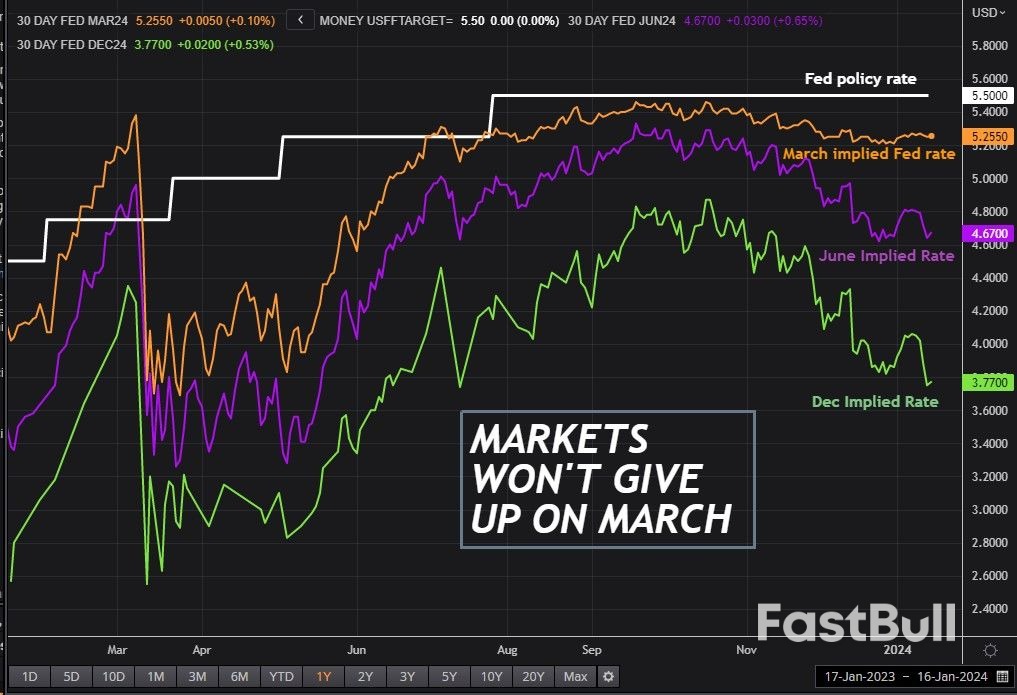
          For all the rhetorical pushback from officials, markets are doggedly clinging to March as the month of the Federal Reserve's first interest rate cut in four years - following two years of historically brutal credit tightening.
          Even though futures pricing for a move has ebbed and flowed over the weeks since Fed policymakers electrified markets last month by pencilling 75 basis points of cuts for 2024, they have consistently assigned a 50% or greater chance of a move as soon as March.
          But listening to the full sweep of Fed speakers, that seems brave.
          Officials couch the policy horizon in a bit of fog as they greedily gather more data to support a critical switch of direction - but more and more point to a first move from midyear on, with some even retaining the option of one final hike.
          Once again on Tuesday, the implied probability of a March cut moved as high as 75% early in the day - only to slip back again after governor Christopher Waller acknowledged the Fed's 2% inflation goal was within striking distance but doused any need to be 'rushed' with a first rate cut while assessing the 'coming months' of data.
          The relatively gentle rap on market knuckles elicited an equally modest response and futures stayed roughly 70% priced for a March move.
          All of which may sound like a familiar old story of irrational market exuberance and foolishly fighting the Fed.
          Perhaps.
          But the obsession with March is not without foundation.
          Aside from the curious fact that March has lately become a bit of milestone month for the Fed - it was the month of the final cut in 2020 and the month it started tightening in 2022 - there are good reasons why futures won't give up the ghost.Markets Won't Give Up on March Fed Cut_1Markets Won't Give Up on March Fed Cut_2
          Wedges And Targets
          Last week's U.S. consumer price report for December lit a fire under March bets despite headline readings initially suggesting it was another obstinate inflation picture the Fed seems to be so cautious about.
          But combined with the following day's benign producer input data, breakdown of the CPI and PPI reports showed very soft readings for components in both that hold larger weightings in the Fed's favoured personal consumption expenditures (PCE) inflation gauge - the December version of which is due on Jan 26.
          A 'wedge' between CPI and PCE appears to be widening.
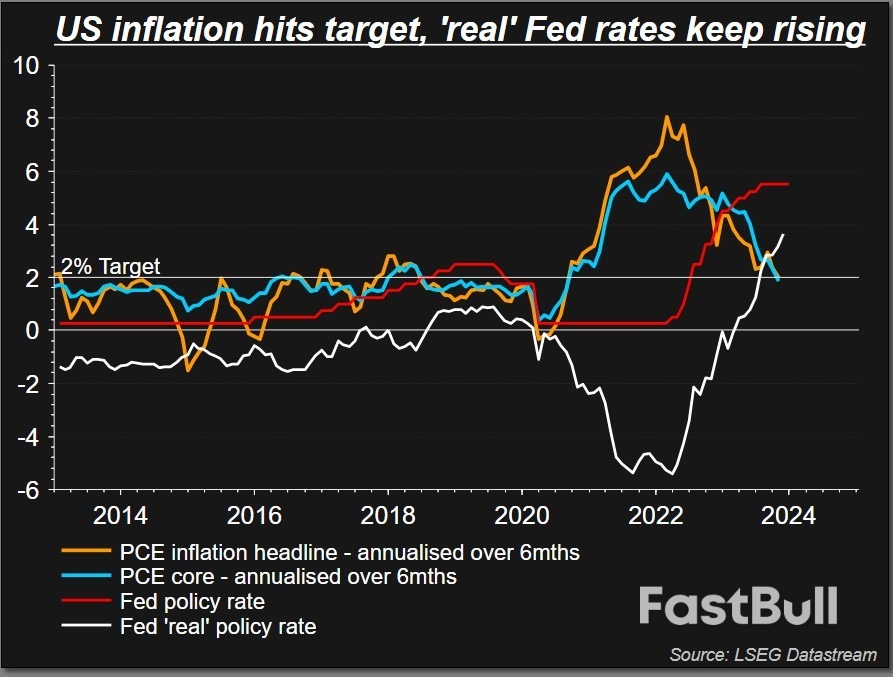
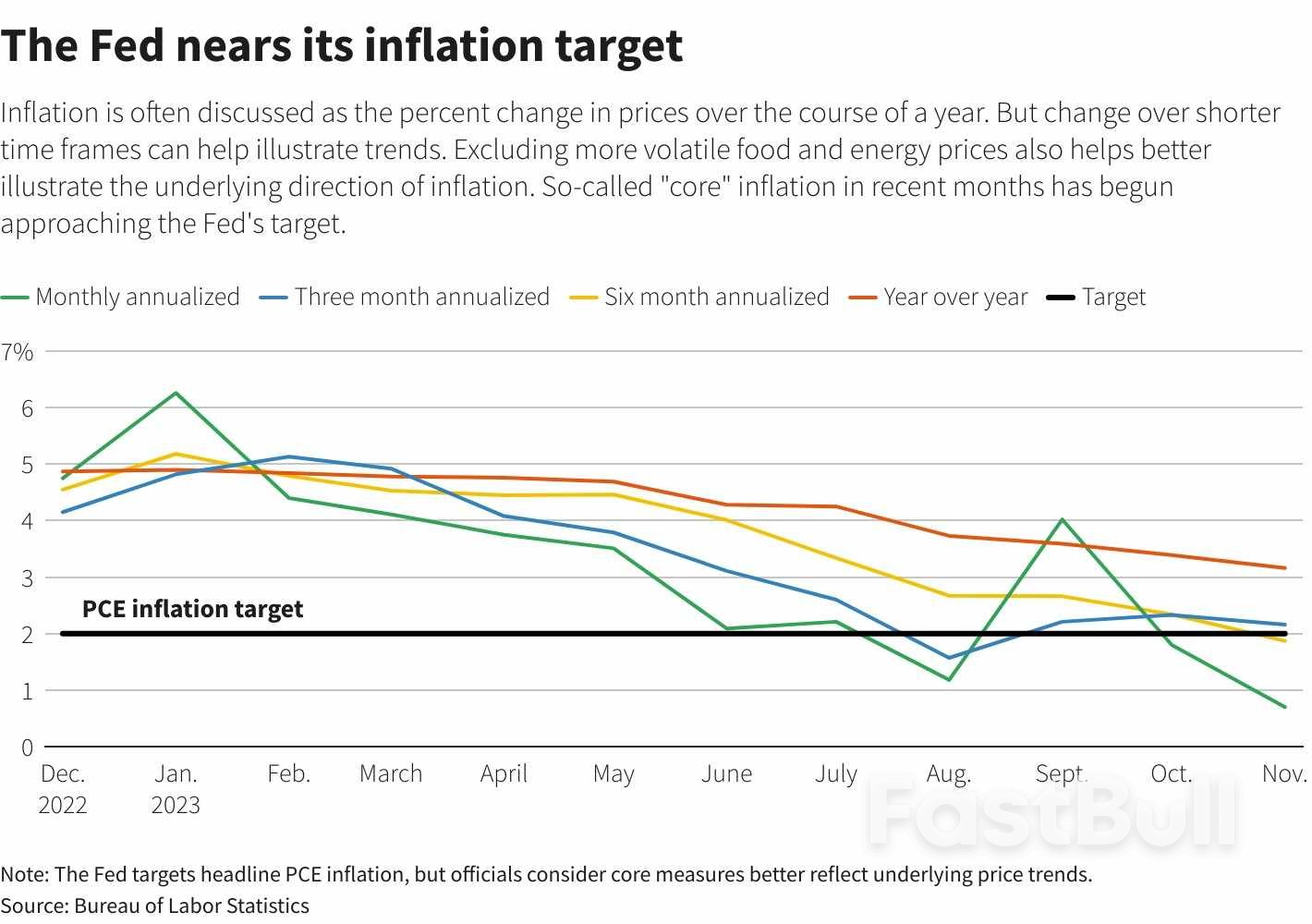
          So much so that many banks and traders slicing and dicing inflation stats quickly homed in on the likelihood that six-month annualised 'core' PCE inflation is now falling below the Fed's 2% target.
          That price picture was enough to prompt Barclays this week to bring forward its forecast for the first Fed rate cut to March from June - as it now sees annualised core PCE for the second half of 2023 as low as 1.9% compared with an equivalent CPI measure still over 3%.
          UBS economists similarly now see the six-month annualised core PCE inflation rate as low as 1.8% - almost a third of its peak at 5.9% in March 2022.
          And while many forecasters warn these measures could pop back slightly above 2% again in the first few months of 2024, most, including Morgan Stanley, are also cutting their full year 2024 core PCE outlooks.
          These shifting sands mean that, regardless of the date of the first cut, the total amount of easing priced for 2024 has now moved consistently back above 150 basis points (bps) - twice Fed indications from last month and 15 bps up from the start of January.
          And many also point out that if you watch other momentum indicators - three-month or even one-month annualised core PCE rates - they have been under 2% since the middle of last year.
          "Eventually the Fed is going to realize that it is behind the curve, just as it did on the other side of this cycle," wrote Tim Duy of SGH Macro Advisors. "The Fed can maintain all it wants that 'inflation is still too high' but that's just a delusion that ignores the fact that inflation has been actually running at or below target for seven months."Markets Won't Give Up on March Fed Cut_3
          Markets Won't Give Up on March Fed Cut_4Lags, Walls and Repos
          If on that basis, inflation has already subsided to or below target, then the 'real' inflation adjusted Fed policy rate is still rising into a slowing economy - despite the fact Fed minutes expressed concern about overtightening.
          Even though the nominal Fed policy rate has been steady in the 5.25 to 5.5% range since July, the real Fed policy rate derived from a six-month annualised core PCE has risen an additional 130 bps to more than 3.60% in the interim and could rise further as these inflation rates subside further.
          The Fed may then be pressured to cut the nominal rate just to stop rising real rates squeezing the economy excessively. That's doubly so because assumptions of one-year-plus lags in policy transmission means it may already be wary of so-called maturity walls in corporate debt refinancing schedules that are assumed be hit early next year.
          Another factor arguing for an early move is interpretation of Fed rhetoric.
          What's clear from the December meeting is that without any rhetorical shift in the cautious statement or comments from Fed Chair Jerome Powell, policymaker forecasts had shifted regardless.
          For many, that signalled that 'Fedspeak' can comfortably reconcile phrases like higher-for-longer and restrictive policy with nominal policy rate cuts as long as rates remain above the 2.5% it sees as long-term neutral.
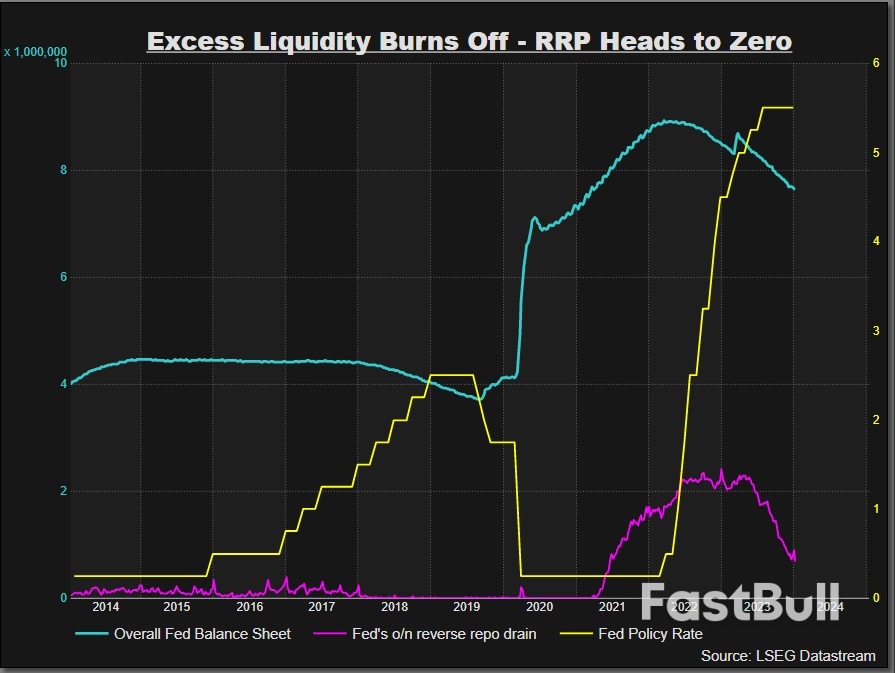
          What's more, the minutes of the Fed meeting have already flagged some concern about the rapid drain of excess liquidity in the money markets as cash parked at the Fed's reverse repo facility overnight falls away.
          Fed officials now appear agreed on at least a discussion about the parameters of a slowdown in its balance sheet runoff - or quantitative tightening policy - as a result.
          Perhaps not coincidentally, if the pace of reverse repo drop of recent months is sustained through the early part of this year, it will have been run dry by March and leave banks open to liquidity shortages the Fed will be mindful of.
          Betting on a March easing may prove wide of the mark in the end - and there are price risks that could shift the dial by then. But it's not unthinking or outlandish and won't go easily.

          Source: Reuters

          To stay updated on all economic events of today, please check out our Economic calendar
          Risk Warnings and Disclaimers
          You understand and acknowledge that there is a high degree of risk involved in trading. Following any strategies or investment methods may lead to potential losses. The content on the site is provided by our contributors and analysts for information purposes only. You are solely responsible for determining whether any trading assets, securities, strategy, or any other product is suitable for investing based on your own investment objectives and financial situation.
          Comments
          Add to Favorites
          Share

          Higher Crude Supply Could Drag Oil Prices Lower This Year, Analysts Say

          Owen Li

          Energy

          Oil prices may be lower this year compared with 2023 on greater crude supply from some producers and weaker demand growth in China, the world's second-largest economy.
          Analysts said increasing production in countries such as the US, Iran, and Venezuela, as well as slower economic growth in China, has resulted in a more "bearish" outlook for oil markets.
          The crude price posted its biggest annual loss since 2020 last year as a bigger-than-expected surge in US production offset the impact of Opec+ supply cuts and geopolitical concerns such as in the Red Sea, a critical trading route for crude oil and liquefied natural gas (LNG).
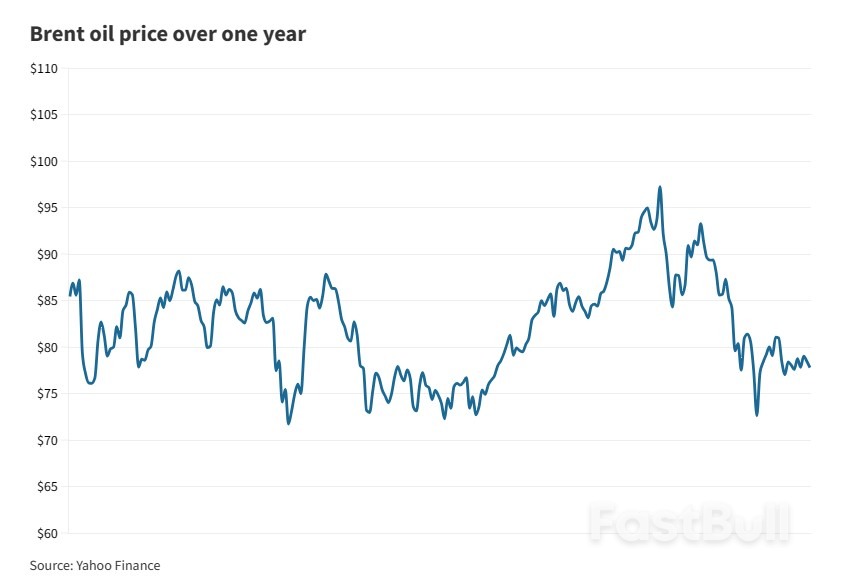
          Brent, the benchmark for two thirds of the world's oil, ended 2023 10 per cent lower at about $77 a barrel. The benchmark surged to nearly $140 a barrel the year before as Russia's invasion of Ukraine triggered concerns about the availability of oil.
          Prices were down on Wednesday morning. Brent was down 0.61 per cent to $77.81 a barrel at 7.05am. West Texas Intermediate, the gauge that tracks US crude, was down 0.70 per cent at $71.89 a barrel.Higher Crude Supply Could Drag Oil Prices Lower This Year, Analysts Say_1
          "With a couple of short-term exceptions, there's more oil available from more sources than has been the case for a very long time," Mike Muller, head of Asia trading at Vitol, said during the Gulf Intelligence Energy Outlook Forum last week.
          "Sanctioned sources of crude, namely Iran and Russia, are finding their way to market in decent quantities also still," Mr Muller said.
          Despite US-imposed economic sanctions, Tehran increased its production to about 3.1 million barrels per day in November, up from 2.55 million bpd in 2022, Opec data showed.
          In 2023, Russian oil production is forecast to fall 2 per cent to 524 million tonnes or 10.57 million bpd, state news agency Tass reported, quoting the country's energy minister.
          Russia recorded an output of 535 million tonnes or 10.73 million bpd in 2022.
          In October, the US eased sanctions on Opec member Venezuela to address the supply concerns caused by the Israel-Gaza war.
          The South American country aims to increase its production to one million bpd from about 850,000 bpd. It had an output of around three million bpd before the sanctions were imposed.
          Analysts have cited an unexpected surge in US output as the main reason for the drop in oil prices in the fourth quarter, which cushioned the impact of the Israel-Gaza war and its escalation into the Red Sea.
          Production by American oil and gas companies rose by about a million-bpd last year, higher than analysts' estimates of an increase of 600,000 bpd.
          "If it again turns out to be a million [bpd] for whatever reason [this year], I think that's when the market balances go out of whack a little bit," said Amrita Sen, founder, and director of research at Energy Aspects.
          "But, if growth is actually slower because … the base of production is a lot higher as well … that will provide some tailwinds for prices to go up in the summer," she said.
          The US Energy Information Administration expects US crude output to reach 13.44 million bpd this year, compared with its 2023 estimate of 13.21 million bpd.
          The EIA, the statistical arm of the US Department of Energy, has forecast Brent crude prices of $82 per barrel in 2024 and $79 in 2025, close to last year's average of $82.
          "Our forecast for relatively little price change is based on expectations that global supply and demand of petroleum liquids will be relatively balanced," the EIA said in its Short-Term Energy Outlook last week.
          "We generally expect that the Brent crude oil price is more likely to decline than rise because we expect global oil production is more likely to exceed our forecast than fall short of our forecast," it added.
          In December, Goldman Sachs lowered its price expectation for Brent this year by $10 a barrel to between $70 and $90 because of strong US production.
          However, UBS has said that supply management by Opec+ would help prices to recover in 2024.
          The Swiss lender expects the price of Brent to recover to $80 to $90 a barrel. The benchmark settled at $78.29 a barrel last Friday.
          Last month, Opec+ announced voluntary production cuts of 2.2 million bpd for the first quarter of this year, taking its total committed reductions to 5.86 million bpd.
          "We'll kind of be around that $80 mark. Given the economic backdrop, I think Opec will take that," said Ms Sen.
          She also said that the negative sentiment in the market around China's oil demand outlook had been exaggerated.
          Chinese economic growth was expected to increase following the end of coronavirus restrictions in late 2022.
          However, the country has been grappling with a slowdown in its property sector, weak consumer spending and high debt levels.
          Despite signs of economic weakness, China's crude imports were at a record high last year, gaining nearly 11 per cent year-over-year to reach 563.99 million metric tonnes, or 11.28 million bpd, according to official data.
          "While you have an economy that everyone says is in the doldrums, the official growth numbers is still around the 4.5/5 per cent number," Mr Muller said.
          "The short term nowcasting is showing a pretty resilient set of demand numbers coming from something that is not construction and maybe not even manufacturing, but China is on the move," he said.
          Red Sea impact
          Growing tension in the Red Sea, which handles 12 per cent of the world's trade, has raised concerns about potential disruption to crude oil deliveries.
          However, the impact on prices has been limited as there have been no oil supply losses so far.
          "These are not black swan events," said Mr Muller, referring to events which are unexpected, rare and have significant impact.
          "They're very much newsworthy, they're very important and some of them carry great dangers, but things like the joint military action to prevent missiles from Yemen hitting merchant fleet ships … have not served to materially disrupt oil prices," he added.
          Instead, the oil executive said, the Covid-19 pandemic and Russia's invasion of Ukraine in 2022 had been black swan events for energy markets.
          The 2020 pandemic wiped out fuel demand overnight, leading to negative US crude prices for the first time in history.
          The involvement of Russia, one of the world's largest energy exporters, in a military offensive sent shock waves across commodity markets, including crude, natural gas and grains.

          Source: The National News

          Risk Warnings and Disclaimers
          You understand and acknowledge that there is a high degree of risk involved in trading. Following any strategies or investment methods may lead to potential losses. The content on the site is provided by our contributors and analysts for information purposes only. You are solely responsible for determining whether any trading assets, securities, strategy, or any other product is suitable for investing based on your own investment objectives and financial situation.
          Comments
          Add to Favorites
          Share
          FastBull
          Copyright © 2025 FastBull Ltd

          728 RM B 7/F GEE LOK IND BLDG NO 34 HUNG TO RD KWUN TONG KLN HONG KONG

          TelegramInstagramTwitterfacebooklinkedin
          App Store Google Play Google Play
          Products
          Charts

          Chats

          Q&A with Experts
          Screeners
          Economic Calendar
          Data
          Tools
          Membership
          Features
          Function
          Markets
          Copy Trading
          Latest Signals
          Contests
          News
          Analysis
          24/7
          Columns
          Education
          Company
          Careers
          About Us
          Contact Us
          Advertising
          Help Center
          Feedback
          User Agreement
          Privacy Policy
          Business

          White Label

          Data API

          Web Plug-ins

          Poster Maker

          Affiliate Program

          Risk Disclosure

          The risk of loss in trading financial instruments such as stocks, FX, commodities, futures, bonds, ETFs and crypto can be substantial. You may sustain a total loss of the funds that you deposit with your broker. Therefore, you should carefully consider whether such trading is suitable for you in light of your circumstances and financial resources.

          No decision to invest should be made without thoroughly conducting due diligence by yourself or consulting with your financial advisors. Our web content might not suit you since we don't know your financial conditions and investment needs. Our financial information might have latency or contain inaccuracy, so you should be fully responsible for any of your trading and investment decisions. The company will not be responsible for your capital loss.

          Without getting permission from the website, you are not allowed to copy the website's graphics, texts, or trademarks. Intellectual property rights in the content or data incorporated into this website belong to its providers and exchange merchants.

          Not Logged In

          Log in to access more features

          FastBull Membership

          Not yet

          Purchase

          Become a signal provider
          Help Center
          Customer Service
          Dark Mode
          Price Up/Down Colors

          Log In

          Sign Up
          Position
          Layout
          Fullscreen
          Default to Chart
          The chart page opens by default when you visit fastbull.com