• Trade
  • Markets
  • Copy
  • Contests
  • News
  • 24/7
  • Calendar
  • Q&A
  • Chats
Trending
Screeners
SYMBOL
LAST
BID
ASK
HIGH
LOW
NET CHG.
%CHG.
SPREAD
SPX
S&P 500 Index
6849.49
6849.49
6849.49
6878.28
6841.15
-20.91
-0.30%
--
DJI
Dow Jones Industrial Average
47810.70
47810.70
47810.70
47971.51
47709.38
-144.28
-0.30%
--
IXIC
NASDAQ Composite Index
23536.08
23536.08
23536.08
23698.93
23505.52
-42.04
-0.18%
--
USDX
US Dollar Index
99.160
99.240
99.160
99.160
98.730
+0.210
+ 0.21%
--
EURUSD
Euro / US Dollar
1.16168
1.16175
1.16168
1.16717
1.16162
-0.00258
-0.22%
--
GBPUSD
Pound Sterling / US Dollar
1.33108
1.33116
1.33108
1.33462
1.33053
-0.00204
-0.15%
--
XAUUSD
Gold / US Dollar
4191.50
4191.91
4191.50
4218.85
4175.92
-6.41
-0.15%
--
WTI
Light Sweet Crude Oil
58.901
58.931
58.901
60.084
58.837
-0.908
-1.52%
--

Community Accounts

Signal Accounts
--
Profit Accounts
--
Loss Accounts
--
View More

Become a signal provider

Sell trading signals to earn additional income

View More

Guide to Copy Trading

Get started with ease and confidence

View More

Signal Accounts for Members

All Signal Accounts

Best Return
  • Best Return
  • Best P/L
  • Best MDD
Past 1W
  • Past 1W
  • Past 1M
  • Past 1Y

All Contests

  • All
  • Trump Updates
  • Recommend
  • Stocks
  • Cryptocurrencies
  • Central Banks
  • Featured News
Top News Only
Share

Israeli Prime Minister Netanyahu: Hamas Has Violated The Ceasefire Agreement, And We Will Never Allow Its Members To Re-arm Themselves And Threaten US

Share

Israeli Prime Minister Netanyahu: We Are Working To Return The Body Of Another Detainee From The Gaza Strip

Share

Iraq's West Qurna 2 Oil Field Will Increase Oil Production Beyond Normal Levels To Compensate For The Production Stoppage Caused By The Trump Administration's Sanctions Against Russia

Share

Israeli Prime Minister Netanyahu: We Are Close To Completing The First Phase Of Trump’s Plan And Will Now Focus On Disarming Gaza And Seizing Hamas Weapons

Share

Moody's Affirmed Burberry's Long-term Rating Of Baa3 And Revised Its Outlook (from Negative) To Stable

Share

The Trump Administration Supports Iraq's Plan To Transfer Russian Oil Company Lukoil Pjsc's Assets In The West Qurna 2 Oil Field To An American Company

Share

JMA: Tsunami Of 70 Centimetres Observed In Japan's Kuji Port In Iwate Prefecture

Share

The U.S. Bureau Of Labor Statistics Plans To Release A Press Release On January 15, 2026, For November 2025, Along With Data For October

Share

Tiger Global Has Established A New Fund, Aiming To Raise $2 Billion To $3 Billion

Share

The U.S. Bureau Of Labor Statistics Announced That It Will Not Release A Press Release Regarding The U.S. Import And Export Price Index (MXP) For October 2025

Share

The U.S. Bureau Of Labor Statistics (BLS) Will Not Release U.S. October CPI Data

Share

Government Negotiator: Dutch Political Center And Center Right Parties D66,  Cda And Vvd Advised To Start Talks On Possible Government

Share

New York Fed: November Home Price Rise Expectation Steady At 3%

Share

New York Fed: US Households' Personal Finance Worries Grew In November

Share

New York Fed: November Five-Year-Ahead Expected Inflation Rate Unchanged At 3%

Share

New York Fed: Households More Pessimistic On Current, Future Financial Situations In November

Share

New York Fed Report: USA Households' Year-Ahead Expected Inflation Rate Unchanged At 3.2% In November

Share

New York Fed: November Year-Ahead Expected Rise In Medical Costs Highest Since January 2014

Share

New York Fed: Labor Market Expectations Improved In November

Share

New York Fed: November Three-Year-Ahead Expected Inflation Rate Unchanged At 3%

TIME
ACT
FCST
PREV
France Trade Balance (SA) (Oct)

A:--

F: --

P: --
Euro Zone Employment YoY (SA) (Q3)

A:--

F: --

P: --
Canada Part-Time Employment (SA) (Nov)

A:--

F: --

P: --

Canada Unemployment Rate (SA) (Nov)

A:--

F: --

P: --

Canada Full-time Employment (SA) (Nov)

A:--

F: --

P: --

Canada Labor Force Participation Rate (SA) (Nov)

A:--

F: --

P: --

Canada Employment (SA) (Nov)

A:--

F: --

P: --

U.S. PCE Price Index MoM (Sept)

A:--

F: --

P: --

U.S. Personal Income MoM (Sept)

A:--

F: --

P: --

U.S. Core PCE Price Index MoM (Sept)

A:--

F: --

P: --

U.S. PCE Price Index YoY (SA) (Sept)

A:--

F: --

P: --

U.S. Core PCE Price Index YoY (Sept)

A:--

F: --

P: --

U.S. Personal Outlays MoM (SA) (Sept)

A:--

F: --

P: --
U.S. 5-10 Year-Ahead Inflation Expectations (Dec)

A:--

F: --

P: --

U.S. Real Personal Consumption Expenditures MoM (Sept)

A:--

F: --

P: --
U.S. Weekly Total Rig Count

A:--

F: --

P: --

U.S. Weekly Total Oil Rig Count

A:--

F: --

P: --

U.S. Consumer Credit (SA) (Oct)

A:--

F: --

P: --
China, Mainland Foreign Exchange Reserves (Nov)

A:--

F: --

P: --

Japan Trade Balance (Oct)

A:--

F: --

P: --

Japan Nominal GDP Revised QoQ (Q3)

A:--

F: --

P: --

China, Mainland Imports YoY (CNH) (Nov)

A:--

F: --

P: --

China, Mainland Exports (Nov)

A:--

F: --

P: --

China, Mainland Imports (CNH) (Nov)

A:--

F: --

P: --

China, Mainland Trade Balance (CNH) (Nov)

A:--

F: --

P: --

China, Mainland Exports YoY (USD) (Nov)

A:--

F: --

P: --

China, Mainland Imports YoY (USD) (Nov)

A:--

F: --

P: --

Germany Industrial Output MoM (SA) (Oct)

A:--

F: --

P: --
Euro Zone Sentix Investor Confidence Index (Dec)

A:--

F: --

P: --

Canada National Economic Confidence Index

A:--

F: --

P: --

U.K. BRC Like-For-Like Retail Sales YoY (Nov)

--

F: --

P: --

U.K. BRC Overall Retail Sales YoY (Nov)

--

F: --

P: --

Australia Overnight (Borrowing) Key Rate

--

F: --

P: --

RBA Rate Statement
RBA Press Conference
Germany Exports MoM (SA) (Oct)

--

F: --

P: --

U.S. NFIB Small Business Optimism Index (SA) (Nov)

--

F: --

P: --

Mexico 12-Month Inflation (CPI) (Nov)

--

F: --

P: --

Mexico Core CPI YoY (Nov)

--

F: --

P: --

Mexico PPI YoY (Nov)

--

F: --

P: --

U.S. Weekly Redbook Index YoY

--

F: --

P: --

U.S. JOLTS Job Openings (SA) (Oct)

--

F: --

P: --

China, Mainland M1 Money Supply YoY (Nov)

--

F: --

P: --

China, Mainland M0 Money Supply YoY (Nov)

--

F: --

P: --

China, Mainland M2 Money Supply YoY (Nov)

--

F: --

P: --

U.S. EIA Short-Term Crude Production Forecast For The Year (Dec)

--

F: --

P: --

U.S. EIA Natural Gas Production Forecast For The Next Year (Dec)

--

F: --

P: --

U.S. EIA Short-Term Crude Production Forecast For The Next Year (Dec)

--

F: --

P: --

EIA Monthly Short-Term Energy Outlook
U.S. API Weekly Gasoline Stocks

--

F: --

P: --

U.S. API Weekly Cushing Crude Oil Stocks

--

F: --

P: --

U.S. API Weekly Crude Oil Stocks

--

F: --

P: --

U.S. API Weekly Refined Oil Stocks

--

F: --

P: --

South Korea Unemployment Rate (SA) (Nov)

--

F: --

P: --

Japan Reuters Tankan Non-Manufacturers Index (Dec)

--

F: --

P: --

Japan Reuters Tankan Manufacturers Index (Dec)

--

F: --

P: --

Japan Domestic Enterprise Commodity Price Index MoM (Nov)

--

F: --

P: --

Japan Domestic Enterprise Commodity Price Index YoY (Nov)

--

F: --

P: --

China, Mainland PPI YoY (Nov)

--

F: --

P: --

China, Mainland CPI MoM (Nov)

--

F: --

P: --

Q&A with Experts
    • All
    • Chatrooms
    • Groups
    • Friends
    Connecting
    .
    .
    .
    Type here...
    Add Symbol or Code

      No matching data

      All
      Trump Updates
      Recommend
      Stocks
      Cryptocurrencies
      Central Banks
      Featured News
      • All
      • Russia-Ukraine Conflict
      • Middle East Flashpoint
      • All
      • Russia-Ukraine Conflict
      • Middle East Flashpoint
      Search
      Products

      Charts Free Forever

      Chats Q&A with Experts
      Screeners Economic Calendar Data Tools
      Membership Features
      Data Warehouse Market Trends Institutional Data Policy Rates Macro

      Market Trends

      Market Sentiment Order Book Forex Correlations

      Top Indicators

      Charts Free Forever
      Markets

      News

      News Analysis 24/7 Columns Education
      From Institutions From Analysts
      Topics Columnists

      Latest Views

      Latest Views

      Trending Topics

      Top Columnists

      Latest Update

      Signals

      Copy Rankings Latest Signals Become a signal provider AI Rating
      Contests
      Brokers

      Overview Brokers Assessment Rankings Regulators News Claims
      Broker listing Forex Brokers Comparison Tool Live Spread Comparison Scam
      Q&A Complaint Scam Alert Videos Tips to Detect Scam
      More

      Business
      Events
      Careers About Us Advertising Help Center

      White Label

      Data API

      Web Plug-ins

      Affiliate Program

      Awards Institution Evaluation IB Seminar Salon Event Exhibition
      Vietnam Thailand Singapore Dubai
      Fans Party Investment Sharing Session
      FastBull Summit BrokersView Expo
      Recent Searches
        Top Searches
          Markets
          News
          Analysis
          User
          24/7
          Economic Calendar
          Education
          Data
          • Names
          • Latest
          • Prev

          View All

          No data

          Scan to Download

          Faster Charts, Chat Faster!

          Download App
          English
          • English
          • Español
          • العربية
          • Bahasa Indonesia
          • Bahasa Melayu
          • Tiếng Việt
          • ภาษาไทย
          • Français
          • Italiano
          • Türkçe
          • Русский язык
          • 简中
          • 繁中
          Open Account
          Search
          Products
          Charts Free Forever
          Markets
          News
          Signals

          Copy Rankings Latest Signals Become a signal provider AI Rating
          Contests
          Brokers

          Overview Brokers Assessment Rankings Regulators News Claims
          Broker listing Forex Brokers Comparison Tool Live Spread Comparison Scam
          Q&A Complaint Scam Alert Videos Tips to Detect Scam
          More

          Business
          Events
          Careers About Us Advertising Help Center

          White Label

          Data API

          Web Plug-ins

          Affiliate Program

          Awards Institution Evaluation IB Seminar Salon Event Exhibition
          Vietnam Thailand Singapore Dubai
          Fans Party Investment Sharing Session
          FastBull Summit BrokersView Expo

          A Look at the Current Oil Market from A Historical Perspective

          King Ten
          Summary:

          The recent movements of various market segments are confusing, many calm segments are running potentially, leaving the surface becoming confusing. Consequently, many participants fail to trade objectively but are in a mess. During the time with massive information in the market, staying calm will be the best solution, as seeing things from different perspectives, the results will be different accordingly, and this is the charm of the market. For sure, sentiments and appearance will impact the market, but only the core can decide the final trend, so it is important to subtract appropriately and give the market enough patience.

          The Story of Crude Oil

          Let's start with the story of oil and its history. After the 1973 Middle East War, OPEC countries introduced an oil embargo and triggered the first oil crisis. At that time, Europe and the United States were highly dependent on oil, and in a period of high inflation, this wave of embargo directly let the oil prices soar 3 times to about $60/barrel. In addition, the up-to-8 years of The Iran-Iraq War began in 1980, Iran's oil production was directly cut to half again, and this is the horrible second oil crisis, causing oil prices to double to $140/barrel. However, this was not the highest position, as the highest level is after the Gulf War, China's oil demand surged significantly, leading oil prices directly soared to $147/barrel in 2007, which was the highest level in history. Followed by the financial crisis in 2008, Crude oil prices began to fall off a cliff. Of course, after the first 2 oil crises, the same recession happened, including the second oil crisis after the recession in 1981, with oil prices also falling back to $ 80 / barrel in 1982, slightly higher than the starting price of the crisis.

          The Future Trend of Crude Oil

          After the historical story of crude oil, try to analyze the oil market this year. At the very beginning, nobody would have thought that Russia would go to war with Ukraine, nor Europe and the US comprehensive sanctions on Russia and the kick-out of the SWIFT system. It was also incredible to think that Europe, which relies heavily on Russia's energy input, would dare to cut off Russia's energy supply. As a result, the oil price rise from $82/barrel to a high of $130/barrel, which is the smallest growth compared to the several oil crises in history. Besides, after the start of June, the global high inflation began to speculate on recession, and crude oil prices fell to a low of around $73/barrel on November 28th, almost cut by half and lower than before the war. In addition, the retracement was also the largest compared to several oil crises, which is more stressful financially on oil exporting countries than any oil crisis. This year, Saudi Arabia's fiscal budget balance is about 85 USD/barrel (BRENT), 2020 Russia's balance is at 43 USD/barrel (WTI), and the average price of exports in the past five years is 70 USD/barrel. Nevertheless, the Russia and Ukraine war accumulated financial stress, coupled with the reduction in oil production and exports, as well as the discount sales to Asian countries. Therefore, the pressure of oil prices on Russia is considerable this year.
          At present, many sections in the market may be under a confusing trend, the amount of information is huge, and many traders began to be shaken or tempted by the market. Because of lacking patience, traders are eventually drowned in the market trend. Referring to the report about crude oil on November 25th "Does the Opportunity Show up After the Plunge of Crude Oil?" It was considered that any irrational drop in crude oil price could be an opportunity for the bulls, market prices will deviate from supply and demand shortly but most essentially, the price will be back to a rational level. On the next trading day, the irrationality of the market directly knocked the price of oil to $73.6/barrel, and then returned to $83.2/barrel on December 1st. The purpose of bringing this up is to show the importance of embracing the market's irrationality and amplifying the irrationality of the market.
          Trading is always along with the greatest uncertainty, and demand-supply determines the trend of the commodity. Before the recession expectation comes true, demand may still have less negotiating leverage than the supply side, and Russia's bottom line will be the most central element of crude oil market trading at the end of the year.
          Risk Warnings and Disclaimers
          You understand and acknowledge that there is a high degree of risk involved in trading. Following any strategies or investment methods may lead to potential losses. The content on the site is provided by our contributors and analysts for information purposes only. You are solely responsible for determining whether any trading assets, securities, strategy, or any other product is suitable for investing based on your own investment objectives and financial situation.
          Comments
          Add to Favorites
          Share

          Rates Spark: Hitting 0.2% is Huge

          Samantha Luan

          Bond

          Core PCE at 0.2% month-on-month at least helps to validate the fall in market rates

          Yesterday's magical hit of 0.2% on core PCE for the US is enough to solidify the move lower we've seen in market rates. Why? The reading of 0.2% annualises to 2.7%. It's fine margins, but that's worlds apart from one notch up to 0.3%, as that annualises to 4.3%. And 0.4% gives 6%, etc. The 0.2% outcome is low enough to secure an annualised inflation reading with a 2% handle. Okay it's still closer to 3% than 2%, but it is something that the Federal Reserve would feel quite good about given where annual inflation currently is.
          The fall in market rates started well before we had the November 10th CPI number. That was really a base-effect impacted fall in the year-on-year CPI inflation rate, but took the 10yr yield crashing back below 4%. The subsequent core PCE month-on-month outcome is arguably more significant. The big question now is whether we see this from other inflation readings, or indeed whether we see a repeat from the core PCE number next month.
          But to really justify the move lower in rates, the Fed needs to be practically done in December. We don't think so, and more importantly, the Fed does not think so (at least not yet anyway). But the market is looking at things through that kind of prism, pulling the terminal fund rate down to 4.9%. While 4.9% technically discounts that the Fed is not done in December and continues to hike in February, the bulk of the volumes are in the first three contracts, which brings the funds rate to 4.7% in February (and falling).

          Rates Spark: Hitting 0.2% is Huge_1No more than a mid-cycle overshoot to the downside, pain deferred to Q1 2023

          Also, it must be noted that players will have a tendency to square up some of the duration and credit shorts set in 2022, in what has been the biggest bear market of modern times. This risk-on mode could sustain if the labor market cools, which is where today's payrolls come in. But it also likely pushes pain into the first quarter of 2023, pain of resumed upward pressure on market rates and wider spreads.
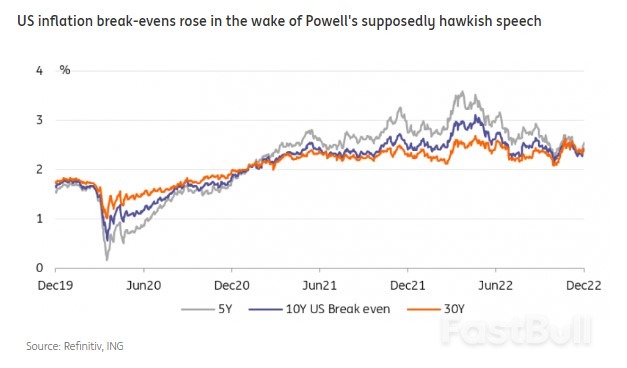
          Anomalously, inflation breakevens actually rose after Chair Powell's speech on Wednesday, in what is supposed to be an inflation topping bond rally. The big move lower in rates came from a virtual collapse in real rates; from 1.5% to 1.25% in the 10yr – a massive move! That discounts macro pain ahead, and suggests worries on defaults and growth ahead. That appears to be the dominant market reaction post Chair Powell's speech.
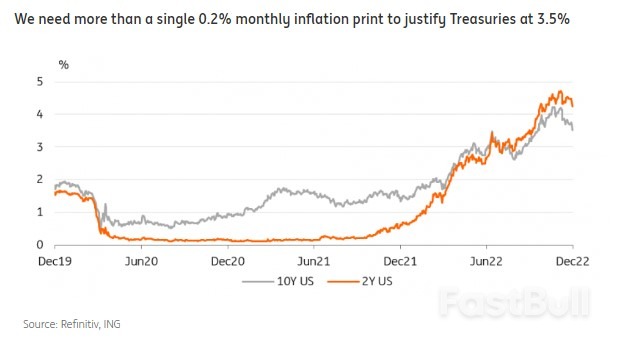
          Bottom line, we think that 0.2% outcome is significant. It brings us to 3.5% for the 10yr. Note that's a low yield level. We doubt the 10yr gets below 3% in the rate cutting cycle ahead, so 3.5% is pricing a lot already. From here it really should drift higher, up towards 3.75%. And if it comes to pass that the 0.2% was a one-off (for now), then a return to the 4% area can't be ruled out by the first quarter of 2023. In fact that remains our central call if the Fed goes ahead and feels the need to hike to 5% at the 1st February FOMC meeting.Rates Spark: Hitting 0.2% is Huge_2

          Today's events and market views

          The focus is squarely on today's US jobs data. There have been signs already of the labor market starting to cool. This week saw job openings falling, although from still very high levels, while yesterday's weaker ISM manufacturing index saw its employment component dropping 1.6 points to 48.4. There have also been the announcements of substantial layoffs, particularly in the technology sector over the past months, which have added to the concerns about the resilience of the labour market.
          That said, the consensus is looking for a payrolls growth of 200k this month, down from last month's 261k. That may be still high enough for the Fed to see the need for further action, but low enough enough for markets to sustain their current risk-on mode. While a 10Y US Treasury yield arguably looks stretched already, we would be cautious to call an end to the rally in the current environment going into year end.
          Of course, further comments from Fed officials will also be followed given this is probably the last opportunity to steer expectations ahead of the pre-meeting black-out period. The Fed's Williams has been out yesterday underscoring that it will take a couple of years to get inflation back to target. Today's scheduled appearances are by the Fed's Barkin and Evans.

          Source: ING

          Risk Warnings and Disclaimers
          You understand and acknowledge that there is a high degree of risk involved in trading. Following any strategies or investment methods may lead to potential losses. The content on the site is provided by our contributors and analysts for information purposes only. You are solely responsible for determining whether any trading assets, securities, strategy, or any other product is suitable for investing based on your own investment objectives and financial situation.
          Comments
          Add to Favorites
          Share

          Markets Slip Back Ahead of November Payrolls

          Samantha Luan

          Forex

          Economic

          European markets got off to a modestly positive start to the month, hitting 6-month highs before slipping back into the close, with the FTSE100 lagging after failing to push through the 7,600 level.
          U.S. markets underwent a little bit of a mixed session with the Nasdaq edging higher, while the S&P500 and Dow slipped back. U.S. treasury yields also slid back with the 10-year yield sliding below its October lows to 3.5%.
          Today's European session will see the focus shift back to the U.S. and the November jobs report.
          Given Powell's comments on Wednesday and yesterday's PCE inflation data, and ISM numbers there might be a case for saying that today's jobs report probably doesn't matter that much.
          We already know that we'll see a 50bps rate hike in just under two weeks' time, and then it's really a question of what comes after that.
          A lot of questions have been raised as to what prompted a slight change of tack from Powell in contrast to what was some significant push back at the November press conference when he was told that stock markets were higher after the decision.
          This more relaxed attitude may speak to some concerns about the extent of the economic weakness in the data that we've seen this week, which may in some part be helping to act as a drag on the inflation numbers.
          Nonetheless, despite increasing evidence of a slowdown in the manufacturing sector, services sector jobs are still being created, while vacancy rates are still high.
          This week we saw weekly jobless claims fall back to 225k after a brief spike up to 241k.
          In October non-farm payrolls came in at 261k, while the September jobs number was revised up to 315k. Slightly more disappointing was the fact that the unemployment rate edged up to 3.7%, while wage growth slowed to 4.7% from 5%.
          The report also served to indicate that there was little sign of a wage price spiral despite still high levels of vacancies.
          Despite the resilience being displayed in the U.S. labour market there are rising pockets of concern.
          The current earnings season reports are seeing the big tech companies letting people go in their thousands.
          Amazon for example has announced the loss of over 10k jobs worldwide with more to come, while Meta recently announced the loss of 11k positions.
          Twitter has also seen people leave the business, some of them voluntarily because they don't want to work for new owner Elon Musk.
          While not all these job losses are likely to be in the U.S. there does appear to be a trend starting to build, although it is likely to take some time to filter through given that vacancy rates are still high.
          On the flip side of the coin, it's important to remember hiring trends tend to pick up in the lead up to Thanksgiving and the Christmas period on the back of temporary hires.
          Expectations for November payrolls is for 200k jobs to be added, down from 261k, which would be the lowest number this year, in the same way this week's ADP report was a weak number.
          The unemployment rate is expected to tick higher to 3.8%, by virtue of a higher participation rate, while wage growth is forecast to remain subdued at 4.6%.
          EUR/USD – pushed above the 1.0400 area and the 200-day SMA and appears to be on course for a move up to the June peaks at 1.0620, which is also the 38.2% retracement of the down move from 1.2350 to 0.9535.
          GBP/USD – broke up to the 1.2300 area, reversing 50% of the decline from the 1.4250 highs to the recent lows at 1.0342. This is likely to be a big obstacle to further gains towards 1.2760. Support comes in at the 1.2190 area and the 200-day SMA.
          EUR/GBP – sank back to the 200-day SMA and the 0.8540 area. This could act as support in the short term, with resistance now at the 0.8675 area. Below 0.8530 targets 0.8480.
          USD/JPY – appears to be heading towards the 200-day SMA at 134.40 having broken below the 137.50 area. This should now act as resistance.

          Source: CMC

          To stay updated on all economic events of today, please check out our Economic calendar
          Risk Warnings and Disclaimers
          You understand and acknowledge that there is a high degree of risk involved in trading. Following any strategies or investment methods may lead to potential losses. The content on the site is provided by our contributors and analysts for information purposes only. You are solely responsible for determining whether any trading assets, securities, strategy, or any other product is suitable for investing based on your own investment objectives and financial situation.
          Comments
          Add to Favorites
          Share

          U.S. Job Growth Likely Slowed Again in November; Labor Market Still Tight

          Alex

          Economic

          U.S. job growth was likely the smallest in nearly two years in November as mounting worries of a recession cooled demand for labor, which could give the Federal Reserve confidence to start slowing the pace of its interest rate hikes this month.
          The Labor Department's closely watched employment report on Friday, which is also expected to show a continued moderation in wage gains last month, would follow on the heels of news on Thursday of a slowdown in inflation in October.
          But the labor market remains tight, with 1.7 job openings for every unemployed person in October, keeping the Fed on its monetary tightening path at least through the first half of 2023. Labor market strength is also one of the reasons economists believe an anticipated recession next year would be short and shallow.
          "It's kind of like it's good news but not great news. The labor market is still very strong and still very tight," said Agron Nicaj, U.S. economist at MUFG in New York. "The Fed might slow down the pace of rate hikes, but they are not at a point where they are going to completely stop."
          The survey of business establishments is likely to show that nonfarm payrolls increased by 200,000 jobs last month, according to a Reuters poll of economists, the smallest number since December 2020, after rising by 261,000 in October. Estimates ranged from 133,000 to 270,000.
          The Reuters poll was, however, conducted before an Institute for Supply Management report on Thursday, which showed manufacturing contracting in November for the first time in 2-1/2 years, with a measure of factory employment falling sharply. That prompted some economists to lower their November payrolls forecasts.
          October payrolls could be revised lower after the household survey, from which the unemployment rate is derived, showed a loss of 328,000 jobs that month, which economists said could have an impact on the employment count for November.
          Employment growth averaged 407,000 jobs per month this year compared with 562,000 in 2021. Fed Chair Jerome Powell said on Wednesday the U.S. central bank could scale back the pace of its rate increases "as soon as December."
          Fed officials meet on Dec. 13 and 14. The Fed has raised its policy rate by 375 basis points this year from near zero to a 3.75%-4.00% range in the fastest rate-hiking cycle since the 1980s as it battles high inflation.
          Companies Right-Sizing
          Economists said most of the slowdown in hiring was by big companies. Technology companies, including Twitter, Amazon and Meta, the parent of Facebook, have announced thousands of jobs cuts.
          Economists said these companies were right-sizing after over-hiring during the COVID-19 pandemic. They noted that small firms remained desperate for workers.
          There were 10.3 million job openings at the end of October, many of them in the leisure and hospitality as well as healthcare and social assistance industries.
          "The S&P 500 companies are not going to be driving job growth, its mainly going to be the small business sector," said Brian Bethune, an economics professor at Boston College.
          The unemployment rate is seen unchanged at 3.7%, consistent with a still-tight labor market. Average hourly earnings are forecast to have increased 0.3% after advancing 0.4% in October. That would lower the annual increase in wages to a still-high 4.6% from 4.7% in October. Wages growth peaked at 5.6% in March.
          "This is a pace that is uncomfortably high for the Fed and not consistent with the 2% inflation target, though officials may take some comfort from the downward trajectory in the annual pace over the past eight months," said Sam Bullard, a senior economist at Wells Fargo in Charlotte, North Carolina.
          Data on Thursday showed the personal consumption expenditures (PCE) price index, excluding the volatile food and energy components, climbed 5.0% on a year-on-year basis in October after increasing 5.2% in September.
          The wage gains are helping consumers to weather the inflation storm, keeping the economy on a steady growth path and raising cautious optimism that the nation could avoid a recession altogether.
          "I still believe the economy tips into a short and shallow recession mid-2023, based on eroding labor market growth, but the probability of no recession is now higher," said Steven Blitz, chief U.S. economist at TS Lombard in New York.

          Source: Reuters

          To stay updated on all economic events of today, please check out our Economic calendar
          Risk Warnings and Disclaimers
          You understand and acknowledge that there is a high degree of risk involved in trading. Following any strategies or investment methods may lead to potential losses. The content on the site is provided by our contributors and analysts for information purposes only. You are solely responsible for determining whether any trading assets, securities, strategy, or any other product is suitable for investing based on your own investment objectives and financial situation.
          Comments
          Add to Favorites
          Share

          【Fed】Slow Down Rate Hikes Is Appropriate, but the Peaking of Inflation is Unknown

          FastBull Featured

          Remarks of Officials

          Federal Reserve Governor Michelle W. Bowman said during an appearance on Dec 1st:
          As the federal funds rate approaches a sufficiently tight level, it would be appropriate to slow the pace of rate hikes as the Fed decides how much it needs to raise the target range.
          Despite October inflation data showing a slight easing of price pressures, inflation remains unacceptably high.
          Until the Fed's actions significantly impact inflation, individuals expect terminal rates to be slightly above the forecast in the September SEP. In addition, interest rates are expected to remain at sufficiently restrictive levels for some time to keep inflation in check, which will help set the stage for sustainable strength in the labor market.
          Meanwhile in a speech yesterday, New York Fed President John Williams also demonstrated that current U.S. inflation is too high, and it will take several years to bring it down to the 2% target level. Moreover, high inflation is not yet stubbornly embedded in the economy and the Fed's role is to balance supply and demand. Besides, it sees signs of slowing inflation but is not sure if it has peaked.
          Does not think there is a wage-price spiral. There are signs of inflation moving in the right direction, and government spending is not the main cause of inflation. How high the terminal rate eventually rises depends on economic data.
          Furthermore, Chicago Fed President Evans will retire in January 2023. The Chicago Fed released an announcement that Austan D. Goolsbee has been appointed president and chief executive officer of the Chicago Fed effective January 9th, 2023. He is expected to serve as a member of the 2023 ticket committee.
          Risk Warnings and Disclaimers
          You understand and acknowledge that there is a high degree of risk involved in trading. Following any strategies or investment methods may lead to potential losses. The content on the site is provided by our contributors and analysts for information purposes only. You are solely responsible for determining whether any trading assets, securities, strategy, or any other product is suitable for investing based on your own investment objectives and financial situation.
          Comments
          Add to Favorites
          Share

          ECB's Lagarde Warns Some Fiscal Policies in Europe Could Fuel Excess Demand

          Devin

          Central Bank

          European Central Bank President Christine Lagarde warned on Friday that some European governments' fiscal policies could lead to excess demand, and that fiscal and monetary policies need to work in synch for sustainable, balanced economic growth.
          "Fiscal policies that create excess demand in a supply constrained economy might force monetary policy to tighten more than would otherwise be necessary," Lagarde said at a conference hosted by the Bank of Thailand and Bank for International Settlements in Bangkok.
          "Regrettably, at the moment, at least some of the fiscal measures that we are analysing from many of the European and particularly euro area governments are pointing in the direction of the latter category," she said, referring to measures that could trigger excess demand.
          The European Commission expects the euro zone economy to shrink in the fourth quarter of 2022 and in the first three months of 2023 because of surging energy prices and rising interest rates which undermine spending, borrowing power and confidence.
          "We need higher investment and structural reforms to remove the supply constraints and ensure that potential output is not impaired by the changing global economy. And that's a big question and an uncertainty that we have," said Lagarde.
          "And in a world where external demand is more uncertain, we will also need to strengthen the domestic supply and demand through higher productivity growth," she said.
          With inflation running at five times its 2% target, the ECB has raised interest rates at its fastest pace on record this year and a string of hikes over the coming months is still likely as price growth will take years to tame.
          Its rate on bank deposits was increased by 200 basis points to 1.5% in three months.
          "What we central bankers have to do is to actually deliver a monetary policy that anchors expectations... We need to signal to the public, to the observers, to the commentators, that in all scenarios, inflation will return to our medium term target in a timely manner," said Lagarde.

          Source: Reuters

          Risk Warnings and Disclaimers
          You understand and acknowledge that there is a high degree of risk involved in trading. Following any strategies or investment methods may lead to potential losses. The content on the site is provided by our contributors and analysts for information purposes only. You are solely responsible for determining whether any trading assets, securities, strategy, or any other product is suitable for investing based on your own investment objectives and financial situation.
          Comments
          Add to Favorites
          Share

          U.S. Diesel Use Slows as Manufacturing, Freight Falter

          Samantha Luan

          Commodity

          U.S. consumption of diesel, heating oil and other distillate fuel oils has started to fall in response to high prices and a slowdown in manufacturing activity and freight transport.
          The volume of distillate supplied to the domestic market (a proxy for consumption) was 4.01 million barrels per day (bpd) in September, down from 4.03 million bpd in the same month a year earlier.
          Distillate supplied was lower compared with a year earlier in four of six months between April and September, data compiled by the U.S. Energy Information Administration showed.
          Distillate prices have been very high as a result of fuel shortages caused by the strong economic rebound from pandemic lockdowns and a lack of domestic refinery capacity.
          Slower diesel exports from China this year and disruptions caused by Russia's invasion of Ukraine and the sanctions imposed in response have intensified the problem.
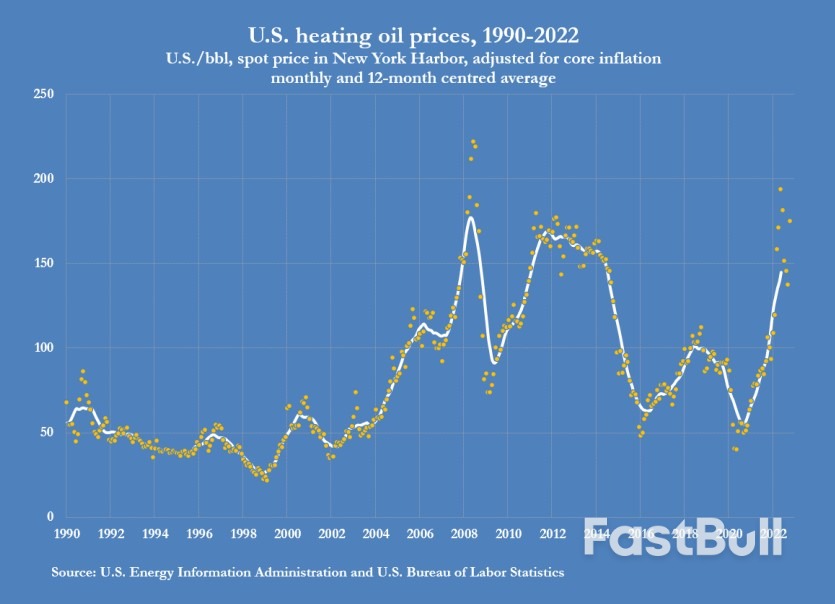
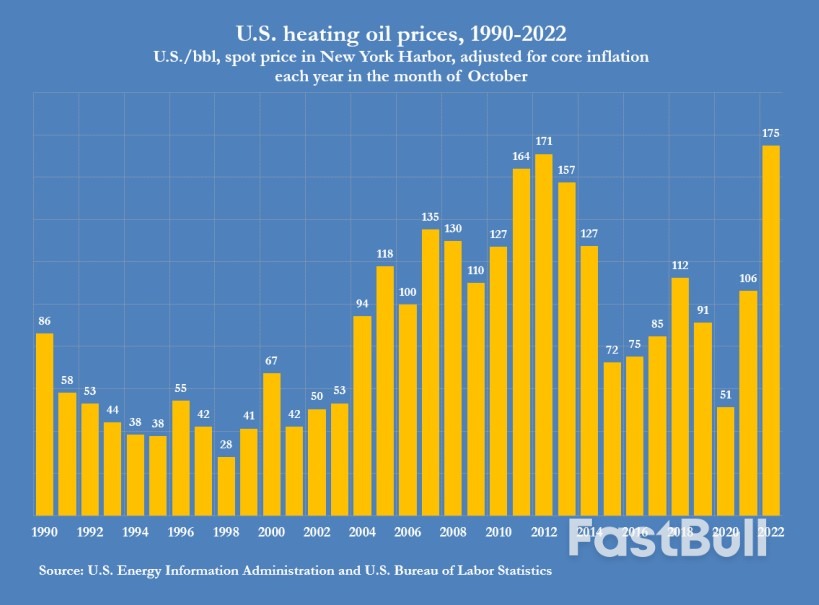
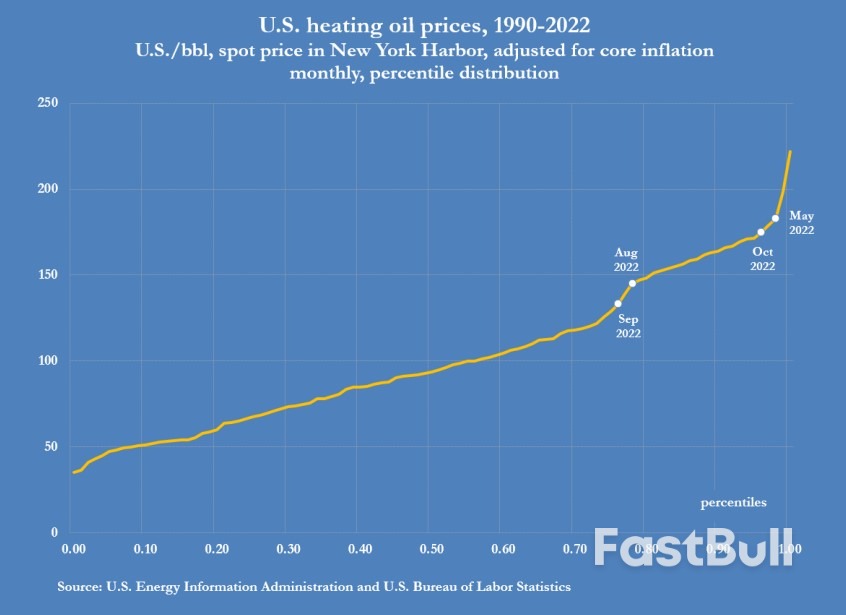
          Between May and October, monthly average spot prices for heating oil delivered to New York Harbor ranged from $137 to $193 per barrel, adjusted for core consumer price inflation.
          In real terms, monthly average prices have been between the 76th and the 98th percentile for all months since the turn of the century.
          High prices have created an incentive to conserve fuel, for example by consolidating freight deliveries into fewer truckloads.
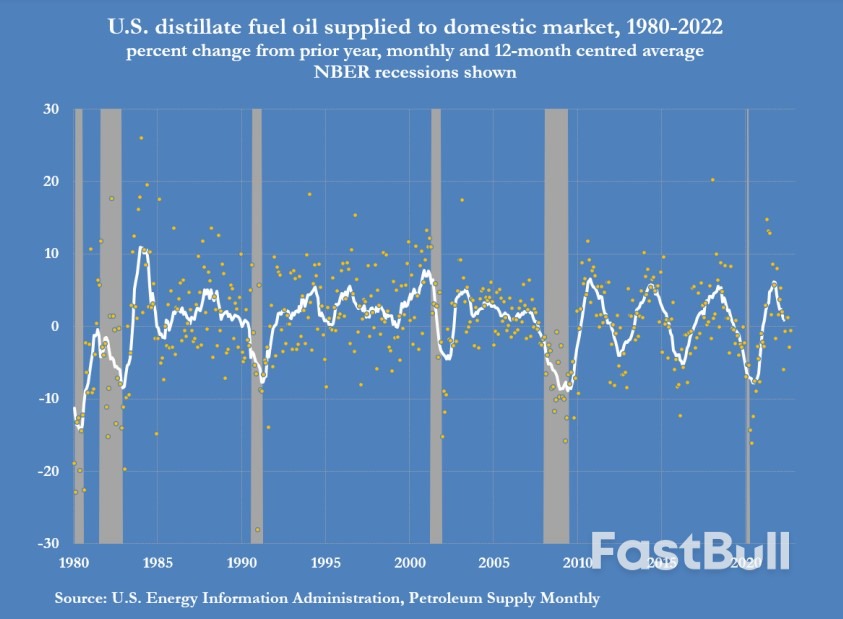
          The direct impact from prices on distillate consumption has probably been limited, but there have been important indirect impacts from inflation, interest rates and the business cycle.U.S. Diesel Use Slows as Manufacturing, Freight Falter_1U.S. Diesel Use Slows as Manufacturing, Freight Falter_2U.S. Diesel Use Slows as Manufacturing, Freight Falter_3U.S. Diesel Use Slows as Manufacturing, Freight Falter_4U.S. Diesel Use Slows as Manufacturing, Freight Falter_5U.S. Diesel Use Slows as Manufacturing, Freight Falter_6U.S. Diesel Use Slows as Manufacturing, Freight Falter_7U.S. Diesel Use Slows as Manufacturing, Freight Falter_8U.S. Diesel Use Slows as Manufacturing, Freight Falter_9U.S. Diesel Use Slows as Manufacturing, Freight Falter_10U.S. Diesel Use Slows as Manufacturing, Freight Falter_11U.S. Diesel Use Slows as Manufacturing, Freight Falter_12U.S. Diesel Use Slows as Manufacturing, Freight Falter_13U.S. Diesel Use Slows as Manufacturing, Freight Falter_14U.S. Diesel Use Slows as Manufacturing, Freight Falter_15

          Manufacturing Slows

          Most distillates are used in freight transportation, manufacturing, construction, farming, mining, and in oil and gas production.
          Distillate consumption is therefore highly sensitive to changes in the business cycle, especially the manufacturing and freight sectors.
          Consumer spending on merchandise has slowed as the economy re-opens from lockdowns and spending has rotated back to services.
          Household expenditure on goods has also declined in response to inflation, falling real incomes and rising interest rates.
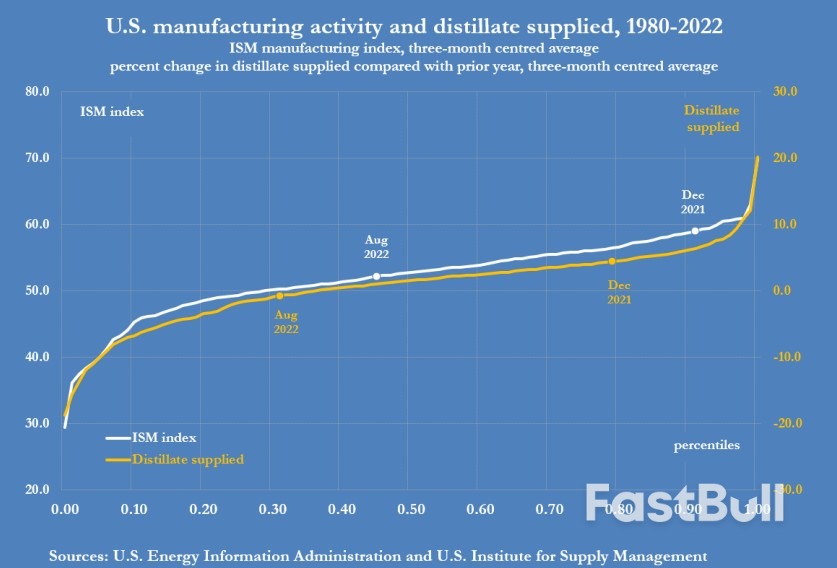
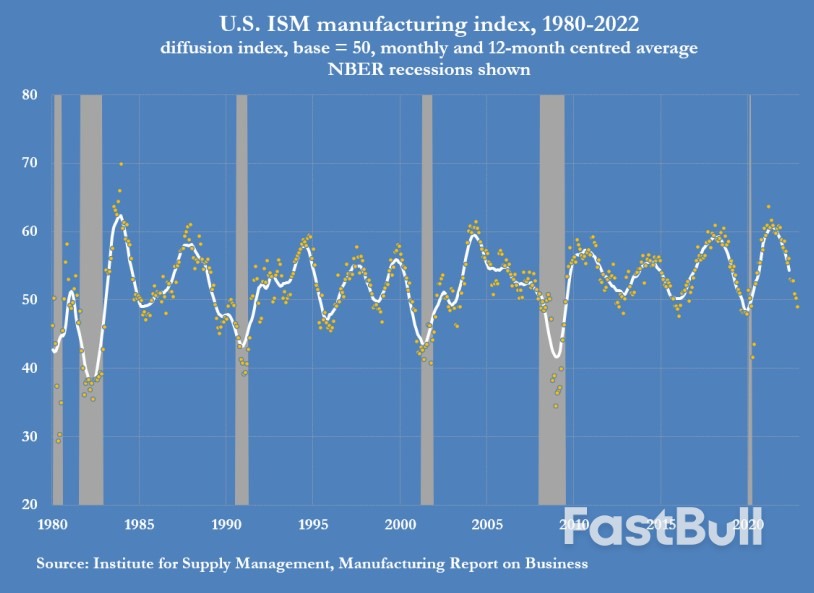
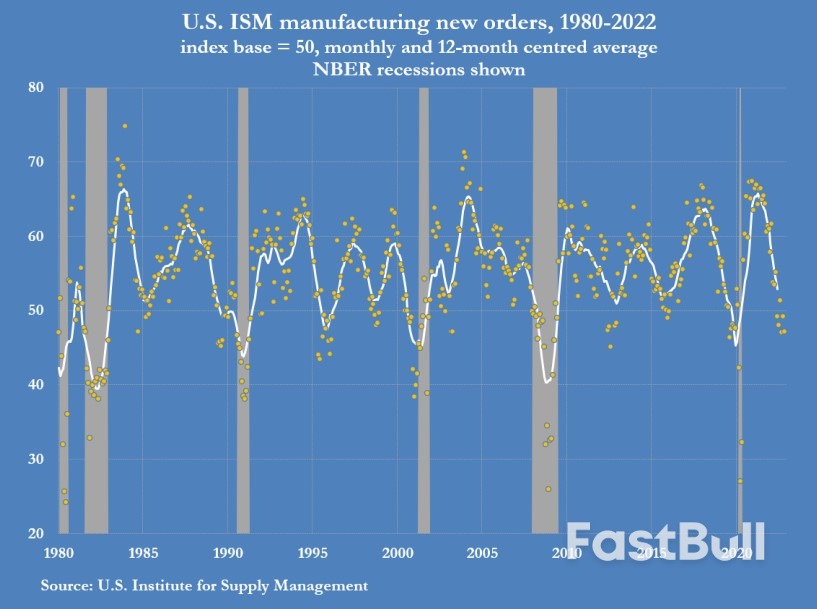
          Monthly business surveys conducted by the Institute for Supply Management (ISM) have shown a progressive deceleration in manufacturing activity since late 2021 and early 2022.
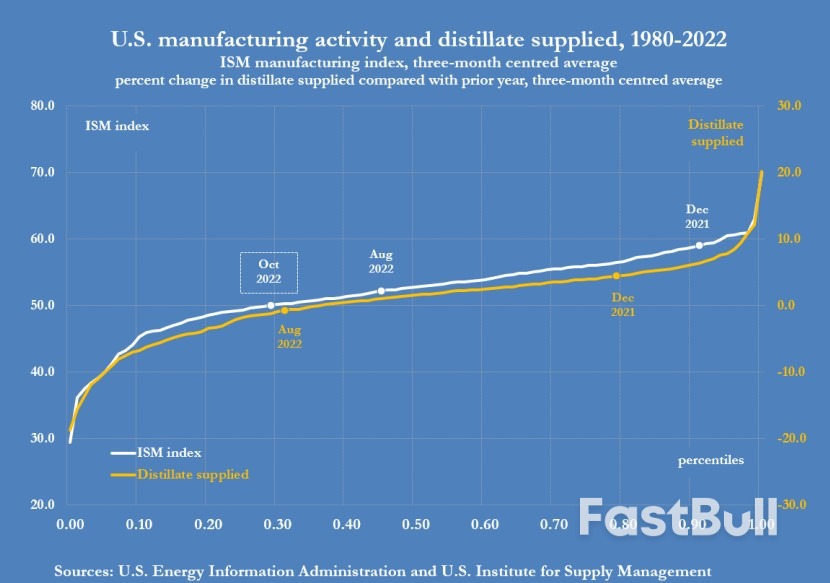
          The ISM manufacturing index fell steadily from an average of 59.0 between November 2021 and January 2022 (91st percentile for all months since 1980) to an average of 52.2 between July and September 2022 (45th percentile).
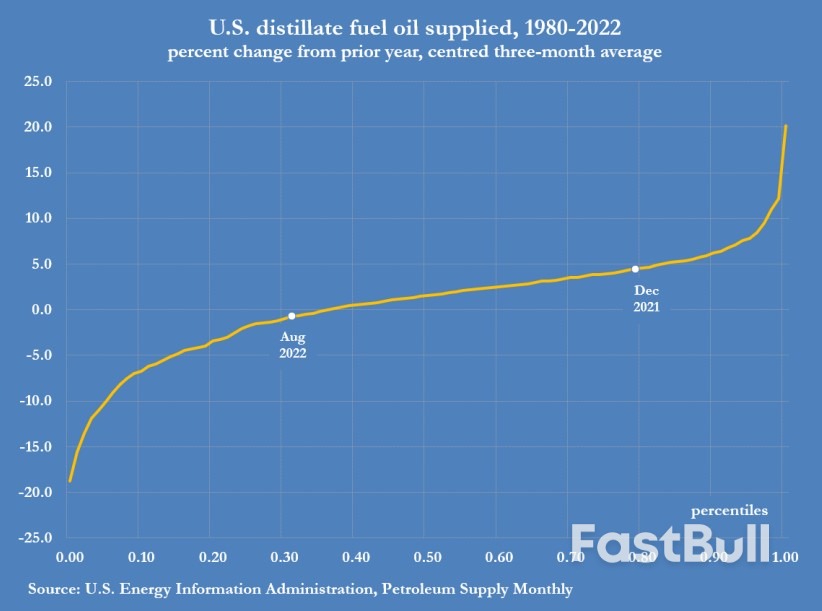
          Over the same period, the year-on-year growth in distillate supplied slowed from an average of +4.4% between November 2021 and January 2022 (79th percentile) to –0.8% between July and September 2022 (31st percentile).
          The slowdown in distillate consumption has been close to what would be expected based on the deceleration in manufacturing.
          Manufacturing activity slowed even further in October, and declined in November, according to the monthly ISM business surveys, implying distillate consumption is likely to have fallen further in both months.
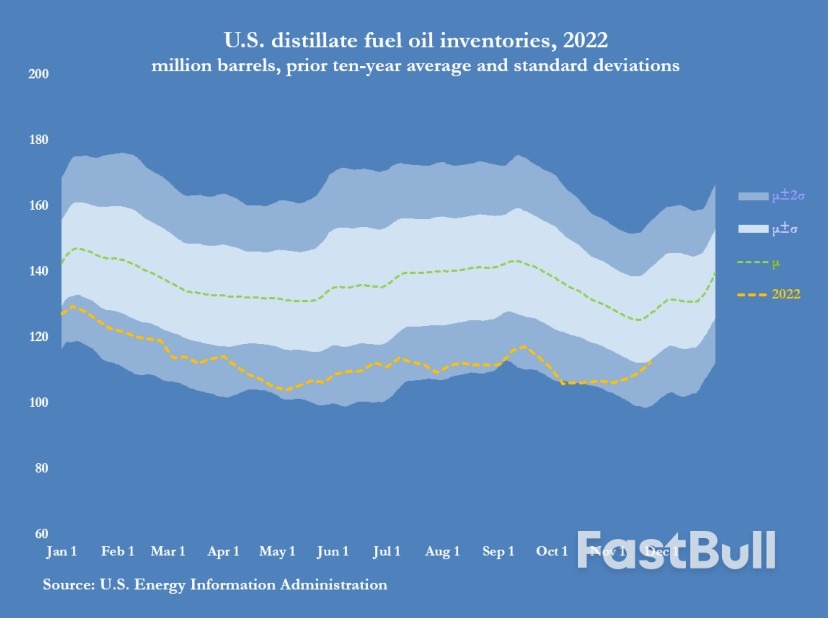
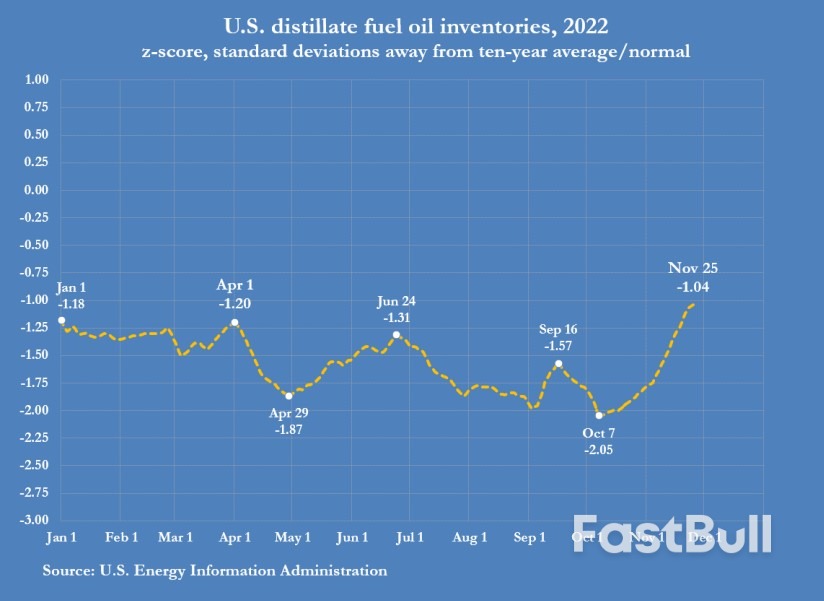
          Reduced distillate use would be consistent with an unusual increase in distillate fuel oil inventories reported over the last seven weeks in weekly surveys conducted by the EIA.
          Stocks increased by 7 million barrels between Oct. 7 and Nov. 25, the first increase at this time of year since 2008, and a contrast to an average seasonal drawdown of 9 million barrels in the ten years before the pandemic.
          The bottom line is that the slowdown in manufacturing and freight activity is starting to rebalance the distillate market and if it continues will help rebuild depleted inventories in 2023.

          Source: Reuters

          Risk Warnings and Disclaimers
          You understand and acknowledge that there is a high degree of risk involved in trading. Following any strategies or investment methods may lead to potential losses. The content on the site is provided by our contributors and analysts for information purposes only. You are solely responsible for determining whether any trading assets, securities, strategy, or any other product is suitable for investing based on your own investment objectives and financial situation.
          Comments
          Add to Favorites
          Share
          FastBull
          Copyright © 2025 FastBull Ltd

          728 RM B 7/F GEE LOK IND BLDG NO 34 HUNG TO RD KWUN TONG KLN HONG KONG

          TelegramInstagramTwitterfacebooklinkedin
          App Store Google Play Google Play
          Products
          Charts

          Chats

          Q&A with Experts
          Screeners
          Economic Calendar
          Data
          Tools
          Membership
          Features
          Function
          Markets
          Copy Trading
          Latest Signals
          Contests
          News
          Analysis
          24/7
          Columns
          Education
          Company
          Careers
          About Us
          Contact Us
          Advertising
          Help Center
          Feedback
          User Agreement
          Privacy Policy
          Business

          White Label

          Data API

          Web Plug-ins

          Poster Maker

          Affiliate Program

          Risk Disclosure

          The risk of loss in trading financial instruments such as stocks, FX, commodities, futures, bonds, ETFs and crypto can be substantial. You may sustain a total loss of the funds that you deposit with your broker. Therefore, you should carefully consider whether such trading is suitable for you in light of your circumstances and financial resources.

          No decision to invest should be made without thoroughly conducting due diligence by yourself or consulting with your financial advisors. Our web content might not suit you since we don't know your financial conditions and investment needs. Our financial information might have latency or contain inaccuracy, so you should be fully responsible for any of your trading and investment decisions. The company will not be responsible for your capital loss.

          Without getting permission from the website, you are not allowed to copy the website's graphics, texts, or trademarks. Intellectual property rights in the content or data incorporated into this website belong to its providers and exchange merchants.

          Not Logged In

          Log in to access more features

          FastBull Membership

          Not yet

          Purchase

          Become a signal provider
          Help Center
          Customer Service
          Dark Mode
          Price Up/Down Colors

          Log In

          Sign Up

          Position
          Layout
          Fullscreen
          Default to Chart
          The chart page opens by default when you visit fastbull.com