• Trade
  • Markets
  • Copy
  • Contests
  • News
  • 24/7
  • Calendar
  • Q&A
  • Chats
Trending
Screeners
SYMBOL
LAST
BID
ASK
HIGH
LOW
NET CHG.
%CHG.
SPREAD
SPX
S&P 500 Index
6827.42
6827.42
6827.42
6899.86
6801.80
-73.58
-1.07%
--
DJI
Dow Jones Industrial Average
48458.04
48458.04
48458.04
48886.86
48334.10
-245.98
-0.51%
--
IXIC
NASDAQ Composite Index
23195.16
23195.16
23195.16
23554.89
23094.51
-398.69
-1.69%
--
USDX
US Dollar Index
97.950
98.030
97.950
98.500
97.950
-0.370
-0.38%
--
EURUSD
Euro / US Dollar
1.17394
1.17409
1.17394
1.17496
1.17192
+0.00011
+ 0.01%
--
GBPUSD
Pound Sterling / US Dollar
1.33707
1.33732
1.33707
1.33997
1.33419
-0.00148
-0.11%
--
XAUUSD
Gold / US Dollar
4299.39
4299.39
4299.39
4353.41
4257.10
+20.10
+ 0.47%
--
WTI
Light Sweet Crude Oil
57.233
57.485
57.233
58.011
56.969
-0.408
-0.71%
--

Community Accounts

Signal Accounts
--
Profit Accounts
--
Loss Accounts
--
View More

Become a signal provider

Sell trading signals to earn additional income

View More

Guide to Copy Trading

Get started with ease and confidence

View More

Signal Accounts for Members

All Signal Accounts

Best Return
  • Best Return
  • Best P/L
  • Best MDD
Past 1W
  • Past 1W
  • Past 1M
  • Past 1Y

All Contests

  • All
  • Trump Updates
  • Recommend
  • Stocks
  • Cryptocurrencies
  • Central Banks
  • Featured News
Top News Only
Share

USA Embassy In Lithuania: Maria Kalesnikava Is Not Going To Vilnius

Share

USA Embassy In Lithuania: Other Prisoners Are Being Sent From Belarus To Ukraine

Share

Ukraine President Zelenskiy: Five Ukrainians Released By Belarus In US-Brokered Deal

Share

USA Vilnius Embassy: USA Stands Ready For "Additional Engagement With Belarus That Advances USA Interests"

Share

USA Vilnius Embassy: Belarus, USA, Other Citizens Among The Prisoners Released Into Lithuania

Share

USA Vilnius Embassy: USA Will Continue Diplomatic Efforts To Free The Remaining Political Prisoners In Belarus

Share

USA Vilnius Embassy: Belarus Releases 123 Prisoners Following Meeting Of President Trump's Envoy Coale And Belarus President Lukashenko

Share

USA Vilnius Embassy: Masatoshi Nakanishi, Aliaksandr Syrytsa Are Among The Prisoners Released By Belarus

Share

USA Vilnius Embassy: Maria Kalesnikava And Viktor Babaryka Are Among The Prisoners Released By Belarus

Share

USA Vilnius Embassy: Nobel Peace Prize Laureate Ales Bialiatski Is Among The Prisoners Released By Belarus

Share

Belarusian Presidential Administration Telegram Channel: Lukashenko Has Pardoned 123 Prisoners As Part Of Deal With US

Share

Two Local Syrian Officials: Joint US-Syrian Military Patrol In Central Syria Came Under Fire From Unknown Assailants

Share

Israeli Military Says It Targeted 'Key Hamas Terrorist' In Gaza City

Share

Rwanda's Actions In Eastern Drc Are A Clear Violation Of Washington Accords Signed By President Trump - Secretary Of State Rubio

Share

Israeli Military Issues Evacuation Warning In Southern Lebanon Village Ahead Of Strike - Spokesperson On X

Share

Belarusian State Media Cites US Envoy Coale As Saying He Discussed Ukraine And Venezuela With Lukashenko

Share

Belarusian State Media Cites US Envoy Coale As Saying That US Removes Sanctions On Belarusian Potassium

Share

Thai Prime Minister: No Ceasefire Agreement With Cambodia

Share

US, Ukraine To Discuss Ceasefire In Berlin Ahead Of European Summit

Share

Incoming Czech Prime Minister Babis: Czech Republic Will Not Take On Guarantees For Ukraine Financing, European Commission Must Find Alternatives

TIME
ACT
FCST
PREV
U.K. Trade Balance Non-EU (SA) (Oct)

A:--

F: --

P: --

U.K. Trade Balance (Oct)

A:--

F: --

P: --

U.K. Services Index MoM

A:--

F: --

P: --

U.K. Construction Output MoM (SA) (Oct)

A:--

F: --

P: --

U.K. Industrial Output YoY (Oct)

A:--

F: --

P: --

U.K. Trade Balance (SA) (Oct)

A:--

F: --

P: --

U.K. Trade Balance EU (SA) (Oct)

A:--

F: --

P: --

U.K. Manufacturing Output YoY (Oct)

A:--

F: --

P: --

U.K. GDP MoM (Oct)

A:--

F: --

P: --

U.K. GDP YoY (SA) (Oct)

A:--

F: --

P: --

U.K. Industrial Output MoM (Oct)

A:--

F: --

P: --

U.K. Construction Output YoY (Oct)

A:--

F: --

P: --

France HICP Final MoM (Nov)

A:--

F: --

P: --

China, Mainland Outstanding Loans Growth YoY (Nov)

A:--

F: --

P: --

China, Mainland M2 Money Supply YoY (Nov)

A:--

F: --

P: --

China, Mainland M0 Money Supply YoY (Nov)

A:--

F: --

P: --

China, Mainland M1 Money Supply YoY (Nov)

A:--

F: --

P: --

India CPI YoY (Nov)

A:--

F: --

P: --

India Deposit Gowth YoY

A:--

F: --

P: --

Brazil Services Growth YoY (Oct)

A:--

F: --

P: --

Mexico Industrial Output YoY (Oct)

A:--

F: --

P: --

Russia Trade Balance (Oct)

A:--

F: --

P: --

Philadelphia Fed President Henry Paulson delivers a speech
Canada Building Permits MoM (SA) (Oct)

A:--

F: --

P: --

Canada Wholesale Sales YoY (Oct)

A:--

F: --

P: --

Canada Wholesale Inventory MoM (Oct)

A:--

F: --

P: --

Canada Wholesale Inventory YoY (Oct)

A:--

F: --

P: --

Canada Wholesale Sales MoM (SA) (Oct)

A:--

F: --

P: --

Germany Current Account (Not SA) (Oct)

A:--

F: --

P: --

U.S. Weekly Total Rig Count

A:--

F: --

P: --

U.S. Weekly Total Oil Rig Count

A:--

F: --

P: --

Japan Tankan Large Non-Manufacturing Diffusion Index (Q4)

--

F: --

P: --

Japan Tankan Small Manufacturing Outlook Index (Q4)

--

F: --

P: --

Japan Tankan Large Non-Manufacturing Outlook Index (Q4)

--

F: --

P: --

Japan Tankan Large Manufacturing Outlook Index (Q4)

--

F: --

P: --

Japan Tankan Small Manufacturing Diffusion Index (Q4)

--

F: --

P: --

Japan Tankan Large Manufacturing Diffusion Index (Q4)

--

F: --

P: --

Japan Tankan Large-Enterprise Capital Expenditure YoY (Q4)

--

F: --

P: --

U.K. Rightmove House Price Index YoY (Dec)

--

F: --

P: --

China, Mainland Industrial Output YoY (YTD) (Nov)

--

F: --

P: --

China, Mainland Urban Area Unemployment Rate (Nov)

--

F: --

P: --

Saudi Arabia CPI YoY (Nov)

--

F: --

P: --

Euro Zone Industrial Output YoY (Oct)

--

F: --

P: --

Euro Zone Industrial Output MoM (Oct)

--

F: --

P: --

Canada Existing Home Sales MoM (Nov)

--

F: --

P: --

Euro Zone Total Reserve Assets (Nov)

--

F: --

P: --

U.K. Inflation Rate Expectations

--

F: --

P: --

Canada National Economic Confidence Index

--

F: --

P: --

Canada New Housing Starts (Nov)

--

F: --

P: --

U.S. NY Fed Manufacturing Employment Index (Dec)

--

F: --

P: --

U.S. NY Fed Manufacturing Index (Dec)

--

F: --

P: --

Canada Core CPI YoY (Nov)

--

F: --

P: --

Canada Manufacturing Unfilled Orders MoM (Oct)

--

F: --

P: --

Canada Manufacturing New Orders MoM (Oct)

--

F: --

P: --

Canada Core CPI MoM (Nov)

--

F: --

P: --

Canada Manufacturing Inventory MoM (Oct)

--

F: --

P: --

Canada CPI YoY (Nov)

--

F: --

P: --

Canada CPI MoM (Nov)

--

F: --

P: --

Canada CPI YoY (SA) (Nov)

--

F: --

P: --

Canada Core CPI MoM (SA) (Nov)

--

F: --

P: --

Q&A with Experts
    • All
    • Chatrooms
    • Groups
    • Friends
    Connecting
    .
    .
    .
    Type here...
    Add Symbol or Code

      No matching data

      All
      Trump Updates
      Recommend
      Stocks
      Cryptocurrencies
      Central Banks
      Featured News
      • All
      • Russia-Ukraine Conflict
      • Middle East Flashpoint
      • All
      • Russia-Ukraine Conflict
      • Middle East Flashpoint
      Search
      Products

      Charts Free Forever

      Chats Q&A with Experts
      Screeners Economic Calendar Data Tools
      Membership Features
      Data Warehouse Market Trends Institutional Data Policy Rates Macro

      Market Trends

      Market Sentiment Order Book Forex Correlations

      Top Indicators

      Charts Free Forever
      Markets

      News

      News Analysis 24/7 Columns Education
      From Institutions From Analysts
      Topics Columnists

      Latest Views

      Latest Views

      Trending Topics

      Top Columnists

      Latest Update

      Signals

      Copy Rankings Latest Signals Become a signal provider AI Rating
      Contests
      Brokers

      Overview Brokers Assessment Rankings Regulators News Claims
      Broker listing Forex Brokers Comparison Tool Live Spread Comparison Scam
      Q&A Complaint Scam Alert Videos Tips to Detect Scam
      More

      Business
      Events
      Careers About Us Advertising Help Center

      White Label

      Data API

      Web Plug-ins

      Affiliate Program

      Awards Institution Evaluation IB Seminar Salon Event Exhibition
      Vietnam Thailand Singapore Dubai
      Fans Party Investment Sharing Session
      FastBull Summit BrokersView Expo
      Recent Searches
        Top Searches
          Markets
          News
          Analysis
          User
          24/7
          Economic Calendar
          Education
          Data
          • Names
          • Latest
          • Prev

          View All

          No data

          Scan to Download

          Faster Charts, Chat Faster!

          Download App
          English
          • English
          • Español
          • العربية
          • Bahasa Indonesia
          • Bahasa Melayu
          • Tiếng Việt
          • ภาษาไทย
          • Français
          • Italiano
          • Türkçe
          • Русский язык
          • 简中
          • 繁中
          Open Account
          Search
          Products
          Charts Free Forever
          Markets
          News
          Signals

          Copy Rankings Latest Signals Become a signal provider AI Rating
          Contests
          Brokers

          Overview Brokers Assessment Rankings Regulators News Claims
          Broker listing Forex Brokers Comparison Tool Live Spread Comparison Scam
          Q&A Complaint Scam Alert Videos Tips to Detect Scam
          More

          Business
          Events
          Careers About Us Advertising Help Center

          White Label

          Data API

          Web Plug-ins

          Affiliate Program

          Awards Institution Evaluation IB Seminar Salon Event Exhibition
          Vietnam Thailand Singapore Dubai
          Fans Party Investment Sharing Session
          FastBull Summit BrokersView Expo

          Wind Power Industry Drifts Off Course

          Kevin Du

          Economic

          Summary:

          A perfect storm of supply chain delays, design flaws and higher costs in the offshore wind industry has put dozens of projects at risk of not being delivered in time for countries to meet climate goals, industry executives, investors and analysts said.

          A perfect storm of supply chain delays, design flaws and higher costs in the offshore wind industry has put dozens of projects at risk of not being delivered in time for countries to meet climate goals, industry executives, investors and analysts said.
          The race to reduce reliance on fossil fuels is putting pressure on manufacturers and supply chains to keep pace with demand for more clean energy, especially in the European Union which is finalising a legally binding goal to produce 42.5% of energy from renewables by 2030.
          Up from 32% now, the new target would require 420 gigawatts (GW) of wind energy including 103 GW offshore, more than double current capacity of 205 GW of which just 17 GW is offshore, according to industry group WindEurope.
          But so far this year, projects off Britain, the Netherlands and Norway have been delayed or shelved due to rising costs and supply chain constraints while Britain's renewable energy auction this month failed to attract any bids from offshore wind developers, also because of high industry costs.
          "If this turns into a prolonged pause of projects then without a doubt a lot of the 2030 renewables goals will be under pressure," said Jon Wallace, an investment manager at Jupiter Asset Management.
          Even before the EU agreed its new renewables target this year, companies including Orsted, Shell, Equinor, wind turbine manufacturer Siemens Gamesa and WindEurope had warned that the offshore wind industry was not big enough to deliver on climate targets.
          Supply chain disruptions which started during the global pandemic have been exacerbated by the Ukraine war while higher shipping rates, raw material costs, interest rates and inflation have dented profits for some wind developers.
          Markus Krebber, CEO of Germany's RWE, posted on LinkedIn that a combination of issues, all coming at time when the offshore industry was expected to expand quickly, called into question the achievement of climate protection goals.
          "We certainly see a big gap between the renewables and wind targets for 2030 and the path we are on right now. We are growing but nowhere near fast enough," said Ben Blackwell, CEO of the Global Wind Energy Council.
          Bigger and better?
          Over the last two decades, the industry has grown fast and cut technology costs to be on a par or even cheaper than fossil fuels in some parts of the world. But the race to develop ever bigger and more efficient turbines may have been too hasty, some executives and analysts said.
          Turbines have roughly doubled in size every decade with the largest ones operating in 2021 and 2022 coming with 110-metre blades and a capacity of 12 to 15 megawatts (MW). But the bigger they get the more susceptible they have become to faults, said Rob West, analyst at consultancy Thunder Said Energy.
          "Physics inherently punishes larger turbines. Larger blades will inherently deflect more, which means they need stiffer spar caps, shear webs and more expensive materials. They will also weigh more which pushes more stress and strain through the blade, root and nacelle during each rotation," he said.
          In June, Siemens Gamesa said quality problems at its two most recent onshore wind turbines would cost 1.6 billion euros ($1.7 billion) to fix.
          Fraser McLachlan, chief executive of GCube Insurance, said the number of insurance claims from wind developers has fallen in the past year but the amounts and severity of claims has gone up significantly.
          "It's like the iPhone. Everyone wants the next generation technology and equipment and the manufacturers have been trying to outdo each other and the result is you are not getting a sufficient amount of R&D invested in the technology," he said.
          "Participation in the offshore wind market has become a risky business, not only for insurers, but also manufacturers, developers, and supplier companies – with some now facing a material risk to their survival," McLachlan said.
          Siemens Gamesa Chief Executive Jochen Eickholt said its offshore business was facing separate issues to the onshore problems, including delays in construction of production sites, supply chain glitches and shortages of quality components.
          "We became a victim of our past successes over the last years. The interest in our products was very high, and this resulted in increased number of orders in 2021 and 2022 and it now requires a ramp-up in almost all of our production facilities," he said in August when the company reported third-quarter results.
          The world's leading turbine maker Vestas has also said it is struggling to deliver a backlog of orders and expects supply chain disruptions to continue this year.
          'Major market failure'
          At the same time, governments have stepped up auction rounds and tenders for seabed licences. Bloomberg New Energy Finance said it expected more than 60 GW of offshore wind contracts and leases to be for grabs worldwide through the end of 2024.
          But some wind developers said the electricity price on offer at auctions was too low for them to embark on new projects given the industry's problems with rising costs.
          "This is coming through to the developers who are discussing prices of turbines, labour, project deployment, hiring ships and finance and that's flowing into how they are budgeting projects," said Wallace at Jupiter.
          Britain aims to triple its offshore wind capacity to 50 GW by the end of this decade but the lack of bids from wind developers at its Sept. 8 auction could be a sign of things to come, some experts said.
          "The ratio between risk and reward is out of line in the offshore wind market in many jurisdictions. You can see this from investors not showing up," the Global Wind Energy Council's Blackwell told Reuters.
          "Governments can and should fix this issue quickly, otherwise we could see a major market failure and climate and economic goals will simply not be met," he said.
          In some auctions, prices have become too high for traditional renewables utilities to compete with major oil and gas companies on the hunt for greener assets.
          For example, BP and TotalEnergies won a German tender for 7 GWs of offshore wind after paying a record 12.6 billion euros for the leases. RWE and Denmark's Orsted dropped out of the auction due to concerns about the price.
          "We participated in that auction, and we would have loved to win. However, bid prices reached levels where our return expectations would not be met even in very optimistic scenarios," said RWE's Krebber.
          Such is the concern about the industry's problems, the European Commission said this month it will put forward a package of support measures.
          European companies are also struggling across the Atlantic.
          In recent months, developers including Orsted, Equinor, BP and Shell have sought to cancel or renegotiate power contracts for the first commercial-scale U.S. wind farms due to start operating between 2025 and 2028.
          And a fleet of U.S. projects central to President Joe Biden's aim for 30 GW of offshore wind by 2030 may not advance unless his administration eases requirements for subsidies in the Inflation Reduction Act, project developers have said.
          "The situation in U.S. offshore wind is severe," Orsted CEO Mads Nipper said last month.
          ($1 = 0.9435 euros)

          Source: ETEnergyworld

          To stay updated on all economic events of today, please check out our Economic calendar
          Risk Warnings and Disclaimers
          You understand and acknowledge that there is a high degree of risk involved in trading. Following any strategies or investment methods may lead to potential losses. The content on the site is provided by our contributors and analysts for information purposes only. You are solely responsible for determining whether any trading assets, securities, strategy, or any other product is suitable for investing based on your own investment objectives and financial situation.
          Comments
          Add to Favorites
          Share

          US Presidential Election 2024: What You Need to Know

          Alex

          Political

          Leading the field of Republican presidential candidates is former President Donald Trump, who faces a battery of federal and state criminal charges related to his efforts to overturn his 2020 election loss to Democrat Joe Biden.
          If Trump captures the Republican nomination and wins the general election, he will become the first president in 130 years to win the White House after sitting out a term, after Grover Cleveland.
          Biden, the incumbent president, is the presumptive Democratic nominee. He will be 81 when the election is held in November 2024, making him the oldest American ever to win a presidential election should he secure a second term.
          Who are the republican candidates running for president?
          Trump, 77, is dominating a field of 10 major candidates who have largely avoided criticizing him directly for fear of alienating his base of diehard supporters.
          His Republican rivals, such as Florida Governor Ron DeSantis and former U.S. Ambassador to the United Nations Nikki Haley, instead have argued that Trump’s legal woes will hamstring him in a general-election fight against Biden.
          Two notable exceptions are Trump’s former vice president, Mike Pence, and former New Jersey Governor Chris Christie, who have both been critical of Trump’s attempts to subvert the 2020 election outcome.
          Entrepreneur Vivek Ramaswamy, a newcomer to politics, is running as an inheritor of Trump’s populist, America First agenda, one that is wary of an expansive federal government, corporate power and international alliances.
          DeSantis was once viewed as the most likely candidate to deny Trump the nomination, but his campaign has sputtered since launching in May despite having a big war chest. He risks falling into the rest of the pack behind Trump.
          Polls show that Trump is largely tied with Biden in head-to-head matchups, with voters concerned about Biden's age and his handling of the economy despite job growth, infrastructure investment and a slow easing of inflation after last year's peak.
          Trump faces indictments in four cases in federal and state courts for his efforts to undermine the 2020 election, his mishandling of classified documents and his involvement in a “hush money” scheme involving a porn star. He has maintained his innocence and argued that he is the victim of politically motivated prosecutions, an assertion the Biden administration denies. The legal calendars for those cases pose obstacles for Trump's ability to campaign.
          Who are the democrats running for us president in 2024?
          While voters may not be enthusiastic, Democratic leaders are backing Biden and his vice president, Kamala Harris.
          Robert F. Kennedy Jr., scion of the storied political family, who has pushed anti-vaccine and anti-COVID-19 safety views, is a long-shot challenger, as is 2020 candidate Marianne Williamson, a self-help author and speaker.
          Biden's pitch for a second four-year term rests on his stewardship of the economy as it has emerged from the COVID pandemic, and what he calls the "battle for the soul of America," a fight against Trump-aligned Republicans.
          Under Biden, unemployment dropped to generational lows, gross domestic product (GDP) grew faster than expected and wages have risen. However, inflation spiked last year, and, while it has eased in recent months, voters remain concerned about the high price of staples such as food, fuel, cars and housing.
          Should Trump be the Republican nominee, much of Biden's campaign is likely to focus on warning voters that Trump poses a mortal threat to American democracy, and that he will undermine U.S. foreign policy interests, and push through new tax cuts for the rich and for companies.
          The lack of enthusiasm among voters for a Biden-Trump rematch suggests a third-party challenger could garner some support or push more Americans to sit out the election after 2020's 66.8% voter turnout marked the highest level for a U.S. presidential election this century. A significant third-party candidate has yet to emerge, however.
          When do 2024 primaries start?
          Republicans will hold their first nominating contest in January with the Iowa caucuses. New Hampshire will hold a more traditional presidential primary shortly thereafter, followed by Nevada, South Carolina and Michigan.
          Democrats plan to hold their first primary in South Carolina in February, with Biden not expected to face a serious challenger. "Super Tuesday" - when more than a dozen states will award delegates to the party conventions, including California and Texas - will be on March 5.
          Each party will nominate the candidate who receives the most delegates at their nominating conventions in the summer of 2024. Republicans will hold their convention in Milwaukee, Wisconsin, while Democrats will stage theirs in Chicago.
          The general election will be held on Nov. 5, 2024.
          What are the key issues?
          Abortion: Democrats plan to make abortion central to their 2024 campaign, with public opinion polls showing most Americans don’t favor strict limits on reproductive rights. The issue has become more motivating to those who support abortion rights than to those who oppose them, and the party is hoping threats to those rights will encourage millions of women and independents to vote their way next year.
          The issue has divided Republicans, with some leaders concerned the party has gone too far with state-level restrictions since the U.S. Supreme Court overturned the landmark 1973 Roe v. Wade ruling last year, ending constitutional protection for abortion.
          Republican presidential candidates are split between those saying abortion laws should be left to the states and those supporting a national ban.
          The Economy: Biden’s White House is trying to reassure Americans that the economy is in solid shape, with inflation slowing and unemployment at its lowest levels in a half-century.
          Republicans say they will cut federal spending, which they blame for stoking inflation and triggering consumer-price spikes, trim back federal regulations and lower taxes.
          Democrats argue the economy is healthy, wages are up and investments in infrastructure are producing long-term job gains.
          Voters remain unconvinced. According to a Reuters/Ipsos poll conducted in August, 42% percent of Biden's 2020 voters said the economy was "worse" than it was in 2020, compared with 33% who said it was "better" and 24% who said it was "about the same."
          Immigration: Since taking office in 2021, Biden has grappled with record numbers of migrants caught illegally crossing the U.S.-Mexico border, straining resources there and cities they have gone to, such as New York and Chicago. Republican candidates, including Trump, have blamed Biden for reversing more restrictive Trump-era policies and have pledged to step up border security.
          Some Democrats have criticized Biden for turning to Trump-style enforcement measures to reduce illegal crossings, while the White House maintains it is moving to a more humane and orderly system by offering new ways for migrants to enter legally.
          Crime: Violent crime remains at higher levels across the nation than in 2019, the year before the COVID pandemic and unrest over racial justice. Americans of both parties are concerned, with 88% of respondents in a September Reuters/Ipsos poll saying crime would be an important issue for determining who gets their vote.
          Foreign Policy: China has emerged as the foreign policy issue in the campaign, with Republicans arguing the Asian power is a growing threat to national security, U.S. corporate interests and Taiwan's independence.
          The Biden administration has said it wants to "de-risk" and not "de-couple" its relationship with China and work to keep the competition between the world's No. 1 and No. 2 economic powers from escalating into conflict.
          Ukraine is another major issue, and has split the Republican field. Trump and DeSantis argue that Biden's support of Ukraine in its war with Russia is distracting the U.S. from preparing for a possible confrontation with China. Other Republican candidates, such as Pence and Haley, say the United States must continue to back Ukraine.
          Biden, who has focused on rebuilding relations with allies after Trump's presidency, has helped build an international coalition to help Ukraine fight Russia, and will likely highlight the importance of maintaining that policy on the campaign trail.
          What are the key states in 2024 general election?
          That both parties are holding their conventions in the Midwest says much about the value they are placing on Michigan, Pennsylvania and Wisconsin, all of which went for Trump in 2016 and flipped to Biden in 2020.
          Arizona, Georgia and Nevada have also proven to be closely divided and contain growing populations that could determine the next election. Another key battleground next year could be North Carolina, another Southern state with an increasingly diverse electorate.

          Source: Yahoo

          Risk Warnings and Disclaimers
          You understand and acknowledge that there is a high degree of risk involved in trading. Following any strategies or investment methods may lead to potential losses. The content on the site is provided by our contributors and analysts for information purposes only. You are solely responsible for determining whether any trading assets, securities, strategy, or any other product is suitable for investing based on your own investment objectives and financial situation.
          Comments
          Add to Favorites
          Share

          Why Britain Could Buy into the EU's New Expansion Proposal

          Damon

          Economic

          Political

          One expert in London remarked on the recent burst of commentary about reversing Brexit by quipping that it had been such a disaster that Europe recognised it needed the UK.
          It’s a double-sided observation because Brexit is not really working for the UK but also the Europeans are seeing that a weakened Britain is not doing any good for the region’s place in the world.
          This is as good as acknowledged in the latest plans for the continent that are emerging from Berlin and Paris. Europe itself is drawing up a blueprint that moves beyond the “my way or no way” attitudes often displayed by Brussels in the past.
          The initial response of the EU to the UK leaving the bloc was a punchy assertion of its own cohesion and ambitions as a top-tier international bloc.
          Seven or so years ago was a time when there was a global obsession with America’s decline. Relative to China, the US was seen as on the wane, leading to a reordering of the global pecking order.
          Into this, the EU wanted to cast off shackles of domestic introspection. It had visions of a global three-legged stool in which all significance revolved around the US, China and the EU blocs.
          For the UK, the idea of leaving the EU was perversely in part rooted in this logic. With its own history and global ambitions, London did not want to trim itself to following the EU guiderails. It could not, for example, throw its lot explicitly away from US interests as Brussels seemed to want.
          It even had its own mercantile ideas about China and India that it wanted to pursue for itself in Brexit.
          The war in Ukraine has been just as significant as Brexit, probably more so, in provoking a reassessment among the Europeans. For a start, the British were far more agile in backing Kyiv both ahead of the invasion and in escalating the international support for Ukraine.
          With a greater focus on the strategic importance of the North Atlantic seas, London also made new alliances with the Scandinavian countries and built stronger links with the Baltics and Poland.
          Ukraine matters to the European power equation not just in the need to stand together against Russia. It highlighted that even as the rest of the world has questioned the US, Washington has become far more powerful relative to its European allies.
          Despite all the talk around the EU challenging US digital dominance and trade protectionism, it is a fact of the northern hemisphere that the transatlantic relationship has not become more balanced. If fact, it is more dominated by the US as the saga proved when Germany would only grant Leopard II tanks to Kyiv after the US said it would find a batch of Abrams main battle tanks.
          Ukraine wasn’t even asking for Abrams tanks, which run on jet fuel. US President Joe Biden said last week the first would arrive soon long after the Leopards. Officials have reassured the Ukrainians that they have been tweaked to use more available petrol supplies.
          What America wants from Europe is not only stronger defence but some sign that the continent’s countries are able to build consensus and avoid splits.
          With a new realism on display in Brussels, Paris and Berlin, the search is on for meaningful change. A task force jointly set up by the French and Germans last week reported, making headlines in Britain, that the new multi-tier Europe was on offer for the UK’s return.
          What the blueprint did offer was a glimpse of the challenges for the EU as it seeks a new model for Europe. The idea is inclusion of Ukraine – which has been offered EU membership – as well as the Balkans, the more nationalistic Eastern Europeans as well as the Swiss and the British under a European umbrella.
          The authors frame their thinking as unity in diversity in Europe. Their approach set out four distinct tiers of the future edifice. An inner circle that drives in the direction of the EU itself with integrated politics and decision-making functions.
          It foresees a moment of truth for the EU27 in which some states are detached, not able to agree to as much pooled sovereignty as is required. In this event, the report recommends a safeguarding of core standards such as the rule of law.
          The third tier is a middle ground between enlargement of membership and the currently friction-filled accession process. This would allow membership of the single market or customs union. It could even be a place where alliances are formalised, such as the EU plus the members of a future European Security Council.
          The fourth gear of co-operation is the European Political Community, which already held two continent-wide gatherings in Prague and Chisinau, Moldova.
          The authors suggested that the new European leadership from 2024 should see this as an exercise in securing the bloc’s fundamentals first, cementing geopolitical interests second and making sure it was capable of conflict resolution third.
          What that means is making Europe work first. It is a task the whole world sorely needs to succeed for global stability.

          Source: The National News

          To stay updated on all economic events of today, please check out our Economic calendar
          Risk Warnings and Disclaimers
          You understand and acknowledge that there is a high degree of risk involved in trading. Following any strategies or investment methods may lead to potential losses. The content on the site is provided by our contributors and analysts for information purposes only. You are solely responsible for determining whether any trading assets, securities, strategy, or any other product is suitable for investing based on your own investment objectives and financial situation.
          Comments
          Add to Favorites
          Share

          Europe Heads More Comfortably into Winter Without Russia's Nord Stream Gas

          Devin

          Energy

          High levels of gas storage, lower energy prices and new sources of fuel mean Europe is heading into a second winter with scarce Russian gas in a more comfortable position than a year ago.
          After decades of relying on Russia to supply cheap gas, resuming that dependency became more unlikely than ever following the unexplained explosions a year ago today that hit the Nord Stream pipelines running under the Baltic Sea from Russia to Germany.
          Before Russia's invasion of Ukraine, the Nord Stream 1 pipeline had accounted for 15% of Europe's gas imports in 2021, according to the Oxford Institute for Energy Studies. A second Nord Stream 2 link was planned but never operated.
          At the time of the pipeline attack, European gas prices were three times higher than before Russia invaded Ukraine and industries were cutting output to contain gas costs.Europe Heads More Comfortably into Winter Without Russia's Nord Stream Gas_1
          Replacing Russia
          Now prices are much lower. European gas benchmark the front month contract on the Dutch Title Transfer Facility is trading at around 40 euros compared with 180 euros a year ago.
          Policymakers and industry remain sensitive to price risks as economies are fragile and inflation high, but they say they have addressed Russia's power to add to the problem.
          "Our biggest risk was that Russia can manipulate our energy markets," EU Energy Commissioner Kadri Simson told Reuters. "They don't have this leverage any more."
          The bloc, she said, has quickly improved its ability to transport alternative supplies.
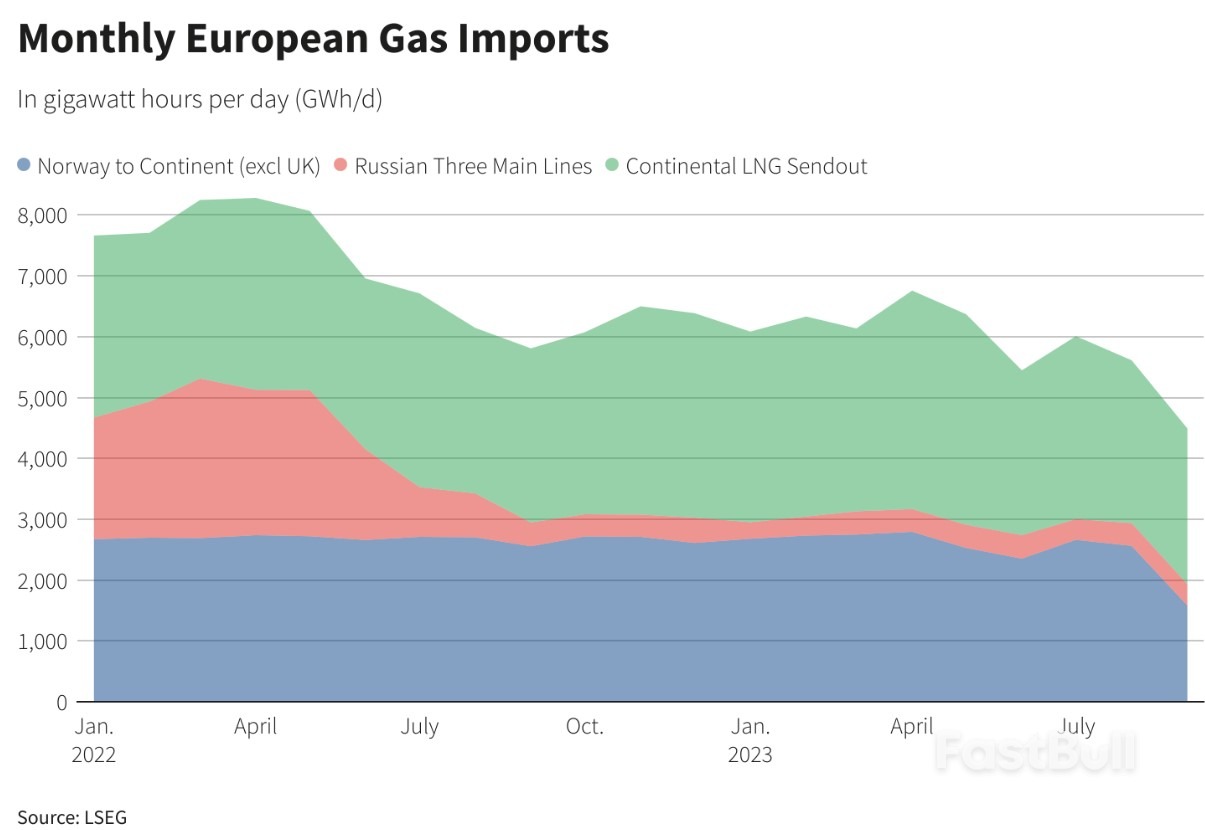
          Before its invasion of Ukraine, Russia sent around 155 billion cubic metres (bcm) of gas to Europe each year, mostly via pipelines, according to EU figures.
          In 2022, piped gas imports to the EU dropped to 60 bcm. This year, the EU expects them to fall to 20 bcm.
          Coping with the shortfall has required tackling supply and demand.
          On the supply side, Norway has replaced Russia as the EU's biggest pipeline gas supplier and liquefied natural gas (LNG) imports have surged, led by supplies from the United States.
          New pipelines to carry non-Russian gas opened last year in Greece and Poland. Finland, Germany, Italy and the Netherlands opened LNG import terminals and more are planned in France and Greece.Europe Heads More Comfortably into Winter Without Russia's Nord Stream Gas_2
          Germany, previously Europe's biggest buyer of Russian gas, has been particularly focused on new infrastructure.
          It has opened three floating storage and regasification (FSRU) vessels, able to import equivalent to 50%-60% of the 55 bcm/year Nord Stream 1 used to pipe in from Russia, SEB Commodities Analyst Ole Hvalbye said.
          To shore up supplies, the EU began jointly buying non-Russian gas.
          It also introduced back-up rules requiring countries to share gas with their neighbours in a crisis and agreed legal obligations for countries to fill gas storage, typically commercial sites used by companies to deal with seasonal variations in consumption.
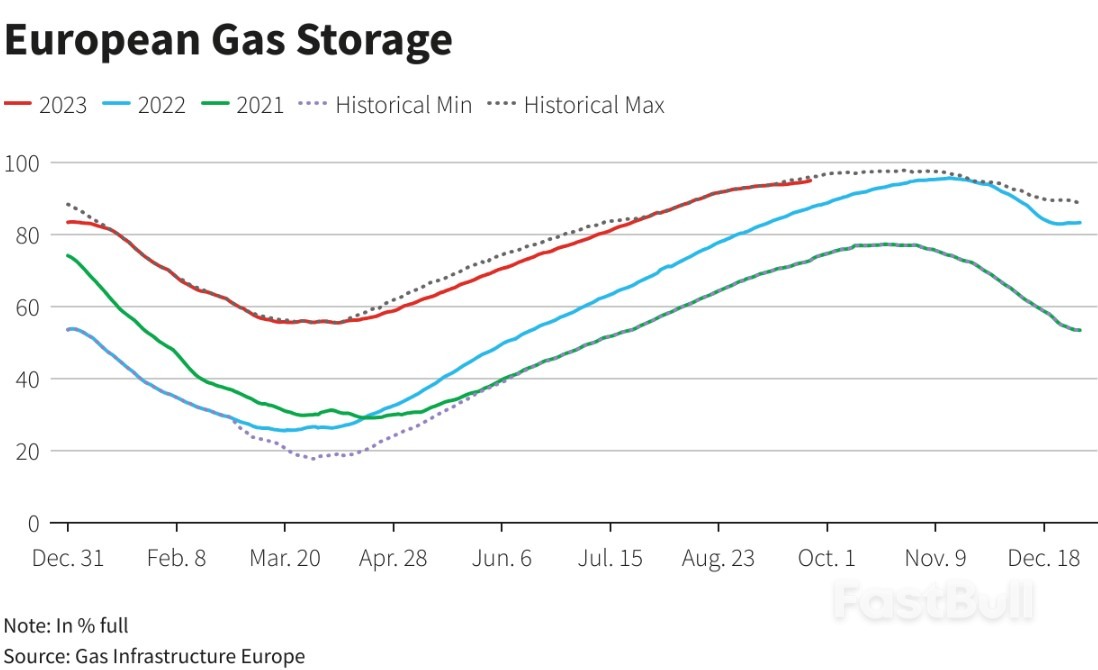
          Across the EU, gas storage caverns are now 95% full, Gas Infrastructure Europe data show. When completely full, they should cover about one third of the EU's winter gas demand.Europe Heads More Comfortably into Winter Without Russia's Nord Stream Gas_3
          Industry Hit
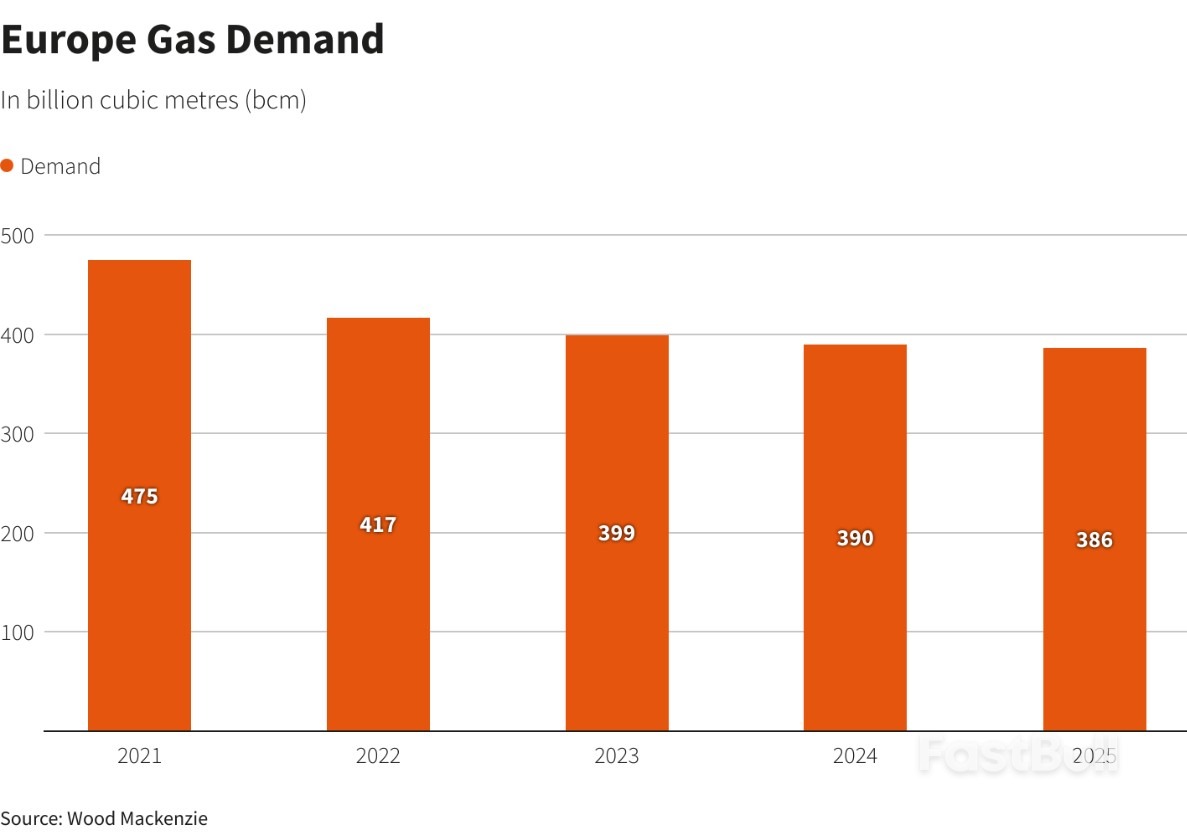
          A big factor in avoiding energy shortages has been the plunge in demand caused by high prices, although EU and government policies also promoted energy saving.
          The weather played a part as a warm winter made it relatively easy to use less energy for heating and Europe emerged early this year from its peak season for gas demand with unusually full storage caverns, making it easier to replenish them this year.
          Apart from uncertainties about this winter's weather, some analysts say the price of reduced energy use could be a permanent contraction of the bloc's industrial activity.
          Europe's biggest economy Germany is expected to shrink this quarter as industry is in recession, according to the country's central bank.
          Energy Aspects estimates 8% of the 2017-21 average industrial gas demand in Belgium, Britain, France, Germany, Italy, Portugal, the Netherlands and Spain may be gone for good by 2024.
          "Europe has managed to swap out the [Russian] volumes. But in reality, this has only been possible at the expense of wider economic activity," Tom Marzec-Manser, head of gas analytics at ICIS, said.
          Some of the reduction in gas demand has been driven by a more positive transition as Europe has increased its reliance on renewable energy.
          Europe is expected to install 56 gigawatts (GW) of new renewable energy capacity in 2023 - enough to replace around 18 bcm of gas this year, Wood Mackenzie said.Europe Heads More Comfortably into Winter Without Russia's Nord Stream Gas_4
          Tight Gas Supplies
          Turning to the coming winter months, Gergely Molnar, gas analyst at the Paris-based International Energy Agency, said Europe was in "a quite comfortable place".
          Analysts said a return to the record high prices seen last year - which peaked at 343 euros/MWh in August 2022 - is unlikely.
          But globally, gas markets are unusually tight - posing the risk that Europe could face price spikes depending on exceptional weather or any further supply shocks, such as Russia cutting off the remaining pipeline gas and LNG it still supplies to Europe.
          Any such spike would increase pressure on politicians when the EU, Britain, Poland and the Netherlands face elections in the next year in which the cost-of-living crisis is expected to be a dominant issue.
          They could find themselves again trying to find funds to help with energy bills and incentivise more filling of storage whose cost is believed to have been many billions.
          "You are talking about a much lower cost than in summer 2022. But that could still cost billions of euros," Jacob Mandel, Senior Associate at Aurora Energy Research said.

          Source: MarketScreener

          Risk Warnings and Disclaimers
          You understand and acknowledge that there is a high degree of risk involved in trading. Following any strategies or investment methods may lead to potential losses. The content on the site is provided by our contributors and analysts for information purposes only. You are solely responsible for determining whether any trading assets, securities, strategy, or any other product is suitable for investing based on your own investment objectives and financial situation.
          Comments
          Add to Favorites
          Share

          In Latin America, Data Center Plans Fuel Water Worries

          Alex

          Economic

          Uruguay's devastating drought was at its peak when President Luis Lacalle Pou took an unexpected question from a young student during a visit to a primary school in the capital: "Why is the water so salty?"
          "We have to wait for the rain," Lacalle Pou replied. "We must save our water only for essential needs."
          Recent rainfall has eased the parched conditions that prompted the government to mix water supplies with a brackish source in parts of Montevideo, and the capital's depleted reservoirs have started to recover.
          But many Uruguayans unable to afford bottled water say the government has prioritized industrial uses during this year's drought, stirring anger over plans by Google to build a data center using millions of liters every day to cool its servers.
          "These companies consume vast volumes of water, which are, in turn, our reserves," said Daniel Pena, a sociologist and researcher at the Republic University in Montevideo.
          "Now, with the drought, it's as if someone emptied your bank account. Your savings just aren't there anymore," said Pena, who has campaigned against growing use of potable water by industry as a member of the Coordination for Water civil group.
          Alphabet-owned Google has acquired land in the western department of Canelones to build its second data center in Latin America. In 2015, it opened its first in the region in a suburb of Chile's capital, Santiago, announcing three years later that it would triple its size to meet growing demand.
          The company's plans to build a second project in Chile - which has been gripped by drought for more than a decade - have faced delays since 2020 as local communities filed environmental complaints.
          Squandered water supplies?
          According to Google's sustainability data, the company's more than 20 data centers consumed approximately 5.22 billion gallons (19.8 billion liters) of water in 2022, or more than 14 million gallons (53 million liters) per day.
          That is equivalent to the domestic water consumption of nearly 175,000 people in the United States, as per the latest estimates from the U.S. Environmental Protection Agency.
          It is still much less than other industries, such as Uruguay's key pulp and paper sector, but it poses a further strain on increasingly limited water supplies as climate change increases the frequency and severity of droughts.
          Surging internet use in recent years has accelerated demand for new data centers around the world, increasing competition for land and raising concerns about the use of resources - including water.
          Data center growth is underpinned by how the pandemic supercharged online and especially video activity, triggering a surge in Zoom calls, photo-sharing and social media use. Novel technologies such as artificial intelligence and autonomous driving could spur further expansion.
          Google's planned data center in Canelones would power user requests for its array of internet services, such as YouTube, Gmail and Search.
          Initial plans for the facility envisaged daily water use of 7.6 million liters (about 2 million gallons), according to information obtained by Pena following a freedom of information request last year.
          That is equivalent to the daily water consumption of 55,000 people in Montevideo, a city of 1.4 million people. Most of the water used in cooling evaporates, meaning it can not be retained for other uses.
          Running a soup kitchen that offers meals to children in the poor Nuevo Comienzo neighborhood just outside the capital, Fabiana Molina, 50, said she feared the poor would bear the brunt of growing competition for limited water resources.
          "The 7.6 million liters that Google will use are 7.6 million squandered," she said.
          Uruguay's industry ministry said the original project had been withdrawn by the company, and that it was now working with an alternative plan that would use less energy and water.
          A Google official told the Thomson Reuters Foundation the project is still in the "exploratory phase" and must undergo environmental approval, for which final figures may differ from initial estimates.
          Global Pushback
          The pushback against Google's plans in Uruguay comes amid growing opposition to data centers around the world - from Europe to the United States and elsewhere in Latin America.
          In Chile, local residents and authorities filed a formal complaint against Google's second planned data center at the country's environmental court in 2020, prompting Google to commit to adopting alternative cooling methods. But the project remains on hold.
          A data center project planned by Microsoft in Quilicura, close to Google's existing Chilean facility, has encountered similar opposition, delaying the approvals process amid concerns from the local community about its potential impact on an ecosystem already suffering from dry weather.
          The project, however, is moving forward as the U.S. company undergoes the environmental permitting process. An additional amendment, in which Microsoft committed not to draw water from nearby sources, led to approval from most local public bodies.
          Tech companies highlight the positive economic impact of data centers. Google said its Chilean data center required a $290-million investment and helped boost gross domestic product (GDP).
          When Google announced in 2018 it would invest an additional $140 million to expand it, then President Sebastian Pinera hailed it as showing Chile was part of the "fourth industrial revolution".
          But critics say data centers create few jobs and give little back in exchange for the resources they use, compounding public anger as water scarcity impacts daily life.
          At her home in El Tobogan, a slum area on the outskirts of Montevideo, pensioner Lita Leite said she had to use salty water to prepare her mate, a traditional infused herbal drink drank widely in parts of South America.
          "It was extremely foul-tasting ... (but) for me, it was impossible to afford bottled water daily," said Leite, 67, accusing Lacalle Pou's conservative government of having "handed over control of our natural water."
          "Big companies take millions of liters of water yearly, but it seems like us Uruguayans have lost our rights," she said.
          ($1 = 38.1500 Uruguayan pesos)

          Source: Reuters

          To stay updated on all economic events of today, please check out our Economic calendar
          Risk Warnings and Disclaimers
          You understand and acknowledge that there is a high degree of risk involved in trading. Following any strategies or investment methods may lead to potential losses. The content on the site is provided by our contributors and analysts for information purposes only. You are solely responsible for determining whether any trading assets, securities, strategy, or any other product is suitable for investing based on your own investment objectives and financial situation.
          Comments
          Add to Favorites
          Share

          Week Ahead – Dollar Shines ahead of Nonfarm Payrolls

          Justin

          Forex

          Central Bank

          Economic

          Dollar goes on a rampage

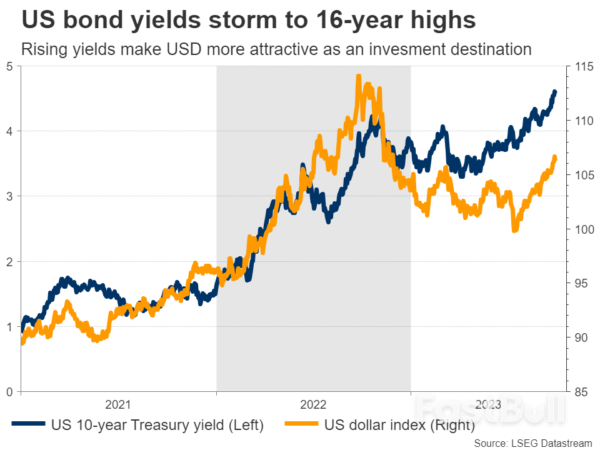
          The US dollar rally has gone into overdrive lately. Empowered by a stunning rise in US yields, solid economic fundamentals, and safe haven flows, the dollar has charged higher to record 11 consecutive weeks of gains against the euro.
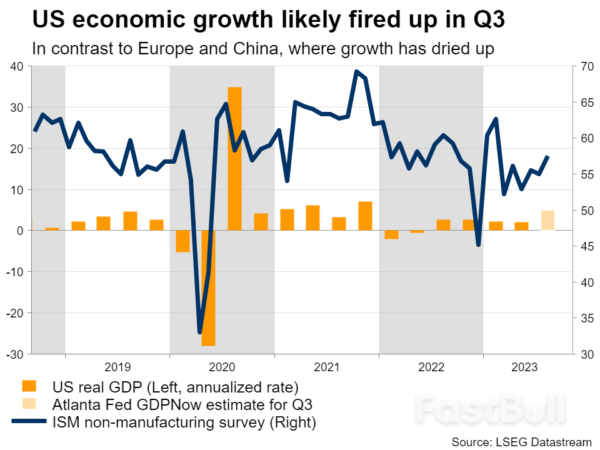
          In a nutshell, the United States appears much more resilient than any other region. Incoming data releases continue to reaffirm the strength of the US economy, while in contrast, Europe is suffering a sharp slowdown in economic growth and China is still dealing with the implosion of its property sector.
          This differential in economic growth is increasingly pushing investors towards the United States, and the impressive rally in US yields lately has made the dollar even more attractive from an interest rate perspective.
          Week Ahead – Dollar Shines ahead of Nonfarm Payrolls_1
          Hence, the dollar offers the ‘full package’ at the moment – the highest real rates among the major economies, the strongest economic growth, and safe haven qualities thanks to its reserve currency status. Meanwhile, there’s a lack of attractive alternatives in the FX arena, as every other major currency is dealing with its own problems.
          Next week’s data releases will either add more fuel to this rally or trigger a correction, with the main event being the US employment report on Friday. Forecasts suggest nonfarm payrolls rose by 150k in September, less than the previous month but still a decent number overall.
          Meanwhile, the unemployment rate is projected to have ticked back down to 3.7%, while wage growth is expected to have picked up some steam in monthly terms. If the forecasts are met, this would be yet another dataset reinforcing the Fed’s message that interest rates could remain higher for longer.
          As for any surprises, most early indicators point to another solid month for the US labor market. Applications for unemployment benefits fell sharply in September, so there were no signs of any mass worker layoffs. Similarly, business surveys from S&P Global signaled a reacceleration in employment growth.
          Week Ahead – Dollar Shines ahead of Nonfarm Payrolls_2
          Speaking of business surveys, the ISM manufacturing index is due on Monday, ahead of the non-manufacturing PMI on Wednesday. In the political scene, the government will shut down this weekend unless a funding deal is reached in Congress. That said, markets usually ignore these shutdowns, as investors view them as political theater. For markets to care, it would need to be a prolonged shutdown that dampens economic growth.

          RBA and RBNZ decisions

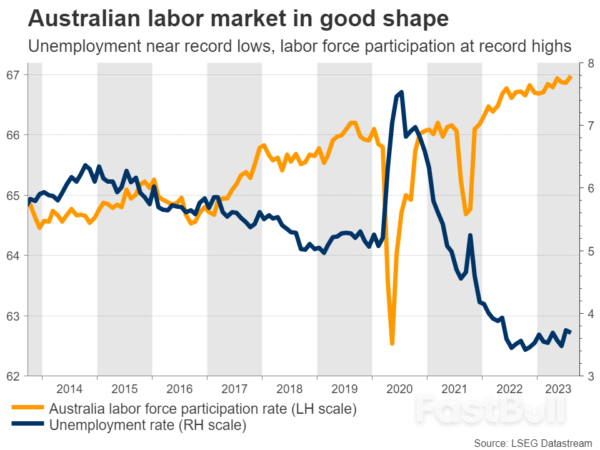
          Crossing into Australia, the Reserve Bank will conclude its meeting early on Tuesday, the first one under the new Governor, Michelle Bullock. Even though data releases have been rather strong lately, with the labor market enjoying a substantial recovery in August and inflation reaccelerating, markets assign less than a 10% probability to a rate increase.
          That’s mostly because the latest signals from the central bank itself show a preference for keeping rates unchanged. The latest RBA minutes preached patience, as rates have already risen quickly and the full impact of all this tightening has not been felt yet.
          Week Ahead – Dollar Shines ahead of Nonfarm Payrolls_3
          A decision to keep rates unchanged would argue for a negative reaction in the Australian dollar, but nothing dramatic, as this is the market’s baseline scenario already.
          In neighboring New Zealand, the central bank will announce its own decision on Wednesday. The market-implied probability for a rate increase is also around 10%, but it might still be an exciting event as the economy has outperformed expectations lately. Hence, the question is whether the RBNZ will set the stage for another rate hike in November.
          Inflation seems to be gaining momentum again. Even though inflation cooled a little in the second quarter, the jobs market remained very tight, with record levels of labor force participation and an explosion in population growth helping to boost demand. In addition, the depreciation of the New Zealand dollar in recent months coupled with the sharp rise in oil prices will also help to refuel inflation.
          Against this backdrop, the RBNZ will likely keep rates unchanged, but perhaps signal that a rate increase in November is a real possibility. Markets assign a 60% chance to that scenario, and if this probability moves any higher in the aftermath, it could lift the currency somewhat.
          Week Ahead – Dollar Shines ahead of Nonfarm Payrolls_4
          That said, there’s an election in two weeks, so the risk is that the RBNZ does not deliver any clear signals, to avoid interfering. Either way, the general outlook for the kiwi dollar seems grim, even if the currency spikes higher after the RBNZ. The slowdown in global growth and the deterioration in risk sentiment will likely keep a lid on any rallies.
          Chinese data releases will be in focus too. China is the largest trading partner of both Australia and New Zealand, so these currencies are very sensitive to developments in China, where the latest business surveys will be released over the weekend.
          Elsewhere, Japan’s Tankan business survey for Q3 will hit the markets on Monday, while in Canada, the employment report for September will see the light on Friday.

          Source: XM

          To stay updated on all economic events of today, please check out our Economic calendar
          Risk Warnings and Disclaimers
          You understand and acknowledge that there is a high degree of risk involved in trading. Following any strategies or investment methods may lead to potential losses. The content on the site is provided by our contributors and analysts for information purposes only. You are solely responsible for determining whether any trading assets, securities, strategy, or any other product is suitable for investing based on your own investment objectives and financial situation.
          Comments
          Add to Favorites
          Share

          Inside Vietnam's Plans to Dent China's Rare Earths Dominance

          Thomas

          Economic

          Vietnam plans to restart its biggest rare-earths mine next year with a Western-backed project that could rival the world's largest, according to two companies involved, as part of a broader push to dent China's dominance in a sector that helps power advanced technologies.
          The move would be a step toward the Southeast Asian country's aim of building up a rare-earths supply chain, including developing its capacity to refine ores into metals used in magnets for electric vehicles, smartphones and wind turbines.
          As an initial step, Vietnam's government intends to launch tenders for multiple blocks of its Dong Pao mine before the year's end, said Tessa Kutscher, an executive at Australia's Blackstone Minerals Ltd, which plans to bid for at least one concession. She cited unpublished information from Vietnam's Ministry of Natural Resources and Environment, which did not respond to requests for comment.
          The auction's timing could change but the government plans to restart the mine next year, said Luu Anh Tuan, chairman of Vietnam Rare Earth JSC (VTRE), the country's main refiner and Blackstone's partner in the project.
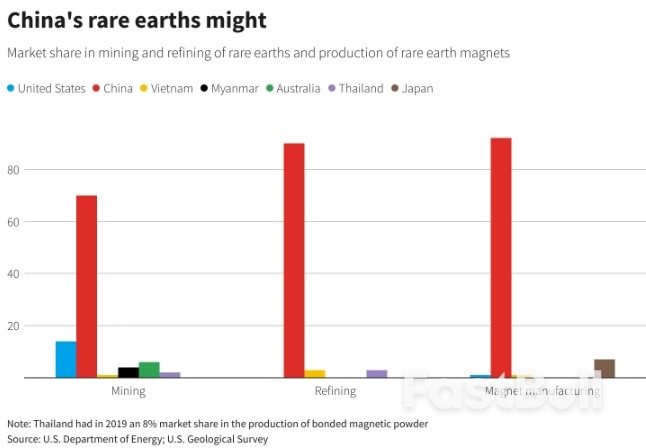
          The proposed restart of Dong Pao - whose timeline, scale and degree of foreign financial support have not been reported previously - comes as many nations fret about their vulnerability to supply disruptions due to China's stranglehold on strategic minerals and its disputes with the U.S. and its allies. Beijing this year-imposed export curbs on minor metals used in semiconductors, which an influential Chinese policy adviser warned was "just a start".
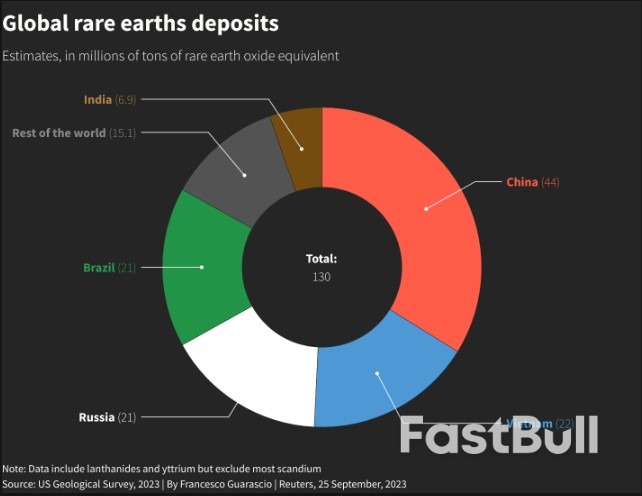
          Vietnam has the second-largest rare-earth deposits, according to the U.S. Geological Survey. But they have remained largely untapped, with investment discouraged by low prices that are effectively set by China because of its near-monopoly on the global market. Visiting Hanoi this month to upgrade bilateral relations, U.S. President Joe Biden signed an agreement to boost Vietnam's ability to lure investors for its rare-earth reserves.
          In interviews with Reuters, 12 industry executives, investors, analysts and foreign officials described plans for Vietnam, including investments they said showed how talk of derisking supply chains to reduce reliance on China is translating into action. Some acknowledged the difficulties of forging a rare-earths hub but said the gambit could make Vietnam a viable player while assuaging strategic worries, even if China remained dominant.
          Kutscher said Blackstone's investment in the project would be worth around $100 million if it wins. She added that the company was talking to potential clients, including electric car makers VinFast and Rivian, about possible contracts with set prices that would shield suppliers from fluctuations and guarantee buyers a secure supply chain.
          Sealing such deals would address a hurdle faced by developers in Vietnam. In recent years, Japanese investors Toyota Tsusho and Sojitz abandoned projects at Dong Pao after China ramped up supply, pummelling prices. The Japanese firms did not respond to requests for comment.
          Yet despite the focus on derisking, it is unclear whether clients would be ready to pay a premium for Vietnam, said Dylan Kelly, of investment firm Terra Capital, noting the market in general was opaque.
          Asked about VinFast's potential involvement, a spokesperson for parent company Vingroup said the group's entity in charge of raw-material procurement, VinES, had no current plans with Blackstone involving rare earths. He did not address subsequent questions about VinFast specifically.
          Rivian did not reply to a request for comment.
          Rivalling Mountain Pass
          Effective exploitation of Dong Pao - which has sat dormant for at least seven years, according to an official at state-controlled miner Lavreco, which owns a concession - would propel Vietnam into the top league of rare-earths producers.
          But refining rare earths is complex, and China controls many processing technologies. Dong Pao's estimated deposits also need to be reassessed with modern methods, according to Blackstone.
          Inside Vietnam's Plans to Dent China's Rare Earths Dominance_1Still, rare earths at Dong Pao are relatively easy to access and are mostly concentrated in bastnaesite ores, according to the Hanoi University of Mining and Geology.
          These are typically rich in cerium, used in flat screens, and lanthanides, such as praseodymium and neodymium, which go into magnets.
          Tuan said VTRE hoped to win a concession that would allow it to extract about 10,000 metric tons of rare-earth oxide (REO) equivalent a year, roughly one-third of the mine's expected annual output. Production could start around the end of 2024, he said.
          That would put Dong Pao's output slightly below that of California's Mountain Pass, one of the world's largest mines, which produced 43,000 metric tons of REO equivalent in 2022, according to the USGS.
          Vietnam also plans to develop additional mines. In July, Hanoi set a target to produce up to 60,000 tons of REO equivalent a year by 2030. China set a domestic quota of 210,000 tons last year.
          Those goals would see Vietnam producing 5% to 15% of China's projected output by the decade's end, said David Merriman, a research analyst at consultancy Project Blue, who expects China to increase production over that period.
          Vietnam's targets were "ambitious, though they are not entirely out of the question", he said.
          U.S. Encouragement
          The U.S. agreed during Biden's visit to help Vietnam better map its rare-earths resources and "attract quality investment", according to a White House fact sheet, a move that could encourage U.S. investors to bid for Vietnam's new concessions.
          Reuters could not determine whether concrete plans involving U.S. investors exist at this stage. Officials at the U.S. embassy in Hanoi, the White House and Department of Commerce did not reply to requests for comment.
          But recent U.S. attempts to gain a foothold in the Vietnamese industry did not succeed, said John Rockhold, a consultant to the rare-earths sector and president of the Hanoi chapter of the U.S. Chamber of Commerce, adding that one such plan involving VTRE collapsed this year.
          That plan would have involved the shipment to the U.S. of rare earths refined by VTRE and possible future investment in Vietnam of $200 million, according to a non-public report for unspecified U.S. investors seen by Reuters.
          VTRE confirmed the shipment deal had foundered.
          Instead, VTRE in April announced a deal to supply 100 metric tons of rare-earth oxides this year to Australian Strategic Materials. ASM declined to comment on Dong Pao's exploitation.
          Blackstone, which is a partner in that deal, operates a nickel mine in Vietnam and has determined that its processing facility in the country could handle ore from Dong Pao, according to a company statement.
          From Ore to Magnet
          Ultimately, VTRE plans to play a role in the whole rare-earth industry from ore extraction to the final products, said Tuan, who with his wife owns most VTRE shares, according to a list of shareholders he showed to Reuters. Blackstone said the ownership information accorded with its assessment following due diligence.
          This is not an easy feat. The U.S. currently exports its rare-earth ores to China for processing as it lacks its own facilities.Inside Vietnam's Plans to Dent China's Rare Earths Dominance_2
          An existing VTRE factory in northern Vietnam specialises in separating rare-earth oxides from the extracted ore. The plant has capacity to process 5,000 tons of REO a year but the company plans to treble that to accommodate input from Dong Pao, Tuan said.
          Once separated, oxides are turned into metals for use in magnets and other industrial applications. The metallization process is controlled by China, which produces 90% of rare-earth metals, according to the U.S. Department of Energy.
          But VTRE is running a pilot project to build a metallization factory with South Korea's Setopia, said Setopia, which has no previous experience in the sector.
          The initial combined investment would be around $4 million, mostly from Setopia, a Setopia official told Reuters, with a plant possibly ready next year.
          In the downstream industry, South Korean and Chinese magnet firms are set to open factories in Vietnam, Reuters reported in August.
          Dudley Kingsnorth, a professor at the Western Australian School of Mines at Curtin University, said Vietnam had some way to go, including in improving environmental practices, to realise its rare-earth goals.
          Still, he said, Vietnam "has the resources, the mining and processing expertise to provide alternatives to China".

          Source: Yahoo

          To stay updated on all economic events of today, please check out our Economic calendar
          Risk Warnings and Disclaimers
          You understand and acknowledge that there is a high degree of risk involved in trading. Following any strategies or investment methods may lead to potential losses. The content on the site is provided by our contributors and analysts for information purposes only. You are solely responsible for determining whether any trading assets, securities, strategy, or any other product is suitable for investing based on your own investment objectives and financial situation.
          Comments
          Add to Favorites
          Share
          FastBull
          Copyright © 2025 FastBull Ltd

          728 RM B 7/F GEE LOK IND BLDG NO 34 HUNG TO RD KWUN TONG KLN HONG KONG

          TelegramInstagramTwitterfacebooklinkedin
          App Store Google Play Google Play
          Products
          Charts

          Chats

          Q&A with Experts
          Screeners
          Economic Calendar
          Data
          Tools
          Membership
          Features
          Function
          Markets
          Copy Trading
          Latest Signals
          Contests
          News
          Analysis
          24/7
          Columns
          Education
          Company
          Careers
          About Us
          Contact Us
          Advertising
          Help Center
          Feedback
          User Agreement
          Privacy Policy
          Business

          White Label

          Data API

          Web Plug-ins

          Poster Maker

          Affiliate Program

          Risk Disclosure

          The risk of loss in trading financial instruments such as stocks, FX, commodities, futures, bonds, ETFs and crypto can be substantial. You may sustain a total loss of the funds that you deposit with your broker. Therefore, you should carefully consider whether such trading is suitable for you in light of your circumstances and financial resources.

          No decision to invest should be made without thoroughly conducting due diligence by yourself or consulting with your financial advisors. Our web content might not suit you since we don't know your financial conditions and investment needs. Our financial information might have latency or contain inaccuracy, so you should be fully responsible for any of your trading and investment decisions. The company will not be responsible for your capital loss.

          Without getting permission from the website, you are not allowed to copy the website's graphics, texts, or trademarks. Intellectual property rights in the content or data incorporated into this website belong to its providers and exchange merchants.

          Not Logged In

          Log in to access more features

          FastBull Membership

          Not yet

          Purchase

          Become a signal provider
          Help Center
          Customer Service
          Dark Mode
          Price Up/Down Colors

          Log In

          Sign Up
          Position
          Layout
          Fullscreen
          Default to Chart
          The chart page opens by default when you visit fastbull.com