• Trade
  • Markets
  • Copy
  • Contests
  • News
  • 24/7
  • Calendar
  • Q&A
  • Chats
Trending
Screeners
SYMBOL
LAST
BID
ASK
HIGH
LOW
NET CHG.
%CHG.
SPREAD
SPX
S&P 500 Index
6827.42
6827.42
6827.42
6899.86
6801.80
-73.58
-1.07%
--
DJI
Dow Jones Industrial Average
48458.04
48458.04
48458.04
48886.86
48334.10
-245.98
-0.51%
--
IXIC
NASDAQ Composite Index
23195.16
23195.16
23195.16
23554.89
23094.51
-398.69
-1.69%
--
USDX
US Dollar Index
97.950
98.030
97.950
98.500
97.950
-0.370
-0.38%
--
EURUSD
Euro / US Dollar
1.17394
1.17409
1.17394
1.17496
1.17192
+0.00011
+ 0.01%
--
GBPUSD
Pound Sterling / US Dollar
1.33707
1.33732
1.33707
1.33997
1.33419
-0.00148
-0.11%
--
XAUUSD
Gold / US Dollar
4299.39
4299.39
4299.39
4353.41
4257.10
+20.10
+ 0.47%
--
WTI
Light Sweet Crude Oil
57.233
57.485
57.233
58.011
56.969
-0.408
-0.71%
--

Community Accounts

Signal Accounts
--
Profit Accounts
--
Loss Accounts
--
View More

Become a signal provider

Sell trading signals to earn additional income

View More

Guide to Copy Trading

Get started with ease and confidence

View More

Signal Accounts for Members

All Signal Accounts

Best Return
  • Best Return
  • Best P/L
  • Best MDD
Past 1W
  • Past 1W
  • Past 1M
  • Past 1Y

All Contests

  • All
  • Trump Updates
  • Recommend
  • Stocks
  • Cryptocurrencies
  • Central Banks
  • Featured News
Top News Only
Share

USA Embassy In Lithuania: Maria Kalesnikava Is Not Going To Vilnius

Share

USA Embassy In Lithuania: Other Prisoners Are Being Sent From Belarus To Ukraine

Share

Ukraine President Zelenskiy: Five Ukrainians Released By Belarus In US-Brokered Deal

Share

USA Vilnius Embassy: USA Stands Ready For "Additional Engagement With Belarus That Advances USA Interests"

Share

USA Vilnius Embassy: Belarus, USA, Other Citizens Among The Prisoners Released Into Lithuania

Share

USA Vilnius Embassy: USA Will Continue Diplomatic Efforts To Free The Remaining Political Prisoners In Belarus

Share

USA Vilnius Embassy: Belarus Releases 123 Prisoners Following Meeting Of President Trump's Envoy Coale And Belarus President Lukashenko

Share

USA Vilnius Embassy: Masatoshi Nakanishi, Aliaksandr Syrytsa Are Among The Prisoners Released By Belarus

Share

USA Vilnius Embassy: Maria Kalesnikava And Viktor Babaryka Are Among The Prisoners Released By Belarus

Share

USA Vilnius Embassy: Nobel Peace Prize Laureate Ales Bialiatski Is Among The Prisoners Released By Belarus

Share

Belarusian Presidential Administration Telegram Channel: Lukashenko Has Pardoned 123 Prisoners As Part Of Deal With US

Share

Two Local Syrian Officials: Joint US-Syrian Military Patrol In Central Syria Came Under Fire From Unknown Assailants

Share

Israeli Military Says It Targeted 'Key Hamas Terrorist' In Gaza City

Share

Rwanda's Actions In Eastern Drc Are A Clear Violation Of Washington Accords Signed By President Trump - Secretary Of State Rubio

Share

Israeli Military Issues Evacuation Warning In Southern Lebanon Village Ahead Of Strike - Spokesperson On X

Share

Belarusian State Media Cites US Envoy Coale As Saying He Discussed Ukraine And Venezuela With Lukashenko

Share

Belarusian State Media Cites US Envoy Coale As Saying That US Removes Sanctions On Belarusian Potassium

Share

Thai Prime Minister: No Ceasefire Agreement With Cambodia

Share

US, Ukraine To Discuss Ceasefire In Berlin Ahead Of European Summit

Share

Incoming Czech Prime Minister Babis: Czech Republic Will Not Take On Guarantees For Ukraine Financing, European Commission Must Find Alternatives

TIME
ACT
FCST
PREV
U.K. Trade Balance Non-EU (SA) (Oct)

A:--

F: --

P: --

U.K. Trade Balance (Oct)

A:--

F: --

P: --

U.K. Services Index MoM

A:--

F: --

P: --

U.K. Construction Output MoM (SA) (Oct)

A:--

F: --

P: --

U.K. Industrial Output YoY (Oct)

A:--

F: --

P: --

U.K. Trade Balance (SA) (Oct)

A:--

F: --

P: --

U.K. Trade Balance EU (SA) (Oct)

A:--

F: --

P: --

U.K. Manufacturing Output YoY (Oct)

A:--

F: --

P: --

U.K. GDP MoM (Oct)

A:--

F: --

P: --

U.K. GDP YoY (SA) (Oct)

A:--

F: --

P: --

U.K. Industrial Output MoM (Oct)

A:--

F: --

P: --

U.K. Construction Output YoY (Oct)

A:--

F: --

P: --

France HICP Final MoM (Nov)

A:--

F: --

P: --

China, Mainland Outstanding Loans Growth YoY (Nov)

A:--

F: --

P: --

China, Mainland M2 Money Supply YoY (Nov)

A:--

F: --

P: --

China, Mainland M0 Money Supply YoY (Nov)

A:--

F: --

P: --

China, Mainland M1 Money Supply YoY (Nov)

A:--

F: --

P: --

India CPI YoY (Nov)

A:--

F: --

P: --

India Deposit Gowth YoY

A:--

F: --

P: --

Brazil Services Growth YoY (Oct)

A:--

F: --

P: --

Mexico Industrial Output YoY (Oct)

A:--

F: --

P: --

Russia Trade Balance (Oct)

A:--

F: --

P: --

Philadelphia Fed President Henry Paulson delivers a speech
Canada Building Permits MoM (SA) (Oct)

A:--

F: --

P: --

Canada Wholesale Sales YoY (Oct)

A:--

F: --

P: --

Canada Wholesale Inventory MoM (Oct)

A:--

F: --

P: --

Canada Wholesale Inventory YoY (Oct)

A:--

F: --

P: --

Canada Wholesale Sales MoM (SA) (Oct)

A:--

F: --

P: --

Germany Current Account (Not SA) (Oct)

A:--

F: --

P: --

U.S. Weekly Total Rig Count

A:--

F: --

P: --

U.S. Weekly Total Oil Rig Count

A:--

F: --

P: --

Japan Tankan Large Non-Manufacturing Diffusion Index (Q4)

--

F: --

P: --

Japan Tankan Small Manufacturing Outlook Index (Q4)

--

F: --

P: --

Japan Tankan Large Non-Manufacturing Outlook Index (Q4)

--

F: --

P: --

Japan Tankan Large Manufacturing Outlook Index (Q4)

--

F: --

P: --

Japan Tankan Small Manufacturing Diffusion Index (Q4)

--

F: --

P: --

Japan Tankan Large Manufacturing Diffusion Index (Q4)

--

F: --

P: --

Japan Tankan Large-Enterprise Capital Expenditure YoY (Q4)

--

F: --

P: --

U.K. Rightmove House Price Index YoY (Dec)

--

F: --

P: --

China, Mainland Industrial Output YoY (YTD) (Nov)

--

F: --

P: --

China, Mainland Urban Area Unemployment Rate (Nov)

--

F: --

P: --

Saudi Arabia CPI YoY (Nov)

--

F: --

P: --

Euro Zone Industrial Output YoY (Oct)

--

F: --

P: --

Euro Zone Industrial Output MoM (Oct)

--

F: --

P: --

Canada Existing Home Sales MoM (Nov)

--

F: --

P: --

Euro Zone Total Reserve Assets (Nov)

--

F: --

P: --

U.K. Inflation Rate Expectations

--

F: --

P: --

Canada National Economic Confidence Index

--

F: --

P: --

Canada New Housing Starts (Nov)

--

F: --

P: --

U.S. NY Fed Manufacturing Employment Index (Dec)

--

F: --

P: --

U.S. NY Fed Manufacturing Index (Dec)

--

F: --

P: --

Canada Core CPI YoY (Nov)

--

F: --

P: --

Canada Manufacturing Unfilled Orders MoM (Oct)

--

F: --

P: --

Canada Manufacturing New Orders MoM (Oct)

--

F: --

P: --

Canada Core CPI MoM (Nov)

--

F: --

P: --

Canada Manufacturing Inventory MoM (Oct)

--

F: --

P: --

Canada CPI YoY (Nov)

--

F: --

P: --

Canada CPI MoM (Nov)

--

F: --

P: --

Canada CPI YoY (SA) (Nov)

--

F: --

P: --

Canada Core CPI MoM (SA) (Nov)

--

F: --

P: --

Q&A with Experts
    • All
    • Chatrooms
    • Groups
    • Friends
    Connecting
    .
    .
    .
    Type here...
    Add Symbol or Code

      No matching data

      All
      Trump Updates
      Recommend
      Stocks
      Cryptocurrencies
      Central Banks
      Featured News
      • All
      • Russia-Ukraine Conflict
      • Middle East Flashpoint
      • All
      • Russia-Ukraine Conflict
      • Middle East Flashpoint
      Search
      Products

      Charts Free Forever

      Chats Q&A with Experts
      Screeners Economic Calendar Data Tools
      Membership Features
      Data Warehouse Market Trends Institutional Data Policy Rates Macro

      Market Trends

      Market Sentiment Order Book Forex Correlations

      Top Indicators

      Charts Free Forever
      Markets

      News

      News Analysis 24/7 Columns Education
      From Institutions From Analysts
      Topics Columnists

      Latest Views

      Latest Views

      Trending Topics

      Top Columnists

      Latest Update

      Signals

      Copy Rankings Latest Signals Become a signal provider AI Rating
      Contests
      Brokers

      Overview Brokers Assessment Rankings Regulators News Claims
      Broker listing Forex Brokers Comparison Tool Live Spread Comparison Scam
      Q&A Complaint Scam Alert Videos Tips to Detect Scam
      More

      Business
      Events
      Careers About Us Advertising Help Center

      White Label

      Data API

      Web Plug-ins

      Affiliate Program

      Awards Institution Evaluation IB Seminar Salon Event Exhibition
      Vietnam Thailand Singapore Dubai
      Fans Party Investment Sharing Session
      FastBull Summit BrokersView Expo
      Recent Searches
        Top Searches
          Markets
          News
          Analysis
          User
          24/7
          Economic Calendar
          Education
          Data
          • Names
          • Latest
          • Prev
          View All

          No data

          Scan to Download

          Faster Charts, Chat Faster!

          Download App
          English
          • English
          • Español
          • العربية
          • Bahasa Indonesia
          • Bahasa Melayu
          • Tiếng Việt
          • ภาษาไทย
          • Français
          • Italiano
          • Türkçe
          • Русский язык
          • 简中
          • 繁中
          Open Account
          Search
          Products
          Charts Free Forever
          Markets
          News
          Signals

          Copy Rankings Latest Signals Become a signal provider AI Rating
          Contests
          Brokers

          Overview Brokers Assessment Rankings Regulators News Claims
          Broker listing Forex Brokers Comparison Tool Live Spread Comparison Scam
          Q&A Complaint Scam Alert Videos Tips to Detect Scam
          More

          Business
          Events
          Careers About Us Advertising Help Center

          White Label

          Data API

          Web Plug-ins

          Affiliate Program

          Awards Institution Evaluation IB Seminar Salon Event Exhibition
          Vietnam Thailand Singapore Dubai
          Fans Party Investment Sharing Session
          FastBull Summit BrokersView Expo

          Why We Remain Positive on Gold

          Samantha Luan

          Commodity

          Economic

          Summary:

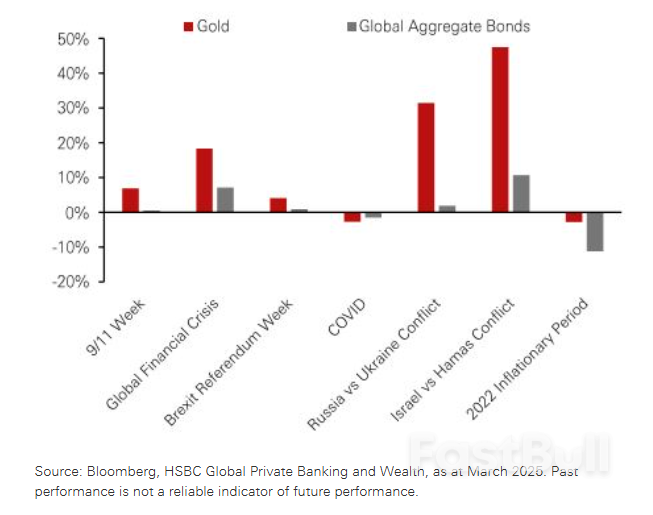
          In addition to bullish trend signals, fundamentals remain supportive of gold with healthy demand for the precious metal from central banks. Historically, gold has provided better overall protection than global aggregate bonds during market stress periods. Our analysis shows that excluding gold in a multi-asset portfolio is sub-optimal.
          After a stellar year in 2024, we expect gold to continue its strong performance in 2025 as trend signals are bullish, and fundamentals are also supportive. Although the gold price has already increased by around 10% year-to-date at the time of writing, we maintain a bullish stance over the medium-to-long term and see gold as a great source of diversification, especially against an unwanted and unexpected drift lower in USD. Here are three reasons that support our positive view on gold.

          Rising demand from central banks

          The US dollar's share of central banks' reserves is steadily falling while holdings in gold are rising. Geopolitics is a major factor, with setbacks in globalisation due to rising trade tensions coinciding with a build-up in gold reserves. Central banks want to diversify away from USD, but as there is no credible alternative currency, they are opting for gold. A further accumulation of gold seems likely, and investors can potentially benefit by adding gold to their portfolio.
          Why We Remain Positive on Gold_1

          A hedge against geopolitical uncertainty

          The strong performance of gold appears to be driven by its safe haven properties during periods of market turbulence and elevated geopolitical risk. Geopolitical uncertainty has remained high in recent times due to multiple regional conflicts and tariffs imposed and announced by the Trump administration.
          From our historical scenario analysis covering January 2005 to February 2025, we can see strong evidence of gold being a more effective tail risk hedge than global aggregate bonds in almost all of the historical scenarios considered.
          Why We Remain Positive on Gold_2

          Higher return for the same amount of risk

          Adding gold to a multi asset portfolio allows investors to achieve a greater level of return for the same amount of risk. We can see in the chart that a portfolio holding only bonds and equities is sub-optimal compared to a portfolio that also holds gold. The efficient frontier constructed with a fixed 10% allocation to gold lies above the efficient frontier constructed from an allocation to solely bonds and equities. When the position in gold is unconstrained, most of the points lie above the efficient frontier for an equity-bond only portfolio.
          Why We Remain Positive on Gold_3

          Source: HSBC

          To stay updated on all economic events of today, please check out our Economic calendar
          Risk Warnings and Disclaimers
          You understand and acknowledge that there is a high degree of risk involved in trading. Following any strategies or investment methods may lead to potential losses. The content on the site is provided by our contributors and analysts for information purposes only. You are solely responsible for determining whether any trading assets, securities, strategy, or any other product is suitable for investing based on your own investment objectives and financial situation.
          Add to Favorites
          Share

          How Much Control Does the President Have over the Fed and Interest Rates?

          Devin

          Central Bank

          Economic

          Following a series of cuts to the federal funds rate in late 2024, the Federal Reserve has since maintained a target range of 4.25% to 4.50%.
          Fed officials are adopting a cautious approach amid economic uncertainties, especially the impact of recent tariffs imposed by the Trump administration. They've emphasized the need for patience, suggesting that any rate changes should await clearer economic data.
          However, President Trump has been vocal in urging the Fed to lower interest rates, recently stating that he may call Chair Jerome Powell and pressure him to cut rates.
          With a new president in the White House, you might wonder how much influence President Trump will have over interest rates. Here's a look at the president’s role in interest rate decisions, and what it means for your bank account when the powers that be choose to raise or lower rates.

          How the Fed affects interest rates

          The Federal Reserve doesn't directly control interest rates set by individual financial institutions. The Federal Open Market Committee (FOMC) — the division of the Fed responsible for setting monetary policy — controls the federal funds rate. That's the short-term interest rate that depository institutions charge each other to borrow money overnight.
          When the FOMC raises or lowers its target rate, banks typically follow suit. Rising rates generally make it more expensive for consumers to borrow money, but it also means they'll earn higher rates on savings accounts, certificates of deposit (CDs), and money market accounts. Conversely, lowering rates decreases short-term interest rates on credit products and deposit accounts.
          Here's a look at how rates have changed since 2022:
          How Much Control Does the President Have over the Fed and Interest Rates?_1

          Does the president control the Fed?

          U.S. presidents don't have authority over the Fed, but they do have certain powers that can impact the future of the Fed and its decisions.
          The president can appoint and fire the Federal Reserve chair
          The chair of the Board of Governors of the Federal Reserve System leads the Fed in working toward its key goals, including maximum employment, stable prices, and moderate long-term interest rates. Some of the Fed chair's responsibilities include reporting to Congress on the Fed's monetary policy objectives, testifying before Congress, and meeting periodically with the Treasury Secretary.
          According to the Federal Reserve Act, the chair and vice chair of the board are appointed by the president but must be confirmed by the Senate. Fed chairs and vice chairs serve four-year terms and can be reappointed by the sitting president. They can also be ousted by a sitting president, although this has never happened.
          The president can nominate key officials
          The president also nominates the seven members of the Board of Governors who serve on the FOMC and oversee the 12 Reserve Banks. Each member is appointed for up to 14 years, which is considered a full term, after which they can't be reappointed.
          “Other than nominations, the president has zero impact on Federal Reserve interest rate policy,” said Scott Fulford, a senior economist at the Consumer Financial Protection Bureau.
          The president can discuss monetary policy and voice concerns
          Though presidents can't control interest rates directly, they can discuss their stance on current monetary policy and its impact on rates. But this can be a touchy topic.
          “Institutionally, the Federal Reserve is very protective of its independence because that independence helps it achieve its mandate,” Fulford said. “Most presidential administrations go out of their way to avoid even publicly commenting on Fed policy.”
          Even so, that hasn't stopped our current president from expressing his views on the Fed and its decisions.
          Trump recently posted on social media that that Powell's termination as Fed chair "cannot come fast enough" and referred to him as "a major loser."
          Experts maintain that the Fed will continue to make decisions independently. Still, this outside commentary can lead to campaign promises and political actions that impact inflation and consumer prices in other ways, according to Fulford.
          “For example, this administration has focused on resolving supply chain problems and reducing monopoly rent-seeking, which reduces inflation,” Fulford said. “Congress could raise taxes or spend less, which would also affect inflation.” He added that there are many policies that affect the broader cost of borrowing as well, such as reducing late fees or closing costs.
          Bottom line: The Fed is designed to operate independently of politics, but public statements by the president can shape market expectations and potentially influence the Fed's policy decisions indirectly.

          Source: Yahoo Finance

          To stay updated on all economic events of today, please check out our Economic calendar
          Risk Warnings and Disclaimers
          You understand and acknowledge that there is a high degree of risk involved in trading. Following any strategies or investment methods may lead to potential losses. The content on the site is provided by our contributors and analysts for information purposes only. You are solely responsible for determining whether any trading assets, securities, strategy, or any other product is suitable for investing based on your own investment objectives and financial situation.
          Add to Favorites
          Share

          ECB Consensus Builds for June Rate Cut but no Appetite for Big Move

          Kevin Du

          Central Bank

          Economic

          European Central Bank policymakers are becoming increasingly confident about cutting interest rates in June as inflation continues its march lower, but there is little to no appetite for a big move, six sources told Reuters.
          ECB governors gathering in Washington for the International Monetary Fund and World Bank's Spring Meetings took stock of a weakening economy in the euro zone and around the world as uncertainty from tariffs imposed by U.S. President Donald Trump puts a dampener on investment.
          Data out of the euro zone also showed business growth stalling this month and pay hikes expected to ease considerably.
          Most importantly for inflation, the 20% tariff rate provisionally imposed by Trump on European goods had been less severe than modelled by the ECB and the risk of retaliation by the European Union had so far been averted.
          That meant that many governors were now seeing growing chances of an eighth quarter-point cut at their June 4 meeting, when the ECB will update its own economic forecasts. The ECB trimmed its benchmark rate to 2.25% earlier this month.
          In line with the ECB's official line, they were keeping an open mind, however, given that the decision was still more than a month away and economic policy had become unpredictable since Donald Trump's April 2 announcement.
          An ECB spokesperson declined to comment.
          Trump's move shook investor confidence in the U.S. economy and even its status as the world's safe haven, causing fuel prices as well as the dollar to fall against the euro.
          This resulted in growing disinflationary pressure in the euro zone, assuaging concerns about high price growth becoming entrenched among even some of the more hawkish members of the ECB's Governing Council.
          The outlook further out remains foggy, however, with the prospect of a more fragmented world, cheaper imports from China and stronger domestic demand from Germany's fiscal spending plans creating contrasting forces.
          For this reason, too, policymakers who spoke to Reuters saw no reason at present to consider a bigger, 50-basis-point cut, which they also believed might raise unnecessary alarm among market participants.

          Source: Reuters

          To stay updated on all economic events of today, please check out our Economic calendar
          Risk Warnings and Disclaimers
          You understand and acknowledge that there is a high degree of risk involved in trading. Following any strategies or investment methods may lead to potential losses. The content on the site is provided by our contributors and analysts for information purposes only. You are solely responsible for determining whether any trading assets, securities, strategy, or any other product is suitable for investing based on your own investment objectives and financial situation.
          Add to Favorites
          Share

          What's Next for Crude Oil?

          Thomas

          Commodity

          Economic

          For the past two years, West Texas Intermediate (WTI) crude oil prices appeared to have a solid floor at $64 per barrel. However, in early April, WTI broke through this support level, falling to a four-year low of $56 per barrel.
          What's Next for Crude Oil?_1
          The recent decline in crude oil prices is driven by three primary factors:
          1. Slowing Growth in China: Since 2005, there has been a notable relationship between Chinese economic growth and crude oil prices – when Chinese growth peaks, crude oil prices tend to peak about a year later. China's growth rate peaked in 2021, and crude prices followed suit, peaking in 2022.
          2. Increased U.S. Production: U.S. crude oil production has surged to 13.5 million barrels per day, adding significant supply to the global market.
          3. Improved Fuel Efficiency: Over the past two decades, vehicles have become increasingly fuel-efficient. On average, cars now use about 2% less fuel per unit of distance driven each year compared to the previous year. These factors have collectively made it challenging for crude oil prices to sustain a significant rally.

          OPEC's Role and Historical Context

          Over the past few years, the Organization of the Petroleum Exporting Countries (OPEC) has cut production by 3.5 million barrels per day, with the majority of these cuts coming from Saudi Arabia. If Saudi Arabia decides to increase production, WTI prices could face further downward pressure.
          What's Next for Crude Oil?_2
          Historical precedents highlight the potential impact of such a move. In late 2014, when Saudi Arabia boosted production, oil prices dropped from $90 to as low as $25 per barrel. Similarly, in 1985, Saudi Arabia increased production from 6 to 10 million barrels per day, causing oil prices to fall from $32 to $12 per barrel – a 70% decline.
          What's Next for Crude Oil?_3
          If Saudi Arabia opts to prioritize market share over price support, WTI prices could decline even further. Additionally, tariffs could slow global demand.

          Source: CME Group

          To stay updated on all economic events of today, please check out our Economic calendar
          Risk Warnings and Disclaimers
          You understand and acknowledge that there is a high degree of risk involved in trading. Following any strategies or investment methods may lead to potential losses. The content on the site is provided by our contributors and analysts for information purposes only. You are solely responsible for determining whether any trading assets, securities, strategy, or any other product is suitable for investing based on your own investment objectives and financial situation.
          Add to Favorites
          Share

          Trump's Next 100 Days To Feature Trade Deals, Peace Talks, 'torpedoes'

          Owen Li

          China–U.S. Trade War

          Key points:

          • Trump to celebrate first 100 days with a rally in Michigan
          • Official says Trump studying a travel ban on various countries
          • Trump expects trade deals within 90 days, analysts skeptical

          President Donald Trump and his administration this week will highlight the accomplishments of his first 100 days in office, while looking toward the next 100 days with a focus on trade deals and peace talks, White House officials said.

          After a pace of changes that have thrilled allies and stunned adversaries, including in social policy areas such as transgender rights, one official said Trump has "torpedoes" in store but did not explain what those were.

          Trump has enacted sweeping changes on a wide range of U.S. domestic and foreign policy priorities since taking office on January 20. He has upended the world economic order with tariffs, slashed the federal government with job cuts and done away with diversity programs in the public and private sector.

          He has also attacked academia, law firms and courts.

          This week, Trump plans to travel to Michigan for a rally to commemorate the 100-day milestone. The White House intends to highlight his economic vision, ejection of undocumented immigrants, changes to foreign policy, and work by billionaire Elon Musk's Department of Government Efficiency to purge the federal bureaucracy and cut what it sees as waste.

          Celebrating those moves will be part of a broad victory lap around Trump's second-term launch that the official, speaking on condition of anonymity, described to reporters as a conservative's fantasy.

          "Every morning I wake up, it’s like living in a dreamscape," he said.

          While Trump officials laud the speed and breadth of his efforts to remake American society, critics say Trump has trampled on the rights of citizens and non-citizens, alienated allies and threatened U.S. supremacy in the world.

          The president has withheld funding from universities for what his administration considers tolerance of anti-Semitic behavior; cut back on transgender rights; and done away with diversity, equity and inclusion (DEI) programs in the federal government and with federal contractors. This has had a broad knock-on effect throughout U.S. society.

          The official said there is more to come, with lots of “torpedoes under the water."

          That includes more executive action, a hallmark of Trump's first 100 days, which the official said would continue like a "snowball rolling downhill." He said the administration was still working on a travel ban for citizens from multiple countries.

          Courts have stymied some of Trump's actions, drawing scorn from his allies and White House rebukes that those judges are thwarting the will of the head of the executive branch and the people who elected him.

          While Trump will continue to wage war with the courts and a government bureaucracy that his team views as too bloated and out of line with his world view, another official said he would put more focus in his next 100 days on trade deals and peace talks.

          The president launched an all-out trade war on numerous countries this year before putting reciprocal tariffs largely on hold to allow for negotiations with individual nations. His administration hopes to secure agreements within 90 days.

          Experts say that is extremely unlikely, noting that Trump has not yet secured a single deal. His rhetoric about talks, particularly with China, has often been at odds with what the other country says is true.

          The president will take an extended trip abroad next month, visiting Saudi Arabia, Qatar and the United Arab Emirates, and continue to push for peace in Russia's war with Ukraine.

          Trump had promised to solve that conflict on "Day One," but peace has been elusive. The president conceded on Saturday that Russian President Vladimir Putin may not want to stop the war.

          Source: Reuters

          Risk Warnings and Disclaimers
          You understand and acknowledge that there is a high degree of risk involved in trading. Following any strategies or investment methods may lead to potential losses. The content on the site is provided by our contributors and analysts for information purposes only. You are solely responsible for determining whether any trading assets, securities, strategy, or any other product is suitable for investing based on your own investment objectives and financial situation.
          Add to Favorites
          Share

          World Bank Chief Economist Sounds Alarm on Emerging Market Debt Issues, Urges Liberalization

          Manuel

          Economic

          Bond

          Spiking trade uncertainty is compounding rising debt and sluggish growth problems facing emerging markets and developing countries, but cutting their own tariffs could provide a big boost, said Indermit Gill, the World Bank's chief economist.
          Gill said global economists were rapidly lowering their growth forecasts for advanced economies and somewhat less so for developing countries, at least for now, in the wake of a tsunami of tariffs announced by U.S. President Donald Trump.
          The International Monetary Fund and World Bank spring meetings this week in Washington have been dominated by worries about the economic fallout from century-high U.S. tariffs - and retaliatory ones announced by China, the European Union, Canada and others.
          The IMF on Tuesday slashed its economic forecasts for the U.S., China and most countries and warned that more trade strife would further slow growth. It forecast global growth of 2.8% for 2025, half a percentage point lower than its January forecast.
          The World Bank won't issue its own twice-yearly forecast until June, but Gill said a consensus of global economists showed sizeable downgrades in forecasts for growth and trade. Uncertainty indices, which were already running far higher than a decade ago, also spiked after Trump's April 2 tariff moves.
          Compared to earlier shocks, including the 2008-2009 global financial crisis and the COVID-19 pandemic, the current shock is the result of government policy, which meant it could also be reversed, Gill said in an interview with Reuters on Thursday.
          He said the current crisis would further depress growth in emerging markets, after steady declines from levels around 6% two decades ago, with global trade now slated to grow by just 1.5% - well below the 8% growth seen in the 2000s.
          "So it's a sudden slowdown on top of a situation that wasn't particularly good," he said, noting that portfolio flows to emerging markets and foreign direct investment (FDI) were also declining, much as they did during earlier crises.
          "FDI was 5% of GDP in emerging markets during good times. Now it's actually 1% and so both portfolio flows and FDI flows are down overall," he said.

          NEGOTIATE TRADE DEALS

          High debt levels mean that half of some 150 developing countries and emerging markets are either unable to make debt service payments or at risk of getting there, a rate that was double the level seen in 2024, and could grow further if the global economy slowed, Gill said.
          "If global growth slows down, trade slows down, more countries and interest rates stay high, then you are going to get many of these countries getting into debt distress, including some that are commodity exporters," he said.
          Net interest payments as a share of gross domestic product - a measure of how much countries spend to service their debts - now stand at 12% for emerging markets, compared to 7% in 2014, returning to levels last seen in the 1990s. The rates are even higher for poor countries, where debt servicing costs eat up 20% of GDP now, compared to 10% a decade ago, he said.
          That means countries are spending less on education, health care and other programs that could boost development, he said.
          Interest rates are also slated to stay high, given rising inflation expectations, which means countries' debt could rise further if they needed to roll over existing debt, Gill said.
          He said his advice to developing countries was to quickly and urgently negotiate agreements with the U.S. to lower their own tariff rates and avert high U.S. tariffs, and to extend lower tariff rates to other countries.
          Doing so now made sense, with U.S. pressure potentially easing domestic resistance. World Bank modeling showed that such moves could boost growth substantially, Gill said.

          Source: Reuters

          To stay updated on all economic events of today, please check out our Economic calendar
          Risk Warnings and Disclaimers
          You understand and acknowledge that there is a high degree of risk involved in trading. Following any strategies or investment methods may lead to potential losses. The content on the site is provided by our contributors and analysts for information purposes only. You are solely responsible for determining whether any trading assets, securities, strategy, or any other product is suitable for investing based on your own investment objectives and financial situation.
          Add to Favorites
          Share

          US Officials Adopt "Organized" Framework to Handle Trade Talks

          Manuel

          Political

          Economic

          China–U.S. Trade War

          President Donald Trump’s administration has drafted a framework to handle negotiations with trading partners rushing to secure deals to avert tariff hikes, according to people familiar with the matter.
          Under the blueprint, US negotiators will use a template that lays out common areas of concern to help guide the discussions, the people said, speaking on condition of anonymity to detail the plan. Among those categories are tariffs, non-tariff barriers, digital trade, economic security and commercial concerns.
          The talks would see the US host negotiators from a select number of countries each week, in a bid to manage the flood of foreign governments and trading blocs seeking tariff relief ahead of a mid-July deadline. That framework could change, according to the people familiar, and officials could raise additional issues specific to certain countries.
          The administration’s plans were first reported Friday by the Wall Street Journal. Under the structure, the US will hold discussions with about 18 countries — six every week — over three weeks, in a rotation until they hit the deadline, the Journal reported.
          The Office of the US Trade Representative, in a statement, said it is “working under an organized and rigorous framework and moving ahead quickly with willing trading partners.”
          “President Trump and USTR have made U.S. objectives clear and our trading partners have a very good sense of what they can each individually offer,” the statement added. “This is why USTR is receiving dozens of meaningful and substantial proposals from countries in pursuit of fair and reciprocal trade with the United States.”
          The effort offers to provide more clarity for a process that has unnerved equity and bond markets and left major US trading partners struggling to determine how to carry out talks with the US and what Trump is seeking.
          Trump earlier this month announced sharp tariff increases on about 60 countries but then quickly paused those measures for three months to allow trading partners to negotiate deals, keeping in place a baseline 10% rate during the negotiating period. That has set off a flurry of visits from foreign delegations eager to strike a deal.
          A South Korean delegation held talks earlier this week and Trump told reporters Friday that an agreement with Japan is “very close.”

          Source: Bloomberg

          To stay updated on all economic events of today, please check out our Economic calendar
          Risk Warnings and Disclaimers
          You understand and acknowledge that there is a high degree of risk involved in trading. Following any strategies or investment methods may lead to potential losses. The content on the site is provided by our contributors and analysts for information purposes only. You are solely responsible for determining whether any trading assets, securities, strategy, or any other product is suitable for investing based on your own investment objectives and financial situation.
          Add to Favorites
          Share
          FastBull
          Copyright © 2025 FastBull Ltd

          728 RM B 7/F GEE LOK IND BLDG NO 34 HUNG TO RD KWUN TONG KLN HONG KONG

          TelegramInstagramTwitterfacebooklinkedin
          App Store Google Play Google Play
          Products
          Charts

          Chats

          Q&A with Experts
          Screeners
          Economic Calendar
          Data
          Tools
          Membership
          Features
          Function
          Markets
          Copy Trading
          Latest Signals
          Contests
          News
          Analysis
          24/7
          Columns
          Education
          Company
          Careers
          About Us
          Contact Us
          Advertising
          Help Center
          Feedback
          User Agreement
          Privacy Policy
          Business

          White Label

          Data API

          Web Plug-ins

          Poster Maker

          Affiliate Program

          Risk Disclosure

          The risk of loss in trading financial instruments such as stocks, FX, commodities, futures, bonds, ETFs and crypto can be substantial. You may sustain a total loss of the funds that you deposit with your broker. Therefore, you should carefully consider whether such trading is suitable for you in light of your circumstances and financial resources.

          No decision to invest should be made without thoroughly conducting due diligence by yourself or consulting with your financial advisors. Our web content might not suit you since we don't know your financial conditions and investment needs. Our financial information might have latency or contain inaccuracy, so you should be fully responsible for any of your trading and investment decisions. The company will not be responsible for your capital loss.

          Without getting permission from the website, you are not allowed to copy the website's graphics, texts, or trademarks. Intellectual property rights in the content or data incorporated into this website belong to its providers and exchange merchants.

          Not Logged In

          Log in to access more features

          FastBull Membership

          Not yet

          Purchase

          Become a signal provider
          Help Center
          Customer Service
          Dark Mode
          Price Up/Down Colors

          Log In

          Sign Up

          Position
          Layout
          Fullscreen
          Default to Chart
          The chart page opens by default when you visit fastbull.com