Markets
News
Analysis
User
24/7
Economic Calendar
Education
Data
- Names
- Latest
- Prev


Signal Accounts for Members
All Signal Accounts
All Contests


France Trade Balance (SA) (Oct)A:--
F: --
Euro Zone Employment YoY (SA) (Q3)A:--
F: --
Canada Part-Time Employment (SA) (Nov)A:--
F: --
P: --
Canada Unemployment Rate (SA) (Nov)A:--
F: --
P: --
Canada Full-time Employment (SA) (Nov)A:--
F: --
P: --
Canada Labor Force Participation Rate (SA) (Nov)A:--
F: --
P: --
Canada Employment (SA) (Nov)A:--
F: --
P: --
U.S. PCE Price Index MoM (Sept)A:--
F: --
P: --
U.S. Personal Income MoM (Sept)A:--
F: --
P: --
U.S. Core PCE Price Index MoM (Sept)A:--
F: --
P: --
U.S. PCE Price Index YoY (SA) (Sept)A:--
F: --
P: --
U.S. Core PCE Price Index YoY (Sept)A:--
F: --
P: --
U.S. Personal Outlays MoM (SA) (Sept)A:--
F: --
U.S. 5-10 Year-Ahead Inflation Expectations (Dec)A:--
F: --
P: --
U.S. Real Personal Consumption Expenditures MoM (Sept)A:--
F: --
U.S. Weekly Total Rig CountA:--
F: --
P: --
U.S. Weekly Total Oil Rig CountA:--
F: --
P: --
U.S. Consumer Credit (SA) (Oct)A:--
F: --
China, Mainland Foreign Exchange Reserves (Nov)A:--
F: --
P: --
Japan Trade Balance (Oct)A:--
F: --
P: --
Japan Nominal GDP Revised QoQ (Q3)A:--
F: --
P: --
China, Mainland Imports YoY (CNH) (Nov)A:--
F: --
P: --
China, Mainland Exports (Nov)A:--
F: --
P: --
China, Mainland Imports (CNH) (Nov)A:--
F: --
P: --
China, Mainland Trade Balance (CNH) (Nov)A:--
F: --
P: --
China, Mainland Exports YoY (USD) (Nov)A:--
F: --
P: --
China, Mainland Imports YoY (USD) (Nov)A:--
F: --
P: --
Germany Industrial Output MoM (SA) (Oct)A:--
F: --
Euro Zone Sentix Investor Confidence Index (Dec)A:--
F: --
P: --
Canada National Economic Confidence IndexA:--
F: --
P: --
U.K. BRC Like-For-Like Retail Sales YoY (Nov)--
F: --
P: --
U.K. BRC Overall Retail Sales YoY (Nov)--
F: --
P: --
Australia Overnight (Borrowing) Key Rate--
F: --
P: --
RBA Rate Statement
RBA Press Conference
Germany Exports MoM (SA) (Oct)--
F: --
P: --
U.S. NFIB Small Business Optimism Index (SA) (Nov)--
F: --
P: --
Mexico 12-Month Inflation (CPI) (Nov)--
F: --
P: --
Mexico Core CPI YoY (Nov)--
F: --
P: --
Mexico PPI YoY (Nov)--
F: --
P: --
U.S. Weekly Redbook Index YoY--
F: --
P: --
U.S. JOLTS Job Openings (SA) (Oct)--
F: --
P: --
China, Mainland M1 Money Supply YoY (Nov)--
F: --
P: --
China, Mainland M0 Money Supply YoY (Nov)--
F: --
P: --
China, Mainland M2 Money Supply YoY (Nov)--
F: --
P: --
U.S. EIA Short-Term Crude Production Forecast For The Year (Dec)--
F: --
P: --
U.S. EIA Natural Gas Production Forecast For The Next Year (Dec)--
F: --
P: --
U.S. EIA Short-Term Crude Production Forecast For The Next Year (Dec)--
F: --
P: --
EIA Monthly Short-Term Energy Outlook
U.S. API Weekly Gasoline Stocks--
F: --
P: --
U.S. API Weekly Cushing Crude Oil Stocks--
F: --
P: --
U.S. API Weekly Crude Oil Stocks--
F: --
P: --
U.S. API Weekly Refined Oil Stocks--
F: --
P: --
South Korea Unemployment Rate (SA) (Nov)--
F: --
P: --
Japan Reuters Tankan Non-Manufacturers Index (Dec)--
F: --
P: --
Japan Reuters Tankan Manufacturers Index (Dec)--
F: --
P: --
Japan Domestic Enterprise Commodity Price Index MoM (Nov)--
F: --
P: --
Japan Domestic Enterprise Commodity Price Index YoY (Nov)--
F: --
P: --
China, Mainland PPI YoY (Nov)--
F: --
P: --
China, Mainland CPI MoM (Nov)--
F: --
P: --


No matching data
Latest Views
Latest Views
Trending Topics
Top Columnists
Latest Update
White Label
Data API
Web Plug-ins
Affiliate Program
View All

No data
There is no possibility that Israel, the US and many of the Arab states will accept a return to Hamas rule in Gaza, says Singapore's former ambassador to Cambodia, Saudi Arabia and Bahrain.
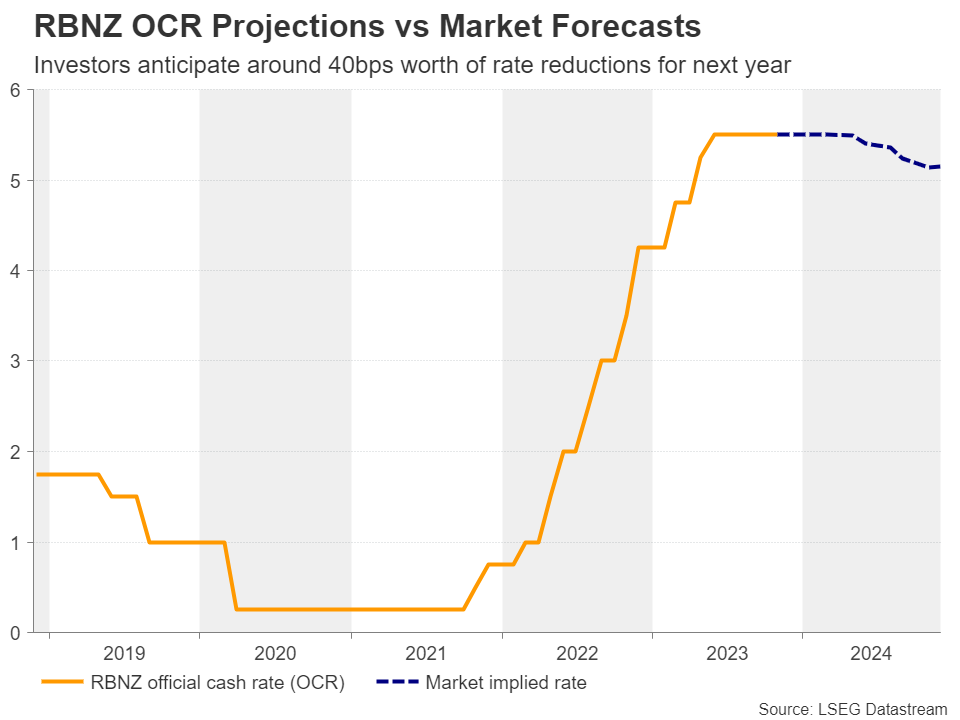
At its latest gathering, the Reserve Bank of New Zealand (RBNZ) held its Official Cash Rate (OCR) steady at 5.5%, noting that interest rates are constraining economic activity and are reducing inflationary pressures as required. Officials also added that there is a near-term risk that activity and inflation do not slow as much as needed, and that’s why the policy rates should stay at restrictive levels for a sustained period of time.
Since then, data have been pointing to further softening of economic activity, with retail sales shrinking 0.8% q/q in Q3 after dropping 1.0% in Q2, and the business PMI for October sliding to 42.5 from 45.3. What’s more, the unemployment rate increased further to 3.9% from 3.6% during Q3 and the CPI slowed to 5.6% y/y from 6.0%. All these numbers allowed investors to continue believing that this tightening crusade is over and to pencil in around 40bps worth of rate cuts for next year.
The Bank’s upcoming gathering is scheduled for Wednesday, with analysts agreeing with the market that officials are most likely to keep their hands off the hike button. Therefore, the attention is likely to fall on the Bank’s new macroeconomic projections and any clues on how they are planning to proceed with monetary policy in 2024.
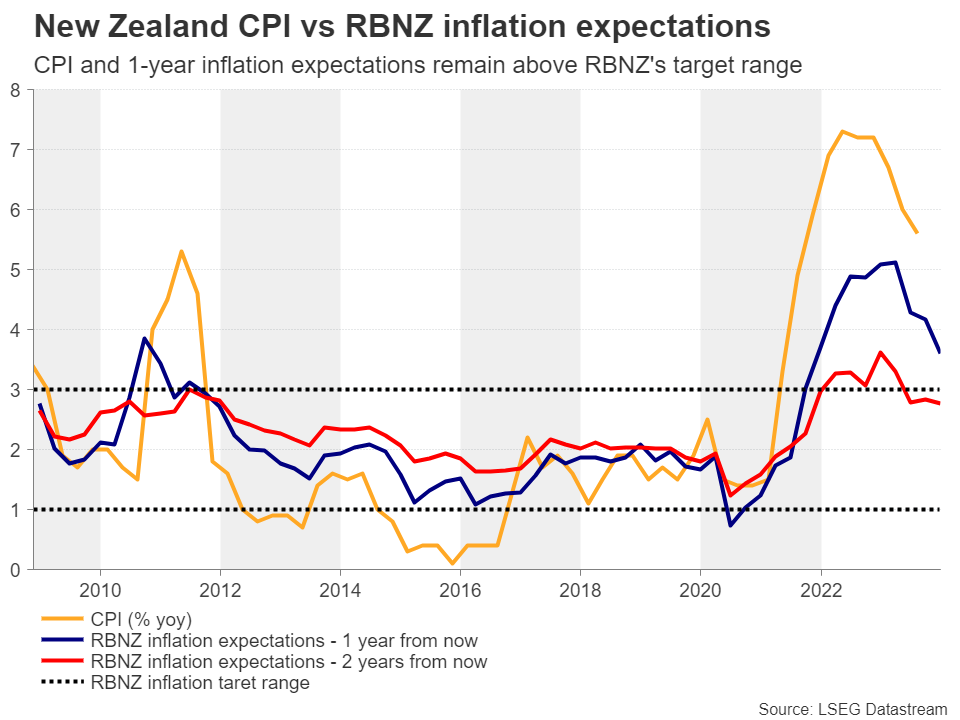
Given that inflation is still nearly double the upper bound of the RBNZ’s 1-3% target range, and that, although cooling, the RBNZ’s own expectations continue to suggest that inflation will stay above that bound in 12 months, officials are unlikely to affirm market expectations and revise lower their OCR projections.
What’s more, it will be interesting to see whether policymakers will incorporate into their forecasts the implications of a new government for the macroeconomic outlook. An official agreement has yet to be signed, but the new coalition is more likely to be led by the National Party, which promised less spending than the previous Labor-led government, but also tax cuts, which is an inflationary policy. It also called for a change in how the RBNZ conducts policy, arguing that the dual mandate should be dropped and suggesting the adoption of a stricter inflation targeting. This means that if the Bank switches to a 2% objective like other major central banks, policy may need to stay restrictive for longer than previously estimated to achieve that target. According to the RBNZ’s inflation projections, inflation would not be at 2% even in 2 years.
Having all these variables in mind, even if officials lower their short-term inflation projections based on the latest data releases, the longer-term outlook is unlikely to be changed much, and they will most likely continue to suggest that interest rates will finish 2024 at the current 5.5% level. Compared to the market’s own implied path, this could be interpreted as a relatively hawkish hold and could prove positive for the New Zealand dollar, which has been outperforming its US counterpart lately on speculation that the Fed may need to cut interest rates by around 90bps next year.
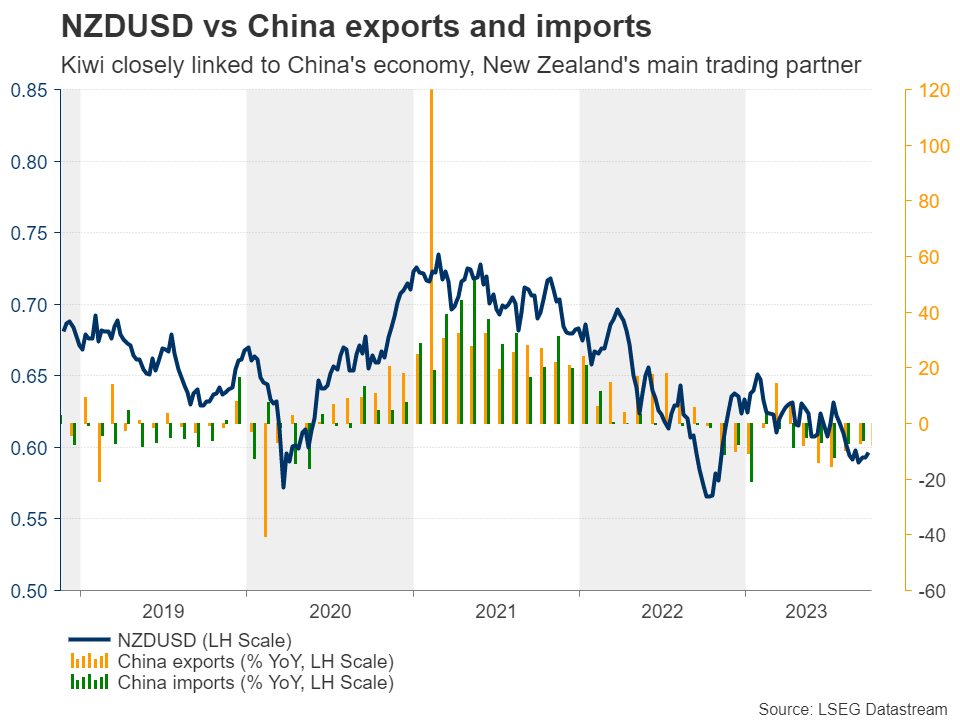
Apart from monetary policy, the kiwi is also driven by the broader risk-appetite and developments surrounding the Chinese economy, New Zealand’s main trading partner. The market expectations regarding the Fed’s future course of action have triggered a wave of market euphoria, fueling the latest rally in stocks, and that’s why the risk-linked kiwi and aussie gained more than other currencies against the dollar. On top of that, despite the major problems facing the Chinese economy, the latest data releases are suggesting that the world’s second largest economy may be bottoming out, which is another plus for the kiwi and its neighboring aussie.
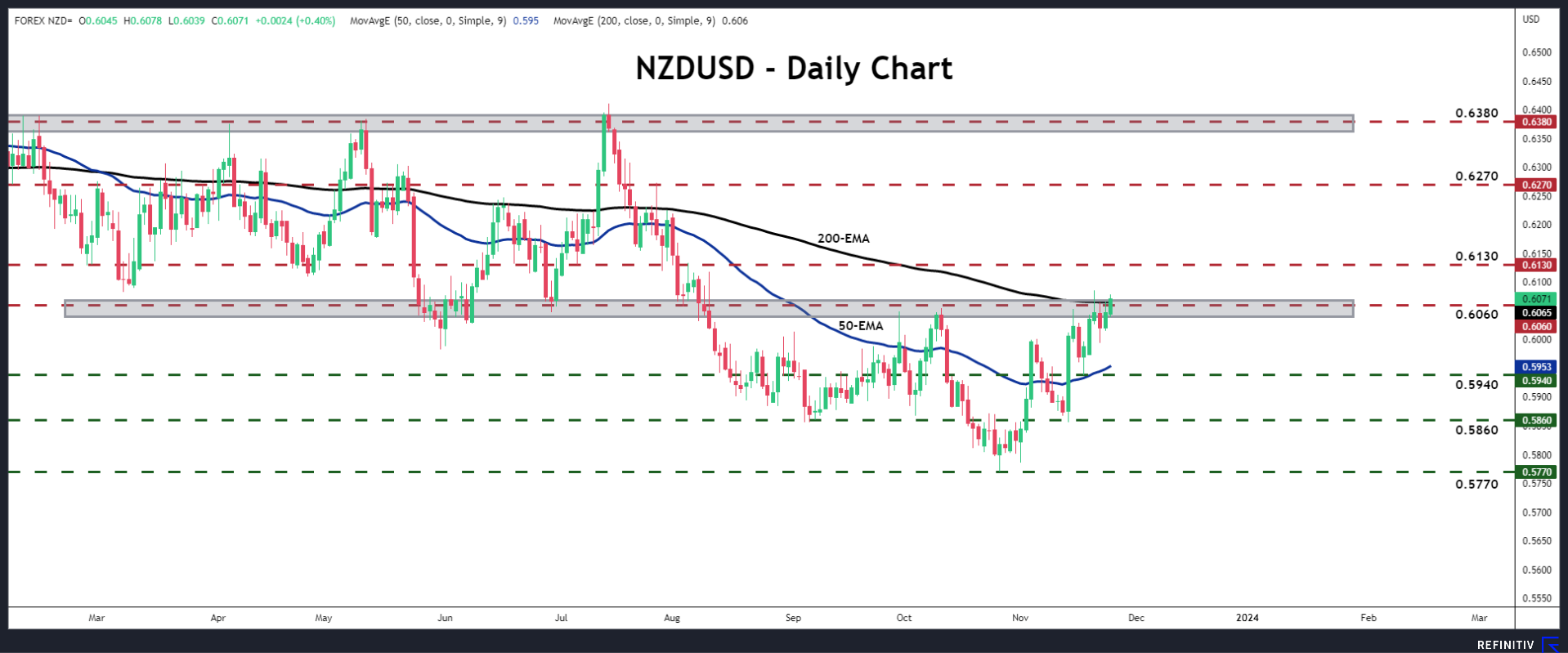
From a technical standpoint, kiwi/dollar has been printing higher lows and higher highs since the October 26 bottom, while today, it poked its nose above the crossroads of the 200-day exponential moving average (EMA) and the 0.6060 key zone. If the week closes above that hurdle, then the bulls may decide to climb towards the 0.6130 barrier, marked by the high of August 4, the break of which could carry larger bullish implications.
For the outlook to darken again, kiwi/dollar may need to slide and close below the 0.5940 barrier, a move that could pave the way towards the next support zone, at around 0.5860.
White Label
Data API
Web Plug-ins
Poster Maker
Affiliate Program
The risk of loss in trading financial instruments such as stocks, FX, commodities, futures, bonds, ETFs and crypto can be substantial. You may sustain a total loss of the funds that you deposit with your broker. Therefore, you should carefully consider whether such trading is suitable for you in light of your circumstances and financial resources.
No decision to invest should be made without thoroughly conducting due diligence by yourself or consulting with your financial advisors. Our web content might not suit you since we don't know your financial conditions and investment needs. Our financial information might have latency or contain inaccuracy, so you should be fully responsible for any of your trading and investment decisions. The company will not be responsible for your capital loss.
Without getting permission from the website, you are not allowed to copy the website's graphics, texts, or trademarks. Intellectual property rights in the content or data incorporated into this website belong to its providers and exchange merchants.
Not Logged In
Log in to access more features

FastBull Membership
Not yet
Purchase
Log In
Sign Up