• Trade
  • Markets
  • Copy
  • Contests
  • News
  • 24/7
  • Calendar
  • Q&A
  • Chats
Trending
Screeners
SYMBOL
LAST
BID
ASK
HIGH
LOW
NET CHG.
%CHG.
SPREAD
SPX
S&P 500 Index
6846.50
6846.50
6846.50
6878.28
6827.18
-23.90
-0.35%
--
DJI
Dow Jones Industrial Average
47739.31
47739.31
47739.31
47971.51
47611.93
-215.67
-0.45%
--
IXIC
NASDAQ Composite Index
23545.89
23545.89
23545.89
23698.93
23455.05
-32.22
-0.14%
--
USDX
US Dollar Index
99.000
99.080
99.000
99.000
99.000
+0.050
+ 0.05%
--
EURUSD
Euro / US Dollar
1.16369
1.16378
1.16369
1.16388
1.16322
+0.00005
0.00%
--
GBPUSD
Pound Sterling / US Dollar
1.33212
1.33223
1.33212
1.33220
1.33140
+0.00007
+ 0.01%
--
XAUUSD
Gold / US Dollar
4191.62
4192.06
4191.62
4193.27
4189.64
+1.92
+ 0.05%
--
WTI
Light Sweet Crude Oil
58.660
58.702
58.660
58.676
58.543
+0.105
+ 0.18%
--

Community Accounts

Signal Accounts
--
Profit Accounts
--
Loss Accounts
--
View More

Become a signal provider

Sell trading signals to earn additional income

View More

Guide to Copy Trading

Get started with ease and confidence

View More

Signal Accounts for Members

All Signal Accounts

Best Return
  • Best Return
  • Best P/L
  • Best MDD
Past 1W
  • Past 1W
  • Past 1M
  • Past 1Y

All Contests

  • All
  • Trump Updates
  • Recommend
  • Stocks
  • Cryptocurrencies
  • Central Banks
  • Featured News
Top News Only
Share

Japan Prime Minister Takaichi: 30 Injuries Reported So Far From Monday Earthquake

Share

USA Senate Committee Votes To Advance Nomination Of Jared Isaacman To Head Nasa

Share

Singapore Post - New Rate For Standard Regular Mail & Standard Large Mail Will Be S$0.62 And S$0.90 Respectively

Share

Australia's S&P/ASX 200 Index Down 0.27% At 8601.10 Points In Early Trade

Share

Trump: The USA Needs Mexico To Release 200000 Acre-Feet Of Water Before December 31St, And The Rest Must Come Soon After

Share

Trump: I Have Authorized Documentation To Impose A 5% Tariff On Mexico If This Water Isn't Released

Share

Brazil's Sao Paulo State Governor Tarcisio De Freitas Says Flavio Bolsonaro Will Have His Support - Cnn Brasil

Share

Ukraine's Security Must Be Guaranteed, In The Long Term, As A First Line Of Defence For Our Union, Says European Commission President

Share

Ukraine's Sovereignty Must Be Respected, Says European Commission President

Share

The Goal Is A Strong Ukraine, On The Battlefield And At The Negotiating Table, Says European Commission President

Share

As Peace Talks Are Ongoing, The EU Remains Ironclad In Its Support For Ukraine, Says European Commission President

Share

Pepsico: Asking USA-Based Pepna Employees As Well As Pbus Division Offices And Pfus Region Offices To Work Remotely This Week

Share

A U.S. Judge Ruled That President Trump’s Ban On Several Wind Power Projects Was Illegal

Share

Senior USA Administration Official: We Continue To Monitor Drc-Rwanda Situation Closely, Continue To Work With All Sides To Ensure Commitments Are Honored

Share

Israeli Military Says It Has Struck Infrastructure Belonging To Hezbollah In Several Areas In Southern Lebanon

Share

SPDR Gold Holdings Down 0.11%, Or 1.14 Tonnes

Share

On Monday (December 8), In Late New York Trading, S&P 500 Futures Fell 0.21%, Dow Jones Futures Fell 0.43%, NASDAQ 100 Futures Fell 0.08%, And Russell 2000 Futures Fell 0.04%

Share

Morgan Stanley: Data Center ABS Spreads Are Expected To Widen In 2026

Share

(US Stocks) The Philadelphia Gold And Silver Index Closed Down 2.34% At 311.01 Points. (Global Session) The NYSE Arca Gold Miners Index Closed Down 2.17%, Hitting A Daily Low Of 2235.45 Points; US Stocks Remained Slightly Down Before The Opening Bell—holding Steady Around 2280 Points—before Briefly Rising Slightly

Share

IMF: IMF Executive Board Approves Extension Of The Extended Credit Facility Arrangement With Nepal

TIME
ACT
FCST
PREV
France Trade Balance (SA) (Oct)

A:--

F: --

P: --
Euro Zone Employment YoY (SA) (Q3)

A:--

F: --

P: --
Canada Part-Time Employment (SA) (Nov)

A:--

F: --

P: --

Canada Unemployment Rate (SA) (Nov)

A:--

F: --

P: --

Canada Full-time Employment (SA) (Nov)

A:--

F: --

P: --

Canada Labor Force Participation Rate (SA) (Nov)

A:--

F: --

P: --

Canada Employment (SA) (Nov)

A:--

F: --

P: --

U.S. PCE Price Index MoM (Sept)

A:--

F: --

P: --

U.S. Personal Income MoM (Sept)

A:--

F: --

P: --

U.S. Core PCE Price Index MoM (Sept)

A:--

F: --

P: --

U.S. PCE Price Index YoY (SA) (Sept)

A:--

F: --

P: --

U.S. Core PCE Price Index YoY (Sept)

A:--

F: --

P: --

U.S. Personal Outlays MoM (SA) (Sept)

A:--

F: --

P: --
U.S. 5-10 Year-Ahead Inflation Expectations (Dec)

A:--

F: --

P: --

U.S. Real Personal Consumption Expenditures MoM (Sept)

A:--

F: --

P: --
U.S. Weekly Total Rig Count

A:--

F: --

P: --

U.S. Weekly Total Oil Rig Count

A:--

F: --

P: --

U.S. Consumer Credit (SA) (Oct)

A:--

F: --

P: --
China, Mainland Foreign Exchange Reserves (Nov)

A:--

F: --

P: --

Japan Trade Balance (Oct)

A:--

F: --

P: --

Japan Nominal GDP Revised QoQ (Q3)

A:--

F: --

P: --

China, Mainland Imports YoY (CNH) (Nov)

A:--

F: --

P: --

China, Mainland Exports (Nov)

A:--

F: --

P: --

China, Mainland Imports (CNH) (Nov)

A:--

F: --

P: --

China, Mainland Trade Balance (CNH) (Nov)

A:--

F: --

P: --

China, Mainland Exports YoY (USD) (Nov)

A:--

F: --

P: --

China, Mainland Imports YoY (USD) (Nov)

A:--

F: --

P: --

Germany Industrial Output MoM (SA) (Oct)

A:--

F: --

P: --
Euro Zone Sentix Investor Confidence Index (Dec)

A:--

F: --

P: --

Canada National Economic Confidence Index

A:--

F: --

P: --

U.K. BRC Like-For-Like Retail Sales YoY (Nov)

--

F: --

P: --

U.K. BRC Overall Retail Sales YoY (Nov)

--

F: --

P: --

Australia Overnight (Borrowing) Key Rate

--

F: --

P: --

RBA Rate Statement
RBA Press Conference
Germany Exports MoM (SA) (Oct)

--

F: --

P: --

U.S. NFIB Small Business Optimism Index (SA) (Nov)

--

F: --

P: --

Mexico 12-Month Inflation (CPI) (Nov)

--

F: --

P: --

Mexico Core CPI YoY (Nov)

--

F: --

P: --

Mexico PPI YoY (Nov)

--

F: --

P: --

U.S. Weekly Redbook Index YoY

--

F: --

P: --

U.S. JOLTS Job Openings (SA) (Oct)

--

F: --

P: --

China, Mainland M1 Money Supply YoY (Nov)

--

F: --

P: --

China, Mainland M0 Money Supply YoY (Nov)

--

F: --

P: --

China, Mainland M2 Money Supply YoY (Nov)

--

F: --

P: --

U.S. EIA Short-Term Crude Production Forecast For The Year (Dec)

--

F: --

P: --

U.S. EIA Natural Gas Production Forecast For The Next Year (Dec)

--

F: --

P: --

U.S. EIA Short-Term Crude Production Forecast For The Next Year (Dec)

--

F: --

P: --

EIA Monthly Short-Term Energy Outlook
U.S. API Weekly Gasoline Stocks

--

F: --

P: --

U.S. API Weekly Cushing Crude Oil Stocks

--

F: --

P: --

U.S. API Weekly Crude Oil Stocks

--

F: --

P: --

U.S. API Weekly Refined Oil Stocks

--

F: --

P: --

South Korea Unemployment Rate (SA) (Nov)

--

F: --

P: --

Japan Reuters Tankan Non-Manufacturers Index (Dec)

--

F: --

P: --

Japan Reuters Tankan Manufacturers Index (Dec)

--

F: --

P: --

Japan Domestic Enterprise Commodity Price Index MoM (Nov)

--

F: --

P: --

Japan Domestic Enterprise Commodity Price Index YoY (Nov)

--

F: --

P: --

China, Mainland PPI YoY (Nov)

--

F: --

P: --

China, Mainland CPI MoM (Nov)

--

F: --

P: --

Italy Industrial Output YoY (SA) (Oct)

--

F: --

P: --

Q&A with Experts
    • All
    • Chatrooms
    • Groups
    • Friends
    Connecting
    .
    .
    .
    Type here...
    Add Symbol or Code

      No matching data

      All
      Trump Updates
      Recommend
      Stocks
      Cryptocurrencies
      Central Banks
      Featured News
      • All
      • Russia-Ukraine Conflict
      • Middle East Flashpoint
      • All
      • Russia-Ukraine Conflict
      • Middle East Flashpoint
      Search
      Products

      Charts Free Forever

      Chats Q&A with Experts
      Screeners Economic Calendar Data Tools
      Membership Features
      Data Warehouse Market Trends Institutional Data Policy Rates Macro

      Market Trends

      Market Sentiment Order Book Forex Correlations

      Top Indicators

      Charts Free Forever
      Markets

      News

      News Analysis 24/7 Columns Education
      From Institutions From Analysts
      Topics Columnists

      Latest Views

      Latest Views

      Trending Topics

      Top Columnists

      Latest Update

      Signals

      Copy Rankings Latest Signals Become a signal provider AI Rating
      Contests
      Brokers

      Overview Brokers Assessment Rankings Regulators News Claims
      Broker listing Forex Brokers Comparison Tool Live Spread Comparison Scam
      Q&A Complaint Scam Alert Videos Tips to Detect Scam
      More

      Business
      Events
      Careers About Us Advertising Help Center

      White Label

      Data API

      Web Plug-ins

      Affiliate Program

      Awards Institution Evaluation IB Seminar Salon Event Exhibition
      Vietnam Thailand Singapore Dubai
      Fans Party Investment Sharing Session
      FastBull Summit BrokersView Expo
      Recent Searches
        Top Searches
          Markets
          News
          Analysis
          User
          24/7
          Economic Calendar
          Education
          Data
          • Names
          • Latest
          • Prev

          View All

          No data

          Scan to Download

          Faster Charts, Chat Faster!

          Download App
          English
          • English
          • Español
          • العربية
          • Bahasa Indonesia
          • Bahasa Melayu
          • Tiếng Việt
          • ภาษาไทย
          • Français
          • Italiano
          • Türkçe
          • Русский язык
          • 简中
          • 繁中
          Open Account
          Search
          Products
          Charts Free Forever
          Markets
          News
          Signals

          Copy Rankings Latest Signals Become a signal provider AI Rating
          Contests
          Brokers

          Overview Brokers Assessment Rankings Regulators News Claims
          Broker listing Forex Brokers Comparison Tool Live Spread Comparison Scam
          Q&A Complaint Scam Alert Videos Tips to Detect Scam
          More

          Business
          Events
          Careers About Us Advertising Help Center

          White Label

          Data API

          Web Plug-ins

          Affiliate Program

          Awards Institution Evaluation IB Seminar Salon Event Exhibition
          Vietnam Thailand Singapore Dubai
          Fans Party Investment Sharing Session
          FastBull Summit BrokersView Expo

          When is A Veto Not a Veto? Rishi Sunak's Brexit Laws Fuel Fresh Unionist Concerns

          Devin

          Political

          Summary:

          The Democratic Unionists reject new British legislation that gives them the power to challenge, but not block, the rollout of new European goods laws in their corner of the United Kingdom.

          With Brexit, the devil is always in the detail.
          New legislation published Monday enacting British Prime Minister Rishi Sunak's much-heralded Windsor Framework makes clear that unionists in Northern Ireland will be able to object to new EU laws — but won't hold the power to veto them.
          Careful reading of the draft regulations enacting into law the so-called Stormont Brake shows that the power to block the introduction in Northern Ireland of any new EU goods standards — essential for Northern Irish exporters to observe if they want to maintain barrier-free trade with neighboring Ireland and the wider EU — will lie exclusively with London, not Belfast.
          And the legislation shows the U.K. government ultimately reserves the right to override any unionist objections, citing "exceptional circumstances."
          Such caveats have proven a dealbreaker for some unionists already highly skeptical of the prime minister's claims to have allayed their chief concerns over the much-maligned Brexit trade protocol that keeps Northern Ireland subject to EU goods rules.
          "These opt-outs render the Stormont Brake useless," said hardline Democratic Unionist MP Sammy Wilson.
          He complained previous U.K. assurances that the Stormont Brake would deliver an effective "unionist veto," promoted particularly by Northern Ireland Secretary Chris Heaton-Harris, have been proven "totally incorrect" now that he's had a chance to read the published rulebook.
          The Democratic Unionists announced Monday they would vote against the Windsor Framework (Democratic Scrutiny) Regulations when they are put to a U.K. House of Commons vote Wednesday, ending weeks of speculation about their intentions.
          The DUP, with only eight votes in a 650-seat House of Commons due to give overwhelming support to the regulations, cannot stop the law from being enacted — though its opposition may prove influential in convincing Euroskeptic Tory MPs to follow suit.
          But Democratic Unionist leader Jeffrey Donaldson, eyeing the need to minimize internal party splits and potential losses in local council elections in May, emphasized that his party would not indefinitely block the revival of power-sharing at Stormont — and hopes in coming weeks to coax the U.K. government to deliver more of the DUP wish list.
          Donaldson stressed that a Wednesday vote against the Stormont Brake did not mean that the DUP was rejecting the wider Windsor Framework, merely maintaining a critical stance in hopes of edging the U.K. government closer to unmet DUP demands.
          Under the new regulations, unionists — a minority in the mothballed Northern Ireland Assembly — would have sufficient numbers to file a formal objection against the local introduction of any new EU law changing goods standards. The regulations specify that 30 members from at least two parties will be sufficient for any "petition of concern" to the U.K. government to be heard.
          This means, in practice, that lawmakers from the Democratic Unionists (25 seats) and the moderate Ulster Unionists (nine seats) must file any objection jointly. Given that the Ulster Unionists, unlike the DUP, opposed Brexit and are more positive on maintaining barrier-free trade with the EU, even attaining this two-party, 30-signature threshold can't be presumed.
          Any successful unionist petition would trigger a review of the proposed law's local impact in Northern Ireland in the U.K.-EU Withdrawal Agreement Joint Committee. It meets regularly to manage and resolve post-Brexit trade tensions.
          While any EU law challenged by a unionist petition wouldn't go into immediate force in Northern Ireland pending these few weeks of deliberations, the London-Brussels dialogue might well result in an agreement that the law doesn't risk sufficient disruption to Northern Ireland trade to merit a British government veto.
          Any joint U.K.-EU agreement to proceed with rolling out that EU law would then be subject to a formal vote at the Northern Ireland Assembly at Stormont.
          Passage would require "cross-community consent" — Stormont jargon for a vote that fails unless both the British unionist and Irish nationalist camps agree.
          But this stipulation doesn't mean the unionist minority would wield a veto over U.K. decision-making. Instead, as the regulations detail, the U.K.'s secretary of state for Northern Ireland would not be legally bound by the Stormont vote.
          The Stormont Brake rules specify that the secretary of state could announce in the House of Commons that the EU law will apply despite unionist objections. In this scenario, the U.K. government could justify its decision by citing "exceptional circumstances," or its own judgment that the EU law "would not create a new regulatory border between Great Britain and Northern Ireland."
          The regulations state that such a barrier must be seen to "materially divert trade or materially impair the free flow of goods."
          "For weeks, the Windsor Framework has been oversold," Wilson said. "Now the wildest assertions are being laid bare as its details are examined and publicly revealed."

          Source: POLITICO

          Risk Warnings and Disclaimers
          You understand and acknowledge that there is a high degree of risk involved in trading. Following any strategies or investment methods may lead to potential losses. The content on the site is provided by our contributors and analysts for information purposes only. You are solely responsible for determining whether any trading assets, securities, strategy, or any other product is suitable for investing based on your own investment objectives and financial situation.
          Comments
          Add to Favorites
          Share

          Bitcoin Passes the Bank Stress Test

          Kevin Du

          Cryptocurrency

          As crisis stalks the traditional world of stocks and bonds, bitcoin is suddenly looking like a safe haven.
          The infamously volatile cryptocurrency seems positively hale and hearty, just as a banking meltdown drives markets into the arms of a recession.
          Bitcoin has risen 21% this month, while a choppy S&P 500 has lost 1.4% and gold has gained 8%.
          "If you were going to describe an environment where there were successive bank runs because central banks are trying to fight inflation with fast rate increases, that is pretty close to as spot-on a thesis for owning bitcoin as you've ever heard," said Stéphane Ouellette, CEO at digital asset investment platform FRNT Financial.
          The cryptocurrency has, for now, severed its ties with stocks and bonds and tagged on to a rally in gold, fulfilling at least one part of creator Satoshi Nakamoto's dream - that bitcoin can serve as a refuge for suffering investors.
          Bitcoin's 30-day correlation with the S&P 500 has slid to negative 0.12 over the past week, where a measure of 1 indicates the two assets are moving in lock step.
          A selloff in banks has wiped out hundreds of billions of dollars in market value and forced U.S. regulators to launch emergency measures. The past couple of weeks has seen Silicon Valley Bank and crypto lender Silvergate go under, while Credit Suisse has teetered on the brink.
          Bitcoin Passes the Bank Stress Test_1'Return to core ethos'
          Let's not carried away, though. This is bitcoin.
          "The bearish argument would be that these dynamics are temporary, and ultimately this rally is not going to sustain," said Ouellette.
          It remains to be seen if bitcoin's bullishness will endure as attention shifts to the Federal Reserve's policy meeting this week where the U.S. central bank must walk a fine line as it fights inflation and bank stresses.
          Furthermore, the cryptocurrency's allure hasn't all been about safety.
          The rapid price rise has forced some short-sellers to cut their bets and buy coin back. Data from Coinglass shows traders liquidated $300 million worth of crypto positions on Monday, with most of that total - $178.5 million - short positions.
          Nonetheless, bitcoin is resurgent.
          It now commands nearly 43% of the total crypto market, its highest share since last June, according to CoinMarketCap data, while the total cryptocurrency market's capitalization has jumped 23% to $1.1 billion since March 10.
          "We're seeing a return to bitcoin's core ethos, that of a financial asset independent from the opacity and meddling of the centralized financial system," said Henry Elder, head of decentralized finance (DeFi) at digital asset investment manager Wave Digital Assets.
          The mainstream bank crisis has also fueled some interest in DeFi, with the total value of tokens linked to such platforms rising to $49 billion from $43 billion over the past week, according to DappRadar.
          Bitcoin In a Bank Crisis
          Not all areas of the digital world have been immune to the banking fallout, though. The no. 2 stablecoin Circle USD or USDC lost its 1:1 peg to the dollar after disclosing its reserves were parked at the shuttered Silicon Valley Bank.
          As worries spread over USDC's ability to maintain its peg, its market cap slid to $36.8 billion last Friday from $43.8 billion a week earlier, even as leading stablecoin Tether gained around $4 billion.
          Market participants said some USDC withdrawals were likely reinvested in bitcoin as well, helping fuel the rally.
          "It's too soon to say that bitcoin has proven the narrative that it's an alternative in a banking crisis," cautioned Ed Hindi, Chief Investment Officer at Tyr Capital in Geneva.
          But he added: "The rally we are currently witnessing in bitcoin will be looked back at as the point in time where its main property as a decentralized non-sovereign asset was stress tested."

          Source: Yahoo

          Risk Warnings and Disclaimers
          You understand and acknowledge that there is a high degree of risk involved in trading. Following any strategies or investment methods may lead to potential losses. The content on the site is provided by our contributors and analysts for information purposes only. You are solely responsible for determining whether any trading assets, securities, strategy, or any other product is suitable for investing based on your own investment objectives and financial situation.
          Comments
          Add to Favorites
          Share

          Dovish Hike, or Hawkish Hold? Fed, Peers Must Choose Their Fear

          Cohen

          Central Bank

          From Washington to Zurich to London, central bankers need to make a pivotal decision in coming days: whether their biggest immediate fear is financial or price stability.
          The Federal Reserve on Wednesday will set the tone as Chair Jerome Powell gathers with his colleagues to consider whether the banking turmoil that erupted less than two weeks ago is so concerning that an interest-rate hike should be abandoned.
          The UK, Swiss and Norwegian central banks are among more than a dozen others that also will be setting rates this week. And while the European Central Bank opted to pull the rate trigger last Thursday, the downfall of Credit Suisse Group AG — and default on its bondholders — since then poses fresh questions for policymakers.
          Tilting toward safeguarding finance by keeping rates on hold could reassure investors that regulators will do what it takes to ensure contagion from three US bank collapses, and now Credit Suisse's demise, will be contained.
          Trouble is, above-target inflation remains stubborn, and Powell and his peers are well aware of the history of the 1970s, when insufficient tightening helped to entrench outsize price gains.
          "Financial crises tend to move in fits and starts and we're still far from a full resolution from this one," said Diane Swonk, chief economist at KPMG LLP. For the Fed, "we're looking for a pregnant pause given the uncertainty about what tightening is in the credit markets already," she said.
          Speaking to how quickly things have changed, Swonk earlier this month, had penciled in a 50 basis-point hike for March 22.

          Communication Challenge

          Central bankers face "a choice between 'a dovish hike' versus 'a hawkish hold,'" Geoffrey Yu, a senior market strategist at Bank of New York Mellon, wrote in a note Monday.
          In other words, policymakers could boost rates further while assuring the public that they are attuned to risks in the banking system and will act appropriately to avert any broader meltdown.
          Or they could stand pat for now to buy time to see how financial developments unfold, while pledging to resume the inflation battle swiftly once stresses subside.
          Futures markets show odds-on bets for a 25 basis-point move by the Fed on Wednesday. For the Bank of England — which started hiking months before the Fed — there's less than a 50-50 chance of an increase on Thursday, when the Swiss National Bank also must make a call, just days after helping oversee Credit Suisse's takeover by UBS Group AG.
          Regardless of what they do this week, markets see central banks much closer to being done with tightening than it appeared just days ago.
          For the Fed, traders were betting on another 110 basis points of hikes before the troubles at Silicon Valley Bank escalated — implying a peak rate of almost 6%. As of Monday, they were pricing in just another 35 basis points. Further out the curve the market is betting on cuts.
          It's a similar picture in Europe, where traders have repriced their terminal-rate expectations for the ECB by an entire percentage point, to 3.2%. The BOE is now seen raising rates to at most 4.25%, compared with 5% previously.
          The markedly more-dovish outlook has also helped fuel a strong bond rally. The yield on two-year German and US government bonds — those most sensitive to policy — have fallen 100 basis points or more since March 8.

          Policy Divergence?

          Both now sit at or below their respective central bank key rates, another sign for many traders that policymakers are quickly nearing the end of their rate-hike cycles.
          Central banks may well decide to make different calls.
          In Switzerland, economists predict a half-point rate rise to 1.5% as the SNB plays catch-up with the neighboring euro zone in its first decision of 2023. However, at 3.4%, Swiss inflation is low compared with much of the advanced world.
          A day before the BOE decides, official inflation data is expected to show a slowing from 10.1% to 9.9%.
          ECB President Christine Lagarde, in overseeing a half-point rate hike last week, insisted that price stability and financial stability "are two different stabilities addressed by different tools."
          But rate increases have been blamed for contributing to the banking crisis that's now erupted.
          "Recent economic momentum and inflation have been overshadowed by banking system risks, sharply repricing the Fed's path," as Bank of America rates strategist Mark Cabana said in a note.

          Source: Bloomberg

          Risk Warnings and Disclaimers
          You understand and acknowledge that there is a high degree of risk involved in trading. Following any strategies or investment methods may lead to potential losses. The content on the site is provided by our contributors and analysts for information purposes only. You are solely responsible for determining whether any trading assets, securities, strategy, or any other product is suitable for investing based on your own investment objectives and financial situation.
          Comments
          Add to Favorites
          Share

          Rates Spark: Contained contagion Risk Puts Hikes Back on The Table

          Owen Li

          Central Bank

          The path for higher Fed rates in the US gets more complicated

          After a wobbly start, it seems markets have reacted positively to the measures taken over the weekend to shore up financial markets from further contagion. In the US, there is a growing consensus that regional banks' vagaries will result in a degree of credit tightening for the economy but, were market conditions to remain calm until the Fed meeting concluding tomorrow, we would expect the Fed to still be in a position to hike 25bp. This is a big if, however, and the strength and speed of the market reaction to Silicon Valley Bank's demise is an important warning that contagion risk is real. In that regard, potential plans to extend FDIC protection to deposits above $250,000, as reported by Bloomberg, would help prevent further runs.
          One of the problems is that the Fed will struggle to escape the perception that further hikes would make regional banks' funding position more difficult, and that cuts would help them. And this is without talking about the unrealised losses on their bond holdings. We fully expect the Fed to draw the distinction between monetary policy and financial stability but whether that distinction holds depends on the amount of stress the system is under. Above a certain level of stress, the system takes precedence, as the preventive extension of dollar swap lines with foreign central banks has shown.

          Rates Spark: Contained contagion Risk Puts Hikes Back on The Table_1Systemic risk indicators at manageable levels vindicate ECB hikes

          In the event, these lines were barely used, which is good news. This suggests that dollar funding conditions for foreign institutions in the jurisdictions covered by the agreement (the European Central Bank and Bank of England are key participants) are not challenging. We draw a similar conclusion looking at other indicators of wholesale money market funding for banks, for example the fact that FRA-OIS spreads did not make new highs after last week's spike. Taken together, they suggest contagion risk is still at a manageable level, although this does not preclude an increase in funding and capital cost for banks, and so the economy.
          If this remained the case, the perception would be that the ECB in particular will be emboldened to continue its hiking cycle. Many officials came out of the woodwork to reinforce President Christine Lagarde's message that future decisions will depend on data, including the effect of banking stress on the economy. They could not help adding, and Lagarde added to the chorus that, absent market volatility, the ECB would have guided markets towards higher rates. In light of this message, a few more days of calm would in our view be enough for markets to price back ECB hikes into the curve. We continue to see euro rates as less liable to drop, and so think a further narrowing of USD-EUR rates differentials is in the cards.

          Rates Spark: Contained contagion Risk Puts Hikes Back on The Table_2Today's events and market view

          Bond supply today takes the form of 30Y UK gilts, alongside auctions from Germany (5Y) and Finland (5Y/13Y).
          The main economic data releases from Europe will be the Zew survey, and construction output. The former might be an opportunity to get an early read on how recent financial market fears have impacted expectations.
          US data are mostly housing-related with existing home sales and house prices the highlights.
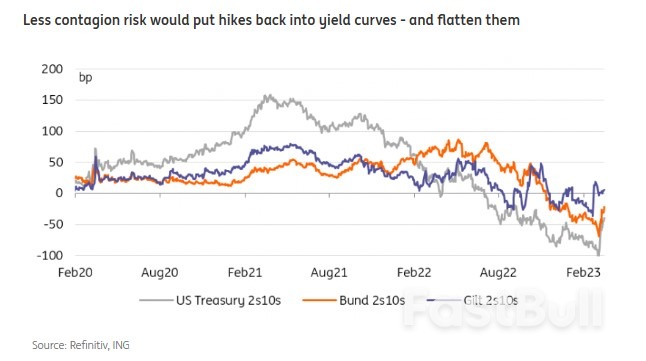
          Rates direction depends more than ever on market sentiment towards banks. The aggressive response by regulators and public authorities in the US and in Switzerland is a reason for optimism. Much hinges on the perception of contagion risk. After the Credit Suisse takeover, one positive is that markets have no 'next domino' to focus on. This should allow hikes to be priced out on the yield curve, and bear-flatten them as a result.

          Source: ING

          Risk Warnings and Disclaimers
          You understand and acknowledge that there is a high degree of risk involved in trading. Following any strategies or investment methods may lead to potential losses. The content on the site is provided by our contributors and analysts for information purposes only. You are solely responsible for determining whether any trading assets, securities, strategy, or any other product is suitable for investing based on your own investment objectives and financial situation.
          Comments
          Add to Favorites
          Share

          Safe-Havens and Risk Assets Both Rise as Banking Woes Shift Fed Expectations

          Alex

          Economic

          Worries over the banking crisis are boosting disparate assets, with traditional safe-havens such as gold, Treasuries and money markets seeing high demand along with more speculative instruments such as tech stocks and bitcoin.
          The unusual cross-currents come as the financial distress that started earlier this month with the collapse of California's Silicon Valley Bank has spread to Europe, with investors on edge about the health of the financial system even after UBS Group agreed to buy ailing Credit Suisse in a state-backed takeover and major central banks took steps to reassure markets.
          The troubles in the financial sector have sparked rapid repositioning in asset markets, as investors bet the Federal Reserve and other central banks will have to slow interest rate hikes in order to avoid hurting the economy as the banking woes threaten to slow growth.
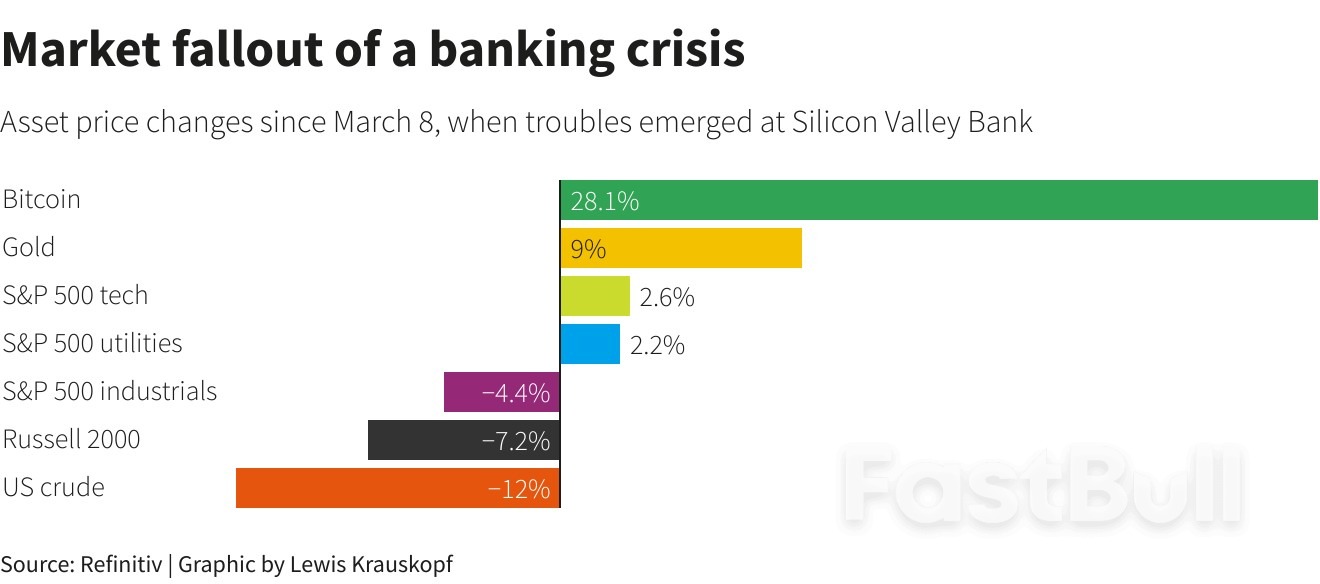
          As a result, some assets that typically struggle when central banks are expected to tighten monetary policy are now holding strong: The S&P 500 tech sector is up around 2% since March 8, the day Silicon Valley Bank's troubles became apparent, compared with a 1% decline in the broad S&P 500 index. Bitcoin, which fell 60% as rates were rising in 2022, has gained nearly 30% since March 8.
          The gains have come alongside big moves in assets traditionally perceived as safe-havens during uncertain times. Yields on shorter-dated Treasuries, which move inversely to prices, saw a historic drop last week, while money market funds notched their biggest inflows since April 2020 in the week to March 15, Refinitiv Lipper data showed. Gold prices are up more than 9% while the S&P 500 utilities sector has gained 2.2%.
          But assets seen as sensitive to economic growth have struggled. Oil prices have fallen to their lowest level since 2021, and shares of industrial and small-cap companies have also faltered.
          "I'm not surprised that we're getting confusing signals because this is a very confusing moment," said Christopher Smart, chief global strategist at Barings. "Investors are very unsure about what comes next."Safe-Havens and Risk Assets Both Rise as Banking Woes Shift Fed Expectations_1
          Looming over the market gyrations is the Fed's two-day policy meeting that concludes on Wednesday. Earlier this month, investors were bracing for a hefty 50 basis-point rate hike as the central bank continued to stress the need to raise rates to tame inflation. But markets on Monday were pricing in a roughly 75% chance of a 25-basis-point rate increase and a 25% chance that the Fed pauses on its most aggressive rate hiking cycle since the early 1980s, even though inflation remains far above its target.
          Some investors see the continued gains in riskier segments of the stock market as a sign that more volatility lies ahead - especially if forecasts of a recession come to pass.
          "The fact that the Nasdaq has held up better tells me that there's another shoe to drop," said Phil Orlando, chief equity market strategist at Federated Hermes, who has been moving into defensive sectors, cash and bonds in anticipation of the S&P 500's testing its bear market lows from October. "If earnings are going to come down by at least another 10%," he said, "it's hard to make the case" for an expansion in price/earnings multiples.
          Morgan Stanley strategist Michael Wilson put forward a similarly cautious view, recommending that investors stay away from tech shares and go with defensive names in anticipation of heightened volatility.
          "The events of the past week mean that credit availability is decreasing for a wide swath of the economy, which may be the catalyst that finally convinces market participants that earnings estimates are too high," he wrote in a Monday report.
          Of course, the decline in Treasury yields has bolstered areas of the market like tech stocks - whose recent strength has outweighed declines in banking and energy shares to help support the broader S&P 500.
          "Less than two weeks ago, the main challenge for the stock market was higher rates. Well, the 10-year U.S. Treasury yield is down about 60 basis points from early March," said Keith Lerner, chief market strategist at Truist Advisory Services, in a Monday report. Nevertheless, he cautioned that banking woes are likely to tighten lending and weigh on growth.
          Investors will likely continue moving to money markets and other cash instruments until the tumult in U.S. regional banks subsides, said Liz Ann Sonders, chief investment strategist at Charles Schwab.
          "The bigger picture story here is that the era of easy money is over and ... things are coming home to roost," she said.

          Source: Reuters

          To stay updated on all economic events of today, please check out our Economic calendar
          Risk Warnings and Disclaimers
          You understand and acknowledge that there is a high degree of risk involved in trading. Following any strategies or investment methods may lead to potential losses. The content on the site is provided by our contributors and analysts for information purposes only. You are solely responsible for determining whether any trading assets, securities, strategy, or any other product is suitable for investing based on your own investment objectives and financial situation.
          Comments
          Add to Favorites
          Share

          Europe Set to Open Cautiously Higher

          Devin

          Forex

          After opening the week lower, European stocks recovered early losses to finish the day higher yesterday, as markets tried to absorb the events of the weekend, and the $3bn absorption of Credit Suisse by its bigger Swiss rival UBS.
          While the deal raises a number of questions with respect to shareholder and bond holder priorities, regulators across the EU assured nervous markets that the Swiss bailout was unique to the two Swiss banks, while investors took the view that recent events would prompt a slowdown in the pace of central bank tightening this week.
          Even the problems being felt in the US banking system were being shrugged off with further weakness in First Republic Bank being treated as a localised difficulty, rather than anything more systemic.
          US markets also finished the day strongly, building on the gains that we saw last week with the Dow and S&P500 closing close to the highs of the last few days. This positive finish has seen Asia markets edge higher and also looks set to translate into a positive European open this morning.
          With the Federal Reserve rate meeting due to start later today, markets have become increasingly divided as to what the FOMC may well do when it comes to interest rates tomorrow, with opinions split between another 25bps hike, a pause, and a 25bps rate cut.
          Assuming recent gains hold, and we get no further surprises then the odds still favour a 25bps rate rise, otherwise, the Fed runs the risk that it sends the message it is more concerned about financial stability than it is about its fight against inflation. A rate cut would send an even worse message that the Fed sees something the market doesn’t and could spook already jittery markets even further.
          Against that backdrop today’s European open looks set to be a positive one, however, sentiment is likely to remain fragile over the next few days until we see the outcome of tomorrow’s Fed meeting, and their take on recent events, while on Thursday we get the latest central bank decisions from the Swiss National Bank and the Bank of England.
          In light of recent events, the actions of the SNB will be particularly notable given they are expected to hike rates by 50bps. If any central bank has a reason to think again about raising rates it's surprising no one has mentioned the SNB, although Swiss rates are still very low relative to their peers at 1%.
          On the data front the latest UK Public sector borrowing numbers for February are expected to see normal service resumed for the UK government are the net receipts of £5.4bn that topped up the Treasury coffers in January.
          Today’s numbers are expected to see monthly borrowing rise to £11.8bn, even as tax receipts showed the UK economy is performing much better than the more pessimistic expectations that we saw at the end of last year.
          We also have the latest German ZEW investor survey for March which is expected to show a significant deterioration from the improvement seen in the February numbers. March expectations are expected to slow to 15.7, after hitting an 11-month high of 28.1 the previous month. The current situation isn’t expected to change that much, with an expectation of an improvement from -45.1 to -44.3.
          In Canada the latest inflation numbers are expected to show a modest slowing in headline CPI to 5.4% from 5.9%, while the median core is forecast to slip back to 4.8%, in a sign that it continues to remain sticky, having been stuck around the 5% level for the previous 3 months. .
          EUR/USD – retesting the last week's highs at 1.0760 as well as the 50-day SMA. A move through here retargets the recent range highs at 1.1030. Still have support at recent lows at 1.0520.
          GBP/USD – had a strong day yesterday and looks set for a retest of the range highs at 1.2300, and even the 1.2450 area. Still has solid support at 1.1800 with a break targeting the 1.1640 area.
          EUR/GBP – a break of trend line support from the lows last August, currently just above the 0.8700 area, could well see further losses towards 0.8620. Resistance at the 0.8830 area.
          USD/JPY – slipped back to cloud support between 130.30/40 yesterday, with the main resistance still up near the 200-day SMA at 135.90. A break of 130.00 targets the 128.00 area.

          Source: CMC

          Risk Warnings and Disclaimers
          You understand and acknowledge that there is a high degree of risk involved in trading. Following any strategies or investment methods may lead to potential losses. The content on the site is provided by our contributors and analysts for information purposes only. You are solely responsible for determining whether any trading assets, securities, strategy, or any other product is suitable for investing based on your own investment objectives and financial situation.
          Comments
          Add to Favorites
          Share

          Aussie Falters After RBA Minutes; Canada CPI Awaited

          Samantha Luan

          Forex

          Central Bank

          Australian Dollar is declining broadly as RBA minutes hinted at the possibility of a pause during their next meeting. Meanwhile, Yen has managed to hold on to the some gains it made earlier this week and appears poised for further rallying, particularly against commodity-based currencies.
          Both Euro and Sterling have maintained their strength after being bought against Swiss Franc. However, their momentum seems to have slowed down a bit. Dollar is on the path to recovery from previous losses but all would depend on tomorrow's FOMC rate decision. Canadian Dollar remains in a mixed state as market participants eagerly await the release of the Canada CPI data.
          Elsewhere in the markets, the banking crisis seems to have reached a point of stabilization at last, with hope that this trend will continue. Asian stock markets are making a comeback, taking cues from the rebound in US markets. Benchmark treasury yields in both the US and Europe have also bounced back, signaling a halt in the flow of funds towards safe-haven assets.
          Gold, after spiking higher yesterday, is currently in a consolidation phase. However, it remains poised to potentially break through the 2000 mark again in the near future.

          RBA Minutes: To reconsider a pause at next meeting

          The minutes of RBA's meeting on March 7 indicate that the central bank is considering a more cautious approach in tightening monetary policy, as uncertainty surrounding the economic outlook persists. The RBA members observed that "further tightening of monetary policy would likely be required to ensure that inflation returns to target." However, they also noted the restrictive nature of current monetary policy and the economic uncertainty, stating that "it would be appropriate at some point to hold the cash rate steady."
          During the meeting, RBA members agreed to "reconsider the case for a pause at the following meeting, recognizing that pausing would allow additional time to reassess the outlook for the economy." The decision on when to pause will be determined by incoming data and the board's assessment of the economic situation.
          The RBA acknowledges that "the outlook for consumption remained a key source of uncertainty." The central bank will closely monitor upcoming data releases on employment, inflation, retail trade, and business surveys, as well as developments in the global economy, to inform their decision-making.

          GBP/AUD resuming rally after dovish RBA minutes

          Australian Dollar trades mildly lower after RBA minutes indicated the possibility of a pause in tightening at next meeting. On the other hand, Sterling (and Euro too) is supported by funds flow from Swiss Franc. But there are some uncertainties for the Pound ahead with UK CPI and BoE rate decisions scheduled later in the week.
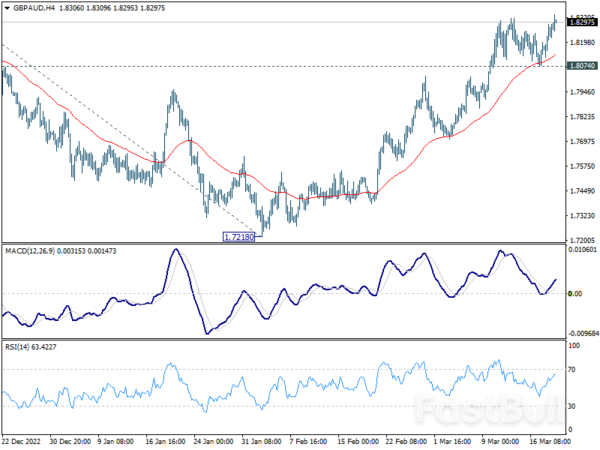
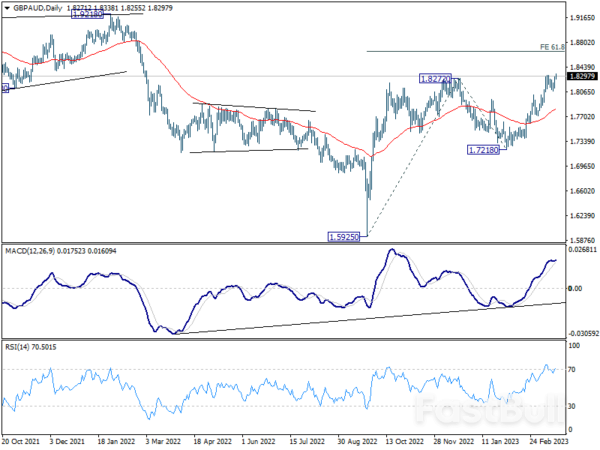
          Technically, GBP/AUD is resuming the near term rise by breaking last week's high at 1.8316. At the same time, rise from 1.7218 is likely resuming the whole up trend from 1.5925. Near term outlook will stay bullish as long as 1.8074 support holds, even in case of retreat. Next target is 61.8% projection of 1.5925 to 1.8272 from 1.7218 at 1.8668. Nevertheless, break of 1.8074 support will delay the bullish case and bring some consolidations before another rally attempt.Aussie Falters After RBA Minutes; Canada CPI Awaited_1

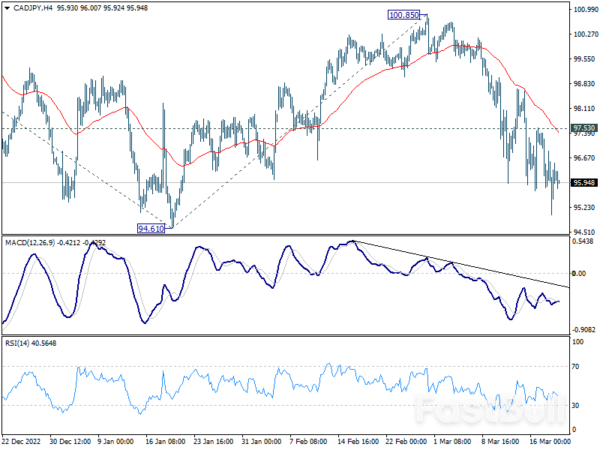
          Aussie Falters After RBA Minutes; Canada CPI Awaited_2CAD/JPY ready for down trend resumption as Canada CPI looms

          Today, Canada's consumer inflation data takes center stage as markets anticipate a slowdown in headline inflation from 5.9% yoy to 5.4% yoy in February. If this decrease materializes, it would mark the lowest inflation reading in over a year. BoC's preferred core inflation metrics, the trimmed and median CPI, are also projected to decelerate from 5.1% yoy to 4.8% yoy and from 5.0% yoy to 4.8% yoy, respectively.
          BoC became the first major central bank to pause its tightening cycle last Wednesday, following eight consecutive rate hikes totaling 425 basis points. Market participants are still expecting one more rate increase this year, but these odds could dwindle if inflation continues to decline.
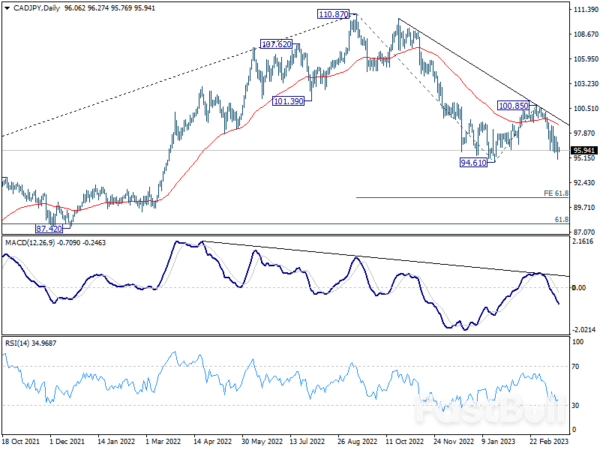
          CAD/JPY is closely watching the 94.61 support level after a recent drop. A decisive break below this threshold would rekindle the broader downtrend from the 110.87 high and aim for a 61.8% projection of 110.87 to 94.61 from 100.85 at 90.80. However, if the cross breaks above 97.53 resistance, it could delay the bearish scenario and extend the corrective pattern from 94.61 with another upswing.Aussie Falters After RBA Minutes; Canada CPI Awaited_3

          Aussie Falters After RBA Minutes; Canada CPI Awaited_4Looking ahead

          Germany ZEW economic sentiment will be the man focus in European session. UK will release public sector net borrowing. Swiss will publish trade balance. Later in the day, Canada CPI will take center stage while US will release existing home sales.

          Source: ActionForex.Com

          Risk Warnings and Disclaimers
          You understand and acknowledge that there is a high degree of risk involved in trading. Following any strategies or investment methods may lead to potential losses. The content on the site is provided by our contributors and analysts for information purposes only. You are solely responsible for determining whether any trading assets, securities, strategy, or any other product is suitable for investing based on your own investment objectives and financial situation.
          Comments
          Add to Favorites
          Share
          FastBull
          Copyright © 2025 FastBull Ltd

          728 RM B 7/F GEE LOK IND BLDG NO 34 HUNG TO RD KWUN TONG KLN HONG KONG

          TelegramInstagramTwitterfacebooklinkedin
          App Store Google Play Google Play
          Products
          Charts

          Chats

          Q&A with Experts
          Screeners
          Economic Calendar
          Data
          Tools
          Membership
          Features
          Function
          Markets
          Copy Trading
          Latest Signals
          Contests
          News
          Analysis
          24/7
          Columns
          Education
          Company
          Careers
          About Us
          Contact Us
          Advertising
          Help Center
          Feedback
          User Agreement
          Privacy Policy
          Business

          White Label

          Data API

          Web Plug-ins

          Poster Maker

          Affiliate Program

          Risk Disclosure

          The risk of loss in trading financial instruments such as stocks, FX, commodities, futures, bonds, ETFs and crypto can be substantial. You may sustain a total loss of the funds that you deposit with your broker. Therefore, you should carefully consider whether such trading is suitable for you in light of your circumstances and financial resources.

          No decision to invest should be made without thoroughly conducting due diligence by yourself or consulting with your financial advisors. Our web content might not suit you since we don't know your financial conditions and investment needs. Our financial information might have latency or contain inaccuracy, so you should be fully responsible for any of your trading and investment decisions. The company will not be responsible for your capital loss.

          Without getting permission from the website, you are not allowed to copy the website's graphics, texts, or trademarks. Intellectual property rights in the content or data incorporated into this website belong to its providers and exchange merchants.

          Not Logged In

          Log in to access more features

          FastBull Membership

          Not yet

          Purchase

          Become a signal provider
          Help Center
          Customer Service
          Dark Mode
          Price Up/Down Colors

          Log In

          Sign Up

          Position
          Layout
          Fullscreen
          Default to Chart
          The chart page opens by default when you visit fastbull.com