Markets
News
Analysis
User
24/7
Economic Calendar
Education
Data
- Names
- Latest
- Prev


Signal Accounts for Members
All Signal Accounts
All Contests


UBS CEO: As We Approach End Of Integration, Confident In Ability To Capture Remaining Synergies By Year-End, Which We Increased By $500 Million To $13.5 Billion
UBS: Remain On Track To Complete Integration By Year-End, With Greater Proportion Of Net Saves Weighted To H2 2026
UBS: Continued Wind-Down Of Non-Core And Legacy Risk-Weighted Asset, Reducing Rwa To $28.8 Billion
Kazakhstan's Kaztransoil: Supplies Of 1.017 Million Tons Of Oil, Including 863000 Tons Of Russian Oil, To China In January Via Kazakhstan
Hsi Closes Midday At 26724, Down 109 Pts, Hsti Closes Midday At 5347, Down 119 Pts, Tencent Down Over 3%, Xinyi Glass, Techtronic Ind, Wharf Reic, Yankuang Energy, China East Air Hit New Highs

US President Trump delivered a speech
South Korea CPI YoY (Jan)A:--
F: --
P: --
Japan Monetary Base YoY (SA) (Jan)A:--
F: --
P: --
Australia Building Approval Total YoY (Dec)A:--
F: --
Australia Building Permits MoM (SA) (Dec)A:--
F: --
Australia Building Permits YoY (SA) (Dec)A:--
F: --
P: --
Australia Private Building Permits MoM (SA) (Dec)A:--
F: --
Australia Overnight (Borrowing) Key RateA:--
F: --
P: --
RBA Rate Statement
Japan 10-Year Note Auction YieldA:--
F: --
P: --
The U.S. House of Representatives voted on a short-term spending bill to end the partial government shutdown.
Saudi Arabia IHS Markit Composite PMI (Jan)A:--
F: --
P: --
RBA Press Conference
Turkey PPI YoY (Jan)A:--
F: --
P: --
Turkey CPI YoY (Jan)A:--
F: --
P: --
Turkey CPI YoY (Excl. Energy, Food, Beverage, Tobacco & Gold) (Jan)A:--
F: --
P: --
U.K. 10-Year Note Auction YieldA:--
F: --
P: --
Richmond Federal Reserve President Barkin delivered a speech.
U.S. Weekly Redbook Index YoYA:--
F: --
P: --
Mexico Manufacturing PMI (Jan)A:--
F: --
P: --
U.S. API Weekly Refined Oil StocksA:--
F: --
P: --
U.S. API Weekly Gasoline StocksA:--
F: --
P: --
U.S. API Weekly Cushing Crude Oil StocksA:--
F: --
P: --
U.S. API Weekly Crude Oil StocksA:--
F: --
P: --
Japan IHS Markit Services PMI (Jan)A:--
F: --
P: --
Japan IHS Markit Composite PMI (Jan)A:--
F: --
P: --
China, Mainland Caixin Services PMI (Jan)A:--
F: --
P: --
China, Mainland Caixin Composite PMI (Jan)A:--
F: --
P: --
India HSBC Services PMI Final (Jan)A:--
F: --
P: --
India IHS Markit Composite PMI (Jan)A:--
F: --
P: --
Russia IHS Markit Services PMI (Jan)A:--
F: --
P: --
South Africa IHS Markit Composite PMI (SA) (Jan)--
F: --
P: --
Italy Services PMI (SA) (Jan)--
F: --
P: --
Italy Composite PMI (Jan)--
F: --
P: --
Germany Composite PMI Final (SA) (Jan)--
F: --
P: --
Euro Zone Composite PMI Final (Jan)--
F: --
P: --
Euro Zone Services PMI Final (Jan)--
F: --
P: --
U.K. Composite PMI Final (Jan)--
F: --
P: --
U.K. Total Reserve Assets (Jan)--
F: --
P: --
U.K. Services PMI Final (Jan)--
F: --
P: --
U.K. Official Reserves Changes (Jan)--
F: --
P: --
Euro Zone Core CPI Prelim YoY (Jan)--
F: --
P: --
Euro Zone Core HICP Prelim YoY (Jan)--
F: --
P: --
Euro Zone PPI MoM (Dec)--
F: --
P: --
Euro Zone HICP Prelim YoY (Jan)--
F: --
P: --
Euro Zone Core HICP Prelim MoM (Jan)--
F: --
P: --
Italy HICP Prelim YoY (Jan)--
F: --
P: --
Euro Zone Core CPI Prelim MoM (Jan)--
F: --
P: --
Euro Zone PPI YoY (Dec)--
F: --
P: --
U.S. MBA Mortgage Application Activity Index WoW--
F: --
P: --
Brazil IHS Markit Composite PMI (Jan)--
F: --
P: --
Brazil IHS Markit Services PMI (Jan)--
F: --
P: --
U.S. ADP Employment (Jan)--
F: --
P: --
The U.S. Treasury Department released its quarterly refinancing statement.
U.S. IHS Markit Composite PMI Final (Jan)--
F: --
P: --
U.S. IHS Markit Services PMI Final (Jan)--
F: --
P: --
U.S. ISM Non-Manufacturing Price Index (Jan)--
F: --
P: --
U.S. ISM Non-Manufacturing Employment Index (Jan)--
F: --
P: --
U.S. ISM Non-Manufacturing New Orders Index (Jan)--
F: --
P: --
U.S. ISM Non-Manufacturing PMI (Jan)--
F: --
P: --
U.S. ISM Non-Manufacturing Inventories Index (Jan)--
F: --
P: --


No matching data
View All

No data
On January 30 2026 our clients was expecting for USDCHF to push higher to terminate red wave c, red wave y, blue wave (iv).
The first chart below was published in our private members area and clearly shows the Elliott Wave count was calling for the red wave c push higher.
The second chart is my buy entry. When the USDCHF pair tagged the bullish FVG zone (Gray Box) I entered the buy trade at 0.7667 with a 29 pip stop loss at 0.7638 and a take profit target at the 2R 0.7725.
Added confirmation for the buy entry was the bullish divergence market pattern (Pink) which formed at the red wave x termination.
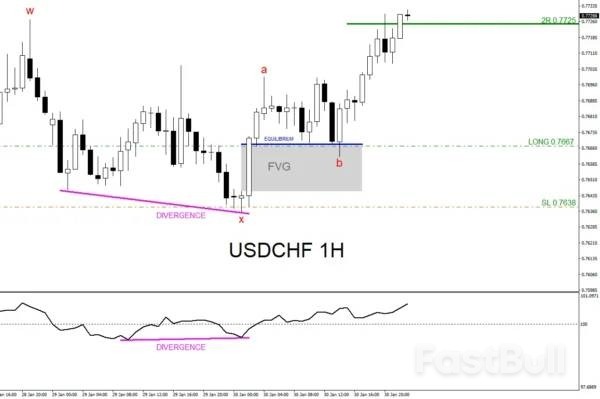
USDCHF moves higher and hits 2R target at 0.7725 where I closed buy position for +58 pips and a +2% profit gain. (Risking 1% on every trade)
A trader should always have multiple strategies all lined up before entering a trade. Never trade off one simple strategy. When multiple strategies all line up it allows a trader to see a clearer trade setup.
We at EWF never say we are always right. No market service provider can forecast markets with 100% accuracy. Only thing we at EWF 100%, is that we are RIGHT more than we are WRONG.
Of course, like any strategy/technique, there will be times when the strategy/technique fails so proper money/risk management should always be used on every trade.
The unemployment rate ticked up to 5.4% in the December quarter. The details were positive though, with growth in jobs and hours being outstripped by an even larger rise in participation.
The December quarter labour market surveys showed some early signs of improvement in the jobs market, despite a further small rise in the headline unemployment rate. Wage growth measures remained unsurprisingly subdued at this stage of the cycle.
Overall, we think the results were broadly in line with the Reserve Bank's forecasts and won't give them much new to mull over ahead of their 18 February policy review. What that means is there is little here to hurry the RBNZ quickly towards reversing those last 75bp of OCR cuts made after August 2025. Still muted wage pressures should imply there is time to assess the strength and durability of the recovery before raising rates. We remain comfortable with our forecast of a December 2026 first rate hike.
The number of people employed rose by 0.5% for the quarter – actually more than what was suggested by the Monthly Employment Indicator, and ahead of the 0.3% rise in the working-age population. However, there was an even more significant rise in labour force participation from 70.3% to 70.5%, with the net result being an uptick in the unemployment rate. In any case, both of these 'surprises' are well with the margin of error for this survey, and we don't regard them as being meaningfully different from our expectations.
Another positive indicator from the household survey was a 1% rise in hours worked for the quarter, on top of a 1.1% rise in the September quarter. We certainly wouldn't dismiss this lightly, given that this measure has been an unusually good guide to the swings in quarterly GDP in recent times. However, there was a contrasting 0.5% fall in total hours paid in the business-oriented Quarterly Employment Survey (which had also seen a strong 1.1% rise last quarter).
Given the existing degree of slack in the labour market, wage trends unsurprisingly remained subdued. The Labour Cost Index rose by 0.4% overall for the quarter, with a 0.5% rise in the private sector and a more modest 0.3% rise in the public sector. On an annual basis the LCI rose by 2.0%, its slowest pace since March 2021.
The unadjusted analytical LCI, which includes pay increases that are related to higher productivity, rose by 0.8% for the quarter, slightly more than the 0.7% rise in the September quarter. The annual growth rate slowed from 3.4% to 3.3%, also the lowest reading since March 2021. The distribution of pay rates continues to drift towards annual increases in the 2-3% range, and away from the larger increases that were more common in previous years.
The United States and Israel have kicked off joint naval military exercises in the Red Sea, a clear show of force as diplomatic tensions with Iran continue to build. The war games began on Monday, signaling a coordinated military posture between the two allies amid fears of a potential conflict.
The Israel Defense Forces (IDF) confirmed the exercise on X, stating, "A joint exercise was conducted yesterday between a U.S. Navy destroyer and Israeli Navy vessels." The statement noted that the drill is part of the ongoing cooperation between the Israeli Navy and the US Fifth Fleet. The IDF added that the American destroyer's port visit was a pre-planned, routine part of the "strategic and close cooperation between the two navies."

This move comes as the US continues to bolster its military presence in the Gulf region with cargo planes, fighter jets, and advanced air defense systems in preparation for any potential escalation with Iran.
The joint drills follow a series of military maneuvers by Iran. In recent days, Iran conducted limited live-fire exercises in the strategic Strait of Hormuz and previously held joint naval operations with China and Russia.
Despite this activity, a fragile de-escalation appears to be in effect. The USS Lincoln carrier group has reportedly moved away from the potential flashpoint and into waters off Yemen, seemingly to lower the temperature ahead of anticipated nuclear negotiations between the US and Iran, which are set to be hosted by Turkey.
While Iran has shown willingness to discuss its nuclear program, negotiations are complicated by Washington's maximalist demands. A key sticking point is the US insistence that Tehran curtails or abandons its ballistic missile program—a non-starter for Iranian leaders.
Iran views its missile capability as a critical defensive tool, particularly after being attacked without warning during the June war. Giving up this deterrent would leave the country vulnerable in any future conflict with Israel. This deep-seated distrust is compounded by the Trump administration's unilateral withdrawal from the Obama-era JCPOA nuclear deal, leaving Iran suspicious of US motives.
Simultaneously, Israeli defense officials have been meeting with top US military leaders, with the Netanyahu government reportedly lobbying the Pentagon for a more robust stance against Iran.
However, an underlying strategic gap may exist between the US and Israeli leadership. One Middle East observer noted a "persistent and unresolved gap between Trump and Prime Minister Netanyahu," which was not closed even during the recent 12-day war.
According to the same analyst, even when President Trump authorized potential strikes in June, his goal was to use military pressure to force Iran into a better deal, not to achieve regime change. Until recently, the overthrow of the Iranian government was not a frequently stated objective from Trump. This nuance highlights the complex and sometimes conflicting strategies at play as all sides navigate the delicate balance between diplomacy and military deterrence.
The UK unemployment rate is on track to hit its highest level since 2015 this year, driven by a sharp increase in labor costs, according to a new forecast from the National Institute of Economic and Social Research (NIESR).
The think tank predicts the jobless rate will average 5.4% in the current year, a notable increase from 4.8% in 2025 and higher than most other economic projections.
A key factor behind the forecast is the mounting cost of hiring workers. "Part of this unemployment story in the UK is rising labour costs," explained NIESR economist Ben Caswell.
According to the institute's analysis, the cost of employing an entry-level worker surged by 10.6% last year. This was fueled by two main drivers:
• A rising minimum wage: Recent government policy has pushed the minimum wage to two-thirds of median earnings.
• Higher employer taxes: An increase in social security contributions last year added to the financial burden on companies.
NIESR found a direct correlation between these costs and job figures. "Industries which have a larger share of their workforce on the minimum wage have also experienced larger increases in their respective unemployment rates," Caswell noted.
The pressure on employers is set to continue, with Britain's minimum wage scheduled to rise by another 4% in April. Prime Minister Keir Starmer's government also plans to continue phasing out the lower minimum wage rates for 18-20 year-old workers, further standardizing labor costs.
NIESR's analysis also identified emerging weakness in the IT sector, where a rise in unemployment may be linked to the adoption of artificial intelligence reducing the demand for certain entry-level positions.
However, the think tank clarified that the rising unemployment rate isn't solely due to a lack of job vacancies. The labor pool itself is expanding. More people who were previously considered economically inactive—neither working nor looking for a job—are now seeking employment. This trend, which follows a post-pandemic rise in inactivity rates, is increasing the number of people officially counted as unemployed.
Looking ahead, NIESR projects the unemployment rate will likely fall to 5% by 2028 or 2029, which it considers a sustainable long-term level outside of an economic boom. This comes after the official unemployment rate hit a nearly 50-year low of 3.8% in 2022 and 2019, though the survey used for that data is currently being overhauled due to quality concerns.
Alongside its unemployment forecast, NIESR also revised its economic growth projections for 2026 and 2027 upward to 1.4% and 1.3%, respectively. The institute anticipates two interest rate cuts from the Bank of England this year, which would lower the benchmark rate from 3.75% to 3.25%.
This prediction is more aggressive than the market consensus. Economists surveyed by Reuters do not expect the first rate cut to occur before March at the earliest. The Bank of England is scheduled to release its own updated economic forecasts on Thursday.
India and the United States have forged a significant trade pact that lowers tariffs on Indian exports from 25% to 18%. The agreement, announced by Trump, also includes a commitment from India to halt purchases of Russian crude oil and instead buy from the U.S. and potentially Venezuela.
According to the announcement, India has pledged to purchase $500 billion worth of American agriculture, technology, energy, and other products. This development comes less than a week after India finalized a major free trade agreement with the European Union, signaling a rapid realignment of its global trade relationships.
While many specifics of the U.S. deal are still being finalized, investors are already identifying key sectors poised to benefit.
India's labor-intensive export sector is seen as a primary winner. According to James Thom, senior investment director at Aberdeen Investments, industries like textiles, clothing, leather, jewelry, toys, and furniture now have a clear opportunity to reclaim market share from regional manufacturing rivals.
The new 18% tariff rate positions India more competitively against:
• Pakistan: 19% tariff
• Vietnam: 20% tariff
• Bangladesh: 20% tariff
Thom noted that small and medium-sized companies are particularly well-positioned to gain from the tariff reduction. He added that the agreement should also provide a lift to banks, non-banking financial companies, and export-focused manufacturers, boosting overall retail sentiment in small and mid-cap stocks.
Analysts at Bernstein suggest that last week's India-EU treaty likely prompted the U.S. to accelerate its own deal with India. The agreement brings India more in line with its peers in the Association of Southeast Asian Nations (ASEAN), which analysts called "incrementally a big positive." It also enhances India's competitive standing relative to China.
While certain industries like autos and metals might still face sector-specific tariffs, the improved diplomatic climate is expected to create broad-based advantages.
Bernstein analysts Venugopal Garre and Nikhil Arela highlighted that India's information technology sector stands to gain significantly. Although the trade pact primarily covers manufactured goods, the improved U.S.-India relations are expected to reduce regulatory scrutiny on I.T. services and lower the risk of future punitive actions, such as additional taxes.
Based on this, the analysts outlined a tactical "buy" recommendation for Indian equities, with a short-term rebound expected in financials, I.T., and telecoms.
Meanwhile, the recent EU trade deal has put a spotlight on India's pharmaceutical industry. According to BMI, Fitch Ratings' research unit, the elimination of 11% tariffs on EU drug imports—covering cancer therapies, biologics, and GLP-1s—is a game-changer. These imports amounted to $1.2 billion in 2024.
BMI forecasts that lower import costs and more efficient supply chains will drive India's pharmaceutical market from $31.2 billion in 2025 to $45.7 billion by 2035, representing a compound annual growth rate of 5.2%. The EU agreement is also expected to help Indian firms diversify their export markets and reverse recent stagnation by streamlining regulatory compliance and reducing administrative costs.
The trade announcement immediately lifted market sentiment. Russ Mould, investment director at A.J. Bell, pointed to the Sensex's 2.5% rise as evidence of renewed investor confidence. The Sensex index tracks 30 of the largest and most actively traded companies on the Bombay Stock Exchange.
The positive momentum extended to UK-listed investment trusts with Indian exposure. Ashoka India, for instance, saw its shares climb 5.6% on the FTSE 250.
"India has been a rich source of returns for investors over the past few decades, but Trump's tariff regime stalled momentum in the Sensex index," Mould said. "Investors will now be wondering if the trade deal effectively removes the shackles on the market and breathes new life into it, rather than simply resulting in a short-term relief rally."
China's booming export sector is fueling a powerful rally in its currency, the yuan, creating a critical challenge for policymakers. While most analysts believe officials will step in to halt further gains, mounting market pressure suggests the yuan could test levels that strain the country's economic model.
The currency's strength is being driven by record-breaking foreign exchange inflows. In December, a staggering $452 billion in foreign currency flowed into Chinese banks, with a record $311 billion of that converted into yuan, according to data from the State Administration of Foreign Exchange. This wave of demand pushed the yuan to 6.9378 per dollar, its strongest point since 2023.
Most bank analysts believe the People's Bank of China (PBOC) will draw a line in the sand to prevent the yuan from appreciating much further. The consensus forecast from 13 global investment banks sees the currency ending the year at 6.92 per dollar, while derivatives markets are pricing it closer to 6.8.
To maintain control, authorities have a well-established toolkit:
• Official Guidance: Setting the yuan's daily midpoint trading fix at a level that signals disapproval of rapid gains.
• State Bank Intervention: Directing state-owned banks to buy U.S. dollars in the open market to absorb upward pressure on the yuan.
• Reserve Ratio Adjustments: Tweaking the foreign exchange reserve requirements for banks, which can compel them to hold more dollars.
"Given that China's economic growth is still highly dependent on exports, the People's Bank of China may not yet be willing to risk a more significant appreciation of the currency," explained Wei He, an economist at Gavekal Dragonomics.
Traders have already noted that the PBOC's midpoint has been consistently weaker than market estimates since November, a clear sign of official resistance. Janice Xue, a strategist at Bank of America Global Research, also anticipates policy tweaks, stating, "We see a high chance for the 20% risk reserve on banks' forward FX sale to be removed and expect FX reserve requirement ratio to be raised."
Despite the central bank's influence, some analysts see risks skewed toward a stronger yuan. Goldman Sachs recently upgraded its 12-month forecast to 6.7 per dollar, which would represent a 3.5% appreciation from current levels.
"The pace of appreciation has exceeded our expectations," Goldman analysts noted, citing the record currency flows and what they perceive as a shift in tone from the central bank.
A key risk is the creation of a positive feedback loop. As the yuan strengthens, exporters are incentivized to convert their dollar earnings into yuan more quickly to avoid future losses. This increased demand for yuan then pushes the currency even higher.
This dynamic is already playing out. An electrical industry exporter based in Shanghai, who gave his surname as Ding, confirmed his firm was converting dollars to yuan faster in response to the recent exchange rate moves. While the 68.8% of export receipts converted to yuan in December was not a record, it signals a growing trend.
The yuan's trajectory presents a fundamental dilemma for Beijing. China's 5% GDP growth last year was heavily reliant on a record $1.2 trillion trade surplus, an increase of about 20% from the previous year. A runaway currency rally would erode the competitive advantage of Chinese exporters and could put this growth engine at risk.
"Our base scenario remains a strong export performance, which could support the yuan," said Chaoping Zhu, global market strategist at J.P. Morgan Asset Management. "However, as foreign governments become more cautious about the impacts on their economies, uncertainties are rising for Chinese export growth."
This suggests a future of "higher two-way volatility," with the exchange rate likely fluctuating around the 7-per-dollar mark.
For now, the PBOC appears focused on ensuring any appreciation is "on a gradual, measured pace," according to Kelvin Lam, senior China+ economist at Pantheon Macroeconomics. By managing a slow and stable nine-month rally that has lifted the yuan nearly 6% against the dollar, policymakers aim to boost the currency's appeal for international trade and investment without derailing the export machine that powers the economy.
The risk of loss in trading financial instruments such as stocks, FX, commodities, futures, bonds, ETFs and crypto can be substantial. You may sustain a total loss of the funds that you deposit with your broker. Therefore, you should carefully consider whether such trading is suitable for you in light of your circumstances and financial resources.
No decision to invest should be made without thoroughly conducting due diligence by yourself or consulting with your financial advisors. Our web content might not suit you since we don't know your financial conditions and investment needs. Our financial information might have latency or contain inaccuracy, so you should be fully responsible for any of your trading and investment decisions. The company will not be responsible for your capital loss.
Without getting permission from the website, you are not allowed to copy the website's graphics, texts, or trademarks. Intellectual property rights in the content or data incorporated into this website belong to its providers and exchange merchants.
Not Logged In
Log in to access more features
Log In
Sign Up