• Trade
  • Markets
  • Copy
  • Contests
  • News
  • 24/7
  • Calendar
  • Q&A
  • Chats
Trending
Screeners
SYMBOL
LAST
BID
ASK
HIGH
LOW
NET CHG.
%CHG.
SPREAD
SPX
S&P 500 Index
6827.42
6827.42
6827.42
6899.86
6801.80
-73.58
-1.07%
--
DJI
Dow Jones Industrial Average
48458.04
48458.04
48458.04
48886.86
48334.10
-245.98
-0.51%
--
IXIC
NASDAQ Composite Index
23195.16
23195.16
23195.16
23554.89
23094.51
-398.69
-1.69%
--
USDX
US Dollar Index
97.950
98.030
97.950
98.500
97.950
-0.370
-0.38%
--
EURUSD
Euro / US Dollar
1.17394
1.17409
1.17394
1.17496
1.17192
+0.00011
+ 0.01%
--
GBPUSD
Pound Sterling / US Dollar
1.33707
1.33732
1.33707
1.33997
1.33419
-0.00148
-0.11%
--
XAUUSD
Gold / US Dollar
4299.39
4299.39
4299.39
4353.41
4257.10
+20.10
+ 0.47%
--
WTI
Light Sweet Crude Oil
57.233
57.485
57.233
58.011
56.969
-0.408
-0.71%
--

Community Accounts

Signal Accounts
--
Profit Accounts
--
Loss Accounts
--
View More

Become a signal provider

Sell trading signals to earn additional income

View More

Guide to Copy Trading

Get started with ease and confidence

View More

Signal Accounts for Members

All Signal Accounts

Best Return
  • Best Return
  • Best P/L
  • Best MDD
Past 1W
  • Past 1W
  • Past 1M
  • Past 1Y

All Contests

  • All
  • Trump Updates
  • Recommend
  • Stocks
  • Cryptocurrencies
  • Central Banks
  • Featured News
Top News Only
Share

China's Central Financial And Economic Affairs Commission Deputy Director: Will Expand Export And Increase Import In 2026

Share

Thai Leader Anutin: Landmine Blast That Killed Thai Soldiers 'Not A Roadside Accident'

Share

Thai Leader Anutin: Thailand To Continue Military Action Until 'We Feel No More Harm'

Share

Cambodian Prime Minister Hun Manet Says He Had Phone Calls With Trump And Malaysian Leader Anwar About Ceasefire

Share

Cambodia's Hun Manet Says USA, Malaysia Should Verify 'Which Side Fired First' In Latest Conflict

Share

Cambodia's Hun Manet: Cambodia Maintains Its Stance In Seeking Peaceful Resolution Of Disputes

Share

Nasdaq Companies: Allergan, Ferrovia, Insmed, Monolithic Power Systems, Seagate Technology, And Western Digital Will Be Added To The NASDAQ 100 Index. Biogen, CdW, GlobalFoundries, Lululemon, ON Semiconductor, And Tradedesk Will Be Removed From The NASDAQ 100 Index

Share

Witkoff Headed To Berlin This Weekend To Meet With Zelenskiy, European Leaders -Wsj Reporter On X

Share

Russia Attacks Two Ukrainian Ports, Damaging Three Turkish-Owned Vessels

Share

[Historic Flooding Occurs In At Least Four Rivers In Washington State Due To Days Of Torrential Rains] Multiple Areas In Washington State Have Been Hit By Severe Flooding Due To Days Of Torrential Rains, With At Least Four Rivers Experiencing Historic Flooding. Reporters Learned On The 12th That The Floods Caused By The Torrential Rains In Washington State Have Destroyed Homes And Closed Several Highways. Experts Warn That Even More Severe Flooding May Occur In The Future. A State Of Emergency Has Been Declared In Washington State

Share

Trump Says Proposed Free Economic Zone In Donbas Would Work

Share

Trump: I Think My Voice Should Be Heard

Share

Trump Says Will Be Choosing New Fed Chair In Near Future

Share

Trump Says Proposed Free Economic Zone In Donbas Complex But Would Work

Share

Trump Says Land Strikes In Venezuela Will Start Happening

Share

US President Trump: Thailand And Cambodia Are In A Good Situation

Share

State Media: North Korean Leader Kim Hails Troops Returning From Russia Mission

Share

The 10-year Treasury Yield Rose About 5 Basis Points During The "Fed Rate Cut Week," And The 2/10-year Yield Spread Widened By About 9 Basis Points. On Friday (December 12), In Late New York Trading, The Yield On The Benchmark 10-year US Treasury Note Rose 2.75 Basis Points To 4.1841%, A Cumulative Increase Of 4.90 Basis Points For The Week, Trading Within A Range Of 4.1002%-4.2074%. It Rose Steadily From Monday To Wednesday (before The Fed Announced Its Rate Cut And Treasury Bill Purchase Program), Subsequently Exhibiting A V-shaped Recovery. The 2-year Treasury Yield Fell 1.82 Basis Points To 3.5222%, A Cumulative Decrease Of 3.81 Basis Points For The Week, Trading Within A Range Of 3.6253%-3.4989%

Share

Trump: Lots Of Progress Being Made On Russia-Ukraine

Share

NOPA November US Soybean Crush Estimated At 220.285 Million Bushels

TIME
ACT
FCST
PREV
U.K. Trade Balance Non-EU (SA) (Oct)

A:--

F: --

P: --

U.K. Trade Balance (Oct)

A:--

F: --

P: --

U.K. Services Index MoM

A:--

F: --

P: --

U.K. Construction Output MoM (SA) (Oct)

A:--

F: --

P: --

U.K. Industrial Output YoY (Oct)

A:--

F: --

P: --

U.K. Trade Balance (SA) (Oct)

A:--

F: --

P: --

U.K. Trade Balance EU (SA) (Oct)

A:--

F: --

P: --

U.K. Manufacturing Output YoY (Oct)

A:--

F: --

P: --

U.K. GDP MoM (Oct)

A:--

F: --

P: --

U.K. GDP YoY (SA) (Oct)

A:--

F: --

P: --

U.K. Industrial Output MoM (Oct)

A:--

F: --

P: --

U.K. Construction Output YoY (Oct)

A:--

F: --

P: --

France HICP Final MoM (Nov)

A:--

F: --

P: --

China, Mainland Outstanding Loans Growth YoY (Nov)

A:--

F: --

P: --

China, Mainland M2 Money Supply YoY (Nov)

A:--

F: --

P: --

China, Mainland M0 Money Supply YoY (Nov)

A:--

F: --

P: --

China, Mainland M1 Money Supply YoY (Nov)

A:--

F: --

P: --

India CPI YoY (Nov)

A:--

F: --

P: --

India Deposit Gowth YoY

A:--

F: --

P: --

Brazil Services Growth YoY (Oct)

A:--

F: --

P: --

Mexico Industrial Output YoY (Oct)

A:--

F: --

P: --

Russia Trade Balance (Oct)

A:--

F: --

P: --

Philadelphia Fed President Henry Paulson delivers a speech
Canada Building Permits MoM (SA) (Oct)

A:--

F: --

P: --

Canada Wholesale Sales YoY (Oct)

A:--

F: --

P: --

Canada Wholesale Inventory MoM (Oct)

A:--

F: --

P: --

Canada Wholesale Inventory YoY (Oct)

A:--

F: --

P: --

Canada Wholesale Sales MoM (SA) (Oct)

A:--

F: --

P: --

Germany Current Account (Not SA) (Oct)

A:--

F: --

P: --

U.S. Weekly Total Rig Count

A:--

F: --

P: --

U.S. Weekly Total Oil Rig Count

A:--

F: --

P: --

Japan Tankan Large Non-Manufacturing Diffusion Index (Q4)

--

F: --

P: --

Japan Tankan Small Manufacturing Outlook Index (Q4)

--

F: --

P: --

Japan Tankan Large Non-Manufacturing Outlook Index (Q4)

--

F: --

P: --

Japan Tankan Large Manufacturing Outlook Index (Q4)

--

F: --

P: --

Japan Tankan Small Manufacturing Diffusion Index (Q4)

--

F: --

P: --

Japan Tankan Large Manufacturing Diffusion Index (Q4)

--

F: --

P: --

Japan Tankan Large-Enterprise Capital Expenditure YoY (Q4)

--

F: --

P: --

U.K. Rightmove House Price Index YoY (Dec)

--

F: --

P: --

China, Mainland Industrial Output YoY (YTD) (Nov)

--

F: --

P: --

China, Mainland Urban Area Unemployment Rate (Nov)

--

F: --

P: --

Saudi Arabia CPI YoY (Nov)

--

F: --

P: --

Euro Zone Industrial Output YoY (Oct)

--

F: --

P: --

Euro Zone Industrial Output MoM (Oct)

--

F: --

P: --

Canada Existing Home Sales MoM (Nov)

--

F: --

P: --

Euro Zone Total Reserve Assets (Nov)

--

F: --

P: --

U.K. Inflation Rate Expectations

--

F: --

P: --

Canada National Economic Confidence Index

--

F: --

P: --

Canada New Housing Starts (Nov)

--

F: --

P: --

U.S. NY Fed Manufacturing Employment Index (Dec)

--

F: --

P: --

U.S. NY Fed Manufacturing Index (Dec)

--

F: --

P: --

Canada Core CPI YoY (Nov)

--

F: --

P: --

Canada Manufacturing Unfilled Orders MoM (Oct)

--

F: --

P: --

Canada Manufacturing New Orders MoM (Oct)

--

F: --

P: --

Canada Core CPI MoM (Nov)

--

F: --

P: --

Canada Manufacturing Inventory MoM (Oct)

--

F: --

P: --

Canada CPI YoY (Nov)

--

F: --

P: --

Canada CPI MoM (Nov)

--

F: --

P: --

Canada CPI YoY (SA) (Nov)

--

F: --

P: --

Canada Core CPI MoM (SA) (Nov)

--

F: --

P: --

Q&A with Experts
    • All
    • Chatrooms
    • Groups
    • Friends
    Connecting
    .
    .
    .
    Type here...
    Add Symbol or Code

      No matching data

      All
      Trump Updates
      Recommend
      Stocks
      Cryptocurrencies
      Central Banks
      Featured News
      • All
      • Russia-Ukraine Conflict
      • Middle East Flashpoint
      • All
      • Russia-Ukraine Conflict
      • Middle East Flashpoint
      Search
      Products

      Charts Free Forever

      Chats Q&A with Experts
      Screeners Economic Calendar Data Tools
      Membership Features
      Data Warehouse Market Trends Institutional Data Policy Rates Macro

      Market Trends

      Market Sentiment Order Book Forex Correlations

      Top Indicators

      Charts Free Forever
      Markets

      News

      News Analysis 24/7 Columns Education
      From Institutions From Analysts
      Topics Columnists

      Latest Views

      Latest Views

      Trending Topics

      Top Columnists

      Latest Update

      Signals

      Copy Rankings Latest Signals Become a signal provider AI Rating
      Contests
      Brokers

      Overview Brokers Assessment Rankings Regulators News Claims
      Broker listing Forex Brokers Comparison Tool Live Spread Comparison Scam
      Q&A Complaint Scam Alert Videos Tips to Detect Scam
      More

      Business
      Events
      Careers About Us Advertising Help Center

      White Label

      Data API

      Web Plug-ins

      Affiliate Program

      Awards Institution Evaluation IB Seminar Salon Event Exhibition
      Vietnam Thailand Singapore Dubai
      Fans Party Investment Sharing Session
      FastBull Summit BrokersView Expo
      Recent Searches
        Top Searches
          Markets
          News
          Analysis
          User
          24/7
          Economic Calendar
          Education
          Data
          • Names
          • Latest
          • Prev

          View All

          No data

          Scan to Download

          Faster Charts, Chat Faster!

          Download App
          English
          • English
          • Español
          • العربية
          • Bahasa Indonesia
          • Bahasa Melayu
          • Tiếng Việt
          • ภาษาไทย
          • Français
          • Italiano
          • Türkçe
          • Русский язык
          • 简中
          • 繁中
          Open Account
          Search
          Products
          Charts Free Forever
          Markets
          News
          Signals

          Copy Rankings Latest Signals Become a signal provider AI Rating
          Contests
          Brokers

          Overview Brokers Assessment Rankings Regulators News Claims
          Broker listing Forex Brokers Comparison Tool Live Spread Comparison Scam
          Q&A Complaint Scam Alert Videos Tips to Detect Scam
          More

          Business
          Events
          Careers About Us Advertising Help Center

          White Label

          Data API

          Web Plug-ins

          Affiliate Program

          Awards Institution Evaluation IB Seminar Salon Event Exhibition
          Vietnam Thailand Singapore Dubai
          Fans Party Investment Sharing Session
          FastBull Summit BrokersView Expo

          US Durable Goods Orders Rise for First Time in Three Months

          Zi Cheng

          Traders' Opinions

          Economic

          Summary:

          New orders placed with US factories for durable goods rose in February for the first time in three months.
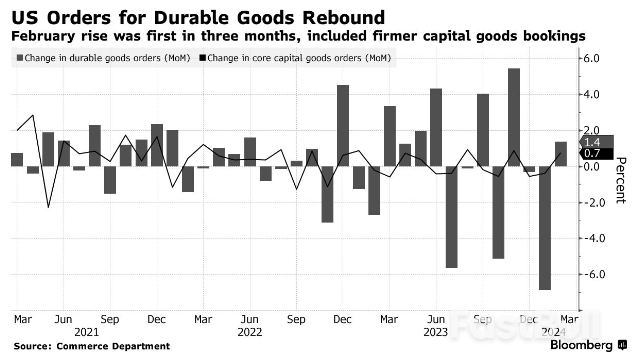
          New orders placed with US factories for durable goods rose in February for the first time in three months, suggesting firms are somewhat optimistic about the direction of the economy.
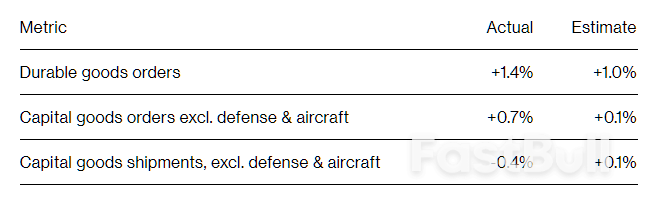
          Bookings for all durable goods — items meant to last at least three years — increased 1.4%, following a downwardly revised 6.9% drop in January, Commerce Department figures showed Tuesday. The median estimate in a Bloomberg survey of economists called for a 1% increase.
          Excluding transportation equipment, orders rose 0.5% after falling the previous two months.

          US Durable Goods Orders Rise for First Time in Three Months_1Source: Commerce Department

          The value of core capital goods orders, a proxy for investment in equipment that excludes aircraft and military hardware, increased 0.7% last month, also after falling in January. The data aren’t adjusted for inflation.
          Core capital goods shipments, a figure that is used to help calculate equipment investment in the government’s gross domestic product report, fell 0.4%. The initial estimate of first-quarter GDP is due in late April.
          US Durable Goods Orders Rise for First Time in Three Months_2
          The Commerce Department’s report showed bookings for commercial aircraft, which are volatile from month to month, nearly 25% after plummeting in January by the most since June 2020.
          Boeing Co. received 15 orders in February, up from three in January. The company announced on Monday that Chief Executive Officer Dave Calhoun is stepping down at the end of the year, part of a sweeping leadership overhaul as the planemaker struggles to get a handle on a safety crisis.
          Bookings also increased for machinery, computers, primary metals and motor vehicles.
          Recent reports have sent mixed signals for US manufacturing. Figures last week showed manufacturing activity expanded by the most since 2022, but a measure of prices received rose to an almost one-year high, suggesting stubborn inflation.

          Source: Bloomberg

          To stay updated on all economic events of today, please check out our Economic calendar
          Risk Warnings and Disclaimers
          You understand and acknowledge that there is a high degree of risk involved in trading. Following any strategies or investment methods may lead to potential losses. The content on the site is provided by our contributors and analysts for information purposes only. You are solely responsible for determining whether any trading assets, securities, strategy, or any other product is suitable for investing based on your own investment objectives and financial situation.
          Add to Favorites
          Share

          Low Affordability To Weigh On Eurozone Housing Market In 2024

          ING

          Economic

          Unfavourable affordability as one of the key drivers behind last year's housing market correction

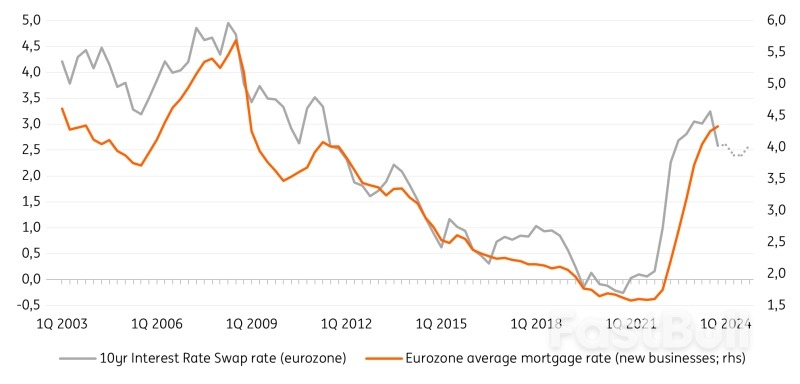
          Over the past two years, mortgage rates in the eurozone almost tripled. The resulting increase in financing costs has put a substantially heavier financial burden on prospective homebuyers and therefore lowered the affordability of residential real estate. The general rise in the cost of living – which has wiped out much of the nominal increase in wages – exacerbated the situation. Accordingly, many people decided to put their spending plans on hold, leading to a significant drop in demand for housing loans and downward pressure on house prices. While demand for housing loans fell by some 30% in 2023 year-on-year, house prices in the eurozone dropped by 2.2% from the peak reached in the third quarter of 2022 to the third quarter of 2023.
          However, there were major differences in house price developments across the eurozone and the latest data from Belgium, Germany, and the Netherlands suggests that this divergent trend continued in the fourth quarter of 2023. In Germany, house prices fell by 2% quarter-on-quarter in the fourth quarter of 2023. This not only corresponds to a price decline of 8.4% for the full year of 2023, but also marks the first annual price decline since 2007. In the Netherlands, house prices fell by 2.9% year-on-year in the full year of 2023, although they started to rise again rapidly in the second half of the year, as illustrated by the 1.7% QoQ increase in the fourth quarter. As a result, house prices were almost back to their mid-2022 peak levels. In Belgium, on the other hand, average house price growth in 2023 was 2.5%. Here, the housing market was supported by the automatic wage indexation, which helped real purchasing power to hold up much better than in other countries, and by an extension of the average maturity at which households borrow.

          House price correction to be followed by a modest rebound in prices

          Looking ahead, house prices in the eurozone should recover slightly this year. While the structural supply deficit of housing is likely to be exacerbated by high material costs and the lack of skilled workers in the construction sector, a moderate increase in demand will probably put slight upward pressure on prices. However, regional differences will persist. The price decline of some 8% in 2023 is likely to be followed by an only marginal increase in house prices of less than 1% in Germany, leaving house prices well below their pre-interest rate turnaround levels. While we assume steady further growth in house prices of 3% in Belgium, house price growth is expected to accelerate in the Netherlands in 2024. Here, the limited supply of homes combined with increased borrowing capacity is expected to push house prices further upwards.Low Affordability To Weigh On Eurozone Housing Market In 2024_1

          Downward potential for mortgage rates limited, despite ECB to cut policy rates

          The rise in mortgage interest rates and the corresponding increase in financing costs have been the main drivers of dropping residential real estate affordability. The development of lending rates is closely linked to long-term capital market interest rates. At the end of last year, long-term interest rates in the eurozone (as measured by the eurozone 10yr Interest Rate Swap rate) had fallen by more than 50bp due to financial market participants' expectations that the European Central Bank would cut key interest rates on a large scale this year. Accordingly, mortgage rates declined both in December and January.
          Low Affordability To Weigh On Eurozone Housing Market In 2024_2
          The drop in mortgage rates was the most pronounced in Germany, with a drop of almost 40bp between November and January, fuelling a significant increase in demand for housing loans. Looking ahead, however, financing costs are not expected to ease significantly any further. As the ECB's future interest rate cuts are already priced in, it would require a surprisingly strong interest rate cut cycle that quickly reverses the rate hikes since July 2022 in order to provide additional downward potential for both capital market and mortgage interest rates.

          Higher wages alone are not enough to improve affordability

          Nominal wages in the eurozone have risen sharply over the past two years. However, they have not risen sufficiently to compensate for high inflation. Consequently, real wages contracted in every single quarter between the first quarter of 2021 and the second quarter of 2023. From the second half of 2023, the drop in headline inflation favoured a marginal increase in real wages – although this was not enough to offset real wage losses of the preceding two years. In addition to the rise in financing costs, this has amplified the decline in purchasing affordability of residential real estate.
          Looking ahead, wage growth in the eurozone is likely to have peaked and should decelerate from here on. Nevertheless, nominal wage growth this year is expected to be stronger than in the past and, more importantly, stronger than inflation. In turn, real wages are likely to increase, thereby returning purchasing power to consumers. In Germany, where the latest wave of strikes demonstrates how strong wage pressure remains, real wages are likely to grow at the fastest pace since 2016. Real wage growth in the Netherlands is also likely to be stronger than in previous years despite a slowdown in nominal wage growth. In Belgium, where wages are linked to inflation, wages will rise more slowly than in other eurozone countries now that inflation has cooled considerably.
          While the expected increase in real wages will have a favorable impact on the affordability of residential real estate, the high level of uncertainty and higher savings interest rates are likely to increase precautionary savings, so that any additional income is more likely to end up in savings accounts and not necessarily in real estate investments.

          Housing market recovery set to be sluggish in 2024

          Whether due to an expected sharp rise in house prices, as in the Netherlands, or due to a rebalancing market characterised by high uncertainty and no further easing of financing costs as in Germany or Belgium, the purchasing affordability of residential real estate is not expected to improve significantly this year. As a result, affordability will remain at historically low levels, which will lead only to a gradual recovery of the eurozone housing market.
          To stay updated on all economic events of today, please check out our Economic calendar
          Risk Warnings and Disclaimers
          You understand and acknowledge that there is a high degree of risk involved in trading. Following any strategies or investment methods may lead to potential losses. The content on the site is provided by our contributors and analysts for information purposes only. You are solely responsible for determining whether any trading assets, securities, strategy, or any other product is suitable for investing based on your own investment objectives and financial situation.
          Add to Favorites
          Share

          Bank of Canada's Rogers Flags Weak Productivity 'Emergency'

          Zi Cheng

          Traders' Opinions

          Economic

          Carolyn Rogers, the bank’s senior deputy governor, said weak business investment and a lack of competition are limiting Canada’s productive capacity. Improving efficiency would allow for faster growth, more jobs and higher wages with less inflationary pressure.
          “You’ve seen those signs that say, ‘In emergency, break glass.’ Well, it’s time to break the glass,” she said in a speech in Halifax on Tuesday.
          Canada’s labor productivity rose for the first time in seven quarters at the end of last year. GDP per capita —an oft-cited measure that also serves as a gauge for living standards — has receded to around 2017 levels.
          The country’s record on productivity is the second-worst among Group of Seven countries, and the gap with the US in terms of the value generated by the economy per hour has worsened for decades, Rogers said.
          “When you compare Canada’s recent productivity record with that of other countries, what really sticks out is how much we lag on investment in machinery, equipment and, importantly, intellectual property.”
          The speech offered little guidance on the immediate path for interest rates or inflation.
          “We’re not all the way back to target and we know we need to finish the job. But we have made a lot of progress,” Rogers said.
          Still, the speech provides insights about the way the Bank of Canada is considering productive capacity in the context of long-run potential growth. Policymakers have consistently flagged the inflation risk of wage growth without productivity increases.
          “Increasing productivity is a way to protect our economy from future bouts of inflation without having to rely so much on the cure of higher interest rates,” Rogers said.
          She said there are three key areas that could improve Canada’s productivity.
          The first is labor composition, or the skills workers bring to the job. For existing workers, that means having access to training and reskilling programs. For new entrants, that means preparing for current and future jobs at colleges, universities and apprenticeship programs, she said.
          She said Canada should also focus on utilizing the skills of immigrants, who were behind a record-setting pace of workforce expansion.

          Bank of Canada's Rogers Flags Weak Productivity 'Emergency'_1Source: Statistics Canada

          “Too often, new Canadians are working in jobs that don’t take advantage of the skills they already possesses. And too often these people wind up stuck in low-wage, low-productivity jobs,” she said.
          The second area is multifactor productivity, which measures how efficiently capital and labor are being used and can refer to how much competition a company faces or how well it’s taking advantage of technologies.
          Canada has proportionally more small and medium-sized companies, which tend to lack the economies of scale that allow larger firms to become more productive, and removing disincentives to growth is “always a good idea,” she said.
          “Businesses become more productive when they’re exposed to competition,” she added. “Competition drives companies to become more productive by innovating and by finding ways to be more efficient.”
          The third is addressing weak investment, which has been a problem in Canada for a long time. There’s a persistent gap between levels of capital spending per worker by Canadian firms compared with US counterparts. It has gotten worse over the past decade: While US spending continues to increase, Canadian investment levels are lower than they were a decade ago.
          Policy uncertainties and the pandemic contributed to the lack of investment in Canada, she acknowledged.
          “We see the risks out there. Yet these same forces and risks are also present in other countries. And companies in those countries — our global competitors — continue to invest, widening the gap with Canada, making it increasingly urgent that we turn the situation around.”
          Members of the central bank’s six-person governing council said it was “still too early” to consider lowering borrowing costs at their March 6 rate decision, where they ultimately held the policy rate at 5% for a fifth straight meeting.
          Economists surveyed by Bloomberg expect the Bank of Canada to start lowering borrowing costs in June. The central bank’s next meeting is April 10.

          Source: Bloomberg

          To stay updated on all economic events of today, please check out our Economic calendar
          Risk Warnings and Disclaimers
          You understand and acknowledge that there is a high degree of risk involved in trading. Following any strategies or investment methods may lead to potential losses. The content on the site is provided by our contributors and analysts for information purposes only. You are solely responsible for determining whether any trading assets, securities, strategy, or any other product is suitable for investing based on your own investment objectives and financial situation.
          Add to Favorites
          Share

          Bank of Japan May Be Less Dovish Than Markets Think

          Devin

          Economic

          Central Bank

          The Bank of Japan has ditched its dovish forward guidance in favour of a more "data-dependent" approach to policy deliberations after ending negative rates, sources say, keeping the door open for another near-term hike in borrowing costs.
          The BOJ ended eight years of negative rates and unorthodox policy last week, making a historic shift away from decades of massive monetary stimulus.
          Despite the rate hike, the yen has tumbled more than 1% since the policy pivot, as markets' dovish reading of the BOJ's communication reinforced expectations that another rate hike would be some time off.
          In its decision last week, the BOJ said it "anticipates that accommodative financial conditions will be maintained for the time being".
          However, a close look at the BOJ statement shows the bank has made no promise to keep interest rates at current low levels but instead conditionally states that borrowing costs could stay low if economic and price conditions don't change.
          "The BOJ has made no commitment about the future rate hike pace," a source familiar with the bank's thinking said on the March statement, a view echoed by another source.
          "The timing of the next move is data-dependent, which means all options are on the table," the first source said.
          The BOJ's language last week compared with the more assertive tone of previous guidance that it "will continue" with ultra-loose policy to stably hit its price target, and "will not hesitate" to ramp up stimulus if needed.
          The new approach to communication aligns the BOJ with other major central banks, including the Federal Reserve, which ditched rigid forward guidance in favour of a more discretionary approach as they hiked rates aggressively to combat soaring inflation.
          While refraining from specifying a timing, BOJ Governor Kazuo Ueda said last week the bank could raise rates if trend inflation, which is still below 2%, heightens "a bit more."
          "If our price forecast clearly overshoots or, even if our median forecast is unchanged, we see a clear increase in upside risk to the price outlook, that will likely lead to a policy change," Ueda said.
          The remarks heighten the importance of the BOJ's fresh quarterly growth and inflation forecasts due at its next policy meeting on April 25-26, which for the first time will include projections for fiscal 2026.
          While the BOJ likely won't hike rates next month, the new forecasts will offer clues on how optimistic policymakers are about the chance of trend inflation heightening to 2%.
          A Reuters poll taken after the March policy shift showed more than a half of economists expect the BOJ to hike rates again this year, though most do not see rate hikes coming at least until the fourth quarter.
          Some analysts see the weak yen as a potential trigger for further rate hikes, as the currency's renewed declines could push up raw material import costs again.
          Ueda has said the BOJ "stood ready to respond" if yen moves had a huge impact on its economic and price projections.
          "The BOJ seems wary of the risk of one-sided yen declines," which could prompt further rate hikes without much pause, said Shunsuke Kobayashi, chief economist at Mizuho Securities.
          "There's a significant chance of the BOJ hiking rates again from October-December onward," he said.
          Others even see the chance of action at the BOJ's meeting on July 25-26, when more data becomes available on whether bumper wages hikes are spreading to smaller firms.
          "If there's a chance of an overshoot in inflation, the BOJ could act as soon as in July," said Mari Iwashita, a veteran BOJ watcher who is chief market economist at Daiwa Securities.

          Source: Reuters

          To stay updated on all economic events of today, please check out our Economic calendar
          Risk Warnings and Disclaimers
          You understand and acknowledge that there is a high degree of risk involved in trading. Following any strategies or investment methods may lead to potential losses. The content on the site is provided by our contributors and analysts for information purposes only. You are solely responsible for determining whether any trading assets, securities, strategy, or any other product is suitable for investing based on your own investment objectives and financial situation.
          Add to Favorites
          Share

          XAU/USD Jumps $25, Fueled by Increased Demand for Gold

          Chandan Gupta

          Traders' Opinions

          Economic

          Commodity

          Fundamental Analysis

          In recent trading sessions, we've witnessed a remarkable surge in gold prices, fueled by a confluence of economic factors that are reshaping the investment landscape.
          At the forefront of this uptrend is the decline in the U.S. Dollar and Treasury yields, two pillars of the global financial system. As the Dollar weakens and Treasury yields dip, investors are seeking refuge in gold, driving its price sharply higher. But what exactly is driving this shift in sentiment?
          A key player in this narrative is the Federal Reserve, the guardian of monetary policy in the United States. Speculations abound regarding the Fed's future actions, with market participants closely monitoring hints from Fed officials and eagerly awaiting economic data releases for clues about the central bank's next move.
          The recent decrease in the 10-year U.S. Treasury yield reflects investors' reactions to the latest economic indicators and their anticipation of imminent inflation data. All eyes are on the upcoming release of the personal consumption expenditures price index, a vital piece of the puzzle that will shape forecasts regarding the Federal Reserve's interest rate decisions.
          Speaking of interest rates, the Federal Reserve's approach to monetary policy is a crucial factor driving market sentiment. While there have been murmurs about potential rate cuts in the near future, recent comments from Federal Reserve authorities suggest a more cautious stance. Fed officials appear to be waiting for more concrete economic data before committing to any significant policy changes, diverging from the market's expectations of immediate rate reductions.
          But what does all of this mean for the almighty Dollar? The Dollar index has experienced a slight dip, prompted in part by speculation about a potential rate cut in June and influenced by other global factors such as the strength of the yen. Additionally, the release of the U.S. core personal consumption expenditures data looms large, poised to impact future U.S. interest rate trajectories.
          Market predictions currently point to a 70% likelihood of the Federal Reserve initiating rate reductions in June, aligning with broader expectations of interest rate cuts in the coming years. This forecast underscores the attractiveness of gold as an investment, particularly in an environment of lower interest rates where holding the precious metal becomes less costly.
          Meanwhile, holdings in SPDR Gold Trust have remained steady, signaling continued interest in gold from institutional investors. As we await the release of the U.S. core personal consumption expenditure price index data, the market eagerly anticipates insights into inflation trends and their implications for future monetary policy decisions.
          Looking ahead, the short-term outlook for gold prices appears bullish, buoyed by the interplay between Treasury yields, the Dollar's performance, and forthcoming economic data. However, long-term support for gold is reinforced by ongoing central bank buying, providing a buffer against significant downside risks.

          Technical Analysis

          Recent sessions have seen gold posting a significant gain, setting the stage for a potential showdown with the formidable resistance level at $2222.915. However, beneath the surface, key support and resistance levels delineate the battleground for price action.
          At the forefront of analysis is the formation of a new main bottom at $2146.155. A breach of this level could signal a shift in the main trend, potentially triggering a downward spiral with the 50-day moving average at $2073.585 emerging as a primary target. This moving average holds sway over the intermediate trend, offering crucial insights into market sentiment.
          Despite the slight decrease in gold's value, currently trading at $2172.58, the market sentiment remains buoyed by an underlying bullish sentiment, as evidenced by its position above the pivotal pivot point of $2165.81. However, the journey ahead is fraught with obstacles, with key resistance levels at $2185.16, $2196.73, and $2212.21 looming as potential barriers to further advances.
          Conversely, in the face of downward pressure, support levels at $2149.29, $2134.65, and $2120.02 stand ready to cushion against adverse movements, providing a semblance of stability amidst volatility.
          Delving deeper into trend analysis, the 50-day Exponential Moving Average (EMA) at $2167.062 and the 200-day EMA at $2113.003 offer valuable insights into the trajectory of gold prices. Both indicators lend support to the prevailing bullish trend, underscoring the resilience of gold as an asset class.
          However, amidst the optimism, caution is warranted. The overarching bullish trend remains intact above the critical level of $2165. Yet, a breach below this threshold could signal a significant shift in sentiment, potentially catalyzing a notable sell-off in gold prices.XAU/USD Jumps $25, Fueled by Increased Demand for Gold_1
          To stay updated on all economic events of today, please check out our Economic calendar
          Risk Warnings and Disclaimers
          You understand and acknowledge that there is a high degree of risk involved in trading. Following any strategies or investment methods may lead to potential losses. The content on the site is provided by our contributors and analysts for information purposes only. You are solely responsible for determining whether any trading assets, securities, strategy, or any other product is suitable for investing based on your own investment objectives and financial situation.
          Add to Favorites
          Share

          Asian Stocks Falter Amidst Yuan's Decline

          Ukadike Micheal

          Economic

          Stocks

          Asian equities faced challenges on Tuesday amid mixed messages from U.S. monetary policymakers and instability in the Chinese yuan, unsettling traders ahead of the impending release of U.S. inflation data. The possibility of Japan intervening to prevent further declines in the yen added pressure on the dollar, although it saw gains against the yuan due to speculation that China might tolerate a weaker currency. MSCI's broadest index of Asia-Pacific shares outside Japan rose 0.3%, led by gains in South Korea's Kospi, particularly driven by chipmaker stocks. However, other markets lacked direction, with sentiment in China and Hong Kong still fragile following Friday's sudden yuan depreciation.
          Investors in Hong Kong remained cautious, awaiting indications of support for the property market and monitoring any potential policy shifts signaled by Friday's unexpected yuan depreciation. The subdued mood was underscored by the decline in shares of insurer AIA, which fell 17% in the past 10 trading days, reflecting heightened investor anxiety. Japan's Nikkei remained steady, alongside the yen, which traded at 151.38 per dollar. In the futures market, S&P 500 futures edged up 0.1%, while European futures remained flat, with FTSE futures declining by 0.3%.
          The mixed signals from Federal Reserve officials on Monday added uncertainty to the policy outlook, further complicating matters for markets awaiting the next U.S. inflation indicators. Chicago Fed President Austan Goolsbee projected three rate cuts this year, while Fed Governor Lisa Cook advocated for caution, and Atlanta Fed President Raphael Bostic adjusted his expectations to one rate cut. Analysts noted varying perspectives among Federal Open Market Committee (FOMC) members, with some anticipating zero, one, or two cuts this year.
          The divergence in views among FOMC participants reflects the challenges faced by central banks in navigating the uncertain economic landscape, marked by inflationary pressures and concerns about economic growth. Chairman Jerome Powell faces the task of balancing differing opinions within the committee while maintaining a cohesive monetary policy approach. The upcoming U.S. inflation data release on Good Friday will provide further insights into the inflationary environment, influencing the Fed's decision-making process in the coming months.
          From a technical viewpoint, the fluctuations in Asian equities and currency markets underscore the interconnectedness of global financial markets and the impact of policy decisions on investor sentiment. Uncertainty surrounding monetary policy direction and economic indicators contributes to market volatility, requiring investors to adopt a cautious approach to risk management. Moreover, the influence of geopolitical tensions and external factors on market dynamics highlights the need for a comprehensive understanding of macroeconomic trends and their implications for investment strategies.
          The challenges faced by Asian equities amid mixed signals from U.S. monetary policymakers and currency fluctuations highlight the complexity of the current market environment. As investors navigate evolving market dynamics and await key economic data releases, maintaining a balanced and informed investment approach will be essential for navigating potential risks and capitalizing on opportunities in global markets.

          Source: Reuters

          To stay updated on all economic events of today, please check out our Economic calendar
          Risk Warnings and Disclaimers
          You understand and acknowledge that there is a high degree of risk involved in trading. Following any strategies or investment methods may lead to potential losses. The content on the site is provided by our contributors and analysts for information purposes only. You are solely responsible for determining whether any trading assets, securities, strategy, or any other product is suitable for investing based on your own investment objectives and financial situation.
          Add to Favorites
          Share

          Vietnam Boosts Coal Imports As It Promises Investors No More Power Cuts

          Kevin Du

          Economic

          Commodity

          Energy

          Vietnam's coal imports so far this year have nearly doubled from the same period of 2023, customs data shows, as the government strives to reassure foreign investors that factories will not face a repeat of last year's power shortages.
          During a meeting with foreign investors last week, Prime Minister Pham Minh Chinh vowed there will be no more electricity shortages, state media reported.
          Two foreign officials in attendance, who were not authorised to speak publicly, said Chinh's commitments were reassuring but vague on measures to achieve that goal.
          The prime minister's office did not respond to requests for comment.
          Vietnam's limited capacity to use renewable energy and commitments to avoiding new power cuts makes it "imperative" to import more coal, said Phan Xuan Dung, a researcher on Vietnam at the Singapore-based ISEAS think tank.
          Coal imports, mostly from Australia and Indonesia, were up by roughly 88 per cent as of March 15 compared to the same period last year, customs data shows. In the first two months of the year output also rose 3.3 per cent from domestic mines, which usually cover about half of Vietnam's demand, according to official estimates.
          That comes after Vietnam's 61 per cent increase in imports of the inexpensive fuel last year as coal-fired power plants resumed full production, in line with rising use by Indonesia, Malaysia and other regional peers.
          Coal imports are projected to rise further in the second half of the year, a Vietnam-based trader said, when steelmakers and other energy-intensive industries are expected to boost production.
          No breakdown on power generation is yet available for this year, but on Monday coal-fired plants accounted for about 60 per cent of total output, according to Vietnam's power network operator.
          The combination of imports and domestic output shows coal supply exceeded 8 million metric tons per month in the usually quieter January-February period, nearly 9 per cent higher than the monthly average over the last two years.
          KEEPING THE LIGHTS ON
          Vietnam, which is among the world's top 20 coal users by volume, wants to cut its reliance on the fuel but still expects peak use will not be reached this decade.
          As plans to boost renewable energy and gas face delays, the government wants to complete by June a transmission line to transfer electricity from the country's centre to its industrialised north. That is where heat-induced blackouts occurred last year and the El Nino weather pattern raises the risk of them this year.
          The government is also working on new rules to allow factories to directly purchase power from producers.
          Foreign investors, on which Vietnam's economy is highly reliant, are demanding quick action.
          Semiconductor companies are delaying investment decisions because of power supply risks, the South Korean chamber of commerce in Vietnam said in a paper published last week.
          In a separate paper last week, the American Chamber of Commerce asked the Vietnamese government to ease approval of energy projects to meet increasing power demand.
          Otherwise, attracting high-tech manufacturing and other key goals "will be difficult to reach," the U.S. business group said.

          Source: Reuters

          To stay updated on all economic events of today, please check out our Economic calendar
          Risk Warnings and Disclaimers
          You understand and acknowledge that there is a high degree of risk involved in trading. Following any strategies or investment methods may lead to potential losses. The content on the site is provided by our contributors and analysts for information purposes only. You are solely responsible for determining whether any trading assets, securities, strategy, or any other product is suitable for investing based on your own investment objectives and financial situation.
          Add to Favorites
          Share
          FastBull
          Copyright © 2025 FastBull Ltd

          728 RM B 7/F GEE LOK IND BLDG NO 34 HUNG TO RD KWUN TONG KLN HONG KONG

          TelegramInstagramTwitterfacebooklinkedin
          App Store Google Play Google Play
          Products
          Charts

          Chats

          Q&A with Experts
          Screeners
          Economic Calendar
          Data
          Tools
          Membership
          Features
          Function
          Markets
          Copy Trading
          Latest Signals
          Contests
          News
          Analysis
          24/7
          Columns
          Education
          Company
          Careers
          About Us
          Contact Us
          Advertising
          Help Center
          Feedback
          User Agreement
          Privacy Policy
          Business

          White Label

          Data API

          Web Plug-ins

          Poster Maker

          Affiliate Program

          Risk Disclosure

          The risk of loss in trading financial instruments such as stocks, FX, commodities, futures, bonds, ETFs and crypto can be substantial. You may sustain a total loss of the funds that you deposit with your broker. Therefore, you should carefully consider whether such trading is suitable for you in light of your circumstances and financial resources.

          No decision to invest should be made without thoroughly conducting due diligence by yourself or consulting with your financial advisors. Our web content might not suit you since we don't know your financial conditions and investment needs. Our financial information might have latency or contain inaccuracy, so you should be fully responsible for any of your trading and investment decisions. The company will not be responsible for your capital loss.

          Without getting permission from the website, you are not allowed to copy the website's graphics, texts, or trademarks. Intellectual property rights in the content or data incorporated into this website belong to its providers and exchange merchants.

          Not Logged In

          Log in to access more features

          FastBull Membership

          Not yet

          Purchase

          Become a signal provider
          Help Center
          Customer Service
          Dark Mode
          Price Up/Down Colors

          Log In

          Sign Up

          Position
          Layout
          Fullscreen
          Default to Chart
          The chart page opens by default when you visit fastbull.com