• Trade
  • Markets
  • Copy
  • Contests
  • News
  • 24/7
  • Calendar
  • Q&A
  • Chats
Trending
Screeners
SYMBOL
LAST
BID
ASK
HIGH
LOW
NET CHG.
%CHG.
SPREAD
SPX
S&P 500 Index
6827.42
6827.42
6827.42
6899.86
6801.80
-73.58
-1.07%
--
DJI
Dow Jones Industrial Average
48458.04
48458.04
48458.04
48886.86
48334.10
-245.98
-0.51%
--
IXIC
NASDAQ Composite Index
23195.16
23195.16
23195.16
23554.89
23094.51
-398.69
-1.69%
--
USDX
US Dollar Index
97.950
98.030
97.950
98.500
97.950
-0.370
-0.38%
--
EURUSD
Euro / US Dollar
1.17394
1.17409
1.17394
1.17496
1.17192
+0.00011
+ 0.01%
--
GBPUSD
Pound Sterling / US Dollar
1.33707
1.33732
1.33707
1.33997
1.33419
-0.00148
-0.11%
--
XAUUSD
Gold / US Dollar
4299.39
4299.39
4299.39
4353.41
4257.10
+20.10
+ 0.47%
--
WTI
Light Sweet Crude Oil
57.233
57.485
57.233
58.011
56.969
-0.408
-0.71%
--

Community Accounts

Signal Accounts
--
Profit Accounts
--
Loss Accounts
--
View More

Become a signal provider

Sell trading signals to earn additional income

View More

Guide to Copy Trading

Get started with ease and confidence

View More

Signal Accounts for Members

All Signal Accounts

Best Return
  • Best Return
  • Best P/L
  • Best MDD
Past 1W
  • Past 1W
  • Past 1M
  • Past 1Y

All Contests

  • All
  • Trump Updates
  • Recommend
  • Stocks
  • Cryptocurrencies
  • Central Banks
  • Featured News
Top News Only
Share

The United States And Mexico Have Reached An Agreement On How To Resolve The Water Dispute In The Rio Grande Basin (which Borders Texas). Starting December 15, Mexico Will Supply The U.S. With An Additional 20.2 Acre-feet (a Unit Of Volume For Irrigation). The Agreement Seeks To “strengthen Water Management In The Rio Grande Basin” Within The Framework Of The 1944 Water Treaty

Share

U.S. Transportation Secretary Duffy: The Engine Of United Airlines Flight 803 That Malfunctioned Caught Fire

Share

Ukraine President Zelenskiy: He Will Meet US, European Representatives About Peace

Share

UK Prime Minister Office: Prime Minister Starmer Spoke To The President Of The European Commission Ursula Von Der Leyen This Evening - Downing Street Spokesperson

Share

Trump: We Will Retaliate Against ISIS

Share

Trump Says We Mourn The Loss Of Three Great Patriots In Syria In An Ambush

Share

Syrian Interior Ministry Spokesperson Confirms Attacker Was Member Of Security Forces With Extremist Ideology

Share

Syrian Interior Ministry Says Attacker Did Not Have Leadership Role In Security Forces, Did Not Say If He Was Junior Member

Share

Man Who Attacked Syrian, US Military Was Member Of Syrian Security Forces -Three Local Syrian Officials

Share

US Envoy Coale Says Belarus President Lukashenko Agreed To Do All He Can To Stop Weather Balloons Flying Into Lithuania

Share

Ukraine Says Russian Drone Attack Hit Civilian Turkish Vessel

Share

Islamic State Attacker In Syria Was Lone Gunman, Who Was Killed -USA Central Command

Share

US Envoy John Coale Says Around 1000 Remaining Political Prisoners In Belarus Could Be Released In Coming Months

Share

US Defense Secretary Hegseth: Attacker Was Killed By Partner Forces

Share

Pentagon Says Two USA Army Soldiers And One Civilian USA Interpreter Were Killed, And Three Were Wounded In Syria

Share

Israel Says It Kills Senior Hamas Commander Raed Saed In Gaza

Share

Ukraine's Navy Says Russian Drone Attack Hit Civilian Turkish Vessel Carrying Sunflower Oil To Egypt On Saturday

Share

Israeli Military Says It Put Planned Strike On South Lebanon Site On Hold After Lebanese Army Requested Access

Share

Norwegian Nobel Committee: Calls On The Belarusian Authorities To Release All Political Prisoners

Share

Norwegian Nobel Committee: His Freedom Is A Deeply Welcome And Long-Awaited Moment

TIME
ACT
FCST
PREV
U.K. Trade Balance (Oct)

A:--

F: --

P: --

U.K. Services Index MoM

A:--

F: --

P: --

U.K. Construction Output MoM (SA) (Oct)

A:--

F: --

P: --

U.K. Industrial Output YoY (Oct)

A:--

F: --

P: --

U.K. Trade Balance (SA) (Oct)

A:--

F: --

P: --

U.K. Trade Balance EU (SA) (Oct)

A:--

F: --

P: --

U.K. Manufacturing Output YoY (Oct)

A:--

F: --

P: --

U.K. GDP MoM (Oct)

A:--

F: --

P: --

U.K. GDP YoY (SA) (Oct)

A:--

F: --

P: --

U.K. Industrial Output MoM (Oct)

A:--

F: --

P: --

U.K. Construction Output YoY (Oct)

A:--

F: --

P: --

France HICP Final MoM (Nov)

A:--

F: --

P: --

China, Mainland Outstanding Loans Growth YoY (Nov)

A:--

F: --

P: --

China, Mainland M2 Money Supply YoY (Nov)

A:--

F: --

P: --

China, Mainland M0 Money Supply YoY (Nov)

A:--

F: --

P: --

China, Mainland M1 Money Supply YoY (Nov)

A:--

F: --

P: --

India CPI YoY (Nov)

A:--

F: --

P: --

India Deposit Gowth YoY

A:--

F: --

P: --

Brazil Services Growth YoY (Oct)

A:--

F: --

P: --

Mexico Industrial Output YoY (Oct)

A:--

F: --

P: --

Russia Trade Balance (Oct)

A:--

F: --

P: --

Philadelphia Fed President Henry Paulson delivers a speech
Canada Building Permits MoM (SA) (Oct)

A:--

F: --

P: --

Canada Wholesale Sales YoY (Oct)

A:--

F: --

P: --

Canada Wholesale Inventory MoM (Oct)

A:--

F: --

P: --

Canada Wholesale Inventory YoY (Oct)

A:--

F: --

P: --

Canada Wholesale Sales MoM (SA) (Oct)

A:--

F: --

P: --

Germany Current Account (Not SA) (Oct)

A:--

F: --

P: --

U.S. Weekly Total Rig Count

A:--

F: --

P: --

U.S. Weekly Total Oil Rig Count

A:--

F: --

P: --

Japan Tankan Large Non-Manufacturing Diffusion Index (Q4)

--

F: --

P: --

Japan Tankan Small Manufacturing Outlook Index (Q4)

--

F: --

P: --

Japan Tankan Large Non-Manufacturing Outlook Index (Q4)

--

F: --

P: --

Japan Tankan Large Manufacturing Outlook Index (Q4)

--

F: --

P: --

Japan Tankan Small Manufacturing Diffusion Index (Q4)

--

F: --

P: --

Japan Tankan Large Manufacturing Diffusion Index (Q4)

--

F: --

P: --

Japan Tankan Large-Enterprise Capital Expenditure YoY (Q4)

--

F: --

P: --

U.K. Rightmove House Price Index YoY (Dec)

--

F: --

P: --

China, Mainland Industrial Output YoY (YTD) (Nov)

--

F: --

P: --

China, Mainland Urban Area Unemployment Rate (Nov)

--

F: --

P: --

Saudi Arabia CPI YoY (Nov)

--

F: --

P: --

Euro Zone Industrial Output YoY (Oct)

--

F: --

P: --

Euro Zone Industrial Output MoM (Oct)

--

F: --

P: --

Canada Existing Home Sales MoM (Nov)

--

F: --

P: --

Euro Zone Total Reserve Assets (Nov)

--

F: --

P: --

U.K. Inflation Rate Expectations

--

F: --

P: --

Canada National Economic Confidence Index

--

F: --

P: --

Canada New Housing Starts (Nov)

--

F: --

P: --

U.S. NY Fed Manufacturing Employment Index (Dec)

--

F: --

P: --

U.S. NY Fed Manufacturing Index (Dec)

--

F: --

P: --

Canada Core CPI YoY (Nov)

--

F: --

P: --

Canada Manufacturing Unfilled Orders MoM (Oct)

--

F: --

P: --

Canada Manufacturing New Orders MoM (Oct)

--

F: --

P: --

Canada Core CPI MoM (Nov)

--

F: --

P: --

Canada Manufacturing Inventory MoM (Oct)

--

F: --

P: --

Canada CPI YoY (Nov)

--

F: --

P: --

Canada CPI MoM (Nov)

--

F: --

P: --

Canada CPI YoY (SA) (Nov)

--

F: --

P: --

Canada Core CPI MoM (SA) (Nov)

--

F: --

P: --

Canada CPI MoM (SA) (Nov)

--

F: --

P: --

Q&A with Experts
    • All
    • Chatrooms
    • Groups
    • Friends
    Connecting
    .
    .
    .
    Type here...
    Add Symbol or Code

      No matching data

      All
      Trump Updates
      Recommend
      Stocks
      Cryptocurrencies
      Central Banks
      Featured News
      • All
      • Russia-Ukraine Conflict
      • Middle East Flashpoint
      • All
      • Russia-Ukraine Conflict
      • Middle East Flashpoint
      Search
      Products

      Charts Free Forever

      Chats Q&A with Experts
      Screeners Economic Calendar Data Tools
      Membership Features
      Data Warehouse Market Trends Institutional Data Policy Rates Macro

      Market Trends

      Market Sentiment Order Book Forex Correlations

      Top Indicators

      Charts Free Forever
      Markets

      News

      News Analysis 24/7 Columns Education
      From Institutions From Analysts
      Topics Columnists

      Latest Views

      Latest Views

      Trending Topics

      Top Columnists

      Latest Update

      Signals

      Copy Rankings Latest Signals Become a signal provider AI Rating
      Contests
      Brokers

      Overview Brokers Assessment Rankings Regulators News Claims
      Broker listing Forex Brokers Comparison Tool Live Spread Comparison Scam
      Q&A Complaint Scam Alert Videos Tips to Detect Scam
      More

      Business
      Events
      Careers About Us Advertising Help Center

      White Label

      Data API

      Web Plug-ins

      Affiliate Program

      Awards Institution Evaluation IB Seminar Salon Event Exhibition
      Vietnam Thailand Singapore Dubai
      Fans Party Investment Sharing Session
      FastBull Summit BrokersView Expo
      Recent Searches
        Top Searches
          Markets
          News
          Analysis
          User
          24/7
          Economic Calendar
          Education
          Data
          • Names
          • Latest
          • Prev

          View All

          No data

          Scan to Download

          Faster Charts, Chat Faster!

          Download App
          English
          • English
          • Español
          • العربية
          • Bahasa Indonesia
          • Bahasa Melayu
          • Tiếng Việt
          • ภาษาไทย
          • Français
          • Italiano
          • Türkçe
          • Русский язык
          • 简中
          • 繁中
          Open Account
          Search
          Products
          Charts Free Forever
          Markets
          News
          Signals

          Copy Rankings Latest Signals Become a signal provider AI Rating
          Contests
          Brokers

          Overview Brokers Assessment Rankings Regulators News Claims
          Broker listing Forex Brokers Comparison Tool Live Spread Comparison Scam
          Q&A Complaint Scam Alert Videos Tips to Detect Scam
          More

          Business
          Events
          Careers About Us Advertising Help Center

          White Label

          Data API

          Web Plug-ins

          Affiliate Program

          Awards Institution Evaluation IB Seminar Salon Event Exhibition
          Vietnam Thailand Singapore Dubai
          Fans Party Investment Sharing Session
          FastBull Summit BrokersView Expo

          US Consumer Prices Rose More Than Expected in March

          Ukadike Micheal

          Economic

          Forex

          Summary:

          The March Consumer Price Index (CPI) showed a 0.4 percent increase, mainly driven by upticks in shelter and gasoline prices, amidst varied sectoral shifts.

          In March, the Consumer Price Index for All Urban Consumers (CPI-U) rose by 0.4 percent on a seasonally adjusted basis, mirroring the increase seen in February. Over the past 12 months, the all items index surged by 3.5 percent before seasonal adjustment.
          The increase in the CPI-U was primarily driven by rises in the indexes for shelter and gasoline, which collectively accounted for over half of the overall monthly increase in the index for all items. Additionally, the energy index experienced a 1.1 percent increase over the month, while the food index saw a modest 0.1 percent rise.
          Excluding food and energy, the index for all items increased by 0.4 percent in March, consistent with the preceding two months. Notable increases were observed in indexes such as shelter, motor vehicle insurance, medical care, apparel, and personal care, while indexes for used cars and trucks, recreation, and new vehicles saw decreases.
          Looking at the broader picture, the all items index rose by 3.5 percent over the 12 months ending in March, a higher increase compared to the previous period. Similarly, the index for all items less food and energy climbed by 3.8 percent over the same timeframe. The energy index registered a 2.1 percent increase over the past 12 months, marking the first such increase since February 2023, while the food index increased by 2.2 percent.
          The food away from home index increased by 0.3 percent in March, while the food at home index remained unchanged. Notably, the index for limited service meals rose by 0.3 percent, and the index for full service meals increased by 0.2 percent over the month.
          In the realm of energy, the energy index rose by 1.1 percent in March, driven by a 1.7 percent increase in the gasoline index. The index for electricity also rose by 0.9 percent, while the index for natural gas remained unchanged. Over the past 12 months, the energy index increased by 2.1 percent, with notable changes observed in the indexes for gasoline and electricity.
          The index for all items less food and energy increased by 0.4 percent in March, with the shelter index being the largest contributor to the monthly increase. Notable increases were also observed in indexes such as motor vehicle insurance, apparel, personal care, and medical care. However, indexes for used cars and trucks, recreation, new vehicles, and airline fares saw decreases over the month.
          The March CPI report indicates a modest increase in consumer prices, driven primarily by rises in shelter and energy costs. While certain sectors experienced notable increases, others saw decreases, reflecting the complex dynamics of the current economic environment. As policymakers and market participants analyze these inflationary trends, the implications for monetary policy and consumer spending remain crucial considerations.

          Source: U.S. Bureau of Labour Statistics

          To stay updated on all economic events of today, please check out our Economic calendar
          Risk Warnings and Disclaimers
          You understand and acknowledge that there is a high degree of risk involved in trading. Following any strategies or investment methods may lead to potential losses. The content on the site is provided by our contributors and analysts for information purposes only. You are solely responsible for determining whether any trading assets, securities, strategy, or any other product is suitable for investing based on your own investment objectives and financial situation.
          Add to Favorites
          Share

          Debt Stress Pandemic

          Owen Li

          Economic

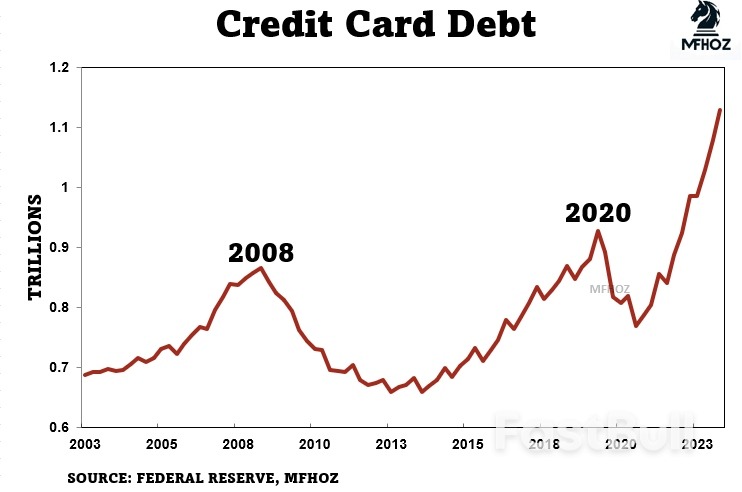
          US credit card debt topped $1.34 trillion in February, significantly above the cycle tops of around $900 billion in 2008 and 2020 (as shown below since 2003, courtesy of MFHOZ). The interest rate on this debt is above 20%.
          Debt Stress Pandemic_1
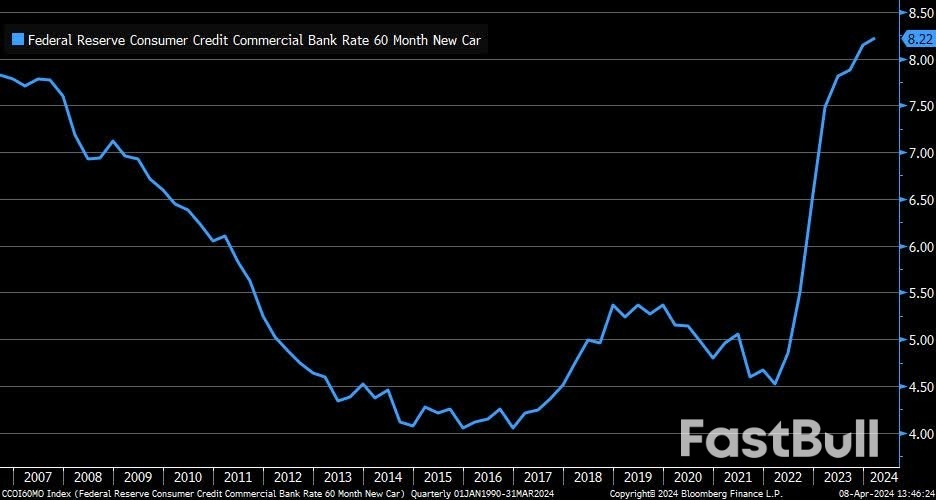
          New car loans (5-year term) at 8.22% are above the 2007 rate peak (shown below courtesy of Liz Ann Sonders). Compounding the pain is that most who bought vehicles (and many homes) in the 2019 to 2023 pandemic price spike have seen their equity fall since.
          Debt Stress Pandemic_2
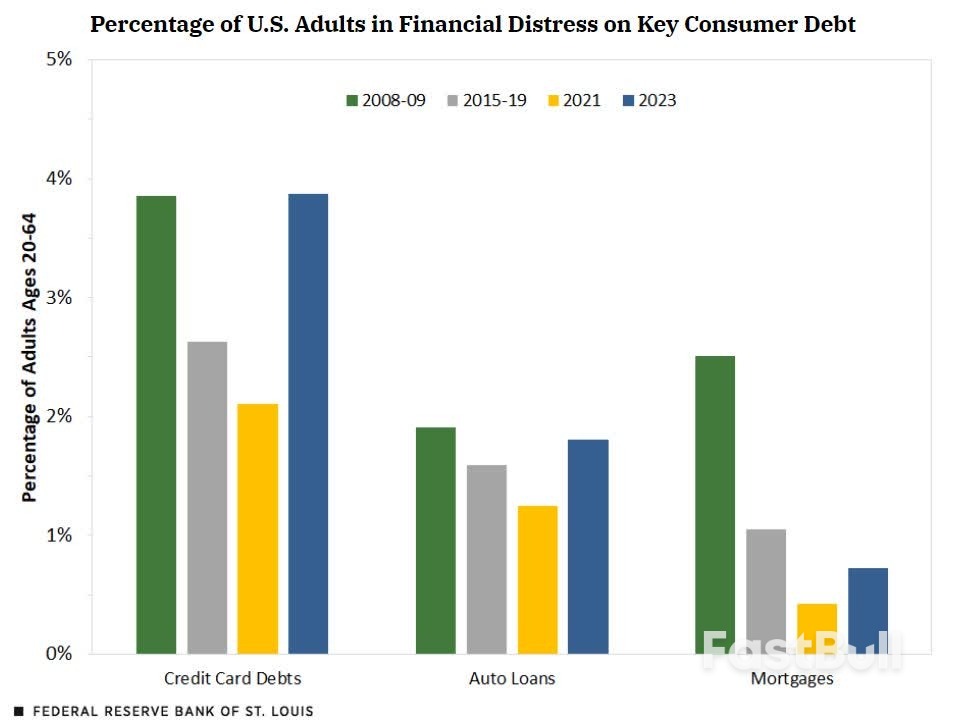
          In 2023, borrowers with credit card and auto loan delinquencies (90 days plus late on payment, shown below courtesy of Mr.Awsumb) had already reached levels matching the 2008 recession. All debt-type delinquencies have continued to rise year-to-date.
          Debt Stress Pandemic_3
          While the US 'U3' unemployment rate remains near all-time lows of 3.8%, individuals saying they defaulted on mortgage payments due to unemployment have already spiked above 2008 levels
          Debt Stress Pandemic_4
          We note that the broader 'U6' measure of US unemployment, at 7.3% in the latest measure, is now 80 basis points above its cycle low and higher than the pre-COVID level of 6.9%.
          Canadian unemployment at 6.1% in March was +130 basis points above the July 2022 low of 4.8% and higher than the pre-COVID level of 5.7%. Historically, when the Canadian unemployment rate rose 80 basis points from the cycle low, a recession was underway. And lest anyone forget, it's typical for unemployment to accelerate during central bank easing cycles and well into the subsequent economic recovery.
          It's not just individuals falling behind on their payments; loan delinquencies on multifamily properties are today the highest since 2013 and the 2008 recession before that (below courtesy of Game of Trades).
          Debt Stress Pandemic_5
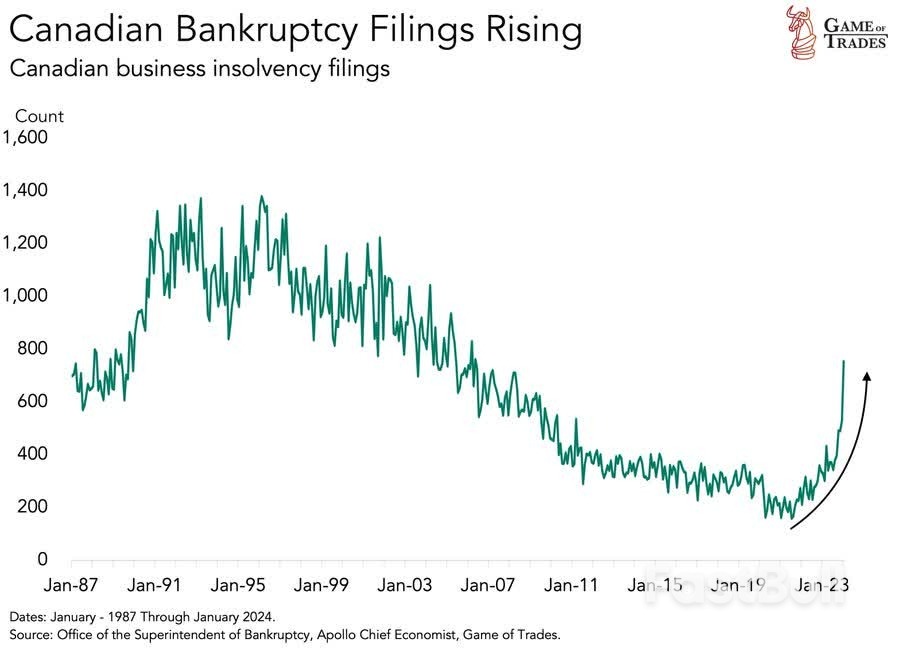
          Corporate bankruptcy filings have been leaping since the Fed started hiking base rates in March 2022, both in America and Canada (shown below).
          Debt Stress Pandemic_6
          Debt Stress Pandemic_7
          Again, it's worth noting that central bank easing cycles have never been a quick fix to debt stress pandemics. Just as tightening efforts move at a 12- to 24-month lag, defaults and bankruptcy filings tend to accelerate as central banks embark on easing efforts and unemployment continues to rise.

          Source: Seeking Alpha

          To stay updated on all economic events of today, please check out our Economic calendar
          Risk Warnings and Disclaimers
          You understand and acknowledge that there is a high degree of risk involved in trading. Following any strategies or investment methods may lead to potential losses. The content on the site is provided by our contributors and analysts for information purposes only. You are solely responsible for determining whether any trading assets, securities, strategy, or any other product is suitable for investing based on your own investment objectives and financial situation.
          Add to Favorites
          Share

          What The Gold And Oil Price Rallies Are Telling Us

          Cohen

          Commodity

          Economic

          If history is any guide, global sharemarkets could be in for a rough period ahead as gold futures prices hit a fresh record high in trading on Tuesday night, while oil prices have settled just under the $US90 ($135) a barrel level.
          And while bubbling geopolitical tensions are no doubt helping to bolster gold and oil prices, it’s clear that these two markets had been rallying even before Israel’s airstrike on Tehran’s consulate in Damascus last week threatened to escalate the years-long shadow war between Israel and Iran.
          One of the reasons for their price strength is that investors are increasingly using gold and oil to hedge against economic uncertainty and geopolitical tensions.
          Indeed, with the oil price rising some 16 per cent so far this year, while gold is up 13 per cent, this strategy has proved more profitable than buying bearish put options on US stocks.
          For most of this year, the market’s so-called fear gauge, the CBOE Volatility Index, or Vix, which measures the implied 30-day volatility of the S&P 500, had been sitting in the low teens.
          It kicked up to a still-sanguine 16 last week as investors fretted about deepening tensions in the Middle East, but has since settled down to around the 15 level.
          And while S&P 500 has managed to climb close to 10 per cent so far this year, its performance has been outstripped by the SPDR Gold Shares ETF, which jumped 14.1 per cent in the same period.
          Meanwhile, the Energy Select Sector SPDR, which concentrates on the big US-based majors and is favoured as a hedge by investors, has risen 15 per cent so far this year.
          What’s more, analysts argue there are good reasons for the gold and oil rallies to continue.

          Central banks set to buy gold

          So far, the rally in the precious metal has been mainly driven by central bank buying, particularly by the People’s Bank of China. Chinese retail investors have also driven the physical demand for gold, both for jewellery and investment. The slump in the Chinese property market, combined with the country’s struggling sharemarket, are both working to burnish gold’s status as a store of wealth.
          There are signs that the latest spike in the gold price has caused central bank purchases to cool. Central banks tend to be patient buyers of gold, taking advantage of low prices, and then pulling back when prices move higher.
          Still, the likelihood that central banks will resume their buying on any sign of price weakness is helping to underpin gold prices in much the same way that the belief in the “Fed put” – the assumption the US central bank would step in to support the financial market if prices fell too far – has buoyed those markets.
          Meanwhile, energy markets have rebounded strongly after their 18-month slide from the peak reached after Russia’s invasion of Ukraine in February 2022 sent the oil price hurtling above $US100 a barrel.
          Investors now believe that stronger economic activity in both the United States and China, the world’s two largest economies, will boost demand.
          And there are also worries about tightening oil supplies, as the Organisation of the Petroleum Exporting Countries and its allies limit oil production.
          The giant hedge fund Citadel this week warned that oil markets are set to become “extremely tight” in the second half of this year, as the oil cartel OPEC+ reasserts its control of the market.
          Traders also fear that global oil supplies could be affected by Ukrainian drone attacks on Russian oil refineries, aimed at crimping production and reducing the oil revenue Russia has available to fund the war.
          And this has prompted warnings that the combination of rising oil prices and outperformance among US energy stocks has historically been a bad sign for the US share market.
          Just cast your mind back to 2022, when the Energy Select Sector SPDR delivered a handsome 64 per cent return, while the S&P 500 suffered its worst year since 2008, dropping nearly 20 per cent.

          Source:Financial Review

          To stay updated on all economic events of today, please check out our Economic calendar
          Risk Warnings and Disclaimers
          You understand and acknowledge that there is a high degree of risk involved in trading. Following any strategies or investment methods may lead to potential losses. The content on the site is provided by our contributors and analysts for information purposes only. You are solely responsible for determining whether any trading assets, securities, strategy, or any other product is suitable for investing based on your own investment objectives and financial situation.
          Add to Favorites
          Share

          March CPI Preview: US Inflation Will Remain Stagnant Without Suitable Downside Conditions

          Damon

          Economic

          On April 10, local time, the US Bureau of Labor Statistics will release the latest March CPI inflation report. The market is now expecting CPI inflation to be 3.4% in March, up from 3.2% in the previous month. Core inflation expectations come in at 3.7%, up from 3.8% previously.
          After a sharp decline in US inflation last year, high inflation data in January and February this year exceeded expectations, which hit the confidence of the market and the Fed in the sustainability of inflation reduction. In addition, market concerns have risen due to the strong economic activity and even signs of accelerated growth in certain sectors.
          Overall, the US disinflation process is in a "critical period" in the short to medium term. While the current inflation is moving towards the Fed's target, there is uncertainty about how long it will take. This is also the"hardest" last stretch of the road inflation needs to take.
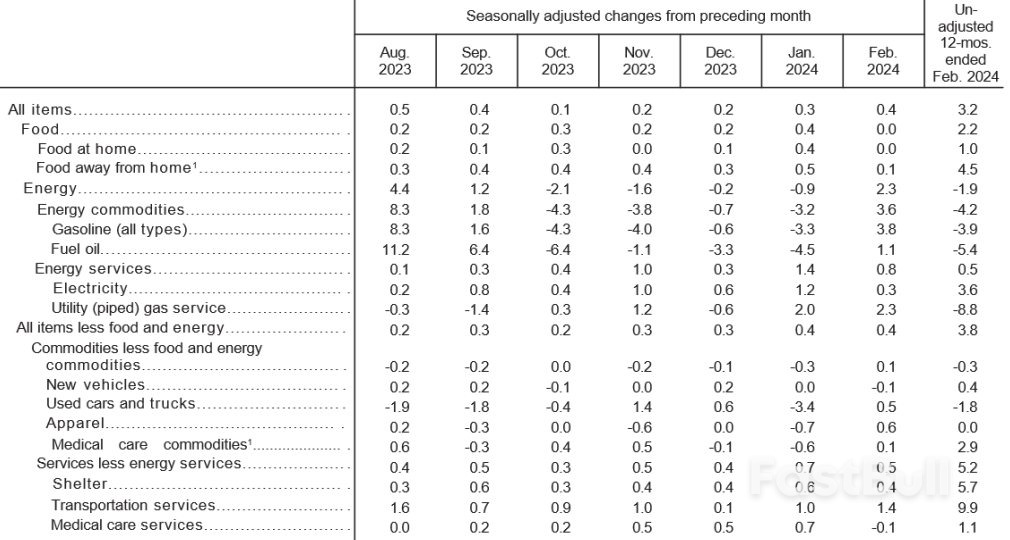
          Combined with the February CPI report below, we will take an outlook for the March CPI.
          March CPI Preview: US Inflation Will Remain Stagnant Without Suitable Downside Conditions_1
          In terms of specific breakdowns, housing and gasoline prices were the main reasons for the increase in the CPI index, which accounted for more than 60% of the increase in February. Food and food-at-home prices were generally unchanged from the previous month. In terms of core commodities, the trends of new vehicles and used cars and trucks are opposite.

          Energy Prices

          According to the American Automobile Association (AAA), the US average price of unleaded gasoline was $3.6 per gallon as of April 9, up 6% Week on Week and up about 14% from the beginning of the year. Besides, it is worth noting that oil prices are expected to rise above $4 this summer as the consumption boom arrives.
          The rise in US gasoline prices is bad news for the Fed. In the summer of 2022, the price of gasoline in the United States soared to more than $5 per gallon, which drove inflation sharply. The continued cooling of inflation in the US last year was also driven by the downward trend in gasoline prices. In other words, if US gasoline starts its upward trend again, even if other sub-items decline, it will keep headline inflation "stagnant".
          In addition, driven by geopolitical influences such as the Russia-Ukraine war and the Red Sea conflict, as well as OPEC+ production cuts and economic recovery, energy prices may become the main driver of rising inflation.
          But there is good news: more US refineries are set to restart in recent weeks due to the lucrative sale of gasoline, which is expected to increase gasoline supply. Currently, there are already traders betting in advance on the fall in wholesale gasoline prices in May.

          Housing Inflation

          Housing inflation has also played a key role in disinflation. In the February CPI inflation report, the core CPI came in at 3.8%, with rental inflation (including landlord equivalent rent) accounting for 2.5%.
          However, a variety of sources point to a significant decline in the coming months: new leases have shown a significant slowdown over the past year and a half, and these new leases are a reliable forward signal of overall rent growth.
          In addition, the market has seen a large supply of housing this year amid rising vacancy rates. According to the latest data from the US Department of Commerce, new home supply rose to 463,000 units in February, which is the highest level since 2017. Due to the abundant supply of new homes, the median price of new homes recorded 400,500 in February, down 7.6% YoY, marking the sixth consecutive month of decline.
          In January of this year, as the US Department of Homeland Management adjusted the weighted index, the impact of single-family housing on housing rents is now more important.
          With the combination of these factors, it is expected that primary residential rents and landlord equivalent rents should continue to slow this year and lower core inflation. Given the lag in housing rent statistics, housing inflation may decline slightly from February in the March CPI inflation report, but there will be no cliff decline.

          New/Used Vehicles

          In February's CPI core inflation (excluding food and energy prices), new vehicles and used cars contributed to disinflation and are still on a downward trend overall.
          According to the latest Mannheim report, the wholesale price of used cars fell by 0.34% MoM in March, which is the first decline since the beginning of the year. However, the price of used cars that are not seasonally adjusted rose by 3.1% MoM and fell by 11.4% YoY. At the same time, the Mannheim used car value index also fell from 203.8 to 203.1, a YoY increase of 14.7%.
          In the retail market, Mannheim estimates that retail sales of used cars in March rose 6% MoM and 7% YoY.
          It is expected that in this CPI inflation, new/used cars will continue to be one of the downward drivers of disinflation.

          Super Core Inflation

          Super core inflation (the core services sector excluding housing) is the indicator that the Fed is most concerned about and will come under pressure. The upward trend in factors such as insurance costs and medical prices will continue to create upward pressure on super-core inflation.
          For the Fed, the trajectory of super-core inflation will be key to a future policy pivot. Despite the slowdown in consumer spending so far this year, household consumption remains supported by a tight labor market. Judging from the latest indicators such as non-farm payrolls, initial jobless claims, and JOLTS job vacancies, the demand for labor remains strong, which supports the healthy growth of employee wages.

          Conclusion

          Every inflation report leading up to the June rate decision is crucial to the Fed's path to rate cuts. Fed Chair Jerome Powell has said: "There will be no reduction in the policy rate until confidence in inflation continues to fall to 2%." His views were also echoed by several members, including Patrick Harker, the Philadelphia Fed President, and Thomas Barkin, the Richmond Fed President.
          However, reviewing the recent market conditions, it seems that there is no potential for inflation to "dive" into this CPI inflation report.
          This is evidenced by a series of Fed actions last week: Fed officials gave unusually hawkish speeches the day before the release of the non-farm payroll data. Neel Kashkari, the Minneapolis Fed President, even said that he would not cut interest rates this year. It's hard not to suspect that the Fed saw the NFP report ahead of time to release downside risks through Kashkari's speech on Thursday. So at the moment of the release of the NFP, the market only made a "polite response" - the dollar rose. But from the second hour onwards, the feedback disappeared. Compared with "there may be no interest rate cuts this year", the impact of non-farm payrolls is only reducing the probability of interest rate cuts, so the market does not think so.
          After the release of the non-farm payrolls data, two Fed officials delivered speeches. Governor Michelle Bowman said that "if inflation progresses stalls or even reverses, further rate hikes may be needed at future meetings". This is the second Fed official to say the word "rate hike" this week, the first being Minneapolis Fed President Kashkari. Lorie Logan, the Dallas Fed President inadvertently revealed that "the Fed should be as prepared as ever to respond appropriately when inflation stops falling."
          The speeches of these two officials, as well as the performance of the non-farm payroll data, undoubtedly "reshaped" market expectations. Combined with the "bumps" in the process of de-inflation in the past two months, the Fed may have expected inflation data (inflation rebound) a long time ago. Otherwise, it would not have been in a hurry to reshape market expectations last week. Of course, this is just speculation. However, it is certain that energy prices and housing inflation, which accounted for the main factors of last month's CPI increase, will not show unexpected weakness. In addition, energy prices may even be constrained by both supply and demand, which will continue to exert upward pressure on inflation. New and used cars will continue their downward trend.
          It is expected that this inflation will still be comparable to the previous value, and even have the potential to be higher than the previous value.
          Given this, Fed officials are likely to continue their hawkish rhetoric. Raphael Bostic, for example, said yesterday that "one rate cut is currently expected this year, but as economic activity and inflation continue to evolve, I may think that two cuts or no rate cuts will be needed in the coming months."
          In addition, expectations of interest rate cuts will also take another hit. However, the US stock market, dollar index, or gold seem to have begun to consume expectations in advance under the influence of the Fed (if the expectation of data is suppressed by the expectation of interest rate cuts, it will be corrected in advance before the release of the data). This highlights the importance of expectation management.
          If the inflation data is stronger than expected, it will weigh on gold prices as it will heat bets on "longer, higher interest rates", which will make gold a non-interest-bearing asset.
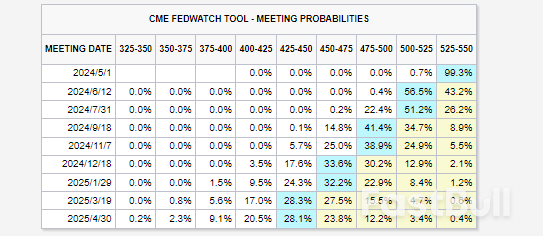
          In addition, it is worth noticing that rate cut expectations have been continuously suppressed, but the US index has fallen instead of rising recently. Therefore, the market's pricing of the Fed's policy path has not yet been fully "revealed", which will doom this CPI to be mixed with strong market expectations. There is already an option for the Fed to cut rates for the first time in September, and to cut rates twice throughout the year. If the CPI shows that inflation continues to rebound, it may deepen the market's pricing in this expectation. Conversely, the market may re-assert that the Fed will cut rates for the first time in June.
          As of now, the probability of a rate cut in June is 56.8%, according to the CME FedWatch data.
          March CPI Preview: US Inflation Will Remain Stagnant Without Suitable Downside Conditions_2
          At present, there are only a few hours left before the release of CPI, and the market is likely to have priced in market expectations ahead of time. In other words, if inflation is lower than expected and the data is recorded at or below the previous reading, this will also increase the likelihood that the Fed will cut rates in June.
          To stay updated on all economic events of today, please check out our Economic calendar
          Risk Warnings and Disclaimers
          You understand and acknowledge that there is a high degree of risk involved in trading. Following any strategies or investment methods may lead to potential losses. The content on the site is provided by our contributors and analysts for information purposes only. You are solely responsible for determining whether any trading assets, securities, strategy, or any other product is suitable for investing based on your own investment objectives and financial situation.
          Add to Favorites
          Share

          SEC Delays Decision On NYSE Proposal For Spot Bitcoin ETF Options Trading

          Alex

          Cryptocurrency

          The United States Securities and Exchange Commission (SEC) has postponed its decision on the New York Stock Exchange’s proposal to introduce option trading on spot Bitcoin exchange-traded funds (ETFs).
          Grayscale Bitcoin Trust and Bitwise Bitcoin ETF are directly affected since they hold BTC on the NYSE.

          SEC Delays Decision on Spot BTC ETF Options Trading

          The SEC cited in its April 8 filing that it will require a longer time to take action on the suggested rule change so that it has enough time to deliberate on it. Notably, the next deadline for the SEC to delay, approve, or deny the proposed rule change is May 29.
          The rule change proposal was submitted to the SEC in February 2024, after which it was opened for public feedback. The proposal would allow trading options on certain Bitcoin ETFs by changing Rule 915.
          Options are financial derivatives that allow investors to speculate on the movement of underlying assets, bringing about hedging and leverage.
          The same delay decision for Grayscale and Bitwise was given for Nasdaq’s request for options trading on BlackRock’s iShares Bitcoin Trust (IBIT) last month.
          In an earlier March 6 filing, the regulator also delayed responding to the CBOE exchange and the Miami International Securities Exchange requests to offer spot Bitcoin ETFs options.

          Grayscale CEO Urges SEC for Spot Bitcoin ETF Options

          Michael Sonnenshein, the Grayscale CEO, was one of the two people who approached the SEC with a request to have the rule changed on options trading.
          In a letter on February 28, Sonnenshein said it only made sense for the SEC to approve options trading on the spot Bitcoin ETFs since the regulator already approved futures and spot ETFs on the NYSE.
          In a February 5 post, Sonnenshein wrote that options for spot Bitcoin ETFs could lead to a “robust and healthy market.”
          Meanwhile, the SEC is still deliberating on the seven spot Ethereum ETFs after postponing the decision until May 23, the same deadline set for the VanEck ETF application.
          Spot Bitcoin ETFs have been on an upward trend this year, attracting attention beyond the United States. Recently, Chinese mainland-based equity funds filed applications to introduce spot Bitcoin ETFs through their Hong Kong subsidiaries. One of the funds, Harvest Fund Management’s Hong Kong branch, has been awaiting approval from the Securities & Futures Commission (SFC) of Hong Kong since January.

          Source:CryptoPotato

          Risk Warnings and Disclaimers
          You understand and acknowledge that there is a high degree of risk involved in trading. Following any strategies or investment methods may lead to potential losses. The content on the site is provided by our contributors and analysts for information purposes only. You are solely responsible for determining whether any trading assets, securities, strategy, or any other product is suitable for investing based on your own investment objectives and financial situation.
          Add to Favorites
          Share

          Inflation Expected to Remain Elevated As Rate Cut Debate Takes Center Stage

          Samantha Luan

          Economic

          Central Bank

          The inflation report, set for release at 8:30 a.m. ET, is expected to show headline inflation of 3.4%, an acceleration from February's 3.2% annual gain in prices, according to estimates from Bloomberg. Higher energy costs, fueled by a jump in gas prices, are expected to have driven the increase.
          Over the prior month, consumer prices are expected to have risen 0.3%, down from February's 0.4% monthly increase.
          On a "core" basis, which strips out the more volatile costs of food and gas, prices in March are expected to have risen 3.7% over last year — a modest slowdown from the 3.8% annual increase seen in February, according to Bloomberg data.
          "After two firm reports to start the year, core CPI inflation should cool off in March," Bank of America economists Stephen Juneau and Michael Gapen wrote in a note to clients on Friday.
          Core prices are expected to have climbed 0.3% on a monthly basis in March, compared with the 0.4% increase seen in the prior month.
          Inflation Expected to Remain Elevated As Rate Cut Debate Takes Center Stage_1
          Core inflation has remained stubbornly elevated due to higher costs of shelter and core services like insurance and medical care.
          But Bank of America expects a slight decline in the prices of core goods, largely driven by a drop in new and used car prices. The bank also expects less price pressure from core services like airfare and lodging away from home.
          "If our forecast proves correct, it should provide some confidence to the Fed," the economists said.
          Other economists also see further improvements in core inflation throughout the year.
          "Going forward, we expect monthly core CPI inflation to slow to 0.20-0.25%," Goldman Sachs lead economist Jan Hatzius wrote on Monday.
          "We see further disinflation in the pipeline in 2024 from rebalancing in the auto, housing rental, and labor markets," the economist added.

          To cut or not to cut?

          Inflation has remained above the Federal Reserve's 2% target on an annual basis. Fed officials have categorized the path down to 2% as "bumpy."
          Notably, the Fed's preferred inflation gauge, the so-called core PCE price index, has shown a slight cooling in recent months.
          The year-over-year change in core PCE slowed to 2.8% for the month of February, down from 2.9% in January. Federal Reserve Chair Jerome Powell said the data is "along the lines of what we want to see."
          But not all of the data has been supportive of a rate cut. Just last week, a strong labor report showed the US economy added more jobs than expected in March, as the unemployment rate decreased while wage growth held steady.
          Investors now anticipate just two and a half 25-basis-point cuts this year, down from the six cuts expected at the start of the year, according to Bloomberg data. Atlanta Fed president Raphael Bostic sees one rate cut in in 2024, but isn't ruling out the possibility of two or zero, he told Yahoo Finance on Tuesday. Meanwhile, former St. Louis Fed president James Bullard said Tuesday a three-rate-cut scenario remains the "the base case."
          "[The Fed] wants to cut rates, but the economy is standing in its way," Mizuho Securities USA chief economist Steven Ricchiuto told Yahoo Finance Live on Tuesday. "The Fed is fighting the economy. In particular, they’re fighting the American consumers, and that’s a fight that I would not want to get involved in."
          As of Tuesday afternoon, markets were pricing in a 56% chance the Federal Reserve begins to cut rates at its June meeting, according to data from the CME Group. That's down from a 62% chance a week ago.

          Source: Yahoo Finance

          To stay updated on all economic events of today, please check out our Economic calendar
          Risk Warnings and Disclaimers
          You understand and acknowledge that there is a high degree of risk involved in trading. Following any strategies or investment methods may lead to potential losses. The content on the site is provided by our contributors and analysts for information purposes only. You are solely responsible for determining whether any trading assets, securities, strategy, or any other product is suitable for investing based on your own investment objectives and financial situation.
          Add to Favorites
          Share

          Earnings Drive Continued Stock Rally on Wall Street

          Ukadike Micheal

          Economic

          Forex

          Stocks

          It's time for corporate earnings to take the spotlight as Wall Street anticipates another robust earnings season. Despite concerns about high valuations and potential bubbles in the market, optimism prevails as analysts predict a healthy 10% gain in earnings for S&P 500 companies in the first quarter.
          The outlook for earnings is particularly positive for technology stocks, which are expected to continue driving profits after a strong performance in the previous quarter. This optimism is reflected in the reluctance of market experts to bet against further gains, even as the S&P 500 Index trades near its all-time high.
          Wall Street strategists, including those at Societe Generale SA, have raised their year-end forecasts for the S&P 500, citing the momentum backed by strong earnings outlook. According to Deutsche Bank AG strategists, earnings upgrades have outnumbered downgrades in the first quarter, further supporting the positive sentiment surrounding corporate profits.
          While concerns about market bubbles persist, rising profit forecasts alleviate some worries, signaling that the equities benchmark may not be overvalued. Despite a 9% rally in the S&P 500 this year, allocations to stocks have surged, driven by optimistic projections for economic growth. However, exposure is expected to plateau as companies enter a blackout period for stock buybacks ahead of the reporting season.
          Although investor confidence is at near two-year highs, sentiment remains below euphoric levels typically associated with market peaks, according to Bank of America Corp. strategist Savita Subramanian. This sentiment is echoed by Citigroup strategist Scott Chronert, who emphasizes the importance of information circumstances in influencing sentiment direction.
          Recent comments from Federal Reserve officials hinting at prolonged high interest rates have sparked volatility in the market, prompting some traders to reevaluate their positions. However, many remain optimistic, viewing any pullback as a buying opportunity. Forecasts for tech earnings remain strong, suggesting continued support for the market rally.
          The broader outlook for the market hinges on the strength of corporate earnings. As Charlie Ashley, portfolio manager at Catalyst Capital Advisors LLC, notes, the sustainability of the rally depends on continued earnings growth. Any softness in earnings could signal trouble ahead, potentially signaling weakening consumer sentiment and economic conditions.
          While concerns about market bubbles and interest rate hikes persist, optimism surrounding corporate earnings remains high. As investors await the upcoming earnings season, the focus shifts to the strength of corporate profits as a key driver of market performance. The ability of companies to deliver on earnings expectations will likely determine the trajectory of the stock market in the coming months.

          Source: Bloomberg

          To stay updated on all economic events of today, please check out our Economic calendar
          Risk Warnings and Disclaimers
          You understand and acknowledge that there is a high degree of risk involved in trading. Following any strategies or investment methods may lead to potential losses. The content on the site is provided by our contributors and analysts for information purposes only. You are solely responsible for determining whether any trading assets, securities, strategy, or any other product is suitable for investing based on your own investment objectives and financial situation.
          Add to Favorites
          Share
          FastBull
          Copyright © 2025 FastBull Ltd

          728 RM B 7/F GEE LOK IND BLDG NO 34 HUNG TO RD KWUN TONG KLN HONG KONG

          TelegramInstagramTwitterfacebooklinkedin
          App Store Google Play Google Play
          Products
          Charts

          Chats

          Q&A with Experts
          Screeners
          Economic Calendar
          Data
          Tools
          Membership
          Features
          Function
          Markets
          Copy Trading
          Latest Signals
          Contests
          News
          Analysis
          24/7
          Columns
          Education
          Company
          Careers
          About Us
          Contact Us
          Advertising
          Help Center
          Feedback
          User Agreement
          Privacy Policy
          Business

          White Label

          Data API

          Web Plug-ins

          Poster Maker

          Affiliate Program

          Risk Disclosure

          The risk of loss in trading financial instruments such as stocks, FX, commodities, futures, bonds, ETFs and crypto can be substantial. You may sustain a total loss of the funds that you deposit with your broker. Therefore, you should carefully consider whether such trading is suitable for you in light of your circumstances and financial resources.

          No decision to invest should be made without thoroughly conducting due diligence by yourself or consulting with your financial advisors. Our web content might not suit you since we don't know your financial conditions and investment needs. Our financial information might have latency or contain inaccuracy, so you should be fully responsible for any of your trading and investment decisions. The company will not be responsible for your capital loss.

          Without getting permission from the website, you are not allowed to copy the website's graphics, texts, or trademarks. Intellectual property rights in the content or data incorporated into this website belong to its providers and exchange merchants.

          Not Logged In

          Log in to access more features

          FastBull Membership

          Not yet

          Purchase

          Become a signal provider
          Help Center
          Customer Service
          Dark Mode
          Price Up/Down Colors

          Log In

          Sign Up
          Position
          Layout
          Fullscreen
          Default to Chart
          The chart page opens by default when you visit fastbull.com