• Trade
  • Markets
  • Copy
  • Contests
  • News
  • 24/7
  • Calendar
  • Q&A
  • Chats
Trending
Screeners
SYMBOL
LAST
BID
ASK
HIGH
LOW
NET CHG.
%CHG.
SPREAD
SPX
S&P 500 Index
6949.79
6949.79
6949.79
6967.31
6925.10
+5.32
+ 0.08%
--
DJI
Dow Jones Industrial Average
49399.23
49399.23
49399.23
49616.70
49246.24
-43.20
-0.09%
--
IXIC
NASDAQ Composite Index
23551.29
23551.29
23551.29
23664.26
23446.81
+21.28
+ 0.09%
--
USDX
US Dollar Index
99.130
99.210
99.130
99.250
98.920
+0.010
+ 0.01%
--
EURUSD
Euro / US Dollar
1.15993
1.16002
1.15993
1.16272
1.15843
-0.00099
-0.09%
--
GBPUSD
Pound Sterling / US Dollar
1.33836
1.33844
1.33836
1.34127
1.33660
+0.00029
+ 0.02%
--
XAUUSD
Gold / US Dollar
4589.58
4589.99
4589.58
4620.79
4536.73
-26.37
-0.57%
--
WTI
Light Sweet Crude Oil
59.337
59.367
59.337
60.010
58.781
+0.203
+ 0.34%
--

Community Accounts

Signal Accounts
--
Profit Accounts
--
Loss Accounts
--
View More

Become a signal provider

Sell trading signals to earn additional income

View More

Guide to Copy Trading

Get started with ease and confidence

View More

Signal Accounts for Members

All Signal Accounts

Best Return
  • Best Return
  • Best P/L
  • Best MDD
Past 1W
  • Past 1W
  • Past 1M
  • Past 1Y

All Contests

  • All
  • Trump Updates
  • Recommend
  • Stocks
  • Cryptocurrencies
  • Central Banks
  • Featured News
Top News Only
Share

Egypt President Sisi: Ready To Restart US Mediation Between Egypt And Ethiopia To Resolve Question Of "The Nile Water Sharing" Once And For All

Share

Chicago Corn Futures Fell Over 4.6% This Week, Soybeans Fell 0.6%, And Soybean Oil Rose About 5.7%. On Friday (January 16), The Bloomberg Grains Index Closed Up 1.02% At 28.7983 Points In New York Trading, Down 1.84% For The Week. It Experienced A Significant Drop At 01:00 Beijing Time On January 13, And Subsequently Fluctuated At Low Levels. This Week, CBOT Corn Futures Fell 4.66% To $4.25 Per Bushel. CBOT Wheat Futures Rose 0.14% To $5.18 Per Bushel. CBOT Soybean Futures Fell 0.59% To $10.5675 Per Bushel, Soybean Meal Futures Fell 4.54%, And Soybean Oil Futures Rose 5.68%

Share

Barclays: Limited US Strikes On Iran Could Quickly Erase $3-4/Bbl Geopolitical Oil Premium

Share

US Officials Have Floated Idea Of Broadening A Gaza “Board Of Peace” Headed By Trump To Include Other Hotspots Such As Ukraine And Venezuela,

Share

JPMorgan Chase Surpasses Dimensional To Become The World's Largest Issuer Of Actively Managed Exchange-traded Funds (ETFs). According To Data Compiled By Bloomberg, The Asset Management Arm Of JPMorgan Chase Currently Manages Nearly $257 Billion In Actively Managed ETF Assets Globally, Slightly Exceeding Dimensional Fund Advisors' Approximately $255 Billion

Share

IAEA: Secured The Agreement Of Both The Russian Federation And Ukraine To Implement A Localized Ceasefire

Share

Brent Crude Futures Settle At $64.13/Bbl, Up 37 Cents, 0.58 Percent

Share

IMF: Board Of The International Monetary Fund (IMF) Today Completed The Fourth Review Of The 48-Month (Ecf) For Ethiopia

Share

WTI Crude Oil Futures For February Delivery Closed At $59.44 Per Barrel. Nymex Natural Gas Futures For February Delivery Closed At $3.1030 Per Million British Thermal Units (MMBtu). Nymex Gasoline Futures For February Delivery Closed At $1.7852 Per Gallon, And Nymex Heating Oil Futures For February Delivery Closed At $2.2376 Per Gallon

Share

USA Crude Oil Futures Settle At $59.44/Bbl, Up 25 Cents, 0.42 Percent

Share

US Federal Aviation Administration Issues Warnings To Airlines To Exercise Caution When Operating In Various Areas Above Panama, Mexico, Central America, Colombia And Parts Of Pacific Ocean Due To Military Activities And Potential Interference

Share

ICE Certified Arabica Stocks Decreased By 2644 As Of January 16, 2026

Share

Easa: Potential For USA Military Action Has Placed Iranian Air Defence Forces On Heightened State Of Alert, Currently Increased Likelihood Of Misidentification Within Fir Tehran

Share

Easa On Iran Says Presence & Possible Use Wide Range Of Weapons & Air-Defence Systems Creates High Risk To Civil Flights Operating At All Altitudes

Share

Peru's Central Bank Says Buy 195 Million Dollars In Spot Market

Share

ICE - Gasoil Speculators Raise Net Long Positions By 15424 Contracts To 52519 In Week To January 13

Share

ICE - Brent Crude Speculators Raise Net Long Positions By 85496 Contracts To 208461 In Week To January 13

Share

ICE Futures Europe - Feed Wheat Speculators Trim Net Short Position By 5 Lots To 1118 Lots As Of Jan 13 - Exchange Cot Data

Share

ICE Futures Europe - Robusta Coffee Speculators Raise Net Long Position By 554 Lots To 4068 Lots As Of Jan 13 - Exchange Cot Data

Share

ICE Futures Europe - White Sugar Speculators Raise Net Long Position By 4544 Lots To 48203 Lots As Of Jan 13 - Exchange Cot Data

TIME
ACT
FCST
PREV
U.S. NY Fed Manufacturing Prices Received Index (Jan)

A:--

F: --

P: --

U.S. NY Fed Manufacturing New Orders Index (Jan)

A:--

F: --

P: --

U.S. NY Fed Manufacturing Employment Index (Jan)

A:--

F: --

P: --

U.S. Export Price Index YoY (Nov)

A:--

F: --

P: --

U.S. NY Fed Manufacturing Index (Jan)

A:--

F: --

P: --
U.S. Initial Jobless Claims 4-Week Avg. (SA)

A:--

F: --

P: --
U.S. Export Price Index MoM (Nov)

A:--

F: --

P: --

Canada Manufacturing Unfilled Orders MoM (Nov)

A:--

F: --

P: --

Canada Manufacturing New Orders MoM (Nov)

A:--

F: --

P: --

U.S. Philadelphia Fed Manufacturing Employment Index (Jan)

A:--

F: --

P: --

Canada Wholesale Sales YoY (Nov)

A:--

F: --

P: --

Canada Wholesale Inventory MoM (Nov)

A:--

F: --

P: --

U.S. Philadelphia Fed Business Activity Index (SA) (Jan)

A:--

F: --

P: --

U.S. EIA Weekly Natural Gas Stocks Change

A:--

F: --

P: --

Richmond Federal Reserve President Barkin delivered a speech.
U.S. Weekly Treasuries Held by Foreign Central Banks

A:--

F: --

P: --

Germany CPI Final MoM (Dec)

A:--

F: --

P: --

Germany CPI Final YoY (Dec)

A:--

F: --

P: --

Germany HICP Final MoM (Dec)

A:--

F: --

P: --

Germany HICP Final YoY (Dec)

A:--

F: --

P: --

Brazil PPI MoM (Nov)

A:--

F: --

P: --

Canada New Housing Starts (Dec)

A:--

F: --

P: --
U.S. Capacity Utilization MoM (SA) (Dec)

A:--

F: --

P: --
U.S. Industrial Output YoY (Dec)

A:--

F: --

P: --

U.S. Manufacturing Capacity Utilization (Dec)

A:--

F: --

P: --

U.S. Manufacturing Output MoM (SA) (Dec)

A:--

F: --

P: --
U.S. Industrial Output MoM (SA) (Dec)

A:--

F: --

P: --
U.S. NAHB Housing Market Index (Jan)

A:--

F: --

P: --

Russia CPI YoY (Dec)

A:--

F: --

P: --

U.S. Weekly Total Rig Count

A:--

F: --

P: --

U.S. Weekly Total Oil Rig Count

A:--

F: --

P: --

Japan Core Machinery Orders YoY (Nov)

--

F: --

P: --

Japan Core Machinery Orders MoM (Nov)

--

F: --

P: --

U.K. Rightmove House Price Index YoY (Jan)

--

F: --

P: --

China, Mainland GDP YoY (YTD) (Q4)

--

F: --

P: --

China, Mainland Industrial Output YoY (YTD) (Dec)

--

F: --

P: --

Japan Industrial Output Final MoM (Nov)

--

F: --

P: --

Japan Industrial Output Final YoY (Nov)

--

F: --

P: --

Euro Zone Core HICP Final MoM (Dec)

--

F: --

P: --

Euro Zone HICP Final MoM (Dec)

--

F: --

P: --

Euro Zone HICP Final YoY (Dec)

--

F: --

P: --

Euro Zone HICP MoM (Excl. Food & Energy) (Dec)

--

F: --

P: --

Euro Zone Core CPI Final YoY (Dec)

--

F: --

P: --

Euro Zone Core HICP Final YoY (Dec)

--

F: --

P: --

Euro Zone CPI YoY (Excl. Tobacco) (Dec)

--

F: --

P: --

Euro Zone Core CPI Final MoM (Dec)

--

F: --

P: --

Canada National Economic Confidence Index

--

F: --

P: --

Canada CPI MoM (SA) (Dec)

--

F: --

P: --

Canada Core CPI MoM (SA) (Dec)

--

F: --

P: --

Canada CPI YoY (SA) (Dec)

--

F: --

P: --

Canada Trimmed CPI YoY (SA) (Dec)

--

F: --

P: --

Canada CPI YoY (Dec)

--

F: --

P: --

Canada CPI MoM (Dec)

--

F: --

P: --

Canada Core CPI YoY (Dec)

--

F: --

P: --

Canada Core CPI MoM (Dec)

--

F: --

P: --

South Korea PPI MoM (Dec)

--

F: --

P: --

China, Mainland 1-Year Loan Prime Rate (LPR)

--

F: --

P: --

China, Mainland 5-Year Loan Prime Rate

--

F: --

P: --

Germany PPI YoY (Dec)

--

F: --

P: --

Germany PPI MoM (Dec)

--

F: --

P: --

Q&A with Experts
    • All
    • Chatrooms
    • Groups
    • Friends
    ADKK987 flag
    Can anyone tell me
    Kung Fu flag
    SABR
    No, I just wanted to know, not to risk it.
    @SABRno news, Brother. The only thing you can do now is scalp
    ADKK987 flag
    Is holding trade till weekends are allowed in funding pips account 5k 2 step
    SABR flag
    What do you think about the market now? What do you say, where will it fly?
    Kung Fu flag
    bagus
    @bagusgood. I'm currently buying through range trading
    Kung Fu flag
    ADKK987
    Is holding trade till weekends are allowed in funding pips account 5k 2 step
    @ADKK987I think most propfirms allow it. Check with your propfirm
    Kung Fu flag
    SABR
    What do you think about the market now? What do you say, where will it fly?
    @SABRthe price is bouncing between 4589 and 5627, even as I said before
    Everthguti flag
    At this time it is no longer beneficial to operate
    Kung Fu flag
    Everthguti
    At this time it is no longer beneficial to operate
    @Everthgutino, not at all. You're right. It should be good night to the market
    3383256 flag
    join this channel. its free and awesome signals no fee nothing. no Ib change
    3383256 flag
    Kung Fu
    @Kung Fuyes its allowed
    3383256 flag
    ADKK987
    Can anyone tell me
    @ADKK987yes it's allowed
    ADKK987 flag
    Thank you🤝
    ADKK987 flag
    One question
    ADKK987 flag
    Can i adjust TP and SL after market closed?
    3383256 flag
    yes please
    umer flag
    ADKK987
    Can i adjust TP and SL after market closed?
    @ADKK987no
    umer flag
    you need to do it before the market is closed
    Everthguti flag
    Let's look forward to Sunday with great anticipation and good analysis.
    ADKK987 flag
    umer
    you need to do it before the market is closed
    Got it thnkx@umer 🤝
    Type here...
    Add Symbol or Code

      No matching data

      All
      Trump Updates
      Recommend
      Stocks
      Cryptocurrencies
      Central Banks
      Featured News
      • All
      • Russia-Ukraine Conflict
      • Middle East Flashpoint
      • All
      • Russia-Ukraine Conflict
      • Middle East Flashpoint
      Search
      Products

      Charts Free Forever

      Chats Q&A with Experts
      Screeners Economic Calendar Data Tools
      Membership Features
      Data Warehouse Market Trends Institutional Data Policy Rates Macro

      Market Trends

      Market Sentiment Order Book Forex Correlations

      Top Indicators

      Charts Free Forever
      Markets

      News

      News Analysis 24/7 Columns Education
      From Institutions From Analysts
      Topics Columnists

      Latest Views

      Latest Views

      Trending Topics

      Top Columnists

      Latest Update

      Signals

      Copy Rankings Latest Signals Become a signal provider AI Rating
      Contests
      Brokers

      Overview Brokers Assessment Rankings Regulators News Claims
      Broker listing Forex Brokers Comparison Tool Live Spread Comparison Scam
      Q&A Complaint Scam Alert Videos Tips to Detect Scam
      More

      Business
      Events
      Careers About Us Advertising Help Center

      White Label

      Data API

      Web Plug-ins

      Affiliate Program

      Awards Institution Evaluation IB Seminar Salon Event Exhibition
      Vietnam Thailand Singapore Dubai
      Fans Party Investment Sharing Session
      FastBull Summit BrokersView Expo
      Recent Searches
        Top Searches
          Markets
          News
          Analysis
          User
          24/7
          Economic Calendar
          Education
          Data
          • Names
          • Latest
          • Prev

          View All

          No data

          Scan to Download

          Faster Charts, Chat Faster!

          Download App
          English
          • English
          • Español
          • العربية
          • Bahasa Indonesia
          • Bahasa Melayu
          • Tiếng Việt
          • ภาษาไทย
          • Français
          • Italiano
          • Türkçe
          • Русский язык
          • 简中
          • 繁中
          Open Account
          Search
          Products
          Charts Free Forever
          Markets
          News
          Signals

          Copy Rankings Latest Signals Become a signal provider AI Rating
          Contests
          Brokers

          Overview Brokers Assessment Rankings Regulators News Claims
          Broker listing Forex Brokers Comparison Tool Live Spread Comparison Scam
          Q&A Complaint Scam Alert Videos Tips to Detect Scam
          More

          Business
          Events
          Careers About Us Advertising Help Center

          White Label

          Data API

          Web Plug-ins

          Affiliate Program

          Awards Institution Evaluation IB Seminar Salon Event Exhibition
          Vietnam Thailand Singapore Dubai
          Fans Party Investment Sharing Session
          FastBull Summit BrokersView Expo

          Ukraine's EU Bid: Brussels May Rewrite Accession Rules

          James Riley

          Russia-Ukraine Conflict

          Political

          Summary:

          The EU explores a radical "two-tier" membership to fast-track Ukraine's entry, challenging traditional norms amid internal opposition.

          The European Union is exploring a radical overhaul of its decades-old membership process, considering a new "two-tier" system to potentially fast-track Ukraine's entry into the bloc. This move comes as Brussels seeks creative solutions to integrate Kyiv, possibly as a key component of a future peace deal to end the war with Russia.

          The proposed model would effectively tear up the accession system used since the Cold War. Instead of a long, merit-based journey to full membership, Ukraine could be offered a "limited" or "reversed" membership first. Under this scenario, Kyiv would join the EU politically, with the full rights and obligations of a member state to be "earned" over a transitional period.
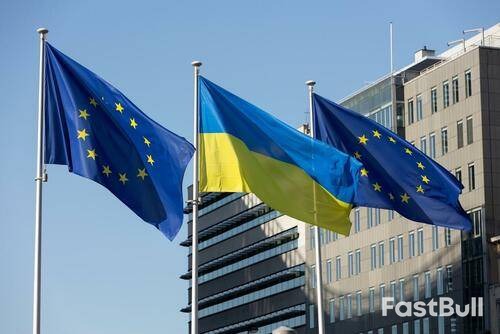
          The flags of the European Union and Ukraine fly together, symbolizing a partnership that Brussels is now considering accelerating through unconventional new membership rules.

          Why the Sudden Urgency?

          Discussions have intensified after a 20-point peace plan, negotiated between the US, Ukraine, and the EU, reportedly included a target for Ukrainian EU membership by 2027. This has put pressure on officials to find a workable path forward, even if traditional standards are not yet met.

          Proponents of the change argue that the current geopolitical landscape demands a new approach. One EU official noted, "We have to recognize that we are in a very different reality than when the (accession) rules were first drawn up."

          An EU diplomat elaborated on this view, framing it as a matter of continental security. "It is Europe's interest to have Ukraine in the E.U., because of our own security," the diplomat said. "It is why we need to look for creative solutions."

          Major Hurdles and Internal Opposition

          Despite the push for creative solutions, the path to fast-tracking Ukraine's membership is lined with significant obstacles.

          The Unanimity Requirement

          Any new member requires the formal, unanimous approval of all 27 existing EU nations, including sign-off from their national parliaments. Several member states could prove difficult to persuade.

          • Political Resistance: Countries seen as more "Russia-friendly," such as Hungary and Slovakia, which are heavily reliant on Russian energy, may oppose an accelerated timeline.

          • Merit-Based Concerns: Many EU governments believe any fixed date is unrealistic. They argue that accession must remain a merit-based process, contingent on a candidate country aligning its laws with EU standards.

          • Precedent and Economic Strain: A "staged access" plan for Ukraine could open the floodgates for other hopefuls who are not economically ready, potentially creating a significant drain on the rest of the Union.

          Even Poland, a key ally of Ukraine, could pose an obstacle. The two neighbors have recently been involved in tense diplomatic disputes, highlighting that even regional partners may not automatically support a special exception.

          A Broader Commitment to Ukraine

          While membership rules are debated, the EU is already deepening its integration with Ukraine's defense sector. As Washington's support appears to have diminished, Brussels is stepping up.

          Last November, the European Parliament approved a 1.5 billion euro ($1.7 billion) program aimed at strengthening ties between Europe's and Ukraine's military-industrial bases, signaling a continued and robust commitment to Kyiv's security, independent of the complex membership question.

          Risk Warnings and Disclaimers
          You understand and acknowledge that there is a high degree of risk involved in trading. Following any strategies or investment methods may lead to potential losses. The content on the site is provided by our contributors and analysts for information purposes only. You are solely responsible for determining whether any trading assets, securities, strategy, or any other product is suitable for investing based on your own investment objectives and financial situation.
          Add to Favorites
          Share

          Machado Courts Trump as U.S. Eyes Venezuela's Oil

          Dark Current

          Remarks of Officials

          Daily News

          Political

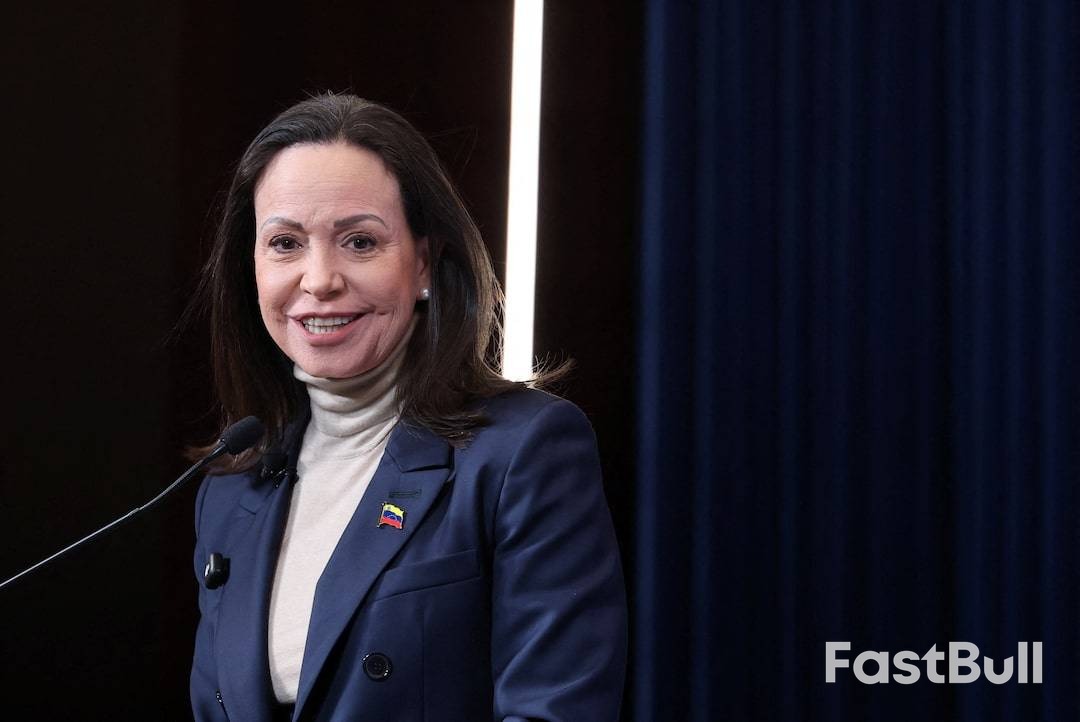
          Venezuelan opposition leader Maria Corina Machado is in Washington pressing her case for a democratic transition, but she faces a Trump administration that appears more focused on oil policy than free elections in the post-Maduro era.

          Following a high-profile meeting with President Donald Trump, Machado voiced confidence that Venezuela would see an "orderly transition" away from what she described as a "criminal regime." However, the U.S. government has so far backed an interim government led by former Maduro loyalists, signaling a pragmatic approach to the nation's future.

          A Push for Free Elections

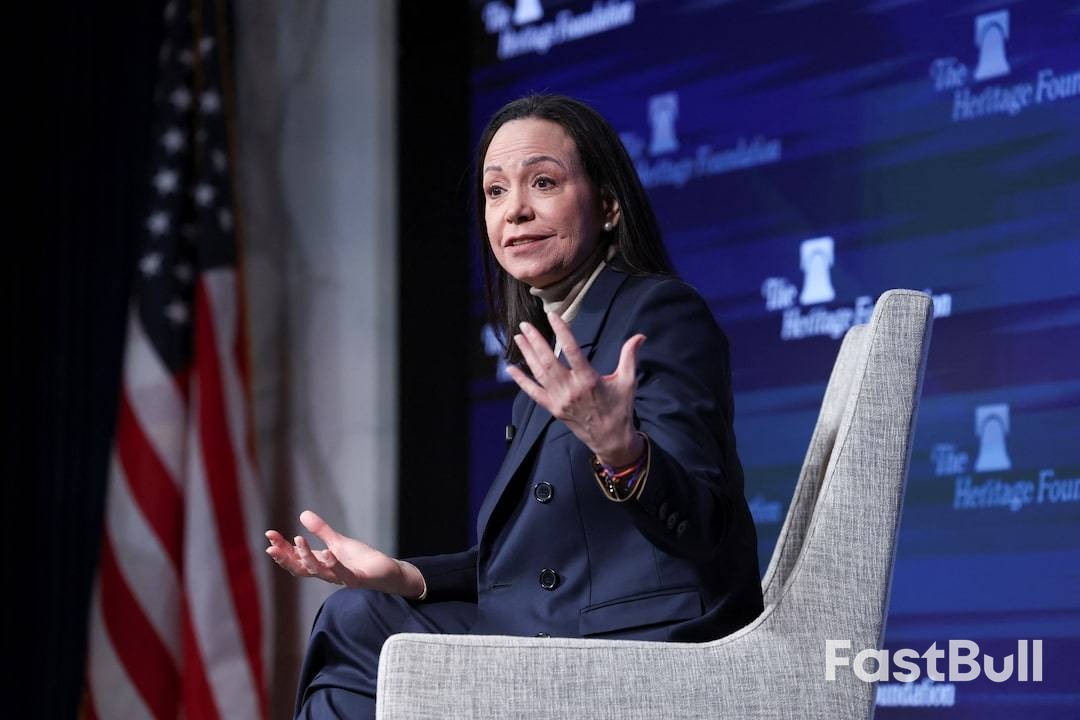
          Speaking at a press conference at the Heritage Foundation, a conservative think tank with close ties to the administration, Machado insisted that a transition to free elections would eventually unfold. She argued that the "criminal structure" that has dominated Venezuela for years would dismantle itself, though she did not specify how this would occur.

          "I am profoundly, profoundly confident that we will have an orderly transition," she stated, emphasizing that the process would be delicate and complex. Machado also downplayed any personal tension with interim President Delcy Rodriguez, framing the issue as a systemic one.

          Figure 1: Venezuelan opposition leader Maria Corina Machado speaks at a press conference at The Heritage Foundation in Washington.

          Trump's Priority: Oil Access and Stability

          Since a January 3 raid that removed Nicolas Maduro from power, the Trump administration has made its priorities clear. Gaining access to Venezuela's vast oil reserves and maintaining order have taken precedence over the immediate restoration of democracy.

          Trump has thrown his support behind the interim government led by Rodriguez, which is composed of former Maduro loyalists. This move is seen as the administration's best bet for short-term stability in the OPEC nation.

          Underscoring this engagement, CIA Director John Ratcliffe flew to Caracas for a meeting with Rodriguez, coinciding with Machado's visit to the White House. This represents the highest-level known U.S. visit since Maduro's ouster and signals a direct line of communication between Washington and the current interim leadership.

          The Nobel Prize Gambit

          During her Oval Office meeting, Machado made a strategic gesture by presenting her Nobel Peace Prize medal to President Trump, claiming he deserved it for his commitment to freedom for the Venezuelan people. Trump, who had openly sought the prize before Machado received it last month, praised the move on his Truth Social platform as a "wonderful gesture of mutual respect."

          The White House later posted a photo of the two with Trump holding a framed display of the medal. This gesture comes after the Norwegian Nobel Institute clarified that the prize cannot be transferred, shared, or revoked.

          Despite the warm reception, the White House has not changed its official stance. Trump had previously dismissed the idea of installing Machado to replace Maduro, who was taken to New York to face "narco-trafficking" charges. White House press secretary Karoline Leavitt affirmed Trump's "realistic" assessment that Machado currently lacks the support needed to lead Venezuela in the short term, even as the president looked forward to their meeting.

          Risk Warnings and Disclaimers
          You understand and acknowledge that there is a high degree of risk involved in trading. Following any strategies or investment methods may lead to potential losses. The content on the site is provided by our contributors and analysts for information purposes only. You are solely responsible for determining whether any trading assets, securities, strategy, or any other product is suitable for investing based on your own investment objectives and financial situation.
          Add to Favorites
          Share

          Trump's Risky Play for Critical Minerals Control

          James Riley

          Political

          Commodity

          Remarks of Officials

          Economic

          China–U.S. Trade War

          President Donald Trump's focus on spheres of influence is radically reshaping the strategic outlook for critical minerals in 2026. This aggressive foreign policy, highlighted by actions in Venezuela and rhetoric on Greenland, risks using genuine supply chain security concerns as a pretext for geopolitical maneuvering.

          On January 14, Trump announced he would personally negotiate agreements to secure mineral supplies. While ensuring reliable supply chains is a valid priority, the administration's methods raise concerns. A balanced strategy of international partnership and targeted market interventions can build resilience, but recent actions suggest a disregard for sovereignty and international law that could destabilize markets.

          The Greenland Gambit: Mixing Policy and Minerals

          The Trump administration's interest in acquiring Greenland is a prime example of how resource security is becoming entangled with foreign policy. While the White House has cited multiple security reasons, access to Greenland's mineral wealth is a key motivating factor, as prioritized in the December National Security Strategy (NSS).

          Greenland holds significant deposits of rare earths and other critical minerals essential for US security projects like the F-35 fighter jet. Washington reportedly intervened last year to block the sale of a large project, rich in heavy rare earths and Gallium, to buyers with links to China.

          However, the reality on the ground presents a different picture:

          • Commercial Viability: Greenland's mining sector is years away from operating at a commercial scale.

          • Operational Hurdles: The region is geologically challenging and difficult to develop.

          • Existing Access: US companies can already access these resources without territorial control.

          By challenging the island's sovereignty, the administration is creating political friction and driving a wedge between the US and its G7 and EU partners. This is happening at the exact moment their cooperation is needed for other critical mineral initiatives.

          Price Floors and Unilateral Moves Strain Alliances

          President Trump’s January 14 proclamation also floated the idea of using price floors and other trade restrictions for critical minerals. However, such measures are difficult to implement without the participation of allies in Europe and Asia. Current political tensions are setting back the diplomatic efforts required to build these alliances.

          Other unilateral actions are also causing friction. In 2025, Trump signed Executive Order 14285 to fast-track domestic mining and assert US leadership in international waters. This move appears to bypass established frameworks like the International Seabed Authority (ISA) and the UN Convention on the Laws of the Sea (UNCLOS), which the US industry sees as too slow in creating regulations for extraction.

          In response, traditional US partners are hedging against Washington's unilateralism. Non-US members of the G7 are expected to accelerate their Action Plan in 2026, focusing on developing standards-based markets, mobilizing capital, and investing in their own partnerships.

          The Tense US-China Mineral Supply Chain

          The relationship between the US and China is set to remain tense in 2026. However, an agreement reached by Presidents Trump and Xi Jinping in October 2025 may prevent a return to the severe export controls and tariffs that defined earlier disputes. China's past restrictions on rare earths served as a wake-up call for the US about its supply chain vulnerabilities.

          For now, both nations seem unwilling to impose new, sweeping export bans on the most sensitive critical minerals, acknowledging the mutual costs and the difficulty of rerouting complex supply chains quickly.

          Despite this, geopolitical tensions will continue to foster exclusionary practices in mineral markets. Governments are pressuring end-users to source materials from specific countries, and both the US and China will increasingly push their companies to avoid infrastructure funded by the other.

          Why 'Critical Minerals' Isn't a Monolith

          The long-term demand for minerals is driven by fundamental economic shifts, including the energy transition, digitization, and development in emerging markets. For example, building out Africa's energy infrastructure to EU or UK levels would require an estimated one billion metric tons of copper.

          To succeed, the Trump administration must adopt a more nuanced understanding of individual mineral markets. Lumping all "critical minerals" together obscures their diverse risk profiles and can lead to ineffective policies that overshoot in some markets while undershooting in others.

          The market dynamics in 2026 vary significantly by commodity:

          • Nickel: A recent expansion in capacity has outpaced near-term demand from stainless steel and batteries, depressing prices and putting pressure on higher-cost producers.

          • Lithium: New projects have come online faster than downstream capacity can absorb the production, leading to sharp price corrections despite strong long-term demand projections. Policy reversals on electric vehicle mandates have also weakened prices.

          • Copper: This market faces a structural shortfall. Demand from EVs, data centers, and industrial electrification is accelerating while new supply is constrained by declining ore grades, project complexity, community opposition, and permitting delays.

          Furthermore, labeling too many materials as "critical" dilutes strategic focus. The U.S. Geological Survey's (USGS) list now includes 60 materials, covering about 80% of all mined elements. Not every mineral can be a top priority.

          The Path Forward: Partnership Over Unilateralism

          Beyond the headlines, the US in 2026 must navigate ongoing trends like resource nationalism in Africa and increased investment in mining by Gulf states, which will both compete with and complement Western interests.

          Ultimately, working with international partners offers the most effective path for the US to secure its supply chains and compete in an increasingly complex world. President Trump's ambitions in Greenland must not be allowed to undermine the long-standing alliances that have been a cornerstone of American strength.

          To stay updated on all economic events of today, please check out our Economic calendar
          Risk Warnings and Disclaimers
          You understand and acknowledge that there is a high degree of risk involved in trading. Following any strategies or investment methods may lead to potential losses. The content on the site is provided by our contributors and analysts for information purposes only. You are solely responsible for determining whether any trading assets, securities, strategy, or any other product is suitable for investing based on your own investment objectives and financial situation.
          Add to Favorites
          Share

          Trump Cuts Taiwan Tariffs for $500B US Tech Investment

          Ukadike Micheal

          Remarks of Officials

          Economic

          China–U.S. Trade War

          Political

          The Trump administration has finalized a major trade deal with Taiwan, lowering tariffs on Taiwanese goods to 15% in exchange for a landmark $500 billion investment aimed at advancing the United States' technology sector. This move is set to reshape global tech alliances and semiconductor supply chains, particularly amid ongoing trade tensions between the U.S. and China.

          The Core of the Agreement

          Under the new terms, the 15% tariff reduction on Taiwanese products takes effect immediately. This decision follows extensive negotiations between key entities, including the U.S. Department of Commerce and the Taiwan Semiconductor Manufacturing Company (TSMC).

          The central component of the agreement is Taiwan's commitment to channel $500 billion into critical U.S. tech industries. This substantial investment is directly linked to the preferential tariff treatment.

          Strategic Implications for US-Taiwan Relations

          This trade deal significantly strengthens the partnership between the United States and Taiwan, a development that has drawn opposition from the Chinese government. The agreement positions Taiwan as a crucial strategic ally for the U.S. in both technology and global trade.

          Cho Jung-tai, the Premier of Taiwan, highlighted the deal's importance, stating, "For the time being, we obtained the best tariff deal enjoyed by the countries with a trade surplus with the U.S. ... This also shows that the U.S. sees Taiwan as an important strategic partner."

          Economic Impact on US Industries

          The influx of capital is expected to energize the U.S. technology landscape, with a particular focus on stimulating the semiconductor and artificial intelligence (AI) sectors. This investment is anticipated to drive economic growth, foster innovation, and enhance America's technological capabilities.

          Historically, similar trade and investment agreements have led to expansion and new employment opportunities within the tech industry.

          Future Outlook and Global Trade Dynamics

          While initial market reactions have been muted, the long-term effects of this deal could be profound. The tariff adjustment and massive investment are likely to trigger shifts in global trade flows, altering market shares and competitive dynamics. As the investment commitments are fulfilled, the deal is projected to provide a substantial boost to the American semiconductor and AI industries for years to come.

          To stay updated on all economic events of today, please check out our Economic calendar
          Risk Warnings and Disclaimers
          You understand and acknowledge that there is a high degree of risk involved in trading. Following any strategies or investment methods may lead to potential losses. The content on the site is provided by our contributors and analysts for information purposes only. You are solely responsible for determining whether any trading assets, securities, strategy, or any other product is suitable for investing based on your own investment objectives and financial situation.
          Add to Favorites
          Share

          China just ‘months’ behind U.S. AI models, Google DeepMind CEO says

          Adam

          Economic

          China’s artificial intelligence models may be just “a matter of months” behind U.S. and Western capabilities, Demis Hassabis, the CEO of Google DeepMind told CNBC.
          The assessment from the head of one of the world’s leading AI labs and a key driver behind Google’s Gemini assistant, runs counter to views that have suggested China remains far behind.
          Speaking on CNBC’s new podcast, The Tech Download, which launched on Friday, Hassabis said Chinese AI models are closer to U.S. and Western capabilities “than maybe we thought one or two years ago.”
          “Maybe they’re only a matter of months behind at this point,” Hassabis told The Tech Download.
          About a year ago, Chinese AI lab DeepSeek came out with a model that sent shockwaves through markets because of its strong performance that was built on less-advanced chips and at a lower cost than American alternatives.
          While DeepSeek has released new models since, and the shock factor has worn off, China’s tech giants like Alibaba and startups such as Moonshot AI and Zhipu have also released very capable models.
          Still, Hassabis said that while China could play catch up, the country’s companies are yet to prove their ability to create AI breakthroughs.
          “The question is, can they innovate something new beyond the frontier? So I think they’ve shown they can catch up ... and be very close to the frontier ... But can they actually innovate something new, like a new transformer ... that gets beyond the frontier? I don’t think that’s been shown yet,” Hassabis said.
          The transformer was a scientific breakthrough made by Google researchers in 2017 that underpins the large language models that have been developed by AI labs in recent years, including those powering products like OpenAI’s ChatGPT and Google’s Gemini.
          Other top technology figures have also given credit to China’s progress. Nvidia CEO Jensen Huang said last year that the U.S. is “not far ahead” in the AI race.
          “China is well ahead of us on energy. We are way ahead on chips. They’re right there on infrastructure. They’re right there on AI models,” Huang said.

          China chip challenges

          China’s technology firms face a number of challenges, with access to critical technology among the biggest. There is a U.S. export ban in force on leading-edge semiconductors from Nvidia that are required to train more advanced AI models.
          The White House has indicated that it would approve sales of Nvidia’s H200 chip to China, a more advanced semiconductor than the country recently had access to. However, it is not Nvidia’s top-of-the-range product.
          Homegrown chip firms like Huawei have looked to fill the gap, but their performance still lags behind Nvidia’s offering.
          Some analysts have suggested that over the longer term, the lack of access to Nvidia chips in China could mean the gap between U.S. and Chinese AI models widens.
          “I do suspect, though that we will start seeing a divergence as that superior U.S. AI infrastructure starts iterating those models and starts making those models more capable over time in years to come,” Richard Clode, portfolio manager at Janus Henderson, told CNBC’s “The China Connection” last week.
          “So I would expect from here we’re probably at peak relative Chinese AI capability versus the U.S.”
          Even Chinese companies have acknowledged their difficulties.
          Lin Junyang, technical lead of Alibaba’s Qwen team, said during an AI conference in Beijing last week, that there was a less than 20% chance that a Chinese firm would surpass U.S. tech giants in the next three-to-five years when it comes to AI, the South China Morning Post reported. Lin reportedly said that U.S. computing infrastructure is “one to two orders of magnitude larger” than China’s.
          Hassabis however, puts the lack of frontier breakthroughs down to “mentality” rather than tech restrictions.

          ‘Modern day Bell Labs’

          The DeepMind CEO compared the company to a “modern day Bell Labs” which encourages “exploratory innovation” rather than just “scaling out what’s known today. Bell Labs, founded in the early 1900s, was responsible for a number of Nobel Prize-winning discoveries.
          “And of course, that’s already very difficult, because you need world-class engineering already to be able to do that. And China definitely has that,” Hassabis said.
          “The scientific innovation part that’s a lot harder,” Hassabis added. “To invent something is about 100 times harder than it is to copy it. ... That’s the next frontier really, and I haven’t seen evidence of that yet, but it’s very difficult.”
          Hassabis is considered to be one of the leading figures in the world of AI. DeepMind, the company he founded more than 10 years ago, which was acquired by Google in 2014, has been a key driving force behind Alphabet-owned Google’s recent success with its AI products, including Gemini.
          In November, Google introduced Gemini 3, its latest model, which has been well-received by users and the market as the tech giant looked to allay fears it was falling behind rivals like OpenAI.

          Source:cnbc

          To stay updated on all economic events of today, please check out our Economic calendar
          Risk Warnings and Disclaimers
          You understand and acknowledge that there is a high degree of risk involved in trading. Following any strategies or investment methods may lead to potential losses. The content on the site is provided by our contributors and analysts for information purposes only. You are solely responsible for determining whether any trading assets, securities, strategy, or any other product is suitable for investing based on your own investment objectives and financial situation.
          Add to Favorites
          Share

          UK's Market Rally on Thin Ice as Data Looms

          King Ten

          Data Interpretation

          Bond

          Forex

          Remarks of Officials

          Economic

          Central Bank

          Traders' Opinions

          Stocks

          Daily News

          A strong start to the year for the British pound, government bonds, and stocks is about to face its first major test with the release of critical economic data. While all three asset classes have posted gains, sterling is the most exposed to a potential downturn.

          Upcoming inflation and unemployment figures could intensify bets on deeper interest-rate cuts from the Bank of England (BOE), creating significant headwinds for the currency. Despite the risk, the pound is currently on course for its fifth consecutive week of gains against a trade-weighted basket of currencies—its best performance since May.

          "Inflation is clearly coming off the boil, likewise the UK labour market is weakening quite rapidly," noted Peter Kinsella, global head of FX strategy at Union Bancaire Privee. "That says to us that the BOE will have more flexibility to cut rates and that's going to weigh on sterling."

          Sterling's Winning Streak Hangs in the Balance

          Traders across bonds and equities will scrutinize the new data for clues on whether recent market momentum can continue. While figures showed the economy rebounded in November, real-time indicators from card spending and business confidence suggest a weak December. Furthermore, the market has yet to fully digest the impact of Chancellor Rachel Reeves' November budget, which increased taxes by £26 billion.

          The upcoming UK Consumer Price Index (CPI) report is expected to show that inflation rose in December, following a significant drop in November. The BOE has anticipated this move and believes any price increases will be temporary, with the long-term trend pointing lower.

          Easing price pressures would strengthen the case for the BOE to lower borrowing costs. This would likely lead to falling bond yields, removing a key pillar of support for the pound, which has benefited from the UK's relatively high yields.

          Adding to the concern are the unemployment statistics due on Tuesday. A recent survey showed that UK employers reduced hiring this month, fueling fears of a rapidly cooling jobs market. According to Evelyne Gomez-Liechti, a multi-asset strategist at Mizuho International Plc, this data could be the "gunpowder markets need to price a more dovish BOE response."

          Stretched Positioning Leaves the Pound Vulnerable

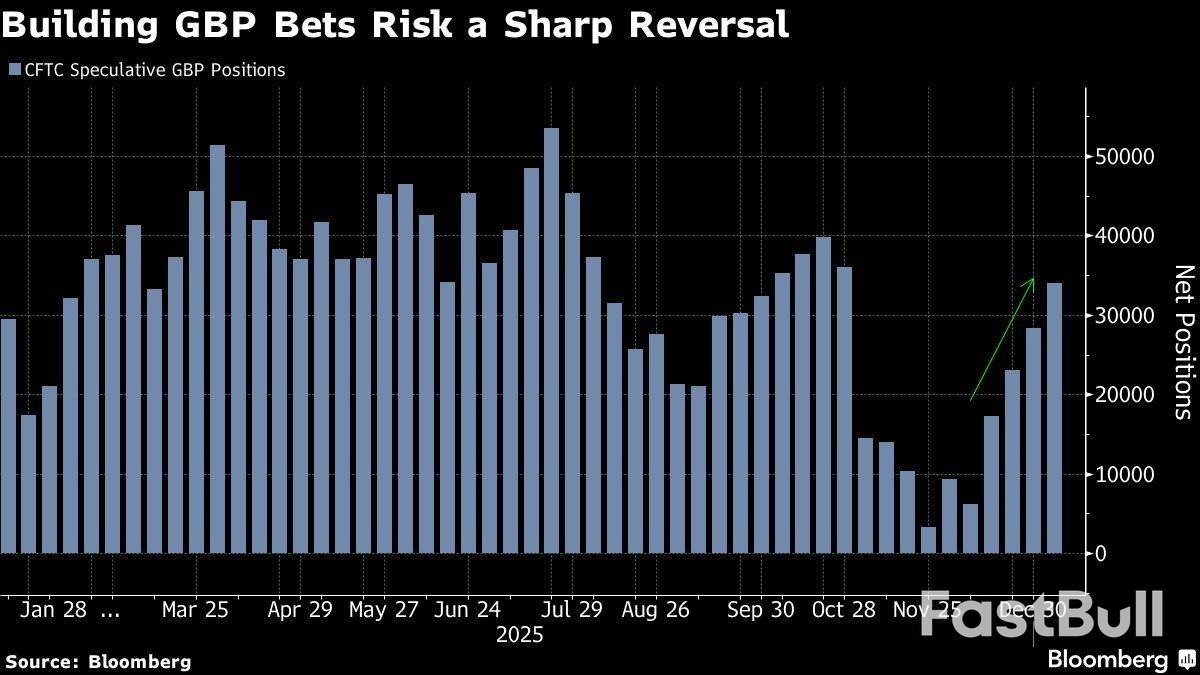
          Analysts at Morgan Stanley have warned that stretched positioning makes the pound particularly susceptible to a downturn. They suggest sterling could deliver "the first big FX move of 2026" if the economic data comes in weaker than expected.

          Figure 1: CFTC data reveals a sharp increase in speculative net long positions on the pound, making the currency vulnerable to a reversal if economic data disappoints.

          Data from the CFTC shows that hedge funds and other speculators have significantly built up their bullish bets on the currency over the past month.

          "The pound will be more sensitive to softer data than to strong," said Jane Foley, head of G10 FX strategy at Rabobank. She anticipates the currency will struggle to overcome a key technical resistance level of 0.8644 against the euro, its 200-day moving average.

          The positive economic data for November, released Thursday, did little to support the pound, which ended the day down 0.3% on a trade-weighted basis. The rebound was partly driven by a one-off recovery at Jaguar Land Rover following a cyberattack, a factor unlikely to be repeated.

          A Mixed Outlook for UK Stocks

          The forecast for UK equities is more complex. The FTSE 100 has already gained 3% this year, rising above 10,000 points for the first time in history and capping its best year since 2009.

          However, Barclays plc strategist Emmanuel Cau remains cautious, maintaining an underweight rating on UK stocks. He argues that companies with a domestic focus are vulnerable due to the nation's precarious fiscal situation. Meanwhile, the internationally-focused companies in the FTSE 100, often viewed as defensive investments, may eventually underperform their European counterparts.

          Gilts Poised to Gain from Economic Weakness

          For bond traders, signs of a weakening economy and increased wagers on rate cuts would be a bullish signal, potentially extending the strong start for UK government bonds, known as gilts. The BOE, along with the Federal Reserve, is one of three G-10 central banks expected to continue cutting rates this year.

          "While the reported erosion in the UK government's fiscal buffer is a cause for concern, a complete wipe-out... isn't the base case. That buys the government time to set its fiscal house right, so there is no immediate risk for holders of gilts," explained Ven Ram, a macro strategist at Bloomberg Strategists.

          This week, the 10-year gilt yield dropped to its lowest point since December 2024, and the two-year yield fell to a low not seen since August of that year. A Bloomberg index tracking gilts has risen 0.9%, marking its best start to a year since 2023.

          David Roberts, co-portfolio manager of the Global Strategic Bond Fund at Nedgroup Investments, suggested that any volatility stemming from a poor showing by the Labour party in the May local elections could present a buying opportunity. "If gilts sell off for political reasons, without any real change in the economic fundamentals, we would likely take the other side of that move and go long the UK again," he said. Roberts recently took profits on UK bonds he purchased in August.

          To stay updated on all economic events of today, please check out our Economic calendar
          Risk Warnings and Disclaimers
          You understand and acknowledge that there is a high degree of risk involved in trading. Following any strategies or investment methods may lead to potential losses. The content on the site is provided by our contributors and analysts for information purposes only. You are solely responsible for determining whether any trading assets, securities, strategy, or any other product is suitable for investing based on your own investment objectives and financial situation.
          Add to Favorites
          Share

          Trump Floats New Tariffs In Push To Acquire Greenland

          Justin

          Political

          U.S. President Donald Trump gestures as he speaks during a "Great, Historic Investment in Rural Health Roundtable" in the East Room of the White House on Jan. 16, 2026 in Washington, DC.

          President Donald Trump said Friday he may impose tariffs on countries "if they don't go along with Greenland."

          "We need Greenland for national security. So I may do that," Trump said at the White House.

          The comments show Trump considering applying tariffs, one of his favorite tools for leveraging his executive power over foreign countries, to his increasingly aggressive efforts to acquire Greenland for the United States.

          The White House did not immediately respond to CNBC's request for additional information on Trump's remarks.

          Source: CNBC

          Risk Warnings and Disclaimers
          You understand and acknowledge that there is a high degree of risk involved in trading. Following any strategies or investment methods may lead to potential losses. The content on the site is provided by our contributors and analysts for information purposes only. You are solely responsible for determining whether any trading assets, securities, strategy, or any other product is suitable for investing based on your own investment objectives and financial situation.
          Add to Favorites
          Share
          FastBull
          Copyright © 2026 FastBull Ltd

          728 RM B 7/F GEE LOK IND BLDG NO 34 HUNG TO RD KWUN TONG KLN HONG KONG

          TelegramInstagramTwitterfacebooklinkedin
          App Store Google Play Google Play
          Products
          Charts

          Chats

          Q&A with Experts
          Screeners
          Economic Calendar
          Data
          Tools
          Membership
          Features
          Function
          Markets
          Copy Trading
          Latest Signals
          Contests
          News
          Analysis
          24/7
          Columns
          Education
          Company
          Careers
          About Us
          Contact Us
          Advertising
          Help Center
          Feedback
          User Agreement
          Privacy Policy
          Personal Information Protection Statement
          Business

          White Label

          Data API

          Web Plug-ins

          Poster Maker

          Affiliate Program

          Risk Disclosure

          The risk of loss in trading financial instruments such as stocks, FX, commodities, futures, bonds, ETFs and crypto can be substantial. You may sustain a total loss of the funds that you deposit with your broker. Therefore, you should carefully consider whether such trading is suitable for you in light of your circumstances and financial resources.

          No decision to invest should be made without thoroughly conducting due diligence by yourself or consulting with your financial advisors. Our web content might not suit you since we don't know your financial conditions and investment needs. Our financial information might have latency or contain inaccuracy, so you should be fully responsible for any of your trading and investment decisions. The company will not be responsible for your capital loss.

          Without getting permission from the website, you are not allowed to copy the website's graphics, texts, or trademarks. Intellectual property rights in the content or data incorporated into this website belong to its providers and exchange merchants.

          Not Logged In

          Log in to access more features

          FastBull Membership

          Not yet

          Purchase

          Become a signal provider
          Help Center
          Customer Service
          Dark Mode
          Price Up/Down Colors

          Log In

          Sign Up

          Position
          Layout
          Fullscreen
          Default to Chart
          The chart page opens by default when you visit fastbull.com