• Trade
  • Markets
  • Copy
  • Contests
  • News
  • 24/7
  • Calendar
  • Q&A
  • Chats
Trending
Screeners
SYMBOL
LAST
BID
ASK
HIGH
LOW
NET CHG.
%CHG.
SPREAD
SPX
S&P 500 Index
6827.42
6827.42
6827.42
6899.86
6801.80
-73.58
-1.07%
--
DJI
Dow Jones Industrial Average
48458.04
48458.04
48458.04
48886.86
48334.10
-245.98
-0.51%
--
IXIC
NASDAQ Composite Index
23195.16
23195.16
23195.16
23554.89
23094.51
-398.69
-1.69%
--
USDX
US Dollar Index
97.950
98.030
97.950
98.500
97.950
-0.370
-0.38%
--
EURUSD
Euro / US Dollar
1.17394
1.17409
1.17394
1.17496
1.17192
+0.00011
+ 0.01%
--
GBPUSD
Pound Sterling / US Dollar
1.33707
1.33732
1.33707
1.33997
1.33419
-0.00148
-0.11%
--
XAUUSD
Gold / US Dollar
4299.39
4299.39
4299.39
4353.41
4257.10
+20.10
+ 0.47%
--
WTI
Light Sweet Crude Oil
57.233
57.485
57.233
58.011
56.969
-0.408
-0.71%
--

Community Accounts

Signal Accounts
--
Profit Accounts
--
Loss Accounts
--
View More

Become a signal provider

Sell trading signals to earn additional income

View More

Guide to Copy Trading

Get started with ease and confidence

View More

Signal Accounts for Members

All Signal Accounts

Best Return
  • Best Return
  • Best P/L
  • Best MDD
Past 1W
  • Past 1W
  • Past 1M
  • Past 1Y

All Contests

  • All
  • Trump Updates
  • Recommend
  • Stocks
  • Cryptocurrencies
  • Central Banks
  • Featured News
Top News Only
Share

Thai Leader Anutin: Landmine Blast That Killed Thai Soldiers 'Not A Roadside Accident'

Share

Thai Leader Anutin: Thailand To Continue Military Action Until 'We Feel No More Harm'

Share

Cambodian Prime Minister Hun Manet Says He Had Phone Calls With Trump And Malaysian Leader Anwar About Ceasefire

Share

Cambodia's Hun Manet Says USA, Malaysia Should Verify 'Which Side Fired First' In Latest Conflict

Share

Cambodia's Hun Manet: Cambodia Maintains Its Stance In Seeking Peaceful Resolution Of Disputes

Share

Nasdaq Companies: Allergan, Ferrovia, Insmed, Monolithic Power Systems, Seagate Technology, And Western Digital Will Be Added To The NASDAQ 100 Index. Biogen, CdW, GlobalFoundries, Lululemon, ON Semiconductor, And Tradedesk Will Be Removed From The NASDAQ 100 Index

Share

Witkoff Headed To Berlin This Weekend To Meet With Zelenskiy, European Leaders -Wsj Reporter On X

Share

Russia Attacks Two Ukrainian Ports, Damaging Three Turkish-Owned Vessels

Share

[Historic Flooding Occurs In At Least Four Rivers In Washington State Due To Days Of Torrential Rains] Multiple Areas In Washington State Have Been Hit By Severe Flooding Due To Days Of Torrential Rains, With At Least Four Rivers Experiencing Historic Flooding. Reporters Learned On The 12th That The Floods Caused By The Torrential Rains In Washington State Have Destroyed Homes And Closed Several Highways. Experts Warn That Even More Severe Flooding May Occur In The Future. A State Of Emergency Has Been Declared In Washington State

Share

Trump Says Proposed Free Economic Zone In Donbas Would Work

Share

Trump: I Think My Voice Should Be Heard

Share

Trump Says Will Be Choosing New Fed Chair In Near Future

Share

Trump Says Proposed Free Economic Zone In Donbas Complex But Would Work

Share

Trump Says Land Strikes In Venezuela Will Start Happening

Share

US President Trump: Thailand And Cambodia Are In A Good Situation

Share

State Media: North Korean Leader Kim Hails Troops Returning From Russia Mission

Share

The 10-year Treasury Yield Rose About 5 Basis Points During The "Fed Rate Cut Week," And The 2/10-year Yield Spread Widened By About 9 Basis Points. On Friday (December 12), In Late New York Trading, The Yield On The Benchmark 10-year US Treasury Note Rose 2.75 Basis Points To 4.1841%, A Cumulative Increase Of 4.90 Basis Points For The Week, Trading Within A Range Of 4.1002%-4.2074%. It Rose Steadily From Monday To Wednesday (before The Fed Announced Its Rate Cut And Treasury Bill Purchase Program), Subsequently Exhibiting A V-shaped Recovery. The 2-year Treasury Yield Fell 1.82 Basis Points To 3.5222%, A Cumulative Decrease Of 3.81 Basis Points For The Week, Trading Within A Range Of 3.6253%-3.4989%

Share

Trump: Lots Of Progress Being Made On Russia-Ukraine

Share

NOPA November US Soybean Crush Estimated At 220.285 Million Bushels

Share

SPDR Gold Trust Reports Holdings Up 0.22%, Or 2.28 Tonnes, To 1053.11 Tonnes By Dec 12

TIME
ACT
FCST
PREV
U.K. Trade Balance Non-EU (SA) (Oct)

A:--

F: --

P: --

U.K. Trade Balance (Oct)

A:--

F: --

P: --

U.K. Services Index MoM

A:--

F: --

P: --

U.K. Construction Output MoM (SA) (Oct)

A:--

F: --

P: --

U.K. Industrial Output YoY (Oct)

A:--

F: --

P: --

U.K. Trade Balance (SA) (Oct)

A:--

F: --

P: --

U.K. Trade Balance EU (SA) (Oct)

A:--

F: --

P: --

U.K. Manufacturing Output YoY (Oct)

A:--

F: --

P: --

U.K. GDP MoM (Oct)

A:--

F: --

P: --

U.K. GDP YoY (SA) (Oct)

A:--

F: --

P: --

U.K. Industrial Output MoM (Oct)

A:--

F: --

P: --

U.K. Construction Output YoY (Oct)

A:--

F: --

P: --

France HICP Final MoM (Nov)

A:--

F: --

P: --

China, Mainland Outstanding Loans Growth YoY (Nov)

A:--

F: --

P: --

China, Mainland M2 Money Supply YoY (Nov)

A:--

F: --

P: --

China, Mainland M0 Money Supply YoY (Nov)

A:--

F: --

P: --

China, Mainland M1 Money Supply YoY (Nov)

A:--

F: --

P: --

India CPI YoY (Nov)

A:--

F: --

P: --

India Deposit Gowth YoY

A:--

F: --

P: --

Brazil Services Growth YoY (Oct)

A:--

F: --

P: --

Mexico Industrial Output YoY (Oct)

A:--

F: --

P: --

Russia Trade Balance (Oct)

A:--

F: --

P: --

Philadelphia Fed President Henry Paulson delivers a speech
Canada Building Permits MoM (SA) (Oct)

A:--

F: --

P: --

Canada Wholesale Sales YoY (Oct)

A:--

F: --

P: --

Canada Wholesale Inventory MoM (Oct)

A:--

F: --

P: --

Canada Wholesale Inventory YoY (Oct)

A:--

F: --

P: --

Canada Wholesale Sales MoM (SA) (Oct)

A:--

F: --

P: --

Germany Current Account (Not SA) (Oct)

A:--

F: --

P: --

U.S. Weekly Total Rig Count

A:--

F: --

P: --

U.S. Weekly Total Oil Rig Count

A:--

F: --

P: --

Japan Tankan Large Non-Manufacturing Diffusion Index (Q4)

--

F: --

P: --

Japan Tankan Small Manufacturing Outlook Index (Q4)

--

F: --

P: --

Japan Tankan Large Non-Manufacturing Outlook Index (Q4)

--

F: --

P: --

Japan Tankan Large Manufacturing Outlook Index (Q4)

--

F: --

P: --

Japan Tankan Small Manufacturing Diffusion Index (Q4)

--

F: --

P: --

Japan Tankan Large Manufacturing Diffusion Index (Q4)

--

F: --

P: --

Japan Tankan Large-Enterprise Capital Expenditure YoY (Q4)

--

F: --

P: --

U.K. Rightmove House Price Index YoY (Dec)

--

F: --

P: --

China, Mainland Industrial Output YoY (YTD) (Nov)

--

F: --

P: --

China, Mainland Urban Area Unemployment Rate (Nov)

--

F: --

P: --

Saudi Arabia CPI YoY (Nov)

--

F: --

P: --

Euro Zone Industrial Output YoY (Oct)

--

F: --

P: --

Euro Zone Industrial Output MoM (Oct)

--

F: --

P: --

Canada Existing Home Sales MoM (Nov)

--

F: --

P: --

Euro Zone Total Reserve Assets (Nov)

--

F: --

P: --

U.K. Inflation Rate Expectations

--

F: --

P: --

Canada National Economic Confidence Index

--

F: --

P: --

Canada New Housing Starts (Nov)

--

F: --

P: --

U.S. NY Fed Manufacturing Employment Index (Dec)

--

F: --

P: --

U.S. NY Fed Manufacturing Index (Dec)

--

F: --

P: --

Canada Core CPI YoY (Nov)

--

F: --

P: --

Canada Manufacturing Unfilled Orders MoM (Oct)

--

F: --

P: --

Canada Manufacturing New Orders MoM (Oct)

--

F: --

P: --

Canada Core CPI MoM (Nov)

--

F: --

P: --

Canada Manufacturing Inventory MoM (Oct)

--

F: --

P: --

Canada CPI YoY (Nov)

--

F: --

P: --

Canada CPI MoM (Nov)

--

F: --

P: --

Canada CPI YoY (SA) (Nov)

--

F: --

P: --

Canada Core CPI MoM (SA) (Nov)

--

F: --

P: --

Q&A with Experts
    • All
    • Chatrooms
    • Groups
    • Friends
    Connecting
    .
    .
    .
    Type here...
    Add Symbol or Code

      No matching data

      All
      Trump Updates
      Recommend
      Stocks
      Cryptocurrencies
      Central Banks
      Featured News
      • All
      • Russia-Ukraine Conflict
      • Middle East Flashpoint
      • All
      • Russia-Ukraine Conflict
      • Middle East Flashpoint
      Search
      Products

      Charts Free Forever

      Chats Q&A with Experts
      Screeners Economic Calendar Data Tools
      Membership Features
      Data Warehouse Market Trends Institutional Data Policy Rates Macro

      Market Trends

      Market Sentiment Order Book Forex Correlations

      Top Indicators

      Charts Free Forever
      Markets

      News

      News Analysis 24/7 Columns Education
      From Institutions From Analysts
      Topics Columnists

      Latest Views

      Latest Views

      Trending Topics

      Top Columnists

      Latest Update

      Signals

      Copy Rankings Latest Signals Become a signal provider AI Rating
      Contests
      Brokers

      Overview Brokers Assessment Rankings Regulators News Claims
      Broker listing Forex Brokers Comparison Tool Live Spread Comparison Scam
      Q&A Complaint Scam Alert Videos Tips to Detect Scam
      More

      Business
      Events
      Careers About Us Advertising Help Center

      White Label

      Data API

      Web Plug-ins

      Affiliate Program

      Awards Institution Evaluation IB Seminar Salon Event Exhibition
      Vietnam Thailand Singapore Dubai
      Fans Party Investment Sharing Session
      FastBull Summit BrokersView Expo
      Recent Searches
        Top Searches
          Markets
          News
          Analysis
          User
          24/7
          Economic Calendar
          Education
          Data
          • Names
          • Latest
          • Prev

          View All

          No data

          Scan to Download

          Faster Charts, Chat Faster!

          Download App
          English
          • English
          • Español
          • العربية
          • Bahasa Indonesia
          • Bahasa Melayu
          • Tiếng Việt
          • ภาษาไทย
          • Français
          • Italiano
          • Türkçe
          • Русский язык
          • 简中
          • 繁中
          Open Account
          Search
          Products
          Charts Free Forever
          Markets
          News
          Signals

          Copy Rankings Latest Signals Become a signal provider AI Rating
          Contests
          Brokers

          Overview Brokers Assessment Rankings Regulators News Claims
          Broker listing Forex Brokers Comparison Tool Live Spread Comparison Scam
          Q&A Complaint Scam Alert Videos Tips to Detect Scam
          More

          Business
          Events
          Careers About Us Advertising Help Center

          White Label

          Data API

          Web Plug-ins

          Affiliate Program

          Awards Institution Evaluation IB Seminar Salon Event Exhibition
          Vietnam Thailand Singapore Dubai
          Fans Party Investment Sharing Session
          FastBull Summit BrokersView Expo

          UK Economists Say Markets Betting Wrong On Interest Rate Cuts

          Samantha Luan

          Economic

          Summary:

          Bank of England says UK trends track closer to Europe than US.Investors are fully pricing in two rate cuts this year.

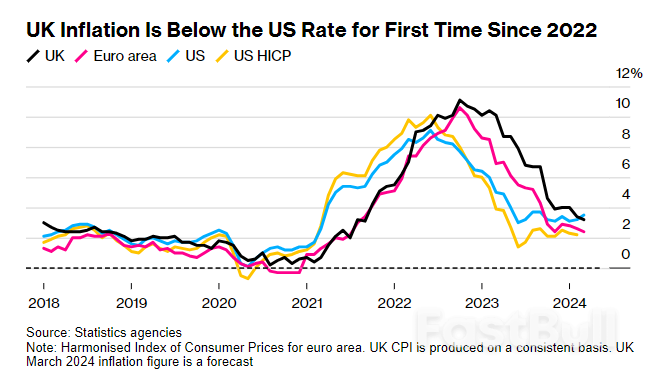
          The Bank of England has found itself caught in the middle of a trans-Atlantic divide over who will cut interest rates first, with costly implications for gilt traders and British political leaders counting on election year relief from high borrowing costs.
          On one side are City of London economists and BOE Governor Andrew Bailey who say the UK’s outlook seems more like the European Central Bank’s. On the other are investors, who are betting the BOE’s path to rate cuts more closely resembles the Federal Reserve as they rapidly unwind expectations for easing in the US this year. Only one can be right.
          UK Economists Say Markets Betting Wrong On Interest Rate Cuts_1
          The split has vexed economists, who have seen little in recent UK data to change their mind about the fundamental differences between the British and American outlooks. The UK faces sluggish growth after a shallow contraction in the second half of last year. The US by contrast continues to show strength.
          “Markets have superimposed the US cycle on the UK, but the US and UK are on very different tracks,” said Sanjay Raja, chief UK economist at Deutsche Bank. “The UK is coming out of technical recession. Inflation is falling more convincingly. Pay settlements are following inflation expectations. And crucially, real policy rates in the UK will be higher than in the US.”
          A Bloomberg survey of economists released last week showed that most expected the BOE to make its first quarter-point cut in June, with a full percentage point of easing by year-end. Markets, meanwhile, have gone from pricing in six cuts for 2024 at the start of the year to just two now. At times last week, traders were only fully pricing a single quarter-point cut this year — and then not until November.
          The confusion over when the BOE might begin to climb down from interest rates, which the central bank has kept at a 16-year high since August, is weakening the case for buying gilts in the near term. More broadly, it’s fueling anxieties in the ruling Conservative Party that Prime Minister Rishi Sunak will see little political relief from elevated mortgage rates before he faces Keir Starmer’s resurgent Labour Party in an election later this year.
          The market’s recalibration has accelerated due in part to unexpectedly hot consumer price index data in the US, which has fueled concerns that the Fed faces a difficult “last mile” on the road back to its 2% inflation target. A delayed pivot by Fed Chair Jerome Powell could also prompt other central bankers to slow down, since cutting in isolation risks weakening the local currencies relative to the dollar.
          The UK was swept up into those jitters last week after wage and inflation data came in slightly higher than expected. Inflation fell to its lowest in 2 1/2 years at 3.2% in March, but headline price growth and underlying measures came in slightly above economists’ predictions. Wage growth was also stronger than expected for the three months to February, stubbornly holding at 6%.UK Economists Say Markets Betting Wrong On Interest Rate Cuts_2
          The result is that the market’s expectations for BOE easing now looks more like those for the Fed than the ECB.
          “While market expectations for the ECB seem to have decoupled somewhat from their US counterparts, expectations for the BOE continue to track US expectations quite closely,” said Michael Pfister, an analyst at Commerzbank. It’s “likely that the BOE is heading for a small correction in the level of interest rates rather than a pronounced cycle of rate cuts.”
          Still, while some economists have since scaled back their predictions for BOE cuts, most haven’t changed expectations for a summer move. Analysts at Morgan Stanley, Goldman Sachs Group, Capital Economics and Bloomberg Economics are all among those still anticipating a shift toward easing in June.
          Against that backdrop, Bailey signaled during appearances with his global peers at International Monetary Fund meetings last week in Washington that he thought the UK shared more in common with Europe than America.
          “The dynamics of inflation are rather different between Europe — I mean Europe geographically now — and in the US,” Bailey said on Tuesday. He said the US was experiencing more “demand-led inflation pressure” than in the UK’s stagnant economy, pointing to “strong evidence” of easing price pressures in the latter.
          Bailey played down the data on Wednesday, saying the BOE was “pretty much on track to where we thought we would be” as of its February forecasts. The central bank expects inflation to meet its 2% target when April data is released in May, due to another drop in energy bills.
          Deputy Governor Dave Ramsden amplified those points on Friday, saying inflation risks are now tilted toward the “downside” and that the UK is looking less like an “outlier” on pricing pressures and more like the euro area.
          “We agree with Bailey that the UK’s dynamics look different which provides reason to think the BOE can diverge from the Fed,” said Dan Hanson, chief UK economist at Bloomberg Economics. “We think the market has pushed pricing for the first BOE cut back too far.”

          Source:Bloomberg

          To stay updated on all economic events of today, please check out our Economic calendar
          Risk Warnings and Disclaimers
          You understand and acknowledge that there is a high degree of risk involved in trading. Following any strategies or investment methods may lead to potential losses. The content on the site is provided by our contributors and analysts for information purposes only. You are solely responsible for determining whether any trading assets, securities, strategy, or any other product is suitable for investing based on your own investment objectives and financial situation.
          Add to Favorites
          Share

          Investors Need to Buckle up Because This Is the Most Dangerous Time Since The End of World War II, Former Top Diplomat Says

          Thomas

          Economic

          Richard Haass, who was a top official in the State Department and is now senior counselor at Centerview Partners, was asked on Bloomberg TV on Friday what investors should keep top of mind.
          “You need to have a seat belt and keep it fastened,” Haass replied.
          He said both Democrats and Republicans are competing over how protectionist they can be when it comes to China, which could have inflationary consequences. They are also looking to tighten the U.S.-Mexico border, which could add to inflation as well if it restricts the supply of workers.
          Haass said he's also worried about time between the U.S. election and the presidential inauguration, especially if there's another close contest that stirs up political violence.
          “A lot of people around the world could get unnerved. A lot of foes around the world might see that as a moment of opportunity,” he warned.
          Then after Inauguration Day, a key question will we be if the U.S. government is functional or dysfunctional, he said. And if former President Donald Trump is elected again, another question would be whether he tries to dismantle key pieces of the world order that have served U.S. interests for more than 75 years, Haass added.
          Trump has been particularly hostile toward NATO members he views as not spending enough. In February, he said he'd encourage Russia to do “whatever the hell they want” to allies that are “delinquent.” Days later, he doubled down, saying “if they're not going to pay, we're not going to protect.”
          “So if you're an investor, there's a degree of uncertainty, this combination of geopolitics in the world against the backdrop of an America that's no longer certain or united as to its role,” Haass said. “This is actually the most dangerous moment, I would argue, not just since the end of the Cold War but in many ways since the end of World War II.”
          To be sure, he also pointed to some positive signs, including the strengthened alliance between the U.S. and Japan, improved ties between Japan and South Korea, the emergence of India's economy, and the West's support for Ukraine against Russia, though that recently wavered until the U.S. House passed a new aid package after months of delays.
          But he cautioned that the world isn't self-organizing, and the U.S. plays a large role that U.S. investors must consider.
          “The rule of law here at home, a stable world—this provides the context for everything American business does,” Haass said, noting that CEOs should support pro-democracy policies at home and “pro-internationalist” abroad.
          His warnings echo those of top economist Mohamed El-Erian, who wrote in a Financial Times op-ed on Friday that there's a major disconnect between investors and security experts about how they view the risks from the Iran-Israel conflict, which could still deliver a major shock to global growth and financial markets.
          The conflict has “durably raised the geopolitical temperature in the region,” but financial markets have brushed that aside, as the recent tit-for-tat hasn't yet resulted in major casualties of physical damage, he said.
          “Given that this is a region that is vulnerable to errors of judgment, insufficient understanding of adversaries, and implementation accidents, that could well prove too complacent a reaction,” El-Erian said.

          Source: Fortune

          To stay updated on all economic events of today, please check out our Economic calendar
          Risk Warnings and Disclaimers
          You understand and acknowledge that there is a high degree of risk involved in trading. Following any strategies or investment methods may lead to potential losses. The content on the site is provided by our contributors and analysts for information purposes only. You are solely responsible for determining whether any trading assets, securities, strategy, or any other product is suitable for investing based on your own investment objectives and financial situation.
          Add to Favorites
          Share

          China's Steel Sector has Bigger Worries than Biden Tariff Hike

          Cohen

          Commodity

          U.S. President Joe Biden's push to triple tariffs on Chinese steel imports strikes a mostly symbolic blow on an industry facing bigger concerns over faltering local demand and threats of even stronger blowback against China's surging exports.
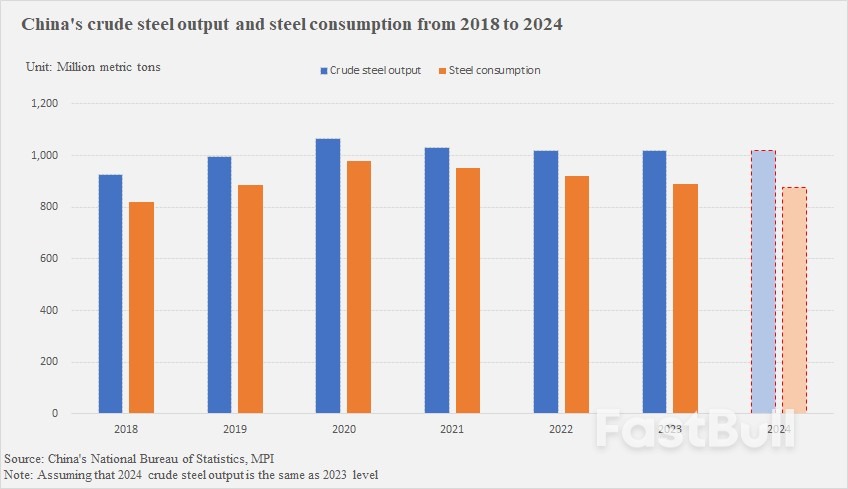
          Steel consumption in the world's second-largest economy is poised to shrink again this year as a protracted property crisis has yet to find bottom and as infrastructure demand growth slows after 12 indebted regions were ordered to halt certain projects.
          The state-backed China Metallurgical Industry Planning and Research Institute (MPI) forecasts a 1.7% drop in China's steel demand this year, following a 3.3% decline in 2023.
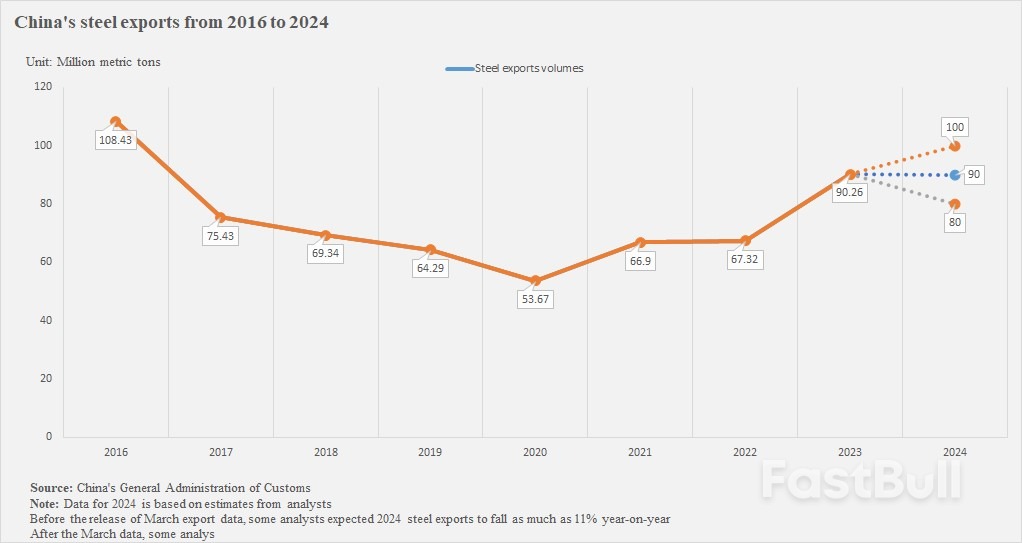
          While China's steel exports last year climbed more than a third to their highest since 2016 at 90.26 million metric tons, about 9% of its total crude steel output, just 598,000 tons of the shipments went to the United States. That was down 8.2% from volumes shipped to the U.S. the previous year and less than 1% of total Chinese steel exports worth $85 billion in 2023.
          China, the world's biggest producer and exporter of steel, is just the seventh-largest shipper of steel to the U.S., softening the blow of Biden's proposal to raise to 25% the tariffs imposed by his predecessor Donald Trump on certain steel and aluminium products.
          "We do not think there will be any big impact as the main destinations for China's steel exports are Japan, South Korea, and Middle East countries," said an analyst at a China-based steel trader who declined to be named as he was not authorised to speak with media.
          Spurred by low local prices, Chinese steelmakers and traders are on track to match or surpass last year's exports, with domestic information provider Lange Steel lifting its forecast to more than 100 million tons for 2024 after March shipments beat expectations.China's Steel Sector has Bigger Worries than Biden Tariff Hike_1
          China's cheap steel products are also stoking complaints from beyond the United States.
          Late last year, India imposed anti-dumping duties on some Chinese steel imports while Mexico announced a nearly 80% tariff. Thailand has launched a probe into Chinese rolled steel imports, and Brazilian steelmakers are urging their government to impose a 25% tariff on imports.
          A report from a Chinese state-backed research agency identified a total of 112 statements from countries regarding anti-dumping and anti-subsidy moves on Chinese steel products in 2023, a rise of around 20 from 2022.
          "We are expecting more trade frictions this year," said David Cachot, research director at consultancy Wood Mackenzie.

          Domestic Doldrums

          Beijing's latest support for the sector, a plan to back equipment upgrades in the industrial and farm sectors and speed consumers' replacement of cars and home appliances, is unlikely to fully offset reduced steel consumption from the property sector.
          Consultancy CRU Group forecast that an additional 8 million to 9 million tons of steel demand will be created over the next four years thanks to the policy. In comparison, the state metallurgical institute expects construction demand to decline 20 million tons, or 4%, this year.
          Some analysts said they expect infrastructure-led steel consumption this year to grow just 1% to 2%, from previous expectations of 7% to 8%, after Beijing's demand that a dozen regional governments delay or halt some state-funded infrastructure projects prompted other regions to follow suit.
          In recent years, Beijing has imposed caps on steel production both to reduce supply and curb carbon emissions, and industry watchers and insiders say further output cuts are needed to curtail overcapacity.
          "The steel industry faces a conspicuous contradiction -strong supply capability and dwindling demand," Luo Tiejun, vice chairman of state-backed China Iron and Steel Association (CISA), told an industry event this week in southern China.
          "The key to address this is that leading producers take the lead in reining in production pace based on demand," Luo said, according to the group's WeChat account.China's Steel Sector has Bigger Worries than Biden Tariff Hike_2

          Exports to the rescue?

          In March, Chinese steel exports climbed to 9.89 million tons, the highest for a month since July 2016, bringing the first-quarter total to 25.8 millions even as overall exports in the world's second-largest economy contracted sharply.
          Valued at $20.3 billion, China's first quarter steel exports averaged $789 per ton, far above local prices averaging 4,145 yuan ($572.30), data from customs and consultancy Mysteel show.
          A weaker-for-longer yuan against the U.S. dollar, partly due to delayed U.S. Federal Reserve interest rate cuts, is also expected to facilitate steel exports.
          But exports are susceptible to uncertainty stemming not only from trade frictions but also growing overseas supply and the potential for Beijing to mandate output limits.
          To be sure, global steel demand is expected to rise 1.7% to 1.793 billion tons this year, the World Steel Association said.
          "Although some countries are building their own capacity to fulfil the increase in local demand, this cannot meet the demand quickly enough, which means that there is still room for steel from China," said Kevin Bai, a Beijing-based analyst at CRU Group.

          ($1 = 7.2426 yuan)

          Source: Yahoo

          Risk Warnings and Disclaimers
          You understand and acknowledge that there is a high degree of risk involved in trading. Following any strategies or investment methods may lead to potential losses. The content on the site is provided by our contributors and analysts for information purposes only. You are solely responsible for determining whether any trading assets, securities, strategy, or any other product is suitable for investing based on your own investment objectives and financial situation.
          Add to Favorites
          Share

          China Braces For Worst As It Becomes Punching Bag In US Election

          Alex

          Economic

          Political

          With Beijing already becoming a top target in the US election campaign, President Xi Jinping’s government is resisting any move that could backfire on the world’s second-largest economy.
          China’s restraint was on display last week after President Joe Biden blasted Beijing as “xenophobic” and vowed to triple tariffs on Chinese steel and aluminum exports, during a campaign stop in a swing state where rust-belt jobs are on the line.
          On the same day, Washington opened a probe into its rival’s shipbuilding sector, causing stocks of Chinese firms in that industry to tumble. Congress also fast-tracked efforts to force TikTok to divest from its Chinese parent ByteDance Ltd., by bundling the decision into an aid bill that passed Saturday.
          China’s response to all this has been relatively muted. In a largely symbolic measure, Beijing imposed tit-for-tat tariffs on propionic acid, an export market worth $7 million to America last year, according to customs data. Officials brushed off the shipping probe as being about “domestic politics,” and deflected criticism of their immigration policies, asking if Biden was really talking about the US.
          After a meeting between Xi and Biden in November “the Chinese understood that US-China relations would not be perfect, but was an improvement relative to last year,” said Zhu Junwei, a former researcher in the People’s Liberation Army who is now director of American research at Grandview Institution, a Beijing think tank. “China is learning to be more practical, more pragmatic — to compartmentalize different areas.”
          Chinese policymakers already battling a protracted property crisis and weak demand at home have scant incentive to escalate tensions. Beijing is relying on the buoyant American consumer as it leans on exports to hit its annual growth goal of about 5%.
          Another reason for moderation: The latest US measures have minimal immediate impact. China sells little of the targeted metals to the US, and the shipbuilding probe will take time. The Senate still needs to approve the TikTok bill, and the company could file an injunction if Biden signs the proposal.
          Senior White House officials are seeking to keep communication lines open to maintain guardrails on the relationship. US Secretary of State Antony Blinken will arrive in China this week, where he will spell out how Chinese companies’ support for Russia’s war machine is impacting European security, according to a senior US official.
          His trip comes on the heels of Treasury Chief Janet Yellen’s visit to Beijing earlier this month, and the first phone call between China’s new defense minister and his US counterpart.
          While Beijing might be able to dismiss largely symbolic tariffs, the prospect of TikTok being acquired by an American entity does appear to be worrying China. Behind the scenes, Chinese embassy workers are quietly meeting congressional staff to lobby against the bill, Politico reported Wednesday.
          The Chinese government has signaled it won’t allow a forced sale of the app with 170 million American users, which US national security officials say China could use to manipulate the election. The popular video-sharing platform says it’s committed to “protecting the integrity” of such votes.
          Another option is that Beijing uses domestic measures it had passed to control technology exports and foreign acquisitions to curtail any sale by stripping out TikTok’s algorithms, according to the Carnegie Endowment for International Peace.
          “Reciprocity is a key feature of Chinese trade and foreign policy making,” said Josef Gregory Mahoney, a professor of international relations at Shanghai’s East China Normal University, adding that Beijing is also aware of the hawkish nature of the US election cycle.
          Biden’s challenger Donald Trump has pledged to impose 60% tariffs on imports from China if he clinches a second term. A trade war resurfacing in 2025 is “one of the biggest risks” to China, according to Larry Hu, chief China economist at Macquarie Group Ltd. “But that’s unlikely to happen this year.”
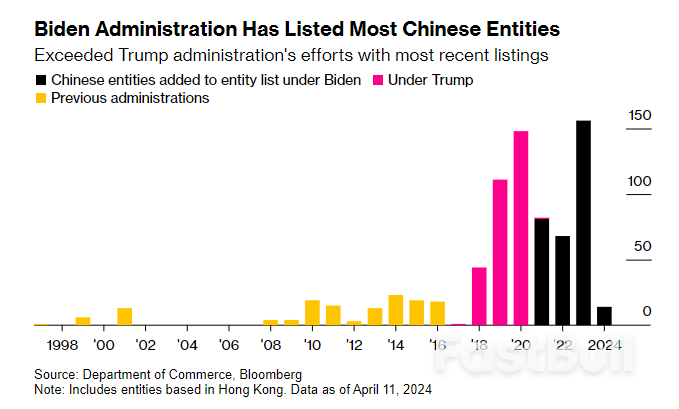
          Still, not all the tension is down to election posturing. Over the past four years, Biden has blacklisted more Chinese entities than any other American president, as he pushed US allies to join his campaign to kneecap Beijing’s access to high-tech chips over national security concerns.
           China Braces For Worst As It Becomes Punching Bag In US Election_1
          The Biden administration argues its curbs on cutting-edge semiconductors fall under a “small yard, high fence” strategy, but national security concerns risk hobbling trade in other areas. While the petition from union workers against Chinese shipbuilders mainly focuses on claims of unfair subsidies, it also has a national security element woven into the request.
          “I do not think there is a policy that would be viewed as ‘too harsh’ on China from Washington’s perspective,” said Deborah Elms, head of trade policy at the Hinrich Foundation. “China certainly wants to limit damage this year.”
          Exemplifying how industry is rallying to take advantage of the hawkish election season, the largest US airlines asked Biden to halt approvals of new flights to America by Chinese operators earlier this month, citing Beijing’s “anti-competitive policies.”
          Xi’s backing of President Vladimir Putin allows his nation’s planes to take shorter routes over Russia, whereas American carriers are excluded from doing so by unilateral sanctions the US imposed on Moscow over its invasion of Ukraine.
          It’s unclear how Biden will respond to that request. But what is plain is the US-China relationship is now in a more precarious position, according to Sun Yun, director of the China Program at the Washington-based Stimson Center.
          “Even when Washington aims to stabilize ties, competition is still the overarching theme,” she said. “Given the election year, things will not be easy.”

          Source:Bloomberg

          To stay updated on all economic events of today, please check out our Economic calendar
          Risk Warnings and Disclaimers
          You understand and acknowledge that there is a high degree of risk involved in trading. Following any strategies or investment methods may lead to potential losses. The content on the site is provided by our contributors and analysts for information purposes only. You are solely responsible for determining whether any trading assets, securities, strategy, or any other product is suitable for investing based on your own investment objectives and financial situation.
          Add to Favorites
          Share

          Asia Stocks Edge Up, Oil and Gold Retreat on Tempered Mideast Fears

          Samantha Luan

          Economic

          Stocks

          Gold and the safe-haven dollar pulled back from near their peaks, and crude oil prices declined as the potential for a major supply disruption waned.
          Iran said on Friday that it had no plan to retaliate following an apparent Israeli drone attack within its borders, which in turn followed an unprecedented Iranian missile and drone attack on Israel days before.
          MSCI's broadest index of Asia-Pacific shares rose 0.93%, retracing some of the 1.8% drop from Friday, after news of the Israeli strike emerged.
          Japan's Nikkei added 0.48%, underperforming the rest of the region due to a high concentration of chip-sector shares, which tracked declines in U.S. peers from Friday.
          Australia's benchmark gained 0.96% and South Korea's KOSPI climbed 1.04%.
          Hong Kong's Hang Seng jumped 2.26%, while mainland Chinese blue chips edged up 0.12% in their first chance to react to new measures announced on Friday aimed at promoting overseas investment in China's technology sector.
          "It seems neither Israel nor Iran want an escalation in the crisis in the Middle East ... and with a subsequent strike from either side not looking like it's coming, investor concerns have eased somewhat," said Kazuo Kamitani, a strategist at Nomura Securities.
          However, Kamitani said expectations of later Federal Reserve interest rate cuts and concerns about chip sector earnings will continue to keep investors on their toes.
          Mideast tensions also stayed on the market's radar. Two Iraqi security sources told Reuters at least five rockets were launched from Iraq's town of Zummar towards a U.S. military base in northeastern Syria on Sunday.
          MSCI's world equities index suffered its worst week since March 2023 last week, dropping 2.85%. Early on Monday, it was up just 0.06%.
          U.S. stock futures added 0.26%, following a 0.88% drop for the S&P 500 on Friday.
          Bond yields - which climb when prices fall - rose back toward multi-month highs. The 10-year U.S. Treasury yield added as much as 9 basis points to 4.658%, heading back toward the five-month peak of 4.696% reached last week on the view that the Fed would be in no hurry to ease policy amid robust economic data and sticky inflation.
          The dollar index, which measures the currency against six major peers, eased 0.07% to 106.03. It was also at a five-month top last week, at 106.51.
          Gold slid 0.6% to $2,376.40, retreating from near the all-time peak of $2,431.29 from last week.
          Crude oil fell as traders put the focus back on fundamentals.
          With a rise in U.S. stockpiles as the backdrop, Brent futures fell 54 cents, or 0.6%, to $86.75 a barrel. The front month U.S. West Texas Intermediate (WTI) crude contract for May, which expires on Monday, fell 12 cents to $83.02 a barrel. The more active June contract dropped 47 cents, or 0.6%, to $81.75 a barrel.
          "It looks on the face of it like oil's uptrend may be over, but based on technical levels, until WTI breaks below $80, the uptrend is still in place," said Nomura's Kamitani.

          Source: Reuters

          To stay updated on all economic events of today, please check out our Economic calendar
          Risk Warnings and Disclaimers
          You understand and acknowledge that there is a high degree of risk involved in trading. Following any strategies or investment methods may lead to potential losses. The content on the site is provided by our contributors and analysts for information purposes only. You are solely responsible for determining whether any trading assets, securities, strategy, or any other product is suitable for investing based on your own investment objectives and financial situation.
          Add to Favorites
          Share

          Asia open: A Busy Week As The Fed Goes Dark

          Cohen

          Economic

          Central Bank

          US stocks are beginning the week on the back foot, with a decline of over 5% from the record highs seen at the end of last month. Much hangs on big-tech earnings reports, scheduled to hit the ticker tape over the next few days, and are now under intense scrutiny after signs of fissures appeared in the mega-cap construct.
          Macro watchers have an important week ahead as they navigate through a series of significant releases from the US alongside the subtleties of a Bank of Japan (BoJ) meeting.
          The initial estimate of Q1 GDP from the world's largest economy is on the horizon, with consensus expectations suggesting an expansion of 2.7% last quarter.
          It goes without saying that this figure contradicts the Federal Reserve's efforts to engineer a slowdown, aiming for a more "sustainable" pace of growth.
          While a 2.7% growth rate would represent a notable slowdown compared to the latter part of 2023, it hardly suggests an economy ready to buckle.
          As recession banter fades into the background, the focus of the week shifts to the realease of personal income and spending figures for March, along with the month’s PCE price data, scheduled for Friday. Investors anticipate that these data points will likely reinforce the notion that the disinflation process isn’t progressing in a manner conducive to near-term rate cuts.
          The headline PCE data covering March will be in the calculus by the time it’s unveiled courtesy of the previous day’s report, but the personal spending release still has market-moving potential. Specifically, traders will look to the PCE-derived “supercore” inflation measure to refine expectations for the May FOMC meeting where anything cooler would come as a welcome surprise and likely be greeted with enthusiasm on Wall Street.
          As the Federal Reserve enters a self-imposed communications blackout ahead of the next policy gathering, many in the market see this as a welcome relief from the constant barrage of hawkish rhetoric.
          Macroeconomic forecasters, including the Federal Reserve, are currently placing greater emphasis on data dependency than usual. Given the elevated levels of economic and financial uncertainty, they are closely scrutinizing each day's data releases to shape their perspectives on the Federal Reserve's policies, inflation trends, and consumer behaviour. However, relying heavily on real-time data can introduce a challenge: the risk of succumbing to recency bias, where recent events disproportionately influence forecasting.
          Extrapolating first-quarter strength into subsequent quarters is seldom a sure bet. Historical data reveals that a single quarter of robust consumer spending growth often fails to predict the growth rate in the following quarter. For instance, last year witnessed a scorching 3.8% annualized rate of real consumer spending in the first quarter, only to plummet to a lacklustre 0.8% rate in the second quarter.
          Following one of the most challenging weeks in the market this year, investors are seeking a rebound, but the road ahead looks daunting. Recent hawkish remarks from the Federal Reserve, escalating tensions in the Middle East, and a continued decline in tech stocks are all contributing to the challenging environment.
          The hawkish tone from Fed officials has injected uncertainty into the market, with investors grappling with the prospect of higher interest rates. Additionally, geopolitical tensions in the Middle East are adding to the sense of unease, as concerns about potential disruptions to global markets linger.
          Meanwhile, weakness in the tech sector, which has been a driving force behind market gains in recent years, is weighing heavily on sentiment. The sector's struggles reflect broader concerns about valuations and regulatory risks.
          In this environment, investors will need to tread carefully and remain both data and headline-vigilant as they navigate the complexities of the current market landscape.

          Forex

          All eyes are on Asia's most traded currency pair as USDJPY hovers near 34-year peaks, nearing 155.00 market. Investors are closely watching to see if Japanese authorities will follow through on recent warnings against the yen's depreciation with intervention.
          Thus far, Tokyo's response has been limited to verbal warnings, which the market thinks rigs hallow. Bank of Japan Governor Kazuo Ueda indicated during a speech in Washington on Friday that the central bank would "very likely" raise interest rates if underlying inflation continued to rise.
          Meanwhile, along the ringing hallow lines, the latest positioning data from U.S. futures markets revealed that hedge funds and speculators increased their aggregate net short yen position in the latest week, reaching a new 17-year high. This suggests growing sentiment favouring further yen depreciation in the near term.

          Source:FXStreet

          To stay updated on all economic events of today, please check out our Economic calendar
          Risk Warnings and Disclaimers
          You understand and acknowledge that there is a high degree of risk involved in trading. Following any strategies or investment methods may lead to potential losses. The content on the site is provided by our contributors and analysts for information purposes only. You are solely responsible for determining whether any trading assets, securities, strategy, or any other product is suitable for investing based on your own investment objectives and financial situation.
          Add to Favorites
          Share

          Funds Post Record Selloff in CBOT Soyoil as U.S. Supplies Build

          Owen Li

          Commodity

          Large speculators have again adopted strongly bearish views in Chicago-traded soybean oil just a couple weeks after having quickly abandoned them, emphasizing the recent heaviness in global vegetable oil prices.
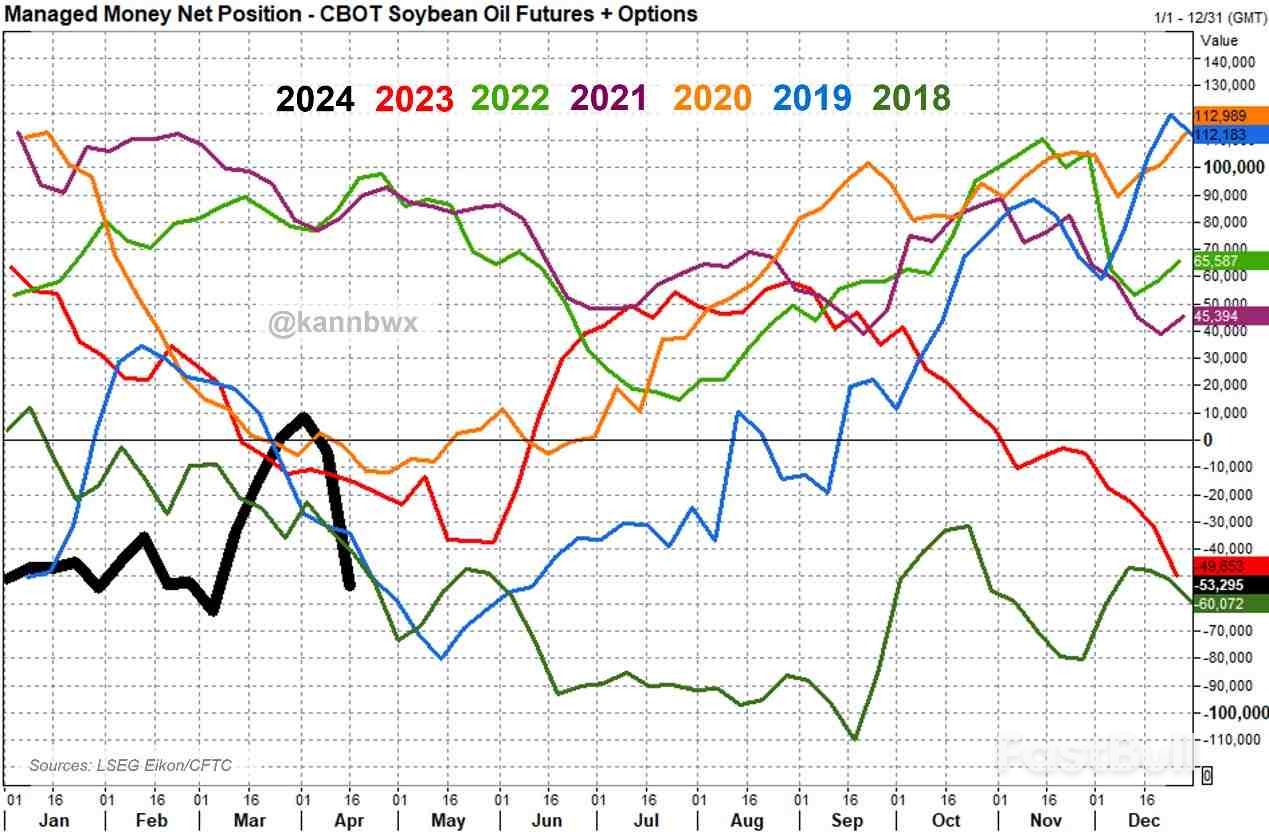
          In the week ended April 16, money managers' net short position in CBOT soybean oil futures and options surged to 53,295 contracts from 4,128 a week earlier, the largest weekly net selling in records back to 2006.Funds Post Record Selloff in CBOT Soyoil as U.S. Supplies Build_1
          End users and other speculators were on the opposite side. Other reportable traders were net buyers of more than 19,000 soyoil futures and options contracts, a weekly record, and market participants such as merchants and processors were net buyers of almost 27,000 contracts, the most since late 2022.
          Soybean oil futures fell more than 5% in the week ended April 16, facing the sharpest slide yet this year. U.S. soyoil demand amid the recent renewable diesel push has been somewhat disappointing, and domestic soyoil stocks have risen to 10-month highs, surpassing analyst predictions.
          Money managers' recent moves in CBOT soybean meal reflect the unwinding of long oil-short meal positions. Soymeal futures slightly weakened in the week ended April 16, though the managed money net short tumbled to 10,543 futures and options contracts from 24,072 a week earlier.
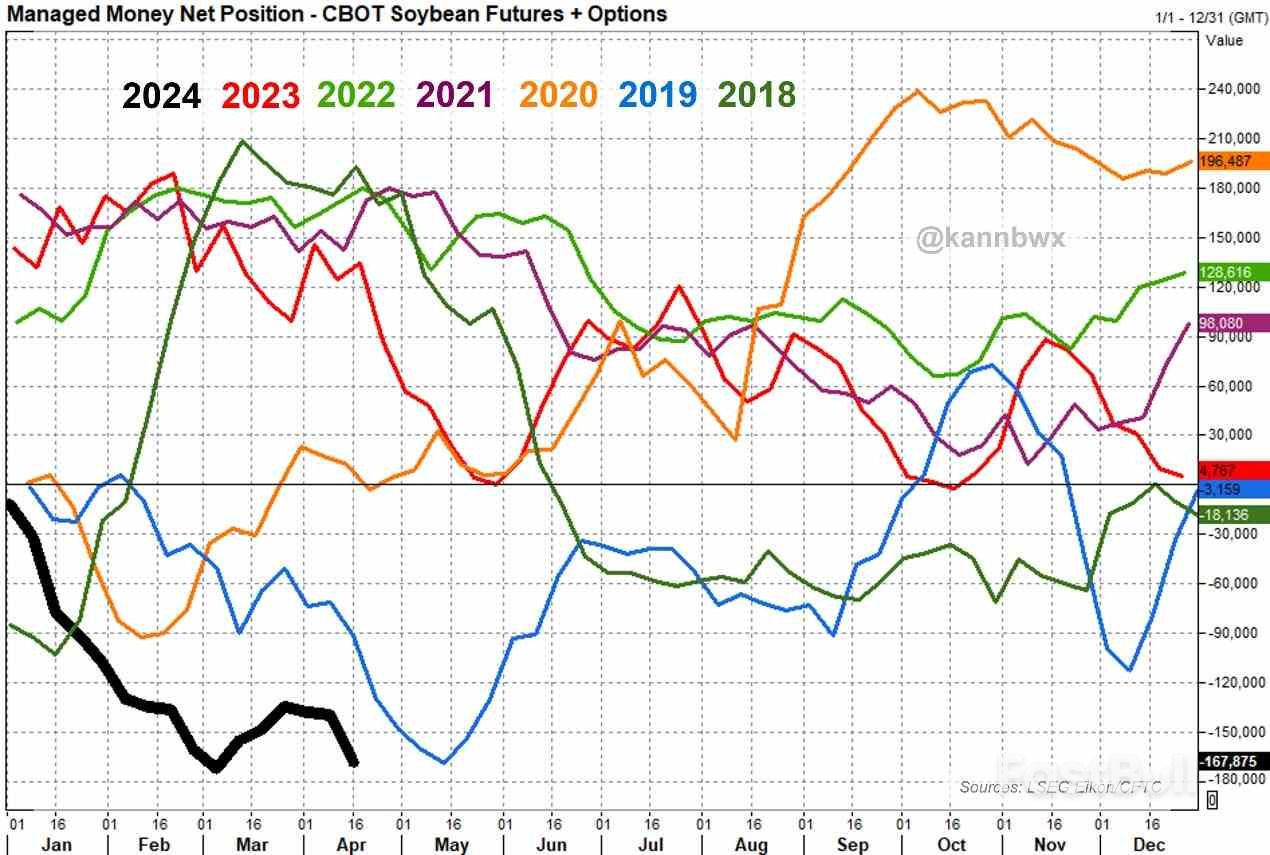
          That marked funds' least bearish meal view in three months. However, their net short in CBOT soybeans reached a six-week high on April 16, surging to 167,875 futures and options contracts from 139,310 a week earlier. New gross shorts accounted for much of the move.
          CBOT soybeans shed more than 2% that week as U.S. export demand continues to be overshadowed by Brazil's soy harvest, which is expected to satisfy global demand despite differing crop size assumptions across the industry.
          Money managers have held bearish views in CBOT soybean futures and options since the start of 2024. Those views have been the most bearish for the time of year since January, though they are tracking similarly to 2019, when funds' net short bottomed in mid-May as U.S planting issues arose.Funds Post Record Selloff in CBOT Soyoil as U.S. Supplies Build_2
          CBOT corn futures were unchanged in the week ended April 16, though money managers were net sellers of the yellow grain for a fourth consecutive week, pushing their net short to 279,570 futures and options contracts from 263,554 a week earlier.
          Money managers' net short in CBOT wheat futures and options through April 16 reached the highest level since November, expanding by nearly 10,000 contracts on the week to 96,403 contracts. Their net short in Kansas City wheat futures and options in the same week rose to 49,231 contracts, also the largest since November.
          CBOT wheat futures jumped 2.5% on Friday over heightened tensions in the Middle East, and corn was up 1.6% as the U.S. Environmental Protection Agency said it will allow higher-ethanol blends of gasoline to be sold this summer, potentially supportive of corn demand.
          CBOT July contracts of corn, soybeans and wheat were all up fractionally over the past three sessions and meal was up nearly 2%, though soyoil lost another 1% over that period, hitting contract lows on Friday.

          Source: MarketScreener

          Risk Warnings and Disclaimers
          You understand and acknowledge that there is a high degree of risk involved in trading. Following any strategies or investment methods may lead to potential losses. The content on the site is provided by our contributors and analysts for information purposes only. You are solely responsible for determining whether any trading assets, securities, strategy, or any other product is suitable for investing based on your own investment objectives and financial situation.
          Add to Favorites
          Share
          FastBull
          Copyright © 2025 FastBull Ltd

          728 RM B 7/F GEE LOK IND BLDG NO 34 HUNG TO RD KWUN TONG KLN HONG KONG

          TelegramInstagramTwitterfacebooklinkedin
          App Store Google Play Google Play
          Products
          Charts

          Chats

          Q&A with Experts
          Screeners
          Economic Calendar
          Data
          Tools
          Membership
          Features
          Function
          Markets
          Copy Trading
          Latest Signals
          Contests
          News
          Analysis
          24/7
          Columns
          Education
          Company
          Careers
          About Us
          Contact Us
          Advertising
          Help Center
          Feedback
          User Agreement
          Privacy Policy
          Business

          White Label

          Data API

          Web Plug-ins

          Poster Maker

          Affiliate Program

          Risk Disclosure

          The risk of loss in trading financial instruments such as stocks, FX, commodities, futures, bonds, ETFs and crypto can be substantial. You may sustain a total loss of the funds that you deposit with your broker. Therefore, you should carefully consider whether such trading is suitable for you in light of your circumstances and financial resources.

          No decision to invest should be made without thoroughly conducting due diligence by yourself or consulting with your financial advisors. Our web content might not suit you since we don't know your financial conditions and investment needs. Our financial information might have latency or contain inaccuracy, so you should be fully responsible for any of your trading and investment decisions. The company will not be responsible for your capital loss.

          Without getting permission from the website, you are not allowed to copy the website's graphics, texts, or trademarks. Intellectual property rights in the content or data incorporated into this website belong to its providers and exchange merchants.

          Not Logged In

          Log in to access more features

          FastBull Membership

          Not yet

          Purchase

          Become a signal provider
          Help Center
          Customer Service
          Dark Mode
          Price Up/Down Colors

          Log In

          Sign Up
          Position
          Layout
          Fullscreen
          Default to Chart
          The chart page opens by default when you visit fastbull.com