Markets
News
Analysis
User
24/7
Economic Calendar
Education
Data
- Names
- Latest
- Prev




Signal Accounts for Members
All Signal Accounts
All Contests


U.K. Retail Sales MoM (SA) (Dec)A:--
F: --
P: --
France Manufacturing PMI Prelim (Jan)A:--
F: --
P: --
France Services PMI Prelim (Jan)A:--
F: --
P: --
France Composite PMI Prelim (SA) (Jan)A:--
F: --
P: --
Germany Manufacturing PMI Prelim (SA) (Jan)A:--
F: --
P: --
Germany Services PMI Prelim (SA) (Jan)A:--
F: --
P: --
Germany Composite PMI Prelim (SA) (Jan)A:--
F: --
P: --
Euro Zone Composite PMI Prelim (SA) (Jan)A:--
F: --
P: --
Euro Zone Manufacturing PMI Prelim (SA) (Jan)A:--
F: --
P: --
Euro Zone Services PMI Prelim (SA) (Jan)A:--
F: --
P: --
U.K. Composite PMI Prelim (Jan)A:--
F: --
P: --
U.K. Manufacturing PMI Prelim (Jan)A:--
F: --
P: --
U.K. Services PMI Prelim (Jan)A:--
F: --
P: --
Mexico Economic Activity Index YoY (Nov)A:--
F: --
P: --
Russia Trade Balance (Nov)A:--
F: --
P: --
Canada Core Retail Sales MoM (SA) (Nov)A:--
F: --
P: --
Canada Retail Sales MoM (SA) (Nov)A:--
F: --
U.S. IHS Markit Manufacturing PMI Prelim (SA) (Jan)A:--
F: --
P: --
U.S. IHS Markit Services PMI Prelim (SA) (Jan)A:--
F: --
P: --
U.S. IHS Markit Composite PMI Prelim (SA) (Jan)A:--
F: --
P: --
U.S. UMich Consumer Sentiment Index Final (Jan)A:--
F: --
P: --
U.S. UMich Current Economic Conditions Index Final (Jan)A:--
F: --
P: --
U.S. UMich Consumer Expectations Index Final (Jan)A:--
F: --
P: --
U.S. Conference Board Leading Economic Index MoM (Nov)A:--
F: --
P: --
U.S. Conference Board Coincident Economic Index MoM (Nov)A:--
F: --
P: --
U.S. Conference Board Lagging Economic Index MoM (Nov)A:--
F: --
P: --
U.S. UMich 1-Year-Ahead Inflation Expectations Final (Jan)A:--
F: --
P: --
U.S. Conference Board Leading Economic Index (Nov)A:--
F: --
P: --
U.S. Weekly Total Rig CountA:--
F: --
P: --
U.S. Weekly Total Oil Rig CountA:--
F: --
P: --
Germany Ifo Business Expectations Index (SA) (Jan)--
F: --
P: --
Germany IFO Business Climate Index (SA) (Jan)--
F: --
P: --
Germany Ifo Current Business Situation Index (SA) (Jan)--
F: --
P: --
Mexico Unemployment Rate (Not SA) (Dec)--
F: --
P: --
Canada National Economic Confidence Index--
F: --
P: --
U.S. Non-Defense Capital Durable Goods Orders MoM (Excl. Aircraft) (Nov)--
F: --
P: --
U.S. Durable Goods Orders MoM (Excl. Defense) (SA) (Nov)--
F: --
P: --
U.S. Durable Goods Orders MoM (Excl.Transport) (Nov)--
F: --
P: --
U.S. Durable Goods Orders MoM (Nov)--
F: --
P: --
U.S. Dallas Fed General Business Activity Index (Jan)--
F: --
P: --
U.K. BRC Shop Price Index YoY (Jan)--
F: --
P: --
China, Mainland Industrial Profit YoY (YTD) (Dec)--
F: --
P: --
Mexico Trade Balance (Dec)--
F: --
P: --
U.S. S&P/CS 20-City Home Price Index YoY (Not SA) (Nov)--
F: --
P: --
U.S. S&P/CS 20-City Home Price Index MoM (SA) (Nov)--
F: --
P: --
U.S. FHFA House Price Index MoM (Nov)--
F: --
P: --
U.S. FHFA House Price Index (Nov)--
F: --
P: --
U.S. Richmond Fed Manufacturing Composite Index (Jan)--
F: --
P: --
U.S. Conference Board Present Situation Index (Jan)--
F: --
P: --
U.S. Conference Board Consumer Expectations Index (Jan)--
F: --
P: --
U.S. Richmond Fed Manufacturing Shipments Index (Jan)--
F: --
P: --
U.S. Richmond Fed Services Revenue Index (Jan)--
F: --
P: --
U.S. Conference Board Consumer Confidence Index (Jan)--
F: --
P: --
Australia RBA Trimmed Mean CPI YoY (Q4)--
F: --
P: --
Australia CPI YoY (Q4)--
F: --
P: --
Australia CPI QoQ (Q4)--
F: --
P: --
Germany GfK Consumer Confidence Index (SA) (Feb)--
F: --
P: --
India Industrial Production Index YoY (Dec)--
F: --
P: --
India Manufacturing Output MoM (Dec)--
F: --
P: --


No matching data
Latest Views
Latest Views
Trending Topics
Top Columnists
Latest Update
White Label
Data API
Web Plug-ins
Affiliate Program
View All

No data
Trump pushes for major crypto legislation, positioning the US for digital asset leadership and market transformation.
Former President Donald Trump has announced his intention to sign comprehensive cryptocurrency market structure legislation, signaling a major move to establish the United States as a global leader in the digital asset space. The declaration came during the World Economic Forum in Davos.
"Congress is working very hard on crypto market structure legislation — bitcoin, all of them — which I hope to sign very soon," Trump stated, emphasizing the urgency of creating a clear regulatory framework.
This legislative initiative aims to create a comprehensive market structure for Bitcoin and other digital assets. The recent push has been spearheaded by a Republican-only draft bill, led by Senate Agriculture Chair John Boozman, which emerged after bipartisan discussions failed to produce a consensus.
The primary objective of the proposed legislation is to foster a more stable and clearly regulated environment for the cryptocurrency sector within the United States.
The announcement is expected to have ripple effects across financial markets. A formal regulatory structure could influence Bitcoin's trading value and redefine the operational landscape for the entire crypto industry.
Market analysts believe that clear regulations could spur growth in crypto investments by providing greater certainty for investors and institutions. The legislation is also expected to trigger significant regulatory and technological shifts, comparable to the impact of past laws like the GENIUS Act, which focused on stablecoins.
This legislative effort is also viewed as a strategic move to address the competitive challenge from other nations, particularly China, in the race for dominance in the digital finance arena. By creating a robust framework, the U.S. aims to secure a leading role in the evolving global digital economy.
The draft bill is targeting approval by the end of the first quarter of 2026, with a potential markup session scheduled soon. The bill is expected to undergo amendments as it moves through the legislative process, which will be closely watched by crypto exchanges, investors, and other industry stakeholders.
Turkey's central bank delivered its fifth consecutive interest rate cut on Thursday but surprised markets by significantly slowing the pace of its monetary easing.
The Monetary Policy Committee reduced the one-week repo rate by 100 basis points, from 38% to 37%. This move fell short of market expectations, as a Bloomberg survey of 22 economists had largely predicted a more aggressive 150 basis point cut.
The decision triggered an immediate reaction in Turkish markets, with stocks erasing earlier gains as banking shares led the decline.
Policymakers pointed to a recent slowdown in inflation as the key justification for continuing to lower borrowing costs. However, this decision comes even after the central bank missed its official year-end inflation target of 24% and with price pressures expected to mount in the first few months of 2026.
In its official statement, the committee acknowledged that January's inflation figures would likely rise, driven by food prices. Despite this, it assessed that the increase in the underlying inflation trend would be "limited."
The central bank's move follows December inflation data that showed annual price growth easing to 30.9%. This was slightly better than the bank's own revised forecast, which had projected a range between 31% and 33%. In November, the central bank had already raised its inflation outlook for the end of 2025 from a previous range of 25%-29%.
Looking ahead, Central Bank Governor Fatih Karahan has cautioned investors about potential volatility. In presentations last week, he warned that inflation data over the next two months could be "mixed," citing elevated food prices and seasonal factors as key drivers.
Inflation in Turkey typically accelerates in January and February due to annual adjustments in the minimum wage and tax hikes on goods such as fuel, tobacco, and alcohol.
Governor Karahan also noted that inflation expectations and changes in calculation methodology could weigh on the data. Still, he suggested that a slowdown in the historically persistent services inflation would provide a supportive backdrop for cooling overall prices.
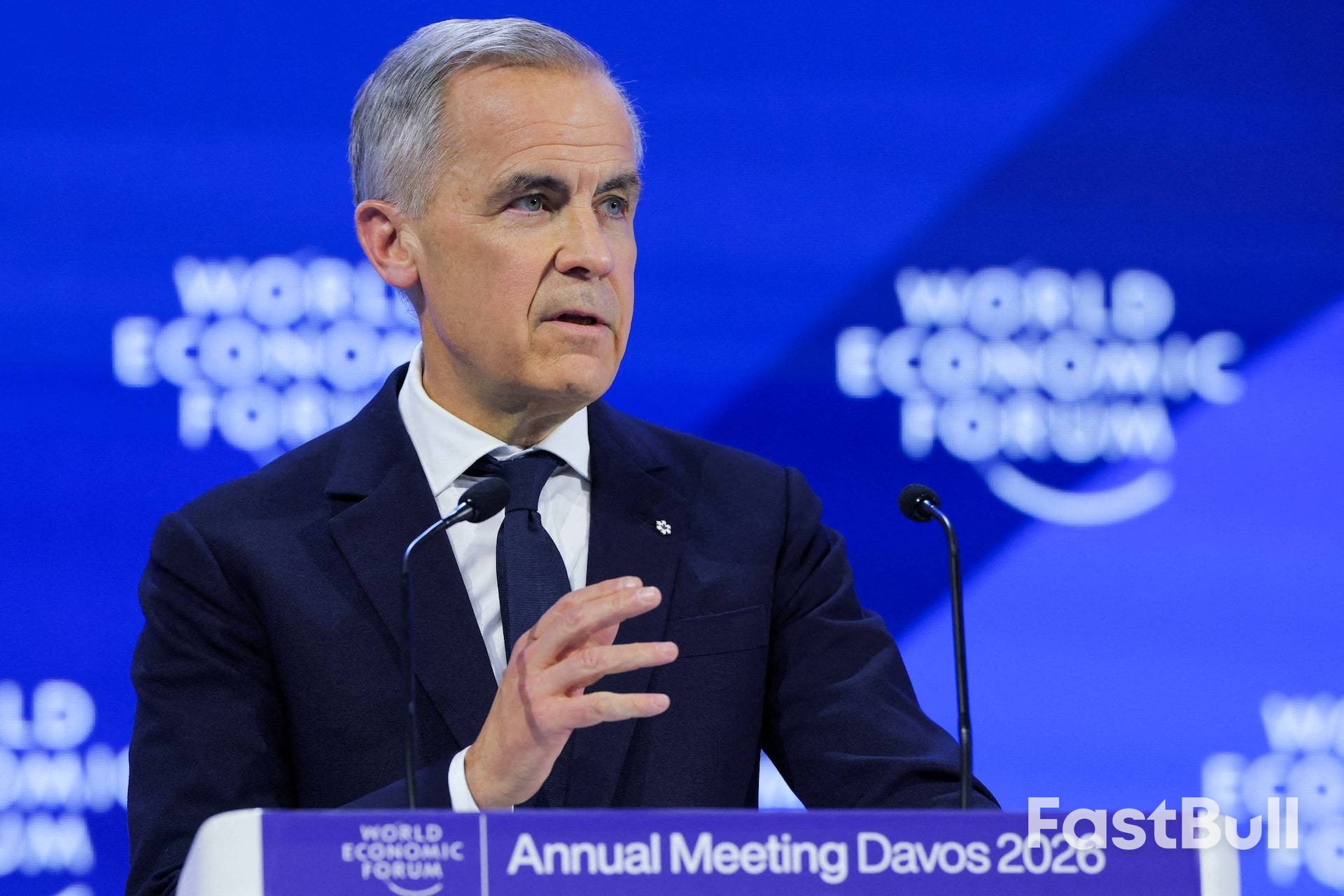
Recent verbal attacks from U.S. President Donald Trump are galvanizing Canadian support for Prime Minister Mark Carney, whose pointed speech at the World Economic Forum in Davos earned him a rare standing ovation. Carney’s message was a direct challenge to powerful nations using economic leverage as a weapon.
The confrontation has quickly escalated, highlighting a deep rift between the two leaders:
• Carney’s Speech: He declared the "rules-based global order" over and called for middle powers to unite against economic bullying.
• Trump’s Retort: The U.S. President posted an AI-generated image of Canada draped in an American flag and publicly chastised Carney.
• Domestic Unity: The clash has triggered a surge of national pride, with Carney earning praise from across the Canadian political spectrum, including from some Conservatives.

In his Davos address, Prime Minister Carney argued that nations like Canada can no longer rely on the old global system for protection. He positioned Canada as a model for how "middle powers" can work together to resist American hegemony.
"When the rules no longer protect you, you must protect yourself," Carney stated. "Middle powers must act together because if you are not on the table, you are on the menu."
Carney's speech came after an overseas trip where he secured a trade deal with China and explored new partnerships in the Middle East—moves clearly aimed at reducing Canada's deep economic dependence on the United States.
President Trump’s response was swift and direct. He dismissed Canada's standing, retorting that the country "lives because of the United States." Addressing the prime minister from the Davos stage, Trump added a warning: "Remember that, Mark, the next time you make your statements."
A day prior, Trump had used his Truth Social platform to post an AI-generated image showing both Canada and Greenland covered by the American flag, amplifying his rhetoric about annexing Canadian territory.
Laura Stephenson, a political science professor at the University of Western Ontario, noted that Carney’s bluntness will stir national pride, though it may also cause concern for those whose jobs depend on U.S. trade, especially with the Canada-U.S.-Mexico Agreement (CUSMA) up for review this year.
"Carney is displaying courage by saying these things so publicly," Stephenson said. "There will be pride that the global reception to his speech has been largely positive."
The escalating rhetoric has resonated deeply within Canada. Ann Peel, a retired race walker in Toronto, described Trump as "a big bully" and praised Carney for articulating a worldview fundamentally different from that of the U.S.
"We're very values-based," she said. "We're not just going to roll over because the United States wants us to."
This sentiment reflects a broader trend since Trump began threatening Canada's sovereignty after his 2024 election win. Canadians have since cut back on travel to the U.S., boycotted American liquor, and prioritized buying Canadian-made goods.
Carney’s firm stance appears to be paying political dividends. Most polls show his approval rating holding above 50% since taking office in April of last year. Recent data from Nanos Research gives him a 22-point lead over Conservative leader Pierre Poilievre. Carney's Liberal party famously overcame a nearly 30-point deficit to win the last federal election after Trump's threats first began.
Jonathan Kalles, a former senior adviser to ex-Prime Minister Justin Trudeau, said he was struck by the broad support for Carney's speech, even from political opponents.
James Moore, a former industry minister under Conservative Prime Minister Stephen Harper, urged Canadians to "put down your partisan swords today and take a moment and listen to this speech."
Similarly, Conservative Member of Parliament Michelle Rempel Garner wrote in the National Post that Carney "rightly named the hard realities of a fractured geopolitical system." She called on him to follow his words with concrete action.
Jack Cunningham, a professor of international relations at the University of Toronto, suggested that Canadians feel pride because their leader is finally confronting Trump directly while still commanding a degree of respect.
"For a long time, every other leader has tried to treat Trump as if he were a difficult grandfather you had to manage," Cunningham said. "There's a sense of pride among Canadians that Carney is the leader that has been able to confront Trump."
European leaders are holding an emergency summit to redefine their relationship with the United States following a turbulent week of threats from President Donald Trump. His abrupt talk of trade tariffs and even military action to acquire Greenland has shattered confidence in the transatlantic alliance, forcing a strategic reassessment in Brussels.
While Trump has since walked back his immediate threats, suggesting a deal is in sight, EU governments remain on edge. The incident is being viewed as a critical turning point, prompting a long-term re-evaluation of how to engage with an unpredictable American administration.
The crisis was triggered by Trump's threats of tariffs on eight European nations and his unprecedented proposal to acquire Greenland, a semi-autonomous Danish territory. On Wednesday, he reversed course, ruling out force and signaling a potential resolution.
German Chancellor Friedrich Merz welcomed the de-escalation, cautioning Europe against abandoning the transatlantic partnership too quickly. However, the prevailing sentiment among EU diplomats is that a line has been crossed.
"Trump crossed the Rubicon. He might do it again. There is no going back to what it was," one EU diplomat stated, highlighting a new imperative for the bloc to reduce its dependence on the United States. The challenge, another diplomat noted, is to "keep him close while working on becoming more independent."
The episode has thrown the EU's deep-seated reliance on the U.S. into sharp relief, revealing vulnerabilities in both defense and trade.
Military and Defense Dependence
For decades, the European Union has depended on the United States for its security under the NATO umbrella. The EU currently lacks the independent intelligence, transport, missile defense, and production capabilities to defend itself from major threats, giving Washington significant leverage in any dispute.
Economic Leverage and Tariff Threats
The U.S. is also Europe's largest trading partner, making the EU highly susceptible to Trump's use of tariffs as a political tool. In response to his latest threats, the EU was preparing a package of retaliatory tariffs on €93 billion ($108.74 billion) worth of U.S. imports, a move that would have inflicted economic damage on both sides of the Atlantic.
"We need to discuss where the red lines are, how we deal with this bully across the Atlantic," a second diplomat explained. "Trump says no tariffs today, but does that mean also no tariffs tomorrow?"
Despite the immediate crisis abating, details surrounding the new "deal" for Greenland remain scarce. The framework was reportedly agreed upon by Trump and NATO Secretary General Mark Rutte at the World Economic Forum in Davos.
Rutte later told Reuters that the agreement involves an increased presence for Western allies in the Arctic and that specific talks would continue between Denmark, Greenland, and the U.S.
Even with this off-ramp, diplomats stress that the fundamental issue of how to manage the U.S. relationship is now a permanent agenda item. While the EU's united front in solidarity with Denmark successfully de-escalated the situation, the experience has served as a wake-up call. The emergency summit in Brussels is no longer just about a single incident but about forging a new, more resilient strategy for the future of the transatlantic alliance.
China is systematically reducing its exposure to U.S. government debt, with its holdings dropping to levels not seen since the 2008 financial crisis. At the same time, the nation is aggressively expanding its gold reserves, signaling a major strategic shift in its management of foreign assets.
Recent data from the U.S. Treasury Department confirms this trend, showing China’s holdings of American debt fell to $682.6 billion in November from $688.7 billion in October. This move is part of a broader de-dollarization effort, with China reallocating capital toward gold and foreign stocks.
While China divests, total foreign holdings of U.S. Treasuries climbed to a record $9.355 trillion in November, an increase from $9.243 trillion the previous month.
While China scales back its investment, other major economies are moving in the opposite direction and increasing their stakes in U.S. debt.
• Japan: The largest foreign holder of U.S. Treasuries, Japan increased its position for the 11th consecutive month, reaching $1.202 trillion in November—its highest level since July 2022.
• United Kingdom: Often a hub for hedge fund activity, the UK raised its holdings by 1.2% to $888.5 billion.
• Canada: Canada boosted its holdings by a substantial 13%, reaching $472.2 billion. This marks a significant recovery from a low of $368.4 billion in April, following new U.S. tariffs on Canadian steel, aluminum, and cars.
In a clear move toward tangible assets, China has ramped up efforts to expand its domestic gold supply. Recent geological discoveries are set to significantly increase the country's known reserves.
Major Gold Discoveries in Hunan and Shandong
In central China’s Hunan province, geologists have uncovered a massive gold deposit in the Wangu gold field, estimated to contain over 1,000 tons of gold valued at approximately $85.9 billion. The deposit, located nearly 9,842 feet deep, includes 40 identified gold veins. Of this total, 300 tons have already been confirmed at a shallower depth of 6,562 feet.
Another significant discovery occurred in the eastern province of Shandong. New gold reserves confirmed off the coast of Laizhou have pushed the region's total holdings to more than 3,900 tons, which represents roughly 26% of China's total known gold reserves, according to the South China Morning Post.
The broader market trend in November showed strong demand for U.S. assets. Foreign investors purchased a net $85.6 billion in Treasuries, a sharp reversal from the $60.1 billion outflow recorded in October.
Foreign purchases of U.S. stocks also saw a notable increase, rising to $92.2 billion in November from $60.3 billion the prior month. In total, the U.S. attracted $212 billion in foreign capital in November, recovering from a revised outflow of $22.5 billion in October.
Despite this surge in foreign investment, China’s continued selling of U.S. Treasuries underscores its distinct and deliberate strategy to reduce reliance on the U.S. dollar and strengthen its position in physical assets like gold.
As a January 31 deadline looms, the U.S. government is once again facing a potential partial shutdown, with a dispute over immigration policy holding the Department of Homeland Security (DHS) funding hostage.
While lawmakers have made progress on several other spending bills needed to keep federal agencies running, Democrats in the House of Representatives are preparing to oppose the DHS package. Their opposition stems from President Donald Trump's immigration crackdown and a lack of accountability for Immigration and Customs Enforcement (ICE).
This standoff sets the stage for a high-stakes political battle, turning the DHS funding bill into the main obstacle to avoiding the second government shutdown in just four months.
The core of the Democratic resistance is a demand for stronger guardrails on ICE operations. This call has intensified following the January 7 killing of a 37-year-old woman in Minneapolis by an ICE agent, an event that has sparked national outrage.
Democratic leaders argue that the current funding bill fails to impose necessary restrictions on the agency. "They should not be able to fire at moving vehicles unless their life is in danger," No. 2 House Democrat Pete Aguilar stated, highlighting a key area of concern.

This sentiment could lead many rank-and-file Democrats to vote against the bill, creating a significant hurdle for its passage.
On the other side, Republicans maintain that the legislation is necessary to support law enforcement. Representative Tom Cole, who chairs the House Appropriations Committee, said the bill empowers frontline agents to effectively uphold immigration laws.
However, with a razor-thin 218-213 Republican majority, House Speaker Mike Johnson has little room for error. The determined opposition from Democrats makes it unclear if the $64.4 billion bill can pass the House. Its prospects in the Senate are also uncertain.
If the bill fails, "unessential" DHS workers could be furloughed. However, ICE operations would likely remain unaffected due to Trump's "One Big Beautiful Bill," a law enacted last year that provided the agency with an additional $75 billion, regardless of the current spending negotiations.
Recognizing this reality, some Democrats are urging pragmatism. Senator Patty Murray argued that achieving meaningful reform requires political power. "The hard truth is that Democrats must win political power to enact the kind of (ICE) accountability we need," she said, alluding to the upcoming November congressional elections.
Beyond the immediate immigration debate, this year's spending bills signal a broader trend: Congress is attempting to reassert its authority over federal spending. This move comes after President Trump refused to spend billions of dollars that lawmakers had already approved and signed into law last year.
Brendan Duke of the Center on Budget and Policy Priorities noted that the current spending bills protect many programs targeted by Trump, such as medical research, housing, and education. However, he cautioned that the final outcome depends on the president's cooperation.
"We will see if President Trump respects this agreement," Duke said.
White Label
Data API
Web Plug-ins
Poster Maker
Affiliate Program
The risk of loss in trading financial instruments such as stocks, FX, commodities, futures, bonds, ETFs and crypto can be substantial. You may sustain a total loss of the funds that you deposit with your broker. Therefore, you should carefully consider whether such trading is suitable for you in light of your circumstances and financial resources.
No decision to invest should be made without thoroughly conducting due diligence by yourself or consulting with your financial advisors. Our web content might not suit you since we don't know your financial conditions and investment needs. Our financial information might have latency or contain inaccuracy, so you should be fully responsible for any of your trading and investment decisions. The company will not be responsible for your capital loss.
Without getting permission from the website, you are not allowed to copy the website's graphics, texts, or trademarks. Intellectual property rights in the content or data incorporated into this website belong to its providers and exchange merchants.
Not Logged In
Log in to access more features

FastBull Membership
Not yet
Purchase
Log In
Sign Up