• Trade
  • Markets
  • Copy
  • Contests
  • News
  • 24/7
  • Calendar
  • Q&A
  • Chats
Trending
Screeners
SYMBOL
LAST
BID
ASK
HIGH
LOW
NET CHG.
%CHG.
SPREAD
SPX
S&P 500 Index
6842.02
6842.02
6842.02
6878.28
6833.87
-28.38
-0.41%
--
DJI
Dow Jones Industrial Average
47746.85
47746.85
47746.85
47971.51
47695.55
-208.13
-0.43%
--
IXIC
NASDAQ Composite Index
23515.04
23515.04
23515.04
23698.93
23481.60
-63.08
-0.27%
--
USDX
US Dollar Index
99.070
99.150
99.070
99.160
98.730
+0.120
+ 0.12%
--
EURUSD
Euro / US Dollar
1.16293
1.16300
1.16293
1.16717
1.16162
-0.00133
-0.11%
--
GBPUSD
Pound Sterling / US Dollar
1.33167
1.33176
1.33167
1.33462
1.33053
-0.00145
-0.11%
--
XAUUSD
Gold / US Dollar
4190.26
4190.60
4190.26
4218.85
4175.92
-7.65
-0.18%
--
WTI
Light Sweet Crude Oil
58.911
58.941
58.911
60.084
58.837
-0.898
-1.50%
--

Community Accounts

Signal Accounts
--
Profit Accounts
--
Loss Accounts
--
View More

Become a signal provider

Sell trading signals to earn additional income

View More

Guide to Copy Trading

Get started with ease and confidence

View More

Signal Accounts for Members

All Signal Accounts

Best Return
  • Best Return
  • Best P/L
  • Best MDD
Past 1W
  • Past 1W
  • Past 1M
  • Past 1Y

All Contests

  • All
  • Trump Updates
  • Recommend
  • Stocks
  • Cryptocurrencies
  • Central Banks
  • Featured News
Top News Only
Share

EU's Foreign Chief: Giving Ukraine The Resources It Needs To Defend Itself Doesn't Prolong The War, It Can Help End It

Share

EU's Foreign Chief: Securing Multi-Year Funding For Ukraine In December Is Absolutely Essential

Share

[Bank For International Settlements: US Tariffs Drive Record Global FX Trading Volume] Data From The Bank For International Settlements (BIS) Shows That Global FX Trading Volume Surged To A Record High This Year, With An Average Daily Trading Volume Of $9.5 Trillion In April, Amid Market Turmoil Triggered By US President Trump's Tariff Policies. On December 8, The Bank Released Its Quarterly Assessment, Citing Data From Its Triennial Survey, Stating That The Impact Of Tariffs Was "substantial," Leading To An Unexpected Depreciation Of The US Dollar And Accounting For Over $1.5 Trillion In Average Daily OTC Trading Volume In April. The Report Shows That Overall FX Trading Volume Increased By More Than A Quarter Compared To The Last Survey In 2022, Surpassing The Estimated Peak During The Market Turmoil Caused By The COVID-19 Pandemic In March 2020. This Data Is An Update Based On Preliminary Survey Results Released In September

Share

UN Secretary General Guterres Strongly Condemns Unauthorized Entry By Israeli Authorities Into UNRWA Compound In East Jerusalem

Share

Bank Of America: A Dovish Federal Reserve Poses A Key Risk To High-grade U.S. Bonds In 2026

Share

Bank CEOs Will Meet With U.S. Senators To Discuss The (regulatory) Framework For The Cryptocurrency Market

Share

The U.S. Supreme Court Has Hinted That It Will Support President Trump's Decision To Remove Heads Of Federal Government Agencies

Share

[BlackRock: The Surge Of Funds Into AI Infrastructure Is Far From Peaking] Ben Powell, Chief Investment Strategist For Asia Pacific At BlackRock, Stated That The Capital Expenditure Spree In The Artificial Intelligence (AI) Infrastructure Sector Continues And Is Far From Reaching Its Peak. Powell Believes That As Tech Giants Race To Increase Their Investments In A "winner-takes-all" Competition, The "shovel Sellers" (such As Chipmakers, Energy Producers, And Copper Wire Manufacturers) Who Provide The Foundational Resources For The Sector Are The Clearest Investment Winners

Share

[Ray Dalio: The Middle East Is Rapidly Becoming One Of The World's Most Influential AI Hubs] Bridgewater Associates Founder Ray Dalio Stated That The Middle East (particularly The UAE And Saudi Arabia) Is Rapidly Emerging As A Powerful Global AI Hub, Comparable To Silicon Valley, Due To The Region's Combination Of Massive Capital And Global Talent. Dalio Believes The Gulf Region's Transformation Is The Result Of Well-thought-out National Strategies And Long-term Planning, Noting That The UAE's Outstanding Performance In Leadership, Stability, And Quality Of Life Has Made It A "Silicon Valley For Capitalists." While He Believes The AI ​​rebound Is In Bubble Territory, He Advises Investors Not To Rush Out But Rather To Look For Catalysts That Could Cause The Bubble To "burst," Such As Monetary Tightening Or Forced Wealth Selling

Share

French President Emmanuel Macron Met With The Croatian Prime Minister At The Élysée Palace

Share

In The Past 24 Hours, The Marketvector Digital Asset 100 Small Cap Index Rose 1.96%, Currently At 4135.44 Points. The Sydney Market Initially Exhibited An N-shaped Pattern, Hitting A Daily Low Of 3988.39 Points At 06:08 Beijing Time, Before Steadily Rising To A Daily High Of 4206.06 Points At 17:07, Subsequently Stabilizing At This High Level

Share

[Sovereign Bond Yields In France, Italy, Spain, And Greece Rose By More Than 7 Basis Points, Raising Concerns That The ECB's Interest Rate Outlook May Push Up Financing Costs] In Late European Trading On Monday (December 8), The Yield On French 10-year Bonds Rose 5.8 Basis Points To 3.581%. The Yield On Italian 10-year Bonds Rose 7.4 Basis Points To 3.559%. The Yield On Spanish 10-year Bonds Rose 7.0 Basis Points To 3.332%. The Yield On Greek 10-year Bonds Rose 7.1 Basis Points To 3.466%

Share

Oil Falls 1% Amid Ongoing Ukraine Talks, Ahead Of Expected US Interest Rate Cut

Share

Azeri Btc Crude Oil Exports From Ceyhan Port Set At 16.2 Million Barrels In January Versus 17.0 Million In December, Schedule Shows

Share

USA - Greenland Joint Committee Statement: The United States And Greenland Look Forward To Building On Momentum In The Year Ahead And Strengthening Ties That Support A Secure And Prosperous Arctic Region

Share

MSCI Nordic Countries Index Fell 0.4% To 356.64 Points. Among The Ten Sectors, The Nordic Healthcare Sector Saw The Largest Decline. Novo Nordisk, A Heavyweight Stock, Closed Down 3.4%, Leading The Losses Among Nordic Stocks

Share

France's CAC 40 Down 0.2%, Spain's IBEX Up 0.1%

Share

Europe's STOXX Index Up 0.1%, Euro Zone Blue Chips Index Flat

Share

Germany's DAX 30 Index Closed Up 0.08% At 24,044.88 Points. France's Stock Index Closed Down 0.19%, Italy's Stock Index Closed Down 0.13% With Its Banking Index Up 0.33%, And The UK's Stock Index Closed Down 0.32%

Share

The STOXX Europe 600 Index Closed Down 0.12% At 578.06 Points. The Eurozone STOXX 50 Index Closed Down 0.04% At 5721.56 Points. The FTSE Eurotop 300 Index Closed Down 0.05% At 2304.93 Points

TIME
ACT
FCST
PREV
France Trade Balance (SA) (Oct)

A:--

F: --

P: --
Euro Zone Employment YoY (SA) (Q3)

A:--

F: --

P: --
Canada Part-Time Employment (SA) (Nov)

A:--

F: --

P: --

Canada Unemployment Rate (SA) (Nov)

A:--

F: --

P: --

Canada Full-time Employment (SA) (Nov)

A:--

F: --

P: --

Canada Labor Force Participation Rate (SA) (Nov)

A:--

F: --

P: --

Canada Employment (SA) (Nov)

A:--

F: --

P: --

U.S. PCE Price Index MoM (Sept)

A:--

F: --

P: --

U.S. Personal Income MoM (Sept)

A:--

F: --

P: --

U.S. Core PCE Price Index MoM (Sept)

A:--

F: --

P: --

U.S. PCE Price Index YoY (SA) (Sept)

A:--

F: --

P: --

U.S. Core PCE Price Index YoY (Sept)

A:--

F: --

P: --

U.S. Personal Outlays MoM (SA) (Sept)

A:--

F: --

P: --
U.S. 5-10 Year-Ahead Inflation Expectations (Dec)

A:--

F: --

P: --

U.S. Real Personal Consumption Expenditures MoM (Sept)

A:--

F: --

P: --
U.S. Weekly Total Rig Count

A:--

F: --

P: --

U.S. Weekly Total Oil Rig Count

A:--

F: --

P: --

U.S. Consumer Credit (SA) (Oct)

A:--

F: --

P: --
China, Mainland Foreign Exchange Reserves (Nov)

A:--

F: --

P: --

Japan Trade Balance (Oct)

A:--

F: --

P: --

Japan Nominal GDP Revised QoQ (Q3)

A:--

F: --

P: --

China, Mainland Imports YoY (CNH) (Nov)

A:--

F: --

P: --

China, Mainland Exports (Nov)

A:--

F: --

P: --

China, Mainland Imports (CNH) (Nov)

A:--

F: --

P: --

China, Mainland Trade Balance (CNH) (Nov)

A:--

F: --

P: --

China, Mainland Exports YoY (USD) (Nov)

A:--

F: --

P: --

China, Mainland Imports YoY (USD) (Nov)

A:--

F: --

P: --

Germany Industrial Output MoM (SA) (Oct)

A:--

F: --

P: --
Euro Zone Sentix Investor Confidence Index (Dec)

A:--

F: --

P: --

Canada National Economic Confidence Index

A:--

F: --

P: --

U.K. BRC Like-For-Like Retail Sales YoY (Nov)

--

F: --

P: --

U.K. BRC Overall Retail Sales YoY (Nov)

--

F: --

P: --

Australia Overnight (Borrowing) Key Rate

--

F: --

P: --

RBA Rate Statement
RBA Press Conference
Germany Exports MoM (SA) (Oct)

--

F: --

P: --

U.S. NFIB Small Business Optimism Index (SA) (Nov)

--

F: --

P: --

Mexico 12-Month Inflation (CPI) (Nov)

--

F: --

P: --

Mexico Core CPI YoY (Nov)

--

F: --

P: --

Mexico PPI YoY (Nov)

--

F: --

P: --

U.S. Weekly Redbook Index YoY

--

F: --

P: --

U.S. JOLTS Job Openings (SA) (Oct)

--

F: --

P: --

China, Mainland M1 Money Supply YoY (Nov)

--

F: --

P: --

China, Mainland M0 Money Supply YoY (Nov)

--

F: --

P: --

China, Mainland M2 Money Supply YoY (Nov)

--

F: --

P: --

U.S. EIA Short-Term Crude Production Forecast For The Year (Dec)

--

F: --

P: --

U.S. EIA Natural Gas Production Forecast For The Next Year (Dec)

--

F: --

P: --

U.S. EIA Short-Term Crude Production Forecast For The Next Year (Dec)

--

F: --

P: --

EIA Monthly Short-Term Energy Outlook
U.S. API Weekly Gasoline Stocks

--

F: --

P: --

U.S. API Weekly Cushing Crude Oil Stocks

--

F: --

P: --

U.S. API Weekly Crude Oil Stocks

--

F: --

P: --

U.S. API Weekly Refined Oil Stocks

--

F: --

P: --

South Korea Unemployment Rate (SA) (Nov)

--

F: --

P: --

Japan Reuters Tankan Non-Manufacturers Index (Dec)

--

F: --

P: --

Japan Reuters Tankan Manufacturers Index (Dec)

--

F: --

P: --

Japan Domestic Enterprise Commodity Price Index MoM (Nov)

--

F: --

P: --

Japan Domestic Enterprise Commodity Price Index YoY (Nov)

--

F: --

P: --

China, Mainland PPI YoY (Nov)

--

F: --

P: --

China, Mainland CPI MoM (Nov)

--

F: --

P: --

Q&A with Experts
    • All
    • Chatrooms
    • Groups
    • Friends
    Connecting
    .
    .
    .
    Type here...
    Add Symbol or Code

      No matching data

      All
      Trump Updates
      Recommend
      Stocks
      Cryptocurrencies
      Central Banks
      Featured News
      • All
      • Russia-Ukraine Conflict
      • Middle East Flashpoint
      • All
      • Russia-Ukraine Conflict
      • Middle East Flashpoint
      Search
      Products

      Charts Free Forever

      Chats Q&A with Experts
      Screeners Economic Calendar Data Tools
      Membership Features
      Data Warehouse Market Trends Institutional Data Policy Rates Macro

      Market Trends

      Market Sentiment Order Book Forex Correlations

      Top Indicators

      Charts Free Forever
      Markets

      News

      News Analysis 24/7 Columns Education
      From Institutions From Analysts
      Topics Columnists

      Latest Views

      Latest Views

      Trending Topics

      Top Columnists

      Latest Update

      Signals

      Copy Rankings Latest Signals Become a signal provider AI Rating
      Contests
      Brokers

      Overview Brokers Assessment Rankings Regulators News Claims
      Broker listing Forex Brokers Comparison Tool Live Spread Comparison Scam
      Q&A Complaint Scam Alert Videos Tips to Detect Scam
      More

      Business
      Events
      Careers About Us Advertising Help Center

      White Label

      Data API

      Web Plug-ins

      Affiliate Program

      Awards Institution Evaluation IB Seminar Salon Event Exhibition
      Vietnam Thailand Singapore Dubai
      Fans Party Investment Sharing Session
      FastBull Summit BrokersView Expo
      Recent Searches
        Top Searches
          Markets
          News
          Analysis
          User
          24/7
          Economic Calendar
          Education
          Data
          • Names
          • Latest
          • Prev

          View All

          No data

          Scan to Download

          Faster Charts, Chat Faster!

          Download App
          English
          • English
          • Español
          • العربية
          • Bahasa Indonesia
          • Bahasa Melayu
          • Tiếng Việt
          • ภาษาไทย
          • Français
          • Italiano
          • Türkçe
          • Русский язык
          • 简中
          • 繁中
          Open Account
          Search
          Products
          Charts Free Forever
          Markets
          News
          Signals

          Copy Rankings Latest Signals Become a signal provider AI Rating
          Contests
          Brokers

          Overview Brokers Assessment Rankings Regulators News Claims
          Broker listing Forex Brokers Comparison Tool Live Spread Comparison Scam
          Q&A Complaint Scam Alert Videos Tips to Detect Scam
          More

          Business
          Events
          Careers About Us Advertising Help Center

          White Label

          Data API

          Web Plug-ins

          Affiliate Program

          Awards Institution Evaluation IB Seminar Salon Event Exhibition
          Vietnam Thailand Singapore Dubai
          Fans Party Investment Sharing Session
          FastBull Summit BrokersView Expo

          Tata Group's $1.6 Billion Investment Sets Stage for Indian EV Battery Manufacturing Revolution

          Warren Takunda

          Traders' Opinions

          In a significant development for India's burgeoning electric vehicle (EV) industry, Tata Group, one of the country's largest conglomerates, has announced plans to construct a state-of-the-art giga-factory in Sanand, Gujarat, dedicated to the production of lithium-ion cells. This landmark agreement, backed by an estimated initial investment of approximately 130 billion rupees ($1.6 billion), is poised to reshape the nation's EV landscape and reinforce India's commitment to building a robust electric vehicle supply chain.
          The strategic decision made by Tata Group reflects a deep understanding of the growing demand for EVs in India, along with the need for a localized battery manufacturing ecosystem. The new facility, with an initial manufacturing capacity of 20 Gigawatt hours (GWh), will play a pivotal role in fulfilling India's ambition to establish a self-reliant EV industry.
          By investing in this giga-factory, Tata Group aims to leverage the rapid growth potential of the Indian EV market and position itself as a frontrunner in the domestic battery manufacturing sector. This move aligns with the company's broader sustainability objectives and its commitment to reducing carbon emissions.
          The plant's location in Sanand, Gujarat, was strategically chosen due to its favorable business environment, proximity to key markets, and strong support from the local government. This collaborative effort between Tata Group and the Gujarat government highlights the commitment of both parties to foster industrial development and promote clean energy solutions in the region.
          The giga-factory's first phase will provide an initial manufacturing capacity of 20 GWh, a substantial boost to India's domestic battery production capabilities. Notably, plans for the future include the possibility of doubling the plant's capacity through a second phase of expansion. This forward-thinking approach demonstrates Tata Group's long-term commitment to meeting the evolving demands of the EV industry and contributing to India's green energy revolution.
          The establishment of this advanced battery manufacturing facility will not only bolster the domestic supply chain but also create significant employment opportunities. It is anticipated that the project will generate a substantial number of direct and indirect jobs, further driving economic growth in the region and supporting India's overall development objectives.
          The Tata Group's foray into EV battery production represents a transformative milestone for the Indian automotive industry. By localizing the manufacturing of lithium-ion cells, India can significantly reduce its dependence on imports and establish a robust ecosystem for electric vehicle production. This development is expected to catalyze further investment in the sector and encourage the growth of ancillary industries, including EV component manufacturing and research and development.
          With Tata Group's commitment to innovation, sustainability, and technological advancements, their ambitious investment in the giga-factory marks a pivotal moment in India's journey towards a cleaner and greener transportation future. The project aligns with the government's ambitious vision for electric mobility, contributing to a more sustainable and eco-friendly transportation landscape for the nation.
          Overall, Tata Group's $1.6 billion investment in the giga-factory signifies a significant stride towards India's ambition of becoming a global leader in the electric vehicle sector. The project holds the potential to revolutionize the country's EV industry, foster economic growth, and contribute to a greener and more sustainable future for India.
          Risk Warnings and Disclaimers
          You understand and acknowledge that there is a high degree of risk involved in trading. Following any strategies or investment methods may lead to potential losses. The content on the site is provided by our contributors and analysts for information purposes only. You are solely responsible for determining whether any trading assets, securities, strategy, or any other product is suitable for investing based on your own investment objectives and financial situation.
          Comments
          Add to Favorites
          Share

          Hopes of Economic 'Soft Landing' Re-Emerge After Stormy Descent

          Damon

          Economic

          The economic airplane hasn't reached the runway yet and has hit some more heavy turbulence in 2023 - but investors suspect a relatively gentle touchdown may be back on the cards.
          It's not even midyear yet, but the full gamut of scenarios has been juggled in just five months.
          World markets have swung from "hard landing" fears of late 2022 to the "soft landing" hopes of the new year and then even unnerving thoughts of "no landing" at all - just before the banking stress hit of March forced them to return to square one.
          But as half-year investment outlooks hit inboxes and go on roadshows - and another crosswind from a risky U.S. debt ceiling crunch dissipates - hopes of walking away without serious damage from this hair-raising post-pandemic trip have re-emerged.
          "The economy is more resilient than the market realizes," BlackRock's Chief Executive Larry Fink said on Wednesday, adding more interest rates rises will be necessary but that he saw no "evidence that we're going to have a hard landing."
          Of course, there's no rulebook on these potential "landings".
          A "soft landing" typically relates to the ability of the Federal Reserve and other central banks to get inflation back close to 2% targets without crashing the economy into a deep contraction with surging unemployment via extreme rate rises.
          That's a narrow airstrip - subject to all kinds of definitional argument. Does a mild technical recession of two quarters of falling national output equate to a crash if "full employment" assumptions of jobless rates below 5% prevail?
          On that looser take, the Fed has indeed managed to pull off the trick in nearly half the slowdowns of the past 60 years.
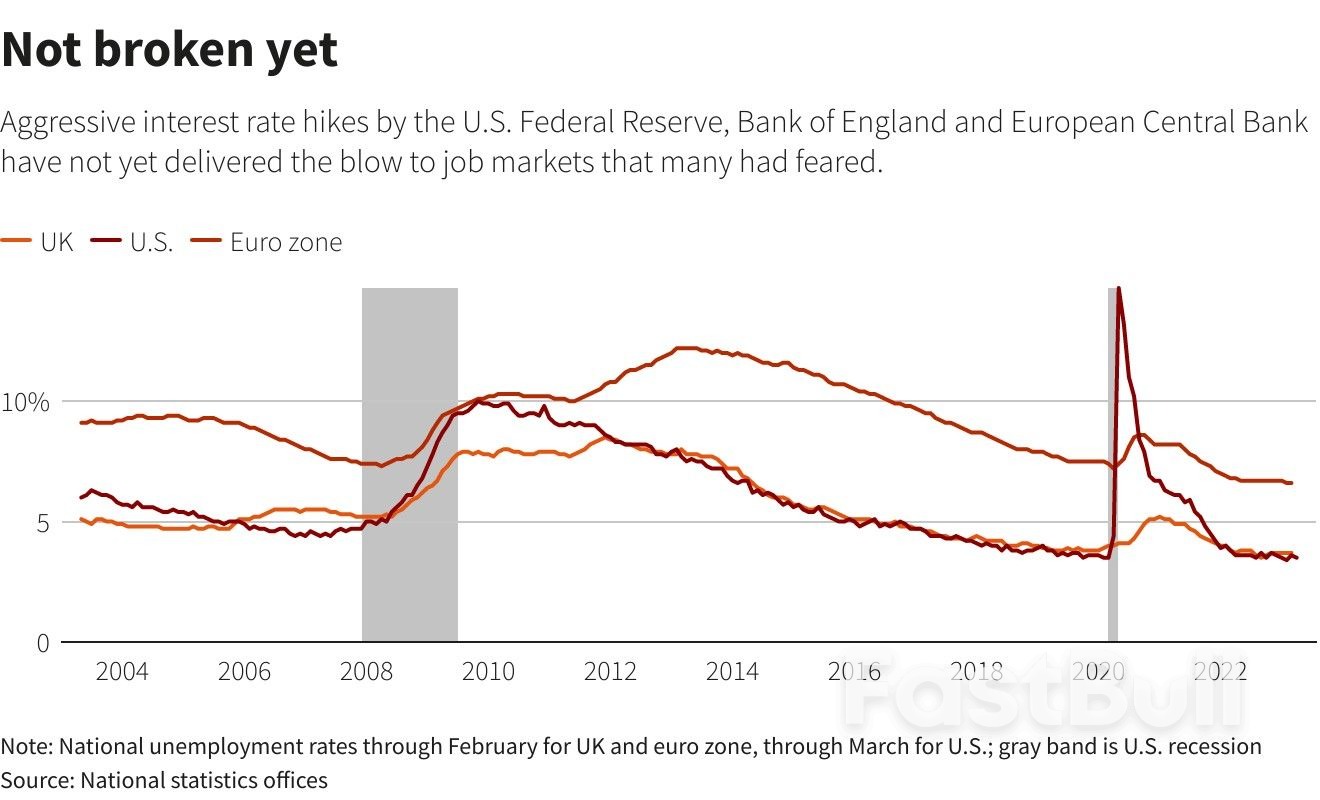
          Judged by the remarkable strength of the jobs market this time around, even as inflation slows and the historically brutal Fed hiking campaign nears an end, it's not hard to see why hopes are rekindled. The ebbing of regional U.S. bank worries helps.
          It also depends on whose perspective you take. A gentle bump on the tarmac for most households may not feel that "soft" for investors - who have arguably already suffered a hard landing in one of the worst annual recoils in both stocks and bonds on record last year.
          And of course, pernicious risks remain - from rancorous geopolitics, energy volatility, the lagged effect of credit tightening on real estate and the sizeable attraction of staying in cash with rates of 4%-5%.Hopes of Economic 'Soft Landing' Re-Emerge After Stormy Descent_1
          Hopes of Economic 'Soft Landing' Re-Emerge After Stormy Descent_2'Nothing easy'
          But many asset managers argue risks always abound and the central case is what matters most from here - with peak interest rates, persistent corporate earnings growth, tech sector excitement around artificial intelligence and some attractive valuations around the world.
          "The core scenario is actually relatively constructive," said Willem Sels, chief investment officer at HSBC Global Private Banking, pointing out that diversified portfolios have already regained more than half their 2022 fall.
          "So while many investors are sitting on cash, we don't," said Sels, advising clients consider blue chip dividend stocks, bonds, volatility strategies and hedge funds.
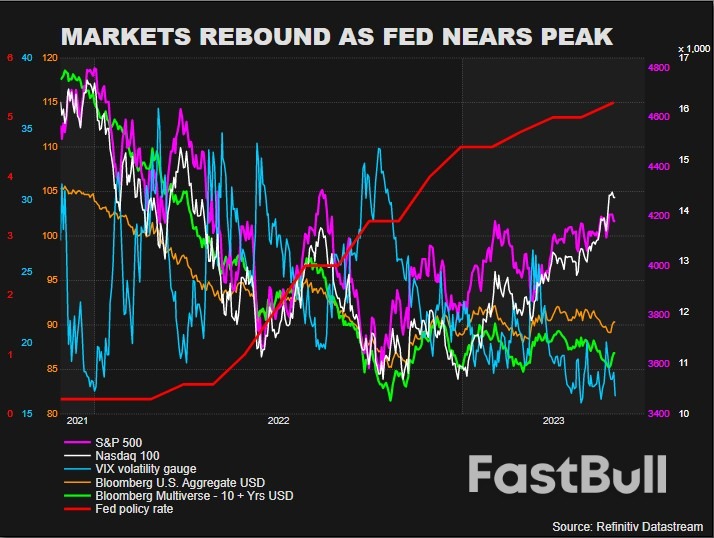
          Although narrowly led by tech, the S&P500 is up almost 10% so far in 2023 - with the Nasdaq 100 up more than 30% and the AI-fueled FANG+TM group of 10 leading digital, chip and tech megacaps up a whopping 65%. The wider MSCI all-country stock index is up 8%.
          Relieved the debt ceiling saga is near over, Wall Street's "fear index" - the VIX gauge of Wall St equity volatility - on Thursday approached its lowest close since 2021.
          Even the broadest indices of U.S. and global government and corporate bonds are up nearly 2% in the year to date despite the persistent inflation, interest rate and political angst.
          Few asset managers seem bullish per se. Even if U.S. recession is averted this year, the combined effect of monetary tightening and ongoing liquidity withdrawal in both the United States and Europe - alongside more restrictive fiscal policies - continues to make many investment houses fret.
          "Nothing easy or pleasant is usually associated with episodes of liquidity withdrawal as intense as the one that the global economy is now experiencing," State Street Global Advisors' chief economist Simona Mocuta told clients.
          But while this keeps the global growth fragile through the end of this year and 2024, and should keep investment strategies cautious too, State Street reckons a deepening and broadening of disinflation is the one "silver lining" in the outlook.
          "Reaching 2% - or close enough that the difference will not matter - in 2024 is not such an impossible hurdle as the general opinion seems to imply," Mocuta said. "Not in a world where price competition likely re-emerges as backlogs shrink, demand slows and base effects work in one's favor."
          If correct - and not all agree - the prospect of a sustained return to 2% inflation targets would surely turn off the seatbelt sign.Hopes of Economic 'Soft Landing' Re-Emerge After Stormy Descent_3

          Hopes of Economic 'Soft Landing' Re-Emerge After Stormy Descent_4Source: U.S. News

          To stay updated on all economic events of today, please check out our Economic calendar
          Risk Warnings and Disclaimers
          You understand and acknowledge that there is a high degree of risk involved in trading. Following any strategies or investment methods may lead to potential losses. The content on the site is provided by our contributors and analysts for information purposes only. You are solely responsible for determining whether any trading assets, securities, strategy, or any other product is suitable for investing based on your own investment objectives and financial situation.
          Comments
          Add to Favorites
          Share

          Week Ahead – RBA and BoC to Hold Rates But Might be Tempted to Hike, OPEC+ Meets

          Justin

          Central Bank

          Economic

          Commodity

          Will the RBA deliver another surprise hike?

          The Reserve Bank of Australia caught markets off guard when it hiked rates last month and there’s a risk that policymakers could again lift borrowing costs higher by 25 basis points when they hold their June meeting on Tuesday.
          However, the economic data has been somewhat mixed lately so the RBA might decide to pause again to get a better picture of what is happening in the economy. The jobless rate edged up slightly in April and the flash PMIs pointed to a modest softening in economic activity in May. However, monthly inflation readings for April were hotter-than-expected.
          First quarter GDP growth figures are due on Wednesday but might come too late for the RBA to fully factor the data into its decision. Also out on Wednesday is the AIG manufacturing index.
          Week Ahead – RBA and BoC to Hold Rates But Might be Tempted to Hike, OPEC+ Meets_1
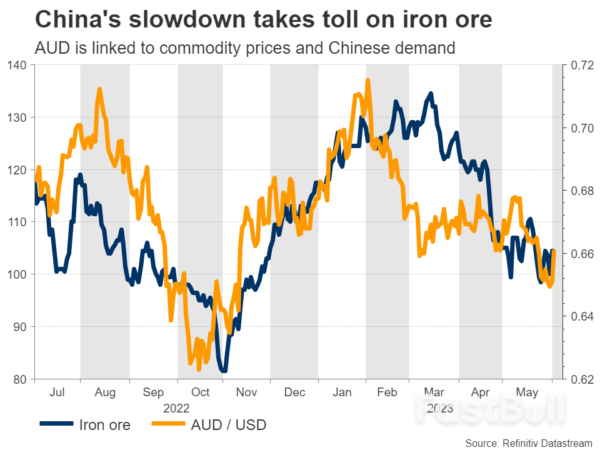
          Another consideration for policymakers is the faltering recovery in China. The slowing demand for industrial metals and other resources from the world’s largest consumer of such commodities is bad news for Australian exporters whose number one market is China.
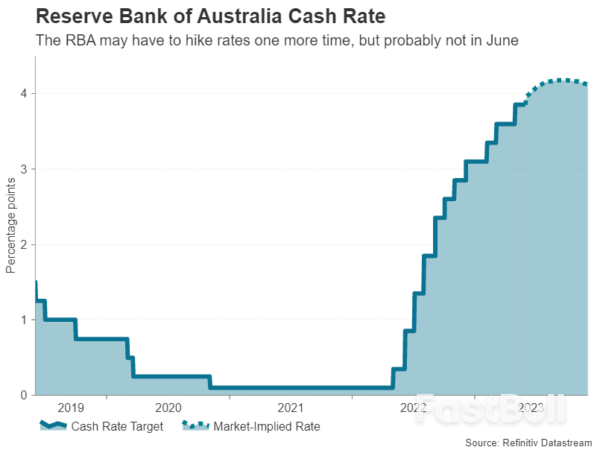
          Hence, the RBA has more incentive to skip a hike, while maintaining a tightening bias and investors appear to be converging with this view as they’ve currently assigned around 55% probability of no change in June but a 25-bps hike is fully priced in for August.
          Week Ahead – RBA and BoC to Hold Rates But Might be Tempted to Hike, OPEC+ Meets_2
          The Australian dollar has tumbled to more than six-month lows versus its US counterpart but could receive support from a hawkish RBA. Aussie traders will also be keeping an eye on some Chinese indicators coming up next week.
          The trade balance will be important on Wednesday to see how exports and imports fared in May, and on Friday, the latest consumer and producer price indices will provide fresh clues on the strength of domestic demand.

          BoC may not be done with rate hikes

          The Bank of Canada has been on pause since March but like the RBA, a rate hike is back on the table. The Canadian economy enjoyed a strong rebound in GDP growth in the first quarter, expanding by 0.8% q/q. The labour market is heating up again, while headline inflation unexpectedly accelerated in April.
          However, underlying measures of inflation continued to decline and this may convince enough policymakers to stay on pause for another meeting in case the increase in headline CPI was a blip.
          Markets are expecting the BoC to remain on hold at least until September before resuming its tightening cycle. But should policymakers display a strong inclination to hike soon, this would likely increase the focus on Friday’s employment report for May.
          Week Ahead – RBA and BoC to Hold Rates But Might be Tempted to Hike, OPEC+ Meets_3
          Another strong set of jobs numbers could bring rate hike bets forward, boosting the Canadian dollar.

          OPEC+ has a tough balance to strike

          The oil-sensitive loonie will also be watching developments with OPEC+. The oil cartel will gather on Sunday to decide whether to follow up April’s surprise cut with a further reduction in output quotas. Russia has signalled it does not favour more cuts but the de-facto leader of the pact, Saudi Arabia, is more mindful about the lacklustre performance of oil prices over the last couple of months.
          Indeed, Saudi Arabia is in a difficult position. By slashing production yet again it could end up conceding more market share to Russia, who is selling oil on the cheap to Asian countries that are able to evade Western sanctions slapped on Moscow over the war in Ukraine.
          The other problem for the Saudis is that another output cut might send the message that oil producers are becoming more worried about the weakening outlook for oil prices and this could trigger the opposite reaction in oil futures, unless they decide on a very large reduction.
          Week Ahead – RBA and BoC to Hold Rates But Might be Tempted to Hike, OPEC+ Meets_4

          Quieter week looms for the dollar

          In the United States, the main highlight is the ISM non-manufacturing PMI on Monday, and April factory orders due the same day might attract some interest too.
          Although the American economy has lost some steam lately, it is far from being out of momentum and the ISM survey should offer a glance as to how things stood in May in the services sector.
          Week Ahead – RBA and BoC to Hold Rates But Might be Tempted to Hike, OPEC+ Meets_5
          Communication from the Fed has been rather conflicting heading into the June 14 FOMC decision, but more recently, it appears that the doves, likely led by Chair Powell himself, are building a case to sit out the next meeting.
          There is still one more CPI report on the way before then, but the ISM PMI will have some significance given the growing divisions within the Fed.
          If the odds start to shift again in favour of a June hike, the US dollar could find itself back on the front foot.

          Can the yen extend its rebound?

          One of the beneficiaries of the dollar’s recent setback has been the Japanese yen, which is recovering from six-month lows. Next week’s data out of Japan are unlikely to have too much of an impact but they could nevertheless aid the recovery if they are broadly positive.
          Kicking things off on Tuesday are household spending stats for April, along with cash earnings for the same period. A pick up in wage growth might add to bets that the Bank of Japan will abandon its yield curve control policy sooner rather than later. On Thursday, the Q1 GDP estimate is likely to get revised up following the positive revision to capital expenditure.
          Finally, in the euro area, German industrial orders and output numbers for April (Tuesday and Wednesday, respectively) will probably grab the most attention amid a manufacturing-led technical recession in Europe’s largest economy.

          Source:XM

          To stay updated on all economic events of today, please check out our Economic calendar
          Risk Warnings and Disclaimers
          You understand and acknowledge that there is a high degree of risk involved in trading. Following any strategies or investment methods may lead to potential losses. The content on the site is provided by our contributors and analysts for information purposes only. You are solely responsible for determining whether any trading assets, securities, strategy, or any other product is suitable for investing based on your own investment objectives and financial situation.
          Comments
          Add to Favorites
          Share

          Poland Defies Big Polluter Expectations with Coal Use Cuts

          Kevin Du

          Energy

          Poland is expected to soon surpass Germany as Europe's top power polluter due to aggressive planned reductions in fossil fuel use across Germany and assumptions that Poland will have no choice but remain Europe's most coal-reliant nation for years to come.
          But so far in 2023 Poland has defied expectations by cutting coal use and pollution to the lowest since at least 2014, and by raising clean power output to record highs just as Germany cut its clean generation by shutting nuclear reactors.
          So instead of emerging as a climate laggard compared to wealthier European peers, Poland is keeping pace with the cuts to coal use and power emissions seen elsewhere, and may soon force emissions forecasters to trim their future pollution projections across the region.
          Targeted Cuts
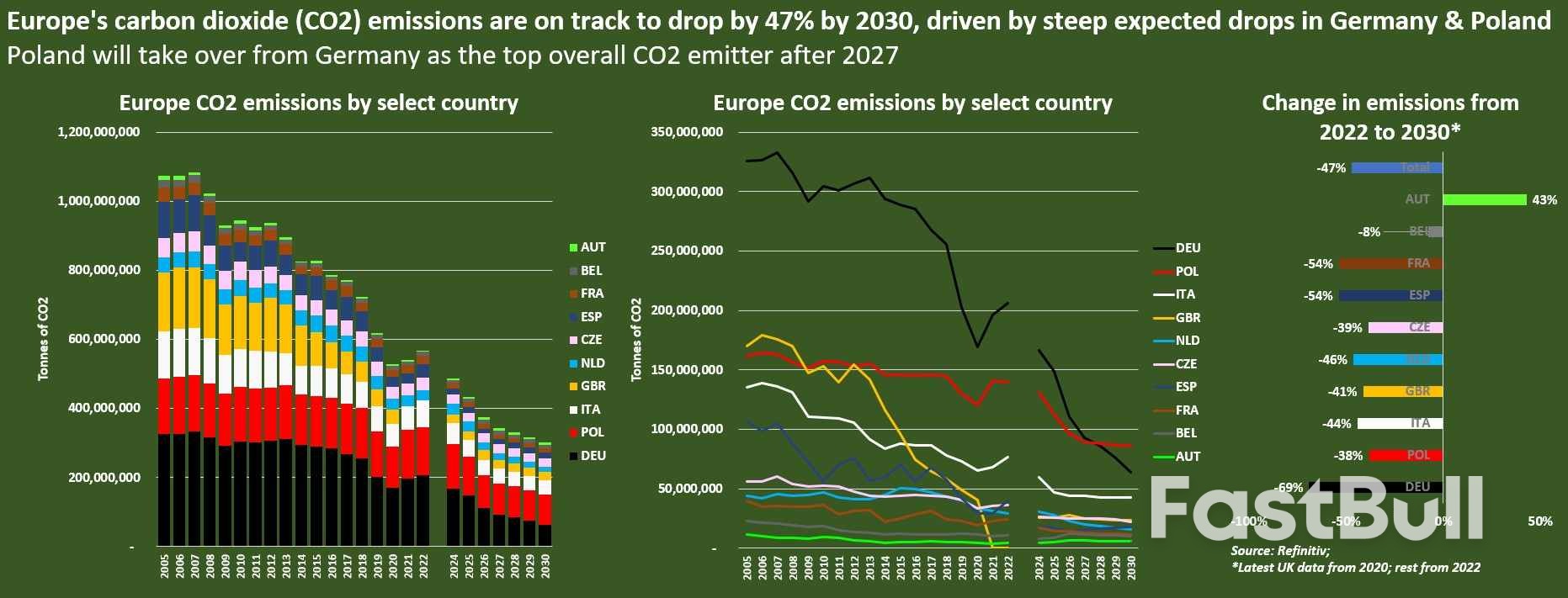
          Emissions forecasters using planned power generation data from major economies estimate that Europe's total carbon dioxide emissions will drop by 47% from 2022's total by 2030, largely due to planned steep cuts to coal use in Germany.
          Germany, currently Europe's top overall CO2 emitter, is seen cutting CO2 discharge by nearly 70% by 2030 from over 200 million tonnes in 2022 to less than 65 million tonnes, data compiled by Refinitiv shows.
          All major European economies are also expected to notch up double-digit declines in CO2 pollution, but Germany's cuts are expected to be by far the steepest, and will help push Germany to second in Europe's pollution rankings behind Poland by 2028.
          Poland Defies Big Polluter Expectations with Coal Use Cuts_1However, those future pollution tables are based on assumptions that Poland will be far slower than other countries in reducing coal emissions, as Poland is not expected to be able to afford the extensive energy system upgrades that are planned in wealthier Western Europe.
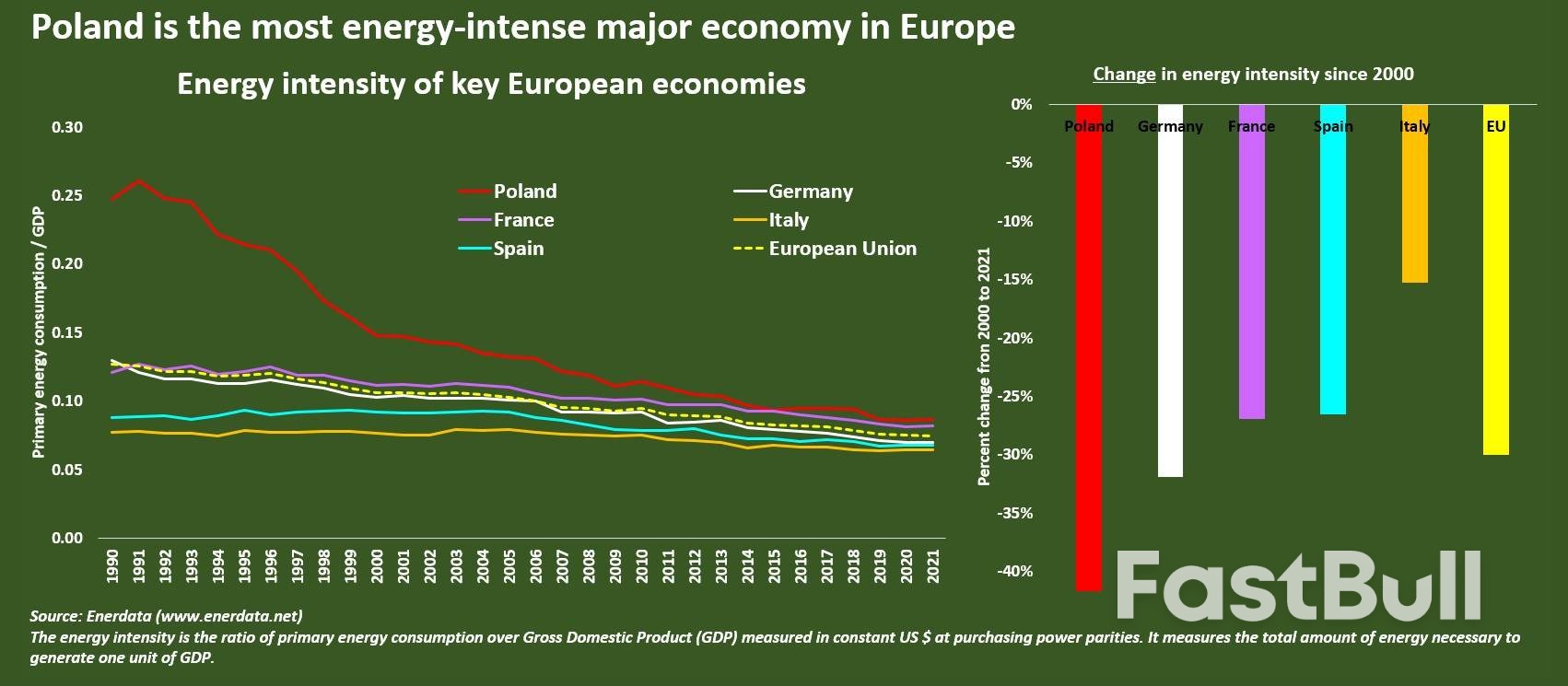
          Poland's gross domestic product (GDP) per capita is roughly 35% of Germany's, and less than half of the average for the European Union, according to data from the World Bank.
          That places the country's government, utilities and businesses at a significant disadvantage to peers when it comes to marshalling the funds and subsidies needed to pay for power system upgrades and overhauls.
          The heavy manufacturing bias to Poland's economy also makes it the most energy intensive country in Europe, according to Ember, which means it can ill afford any drops to energy supplies or jumps in power costs that may undermine economic activity.
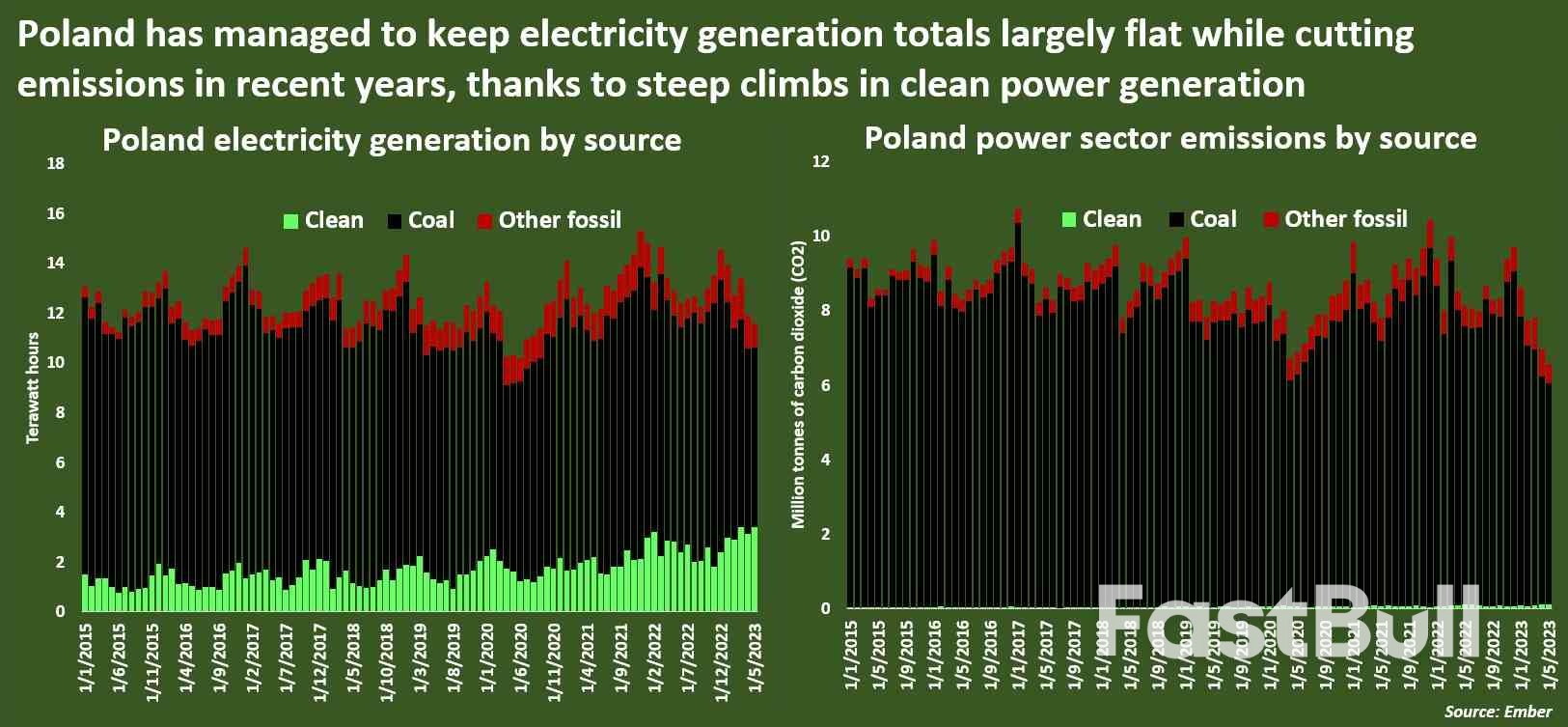
          Poland Defies Big Polluter Expectations with Coal Use Cuts_2Nonetheless, Poland has managed to boost clean electricity supply capacity by 156% since 2018, which in percentage terms is nearly seven times more than Europe's average over the same period, and four times more than the global average, Ember data shows.
          Pushing Ahead
          A nearly 4,000% jump in solar power generation in January to May 2023 from the same period in 2018, along with an 80% increase in wind power, have been the drivers of Poland's clean power advances.
          Over the same time frame, Poland's electricity generation from coal has dropped by roughly 20%, resulting in an equal magnitude drop in coal-fired emissions.
          Poland Defies Big Polluter Expectations with Coal Use Cuts_3So far in 2023, Poland's total emissions from electricity generation have dropped to new lows, falling even below the diminished levels of mid-2020 when Poland's economy was stalled by COVID-19 lockdowns.
          Patchy global demand for some of the goods produced in Poland - led by motor vehicles, electric batteries, furniture and electronics - have also resulted in a slight slowdown in factory production and energy demand in recent months.
          However, Poland's peak period for air conditioner use - which is a key source of electricity demand in every country - looms over the coming months, and should result in a rise in overall power demand through September.
          Price Pain
          Going forward, a key factor that will drive Poland's overall electricity demand will be the price of it.
          In 2022, Poland's heavy reliance on its own coal supplies shielded the country from the worst effects of the cut-off of Russian natural gas to Europe, which sent power costs across the continent to record highs.
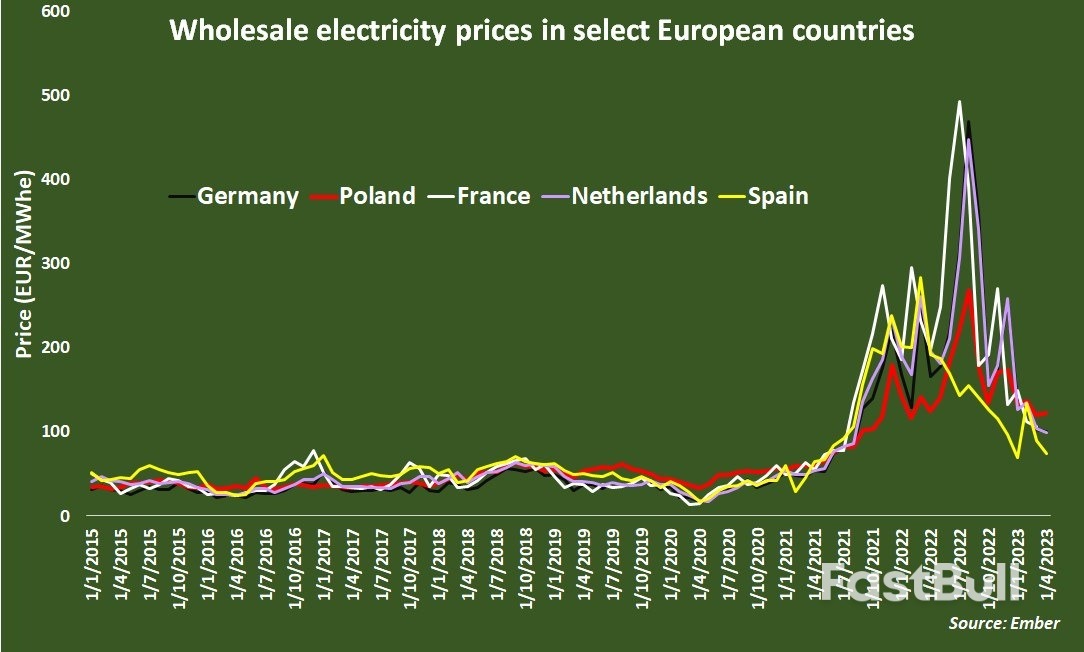
          Poland Defies Big Polluter Expectations with Coal Use Cuts_4However, so far this year Poland's wholesale electricity prices have climbed above those of Germany, France, The Netherlands and Spain as natural gas prices have declined by more than international coal prices.
          If coal prices remain stubbornly strong relative to gas, then Poland's power producers may find themselves in the unenviable position of potentially ranking among the highest cost electricity generators in Europe.
          But such a scenario would likely underscore the attractiveness of further increasing renewable energy supplies, which in most countries are already cheaper than fossil fuel alternatives.
          In any event, previous commitments to invest more than $100 billion in grid upgrades and expansions to renewable power supplies should sustain Poland's clean power momentum, and put the country in a strong position to continue exceeding emissions reduction expectations.

          Source:Reuters

          Risk Warnings and Disclaimers
          You understand and acknowledge that there is a high degree of risk involved in trading. Following any strategies or investment methods may lead to potential losses. The content on the site is provided by our contributors and analysts for information purposes only. You are solely responsible for determining whether any trading assets, securities, strategy, or any other product is suitable for investing based on your own investment objectives and financial situation.
          Comments
          Add to Favorites
          Share

          Will RBA Surprise Traders and Raise Rates Again?

          Justin

          Central Bank

          Economic

          Forex

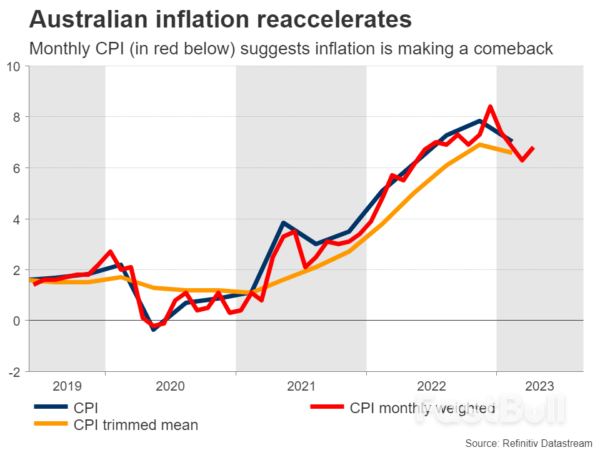
          Hotter inflation, slower growth

          It will be a difficult decision for Australian central bank officials next week, as there are solid arguments both for raising interest rates and for pausing. The prospect of another rate increase is supported mainly by the recent trend in inflation.
          After several months of declines, inflation fired up again in April and is currently on track to overshoot the Reserve Bank’s forecasts for this quarter. Similarly, the latest quarterly data on wages showed an acceleration, fanning concerns of a wage-price spiral that keeps inflation burning for some time.
          Reinforcing such concerns was this week’s decision by the Fair Work Commission to raise the minimum wage by 5.75%, providing another boost to wage growth that could lead the RBA to adopt a more aggressive stance.
          Will RBA Surprise Traders and Raise Rates Again?_1
          However, other elements suggest the RBA should take a cautious approach and do nothing next week. The labor market weakened in April, with the unemployment rate rising noticeably. Meanwhile, retail sales stagnated as consumers turned more defensive. Combined, these suggest economic growth has started to lose momentum.
          Similarly, the slowdown in China’s manufacturing sector continues to intensify, which spells bad news for an Australian economy that relies on Chinese demand to absorb its commodity exports.

          RBA decision is a close call

          Hence, the question heading into next week’s rate decision is whether the RBA will prioritize fighting inflation or supporting economic growth. So far, policymakers have been laser-focused on bringing inflation down, and with inflationary forces regaining strength, it will be hard for the RBA to do nothing.
          Markets are pricing in a 45% probability for a quarter-point rate increase, which seems relatively low considering the inflation dynamics. Nonetheless, a rate hike is almost fully priced in by July, so traders are betting it’s only a matter of time before the RBA hits the tightening button again.
          Will RBA Surprise Traders and Raise Rates Again?_2
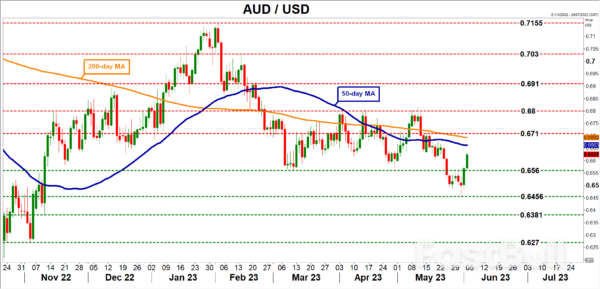
          Since investors view this decision as a coin toss, there is scope for the Australian dollar to gain if rates are raised. From a chart perspective, any advances in aussie/dollar could encounter initial resistance around the 0.6710 zone, which roughly encapsulates the 200-day moving average, currently at 0.6694.
          On the flipside, if the RBA pauses and signals it will be patient while it examines incoming data, the pair could resume its downward trajectory, turning the spotlight towards the 0.6560 support region.

          Rallies might be short-lived

          Looking beyond this meeting, the trajectory in the Australian dollar might depend mostly on how the Chinese economy evolves in the coming months, and how global risk sentiment fares.
          Admittedly, it’s tough to be optimistic about the aussie when Chinese demand is rolling over and commodity prices are struggling, against the backdrop of slowing global growth. The charts tell a similar story as the aussie has been trapped in a downtrend for over two years now.
          Will RBA Surprise Traders and Raise Rates Again?_3
          One potential game-changer for the aussie would be an announcement from China that serious stimulus measures are on the way. This has been widely speculated, as it seems almost impossible for Chinese authorities to hit their growth targets without juicing up the economy.
          A deluge of Chinese stimulus would be good news for the aussie, but whether it will be enough to turn the tide for good is another question. Ultimately, that might depend on the scale and scope of any measures.
          Note that GDP growth numbers for Q1 will be released Wednesday, after the RBA meeting.

          Source:XM

          To stay updated on all economic events of today, please check out our Economic calendar
          Risk Warnings and Disclaimers
          You understand and acknowledge that there is a high degree of risk involved in trading. Following any strategies or investment methods may lead to potential losses. The content on the site is provided by our contributors and analysts for information purposes only. You are solely responsible for determining whether any trading assets, securities, strategy, or any other product is suitable for investing based on your own investment objectives and financial situation.
          Comments
          Add to Favorites
          Share

          Sticky U.S. Inflation is the Biggest Threat to Our FX Views

          Alex

          Forex

          Being bearish on the dollar is our baseline view
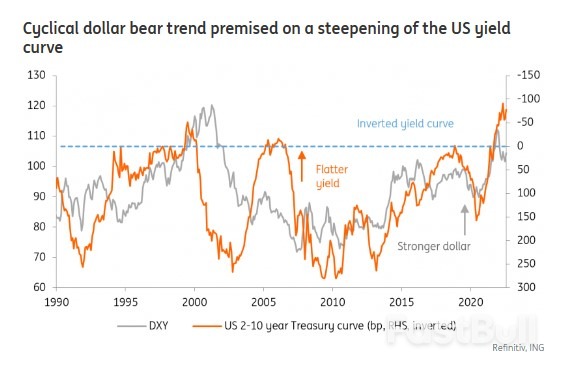
          Our baseline view in FX markets is that the dollar over the coming months will be entering a cyclical bear trend. This is premised on tighter U.S. credit conditions adding to tighter monetary conditions and delivering the long-awaited U.S. disinflation story. Should the Federal Reserve be in a position to cut rates sharply later this year, we are convinced that the dollar would trade lower. Under that scenario, we think EUR/USD should be somewhere in the 1.15+ area by year-end, while USD/JPY should be below 130.
          Our cyclical call for a weaker dollar later this year should be roughly in sync with the next chapter of the U.S. business cycle, where the bearish inversion of the U.S. Treasury curve rotates into bullish steepening - all premised on the Fed being able to respond to the slowdown with rate cuts.
          Equally, a weaker dollar should be a positive story for global growth. Many countries, especially emerging market countries, have had to support local currencies with higher rates. A turn in the broad dollar trend should give them some breathing room and perhaps attract to emerging markets the kind of positive portfolio inflows not seen since late 2020.
          Sticky U.S. Inflation is the Biggest Threat to Our FX Views_1The alternative is a 1980s style dollar rally
          As above, U.S. disinflation is the vital cog in the wheel to a weaker dollar. Failure of U.S. inflation to slow would keep Fed policy tight/tighter for longer - probably causing a deeper U.S. slowdown if not a recession. Under such a scenario, the U.S. yield curve would stay inverted for a lot longer, and 5-6% dollar interest rates would look even more attractive amid a global slowdown. Such a scenario would loosely resemble that of the early 1980s when Fed Chair Paul Volcker took the U.S. economy into recession in order to get inflation under control. The hugely inverted U.S. yield curve at that time sent the dollar through the roof and added to the U.S. current account deficit. That dollar rally was only reversed in 1985 when the G5 nations agreed on the need for an orderly reversal of the dollar with the Plaza Accord.
          Equally, the Fed keeping rates tight/tighter for longer would exacerbate the global slowdown and exacerbate the decline in pro-cyclical currencies such as the euro. In addition, many emerging market economies looking for breathing room with a weaker dollar would be frustrated. And presumably higher dollar rates would tip more EM sovereigns into default/debt restructuring. Instead of the virtuous cycle of a weaker dollar and lower global rates, the cycle could become a vicious one.

          Source: ING

          Risk Warnings and Disclaimers
          You understand and acknowledge that there is a high degree of risk involved in trading. Following any strategies or investment methods may lead to potential losses. The content on the site is provided by our contributors and analysts for information purposes only. You are solely responsible for determining whether any trading assets, securities, strategy, or any other product is suitable for investing based on your own investment objectives and financial situation.
          Comments
          Add to Favorites
          Share

          Brexit, Three Years Later

          Devin

          Economic

          Brexit formally came into effect in February 2020, some 27 years after the United Kingdom entered the European Communities (the European Union's predecessor) and less than four years after the referendum gave a slight majority (51.9 percent) to the Leavers, a figure that drops to 37.4 percent if one considers all registered voters.
          Brexit happened because British voters had three significant concerns. They did not want to join the eurozone and give up monetary independence, but at the same time, they feared that staying out of the euro area would have weakened their political weight in Brussels and possibly made them vulnerable to undesirable waves of banking regulation coming from the European Central Bank (ECB).
          They were also increasingly worried about the inner dynamic characterizing Brussels' institutions, that is, the transformation of an original European project devoted to free trade, free capital and labor movements into a blueprint for a technocratic planning "superstate" managed by an ever-more powerful and expensive bureaucracy (Britain was a net contributor to the EU budget).
          Last but not least, the British public was stirred by the notion that Brussels' policies could swamp the UK with an unrestricted flood of immigrants from all over the world.
          Magical thinking, misplaced hopes
          By contrast, the main argument put forth by the Remainers had to do with economics. They believed that looser ties with Europe would lead to lower trade volumes and investment and a possibly weaker status for London in global politics and finance. The Remainers thought the UK would be unable to compensate for the lost benefits of tighter European economic integration with closer ties with the United States, China and the former Commonwealth countries. Lower economic growth and a lesser geopolitical role would have followed, their argument went.
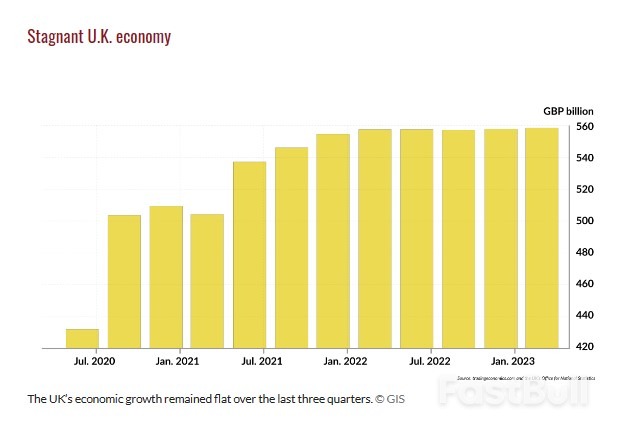
          The evidence suggests that to some extent, both sides were correct. Over the past three years, the growth rate in real gross domestic product (GDP) accelerated at first by about 30 percent in the UK and 21 percent in the EU (during the post-Covid-19 economic restart), but it flattened in both cases in the last three quarters. According to an April 2023 report from the International Monetary Fund (IMF), GDP over the next five years should be more or less stagnant in the UK and the EU. The Leavers had been right in maintaining that Brexit would not bring about an economic catastrophe for the UK. The Remainers argued that leaving the EU alone would not make the dream of a supercharged Britain come true.
          Brexit, Three Years Later_1The policymaking fiascos
          Similar comments apply to monetary policy. Since Brexit, the Bank of England (BoE) and the ECB have both engaged in extensive interest-rate manipulations and unorthodox monetary policies, while doing a lamentable job of monitoring the banking sectors. If one is to judge from the current UK rate of inflation (10.1 percent in March), the BoE has performed worse than the ECB. Brexit has made no positive policy impact, and the banking industry remains fragile on both sides of the English Channel.
          Regarding the quality of policymaking, valuable information comes from the Index of Economic Freedom compiled by the Heritage Foundation and The Wall Street Journal. Between 2020 and 2023, the UK's score dropped 11.85 percent, and its economy is now considered "moderately free" (it used to be "mostly free"). For comparison, during the past three years, the index for Germany (a mostly free economy) has remained nearly constant, while the index for France (moderately free) declined 3.6 percent.
          Brexit, Three Years Later_2The overgrown, overbearing government
          Among the particulars that contribute to the index's final score for each country, the size of government has been a significant factor in the UK case. Its debt-to-GDP ratio is above 100 percent, public expenditure keeps rising (now above 46 percent of GDP) and the predicted budget deficit for the fiscal year 2022-23 is a worrying 6 percent (the EU figure is about 3.5 percent).
          Just as the Remainers feared, Brexit has not improved the quality of policymaking, has failed to strengthen the condition of the UK's public finances and has had a negligible impact on productivity. At the end of last year, the country's productivity was less than 2 percent higher than in 2018 and 2019 (the EU figure was similar).
          Brexit could have been a winning move instead of a fiasco had it led to a better economic situation than under the EU framework. Instead, all remained business as usual. The Liz Truss government briefly tried to alter the picture but failed miserably. Critics bemoaned Ms. Truss's failure to explain how she would balance the budget with significantly lower tax revenues. However, most British were unwilling to accept lighter government and lower public expenditure. Prime Minister Rishi Sunak, a fervent Brexit supporter but not quite a free-market aficionado, belongs to the business-as-usual camp, which earned him his current position.
          No going back to the EU fold
          Mr. Sunak's approach is a good guide to figuring out the future of the British economy. He is not the standard bearer of an economic school of thought. Like most of his counterparts in Europe, is aware that the national economy is in trouble, readily describes the symptoms (deficient education, poor productivity and low investments), and concludes that the solution should come from better government policies.
          Not surprisingly, "less government" is not part of the prime minister's program. Instead, his strategy seems to be: do nothing, increase public expenditure if you can and keep your fingers crossed.
          This attitude is not paying off in electoral terms: opinion polls show that 58 percent of the British believe economic conditions will deteriorate over the next 12 months. Moreover, support for the Conservative Party did recover from the Truss disaster (September-October 2022) but is still behind the pre-Truss months and far behind 2021 levels.
          Only 15 percent of the British are happy about how the government runs the economy. Prime Minister Sunak's popularity is also disappointing: 45 percent of British people have an unfavorable view of him (29 percent have a favorable view).
          Brexit may have opened a window of opportunity, but the British have been unwilling to exploit it, which turned the brave policy move into a fiasco. It seems many thought that the very word – Brexit – would do the magic. Indeed, if elections took place today, the post-Brexit governments and Prime Minister Sunak would be the losers.
          This attitude is not paying off in electoral terms: opinion polls show that 58 percent of the British believe economic conditions will deteriorate over the next 12 months. Moreover, support for the Conservative Party did recover from the Truss disaster (September-October 2022) but is still behind the pre-Truss months and far behind 2021 levels.
          Only 15 percent of the British are happy about how the government runs the economy. Prime Minister Sunak's popularity is also disappointing: 45 percent of British people have an unfavorable view of him (29 percent have a favorable view).
          Brexit may have opened a window of opportunity, but the British have been unwilling to exploit it, which turned the brave policy move into a fiasco. It seems many thought that the very word – Brexit – would do the magic. Indeed, if elections took place today, the post-Brexit governments and Prime Minister Sunak would be the losers.

          Source: GIS

          To stay updated on all economic events of today, please check out our Economic calendar
          Risk Warnings and Disclaimers
          You understand and acknowledge that there is a high degree of risk involved in trading. Following any strategies or investment methods may lead to potential losses. The content on the site is provided by our contributors and analysts for information purposes only. You are solely responsible for determining whether any trading assets, securities, strategy, or any other product is suitable for investing based on your own investment objectives and financial situation.
          Comments
          Add to Favorites
          Share
          FastBull
          Copyright © 2025 FastBull Ltd

          728 RM B 7/F GEE LOK IND BLDG NO 34 HUNG TO RD KWUN TONG KLN HONG KONG

          TelegramInstagramTwitterfacebooklinkedin
          App Store Google Play Google Play
          Products
          Charts

          Chats

          Q&A with Experts
          Screeners
          Economic Calendar
          Data
          Tools
          Membership
          Features
          Function
          Markets
          Copy Trading
          Latest Signals
          Contests
          News
          Analysis
          24/7
          Columns
          Education
          Company
          Careers
          About Us
          Contact Us
          Advertising
          Help Center
          Feedback
          User Agreement
          Privacy Policy
          Business

          White Label

          Data API

          Web Plug-ins

          Poster Maker

          Affiliate Program

          Risk Disclosure

          The risk of loss in trading financial instruments such as stocks, FX, commodities, futures, bonds, ETFs and crypto can be substantial. You may sustain a total loss of the funds that you deposit with your broker. Therefore, you should carefully consider whether such trading is suitable for you in light of your circumstances and financial resources.

          No decision to invest should be made without thoroughly conducting due diligence by yourself or consulting with your financial advisors. Our web content might not suit you since we don't know your financial conditions and investment needs. Our financial information might have latency or contain inaccuracy, so you should be fully responsible for any of your trading and investment decisions. The company will not be responsible for your capital loss.

          Without getting permission from the website, you are not allowed to copy the website's graphics, texts, or trademarks. Intellectual property rights in the content or data incorporated into this website belong to its providers and exchange merchants.

          Not Logged In

          Log in to access more features

          FastBull Membership

          Not yet

          Purchase

          Become a signal provider
          Help Center
          Customer Service
          Dark Mode
          Price Up/Down Colors

          Log In

          Sign Up

          Position
          Layout
          Fullscreen
          Default to Chart
          The chart page opens by default when you visit fastbull.com