Markets
News
Analysis
User
24/7
Economic Calendar
Education
Data
- Names
- Latest
- Prev




Signal Accounts for Members
All Signal Accounts
All Contests


U.K. Retail Sales MoM (SA) (Dec)A:--
F: --
P: --
France Manufacturing PMI Prelim (Jan)A:--
F: --
P: --
France Services PMI Prelim (Jan)A:--
F: --
P: --
France Composite PMI Prelim (SA) (Jan)A:--
F: --
P: --
Germany Manufacturing PMI Prelim (SA) (Jan)A:--
F: --
P: --
Germany Services PMI Prelim (SA) (Jan)A:--
F: --
P: --
Germany Composite PMI Prelim (SA) (Jan)A:--
F: --
P: --
Euro Zone Composite PMI Prelim (SA) (Jan)A:--
F: --
P: --
Euro Zone Manufacturing PMI Prelim (SA) (Jan)A:--
F: --
P: --
Euro Zone Services PMI Prelim (SA) (Jan)A:--
F: --
P: --
U.K. Composite PMI Prelim (Jan)A:--
F: --
P: --
U.K. Manufacturing PMI Prelim (Jan)A:--
F: --
P: --
U.K. Services PMI Prelim (Jan)A:--
F: --
P: --
Mexico Economic Activity Index YoY (Nov)A:--
F: --
P: --
Russia Trade Balance (Nov)A:--
F: --
P: --
Canada Core Retail Sales MoM (SA) (Nov)A:--
F: --
P: --
Canada Retail Sales MoM (SA) (Nov)A:--
F: --
U.S. IHS Markit Manufacturing PMI Prelim (SA) (Jan)A:--
F: --
P: --
U.S. IHS Markit Services PMI Prelim (SA) (Jan)A:--
F: --
P: --
U.S. IHS Markit Composite PMI Prelim (SA) (Jan)A:--
F: --
P: --
U.S. UMich Consumer Sentiment Index Final (Jan)A:--
F: --
P: --
U.S. UMich Current Economic Conditions Index Final (Jan)A:--
F: --
P: --
U.S. UMich Consumer Expectations Index Final (Jan)A:--
F: --
P: --
U.S. Conference Board Leading Economic Index MoM (Nov)A:--
F: --
P: --
U.S. Conference Board Coincident Economic Index MoM (Nov)A:--
F: --
P: --
U.S. Conference Board Lagging Economic Index MoM (Nov)A:--
F: --
P: --
U.S. UMich 1-Year-Ahead Inflation Expectations Final (Jan)A:--
F: --
P: --
U.S. Conference Board Leading Economic Index (Nov)A:--
F: --
P: --
U.S. Weekly Total Rig CountA:--
F: --
P: --
U.S. Weekly Total Oil Rig CountA:--
F: --
P: --
Germany Ifo Business Expectations Index (SA) (Jan)--
F: --
P: --
Germany IFO Business Climate Index (SA) (Jan)--
F: --
P: --
Germany Ifo Current Business Situation Index (SA) (Jan)--
F: --
P: --
Mexico Unemployment Rate (Not SA) (Dec)--
F: --
P: --
Canada National Economic Confidence Index--
F: --
P: --
U.S. Non-Defense Capital Durable Goods Orders MoM (Excl. Aircraft) (Nov)--
F: --
P: --
U.S. Durable Goods Orders MoM (Excl. Defense) (SA) (Nov)--
F: --
P: --
U.S. Durable Goods Orders MoM (Excl.Transport) (Nov)--
F: --
P: --
U.S. Durable Goods Orders MoM (Nov)--
F: --
P: --
U.S. Dallas Fed General Business Activity Index (Jan)--
F: --
P: --
U.K. BRC Shop Price Index YoY (Jan)--
F: --
P: --
China, Mainland Industrial Profit YoY (YTD) (Dec)--
F: --
P: --
Mexico Trade Balance (Dec)--
F: --
P: --
U.S. S&P/CS 20-City Home Price Index YoY (Not SA) (Nov)--
F: --
P: --
U.S. S&P/CS 20-City Home Price Index MoM (SA) (Nov)--
F: --
P: --
U.S. FHFA House Price Index MoM (Nov)--
F: --
P: --
U.S. FHFA House Price Index (Nov)--
F: --
P: --
U.S. Richmond Fed Manufacturing Composite Index (Jan)--
F: --
P: --
U.S. Conference Board Present Situation Index (Jan)--
F: --
P: --
U.S. Conference Board Consumer Expectations Index (Jan)--
F: --
P: --
U.S. Richmond Fed Manufacturing Shipments Index (Jan)--
F: --
P: --
U.S. Richmond Fed Services Revenue Index (Jan)--
F: --
P: --
U.S. Conference Board Consumer Confidence Index (Jan)--
F: --
P: --
Australia RBA Trimmed Mean CPI YoY (Q4)--
F: --
P: --
Australia CPI YoY (Q4)--
F: --
P: --
Australia CPI QoQ (Q4)--
F: --
P: --
Germany GfK Consumer Confidence Index (SA) (Feb)--
F: --
P: --
India Industrial Production Index YoY (Dec)--
F: --
P: --
India Manufacturing Output MoM (Dec)--
F: --
P: --


No matching data
Latest Views
Latest Views
Trending Topics
Top Columnists
Latest Update
White Label
Data API
Web Plug-ins
Affiliate Program
View All

No data
British retail sales rose unexpectedly last month, helped by strong online shopping, according to data published on Friday which added to signs of a pickup in the economy after finance minister Rachel Reeves' budget.

British retail sales rose unexpectedly last month, helped by strong online shopping, according to data published on Friday which added to signs of a pickup in the economy after finance minister Rachel Reeves' budget.
Sales volumes rose by 0.4% in December from November, the Office for National Statistics said. This was the first increase since September and marked a brighter end to an otherwise drab final quarter for shops.
Economists polled by Reuters had expected sales to fall by 0.1% in month-on-month terms.
Earlier, market research firm GfK said consumer confidence rose to its highest level since August 2024 as households became more positive about their own finances.
Friday's data added to tentatively positive readings for economic activity for Reeves after her tax-raising November budget, despite more signs of cooling in the labour market and still-high inflation.
"The budget was tough, but people's worst fears weren't met," said Neil Birrell, chief investment officer at Premier Miton, a wealth management company.
"This does suggest the UK consumer is in better shape than expected, and if that follows through in the wider economy, maybe there is room for a bit more optimism for the UK."
For the fourth quarter as a whole, retail sales fell by 0.3%, reflecting declines in November and October, which the ONS said would exert a 0.01 percentage-point drag on overall economic output.
Thomas Pugh, chief economist at RSM UK, said the outlook for spending hinged on whether consumers stuck to their high levels of savings or used them to boost spending, and on the possibility of fresh political turmoil with Prime Minister Keir Starmer under pressure ahead of local elections in May.
"A disruptive leadership contest, which opens the door to another round of tax increases, is a significant downside risk to confidence continuing to recover," Pugh said.
The ONS said online jewellers saw renewed demand for precious metals in December - against a backdrop of rising gold prices.
Compared with December a year ago, overall retail sales volumes were 2.5% higher, marking the strongest such reading since April.
Still, sales volumes remained 2.2% lower last month than their level six years ago, before the COVID-19 pandemic.
Major British retailers were generally cautious about 2026 prospects in their post-Christmas trading updates.

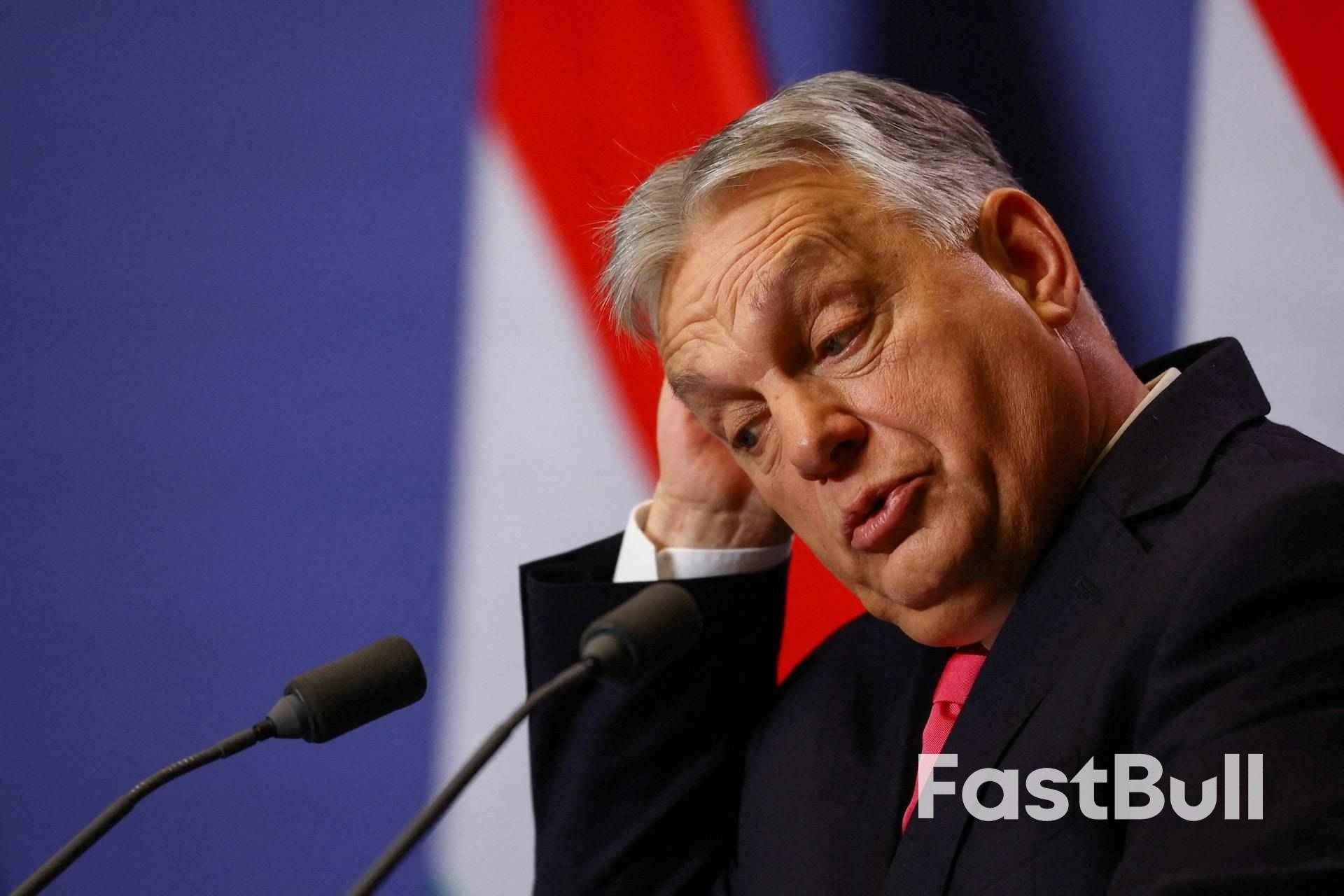
Hungary's Viktor Orban criticised Ukrainian President Volodymyr Zelenskiy, describing him as "a man in a desperate position" whose "war efforts" he would not support, intensifying his anti-Ukrainian campaign ahead of pivotal April elections.
As Hungary's economy stagnates and Orban's Fidesz party trails the opposition Tisza party in most polls, the prime minister has framed the parliamentary election due on April 12 as a choice between war and peace, portraying Ukraine as undeserving of financial support.
In a Facebook post directly addressed to Zelenskiy, late on Thursday Orban said:
"You are a man in a desperate position who, for the fourth year now, has been unable or unwilling to bring a war to an end - despite the fact that the President of the United States has provided every possible assistance to do so."
"Therefore, no matter how much you flatter me, we cannot support your war efforts," the nationalist leader added, again rejecting financial aid for Ukraine.
Zelenskiy on Thursday criticised Europe for being a "fragmented kaleidoscope of small and middle powers" lacking the courage to act decisively and facing a dark future unless it stood up to U.S. and Russian power.
Orban, who has maintained close ties with Moscow and with Russian President Vladimir Putin, has sought to associate Hungarian opposition leader Peter Magyar with Brussels and Ukraine, and accused Ukraine of wanting a change in government.
"The Ukrainians will be active participants in the Hungarian campaign, because they have a vested interest in a change of government in Hungary," Orban told a briefing early on Friday in Brussels.
Ukraine's government could not immediately be reached for comment.
Orban said his government would launch a "national petition" that Hungarians can sign to "tell Brussels that Hungarians won't pay to Ukraine."
This primarily targets rural voters and echoes Orban's past anti-migrant campaigns.
Magyar has said Tisza supports peace in Ukraine, rejects the idea of conscription, and will not support any escalation in the war.
China and the Philippines said on Friday they launched rescue operations after receiving reports of a sinking cargo ship near the Scarborough Shoal in the South China Sea that was carrying 21 Philippine crew members.
Scarborough Shoal is one of Asia's most contested maritime features and a frequent flashpoint in disputes, particularly between China and the Philippines, over sovereignty and fishing rights.
The Chinese military said 17 crew members were rescued and two of them later died, after a report around 1:30 a.m. on Friday (1730 GMT on Thursday) that a foreign cargo vessel had capsized in waters near the shoal.
It dispatched aircraft to conduct searches and the Chinese Coast Guard sent two vessels for rescue efforts.
One person was receiving emergency medical treatment, it said, adding that China's maritime authorities were organising additional rescue forces to head to the area.
The Philippine Coast Guard said it deployed two vessels and two aircraft to rescue the Philippine crew from a Singaporean-flagged cargo vessel loaded with iron ore that was en route to the southern Chinese city of Yangjiang.
"The PCG Command Center acquired information from the Hong Kong Maritime Rescue Coordination Centre that 10 of the 21 Filipino crew members were rescued by a passing China Coast Guard vessel," it said.
The Maritime and Port Authority of Singapore confirmed that the bulk carrier, "Devon Bay", had sunk in the South China Sea while en route to Yangjiang.
"As the vessel's flag state, MPA is in contact with the ship owner and relevant search and rescue authorities, and is providing support as required," it said, adding that it will investigate the incident.
Underlining the Scarborough Shoal's disputed status, China's military said on Tuesday it had organised naval and air force units to repel a Philippine government aircraft that it accused of "illegally intruding" into airspace over the atoll.
Both China and the Philippines claim the Scarborough Shoal, but sovereignty remains unresolved. China took control in 2012 after a standoff and has since stationed its coast guard and fishing vessels there.
A 2016 ruling by the Permanent Court of Arbitration in The Hague invalidated China's sweeping claims in the South China Sea and declared its blockade illegal, affirming the shoal as a traditional fishing ground for countries like the Philippines and Vietnam. China rejected the ruling.
China's claims overlap with the exclusive economic zones of Brunei, Indonesia, Malaysia, the Philippines and Vietnam.
The UK's private sector expanded at its fastest pace in nearly two years this January, fueled by a resurgence in the technology and financial services industries. A key business survey from S&P Global showed its purchasing managers' index (PMI) climbing to a 21-month high of 53.9.
This figure significantly outpaced the 51.4 recorded in the previous month and economists' expectations of 51.5. A reading above 50 indicates expansion, and S&P noted the current level corresponds to quarterly economic growth of approximately 0.4%.
Analysts attribute the surge in activity to renewed business confidence following the Labour government's budget on November 26. With fiscal policy clarified, companies reportedly moved forward with previously stalled projects.
The survey suggested that firms were relieved after being largely spared from the £26 billion in tax increases announced by Chancellor of the Exchequer Rachel Reeves. Businesses also appeared to overlook geopolitical risks, including potential trade tensions between the US and Greenland, to focus on domestic opportunities.
The data points to the British economy regaining momentum after a period of slower growth and a weaker labor market in the second half of 2025.
The UK's dominant services sector remains the primary engine of growth.
"Growth continues to be driven by the service sector, and in particular financial services and tech," said Chris Williamson, chief business economist at S&P Global Market Intelligence. "Companies are reporting higher demand, both from home and export markets, which has driven output growth to the fastest since April 2024."
The services business activity index reached a 21-month high. Meanwhile, the manufacturing output index also showed positive momentum, marking its fourth consecutive month of growth.
Forward-looking indicators also painted a positive picture. The overall increase in new business orders was the most rapid since October 2024, while business optimism for the year ahead hit its highest level since September 2024.
Export sales saw their strongest performance in 18 months, supported by climbing demand from key markets in Europe, the US, and China.
Despite the strong headline figures, the survey highlighted persistent challenges. Firms continued to reduce their workforce, and input costs rose at the joint-fastest rate seen in eight months, signaling ongoing inflationary pressures.
According to AccuWeather, a powerful Arctic cold front is expected to sweep across the United States, reaching as far south as the southern states and bringing lower temperatures to more than 150 million people across 24 states.
On Thursday, Texas Governor Abbott declared a state of emergency in more than half of the state's counties ahead of the cold snap. It is worth noting that Texas is home to key natural gas production facilities, while its infrastructure is less adapted to prolonged cold weather.
As a result, market sentiment is being shaped both by expectations of higher natural gas demand for heating and by the risk of technical disruptions to production.
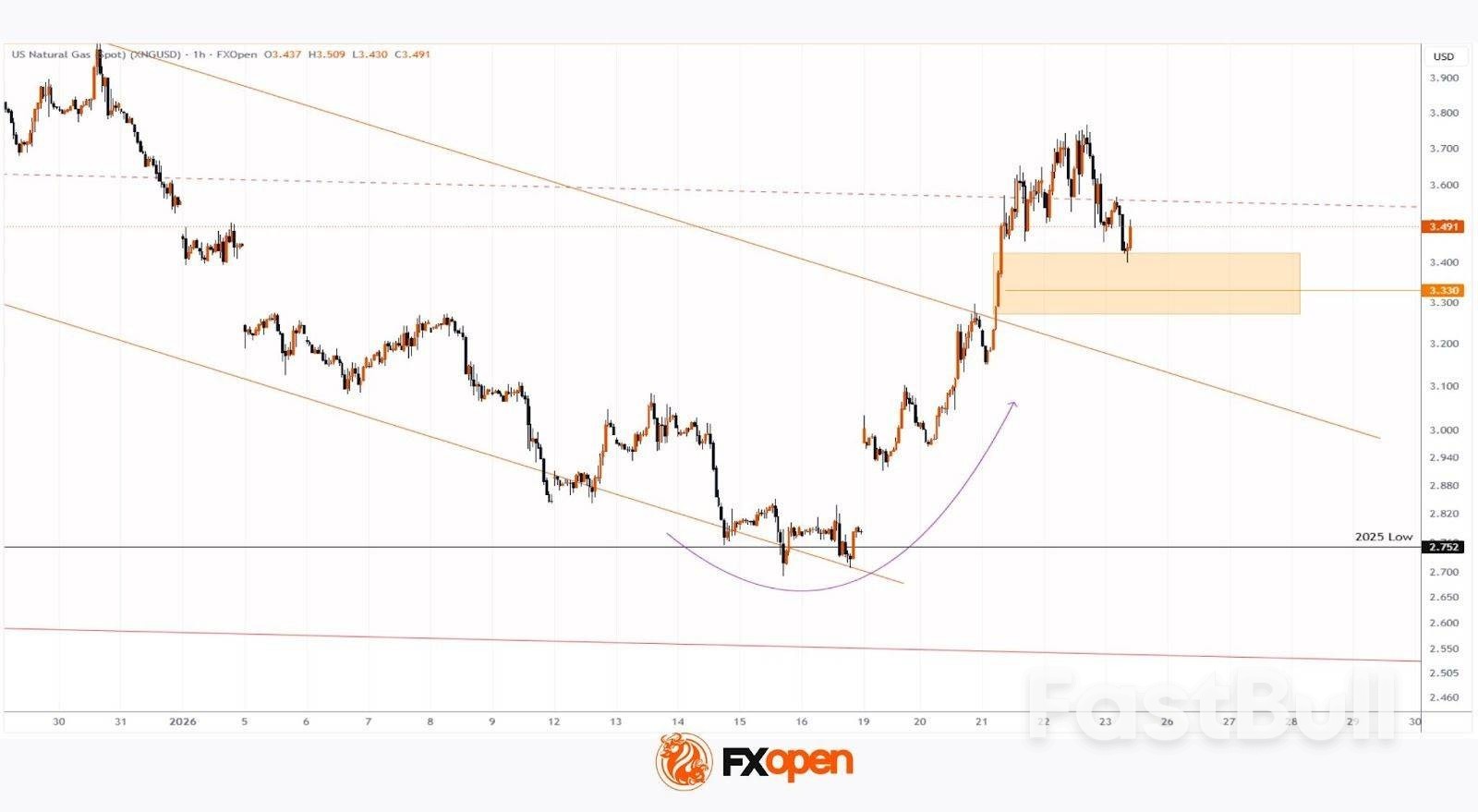
Consequently, the XNG/USD chart shows a sharp rise in natural gas prices, with the move from last week's low to the recent high amounting to nearly 40%.

When analysing gas prices on 15 January, we identified a long-term descending channel, highlighted in red on the chart. At that time, we also:
→ noted that prices were hovering near the 2025 low;→ suggested that bears might attempt to break below the 2025 low, which could have a psychological impact on the market, prompting short sellers to take profits and encouraging renewed buying interest.
Indeed, following a false bearish break of the 2025 low (as indicated by the arrow), prices surged sharply towards the median of the channel, an area where supply and demand often tend to balance.
Moreover, around the 3.330 level, there was a clear period of imbalance in favour of buyers. Bulls broke through the descending trendline resistance, and XNG/USD rose with minimal pullbacks.
From a technical perspective, it is therefore possible that this area may now act as support. However, the actual path of the natural gas market will largely depend on the severity of the cold weather and its impact on conditions across the country.
Eurozone private sector activity showed no signs of acceleration in January, with the latest business surveys pointing to a continuation of the modest growth seen at the end of last year.
The HCOB Flash Eurozone Composite PMI Output Index held steady at 51.5, the same level as in December. While this marks the 13th consecutive month of expansion, the rate of growth remains tied for the slowest pace recorded since September.
A clear divergence emerged between the Eurozone's two main sectors. The previously resilient services sector saw its growth cool to a four-month low, with its PMI falling to 51.9 from 52.4.
In contrast, the manufacturing sector showed signs of life. After contracting in December, manufacturing production edged back into growth territory with a reading of 50.2. The broader Manufacturing PMI, while still indicating an overall contraction, rose to a two-month high of 49.4 from 48.8.
Despite the mixed performance, demand showed signs of weakening. New orders rose for the sixth straight month, but the pace of this increase was the slowest since September 2025. Export orders also continued to fall, though the rate of decline was less severe than in December.
In a concerning turn, Eurozone companies reduced their workforce for the first time in four months. This employment decline was heavily concentrated in Germany, which experienced its most significant job cuts since November 2009, excluding the initial shock of the pandemic.
Meanwhile, hiring continued in France and the rest of the Eurozone, highlighting a growing divergence in labor market trends across the bloc.
The January data revealed a notable intensification of inflation pressures. Input costs for businesses climbed at the fastest rate in nearly a year, and this was passed on to customers through higher output prices. The rate of output price inflation was the strongest seen since April 2024, driven primarily by the services sector.
According to analysts at ING, these trends are unlikely to force the European Central Bank's hand immediately. "Even though inflation has remained remarkably benign in recent months despite all the economic turmoil, the PMI does indicate increasing price pressures again," they noted. "That being said, the moves are not nearly enough to sway the ECB from its expectations to hold rates for the foreseeable future."
Despite the sluggish activity and job cuts, business confidence across the Eurozone climbed to a 20-month high. Optimism in the manufacturing sector was particularly strong, reaching a peak not seen in nearly four years.
Dr. Cyrus de la Rubia, Chief Economist at Hamburg Commercial Bank, characterized the recovery as "rather feeble" and suggested the data points to "more of the same in the months to come."
He added that the resurgence in services inflation could reinforce the ECB's cautious stance. The rising price pressures might even lead some central bank officials to argue against rate cuts and in favor of holding rates steady or potentially even increasing them.
The report also highlighted differing national performances, with Germany beginning 2026 on a growth trajectory while France saw a monthly decline in output, potentially linked to budget finalization challenges.
India and the European Union are on the verge of finalizing a long-awaited free trade agreement (FTA), with an official announcement anticipated this Tuesday during the India-EU Summit in New Delhi. This pact marks a significant step in global trade dynamics for both economic powers.
This agreement would be India's ninth in four years, underscoring New Delhi's strategy to secure new market access as global trade becomes increasingly protectionist. For the European Union, the deal is a key move to diversify supply chains, lessen its economic reliance on China, and gain deeper entry into India's rapidly expanding $4.2 trillion economy.
The economic relationship is already substantial. The EU is one of India's largest trading partners, with total bilateral trade in goods and services set to surpass $190 billion in the 2024/25 fiscal year. In that period, India's exports to the 27-nation bloc included approximately $76 billion in goods and $30 billion in services.
The scope of the new FTA is focused specifically on goods, services, and trade regulations. Negotiations concerning investment protection and geographical indications (GIs) are being handled separately.
A core function of the FTA is to rebalance the existing tariff structures between the two markets.
EU Tariffs on Indian Goods
The EU's average tariffs on Indian products are relatively low at about 3.8%. However, critical labor-intensive sectors face steeper duties. According to the Global Trade Research Initiative, a Delhi-based think tank, tariffs on textiles and garments are around 10%.
The agreement aims to restore India's competitive edge, which was diminished after the EU began phasing out tariff concessions under its Generalised System of Preferences (GSP) in 2023. This change affected key exports like garments, pharmaceuticals, and machinery. The FTA could also help Indian exporters offset the impact of high U.S. tariffs imposed since last August.
Indian Tariffs on EU Goods
Conversely, EU exports to India encounter significantly higher barriers. The weighted-average tariff on $60.7 billion worth of EU goods was about 9.3% in 2024/25.
Duties are particularly high for automobiles, auto parts, chemicals, and plastics. Lowering these tariffs would create opportunities for European companies in sectors like cars, machinery, aircraft, and chemicals. The EU also seeks better access to India's services, procurement, and investment markets.
While both sides are motivated to reach a compromise, several sensitive issues and key demands remain central to the negotiations.
Key Demands and Exclusions
• Excluded Sectors: Agriculture and dairy products are not part of the agreement.
• Tariff Elimination: India is resisting EU pressure to eliminate tariffs on over 95% of goods, offering a figure closer to 90%.
• Sensitive Industries: Autos, wine, and spirits remain contentious. India is exploring phased tariff reductions or limited quotas to protect its domestic manufacturing sector.
• India's Asks: New Delhi is seeking "data-secure" status under EU regulations, easier cross-border movement for its professionals, and an end to double social security payments for its workers.
• EU's Asks: The EU is pushing for broader access to India's financial and legal services, along with stronger commitments on labor, environmental, and intellectual property standards—areas where India prefers to maintain flexibility.
Overarching Concerns
Two major challenges could impact the deal's effectiveness. First, the EU's carbon border levy could potentially cancel out the benefits of tariff reductions for Indian exporters. Second, high non-tariff barriers, such as regulatory delays, strict product standards, and costly certifications, continue to be a significant hurdle for Indian businesses.
Once signed, the FTA must be ratified by the European Parliament, a process that could take at least a year. Recent events, such as EU lawmakers challenging the bloc's trade pact with South America in court, show that parliamentary approval is not guaranteed and can lead to delays or complications.
Analysts believe that current geopolitical pressures and trade shocks have pushed both India and the EU toward a practical and achievable compromise. However, the true success of the agreement will depend on how effectively the final terms address the carbon levy, services mobility, and non-tariff barriers to create balanced gains for both sides.
White Label
Data API
Web Plug-ins
Poster Maker
Affiliate Program
The risk of loss in trading financial instruments such as stocks, FX, commodities, futures, bonds, ETFs and crypto can be substantial. You may sustain a total loss of the funds that you deposit with your broker. Therefore, you should carefully consider whether such trading is suitable for you in light of your circumstances and financial resources.
No decision to invest should be made without thoroughly conducting due diligence by yourself or consulting with your financial advisors. Our web content might not suit you since we don't know your financial conditions and investment needs. Our financial information might have latency or contain inaccuracy, so you should be fully responsible for any of your trading and investment decisions. The company will not be responsible for your capital loss.
Without getting permission from the website, you are not allowed to copy the website's graphics, texts, or trademarks. Intellectual property rights in the content or data incorporated into this website belong to its providers and exchange merchants.
Not Logged In
Log in to access more features

FastBull Membership
Not yet
Purchase
Log In
Sign Up