
• Trade
  • Markets
  • Copy
  • Contests
  • News
  • 24/7
  • Calendar
  • Q&A
  • Chats
Trending
Screeners
SYMBOL
LAST
BID
ASK
HIGH
LOW
NET CHG.
%CHG.
SPREAD
SPX
S&P 500 Index
6827.42
6827.42
6827.42
6899.86
6801.80
-73.58
-1.07%
--
DJI
Dow Jones Industrial Average
48458.04
48458.04
48458.04
48886.86
48334.10
-245.98
-0.51%
--
IXIC
NASDAQ Composite Index
23195.16
23195.16
23195.16
23554.89
23094.51
-398.69
-1.69%
--
USDX
US Dollar Index
97.910
97.990
97.910
98.070
97.810
-0.040
-0.04%
--
EURUSD
Euro / US Dollar
1.17466
1.17473
1.17466
1.17596
1.17262
+0.00072
+ 0.06%
--
GBPUSD
Pound Sterling / US Dollar
1.33863
1.33874
1.33863
1.33961
1.33546
+0.00156
+ 0.12%
--
XAUUSD
Gold / US Dollar
4333.26
4333.67
4333.26
4350.16
4294.68
+33.87
+ 0.79%
--
WTI
Light Sweet Crude Oil
56.849
56.879
56.849
57.601
56.789
-0.384
-0.67%
--

Community Accounts

Signal Accounts
--
Profit Accounts
--
Loss Accounts
--
View More

Become a signal provider

Sell trading signals to earn additional income

View More

Guide to Copy Trading

Get started with ease and confidence

View More

Signal Accounts for Members

All Signal Accounts

Best Return
  • Best Return
  • Best P/L
  • Best MDD
Past 1W
  • Past 1W
  • Past 1M
  • Past 1Y

All Contests

  • All
  • Trump Updates
  • Recommend
  • Stocks
  • Cryptocurrencies
  • Central Banks
  • Featured News
Top News Only
Share

Bank Of America Expects A Deficit In Aluminium Next Year And Sees Prices Pushing Above $3000/T

Share

Fed Data - USA Effective Federal Funds Rate At 3.64 Percent On 12 December On $102 Billion In Trades Versus 3.64 Percent On $99 Billion On 11 December

Share

Brazil's Petrobras Says No Impact Seen On Oil, Petroleum Products Output As Workers Start Planned Strike

Share

Statement: US Travel Group Warns New Proposed Trump Administration Requirements For Foreign Tourists To Provide Social Media Histories Could Mean Millions Of People Opting Not To Visit

Share

Blackrock: Kerry White Will Become Head Of Citi Investment Management At Citi Wealth

Share

Blackrock: Rob Jasminski, Head Of Citi Investment Management, Has Joined With Team

Share

Blackrock: Effective Dec 15, Citi Investment Management Employees Will Join Blackrock

Share

Blackrock: Formally Launch Citi Portfolio Solutions Powered By Blackrock

Share

According To Data From The Federal Reserve Bank Of New York, The Secured Overnight Funding Rate (Sofr) Was 3.67% On The Previous Trading Day (December 15), Compared To 3.66% The Day Before

Share

Peru Energy And Mines Ministry: Copper Production Up 4.8% Year-On-Year In October To 248192 Metric Tons

Share

Security Source: Ukrainian Drones Hits Russian Oil Infrastructure In Caspian Sea For Third Time

Share

Spot Palladium Extends Gains, Last Up 5% To $1562.7/Oz

Share

Mexico's Economy Ministry Announces Start Of Anti-Dumping Investigation And Anti-Subsidy Investigations Into USA Pork Imports

Share

Canada Nov CPI Common +2.8%, CPI Median +2.8%, CPI Trim +2.8% On Year

Share

NY Fed's Empire State Prices Paid Index +37.6 In December Versus+49.0 In November

Share

Canada Nov Consumer Prices +0.1% On Month, +2.2% On Year

Share

Canada Nov CPI Core -0.1% On Month, +2.9% On Year

Share

Canada Nov Core CPI, Seasonally Adjusted +0.2% On Month, Oct +0.3% (Unrevised)

Share

UK Health Minister Streeting On Doctors' Strike: Vote To Go Ahead Reveals The Bma's Shocking Disregard For Patient Safety

Share

Venezuelan State Oil Company Pdvsa Says Was Subject To Cyber Attack But Operations Unaffected

TIME
ACT
FCST
PREV
Japan Tankan Small Manufacturing Outlook Index (Q4)

A:--

F: --

P: --

Japan Tankan Large Non-Manufacturing Outlook Index (Q4)

A:--

F: --

P: --

Japan Tankan Large Manufacturing Outlook Index (Q4)

A:--

F: --

P: --

Japan Tankan Small Manufacturing Diffusion Index (Q4)

A:--

F: --

P: --

Japan Tankan Large Manufacturing Diffusion Index (Q4)

A:--

F: --

P: --

Japan Tankan Large-Enterprise Capital Expenditure YoY (Q4)

A:--

F: --

P: --

U.K. Rightmove House Price Index YoY (Dec)

A:--

F: --

P: --

China, Mainland Industrial Output YoY (YTD) (Nov)

A:--

F: --

P: --

China, Mainland Urban Area Unemployment Rate (Nov)

A:--

F: --

P: --

Saudi Arabia CPI YoY (Nov)

A:--

F: --

P: --

Euro Zone Industrial Output YoY (Oct)

A:--

F: --

P: --

Euro Zone Industrial Output MoM (Oct)

A:--

F: --

P: --

Canada Existing Home Sales MoM (Nov)

A:--

F: --

P: --

Canada National Economic Confidence Index

A:--

F: --

P: --

Canada New Housing Starts (Nov)

A:--

F: --

P: --
U.S. NY Fed Manufacturing Employment Index (Dec)

A:--

F: --

P: --

U.S. NY Fed Manufacturing Index (Dec)

A:--

F: --

P: --

Canada Core CPI YoY (Nov)

A:--

F: --

P: --

Canada Manufacturing Unfilled Orders MoM (Oct)

A:--

F: --

P: --

U.S. NY Fed Manufacturing Prices Received Index (Dec)

A:--

F: --

P: --

U.S. NY Fed Manufacturing New Orders Index (Dec)

A:--

F: --

P: --

Canada Manufacturing New Orders MoM (Oct)

A:--

F: --

P: --

Canada Core CPI MoM (Nov)

A:--

F: --

P: --

Canada Trimmed CPI YoY (SA) (Nov)

A:--

F: --

P: --

Canada Manufacturing Inventory MoM (Oct)

A:--

F: --

P: --

Canada CPI YoY (Nov)

A:--

F: --

P: --

Canada CPI MoM (Nov)

A:--

F: --

P: --

Canada CPI YoY (SA) (Nov)

A:--

F: --

P: --

Canada Core CPI MoM (SA) (Nov)

A:--

F: --

P: --

Canada CPI MoM (SA) (Nov)

A:--

F: --

P: --

Federal Reserve Board Governor Milan delivered a speech
U.S. NAHB Housing Market Index (Dec)

--

F: --

P: --

Australia Composite PMI Prelim (Dec)

--

F: --

P: --

Australia Services PMI Prelim (Dec)

--

F: --

P: --

Australia Manufacturing PMI Prelim (Dec)

--

F: --

P: --

Japan Manufacturing PMI Prelim (SA) (Dec)

--

F: --

P: --

U.K. 3-Month ILO Employment Change (Oct)

--

F: --

P: --

U.K. Unemployment Claimant Count (Nov)

--

F: --

P: --

U.K. Unemployment Rate (Nov)

--

F: --

P: --

U.K. 3-Month ILO Unemployment Rate (Oct)

--

F: --

P: --

U.K. Average Weekly Earnings (3-Month Average, Including Bonuses) YoY (Oct)

--

F: --

P: --

U.K. Average Weekly Earnings (3-Month Average, Excluding Bonuses) YoY (Oct)

--

F: --

P: --

France Services PMI Prelim (Dec)

--

F: --

P: --

France Composite PMI Prelim (SA) (Dec)

--

F: --

P: --

France Manufacturing PMI Prelim (Dec)

--

F: --

P: --

Germany Services PMI Prelim (SA) (Dec)

--

F: --

P: --

Germany Manufacturing PMI Prelim (SA) (Dec)

--

F: --

P: --

Germany Composite PMI Prelim (SA) (Dec)

--

F: --

P: --

Euro Zone Composite PMI Prelim (SA) (Dec)

--

F: --

P: --

Euro Zone Services PMI Prelim (SA) (Dec)

--

F: --

P: --

Euro Zone Manufacturing PMI Prelim (SA) (Dec)

--

F: --

P: --

U.K. Services PMI Prelim (Dec)

--

F: --

P: --

U.K. Manufacturing PMI Prelim (Dec)

--

F: --

P: --

U.K. Composite PMI Prelim (Dec)

--

F: --

P: --

Euro Zone ZEW Economic Sentiment Index (Dec)

--

F: --

P: --

Germany ZEW Current Conditions Index (Dec)

--

F: --

P: --

Germany ZEW Economic Sentiment Index (Dec)

--

F: --

P: --

Euro Zone Trade Balance (Not SA) (Oct)

--

F: --

P: --

Euro Zone ZEW Current Conditions Index (Dec)

--

F: --

P: --

Euro Zone Trade Balance (SA) (Oct)

--

F: --

P: --

U.S. Retail Sales MoM (Excl. Automobile) (SA) (Oct)

--

F: --

P: --

Q&A with Experts
    • All
    • Chatrooms
    • Groups
    • Friends
    Connecting
    .
    .
    .
    Type here...
    Add Symbol or Code

      No matching data

      All
      Trump Updates
      Recommend
      Stocks
      Cryptocurrencies
      Central Banks
      Featured News
      • All
      • Russia-Ukraine Conflict
      • Middle East Flashpoint
      • All
      • Russia-Ukraine Conflict
      • Middle East Flashpoint
      Search
      Products

      Charts Free Forever

      Chats Q&A with Experts
      Screeners Economic Calendar Data Tools
      Membership Features
      Data Warehouse Market Trends Institutional Data Policy Rates Macro

      Market Trends

      Market Sentiment Order Book Forex Correlations

      Top Indicators

      Charts Free Forever
      Markets

      News

      News Analysis 24/7 Columns Education
      From Institutions From Analysts
      Topics Columnists

      Latest Views

      Latest Views

      Trending Topics

      Top Columnists

      Latest Update

      Signals

      Copy Rankings Latest Signals Become a signal provider AI Rating
      Contests
      Brokers

      Overview Brokers Assessment Rankings Regulators News Claims
      Broker listing Forex Brokers Comparison Tool Live Spread Comparison Scam
      Q&A Complaint Scam Alert Videos Tips to Detect Scam
      More

      Business
      Events
      Careers About Us Advertising Help Center

      White Label

      Data API

      Web Plug-ins

      Affiliate Program

      Awards Institution Evaluation IB Seminar Salon Event Exhibition
      Vietnam Thailand Singapore Dubai
      Fans Party Investment Sharing Session
      FastBull Summit BrokersView Expo
      Recent Searches
        Top Searches
          Markets
          News
          Analysis
          User
          24/7
          Economic Calendar
          Education
          Data
          • Names
          • Latest
          • Prev

          View All

          No data

          Scan to Download

          Faster Charts, Chat Faster!

          Download App
          English
          • English
          • Español
          • العربية
          • Bahasa Indonesia
          • Bahasa Melayu
          • Tiếng Việt
          • ภาษาไทย
          • Français
          • Italiano
          • Türkçe
          • Русский язык
          • 简中
          • 繁中
          Open Account
          Search
          Products
          Charts Free Forever
          Markets
          News
          Signals

          Copy Rankings Latest Signals Become a signal provider AI Rating
          Contests
          Brokers

          Overview Brokers Assessment Rankings Regulators News Claims
          Broker listing Forex Brokers Comparison Tool Live Spread Comparison Scam
          Q&A Complaint Scam Alert Videos Tips to Detect Scam
          More

          Business
          Events
          Careers About Us Advertising Help Center

          White Label

          Data API

          Web Plug-ins

          Affiliate Program

          Awards Institution Evaluation IB Seminar Salon Event Exhibition
          Vietnam Thailand Singapore Dubai
          Fans Party Investment Sharing Session
          FastBull Summit BrokersView Expo

          Shipping Costs Rise by Up to 250% Due to Red Sea Attacks

          Devin

          Economic

          Summary:

          Price of transporting a 40-foot container from China to Europe soars.

          The cost of shipping goods through the Red Sea has surged since Yemen's Houthi rebels began attacking commercial vessels in late November, and this continuing disruption may lead to higher inflation globally, industry analysts have said.
          Charges for transporting a 40-foot container from China to Europe through the key waterway have surged to about $4,000 at present, according to the Drewry World Container Index, which tracks container freight rates on eight major routes to and from the US, Europe and Asia.
          That is a 248 per cent jump from $1,148 from November 21, the week the attacks began, and a 140 per cent increase from $1,667 on December 23, data from London-based Drewry showed.
          Some of the world's largest shipping companies have been forced to suspend Red Sea routes and redirect their vessels.
          These include Europe-based MSC, Maersk, CMA CGM and Hapag-Lloyd, and Asia-based Cosco Shipping, HMM and Evergreen Line, as well as oil and gas tanker operators.
          The alternative route for East-West trade involves passage around the Cape of Good Hope at the southern tip of Africa, which increases the travel time between Europe and Asia.
          "This strategic shift not only increases sailing times by 10-14 days but also adds additional fuel costs," Rahul Sharan, senior manager for bulk research at Drewry, told The National.
          Some of the companies have imposed surcharges to cover additional expenses.
          Choppy waters
          The rise in freight charges is not only due to the issues in the Red Sea.
          A "panic" in China, owing to fears of insufficient shipping capacity to transport products before the Chinese New Year holiday, has also been pushing prices up, Mr Sharan said.
          In addition, higher ancillary costs such as surcharges and insurance have also increased, so "logistically, this becomes a difficult situation", Christian Roeloffs, co-founder and chief executive of Hamburg-based Container xChange, told The National.
          Shipping Costs Rise by Up to 250% Due to Red Sea Attacks_1"The cost of war risk insurance has doubled in the past week and we do expect this to further go up," he said.
          "The higher rates could put as much as $760,000 on the cost of each voyage for a brand-new $130 million VLCC [very large crude carrier] and push the million-dollar mark for an ultra-large boxship."
          Container rates on the Asia-Europe trade have been affected the most, said Rico Luman, senior economist of transport, logistics and automotive at Amsterdam-based ING Research.
          "Particularly sailings to Mediterranean ports are significantly longer. Port-to-port container rates on the Asia-Europe trade was up 130 per cent compared to early November."
          The Houthi attacks are part of the rebels' pressure campaign to stop Israel's bombardment of Gaza.
          The assaults have significantly increased the risk for shipping companies while also escalating concerns about the security and welfare of seafarers.
          A senior US official said last week that 25 Houthi attacks had been carried out since November 18 on merchant vessels transiting the southern Red Sea and Gulf of Aden.
          The US last month also formed Operation Prosperity Guardian, a new international mission focused on countering attacks on commercial vessels in the Red Sea.
          "If left unchecked, the deteriorating security situation has major implications for global supply chains, including delayed shipments, increased transit times, and higher costs on energy and non-energy trade between Europe, the Middle East and Asia," said Pat Thaker, editorial director for the Middle East and Africa at the Economist Intelligence Unit.
          The closure of the Red Sea route or any disruptions will have significant repercussions, especially for international shipping companies, said Ali Abouda, chief financial officer of Dubai Financial Market-listed Gulf Navigation.
          "The Bab El Mandeb is a key route for maritime trade, especially for oil shipments from the Middle East to Europe and the US," Mr Abouda said.
          "The closure could lead to delays, increased shipping costs and potential shortages of goods."
          As shipping companies reroute their vessels around the southern tip of Africa, this could result "in congestion at alternative routes which will impact the supply chain and affect industries that rely on just-in-time delivery systems", he added.
          It would also lead to heightened security risks in the region and insurance providers may increase premiums to account for the perceived higher likelihood of incidents due to the geopolitical tensions.
          Alternative routes may also be associated with higher risks and, consequently, higher premiums, Mr Abouda said.
          Gulf Navigation owns and operates mid-range chemical vessels and a mixed pool of offshore vessels. The fleet trades mainly in the Far East and increasingly in North America.
          "Crossing the Red Sea is rare but when the vessels do cross the area, the company will put all necessary measures in place and assess the situation beforehand."
          Crucial channel
          The Red Sea, one of the world's major trade arteries, carries an estimated 9 million barrels a day of oil shipments, representing about 10 per cent of global demand, while the route covers almost one-third of global container traffic and around 12 per cent of global goods trade.
          On the energy front, continued attacks by the Houthis have escalated concerns about supply disruption in the oil market.
          Bab Al Mandeb, on the southern edge of the Red Sea, is a route for oil tankers and cargo ships sailing between the Arabian Gulf and Asia, as well as to Europe through the Suez Canal.Shipping Costs Rise by Up to 250% Due to Red Sea Attacks_2
          Shipping Costs Rise by Up to 250% Due to Red Sea Attacks_3About 12 per cent of the world's seaborne oil trade and 8 per cent of liquefied natural gas passes through the strait.
          While the price of Brent, the benchmark for two thirds of the world's oil, has been fluctuating since the attacks began due to fears of supply disruption, it remains below $80 on demand concerns.
          Analysts at Fitch forecast the price of Brent to hover around $85 a barrel in 2024.
          However, "should more shippers divert vessels around the Red Sea beyond our expectations, extending the costs and travel time for fuel and crude, the impacts to prices could be more significant than estimated and warrant an increase to our 2024 forecast", they said.
          At the close of trading on Monday, Brent slid 3.3 per cent to settle at $76.12 a barrel, while West Texas Intermediate, which tracks US crude, fell 4.1 per cent to $70.77 a barrel.
          "At a regional level, a prolonged Houthi campaign against shipping in the Red Sea would severely risk the sustainability of oil and gas exports from major regional producers, such as Iraq, Libya and Algeria, which have more limited recourse to increasing pipeline exports compared with Saudi Arabia and the UAE, constraining revenue gains in the short term during a period of elevated hydrocarbons prices," Ms Thaker said.
          Meanwhile, Egypt, which received about $9.4 billion in Suez Canal tolls from shipping companies in the fiscal year 2022-2023 that begins in July, is "anxious to protect this crucial source of income", she said.
          About 1,500 ships passed through the Red Sea every month last year.
          Beyond shipping
          The global economy is unlikely to face any major impact right now because of the Red Sea crisis but "it drags yet again on trade conditions, so it's a reminder for shippers to build resilience and work on contingency plans", Mr Luman said.
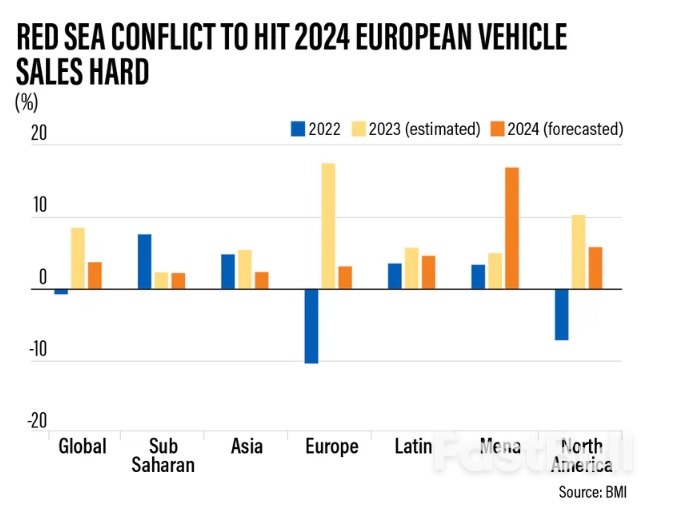
          Other industries are also being affected. Europe's car industry, for instance, could experience "far-reaching" implications if the disruptions are sustained, Fitch analysts said.
          Total vehicle sales in the continent are expected to cool down in 2024, with a projected 3.5 per cent growth this year compared to 2023's estimated 17.6 per cent, as manufacturers grapple with delays in new car deliveries, which have been building up since 2020.
          "We expect the shipping disruptions around the Red Sea to add to the headwinds facing vehicle sales in the Europe region over 2024, especially dragging on the supply of more affordable electric vehicles from Mainland China and vehicles from the Asia region overall," Fitch analysts said.
          Shipping Costs Rise by Up to 250% Due to Red Sea Attacks_4The cost of shipping will surge if the situation is not contained and the consequences of the closure of the key shipping route "will have a great impact on the global economy which will be very difficult to handle", Mr Abouda said.
          Overall, this could escalate into a global inflation concern, said Scott Livermore, chief economist at Oxford Economics.
          “If the Red Sea were to remain closed to shipping for several months and shipping freight costs stayed around twice the level of mid-December, this could add 0.7 percentage points to global CPI [consumer price index] inflation by the end of 2024," he told The National.
          Mr Livermore, however, expects the current crisis to be “short-lived" and says "the recent spike in sea freight prices will reverse".
          Inflation has been falling in the last few months on easing supply bottlenecks and as the impact of tightening monetary policy by central banks takes effect.
          However, protracted disruption to Red Sea trade routes and broader losses would mean "supply delays and higher costs at a time when inflation has already spent nearly three years above central bank targets", said Simon Williams, HSBC's chief economist for Central and Eastern Europe, the Middle East and Africa.

          Source: The National News

          To stay updated on all economic events of today, please check out our Economic calendar
          Risk Warnings and Disclaimers
          You understand and acknowledge that there is a high degree of risk involved in trading. Following any strategies or investment methods may lead to potential losses. The content on the site is provided by our contributors and analysts for information purposes only. You are solely responsible for determining whether any trading assets, securities, strategy, or any other product is suitable for investing based on your own investment objectives and financial situation.
          Comments
          Add to Favorites
          Share

          Crude Oil Price Could Drop Unless It Clears This Hurdle

          Titan FX

          Energy

          Crude Oil Price Technical Analysis

          In the past few days, Crude oil prices saw a few swing moves below the $75.00 resistance zone. The price declined below the $74.00 and $73.00 support levels.
          Crude Oil Price Could Drop Unless It Clears This Hurdle_1Looking at the 4-hour chart of XTI/USD, the price settled below the $73.20 zone, the 200 simple moving average (green, 4-hour), and the 100 simple moving average (red, 4-hour).
          However, the bulls were active near the $70.00 zone. The recent low was formed near $70.07 before the price started a fresh increase. There was a move above the $71.50 resistance. On the upside, the price is facing hurdles near the $73.00 level.
          There is also a major bearish trend line forming with resistance near $73.10 on the same chart. The next major resistance is near the $74.00 zone, above which the price may perhaps accelerate higher. In the stated case, it could even visit the $76.50 resistance.
          Immediate support is near the $70.50 level. The next support is at $70.00, below which there is a risk of a sharp decline. In the stated case, the price could dive toward the $68.00 support. Any more losses might call for a test of the $66.20 support zone.
          Looking at gold prices, the bears seem to be active and they might continue to protect the $2,050 resistance zone.

          Economic Releases to Watch Today

          US Wholesale Inventories for Nov 2023 – Forecast -0.2%, versus -0.2% previous.
          Risk Warnings and Disclaimers
          You understand and acknowledge that there is a high degree of risk involved in trading. Following any strategies or investment methods may lead to potential losses. The content on the site is provided by our contributors and analysts for information purposes only. You are solely responsible for determining whether any trading assets, securities, strategy, or any other product is suitable for investing based on your own investment objectives and financial situation.
          Comments
          Add to Favorites
          Share

          January 10th Financial News 

          FastBull Featured

          Daily News

          [Quick Facts]
          1. EIA raised its forecast for global crude oil demand growth in 2024.
          2. The World Bank lowered its forecast for global GDP growth to 2.4% in 2024.
          3. The Bitcoin market shockingly happened to a mix-up.
          4. Australian inflation is slowing down, and the possibility of holding unchanged in February is strengthened.
          [News Details]
          EIA raised its forecast for global crude oil demand growth in 2024
          On Tuesday local time, the EIA released a short-term energy outlook report, raising its forecast for global crude oil demand growth in 2024 by 50,000 b/d to 1.39 million b/d, compared with the previous forecast of 1.34 million b/d. At the same time, global oil demand is expected to exceed supply by 120,000 b/d in 2024 as the OPEC+ production cuts tighten the market. Russia's crude oil production fell by 9.57 million b/d in December, which is the biggest since the cuts began, the data showed.
          The EIA said in its monthly market forecast that this modest supply gap could push Brent crude futures prices up from $78 per barrel last month to $85 per barrel in March.
          The World Bank lowered its forecast for global GDP growth to 2.4% in 2024
          According to the World Bank's latest Global Economic Prospects report, the global economy is on track for a “soft landing” in 2024. The report shows that global economic growth will slow for the third consecutive year, but will avoid falling into a recession. Growth in 2024 is expected to slow to 2.4% from last year's estimated 2.6%. Growth is expected to pick up to 2.7% by 2025.
          The forecast for an economic slowdown in 2024 is related to the effects of high-interest rates caused by weak global trade and actions by central banks to reduce inflation. The World Bank notes that many countries, including the Fed, are expected to cut interest rates this year. However, the World Bank also noted that the half decade set to be the worst in 30 years with downside risks to global economic growth, including the recent escalation of the conflict in the Middle East, the possibility of a spike in commodity prices pushing up inflation, financial stress that could result from high debt and high borrowing costs, trade fragmentation, climate-related disasters, and lower-than-expected growth in large Asian countries.
          The Bitcoin market shockingly happened to a mix-up
          The U.S. Securities and Exchange Commission (SEC) tweeted on social platform X that the SEC approved the listing of the Bitcoin ETF. Gary Gensler, the SEC Chairman, then said that the account had been hacked and that the Bitcoin ETF had not been approved on Tuesday. This caused Bitcoin to fluctuate sharply by more than $3,000, and more than $40 million of cryptocurrency funds on the network were liquidated within an hour.
          Australian inflation is slowing down, and the possibility of holding unchanged in February is strengthened
          The Australian Bureau of Statistics reported on Wednesday that the consumer price indicator rose 4.3% YoY in November, below expectations of 4.4%. Excluding volatility items, the YoY increase was 4.8%, down from 5.1% in October. The Reserve Bank of Australia (RBA) unexpectedly raised interest rates in November last year, raising the key interest rate to a 12-year high of 4.35%, aiming to bring inflation back into the 2-3% target range. The bank then held its ground in December, and money market bets now suggest that the next move is to cut rates rather than raise them. The RBA is likely to await the release of Q4 data later this month, including broader price data, to inform its policy decision on 5-6 February.
          [Focus of the Day]
          UTC+8 08:30 Australia CPI YoY (Not SA) (Nov)
          UTC+8 15:45 France Industrial Output MoM (SA) (Nov)
          UTC+8 23:00 U.S. Wholesale Sales MoM (SA) (Nov)
          UTC+8 23:30 U.S. EIA Weekly Crude Stocks
          UTC+8 02:00 U.S. 10-Year Note Auction Yield
          UTC+8 04:15 FOMC Member Williams Speaks on the Economic Outlook
          Risk Warnings and Disclaimers
          You understand and acknowledge that there is a high degree of risk involved in trading. Following any strategies or investment methods may lead to potential losses. The content on the site is provided by our contributors and analysts for information purposes only. You are solely responsible for determining whether any trading assets, securities, strategy, or any other product is suitable for investing based on your own investment objectives and financial situation.
          Comments
          Add to Favorites
          Share

          Nikkei Rides High While Traders Wait on US Inflation

          Thomas

          Economic

          Stocks

          Japanese stocks hit a near 34-year high on Wednesday while other Asian equities meandered close to one-month lows and bond markets traded cautiously ahead of U.S. inflation data due this week.
          Japan's Nikkei - which had its best year for a decade in 2023 - climbed 1 per cent in early trade to break above 34,000 for the first time since 1990.
          Exporters led the charge, helped by a softening yen. The broader Topix also hit its highest since 1990.
          MSCI's broadest index of Asia-Pacific shares outside Japan fell 0.5 per cent to its lowest since mid-December.
          Overnight, U.S. stocks slipped modestly, as had Treasury prices, while the dollar nudged higher. Bitcoin spiked after an unauthorised post from the U.S. Securities and Exchange Commission's X account said it had approved bitcoin exchange-traded funds.
          U.S. equity futures were steady in the Asian morning and, after Australian inflation came slightly cooler than expected, focus was on U.S. consumer price data due on Thursday.
          Interest rate futures are pricing around 140 basis points of U.S. rate cuts this year, compared to the Federal Reserve's dot plot of 75 bps. The probability of a move as early as March has been pared somewhat to a still-high 64 per cent, and will likely shift again depending on Thursday's report.
          "Markets are starting to come to the expectation that rate cuts in the U.S. may be some way off. Guidance from members of the Federal Reserve Monetary Committee tend to favour cuts in the second half of the year," ANZ analysts said in a note.
          Forecasts are for core CPI to rise 0.3 per cent in December, pulling annual inflation down to 3.8 per cent and its lowest since mid-2021.
          Geopolitical tensions were also on the radar as disruptions in the Red Sea and a production outage in Libya raised oil prices, and an election looms in Taiwan.
          U.S. and UK forces shot down 21 drones and missiles fired by Yemen-based Houthis on Tuesday into the Southern Red Sea towards international shipping lanes, the U.S. military's Central Command said.
          Brent crude futures rose 1.9 per cent on Tuesday and were up 0.1 per cent to $77.68 a barrel early on Wednesday.
          Bitcoin was last down 1 per cent at $45,683 after spiking as high as $47,897 on the false reports of ETF approvals.
          Data Dependent
          Trade in foreign exchange and fixed income markets was tentative ahead of the U.S. inflation report.
          Benchmark 10-year Treasury yields rose 1.5 bps overnight and were steady at 4.01 per cent in Tokyo on Wednesday. The U.S. dollar held small gains, buying 144.72 yen and trading at $1.0927 per euro.
          The Aussie dollar was little moved at $0.6687 after data showing Australian inflation slowed to a near two-year low, since it reinforced market expectations interest rates would not need to rise any further.
          "It's now time for cuts, but global growth expectations don't point to a global recession," said analysts at TD Securities in a note to clients.
          "Our global growth indicators have improved, suggesting further USD downside through H1. However, it won't be a straight line, especially as geopolitics will feature heavily on the market calendar this year and markets remain data dependent."
          Chinese lending figures are also due this week, with 2023 lending expected to have hit a record high as China keeps policy accommodative, though there is little sign of a shift in investors dour sentiment.
          China's blue-chip CSI300 index was flirting with a five-year low on Tuesday, while the Hang Seng dropped 0.7 per cent to a one-month low and the yuan hit its weakest since Dec. 13.
          "Despite cries that Chinese/HK equity is cheap, we see no signs that international managers are prepared to step in and buy these markets with any conviction," said Chris Weston, head of research at brokerage Pepperstone.
          "It seems the drip-fed approach to policy easing and support just isn't cutting it and the market wants a shock-and-awe approach."

          Source: Reuters

          To stay updated on all economic events of today, please check out our Economic calendar
          Risk Warnings and Disclaimers
          You understand and acknowledge that there is a high degree of risk involved in trading. Following any strategies or investment methods may lead to potential losses. The content on the site is provided by our contributors and analysts for information purposes only. You are solely responsible for determining whether any trading assets, securities, strategy, or any other product is suitable for investing based on your own investment objectives and financial situation.
          Comments
          Add to Favorites
          Share

          Aussie, Chinese Data Eyed as Investors Seek Tech Tonic

          Damon

          Economic

          Australian inflation tops the Asian-Pacific economic calendar on Wednesday with the latest Chinese lending figures potentially due for release too, as investors also grapple with mixed news from the Asian tech sector.
          Wall Street's lackluster performance on Tuesday is unlikely to provide much impetus - the Nasdaq closed flat while the Dow and S&P 500 slipped into the red - so perhaps the key regional indicators will give markets some early direction.
          Australia's weighted annual consumer price inflation rate is expected to have fallen sharply in November to 4.4% from 4.9%. This would be the lowest in almost two years, and would follow an even steeper fall the month before to 4.9% from 5.6%.
          Aussie swaps markets are indicating around 50 basis points of rate cuts from the central bank this year, with the first quarter-point cut coming by August. A weaker-than-expected CPI report could well increase these policy easing expectations.
          Aussie, Chinese Data Eyed as Investors Seek Tech Tonic_1New bank loans in China, meanwhile, likely rose in December, bringing 2023 lending to a new record high as the central bank keeps policy accommodative to support a shaky economic recovery.
          Figures this week are expected to show that Chinese banks issued 1.40 trillion yuan in net new yuan loans last month, up from 1.09 trillion yuan in November. If these numbers are borne out, total new lending in 2023 would hit 22.98 trillion yuan, beating the previous record of 21.31 trillion yuan in 2022.
          But China's economy and markets are still underperforming and struggling to convince foreign investors that 2024 will witness a meaningful recovery. Rising tensions with Taiwan, which goes to the polls on Saturday, won't help either.
          Taiwan on Tuesday reported a stronger-than-expected rise in exports in December thanks to a near 50% surge in sales to the United States. But China remained a weak spot - Taiwan's exports to China fell 6.4%.
          Later on Wednesday Taiwan's TSMC, the world's largest chipmaker, unveils its latest monthly sales figures.
          Asian tech has got off to a particularly rocky start this year, with the MSCI Asia IT index down 4.5% since the turn of the year and the Asia ex-Japan equivalent down 5%. That compares to the Nasdaq's 1% year-to-date slip.
          Sentiment will have been dented further by Samsung, which reported a likely 35% drop in fourth-quarter operating profit on Tuesday, much worse than analysts expected.
          If there has been little New Year cheer across major U.S. and global stock markets, it has been in even shorter supply in Asia. The MSCI Asia & Pacific ex-Japan share is down 3.5% so far this year, compared with a decline of around 1% for the MSCI World index and S&P 500.
          Aussie, Chinese Data Eyed as Investors Seek Tech Tonic_2Here are key developments that could provide more direction to markets on Wednesday:
          - South Korea unemployment (December)
          - Australia CPI inflation (November)
          - China lending (December)

          Source: Reuters

          To stay updated on all economic events of today, please check out our Economic calendar
          Risk Warnings and Disclaimers
          You understand and acknowledge that there is a high degree of risk involved in trading. Following any strategies or investment methods may lead to potential losses. The content on the site is provided by our contributors and analysts for information purposes only. You are solely responsible for determining whether any trading assets, securities, strategy, or any other product is suitable for investing based on your own investment objectives and financial situation.
          Comments
          Add to Favorites
          Share

          US Oil Output Forecasts Edge Higher

          ING

          Economic

          Energy- Stronger US oil supply growth
          The oil market managed to move higher yesterday following the aggressive sell-off on Monday. ICE Brent rallied by a little more than 1.9%, while the prompt Brent timespread also managed to see its backwardation widen. However, for now the flat price remains firmly below US$80/bbl and with the balance expected to be fairly comfortable over the 1H24, significant upside is likely limited.
          The API reported overnight that US crude oil inventories fell by 5.2m barrels, which is larger than the market was expecting. However, large builds were once again seen on the products side, with gasoline and distillate stocks increasing by 4.9m barrels and 6.9m barrels respectively. If the EIA’s weekly report confirms a build in distillates, it will be the seventh consecutive week of stocks increasing, which will further help ease tightness concerns in the middle distillate market.
          The EIA yesterday released its Short Term Energy Outlook, in which includes its latest US crude oil production forecasts. The EIA revised higher its US output growth for 2024 from 190k b/d last month to 290k b/d. This would see US crude oil output averaging 13.21m b/d this year. Meanwhile, in its first forecasts for 2025, the EIA expects us production to grow by around 230k b/d to 13.44m b/d.
          While European natural gas continues to come under pressure amid comfortable storage, US natural gas prices rallied significantly yesterday with the front-month Henry Hub contract rallying by more than 7% on the day to settle back above US$3/MMBtu. Since the start of the year, Henry Hub has rallied by almost 27%. The more recent rally has been on the back of forecasts for cold weather through until the end of January. For now though, storage in the US is comfortable with it 13% above the 5-year average at the end of December.
          There is little on the energy calendar today with just the usual weekly US inventory report from the EIA, which is expected to show a similar trend to the API numbers- a draw in crude inventories and builds in refined products.
          To stay updated on all economic events of today, please check out our Economic calendar
          Risk Warnings and Disclaimers
          You understand and acknowledge that there is a high degree of risk involved in trading. Following any strategies or investment methods may lead to potential losses. The content on the site is provided by our contributors and analysts for information purposes only. You are solely responsible for determining whether any trading assets, securities, strategy, or any other product is suitable for investing based on your own investment objectives and financial situation.
          Comments
          Add to Favorites
          Share

          Gas Market Grapples with Slight Pull as Forecasts Take Shape

          Chandan Gupta

          Commodity

          Traders' Opinions

          The natural gas market has been quite the rollercoaster, especially as it sang with the 200-day Exponential Moving Average (EMA) recently. Now, this EMA is a bit of a celebrity in the trading world, known for stirring up some market commotion.
          Hitting just under the pivotal $3 mark in terms of pricing also played a significant role in steering the market's direction. That price tag holds some serious weight in shaping how things unfold in the natural gas arena.
          But here's the thing, natural gas is a bit of a weather chameleon. It's super sensitive to weather patterns, and this upcoming winter storm gearing up to hit the United States? It's got the gas market on its toes. Even the slightest change in weather predictions can send ripples through this market, which, let's be real, makes it a bit of a wild card.
          Now, for the traders out there trying to navigate this maze of market forces, they're not just dealing with stock trends; they've got to factor in the weather too! Talk about juggling multiple balls at once.
          One major player in this game is the sheer volume of natural gas reserves kicking around in the United States. It's like having a pantry stocked to the brim—you run the risk of too much of a good thing. Last year's price surge lured in tons of drillers, resulting in an overflow of gas flooding the market. So, guess what? We're currently swimming in a sea of gas surplus. Not the easiest situation to handle, right?
          Unless we get hit with an unexpectedly long cold snap or some other unexpected twist, keeping those price gains steady is proving to be a tough nut to crack. The futures markets are already giving us a hint—they've got their sights set on February, signaling that this current upswing might just be one of the last hurrahs of the year.
          Now, brace yourselves for this reality check, while there might be another price surge on the horizon, it's not looking like it'll stick around for long. That pesky oversupply of natural gas is acting like a weight, making it tough to keep prices marching upwards. The market's wrestling match with higher price levels is pretty evident, and even with all the geopolitical jostling like the Nordstream II situation and transportation hiccups in West Africa, the winter's been surprisingly mild.
          As long as the weather keeps playing nice, the natural gas market is going to keep facing an uphill battle. Truth be told, it might be a bit late in the season to expect a massive shake-up in how things are playing out.
          So, natural gas took a bit of a nosedive when it bumped into that 200-day EMA and nearly hit that $3 mark. Traders, take heed—keep your eyes peeled for any changes in the weather because that's the secret sauce influencing natural gas prices. The surplus of natural gas in the US and this rather mild winter have been throwing a spanner in the works, making it tough to keep those prices climbing. Sure, short-term opportunities might pop up down the road, but the bigger picture? It's all about that abundance of gas and the weather's mood swings.Gas Market Grapples with Slight Pull as Forecasts Take Shape_1
          Risk Warnings and Disclaimers
          You understand and acknowledge that there is a high degree of risk involved in trading. Following any strategies or investment methods may lead to potential losses. The content on the site is provided by our contributors and analysts for information purposes only. You are solely responsible for determining whether any trading assets, securities, strategy, or any other product is suitable for investing based on your own investment objectives and financial situation.
          Comments
          Add to Favorites
          Share
          FastBull
          Copyright © 2025 FastBull Ltd

          728 RM B 7/F GEE LOK IND BLDG NO 34 HUNG TO RD KWUN TONG KLN HONG KONG

          TelegramInstagramTwitterfacebooklinkedin
          App Store Google Play Google Play
          Products
          Charts

          Chats

          Q&A with Experts
          Screeners
          Economic Calendar
          Data
          Tools
          Membership
          Features
          Function
          Markets
          Copy Trading
          Latest Signals
          Contests
          News
          Analysis
          24/7
          Columns
          Education
          Company
          Careers
          About Us
          Contact Us
          Advertising
          Help Center
          Feedback
          User Agreement
          Privacy Policy
          Business

          White Label

          Data API

          Web Plug-ins

          Poster Maker

          Affiliate Program

          Risk Disclosure

          The risk of loss in trading financial instruments such as stocks, FX, commodities, futures, bonds, ETFs and crypto can be substantial. You may sustain a total loss of the funds that you deposit with your broker. Therefore, you should carefully consider whether such trading is suitable for you in light of your circumstances and financial resources.

          No decision to invest should be made without thoroughly conducting due diligence by yourself or consulting with your financial advisors. Our web content might not suit you since we don't know your financial conditions and investment needs. Our financial information might have latency or contain inaccuracy, so you should be fully responsible for any of your trading and investment decisions. The company will not be responsible for your capital loss.

          Without getting permission from the website, you are not allowed to copy the website's graphics, texts, or trademarks. Intellectual property rights in the content or data incorporated into this website belong to its providers and exchange merchants.

          Not Logged In

          Log in to access more features

          FastBull Membership

          Not yet

          Purchase

          Become a signal provider
          Help Center
          Customer Service
          Dark Mode
          Price Up/Down Colors

          Log In

          Sign Up

          Position
          Layout
          Fullscreen
          Default to Chart
          The chart page opens by default when you visit fastbull.com