• Trade
  • Markets
  • Copy
  • Contests
  • News
  • 24/7
  • Calendar
  • Q&A
  • Chats
Trending
Screeners
SYMBOL
LAST
BID
ASK
HIGH
LOW
NET CHG.
%CHG.
SPREAD
SPX
S&P 500 Index
6827.42
6827.42
6827.42
6899.86
6801.80
-73.58
-1.07%
--
DJI
Dow Jones Industrial Average
48458.04
48458.04
48458.04
48886.86
48334.10
-245.98
-0.51%
--
IXIC
NASDAQ Composite Index
23195.16
23195.16
23195.16
23554.89
23094.51
-398.69
-1.69%
--
USDX
US Dollar Index
97.950
98.030
97.950
98.500
97.950
-0.370
-0.38%
--
EURUSD
Euro / US Dollar
1.17394
1.17409
1.17394
1.17496
1.17192
+0.00011
+ 0.01%
--
GBPUSD
Pound Sterling / US Dollar
1.33707
1.33732
1.33707
1.33997
1.33419
-0.00148
-0.11%
--
XAUUSD
Gold / US Dollar
4299.39
4299.39
4299.39
4353.41
4257.10
+20.10
+ 0.47%
--
WTI
Light Sweet Crude Oil
57.233
57.485
57.233
58.011
56.969
-0.408
-0.71%
--

Community Accounts

Signal Accounts
--
Profit Accounts
--
Loss Accounts
--
View More

Become a signal provider

Sell trading signals to earn additional income

View More

Guide to Copy Trading

Get started with ease and confidence

View More

Signal Accounts for Members

All Signal Accounts

Best Return
  • Best Return
  • Best P/L
  • Best MDD
Past 1W
  • Past 1W
  • Past 1M
  • Past 1Y

All Contests

  • All
  • Trump Updates
  • Recommend
  • Stocks
  • Cryptocurrencies
  • Central Banks
  • Featured News
Top News Only
Share

China's Central Financial And Economic Affairs Commission Deputy Director: Will Expand Export And Increase Import In 2026

Share

Thai Leader Anutin: Landmine Blast That Killed Thai Soldiers 'Not A Roadside Accident'

Share

Thai Leader Anutin: Thailand To Continue Military Action Until 'We Feel No More Harm'

Share

Cambodian Prime Minister Hun Manet Says He Had Phone Calls With Trump And Malaysian Leader Anwar About Ceasefire

Share

Cambodia's Hun Manet Says USA, Malaysia Should Verify 'Which Side Fired First' In Latest Conflict

Share

Cambodia's Hun Manet: Cambodia Maintains Its Stance In Seeking Peaceful Resolution Of Disputes

Share

Nasdaq Companies: Allergan, Ferrovia, Insmed, Monolithic Power Systems, Seagate Technology, And Western Digital Will Be Added To The NASDAQ 100 Index. Biogen, CdW, GlobalFoundries, Lululemon, ON Semiconductor, And Tradedesk Will Be Removed From The NASDAQ 100 Index

Share

Witkoff Headed To Berlin This Weekend To Meet With Zelenskiy, European Leaders -Wsj Reporter On X

Share

Russia Attacks Two Ukrainian Ports, Damaging Three Turkish-Owned Vessels

Share

[Historic Flooding Occurs In At Least Four Rivers In Washington State Due To Days Of Torrential Rains] Multiple Areas In Washington State Have Been Hit By Severe Flooding Due To Days Of Torrential Rains, With At Least Four Rivers Experiencing Historic Flooding. Reporters Learned On The 12th That The Floods Caused By The Torrential Rains In Washington State Have Destroyed Homes And Closed Several Highways. Experts Warn That Even More Severe Flooding May Occur In The Future. A State Of Emergency Has Been Declared In Washington State

Share

Trump Says Proposed Free Economic Zone In Donbas Would Work

Share

Trump: I Think My Voice Should Be Heard

Share

Trump Says Will Be Choosing New Fed Chair In Near Future

Share

Trump Says Proposed Free Economic Zone In Donbas Complex But Would Work

Share

Trump Says Land Strikes In Venezuela Will Start Happening

Share

US President Trump: Thailand And Cambodia Are In A Good Situation

Share

State Media: North Korean Leader Kim Hails Troops Returning From Russia Mission

Share

The 10-year Treasury Yield Rose About 5 Basis Points During The "Fed Rate Cut Week," And The 2/10-year Yield Spread Widened By About 9 Basis Points. On Friday (December 12), In Late New York Trading, The Yield On The Benchmark 10-year US Treasury Note Rose 2.75 Basis Points To 4.1841%, A Cumulative Increase Of 4.90 Basis Points For The Week, Trading Within A Range Of 4.1002%-4.2074%. It Rose Steadily From Monday To Wednesday (before The Fed Announced Its Rate Cut And Treasury Bill Purchase Program), Subsequently Exhibiting A V-shaped Recovery. The 2-year Treasury Yield Fell 1.82 Basis Points To 3.5222%, A Cumulative Decrease Of 3.81 Basis Points For The Week, Trading Within A Range Of 3.6253%-3.4989%

Share

Trump: Lots Of Progress Being Made On Russia-Ukraine

Share

NOPA November US Soybean Crush Estimated At 220.285 Million Bushels

TIME
ACT
FCST
PREV
U.K. Trade Balance Non-EU (SA) (Oct)

A:--

F: --

P: --

U.K. Trade Balance (Oct)

A:--

F: --

P: --

U.K. Services Index MoM

A:--

F: --

P: --

U.K. Construction Output MoM (SA) (Oct)

A:--

F: --

P: --

U.K. Industrial Output YoY (Oct)

A:--

F: --

P: --

U.K. Trade Balance (SA) (Oct)

A:--

F: --

P: --

U.K. Trade Balance EU (SA) (Oct)

A:--

F: --

P: --

U.K. Manufacturing Output YoY (Oct)

A:--

F: --

P: --

U.K. GDP MoM (Oct)

A:--

F: --

P: --

U.K. GDP YoY (SA) (Oct)

A:--

F: --

P: --

U.K. Industrial Output MoM (Oct)

A:--

F: --

P: --

U.K. Construction Output YoY (Oct)

A:--

F: --

P: --

France HICP Final MoM (Nov)

A:--

F: --

P: --

China, Mainland Outstanding Loans Growth YoY (Nov)

A:--

F: --

P: --

China, Mainland M2 Money Supply YoY (Nov)

A:--

F: --

P: --

China, Mainland M0 Money Supply YoY (Nov)

A:--

F: --

P: --

China, Mainland M1 Money Supply YoY (Nov)

A:--

F: --

P: --

India CPI YoY (Nov)

A:--

F: --

P: --

India Deposit Gowth YoY

A:--

F: --

P: --

Brazil Services Growth YoY (Oct)

A:--

F: --

P: --

Mexico Industrial Output YoY (Oct)

A:--

F: --

P: --

Russia Trade Balance (Oct)

A:--

F: --

P: --

Philadelphia Fed President Henry Paulson delivers a speech
Canada Building Permits MoM (SA) (Oct)

A:--

F: --

P: --

Canada Wholesale Sales YoY (Oct)

A:--

F: --

P: --

Canada Wholesale Inventory MoM (Oct)

A:--

F: --

P: --

Canada Wholesale Inventory YoY (Oct)

A:--

F: --

P: --

Canada Wholesale Sales MoM (SA) (Oct)

A:--

F: --

P: --

Germany Current Account (Not SA) (Oct)

A:--

F: --

P: --

U.S. Weekly Total Rig Count

A:--

F: --

P: --

U.S. Weekly Total Oil Rig Count

A:--

F: --

P: --

Japan Tankan Large Non-Manufacturing Diffusion Index (Q4)

--

F: --

P: --

Japan Tankan Small Manufacturing Outlook Index (Q4)

--

F: --

P: --

Japan Tankan Large Non-Manufacturing Outlook Index (Q4)

--

F: --

P: --

Japan Tankan Large Manufacturing Outlook Index (Q4)

--

F: --

P: --

Japan Tankan Small Manufacturing Diffusion Index (Q4)

--

F: --

P: --

Japan Tankan Large Manufacturing Diffusion Index (Q4)

--

F: --

P: --

Japan Tankan Large-Enterprise Capital Expenditure YoY (Q4)

--

F: --

P: --

U.K. Rightmove House Price Index YoY (Dec)

--

F: --

P: --

China, Mainland Industrial Output YoY (YTD) (Nov)

--

F: --

P: --

China, Mainland Urban Area Unemployment Rate (Nov)

--

F: --

P: --

Saudi Arabia CPI YoY (Nov)

--

F: --

P: --

Euro Zone Industrial Output YoY (Oct)

--

F: --

P: --

Euro Zone Industrial Output MoM (Oct)

--

F: --

P: --

Canada Existing Home Sales MoM (Nov)

--

F: --

P: --

Euro Zone Total Reserve Assets (Nov)

--

F: --

P: --

U.K. Inflation Rate Expectations

--

F: --

P: --

Canada National Economic Confidence Index

--

F: --

P: --

Canada New Housing Starts (Nov)

--

F: --

P: --

U.S. NY Fed Manufacturing Employment Index (Dec)

--

F: --

P: --

U.S. NY Fed Manufacturing Index (Dec)

--

F: --

P: --

Canada Core CPI YoY (Nov)

--

F: --

P: --

Canada Manufacturing Unfilled Orders MoM (Oct)

--

F: --

P: --

Canada Manufacturing New Orders MoM (Oct)

--

F: --

P: --

Canada Core CPI MoM (Nov)

--

F: --

P: --

Canada Manufacturing Inventory MoM (Oct)

--

F: --

P: --

Canada CPI YoY (Nov)

--

F: --

P: --

Canada CPI MoM (Nov)

--

F: --

P: --

Canada CPI YoY (SA) (Nov)

--

F: --

P: --

Canada Core CPI MoM (SA) (Nov)

--

F: --

P: --

Q&A with Experts
    • All
    • Chatrooms
    • Groups
    • Friends
    Connecting
    .
    .
    .
    Type here...
    Add Symbol or Code

      No matching data

      All
      Trump Updates
      Recommend
      Stocks
      Cryptocurrencies
      Central Banks
      Featured News
      • All
      • Russia-Ukraine Conflict
      • Middle East Flashpoint
      • All
      • Russia-Ukraine Conflict
      • Middle East Flashpoint
      Search
      Products

      Charts Free Forever

      Chats Q&A with Experts
      Screeners Economic Calendar Data Tools
      Membership Features
      Data Warehouse Market Trends Institutional Data Policy Rates Macro

      Market Trends

      Market Sentiment Order Book Forex Correlations

      Top Indicators

      Charts Free Forever
      Markets

      News

      News Analysis 24/7 Columns Education
      From Institutions From Analysts
      Topics Columnists

      Latest Views

      Latest Views

      Trending Topics

      Top Columnists

      Latest Update

      Signals

      Copy Rankings Latest Signals Become a signal provider AI Rating
      Contests
      Brokers

      Overview Brokers Assessment Rankings Regulators News Claims
      Broker listing Forex Brokers Comparison Tool Live Spread Comparison Scam
      Q&A Complaint Scam Alert Videos Tips to Detect Scam
      More

      Business
      Events
      Careers About Us Advertising Help Center

      White Label

      Data API

      Web Plug-ins

      Affiliate Program

      Awards Institution Evaluation IB Seminar Salon Event Exhibition
      Vietnam Thailand Singapore Dubai
      Fans Party Investment Sharing Session
      FastBull Summit BrokersView Expo
      Recent Searches
        Top Searches
          Markets
          News
          Analysis
          User
          24/7
          Economic Calendar
          Education
          Data
          • Names
          • Latest
          • Prev

          View All

          No data

          Scan to Download

          Faster Charts, Chat Faster!

          Download App
          English
          • English
          • Español
          • العربية
          • Bahasa Indonesia
          • Bahasa Melayu
          • Tiếng Việt
          • ภาษาไทย
          • Français
          • Italiano
          • Türkçe
          • Русский язык
          • 简中
          • 繁中
          Open Account
          Search
          Products
          Charts Free Forever
          Markets
          News
          Signals

          Copy Rankings Latest Signals Become a signal provider AI Rating
          Contests
          Brokers

          Overview Brokers Assessment Rankings Regulators News Claims
          Broker listing Forex Brokers Comparison Tool Live Spread Comparison Scam
          Q&A Complaint Scam Alert Videos Tips to Detect Scam
          More

          Business
          Events
          Careers About Us Advertising Help Center

          White Label

          Data API

          Web Plug-ins

          Affiliate Program

          Awards Institution Evaluation IB Seminar Salon Event Exhibition
          Vietnam Thailand Singapore Dubai
          Fans Party Investment Sharing Session
          FastBull Summit BrokersView Expo

          Raw Materials Squeeze Jolts Copper Out of Its Torpor

          Owen Li

          Commodity

          Summary:

          The copper market has awoken from its year-long slumber.
          London Metal Exchange (LME) copper surged by 3.1% on Wednesday, breaking out of its long-standing range. The move extended on Thursday morning to an eleven-month high of $8,976.50 per metric ton.
          The trigger for the price break-out is news that China's copper smelters have agreed to curb output in response to a much tighter-than-expected raw materials market.
          Spot treatment charges, which are the fees smelters earn for converting mined concentrates into metal, have collapsed in recent weeks as too many buyers chase too little material.
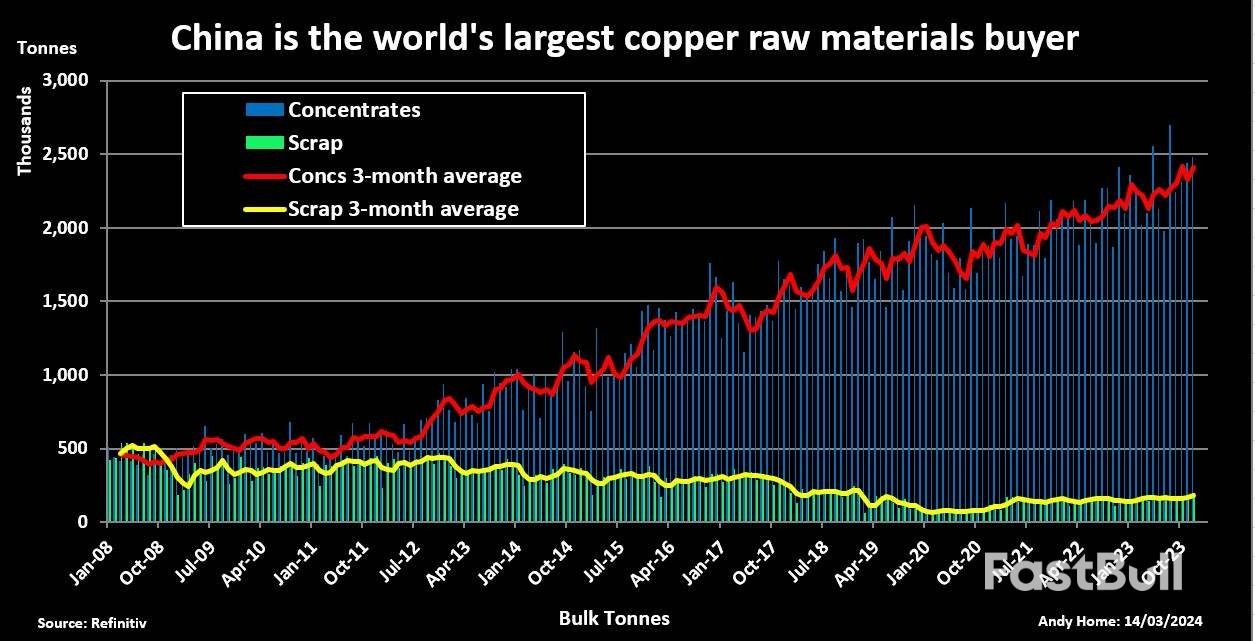
          As the world's largest buyer of concentrates, China is particularly exposed to the resulting squeeze on smelter margins.
          China's collective reaction has turned the market's attention from weak global demand to copper's stressed supply dynamics.
          But to what extent it translates into less refined metal supply remains to be seen.

          Raw Materials Squeeze Jolts Copper Out of Its Torpor_1Concentrates Squeeze

          Smelter treatment charges say a lot about what's happening in the upstream segment of copper's supply chain and right now they're flashing red warning lights.
          Spot charges in China tumbled to $11.20 per ton last week, a near 76% drop in just two months and the lowest level since 2013, according to price reporting agency Fastmarkets.
          The implosion in processing fees speaks to an acute shortfall of concentrates in the spot market.
          The unexpected closure of First Quantum's Cobre Panama mine at the end of last year has blown a 350,000-ton hole in China's copper supply chain.
          Some Chinese producers are insulated by annual supply deals, which were priced at a benchmark treatment charge of $80 per ton for this year's shipments.
          Others, particularly newer operators, are more dependent on spot supply and have evidently been scrambling to buy replacement tonnage, chasing treatment charges down to unprofitable levels.
          In January China's Nonferrous Metals Industry Association (CNIA) advised the country's copper smelters they needed "to bring maintenance ahead of schedule or extend the maintenance time, to cut production and to postpone the commencement of new projects."
          Which is what they agreed to do this week at a well-flagged meeting to discuss the unfolding crisis. The collective commitment to curb output is intended to safeguard the "healthy development of (the) global copper smelting industry", according to state research company Antaike.

          Too Many Smelters

          There are no quotas for production cuts among the 19 Chinese operators at this week's rare meeting. Rather, each producer will make their own assessment of what needs to be done.
          In some cases the action has already likely been taken with maintenance downtime brought forward and unprofitable lines shuttered.
          An average 11.5% of global smelting capacity was off-line in the first two months of this year, according to Earth-i, which uses satellite imagery to monitor plant activity rates. This is up from 8.6% last year and 8.0% in January-February 2022.
          Tellingly, inactive capacity in top producer China averaged 8.3% this year, up from 4.8% last year, a much sharper jump than in the rest of the world.
          Some Chinese producers, it seems, either voluntarily heeded the CNIA's January call for sector restraint or were forced to by market reality.
          Moreover, any promised curbs to output must be seen in the context of China's rapid build-out of copper smelting capacity.
          Treatment charges reflect not just the state of mine supply but also the volume of smelter demand.
          China started up 780,000 tons of annual smelter capacity last year with another net 150,000 tons due this year, according to analysts at Macquarie Bank. ("Commodities Comment," Jan. 16, 2024)
          Macquarie estimates another two million tonnes of new or expanded capacity is also due to ramp up outside of China this year, increasing the pressure on concentrates availability.
          Freeport McMoRan's new Indonesian smelter, for example, will at full capacity soak up 1.7 million tons of concentrates, material that until now has been available for export.
          The dramatic collapse in processing fees is as much a function of this new call on raw materials as it is of mine supply problems.

          Sentiment Shifts

          China's production restraint may slow but is unlikely to reverse the country's recent rapid output growth.
          The country's production of refined copper jumped by an eye-watering 13.5% year-on-year to 12.99 million tons in 2023, according to the National Bureau of Statistics.
          And while analysts have adjusted their market balance estimates to factor in recent mine losses, most still think the refined market will be in supply surplus this year, albeit to a smaller extent than previously thought.
          But market sentiment has palpably shifted.
          The weak state of global manufacturing activity, not least in China, has kept copper locked in a sideways trading range for much of the last year.
          Macro drivers, particularly interest rate expectations, have dominated the choppy price action.
          The concentrates squeeze has refocused attention on copper's micro dynamics of stretched supply and chronic under-investment in new mines.
          Copper's bull narrative has just been reactivated, even if China's collective commitment to curb output may promise more than it delivers.

          Source: Reuters

          Risk Warnings and Disclaimers
          You understand and acknowledge that there is a high degree of risk involved in trading. Following any strategies or investment methods may lead to potential losses. The content on the site is provided by our contributors and analysts for information purposes only. You are solely responsible for determining whether any trading assets, securities, strategy, or any other product is suitable for investing based on your own investment objectives and financial situation.
          Add to Favorites
          Share

          Natural Gas and Oil Forecast: Hawkish Fed May Pressure Prices Amid 4% Gain

          Thomas

          Commodity

          High U.S. inflation data prompts a slight retreat in oil prices, yet a weekly gain over 4% is anticipated. Strengthened dollar and Fed's expected hawkish stance may increase pressure on natural gas and oil prices. Geopolitical tensions and supply disruptions, alongside strong OPEC and IEA demand forecasts, hint at a tight oil market outlook.

          Market Overview

          In the wake of unexpectedly high U.S. inflation data, oil prices experienced a minor retreat from their four-month highs, influenced by profit-taking and a strengthened dollar. Despite this, crude oil, including Brent and WTI contracts, is on track for a weekly gain of over 4%, buoyed by signals of increased U.S. demand and tightening fuel markets.
          The heightened dollar and anticipation of the Federal Reserve’s hawkish stance may pressurize natural gas and oil prices by making them more expensive for holders of other currencies and by affecting investor sentiment regarding energy commodities.
          Additionally, geopolitical tensions and supply disruptions, alongside robust demand forecasts from OPEC and the IEA, suggest a tight supply and strong demand outlook for oil markets, potentially impacting future price trajectories for both natural gas and oil.

          Natural Gas Price Forecast

          Natural Gas and Oil Forecast: Hawkish Fed May Pressure Prices Amid 4% Gain_1
          On March 15, Natural Gas (NG) experienced a modest decline, dropping by 0.44% to close at $1.825. Positioned slightly below its pivot point of $1.84, the commodity faces a potential trend shift. Resistance levels are set at $1.88, $1.93, and $1.99, challenging any attempts at upward movement.
          Conversely, support is found at $1.78, with subsequent levels at $1.73 and $1.68, providing key fallback positions in case of further declines. The 50-day and 200-day Exponential Moving Averages (EMAs) at $1.83 and $1.94, respectively, indicate a mixed outlook.
          The technical stance suggests bearishness below $1.84, with the possibility of shifting to a bullish bias if it surpasses this critical level.

          WTI Oil Price Forecast

          Natural Gas and Oil Forecast: Hawkish Fed May Pressure Prices Amid 4% Gain_2
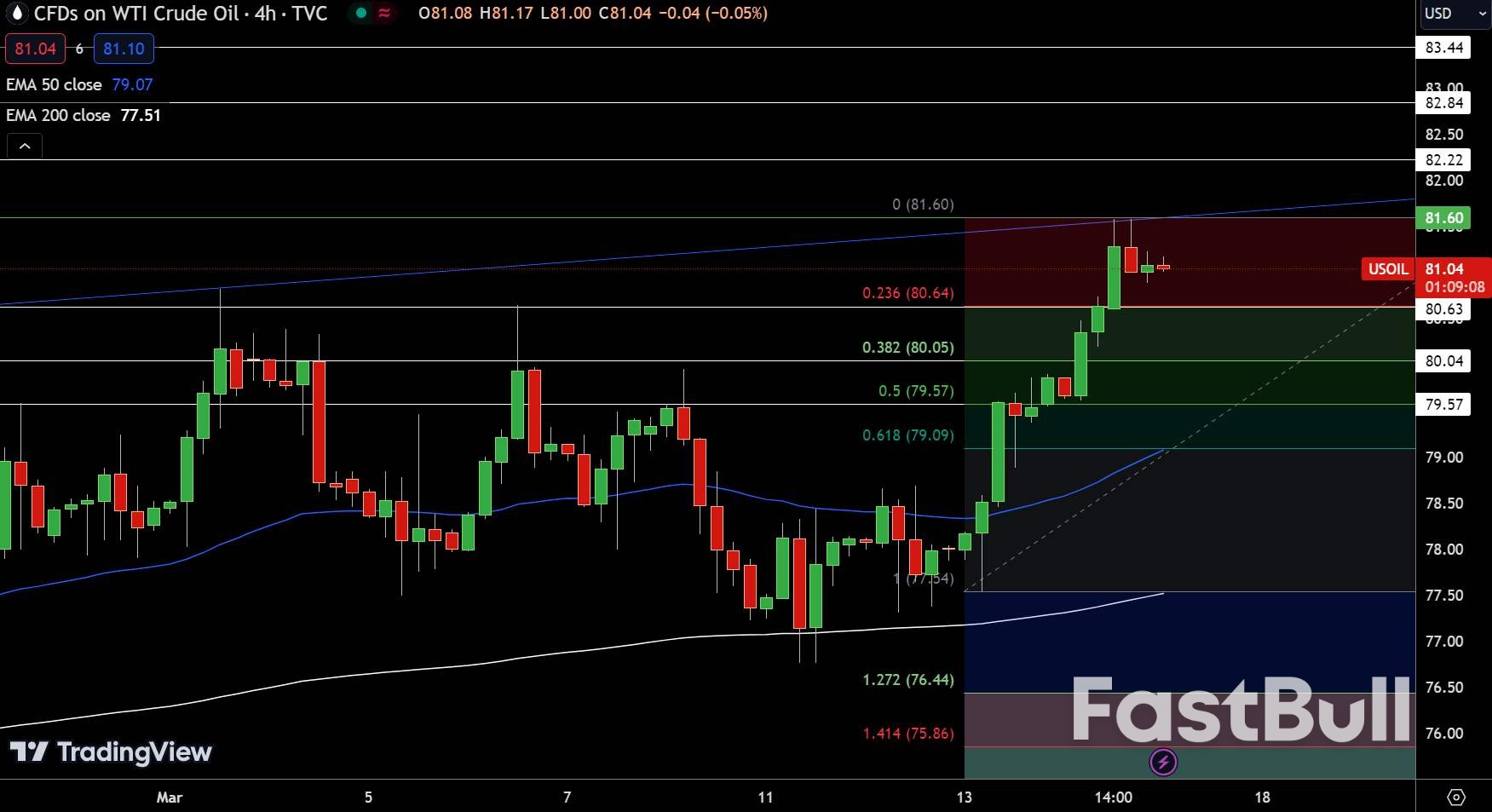
          On March 15, USOIL slightly increased by 0.06%, trading at $81.04. The commodity is currently trading below its pivot point of $81.60, a critical juncture that may determine its short-term direction. Resistance levels are staged at $82.22, $82.84, and $83.44, which could impede upward momentum.
          Conversely, support is established at $80.63, with further safety nets at $80.04 and $79.57, crucial for buffering any declines. The Relative Strength Index (RSI) details are not provided, but the 50-day and 200-day Exponential Moving Averages (EMAs) at $79.07 and $77.51, respectively, suggest underlying support for the price.
          The technical outlook for USOIL is cautiously bearish below the $81.60 pivot, with potential for bullish reversal upon breaching this level.

          Brent Oil Price Forecast

          Natural Gas and Oil Forecast: Hawkish Fed May Pressure Prices Amid 4% Gain_3
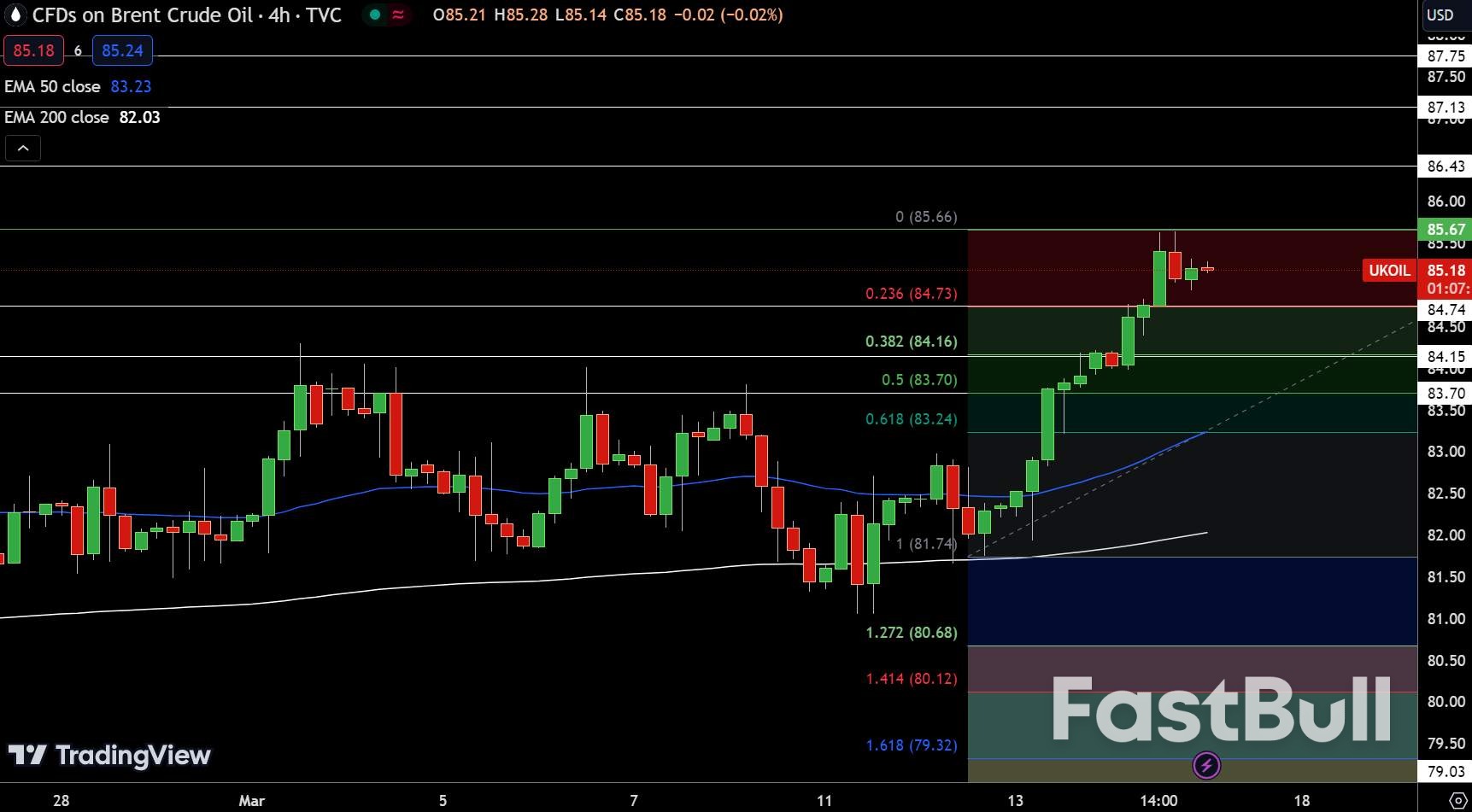
          UKOIL edged up by 0.14%, trading at $85.18. Trading just below its pivot point of $85.67, UKOIL’s next moves could be pivotal. Resistance levels are outlined at $86.43, $87.13, and $87.75, posing potential hurdles for upward momentum.
          Conversely, support is found at $84.74, with further levels at $84.15 and $83.70, providing critical junctures to counteract downward trends. The 50-day and 200-day Exponential Moving Averages (EMAs), at $83.23 and $82.03 respectively, underline a supportive base for the price.
          The current analysis suggests a bearish trend below $85.67, with opportunities for a bullish shift upon surpassing this marker.

          Source: FX Empire

          Risk Warnings and Disclaimers
          You understand and acknowledge that there is a high degree of risk involved in trading. Following any strategies or investment methods may lead to potential losses. The content on the site is provided by our contributors and analysts for information purposes only. You are solely responsible for determining whether any trading assets, securities, strategy, or any other product is suitable for investing based on your own investment objectives and financial situation.
          Add to Favorites
          Share

          Central Bank Galore with BOJ, Fed, BOE, SNB and RBA on Tap: The Week Ahead

          FOREX.com

          Central Bank

          Economic

          Forex

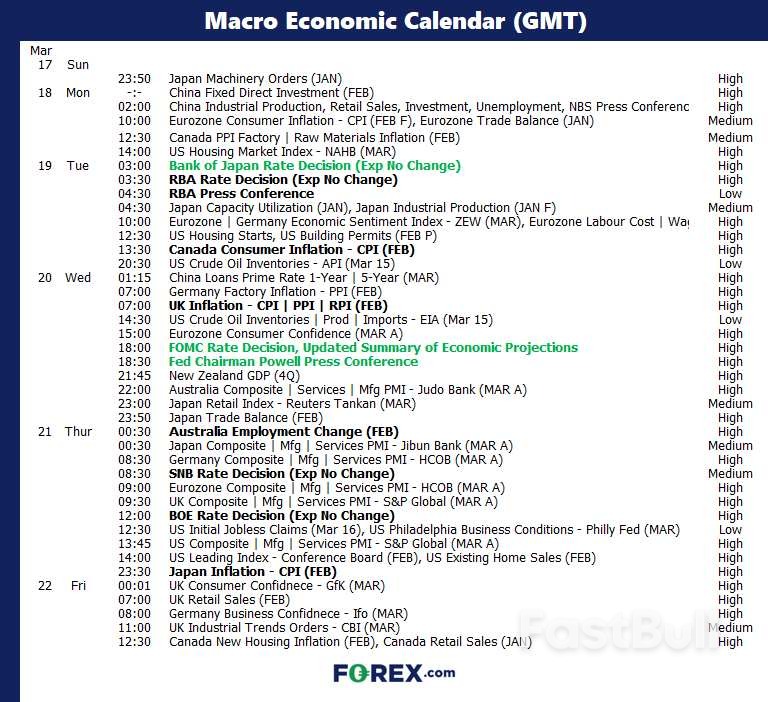
          We have no fewer than five central bank meetings of major currencies next week, kicking off with the RBA and BOJ on Tuesday, FOMC on Wednesday before SNB and BOE on Thursday. This clearly makes the US dollar a focal point alongside classic major pairs such as AUD/USD, USD/JPY, GBP/USD and USD/CHF. But it can also bring crosses into the mix such as AUD/JPY and GBP/CHF for traders to seek moves on the relative shift of currencies between such pairs.

          The week that was:

          A combination of hotter-than-expected CPI and PPI data for the US bought into doubt whether the Fed will actually cut their interest rate in JuneBond yields jumped and dragged the US dollar higher as bears ran for cover, helping the US dollar index recoup some of the prior week’s losses sustained on ‘BOJ hike’ betsGold snapped its 9-day rally at a record high after the CPI print, although as of yet we’re yet to see a material pullback despite the subsequent hot PPI printBitcoin reached a record high at the beginning of the week before the usual volatility ensues that tends to occur around record highsCrude oil prices rose to a 4-month high which saw WTI break comfortably above $80, thanks to the IEA raising their demand outlook for 2024 and Ukraine drone attack on Russia’s oil refineriesCopper prices rallied above $4 to a 7-month high as China’s top smelters agreed to production cuts.

          The week ahead (calendar):

          Central Bank Galore with BOJ, Fed, BOE, SNB and RBA on Tap: The Week Ahead_1

          The week ahead (key events and themes):

          · FOMC meeting
          · BOJ interest rate decision
          · BOE interest rate decision
          · RBA cash rate decision

          RBA cash rate decision

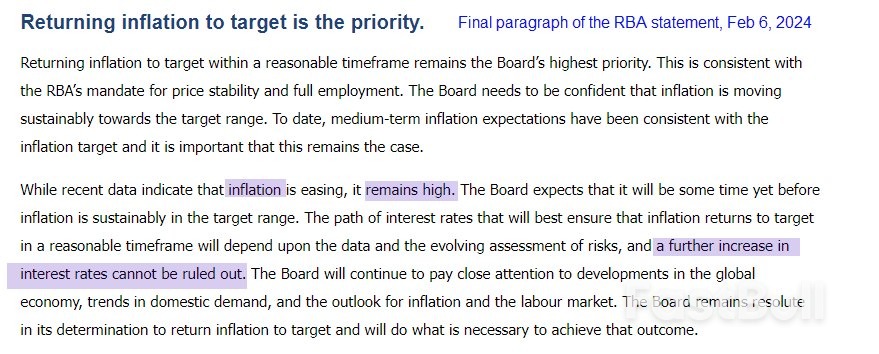
          This is arguably the least interesting of all of the meeting, but sometimes less can be more. The RBA surprised traders by retaining their hawkish bias in their statement, so the big question remains; will the RBA remove their hawkish bias next week?
          Like many, I’ll be going straight to the final paragraph to see if “a further increase in the interest rate cannot be ruled out” has been removed or altered, alongside inflation being “too high”. The OIS curve remains beneath the RBA’s cash rate of 4.35%, and the cash rate futures curve has fully priced in a 25bp cut for September. Ultimately, markets don’t anticipate another hike given the steady stream of slightly weaker data that has appeared this year.
          All polled economists favour a hold according to Reuters, which I am in agreement with. Interestingly, Bloomberg pricing estimates a 33.6% chance of a cut – which I suspect seem dovishly-optimistic given their ‘reserved’ style and slight hawkish bias. Bloomberg pricing and RBA cash rate futures have fully priced in the first RBA cut to arrive in September.
          Trader’s watchlist: AUD/USD, NZD/USD, AUD/NZD, NZD/JPY, AUD/JPY, ASX 200.
          Central Bank Galore with BOJ, Fed, BOE, SNB and RBA on Tap: The Week Ahead_2

          BOJ interest rate decision

          Next week’s BOJ meeting is arguably the most interesting, simply because they might hike rates and ditch negative interest rate for the first time in eight years.
          And there’s good reason to believe they just might. Wage negotiations have gone well for the Unions, where large corporations have met all of their demands. Tokyo’s inflation rate (which provides a 3-week lead on nationwide CPI) increased sharply and remains above the BOJ’s 2% target. And we have also had a number of hawkish comments form BOJ governors, and ‘sources’ revealing that the BOJ are contemplating hiking next week.
          According to Bloomberg, there is a 68.3% chance the BOJ will hike by 10bp on Tuesday to take rates to zero, with a 31.5% chance it could be delayed until June. And there is a 60.4% chance of a second hike in October.
          So with a hike expected between March and June, the bigger question is how much of an impact this could have on USD/JPY, given it 2% during its last week in eight months in anticipation of the cut.
          Trader’s watchlist: USD/JPY, AUD/JPY, GBP/JPY, EUR/JPY, Nikkei 225.
          Central Bank Galore with BOJ, Fed, BOE, SNB and RBA on Tap: The Week Ahead_3

          FOMC meeting

          It is practically a given that the Fed will not change policy next week. So once again it is about sharing investors expectation of the future path and trajectory of any potential cuts. Yet this week’s CPI and PPI reports has thrown a spanner in the works for doves, simply because they came in too hot and makes it harder for the Fed to signal any such move at their March meeting.
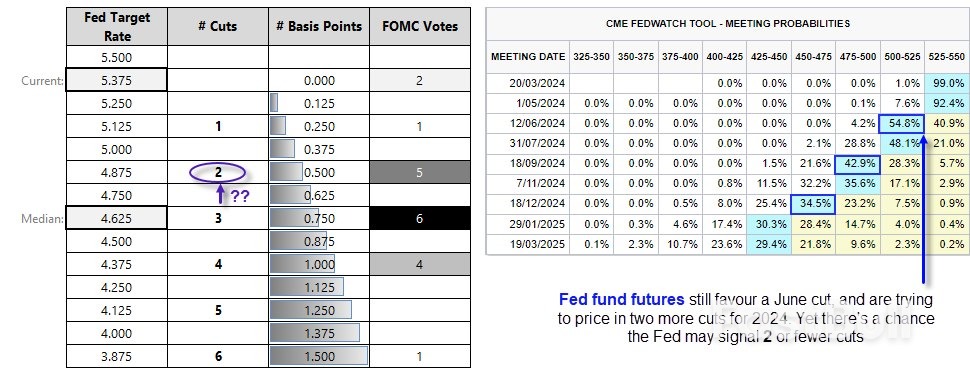
          Bloomberg pricing estimates a 54.2% chance of their first cut to arrive in June and a cut has been fully priced in by July. They also estimate a 67.4% chance of three cuts to arrive by December, which would place it in line with the Fed’s median estimate to three cuts form their December 2023 dot plot.
          However, think there’s a real chance the Fed’s median Fed Funds forecast for 2024 may be reduced to two cuts, given the majority of voters who didn’t favour three cuts were dovish. And that could prompt another bout of USD strength as bears cover their short, like we saw after the CPI and PPI figures.
          Trader’s watchlist: US dollar index, EURUSD, USD/JPY, WTI Crude Oil, Gold, S&P 500, Nasdaq 100, Dow Jones.
          Central Bank Galore with BOJ, Fed, BOE, SNB and RBA on Tap: The Week Ahead_4

          BOE interest rate decision

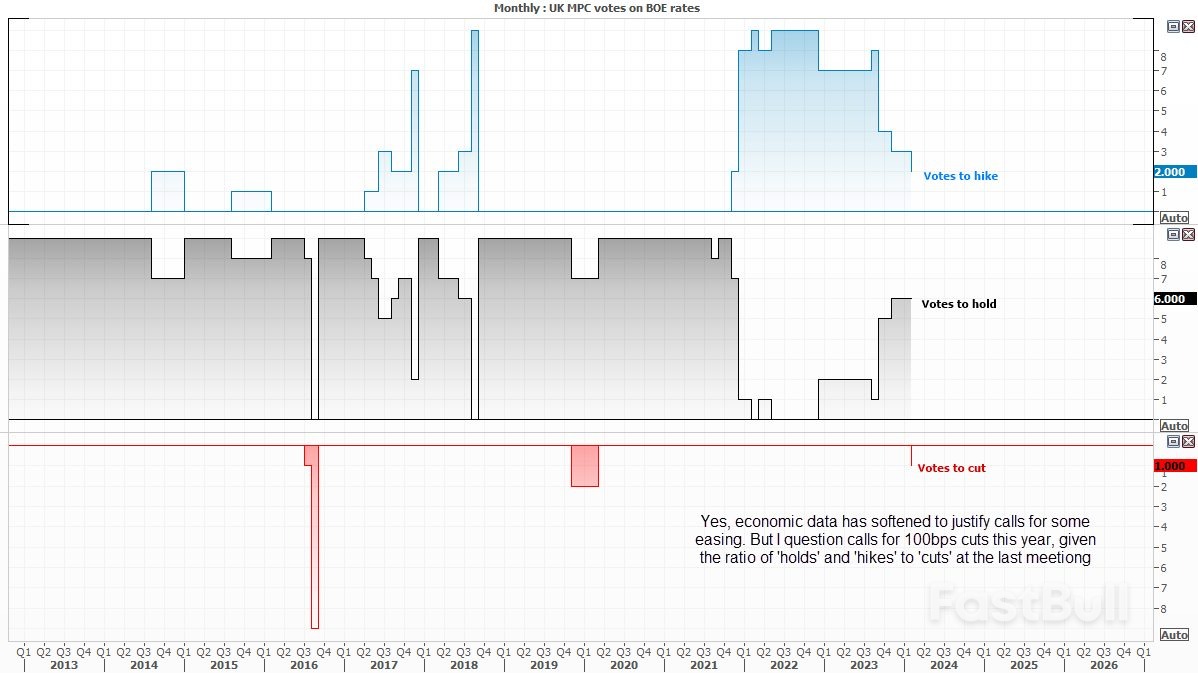
          Incoming data has seen some banks call for 100bp of BOE cuts this year, potentially beginning in June. For that to become realistic, I imagine we’ll need to see more than the single vote for a cut we saw at their last meeting (which was the first time an MPC member voted for a cut since March 2020). And we’ll likely need to see a particularly soft set of inflation figures on Tuesday.
          As it stood last month, two members vote for a hike, one for a cut and six to hold. I therefore doubt we’ll get the dovish go-ahead traders want to hear at next week’s meeting. Yes, wages and employment are lower – but has it really deteriorated fast enough to warrant a drastic change of mind among the 6 who voted to hold and 2 for a hike? I remain sceptical.
          Bloomberg pricing estimates a 56.2% chance of a 25bp cut in August and a 64.5% chance of a second cut arriving in November, which seems more realistic to me. The question then becomes whether the BOE will have the appetite to signal this next week, and again I remain sceptic.
          Trader’s watchlist: GBP/USD, GBP/JPY, EUR/GBP, FTSE 100.
          Central Bank Galore with BOJ, Fed, BOE, SNB and RBA on Tap: The Week Ahead_5

          As for the rest:

          AU employment: The RBA meeting ahead of Thursday’s employment report, which detracts from its potency. But it we see unemployment continue to rise and job growth falter, it builds a case for a rate cut sooner than September and could weigh on AUD/USD.
          SNB interest rate decision: No change is expected, although Bloomberg estimates an 82.6% probability of a cut in June.
          Inflation figures: CPI reports for UK, Canada, and Japan are released. The BOJ meeting would have already been and gone, and its likely we’ll see it move higher anyway as that is what we saw on Tokyo’s data. But if its hotter than expected, odds increase for a hike in June – assuming the BOJ didn’t hike next week already.
          UK inflation is released ahead of the BOE meeting, but as mentioned above it would take quite a set of weak data to convince the BOE to get too dovish next week IMO.
          Canada’s inflation figures have continued to soften, and should that trend persist then it could weaken the Canadian dollar on bets of a sooner BOC cut. Bloomberg estimates a 51.5% chance of a 25bp cut in July.
          To stay updated on all economic events of today, please check out our Economic calendar
          Risk Warnings and Disclaimers
          You understand and acknowledge that there is a high degree of risk involved in trading. Following any strategies or investment methods may lead to potential losses. The content on the site is provided by our contributors and analysts for information purposes only. You are solely responsible for determining whether any trading assets, securities, strategy, or any other product is suitable for investing based on your own investment objectives and financial situation.
          Add to Favorites
          Share

          U.S. Feb CPI Analysis: Inflation Slightly Exceeds Expectations but Acceptable

          Damon

          Economic

          The U.S. Bureau of Labor Statistics released its CPI inflation report for February on March 12, local time. YoY: headline CPI rose 3.2% YoY, slightly higher than the previous reading and market expectations of 3.1%; core CPI rose 3.8% YoY, slightly lower than the previous reading of 3.9%, higher than the expectations (3.7%), a new low since May 2021.
          MoM: Headline CPI grew at a rate of 0.4%, in line with expectations, while core CPI grew at a rate of 0.4%, higher than the expected 0.3%, the largest increase in eight months.
          February inflation and core inflation in the U.S. slightly exceeded expectations, which seems to run counter to the decline in inflation indicators closely tracked by the Fed. Since the end of January, the international oil price has returned to the threshold of US$80, and the market has expected the rebound of U.S. CPI in February, but the final reading is still slightly higher, reflecting that the resilience of U.S. inflation is still relatively strong.
          Generally speaking, the process of de-inflation in the U.S. may be in a "critical period" in the short to medium term. Although the current inflation level is moving towards the goal of the Federal Reserve, there may still be more uncertainties about the required time. This is also the "hardest and last road" that inflation needs to take.
          U.S. Feb CPI Analysis: Inflation Slightly Exceeds Expectations but Acceptable_1
          This CPI inflation has been driven almost by rent costs and services such as shelter, medical care, and transportation.
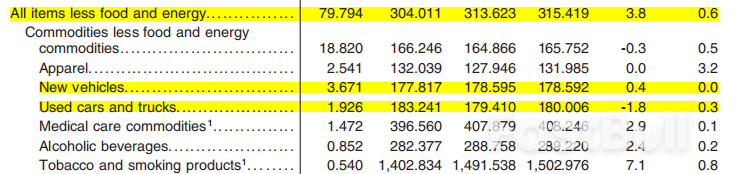
          Looking at the February inflation data in terms of breakdown items, shelter, and gasoline prices were the main contributors to the increase in the CPI, with both accounting for more than 60% of the February increase. The prices of food and food at home as a whole remained unchanged from the previous month. In core commodities, the trend of new vehicles and used vehicles is out of touch. Specifically:
          Energy prices were the main driver of this increase in the headline CPI, and the decline in energy inflation narrowed in February. Fuel oil rose 1.5% MoM, while gasoline increased 4.3%. The price increase was partly due to rising ongoing geopolitical risks, with the Red Sea conflict severely disrupting international shipping and forcing some merchant ships to take long-distance detours to avoid danger, increasing costs and pushing up prices. Moreover, the expected extension of the OPEC+ production cuts, officially announced on March 4, has been an important factor driving prices higher, with the extended cuts tightening the global oil supply in the short term. Finally, the largest refineries in the Midwest of the U.S. were on shutdown in early February due to power outages, resulting in lower motor gasoline production and inventories. Inventory declines on the East Coast and Gulf Coast have had a huge impact on the total supply of gasoline in the U.S. (the largest producer and consumer of gasoline in the U.S.), whose retail price industry has risen again due to higher crude oil prices.
          Although energy does not account for the largest share of the CPI, oil prices not only affect the prices of commodities but also the prices of other services, which will also weigh on inflationary expectations and thus exacerbate the risk of inflation.
          Last week the EIA released its weekly report on crude oil inventories, which fell by 1.536 million barrels by March 8, exceeding expectations of 1.338 million barrels and marking the second consecutive weekly decline. The focus remains on whether U.S. crude oil production is supportive of market supply. If the support is insufficient, it could even lead to a reversal of energy inflation.
          U.S. Feb CPI Analysis: Inflation Slightly Exceeds Expectations but Acceptable_2
          In terms of core inflation (excluding food and energy prices), new vehicles and used vehicles are excellent performers in this inflation. On a MoM basis, there was no increase in new vehicles; used vehicles increased by 0.3%, continuing the downtrend overall.
          U.S. vehicle inventories reached 248,000 in January, slightly up from a month earlier (previous reading of 240,000), but compared to the same period last year, vehicle inventories have doubled. In the past, the global chip shortage led to a reduction in the supply of vehicle inventories, the price spike has improved significantly. With the current increase in supply, it is expected that vehicle manufacturers will continue to be forced to cut prices and that new vehicle prices will continue to fall this year. The used vehicles are downstream of the new vehicle industry chain, and as new vehicle prices cool down, used vehicles become significantly less attractive to consumers, while prices must adjust along with them.
          According to vehicle sales tracked by vAuto, used vehicle retail sales were up 18% in February compared to January, and used vehicle retail sales are expected to be up 5% YoY in February. Sales of new vehicles also rose significantly, with new vehicle sales in February up 9.6% YoY and 16.6% MoM.
          The forward-looking Manheim Used Vehicle Value Index for February also reported that wholesale used vehicle prices declined in February compared to January. It is expected that used vehicle prices may continue to decline over the next 2-3 months.
          It is important to focus on the fact that while there was a decline in the data for the entire month, wholesale prices in the last week of February were the strongest gain in years. Lower prices for new and used vehicles brought strong growth in consumer demand, but the U.S. vehicle inventories have risen only slightly over the past three months, and if demand continues to grow at this rate, there will likely be the possibility of oversupply, which will lead to prices picking up again.
          U.S. Feb CPI Analysis: Inflation Slightly Exceeds Expectations but Acceptable_3
          As for core services, shelter remains the largest contributor to core inflation, accounting for 45% of core inflation, and its growth rate has been in the range of 0.4%-0.6% MoM from December last year to February this year, with 0.5% recorded this time.
          The unusual increase in Owners' Equivalent Rent (OER) in January did not continue in February, suggesting that the past value was likely just a fluke, that housing inflation is not as sticky as we imagined, and that housing services inflation is still on track to come down. In addition, new leases show a marked slowdown in the pace of rent increases, and in some cases even a decline. It is expected that rents for primary residences and OER should continue to slow down this year and reduce core inflation.
          In addition, the supply of new homes has increased to 456,000 units, the highest level in more than a year. In January, the median housing price in the U.S. recorded US$420,700, a slight increase from the previous month (the previous reading was US$413,100), which was the fifth consecutive month of YoY decline. The decrease in housing prices will be reflected in the inflation report in the future by the decrease of the OER. However, it should be noted that the current new home projects are sharply reduced, which may lead to the reversal of housing prices in the case of insufficient supply and strong demand, thus promoting the rise of housing inflation.
          U.S. Feb CPI Analysis: Inflation Slightly Exceeds Expectations but Acceptable_4
          Supercore inflation (less the sub-items of shelter's core CPI services), the Fed's favored indicator, rose 0.47% MoM in February, a slowdown from January's 0.85% MoM rise, but still above pre-pandemic levels. It also rose as much as 4.5% YoY, the largest increase in almost a year.
          Services inflation is currently sticky from an endogenous supply-demand gap with strong sustainability, suggesting that the last mile will be particularly difficult. In terms of sub-items, transportation services (1.4% MoM) and airline fares (6.6%) showed an accelerating trend in February, except for medical care services (-0.6%), which declined MoM.
          But slower MoM wage growth will likely ease the stickiness of service sector inflation. The February non-farm payrolls showed a sharp decline in private sector wage growth to 0.1% MoM (from 0.4% previously), which is certainly good news for inflation. However, given that the labor supply deficit has yet to fully improve, it remains to be seen whether wages reverse quickly.
          After strong numbers in January, this report is further evidence that inflation is becoming stubborn. While the overall trend is still slowing, the Fed is looking for greater confidence that inflation will continue to move toward 2%, and that confidence is not found in this report. However, the "supercore" that Powell has repeatedly emphasized and focused on has slowed down sharply, and other sub-items are heated but not extreme. The composition of the overall report is still consistent with the slowdown trend. Although there are "accidents", it is not high enough to prevent the Fed from cutting interest rates in June.
          Therefore, the Fed will most likely cut rates in 2024. The inflation data of the month may have limited influence on the timing of interest rate cuts, and the change in inflation trend is the most important for the current Fed's judgment. Combined with the February non-farm payrolls data, the U.S. labor market is still rebalancing, the supply and demand relationship in the labor market is gradually improving, but is still in a tight state. Premature interest rate cuts may cause a rebound in inflation in the later period.
          According to data from the FedWatch tool of CME, the probability of a rate cut in June is now 62.6%, down from 70% in February before the inflation release, but the magnitude is limited. This means that the result of the inflation data exceeding expectations is well within the market's acceptable range, and even a little "favorable".
          However, it should be noted that as the U.S. is a consumption-led economy, Q3 and Q4 are the traditional peak consumption seasons. If there is no recession in Q2, there is a high probability that the economic performance in Q3 and Q4 is acceptable, and it is still necessary to consider the fact that the Fed has postponed the interest rate cut timeline due to the strong economy.
          Overall, this round of de-inflation in the U.S. may be a long-term process, but as it continues, the real interest rate level is also rising. As long as the process of de-inflation does not fluctuate greatly, the Fed may be more inclined to carry out "preventive rate cuts" to prevent the economy from continuing to be under pressure at a restrictive interest rate level.
          To stay updated on all economic events of today, please check out our Economic calendar
          Risk Warnings and Disclaimers
          You understand and acknowledge that there is a high degree of risk involved in trading. Following any strategies or investment methods may lead to potential losses. The content on the site is provided by our contributors and analysts for information purposes only. You are solely responsible for determining whether any trading assets, securities, strategy, or any other product is suitable for investing based on your own investment objectives and financial situation.
          Add to Favorites
          Share

          IEA Forecast of Market Deficit Propels Oil to Four-Month High Surpassing $85

          Zi Cheng

          Traders' Opinions

          Commodity

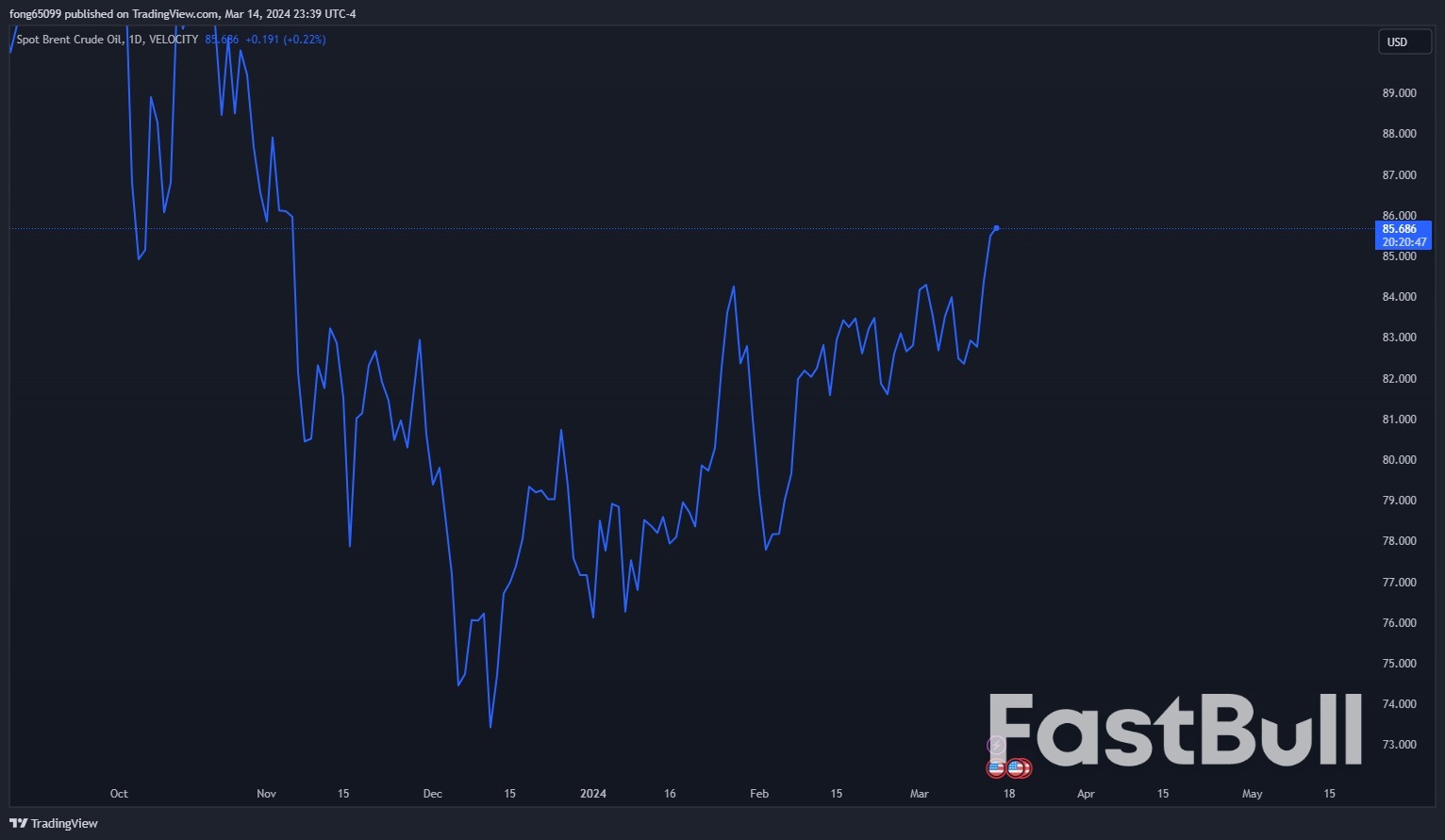
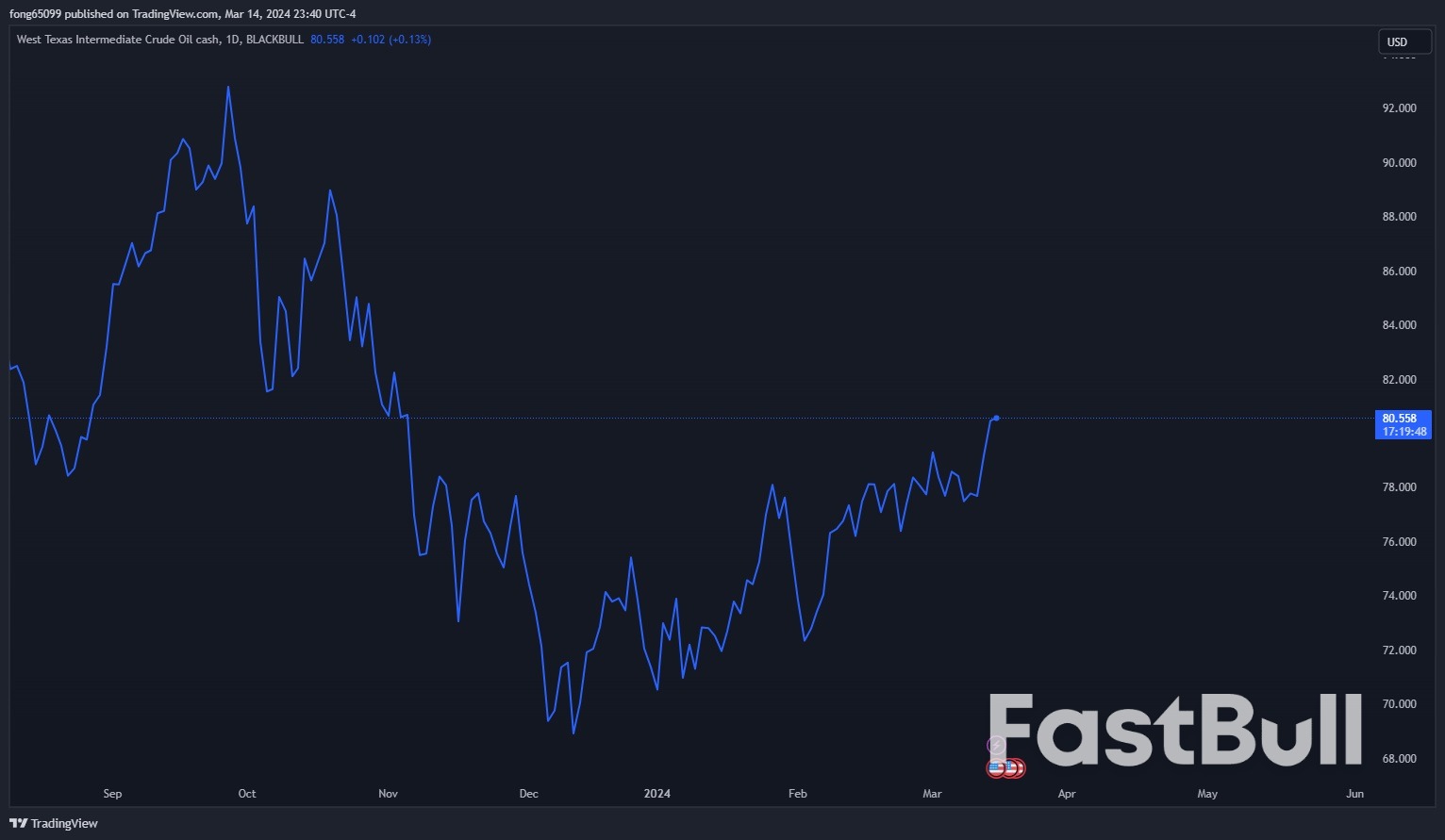
          Oil prices surged to a four-month peak as the energy watchdog for the western world projected a demand surpassing market supply, a reversal from its earlier prediction of a surplus. Brent crude, the global benchmark, broke the $85 mark for the first time since November, marking a 1.3% increase to $85.15, and its year-to-date climb stands at 11%. Meanwhile, the US benchmark West Texas Intermediate rose by 1.7% to $81.04 per barrel.

          IEA Forecast of Market Deficit Propels Oil to Four-Month High Surpassing $85_1Brent Crude Chart

          IEA Forecast of Market Deficit Propels Oil to Four-Month High Surpassing $85_2WTI Chart

          The International Energy Agency stated that the oil market is expected to experience a "slight deficit" this year. This adjustment comes as the IEA lowered its forecast for global supply growth to 800,000 barrels a day, down from 1.7 million barrels a day as per its February report. The revised estimate is based on the assumption that the voluntary production cuts implemented by OPEC+ members to bolster prices will continue throughout 2024.
          The gains seen on Thursday build upon the momentum of the previous trading session, which witnessed an increase of over 2.5%. This surge followed Ukraine's drone strikes on oil refineries located deep within Russia and a report indicating a decline in US stockpiles. Additionally, hedge funds have been consistently boosting their net positions betting on rising prices since December, as highlighted by data from the US Commodity Futures Trading Commission, thereby providing additional support to the market.
          The recent upticks in oil prices have pushed them further above thresholds where the budgets of Saudi Arabia and Russia are perceived to face strain. However, these higher prices may present a challenge for US President Joe Biden, especially as he gears up for a challenging re-election battle against Donald Trump.
          Over the past month, oil prices have largely remained within a narrow range, only to begin climbing earlier in March following the announcement by OPEC+ members that they would prolong voluntary production cuts for an additional three months beyond the original expiration date set for the end of the month.
          The recent increases in prices could be interpreted as a validation for Saudi Arabia's strategy. The nation has opted to maintain higher prices, sacrificing some market share in the process, to support funding for a range of ambitious economic diversification projects.
          Price movements remained subdued despite geopolitical tensions arising from Israel's conflict with Hamas and attacks on shipping in the Red Sea by Yemen-based Houthi rebels. Traders remained optimistic that OPEC's competitors' record production growth would sufficiently meet market demand, thus keeping prices stable.
          Risk Warnings and Disclaimers
          You understand and acknowledge that there is a high degree of risk involved in trading. Following any strategies or investment methods may lead to potential losses. The content on the site is provided by our contributors and analysts for information purposes only. You are solely responsible for determining whether any trading assets, securities, strategy, or any other product is suitable for investing based on your own investment objectives and financial situation.
          Add to Favorites
          Share

          China Central Bank Leaves Key Policy Rate Unchanged, As Expected

          Devin

          Central Bank

          Economic

          China's central bank left a key policy rate unchanged while withdrawing cash from a medium-term policy loan operation on Friday, as authorities continued to prioritise currency stability amid uncertainty over the timing of expected Federal Reserve interest rate cuts.
          The Fed's historic monetary tightening has bolstered the dollar and pressured the yuan over the past few years. Cutting rates before a move by the Fed or other major central banks would widen yield differentials, potentially putting more pressure on the local currency.
          The People's Bank of China (PBOC) said it was keeping the rate on 387 billion yuan ($53.80 billion) worth of one-year medium-term lending facility (MLF) loans to some financial institutions unchanged at 2.50% from the previous operation.
          With 481 billion yuan worth of MLF loans set to expire this month, the operation resulted in a net 94 billion yuan fund withdrawal from the banking system. It marked the first cash withdrawal through the liquidity instrument since November 2022.
          The central bank said the Friday's loan operation has "fully met financial institutions' demand" to maintain banking system liquidity reasonably ample, according to an online statement.
          "Net cash withdrawal is an obvious signal, echoing the content of the government work report on preventing idling of funds," said Xing Zhaopeng, senior China strategist at ANZ.
          "Given major commercial banks have not yet lowered deposit rates again, chances of another policy rate cut are low."
          In a Reuters poll of 36 market watchers, 32, or 89%, of all respondents, expected the central bank to keep the borrowing cost of the one-year MLF loans unchanged.
          China has set an ambitious 2024 economic growth target of around 5%, promising steps to transform the country's development model and defuse risks fuelled by bankrupt property developers and indebted cities.
          PBOC Governor Pan Gongsheng said last week the bank would keep the yuan basically stable and sent a dovish message to the market by saying China had "rich monetary policy tools at its disposal."
          Investors have since ramped up their bets authorities will roll out more monetary easing measures, including a further reduction to bank reserves, to support the world's second-largest economy.
          The MLF operation "may suggest that a reserve requirement ratio (RRR) cut is forthcoming," said Frances Cheung, rates strategist at OCBC Bank.
          "There may be an intention to replace part of MLF with liquidity released from an RRR cut. After all, there have been strong hints from officials of an RRR cut."
          The central bank also injected 13 billion yuan through seven-day reverse repos while keeping the borrowing cost unchanged at 1.80%, it said in a statement.

          Source: Reuters

          To stay updated on all economic events of today, please check out our Economic calendar
          Risk Warnings and Disclaimers
          You understand and acknowledge that there is a high degree of risk involved in trading. Following any strategies or investment methods may lead to potential losses. The content on the site is provided by our contributors and analysts for information purposes only. You are solely responsible for determining whether any trading assets, securities, strategy, or any other product is suitable for investing based on your own investment objectives and financial situation.
          Add to Favorites
          Share

          Nikkei Attempts to Stabilise, HSI Seasonality on Watch

          IG

          Economic

          Stocks

          Asia Open

          The Asian session looks set for a negative open to end the week, with Nikkei -0.66%, ASX -1.39% and KOSPI -1.12% at the time of writing. Overnight, US Treasury yields reacted to the upside on another hotter-than-expected inflation print, this time from the US producer price index (PPI). Along with a surging US dollar (+0.6%) and the subdued session in Wall Street, risk sentiments across the region are kept on the backfoot.
          On the radar, China’s new home prices extended its decline to -1.4% in February, significantly deeper than the -0.7% in January, which suggests that its property downturn remains in place amid sluggish demand. The Hang Seng Properties Index is down more than 1% lower at the time of writing. The People's Bank of China (PBOC) has also kept the rate on its one-year medium-term lending facility rate unchanged at 2.5% in today’s session in a widely-expected move, which is in line with authorities’ current stance for a more gradual approach in extending support.
          The China A50 index is back to retest its key 200-day moving average (MA), following an upward break last week, which will have to see some immediate defending from buyers in today’s session. The Hang Seng Index (HSI) dipped 1.3% lower at the time of writing, but that will leave one to watch for any formation of a new higher low to keep the upward trend since January this year in place.

          Is the HSI set for better days ahead?

          As we officially step into the second half of March today, the HSI is up 1.5% month-to-date and if the bulls want to find further validation, they will be glad to know that seasonality may be in their favour ahead. Looking at the seasonality for the HSI over the past 30 years, the second half of March through the month of April tends to be a turnaround period for the index and is generally supportive of gains.
          Of course, one may note that seasonality is essentially an average and is often just used as a pure reference. It did not play out last year, where the index was down 13% from late-March to end-April. To sustain the rebound, economic recovery may remain the key and with recent data revealing some green shoots in China's economy, further follow-through will be much needed ahead.Nikkei Attempts to Stabilise, HSI Seasonality on Watch_1

          On the watchlist: Nikkei’s daily RSI back to retest its key 50 level

          The Nikkei 225 has come under some heavy profit-taking lately, as speculations mount for a quicker stimulus exit from the Bank of Japan (BoJ), which may drive a cautious lead-up to the BoJ meeting next week.
          The index has dipped more than 5% to hang around its two-week low, although one may note that it is still up more than 16% year-to-date. For now, its daily relative strength index (RSI) is back to retest its key 50 level for the first time since January this year, which may have to see some defending from buyers.
          Ahead, immediate support to watch may potentially be at the 38,200 level, where a 23.6% Fibonacci retracement level stands. The broader upward trend may remain intact for now, with the index still trading above its daily Ichimoku cloud support, along with various moving averages (50-day, 100-day, 200-day).Nikkei Attempts to Stabilise, HSI Seasonality on Watch_2
          To stay updated on all economic events of today, please check out our Economic calendar
          Risk Warnings and Disclaimers
          You understand and acknowledge that there is a high degree of risk involved in trading. Following any strategies or investment methods may lead to potential losses. The content on the site is provided by our contributors and analysts for information purposes only. You are solely responsible for determining whether any trading assets, securities, strategy, or any other product is suitable for investing based on your own investment objectives and financial situation.
          Add to Favorites
          Share
          FastBull
          Copyright © 2025 FastBull Ltd

          728 RM B 7/F GEE LOK IND BLDG NO 34 HUNG TO RD KWUN TONG KLN HONG KONG

          TelegramInstagramTwitterfacebooklinkedin
          App Store Google Play Google Play
          Products
          Charts

          Chats

          Q&A with Experts
          Screeners
          Economic Calendar
          Data
          Tools
          Membership
          Features
          Function
          Markets
          Copy Trading
          Latest Signals
          Contests
          News
          Analysis
          24/7
          Columns
          Education
          Company
          Careers
          About Us
          Contact Us
          Advertising
          Help Center
          Feedback
          User Agreement
          Privacy Policy
          Business

          White Label

          Data API

          Web Plug-ins

          Poster Maker

          Affiliate Program

          Risk Disclosure

          The risk of loss in trading financial instruments such as stocks, FX, commodities, futures, bonds, ETFs and crypto can be substantial. You may sustain a total loss of the funds that you deposit with your broker. Therefore, you should carefully consider whether such trading is suitable for you in light of your circumstances and financial resources.

          No decision to invest should be made without thoroughly conducting due diligence by yourself or consulting with your financial advisors. Our web content might not suit you since we don't know your financial conditions and investment needs. Our financial information might have latency or contain inaccuracy, so you should be fully responsible for any of your trading and investment decisions. The company will not be responsible for your capital loss.

          Without getting permission from the website, you are not allowed to copy the website's graphics, texts, or trademarks. Intellectual property rights in the content or data incorporated into this website belong to its providers and exchange merchants.

          Not Logged In

          Log in to access more features

          FastBull Membership

          Not yet

          Purchase

          Become a signal provider
          Help Center
          Customer Service
          Dark Mode
          Price Up/Down Colors

          Log In

          Sign Up
          Position
          Layout
          Fullscreen
          Default to Chart
          The chart page opens by default when you visit fastbull.com