Markets
News
Analysis
User
24/7
Economic Calendar
Education
Data
- Names
- Latest
- Prev



Signal Accounts for Members
All Signal Accounts
All Contests


U.S. IHS Markit Manufacturing PMI Prelim (SA) (Jan)A:--
F: --
P: --
U.S. IHS Markit Services PMI Prelim (SA) (Jan)A:--
F: --
P: --
U.S. IHS Markit Composite PMI Prelim (SA) (Jan)A:--
F: --
P: --
U.S. UMich Consumer Sentiment Index Final (Jan)A:--
F: --
P: --
U.S. UMich Current Economic Conditions Index Final (Jan)A:--
F: --
P: --
U.S. UMich Consumer Expectations Index Final (Jan)A:--
F: --
P: --
U.S. Conference Board Leading Economic Index MoM (Nov)A:--
F: --
P: --
U.S. Conference Board Coincident Economic Index MoM (Nov)A:--
F: --
P: --
U.S. Conference Board Lagging Economic Index MoM (Nov)A:--
F: --
P: --
U.S. UMich 1-Year-Ahead Inflation Expectations Final (Jan)A:--
F: --
P: --
U.S. Conference Board Leading Economic Index (Nov)A:--
F: --
P: --
U.S. Weekly Total Rig CountA:--
F: --
P: --
U.S. Weekly Total Oil Rig CountA:--
F: --
P: --
Japanese Prime Minister Sanae Takaichi delivers a speech
Germany Ifo Business Expectations Index (SA) (Jan)A:--
F: --
P: --
Germany IFO Business Climate Index (SA) (Jan)A:--
F: --
P: --
Germany Ifo Current Business Situation Index (SA) (Jan)A:--
F: --
P: --
Brazil Current Account (Dec)A:--
F: --
P: --
Mexico Unemployment Rate (Not SA) (Dec)A:--
F: --
P: --
Canada National Economic Confidence IndexA:--
F: --
P: --
U.S. Non-Defense Capital Durable Goods Orders MoM (Excl. Aircraft) (Nov)A:--
F: --
U.S. Durable Goods Orders MoM (Excl. Defense) (SA) (Nov)A:--
F: --
U.S. Durable Goods Orders MoM (Excl.Transport) (Nov)A:--
F: --
P: --
U.S. Durable Goods Orders MoM (Nov)A:--
F: --
U.S. Chicago Fed National Activity Index (Nov)A:--
F: --
U.S. Dallas Fed New Orders Index (Jan)A:--
F: --
P: --
U.S. Dallas Fed General Business Activity Index (Jan)A:--
F: --
U.S. 2-Year Note Auction Avg. YieldA:--
F: --
P: --
U.K. BRC Shop Price Index YoY (Jan)A:--
F: --
P: --
China, Mainland Industrial Profit YoY (YTD) (Dec)A:--
F: --
P: --
Germany 2-Year Schatz Auction Avg. Yield--
F: --
P: --
Mexico Trade Balance (Dec)--
F: --
P: --
U.S. Weekly Redbook Index YoY--
F: --
P: --
U.S. S&P/CS 20-City Home Price Index YoY (Not SA) (Nov)--
F: --
P: --
U.S. S&P/CS 20-City Home Price Index MoM (SA) (Nov)--
F: --
P: --
U.S. FHFA House Price Index MoM (Nov)--
F: --
P: --
U.S. FHFA House Price Index (Nov)--
F: --
P: --
U.S. FHFA House Price Index YoY (Nov)--
F: --
P: --
U.S. S&P/CS 10-City Home Price Index YoY (Nov)--
F: --
P: --
U.S. S&P/CS 10-City Home Price Index MoM (Not SA) (Nov)--
F: --
P: --
U.S. S&P/CS 20-City Home Price Index (Not SA) (Nov)--
F: --
P: --
U.S. S&P/CS 20-City Home Price Index MoM (Not SA) (Nov)--
F: --
P: --
U.S. Richmond Fed Manufacturing Composite Index (Jan)--
F: --
P: --
U.S. Conference Board Present Situation Index (Jan)--
F: --
P: --
U.S. Conference Board Consumer Expectations Index (Jan)--
F: --
P: --
U.S. Richmond Fed Manufacturing Shipments Index (Jan)--
F: --
P: --
U.S. Richmond Fed Services Revenue Index (Jan)--
F: --
P: --
U.S. Conference Board Consumer Confidence Index (Jan)--
F: --
P: --
U.S. 5-Year Note Auction Avg. Yield--
F: --
P: --
U.S. API Weekly Refined Oil Stocks--
F: --
P: --
U.S. API Weekly Crude Oil Stocks--
F: --
P: --
U.S. API Weekly Gasoline Stocks--
F: --
P: --
U.S. API Weekly Cushing Crude Oil Stocks--
F: --
P: --
Australia RBA Trimmed Mean CPI YoY (Q4)--
F: --
P: --
Australia CPI YoY (Q4)--
F: --
P: --
Australia CPI QoQ (Q4)--
F: --
P: --
Germany GfK Consumer Confidence Index (SA) (Feb)--
F: --
P: --
Germany 10-Year Bund Auction Avg. Yield--
F: --
P: --
India Industrial Production Index YoY (Dec)--
F: --
P: --
India Manufacturing Output MoM (Dec)--
F: --
P: --


No matching data
Latest Views
Latest Views
Trending Topics
Top Columnists
Latest Update
White Label
Data API
Web Plug-ins
Affiliate Program
View All

No data
Oil prices defied a US storm's supply disruption, edging lower amid Middle East tensions and OPEC+ policy.
Oil prices edged lower on Tuesday, defying a major supply disruption as a massive winter storm swept across the United States, impacting both crude production and refinery operations.
Brent crude futures registered a 0.4% decline, falling 28 cents to US$65.31 a barrel by 0145 GMT. Similarly, US West Texas Intermediate (WTI) crude dropped 24 cents, or 0.4%, to trade at US$60.39 a barrel.
The price dip comes as a severe winter storm strained energy infrastructure across the US. According to analysts and traders, the extreme weather knocked out up to two million barrels of daily crude production over the weekend, accounting for roughly 15% of the nation's total output.
The freezing conditions also created significant operational issues for several refineries located along the US Gulf Coast. Daniel Hynes, an analyst at ANZ, noted that these disruptions have raised concerns about potential fuel supply shortages.
Beyond the immediate weather impact, traders are also watching geopolitical and policy developments that could influence the market.
Middle East Tensions Add Risk
Supply risks in the Middle East remain a key factor. According to two US officials, an American aircraft carrier and its supporting warships arrived in the region on Monday. This deployment expands President Donald Trump's military capabilities to either defend US forces or take potential action against Iran.
"Supply risks haven't totally evaporated," said Hynes, adding that "Tension in the Middle East persists after President Trump dispatched naval assets to the region."
OPEC+ Poised to Hold Production Steady
Meanwhile, key members of the Organization of the Petroleum Exporting Countries and their allies (OPEC+) are expected to maintain their current pause on oil output increases for March.
Three OPEC+ delegates indicated that the decision is likely to be confirmed at a meeting on February 1. The group's stance is supported by rising oil prices, which have been partly driven by a recent drop in Kazakhstan's oil production.
The eight OPEC+ members participating in the meeting are:
• Saudi Arabia
• Russia
• UAE
• Kazakhstan
• Kuwait
• Iraq
• Algeria
• Oman
China's industrial sector posted its first annual profit increase in four years in 2025, signaling a potential stabilization for businesses in the $19 trillion economy. The turnaround was supported by a government-led effort to curb damaging price wars and a significant boom in exports that helped compensate for weaker consumption at home.
Data from the National Bureau of Statistics reveals a marked improvement in the final month of the year. In December, industrial firm profits climbed 5.3% compared to the same month a year prior, a sharp reversal from the 13.1% year-on-year decline recorded in November.
This late surge pushed the full-year profit growth for 2025 to 0.6%. This figure represents a slight acceleration from the 0.1% increase seen over the first 11 months of the year and marks the first time since 2021 that annual profits have risen.
The recovery was not evenly distributed, with specific industries and factors driving the positive results.
One of the most critical drivers was the auto industry, which ended 2025 with a 0.6% profit increase. This performance marks a significant turnaround from the 8% profit decline the sector experienced in 2024, largely buoyed by robust export performance.
More broadly, China's strategy of diversifying its export markets away from the United States helped cushion the economic blow from tariffs imposed by U.S. President Donald Trump, allowing for sustained overseas sales.
An analysis of the data shows varied outcomes across different types of companies:
• Foreign Firms: Recorded a 4.2% gain in profit.
• Private-Sector Firms: Profits remained flat for the year.
• State-Owned Firms: Saw profits decline by 3.9%.
The official industrial profit data covers firms with a minimum annual revenue of 20 million yuan ($2.88 million) from their primary operations. The exchange rate used for conversion was $1 to 6.9542 Chinese yuan.
South Korea’s Finance Minister, Koo Yun-cheol, is set to urge lawmakers to fast-track a $350 billion U.S. investment bill following a threat from President Donald Trump to increase tariffs on South Korean automobiles.
The move comes just hours after Trump announced potential tariff hikes not only on cars but also on South Korean lumber and pharmaceuticals, citing the country's failure to ratify a trade agreement with Washington.
In a social media post, President Trump declared his intention to raise tariffs on a range of South Korean goods. He specifically flagged an increase on auto tariffs from 15% to 25%.
"South Korea's Legislature is not living up to its Deal with the United States," Trump wrote. He stated that because the legislature had not enacted their "Historic Trade Agreement," he was increasing tariffs on autos, lumber, and pharmaceuticals to 25%.
In response, South Korea's Finance Ministry announced that Minister Koo Yun-cheol will meet with Lim Lee-ja, the head of the National Assembly's finance committee, to push for the bill's passage. The proposed legislation has been stalled in the committee since its submission in December.
"We are currently assessing the U.S. side's intentions," the finance ministry said in a statement. "We will communicate with the U.S. government, including by explaining the status of the bill's discussion in the National Assembly."
The ministry added that it would continue to actively consult with the National Assembly on the matter.
The threat from Washington sent immediate ripples through South Korea's stock market. In morning trading, shares of Hyundai Motor fell by more than 2%, while Kia's stock price dropped by over 3%.

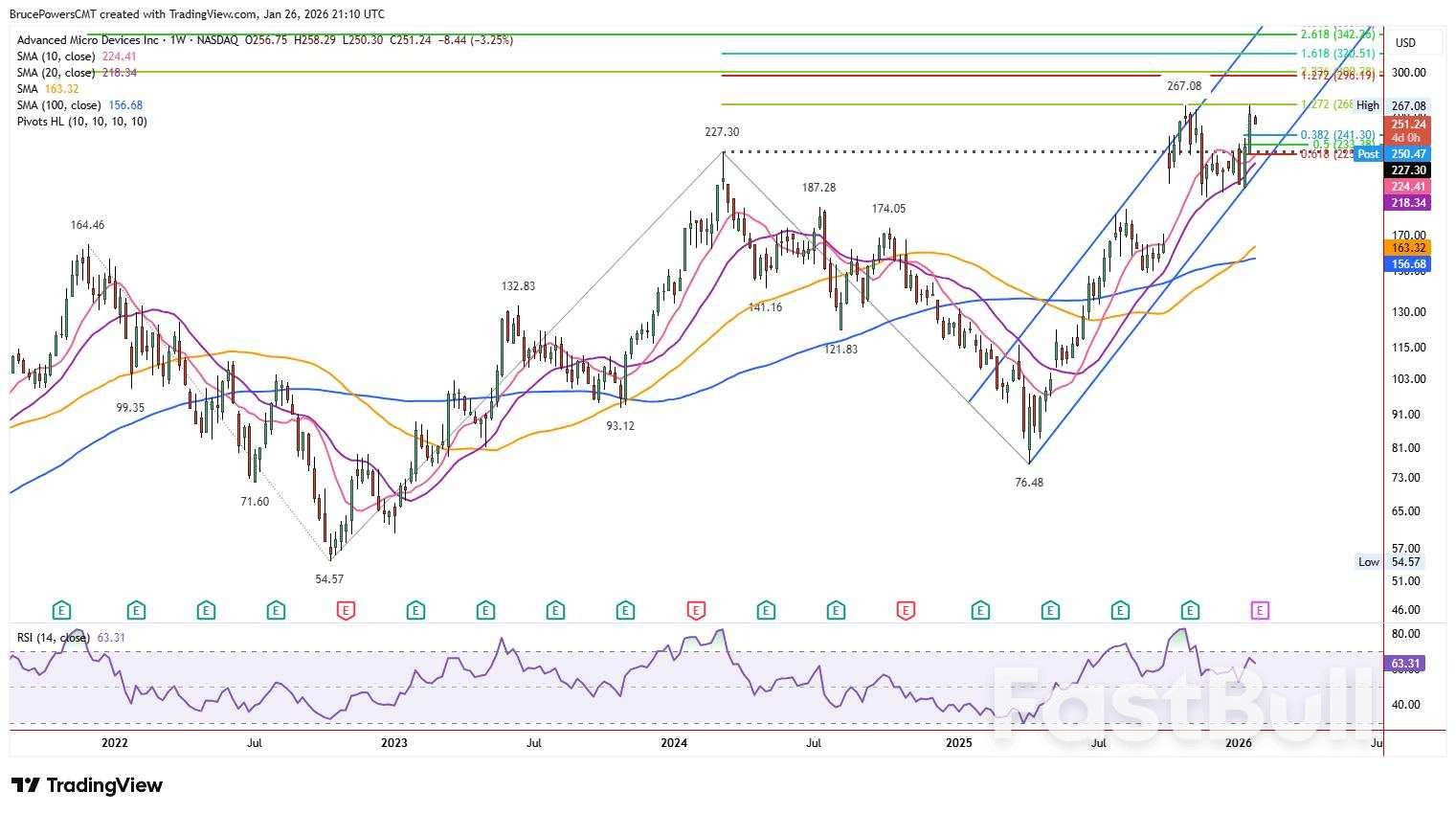
The stock of Advanced Micro Devices (AMD) has been a market leader and remains strong. It is hovering near prior highs around $267. AMD is a leading semiconductor firm specializing in high-performance CPUs, GPUs, and adaptive computer solutions for data centers and gaming. The company competes with Intel (INTC) and Nvidia (NVDA) with innovations like MI300 AI accelerators. In 2025, AMD stock advanced by 77%, and as of Monday's closing price, it was up by 17.3% year-to-date. Earnings are reported next week.
AMD weekly chart showing that a long term base breakout attempt remains in progress. Source: TradingView as of Jan 26, 2026.An attempt to further the advance in AMD stock has been underway following a new record high breakout to $267.08 in October. The first pullback culminated with a higher swing low of $194.28 and a seven-month consolidation bottom phase. During the related consolidation period trend support was recognized near the 20-week average. Last week's the bulls failed to breakout to a new record high as a top was hit at $266.96, very close to the prior high, before weakening on Monday.
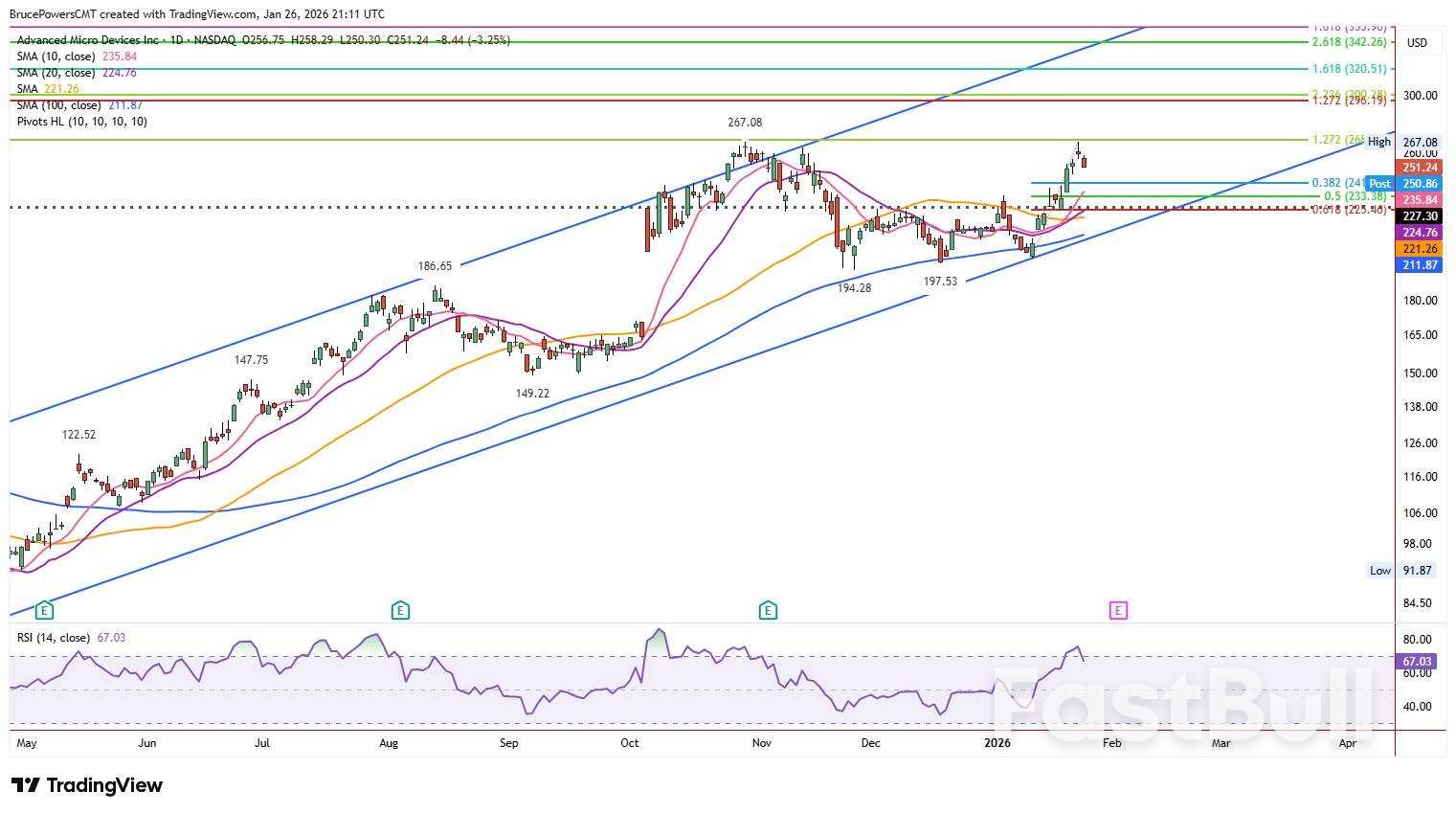
AMD daily chart showing a bounce off solid dynamic support. Source: TradingView as of Jan 26, 2026.Following a pullback from last week's high, the bull structure in AMD shows a likely continuation into new highs. The daily chart confirms underlying strength with faster moving averages rising above the 50-day average recently. Support for the recent pullback was confirmed near the long-term 200-day average. Moreover, a rising channel outlines the price movement within the uptrend, showing the potential for higher prices as the top of the channel is a potential target. A bounce from the lower boundary of the channel improves the possibility of AMD eventually approaching the top boundary line.
Last week's low of $225.41 is considered the maximum downside for support to hold while maintaining a short-term bullish structure. It remains possible that AMD trades range-bound for a period before another breakout attempt. However, signs of strength following tests of key support levels may signal the potential for a renewed advance toward the $267.08 high.
The 38.2% Fibonacci retracement of the prior advance is located at $241.30, while the rising 10-day average is currently near $236. A deeper pullback would bring the 50% retracement into focus at $233.48, which closely aligns with the top of a seven-week consolidation range near $234.02, reinforcing that zone as an important area of technical support.
China's industrial sector posted its first profit increase in three months, offering a sign of stability as persistent factory-gate deflation shows signs of letting up.
According to data from the National Bureau of Statistics, industrial profits climbed 5.3% in December from a year earlier. This marks a significant turnaround from the more than 13% plunge recorded in November and soundly beats Bloomberg Economics' forecast of an 11% drop.
For the full year, industrial earnings rose 0.6%, the first annual gain since 2021. This metric is a key indicator of the financial health of China's factories, mines, and utilities, and it often influences their investment decisions in the quarters ahead.
Despite the year-end recovery, profit margins have been consistently squeezed by weak domestic demand. Government efforts to manage excess competition and reduce overcapacity have yet to fully resolve these pressures. While the broader economy lost momentum in the last quarter, industrial production remained resilient, largely supported by strong export performance.
The core challenge for China's manufacturing-dominated industry has been domestic deflation, which erodes both revenue and profits. Producer prices have been falling for over three years, but December saw the smallest year-on-year decrease in over twelve months, providing some relief to companies.
These deflationary pressures emerged after the pandemic, driven by a prolonged slump in the housing market and sluggish consumer spending. At the same time, a glut of production capacity in certain industries has created an oversupply, forcing firms to slash prices to stay competitive.

US natural gas prices continued their rally yesterday, with front-month Henry Hub settling almost 29% at $6.80/MMBtu. This takes the total gains since 19 January to almost 120%. Yet the move in US natural gas is even more astonishing when looking at the spot Henry Hub price, which briefly broke above $30/MMBtu in recent days. It's been driven by a severe winter storm across the US. This is impacting natural gas production and boosting heating demand. The storm is estimated to have hit around 11% of US natural gas production. The key question for the outlook, obviously, is how long this disruption lasts. There are some signs that production is already recovering, with gas output from the Permian estimated to be up 11% day-on-day yesterday. If this trend continues, it suggests prices have likely peaked.
Developments in the US natural gas market remain a concern for the European market, as supply disruptions could weigh on US LNG exports to Europe. In recent days, US LNG plants have significantly reduced their gas intake, estimated at around 48%, which will translate into reduced LNG exports from these plants. TTF continues to trade at a healthy premium to Asian LNG to ensure LNG cargoes move into Europe, where storage has now fallen below 45% full. It's looking increasingly likely that storage will end the 25/26 heating season at below 25% full. This would also be below the levels seen in 2022. The difference between 2022 and 2026 is that we are currently seeing significant LNG supply ramp-ups, which should help soothe supply concerns to some extent.
Oil prices settled lower yesterday, with ICE Brent closing down more than 0.4%. The US winter storm should also support demand for heating fuels, as reflected in the heating oil crack. Freezing conditions will disrupt US oil output. The weather has also affected refinery operations. So, refinery run rates have fallen in recent days.
There are also signs that the honeymoon phase between the US and the new Venezuelan leader may be coming to an end, with President Delcy Rodriguez saying Venezuela has had enough of US interference. While these comments may be more for internal consumption, they are certainly worth keeping an eye on, as they could alter the outlook for Venezuelan oil supply.
Kazakhstan's oil output is set to recover, with Tengizchevroil restoring power to its Tengiz field. Operations at the Tengiz and Korolev fields, which produced around 890k b/d over the first three quarters of 2025, were halted last week due to power issues. Meanwhile, the completion of repair work at the CPC terminal should also support a recovery in export flows. A recovery in these flows should improve availability in the prompt market, putting some pressure on the Brent prompt spread, which has strengthened significantly through January. The strength in timespreads has been at odds with estimates for a large oil surplus.
Silver surged more than 12% in its biggest one-day jump since 2008, hitting a new record above $110/oz, before giving back some of these gains. The rally reflects both its precious metal appeal and tightening physical conditions: inventories remain low, lease rates are elevated, and the market has entered yet another year of supply deficits. Prices are now up around 60% year‑to‑date after a nearly 150% surge in 2025. Yet risks remain, with high prices potentially triggering industrial demand destruction and silver's tendency to overshoot, keeping volatility high. The gold–silver ratio has now slipped below 50, its lowest level since 2011, underscoring silver's dramatic outperformance.
Gold also extended its rally above $5,100/oz at one stage yesterday. It was supported by Federal Reserve rate cut expectations, a weaker dollar and persistent geopolitical risks. With the central bank buying holding strong and real rates likely heading lower, the medium-term outlook remains favourable. As political uncertainty elevated, from President Trump‑driven policy surprises to a new Fed chair to the US midterm elections later this year, gold should continue to find investor support.
Former US President Donald Trump has signaled a potential tariff hike to 25% on goods imported from South Korea. He cited the Korean legislature's alleged failure to finalize a trade agreement concluded with the United States last year as the primary reason for the move.
The current tariff rate on South Korean exports under the existing agreement is 15%. In a social media post on Monday, January 26, Trump stated the increased tariff would apply to sectors including cars, lumber, and pharmaceuticals, among other "Reciprocal TARIFFS."
Trump claimed that South Korea's legislature is not honoring its side of the trade deal. "In each of these Deals, we have acted quickly to lower our TARIFFS as agreed," he stated. "We expect our Trading Partners to do the same."
Analysts immediately weighed in, warning that such a tariff increase could severely impact major South Korean companies. Hyundai Motor Co., for example, shipped 1.1 million cars to the U.S. in 2024 and would be significantly affected by the change.
It is important to note, however, that the administration has not issued any official notice authorizing the execution of these suggested tariff amendments.
Reports suggest this move is part of a broader strategy by Trump to escalate trade tensions with key U.S. allies. His statements targeting South Korea are consistent with other recent threats made against major trading partners.
Canada and Europe Targeted
Trump has also signaled plans to impose 100% tariffs on Canadian products if the country finalizes a trade agreement with China.
Furthermore, he has indicated that he is considering new tariffs on goods from Europe. This consideration is reportedly in line with his strategic focus on Greenland, the world's largest island and a territory within the Kingdom of Denmark.
Sanctions Pressure via Iran
To intensify pressure on Tehran amid anti-government protests, Trump also announced his intention to impose tariffs on exports from any nation that trades with Iran. This tactic uses secondary sanctions to isolate the Iranian government.
While Trump’s trade policies create global market uncertainty, their long-term viability faces significant challenges within the United States.
Supreme Court Scrutiny
Analysts note that an upcoming Supreme Court decision could render these latest tariff threats insignificant. If the court rules against him, Trump's ability to unilaterally adjust import taxes could be restricted. A hearing on the matter is scheduled for February 20 of this year.
Public and Party Concerns
Recent polls suggest that many Americans are frustrated with Trump's leadership approach, a sentiment observed ahead of the midterm elections scheduled for Tuesday, November 3, 2026.
Even the former president's allies have reportedly raised concerns about his high-pressure tactics. They have pointed to his interest in Greenland, a fatal shooting by federal agents during an immigration crackdown in Minneapolis, and a US military operation that resulted in the arrest of Venezuelan President Nicolás Maduro. Some allies have argued that Trump should soften his hardline stance, particularly on deportation.
White Label
Data API
Web Plug-ins
Poster Maker
Affiliate Program
The risk of loss in trading financial instruments such as stocks, FX, commodities, futures, bonds, ETFs and crypto can be substantial. You may sustain a total loss of the funds that you deposit with your broker. Therefore, you should carefully consider whether such trading is suitable for you in light of your circumstances and financial resources.
No decision to invest should be made without thoroughly conducting due diligence by yourself or consulting with your financial advisors. Our web content might not suit you since we don't know your financial conditions and investment needs. Our financial information might have latency or contain inaccuracy, so you should be fully responsible for any of your trading and investment decisions. The company will not be responsible for your capital loss.
Without getting permission from the website, you are not allowed to copy the website's graphics, texts, or trademarks. Intellectual property rights in the content or data incorporated into this website belong to its providers and exchange merchants.
Not Logged In
Log in to access more features
Log In
Sign Up