• Trade
  • Markets
  • Copy
  • Contests
  • News
  • 24/7
  • Calendar
  • Q&A
  • Chats
Trending
Screeners
SYMBOL
LAST
BID
ASK
HIGH
LOW
NET CHG.
%CHG.
SPREAD
SPX
S&P 500 Index
6827.42
6827.42
6827.42
6899.86
6801.80
-73.58
-1.07%
--
DJI
Dow Jones Industrial Average
48458.04
48458.04
48458.04
48886.86
48334.10
-245.98
-0.51%
--
IXIC
NASDAQ Composite Index
23195.16
23195.16
23195.16
23554.89
23094.51
-398.69
-1.69%
--
USDX
US Dollar Index
97.950
98.030
97.950
98.500
97.950
-0.370
-0.38%
--
EURUSD
Euro / US Dollar
1.17394
1.17409
1.17394
1.17496
1.17192
+0.00011
+ 0.01%
--
GBPUSD
Pound Sterling / US Dollar
1.33707
1.33732
1.33707
1.33997
1.33419
-0.00148
-0.11%
--
XAUUSD
Gold / US Dollar
4299.39
4299.39
4299.39
4353.41
4257.10
+20.10
+ 0.47%
--
WTI
Light Sweet Crude Oil
57.233
57.485
57.233
58.011
56.969
-0.408
-0.71%
--

Community Accounts

Signal Accounts
--
Profit Accounts
--
Loss Accounts
--
View More

Become a signal provider

Sell trading signals to earn additional income

View More

Guide to Copy Trading

Get started with ease and confidence

View More

Signal Accounts for Members

All Signal Accounts

Best Return
  • Best Return
  • Best P/L
  • Best MDD
Past 1W
  • Past 1W
  • Past 1M
  • Past 1Y

All Contests

  • All
  • Trump Updates
  • Recommend
  • Stocks
  • Cryptocurrencies
  • Central Banks
  • Featured News
Top News Only
Share

Ukraine's Navy Says Russian Drone Attack Hit Civilian Turkish Vessel Carrying Sunflower Oil To Egypt On Saturday

Share

Israeli Military Says It Put Planned Strike On South Lebanon Site On Hold After Lebanese Army Requested Access

Share

Norwegian Nobel Committee: Calls On The Belarusian Authorities To Release All Political Prisoners

Share

Norwegian Nobel Committee: His Freedom Is A Deeply Welcome And Long-Awaited Moment

Share

Ukraine Says It Received 114 Prisoners From Belarus

Share

USA Embassy In Lithuania: Maria Kalesnikava Is Not Going To Vilnius

Share

USA Embassy In Lithuania: Other Prisoners Are Being Sent From Belarus To Ukraine

Share

Ukraine President Zelenskiy: Five Ukrainians Released By Belarus In US-Brokered Deal

Share

USA Vilnius Embassy: USA Stands Ready For "Additional Engagement With Belarus That Advances USA Interests"

Share

USA Vilnius Embassy: Belarus, USA, Other Citizens Among The Prisoners Released Into Lithuania

Share

USA Vilnius Embassy: USA Will Continue Diplomatic Efforts To Free The Remaining Political Prisoners In Belarus

Share

USA Vilnius Embassy: Belarus Releases 123 Prisoners Following Meeting Of President Trump's Envoy Coale And Belarus President Lukashenko

Share

USA Vilnius Embassy: Masatoshi Nakanishi, Aliaksandr Syrytsa Are Among The Prisoners Released By Belarus

Share

USA Vilnius Embassy: Maria Kalesnikava And Viktor Babaryka Are Among The Prisoners Released By Belarus

Share

USA Vilnius Embassy: Nobel Peace Prize Laureate Ales Bialiatski Is Among The Prisoners Released By Belarus

Share

Belarusian Presidential Administration Telegram Channel: Lukashenko Has Pardoned 123 Prisoners As Part Of Deal With US

Share

Two Local Syrian Officials: Joint US-Syrian Military Patrol In Central Syria Came Under Fire From Unknown Assailants

Share

Israeli Military Says It Targeted 'Key Hamas Terrorist' In Gaza City

Share

Rwanda's Actions In Eastern Drc Are A Clear Violation Of Washington Accords Signed By President Trump - Secretary Of State Rubio

Share

Israeli Military Issues Evacuation Warning In Southern Lebanon Village Ahead Of Strike - Spokesperson On X

TIME
ACT
FCST
PREV
U.K. Trade Balance Non-EU (SA) (Oct)

A:--

F: --

P: --

U.K. Trade Balance (Oct)

A:--

F: --

P: --

U.K. Services Index MoM

A:--

F: --

P: --

U.K. Construction Output MoM (SA) (Oct)

A:--

F: --

P: --

U.K. Industrial Output YoY (Oct)

A:--

F: --

P: --

U.K. Trade Balance (SA) (Oct)

A:--

F: --

P: --

U.K. Trade Balance EU (SA) (Oct)

A:--

F: --

P: --

U.K. Manufacturing Output YoY (Oct)

A:--

F: --

P: --

U.K. GDP MoM (Oct)

A:--

F: --

P: --

U.K. GDP YoY (SA) (Oct)

A:--

F: --

P: --

U.K. Industrial Output MoM (Oct)

A:--

F: --

P: --

U.K. Construction Output YoY (Oct)

A:--

F: --

P: --

France HICP Final MoM (Nov)

A:--

F: --

P: --

China, Mainland Outstanding Loans Growth YoY (Nov)

A:--

F: --

P: --

China, Mainland M2 Money Supply YoY (Nov)

A:--

F: --

P: --

China, Mainland M0 Money Supply YoY (Nov)

A:--

F: --

P: --

China, Mainland M1 Money Supply YoY (Nov)

A:--

F: --

P: --

India CPI YoY (Nov)

A:--

F: --

P: --

India Deposit Gowth YoY

A:--

F: --

P: --

Brazil Services Growth YoY (Oct)

A:--

F: --

P: --

Mexico Industrial Output YoY (Oct)

A:--

F: --

P: --

Russia Trade Balance (Oct)

A:--

F: --

P: --

Philadelphia Fed President Henry Paulson delivers a speech
Canada Building Permits MoM (SA) (Oct)

A:--

F: --

P: --

Canada Wholesale Sales YoY (Oct)

A:--

F: --

P: --

Canada Wholesale Inventory MoM (Oct)

A:--

F: --

P: --

Canada Wholesale Inventory YoY (Oct)

A:--

F: --

P: --

Canada Wholesale Sales MoM (SA) (Oct)

A:--

F: --

P: --

Germany Current Account (Not SA) (Oct)

A:--

F: --

P: --

U.S. Weekly Total Rig Count

A:--

F: --

P: --

U.S. Weekly Total Oil Rig Count

A:--

F: --

P: --

Japan Tankan Large Non-Manufacturing Diffusion Index (Q4)

--

F: --

P: --

Japan Tankan Small Manufacturing Outlook Index (Q4)

--

F: --

P: --

Japan Tankan Large Non-Manufacturing Outlook Index (Q4)

--

F: --

P: --

Japan Tankan Large Manufacturing Outlook Index (Q4)

--

F: --

P: --

Japan Tankan Small Manufacturing Diffusion Index (Q4)

--

F: --

P: --

Japan Tankan Large Manufacturing Diffusion Index (Q4)

--

F: --

P: --

Japan Tankan Large-Enterprise Capital Expenditure YoY (Q4)

--

F: --

P: --

U.K. Rightmove House Price Index YoY (Dec)

--

F: --

P: --

China, Mainland Industrial Output YoY (YTD) (Nov)

--

F: --

P: --

China, Mainland Urban Area Unemployment Rate (Nov)

--

F: --

P: --

Saudi Arabia CPI YoY (Nov)

--

F: --

P: --

Euro Zone Industrial Output YoY (Oct)

--

F: --

P: --

Euro Zone Industrial Output MoM (Oct)

--

F: --

P: --

Canada Existing Home Sales MoM (Nov)

--

F: --

P: --

Euro Zone Total Reserve Assets (Nov)

--

F: --

P: --

U.K. Inflation Rate Expectations

--

F: --

P: --

Canada National Economic Confidence Index

--

F: --

P: --

Canada New Housing Starts (Nov)

--

F: --

P: --

U.S. NY Fed Manufacturing Employment Index (Dec)

--

F: --

P: --

U.S. NY Fed Manufacturing Index (Dec)

--

F: --

P: --

Canada Core CPI YoY (Nov)

--

F: --

P: --

Canada Manufacturing Unfilled Orders MoM (Oct)

--

F: --

P: --

Canada Manufacturing New Orders MoM (Oct)

--

F: --

P: --

Canada Core CPI MoM (Nov)

--

F: --

P: --

Canada Manufacturing Inventory MoM (Oct)

--

F: --

P: --

Canada CPI YoY (Nov)

--

F: --

P: --

Canada CPI MoM (Nov)

--

F: --

P: --

Canada CPI YoY (SA) (Nov)

--

F: --

P: --

Canada Core CPI MoM (SA) (Nov)

--

F: --

P: --

Q&A with Experts
    • All
    • Chatrooms
    • Groups
    • Friends
    Connecting
    .
    .
    .
    Type here...
    Add Symbol or Code

      No matching data

      All
      Trump Updates
      Recommend
      Stocks
      Cryptocurrencies
      Central Banks
      Featured News
      • All
      • Russia-Ukraine Conflict
      • Middle East Flashpoint
      • All
      • Russia-Ukraine Conflict
      • Middle East Flashpoint
      Search
      Products

      Charts Free Forever

      Chats Q&A with Experts
      Screeners Economic Calendar Data Tools
      Membership Features
      Data Warehouse Market Trends Institutional Data Policy Rates Macro

      Market Trends

      Market Sentiment Order Book Forex Correlations

      Top Indicators

      Charts Free Forever
      Markets

      News

      News Analysis 24/7 Columns Education
      From Institutions From Analysts
      Topics Columnists

      Latest Views

      Latest Views

      Trending Topics

      Top Columnists

      Latest Update

      Signals

      Copy Rankings Latest Signals Become a signal provider AI Rating
      Contests
      Brokers

      Overview Brokers Assessment Rankings Regulators News Claims
      Broker listing Forex Brokers Comparison Tool Live Spread Comparison Scam
      Q&A Complaint Scam Alert Videos Tips to Detect Scam
      More

      Business
      Events
      Careers About Us Advertising Help Center

      White Label

      Data API

      Web Plug-ins

      Affiliate Program

      Awards Institution Evaluation IB Seminar Salon Event Exhibition
      Vietnam Thailand Singapore Dubai
      Fans Party Investment Sharing Session
      FastBull Summit BrokersView Expo
      Recent Searches
        Top Searches
          Markets
          News
          Analysis
          User
          24/7
          Economic Calendar
          Education
          Data
          • Names
          • Latest
          • Prev

          View All

          No data

          Scan to Download

          Faster Charts, Chat Faster!

          Download App
          English
          • English
          • Español
          • العربية
          • Bahasa Indonesia
          • Bahasa Melayu
          • Tiếng Việt
          • ภาษาไทย
          • Français
          • Italiano
          • Türkçe
          • Русский язык
          • 简中
          • 繁中
          Open Account
          Search
          Products
          Charts Free Forever
          Markets
          News
          Signals

          Copy Rankings Latest Signals Become a signal provider AI Rating
          Contests
          Brokers

          Overview Brokers Assessment Rankings Regulators News Claims
          Broker listing Forex Brokers Comparison Tool Live Spread Comparison Scam
          Q&A Complaint Scam Alert Videos Tips to Detect Scam
          More

          Business
          Events
          Careers About Us Advertising Help Center

          White Label

          Data API

          Web Plug-ins

          Affiliate Program

          Awards Institution Evaluation IB Seminar Salon Event Exhibition
          Vietnam Thailand Singapore Dubai
          Fans Party Investment Sharing Session
          FastBull Summit BrokersView Expo

          Oil Price Is Unstoppable Until Russia-Ukraine War Ceases

          King Ten

          Russia-Ukraine Conflict

          Summary:

          The Russia-Ukraine war has lasted for more than half a year. Apparently, it was a Russia-Ukraine war of attrition, while the truth is a battle between Russia and the US, a bayonet of the two world energy powers, and the final competition of global arms exports. For Russia, withdrawal may mean loss, more than the energy and arms market, the loss will be the country's future. Thus, so even if Russia is drained on the battlefield, it will maintain the cheese of the arms and energy markets on which they depend now.

          The Update on War Between Russia and Ukraine

          Russia launches largest missile attack on all of Ukraine since the conflict: The Ukrainian side says Russia launched about 100 missiles on November 15th. Fifteen energy facilities across Ukraine were damaged, and more than 7 million users in the first Kiev, Vinnytsia, Volyn, Dnepropetrovsk, Zhytomyr, Lviv, and Poltava regions lost power.
          On the night of the 15th, a Russian missile fell into Polish territory and killed two people, the Russian side denied striking the Polish-Ukrainian border, arguing that it was a Ukrainian S-300 missile that fell into Poland, while Russian cruise missiles are high-precision weapons and could not have deviated from their course. However, Zelensky insisted that Russia had done it.
          If anyone dares to fire the first shot of NATO against Russia for the US, it must be Poland, which has been trying to find ways to send troops to Ukraine since the moment the Russian-Ukrainian conflict broke out. It even put forward some proposals that were vetoed. Although Poland did not send troops explicitly, it has been helping Ukraine to transport arms and has sent enormous mercenaries. It is unnecessary to talk about whose missiles landed on Polish territory, but the results are interesting and questionable.

          Behind the War

          The current global annual arms sales are roughly $100 billion, and the countries involved in the distribution of this cake in 2021 with the proportion are the US, Russia, France, Germany, and China, accounting for 37%, 20%, 8.2%, 5.5%, and 5.2% respectively. One characteristic of arms sales is that it is significantly impacted by battlefield performance.
          China is a typical example. In the 80s, China and Iraq were in a good relationship, and the Iraqi army's major equipment was purchased from China before the Gulf War. During that time, someone jokingly said that the Iraqi army is the Middle East version of the Liberation Army, but after the outbreak of the Gulf War, the Iraqi army was completely crushed by the US Army, resulting in a plummet in China's arms export market.
          If Russia loses on the battlefield or is severely crushed, Russia's 20% market share will certainly drop significantly from the global arms market. It is lethal, that the degree of profiteering in the arms industry is comparable to tobacco and drugs, with profits of at least 50%. Therefore, the impact of reduced market share is not simply 10 billion in profits, but more horrific results. For example, if a country purchases many arms from you, it also means that its national defense security is dominated by you. Under the superheating competition between the US and China, the US is forcing people to make decisions, and the potential value to seize the $20 billion in arms is more crucial than $200 billion or more.

          Oil Price Is Unstoppable Until the War Ceases

          Russia's three pillars are energy, arms, and agriculture. If it loses military barriers, the advantages of energy will also fade, becoming a replica of Syria, a country whose oil has just been openly looted by the US. Although Russia is not at this stage, the truth is always within the range of the cannon, people should understand why Russia will not easily get defeated in the frontal market, and that becomes a protracted war. Nevertheless, who pays the military spending? Energy is the blood of the war, since the Russian-Ukrainian war, Brent oil prices are basically maintained at high levels, and Russian energy profits have increased by at least 50%.
          Basically, a War determines the trend of energy prices this year, and Russia needs it. If oil prices fall, Russia will be very active in reducing production to fight the future demand reduction, while now Saudi Arabia and other Middle Eastern countries are also decoupled from the US, even acting oppositely. It is clear from the weapons purchased in the Zhuhai air show. There were few choices in the past, but now the rise of China has given the world a better choice of opportunities, to the interests of the members within OPEC+, they will also be on the same page.
          With the EU's ban on Russian oil coming into effect and the West close to reaching a price cap on Russian oil, oil supply shortages are still likely to be a thorny issue going forward, and Europe is facing an energy crisis, with oil prices likely to continue to soar at the end of this year and early next year. Furthermore, a slowdown in US shale oil production and a halt in the release of oil after US strategic oil reserve stocks fall below the tolerance line could also help oil prices take off. Also, if Russia takes retaliatory action against the price cap, oil prices could be pushed even higher, depending of course on current oil prices, as $80/bbl. is the financial break-even point for major oil producers, a support effect that will remain in place during the Russia-Ukraine conflict.
          Risk Warnings and Disclaimers
          You understand and acknowledge that there is a high degree of risk involved in trading. Following any strategies or investment methods may lead to potential losses. The content on the site is provided by our contributors and analysts for information purposes only. You are solely responsible for determining whether any trading assets, securities, strategy, or any other product is suitable for investing based on your own investment objectives and financial situation.
          Comments
          Add to Favorites
          Share

          Korea's Growth Stocks, ETFs Bounce Back Amid Diminished Rate Hike Fears

          Michelle
          Korea's growth stocks and exchange-traded funds (ETFs) are headed for a rebound amid reviving investor confidence driven by growing hopes for the end of the U.S. Federal Reserve's rate hike cycle.
          According to data from the Korea Exchange, most growth-related ETFs have enjoyed a double-digit rally for the past month. The TIGER KRX BBIG K-New Deal Leverage ETF jumped by 45.44 percent between Oct. 17 and Nov. 14. The index consists of Korea's representative growth stocks in industries such as secondary batteries, internet and games.
          The increasing likelihood for the Fed to control its pace of rate hikes helped boost the rally after the country's consumer price index reported a lower-than-expected rise for October. This has built up expectations for the Fed to discontinue its aggressive rhetoric sometime around the end of this year.
          Other growth ETFs also placed their names on the list of the most profitable ETFs. The TIGER KRX Secondary Batteries K-New Deal Leverage ETF also soared by 28.39 percent during the same period. LG Energy Solution, the nation's most valuable battery firm by market capitalization, faced turbulent ups and downs in its stock price this year, but starting this month, shares of the firm have shown a sharp upward trajectory on hopes for an imminent end to the Fed's cycle of monetary tightening.
          The valuations of game stocks also bounced back recently due to a similar sense of expectation. This year's global rate hikes dealt a severe blow to shares of Krafton, one of the nation's most influential game firms, with its valuation halving from a previous high. But the shares are showing signs of a robust rally this month on the growing possibility of monetary normalization here and abroad.
          Given that price movements of growth stocks are hit hard by external macroeconomic factors, chances are they will be able to enjoy additional momentum for a rally when the Fed and the Bank of Korea (BOK) send gestures for their monetary policy shifts.
          "Other countries ― such as Australia, Canada and Norway ― have also started adjusting their pace of rate hikes due to such reasons as household debts and housing market problems," said Kang Seung-won, an analyst at NH Investment & Securities. "The BOK will also likely control the pace of rate hikes."
          IBK Investment & Securities also recently selected growth stocks as its top pick for next year, citing their possibly stronger-than-expected rebound after the end of the Fed's monetary tightening.
          "The Fed is likely to end its rate hike cycle sometime in the first quarter of 2023, and other major economic indexes will hit the bottom between the first and second quarters of next year," IBK Investment & Securities analyst Byun Joon-ho said.

          Source: koreatimes

          Risk Warnings and Disclaimers
          You understand and acknowledge that there is a high degree of risk involved in trading. Following any strategies or investment methods may lead to potential losses. The content on the site is provided by our contributors and analysts for information purposes only. You are solely responsible for determining whether any trading assets, securities, strategy, or any other product is suitable for investing based on your own investment objectives and financial situation.
          Comments
          Add to Favorites
          Share

          FX Daily: Between Geopolitics and A Position Squeeze

          Thomas

          Forex

          USD: Buy-side wants and needs a weaker dollar

          Realised levels of FX volatility remain near the highs of the year. For example, one-month EUR/USD realised volatility, at 14%, is back to levels not seen since April 2020. The dominant near-term theme is the aggressive position adjustment in FX, perhaps more so than in other asset classes, on the back of softer U.S. price data. The dollar took another sharp leg lower on yesterday's release of soft October PPI data. Clearly, U.S. price data is the hottest commodity in the macro space right now.
          Dollar price action does suggest the market is caught long dollars at higher levels and that corrective rallies in the dollar are tending to be relatively shallow. There is also a lot of buy-side interest in expectations (and hopes) that the dollar has peaked. If so, that will release some handsome gains for emerging market local currency bond and equity markets. For example, were it not for the recent dollar correction, returns in the EM local currency bond index would be a lot lower than the current -10% year-to-date figures, and EM hard currency bond indices are down closer to 20% year-to-date.
          Given the weight of long dollar positioning after a major 18-month bull trend, it looks too early to expect that this position adjustment has run its course. Yet developments in Poland late yesterday have somewhat clouded the picture. The market will await any announcement from NATO representatives today on the source of the explosion - although President Biden has partially defused the situation by suggesting the missile was not fired from Russia.
          Beyond geopolitics today, the focus will be on U.S. retail sales and industrial production data. Both should be reasonably strong, but less market-moving than price data. We will also hear from the Federal Reserve's John Williams and Mary Daly around 16CET.
          For the DXY today, we did note that the dollar seemed to find a little natural buying interest after the PPI data, but before the Polish news broke. That might tend to favour a 106.00-107.20 DXY trading range today. In terms of the bigger picture, the question is whether 105 is a large enough correction for DXY.

          EUR: Ongoing correction

          EUR/USD turned from a high of 1.0480 yesterday - driven there by the softer U.S. PPI data. By comparison, today's U.S. data is second tier and might prove a weak dollar positive if retail sales and industrial production emerge on the strong side. Attention may also return to the energy markets given events in Poland. And this will also serve as a reminder of the upcoming embargo on Russian oil exports due to start in early December. This potentially is a downside risk to European currencies should energy prices take a leg higher.
          On the calendar today are plenty of European Central Bank speakers. The ECB will also release its semi-annual financial stability report. Expect plenty of focus on the regulation of the non-bank financial sector after the recent debacle amongst the UK pension fund industry with its LDI hedges in the UK Gilt markets. Remarks earlier this week from the ECB relating to this report drew a conclusion that financial risks had increased.
          We noted yesterday that EUR/USD seemed to turn naturally from 1.0480, suggesting the corrective rally might have run its course - at least for the very short term. But the bottom of the short-term range has now been defined at 1.0270 - pointing to a 1.0270-1.0500 range over coming sessions. This assumes no major escalation in geopolitics. Bigger picture, we are in the camp that something like 1.05/1.06 may be the best EUR/USD levels between now and year-end.

          GBP: BoE speakers in focus

          Bank of England speakers will be in focus today after the release of the October CPI data. This is expected to be peaking around the 11%year-on-year level around now. BoE Governor Andrew Bailey and colleagues testify to the Treasury Select Committee at 1515CET today. We suspect the message will be very much the same as that given at the policy meeting earlier this month - i.e. do not expect 75bp hikes to become common and that the market pricing of the tightening cycle is too aggressive.
          GBP/USD briefly peaked over 1.20 yesterday. We think 1.20 is a good level to hedge GBP receivables. Equally, we have a slight preference for EUR/GBP staying over 0.8700. Tomorrow is the big event risk of the autumn budget - which on paper should be sterling negative.

          JPY: Wild ride continues

          USD/JPY continues to deliver 20% annualised readings in volatility (as do the high beta commodity currencies and those in Scandinavia). We suspect the next five big figures in USD/JPY come to the upside. We see this because the U.S. 10-year Treasury yield typically only trades 50-75bp below the Fed funds rate towards the end of the tightening cycle. And given that our team is looking for the policy rate to still be taken 100bp higher, we think U.S. 10-year Treasury yields will probably return to the 4.25/4.35% area before the end of the year.
          Equally and once position adjustment has run its course, the yen rather than the dollar should become the preferred funding currency should market conditions begin to settle. Although that does seem an unlikely prospect right now.

          Source: ING

          Risk Warnings and Disclaimers
          You understand and acknowledge that there is a high degree of risk involved in trading. Following any strategies or investment methods may lead to potential losses. The content on the site is provided by our contributors and analysts for information purposes only. You are solely responsible for determining whether any trading assets, securities, strategy, or any other product is suitable for investing based on your own investment objectives and financial situation.
          Comments
          Add to Favorites
          Share

          Rates Spark: Poking the Hawks

          Samantha Luan

          Bond

          Central Bank

          Fed Funds forwards at the bottom of what the Fed can endorse

          A slowdown in U.S. consumer and producer inflation of late has pushed swap curves to price out rate hikes. This has come on the back of a related improvement in risk sentiment. However, not all that rally in risk assets has come from a perceived more dovish outlook. In theory, this should push yields higher, but it appears markets are positioned short both risk assets and safer alternatives, such as government bonds. The result is an 'everything rally' that is at risk of a continued improvement in economic data, especially in the case of bonds.
          The other, clearer, danger is coming from central banks. Assuming the Fed needs two more such, ideally lower, monthly CPI prints before it can consider ending its hikes, we think markets are at the mercy of one upside surprise out of the next two inflation reports. Given the volatility in the series, this is far from a scenario that we can ignore. The same goes for central bankers. The USD swap curve now prices only two more 50bp hikes in this cycle to a terminal rate between 4.75% and 5%. This is in line with our view but we don't see Fed officials encouraging a lower terminal rate until the next batch of inflation data due in early December.

          Rates Spark: Poking the Hawks_1Sovereign spreads tighten in the face of QT

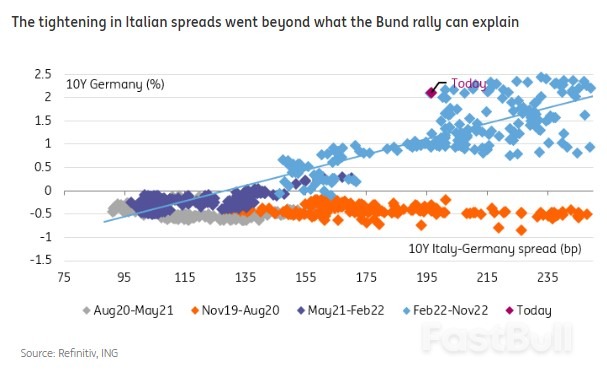
          Peripheral bonds in Europe also joined in on the 'everything rally', benefitting from both the drop in core bond yields on hopes of less aggressive monetary tightening going forward, and more broadly on the improvement in risk sentiment among riskier assets. As a result, the tightening in 10Y Italy-Germany spreads has exceeded what its recent relationship with 10Y Bund yields levels would have suggested.
          This is surely good news for a market that we identified in our 2023 outlook as one of the potential weak links as central banks continue their fight against inflation. But risks remain for higher beta fixed income, such as peripheral bonds. The ECB seems intent on reducing its balance sheet with likely detrimental effects on demand for riskier debt, especially in a recession. The hope is that an early stop to the ECB's hiking cycle, we think it could end in February, would allow markets to digest Quantitative Tightening better, but we won't know for sure until we have more tangible evidence that inflation is indeed on its way down.

          Rates Spark: Poking the Hawks_2Today's events and market view

          Eurozone data consists mostly in Italy's final October CPI print. The European Central Bank will publish its financial stability review.
          The U.S. economic calendar will be livelier with retail sales and industrial production the highlights. Other releases include mortgage applications, import and export price indices, and NAHB housing market index.
          There is a long list of central bank speakers, culminating with BoE Governor Andrew Bailey and ECB President Christine Lagarde.

          Source: ING

          Risk Warnings and Disclaimers
          You understand and acknowledge that there is a high degree of risk involved in trading. Following any strategies or investment methods may lead to potential losses. The content on the site is provided by our contributors and analysts for information purposes only. You are solely responsible for determining whether any trading assets, securities, strategy, or any other product is suitable for investing based on your own investment objectives and financial situation.
          Comments
          Add to Favorites
          Share

          FTX's Bankman-Fried Begged for A Rescue Even as He Revealed Huge Holes in Firm's Books

          Kevin Du

          Cryptocurrency

          As customers withdrew billions of dollars from crypto exchange FTX one frantic Sunday this month, founder Sam Bankman-Fried worked the phones in a futile bid to raise $7 billion in emergency funds.
          Hunkered in his Bahamas apartment, Bankman-Fried toiled through the night, calling some of the world's biggest investors, including Sequoia Capital, Apollo Global Management Inc and TPG Inc, according to three people with knowledge of the matter.
          Sequoia was among investors that lined up only months before to pump money into Bankman-Fried's empire. But not now. Sequoia was shocked at the amount of money Bankman-Fried needed to save FTX, according to the sources, while Apollo first asked for more information, only to later decline. Both firms and TPG declined to comment for this article.
          In the end, the calls came to naught and FTX filed for bankruptcy on Nov. 11, leaving an estimated 1 million customers and other investors facing total losses in the billions of dollars. The collapse reverberated across the crypto world and sent bitcoin and other digital assets plummeting.
          Some details of what happened at FTX have already emerged: Reuters reported Bankman-Fried secretly used $10 billion in customer funds to prop up his trading business, for instance, and that at least $1 billion of those deposits had vanished.
          Now, a review of dozens of company documents and interviews with current and former executives and investors provide the most comprehensive picture so far of how Bankman-Fried, the 30-year-old son of Stanford University professors, became one of the richest men in the world in just a couple of years, then came crashing down.
          The documents, reported here for the first time, include financial statements, business updates, company messages and letters to investors. They, along with the interviews, reveal that:
          -- In presentations to investors, some of the same assets appeared simultaneously on the balance sheets of FTX and of Bankman-Fried's trading firm, Alameda Research – despite claims by FTX that Alameda operated independently.
          -- One of Bankman-Fried's close aides tweaked FTX's accounting software. This enabled Bankman-Fried to hide the transfer of customer money from FTX to Alameda. A screenshot of FTX's book-keeping system showed that even after the massive customer withdrawals, some $10 billion in deposits remained, plus a surplus of $1.5 billion. This led employees to believe wrongly that FTX was on a solid financial footing.
          -- FTX made about $400 million in "software royalty" payments to Alameda over the years. Alameda used the funds to buy FTX's digital coin FTT, reducing supply of the coin and supporting its price.
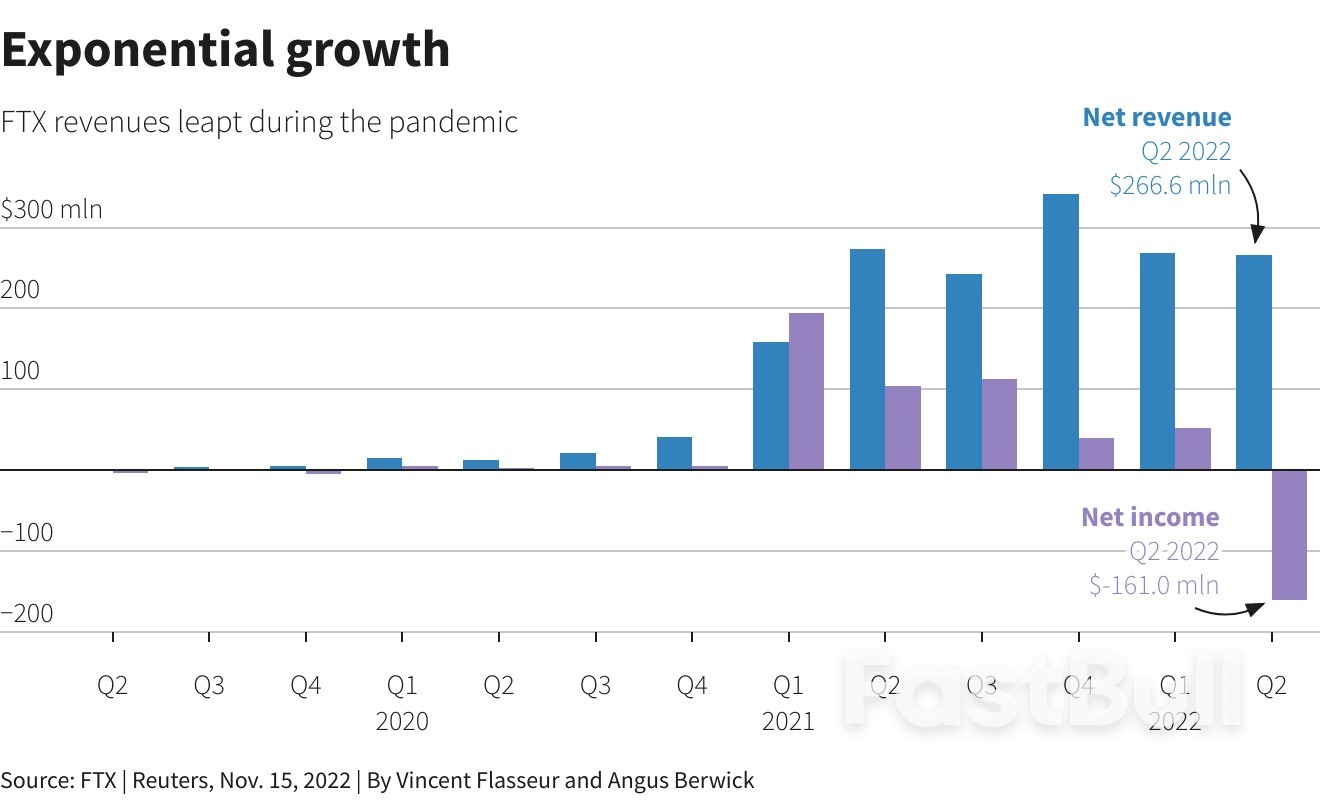
          -- In the second quarter of this year, FTX posted a $161 million loss. Bankman-Fried, meanwhile, had spent some $2 billion on acquisitions.
          -- As Bankman-Fried tried to rescue FTX in its frantic final days, he sought emergency investments from financial behemoths in Saudi Arabia and Japan – and was joined at his Bahamas headquarters by his law professor father.
          Bankman-Fried told Reuters in an email that due to a "confusing internal account," Alameda's leverage was substantially higher than he believed it was. He added that FTX processed roughly $6 billion of client withdrawals.
          He said FTX and Alameda together made a profit of roughly $1.5 billion in 2021, which was more than all of the expenses put together of both organizations since their founding. "I was unfortunately unable to communicate much of what was going on to the broader company in real time because much of what I posted in Slack appeared on Twitter soon after," he added.
          FTX did not respond to questions for this article.
          The U.S. Department of Justice, Securities and Exchange Commission and Commodity Futures Trading Commission are now all investigating FTX, including how it handled customer funds, Reuters has reported. The collapse has shaken investor confidence in cryptocurrencies and led to calls from lawmakers and others for greater regulation of the industry. The CFTC and DOJ declined to comment for this article. The SEC did not respond.

          A Life in The Bahamas

          Born in 1992, Bankman-Fried grew up around Stanford University's Palo Alto-area campus, where both his parents taught at the law school. He landed at the Massachusetts Institute of Technology, where he studied math and physics and embraced the idea of effective altruism, a movement that encourages people to prioritize donations to charities.
          After graduating from MIT in 2014, he took a job on Wall Street with a quantitative trading firm. Bankman-Fried founded Alameda Research three years later, billing it as "a crypto quant trading firm."
          Rejected initially by venture investors, he cobbled together loans and assembled a team of young traders and programmers, many of them sleeping and working in a small walkup apartment in the San Francisco area, according to a profile that later appeared on the website of FTX investor Sequoia.
          Alameda found early trading success by arbitraging cryptocurrency prices on international markets, with half of profits going to charity, according to the same profile. By 2019, the company handled $55 million for clients, an Alameda company booklet said. Reuters could not independently confirm these details.
          The booklet flagged the risks of crypto trading, particularly how sudden sales of tokens could trigger a "domino effect" that would lead to a "cascading set of liquidity failures." It noted that "nothing fundamental" backed bitcoin's value.
          Using profits from Alameda, Bankman-Fried launched FTX in 2019. His aim was to build an "FTX Superapp" that combined cryptocurrency trading, betting markets, stock trading, banking, and peer-to-peer and business payments, according to an FTX marketing document from earlier this year.
          The company's growth over the next two years was only surpassed by his vision.
          FTX's revenues grew from $10 million in 2019 to $1 billion in 2021. From almost nothing in 2019, FTX handled about 10% of global crypto trading this year, a September document shows. It spent roughly $2 billion buying companies, the document shows.
          FTX's Bankman-Fried Begged for A Rescue Even as He Revealed Huge Holes in Firm's Books_1In an undated document, titled 'FTX Roadmap 2022,' the company laid out its goals for the next five to 10 years. It hoped to be "the largest global financial exchange," with $30 billion in annual revenue, more than what U.S. retail brokerage giant Fidelity Investments earned in revenues last year.
          In October 2021, Bankman-Fried, then 29 years old, landed on the cover of Forbes, which pegged his net worth at $26.5 billion – the 25th richest person in America. FTX said on its website that "FTX, its affiliates, and its employees have donated over $10m to help save lives, prevent suffering, and ensure a brighter future."
          Bankman-Fried's personal finances suggest he lived frugally for a billionaire. A financial statement reviewed by Reuters shows that for 2021, he drew an annual salary of $200,000, declared $1 million in real estate assets, and spent $50,000 on personal expenses.
          But in the Bahamas, his lifestyle was more luxurious than his finances showed. At one point, he lived in a penthouse overlooking the Caribbean, valued at almost $40 million, according to two people who worked with FTX.
          Bankman-Fried told Reuters he lived in a house with nine other colleagues. For his employees, he said FTX provided free meals and an "in-house Uber-like" service around the island.

          "Ultimate source of truth"

          This year began with FTX seemingly everywhere.
          Its logo was emblazoned on a major sports arena in Miami and on Major League Baseball umpire uniforms. Sports stars and celebrities including Tom Brady, Gisele Bundchen and Steph Curry became partners in promoting the company. None of them commented for this article. Bankman-Fried became a regular presence in Washington, donating tens of millions of dollars to politicians and lobbying lawmakers on crypto markets.
          FTX was also planning partnerships with some of the world's largest companies. An FTX document from June 2022, which has not been previously reported, shows a list of FTX's "select partners" for business-to-business (B2B) services. Prospective partners included retail giant Walmart Inc, social media titan Meta Platforms Inc, payment-system provider Stripe, and financial website Yahoo! Finance, according to the document.
          A Yahoo spokesperson said, "While we were in very early stages of a prospective partnership with FTX, nothing was close to completion when the events of last week occurred."
          A person with knowledge of the matter said Stripe has no contract with FTX to enable Stripe users to accept crypto payments. Walmart didn't respond to a request for comment about a proposed partnership with FTX for employee investing. Meta too didn't comment about discussions to make FTX a digital-wallet provider for Instagram users.
          Investors loved Bankman-Fried's ambition. FTX had already received more than $2 billion from backers including Sequoia, SoftBank Group Corp, BlackRock Inc and Temasek. In January, FTX raised a further $400 million, valuing the business at $32 billion.
          FTX expected to take its international and U.S. businesses public, an investor due-diligence document from this June said. The document is reported here for the first time.
          At the peak of his powers, Bankman-Fried urged the crypto industry to help governments shape laws to supervise it, saying FTX's goal was to become "one of the most regulated exchanges in the world." "FTX has the cleanest brand in crypto," it proclaimed earlier this year.
          Behind his rapid growth, there was a secret Bankman-Fried kept from most other employees: he had dipped into customer funds to pay for some of his projects, according to company documents and people briefed on FTX's finances. Doing so was explicitly barred in the exchange's terms of use, which affirmed user deposits "shall at all times remain with you."
          FTX generated 2 cents in fees for every $100 traded, documents seen by Reuters show, reaping hundreds of millions of dollars in revenue by 2021. Nonetheless, FTX barely broke even during its first two years, 2019 and 2020. It generated around $450 million in profit in 2021, when crypto markets boomed, but it slumped to a $161 million loss in the second quarter of this year, according to financial records, which are reported here for the first time.
          Some of the $10 billion in removed customers' money went to cover losses that Alameda sustained earlier this year on a series of bailouts, including in failed crypto lender Voyager Digital, according to the three FTX sources briefed on the company's finances.
          FTX also financed acquisitions such as the purchase in May of a $640 million stake in trading platform Robinhood Markets Inc. Robinhood didn't respond to a request for comment.
          Bankman-Fried told Reuters he did not believe that Alameda had substantial losses, including on Voyager, without providing further details.
          Around $1 billion of the $10 billion sum is not accounted for among Alameda's assets, Reuters reported on Friday. Reuters has not been able to trace these missing funds.
          According to the three FTX sources, only Bankman-Fried's innermost circle of associates knew about his use of client deposits: his co-founder and chief technology officer, Gary Wang; the head of engineering, Nishad Singh; and Caroline Ellison, chief executive of Alameda. Wang and Singh both worked with Bankman-Fried at Alameda previously.
          Wang, Singh and Ellison did not return requests for comment.
          To conceal the transfers of customer funds to Alameda, Wang, a former Google software developer, built a backdoor in FTX's book-keeping software, the people said.
          Bankman-Fried often told employees tasked with monitoring the company's financials that the book-keeping system was "the ultimate source of truth" about the company's accounts, two of the people said. But the backdoor, known only to his most trusted lieutenants, allowed Alameda to withdraw crypto deposits without triggering internal red flags, they said.
          FTX also had a vulnerability: its bespoke cryptocurrency.
          Shortly after its launch, FTX introduced its own digital token, called FTT, described on its website as the exchange's "backbone." Staff could opt to receive pay and bonuses in the token, and many of them accumulated fortunes in FTT as its value exploded in 2021, according to the three current and former executives. One executive invested all their savings in FTT, worth millions of dollars, the executive said, "because of loyalty to Sam."
          According to a June 2022 due diligence document Bankman-Fried sent to a potential investor and the company's financial records, FTX paid $400 million to an Alameda subsidiary since 2019 as "software royalty" payments for development work. The subsidiary used the funds to buy FTT and remove the digital tokens from supply, so supporting the price.
          FTX disclosed on its website that it was using part of its trading fees to buy FTT. It did not reveal the arrangement with Alameda.
          Over the years, Alameda accumulated a huge holding of FTT, valued at around $6 billion before last week, according to a balance sheet later sent to investors. It used the FTT reserves to secure corporate loans, people familiar with its finances said. This meant that Bankman-Fried's business empire was dependent on the token.
          That little-known holding became Bankman-Fried's undoing.

          Pressure Builds

          On Nov. 2, news outlet CoinDesk reported a leaked balance sheet disclosing Alameda's reliance on FTT. The head of the world's largest crypto exchange – Bankman-Fried's chief rival – pounced on that report. Binance CEO Changpeng Zhao, citing "recent revelations," said Binance would sell its entire FTT holding due to "risk management."
          Bankman-Fried retorted on Twitter that Zhao was spreading "false rumors." In a since-deleted tweet, he wrote: "FTX has enough to cover all client holdings. We don't invest client assets."
          Nonetheless, FTT came under intense selling pressure, forcing Alameda to buy more of the tokens in an attempt to stabilize the price, a person with knowledge of the trades said. Customers panicked and rushed to withdraw deposits from FTX, with over $100 million flowing out of the firm each hour that Sunday, company documents reviewed by Reuters show.
          In his email to Reuters, Bankman-Fried said, "To my knowledge, Alameda did not buy very much FTT during the crash to stabilize it."
          Staff initially remained calm. The finance team could still see ample assets on the book-keeping portal as of last week. About $10 billion in client deposits remained, with a $1.5 billion surplus to cover any further withdrawals, according to a screenshot of the database seen by Reuters.
          In reality, those funds were gone.
          Several hours after Zhao's Sunday tweet, Bankman-Fried has told Reuters, he gathered his lieutenants Wang and Singh at his apartment to decide on a plan. It was a "rough weekend," he messaged staff on Slack that evening, but "we're chugging along."
          The following day, he summoned several other senior managers to his home to join Wang and Singh. He broke the news to them: FTX was almost out of money.
          This account of the scramble that ensued is based on interviews with three current and former FTX executives briefed by top staff and documents that Reuters reviewed.
          Bankman-Fried showed the executives spreadsheets that revealed there was a $10 billion hole in FTX's finances – because customer deposits had been transferred to Alameda and mostly spent on other assets. The executives were shocked. One of them told Bankman-Fried the spreadsheet presentation contradicted what FTX told regulators about its use of client funds.
          To make up the shortfall, they calculated that Alameda could sell around $3 billion of the assets within hours, mainly money held in company trading accounts on other crypto exchanges. The rest would take days or weeks to offload because it was hard to trade those assets. And FTX urgently needed a further $7 billion in cash to survive.
          So began Bankman-Fried's search for a savior.
          While money continued to drain away from FTX, the three sources told Reuters, he and his aides worked through the night, contacting about a dozen potential investors.
          He turned to the crypto community, too, ringing up the organization behind Tether, the world's largest stablecoin, and asking for a loan. His father, Joseph Bankman, a Stanford Law professor, also arrived to advise his son. Bankman did not respond to a request for comment. In return for any funding, Bankman-Fried pledged to investors most of Alameda's assets, including its holding of FTT, along with his own 75% stake in FTX. But no one came through with an offer.
          One of the investors who turned down Bankman-Fried said his numbers were "very amateurish," without elaborating. Another red flag was that the spreadsheets showed ties between FTX and Alameda, the investor said.
          Around 3 a.m., Bankman-Fried resorted to Zhao, his archrival at Binance. Zhao, widely known by the initials CZ, came to the phone. A few hours later, Zhao sent over a non-binding letter of intent to acquire FTX.com, which Bankman-Fried signed. The pair tweeted a joint announcement later that morning.
          For most FTX employees, this was the first they heard about the company's dire situation. "Just complete disbelief and feelings of betrayal," Zane Tackett, FTX's head of institutional sales, wrote on Twitter the day after. He declined to comment.
          Tackett and some others resigned. "I can't do it anymore," another FTX team member texted colleagues.
          To worsen the pain, the price of the FTT token crashed 80% within three hours of the news, shrinking Alameda's assets further and wiping out many employees' net worth. The executive with millions of dollars in FTT said watching it collapse "was like seeing my world diminishing."
          Bankman-Fried pleaded for employees' forgiveness on Slack, saying he "fucked up" but that the Binance deal allowed them to "fight another day." Less than 30 hours later, Binance pulled out, citing its due diligence. Sequoia then wrote off its $150 million investment in FTX.
          Scrambling to find a savior, Bankman-Fried expanded his search around the world. "I'll keep fighting," he messaged staff.
          He sought to persuade officials at major financial institutions such as Saudi Arabia's Public Investment Fund and Japanese investment bank Nomura Holdings Inc to invest, according to a message he sent on Thursday to advisors, along with two other people familiar with the talks. Those appeals are reported here for the first time. PIF and Nomura did not comment.
          Bankman-Fried also tried to get a group of crypto firms to each pitch in $1 billion. But a balance sheet FTX sent to investors, showing only $900 million in liquid assets, spooked them, according to two people familiar with the matter.
          By Friday, when FTX filed for bankruptcy in the United States, "we were all doomed," an executive said.FTX's Bankman-Fried Begged for A Rescue Even as He Revealed Huge Holes in Firm's Books_2

          FTX's Bankman-Fried Begged for A Rescue Even as He Revealed Huge Holes in Firm's Books_3Source: Reuters

          Risk Warnings and Disclaimers
          You understand and acknowledge that there is a high degree of risk involved in trading. Following any strategies or investment methods may lead to potential losses. The content on the site is provided by our contributors and analysts for information purposes only. You are solely responsible for determining whether any trading assets, securities, strategy, or any other product is suitable for investing based on your own investment objectives and financial situation.
          Comments
          Add to Favorites
          Share

          The Netherlands: Third-Quarter GDP Signals the Start of a Mild Recession

          Michelle

          GDP decline mainly caused by a fall in investment

          The decline in Dutch GDP was in the ballpark of ING forecasts. Investment was the biggest drag on growth, with gross capital formation falling by -1.7% compared to the second quarter. Expenditure volumes fell due to fewer purchases of transport equipment (-11.3%). Investment in housing (-2.7%), non-residential buildings (-1.7%), infrastructure (-1.7%) and intangible assets (-0.4%) also fell. While demand for (the construction of) housing is generally strong in the Netherlands and the government is ambitious with investing in several types of infrastructure, environmental regulations and insufficient administrative capacity limit the number of building permits. Investment in ICT equipment (3.8%) and machinery and other equipment (2.6%) still expanded.
          Government consumption dropped by a minor 0.1%, while the consumption of households stagnated – rising by just 0.1%, somewhat better than expected. While the consumption of services, durable and other non-food goods fell in an environment of higher prices and record low consumer confidence, the consumption volumes of food and tourism abroad rose. Accelerating wages, a tight labour market with low unemployment, high amounts of deposit savings among wealthy households (mostly built-up during Covid-induced lockdowns), the certainty provided by the announcement of fiscal support for households in light of the energy crisis, and an eagerness to go on holiday abroad with few Covid-restrictions may explain why consumption volumes of households have not yet collapsed.
          Dutch exports continue to perform surprisingly well given the worsening international trade environment, with growth of 0.9%. Goods exports expanded by 0.5%, with both domestically-produced goods exports and re-exports showing a positive development. Service exports expanded by 2.3%, at least partially driven by increases in incoming foreign tourism. Imports (1.0%) showed similar growth as exports. Imports of services increased by 1.9%, while goods imports expanded by 0.8%. The overall net contribution of international trade to GDP growth was close to zero (0.05%-point) in the third quarter.

          Decline in the financial sector, retail and construction are the main reasons for the economic contraction

          From a sectoral perspective, value-added fell in the financial sector (-2.6% quarter-on-quarter growth), water utilities (-2.2%), energy supply sector (-1.9%), construction (-1.1%) and trade, transport & hospitality (-0.8%). The latter includes retail, of which sales volumes declined by more than 1% in line with low consumer sentiment. Taking into account the size of sectors as well, it was the financial sector, retail and construction that provided the largest drag on total value-added.
          Semi-public services (-0.2%) and manufacturing (0.0%) stagnated, while value-added still expanded in mining & quarrying (i.e. oil & gas, 3.9%), agriculture & fishery (1.9%), ICT (1.1%), business services (1.1%) and real estate (0.9%). The stagnation of manufacturing stands out positively, as this is despite the fact it has reduced the use of gas strongly (-39% in 3Q22 compared to 3Q19) and some firms were shut down partially or completely, such as those in aluminium, zinc and fertilisers. Manufacturers of pharmaceuticals, cars and trailers, clothing and electrical equipment performed particularly well in terms of production growth in the third quarter.

          Momentum worsens, but indicators and fiscal plans suggest only a mild recession

          The third-quarter figure for GDP is the start of a mild technical recession that we projected for the Dutch economy. We see sentiment indicators based on surveys declining further, in line with a weakening global business cycle. Today's quarterly business sentiment indicator as released by Statistics Netherlands also points in the direction of further worsening of momentum in the market sector, as it dropped across all main sectors. The overall economy-wide indicator fell into negative territory for the first time since 1Q21. Investment expectations for the current year and next year fell but remained net positive. Business expectations for foreign turnover over the next three months also came down but remained positive on balance. So, there is less optimism, but not total gloom about the economy.
          Still, the situation is one of high capacity utilisation. Staff shortages are still the key factor limiting production and sales for the majority of businesses (34%). The share of firms reporting it as the main issue is, however, falling. Although the share of businesses seeing a lack of demand as their main issue has started to rise along with the share of firms claiming financial constraints (at 5%) as the main issue, it is still quite low at 11%. This is a confirmation that the economy is at a turning point of worsening momentum from a high level, and there is no reason for us to project a long and deep recession.
          What's also important going forward is the fact that the Dutch government has announced huge support for households in the form of an energy price cap in 2023 and a €190 tax cut on the energy bill of households and some small firms for November and December 2022. It is also providing financial support to energy-intensive small and medium-sized enterprises (although less so than for households) of up to €160,000 per firm.

          Source: CMC

          Risk Warnings and Disclaimers
          You understand and acknowledge that there is a high degree of risk involved in trading. Following any strategies or investment methods may lead to potential losses. The content on the site is provided by our contributors and analysts for information purposes only. You are solely responsible for determining whether any trading assets, securities, strategy, or any other product is suitable for investing based on your own investment objectives and financial situation.
          Comments
          Add to Favorites
          Share

          Housing Storm Leaves UK Exposed, Skews Policy

          Devin

          Economic

          If financial markets bore the brunt of this year's interest rate shock, housing now stands in the firing line.
          And a residential real estate quake would hurt many economies far more, amplifying the bond market ructions of the past 12 months if inflation can't be contained quickly enough to allow central banks to stop tightening in 2023.
          Overall housing activity - construction, sales and the related demand for goods and services that goes with housing churn - contributes an estimated 16-18% of gross domestic product annually in the United States and Britain. That's well over $4 trillion for the former and half a trillion in the UK.
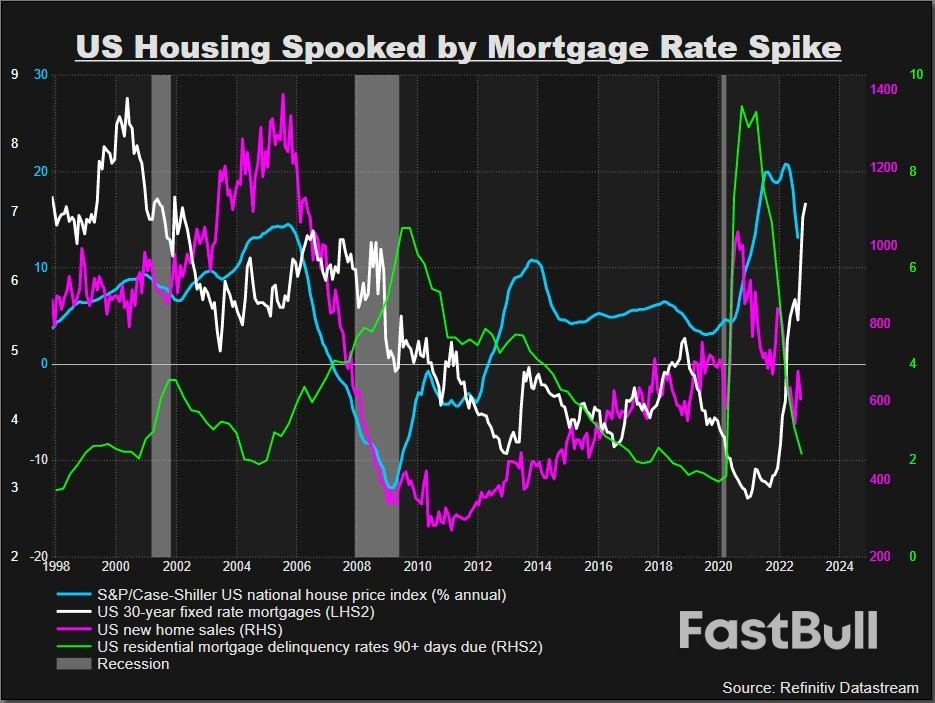
          With long-term U.S. fixed mortgage rates above 7% for the first time in 20 years, and more than double January rates, U.S. housing sales and starts are already feeling the heat.
          And as property has ridden the bond bull market of low inflation and interest rates for much those intervening decades - the sub-prime mortgage crash of 2007-2008 apart - any risk of a paradigm shift in that whole picture is a mega concern.
          Twenty years ago, after the dot.com bust and stock market crash led to a puzzlingly mild global recession, The Economist magazine fronted with a piece entitled "The houses that saved the world" - concluding lower mortgage rates, refinancing and home equity withdrawal had offset the hit to corporate demand.
          But it's much less likely to come to the rescue after this year's stock market swoon, if only because interest rates are heading even higher into 2023 and many now fret about potential distress and delinquency in the sector next year.
          Some 10% of global fund managers polled by Bank of America this month think real estate in developed economies is the most likely source of another systemic credit event going forward.
          And Britain, which even the Bank of England assumes has already entered recession, is particularly vulnerable.
          UK homeowners outsize exposure to floating rate mortgages and greater vulnerability to rising unemployment leaves the British market a potential outlier amid the twin hits of rising Bank of England rates and this week's expected fiscal squeeze.
          Indeed, many feel the extent of finance minister Jeremy Hunt's dramatic fiscal U-turn away from September's botched giveaway budget is precisely to avoid the sort of brutal BoE rate hit to the housing market that had threatened initially.
          British think-tank the National Institute of Economic and Social Research reckons some 2.5 million UK households on variable rate mortgages - about 10% of the total - would be hit hard by further BoE rate rises next year, pushing mortgage costs for about 30,000 beyond monthly incomes if rates hit 5%.
          That partly explains why even though money markets still see BoE rates peaking as high as 4.5%, from 3% at present, high-street clearing banks Barclays and HSBC forecast the central bank's terminal rate as low as 3.5% and 3.75% respectively.Housing Storm Leaves UK Exposed, Skews Policy_1
          Housing Storm Leaves UK Exposed, Skews Policy_2No Housing Saviour
          Goldman Sachs chief economist Jan Hatzius and team feel the threat of a major credit event in developed housing markets may be overstated - as many mortgage holders are still on low, long-term fixed deals and there are substantial home equity buffers.
          But they said Britain stands out nonetheless.
          "We see a relatively greater risk of a meaningful rise in mortgage delinquency rates in the UK," Goldman said this month. "This reflects the shorter duration of UK mortgages, our more negative economic outlook, and the greater sensitivity of default rates to downturns."
          While Australia and New Zealand have higher variable mortgage rates, British mortgage holders also have a higher vulnerability to rising joblessness.
          Goldman estimates that a one percentage point rise in unemployment tends to boost mortgage delinquency rates by more than 20 basis points after one year in Britain - twice as much as the 10bp impact from a similar scenario in the United States.
          All of which bodes ill for UK house prices - although forecasts are still far from apocalyptic.
          UK estate agent Knight Frank expects nationwide house prices to drop 5% next year and again in 2024, a cumulative decline of almost 10% but one that only takes average prices back to where they were in the middle of 2021. Further out they see stagnation persisting - with just a 1.5% cumulative gain in the five years to 2026 and London prices basically flat over all that period.
          NIESR economist Urvish Patel concurred with the thrust of that - expecting lower house prices over the next couple of years but adding "fears of a house price and housing market collapse because of higher mortgage rates are unlikely to be proved correct".
          Offsetting factors are that a majority will be on fixed rates, supply remains tight and stamp duty taxes are due to be cut again, he said.
          But he did point to Bank of England research from 2019 that studied more than 30 years of data and showed that a 1% sustained increase in index‑linked UK government bond yields could ultimately result in a fall in real house prices of just under 20%.
          Ominously perhaps, 10- and 30-year index-linked gilt yields were at the epicentre of the September budget shock. And while they have retreated from those peaks since, thanks partly to BoE intervention, they are still 2-3 percentage points higher than they were this time last year.

          Source: Reuters

          To stay updated on all economic events of today, please check out our Economic calendar
          Risk Warnings and Disclaimers
          You understand and acknowledge that there is a high degree of risk involved in trading. Following any strategies or investment methods may lead to potential losses. The content on the site is provided by our contributors and analysts for information purposes only. You are solely responsible for determining whether any trading assets, securities, strategy, or any other product is suitable for investing based on your own investment objectives and financial situation.
          Comments
          Add to Favorites
          Share
          FastBull
          Copyright © 2025 FastBull Ltd

          728 RM B 7/F GEE LOK IND BLDG NO 34 HUNG TO RD KWUN TONG KLN HONG KONG

          TelegramInstagramTwitterfacebooklinkedin
          App Store Google Play Google Play
          Products
          Charts

          Chats

          Q&A with Experts
          Screeners
          Economic Calendar
          Data
          Tools
          Membership
          Features
          Function
          Markets
          Copy Trading
          Latest Signals
          Contests
          News
          Analysis
          24/7
          Columns
          Education
          Company
          Careers
          About Us
          Contact Us
          Advertising
          Help Center
          Feedback
          User Agreement
          Privacy Policy
          Business

          White Label

          Data API

          Web Plug-ins

          Poster Maker

          Affiliate Program

          Risk Disclosure

          The risk of loss in trading financial instruments such as stocks, FX, commodities, futures, bonds, ETFs and crypto can be substantial. You may sustain a total loss of the funds that you deposit with your broker. Therefore, you should carefully consider whether such trading is suitable for you in light of your circumstances and financial resources.

          No decision to invest should be made without thoroughly conducting due diligence by yourself or consulting with your financial advisors. Our web content might not suit you since we don't know your financial conditions and investment needs. Our financial information might have latency or contain inaccuracy, so you should be fully responsible for any of your trading and investment decisions. The company will not be responsible for your capital loss.

          Without getting permission from the website, you are not allowed to copy the website's graphics, texts, or trademarks. Intellectual property rights in the content or data incorporated into this website belong to its providers and exchange merchants.

          Not Logged In

          Log in to access more features

          FastBull Membership

          Not yet

          Purchase

          Become a signal provider
          Help Center
          Customer Service
          Dark Mode
          Price Up/Down Colors

          Log In

          Sign Up

          Position
          Layout
          Fullscreen
          Default to Chart
          The chart page opens by default when you visit fastbull.com