• Trade
  • Markets
  • Copy
  • Contests
  • News
  • 24/7
  • Calendar
  • Q&A
  • Chats
Trending
Screeners
SYMBOL
LAST
BID
ASK
HIGH
LOW
NET CHG.
%CHG.
SPREAD
SPX
S&P 500 Index
6827.42
6827.42
6827.42
6899.86
6801.80
-73.58
-1.07%
--
DJI
Dow Jones Industrial Average
48458.04
48458.04
48458.04
48886.86
48334.10
-245.98
-0.51%
--
IXIC
NASDAQ Composite Index
23195.16
23195.16
23195.16
23554.89
23094.51
-398.69
-1.69%
--
USDX
US Dollar Index
97.950
98.030
97.950
98.500
97.950
-0.370
-0.38%
--
EURUSD
Euro / US Dollar
1.17394
1.17409
1.17394
1.17496
1.17192
+0.00011
+ 0.01%
--
GBPUSD
Pound Sterling / US Dollar
1.33707
1.33732
1.33707
1.33997
1.33419
-0.00148
-0.11%
--
XAUUSD
Gold / US Dollar
4299.39
4299.39
4299.39
4353.41
4257.10
+20.10
+ 0.47%
--
WTI
Light Sweet Crude Oil
57.233
57.485
57.233
58.011
56.969
-0.408
-0.71%
--

Community Accounts

Signal Accounts
--
Profit Accounts
--
Loss Accounts
--
View More

Become a signal provider

Sell trading signals to earn additional income

View More

Guide to Copy Trading

Get started with ease and confidence

View More

Signal Accounts for Members

All Signal Accounts

Best Return
  • Best Return
  • Best P/L
  • Best MDD
Past 1W
  • Past 1W
  • Past 1M
  • Past 1Y

All Contests

  • All
  • Trump Updates
  • Recommend
  • Stocks
  • Cryptocurrencies
  • Central Banks
  • Featured News
Top News Only
Share

Thai Leader Anutin: Landmine Blast That Killed Thai Soldiers 'Not A Roadside Accident'

Share

Thai Leader Anutin: Thailand To Continue Military Action Until 'We Feel No More Harm'

Share

Cambodian Prime Minister Hun Manet Says He Had Phone Calls With Trump And Malaysian Leader Anwar About Ceasefire

Share

Cambodia's Hun Manet Says USA, Malaysia Should Verify 'Which Side Fired First' In Latest Conflict

Share

Cambodia's Hun Manet: Cambodia Maintains Its Stance In Seeking Peaceful Resolution Of Disputes

Share

Nasdaq Companies: Allergan, Ferrovia, Insmed, Monolithic Power Systems, Seagate Technology, And Western Digital Will Be Added To The NASDAQ 100 Index. Biogen, CdW, GlobalFoundries, Lululemon, ON Semiconductor, And Tradedesk Will Be Removed From The NASDAQ 100 Index

Share

Witkoff Headed To Berlin This Weekend To Meet With Zelenskiy, European Leaders -Wsj Reporter On X

Share

Russia Attacks Two Ukrainian Ports, Damaging Three Turkish-Owned Vessels

Share

[Historic Flooding Occurs In At Least Four Rivers In Washington State Due To Days Of Torrential Rains] Multiple Areas In Washington State Have Been Hit By Severe Flooding Due To Days Of Torrential Rains, With At Least Four Rivers Experiencing Historic Flooding. Reporters Learned On The 12th That The Floods Caused By The Torrential Rains In Washington State Have Destroyed Homes And Closed Several Highways. Experts Warn That Even More Severe Flooding May Occur In The Future. A State Of Emergency Has Been Declared In Washington State

Share

Trump Says Proposed Free Economic Zone In Donbas Would Work

Share

Trump: I Think My Voice Should Be Heard

Share

Trump Says Will Be Choosing New Fed Chair In Near Future

Share

Trump Says Proposed Free Economic Zone In Donbas Complex But Would Work

Share

Trump Says Land Strikes In Venezuela Will Start Happening

Share

US President Trump: Thailand And Cambodia Are In A Good Situation

Share

State Media: North Korean Leader Kim Hails Troops Returning From Russia Mission

Share

The 10-year Treasury Yield Rose About 5 Basis Points During The "Fed Rate Cut Week," And The 2/10-year Yield Spread Widened By About 9 Basis Points. On Friday (December 12), In Late New York Trading, The Yield On The Benchmark 10-year US Treasury Note Rose 2.75 Basis Points To 4.1841%, A Cumulative Increase Of 4.90 Basis Points For The Week, Trading Within A Range Of 4.1002%-4.2074%. It Rose Steadily From Monday To Wednesday (before The Fed Announced Its Rate Cut And Treasury Bill Purchase Program), Subsequently Exhibiting A V-shaped Recovery. The 2-year Treasury Yield Fell 1.82 Basis Points To 3.5222%, A Cumulative Decrease Of 3.81 Basis Points For The Week, Trading Within A Range Of 3.6253%-3.4989%

Share

Trump: Lots Of Progress Being Made On Russia-Ukraine

Share

NOPA November US Soybean Crush Estimated At 220.285 Million Bushels

Share

SPDR Gold Trust Reports Holdings Up 0.22%, Or 2.28 Tonnes, To 1053.11 Tonnes By Dec 12

TIME
ACT
FCST
PREV
U.K. Trade Balance Non-EU (SA) (Oct)

A:--

F: --

P: --

U.K. Trade Balance (Oct)

A:--

F: --

P: --

U.K. Services Index MoM

A:--

F: --

P: --

U.K. Construction Output MoM (SA) (Oct)

A:--

F: --

P: --

U.K. Industrial Output YoY (Oct)

A:--

F: --

P: --

U.K. Trade Balance (SA) (Oct)

A:--

F: --

P: --

U.K. Trade Balance EU (SA) (Oct)

A:--

F: --

P: --

U.K. Manufacturing Output YoY (Oct)

A:--

F: --

P: --

U.K. GDP MoM (Oct)

A:--

F: --

P: --

U.K. GDP YoY (SA) (Oct)

A:--

F: --

P: --

U.K. Industrial Output MoM (Oct)

A:--

F: --

P: --

U.K. Construction Output YoY (Oct)

A:--

F: --

P: --

France HICP Final MoM (Nov)

A:--

F: --

P: --

China, Mainland Outstanding Loans Growth YoY (Nov)

A:--

F: --

P: --

China, Mainland M2 Money Supply YoY (Nov)

A:--

F: --

P: --

China, Mainland M0 Money Supply YoY (Nov)

A:--

F: --

P: --

China, Mainland M1 Money Supply YoY (Nov)

A:--

F: --

P: --

India CPI YoY (Nov)

A:--

F: --

P: --

India Deposit Gowth YoY

A:--

F: --

P: --

Brazil Services Growth YoY (Oct)

A:--

F: --

P: --

Mexico Industrial Output YoY (Oct)

A:--

F: --

P: --

Russia Trade Balance (Oct)

A:--

F: --

P: --

Philadelphia Fed President Henry Paulson delivers a speech
Canada Building Permits MoM (SA) (Oct)

A:--

F: --

P: --

Canada Wholesale Sales YoY (Oct)

A:--

F: --

P: --

Canada Wholesale Inventory MoM (Oct)

A:--

F: --

P: --

Canada Wholesale Inventory YoY (Oct)

A:--

F: --

P: --

Canada Wholesale Sales MoM (SA) (Oct)

A:--

F: --

P: --

Germany Current Account (Not SA) (Oct)

A:--

F: --

P: --

U.S. Weekly Total Rig Count

A:--

F: --

P: --

U.S. Weekly Total Oil Rig Count

A:--

F: --

P: --

Japan Tankan Large Non-Manufacturing Diffusion Index (Q4)

--

F: --

P: --

Japan Tankan Small Manufacturing Outlook Index (Q4)

--

F: --

P: --

Japan Tankan Large Non-Manufacturing Outlook Index (Q4)

--

F: --

P: --

Japan Tankan Large Manufacturing Outlook Index (Q4)

--

F: --

P: --

Japan Tankan Small Manufacturing Diffusion Index (Q4)

--

F: --

P: --

Japan Tankan Large Manufacturing Diffusion Index (Q4)

--

F: --

P: --

Japan Tankan Large-Enterprise Capital Expenditure YoY (Q4)

--

F: --

P: --

U.K. Rightmove House Price Index YoY (Dec)

--

F: --

P: --

China, Mainland Industrial Output YoY (YTD) (Nov)

--

F: --

P: --

China, Mainland Urban Area Unemployment Rate (Nov)

--

F: --

P: --

Saudi Arabia CPI YoY (Nov)

--

F: --

P: --

Euro Zone Industrial Output YoY (Oct)

--

F: --

P: --

Euro Zone Industrial Output MoM (Oct)

--

F: --

P: --

Canada Existing Home Sales MoM (Nov)

--

F: --

P: --

Euro Zone Total Reserve Assets (Nov)

--

F: --

P: --

U.K. Inflation Rate Expectations

--

F: --

P: --

Canada National Economic Confidence Index

--

F: --

P: --

Canada New Housing Starts (Nov)

--

F: --

P: --

U.S. NY Fed Manufacturing Employment Index (Dec)

--

F: --

P: --

U.S. NY Fed Manufacturing Index (Dec)

--

F: --

P: --

Canada Core CPI YoY (Nov)

--

F: --

P: --

Canada Manufacturing Unfilled Orders MoM (Oct)

--

F: --

P: --

Canada Manufacturing New Orders MoM (Oct)

--

F: --

P: --

Canada Core CPI MoM (Nov)

--

F: --

P: --

Canada Manufacturing Inventory MoM (Oct)

--

F: --

P: --

Canada CPI YoY (Nov)

--

F: --

P: --

Canada CPI MoM (Nov)

--

F: --

P: --

Canada CPI YoY (SA) (Nov)

--

F: --

P: --

Canada Core CPI MoM (SA) (Nov)

--

F: --

P: --

Q&A with Experts
    • All
    • Chatrooms
    • Groups
    • Friends
    Connecting
    .
    .
    .
    Type here...
    Add Symbol or Code

      No matching data

      All
      Trump Updates
      Recommend
      Stocks
      Cryptocurrencies
      Central Banks
      Featured News
      • All
      • Russia-Ukraine Conflict
      • Middle East Flashpoint
      • All
      • Russia-Ukraine Conflict
      • Middle East Flashpoint
      Search
      Products

      Charts Free Forever

      Chats Q&A with Experts
      Screeners Economic Calendar Data Tools
      Membership Features
      Data Warehouse Market Trends Institutional Data Policy Rates Macro

      Market Trends

      Market Sentiment Order Book Forex Correlations

      Top Indicators

      Charts Free Forever
      Markets

      News

      News Analysis 24/7 Columns Education
      From Institutions From Analysts
      Topics Columnists

      Latest Views

      Latest Views

      Trending Topics

      Top Columnists

      Latest Update

      Signals

      Copy Rankings Latest Signals Become a signal provider AI Rating
      Contests
      Brokers

      Overview Brokers Assessment Rankings Regulators News Claims
      Broker listing Forex Brokers Comparison Tool Live Spread Comparison Scam
      Q&A Complaint Scam Alert Videos Tips to Detect Scam
      More

      Business
      Events
      Careers About Us Advertising Help Center

      White Label

      Data API

      Web Plug-ins

      Affiliate Program

      Awards Institution Evaluation IB Seminar Salon Event Exhibition
      Vietnam Thailand Singapore Dubai
      Fans Party Investment Sharing Session
      FastBull Summit BrokersView Expo
      Recent Searches
        Top Searches
          Markets
          News
          Analysis
          User
          24/7
          Economic Calendar
          Education
          Data
          • Names
          • Latest
          • Prev

          View All

          No data

          Scan to Download

          Faster Charts, Chat Faster!

          Download App
          English
          • English
          • Español
          • العربية
          • Bahasa Indonesia
          • Bahasa Melayu
          • Tiếng Việt
          • ภาษาไทย
          • Français
          • Italiano
          • Türkçe
          • Русский язык
          • 简中
          • 繁中
          Open Account
          Search
          Products
          Charts Free Forever
          Markets
          News
          Signals

          Copy Rankings Latest Signals Become a signal provider AI Rating
          Contests
          Brokers

          Overview Brokers Assessment Rankings Regulators News Claims
          Broker listing Forex Brokers Comparison Tool Live Spread Comparison Scam
          Q&A Complaint Scam Alert Videos Tips to Detect Scam
          More

          Business
          Events
          Careers About Us Advertising Help Center

          White Label

          Data API

          Web Plug-ins

          Affiliate Program

          Awards Institution Evaluation IB Seminar Salon Event Exhibition
          Vietnam Thailand Singapore Dubai
          Fans Party Investment Sharing Session
          FastBull Summit BrokersView Expo

          New West-East Route Keeps Europe Hooked on Russian Gas

          Owen Li

          Energy

          Economic

          Commodity

          Summary:

          Western European governments have sought to reduce their energy dependence on Russia since the outbreak of the Ukraine war, but when it comes to gas...

          Western European governments have sought to reduce their energy dependence on Russia since the outbreak of the Ukraine war, but when it comes to gas, they have increasingly substituted the country's pipeline supplies with its liquefied natural gas (LNG).
          A Reuters analysis of data found more than a tenth of the Russian gas formerly shipped by pipeline to the European Union has been replaced by LNG delivered into EU ports.
          The rise is partly the result of discounts, industry and trading sources say.
          Private Russian producer Novatek last year sold cut-rate cargoes into the EU rejected by buyers in other parts of the world, while state-owned Gazprom increased exports from its new Portovaya LNG project, offseting its falling pipeline deliveries westward.
          Home to the EU's largest fleet of import terminals, Spain, which did not previously import piped Russian gas, has become the top re-exporter of seaborne Russian supply.
          EU statistics and Reuters calculations show the rise in LNG has pushed the share of Russian gas in EU supply back up to around 15% after pipeline imports from Gazprom had plunged since the war to 8.7% from 37% of EU gas supply.
          Russia sent more than 15.6 million metric tons (mt) of Russian LNG to EU ports last year, according to data analytics firm Kpler, a slight increase from 2022 and a 37.7% jump compared to 2021.
          The rise does not breach EU law.
          Western European governments-imposed sanctions on oil following the outbreak of the Ukraine war in February 2022, but they have not done the same for natural gas.
          Instead the European Commission has called for a voluntary phaseout of all Russian fuel imports by 2027.
          The switch from pipeline to LNG imports has, however, a significant environmental cost, as energy is required to gasify, ship and re-liquefy the fuel - a trend at odds with the EU goal of reaching net zero greenhouse gas emissions by 2050.New West-East Route Keeps Europe Hooked on Russian Gas_1

          New West-East Route Keeps Europe Hooked on Russian Gas_2Ultimate Origin Becomes Invisible

          Delivery records only show cargoes' previous destinations, rather than the ultimate origin.
          That means LNG landing in Belgium, France Spain and the Netherlands sheds its Russian label - which can deter buyers - before being piped inland or reloaded onto other ships.New West-East Route Keeps Europe Hooked on Russian Gas_3
          In late 2023, independent traders sold Russian volumes on the Spanish market at a discount of 1 euro ($1.07) per megawatt-hour (MWh) cheaper than the European benchmark price TTF, industry and trading sources told Reuters.
          That equates to savings of roughly 920,000 euros on a typical cargo worth 41 million euros at spot prices, Reuters calculations showed.
          This year, a discount of between 30-50 eurocents has applied, the sources said.
          Sales data is private, but ship-tracking satellites showed four Swiss trading firms bought and sold 1.3 mt of Russian LNG in Spain last year: Gunvor, MET, ENET and DXT.
          That included a cargo initially destined for Argentina, before concerns over sanctions on financial transactions with Russia stopped the sale.
          Gunvor diverted the rejected tanker to Spain.
          Gunvor and MET declined comment on their Russian trading. ENET and DXT did not respond to Reuters requests for comment.
          Large Spanish energy companies, including Repsol, Cepsa, Endesa and Iberdrola said they do not buy Russian gas directly.
          However, Endesa CEO José Bogas did not rule out that it found its way into volumes bought from third parties.
          Spain's Naturgy, France's TotalEnergies and Britain's Shell, have stopped additional spot purchases, but say they are obliged to pay for the minimum amount of gas on their long-term contracts whether they take it or not.
          The Russian imports have reshaped Spain's and the EU's energy profile.New West-East Route Keeps Europe Hooked on Russian Gas_4
          In 2023 the 5.08 mt imported from Russia slightly exceeded the total volume of gas Spain exported to 21 countries around the world, including some members of the EU.New West-East Route Keeps Europe Hooked on Russian Gas_5

          Reversal of Flows

          Until February 2022, the bulk of the gas Russia supplied to Europe arrived through the Nord Stream pipeline to Germany. Now, it lands on Europe's western periphery and makes its way inland, reversing the previous east-to-west flow.
          France's 3.6 mt of Russian LNG imports last year represented 41% of its net exports.
          When adding in the volumes sent eastward by Portugal and Spain, all the gas France piped to Belgium and Germany and nearly half what was sent to Switzerland and Italy could be attributed to Russian LNG, data from grid operators show.
          Belgium imported some 4.8 mt of Russian LNG - almost double the volume it piped to the Netherlands.
          About 0.7 mt came in through Dutch terminals.
          Those calculations exclude transhipments, when LNG switches ships in an EU port before sailing on.
          Germany - which no longer directly imports Russian gas - is the ultimate destination.
          Last year, Germany imported 48.6% of its gas via pipeline from Belgium, France and the Netherlands, according to the federal network regulator Bundesnetzagentur.
          As much as 13.7% of gas in the German grid could be Russian, in a scenario where those countries passed on as much Novatek LNG as possible.
          The reality is probably less when accounting for national consumption and supply mixes.
          "Physically, it is conceivable that Russian gas molecules could come to Germany," a Bundesnetzagentur spokesperson said.
          "We do not know whether German importers buy Russian LNG quantities directly. It would not be prohibited," the spokesperson added.New West-East Route Keeps Europe Hooked on Russian Gas_6

          Struggle To Reduce Reliance

          As the share of Russian LNG grows, the impact particularly stands out in Greece.
          It cut gas consumption and reduced its pipeline Russian imports by 20%.
          But because Gazprom LNG deliveries more than quadrupled, the share of Russian gas in Greece's supply reached 47% last year, up from 36% in 2022, according to grid operator DEFSA.
          Greece's state-controlled DEPA has since filed for arbitration against Gazprom, partly based on data showing those LNG sales to Greek competitors were at a steep discount to DEPA's pipeline gas contract price.
          Beginning in April, EU countries can legally ban Russian firms from booking their infrastructure capacity to deliver LNG.
          Major importers Spain and Belgium, however, said they probably will not do so.
          "If I ban it unilaterally and it comes to France?" Spanish Energy Minister Teresa Ribera said. "We need a common position."
          ($1 = 0.9305 euros)

          Source: Yahoo

          To stay updated on all economic events of today, please check out our Economic calendar
          Risk Warnings and Disclaimers
          You understand and acknowledge that there is a high degree of risk involved in trading. Following any strategies or investment methods may lead to potential losses. The content on the site is provided by our contributors and analysts for information purposes only. You are solely responsible for determining whether any trading assets, securities, strategy, or any other product is suitable for investing based on your own investment objectives and financial situation.
          Add to Favorites
          Share

          A Deep Look at Breadth of Market Theory

          Glendon
          Investors often focus on major stock indexes like the S&P 500 to understand market direction. But what if there was a way to assess the health of the market beyond just a few big movers? This is where the Breadth of Market Theory comes in.

          Understanding Market Breadth: A Deeper Look

          Market breadth, the foundation of the Breadth of Market Theory, is a concept in technical analysis that focuses on the participation level within an index. It goes beyond simply looking at the index itself and dives into the number of stocks within that index that are advancing versus those that are declining. This provides a more nuanced view of the market's overall health and direction. It's a tool used by both traders and investors to analyze the price movements of stocks listed on an exchange, like the S&P 500 on the New York Stock Exchange (NYSE).

          Breadth Indicators: Guiding Lights for Market Trends

          At the heart of this theory are breadth indicators. These tools act like gauges, measuring the balance between advancing and declining stocks (and their trading volume). A rising breadth indicator, where "up" outweighs "down," suggests a healthy market that's likely to support increasing index prices. Conversely, a divergence between the indicator and the index itself can be a warning sign, potentially foreshadowing a shift in the index's direction.

          Aiding the Investment Journey, Not Dictating It

          While powerful, breadth indicators are not crystal balls. They don't provide pinpoint timing for market movements. Instead, they're best used as part of a wider analysis toolkit. By incorporating this information alongside other technical and fundamental analysis techniques, investors can gain a more comprehensive understanding of market sentiment.

          Popular Tools and Their Limitations

          Some of the most popular breadth indicators include the Advance/Decline (A/D) Ratio and Line. These tools track the difference between advancing and declining stocks, offering valuable insights into market dynamics. However, it's important to acknowledge their limitations. Breadth indicators rely on historical data, and their predictive power can be imprecise.

          The Bigger Picture: Market Health Beyond the Index

          In essence, the Breadth of Market Theory equips investors with a broader view. It goes beyond the surface level of major indexes, offering valuable insights into the overall participation within the market. By understanding the balance between advancing and declining stocks, investors can make more informed decisions as they navigate the ever-changing market landscape.

          Additional Insights from Market Breadth

          Predicting Potential Reversals: Market breadth can help predict potential price reversals by offering early signs of both bullish and bearish market sentiments.
          Market Breadth Indications: Positive market breadth signifies a bullish sentiment with more stocks advancing, while negative breadth suggests a bearish sentiment with more stocks declining. Confirmation occurs when market breadth aligns with index movement, and divergence suggests a possible reversal or weakness in the trend.
          Market Breadth and Trade Volume: Trade volume is a critical component that adds depth to the analysis. Significant price movements backed by high trade volumes are considered more credible. Market breadth can highlight discrepancies between the overall index performance and individual stock movements, aiding traders in making informed decisions.
          Types of Breadth Indicators: There are various indicators, each with different calculation methods and conveying unique market information. Some focus solely on the advance-decline ratio, while others incorporate trade volume or compare stock prices against other benchmarks.
          Here are some popular examples: Advance-Decline Index (A/D line): Offers a net difference between advancing and declining stocks, helping to identify market trends and potential weaknesses in uptrends.
          New Highs-Lows Index: Compares stocks hitting 52-week highs versus those at 52-week lows to gauge market bullishness or bearishness.S&P 500 200-Day Index: Measures the percentage of S&P 500 stocks above their 200-day moving average, indicating general market sentiment.
          Cumulative Volume Index: Calculates the net volume of advancing versus declining stocks, assisting in assessing overall market mood.
          Market breadth offers a layer of insight beyond simple index chart analysis, revealing undercurrents in market sentiment and potential shifts in trend direction. It's a valuable tool for technical traders aiming to understand the broader market dynamics and make informed investment decisions.
          Risk Warnings and Disclaimers
          You understand and acknowledge that there is a high degree of risk involved in trading. Following any strategies or investment methods may lead to potential losses. The content on the site is provided by our contributors and analysts for information purposes only. You are solely responsible for determining whether any trading assets, securities, strategy, or any other product is suitable for investing based on your own investment objectives and financial situation.
          Add to Favorites
          Share

          Here’s Why 5% is Again a Risk for the US 10yr

          ING

          Economic

          Central Bank

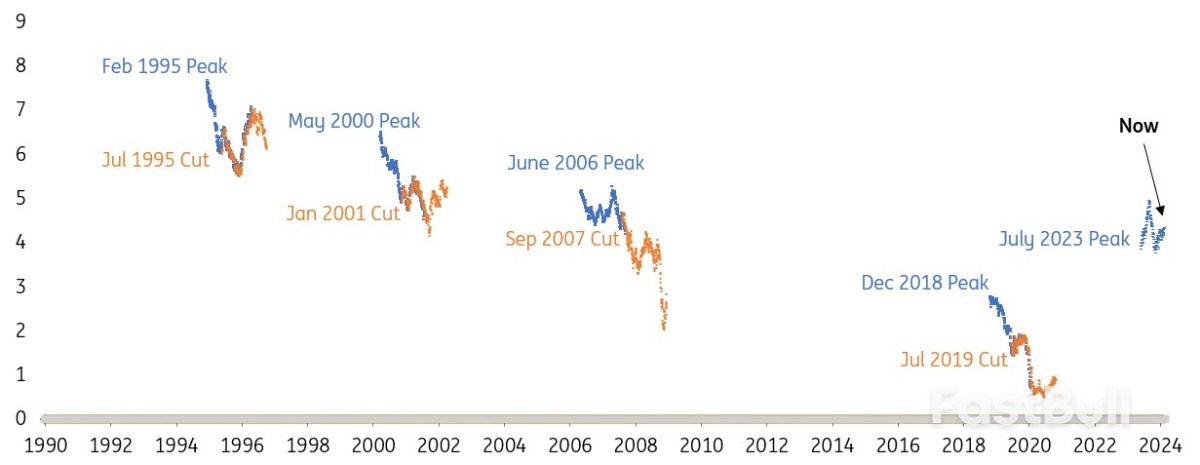
          In previous cycles, the 10yr yield typically managed to fall, appreciably (blue line in graph below). In the current cycle, the 10yr yield has in fact risen post the peak, and hit its cycle high of 5% in October 2023, some three months after the funds rate peak. And it remains elevated.
          What is clear is market rates have not fallen by anything near what would have been typically expected from a “Fed peak moment”. Firm labour market data and pops in inflation data have muddied the water. And the latest payrolls report largely contains more of the same.

          The US 10yr (%) as the Fed peaks (blue), and then cuts (orange)

          The blue line in the graph below shows the movement in the 10yr yield from the moment the Fed peaks. The orange line shows the movement in the 10yr yield from the moment the Fed cuts. It then extends for 18 months of data.
          Here’s Why 5% is Again a Risk for the US 10yr_1
          History shows that when the Fed actually cuts for the first time, market rates have tended to pop higher for a bit (chart above). That’s typically a sell on the fact, as the prior rumor had been bought into. But ultimately as the Fed continues to cut, the 10yr yield follows through with further falls, and finds a new bottom.
          The magnitude of fall has typically been similar post the peak, and then post the first cut. And the aggregate size of falls are broadly proportional to the size of the rate cuts delivered.
          In the current cycle, we’ve not had the first phase fall in the 10yr yield post the peak in rates (hence the confused Martian). In part this reflects a relative shortage of longer-dated Treasuries, a legacy of the pandemic-induced build of Federal Reserve holdings of Treasuries (albeit now falling). This helped manifest in an extremely inverted 2/10yr curve at the moment of the Fed peak. The 10yr yield was still below 4% when the funds rate hit 5.3%.
          The subsequent move in the 10yr to 5% by October 2023 helped to do some dis-inversion from both ends. And in fact by quite a considerable amount, as the 2/10yr moved from -100bp then to -35bp now (chart below). Previous cycles show that the Fed peak tends to mark the beginning of a dis-inversion (or steepening). But the bulk of the dis-inversion / steepening occurs once the Fed actually starts to cut rates.

          US 2/10yr curve (bp) as the Fed peaks (blue) and then cuts (orange)

          The blue line in the graph below shows the movement in the 2/10yr curve from the moment the Fed peaks. The orange line shows the movement in the 2/10yr curve from the moment the Fed cuts. It then extends for 18 months of data.
          Here’s Why 5% is Again a Risk for the US 10yr_2

          There are a number of implications from this.

          First, at the moment the Fed peaked the 10yr yield was arguably too low and the curve too inverted. That has been in part corrected since.
          Second, we actually don’t know for sure that the Fed has peaked. It likely has. But until it cuts, by definition it has not peaked.
          Third, the data since the Fed has peaked has not been consistent with an excuse to cut, which delays confirmation of July 2023 as the peak.
          That in turn exposes an excuse for the 10yr yield to continue to re-test higher, for as long as the economy refuses to lie down. We’re now approaching 4.5%. Hit that, and the next big target is a potential re-visit of 5%. With another run of 0.3% month-on-month readings for March inflation coming in the next few weeks, the pressure builds in that direction.

          Source: ING

          To stay updated on all economic events of today, please check out our Economic calendar
          Risk Warnings and Disclaimers
          You understand and acknowledge that there is a high degree of risk involved in trading. Following any strategies or investment methods may lead to potential losses. The content on the site is provided by our contributors and analysts for information purposes only. You are solely responsible for determining whether any trading assets, securities, strategy, or any other product is suitable for investing based on your own investment objectives and financial situation.
          Add to Favorites
          Share

          US Inflation Unexpectedly Climbs, Shaking Up Gold Market and Investor Confidence

          Glendon
          US Inflation Unexpectedly Climbs, Shaking Up Gold Market and Investor Confidence_1
          The US economic landscape took a surprising turn in February, with the Consumer Price Index (CPI) exceeding analyst expectations and surging to 3.2%. This unexpected rise in inflation rattled markets accustomed to a more subdued trend. The news came alongside robust economic indicators, particularly a booming job market with a significant increase in new positions. This seemingly contradictory data set has created a wave of uncertainty, with the gold market acting as a microcosm of the larger financial climate.

          Gold's Initial Jump and Subsequent Slide

          Traditionally viewed as a hedge against inflation, gold prices initially reacted positively to the news. Investors seeking a haven drove the price of gold per ounce to a peak of $2,330 in February. However, the strong job market data threw a wrench into this initial surge. A robust economy often translates to the Federal Reserve (Fed) taking a more hawkish stance on interest rates. The prospect of steady or even rising interest rates diminishes the appeal of gold as an investment, as higher-yielding options like bonds become more attractive. This interplay of factors caused gold prices to fall back after their initial climb.

          Uncertainty Reigns as All Eyes Turn to the Fed

          The upcoming Fed policy meeting hangs heavy over the future trajectory of gold and other assets. Investors are hanging on every word, searching for any clues regarding potential interest rate cuts. A decision to hold rates steady or even raise them could further dampen the appeal of gold. This uncertainty extends beyond gold, affecting various asset classes as investors grapple with the possibility of a more aggressive Fed stance in response to rising inflation.

          Beyond February: A Continued Focus on Economic Data

          The coming weeks and months will likely see a laser focus on economic data releases. Investors are waiting with bated breath for any hint of a slowdown in inflation or a cooling job market. These factors will be crucial for the Fed in determining its monetary policy. This ongoing economic assessment will be a key driver of gold prices and the broader financial markets.
          A Delicate Balancing Act
          The Fed faces a delicate balancing act. While rising inflation requires action, a robust job market signifies a strong economy. Overly aggressive measures to curb inflation could stifle economic growth, while inaction could see inflation spiral further out of control. Striking the right balance will be key to navigating this complex economic landscape.

          Conclusion: A Mixed Bag with Unforeseen Consequences

          February's economic data presented a mixed bag for investors. Rising inflation suggests a potential haven for gold, but the robust job market points towards a strong economy and a potentially less accommodative Fed. The upcoming Fed meeting and ongoing economic data releases will be crucial in determining the fate of the gold market and the broader financial landscape. As the economic picture continues to unfold, one thing is certain: volatility is likely to remain a key player in the coming months.
          Risk Warnings and Disclaimers
          You understand and acknowledge that there is a high degree of risk involved in trading. Following any strategies or investment methods may lead to potential losses. The content on the site is provided by our contributors and analysts for information purposes only. You are solely responsible for determining whether any trading assets, securities, strategy, or any other product is suitable for investing based on your own investment objectives and financial situation.
          Add to Favorites
          Share

          What's at Stake in South Korea's Election

          Thomas

          Political

          Campaigning for South Korea's legislative election is in full swing ahead of an April 10 vote that will decide the make-up of its 300-strong National Assembly. The assembly will set the agenda largely for domestic politics for the next four years.

          Why does the election matter?

          The election comes nearly two years after conservative President Yoon Suk Yeol won the 2022 presidential election defeating Lee Jae-myung of the Democratic Party by 0.73% - the slimmest margin in South Korean history.
          Yoon has suffered from low approval ratings for months and will further lose momentum if his People Power Party performs poorly in the election or is unable to claim a majority in the parliament, currently dominated by the Democratic Party.
          "With the opposition-led parliament, it has been hard to make a policy push or achievement over the last two years. Without change during the rest of his term, it would be extremely hard to do his job," said Lee Jun-han, professor of political science at Incheon National University.
          Analysts said Seoul's foreign policy, which has sought closer ties with Washington and Tokyo under Yoon, will not change significantly whoever wins. South Korea's powerful presidency leaves little room for parliament to weigh in on the president's foreign policy agenda.

          What are the key issues?

          In recent polls, the cost of living and high food inflation have emerged as key issues among voters. The price tag of green onions has made headlines after Yoon's visit to a supermarket.
          Another issue is the prolonged doctors' strike by trainee doctors and some senior doctors. Yoon showed the first signs of flexibility in his medical reform plan this week.
          Polls showed increasing public support for a compromise between the doctors and the government which plans to increase medical school admissions by 2,000 starting 2025.
          Political parties have also vowed to tackle the fertility crisis with measures such as public housing and tax breaks. South Korea has the world's lowest fertility rate, or the average number of children born to a woman, and data shows it is likely to fall to 0.68 in 2024, past the figure of 0.78 in 2022, which was already a record low.
          Corruption remains a major issue. Likely flashpoints are the ambassador to Australia who resignedlast month amid controversy over his appointment while being under a corruption investigation and the First Lady's "Dior bag scandal". Main opposition leader Lee Jae-myung is facing trials over charges including bribery which will see him appear in court during the election cycle.

          How does the election system work?

          South Korea has a partly proportional representation system for its legislative elections which means voters will cast one ballot for district representatives, who have 254 seats in the parliament. They will also vote for a political party which will decide the share of the 46 proportional representation seats.
          The rise of third parties in recent polls has come as a surprise in the fourth-largest economy in Asia where politics is often dominated by the two major parties.
          More than 20% of voters said they would vote for a third party launched by former justice minister Cho Kuk via the proportional representation vote, according to a Gallup poll released on March 29. Cho is also facing jail time in a fraud case.
          Hong Won-pyo, a 67-year-old from Seoul, said he would vote for a third party as a protest vote because he is dissatisfied with both the ruling People Power Party and the main opposition Democratic Party.
          "I don't agree with voting for either of the two main parties just because you dislike the other."

          Source: The Star

          Risk Warnings and Disclaimers
          You understand and acknowledge that there is a high degree of risk involved in trading. Following any strategies or investment methods may lead to potential losses. The content on the site is provided by our contributors and analysts for information purposes only. You are solely responsible for determining whether any trading assets, securities, strategy, or any other product is suitable for investing based on your own investment objectives and financial situation.
          Add to Favorites
          Share

          Stock Market Crashes Are Rare, Equity Bubbles Even Rarer

          Cohen

          Economic

          Stocks

          If you're sure we're in a mass-market equity bubble, you probably have to rely on instinct as to what happens next as there are precious few historical examples to guide you as to when, where or even if it will implode.
          One reason people continually compare the tech-led U.S. stock market boom of the moment to the disastrous dotcom implosion in 2000 is that the latter is really the only true U.S. equity market bubble and bust of the post-World War Two period.
          And while there's good reason to fear a repeat of that millennium psychosis - the bear market that ensued lasted almost three years and markets didn't durably recover the peaks for over a decade - the timing of the bust was almost random. The market eventually just fell over itself.
          It's one of the few stock market busts in decades not triggered by an external shock or specific event - or circumstances beyond what might be deemed the plain old 'irrational exuberance' of stock investors themselves.
          Black Monday in 1987? High valuations, yes, but also worries over growth, inflation and the trade deficit. 2008? A U.S. housing bust, banking crash and credit crunch. 2020? A global pandemic. 2022? An energy and supply chain shock from Russia's invasion of Ukraine that spiked inflation and interest rates.
          But more than most, the bursting of the dotcom bubble in 2000 was the result of ever crazier valuations that eventually succumbed to the laws of gravity - in large part because there was scant revenue or profit growth emerging to back them up.
          Tech today is nowhere near as expensive, and is riding a very real boom in underlying revenues. Yet pockets could get extremely frothy very soon.
          And if there is a bust looming, like 2000, it is not immediately clear what will trigger it. Recession seems a ways off, businesses are not over-extended and are cash-rich, the Fed's next move on rates will almost certainly be a cut, and earnings growth forecasts are in double digits for next year.Stock Market Crashes Are Rare, Equity Bubbles Even Rarer_1

          Fair Value

          The crash of 2000 was the most prolonged and one of the deepest of recent decades - the Nasdaq bubble took three years to deflate, the peak-to-trough fall was a staggering 80%, and it was 16 years before the index revisited its previous high.
          Black Monday in October 1987 may have been the biggest one-day collapse ever, but the Dow and S&P 500 ended that year higher. The recoveries from the Great Financial Crisis and pandemic crashes, aided by vast monetary and fiscal support, were far quicker too.
          On some level, it may be that purely speculative market runs that eventually get crushed under their own weight leave deeper scars.
          "Only the dotcom implosion was an equity bubble," says Barry Ritholtz, CIO of Ritholtz Wealth Management, noting that a bubble is typically an asset class that becomes un-moored from intrinsic value, that leads to excessive speculation, that leads to a giant market crash.
          He echoes the broad consensus that while the 'Magnificent 7' clutch of mega tech stocks powering the market higher are expensive, they are not in that space yet. Expectations of $2 trillion in revenue and $300 billion profits this year see to that.
          "Are they above fair value? Probably, but all great stocks are. Fair value is not a magnet that automatically draws markets there. In fact, stocks rarely find themselves at fair value," he says.Stock Market Crashes Are Rare, Equity Bubbles Even Rarer_2

          Stock Market Crashes Are Rare, Equity Bubbles Even Rarer_3Hope And Momentum

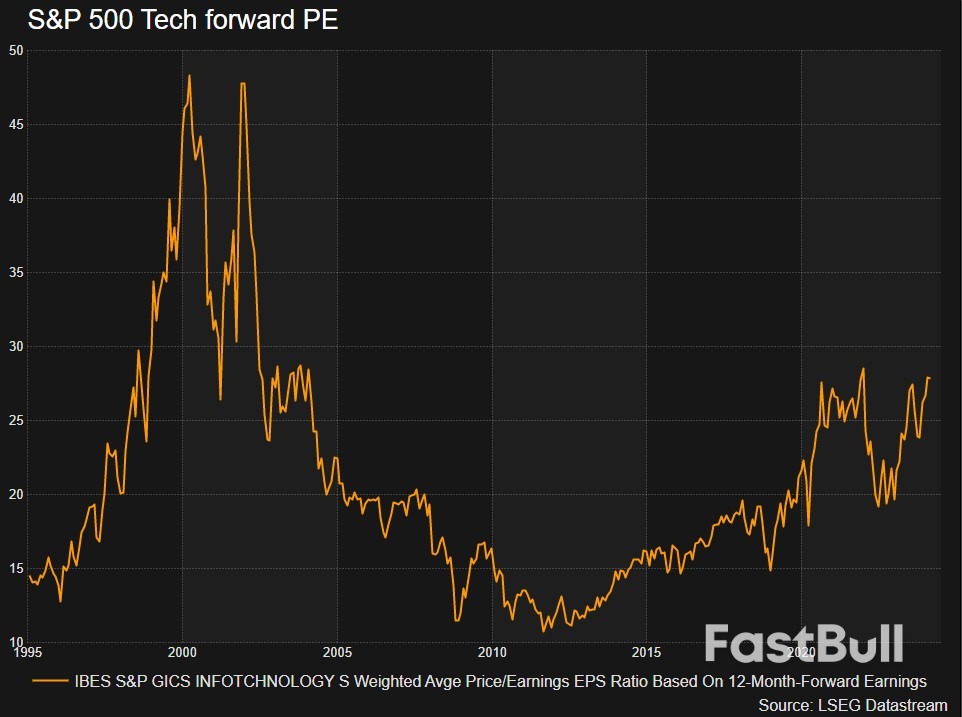
          Accurately assessing 'fair value' is difficult, but most people would agree tech and the wider market were well above it in early 2000 - tech stocks were trading up to 70 times forward earnings.
          Contrast that with valuations just before the busts in 2008 and 2020. They were much lower, particularly in 2008, which may help explain why the drawdowns were shallower and relatively short-lived.
          In real terms the dotcom drawdown lasted over a decade, second only behind the Great Depression, according to UBS.
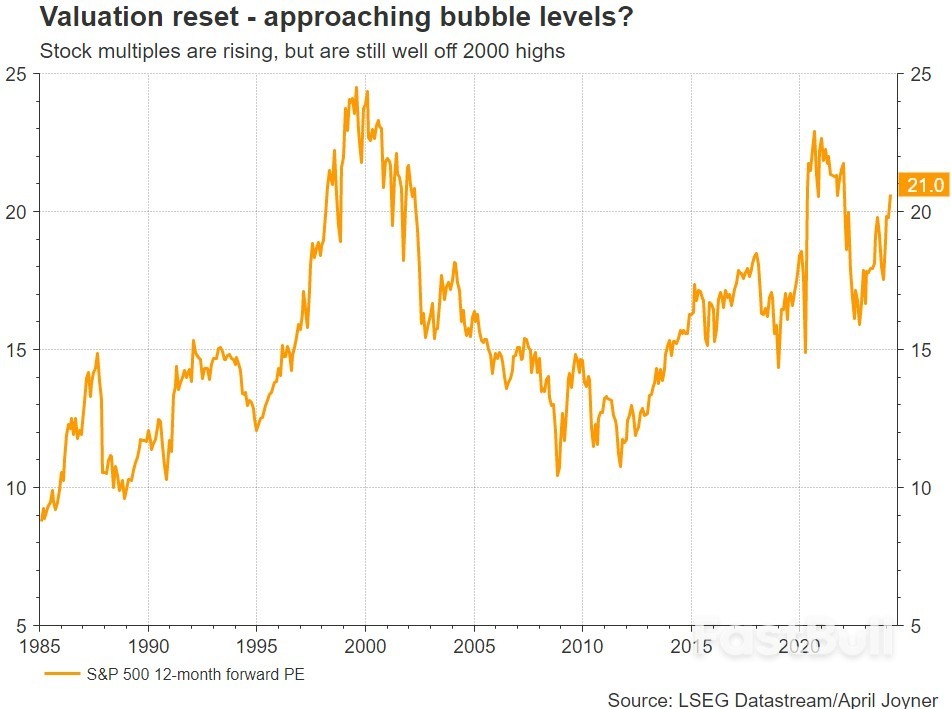
          Stocks today are expensive, but they were pricier in 2021. Since then, the Nasdaq and S&P 500 have entered bear markets, rebounded 50-60%, and reached new record highs.
          This suggests today's optimism about the productivity-enhancing effects of technology may be more justified than 25 years ago.
          That may change if some of the eye-popping revenue and profits forecasts fail to materialize. But consumer and corporate balances sheets are in good shape - the S&P 500's market cap has soared by almost $11 trillion in the last five months.
          Brett House, professor at Columbia Business School, doesn't believe the current tech boom is history repeating itself. If he's right the drawdown, when it comes, is unlikely to be as prolonged or painful either.
          "If there are reasons to justify valuations beyond pure hope or momentum, it may be that the scale of any subsequent correction is smaller and the length of the correction is shorter," he said.

          Source: Reuters

          To stay updated on all economic events of today, please check out our Economic calendar
          Risk Warnings and Disclaimers
          You understand and acknowledge that there is a high degree of risk involved in trading. Following any strategies or investment methods may lead to potential losses. The content on the site is provided by our contributors and analysts for information purposes only. You are solely responsible for determining whether any trading assets, securities, strategy, or any other product is suitable for investing based on your own investment objectives and financial situation.
          Add to Favorites
          Share

          RBNZ May Start Laying Groundwork for a Rate Cut

          XM

          Economic

          Central Bank

          Weaker economy has been good news for inflation

          New Zealand’s economy shrunk in the final three months of 2023, entering a technical recession for the second time in 15 months. In the bigger picture, economic growth appears to have stagnated, much like in Europe and the United Kingdom. For policymakers, this is probably seen as a necessary price for bringing inflation under control, and all the indications are that it is working.
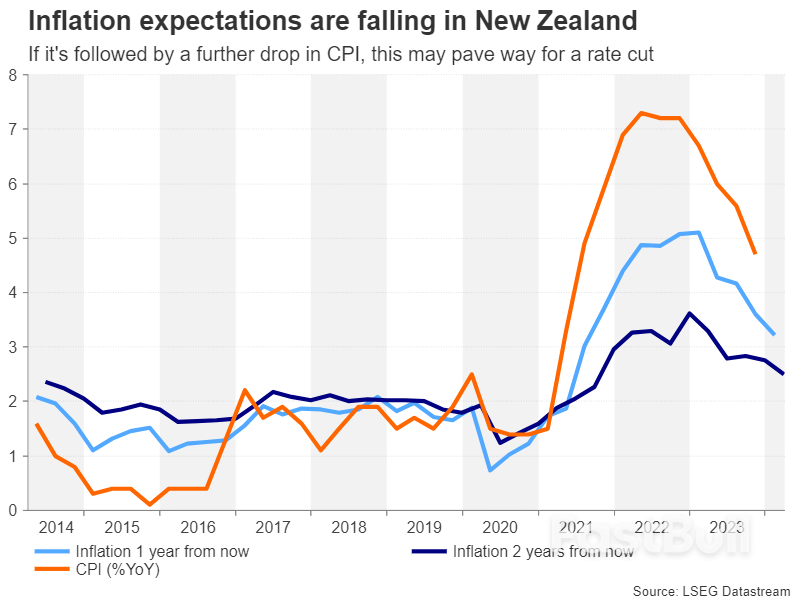
          Inflation fell to 4.7% in Q4 and there was likely a further drop in the consumer price index in the first few months of 2024 as the RBNZ’s own measures of inflation expectations continued to decline in the first quarter.
          RBNZ May Start Laying Groundwork for a Rate Cut_1
          Things have also been moving in a ‘satisfactory’ direction for the labour market. Worker shortages started to ease after more migrants were allowed to enter the country following the reopening of the borders in 2022. The unemployment rate has been steadily edging higher, reaching 4.0% in Q4 versus the post-pandemic low of 3.2%. More importantly, wage growth has been moderating, falling to 3.9% in Q4.

          Rate cuts may come sooner than anticipated

          Governor Adrian Orr even went as far as acknowledging in recent remarks that the conditions for cutting rates are becoming more apparent. Meanwhile. the Bank’s chief economist, Paul Conway, signalled back in March that a Fed rate cut towards the end of this year would make it easier for the RBNZ to follow suit if it leads to an appreciation in the New Zealand dollar versus the greenback.
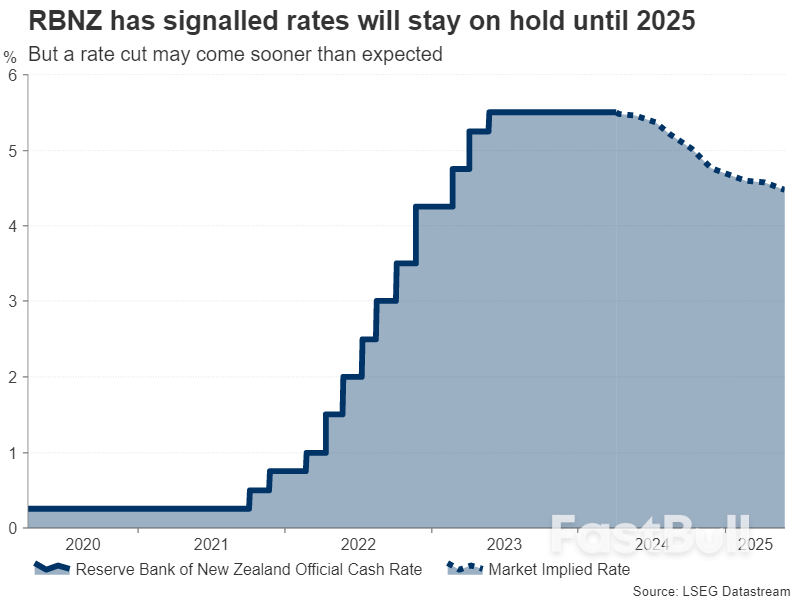
          At the last meeting, policymakers had projected that rates could begin to fall sometime in the middle of 2025, significantly later than the current market pricing of August 2024 for a 25-basis-point cut. There will be no updated forecasts at the April meeting, nor a press conference by Orr, but there’s likely to be some clues in the statement about whether or not committee members are becoming more optimistic about inflation falling within the 1-3% target band sooner than anticipated.
          RBNZ May Start Laying Groundwork for a Rate Cut_2
          Specifically, the language will possibly reveal whether the expected decision to keep the policy rate unchanged at 5.50% will signal another dovish tilt after the Bank adopted a somewhat more neutral stance at the February meeting.

          Kiwi on the slide

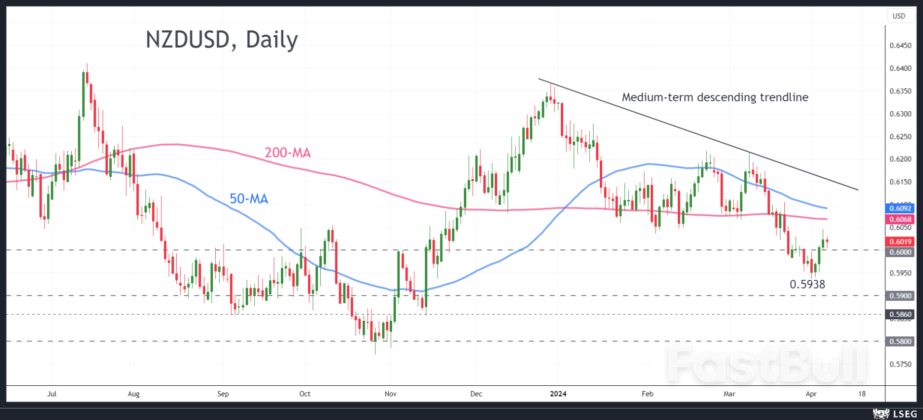
          And this will likely determine the market reaction in the local dollar. The kiwi has come under pressure lately, slipping to four-and-a-half-month lows against the US dollar. Should the language of the statement be more dovish than expected, the kiwi could breach the April 1 low of $0.5938 and head for the $0.5900 mark. A drop below this level would bring $0.5860 into view before targeting the $0.5800 area that supported prices in October 2023.
          RBNZ May Start Laying Groundwork for a Rate Cut_3
          However, if policymakers maintain their caution over the inflation outlook and the need for a prolonged period of restrictive policy, the kiwi could rebound towards its 200-day moving average, currently at $0.6068, before aiming for the medium-term descending trendline.
          Yet, for the kiwi to stage a meaningful rebound, the Fed would first have to start its easing cycle and additionally, China’s economic recovery would have to gather more pace. This would create the ideal conditions for a rally, potentially offsetting any selling pressure from a more dovish RBNZ.

          Source:XM

          To stay updated on all economic events of today, please check out our Economic calendar
          Risk Warnings and Disclaimers
          You understand and acknowledge that there is a high degree of risk involved in trading. Following any strategies or investment methods may lead to potential losses. The content on the site is provided by our contributors and analysts for information purposes only. You are solely responsible for determining whether any trading assets, securities, strategy, or any other product is suitable for investing based on your own investment objectives and financial situation.
          Add to Favorites
          Share
          FastBull
          Copyright © 2025 FastBull Ltd

          728 RM B 7/F GEE LOK IND BLDG NO 34 HUNG TO RD KWUN TONG KLN HONG KONG

          TelegramInstagramTwitterfacebooklinkedin
          App Store Google Play Google Play
          Products
          Charts

          Chats

          Q&A with Experts
          Screeners
          Economic Calendar
          Data
          Tools
          Membership
          Features
          Function
          Markets
          Copy Trading
          Latest Signals
          Contests
          News
          Analysis
          24/7
          Columns
          Education
          Company
          Careers
          About Us
          Contact Us
          Advertising
          Help Center
          Feedback
          User Agreement
          Privacy Policy
          Business

          White Label

          Data API

          Web Plug-ins

          Poster Maker

          Affiliate Program

          Risk Disclosure

          The risk of loss in trading financial instruments such as stocks, FX, commodities, futures, bonds, ETFs and crypto can be substantial. You may sustain a total loss of the funds that you deposit with your broker. Therefore, you should carefully consider whether such trading is suitable for you in light of your circumstances and financial resources.

          No decision to invest should be made without thoroughly conducting due diligence by yourself or consulting with your financial advisors. Our web content might not suit you since we don't know your financial conditions and investment needs. Our financial information might have latency or contain inaccuracy, so you should be fully responsible for any of your trading and investment decisions. The company will not be responsible for your capital loss.

          Without getting permission from the website, you are not allowed to copy the website's graphics, texts, or trademarks. Intellectual property rights in the content or data incorporated into this website belong to its providers and exchange merchants.

          Not Logged In

          Log in to access more features

          FastBull Membership

          Not yet

          Purchase

          Become a signal provider
          Help Center
          Customer Service
          Dark Mode
          Price Up/Down Colors

          Log In

          Sign Up

          Position
          Layout
          Fullscreen
          Default to Chart
          The chart page opens by default when you visit fastbull.com