• Trade
  • Markets
  • Copy
  • Contests
  • News
  • 24/7
  • Calendar
  • Q&A
  • Chats
Trending
Screeners
SYMBOL
LAST
BID
ASK
HIGH
LOW
NET CHG.
%CHG.
SPREAD
SPX
S&P 500 Index
6827.42
6827.42
6827.42
6899.86
6801.80
-73.58
-1.07%
--
DJI
Dow Jones Industrial Average
48458.04
48458.04
48458.04
48886.86
48334.10
-245.98
-0.51%
--
IXIC
NASDAQ Composite Index
23195.16
23195.16
23195.16
23554.89
23094.51
-398.69
-1.69%
--
USDX
US Dollar Index
97.950
98.030
97.950
98.500
97.950
-0.370
-0.38%
--
EURUSD
Euro / US Dollar
1.17394
1.17409
1.17394
1.17496
1.17192
+0.00011
+ 0.01%
--
GBPUSD
Pound Sterling / US Dollar
1.33707
1.33732
1.33707
1.33997
1.33419
-0.00148
-0.11%
--
XAUUSD
Gold / US Dollar
4299.39
4299.39
4299.39
4353.41
4257.10
+20.10
+ 0.47%
--
WTI
Light Sweet Crude Oil
57.233
57.485
57.233
58.011
56.969
-0.408
-0.71%
--

Community Accounts

Signal Accounts
--
Profit Accounts
--
Loss Accounts
--
View More

Become a signal provider

Sell trading signals to earn additional income

View More

Guide to Copy Trading

Get started with ease and confidence

View More

Signal Accounts for Members

All Signal Accounts

Best Return
  • Best Return
  • Best P/L
  • Best MDD
Past 1W
  • Past 1W
  • Past 1M
  • Past 1Y

All Contests

  • All
  • Trump Updates
  • Recommend
  • Stocks
  • Cryptocurrencies
  • Central Banks
  • Featured News
Top News Only
Share

Ukraine's Navy Says Russian Drone Attack Hit Civilian Turkish Vessel Carrying Sunflower Oil To Egypt On Saturday

Share

Israeli Military Says It Put Planned Strike On South Lebanon Site On Hold After Lebanese Army Requested Access

Share

Norwegian Nobel Committee: Calls On The Belarusian Authorities To Release All Political Prisoners

Share

Norwegian Nobel Committee: His Freedom Is A Deeply Welcome And Long-Awaited Moment

Share

Ukraine Says It Received 114 Prisoners From Belarus

Share

USA Embassy In Lithuania: Maria Kalesnikava Is Not Going To Vilnius

Share

USA Embassy In Lithuania: Other Prisoners Are Being Sent From Belarus To Ukraine

Share

Ukraine President Zelenskiy: Five Ukrainians Released By Belarus In US-Brokered Deal

Share

USA Vilnius Embassy: USA Stands Ready For "Additional Engagement With Belarus That Advances USA Interests"

Share

USA Vilnius Embassy: Belarus, USA, Other Citizens Among The Prisoners Released Into Lithuania

Share

USA Vilnius Embassy: USA Will Continue Diplomatic Efforts To Free The Remaining Political Prisoners In Belarus

Share

USA Vilnius Embassy: Belarus Releases 123 Prisoners Following Meeting Of President Trump's Envoy Coale And Belarus President Lukashenko

Share

USA Vilnius Embassy: Masatoshi Nakanishi, Aliaksandr Syrytsa Are Among The Prisoners Released By Belarus

Share

USA Vilnius Embassy: Maria Kalesnikava And Viktor Babaryka Are Among The Prisoners Released By Belarus

Share

USA Vilnius Embassy: Nobel Peace Prize Laureate Ales Bialiatski Is Among The Prisoners Released By Belarus

Share

Belarusian Presidential Administration Telegram Channel: Lukashenko Has Pardoned 123 Prisoners As Part Of Deal With US

Share

Two Local Syrian Officials: Joint US-Syrian Military Patrol In Central Syria Came Under Fire From Unknown Assailants

Share

Israeli Military Says It Targeted 'Key Hamas Terrorist' In Gaza City

Share

Rwanda's Actions In Eastern Drc Are A Clear Violation Of Washington Accords Signed By President Trump - Secretary Of State Rubio

Share

Israeli Military Issues Evacuation Warning In Southern Lebanon Village Ahead Of Strike - Spokesperson On X

TIME
ACT
FCST
PREV
U.K. Trade Balance Non-EU (SA) (Oct)

A:--

F: --

P: --

U.K. Trade Balance (Oct)

A:--

F: --

P: --

U.K. Services Index MoM

A:--

F: --

P: --

U.K. Construction Output MoM (SA) (Oct)

A:--

F: --

P: --

U.K. Industrial Output YoY (Oct)

A:--

F: --

P: --

U.K. Trade Balance (SA) (Oct)

A:--

F: --

P: --

U.K. Trade Balance EU (SA) (Oct)

A:--

F: --

P: --

U.K. Manufacturing Output YoY (Oct)

A:--

F: --

P: --

U.K. GDP MoM (Oct)

A:--

F: --

P: --

U.K. GDP YoY (SA) (Oct)

A:--

F: --

P: --

U.K. Industrial Output MoM (Oct)

A:--

F: --

P: --

U.K. Construction Output YoY (Oct)

A:--

F: --

P: --

France HICP Final MoM (Nov)

A:--

F: --

P: --

China, Mainland Outstanding Loans Growth YoY (Nov)

A:--

F: --

P: --

China, Mainland M2 Money Supply YoY (Nov)

A:--

F: --

P: --

China, Mainland M0 Money Supply YoY (Nov)

A:--

F: --

P: --

China, Mainland M1 Money Supply YoY (Nov)

A:--

F: --

P: --

India CPI YoY (Nov)

A:--

F: --

P: --

India Deposit Gowth YoY

A:--

F: --

P: --

Brazil Services Growth YoY (Oct)

A:--

F: --

P: --

Mexico Industrial Output YoY (Oct)

A:--

F: --

P: --

Russia Trade Balance (Oct)

A:--

F: --

P: --

Philadelphia Fed President Henry Paulson delivers a speech
Canada Building Permits MoM (SA) (Oct)

A:--

F: --

P: --

Canada Wholesale Sales YoY (Oct)

A:--

F: --

P: --

Canada Wholesale Inventory MoM (Oct)

A:--

F: --

P: --

Canada Wholesale Inventory YoY (Oct)

A:--

F: --

P: --

Canada Wholesale Sales MoM (SA) (Oct)

A:--

F: --

P: --

Germany Current Account (Not SA) (Oct)

A:--

F: --

P: --

U.S. Weekly Total Rig Count

A:--

F: --

P: --

U.S. Weekly Total Oil Rig Count

A:--

F: --

P: --

Japan Tankan Large Non-Manufacturing Diffusion Index (Q4)

--

F: --

P: --

Japan Tankan Small Manufacturing Outlook Index (Q4)

--

F: --

P: --

Japan Tankan Large Non-Manufacturing Outlook Index (Q4)

--

F: --

P: --

Japan Tankan Large Manufacturing Outlook Index (Q4)

--

F: --

P: --

Japan Tankan Small Manufacturing Diffusion Index (Q4)

--

F: --

P: --

Japan Tankan Large Manufacturing Diffusion Index (Q4)

--

F: --

P: --

Japan Tankan Large-Enterprise Capital Expenditure YoY (Q4)

--

F: --

P: --

U.K. Rightmove House Price Index YoY (Dec)

--

F: --

P: --

China, Mainland Industrial Output YoY (YTD) (Nov)

--

F: --

P: --

China, Mainland Urban Area Unemployment Rate (Nov)

--

F: --

P: --

Saudi Arabia CPI YoY (Nov)

--

F: --

P: --

Euro Zone Industrial Output YoY (Oct)

--

F: --

P: --

Euro Zone Industrial Output MoM (Oct)

--

F: --

P: --

Canada Existing Home Sales MoM (Nov)

--

F: --

P: --

Euro Zone Total Reserve Assets (Nov)

--

F: --

P: --

U.K. Inflation Rate Expectations

--

F: --

P: --

Canada National Economic Confidence Index

--

F: --

P: --

Canada New Housing Starts (Nov)

--

F: --

P: --

U.S. NY Fed Manufacturing Employment Index (Dec)

--

F: --

P: --

U.S. NY Fed Manufacturing Index (Dec)

--

F: --

P: --

Canada Core CPI YoY (Nov)

--

F: --

P: --

Canada Manufacturing Unfilled Orders MoM (Oct)

--

F: --

P: --

Canada Manufacturing New Orders MoM (Oct)

--

F: --

P: --

Canada Core CPI MoM (Nov)

--

F: --

P: --

Canada Manufacturing Inventory MoM (Oct)

--

F: --

P: --

Canada CPI YoY (Nov)

--

F: --

P: --

Canada CPI MoM (Nov)

--

F: --

P: --

Canada CPI YoY (SA) (Nov)

--

F: --

P: --

Canada Core CPI MoM (SA) (Nov)

--

F: --

P: --

Q&A with Experts
    • All
    • Chatrooms
    • Groups
    • Friends
    Connecting
    .
    .
    .
    Type here...
    Add Symbol or Code

      No matching data

      All
      Trump Updates
      Recommend
      Stocks
      Cryptocurrencies
      Central Banks
      Featured News
      • All
      • Russia-Ukraine Conflict
      • Middle East Flashpoint
      • All
      • Russia-Ukraine Conflict
      • Middle East Flashpoint
      Search
      Products

      Charts Free Forever

      Chats Q&A with Experts
      Screeners Economic Calendar Data Tools
      Membership Features
      Data Warehouse Market Trends Institutional Data Policy Rates Macro

      Market Trends

      Market Sentiment Order Book Forex Correlations

      Top Indicators

      Charts Free Forever
      Markets

      News

      News Analysis 24/7 Columns Education
      From Institutions From Analysts
      Topics Columnists

      Latest Views

      Latest Views

      Trending Topics

      Top Columnists

      Latest Update

      Signals

      Copy Rankings Latest Signals Become a signal provider AI Rating
      Contests
      Brokers

      Overview Brokers Assessment Rankings Regulators News Claims
      Broker listing Forex Brokers Comparison Tool Live Spread Comparison Scam
      Q&A Complaint Scam Alert Videos Tips to Detect Scam
      More

      Business
      Events
      Careers About Us Advertising Help Center

      White Label

      Data API

      Web Plug-ins

      Affiliate Program

      Awards Institution Evaluation IB Seminar Salon Event Exhibition
      Vietnam Thailand Singapore Dubai
      Fans Party Investment Sharing Session
      FastBull Summit BrokersView Expo
      Recent Searches
        Top Searches
          Markets
          News
          Analysis
          User
          24/7
          Economic Calendar
          Education
          Data
          • Names
          • Latest
          • Prev

          View All

          No data

          Scan to Download

          Faster Charts, Chat Faster!

          Download App
          English
          • English
          • Español
          • العربية
          • Bahasa Indonesia
          • Bahasa Melayu
          • Tiếng Việt
          • ภาษาไทย
          • Français
          • Italiano
          • Türkçe
          • Русский язык
          • 简中
          • 繁中
          Open Account
          Search
          Products
          Charts Free Forever
          Markets
          News
          Signals

          Copy Rankings Latest Signals Become a signal provider AI Rating
          Contests
          Brokers

          Overview Brokers Assessment Rankings Regulators News Claims
          Broker listing Forex Brokers Comparison Tool Live Spread Comparison Scam
          Q&A Complaint Scam Alert Videos Tips to Detect Scam
          More

          Business
          Events
          Careers About Us Advertising Help Center

          White Label

          Data API

          Web Plug-ins

          Affiliate Program

          Awards Institution Evaluation IB Seminar Salon Event Exhibition
          Vietnam Thailand Singapore Dubai
          Fans Party Investment Sharing Session
          FastBull Summit BrokersView Expo

          Latest News on the Israeli-Palestinian Conflict (December 22)

          Thomas

          Palestinian-Israeli conflict

          Latest news on the Israeli-Palestinian conflict

          Summary:

          According to CNN, the White House said on Thursday (21st) that Israel has assured the United States that its military operations in Gaza will "transition from higher intensity to lower intensity" as goals change. .
          0:03
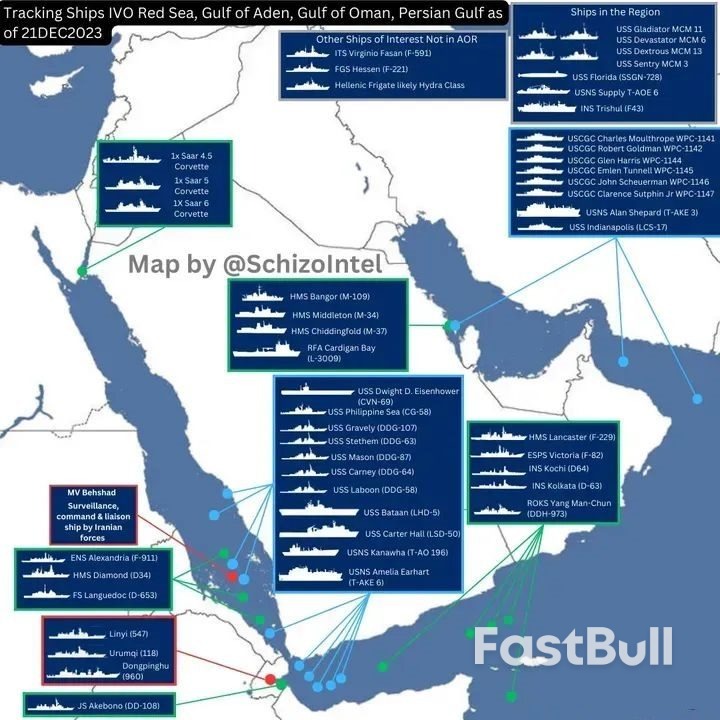
          The map of warships operating in the Red Sea, Gulf of Oman, Gulf of Aden, Persian Gulf, and Arabian Sea was updated on December 21, 2023.
          Latest News on the Israeli-Palestinian Conflict (December 22)_1 Italian Defense Minister Guido Crosetto said: Italy will work with the international community to jointly combat the destabilizing hijacking activities of the Houthi armed forces...It is necessary to increase military presence in the region to create conditions for stability and avoid ecological disasters, Prevent inflationary pressure from rising again.
          Egyptian Foreign Minister Sameh Shoukry said: Red Sea countries have the responsibility to protect the Red Sea, and we continue to work with many partners to provide suitable conditions for freedom of navigation in the Red Sea.
          Greek Defense Minister Nikos Dendias announced: Following the order of Prime Minister Kyriakos Mitsotakis, Greece will participate in Operation Prosperity Guardian and will dispatch a Greek Navy frigate.
          The international community faces huge security challenges in the Red Sea and Gulf of Aden. Attacks by members of the Houthi armed group on commercial ships, drones and missiles pose a major threat to human life and international security and stability.
          Greece is the country with the largest maritime fleet. Maintaining freedom of navigation and protecting the lives of crew members are Greece's primary interests. I also informed the Egyptian side on this issue during my visit to Cairo: this is self-evident for the frigates participating in this operation and equipped with the necessary self-protection equipment.
          0:31
          Israeli Prime Minister Netanyahu's response to Hamas: "We are fighting until we win! We will not stop the war until we have accomplished all our goals. We insist on completing the elimination of Hamas and the release of all hostages."
          “The choice I presented to Hamas was simple: Surrender or die. They did not and would not have any other choice. After Hamas is eliminated, I will do everything in my power to ensure that Gaza no longer poses a threat to Israel. Hamastan and Fatastan is neither.”
          0:56
          CNN: Citing U.S. intelligence reports, Hamas has successfully positioned itself in parts of Arab and Islamic countries as a defender of the Palestinian cause. Analysis in the report also shows that Hamas's influence and credibility have grown significantly since October 7.
          1:32
          "Washington Post" investigation: None of the five buildings at Al-Shifa Hospital identified by the Israeli military are connected to the tunnel network in the Gaza Strip.
          1:57
          The Palestinian Red Crescent reported no contact with the Jabaliya ambulance centre. Two hours earlier, Israeli forces stormed the center, arrested the entire team and medical staff and took them to an unknown area. Women remain trapped alone inside the centre.
          2:15
          Israel’s Haaretz: Netanyahu’s security in Miami cost the country approximately 1 million shekels.
          2:27
          Israeli forces blew up an entire section of the Palestinian mosque near Al-Rimal, even though they had been stationed there for a full month.
          3:06
          Some reports on the waters of the Red Sea these days:
          It appears that while some U.S.-flagged merchant vessels (ARC Liberty and Maersk Chicago) changed course, others were still heading south toward the Suez Canal; some vessels (Maersk Kensington and Green Bay) were holding their ground, Waiting for the escort to be established.
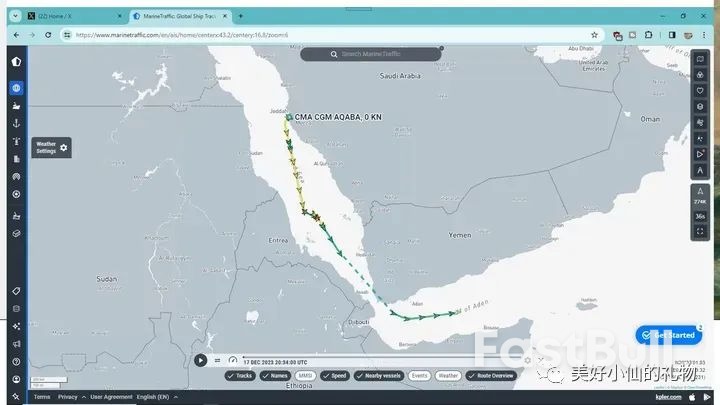
          At the same time, the French-owned and Maltese-flagged CMA CGM Aqaba has just (December 20, 2021) sailed into the Gulf of Aden through the Bab el-Mandeb Strait. The CMA CGM Pegasus (with armed guards on board) had just left Djibouti after sailing past BAM on December 18, destined for Jeddah, Saudi Arabia on the Red Sea (but possibly heading to Asia).
          Latest News on the Israeli-Palestinian Conflict (December 22)_2
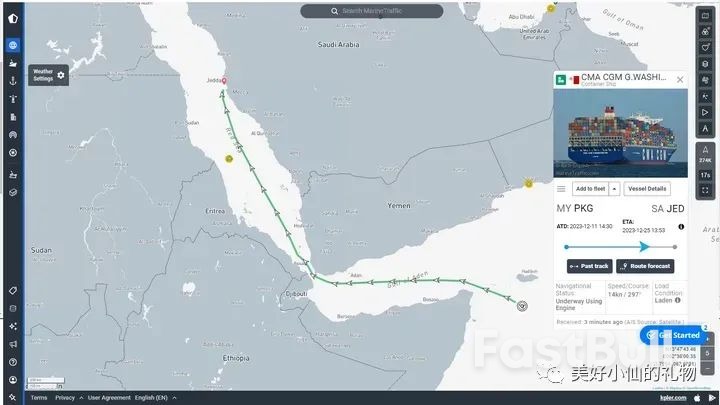
          The French-owned CMA CGM Washington (Malta-flagged 14,360 TEU) and APL Salalah (Singapore-flagged 10,800 TEU, owned by CMA CGM) are the only container ships over 8,000 TEU sailing to the Indian Ocean BAM and may pick up An escort passes through Yemen.
          It appears the French navy is using the Languedoc frigate to escort their ships through the waters around Yemen and avoid the Houthis.
          Has Maersk Kensington not been escorted through BAM yet because the ship has been in the Red Sea (since December 15th) or the Green Bay of Aden (since December 17th) for a week?
          Latest News on the Israeli-Palestinian Conflict (December 22)_3
          5:27
          Israel Channel 12: Since the Houthi attacks on the Red Sea began, activity at the Port of Eilat has dropped by 85% and revenue at the Eilat seaport has dropped by 80%.
          6:31
          The Houthis have sent a message to Saudi Arabia: We do not want any alliance from Saudi Arabia to support Israel.
          The Houthis will respond to any country that opens its airspace to bomb Yemen.
          Saudi Arabia's future is threatened by Israel, while Egypt rejects the position of a U.S. coalition in the Red Sea that would protect the Suez Canal.
          The Houthis advised Saudi Arabia and the UAE not to stand with Israel in front of those who support the Palestinian people.
          7:02
          The Israeli military today released a video showing an entire neighborhood in the Al Rimal neighborhood of western Gaza being bombed. Targeted civilian areas included a rehabilitation hospital and other institutions, including the Gaza Civil Registry.
          7:39
          Iran Observer said on X (formerly Twitter):
          The United States has given up its plan to attack the Houthis after the two million soldiers of Yemen's Ansarullah group threatened to launch an all-out war.
          According to the Associated Press (AP), warships from the U.S.-led coalition will provide air defense parachutes for as many ships as possible at any given time.
          Basically, they're going to launch a $2 million missile to intercept a $2,000 Yemeni drone.
          8:15
          Israeli newspaper Maariv: Israelis fear that Hezbollah will significantly expand strikes and attacks in the coming days to deter Israel.
          8:27
          The new Red Sea Security Alliance has 10 secret members. How can secret members help open a major maritime chokepoint?
          The day before yesterday, National Security Council spokesman John Kirby confirmed that 10 other unnamed countries have also joined the alliance, and the list of members of these 10 countries seems to be only known now. According to Politico's Lara Seligman, some of the covert members are Arab governments who don't want to be seen defending Israeli shipping. (Limited polling suggests that Israel's actions in Gaza have made pro-Israel politicians less popular in the Arab world.)
          9:36
          Israel's Channel 14: Earlier this week, Hezbollah launched a series of suicide drones at Israel's Kalish gas platform in the Mediterranean in an attempt to destroy it. The drone was intercepted and Israel responded by attacking Hezbollah targets deep inside Lebanon.
          9:51
          Israel withdrew its special forces Golani Brigade after suffering heavy losses in Gaza, especially the deaths of many officers and soldiers.
          9:55
          Israeli soldiers from the Golani Brigade celebrate leaving the battlefield in Gaza.
          A few days ago, the Israeli military announced that the unit had suffered heavy losses during its presence in Shejaiya. At the same time, the resistance announced that it had inflicted a heavy death toll and vehicle damage among Israelis.
          10:04
          Breaking news: Pentagon says more than 20 countries have joined the Red Sea Task Force.
          10:19
          Israeli Air Force strikes deep into southern Lebanon last night reportedly hit a key Hezbollah compound used by the Redwan special operations force, which had only recently withdrawn from the border as hostilities intensified.
          10:21
          The Associated Press cited analysis of satellite imagery: Israeli operations destroyed more than two-thirds of buildings in northern Gaza and a quarter of buildings in Khan Younis.
          11:59
          Jordan defends Israel again: Jordanian forces shot down a suicide drone flying from Iraq to Eilat, Israel.
          13:06
          Jordanian air defense systems are ready and on alert to protect the entity from any threats and to intercept Iraqi resistance marches and missiles flying towards the entity, while Israeli warplanes roam and attack Jordanian airspace from west to east , Jordan’s air defense system was absent.
          Syria: Its airspace is open to Israel, but resistance movements are prohibited.
          13:50
          The European Union said it would join the Red Sea Alliance led by the United States.
          15:52
          Analysis by foreign netizens: The missile used by the United States to intercept Houthi drones is worth US$2 million (not that it is really worth that much, but the US military industry is squeezing the budget).
          The Houthi armed drone is worth $2,000. Not to mention all the bombs used by Israel to commit the genocide, which will never be paid to the United States, which has already given them $14 billion for this because their economy is in such devastation.
          The Houthis allow all ships except those bound for Israel to enter the Red Sea. Therefore, protecting Israel from genocide has cost the United States dearly. But adding a few billion dollars to America's $31 trillion foreign debt won't change anything.
          16:20
          British newspaper "The Times": The United States is spending huge sums of money to shoot down drones launched by the Houthi armed forces at targets in the Red Sea. The drones launched by the Houthi armed forces cost between one thousand and two thousand dollars, while the anti-ballistic missiles launched by the U.S. Navy to shoot down the drones cost more than 11 million U.S. dollars each.
          18:05
          According to the U.S. Institute of War, on December 21, as the Israeli army transitioned to control operations in parts of the northern Gaza Strip, the Israeli army expanded its clearing operations against Hamas's central Gaza Strip brigade.
          19:47
          Former Israeli Prime Minister Ehud Olmert: "There must be an immediate ceasefire in Gaza and Netanyahu must be fired! Netanyahu should realize that the goals he announced in Gaza cannot be achieved!"
          20:11
          Hamas's rejection of a seven-day truce and its demand for a permanent ceasefire is a reaction to what is happening on the ground: Hamas can wage a long war and remain powerful on the ground.
          20:37
          A serious security incident occurred on the Israel-Lebanon border, and the Israeli military establishment enforced a gag order.
          According to Mayadeen, there were also direct clashes between Hezbollah and the Israel Defense Forces near Avivim. Israeli sources called it an "unusual" and "extremely worrying incident" that would only be announced by official sources with the government's permission.
          21:00
          Hezbollah attacked a group of Israeli officers and soldiers in the settlement of Evin Menachem near Shtura, killing several people.
          21:46
          France is reportedly withdrawing from Operation Prosperity Guardian, the US-led naval coalition fighting the Houthis.
          U.S. maritime experts say the French navy wants to escort EU ships in the Red Sea, while the U.S. still doesn't know how to deal with coalition forces.
          22:33
          Israel has rejected a formal Russian request to build a field hospital in southern Gaza to help treat the wounded.
          Instead, Israel responded by convincing Russia to assist in the displacement of Gaza residents to Egypt by providing medical and humanitarian services on the Egyptian side of the border and applying pressure on Egypt. However, Russia rejected the proposal.

          Article source: "The Gift of the Beautiful Fairy" WeChat public account

          Risk Warnings and Disclaimers
          You understand and acknowledge that there is a high degree of risk involved in trading. Following any strategies or investment methods may lead to potential losses. The content on the site is provided by our contributors and analysts for information purposes only. You are solely responsible for determining whether any trading assets, securities, strategy, or any other product is suitable for investing based on your own investment objectives and financial situation.
          Comments
          Add to Favorites
          Share

          Japan's Core Inflation Slows in November, Eases Pressure on BOJ

          Thomas

          Economic

          • Nov core CPI rises 2.5% yr/yr, matches forecast
          • Slowdown reflects easing cost-push pressure
          • Service inflation accelerates to 2.3% in November
          • BOJ to await signs of wage-driven inflation
          Japan's core inflation slowed sharply in November to a pace unseen in over a year, data showed on Friday, highlighting easing cost-push pressures that may give the central bank more time before phasing out its massive monetary stimulus.
          While service prices continued to rise, some analysts doubt whether the increase will accelerate enough to create a more demand-driven inflation seen as a prerequisite for the Bank of Japan (BOJ) to exit ultra-loose policy.
          "Inflation is coming down as supply-side factors that pushed up prices fade. Meanwhile, evidence of demand-driven inflation, a by-product of strong domestic spending and wage gains, remains preciously scarce," said Jeemin Bang, an associate economist at Moody's Analytics.
          "Our baseline is for the BOJ to drop negative interest rates in 2024, but we expect the central bank will maintain some level of support given the economy's weak state."
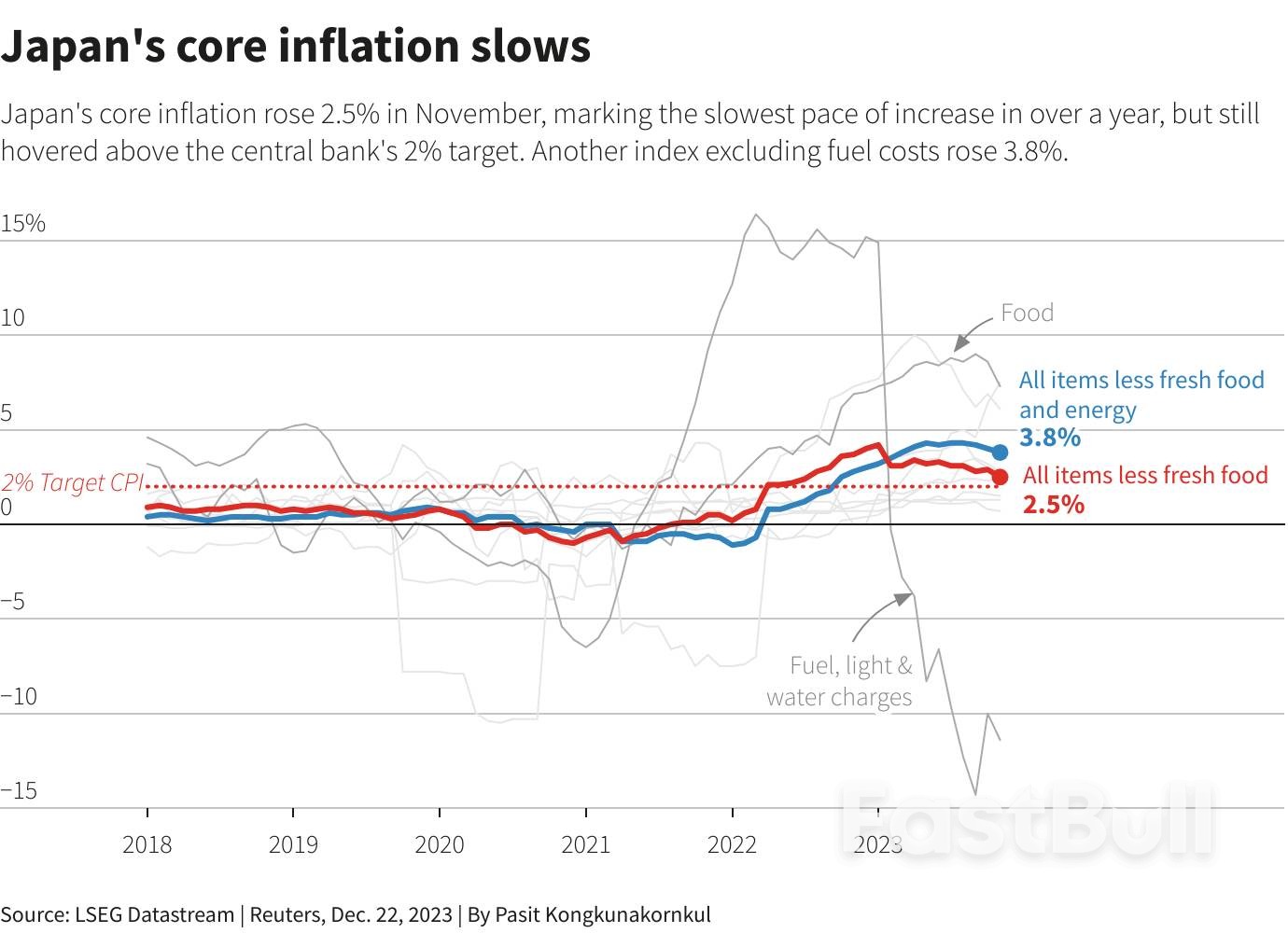
          The core consumer price index (CPI), which excludes volatile fresh food but includes fuel costs, rose 2.5% in November from a year earlier, matching market forecasts and slowing from a 2.9% gain in October. It was the slowest pace of rise since a 2.4% growth marked in July 2022.
          Japan's Core Inflation Slows in November, Eases Pressure on BOJ_1
          A breakdown showed goods prices rose 3.3% in November from a year earlier, slower than a 4.4% gain in October, due to falling fuel costs and moderating hikes for food.
          But services inflation accelerated to 2.3% in November from 2.1% in the previous month, underscoring the BOJ's view that prospects of higher wages are prodding some firms to pass on rising labour costs.
          "We expect companies to keep raising service prices, though there's no change to our view that overall inflation will slow as a trend," said Takeshi Minami, chief economist at Norinchukin Research Institute. "The BOJ probably won't normalise policy for the time being."
          Japan has seen inflation hold above 2% since April last year and some firms have signalled their readiness to keep raising wages, increasing the chance the BOJ will finally abandon its status as a dovish outlier among global central banks.
          But the BOJ kept ultra-loose policy intact on Tuesday and Governor Kazuo Ueda left no hints of an early exit, stressing that the bank needed to continue scrutinising whether a positive wage-inflation cycle will fall in place.
          Minutes of the BOJ's October meeting, released on Friday, showed board members remaining divided on how soon Japan can see conditions for an exit fall in place.
          More than 80% of economists polled by Reuters in November expect the BOJ to end its negative rate policy next year with half of them predicting April as the most likely timing. Some see the chance of a policy shift in January.

          Source: Reuters

          To stay updated on all economic events of today, please check out our Economic calendar
          Risk Warnings and Disclaimers
          You understand and acknowledge that there is a high degree of risk involved in trading. Following any strategies or investment methods may lead to potential losses. The content on the site is provided by our contributors and analysts for information purposes only. You are solely responsible for determining whether any trading assets, securities, strategy, or any other product is suitable for investing based on your own investment objectives and financial situation.
          Comments
          Add to Favorites
          Share

          Five Major Chinese Banks Cut Interest Rates on Some Deposits

          Alex

          Economic

          Five of China's largest state banks lowered interest rates on some deposits on Friday, the third round of such cuts this year, offering the prospect of reduced lending costs at a time when the government is urging banks to support the economy.
          Industrial and Commercial Bank of China 601398.SS, Agricultural Bank of China 601288.SS and China Construction Bank 601939.SS were among banks to cut rates for time deposits by as much as 25 basis points (bps), their websites showed.
          Banks cut annual interest rates for one-year and two-year time deposits by 10 basis points (bps) and 20 bps to 1.45% and 1.65% respectively, and rates for three-year and five-year time deposits by 25 bps. They cut large-scale certificates of deposit rates even more.
          Reuters on Thursday reported major banks' impending cuts on time deposits citing people with knowledge of the matter.
          The cuts are the third this year following rounds in June and September. The latest cuts could help banks' net interest margins (NIMs) - a profitability gauge - widen 3 bps next year, contributing to 3% of lenders' 2024 net profit, analysts at broker CICC said in a research note on Friday.
          NIMs at China's major state banks have fallen below the 1.8% threshold that is regarded by authorities as necessary for lenders to maintain sustainable profitability.
          The cuts could smoothen the People's Bank of China's (PBOC) move toward easing monetary policy, and will drive money into wealth management products and bond funds, potentially pushing treasury yields even lower, Caitong Securities said in a report.
          On Friday, 10-year treasury futures CFTc1 jumped as much as 0.13%, hitting a four-month high. The 10-year government bond yields CN10YT=RR, which move inversely to prices, fell as low as 2.610%, the lowest since Sept. 1.
          "We expect the PBOC to cut its policy lending rates in January 2024," said Lu Ting, chief China economist at Nomura. "The lasting disinflationary pressures and a sharp reversal of U.S. rates have lowered the hurdle for the PBOC to cut rates."
          "The PBOC may also deliver a 25bp RRR (reserve requirement ratio) cut in H1 2024 to increase loanable funds to banks, which have shouldered some national services by providing funding to LGFVs (local government financing vehicles) and cash-strapped developers," said Lu.
          Even before Friday's announcement, expectations of lower deposit rates had triggered a retail rush for higher-yielding fixed-income products.
          Last week, JPMorgan Asset Management's China unit hits its 5 billion yuan ($699.61 million) fundraising target ahead of schedule for an index fund that invests in negotiable certificates of deposit.

          Source: Reuters

          To stay updated on all economic events of today, please check out our Economic calendar
          Risk Warnings and Disclaimers
          You understand and acknowledge that there is a high degree of risk involved in trading. Following any strategies or investment methods may lead to potential losses. The content on the site is provided by our contributors and analysts for information purposes only. You are solely responsible for determining whether any trading assets, securities, strategy, or any other product is suitable for investing based on your own investment objectives and financial situation.
          Comments
          Add to Favorites
          Share

          Industrial Policy Makes a Comeback in East Asia

          Damon

          Economic

          Since the World Bank published The East Asian Miracle report in 1993, a myriad of studies debating the merits of industrial policy have appeared.
          Proponents argue that the success of Hong Kong, South Korea, Singapore and Taiwan was due to selective industrial policies, including trade and protection policy, capital controls and labour market restrictions. Critics argue that the impressive growth of the East Asian ‘tigers’ was, on the contrary, the result of economically orthodox strategies such as stable macroeconomic management, non-discriminatory and incentive-based export promotion measures, exchange rate stability and commitment to human capital formation.
          Now, three decades later, industrial policy seems to have made a comeback. In Indonesia, where slow industrial growth is a concern, President Joko Widodo is promoting an activist industrial policy by pursuing ‘downstreaming’. He has banned exports of nickel ore to encourage domestic processing and, motivated by a significant increase in the exports of processed nickel, has extended the strategy to bauxite and other minerals as well as resource commodities such as crude palm oil and seaweed.
          This strategy is a touchstone of Indonesia’s new 2025–45 National Long-Term Development Plan. In Malaysia, the New Industrial Master Plan 2030 aims to build more competitive industries and ‘advance economic complexity’, and South Korea and Japan have also tailored their industrial policy to foster their semiconductor industries to compete with China and the United States.
          In the past, industrial policies were largely domestically oriented, subsidising the expansion of certain sectors over others. As countries engaged more in international trade, policies were used to affect cross-border flows of goods and services. Industrial and trade policies do not operate in isolation.
          Recent industrial policies for commercial purposes take many forms, as opposed to the blunt import tariffs commonly used in the past. The most prominently used strategies at the global level are trade financing, state loans, financial grants, financial assistance to expand foreign markets, local sourcing, loan guarantees and import tariffs. In countries such as Indonesia, Vietnam, Thailand, Malaysia and China, frequently used industrial policies include capital injection and equity stakes, anti-dumping measures, tax or social insurance relief, state loans and financial grants.
          There are several reasons for the resurgence of industrial policy. Economic shocks such as the Global Financial Crisis and the COVID-19 pandemic have increased the appetite for government intervention. Recent US legislation addressing inflation, semiconductor supply chains and employment is a significant driver of industrial policy. This is also the case with the EU’s Green Deal Industrial Plan and the Made in China 2025 initiative. Such an embrace of industrial policy by major economic powers has motivated other countries to follow suit.
          At the same time, the global trading system has become more fragmented, and the WTO has weakened. Member countries have introduced trade measures that do not legally comply with WTO regulations.
          Policymakers’ misreading of history has also repopularised industrial policy. The false belief that richer countries were successful because they protected manufacturing gave respectability to arguments favouring industrial policy. Industrial policy is also tied up in political agendas. In Indonesia, for example, industrial policy is often linked with nationalism and self-sufficiency, objectives which have roots in the country’s colonial history. In this regard, Indonesian industrial policy in the form of trade protection is easier, more expedient and politically popular.
          Most industrial policies implemented in East Asia are designed to increase domestic value added. At the same time, governments want to establish vertical integration in the global value chain. These two objectives are contradictory — global value chains involve the slicing up of production processes across borders, which thins out the domestic value added in each process.
          The emphasis on the share of domestic value added in exports as a policy criterion is misguided. First, production for export markets requires high-quality inputs procured in the world market to maintain competitiveness. Second, total export earnings are driven by volume rather than per unit of value added. Third, intermediate production is typically capital intensive, while final assembly is labour intensive, so shifting domestic production towards the latter would generate better jobs in countries like Indonesia. Finally, in the case of resource-rich countries, most major producers export large amounts offshore for processing as the domestic demand and processing capacity is far smaller.
          There are areas in which industrial policy is justifiable. One is in response to climate change. As environmental problems involve externalities, it is likely that state interventions in this area will increase. The challenge is how to disentangle the objective of mitigating climate externalities from the protection of domestic industries from foreign competition. The semiconductor and electric vehicle battery industries are examples of this.
          As in other parts of the world, it seems that the use of industrial policy in East Asia will remain a factor, if not an increasing issue. This is not necessarily a bad thing. To ensure that the policy is not simply about picking winners, but enhancing the productivity of the overall economy, it should prioritise measures with the least distortion — incentives instead of targets and export taxes instead of export bans.
          Complementary policies are also needed. These include labour market, bureaucratic and regulatory reforms. Governments should focus on domestic issues and seek the most appropriate solution, not just copy others. They should also note that many countries have become advanced or are fast developing largely due to globalisation, while many past industrial policies have failed.
          East Asia and countries like Indonesia and Malaysia need to find the right balance of industrial and trade policies so they do not lose out on the benefits of participating in global trade. Policymakers should not forget past failures of industrial policy, exemplified by Malaysia’s and Indonesia’s unsuccessful transition from Japanese and Korean automobile components to domestically produced parts or the government-funded Nihon Aircraft Manufacturing Corporation’s failed attempt to commercialise an economically viable domestic civilian airliner in Japan.

          Source: eastasiaforum.org

          To stay updated on all economic events of today, please check out our Economic calendar
          Risk Warnings and Disclaimers
          You understand and acknowledge that there is a high degree of risk involved in trading. Following any strategies or investment methods may lead to potential losses. The content on the site is provided by our contributors and analysts for information purposes only. You are solely responsible for determining whether any trading assets, securities, strategy, or any other product is suitable for investing based on your own investment objectives and financial situation.
          Comments
          Add to Favorites
          Share

          [BOJ] Meeting Minutes: Continue With Monetary Easing

          FastBull Featured

          Remarks of Officials

          The Bank of Japan (BOJ) released the minutes of its October meeting on December 22, the main content of which is as follows.
          The year-on-year growth of CPI (excluding fresh food) was slower than a while ago, mainly due to the effects of pushing down energy prices from the government's economic measures, but it had been in the range of 2.5-3.0 percent recently owing to the effects of a pass-through to consumer prices of cost increases led by the past rise in import prices.
          The employment and income situation improved moderately. There was a slight increase in the number of regular employees. The medical, healthcare, and welfare services industry, as well as the information and communications industry, faced severe labor shortages. With economic activity normalizing, the number of non-regular employees had been on a moderate uptrend, mainly in the wholesale and retail trade as well as the face-to-face services industries. Employment may continue rising due to labor shortages, but the pace of increase was projected to moderate gradually.
          The Japanese economy had recovered moderately. Although exports and production had been affected by the slowdown in the pace of recovery in overseas economies, they had been more or less flat, supported by a waning of the effects of supply-side constraints. Looking ahead, the Japanese economy was expected to continue to grow at a slow pace, supported by an accommodative financial environment and the government's related economic measures.
          Private consumption had been on a recovery trend due to the low real interest rates. Although consumption had been affected by rising prices, demand had been resilient. The depreciation of the yen also had a direct impact on the shift of demand from imported goods to domestic goods, which contributed to the consumption cycle. There was evidence that private consumption as a whole had returned to a moderate and stable increasing trend, but there was still a need for continued attention to the impact of rising prices
          Looking ahead, the virtuous cycle between wages and prices needed to be intensified to achieve the 2% inflation target. At the same time, the BOJ needed to patiently continue with monetary easing under yield curve control, aiming to facilitate a favorable environment for wage increases.

          BOJ's Meeting Minutes

          Risk Warnings and Disclaimers
          You understand and acknowledge that there is a high degree of risk involved in trading. Following any strategies or investment methods may lead to potential losses. The content on the site is provided by our contributors and analysts for information purposes only. You are solely responsible for determining whether any trading assets, securities, strategy, or any other product is suitable for investing based on your own investment objectives and financial situation.
          Comments
          Add to Favorites
          Share

          Three Calls for Commodity Markets

          ING

          Commodity

          Despite more recent weakness in the oil market, a tight balance in the second half of next year should see prices trade higher. Meanwhile, we expect Europe to end the 2023/24 winter with comfortable gas storage. In the metals market, we see gold prices hitting record levels in 2024 as the Federal Reserve starts to cut rates.

          Oil back above $90 in second half of 2024

          The oil market is expected to be largely balanced over the first half of 2024 if Saudi Arabia extends its additional voluntary supply cut through until the end of the year's first quarter. Doing so should ensure that Brent remains above US$80/bbl over the first half of the year. However, we do forecast a tighter market through the latter part of 2024 and, as a result, expect Brent to average a little over US$90/bbl in the second half of next year.
          A key downside risk is if the Saudis decide against rolling over their voluntary cuts. This would be a strange move, given the effort they have put in this year to support the market –although there are signs of growing disagreement between some OPEC members.
          While geopolitical tensions have eased somewhat – at least for the oil market – this can change quickly and so remains an upside risk. In addition, the potential for stricter and more effective enforcement of US sanctions against Iran would leave upside to our current forecasts.

          European natural gas storage to remain comfortable through 23/24 winter

          European gas storage started the 2023/24 heating season full, and up until now, storage is drawing at a slow pace. This means that it remains at record highs for this time of year. Our balance shows that European storage is likely to end the heating season somewhere between 45-50% full. While this would be lower than the levels we ended last winter, it would be comfortably above the five-year average. This would make the job of refilling storage next summer much more manageable again and suggests that there is limited upside in European gas prices through much of 2024. We assume that European gas demand will remain at around 15% below the five-year average through until the end of March.
          However, it is important to point out that the European gas market remains vulnerable to any supply disruptions or demand spikes, particularly over the winter months.

          Gold to hit record levels in 2024

          Gold prices have held up well this year, considering both the rates environment and the stronger US dollar. The market has seen significant ETF outflows, where higher real yields have made gold less attractive to the investment community. However, weak investment demand has been offset by strong central bank buying.
          We are bullish on gold through 2024 with the expectation that the US Federal Reserve will start to ease monetary policy throughout the year. Our US economist expects the Fed to cut rates by 150bp between the second quarter and the end of 2024. Lower rates and expectations for a weaker USD should see investment demand picking up once again. We also believe that central bank buying will remain robust next year. This will propel spot gold to record levels. We expect spot gold to average US$2,100/oz in the fourth quarter of 2024.
          The biggest risk to this view is rates staying higher for longer.
          Risk Warnings and Disclaimers
          You understand and acknowledge that there is a high degree of risk involved in trading. Following any strategies or investment methods may lead to potential losses. The content on the site is provided by our contributors and analysts for information purposes only. You are solely responsible for determining whether any trading assets, securities, strategy, or any other product is suitable for investing based on your own investment objectives and financial situation.
          Comments
          Add to Favorites
          Share

          BTC/USD: News Reports Encourage Bulls to Attack the $44k Level

          FXOpen

          Cryptocurrency

          Optimism associated with the SEC regulator’s approval of applications to launch BTC-ETF is the main driver of Bitcoin price growth.

          Coindesk reports that representatives from BlackRock, Nasdaq and the Securities and Exchange Commission (SEC) met for the second time in a month to discuss rule changes required for the listing of an exchange-traded BTC-ETF.

          And companies like Bitwise and Hashdex have already launched advertising campaigns to attract attention to the BTC-ETF — apparently demonstrating confidence that applications will be approved.

          BTC/USD: News Reports Encourage Bulls to Attack the $44k Level_1

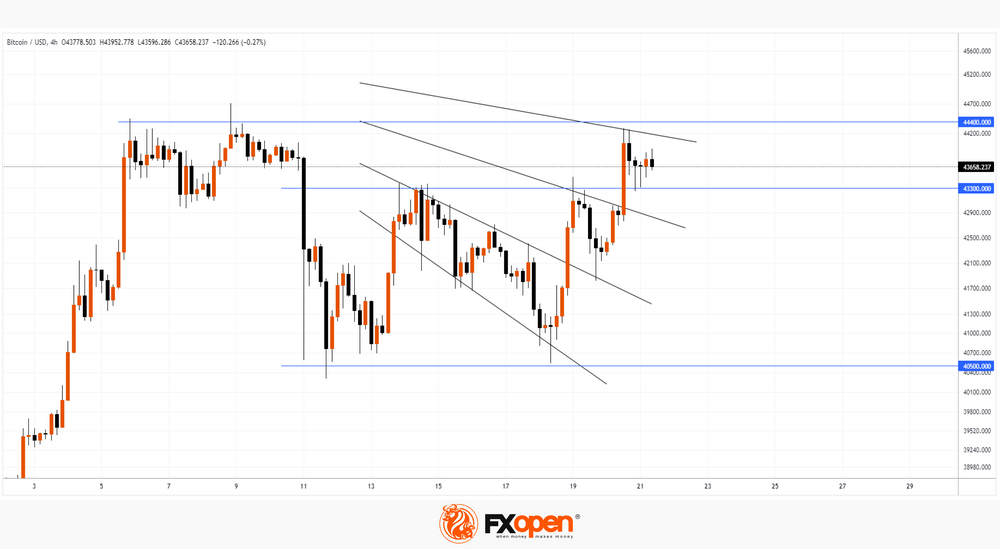
          The graph shows that:

          → the price of BTC/USD has recovered after a strong fall on December 11 – this is a sign of the strength of demand in the market. The level of 40,500 served as a reliable support for the recovery, which was tested on November 18th.

          → On December 20, the bulls were able to overcome the level of 43,300, which provided resistance on December 13-14 and 19. This level is now showing signs of support.

          → There is an important obstacle in front of the bulls. It is formed from the $44k level and the upper black line, forming some structure similar to a Gann fan and having a noticeable impact on the price of Bitcoin this month.

          The media is increasingly citing January 10 as a possible date by which the SEC’s decision, believed to approve the launch of the ETF, will be published. It is possible that as we approach this date, the bulls will be able to overcome the $44k resistance.

          This article represents the opinion of the Companies operating under the FXOpen brand only. It is not to be construed as an offer, solicitation, or recommendation with respect to products and services provided by the Companies operating under the FXOpen brand, nor is it to be considered financial advice.

          Article Source: ACTIONFOREX


          Risk Warnings and Disclaimers
          You understand and acknowledge that there is a high degree of risk involved in trading. Following any strategies or investment methods may lead to potential losses. The content on the site is provided by our contributors and analysts for information purposes only. You are solely responsible for determining whether any trading assets, securities, strategy, or any other product is suitable for investing based on your own investment objectives and financial situation.
          Comments
          Add to Favorites
          Share
          FastBull
          Copyright © 2025 FastBull Ltd

          728 RM B 7/F GEE LOK IND BLDG NO 34 HUNG TO RD KWUN TONG KLN HONG KONG

          TelegramInstagramTwitterfacebooklinkedin
          App Store Google Play Google Play
          Products
          Charts

          Chats

          Q&A with Experts
          Screeners
          Economic Calendar
          Data
          Tools
          Membership
          Features
          Function
          Markets
          Copy Trading
          Latest Signals
          Contests
          News
          Analysis
          24/7
          Columns
          Education
          Company
          Careers
          About Us
          Contact Us
          Advertising
          Help Center
          Feedback
          User Agreement
          Privacy Policy
          Business

          White Label

          Data API

          Web Plug-ins

          Poster Maker

          Affiliate Program

          Risk Disclosure

          The risk of loss in trading financial instruments such as stocks, FX, commodities, futures, bonds, ETFs and crypto can be substantial. You may sustain a total loss of the funds that you deposit with your broker. Therefore, you should carefully consider whether such trading is suitable for you in light of your circumstances and financial resources.

          No decision to invest should be made without thoroughly conducting due diligence by yourself or consulting with your financial advisors. Our web content might not suit you since we don't know your financial conditions and investment needs. Our financial information might have latency or contain inaccuracy, so you should be fully responsible for any of your trading and investment decisions. The company will not be responsible for your capital loss.

          Without getting permission from the website, you are not allowed to copy the website's graphics, texts, or trademarks. Intellectual property rights in the content or data incorporated into this website belong to its providers and exchange merchants.

          Not Logged In

          Log in to access more features

          FastBull Membership

          Not yet

          Purchase

          Become a signal provider
          Help Center
          Customer Service
          Dark Mode
          Price Up/Down Colors

          Log In

          Sign Up

          Position
          Layout
          Fullscreen
          Default to Chart
          The chart page opens by default when you visit fastbull.com